





There is a Reaper, whose name is Death, And, with his sickle keen, He reaps the bearded grain at a breath, And the flowers that grow between. – Henry Wadsworth Longfellow, “The Reaper and the Flowers”
I love sleep. My life has a tendency to fall apart when I’m awake, you know. – Ernest Hemingway
Introduction
Sicklepod [Senna obtusifolia (L.) H. S. Irwin & Barneby], also known as Cassia obtusifolia (L.), is an annual, herbaceous, dicotyledonous plant in the Fabaceae (Leguminosae) family, which is commonly known as the bean, legume, and pea family. The Fabaceae consist of herbs, shrubs, vines, or trees; the family has a cosmopolitan distribution with members numbering approximately 751 genera and 19,500 species (Christenhusz and Byng Reference Christenhusz and Byng2016). Characteristics of the Fabaceae include alternate, stipulate, and compound leaves. Leaflets often have pulvini (i.e., cushion-like swellings at the base of leaves that are subject to changes in turgor pressure), which are responsible for growth-independent or “sleep” movements. Another interesting anatomical feature exhibited by many species in the family is the formation of parenchymatous root nodules that are generated in association with nitrogen-fixing bacteria (Zomlefer Reference Zomlefer1994). The ovary of the Fabaceae usually develops into a dehiscent legume (e.g., pod). Although some Fabaceae may be weedy pests, others are important food crops [e.g., soybean, Glycine max (L.) Merr.] and fodder and forage plants (e.g., alfalfa, Medicago sativa L.). Some members of the Fabaceae produce valuable gums [e.g., gum arabic, Acacia senegal (L.) Britton] and dyes (e.g., indigo, Indigofera tinctoria L.), whereas others are prized as desirable ornamentals (e.g., eastern redbud, Cercis canadensis L.). Many species in the Fabaceae produce alkaloids or cyanogenic glycosides in different plant structures. Rotenone, an isoflavone insecticide, is derived from Derris eclipta (Wall.) Benth.
Etymology
Carl von Linné (Linnaeus) in 1753 first described sicklepod as Cassia obtusifolia. Obtusifolia is derived from the Latin words obtusus meaning dull or blunt, and folium meaning leaf, both of which refer to leaflet shape. Irwin and Barneby (Reference Irwin and Barneby1982) undertook a revision of Cassia and suggested that the species be moved to the genus Senna, emphasizing the importance of floral morphology for classification as opposed to fruit structure (e.g., Bentham, Reference Bentham1871; Marazzi et al. Reference Marazzi, Endress, Paganucci De Queiroz and Conti2006). Further studies, including molecular examinations, have confirmed the separation of Senna from Cassia (Marazzi et al. Reference Marazzi, Endress, Paganucci De Queiroz and Conti2006; Randell Reference Randell1988). The Weed Science Society of America (WSSA) currently uses Senna obtusifolia (L.) H. S. Irwin and Barneby as the preferred scientific designation for sicklepod (WSSA 2021a). In preparing this manuscript, the authors found that the genus name Cassia was used in many cited references until roughly the mid-1990s, after which sicklepod was referred to as Senna.
Linnaeus also described what he considered a separate species, sickle senna, as Cassia tora L. [now Senna tora (L.) Roxb.]. More than one hundred years later, Bentham (Reference Bentham1871) argued that C. obtusifolia and C. tora were the same species and suggested they both be referred to as C. tora. From this time on there has been confusion in the literature and debate among taxonomists about whether S. obtusifolia and S. tora are the same or independent species (Crawford et al. Reference Crawford, McDonald and Friedman1990). Some publications state that S. obtusifolia is synonymous with S. tora (e.g., Holm et al. Reference Holm, Pancho, Herberger and Plunknett1979, Reference Holm, Doll, Holm, Pancho and Herberger1997), while others distinguish them as separate species (e.g., Brenan Reference Brenan1958; Irwin and Barneby Reference Irwin and Barneby1982; Randell Reference Randell1995).
While it is commonly acknowledged that S. obtusifolia and S. tora are related and are morphologically similar, they do vary in appearance and distribution. Documented taxonomical differences between species occur in anther shape and structure, seed structure, shape and weight, number of glands on leaf rachis, and length of pedicels (Brenan Reference Brenan1958; Randell Reference Randell1988). Irwin and Turner (Reference Irwin and Turner1960) also found high levels of infertility resulting from experimental crosses between the two species, which suggested they are, indeed, distinctly different. Upadhaya and Singh (Reference Upadhyaya and Singh1986) also reported that S. obtusifolia and S. tora failed to hybridize.
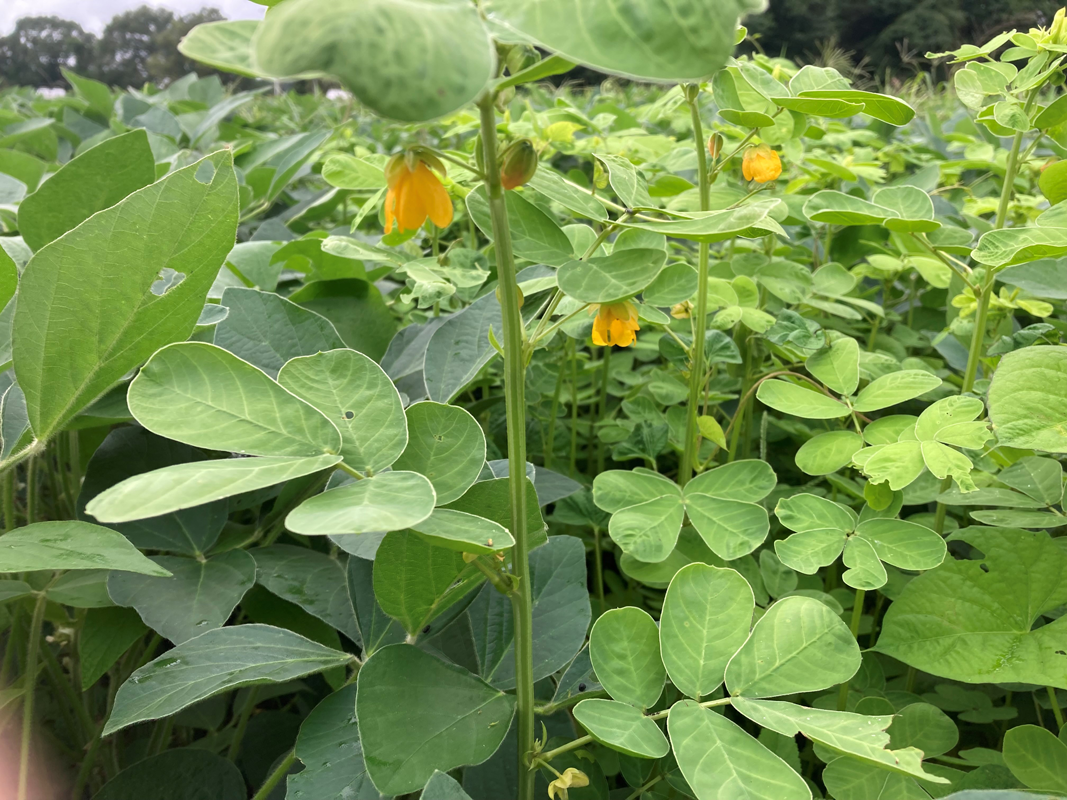
Sicklepod flowering.
With respect to range, sicklepod occurs within the core distribution area of the series (South America), whereas sickle senna is found primarily in China, India, the Philippines, and other parts of Asia (Randell Reference Randell1995). However, S. obtusifolia does co-occur in some areas with S. tora (e.g., India and southern Asia; Randell Reference Randell1995). Randell (Reference Randell1995) noted it was significant that those who thought the taxa were synonymous worked in America or Europe, where only herbarium material was available for S. tora. Researchers in Asia who had access to living specimens uniformly declared the taxa to be separate. Randell (Reference Randell1995) hypothesized that S. obtusifolia made its way to Africa from the Caribbean and spread from there to Asia and gave rise to S. tora. Irwin and Turner (Reference Irwin and Turner1960) also state that S. tora likely arose from S. obtusifolia and that the wide distribution of sicklepod occurred at least in part by human intervention.
The common name for S. obtusifolia is sicklepod (WSSA 2021a), which alludes to its long, strongly curved (sickle-shaped), leguminous fruit. Other common names include sickle-pod, sickle senna, java-bean, coffeebean, coffee bean, coffee-pod, coffee-weed, and indigo (Bryson and DeFelice Reference Bryson and DeFelice2009; Burrows and Tyrl Reference Burrows and Tyrl2006; Cock and Evans Reference Cock and Evans1984; McCormack and Neisler Reference McCormack and Neisler1980; Nowick Reference Nowick2015; Page et al. Reference Page, Vezey, Charles and Hollifield1977 Robertson and Lee Reference Robertson and Lee1976; USDA 2020). Adding to the confusion over nomenclature, S. tora is also known by the common name sicklepod. Senna occidentalis (L.) Link is referred to as coffee senna, which is similar to several common names of S. obtusifolia (ITIS 2021; WSSA 2021b). Both S. tora and S. occidentalis are called coffee weed (Nowick Reference Nowick2015).
Description
The following descriptive information is summarized from works published by Bryson and DeFelice (Reference Bryson and DeFelice2009), Creel et al. (Reference Creel, Hoveland and Buchanan1968), Gleason and Cronquist (Reference Gleason and Cronquist1963), Hilty (Reference Hilty2018), Irwin and Barneby (Reference Irwin and Barneby1982), and Zomlefer (Reference Zomlefer1994). Sicklepod is an erect (but sometimes sprawling), annual (sometimes biennial) herb. Cotyledons are rounded, with three to five distinct veins. Stems are erect, 0.3 to 2.5 m tall, branched, green, round, and glabrous. Leaves are alternate, pinnately compound with two or three (most commonly three) pairs of leaflets. Leaflets are elliptic to obovate with blunt or rounded tips. Leaflets are 2.0 to 7.0 cm long with the terminal pair the largest. Leaflets lack hairs and have deciduous stipules. Leaflets of young plants may be wrinkled. A gland (sometimes two) is present on the rachis between the lower leaflets. Petioles are 10 to 15 mm long. Leaves and stems have a distinct, rank odor when crushed or cut. Mature plants have a fibrous root system originating from a taproot. However, unlike many members of the Fabaceae family, sicklepod is non-nodulating and therefore does not form symbiotic associations with nitrogen-fixing bacteria.
Sicklepod plants bloom sparingly. One or two inflorescences are borne on short (3 to 4 mm) peduncles in leaf axils. Flowers consist of five rounded, asymmetrical petals that are yellow, showy, and 0.8 to 2.0 cm long. Sepals are unequal, 4.0 to 10.0 cm long and 2.0 to 5.0 mm wide. There are 10 stamens (three are infertile) and ovaries are finely hairy. Sicklepod is self-pollinated, and fertilization typically occurs before flowers open (Irwin and Barneby Reference Irwin and Barneby1982; Retzinger Reference Retzinger1984). The fruit is a legume, 8.0 to 20.0 cm long, 3.0 to 6.0 mm wide, slender, strongly curved, glabrous, rounded in cross-section, and terete or rod-like. Fruits are green turning to brown at maturity and dehiscing elastically along both sutures. Fruit set at the bottom portion of plants matures first; maturation progresses up the plant even while the younger, uppermost nodes are still flowering (Turner and Karlander Reference Turner and Karlander1975). Seeds are thick, rhomboidal or angular, 4.0 to 5.0 mm long, brownish in color, and shiny. Seeds have a waxy covering about 0.1 mm thick and a closed, elliptical pleurogram. Sicklepod has a hard seed coat, which is a barrier to germination. Unlike most other species in the genera, the embryo of sicklepod has folded cotyledons (Robertson and Lee Reference Robertson and Lee1976).
There are two forms of sicklepod in the Western hemisphere (Irwin and Barneby Reference Irwin and Barneby1982). The form that occurs in the Caribbean and the southeastern United States has one extrafloral nectary on the upper surface of the rachis and a chromosome count of 2n = 28; the other form, which originated in northern South America, has two extrafloral nectaries and a chromosome count of 2n = 26 (Irwin and Turner Reference Irwin and Turner1960; Retzinger Reference Retzinger1984). Retzinger (Reference Retzinger1984) reported that 10 sicklepod selections from nine southeastern U.S. states all produced plants that had one petiolar gland located on the upper side of the rachis between the two lower leaflets, which agrees with that reported by Irwin and Barneby (Reference Irwin and Barneby1982). The variant in the United States also has a broader pod compared with the South American form and is the subject of this paper.
In addition to S. tora, sicklepod may be easily confused with coffee senna; both species often grow together in the southern United States (McCormack and Neisler Reference McCormack and Neisler1980). However, leaves of coffee senna produce four to six pairs of leaflets compared with sicklepod, which has two to three pairs (Bryson and DeFelice Reference Bryson and DeFelice2009). Leaflets of coffee senna are ovate or oblong-lanceolate with a pointed tip, unlike the blunted or round-tipped obovate leaflets of sicklepod. Cotyledons of coffee senna are glabrous above, but have white trichomes below, whereas trichomes are not found on sicklepod. The legume of coffee senna is more linear, straight or slightly curved, as compared to the strongly curved, sickle-shaped fruit of sicklepod. Coffee senna seeds are also elliptical and dull brown, whereas sicklepod seeds are shiny brown and angular.
An interesting characteristic of many Fabaceae plants is the pulvinus, which is a vegetative thickening at each petiole and petiolule base that is associated with leaf movement. Changes in turgor resulting from water movement into or out of extracellular spaces causes leaflets to “open” during the day and “close” at night, and is sometimes referred to as “sleep movements” (Andersen and Koukkari Reference Andersen and Koukkari1979; Zomlefer Reference Zomlefer1994). This phenomenon was observed and recorded for some plants as early as the time of Alexander the Great (Cumming and Wagner Reference Cumming and Wagner1968). Linnaeus even included a list of plants that “sleep” in his essay titled “Somnus Plantarum” published in 1755. Kraatz and Andersen (Reference Kraatz and Andersen1980) studied the difference in percent projected leaf area (PPLA) of sicklepod, defined as “the projected leaf area expressed as a percentage of total actual leaf areas”. Sicklepod cotyledons and leaflets open to an almost horizontal position during the day and fold tightly together to an almost vertical position at night resulting in a 7-fold difference between the highest (daytime) and lowest (nighttime) PPLA values (Andersen and Koukkari Reference Andersen and Koukkari1979; Kraatz and Andersen Reference Kraatz and Andersen1980). Sleep movements are a circadian phenomenon that is endogenously controlled and occurs even if the sicklepod plants are kept in continuous light or darkness (Andersen and Koukkari Reference Andersen and Koukkari1979; Kraatz and Andersen Reference Kraatz and Andersen1980). This phenomenon can have an impact of weed control success; percent control of sicklepod with linuron was highly correlated with PPLA in an herbicide application time-of-day study (Kraatz and Andersen Reference Kraatz and Andersen1980).
Sicklepod development is influenced by environmental factors such as moisture availability, temperature, pH, and light. Sicklepod has a relatively high stomatal resistance and a low threshold leaf water potential and is characterized as a “water saver” (Patterson and Flint Reference Patterson and Flint1983), which may explain the species’ drought tolerance (Hilty Reference Hilty2018). Maximum dry weight, leaf area, plant height, node number, and leaf number for sicklepod occur when day/night temperature regimes of 29/26 C and 34/26 C occur. Leaf production ceases when aerial temperatures are below 13 C. Daytime temperature has more effect on main stem node number, leaf number, leaf weight, and total leaf area than night temperature (Patterson Reference Patterson1993). Night temperature has more influence on plant height, root weight, and total plant weight (Patterson Reference Patterson1993). Optimal temperatures for sicklepod root growth are reported to be in the range of 32 to 39 C or higher (Teem et al. Reference Teem, Hoveland and Buchanan1974). These findings may explain why sicklepod thrives in the higher temperatures of July and August in the southeastern United States (Creel et al. Reference Creel, Hoveland and Buchanan1968; Jones and Walker Reference Jones and Walker1993 Patterson Reference Patterson1993; Patterson and Flint Reference Patterson and Flint1983; Shibles et al. Reference Shibles, Anderson, Gibson and Evans1975; Teem et al. Reference Teem, Hoveland and Buchanan1974, Reference Teem, Hoveland and Buchanan1980; Wright et al. Reference Wright, Jennette, Coble and Rufty1999).
Although sicklepod root growth can occur over a wide range of soil pH values, in one study, primary root elongation was greater when the soil pH was 6.5 compared with pH 5.5 or 5.1 (Teem et al. Reference Teem, Hoveland and Buchanan1974). Creel et al. (Reference Creel, Hoveland and Buchanan1968) reported that sicklepod plants grew well in soils with a pH range of 3.2 to 7.9 with an optimal pH range of 5.5 to 6.0. Sicklepod responded similarly to cotton [Gossypium hirsutum L.] in response to nitrogen, phosphorus, and potassium levels in soil (Creel et al. Reference Creel, Hoveland and Buchanan1968). Sicklepod was found to be more tolerant to low potassium levels in soil than to low phosphorous levels (Hoveland et al. Reference Hoveland, Buchanan and Harris1976). Sicklepod plants are also tolerant to a range of soil types (Dirar Reference Dirar1984; Hilty Reference Hilty2018).
With respect to root architecture, sicklepod is reported to have two times more roots than soybean [Glycine max (L.) Merr.] among plants with similar root fresh weights (Wright et al. Reference Wright, Jennette, Coble and Rufty1999). Sicklepod roots were 2.9 times longer, although smaller in diameter, than soybean roots, providing the species with significantly more root surface area. Sicklepod seedling roots occupy a much larger volume of soil compared to that of soybean (Wright et al. Reference Wright, Jennette, Coble and Rufty1999). Combined, these factors would, presumably, give sicklepod an advantage for acquiring water and nutrients when in competition with soybean.
Sicklepod can emerge continually beneath a soybean canopy, and it grows well under trees, which suggests shade tolerance (Becker Reference Becker1983; Norsworthy and Oliveira Reference Norsworthy and Oliveira2007). The presence of a soybean canopy stimulated aboveground biomass elongation and growth of sicklepod when roots competed (Jones and Walker Reference Jones and Walker1993). Sicklepod is a short-day plant with a critical day length of 13 to 14 h for flower initiation (Patterson Reference Patterson1993; Senseman and Oliver Reference Senseman and Oliver1993; Shibles et al. Reference Shibles, Anderson, Gibson and Evans1975; Turner and Karlander Reference Turner and Karlander1975; Wright et al. Reference Wright, Jennette, Coble and Rufty1999). Sicklepod in Arkansas initiated flowering 70 to 77 d after emergence even with a 2-wk difference in planting date, affirming a photoperiodic relationship to flowering (Senseman and Oliver Reference Senseman and Oliver1993). Flowering ceased when the photoperiod reached 12 h (Senseman and Oliver Reference Senseman and Oliver1993). No flowers developed in 15- or 16-h photoperiods (Patterson Reference Patterson1993).
Sicklepod plants grown without competition produced on average 1,500 to 16,000 seeds per plant (Retzinger Reference Retzinger1984; Senseman and Oliver Reference Senseman and Oliver1993). Average numbers of seeds per pod ranged from 24.8 to 30 (Bridges and Walker Reference Bridges and Walker1985; Retzinger Reference Retzinger1984). Bridges and Walker (Reference Bridges and Walker1985) reported that sicklepod plants produced 2.5 × 10⁷ and 4.5 × 10⁷ seeds ha−1 at a subcompetitive density of 0.45 and 0.90 plants m−2, respectively. Sicklepod produced 145 and 995 pods per plant in Arkansas, which resulted in 2,000 to 11,000 seeds per plant, depending on growing conditions (Senseman and Oliver Reference Senseman and Oliver1993). Sicklepod plants produced 14 × 107 seeds ha−1 under intraspecific interference and 7.0 × 10⁷ seeds ha−1 under interspecific interference (Senseman and Oliver Reference Senseman and Oliver1993). Soybean competition reduced sicklepod seeds per plant by 49% to 74% at a weed density of 1 plant per 30-cm row (Sims and Oliver Reference Sims and Oliver1990).
Seed dormancy, which is enforced by the hard and waxy coat, resulted in only 15% germination over a 12-mo study (Creel et al. Reference Creel, Hoveland and Buchanan1968). Similarly, Retzinger (Reference Retzinger1984) reported that the germination of hand-harvested, nonscarified sicklepod seed grown from 10 different seed selections ranged from 2% to 23%. Germination in the laboratory may be increased by mechanical scarification or abrasion, puncturing the seed coat with a needle, or treatment with sulfuric acid (Creel et al. Reference Creel, Hoveland and Buchanan1968; Teem et al. Reference Teem, Hoveland and Buchanan1974, Reference Teem, Hoveland and Buchanan1980). For example, Egley and Chandler (Reference Egley and Chandler1978) found that piercing sicklepod seed coats resulted in dramatically increased germination (pierced 96% ± 3%) relative to the untreated check (4% ± 2%) by allowing imbibition of water. Bararpour and Oliver (Reference Bararpour and Oliver1998) and Vencill and Banks (Reference Vencill and Banks1994) reported that sicklepod fares better in a no-till system than in a conventionally tilled system because the seedbank will not be actively depleted. Repeated disking favors sicklepod germination and emergence (perhaps due to the mechanical scarification), and the resulting plants produced more pods per plant in a conventional system (Bridges and Walker Reference Bridges and Walker1985).
Creel et al. (Reference Creel, Hoveland and Buchanan1968) and Teem et al. (Reference Teem, Hoveland and Buchanan1980) found that sicklepod germination occurs between 15 and 36 C with an optimum germination range of 24 to 36 C; rapid seedling growth happens between 30 and 36 C. More recently, Norsworthy and Oliveira (Reference Norsworthy and Oliveira2006) reported sicklepod germination occurred over a range of constant temperatures from 15 to 50 C with an optimum germination temperature range of 15 and 30 C for seed sourced from South Carolina. No germination was observed at 12.5 C or below (Norsworthy and Oliveira Reference Norsworthy and Oliveira2006).
Sicklepod seeds were found to be viable after dry, low-temperature storage up to 30 mo (Egley and Chandler Reference Egley and Chandler1978). Even though sicklepod has a hard seed coat, seed longevity was less than what was reported for similarly hard-seeded species such as velvetleaf (Abutilon theophrasti Medik.), spurred anoda [Anoda cristata (L.) Schiltdl.], or purple moonflower [Ipomoea muricata (L.) Jacq.]. Egley and Chandler (Reference Egley and Chandler1983) reported sicklepod seeds in the soil lost their hardness relatively quickly; after 5.5 yr of burial, only 6% of seeds were still hard, although all remained viable. Although sicklepod emergence is greater at shallow burial depths, seedlings could still emerge from seeds buried to a depth of 12.7 cm (Norsworthy and Oliveira Reference Norsworthy and Oliveira2006; Teem et al. Reference Teem, Hoveland and Buchanan1980). Seedling emergence was observed to occur from April through November in South Carolina (Norsworthy and Oliveira Reference Norsworthy and Oliveira2006).
Sicklepod seeds were more tolerant than soybean under simulated drought conditions with some seed germinating at an osmotic pressure as high as 10 bars (10-bar water solutions of polyethylene glycol; Hoveland and Buchanan Reference Hoveland and Buchanan1973). Norsworthy and Oliveira (Reference Norsworthy and Oliveira2006) reported a relationship between soil solution osmotic potential and soil temperature effects on sicklepod germination. For example, soil solution osmotic potential had no effect on sicklepod germination at a soil temperature of 15 C; however, at 30 C, when osmotic potential was low (no stress), sicklepod germination was less than when osmotic potential was high (more stress; Norsworthy and Oliveira Reference Norsworthy and Oliveira2006). This suggests that sicklepod is more likely to germinate when temperatures are high and the seed is under drought stress, which occurs more frequently in areas such as the southeastern United States, where it is a common weed.
Natural light, and red- to far-red light ratio did not affect germination, although Norsworthy and Oliveira (Reference Norsworthy and Oliveira2006) reported having scarified the seed and did not study whether this influenced their results. Norsworthy and Oliveira (Reference Norsworthy and Oliveira2006) also reported that germination was less at 2% oxygen than at 20% oxygen. They went on to note that sicklepod germinated from solution pH 3 to pH 9, with a predicted maximum germination at a solution pH of 6.1. Their research suggests that sicklepod germinates most readily near neutral pH but it can germinate under both acidic and basic conditions.
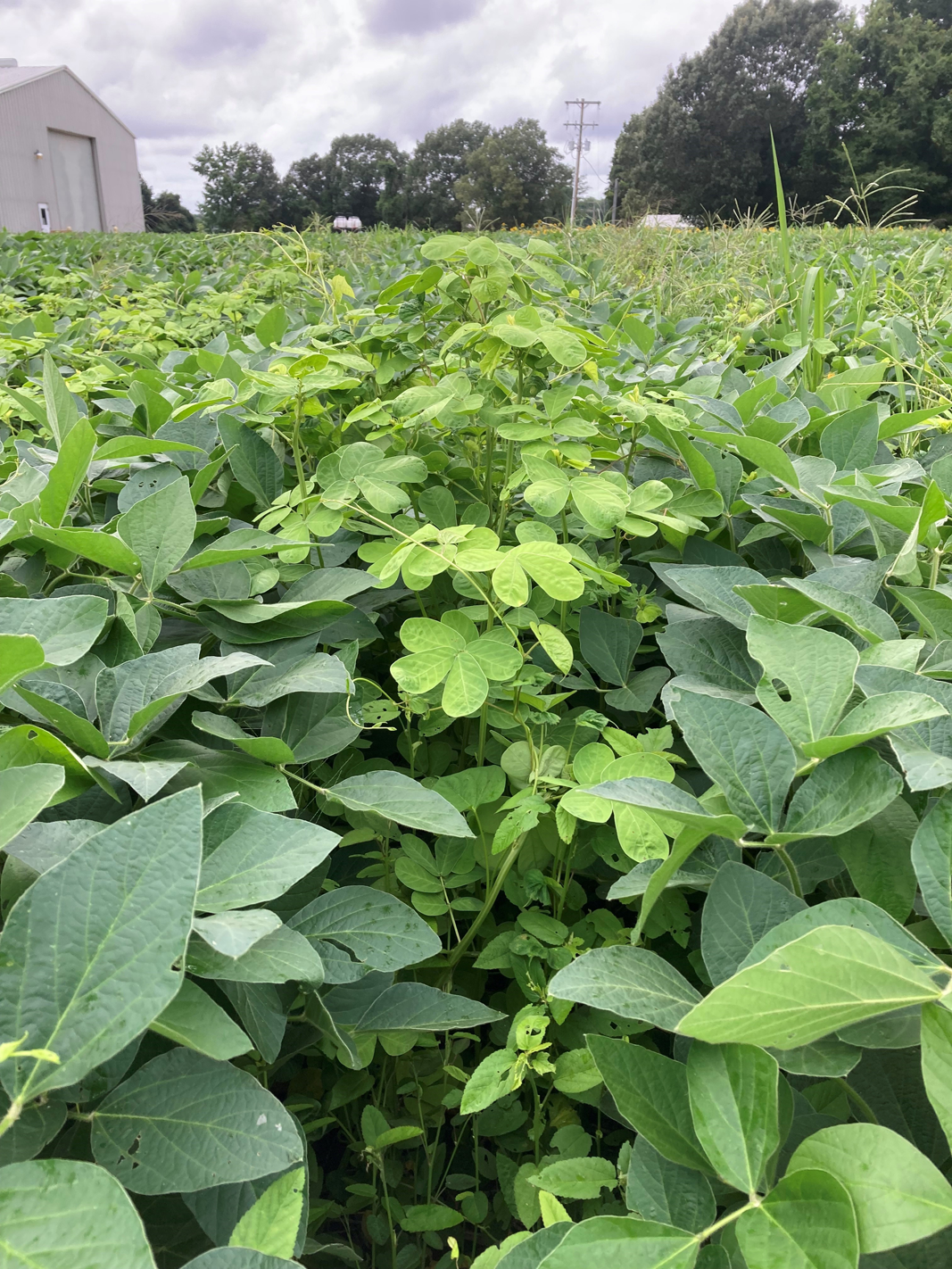
Sicklepod competing with soybean.
Various attempts have been made to reduce the weed seed soil seedbank, including use of the integrated Harrington Seed Destructor mill to destroy seed at harvest. Sicklepod seeds had <1% survival from this process (Schwartz-Lazaro and Norsworthy Reference Schwartz-Lazaro and Norsworthy2018).
History and Distribution
Senna is a large, widespread, and diverse genus with approximately 350 species; of these, 80% occur in tropical and warm, temperate climates of the Americas (Irwin and Barneby Reference Irwin and Barneby1982; Mabberley Reference Mabberley1997; Marazzi et al. Reference Marazzi, Endress, Paganucci De Queiroz and Conti2006). S. obtusifolia is native to tropical America and the southeastern United States and is now widespread throughout most tropical and warm-temperate regions. Its range in the United States has expanded and is now found in southern states from Texas to Florida, north to New Jersey and New York, and west to Nebraska, Wisconsin, and California. Herbarium records reveal that it has also been introduced to Hawaii (Staples et al. Reference Staples, Imada and Herbs2003). Sicklepod can be found growing in waste places, annual cropping systems (especially no-till), pastures, fallow land, orchards, riparian zones, roadsides and railways, and moist, open woodlands (Bryson and DeFelice Reference Bryson and DeFelice2009; Hilty Reference Hilty2018; Vencill and Banks Reference Vencill and Banks1994). Sicklepod seeds do not have specialized dispersal mechanisms and most fall close to the parent plant. Seed movement may occur via machinery, or through contamination of grain, hay, fodder, or forage. Sicklepod most commonly grows at elevations of 0 to 500 m, but may be found up to 1,680 m (Irwin and Barneby Reference Irwin and Barneby1982).
Characteristics
Weediness and Control
In a 1998 survey of weeds in Georgia fields of corn (Zea mays L.), cotton, forages and pastures, peanut (Arachis hypogaea L.), small grains, soybean, tobacco (Nicotiana tabacum L.), and vegetables, sicklepod was identified as the most troublesome across the state (Webster and MacDonald Reference Webster and MacDonald2001). It was found throughout all nine climate gradients of the state and was present in all the crops examined.
Densities of 7.7 sicklepod plants per square meter reduced soybean yield by as much as 35% (Thurlow and Buchanan Reference Thurlow and Buchanan1972). A sicklepod density of 1.6 plants 1-m row caused a reduction in crop height and a 5% yield loss in soybean (Shurtleff and Coble Reference Shurtleff and Coble1985). One sicklepod plant per 2-m row (0.6 m−2) caused a 20% yield reduction in soybean in Florida (Currey et al. Reference Currey, Teem and Jordan1981).
Height and weight of sicklepod was reduced when soybeans were grown on narrow rows (25 cm) compared with wider rows (102 cm; Monks and Oliver Reference Monks and Oliver1988). Weed weight at harvest was inversely correlated with soybean yield, and sicklepod was more competitive when grown 15 to 30 cm from the drill versus in the drill row. Soybean competing with sicklepod plants that were spaced 10 and 30 cm apart yielded 25% to 35% less than when grown alone or with sicklepod spaced 90 cm apart, indicating that 90 cm is outside the area of influence of sicklepod (Bozsa et al. Reference Bozsa, Oliver and Driver1989). This suggests that sicklepod is only competitive with soybean at high weed density (Monks and Oliver Reference Monks and Oliver1988).
Soybean yield was reduced if sicklepod competed with the crop for as little as 4 wk (McWhorter and Sciumbato Reference McWhorter and Sciumbato1988), although when in competition with soybean, sicklepod’s greatest growth occurs later in the season (Monks and Oliver Reference Monks and Oliver1988). At 6 wk after emergence (WAE), the major portion of sicklepod leaf area index (LAI) was in the lower 30 cm of the sicklepod canopy (Sims and Oliver Reference Sims and Oliver1990. By 10 WAE, LAI was uniform throughout the plant canopy, and as sicklepod height increased through 14 WAE, a greater percentage of LAI was in the upper portion of the plant (Sims and Oliver Reference Sims and Oliver1990). Reduction in soybean dry matter to sicklepod competition was first detected 6 WAE (Sims and Oliver Reference Sims and Oliver1990). Sicklepod reduced soybean dry matter weights 20% by 14 WAE, indicating that it became more competitive during the reproductive stage of soybean (Sims and Oliver Reference Sims and Oliver1990). By 10 WAE, sicklepod was taller than soybean and had formed a partial canopy over the crop during its reproductive stages. S. obtusifolia reduced soybean yield more than johnsongrass [Sorghum halapense (L.) Pers.] when competing individually and was similar when both weeds were present together (Sims and Oliver Reference Sims and Oliver1990). Individual sicklepod plants exhibited the greatest increase in weight and growth of axillary branches from 72 to 96 d after emergence. The increase in weight was attributed to an almost 8-fold increase in leaf number during this period. Axillary branches continued to grow rapidly from 96 to 120 d after emergence and about 30% to 60% of sicklepod seed production occurred at these sites. Sicklepod height increased most rapidly from 96 to 120 d after emergence. Soybean grew little in height from 35 to 84 d after emergence, though the competing sicklepod continued to grow until they were 30 to 45 cm taller than the crop (Bozsa et al. Reference Bozsa, Oliver and Driver1989).
Sicklepod is very competitive with cotton. Seed cotton yield in a study in Alabama was reduced 10% to 40% from a sicklepod density of 1.09 plants row m−1 (Buchanan and Burns Reference Buchanan and Burns1971). Increasing the weed density to 6.6 plants row m−1 resulted in a 45% to 80% yield loss (Buchanan and Burns Reference Buchanan and Burns1971). Additional studies have reported that for every sicklepod plant per 15 m−1 of row, cotton yield is reduced by 24 to 49 kg ha−1 (Buchanan et al. Reference Buchanan, Crowley, Street and McGuire1980; Street et al. Reference Street, Buchanan, Crowley and McGuire1981). Additionally, the percentage of trash in mechanically harvested seed cotton typically increased with higher sicklepod densities (Buchanan et al. Reference Buchanan, Crowley, Street and McGuire1980).
Sicklepod did not reduce yields of two peanut cultivars when the crop was kept weed-free for 4 wk after crop emergence (Hauser et al. Reference Hauser, Buchanan and Ethredge1975). Other reports suggest that the weed-free requirement is even longer (5 to 6 wk) to adequately preserve peanut yields (Buchanan and Hauser Reference Buchanan and Hauser1980; Hauser and Buchanan Reference Hauser and Buchanan1981). Sicklepod plants in competition with peanut grew taller than the crop if weeds emerged within 4 wk of crop planting (Hauser and Buchanan Reference Hauser and Buchanan1981). Although sicklepod seedlings were often able to emerge after the fourth week, few were able to break through the peanut canopy (Hauser et al. Reference Hauser, Buchanan and Ethredge1975). Hauser et al. (Reference Hauser, Buchanan and Ethredge1975) reported that sicklepod had to compete for a duration of 10 wk or more before peanut yield was reduced. With respect to density, Hauser et al. (Reference Hauser, Buchanan, Nichols and Patterson1982) found a 6.1 to 22.3 kg ha−1 reduction in peanut yield for each sicklepod plant 10 m−2. Planting peanuts in narrow rows (20.3 cm < 40.6 cm < 81.2 cm) reduced sicklepod vegetative growth (Buchanan and Hauser Reference Buchanan and Hauser1980).
Sicklepod densities >10.8 weeds m−2 frequently reduced yield of lima bean [Phaseolus lunatus (L.); Glaze and Mullinix Reference Glaze and Mullinix1984]. Average yield of lima bean decreased if sicklepod competed for more than 6 wk (Glaze and Mullinix Reference Glaze and Mullinix1984). However, losses due to decreased harvest efficiency or contamination in green vegetable crops by weeds could be greater than those from competition.
Toxicity
All parts of S. obtusifolia are toxic, especially the seeds; this is attributed to various derivatives of anthraquinones (Burrows and Tyrl Reference Burrows and Tyrl2006; Crawford et al. Reference Crawford, McDonald and Friedman1990). Because sicklepod seeds have a higher density than corn they tend to settle at the bottom of freight cars during transport; Page et al. (Reference Page, Vezey, Charles and Hollifield1977) reported grain samples containing as much as 40% sicklepod. Large amounts of sicklepod seeds should be removed prior to feeding grain to livestock (Crawford et al. Reference Crawford, McDonald and Friedman1990). In addition to anthraquinones, vegetative sicklepod has a high calcium-to-phosphorus ratio, which could result in metabolic disorders if these weeds were used as a sole feed source (Bosworth et al. Reference Bosworth, Hoveland, Buchanan and Anthony1980). McCormack and Neisler (Reference McCormack and Neisler1980) reported sicklepod to be the leading cause of livestock poisoning in the southern United States. While cattle do not usually forage on sicklepod plants if other, more desirable forage is available, problems may occur if animals are fed hay or green chop containing an abundance of sicklepod plant material or fed grain that is heavily contaminated with seeds (Cock and Evans Reference Cock and Evans1984; McCormack and Neisler Reference McCormack and Neisler1980). Often the first signs of Senna intoxication in cattle are diarrhea and anorexia, which occur within hours of ingestion (Burrows and Tyrl Reference Burrows and Tyrl2006; McCormack and Neisler Reference McCormack and Neisler1980). The toxicity also affects the skeletal muscles (especially those in the hind legs), kidneys, and liver of cattle (McCormack and Neisler Reference McCormack and Neisler1980). Weakness, uncoordinated movement, and muscular trembling are often noticeable before the animal becomes recumbent (Burrows and Tyrl Reference Burrows and Tyrl2006; McCormack and Neisler Reference McCormack and Neisler1980). Cattle often die from congestive heart failure within 2 to 3 d after recumbency (McCormack and Neisler Reference McCormack and Neisler1980). Feeding Holstein calves rations including S. obtusifolia seed resulted in intermittent feed refusal, decreased feed consumption, intermittent diarrhea, and decreased weight gain (Putnam et al. Reference Putnam, Boosinger, Spano, Wright and Wiggins1988). The average daily weight gains were significantly greater for the calves in the control group than for calves in either group that were fed sicklepod seed in their ration.
Ingestion of feed contaminated by sicklepod seeds also poses a serious threat to pigs and chickens (Burrows and Tyrl Reference Burrows and Tyrl2006). White leghorn chicken hens consumed less feed and laid fewer eggs when sicklepod seed was ground and mixed into feed at levels of 2%, 5%, and 10% (Page et al. Reference Page, Vezey, Charles and Hollifield1977). Egg size was also reduced, and egg yolks were discolored. Feed consumption and egg production did not return to control levels for weeks after the contaminated feed was stopped, with the effects more pronounced in younger hens. Cock and Evans (Reference Cock and Evans1984) reported that sicklepod seeds were harmful to chickens due to the presence of a trypsin inhibitor.
Uses
Conversely, sicklepod has been reported to be an important food plant for human nutrition in northern Senegal when other food sources are scarce (Becker Reference Becker1983). The leaves are harvested and cooked like greens and supply several nutrients including Vitamin B2. In Sudan, green leaves harvested at the flowering and fruiting stages of sicklepod growth are ground, fermented, dried, and consumed in a stew as a meat substitute called kawal (Dirar Reference Dirar1984). Though it has a strong, repugnant odor, kawal consumption has spread in that area. The foliage of S. obtusifolia has also been reported as a purgative drug, and poultices are made for treating sores, ulcers, and insect bites (Crawford et al. Reference Crawford, McDonald and Friedman1990; Irwin and Barneby Reference Irwin and Barneby1982). Though seeds are not used for human consumption in Sudan, Dirar (Reference Dirar1984) reported claims that they could be a cure for jaundice (hepatitis), and a tea made from seeds could be imbibed as a treatment for headache, stomachache, or fatigue.
An extract of sicklepod tops inhibited germination of cotton and oats (Avena sativa L.); the germination of cotton seed was also reduced when sicklepod residues were incorporated into soil (Creel et al. Reference Creel, Hoveland and Buchanan1968). Additionally, sicklepod appeared to release a phytotoxic residue from its roots that reduced the growth of cotton (Creel et al. Reference Creel, Hoveland and Buchanan1968). Ground whole sicklepod seed meal incorporated into soil at 5% had no adverse effects on tomato plants but populations of Meloidogyne chitwoodi (Columbia root knot nematode) were reduced (Abbott et al. Reference Abbott, Vaughn, Dowd, Mojtahedi and Wilson1998). An extract from sicklepod has recently been investigated as a possible deer repellant in soybean and for insecticidal activity against soybean looper [Chrysodeixis includens Walker; Yue et al. Reference Yue, Tseng and Krishnan2020].
Sicklepod is tolerant to anthracnose (Colletotrichum dematium f. truncate) but is susceptible to seedling blight caused by Alternaria cassia (A. M. M. Juriar & A. Khan), which was investigated as a mycoherbicide (Teem et al. Reference Teem, Hoveland and Buchanan1980; Walker Reference Walker1982, Reference Walker1983; Walker and Riley Reference Walker and Riley1982). Alternaria alternata (Fr.) Keissl. and Pseudocercospora nigricans (Cooke) Deighton were also identified as suitable pathogens for further study for biocontrol of sicklepod (Hofmeister Reference Hofmeister1987; Mello et al. Reference Mello, Ribeiro, Sousa, Tigano, Nachtigal and Fontes2001). A beetle in the Bruchidae family, Sennius instabilis, feeds on S. obtusifolia seeds in tropical countries in the Western Hemisphere and could be considered for biological control of weedy Senna species elsewhere (Cock and Evans Reference Cock and Evans1984).
Sicklepod may serve as an alternate host to some crop pests. It was identified as an excellent host for reniform nematode [Rotylenchulus reniformis (Linford and Oliveira)] in Georgia, Alabama, and the Mississippi Delta region with populations greater than or equal to those developing on susceptible cotton plants (Davis and Webster Reference Davis and Webster2005; Lawrence et al. Reference Lawrence, Price, Lawrence, Jones and Akridge2008; Molin and Stetina Reference Molin and Stetina2016). The ability of sicklepod to sustain root-knot nematode (Meloidogyne spp.) populations was also reported (Singh et al. Reference Singh, Khurma and Lockhart2010). Cowpea curculio (Chalcodermus aeneus Boheman), is an important pest of cowpea [Vigna unguiculata (L.) Walp.] in the southeastern United States, and adult insects were observed feeding on sicklepod pods and stems during the cowpea growing season, although no eggs or larvae were found in pods (Sudbrink et al. Reference Sudbrink, Mack and Zehnder1998). The whitefly, Bemisia tabaci (Gennadius), damaged tomato in Florida. Smith et al. (Reference Smith, Nagle and Evans2014) found oviposition on S. obtusifolia supporting high B. tabaci populations. Sicklepod extrafloral nectaries attract ants primarily, but also some species of wasps, flies, and small bees (Hilty Reference Hilty2018; Marazzi et al. Reference Marazzi, Endress, Paganucci De Queiroz and Conti2006). The pollen attracts honeybees, bumblebees, miner bees, and leaf-cutting bees (Hilty Reference Hilty2018; Retzinger Reference Retzinger1984). The caterpillars of several species of sulphur butterflies have been observed to feed on foliage of Senna species, although it is unclear whether sicklepod is one of them (Hilty Reference Hilty2018). Sicklepod has no wildlife value due to its toxicity (Miller and Miller Reference Miller and Miller1999).
Sicklepod has been the subject of extensive studies in the United States, despite not having a history of evolving herbicide resistance. This in part speaks to it distribution, toxicity, and competitiveness with important agronomic crops. Additionally, sicklepod possesses intrinsic characteristics that make it interesting to study, among these are its sleep movements. Good night!

 Open access

