


Introduction
Recovery of large carnivores in Europe has been accompanied by a re-emergence of ancient conflicts with human interests (Kaczensky, Reference Kaczensky1996). Carnivores prey on livestock, damage crops, compete with hunters for game and occasionally injure or even kill humans (Woodroffe et al., Reference Woodroffe, Thirgood and Rabinowitz2005). Historically, people retaliated with persecution, precipitating declines in carnivore populations (Breitenmoser, Reference Breitenmoser1998). Together with a better understanding of ecology, however, a change in society’s attitudes has resulted in legal protection for many species of carnivore (Mech, Reference Mech1996). Large carnivores can coexist with humans given favourable management policy (Linnell et al., Reference Linnell, Swenson and Andersen2001) but, to avoid a return to unsustainable levels of lethal control, there is a need to mitigate conflicts in ways that are both effective and acceptable (Sillero-Zubiri & Laurenson, Reference Sillero-Zubiri, Laurenson, Gittleman, Funk, Macdonald and Wayne2001).
Many non-lethal methods have been tried to reduce livestock predation, the most prevalent conflict (reviewed in Cluff & Murray, Reference Cluff, Murray, Carbyn, Fritts and Seip1995; Linnell et al., Reference Linnell, Smith, Odden, Kaczensky and Swenson1996; Bangs & Shivik, Reference Bangs and Shivik2001; Rigg, Reference Rigg2001; Fritts et al., Reference Fritts, Stephenson, Hayes, Boitani, Mech and Boitani2003; Breitenmoser et al., Reference Breitenmoser, Angst, Landry, Breitenmoser-Würsten, Linnell, Weber, Woodroffe, Thirgood and Rabinowitz2005; Sillero-Zubiri et al., Reference Sillero-Zubiri, Sukumar, Treves, Macdonald and Service2006). These include separating livestock and carnivores (e.g. predator-proof fencing, avoiding high risk areas/seasons, confining livestock at night or during bad weather), discouraging predators (e.g. electric fences, audio, visual and chemical repellents, conditioned taste aversion, proper carcass disposal, diversionary feeding, replacing vulnerable stock, adjusting calving/lambing seasons and location) and protecting livestock (e.g. guarding animals, harassing, shooting stock raiders with non-lethal projectiles, fitting protective collars, leaving horns on cattle). When preventive measures fail, the cost of damage is often compensated (Fourli, Reference Fourli1999). Managers may resort to selective removal of persistent stock raiders by lethal control (Treves & Naughton-Treves, Reference Treves, Naughton-Treves, Woodroffe, Thirgood and Rabinowitz2005) or translocation (Linnell et al., Reference Linnell, Aanes, Swenson, Odden and Smith1997). The effectiveness of these interventions in reducing conflicts has not always been adequately assessed.
In Slovakia a 30-year moratorium on hunting allowed the brown bear Ursus arctos to recover from 20–60 individuals in 1932 to 770–870 (Rigg & Adamec, Reference Rigg and Adamec2007). Grey wolf Canis lupus and Eurasian lynx Lynx lynx numbers increased following growth of ungulate populations and partial legal protection to current estimates of 170–435 (Rigg, Reference Rigg, Adamec, Urban and Adamcová2008) and c. 300 (Rigg, Reference Rigg2004), respectively. Current overlap of these species with sheep farming is c. 90% and predation on livestock is commonplace (Rigg, Reference Rigg2004). Compensation for damage by bears has been paid since 1962 and for damage by other species since 2003. In addition to regulated hunting, several non-lethal measures have been tried. Slovakia therefore represents an unusual opportunity for a case study of the long-term efficacy of different approaches to mitigation. Here, we analyse the scale of the conflict and evaluate strategies to improve coexistence, in particular the traditional use of livestock-guarding dogs.
Study area
Livestock and large carnivores are largely confined to the Carpathian Mountains, which cover 59% of Slovakia’s 49,035 km2. Typically, continuous woodland extends up to 1,400–1,600 m and consists primarily of spruce Picea abies in the north, with deciduous or mixed forests dominated by beech Fagus sylvatica at lower elevations. Mountain ranges are interspersed with lower-lying areas of higher human use and permanent settlement (Salvatori, Reference Salvatori2004). Native red deer Cervus elaphus, roe deer Capreolus capreolus and wild boar Sus scrofa occur at medium–high densities. Commercial forestry, game management, gathering of forest fruits and recreation (hiking and skiing) are common.
Carnivore diet was studied in Tatranský, Nízke Tatry and Vel'ká Fatra National Parks and surrounding regions (Fig. 1), chosen for their abundant farms, carnivores and conflicts. Between the protected areas (≤ 738 km2) are scattered settlements and transport infrastructure in a mosaic of pastures, meadows, fields and woodland. Mean human population density in Liptovský Mikulás̆ district in 2001–2005 was 55 km-2 (SOSR, 2008). Sheep are usually grazed in unfenced pastures attended by a shepherd and herding dog; one to five shepherds spend the night nearby in a caravan, cabin or farm building.
Study areas and trial farms in relation to large carnivore distribution in Slovakia. The shaded area on the inset indicates the location of Slovakia in Europe.

Methods
Carnivore diet
The proportion of livestock in carnivore diets was studied by faecal analysis. Faeces were collected 0–15 km from grazing areas in 2001–2004, during months when flocks were outdoors, and stored at -18°C. Investigation for dietary content followed standard procedures (Rigg & Gorman, Reference Rigg and Gorman2004, Reference Rigg, Gorman, Adamec and Urban2006). Hairs were identified using a reference collection and published keys and photographs (Dziurdzik, Reference Dziurdzik1973; Teerink, Reference Teerink1991).
Impact of predation
Data on livestock were compiled from official publications (e.g. MPSR, 2000). Bear damage was assessed from compensation claims verified by inspection commissions and additional data in the literature (Rigg, Reference Rigg2004; Rigg & Adamec, Reference Rigg and Adamec2007). Equivalent records for other species were unavailable because damage was not usually compensated before 2003. Therefore, we estimated sheep losses to wolves, lynx and bears in 2001–2003 by extrapolating from reports at 164 flocks, evaluating reliability by comparison with records of verified bear damage.
To investigate relationships between predator numbers and damage we used official game statistics, which are compiled at Zvolen Forestry Research Institute based on questionnaires returned by all hunting ground users. We commissioned a summary of reported predator numbers by region (n = 36) for the years 2000–2002 (Rigg, Reference Rigg2004). These are the only nationwide data on large carnivore populations. Although they overestimate total population size because of multiple counting of the same individuals in two or more hunting grounds, they enable comparisons between regions and years. We considered a species to be present in a region if hunters reported it in ≥ 2 of 3 years.
Local conditions related to losses
Damage records showed that most losses to carnivores were of upland sheep. In August–September 2003 we visited a stratified random sample of 164 flocks at 147 different farms in 20 of 25 administrative regions identified as having ≥ 1 large carnivore species. These regions harboured 95–97% of bears, lynx and wolves in Slovakia (Rigg, Reference Rigg2004). An effort was made to include a representative variety of locations at different elevations and distances from roads and settlements. The flocks contained a total of 79,000 sheep, 26% of all those in regions with large carnivores (MPSR, 2000).
Trained field workers gathered data from farm personnel using a semi-structured interview protocol (Rigg, Reference Rigg2004). A mixture of open and fixed-response questions covered numbers of livestock, shepherds and dogs, husbandry practices, shepherds’ experience, damage prevention methods, alleged predation and details of attacks. The response rate to the interview (but not every item) was > 95%. After the 2003 grazing season 87% of farms were contacted by telephone or revisited to add reports of additional losses. To identify which factors best explained variation in losses, flocks were assigned to categories: no losses (no predation reported in 2001–2003), low–medium losses (1–9 head of livestock lost in 1 year) and high/repeated losses (≥ 10 head of livestock lost in 1 year or predation in ≥ 2 years).
In August–October 2005 we evaluated 77 flocks with 30,000 sheep using an expanded recording schedule. Field workers recorded distances to forest cover, village and paved road as well as several habitat variables.
On-farm livestock-guarding dog trials
The tradition of using livestock-guarding dogs was abandoned in Slovakia in the mid 20th century, when large carnivores had become rare. Large sheepdogs are still kept at > 90% of farms but most are permanently chained near the sheepfold or farm buildings (Rigg, Reference Rigg2004). They may confer a benefit in alerting shepherds or dissuading less determined predators but cannot repel stock raiders.
To test the hypothesis that free-ranging livestock-guarding dogs accompanying flocks would be more effective, guarding dogs were introduced to livestock operations following procedures developed in North America (Lorenz & Coppinger, Reference Lorenz and Coppinger1996; Dawydiak & Sims, Reference Dawydiak and Sims2004). In 2000–2004 the Protection of Livestock and Conservation of Large Carnivores Project supplied farmers, free of charge, with a total of 68 pups of two different breeds: Slovenský čuvač (26 pedigree dogs and seven crossbreeds) and Caucasian shepherd dog (32 and three, respectively). Pups were bought from dog breeders or stockmen, dewormed, vaccinated against distemper, parvovirus and rabies, and placed at working farms opting into the project. In most cases high quality commercial dog food was provided. Age at first contact with sheep was 5–13 weeks (median = 7) depending on availability of suitable pups and farms. Participating stockmen were asked to keep them in specially constructed enclosures, or barns, with ≥ 5 young sheep that were to be regularly exchanged for different individuals throughout the socialization period, minimizing pups’ interactions with other dogs and humans. Subsequently, shepherds were encouraged to take young dogs out to pasture until eventually they could accompany flocks day and night. Regular telephone contact was maintained with livestock owners and shepherds and farms were visited at least once per month to check the health and progress of pups and address any problems.
Fourteen dogs were studied in detail using quantitative focal observation protocols to measure pups’ behaviour and interactions with sheep (Rigg, Reference Rigg2004). Each was given three outcome ratings on a continuous 1–10 scale (Martin & Bateson, Reference Martin and Bateson1993) for the extent to which (1) shepherds followed recommended guidelines, (2) the dog manifested preferred behavioural traits (Coppinger et al., Reference Coppinger, Lorenz, Glendinning and Pinardi1983), and (3) the dog became integrated into the flock (bonded to sheep, free-ranging and regularly accompanied sheep to pasture). Ratings were converted into scores as follows: lower third of the range = poor, middle third = intermediate, and upper third = good.
Reported losses for 2002 were compared at flocks with successfully integrated 1- to 2-year-old livestock-guarding dogs (trial) vs others in the same regions without such dogs (control). We did not use a before-and-after comparison (Marker et al., Reference Marker, Dickman and Macdonald2005) because we had previously observed substantial inter-annual variation in predation rates, irrespective of preventive measures.
Attitudes
A self-administered written questionnaire was given to 800 residents > 16 years old, 157 school pupils aged 12–15 years, 121 woods-people (shepherds, farmers, hunters, foresters and mountain lodge staff), and 30 tourists in districts within the core (Liptovský Mikulás̆) and at the periphery (Nové Mesto nad Váhom) of large carnivore distribution, as well as 70 shepherds/farmers in other districts with carnivores. Attitudinal questions were measured on a 5-point Likert scale ranging from, for example, very negative to very positive (Wechselberger et al., Reference Wechselberger, Rigg and Beťková2005). The overall response rate (usable questionnaires only) was > 90%. A mean attitude score was calculated from responses to 13 questions on attitudes towards wolves, bears and lynx. The interview protocol on farm conditions also included two questions relating to attitudes towards preventive measures (response rate: 25–65%).
Data analysis
Data on farm conditions, reported losses and dog trials were analysed with non-parametric tests for statistical comparisons using Minitab v. 13.30 (Minitab, State College, USA). Individual dogs, rather than farms or litter averages, were treated as independent data points. Data from the questionnaire survey were analysed using either a χ2 test of association or an independent samples t-test (Mann–Whitney U test and Kruskal–Wallis H test) using SPSS v. 10.0 (SPSS, Chicago, USA).
Results
National vs local level of losses
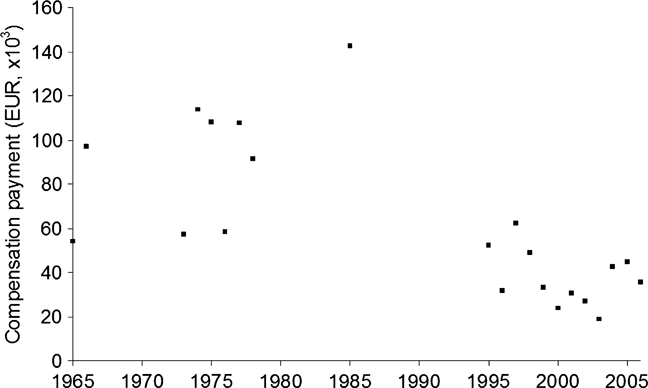
Bear damage to agriculture was inconsequential on a national scale: compensation in 1998–2006 totalled EUR 18,700–62,400 per annum at constant prices whereas, in 2001, direct payments to subsidize livestock production amounted to EUR 38 million (MPSR, 2002). Sheep/goats accounted for 44% of compensation payments, apiaries 40% and cattle/horses 11%. Total annual compensation payments have increased steadily in absolute values, correlated with hunters’ estimates of bear numbers (r = 0.969, P = 0.007). However, the numbers of livestock killed and the value of economic damage at constant prices have remained steady or declined (Fig. 2).
Total annual compensation payments for damage attributed to bears during 1965–2006, adjusted to constant prices using annual inflation rates provided by the Statistics Office of the Slovak Republic and converted using the National Bank of Slovakia exchange rate of 1 EUR = 34.573 SKK on 31 December 2006.
Annual sheep losses were estimated at 1,625 to wolves, 290 to bears (compensation was paid for c. 200) and four to lynx. In 2004 reported losses averaged 3.1 sheep per flock to wolves and 0.7 to bears, representing 0.8 and 0.2% of sheep, respectively. Livestock was not a major component of carnivore diet. None of 373 bear faeces contained livestock remains. Cattle and sheep were each identified in one of 78 wolf faeces during spring–autumn.
Damage varied widely among farms. Almost half the shepherds interviewed in 2005 said they rarely or never had problems with predation, whereas 12% of flocks accounted for 79–82% of all losses to bears and wolves in 2001–2003. The same flocks tended to be affected each year (χ 2 = 27.01, df = 1, P < 0.001, n = 131) and by both species (χ 2 = 10.23, df = 1, P < 0.001, n = 119). At a small number of flocks repeated attacks or occasional instances of surplus killing (in which predators, particularly wolves, killed more prey than necessary to sate their hunger; Kruuk, Reference Kruuk1972), caused major losses (≤60 sheep per attack). Less than 11% of flocks in any 1 year had total losses of > 10 sheep but these hard-hit flocks together accounted for 56–76% of all damage.
Farm characteristics
Flocks with high/repeated losses (n = 51) accounted for 83–96% of all reported losses each year. The most significant difference (χ 2 = 21.41, df = 1, P < 0.001) between flocks in this category and those with no losses was the method of night-time confinement. Whereas 57% of flocks with no losses (n = 61) were always or sometimes confined in a barn or farmyard, 86% of flocks with high/repeated losses were left in the pasture, either in a mobile sheepfold or loose. Eighty-six percent of losses to bears were reported to occur at night vs 67–70% for wolves. Losses reported from 93 flocks kept in pastures at night averaged 3.6 sheep per flock compared to 0.4 for 47 flocks always or sometimes returned to a barn (Mann–Whitney U test, P < 0.001). Losses dropped to zero when flocks were confined to barns in winter. We found no correlations between predation and flock size (range: 100–2,000 sheep), numbers of dogs or shepherds’ experience.
The most important habitat variables related to vegetation cover: none of seven sheep farms > 500 m from the forest edge had major losses, whereas all 13 flocks with high/repeated losses were < 500 m from forest cover (Fisher’s Exact Test, P = 0.029, n = 36). Wolves frequently attacked grazing flocks during daylight hours. Although we did not detect a significant difference within our sample (P = 0.127, n = 36), there seemed to be a trend for brushy pastures to be more susceptible to predation.
Uptake and effectiveness of livestock-guarding dogs
Of 34 pups placed at farms in 2000–2004, 17 were successfully integrated into flocks during their first full grazing season, five were partially integrated, 10 were separated from livestock by shepherds (three because of untrustworthiness or excessive roaming; seven without justification) and two died. Total known mortality by 2 years of age was ≥ 7 of 68 dogs due to the following causes: shot by hunters (n = 2), hit by vehicles (2), poisoned (1), bad food (1), infection (1). An additional three dogs disappeared. Of 14 dogs studied in detail, 12 showed good or acceptable patterns of behaviour, retaining key traits of trustworthiness, attentiveness and protectiveness.
The presence of livestock-guarding dogs was associated with lower levels of predation and an absence of surplus killing. The mean loss reported at 13 trial flocks in 2002 was 1.1 sheep compared to 3.3 for 45 control flocks in the same regions. Five of the control flocks lost 10–35 sheep/goats, whereas the maximum loss at trial flocks, from which shepherds saw dogs chasing away predators, was five. An overall difference in the median level of losses between trial and control flocks was not detected. However, when selecting trial sites, flocks that had previously suffered from predation were preferred, so control flocks tended to be less prone to attacks regardless of how they were managed. If only flocks that suffered predation are considered in both groups, damage was significantly lower (Mann–Whitney U test, P = 0.015) at trial flocks, where the median loss was 1.5 sheep (inter-quartile range: 1–4, n = 6) compared with 5.0 at control flocks (inter-quartile range: 3–10, n = 16).
Other preventive measures
Electric fences were used at 28 of 152 flocks (18%) surveyed in 2003. Typically, they were of a type designed to contain livestock rather than exclude predators. No significant difference was found in the number of sheep predated at flocks with vs without such fences.
Of 136 farm personnel who answered a question on prevention 34 (25%) said they used other methods. Guarding/patrolling was mentioned 17 times, returning the flock to the farmyard or secure fencing nine times and aversive devices nine times. Shepherds sometimes succeeded in chasing predators away whereas, in other cases, unwary carnivores killed sheep despite their interventions. Some attacks were not discovered until it was too late. Firecrackers, lamps and other simple aversive devices were said to be helpful but, if encountered repeatedly, predators habituated to them.
At least 21 ‘problem’ bears have been live-trapped and relocated but, typically, these were human-habituated food conditioned individuals (Rigg & Baleková, Reference Rigg and Baleková2003). Monitoring has generally been insufficient to assess outcomes.
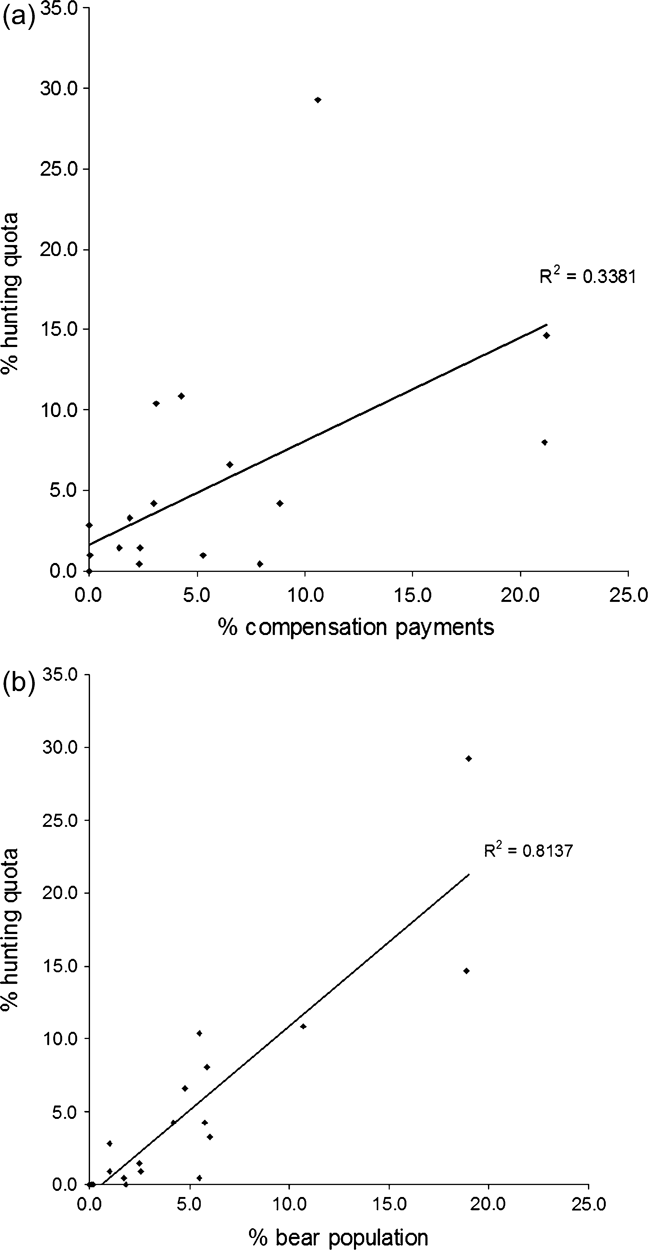
Permits were issued annually for the shooting of ≤ 10% of estimated bear numbers. In 2000–2006, trophy hunters shot on average 24 bears per annum, 35% of the total permitted. According to official guidelines, hunting is targeted at areas where conflicts with human interests occurred in the previous year, the assumption being that population control can limit damage to socially acceptable levels. However, the regional allocation of the 2002 hunting quota correlated more strongly with bear distribution than compensation payments in 2001 (Fig. 3). Sheep numbers (r s = 0.733, P = 0.001) explained more of the inter-regional variation in losses than did bear numbers (rs = 0.697, P = 0.001). In addition to the planned harvest three problem bears were removed, on average, annually, half of them following damage to livestock or beehives. During our study there were no restrictions on the number of wolves that could be shot during the open season (1 November to 15 January). The average annual harvest in 1997–2005 was 88. The regional distribution of wolves derived from hunters’ reports explained 22–41% of variation in number and percentage of sheep reported lost to wolves and proportion of flocks allegedly affected. Hunting lynx has been illegal since 1999.
Relation of regional distribution of bear hunting permits allocated in 2002 to (a) distribution of compensation payments in 2001 and (b) distribution of bear numbers as estimated by hunting ground users for 2001.
Attitudes to predator management
A large majority of survey respondents (83%, n = 1,178) agreed that, ‘Bears, wolves and lynx belong in the wild in Slovakia’. Most did not agree that they ‘kill a lot of livestock’. However, those who had experienced damage held significantly more negative attitudes. Shepherds had the most negative attitudes of nine occupational groups questioned (Fig. 4).
Box and whisker plots of attitude to large carnivores according to occupation, with sample size in parentheses (1 = strongly negative attitude, 3 = neutral and 5 = strongly positive).

Most respondents (61%, n = 1,076) agreed that livestock owners should receive compensation for losses; only 30% knew it was already available. Almost half thought payment should be conditional on use of preventive measures, as required by law since 2003. Woods-people more often agreed (61%) with this than other target groups (χ2 = 39.52, P < 0.001). Most shepherds interviewed (63%, n = 32) asserted that they were interested in improving flock protection measures. Nevertheless, when asked, ‘What could help prevent attacks by predators?’, only 16% of them mentioned a non-lethal method. Most (58%, n = 19) cited shooting predators as a way to prevent attacks. Measures most often reported to have been very effective in reducing predation were enclosing the flock in a barn/farmyard at night or when it rains, using livestock-guarding dogs, increasing vigilance and chasing away predators.
Survey respondents equally agreed (38%) as disagreed (35%) that carnivores should be eliminated from areas where they kill livestock. Only 30% of woods-people were in favour of this, fewer than any other target group except tourists (14%; χ2 = 52.80, P < 0.001). This seems paradoxical, as woods-people most often thought there were too many bears and that carnivores caused a lot of damage. Three-quarters of respondents (78% of those in the core area and 70% of woods-people) agreed that hunting of large carnivores should be strictly regulated.
Discussion
Set against the general level of prosperity in Europe, carnivore–livestock conflict is more a social and psychological problem than a financial one (Fourli, Reference Fourli1999). Although some individuals in poor rural communities suffer significant impacts (Mertens & Promberger, Reference Mertens and Promberger2001), only a small proportion of livestock operations are seriously affected (Kaczensky, Reference Kaczensky1996). Perception of economic loss may differ among individuals and social groups (Wechselberger et al., Reference Wechselberger, Rigg and Beťková2005) or in relation to the historical presence or absence of carnivores (Ricci et al., Reference Ricci, Salvatori, Mertens and Teofili2006). Conflict mitigation is therefore not only a question of reducing actual damage but also of increasing tolerance (Sillero-Zubiri et al., Reference Sillero-Zubiri, Sukumar, Treves, Macdonald and Service2006).
In Slovakia a belief that there are too many bears has become entrenched in recent years even though the real cost of economic damage has not increased. Our results reaffirm that local conditions, not predator numbers, play a key role in determining the extent of losses (Kaczensky, Reference Kaczensky1996). Factors associated with increased risk of predation include landscape features (Treves et al., Reference Treves, Naughton-Treves, Harper, Mladenoff, Rose, Sickley and Wydeven2004; Jędrzejewski et al., Reference Jędrzejewski, Niedziałkowska, Myslajek, Nowak and Jędrzejewski2005), distance to forest cover (Azevedo & Murray, Reference Azevedo and Murray2007), reduced availability of wild prey (Sidorovich et al., Reference Sidorovich, Tikhomirova and Jędrzejewska2003) or, conversely, high densities of wild ungulates in pastures (Stahl et al., Reference Stahl, Vandel, Herrenschmidt and Migot2001; Treves et al., Reference Treves, Naughton-Treves, Harper, Mladenoff, Rose, Sickley and Wydeven2004), calving in forested or brushy pastures (Paul, Reference Paul2000), lack of human attendance, guard animals or other preventive measures (Kaczensky, Reference Kaczensky1996) and, possibly, improper disposal of livestock carcasses (Mech et al., Reference Mech, Harper, Meier and Paul2000). Some variables may be of a temporary nature; e.g. bears cause more damage during, or following, years of mast/berry crop failure (Ryan et al., Reference Ryan, Pack, Igo and Billings2007) and wolves predate more on livestock following milder winters (Mech et al., Reference Mech, Fritts and Paul1988). Damage hot spots may persist over time or reappear when predators recolonize the area (Stahl et al., Reference Stahl, Vandel, Ruette, Coat, Coat and Balestra2002).
A combination of preventive measures, compensation for damage and elimination of problem individuals has been described as the most rational and effective approach in support of wolf conservation (Boitani, Reference Boitani, Mech and Boitani2003). Each of these elements has been implemented in Slovakia to varying degrees but with greater emphasis placed on carnivore population control. The current system of permitting a largely untargeted harvest up to 1.5 years after damage occurred seems unlikely to be the most effective way to avert further attacks, although it may improve public acceptance of carnivores by empowering those affected (Treves & Naughton-Treves, Reference Treves, Naughton-Treves, Woodroffe, Thirgood and Rabinowitz2005). As not all individuals in carnivore populations are equally involved in conflicts (Jedrzejewski et al., Reference Jedrzejewski, Nowak, Jedrzejewski, Myslajek, Rogala and Schmidt2003) selective removal of problem animals is more likely to reduce losses but can be difficult to achieve (Linnell et al., Reference Linnell, Odden, Smith, Aanes and Swenson1999) and, if circumstances remain otherwise unchanged, effects may be short term because of recolonization by conspecifics (Treves & Naughton-Treves, Reference Treves, Naughton-Treves, Woodroffe, Thirgood and Rabinowitz2005). Other measures are therefore required.
Since its introduction in 1962 compensation for bear damage has been conditional on an inspection commission absolving the owner or guardian of blame. Preconditions for payment from 2003 specifically mention use of prevention (enclosures, electric fences, guardians and shepherd dogs). Nevertheless, ineffective methods (chained dogs and inadequate electric fencing) prevail and shepherds have the most negative attitudes to carnivores despite the availability of compensation.
Establishment of a team trained to implement mitigation measures could improve their efficacy and address people’s grievances. The compensation scheme could be improved by streamlining bureaucratic procedures to reimburse afflicted parties promptly. Payments could be made proactively for tolerating carnivore presence (Schwerdtner & Gruber, Reference Schwerdtner and Gruber2007). Other possibilities include subsidized insurance cover, providing replacement animals or compensating lost production, inconvenience and distress as well as the market value of depredated stock. For a compensation scheme to foster tolerance, people must know it exists. This was not usually the case during our study, and thus awareness needs to be raised.
Damage per carnivore is lower in Slovakia than some regions of Europe where they have recovered in smaller numbers; e.g. in Norway, the Alps and the Pyrenees (Kaczensky, Reference Kaczensky1996). This could be because of the presence of shepherds (possibly explaining the absence of lynx predation), use of preventive measures and relative availability of alternative food. The substantial influence of local conditions on predation levels implies that there is scope for improving prevention. Further research on predictors of damage could help identify farms predisposed to predation, where the financial cost of prevention could be recouped by a concomitant reduction in compensation payments.
As most predation occurs at night the method of confinement is important. Livestock is more vulnerable in simple sheepfolds or loose in the pasture than in a barn or securely-fenced farmyard. However, in Slovakia wolves also attack sheep during daylight hours. Pastures are usually unfenced and interspersed with woodland. Securing the whole grazing area with predator-proof fencing is unfeasible for most farms, so livestock-guarding dogs seem to be the best option for adequate flock protection where wolves are present.
Surplus killing has a major impact on individual farms and accounts for a large percentage of all losses, so its prevention has substantial benefits. Our results show that, although they did not eliminate losses, even young livestock-guarding dogs reduced predation and prevented surplus killing by actively repelling predators, as reported from Romania (Mertens & Promberger, Reference Mertens and Promberger2001).
In trials, the success or otherwise of raising livestock-guarding dogs depended more on the attitude and diligence of shepherds than on differences between dogs in their behavioural conformation or genotype. The main obstacles to uptake were reluctance of shepherds to take on extra work, hostility of hunters concerned that free-ranging dogs might harass game (this resulted in the shooting of at least two of the dogs) and interactions between dogs and farm visitors. Likewise, the shortcoming of electric fencing in Slovakia was because of failings in its design or installation. Electric fencing can be highly effective at preventing damage if correctly implemented (Levin, Reference Levin2002; Mertens et al., Reference Mertens, Promberger and Gheorge2002).
To conclude, this case study illustrates that damage levels need not be excessive despite high predator densities in human-dominated European landscapes. Conflicts tend to be unevenly distributed, with a minority of livestock operations suffering high and repeated losses. Much of the variation is explained by local conditions, including husbandry practices and, in particular, preventive measures. Livestock-guarding dogs are one of the best ways to prevent substantial losses and are particularly appropriate where wolves are present in proximity to unfenced pastures.
The data presented in this article date from the period up to 2006. Since then the dogs have continued to work effectively and we have seen farmers and shepherds at 15 other farms raise free-ranging livestock-guarding dogs after witnessing them in use at trial farms. Our results have been presented to decision makers through presentations, publications and lobbying. Nevertheless, the attention of the Slovak authorities, farming and hunting communities, the media and general public has so far remained focused on considerations of predator population size and lethal control.
Acknowledgements
Several Slovak Wildlife Society projects provided data for this study: the Protection of Livestock and Conservation of Large Carnivores Project funded principally by the Born Free Foundation, The BEARS Project supported by WWF Denmark c/o the Danube-Carpathian Programme Office, and the Slovakia Wolf Census Project funded by the Wolves and Humans Foundation. Additional support was provided by the British Trust for Conservation Volunteers, the University of Aberdeen and private donors. For access to official records we thank M. Adamec at the State Nature Conservancy, Banská Bystrica and P. Kaštier of Zvolen Forestry Research Institute. Work on this article was kindly supported by The European Nature Trust and Oxford University’s WildCRU. We thank P. Johnson for statistical advice and anonymous reviewers for their helpful comments.
Biographical sketches
Robin Rigg has been endeavouring to mitigate carnivore–human conflicts in Slovakia since 1998. After first working with livestock-guarding dogs he established and leads The BEARS Project (http://www.medvede.sk). Slavomír Finďo has been researching wolves and their prey in Slovakia since the 1990s. Maria Wechselberger has carried out human-dimensions research on large carnivores in Slovakia, Canada and her native Austria. Martyn L. Gorman’s main research interest is the ecology and conservation biology of wild mammals. Claudio Sillero-Zubiri is Chair of the IUCN/Species Survival Commission Canid Specialist Group. His interests include the conservation of threatened species and human–wildlife conflict. David W. Macdonald is the founder and Director of WildCRU.



