




With the pathologization of homosexuality in late nineteenth-century Europe and the consequent emergence of distinct homosexual identities as deviations from the norm, Orientalism became a crucial vehicle for articulating non-normative sexualities. Many artists idealized ‘the Orient’ as an Arcadian realm in which to project notions linked to sexual otherness. Notable examples include André Gide’s novel L’Immoraliste (1902), Thomas E. Lawrence’s memoir Seven Pillars of Wisdom (1926), the paintings of the Spanish artist Gabriel Morcillo (Figure 1), and several productions by the Ballets Russes company (Figure 2). In music, significant instances include Claude Debussy’s Chansons de Bilitis (1900–1), the song L’indifférent from Maurice Ravel’s Shéhérazade (1903), Karol Szymanowski’s Songs of Love of Hafiz (1911/1914), and the corpus of works inspired by gamelan music by composers such as Benjamin Britten, Henry Cowell, and Colin Phee.Footnote 1
Gabriel Morcillo: Esclavos (Slaves, c. 1926), private collection.

George Barbier: Nijinsky as the Golden Slave and Rubinstein as Zobeide in Scheherazade (1910), from Designs on the Dances of Vaslav Nijinsky (Paris: C.W. Beaumont & Co., 1913).

The articulation of sexual otherness through musical Orientalism held particular significance in early twentieth-century Spain, where several leading modernist composers were not heterosexual, and Orientalism was closely entwined with national identity, and had been shaped to a great extent by the country’s Islamic past. Among the most compelling Spanish figures associated with this phenomenon is Adolfo Salazar (1890–1958), who pursued a largely underexplored career as a composer and is today widely recognized as one of the most influential music critics in Spanish history. In the early 1920s, Salazar developed a close romantic relationship with the Madrid-born composer Ernesto Halffter (1905–89), whom he first met in March 1922.Footnote 2 This relationship became a catalyst for both composers’ engagement with musical Orientalism. That same year, Halffter composed Un perfume de Arabia (A Perfume of Arabia, 1922), which he dedicated to Salazar. Shortly afterwards, Salazar followed with two of his most substantial homoerotic Orientalist works: Arabia (1923) and Rubaiyat (1924), the latter dedicated to Halffter.
At the time of their first meeting, Halffter was seventeen and Salazar thirty-two. Their relationship aligned to the so-called Greek model, one of the main forms of homoerotic relationships of the period (alongside working-class camaraderie). This form of male romantic bonding – centred on a close relationship between an older mentor and a younger disciple – was particularly prevalent among artists and intellectuals, and generally tolerated so long as it remained within platonic and chaste boundaries. In Halffter’s case, however, his family disapproved of the closeness between the two, and in early 1924, restricted the time he was allowed to spend with Salazar.Footnote 3 Four years later, Halffter married the pianist Alicia Cámara de Santos, whom he had met in around late 1924. ‘I hope, if God allows, that with her I will have resolved my life as a man so that I may henceforth dedicate my life to music’, he wrote to Manuel de Falla in 1928.Footnote 4 To date, no study on Halffter has addressed his sexuality. Existing scholarship on Salazar has largely treated his homosexuality as incidental to a comprehensive understanding of his musical and intellectual contributions.Footnote 5 The only exception is a pioneering essay by Spanish musicologist María Palacios.Footnote 6
Gustavo Durán (1906–69) was another key figure in Spanish musical modernism who, during this period, lived his homosexuality with relative openness and expressed it creatively through Orientalist music. One of his earliest romantic relationships was with the Granada-born poet Federico García Lorca (1898–1936), whom he met around 1922. Durán was then sixteen years old and Lorca twenty-four. Shortly thereafter, Durán composed for him the love song El corazón de Hafiz (The Heart of Hafiz, 1923) and the Berceuse (a la manera de M. Ravel) para dormir a Federico cuando se vuelva pequeño (Berceuse, in the style of M. Ravel, to lull Federico when he becomes a child again, 1925). The relationship seemingly endured for roughly a year.Footnote 7 In late 1922, Durán met the Canarian painter Néstor (Néstor Martín-Fernández de la Torre, 1887–1938), who became his partner for twelve years. In the mid-1930s, seemingly due to family pressure, Durán distanced himself from the painter and, in 1939, married the American Bonte Crompton, with whom he had two daughters. Durán’s non-normative sexuality, too, has been largely overlooked or silenced in scholarship on his work.Footnote 8
The leading Spanish composer of the period, Manuel de Falla (1876–1946), also occupies a significant position within this early twentieth-century trend of homoerotic Orientalism. In 2005, his principal biographer, Carol Hess, was among the first to document in print what had long been an open secret: the composer’s deeply repressed homosexuality.Footnote 9 Since then, no scholarly work on his music has examined this aspect of his personality and artistic identity. Falla never married, had no children, and no serious romantic relationships with either men or women are known. During his time in Paris, he maintained regular ties with several non-heterosexual artists, including the lesbian painter and amateur singer Romaine Brooks (1874–1970), to whom he dedicated Chinoiserie (1909). This Orientalist mélodie represents one of the earliest instances of a Western modernist composer articulating sexual otherness through a reimagining of gamelan music. Brooks was then romantically involved with Winnaretta Singer, the Princess of Polignac (1865–1943), who, nine years later, would commission a work from Falla. One of the composer’s closest friends in Paris was the homosexual pianist Ricardo Viñes (1875–1943), to whom he dedicated the particularly sensual Noches en los jardines de España (Nights in the Gardens of Spain, 1909–15). This work belongs to the later phase of so-called Alhambrismo, a strand of Orientalism rooted in the cultural memory of Al-Andalus (Medieval Islamic Iberia). Upon his return from Paris, Falla formed a close bond with his sister, with whom he would live for the remainder of his life.
During the period under study, Falla, Salazar, Halffter, and Durán shared a notable commonality: their affective, sexual, or familial lives deviated from prevailing social norms. The term sexual otherness thus serves as a useful framework for describing this dimension of their identities. This article explores how they expressed this form of otherness in the Orientalist works mentioned above, with particular attention to Arabia (1923), one of Salazar’s most interesting (yet unpublished) compositions. I analyse this piece in dialogue with a range of closely related artistic works, including the eponymous poem (c. 1912) by the English poet Walter de la Mare (1873–1956); the song Arabia (1914) by English composer William Denis Browne (1888–1915); Lorca’s early poetry; the writings on contemporary Andalusian culture by the English homosexual hispanist John B. Trend (1887–1958); the book of Symbolist poetic prose Granada, guía emocional (Granada, Emotional Guide, 1911) by Spanish writer María Lejárraga (1874–1974); as well as the above-mentioned modernist compositions Chinoiserie (1909), Noches en los jardines de España (1909–15), Un perfume de Arabia (1922), El corazón de Hafiz (1923), Rubaiyat (1924), and Berceuse (1925).
These Orientalist compositions were informed by the aesthetic principles of French Symbolism, particularly in their evocation of the dreamlike, the archaic, the sensual, and the mysterious. Stylistically, they draw upon the music of Debussy, Ravel, and, in certain instances, Satie. Their homoerotic dimensions were expressed primarily through extra-musical means, most notably through their titles, lyrics, programmatic content, and associated iconography. Among their most distinctive features is a markedly static musical temporality, which functions as a clear Orientalist marker and exemplifies what recent scholarship has termed ‘queer temporalities’: modes of temporal organization that articulate (sexual) difference by subverting the normative linear models of time that have structured Western modernity since the Enlightenment. Beyond these musico-textual elements, the specific circumstances of each work’s composition and early reception further inscribed them with meanings associated with sexual otherness.
Drawing on recent methodological developments in feminist and queer musicology – along with the work of Ralph P. Locke and other scholars of musical exoticism – this article explores how this corpus of Symbolist Orientalist compositions served as vehicles for expressing homoeroticism within specific circles of the educated elite. The central thesis is that these musical works functioned as dreamscapes onto which composers projected visions of alternative worlds – worlds more desirable than their own lived realities – while simultaneously articulating themes closely linked to national identity. For certain segments of their early audiences, both in Spain and abroad, these compositions also offered a means of sublimating non-normative sexualities, particularly within John B. Trend’s intellectual circle and specific Parisian artistic milieus. This essay provides a musicological analysis of the broader cultural phenomenon of homoerotic Orientalism in early twentieth-century Europe, with a particular focus on Spain – a subject increasingly examined in literary and art-historical scholarship, yet still largely neglected within musicological discourse.Footnote 10
The spell of far Arabia
Salazar composed Arabia. Boceto para piano y cuarteto de cuerda (Arabia. Sketch for Piano and String Quartet) in the spring of 1923.Footnote 11 The primary inspiration for the programmatic, single-movement work was the poem ‘Arabia’ by the English poet Walter de la Mare (1873–1956), which had been published a decade earlier in London.Footnote 12 The poem portrays ‘Arabia’ as an idyllic, exuberant, highly stylized fantasy – a distant paradise in both time and space. The text is especially suited to homoerotic readings due to its Orientalist themes, dreamlike atmosphere, absence of female characters, and references to elegant, youthful musicians playing through the night. The poem incorporates several widely recognized symbols of homoeroticism from the period, most notably the reference to flowers, the colour lilac, and the darkness of night. Additionally, the reference to the ‘cold voices’ that chastise the poetic ‘I’ – and, by extension, the complicit reader – for being ‘crazed’ by the poem’s Orientalist fantasy might have been read as an allusion to homosexuality, which was widely regarded as a psychological disorder by both medical discourse and the educated classes. The full poem, which Salazar transcribed onto the cover of his manuscript, reads:
Far are the shades of Arabia,
Where the Princes ride at noon,
’Mid the verdurous vales and thickets,
Under the ghost of the moon;
And so dark is that vaulted purple
Flowers in the forest rise
And toss into blossom gainst the phantom stars
Pale in the noonday skies.
Sweet is the music of Arabia
In my heart, when out of dreams
I still in the thin clear mirk of dawn
Descry her gliding streams;
Hear her strange lutes on the green banks
Ring loud with the grief and delight
Of the dim-silked, dark-haired Musicians
In the brooding silence of night.
They haunt me – her lutes and her forests;
No beauty on earth I see
But shadowed with that dream recalls
Her loveliness to me:
Still eyes look coldly upon me,
Cold voices whisper and say –
‘He is crazed with the spell of far Arabia,
They have stolen his wits away.’
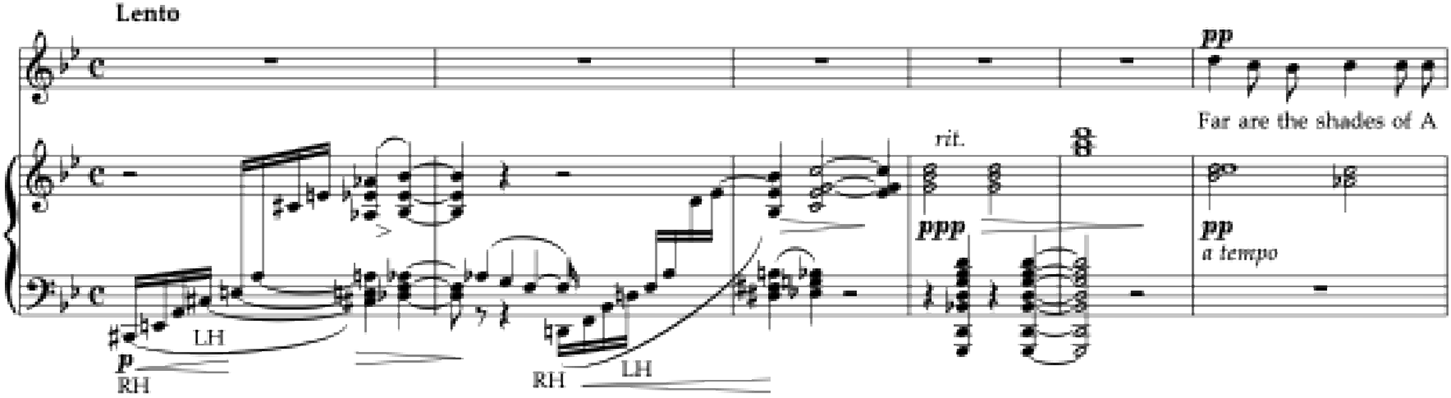
A clear indication of the homoerotic interpretations of this poem in the early twentieth century is that, prior to Salazar, it had been set to music by only one composer: William Denis Browne (1888–1915), who was himself homosexual. In 1914, Browne composed a song for voice and piano, also titled Arabia, which proved to be his final work before his death at the age of twenty-six in the trenches of the First World War. The score was posthumously published in 1919 in the English cultural journal The Monthly Chapbook.Footnote 13 It is possible that Salazar knew of Browne’s setting when composing his own Arabia, given that Browne had been the love of Edward Dent (1876–1957) and that Salazar had maintained regular contact with Dent and his partner Trend from around 1920 onward.Footnote 14 Salazar’s primary compositional models, however, were not Browne’s Arabia but rather Debussy’s middle-period works and, above all, Falla’s Noches en los jardines de España. Example 1 and Example 2 illustrate the beginnings of Salazar’s and Browne’s respective Arabia compositions.
Salazar most likely encountered the poem ‘Arabia’ through the writings of Trend, to whom he dedicated the composition. Between 1919 and 1920, Trend had spent nearly a year in Spain, where he formed friendships with Falla and Lorca. It is possible that he met Salazar during this period.Footnote 15 In 1922, a year before Salazar began work on his composition, Trend had linked de la Mare’s poem with the Andalusia-inspired works of Lorca and Falla in two texts published in England. The first was a review of Lorca’s Libro de poemas (Book of Poems, 1921), which Trend published in January 1922 in the prominent British newspaper The Nation and Athenaeum. This was the first review of Lorca’s work to be published outside the Spanish-speaking countries. Trend titled his review A Poet of ‘Arabia’ in reference to Lorca. The quotation marks in the title signalled that the ‘Arabia’ linked to the Spanish poet was not the real one, but rather the fantasy imagined by de la Mare:
In that corner of Europa [Andalusia] to which Sr. Lorca belongs, poetry, like music, is a thing which is performed. It is read in gardens on summer nights, in surroundings which are like Mr. Walter de Mare’s ‘Arabia’ come true. To understand Sr. Lorca an English reader must begin by saying that exquisite English poem over to himself. He must ‘descry her streams’, he must ‘Hear her strange lutes on the green banks/Ring loud with the grief and delight/Of the dim-silked, dark-haired Musicians/In the brooding silence of night.’ This is the background against which Sr. Lorca’s poetry – and other modern Spanish poetry – is performed.Footnote 16
Beginning of Adolfo Salazar’s Arabia (1923), bb. 1–11.

Beginning of William D. Browne’s Arabia (1914), bb. 1–6.

Beginning of Gustavo Durán’s El corazón de Hafiz (1923), bb. 1–17. Source: Centro Federico García Lorca.

This notion of a connection between Andalusia-inspired Orientalism and homoeroticism was then gaining prominence in Lorca’s thought and artistic work. The poet subtly alluded to this connection in his lecture El cante jondo. Primitivo canto andaluz (The Deep Song. Primitive Andalusian Singing), which he delivered shortly after Trend’s review was published. Lorca observed that ancient Oriental elements were apparent in the older musical styles and lyrics of cante jondo (i.e., early flamenco), noting that many of these traditional Andalusian song lyrics were ‘equivalent’ to the ghazals of the medieval Persian poet Hafiz (1325–90).Footnote 17 Lorca had recently discovered Hafiz’s poetry through a collection of Spanish translations of Arabic, Persian, and Turkish poems published in the nineteenth century under the title Poesías asiáticas (Asian Poems).Footnote 18 At the time, Hafiz was celebrated in the West as the foremost exponent of the ghazal, a lyrical form typically centred on themes of love and wine, in which the evocation of youthful, beardless teenagers was often interpreted as a symbolic pathway to mystical union with the divine. Hafiz’s work significantly influenced Lorca, sensitizing him to the presence of Oriental elements within Andalusian culture. Not long after, he would begin to engage directly with the ghazal form in his Diván del Tamarit (Divan of the Tamarit), a project initiated in the mid- to late 1920s.Footnote 19
Reflecting Lorca’s fascination with Hafiz’s poetry, Durán composed El corazón de Hafiz for him in July 1923, shortly after their romantic relationship began. The manuscript, which Durán gifted to Lorca, bears the dedication ‘Para Federico, amigo en la vida y en el arte’ (For Federico, friend in life and art).Footnote 20 The composition is a love song, with lyrics that read: ‘Cuando mi corazón caliente se haya quebrado en mil pedazos, entonces podrás ver, amor mío, como cada uno de estos mil pedacitos te ama como un corazón entero’ (When my warm heart has shattered into a thousand pieces, then you will see, my love, how each of these thousand fragments loves you as a whole heart). These lyrics do not appear to be a direct translation or reworking of any Hafiz poem; rather, they are likely Durán’s own creation. The phrase ‘mi corazón caliente’ (my warm heart) was most likely employed as a euphemism for homosexual love, given the widespread use of ‘warm’ and ‘warme Brüder’ (warm brothers) as euphemisms for homosexuality in Germany – then an international epicentre of homosexual activism and culture – and Durán’s familiarity with the German language. This expression, together with the reference to Hafiz in the title, as well as the work’s dreamlike character and its static musical temporality – discussed in detail below – constitutes the principal means by which Durán articulated homoerotic meanings in his love song for Lorca. Example 3 shows the beginning of the piece. Note that Durán sets the words ‘te ama’ (loves you) to the final segment of a descending chromatic motif – the only one in the piece – which spans from E♭ to C♮ (bb. 15–7, boxed in Ex. 3). Descending chromatic motifs, particularly those spanning a fourth, constitute an age-old emblem of the lament. This association between love and pain may reflect Durán’s feelings for Lorca at the time and, more broadly, the emotional hardships inherent in homosexual relationships during that era.
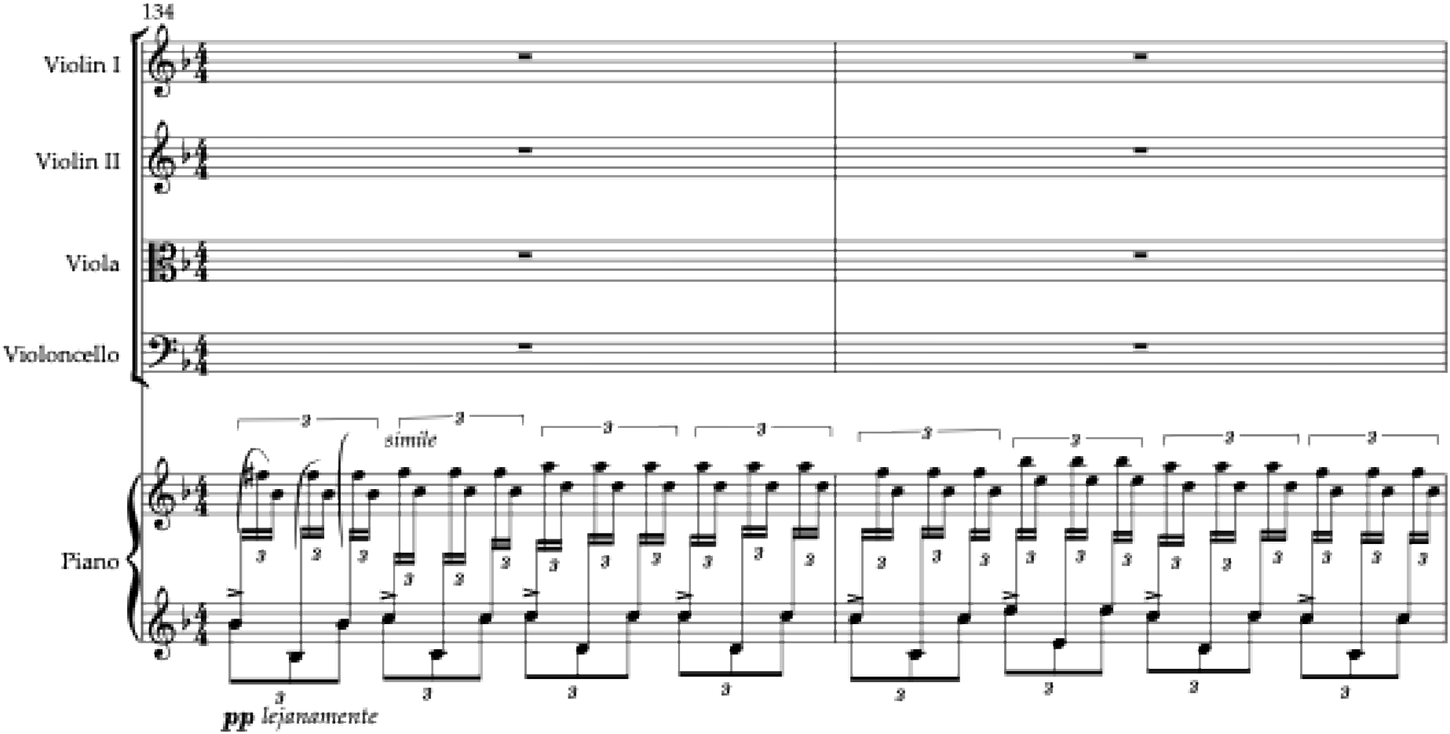
Adolfo Salazar: Arabia (bb. 134–35). This material reappears with slight variations in bars 182–83 and 197–214.

Passage inspired in Albéniz’ music in Salazar’s Arabia (1923), bb. 121ff.

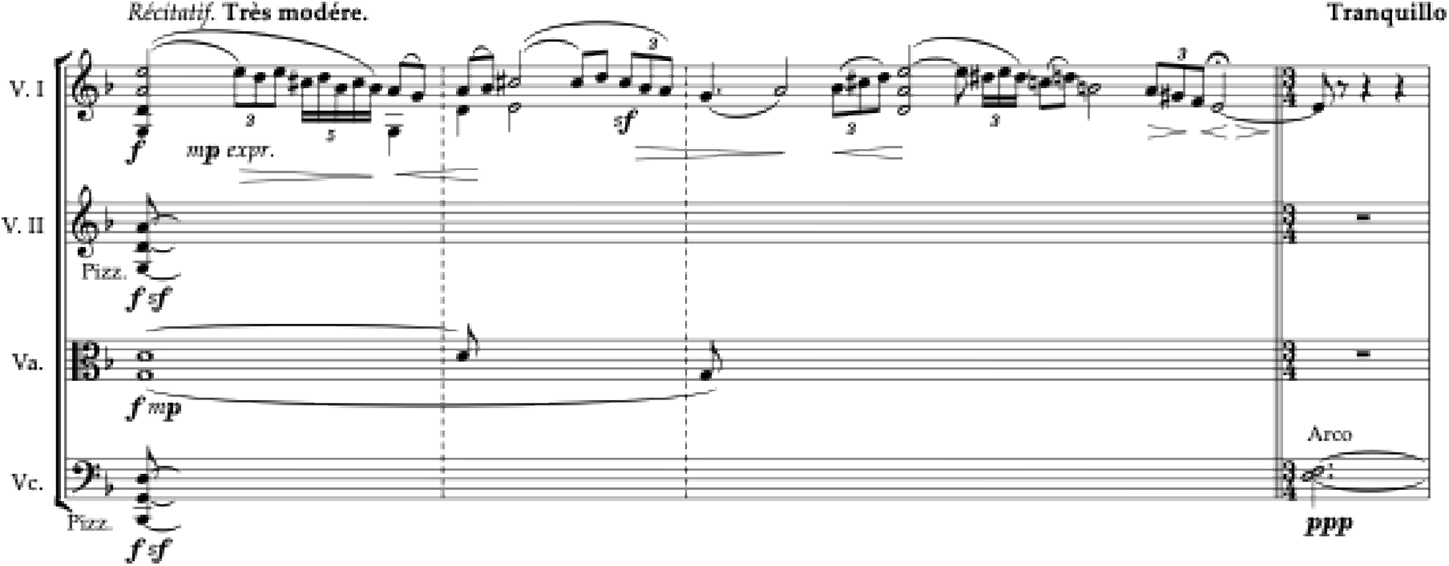
Opening arabesque in Rubaiyat (1924), bb. 1–2.

Sultry nights in the gardens of Granada
In April 1922, Trend revisited the ideas he had put forth in A Poet of ‘Arabia’, this time in relation to Falla’s music. In a brief essay on the composer published in Music & Letters, the hispanist once again underscored the Orientalist otherness of Andalusia, portraying the region as markedly different from the rest of Europe and other parts of Spain. He elaborated that Andalusia closely resembled de la Mare’s vision of ‘Arabia’, asserting that for ‘an Englishman to fully appreciate the nuances of Falla’s music, he should begin by reciting that exquisite poem to himself’. For Trend, de la Mare’s depiction of a group of Arabian musicians playing in gardens on summer nights created an evocative backdrop through which the music of Falla and other Spanish composers could be fully appreciated.Footnote 21 These connections between de la Mare’s ‘Arabia’ and the Andalusia-inspired works of Lorca and Falla likely played a crucial role in Salazar’s decision to compose an evocative piece inspired by the poem and dedicate the composition to the hispanist.
References in both of Trend’s reviews to music heard in Andalusian gardens on summer nights established a clear connection with Noches en los jardines de España (1909–15), which Trend had heard by May 1921 at the latest, during its English premiere in London, with Falla at the piano. This work stands as one of Falla’s most vivid articulations of Symbolist Orientalism. One of the principal literary sources that inspired Falla during its composition was Granada, guía emocional (1911) by the Spanish writer María Lejárraga. This book of Symbolist poetic prose depicts the gardens and fountains of the Alhambra as metaphors for sexual desire, a portrayal that is especially prominent in the chapter entitled En el Generalife, whose title Falla adopted for the first movement. Lejárraga’s singular book claims to be written specifically for women and is imbued with what we now recognise as a queer sensibility, articulated through an overtly feminist, anticlerical, and anti-capitalist discourse. Her critique entails a rejection of the presumed ‘progress’ of Western civilization and a celebratory embrace of leisure and idleness over productive labour – encapsulated in expressions such as ‘the only time truly won in life is the time that is lost [to idleness]’.Footnote 22
Noches was received through homoerotic lenses within certain circles in Spain and abroad. In the summer of 1916, shortly after the work’s premiere in Madrid, Sergei Diaghilev planned to use the work as the score for a ballet, with choreography by either Léonide Massine or Michel Fokine. Néstor might have been under consideration as the set designer. The project was eventually abandoned for reasons as yet unknown.Footnote 23 Two years later, Winnaretta Singer, a prominent figure in Paris’s Sapphic circles, commissioned Falla to compose a work for her. Initially, the project involved the French music critic Jean-Pierre Altermann (1892–1959), who was then close to Singer and appears to have been acquainted with Falla. Altermann, who would later become a priest, was seemingly not heterosexual. In a series of letters to the composer, he proposed to create together an Orientalist work in the spirit of Falla’s earlier Alhambrist compositions. The new piece – he wrote – had to be inspired by ‘that poem I imagined last winter, not far from your music and from you, The Unknown Man in the Gardens of Granada, that voice of a stranger man rising toward the midday of the Moorish garden and singing the enigma of the garden…’Footnote 24 The figure of an enigmatic, exotic, and unknown man was a recurring trope of homoeroticism during the period, appearing in works such as L’indifférent – one of Ravel’s most overtly homoerotic pieces – and in the opening of Thomas Mann’s Death in Venice (1912).Footnote 25 A few weeks later, Altermann sent Falla a detailed scenario containing several homoerotic elements, including an opening scene in which a male slave plays the flute while longing for his absent male master.Footnote 26 The proposed Alhambrist work never came to fruition; instead, Falla composed El retablo de Maese Pedro for Singer.Footnote 27
The reception of Noches through homoerotic sensibilities was surely facilitated by the distinctly ‘feminine’ character of the composition, which derived from its Symbolist and Orientalist qualities, its evocation of Gypsy otherness (particularly in the second and third movements), and the fact that Falla associated the work with the genre of the nocturne, frequently referring to it as Nocturnos. As Jeffrey Kallberg has persuasively argued, the nocturne had become one of the ‘small genres’ most closely linked to femininity and sexual otherness following the popularization of Chopin’s nocturnes in the mid-nineteenth century.Footnote 28 Falla’s association of Noches with this genre stemmed largely from the work’s initial conception as a set of four ‘Andalusian nocturnes’ for solo piano. In Noches, however, only the opening of the first movement (bb. 21–31) preserves the defining features of the Romantic nocturne, namely a cantabile, richly ornamented rubato melody accompanied by arpeggiated motives.
With regard to the homoerotic meanings initially associated with Noches, it is also noteworthy that Salazar emulated several elements of Falla’s work in his Arabia. In both compositions, the piano is not treated as a virtuosic solo voice but rather as a distinct timbral element within the piece’s instrumental colour palette. Both pieces open with a ‘veiled and mysterious sonority’ achieved through pianissimo ostinato motifs moving in stepwise motion, serving as a prelude to the piano’s entrance (compare Example 1 with the opening bars of Noches). Each work concludes in the same tonality (D major) with a similar chordal configuration. Moreover, one of the few recurring motifs in Arabia, shown in Example 4, appears to be inspired by several passages in the first and second movements of Noches, particularly bars 37–50 of the second movement, Danza lejana (Distant Dance).
Homoerotic symbolism and national identity
Like Trend, Salazar drew connections between Andalucía and de la Mare’s ‘Arabia’. In a 1923 article on his Arabia, Salazar articulated how the English poet’s evocation of Arabian music – through images of distant, nocturnal lutes sounding among groves of roses and the murmuring of hidden streams – had stirred within him ‘ineffable memories of the nights of Granada and Córdoba’. This had prompted him to make ‘discreet’ allusions to Andalusian music in certain parts of Arabia.Footnote 29 Though Salazar did not elaborate further, he appears to have been referring to a passage in the second part of the composition (bb. 121–33), which recalls several piano pieces by Isaac Albéniz, where guitar-like strumming accompanies the main melody, for instance, Rumores de la caleta (1887) or Cádiz (1889). The opening of this Albéniz-inspired passage is shown in Example 5 (bb. 121ff). This passage seamlessly transitions into the earlier-mentioned section that evokes Noches (Example 4).
In the same article, Salazar firmly defended Debussyan Symbolism as the ‘path’ Spanish music should continue to pursue in the future, highlighting this style’s potential to express Spanish identity through a poetic and sensual form of Orientalism. In Arabia, he had followed ‘the suggestion made by Debussy directly to the Spaniards to create a type of music in which the evocation of an imaginary place, the depiction of a dreamlike atmosphere, a vision glimpsed through a thousand poetic veils, is distilled to the imperceptible before reaching sonic reality.’Footnote 30 With Arabia, Salazar aimed to show
the path that, in my view, [music] ‘nationalism’ in Spain should follow, after the admirable chapters that Iberia by Albéniz and, even further in its evolution, Falla’s Nocturnos [Noches en los jardines de España] have contributed to its history. In my opinion, a guiding principle has been set forth here, and before long, we shall see the most exquisite fruits. I refer, above all, to certain works written in this spirit by Ernesto Halffter. One of them (for piano trio and strings) bears the title Un perfume de Arabia [1922], and it is something of a spiritual synthesis of my own Arabia [1923]. That title alone already encapsulates an entire programme for the future: music aspires to become fragrance, aroma – that ‘impalpable and indefinable essence’ which the Romantics, in our eyes today, seemed to have attempted so clumsily. Sensibility is continuously enriched with new nuances. The foundation has been laid for its continuation along the noblest and loftiest path of Spanish music.Footnote 31
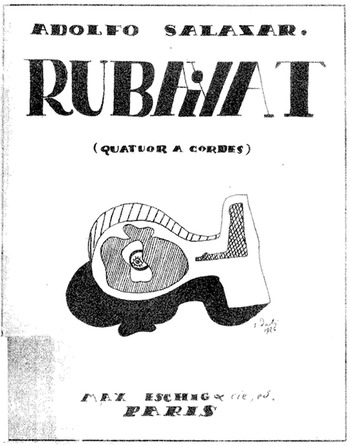
Immediately after the publication of this article, Salazar continued along this ‘path’ of Symbolist, Orientalist, and homoerotic musical ‘nationalism’ with the composition of Rubaiyat. Siete fantasías para cuarteto de cuerda (Rubaiyat. Seven fantasies for string quartet). He completed the seven-movement work in early 1924, at the height of his romantic relationship with Halffter, to whom he dedicated the composition. The cover of the published score, designed by Salvador Dalí, features two superimposed faces, which at the time served as a familiar symbol of homoeroticism within the circle of Salazar, Halffter, Lorca, Dalí, and others (Figure 3).Footnote 32 Salazar noted that he drew inspiration from several of the Rubaiyat of the medieval Persian poet Omar Khayyam (1048–1131). Rubaiyat is the title given by the British poet Edward Fitzgerald in 1859 to his English translation of a selection of quatrains (rubāʿiyāt) attributed to Khayyam. These quatrains were widely read among European homosexual intellectuals, as they typically celebrated life’s pleasures and often implied that the object of desire was a young male companion.Footnote 33 Salazar possibly read the Spanish translation by the Argentine Orientalist Carlos Muzzio Sáenz-Peña, published in Spain in 1916, or one of the earlier partial translations produced in Spain – the earliest of which, from 1907, was by María Lejárraga.Footnote 34
Overlapping faces as homoerotic symbol on the cover of the first edition of Rubaiyat (Paris: Max Eschig, 1929).

Ernesto Halffter: Un perfume de Arabia (1922), bb. 1–14.

Salazar’s Rubaiyat showcases a rich array of Orientalist musical topoi, including the expansive arabesque in an improvisatory style that opens the piece (Example 6). This melody is built on an E-Phrygian scale that begins in a minor mode (with G♮) and ends in a major mode (with G♯). The principal underlying model for this melody is not traditional Persian music – which Salazar probably knew only superficially – but rather the rich corpus of late nineteenth- and early twentieth-century Orientalist works, particularly Alhambrist compositions influenced by flamenco, a genre in which major and minor Phrygian modalities – especially those centred on E – play a central role. A few years later, he wrote that Rubaiyat’s ‘imaginary Orientalism’ had ‘a genuinely Spanish origin’ and acknowledged Debussy’s music as one of his main influences in the work.Footnote 35 Although he did not mention Ravel, my analysis suggests that the latter’s String Quartet (1902–3) – a work Salazar himself characterized as ‘Orientalist’Footnote 36 – also served as a compositional model for Rubaiyat, particularly for the fourth movement.
In his monograph Música y músicos de hoy (Music and Musicians of Today), published shortly after completing Rubaiyat, Salazar framed Debussy’s Symbolism within a discourse of feminine and homoerotic Orientalist otherness. He contended that Debussy had steered Western music out of crisis by assimilating a set of ‘qualities of Oriental art’, which Salazar described as ‘refinement of line, sharpness of expression, a love for synthesis, for intense concision, a certain disdain for what is too obvious, coupled with a barely concealed spirit of mischief, and, above all, that aspect of naïveté, an appearance of simplicity’.Footnote 37 Salazar implicitly linked Symbolist Orientalism to homoeroticism by describing Debussy’s Prélude à l’après-midi d’un faune as ‘a masterpiece as a Persian artist might have dreamed it after reading Hafez or Omar.’Footnote 38 By that time, Prélude had acquired homoerotic connotations, influenced by Vaslav Nijinsky’s performance in the 1912 Ballets Russes production. Furthermore, Salazar connected Debussy’s modernism to various homoerotic motives and themes – particularly the imagery of sensual gardens and their fragrances, along with the allure of forbidden desire. He contrasted these elements with notions of repression and decay that he associated with musical academicism.
For a moment, the [Symbolist] artist lifted his gaze above the wall that the [academicist] school had built around his own orchard. The luxuriance of the nearby vegetation fascinated him. Was he forbidden from breathing in the scents of the neighbouring enclosure? He tried not to overstep the imposed boundaries but found them too narrow. The heady perfumes of the adjacent garden pursued him, lingering in the air; those alluring colours still illuminated his eyes. Then he realized that all of this was intangible – because it broke with tradition and because it disrupted the purity of its language, which was pure only by virtue of its age. Against the enticing, novel apple [Symbolism], museum art was set; against youthful, naked life, a model ‘in the ancient style’; and in the name of the enduring nature of fresh, pulsating flesh, the semi-eternity of the pharaonic mummy – enshrined within a display case that was elevated to the status of an institution.Footnote 39
Timeless arcadias
The piece Salazar referred to as a precedent and ‘spiritual synthesis’ of his Arabia is the third movement of one of Ernesto Halffter’s earliest compositions: the trio for violin, cello, and piano Hommages (1922). Halffter composed this movement around the time he began his romantic relationship with Salazar, to whom he dedicated the piece. The composition’s title, Un perfume de Arabia, intertwines two concepts – the Orient and fragrance – that were then closely associated with sexual otherness. These associations became particularly pronounced following the European reception of Oscar Wilde’s works, in which perfume plays a central role, and the early twentieth-century publication of translations of The Perfumed Garden into English, French, and German. This fifteenth-century sexual treatise by the Tunisian Arab author Nefzawi explores a wide range of aspects of human sexuality, including homosexuality.Footnote 40
Stylistically, Un perfume de Arabia is indebted to Debussy and Satie. As shown in Example 7, the piece unfolds through a series of simple melodies, accompanied by repeating ostinati and long sustained notes. Several of these melodies, particularly in the central sections (bb. 16–45), evoke children’s ditties, suggesting themes of innocence and youth – perhaps alluding to the disciple–master relationship between the composer and the work’s dedicatee. Halffter’s portrait in the article through which Salazar introduced him to Madrid’s music lovers similarly conveys a sense of youthful innocence (Figure 4).Footnote 41 Falla, who reviewed the manuscript of Hommages in 1922, was particularly enthusiastic about Un perfume de Arabia, only marking the corresponding page with ‘Bravo!!’.Footnote 42
Portrait featured in Salazar’s first article on Halffter’s music, from 1923.

Opening of Maurice Ravel’s L’indifferent (1903), bb. 1–5.

Suspended temporality in Browne’s Arabia (bb. 45–51).

Beginning of Gustavo Durán’s Berceuse (1925), bb. 1–15.

Unlike Arabia and Rubaiyat, Un perfume de Arabia does not include Orientalist topoi such as Phrygian motives, arabesques, or augmented seconds. The piece’s only Orientalist feature lies in its title, combined with its markedly static treatment of musical time. The composition is characterized by a radical weakening of directional momentum through pronounced harmonic stasis, a trait it shares with several works examined in this essay. This weakening represents a rejection of the Western modern conception of time as a linear progression towards a final goal or climax, a notion that became normative with the Enlightenment.Footnote 43 In music, paradigmatic examples of these normative teleological structures include the sonata form and the harmonic trajectories generated by modulations, culminating in what Richard Taruskin terms a ‘far-out point’ in musical progressions, referring to a harmonic departure that eventually resolves back to the tonic.Footnote 44
In the music of German Romantic and post-Romantic composers, particularly from Richard Wagner onward, forward motion was sustained mainly through the deferral of dissonance resolution. Although musical time could be momentarily ‘halted’ or slowed through slow harmonic rhythms and the marginalization of thematic–motivic development – typically to evoke notions related to nature, the pastoral, and the exotic – temporal stasis remained fleeting and firmly situated within an overarching teleological framework. By the late nineteenth century, Debussy, Satie, Ravel, and other French composers of their generation shifted their focus to the ‘decorative’ aspects of music, adopting a different approach to harmony and musical time. Their method relied primarily on treating triads with added notes as stable sonorities, thereby eliminating the necessity of resolving the dissonances introduced by these added notes (primarily sevenths, ninths, and elevenths, but also seconds, fourths, and sixths). The stability of these chords, coupled with the prevalence of modal cadences (lacking leading tones) stripped French music of Wagnerian propulsion, promoting harmonic stasis and, in turn, generating a prevailing sense of timeless calm throughout. The use of ostinati as a key structural element became also essential in undermining the perception of temporal progression. Erik Satie emerged as the principal exponent of the timeless calm that characterized turn-of-the-century French modernist music.Footnote 45
This kind of static temporality characterizes numerous works by early twentieth-century French composers, as well as the Spanish composers influenced by them, such as Frederic Mompou. Un perfume de Arabia is remarkable for pushing these strategies to the extreme. The piece is defined by the complete absence of motivic development and the relentless repetition of various ostinati in steady pulses at a slow, unwavering tempo. Particularly striking is the four-quaver motif in the piano’s left hand, which remains unchanged from beginning to end. The use of a single, unaltered ostinato throughout an entire piece is exceptionally rare in Western classical music before the emergence of minimalism in the 1960s. The sense of stasis is further reinforced by the prevalence of extremely long-held notes in the strings, the constant reverberation of the piano, and the pervasive legato phrasing. The piece’s primary harmony is a G minor triad with several added notes – including a major third and a tritone above the tonic (Example 7). The dissonances generated by the added notes remain unresolved throughout. All these elements contribute to the work’s trance-like quality. The piece ends where it began, without reaching any climax or generating a sense of forward motion or temporal progression.
Durán approached harmonic time similarly in El corazón de Hafiz. The accompaniment consists of an unbroken stream of pianissimo quavers, maintaining a consistent level of stable dissonance throughout the piece. Each of the four sections introduces its own ostinato, which succeeds the previous one without transition or cadential resolution. In the final section (bb. 17–21), the initial ostinato returns, yet the effect is one not of progression but of circularity and stasis. As in Un perfume de Arabia, the piece’s only Orientalist elements are its title and this non-teleological treatment of musical time (Example 3). The resemblance in style, length, texture, structure, and harmonic organization between El corazón de Hafiz and Un perfume de Arabia suggests that Durán may have heard or studied Halffter’s piece and emulated it in his song for Lorca.
The striking temporal stasis in the works of Halffter and Durán is made possible by their brevity – comprising 61 and 21 bars, respectively. In Salazar’s significantly longer Arabia (216 bars), the formal and harmonic organization is more intricate, yet similar strategies for weakening temporal progression remain evident. The composition lacks the teleological trajectories that underpin classical forms. Rather than treating the recurring material as themes to be developed through modulations leading to a final resolution on the tonic, Salazar allows the sections to unfold with minimal preparation. The few recurring elements – for instance, the Phrygian melody introduced in bb. 27–9 – appear in fragmented form and are never developed. Salazar described the piece’s form as ‘quasi a recitative’ and explained that both this structure and the piece’s harmonic, rhythmic, and timbral ‘vagueness’ were inspired by de la Mare’s poem.Footnote 46 The musical form of Arabia did not go unnoticed by some of those who heard it or studied its score, including composers Maurice Ravel and Joaquín Turina, who responded in opposing ways. According to Salazar, while Ravel described the structure as ‘très exacte’ (very precise), Turina deemed it a failure.Footnote 47 Turina was considerably more stylistically conservative as a composer than Ravel, which may be one of the main reasons for his rejection of the unconventional form of Arabia. Yet I wonder whether the fact that Turina was heterosexual, whereas Ravel was not, also influenced their contrasting responses to the work’s non-teleological temporality.Footnote 48
The harmonic organization of Arabia is strongly influenced by Debussy’s middle-period works (fc. 1892–1912). Salazar largely avoids perfect cadences, even at the end of the piece. The tertian harmonies that pervade the composition are better understood as textural thickening of the melodic lines, rather than as traditional harmonic progressions. One of the most striking instances of Salazar’s intention to ‘freeze’ musical time is the seventeen-bar passage that opens the piece, particularly from bb. 8–11 (see Example 1). The string instruments play very simple ostinato consisting of repeated seconds. The absence of a theme to structure the passage and the lack of leading tones further adds to a sense of stasis. (Salazar reintroduces this initial material four times, at different pitch levels, to mark the beginning of important sections.) The beginning of Arabia bears similarities not only to the opening of Noches, as previously noted, but also to the harmonically static passage that opens Ravel’s L’indifferent (1903), as shown in Example 8.
Significantly, Browne also created a distinctly static sense of musical time in his setting of de la Mare’s Arabia. He accomplished this through techniques similar to those employed by Halffter, Durán, and Salazar in the compositions discussed above. The desire to ‘freeze’ time is particularly evident in the musical setting of the last stanza, which portrays the fascination with ‘Arabia’ as a manifestation of madness. The voice is accompanied by an alternation of E♭ minor and E♭ major arpeggios, each incorporating a major second (F) and a diminished sixth (C♭). The dissonances created by these added tones remain unresolved. Browne sets the spiteful voices (‘He is crazed with the spell of Arabia…’) to music in a quasi-parlando style, accompanied by a similar harmonic organization (bb. 63–5, not in the example). As in Salazar’s Arabia, the effect is one of fragmentation and spontaneity rather than teleological drive.
Queer reveries
All these forms of suspended musical time encompass two closely interrelated dimensions. On one level, they operate as exoticist features, reflecting a conception of ‘the Orient’ as an Arcadia rooted in a mythical past yet imagined as timeless, and more closely aligned with primitivism, archaism, and mysticism than with Western ideals of modernity and progress. On another level, such static temporalities function as evocations of the dream realm, a central feature of Symbolism that resonated particularly with homosexuals, for whom dreamworlds provided a mode of Otherness through which non-normative subjectivities and desires could be articulated.
The drive to explore the dream world and the unconscious was explicitly articulated by Lorca in 1928, when he argued that dreams should serve as a primary source of inspiration for artists in their pursuit of an ‘escaped reality’ (realidad evadida).Footnote 49 Around the same period, Trend described Noches en los jardines de España as a sort of dream in which it was possible to experience emotions in a heightened, sensual way beyond the ordinary. In the first movement of Noches – he wrote in 1929 – ‘we wake suddenly into the middle of a vivid dream, as if the music had been there already, going on for some time, before we became aware of it’. Trend portrayed the final movement as a nocturnal celebration hosted by a group of Andalusian ‘gypsies’, culminating at dawn with the guitar players and dancers worn out from the revelry:
It has been a wild night, orgiastic, un-European; and yet the composer has so arranged things that we have it all clearly before us, and our dreams do not outstay their vividness. Falla’s art lies in this: that he has made it seem not exotic, but natural. We have been caught up, like Christopher Sly, like the Prince in Calderon’s play of Life’s a Dream, or like The Sleeper Wakened in the Arabian Nights, to hear things and to see things with other senses than ours, and yet with senses that all the time are our own. It was a dream, but at the same time it was real.Footnote 50
A dreamlike quality is also particularly pronounced in de la Mare’s Arabia, as well as in Salazar’s and Browne’s musical settings of it. The poet Gerardo Diego, a friend of Salazar, highlighted this aspect in relation to Salazar’s Arabia, describing the composition as a ‘sonorous dream.’Footnote 51 Salazar himself characterized his work as music that was ‘heard in memory, almost dreamed.’Footnote 52 Similarly, the two musicologists who have studied Browne’s oeuvre, Trevor Hold and Stephen Banfield, have emphasized the oneiric nature of his Arabia, describing it as ‘trance-like’ and ‘narcotic’, respectively.Footnote 53 Arabia is one of Browne’s most homoerotic pieces and – as Banfield has noted – one of the works most influenced by the style of late Debussy in 1910s England.Footnote 54 I argue that Browne’s engagement with Debussy’s style in this piece stems primarily from the style’s potential to evoke a sense of ‘feminine’, Orientalist, and temporal otherness – qualities that serve here as a vehicle for the homoerotic reverie evoked in the lyrics.
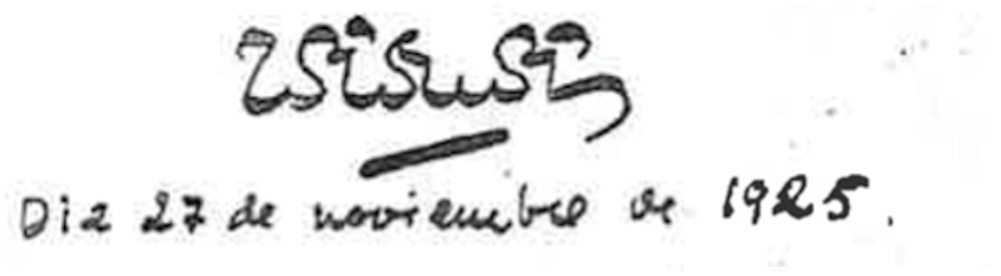
This connection between dreams and sexual otherness renders especially significant the fascination that the lullaby held for Lorca, Durán, Falla, and other homosexual composers of the time – both within and beyond Spain, including major figures such as Szymanowski (1882–1937).Footnote 55 In this regard, Durán’s Berceuse (a la manera de M. Ravel) para dormir a Federico cuando se vuelva pequeño is particularly compelling. Composed in 1925 for Lorca, this piece is a modernist miniature for two violins featuring a pianissimo cantabile melody accompanied by highly repetitive pizzicato ostinati. Durán weakens the harmonic drive through the compositional techniques discussed above. Beyond the feminine (motherly) connotations of the lullaby genre, Durán’s Berceuse displays several traits then regarded as semiotically feminine, or heterodoxically masculine, including a dolce character, soft dynamics, the absence of motivic work, and the aforementioned lack of harmonic–temporal drive. The unpublished manuscript features a word inscribed by Durán that mimics Arabic script, which appears to be his signature from that period (Figure 5).
Durán’s signature in the manuscript of Berceuse.

Evocation of gamelan music in the first movement of Francis Poulenc’s Concerto for Two Pianos (1931), rehearsal number 25 (orchestra tacet in this passage).

Given the homoerotic contexts in which the analysed works were composed, their distinctly non-teleological temporal frameworks can be understood as an instance of what has recently been termed queer temporalities. Emerging as a prominent concept in early twenty-first-century academic discourse, queer temporality refers to models of temporal and narrative organization that articulate forms of sexual otherness by challenging the linear conceptions of time embedded in (capitalist and heteropatriarchal) Western modernity since the Enlightenment. While these normative conceptions of time are typically goal-driven – culminating in climaxes, epiphanies, or significant transformations – queer temporalities instead privilege circularity, repetition, stasis, incompleteness, and fragmentation.Footnote 56
In their queer challenge to teleological chrono-normativity, the aforementioned Spanish works are closely linked to a body of Orientalist compositions from the 1930s and later, in which Francis Poulenc, Henry Cowell, John Cage, Lou Harrison, Colin McPhee, Benjamin Britten, and other non-heterosexual composers reimagined the repetitive, cyclical elements of traditional gamelan music as a means of expressing sexual difference. Early examples include the first movement of Poulenc’s Concerto for Two Pianos (1931), where musical time is momentarily ‘halted’ through the evocation of gamelan music (Example 11), and Cowell’s Ostinato Pianissimo (1934) for percussion ensemble, where gamelan-inspired musical elements provide a framework for generating non-teleological temporalities throughout.Footnote 57
Brett identified this corpus of 1930s works as pioneering in their expression of homosexuality through the reimagining of gamelan music.Footnote 58 My research, however, indicates that more than two decades earlier, Falla had already pursued a comparable approach in the aforementioned Chinoiserie (1909). This mélodie for voice and piano was composed while Falla acted as the teacher, performer, and piano accompanist of the lesbian painter, amateur singer, and wealthy patron Romaine Brooks, roles for which he received generous remuneration. The song appears to have been conceived with her in mind. Falla himself selected as the lyrics a 1838 poem by Théophile Gautier, whose gender-indeterminate voice extols the beauty of a young Chinese woman through exoticized depictions of her skin, eyes, feet, and nails. The poem’s potential for a lesbian-erotic reading was likely among the principal reasons Falla chose to set it to music and dedicate the resulting work to Brooks. In setting this poem to music, Falla drew upon materials from a transcription of the gamelan piece Gamelan-Goedjin (Danse javanaise), included in the book Les musiques bizarres à l’Exposition de 1900 (The Strange Musics at the 1900 Exposition).Footnote 59 Figure 6 shows the beginning of this transcription. This piece is entirely based on an anhemitonic pentatonic scale consisting of the pitch classes E–F#–A–B–D (an alternation of whole tones and minor thirds). Falla employs this scale as a referential collection throughout much of the mélodie, often adapting it to a diatonic context. Example 12 presents the first section of the song after the a-capella introduction.
Beginning of Gamelan-Goedjin (Danse javanaise), from Les musiques bizarres à l’Exposition de 1900, 11.

First section of Chinoiserie after the introduction (bb. 21–8).

Chinoiserie is part of a broader trend in French contemporary modernist music that borrowed from Javanese music, a movement in which Ravel and Debussy – Falla’s primary influences – also participated. In the history of homoerotic Orientalism, it stands out as one of the earliest instances in which gamelan music was reinterpreted in connection with homosexuality, here relating to Brooks. The song remains the only piece in which Falla directly engaged with the cultural imagery of the Far East.
Conclusion: dreaming of elsewhere
As Locke has convincingly argued, musical exoticism is not conveyed solely through well-established musical topoi. More often, musical elements that are not inherently exotic acquire exoticizing connotations through extra-musical factors such as titles, song texts, programmatic features, dramatic plots, iconographic elements, and the like. Moreover, specific contexts of composition, performance, or reception can also impart or reinforce an exoticist meaning to a work. Locke refers to this broader approach as the ‘All the Music in Full Context’ paradigm of musical exoticism.Footnote 60 This comprehensive perspective also offers the most effective framework for examining the homoerotic dimensions of the Orientalist works discussed in this essay.
These compositions acquired associations with non-normative sexualities primarily through the interplay of textual and contextual factors. Instances of homoerotic significance conveyed through textual features include Salazar’s use of Walter de la Mare’s homoerotic poem as the programmatic basis for his eponymous work, Durán’s invocation of Hafiz in the title of a love song dedicated to Lorca, and Falla’s setting of Gautier’s gender-ambiguous poem for Chinoiserie. The contexts in which these works were composed and received further inscribed them with meanings linked to sexual otherness. The most explicit examples are those created within the intimate framework of the composers’ romantic relationships and dedicated to their respective partners. In Rubaiyat, the inclusion of the aforementioned iconographic element in the published score reinforced the music’s homoerotic meaning among audiences attuned to its symbolic resonance. Noches en los jardines de España presents a similarly compelling case: although not composed within explicitly homoerotic biographical circumstances (at least, none that we are aware of), several factors aligned the work with feminine and queer subjectivities, shaping its early reception in particular milieus.
These strategies enabled homoerotic interpretations without precluding more general prescriptive (i.e., heteronormative) readings. Such an approach was essential, given that homosexual cultures of the period were profoundly shaped by stigma, secrecy (what we might anachronistically refer to as ‘the closet’), and the necessary sublimation of sexual difference. In other words, these composers did not aim to express sexual difference through the politicized, identity-driven frameworks that would come to characterize Western homosexual cultures in the wake of the sexual revolutions of the 1960s. Rather, their works performed an escapist function, conjuring an idyllic, utopian Orientalist imaginary in stark contrast to the rigid structures of their present.
The strain of Spanish musical modernism that combined Orientalist, Symbolist, and veiled homoerotic elements – as outlined by Salazar in the aforementioned 1923 article – proved relatively short-lived. By the early 1920s, Spanish musical modernism was increasingly shaped by a neoclassical ‘return to order’, characterized by emotional restraint, irony, and a distinctly Castilianist imprint, as exemplified by works such as Falla’s El retablo de Maese Pedro (1918–23) and Concerto for Harpsichord (1926), as well as Ernesto Halffter’s Sinfonietta (1925). The interwar preference for classical musical forms – intrinsically teleological in nature – along with the evocation of austere, virile Castile rather than sensual, feminine Andalusia, left little room for homoerotic reverie. This, however, does not mean that neoclassicism lacked avenues for the sublimation of sexual difference – something that recent studies on Poulenc’s interwar music have already shown. Rather, it indicates that these avenues, still largely unexplored in the Spanish context, differ from those examined in this article.Footnote 61
The appeal of Orientalist otherness to many non-heterosexual individuals in the early twentieth century neither means that all Orientalist compositions were conceived or received through homoerotic lenses, nor that all sublimations of homosexual desire inherently contained an Orientalist dimension. Nonetheless, Orientalism clearly played a significant role in shaping the emerging homosexual cultures of the educated classes during that time. This article therefore calls for a re-evaluation of early twentieth-century Orientalist music, both from Spain and beyond, in light of the new perspectives on sexuality and gender subjectivity that emerged in Europe at the turn of the century. This approach holds considerable historiographical potential for Spanish music, as the loss of its last colonies in 1898 – a watershed moment in both political and cultural terms – not only prompted a profound reflection on national identity (a theme already widely explored in the literature), but also provoked fundamental shifts in the understanding and artistic expression of masculinity in Spain. Within the broader European context, examining the culturally pivotal movement of musical Orientalism through the lens of emerging modern homosexual identities offers a valuable opportunity to uncover new insights into the largely unexplored yet essential connections between musical modernity and sexuality in the early twentieth century.
Acknowledgements
This publication is part of the Grant RYC2021-033651-I, funded by MCIN/AEI (10.13039/501100011033) and the European Union NextGenerationEU/PRTR. I would like to express my gratitude to music scholars Enrique Mejías, Mario Lerena, and two anonymous reviewers for their valuable feedback on an earlier version of this article. I am also deeply grateful to the Prieto family, as well as to Consuelo Carredano and Roberto Kolb, for their invaluable support in my research on Adolfo Salazar.








 Open access

