





Introduction
Turkey’s networked authoritarianism intensified following the 2013 Gezi resistance and the 2016 coup attempt, marked by expanding surveillance, centralized traffic control, and the criminalization of digital dissent. This article argues that its foundations, however, were laid much earlier through a slow and steady process of infrastructural and regulatory consolidation. Well before the overt authoritarian turn, the incremental concentration of Internet infrastructure, legal authority, and market power established the groundwork for rapid authoritarian expansion during moments of political crisis. In the early years of the Justice and Development Party (Adalet ve Kalkınma Partisi; AKP), these structural transformations in Turkey’s digital landscape unfolded with little resistance, enabling the gradual consolidation of critical infrastructures that would later underpin the resilience of networked authoritarianism. The Internet Conference of Turkey (Türkiye’de İnternet Konferansları; INET-TR), the only forum that brought together state actors, academics, civil society, and the private sector between 1995 and 2017, provided a rare venue for public discussion on Internet governance. As this article demonstrates, however, its agenda also remained shaped primarily by the developmentalist market narrative of the 1990s. How, then, did the marginalization of key infrastructural issues such as Internet service provider (ISP) monopolization, data localization, and the ownership of critical infrastructures contribute to the gradual formation of a distinctive form of networked authoritarianism in Turkey?
Following the Gezi protests of 2013 and especially after the failed coup attempt of 2016, the AKP did escalate censorship, surveillance, social media bans, arrests, and legal repression, normalizing state surveillance as a core tool of governance (Saka Reference Saka2019; Topak Reference Topak2019; Yeşil Reference Yeşil2016; Yıldız and Smets Reference Yıldız and Smets2019; Yücel Reference Yücel2024). Demonstrations such as Internetime Dokunma (Don’t Touch my Internet, in 2014) and alternative initiatives like the Ungovernance Forum (of 2014), which took place in parallel to the Internet Governance Forum in İstanbul (Ustun Reference Ustun2021), framed the Internet as a contested infrastructure capable of sustaining democratic communication outside the logic of state control. Slogans like Bırak Dağıtık Kalsın! (Keep it Distributed!) expressed an infrastructural understanding of the network not simply as a platform but as a socio-technical system whose decentralized architecture could resist the vertically integrated censorship long embedded in Turkey’s broadcast media (Ustun Reference Ustun2021). Supported by groups such as Alternative Informatics and legal scholars including Yaman Akdeniz and Kerem Altıparmak, these mobilizations foregrounded the infrastructural conditions of media freedom and underscored the need for autonomous, collective ownership of connectivity as a counter to networked authoritarianism.
A closer examination of expert debates prior to Gezi, however, reveals a different landscape, one in which the expert sphere remained disengaged mainly from the core infrastructural and regulatory issues shaping Turkey’s digital future. Discussions at the INET-TR in the early years of the AKP administration often focused on technical innovation, commercial expansion, freedom of expression, and digital inclusion. However, critical questions of ownership, governance, and state control were largely absent or marginalized. As state control over Internet infrastructure tightened in the late 2000s, effective resistance increasingly required technical expertise and institutional legitimacy. Without informed opposition to translate complex issues into public discourse, key developments were often misunderstood or ignored. This lack of accessible, timely resistance allowed the government to consolidate digital power at a critical moment when these changes could still have been challenged. What unfolded in post-Gezi Turkey was not a sudden rupture. This process consolidated a model rooted in long-standing control over core Internet infrastructure, reinforced by 1990s developmentalist ideologies that prioritized market expansion over the democratizing potential of distributed communication. In this sense, Turkey’s networked authoritarianism is not just a political outcome but a historical and material one, shaped by how the Internet was built, owned, and governed.
This article examines the dynamics of Turkey’s early Internet development because three interconnected layers of early ISP monopolization, governance debates, and legal centralization shaped its trajectory of networked authoritarianism. First, it shows how infrastructural power was consolidated in the 2000s as privatization and market concentration created a crony network around Turk Telekom, which came to dominate Turkey’s digital sovereignty. Second, it analyzes key debates at INET-TR conferences between 1995 and 2017. Third, it traces continuities across pre- and post-Gezi periods by mapping amendments to the 2007 Internet Law alongside INET-TR discussions, highlighting the legal consolidation of state control and shifting framings of digital regulation.
By tracing the historical development of Turkey’s digital infrastructure alongside expert debates and the regulatory landscape, this study scrutinizes how ownership and monopolization intersect with local socio-political dynamics. While prior work on networked authoritarianism in Turkey has emphasized censorship and platform control, this article foregrounds the infrastructural and regulatory foundations of the state’s digital power. It treats the network as a historically constructed and layered space shaped by legal, technical, economic, and social interventions. In doing so, it expands the scope of networked authoritarianism by demonstrating that the material conditions that sustain digital repression in Turkey – conditions that remain comparatively understudied – are central to understanding the durability and depth of authoritarian control (Deibert Reference Deibert2015; Howard and Hussain Reference Howard and Hussain2013; Truscello Reference Truscello2020).
Theorizing Turkey’s networked authoritarianism
The 2010s witnessed a wave of mass uprisings across the globe, many of which scholars have analyzed as digitally mediated forms of collective action. These movements frequently relied on the strategic and tactical use of Internet technologies for mobilization, coordination, and narrative framing (Castells Reference Castells2015; Gerbaudo Reference Gerbaudo2012; Tufekci Reference Tufekci2017). In response, numerous states advanced legislative initiatives to regulate domestic Internet traffic, often justifying their interventions with the principle of digital sovereignty (DeNardis Reference DeNardis2014). In Egypt, post-Arab revolts, cybercrime and anti-terror laws expanded state authority over online speech; in Russia, the “sovereign Internet” framework formalized state control over Internet infrastructure; and, in India, amendments to the Information Technology Act and the adoption of intermediary rules strengthened government oversight of digital platforms (Deibert Reference Deibert2015; Dergacheva and Tous-Rovirosa Reference Dergacheva and Tous-Rovirosa2021).Footnote 1 State control and corporate monopolies quickly suppressed digital resistance in these regions, and similar power dynamics have also been increasingly observed in Western contexts (Deibert Reference Deibert2015, 71). Turkey must be understood within this global shift, but its trajectory shows distinctive infrastructural roots.
The Internet surveillance system in “New Turkey”Footnote 2 represents a continuation and intensification of earlier mechanisms aimed at monitoring protests and dissent. As Topak (Reference Topak2019) observes, the AKP shifted from a “soft” authoritarian mode before the 2013 Gezi protests to a “hard” authoritarian model afterward, marked by expansive surveillance infrastructures, centralized regulatory authority, and punitive restrictions on online expression. Yeşil (Reference Yeşil2016) documents that signs of impending Internet restrictions appeared as early as June 2013, while protests were still ongoing. Responding to alleged cyberattacks, the government created the Center for Intervention in Cyber Events (Siber Olaylara Müdahale Ekibi; SOME) (Yeşil Reference Yeşil2016, 114). Even before Gezi, the AKP strategically co-opted individual privacy concerns to delegitimize social media, framing it as a threat to family values, social unity, and the moral fabric of society. During the protests, this discourse positioned digital platforms not only as external intrusions but also as cultural dangers to national cohesion (Tufekci Reference Tufekci2017, 132; Yeşil Reference Yeşil2016, 117).
Networked authoritarianism, defined as the adaptation of authoritarian regimes to the transformations brought by digital communications (MacKinnon Reference MacKinnon2011, 33), manifests in practices such as uniform resource locator (URL) and domain name server (DNS) bans, Internet shutdowns, throttling, content filtering, and content removal. These interventions extend beyond censorship, targeting digital dissidents to instill public fear about activism (Pearce and Kendzior Reference Pearce and Kendzior2012). Building on Deibert et al.’s (Reference Deibert, Palfrey, Rohozinski and Zittrain2010) foundational work, MacKinnon (Reference MacKinnon2011) identifies three “generations” of networked authoritarian control. The first relies on direct interventions, including filtering, surveillance, and manual censorship. The second reflects systemic measures, characterized by legal and regulatory frameworks that institutionalize digital control, or what MacKinnon (Reference MacKinnon2011, 43) calls the “construction of a legal environment legitimizing control.” The third collapses distinctions between online and offline repression, combining digital propaganda campaigns with coercive physical interventions to silence dissent (MacKinnon Reference MacKinnon2011, 43). In Turkey, all three generations are evident.
Unlike more centralized authoritarian models such as China or Russia, Turkey’s AKP had avoided building localized digital infrastructures such as national platforms or mandatory data storage at first, opting instead to preserve profitable relations with transnational platforms while strategically limiting their democratic potential. Later there was a turn toward digital sovereignty, formalized through the 2020 amendments to Law No. 5651, particularly Additional Article 4, which requires major social network providers to appoint local representatives, comply with rapid takedown and data-disclosure requests, and take the necessary measures to store Turkish users’ data within Turkey, with non-compliance punished through fines, advertising bans, and severe bandwidth throttling (Law No. 5651, 2022 amendment).Footnote 3 As Yeşil (Reference Yeşil2024, 55) argues in Talking Back to the West, such regulatory interventions are framed by Turkish authorities as challenges to Western dominance over media and communication infrastructures, even as they aimed to consolidate state power over digital communication and surveillance.
Al-Rawi (Reference Al-Rawi2021, 141) notes that contemporary multifaceted models highlight how authoritarian regimes increasingly fuse discursive and material practices. The AKP exemplifies this hybridity. As Yeşil and Sözeri (Reference Yeşil and Sözeri2017) show, the state has deployed punitive measures such as throttling social media platforms, executing temporary Internet shutdowns, and prosecuting oppositional users. At the same time, it has cultivated a pro-government digital sphere, amplifying state-aligned voices through coordinated online actors (Yeşil and Sözeri Reference Yeşil and Sözeri2017, 544). The AKP subdues dissent through targeted censorship (site throttling, blocks, and prosecutions) while simultaneously deploying astroturfing networks such as troll armies and coordinated “information operations” to amplify pro-government content and suppress oppositional voices (Yıldız and Smets Reference Yıldız and Smets2019). Although the authoritarian imperative to retain power and suppress dissent remains constant, the tools have been reshaped by digital technologies. As Yücel (Reference Yücel2024, 2) argues, contemporary autocrats leverage technological tools to extend their reach, enabling more effective surveillance, control over information flows, and manipulation of public opinion even in the face of resistance. He characterizes Turkey’s model as a form of hybrid network authoritarianism, where repressive digital controls coexist with limited, strategically allowed freedoms to preserve a façade of democratic legitimacy (Yücel Reference Yücel2024, 3) and demonstrates that the rise of deepfakes and artificial intelligence (AI)-generated videos has become a central tool in this strategy, manipulating public opinion by falsely portraying opposition candidates as linked to terrorism (Yücel Reference Yücel2024, 15).
Existing conceptual and theoretical models of Turkey’s networked authoritarianism, however, have tended to emphasize platform-specific interventions such as takedown requests, access blocks, and regulatory pressure on social media companies (Parks et al. Reference Parks, Goodwin and Han2017; Yeşil and Sözeri Reference Yeşil and Sözeri2017; Yücel Reference Yücel2024). These approaches have been crucial in demonstrating how the state constrains digital expression, yet they also reflect a broader tendency to focus on the visible, content-level operations of control. Consequently, the material conditions that enable such interventions received comparatively little focus. This gap reflects a wider inclination to treat Internet infrastructure as invisible, technical, or politically neutral, positioned behind the scenes and thus less urgent than highly visible forms of content control (Deibert Reference Deibert2015; Truscello Reference Truscello2020).
This article remedies that gap by foregrounding the material, political–economic, and regulatory foundations of Turkey’s digital sphere, showing how infrastructure, ownership, and legal architectures not only enable but actively shape authoritarian interventions, and by arguing that these structural conditions are central to the durability and depth of networked authoritarianism. What emerges is a form of authoritarianism embedded not only in ideology or reactive censorship but also in the material architecture of digital infrastructure. In Turkey, the early consolidation of ISPs, regulatory bodies, and domestic data flows created the foundation for a durable and flexible system of control, one capable of integrating emerging technologies such as AI-generated disinformation, algorithmic filtering, and deep packet inspection without systemic rupture. Rather than asserting full digital sovereignty through national platforms and infrastructure, the Turkish state has pursued a hybrid model: maintaining access to transnational platforms while exerting control through legal, bureaucratic, and infrastructural manipulation. In this context, the Internet functions not as a neutral utility but as a contested political and historical terrain, an infrastructural formation shaped by privatization, surveillance, and the entwined interests of state and capital (Mullaney et al. Reference Mullaney, Peters, Hicks and Philip2021; Truscello Reference Truscello2020). These dynamics are not isolated but embedded in a broader local and global history.
Çelik’s analysis of nineteenth- and early twentieth-century Ottoman communication systems shows that this condition has deep imperial precedents: European powers established dominance over postal services, transport routes, and print circulation through capitulatory agreements and commercial privileges, allowing them to control key communication infrastructures without formal colonial rule (Çelik Reference Çelik2023). These arrangements intensified economic dependency and positioned communication networks as instruments of imperial rivalry, while Ottoman reformers simultaneously sought to centralize and reclaim communications, especially through state-controlled telegraphy, as a means of asserting sovereignty and governing a fragmented empire (Çelik Reference Çelik2023). Read alongside the global history of the Internet, Çelik’s account highlights how contemporary digital infrastructures similarly emerge from imperial competition, legal asymmetries, and infrastructural control, reproducing older colonial dynamics through new technological forms rather than breaking from them.
Colonial and imperial legacies continue to influence both the development and governance of Internet infrastructure in the Global South. As Mullaney et al. (Reference Mullaney, Peters, Hicks and Philip2021) argues, “if colonial and imperial forces impact the Internet, it is vital to understand what that means for the critical infrastructures of digital communication worldwide.” Truscello (Reference Truscello2020, 82) similarly observes that “the Internet is now a pervasive infrastructural feature of global capitalism and its state accomplices,” with shutdowns and kill switches revealing that “the primary purpose of this infrastructure is to defend state power and capitalist commerce.” Understanding how digital authoritarianism consolidates thus requires moving beyond platform-centric or episodic frameworks to examine the long-term accumulation of infrastructural power, whether through slow institutional erosion or sudden legal and technical interventions.
This question becomes particularly salient when examining the historical and political–economic conditions that enable and sustain authoritarian trajectories online. Understanding the pace and structure of this consolidation requires attention to both long-term institutional erosion and the strategic interventions that accelerate centralization. In Turkey, this tension calls for closer scrutiny of how the restructuring of Internet infrastructure has produced an authoritarian configuration that is gradual in institutional decay yet abrupt in legal and digital enforcement. I approach networks as historically layered formations, best understood through the question of who owns, controls, and can contest the material infrastructure of domestic Internet traffic. Such infrastructural dominance does not emerge overnight, nor can it be fully explained by the AKP’s authoritarian turn after Gezi in 2013 or the coup attempt in 2016. Rather, it must be traced to earlier phases of Turkey’s digital development, particularly the transition between the first and second AKP administrations, when key political–economic decisions on privatization, regulation, and platform governance were first enacted.
Methodological framework
In this study, I weave together activist insights, archival reconstruction, and network mapping to reveal the material and discursive foundations of digital control in Turkey. This study utilizes secondary sources and online archives to trace the gradual development of material infrastructures and the emergence of networked authoritarianism in Turkey. It also draws on insights gained through my long-standing involvement in the country’s digital rights movement. As part of my fieldwork, I followed the work of Alternative Informatics (Alternatif Bilişim) between 2014 and 2016, an İstanbul-based collective and one of Turkey’s earliest advocacy groups focused on digital rights and Internet freedom. My field engagement included participant observation at their events, tactical workshops, and meetings, as well as during mobilizations such as the “Don’t Touch My Internet” rally and the Ungovernance Forum (Ustun Reference Ustun2021). This involvement provided access to the group’s internal archive of legal documents, press releases, campaign materials, and policy critiques. It also enabled access to the now-archived digital repository curated by Dr Mustafa Akgül at the Middle East Technical University (METU), a foundational figure in Turkey’s Internet infrastructure and governance discourse.
To guide this work, I draw on a methodology I developed and elaborated in earlier scholarship: cartographic ethnography (Ustun Reference Ustun2021). Cartographic ethnography is a multi-modal qualitative method that combines traditional ethnographic techniques, such as archival research and textual analysis, with network mapping. While inspired by Barassi’s (Reference Barassi2013) “ethnographic cartography,” which focused on human interactions within activist media networks, cartographic ethnography expands the analytical lens to include non-human actors, regulatory infrastructures, and the spatial–temporal layers of digital geographies. This approach views digital infrastructures not only as technical artifacts but as contested political terrains that are actively shaped by legal interventions, state–corporate alliances, and activist resistance (Donovan Reference Donovan2018). In practice, for this article this approach involved three iterative steps. First, I conducted close reading and coding of archival materials, namely INET-TR conference programs and panel papers. Second, I named actors and their relationships that later were translated into node-edge datasets on an Excel sheet. Third, these datasets were visualized and refined using Graph Commons, allowing patterns of centralization, brokerage, and clustering to emerge across time.Footnote 4
Drawing from Latour’s (Reference Latour2005) actor–network theory and feminist epistemologies that emphasize situated knowledge and reflexivity (Haraway Reference Haraway1988; Rose Reference Rose1997), this method resists the view of networks as neutral platforms. Instead, it foregrounds the infrastructural and legal configurations that govern information flows and condition the possibilities for resistance. This methodological orientation also aligns with digital ethnographic approaches that treat online archives and networks as lived field sites, dynamic spaces where material infrastructures, platforms, users, and governance regimes intersect (Burrell Reference Burrell2009; Hine Reference Hine2015; Lingel Reference Lingel2017; Pink et al. Reference Pink, Horst, Postill, Hjorth, Lewis and Tacchi2016). Unlike standard digital ethnography that often focuses on platforms or user communities, cartographic ethnography seeks to map power by visualizing the structural alignments between legal code, critical infrastructures, and digital dissent.
In this study, the use of cartographic ethnography serves not only to reconstruct the historical evolution of Turkey’s networked authoritarianism on a canvas of a timeline, but also to examine how experts, and the discourses they generate, interact with shifting technical architectures and legal frameworks. By mapping the archive of INET-TR conferences as a historically contingent discursive space and layering it with policy events and interventions, I provide a comprehensive relational analysis of how Turkey’s digital terrain has been restructured and contested over time.
The INET-TR archive consists of individual webpages for each year’s conference from 1995 to 2017, hosted by a rotating set of Turkish universities, including Hacettepe, İstanbul Bilgi, and Ege universities, and METU. These webpages collectively form a comprehensive and publicly accessible digital repository that chronicles the evolution of Internet governance discourse in Turkey. The archive contains a wide range of materials, including call-for-papers, conference programs, presentation abstracts, session descriptions, and policy-oriented white papers. It provides a valuable resource for analyzing the discursive, institutional, and technical dimensions of Turkey’s Internet development over two decades. For this study, I chronologically mapped the content of these annual conference websites. Each year’s content is hosted on separate websites and archived in a single format. Focus was given to the “pressing issues” identified by the organizing committees each year, which I treated as key thematic indicators of institutional concern. These topics were then visualized on Graph Commons, a collaborative network-mapping platform that enables interactive navigation and clustering of data. The resulting timeline overlays two analytical layers: a chronological record of national digital policy developments and the evolving institutional discourse reflected in the INET-TR programming. This mapping process made it possible to identify both persistent thematic patterns and long-standing silences, particularly regarding infrastructure ownership, regulatory consolidation, and data governance.
By approaching the Internet as a politically constructed infrastructure rather than a neutral medium, cartographic ethnography enables a layered, historically situated analysis of how authoritarian formations emerge through legal, technical, and institutional alignments. While this study is anchored in the Turkish context, the method offers a flexible framework for tracing the infrastructural conditions of digital power elsewhere, particularly in contexts where platform governance, state regulation, and infrastructural consolidation converge to shape the limits of dissent.
The making of a monopoly: Türk Telekom and the reshaping of Turkey’s ISP landscape
The historical development of Turkey’s digital infrastructure deviates significantly from dominant commercial narratives that equate the emergence of the Internet with decentralization, democratization, and civic empowerment. Turkey’s early adoption of Internet technologies followed a state-driven, technocratic model in which connectivity was embedded within existing centralized institutional logics. The resulting infrastructural regime privileged hierarchical control, bureaucratic oversight, and, eventually, corporate monopolization under conditions of state-enabled governance (Yeşil Reference Yeşil2016). In this section, I provide an overview of the ISP landscape because it is through backbone control that the Turkish government has consolidated power and established networked authoritarianism; I trace its evolution from academic origins and early state-led initiatives to the emergence of private ISPs and the eventual consolidation of infrastructural control through privatization, regulatory restructuring, and political appointments.
Turkey’s entry into the global Internet began on April 12, 1993, when engineers at the Middle East Technical University (ODTU) established the first transmission control protocol/Internet protocol (TCP/IP) connection to the National Science Foundation Network (NSFNET) backbone (Internet.org.tr 2018). This 64-kbps leased-line link marked the beginning of the country’s digital integration. The commercialization of Turkey’s Internet services quickly gained momentum in the mid-to-late 1990s. In 1996, Türk Telekom introduced TURNET, the first public access Internet backbone, which provided the foundation for commercial ISPs. Around the same time, private ISPs such as Superonline, E-Kolay, Ixir, and TurkNet entered the market. Despite this seeming liberalization, most ISPs continued to depend on infrastructure leased from Türk Telekom, which retained monopoly control over the backbone and fixed-line services (Saka Reference Saka2017; Wolcott and Çagıltay Reference Wolcott and Çagıltay2001, 134–138). Türk Telekom was formally separated from the state postal and telegraph entity (Posta Telgraf Telefon; PTT) in 1995, a corporatization that institutionalized the centralization of backbone control (Wolcott and Çagıltay Reference Wolcott and Çagıltay2001). The company subsequently expanded rapidly into fixed-line, global system for mobile communications (GSM), asymmetric digital subscriber line (ADSL), and cable services. GSM licenses were issued in 1998 to Turkcell and Telsim (later acquired by Vodafone), with Turkcell emerging as a central node in the national telecom ecosystem due to its vast subscriber base, mobile data infrastructure, and its role in carrying voice, short message service (SMS), and government service traffic (Yeşil and Aydınlı Reference Yeşil and Aydınlı2024, 19).
In 2005, a controlling 55 percent stake in Türk Telekom was sold to Oger Telecom, a Saudi–Dubai-based conglomerate, for US$6.55 billion. This was one of the largest privatizations in Turkey’s economic history, granting Oger full operational control over the country’s core infrastructure (Arab News 2005). Following Oger’s default on debt repayments in 2018, ownership was transferred to a consortium of creditor banks under the LYY holding company, though Türk Telekom’s infrastructural centrality remained intact (Bradley Reference Bradley2018). In parallel, the government began asserting influence over the sector by appointing political loyalists to the boards of major telecom companies, including Turkcell. In 2020, the Turkish Wealth Fund (Türkiye Varlık Fonu) restructured Turkcell’s shareholder rights to acquire effective control, a move publicly justified in terms of national interest but widely understood as a strategy to exert indirect political control over strategic infrastructure (Türkiye Varlık Fonu 2020).
The ISP landscape in Turkey has since been characterized by high market concentration and political alignment. A small number of conglomerates – most notably Turk Telekom, Superonline (a subsidiary of Turkcell), and Vodafone Net – dominate fixed-line broadband services (Yeşil and Aydınlı Reference Yeşil and Aydınlı2024, 19). These three providers collectively control more than 90 percent of the market, establishing a de facto oligopoly over digital access infrastructure (Yeşil and Aydınlı Reference Yeşil and Aydınlı2024, 19). Smaller ISPs operate under Bilgi Teknolojileri ve İletişim Kurumu (Information and Communication Technologies Authority; ICTA)-issued licenses, but their market share remains negligible due to structural constraints such as limited access to backbone infrastructure, bandwidth quotas, and prohibitive compliance costs (İfade Özgürlüğü Derneği 2022). This concentration of infrastructural power has unfolded alongside a broader political–economic strategy pursued by the ruling AKP in post-Gezi Turkey.
Legal and bureaucratic frameworks further consolidated infrastructural control even before the authoritarian turn in 2013. The ICTA, established in 2000 and significantly restructured in 2008, was empowered to enforce mandatory data retention, content blocking, deep packet inspection (DPI), and domain-name filtering. Law No. 5651, first introduced in 2007 and amended in 2014 and 2020, granted the ICTA expansive powers to order the removal or blocking of online content without prior court approval, enabling real-time information control (Freedom of Expression Association 2022). These included mandates for data retention, DNS filtering, URL- and IP-level blocking, and real-time surveillance. Combined with infrastructural dominance, these legal instruments enabled the state to enforce digital compliance. Technical interventions such as DNS manipulation, bandwidth throttling, and IP-level blacklisting have become routine mechanisms for restricting access to politically sensitive content in post-Gezi Turkey.
Within this regulatory environment, Turkey’s ISP ecosystem exemplifies a vertically integrated model of digital governance, in which critical infrastructures function not merely as an economic asset but as strategic instruments of political control. In this configuration, connectivity ceases to be a neutral technical capacity and becomes instead a means by which the state surveils, censors, and governs the real-time circulation of information.
Expert debates: historical shifts in INET-TR’s focus and priorities
This section introduces the INET-TR conferences, annual gatherings held between 1995 and 2017 that served as foundational venues for shaping Turkey’s Internet governance discourse. Conferences were described as the following in the main page of the archive:
Since 1995, the Internet Conference series has been organized in Turkey with the aim of bringing together groups concerned with the Internet to promote, develop, and debate the Internet in all its dimensions, to increase societal productivity through Internet technologies, and to direct public attention as much as possible toward this field. These conferences are national in scope. The conferences are organized in collaboration between the Internet Technologies Association (Internet Teknolojileri Dernegi) and a local host university, which the Permanent Organizing Committee selects based on the university’s human resources and conference venue infrastructure.Footnote 5
As explained in the Methodological framework section, I applied a cartographic ethnographic approach to analyze this archive: I tagged and mapped each year’s conference themes using network mapping on Graph Commons, generating a relational timeline that traces shifts in governance concerns, institutional priorities, and silences over time. This serves as the backdrop to the following discussion on the role and limits of expert networks in Turkey’s evolving Internet landscape. The INET-TR digital archive, originally curated by Mustafa Akgül, serves as the central repository for Turkey’s annual Internet conferences from 1995 to 2017. Each year’s conference has its own dedicated webpage within the archive – still accessible via the INET-TR site – containing program schedules, session titles, presentation abstracts, white papers, and event announcements. These pages form a comprehensive record of the technical, policy, and civic debates that have shaped Internet governance in Turkey over the past two decades.
Drawing on these archival materials, I constructed what I call a cartography of data: a diagrammatic canvas that maps the evolution of conference themes alongside key infrastructural and legislative shifts. I focused particularly on the topics selected by the organizing chairs each year as that conference’s central issues. These were linked on the canvas to significant regulatory developments – such as amendments to Internet Law No. 5651 – alongside structural transformations, including the privatization of Türk Telekom and the expansion of the ICTA’s authority. Using the Graph Commons platform, this network visualization traces not only temporal progression but relational patterns across Turkey’s socio-technical landscape, revealing how Internet governance debates intersect with state power, infrastructure ownership, and public discourse.
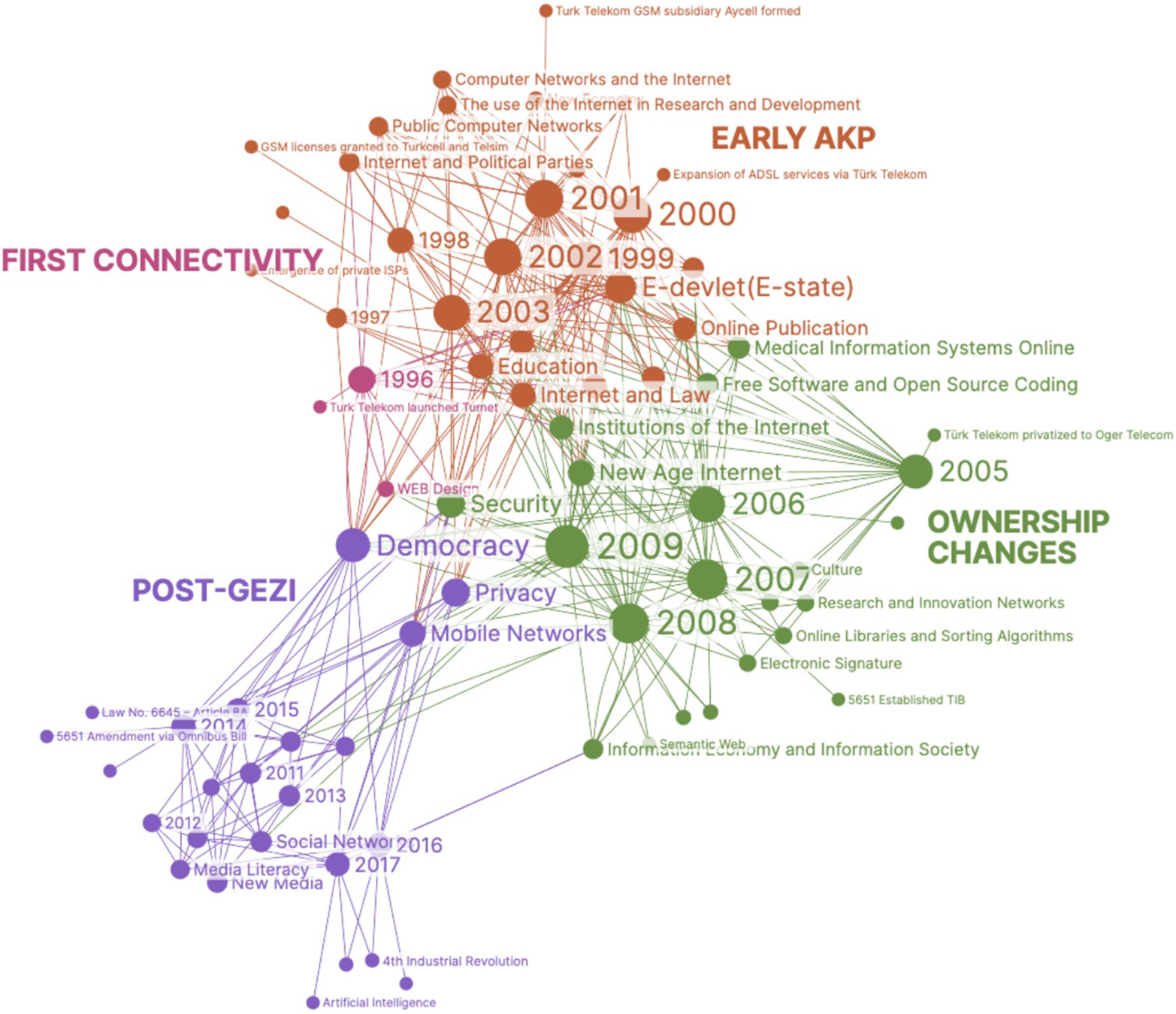
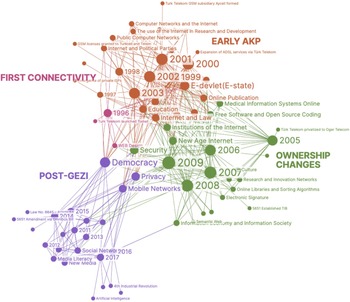
The visual map produced through my cartographic mapping overlays two distinct yet interrelated matrices: (1) the discursive trajectory of expert knowledge shaped through the annual INET-TR conferences, and (2) the material and regulatory transformation of Turkey’s digital infrastructure. Each node on the map represents either a conference year, a thematic topic, or a pivotal event in the development of national Internet policy and infrastructure. Figures 1 and 2 visualize a relational timeline that maps how expert discourse at the INET-TR conferences evolved over time. Conference years and thematic issues are introduced as nodes on a shared canvas, allowing their relationships to be traced longitudinally and situated within broader patterns of continuity and change. In Figure 1, blue nodes represent conference years, green nodes indicate the thematic tags associated with each year’s program, and red nodes mark key legal amendments to Turkey’s communication and Internet laws. Node size reflects the recurrence of themes across multiple years, while proximity indicates thematic co-occurrence within the same temporal contexts. Clusters highlight dominant continuities and organizing frames within expert debates. In Figure 2, node colors differentiate four distinct timelines, allowing shifts in thematic emphasis and regulatory developments to be compared across periods. The figures show how expert discourse accumulated density and coherence over time while remaining largely disconnected from the infrastructural and regulatory transformations unfolding in parallel.
Internet Conferences of Turkey (INET-TR) map of annual topics, 1996–2017.
Source: Author’s cartographic analysis based on the INET-TR archive

Internet Conferences of Turkey (INET-TR) topics map – timeline clusters.
Source: Author’s cartographic analysis based on the INET-TR archive
By linking these elements through relational vectors, the map surfaces both presence and absence – what topics gained visibility and traction, and what structural shifts remained underarticulated or ignored within expert discourse.
In the early years of the conferences (1996–2001), the thematic clusters gravitated toward education, infrastructure, public networks, and democratic participation. This pattern reflects a broader atmosphere of technocratic optimism in the mid-1990s, during which time the Internet was widely imagined as a vehicle for modernization and transparency. Themes such as “Institutions of the Internet,” “E-devlet (E-government),” and “Democracy” appear frequently and are densely connected across multiple years. However, these discussions largely occurred in the absence of a critical analysis of ownership structures, access asymmetries, or long-term governance strategies.
The clusters map shows that after 2001 – a year that marked the transfer of Internet governance from the Turkish Post (PTT) to the Ministry of Transport (Ulaştırma ve Altyapı Bakanlığı) and the creation of the ICTA – there was an expansion in thematic scope. Discussions began to include security, privacy, electronic signature, and copyright. Nevertheless, this discursive shift was not accompanied by explicit recognition of the emerging legal and infrastructural transformations that would soon centralize state control over digital networks.
Crucially, the 2005 privatization of Türk Telekom to Oger Telecom, one of the most consequential events for Turkey’s digital sovereignty, is not mirrored in the dominant conference themes. Likewise, key developments such as the creation of TTNet in 2006, the rebranding of Türk Telekom in 2016, and the passage of Article 8A in 2015 – which granted the state sweeping censorship powers – remain marginal or completely absent from the conference record. This discursive lag suggests that expert networks failed to intervene in, or even reflect upon, fundamental shifts in infrastructure control.
As the map moves into the post-Gezi era (2013–2017), a new set of topics – censorship, media literacy, social networks, privacy, and security – begin to cluster. This shift indicates growing awareness of surveillance and content regulation; however, even these discussions often appear decoupled from the structural mechanisms enabling them. For example, despite amendments to Law No. 5651 in 2007, 2014, and 2020 – which significantly expanded the government’s capacity for surveillance, data retention, and content blocking – legal and infrastructural critiques remained largely peripheral in conference discourse.
The spatial layout of the map makes visible this pattern of thematic saturation without structural critique. Highly recurrent topics such as “Democracy” and “Internet and Law” are connected to nearly every year, yet their proximity to major policy shifts or ownership changes is weak or absent. Even as new themes like “Artificial Intelligence” and the “Fourth Industrial Revolution” emerge in the later years, their appearance does not correlate with deeper interrogations of the political economy of Internet infrastructure, or the increasing role of conglomerate ISPs aligned with the state.
Through this archival analysis, I argue that the INET-TR conferences – though valuable as sites of deliberation – gradually evolved into institutionally safe spaces rather than challenging state narratives. While the network map reveals a growing complexity in thematic content, it also demonstrates a lack of discursive evolution in relation to the intensification of networked authoritarianism in Turkey. The map, then, is not just a tool for tracing thematic recurrence; it is a visual critique of expert silences and a record of missed opportunities for contestation. It allows us to see how digital policy debates have been shaped, contained, or foreclosed by the very institutions meant to foster dialogue. It also underscores how Turkey’s trajectory toward networked authoritarianism was not only enabled by legal and infrastructural changes, but also by the epistemic limitations of expert discourse, which too often mirrored the reactive posture of state developmentalism rather than anticipating or systematically resisting it.
Legalizing control: the making of Turkey’s Internet surveillance law
Law No. 5651, originally enacted in 2007, laid the legal groundwork for regulating online content under the pretext of safeguarding public morality and national security (Akgül and Kırlıdog Reference Akgül and Kırlıdog2015; Yeşil Reference Yeşil2016). The law authorized judicial and administrative institutions – such as the Telecommunications Communication Presidency (Telekomünikasyon İletişim Başkanlığı, TIB) and the ICTA – to block websites accused of hosting content related to obscenity, suicide, drug use, or defamation of Atatürk (Akdeniz and Altıparmak Reference Akdeniz and Altıparmak2008). While its early focus was largely limited to content moderation and URL-level censorship, the law’s underlying regulatory logic paved the way for more expansive and discretionary powers in subsequent years.
A turning point came in 2011, when the ICTA issued a regulation requiring all ISPs to offer users one of four pre-set filtering profiles: “family;” “child;” “domestic;” and “standard.” Though not a formal amendment to Law No. 5651, this administrative action catalyzed public backlash. In May 2011, the “Don’t Touch My Internet” protests drew tens of thousands to the streets, with over 600,000 users joining an online campaign against the proposed measures. The protest brought together a broad spectrum of civil society actors, including Ekşi Sözlük, Lambda, the Linux Users Association of Turkey, and grassroots digital rights activists (Yeşil Reference Yeşil2016, 116–118). Yet despite its size and diversity, the movement failed to halt the implementation of the filtering regime or foster sustained, cross-sectoral resistance.
After the 2013 Gezi protests, which exposed the Internet’s capacity for political mobilization, the AKP’s regulatory approach shifted decisively. The 2014 amendment to Law No. 5651 marked a substantial expansion of state authority: the ICTA was granted the power to order content takedowns without prior court approval, and all ISPs were required to retain user traffic data for two years, sharing it with Türk Telekom (Freedom of Expression Association 2022, 8–9). This amendment also ushered in deeper infrastructural interventions, including the deployment of centralized Internet exchange points (IXPs) and the widespread use of DPI technologies. These tools allowed for content-level monitoring and throttling, particularly during periods of political unrest. This transition from content regulation (2007–2011) to infrastructural capture (2014–2020) was made possible by the monopolistic structure of Turkey’s ISP ecosystem. Dominated by a handful of conglomerates – primarily Türk Telekom and Turkcell – the sector had, by this point, been consolidated through privatization, regulatory shielding, and political appointments. The AKP’s strategic placement of loyalists on the boards of these telecom giants and the entrenchment of a state-affiliated crony network facilitated legal interventions without significant bureaucratic friction.
The 2015 addition of Article 8A further consolidated executive power, authorizing the Prime Minister or relevant ministers to issue immediate blocking orders subject only to retroactive judicial review. In 2020, the state introduced another pivotal amendment, requiring all social media platforms with more than one million daily users in Turkey to appoint a local legal representative. These representatives were mandated to comply with takedown requests within forty-eight hours and submit biannual reports to the ICTA. Non-compliance triggered escalating penalties, ranging from advertising bans to bandwidth throttling (Kurban and Sözeri Reference Kurban and Sözeri2012). Major platforms such as Facebook, Twitter, and YouTube soon capitulated.
These infrastructural and legal interventions have been accompanied by a nationalist discourse that frames digital control as a matter of territorial sovereignty. Erdoğan’s 2019 launch of the Digital Turkey (Dijital Türkiye) initiative crystallized this logic: “Just as every inch of our country’s land is valuable to us at the cost of our lives, we should view every byte of data with the same importance” (Savas Reference Savas, Calp and Butuner2022, 61). This rhetoric has normalized the state’s vertically integrated regime of digital sovereignty, where legal mandates, technical systems, and corporate infrastructure converge to extend state control over data, platforms, and users alike. The 2022 amendments to Law No. 5651, enacted through Law No. 7418, also known as the Disinformation Law, strengthened state oversight of digital communications by expanding the obligations of social network providers and reinforcing enforcement mechanisms. The amendments enhanced the authority of the Erişim Sağlayıcıları Birliği (Access Providers Association), tightened local representative and reporting requirements for platforms, and broadened the scope of content subject to removal or access restriction, particularly in relation to public order and national security (Law No. 5651, as amended by Law No. 7418, Official Gazette, 18 October 2022).Footnote 6
Law No. 5651, to sum up, first enacted in 2007, gradually expanded from content-level censorship to deep infrastructural control, with successive amendments empowering the ICTA to impose takedowns, mandate data retention, and enforce compliance through ISPs and global platforms. Enabled by the monopolistic ISP landscape and legitimized through nationalist discourses of digital sovereignty, these measures consolidated a vertically integrated regime of networked authoritarianism in Turkey.
Conclusion
Over the past two decades, Turkey’s networked authoritarianism has expanded as result of the infrastructural conditions and legal capture of the country’s Internet backbone. Under the AKP, this approach has evolved gradually but purposefully. While its more visible manifestations appeared after the 2013 Gezi protests and the 2016 coup attempt, the groundwork was laid much earlier through the consolidation of control over ISPs, online service platforms (OSPs), and domestic traffic routing. By embedding loyal actors within key infrastructural nodes, the AKP has developed a layered system of control that includes legal mandates, centralized oversight, surveillance mechanisms, and an increasingly sophisticated digital toolkit – ranging from content throttling and shutdowns to algorithmic filtering and AI-powered monitoring. Internet shutdowns during moments of unrest have become a normalized tactic. Rather than relying solely on visible censorship, this strategy reshapes the underlying conditions of connectivity, turning the Internet in Turkey from a space of dissent into a tightly managed communications environment.
The analysis presented in this study, grounded in both historical and cartographic methods, demonstrates how the entanglement of infrastructure, law, and discourse enabled the Turkish state to assert control over cyberspace without severing ties to the global Internet or creating nationalized online service providers. Visualizing thematic trends in the INET-TR conferences alongside key moments in regulatory and infrastructural change revealed not only what was discussed but what remained conspicuously absent, particularly concerning surveillance, ownership monopolies, and the expansion of the state’s digital reach. The silences within expert discourses mirrored broader political conditions in which dissent was often reactive, fragmented, and ultimately insufficient to counter the institutional momentum of authoritarian digital policy.
At the same time, this study is shaped by certain limitations. As a macro-level analysis of infrastructural and regulatory shifts, it does not fully account for the lived experiences, motivations, and internal dynamics of the actors within expert networks. By focusing on structural patterns and institutional discourse, it may overlook the affective, informal, and sometimes contradictory ways in which individuals engaged with or resisted the state’s digital policies from within these networks. Additionally, while cartographic ethnography offers a powerful framework for visualizing legal–infrastructural entanglements, its abstraction can obscure how repression is experienced on the ground, particularly by those directly impacted by surveillance, shutdowns, and legal targeting. Future research could build on this work by integrating micro-level ethnographic approaches that center the everyday practices and embodied realities of both experts and digital dissidents.
This paper contributes to the literature on networked authoritarianism by highlighting the infrastructural and legal foundations that underpin the consolidation of state control over time. While much of the existing research has emphasized platform-specific interventions – such as takedown requests, access blocks, and regulatory pressure on social media companies (Yeşil and Sözeri Reference Yeşil and Sözeri2017; Yücel Reference Yücel2024) – the underlying material conditions that enable such interventions have received comparatively little attention. This gap reflects a broader tendency to treat Internet infrastructure as either invisible, technical, or politically neutral, positioned behind the scenes and thus less urgent than highly visible forms of content control (Deibert Reference Deibert2015; Truscello Reference Truscello2020). Yet as this article shows, the early monopolization of Internet service provision, the centralization of domestic traffic routing, and the legal entrenchment of regulatory authority (e.g. through the ICTA and Law No. 5651) have played a decisive role in enabling censorship, surveillance, and shutdowns (Topak Reference Topak2019; Yıldız and Smets Reference Yıldız and Smets2019). Building on MacKinnon’s (Reference MacKinnon2011) typology of networked authoritarianism and Deibert et al.’s (Reference Deibert, Palfrey, Rohozinski and Zittrain2010) account of infrastructural power, this study argues that Turkey’s digital governance model exemplifies a hybrid authoritarian strategy – one that relies not only on direct repression or content-based regulation, but also on long-term control embedded in ownership structures, bureaucratic frameworks, and technical systems. By centering this infrastructural dimension, the paper contributes to media infrastructure studies and research on Global South Internet governance, illustrating how infrastructural capture has enabled the normalization of digital repression within a globally integrated communications environment.
This case thus offers critical insights into the emerging logic of networked authoritarianism in the Global South. Turkey illustrates how a regime can maintain outward-facing digital modernization – participating in global infrastructures and economies – while domestically curating a repressive media environment underpinned by legal coercion, infrastructural monopolization, and ideological narratives of national digital sovereignty. In such contexts, digital resistance cannot be reduced to platform use or content production alone; it must also engage the technical and institutional foundations of the Internet itself. Ultimately, the Turkish example underscores the urgency of cultivating resilient, autonomous expert networks and critical infrastructural knowledge to contest authoritarian digital regimes. It also points to the need for transnational solidarity among digital rights actors, especially in semi-authoritarian settings where the line between infrastructure and ideology is increasingly blurred. Without such coordinated efforts, the democratic potential of decentralized networks risks being systematically eroded – repurposed not for collective empowerment, but for the consolidation of power.
AI. The author used an AI-assisted language tool for limited editorial support during the drafting process, specifically for language refinement and structural clarity. The AI tool did not contribute to the development of arguments, data construction, interpretation, or analysis. The author takes full responsibility for the content of the manuscript.
Acknowledgments
This work is shaped through ongoing networks of care, solidarity, and intellectual exchange. I remain grateful to those who, in different ways, contributed to its formation through their support, insight, and presence.
Competing interests
The author reports there are no competing interests to declare.


 Open access

