

Introduction
With a population almost evenly split between Muslims and Christians, Nigeria is home to some of the most religious people in the world. “Neither religion is dominant over the other, but religion is dominant over secularism” (Campbell and Page, Reference Campbell and Page2018, 75).Footnote 1 The contrast between the two religious groups is highlighted by the fact that religion is practiced along ethnic lines (Nche, Reference Nche2023). Moreover, the religious distribution of Nigeria’s population varies geographically, with Muslims predominantly located in the northern region and Christians in the southern region. This pattern stems from the northern region’s history as an Islamic caliphate for a century prior to British rule while Christian missionary activities were mainly concentrated in the south (see Harnischfeger, Reference Harnischfeger2006; Iwuchukwu, Reference Iwuchukwu2013; Tuki, 2025a; Vaughan, Reference Vaughan2016).
This historical and regional context provides a foundation for understanding the exceptionally high levels of religiosity observed among Nigerians today. Campbell and Page (Reference Campbell and Page2018, 69) observed that “Religiosity permeates public life; events big and small are routinely ascribed to divine intervention. Sickness and other misfortunes are the result of spiritual, rather than physical causes.” A survey conducted by the Pew Research Center in 2018 found that 96% of Nigerians consider religion to be “very important” in their lives (Poushter et al., Reference Poushter, Fetterolf and Tamir2019). This finding is corroborated by data from the World Values Survey (WVS) (Haerpfer et al., Reference Haerpfer, Inglehart, Moreno, Welzel, Kizilova, Diez-Medrano, Lagos, Norris, Ponarin and Puranen2022) conducted in the same year: some 93% of Nigerians consider religion to be “very important” in their lives, while 5% consider it “rather important.” The WVS also shows that 99% of Nigerians believe in God, 90% attend religious services at least once a month, 94% pray at least once a day, and 70% either “strongly agree” or “agree” that their religion is the only acceptable one.
To further contextualize these high levels of religiosity, it is useful to compare them with other countries where the WVS was conducted in 2018, such as Australia, Germany, Brazil, and China. Some 29% of Australians consider religion to be either “very important” or “rather important” in their lives, while 56% report believing in God. In Germany, 39% regard religion as important, while an identical share (56%) express belief in God. Brazil exhibits substantially higher levels of religiosity, with 85% considering religion important and 96% affirming belief in God. By contrast, China reports much lower levels, with only 13% viewing religion as important and 17% indicating belief in God.
While historical, cultural, and demographic factors explain some of Nigeria’s high religiosity, contemporary conditions such as insecurity may also play a role. Why are Nigerians so religious? Could their religiosity, to some extent, stem from the threat of insecurity that they contend with in their daily lives? Nigeria has been struggling with violent conflicts for the past three decades, earning the notorious reputation of being one of Africa’s most unstable countries. In fact, the 2024 Global Terrorism Index (GTI) ranked Nigeria as the fourth most affected country by terrorism in Africa (Institute for Economics and Peace 2024). Religion has fueled some of the most violent conflicts in Nigeria. As Maier (Reference Maier2002, 143) observes, “holy wars are almost by definition bloody affairs because they spring from the very depths of the human soul. The combatants invoke the name of God to justify their cause, but by doing so, they question their enemy’s place in the living world.”
Religious conflicts in Nigeria include the Shariah Crisis that occurred in Kaduna State in 2000.Footnote 2 The conflict began when the state governor introduced Shariah law. Christians strongly opposed the law, seeing it as a step toward Muslim domination, while Muslims favored it. The ensuing Muslim-Christian violence caused over 2,000 deaths (Human Rights Watch, 2003). Other religion-related conflicts in Nigeria include the persistent Muslim-Christian clashes in Plateau State (Eke Reference Eke2022a; Higazi, Reference Higazi2008; Krause, Reference Krause2011; Madueke and Vermeulen, Reference Madueke and Vermeulen2018), the Boko Haram insurgency (Anugwom, Reference Anugwom2019; Weeraratne, Reference Weeraratne2017), and the violent clashes between nomadic herders and sedentary communities over land and water resources, which have increasingly assumed a religious character (Christian Association of Nigeria, 2018, 2023; Parsons, Reference Parsons2023; Tuki, Reference Tuki2025b).
Beyond religious and insurgent conflicts, political competition also shapes the interreligious dynamics in Nigeria. To fully grasp the competitive, and at times adversarial, relationship between Christians and Muslims in Nigeria, the scramble for political power cannot be ignored. Alao (Reference Alao2022, 12) observes that “The question of political leadership is also critical to religion. In the zero-sum relationships among the various ethnic groups in Nigeria, which group will produce the leader is often a contentious issue.”Footnote 3 Similarly, Agbiboa and Maiangwa (Reference Agbiboa and Maiangwa2013, 383) assert that “elections and political appointments are areas where the interplay between religion and politics are most clearly demonstrated in Nigeria.” For instance, in 2023, a video surfaced showing Nasir El-Rufai, the governor of Kaduna State, openly acknowledging that he frequently considered religion when making employment decisions. He also boasted that he had ensured all key government positions were held by Muslims. He expressed his desire for Muslims to maintain political dominance in the state until Christians accepted their subordinate status (ACN International, 2023; Sahara TV, Reference Sahara2023). This statement incited anger among Christians, who reiterated their concerns about Muslim domination.
Despite the centrality of religion to conflict in Nigeria, this study focuses on the reverse relationship. Extensive research has examined how religion leads to violence (e.g., Agbiboa, Reference Agbiboa2013; Agbiboa and Maiangwa, Reference Agbiboa and Maiangwa2013; Bienen, Reference Bienen1986; Çancı and Odukoya, Reference Çancı and Odukoya2016; Krause, Reference Krause2011; Tuki, Reference Tuki2024a; Ukiwo, Reference Ukiwo2003). Instead, this study investigates whether exposure to violent conflict prompts Nigerians to place greater importance on God in their lives. To capture potential heterogeneity, the analysis also examines whether this relationship varies based on gender (men vs. women), religious affiliation (Muslims vs. Christians), and region of residence (north vs. south).
Although religiosity can be assessed through organizational religious engagement (e.g., attending church or mosque services), non-organizational religious engagement (e.g., personal practices like praying or reading sacred texts), and individuals’ self-assessment of their own level of religiousness (i.e., subjective religiosity) (Holman and Podrazik, Reference Holman and Podrazik2018), this study employs the subjective approach because it is more efficient. For instance, people may engage in ritualistic activities like church or mosque attendance and reading sacred texts out of pressure from family members and coreligionists, without necessarily believing in God or in the efficacy of these rituals. Moreover, it is possible to believe in the existence of God or a higher power without belonging to any particular religion. In this study, religiosity is measured using an item in the WVS asking respondents to rate the importance of God in their lives on a ten-point ordinal scale ranging from “not at all important” to “very important.” Exposure to violent conflict is assessed using the cumulative number of conflict incidents occurring within a 30 km radius of respondents’ dwellings. To construct this measure, QGIS software is used to exploit the geocoded dimensions of the WVS and conflict data from the Armed Conflict Location and Event Data Project (ACLED) (Raleigh et al., Reference Raleigh, Andrew, Håvard and Joakim2010).
Regression analysis reveals that, as conflict exposure increases, so does the importance Nigerians attach to God in their lives. This likely occurs because the existential threat posed by insecurity prompts reliance on God as a coping strategy. This positive correlation holds when the data are disaggregated by religious affiliation (Muslims and Christians), gender (men and women), and region of residence (North vs. South), with models estimated for each subsample. To assess external validity of the results, data from Ethiopia, a country that has also experienced Muslim-Christian conflicts, are used to re-estimate the regression models. Surprisingly, the analysis reveals a negative correlation between conflict exposure and religiosity. Thus, while the Nigerian case supports research suggesting that traumatic experiences can induce religiosity by fostering resilience and enabling people to make sense of their sufferings (e.g., Atari-Khan et al., Reference Atari-Khan, Covington, Gerstein, Herz, Varner, Brasfield, Shurigar, Hinnenkamp, Devia, Barrera and Deogracias-Schleich2021; Lusk et al., Reference Lusk, Terrazas, Caro, Chaparro and Puga Antúnez2021; Pertek, Reference Pertek2022), the Ethiopian case aligns with studies showing that trauma may erode religiosity or lead individuals to abandon their faith (e.g., Janoff-Bulman, Reference Janoff-Bulman1992; Leo et al., Reference Leo, Izadikhah, Fein and Forooshani2021).
The remainder of the study is organized as follows: In the following section, I discuss the trend of violent conflict in Nigeria. I then review the literature on the nexus between religiosity and traumatic experiences and outline the hypotheses. Next, I introduce the data and describe the variables used to estimate the regression model. The regression results are then presented and discussed, after which comes the conclusion that summarizes the study and outlines its policy implications.
Trend of violent conflicts in Nigeria
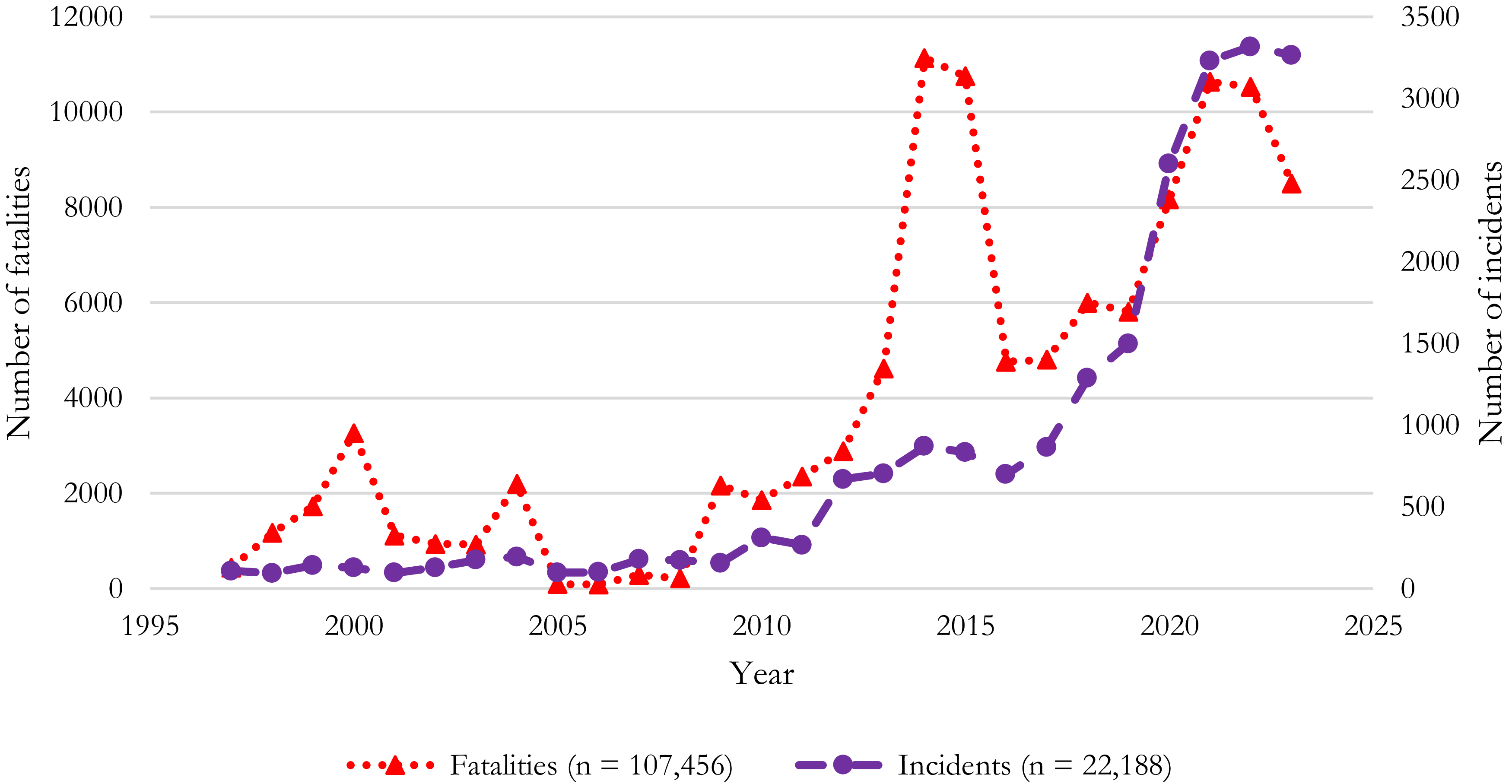
Figure 1, based on data from ACLED (Raleigh et al., Reference Raleigh, Andrew, Håvard and Joakim2010), illustrates the trend of violent conflict incidents and associated fatalities in Nigeria from 1997 to 2023. A total of 22,188 incidents occurred during this period, causing 107,456 fatalities. Conflict incidence rose steadily from 2016 to 2022 and then dipped slightly in 2023. Notably, the 3,265 incidents recorded in 2023 were the second highest in Africa that year, surpassed only by Sudan. The number of fatalities also rose steadily from 2010 and peaked in 2014 (n = 11,136), after which it dipped slightly in 2015 before plummeting in 2016 (n = 4,758). However, by 2023, the number of fatalities had risen to 8,505.
Violent conflict incidents and associated fatalities in Nigeria. Note: The figure displays the incidence of violent conflict in Nigeria from 1997–2023 alongside the associated fatalities. The dotted line, which is affiliated with the y-axis on the left, shows the annual fatalities, while the dashed line, which is affiliated with the y-axis on the right, shows the annual conflict incidents. The x-axis shows the year. Violent conflicts are defined as incidents that fall under any of the following three categories: battles, violence against civilians, and explosions/remote violence.

To understand these national-level trends, it is important to examine the specific types of conflict and actors that drive them. Most conflict incidents, especially after 2009, involve the radical Islamist group Boko Haram, which rejects Western values and seeks to establish a state that operates strictly under the tenets of Islam (Adesoji, Reference Adesoji2010; Anugwom, Reference Anugwom2019). Violent clashes between nomadic herders and sedentary communities (especially those engaged in crop cultivation) which have ravaged Nigeria during the past two decades, also account for a significant number of the incidents. Although many scholars argue that the adverse effects of climate change, such as droughts and rising temperatures, underlie farmer-herder conflicts by depleting land and water resources and intensifying competition (Ehiane and Moyo, Reference Ehiane and Moyo2022; Lenshie et al., Reference Lenshie, Okengwu, Ogbonna and Ezeibe2021; Madu and Nwankwo, Reference Madu and Nwankwo2021), recent studies have shown that these conflicts also have a notable religious dimension (Parsons, Reference Parsons2023; Tuki, Reference Tuki2026a). While nomadic herders are predominantly Muslims, the sedentary farmers on the other side of the conflict may be either Muslims or Christians. Overall, these conflicts are more likely to occur in areas where the farming population is predominantly Christian, reflecting the interaction of ethnoreligious identities with resource competition (Tuki, Reference Tuki2026b).
In addition to insurgency and resource-based conflicts, criminal and secessionist forms of violence have intensified in recent years, contributing further to Nigeria’s overall conflict burden. Armed banditry and ransom-driven abductions have been on the rise in Nigeria during the past decade (Ojewale, Reference Ojewale2024; Aina et al., Reference Aina, Ojo and Oyewole2023), accounting for a significant share of conflict incidents, particularly after 2017. Moreover, the fight for secession in Nigeria’s Eastern Region, spearheaded by neo-Biafran groups such as the Indigenous People of Biafra (IPOB), has turned violent and assumed religious undertones (Agbo, Reference Agbo2024; Nche, Reference Nche2023; Tuki, Reference Tuki2024a).
As these diverse forms of violence have escalated across the country, public perceptions of safety have deteriorated correspondingly. A 2020 Afrobarometer survey shows that 76% of Nigerians consider the country to be unsafe to live in. When asked to assess the government’s performance in preventing and resolving violent conflicts, 73% rate it poorly. Furthermore, 71% expect the country to become less safe over the next five years. These perceptions highlight the societal consequences of prolonged and multifaceted insecurity, setting the stage for exploring how such conditions may influence other aspects of Nigerian life, such as religiosity.Footnote 4
Literature review and hypotheses
Some studies have examined the relationship between exposure to violent conflict and religiosity. In a study conducted in Israel, Zussman (Reference Zussman2014) found that political violence emanating from the Arab-Israeli conflict had a positive effect on religiosity: individuals who had been exposed to political violence were more likely to consider themselves religious. This effect was observed among both Jewish and Muslim Israelis. In another study also conducted in Israel, Shai (Reference Shai2022) found that people who were exposed to the war between Israel and Hezbollah or who were residing in war-affected areas had a higher level of religiosity than those who were not exposed to the conflict. He further compared religiosity before and after the war, revealing a noticeable increase, particularly among individuals with lower levels of education and those who were initially less religious. He concluded that religiosity acted as a coping mechanism to deal with the negative impacts of the war. Analyzing survey data spanning Uganda, Sierra Leone, and Tajikistan, Henrich et al. (Reference Henrich, Bauer, Cassar, Chytilová and Purzycki2019) found that exposure to war has a positive effect on religiosity. Specifically, individuals who had experienced war tended to remain engaged in religious activities even several years after the conflict ended. The study by Du and Chi (Reference Du and Chi2016), which analyzed global data, supports these findings by demonstrating a positive correlation between exposure to war and religiosity.
However, the immediate threat of conflict may not be the only factor driving religiosity. Even when people are not directly exposed to danger, they can be affected indirectly—for instance, through family members or kin living in the conflict zone. Using the German Socio-economic Panel (SOEP) dataset, Van Tubergen et al. (Reference Van Tubergen, Kosyakova and Kanas2023) examined how conflicts in the origin country influenced religiosity among Syrian, Afghan, and Iraqi refugees residing in Germany. They found that refugees from regions with higher conflict-related deaths tended to pray more frequently, especially when they had family members or relatives in the conflict zone.
Some studies have concentrated specifically on the role of religiosity in alleviating psychological trauma among military personnel. Cesur et al. (Reference Cesur, Freidman and Sabia2020) investigated how combat service impacted the religiosity of United States military personnel deployed to Iraq or Afghanistan. They found that servicemen in combat roles were more likely to attend religious services and engage in personal prayer than those deployed without combat experience. In a study involving 54 Israeli soldiers who returned from combat, Israel-Cohen et al. (Reference Israel-Cohen, Kaplan, Noy and Kashy-Rosenbaum2016) found that religious soldiers managed war-related trauma more effectively than non-religious soldiers. Aflakseir and Coleman (Reference Aflakseir and Coleman2009) studied 78 disabled Iranian war veterans from the Iran–Iraq War (1980 and 1988) and found that religious beliefs helped veterans cope with physical disabilities and war-related trauma.
Another strand of research has examined religious coping among refugees. In a qualitative study across Italy, Poland, and Spain, Oviedo et al. (Reference Oviedo, Seryczyńska, Torralba, Roszak, Del Angel, Vyshynska, Muzychuk and Churpita2022) interviewed 94 Ukrainians displaced by the Russia-Ukraine War. They found that prayer functioned as a form of “psychological capital,” helping refugees cope with war-induced trauma. Similarly, Pertek (Reference Pertek2022) studied Sub-Saharan African refugee women in Tunisia who had been victims of gender-based violence and trafficking. She found that direct relationships with God and prayer were critical to survival, and some women also used fasting as a means to strengthen their spiritual connection and have their prayers answered. The positive effect of religiosity on resilience has been documented among refugees of Pakistani and Somali origin in Nepal (Thomas et al., Reference Thomas, Roberts, Luitel, Upadhaya and Tol2011), refugees from Central America and Mexico migrating to the United States (Lusk et al., Reference Lusk, Terrazas, Caro, Chaparro and Puga Antúnez2021), adolescent refugees in Malaysia (Chow et al., Reference Chow, Hashim and Guan2021), unaccompanied minors in Ireland (Ní Raghallaigh and Gilligan, Reference Ní Raghallaigh and Gilligan2010), refugees in the Netherlands (Fadhlia et al., Reference Fadhlia, Sauter and Doosje2022; Sleijpen et al., Reference Sleijpen, Mooren, Kleber and Boeije2017), Karen (Burmese) refugees in the United States (Muruthi et al., Reference Muruthi, Young, Chou, Janes and Ibrahim2020), Syrian refugees in the United States (Atari-Khan et al., Reference Atari-Khan, Covington, Gerstein, Herz, Varner, Brasfield, Shurigar, Hinnenkamp, Devia, Barrera and Deogracias-Schleich2021; Hasan et al., Reference Hasan, Mitschke and Ravi2018; Hassan et al., Reference Hassan, Ventevogel, Jefee-Bahloul, Barkil-Oteo and Kirmayer2016; Yalim and Chapple, Reference Yalim and Chapple2024) and in the United Kingdom (Alachkar, Reference Alachkar2022), Eritrean refugees in Norway (Abraham et al., Reference Abraham, Lien and Hanssen2018), and Sudanese refugees in Australia (Schweitzer et al., Reference Schweitzer, Greenslade and Kagee2007).
Some studies have explored the relationship between religiosity and resilience among patients facing illness. Fradelos et al. (Reference Fradelos, Latsou, Mitsi, Tsaras, Lekka, Lavdaniti, Tzavella and Papathanasiou2018) studied 152 breast cancer patients in Greece and found that those with advanced-stage disease were more religious than those whose with early-stage disease. They also observed a positive correlation between religiosity and resilience. Choi and Hastings (Reference Choi and Hastings2019) found that religion helped African American diabetic patients manage their condition. One patient said, “I think God keeps me strong enough to come and fight and come to my doctor’s appointment” (Choi and Hastings, Reference Choi and Hastings2019, 14), while another saw his suffering as a test from God: “So whatever He [God] got for me, maybe He wants me to be able to hold up something and be strong for His glory, I guess, so He got to put some stress on me” (Choi and Hastings, Reference Choi and Hastings2019, 12). Other studies have shown similar effects in coping with natural disasters such as hurricanes (Alawiyah et al., Reference Alawiyah, Bell, Pyles and Runnels2011; Cherry et al., Reference Cherry, Sampson, Nezat, Cacamo, Marks and Galea2015), earthquakes (Bentzen, Reference Bentzen2019; Mesidor and Sly, Reference Mesidor and Sly2019; Sibley and Bulbulia, Reference Sibley and Bulbulia2012; Smith et al., Reference Smith, Bernal, Schwartz, Whitt, Christman, Donnelly, Wheatley, Guillaume, Nicolas, Kish and Kobetz2014), tsunamis (Holmgaard, Reference Holmgaard2019), floods (Cherry et al., Reference Cherry, Calamia, Elliott, McKneely, Nguyen, Loader, Miller, Sampson and Galea2023; Sipon et al., Reference Sipon, Nasrah, Nazli, Abdullah and Othman2014), and tornadoes (Lim et al., Reference Lim, Liu, Egnoto and Roberts2019), as well as disease outbreaks (Bentzen, Reference Bentzen2021; Upenieks and Ellison, Reference Upenieks and Ellison2022).
In the Nigerian context, where violent conflicts are persistent and state capacity is weak, the existential threat posed by violent conflict may generate a sense of helplessness. This sense of helplessness may lead individuals to seek comfort and protection in God, forming the basis of the first hypothesis tested in this study:
H1: Exposure to violent conflict positively correlates with the importance Nigerians attach to God in their lives.
The studies examined so far have primarily focused on how religiosity can mitigate the negative impacts of misfortune and traumatic experiences. However, the relationship between traumatic experiences and religiosity is not unidirectional. A growing body of research suggests that trauma can also undermine religiosity and, in some cases lead to a loss of faith (Janoff-Bulman, Reference Janoff-Bulman1992). “People with exposure to trauma…may either relinquish their religious beliefs or elaborate upon these in a continued attempt to preserve their beliefs, thus increasing their beliefs” (Leo et al., Reference Leo, Izadikhah, Fein and Forooshani2021, 164). Hussain et al. (Reference Hussain, Weisaeth and Heir2011) conducted a study among 1,180 Norwegian tourists who had been exposed to the 2004 tsunami to determine the effect that this experience had on their level of religiosity. Their findings were mixed: while most respondents’ religiosity remained unaffected by the traumatic experience, it led to stronger religious beliefs in 8.3% of the respondents and weaker beliefs in 5.2% of them. The decline in religious beliefs was particularly notable among younger respondents, those with post-traumatic stress, and individuals who had been significantly exposed to the disaster. Kennedy and Drebing (Reference Kennedy and Drebing2002) discovered that devout evangelical adults in the United States who experienced physical or sexual abuse were more likely to report religious doubts and feelings of distance from God. Similarly, Ben-Ezra et al. (Reference Ben-Ezra, Palgi, Sternberg, Berkley, Eldar, Glidai, Moshe and Shrira2010) conducted a study among 111 Jewish women, 51 of whom were sexual trauma victims. They found that about half of the women who had been victimized “changed their religious perception toward secularism, thus becoming less religious” (Ben-Ezra et al., Reference Ben-Ezra, Palgi, Sternberg, Berkley, Eldar, Glidai, Moshe and Shrira2010, 10). This leads to the second hypothesis that this study seeks to test:
H2: Exposure to violent conflict negatively correlates with the importance Nigerians attach to God in their lives.
Data and methodology
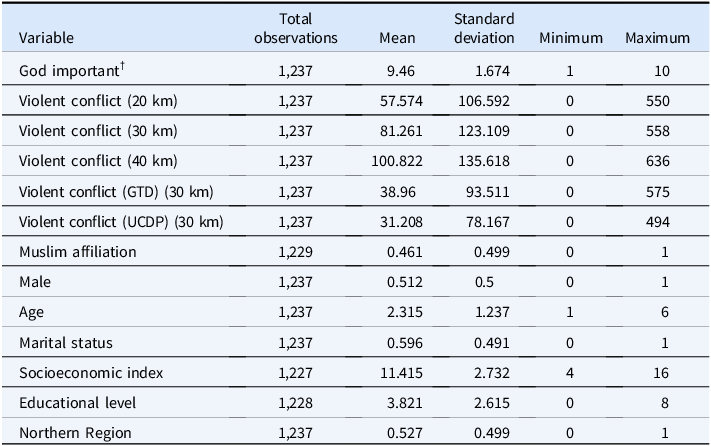
This study relies on data from Wave 7 of the WVS conducted in Nigeria in 2018.Footnote 5 The dataset, which consists of 1,237 observations, is representative of the country’s adult population. Respondents were aged 16 and older, with a gender distribution of 51% male and 49% female. The sample covers each of Nigeria’s 36 states and the Federal Capital Territory (Abuja), except for Ebonyi. The following section discusses the variables used to estimate the regression models, while Table A1 in the Appendix reports the summary statistics for these variables.
Operationalization of the variables
Dependent variable
God important. This variable is derived from the question, “How important is God in your life?”, with the responses measured on a ten-point ordinal scale ranging from “1 = not at all important” to “10 = very important.” I treated “don’t know” and “no answer” responses as missing observations, applying this rule to all variables derived from the WVS.
Explanatory variable
Violent conflict. This measures the total number of violent conflict incidents occurring within a 30 km radius of respondents’ dwellings from 1997 to 2017. Higher number of incidents within the radius suggests greater exposure to violent conflict. Violent conflicts are operationalized as incidents that fall under any of the following three categories: battles, violence against civilians, and explosions/remote violence. I consider the total number of conflict incidents within the radius because I am particularly interested in the cumulative effect of conflict. Moreover, some studies have shown that the effect of conflict on perception tends to persist over time (e.g., Hunt, Reference Hunt2010; Tuki, Reference Tuki2024a). The start year of 1997 was chosen because the ACLED dataset (Raleigh et al., Reference Raleigh, Andrew, Håvard and Joakim2010) begins in that year. Incidents that occurred after 2017 were excluded to create a lag that attenuates the potential problem of reverse causation.
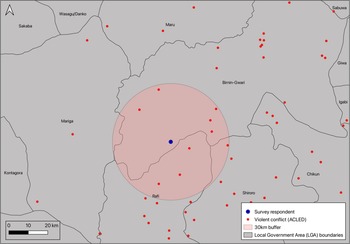
Conflict exposure was measured using buffers instead of the local government area (LGA) administrative boundaries because using the latter approach poses two main challenges. First, it would require associating each respondent with the total number of incidents in the LGA where they reside. This approach, which assumes that all respondents within an LGA are equally exposed to violence, may be misleading, because incidents in contiguous LGAs may be closer to respondents’ dwellings than those in the specific LGA where they reside. As shown in Figure 2, a respondent may reside in Birnin-Gwari, yet some conflict incidents in Shiroro and Rafi LGAs are closer to their dwelling than some incidents in Birnin Gwari. Moreover, conflict spillovers and perceptions of insecurity are likely to operate across geographic space rather than strictly along administrative boundaries. For this reason, spatial buffers are used to capture localized exposure to violence independent of administrative units. Second, using LGA boundaries would limit variation in the conflict exposure variable. Notably, 98% of respondents had at least one conflict incident within the 30 km buffer; 50% had at least 30 incidents.
To ensure that the results are not influenced by the size of the buffers used in constructing the conflict exposure measure, two additional measures using buffers with radii of 20 km and 40 km were developed. Furthermore, to ensure that the results are not biased by the choice of data source, two more measures of conflict exposure were constructed using data from the Global Terrorism Database (GTD) (National Consortium for the Study of Terrorism and Responses to Terrorism 2022)Footnote 6 and the Uppsala Conflict Data Program’s Georeferenced Events Database (UCDP-GED) (Sundberg and Melander Reference Sundberg and Melander2013).Footnote 7
Measuring conflict exposure. Note: The figure visualizes the geolocation of a hypothetical respondent, the 30 km buffer, the administrative boundaries of the local government areas (LGAs, i.e., municipalities), and the geolocations of the violent conflict incidents.

The UCDP-GED dataset records only conflict incidents that resulted in at least one fatality, whereas the ACLED and GTD datasets do not impose any fatality thresholds—i.e., they include all events regardless of whether fatalities occurred. Because the UCDP-GED dataset is available starting from 1989, all conflict incidents from 1989 through 2017 were considered when developing the conflict exposure variable. According to the GTD Codebook (2021, p. 11), a terrorist attack is any incident involving “the threatened or actual use of illegal force and violence by a nonstate actor to attain a political, economic, religious, or social goal through fear, coercion, or intimidation.” Because the GTD data are available starting from 1970, all terrorist incidents from 1970 through 2017 were considered while developing the measure for conflict exposure. Importantly, the steps used to construct the alternative explanatory variables based on the UCDP-GED and GTD datasets were identical to those applied earlier with the ACLED data.
Control variables
Socioeconomic index. This is an additive indicator that evaluates the socioeconomic status of the households to which respondents belong. It was derived from the question, “In the last 12 months, how often have you or your family: (a) Gone without enough food to eat? (b) Gone without needed medicine or treatment that you needed? (c) Gone without a cash income? (d) Gone without a safe shelter over your head?” Responses were measured on a four-point ordinal scale ranging from “1 = often” to “4 = never.” I summed the ordinal values assigned to the response categories across the four items to develop an index ranging from 4 to 16, where higher scores indicate better socioeconomic conditions. The four items had a Cronbach’s alpha statistic of 0.74, indicating strong internal reliability. I controlled for socioeconomic status because it can confound the relationship between the dependent and explanatory variables. Poor socioeconomic conditions might elevate the risk of conflict by reducing the opportunity cost of engaging in violence (DoandIyer, Reference Do and Iyer2010; Von Uexkull, Reference Von Uexkull2014). Some studies have found that as socioeconomic conditions improve, religiosity tends to decrease (Barber, Reference Barber2013, Reference Barber2015; Storm, Reference Storm2017). Other studies have found the opposite effect (Buser, Reference Buser2015).
Educational level. This variable measures the highest level of education that respondents have attained on a scale with nine ordinal categories ranging from “0 = no formal education/koranic education” to “8 = university-level education with a degree.” Educational attainment might also be a confounder because individuals with low education might lack critical thinking skills and may therefore be more susceptible to manipulation by political elites or armed groups that use propaganda to incite violence or war. Low education may also be associated with feelings of social and political exclusion, which can foster grievances and resentment, ultimately increasing the likelihood of engaging in violence (Sklad and Park, Reference Sklad and Park2017; Thyne, Reference Thyne2006). Education has also been found to be negatively correlated with religiosity (Arias-Vazquez, Reference Arias-Vazquez2012; Schwadel, Reference Schwadel2015).
Northern region. This is a dummy variable that takes a value of 1 if a respondent resides in a state in Nigeria’s northern region and 0 if they reside in a southern state. The distribution of violent conflicts across Nigeria varies geographically, with most of them concentrated in the Northern region. Data from ACLED (Raleigh et al., Reference Raleigh, Andrew, Håvard and Joakim2010) reveals that of the 22,188 violent conflict incidents recorded in Nigeria between 1997 and 2023, 71% occurred in Northern Nigeria, while the remaining 29% took place in the southern region. The higher conflict incidence of Northern Nigeria may lead to its population exhibiting higher levels of religiosity.
Muslim affiliation. This is a dummy variable that takes the value of 1 if a respondent is Muslim and 0 if Christian. To allow for a more direct comparison between Muslims and Christians, the 7 respondents who belonged to neither of the two major religions were treated as missing observations. This resulted in a marginal decrease in the number of observations.
Male. This variable takes a value of 1 if a respondent is male and 0 if female. Research has shown that religiosity may follow gendeed patterns (e.g., Hackett et al. Reference Hackett, Cooperman, Schiller and Cornibert2016; Miller and Hoffman Reference Miller and Hoffmann1995; Trzebiatowska and Bruce, Reference Trzebiatowska and Bruce2012).
Married. This is a dummy variable that is coded 1 if a respondent is currently married or has ever been married, and 0 otherwise. Prior research indicates that marital status may influence religiosity (e.g., Blekesaune and Skirbekk, Reference Blekesaune and Skirbekk2023).
Age. This variable measures respondents’ age on a six-point ordinal scale ranging from “1 = 16–24 years” to “6 = 65 and more years.” Research indicates that religiosity tends to increase withage, possibly linked to a heightened awareness of mortality (e.g., Bengtson et al., Reference Bengtson, Silverstein, Putney and Harris2015; Hackett et al., Reference Hackett, Kramer and Schiller2018).
Analytical technique
To examine the relationship between exposure to violent conflict and religiosity, I consider a model of the following general form: ${\gamma _i} = \;{\beta _0} + \;{\beta _1}Violent\;conflic{t_{1997 - 2017}} + {\beta _2}{\varphi '_i} + \;{\delta _i}$
where γ i is the dependent variable, which measures the amount of importance that Respondent i attaches to God in their life. φ′ i is a vector of control variables, β 0 is the intercept, β 1 and β 2 are the coefficients of the explanatory and control variables, respectively, and δ i is the error term. I estimate the model using ordinary least squares (OLS) regression. The analysis is conducted using a two-step process: first, I estimate regression models using the full sample. Next, I disaggregate the data by religious affiliation (i.e., Christians and Muslims), gender (males and females), and region of residence (north and south), and estimate models for each subsample.
Results and discussion
Full sample analysis
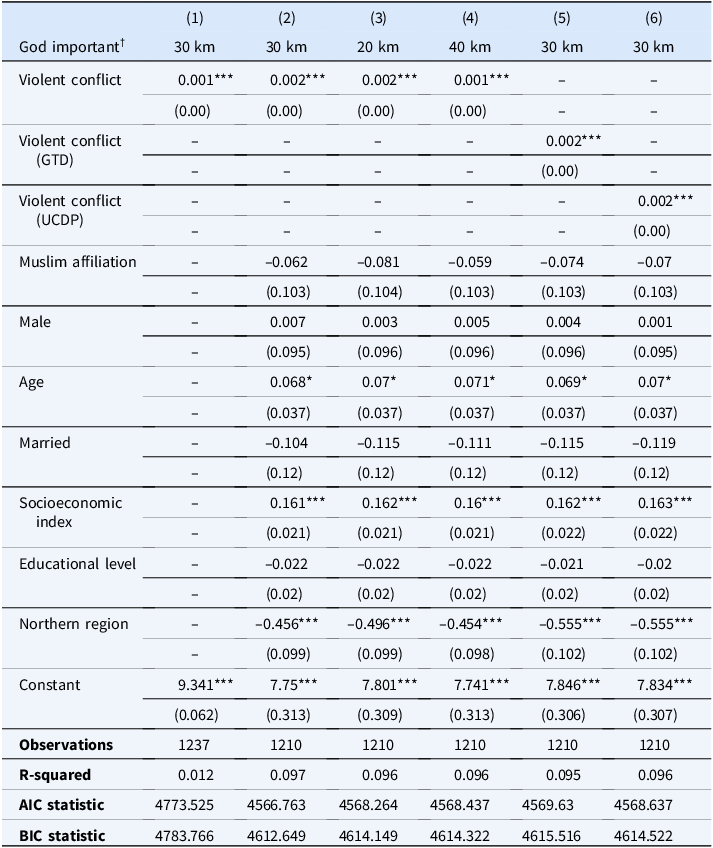
Table 1, based on the full sample, reports the results of regression models examining the relationship between violent conflict and religiosity. In Model 1, which includes only violent conflict, the variable carries a positive coefficient and is statistically significant at the 1% level. This result supports Hypothesis 1, which posits that exposure to conflict prompts Nigerians to attach greater importance to God in their lives. This is likely because reliance upon God enables individuals to cope with the existential threat posed by violent conflict and to make sense of their challenging circumstances.
OLS models regressing religiosity on violent conflict in Nigeria (full sample)

Note: Robust standard errors are in parentheses, † is the dependent variable, *** p < 0.01, ** p < 0.05, * p < 0.10. Violent conflict is measured using buffers with a radius of 30 km in all models except in models 3 and 4 where the buffers have radii of 20 km and 40 km, respectively. All models are estimated using ordinary least squares (OLS) regression.
Building on Model 1, Model 2 introduces control variables to account for other factors that might influence religiosity. Violent conflict remains significant at the 1% level and retains its positive coefficient, although the magnitude increases from 0.001 to 0.002. Moreover, the AIC statistic declines from 4,773 to 4,566, indicating that Model 2 has a better fit than its predecessor. Among the control variables, only age, socioeconomic condition, and residence in the Northern Region reach statistical significance. The positive coefficient associated with age suggests that individuals tend to attach greater importance to God as they get older, likely because they become more conscious of their mortality (Bengtson et al., Reference Bengtson, Silverstein, Putney and Harris2015; Hackett et al., Reference Hackett, Kramer and Schiller2018). The negative coefficient for northern region indicates that, compared to individuals living in southern Nigeria, those residing in the north attach less importance to God in their lives. The positive coefficient for socioeconomic index implies that as individuals’ socioeconomic conditions improve, they place greater importance on God in their lives. This contrasts with evidence from Europe where higher socioeconomic status has been associated with a decline in religiosity (e.g., Storm, Reference Storm2017). A plausible explanation for this finding is that, once material needs are satisfied, individuals may seek meaning and purpose in life through religion, turning to faith for existential answers.
In addition to these significant controls, several variables did not reach statistical significance, revealing interesting patterns regarding demographic characteristics. The statistical insignificance of the indicator for religious affiliation suggests that Muslims do not differ from Christians in their level of religiosity. Similarly, the statistical insignificance of gender indicates that there is no meaningful difference in religiosity between men and women. This contrasts with research from the United States and global studies which find that women exhibit higher levels of religiousity than men (e.g., Hackett et al., Reference Hackett, Cooperman, Schiller and Cornibert2016; Miller and Hoffman Reference Miller and Hoffmann1995; Trzebiatowska and Bruce, Reference Trzebiatowska and Bruce2012), as well as studies in Israel showing that men are more religious than women (Schnabel et al., Reference Schnabel, Hackett and McClendon2018). The statistical insignificance of marital status suggests that married individuals do not differ from their unmarried counterparts in terms of religiosity, contradicting previous research reporting a positive correlation between marriage and religiosity (e.g., Blekesaune and Skirbekk, Reference Blekesaune and Skirbekk2023). Likewise, the statistical insignificance of educational level suggests that educational attainment does not independently influence religiosity, contrasting with studies that identify a positive correlation between education and secularization (e.g., Albrecht and Heaton, Reference Albrecht and Heaton1984; Arias-Vazquez, Reference Arias-Vazquez2012; Schwadel, Reference Schwadel2015).
To ensure that the observed relationship between violent conflict and religiosity is robust, I conduct some checks. Models 3 and 4 estimate the full model using alternative measures of conflict exposure with radii of 20 km and 40 km. The significant positive coefficient associated with these variables indicate that the main results are not influenced by the choice of buffer size used to construct the explanatory variable. Furthermore, Models 5 and 6 show that the main results are also robust to alternative measures of conflict exposure based on data from the GTD and UCDP-GED. Taken together, these findings provide additional support for Hypothesis 1.
Subsample analysis and external validity
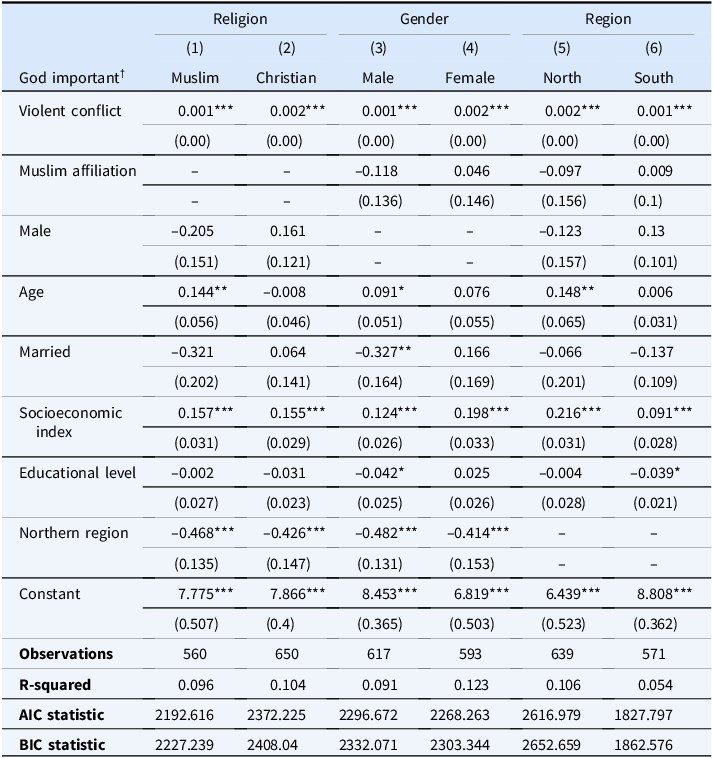
To determine whether the relationship between violent conflict and religiosity varies by religious affiliation, gender, and region of residence, I disaggregate the data accordingly and estimate models for each subsample. Table 2 reports the results. As shown in Models 1 and 2, which are based on the Muslim and Christian subsamples, violent conflict carries a statistically significant positive coeffcicient in both groups, consistent with Hypothesis 1. However, the magnitude of the association between violent conflict and religiosity is larger among Christians than among Muslims. This difference is particularly notable because, on average (i.e., independent of conflict exposure), Muslims do not differ statistically from Christians in terms of their overall level of religiosity (see results in Table 1). The reasons underlying this heterogeneity warrant further investigation.Footnote 8
OLS models regressing religiosity on violent conflict in Nigeria (subsample analysis)

Note: Robust standard errors are in parentheses, † is the dependent variable, *** p < 0.01, ** p < 0.05, * p < 0.10. Violent conflict is measured using buffers with a radius of 30 km. All models are estimated using ordinary least squares (OLS) regression.
Turning to gender differences, in Models 3 and 4, which are estimated using the male and female subsamples, respectively, violent conflict retains a statistically significant positive coefficient in both models. Moreover, the magnitude of the association between violent conflict and religiosity is larger among women than among men. The stronger association observed among women might be related to the gendered differences in the experience of violence. Some studies have shown that women and men do not experience violence in the same way (e.g., Denov and Richard-Guay Reference Denov and Ricard-Guay2013; Nieto-Valdivieso, Reference Nieto-Valdivieso2017; Ssali and Theobald, Reference Ssali and Theobald2016; Van der Haer and Brown, Reference Van der Haer and Brown2025; Young et al., Reference Young, Kovnick, Korinek and Huu Minh2022). This pattern also warrants further investigation.Footnote 9
A comparable pattern is observed when the data are disaggregated by region of residence. In Models 5 and 6, the positive correlation between conflict exposure and religiosity persists among respopndents living in the northern and southern regions, respectively. However, the magnitude of the association is larger among individuals in the north than among those in the south. This is unsurprising because the incidence of violence is higher in the former region than in the latter one. For instance, attacks perpetrated by Boko Haram are clustered in the northern state of Borno. Moreover, the states of Benue, Plateau, and Kaduna, which are also northern states, record the highest incidence of farmer-herder conflicts among Nigeria’s 36 states (Anugwom, Reference Anugwom2019; Tuki, Reference Tuki2025a).
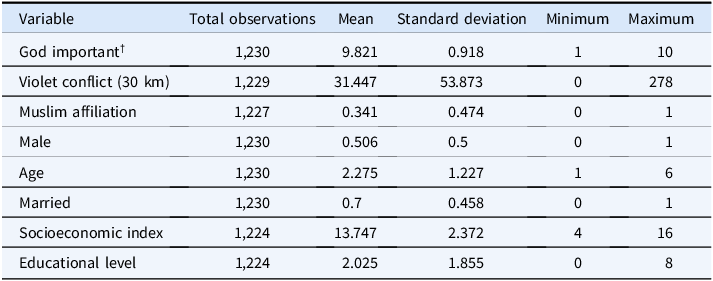
Having examined within-country variation, I now turn to external validation of these findings. To achieve this, I estimate some models using the WVS data from Ethiopia, a country which, like Nigeria, has also withnessed a rising incidence of Muslim-Christian conflict (United Østebø, Reference Østebø2023; Nations, Reference Nations2022). However, unlike Nigeria, where the population is almost evenly divided between members of the two religious groups, Christians constitute a significant majority in Ethiopia, accounting for 67% of the population, while Muslims account for 31% (United States Department of State 2022). Ethiopians also generally exhibit high levels of religiosity (Diamant, Reference Diamant2017), as well as a high level of exposure to violence. Specifically, data from ACLED show that 77% of respondents have experienced at least one conflict incident within a 30 km radius. Focusing on the Ethiopian case allows for an assessment of the external validity of the findings from Nigeria in a similar, though not identical, context. Table A2 in the appendix reports the summary statistics for the data from Ethiopia.
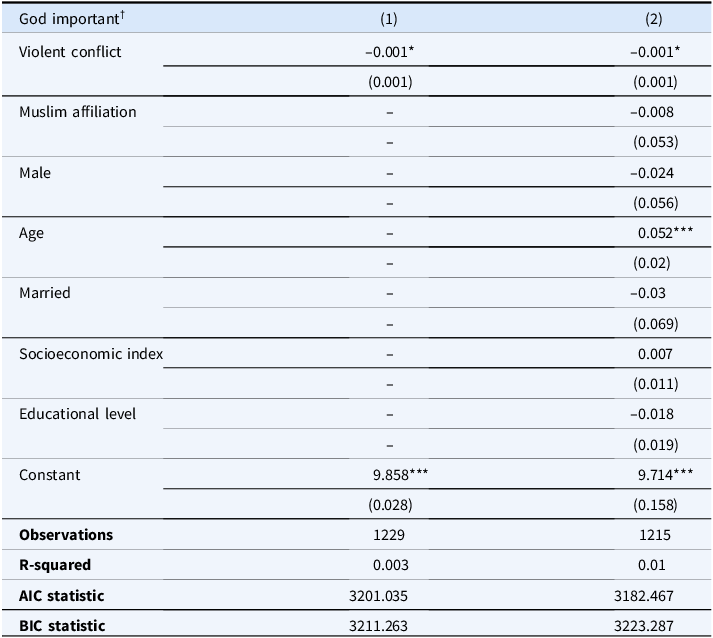
Table 3 reports the regression results for Ethiopia. In Model 1, which includes only violent conflict, the variable carries a negative coefficient that is statistically significant at the 10% level. The negative correlation is robust to the inclusion of control variables (Model 2).Footnote 10 These results contrast with the Nigerian case, where conflict exposure is positively correlated with religiosity. In other words, the more Ethiopians are exposed to violent conflict, the less importance they attach to God in their lives. A crisis of faith may underlie this result, as the perceived unfairness of the trauma caused by violence can lead to feelings of betrayal by God and disillusionment with religious teachings. Moreover, intense emotional reactions to trauma, such as anger and grief, can overshadow religious teachings about forgiveness and acceptance. Notably, the results from Ethiopia support Hypothesis 2.
OLS models regressing religiosity on violent conflict in Ethiopia

Note: Robust standard errors are in parentheses, †is the dependent variable, *** p < 0.01, ** p < 0.05, * p < 0.10. Violent conflict is measured using buffers with a radius of 30 km. All models are estimated using ordinary least squares (OLS) regression. All variables are operationalized exactly as was done in the Nigerian case.
These divergent findings highlight the fundamental differences in the socio-political landscapes of Nigeria and Ethiopia. Nevertheless, it is also worth noting that, while Nigeria and Ethiopia share similarities in their experiences with Muslim-Christian conflicts, there are also significant differences between them. They have distinct histories, institutions, and ethnoreligious compositions. Moreover, the nature of the violent conflicts and the conditions under which they occur differ significantly. The incidence and intensity of violent conflicts in Ethiopia are relatively lower than in Nigeria; furthermore, the religious fault lines in Nigeria appear to be more salient than in Ethiopia. It is difficult to assert that the findings in Nigeria are unique to the country due to a lack of sufficient data to test the hypotheses in other contexts. An ideal scenario would involve testing these hypotheses using pooled data covering all African countries. However, the Wave 7 WVS data is available for only seven African nations: Egypt, Ethiopia, Kenya, Libya, Nigeria, Tunisia, and Zimbabwe.
Conclusion
Using data from the WVS, this study examined the relationship between exposure to violent conflict and religiosity among Nigerians. Regression analysis revealed a positive correlation: as conflict exposure increases, so does the importance Nigerians attach to God in their lives. The positive correlation persisted when the data were disaggregated by religious affiliation (Muslims and Christians), gender (men and women), and region of residence (north and south), with models estimated for each subsample. This observed positive relationship suggests that reliance on God serves as a coping strategy that enables individuals to deal with the existential threat posed by violent conflict. To assess the external validity of the findings from Nigeria, data from Ethiopia, a country that has experienced Muslim-Christian conflicts, were used to re-estimate the regression models. Surprisingly, exposure to violent conflict was negatively correlated with religiosity, providing support for the hypothesis that exposure to traumatic events can prompt individuals to abandon their faith.
It is worth noting that while religiosity can foster resilience, helping individuals exposed to violence to continue to function despite an increased awareness of mortality arising from conflict exposure, it can also strengthen religious identification. This heightened identification might make intergroup boundaries more salient, thereby increasing the risk of further conflict (Tuki, Reference Tuki2024b, Reference Tuki2025a). Moreover, in Nigeria, religious patterns have been found to underlie the mobilization processes that precede violence (see Eke, Reference Eke2022a, Reference Eke2022b; Schaub, Reference Schaub2014).
Data
The replication files underlying this study are available in the Harvard Dataverse: https://doi.org/10.7910/DVN/7IDUHV.
Acknowledgements
I thank the journal’s editors and two anonymous referees for their helpful comments. An early version of this paper was presented at a colloquium organized by the Migration, Integration, and Transnationalization Department at the WZB Berlin Social Science Center, Germany. I thank the participants for their feedback. Thanks to Roisin Cronin for editorial assistance.
Financial support
None.
Competing interests
None.
Daniel Tuki’s research focuses on conflict studies and development economics. His articles have appeared in International Studies Quarterly, Democratization, Terrorism and Political Violence, Environment and Development Economics, and Defence and Peace Economics among others.
Appendix
Descriptive statistics (Nigeria)

Note: † is the dependent variable.
Descriptive statistics (Ethiopia)

Note: † is the dependent variable.

 Open access

