





Highlights
-
• Emotional states and language contexts jointly modulate domain-general control.
-
• Negative states effectively allocate resources in medium switching contexts.
-
• Positive states employ proactive control in contexts of high-switching frequency.
-
• Negative states rely on reactive control in contexts of high-switching frequency.
-
• The Emotion Adaptive Control model is proposed.
1. Introduction
Bilingual individuals often switch between their languages in their daily lives, effectively suppressing interference from the language that they are not currently using to achieve accurate use of the target language (Abutalebi, Reference Abutalebi2008; Abutalebi & Green, Reference Abutalebi and Green2007; Blanco-Elorrieta & Pylkkänen, Reference Blanco-Elorrieta and Pylkkänen2016; Blanco-Elorrieta et al., Reference Blanco-Elorrieta, Emmorey and Pylkkänen2018; Costa et al., Reference Costa, Miozzo and Caramazza1999; Green, Reference Green1998; Kroll et al., Reference Kroll, Bobb and Wodniecka2006; Schwieter & Sunderman, Reference Schwieter and Sunderman2008). Although the relationship between language control and domain-general cognitive control remains debated, some studies have found that language switching and domain-general cognitive control rely on partially overlapping neural mechanisms (see, for a review, Abutalebi & Green, Reference Abutalebi and Green2016). Specifically, language control engages core components of domain-general cognitive control, such as working memory, inhibitory control and conflict monitoring (Abutalebi & Green, Reference Abutalebi and Green2007; Bialystok et al., Reference Bialystok, Craik, Grady, Chau, Ishii, Gunji and Pantev2005; Calvo & Bialystok, Reference Calvo and Bialystok2014; Costa et al., Reference Costa, Hernández, Costa-Faidella and Sebastián-Gallés2009; Declerck et al., Reference Declerck, Grainger, Koch and Philipp2017; Verreyt et al., Reference Verreyt, Woumans, Vandelanotte, Szmalec and Duyck2016).
According to the Adaptive Control Hypothesis (Green & Abutalebi, Reference Green and Abutalebi2013), bilinguals dynamically allocate cognitive control depending on various degrees of control demands in different contexts. For example, a dual-language context, which involves “use of both languages in the same context, but with different individuals (e.g., using one language with some individuals at work and another language with other individuals in the same workplace)” (Schwieter et al., Reference Schwieter, Ferreira and Wei2025, p. 52), typically requires greater goal maintenance, conflict monitoring and interference suppression compared to a single-language context. Unlike task switching adaptations, such as the list-wide switch probability (LWSP) effect, in which frequent switching reduces switch costs by inducing a more flexible control state that is task-specific and does not readily generalize to novel tasks (Experiments 2–3; Nack & Chiu, Reference Nack and Yu-Chin2024), bilingual control involves dynamic coordination across multiple language systems and recruits broader and more sustained cognitive resources (Green & Abutalebi, Reference Green and Abutalebi2013). Such cross-language management may facilitate the transfer of control states to other domains. Indeed, empirical studies in mixed-language contexts have reported enhancements in subsequent executive control (Jiao et al., Reference Jiao, Liu, Liang, Plummer, Perfetti and Chen2019, Reference Jiao, Liu, Bruin and Chen2020; Liu, Li, et al., Reference Liu, Li, Zuo, Wang, Guo and Schwieter2022; Liu et al., Reference Liu, Meng, Liu, Liu, Schwieter and Chen2025; Wu & Thierry, Reference Wu and Thierry2013). However, most studies have compared single- and mixed-language contexts with fixed switching frequencies, overlooking how various degrees of switching demands influence the adaptability of executive control.
Emotional states have been found to modulate cognitive resource allocation and control strategies (Dreisbach & Goschke, Reference Dreisbach and Goschke2004; Grahek et al., Reference Grahek, Musslick and Shenhav2020; Jiang et al., Reference Jiang, Meng and Chen2024; Pessoa, Reference Pessoa2009; Shenhav, Reference Shenhav2024). Positive emotions tend to enhance flexibility and broaden attentional scope (Dreisbach & Goschke, Reference Dreisbach and Goschke2004; Fiedler, Reference Fiedler, Martin and Clore2013; Fredrickson, Reference Fredrickson2004; Johnson et al., Reference Johnson, Waugh and Fredrickson2010; Rowe et al., Reference Rowe, Hirsh and Anderson2007), whereas negative emotions promote a more cautious, detail-focused mode of processing (Eysenck et al., Reference Eysenck, Derakshan, Santos and Calvo2007; Fiedler, Reference Fiedler, Martin and Clore2013; Fredrickson, Reference Fredrickson2004). However, no study has systematically examined how emotional states interact with different language-switching demands and influence bilinguals’ executive control adaptability. Therefore, in the present study, we manipulate language-switching frequency (low: 25%, medium: 50%, high: 75%) to create a gradient of dynamic cognitive demands. Moreover, we incorporate emotional states (positive, negative, neutral) into the experimental design to systematically examine how context-involved language control and emotional states jointly influence cognitive control adaptation.
1.1. Background
Language switching is thought to involve both language-specific control processes and partially overlapping mechanisms with domain-general cognitive control (Abutalebi et al., Reference Abutalebi, Della Rosa, Green, Hernandez, Scifo, Keim, Cappa and Costa2012, Reference Abutalebi, Della Rosa, Ding, Weekes, Costa and Green2013; Blanco-Elorrieta & Pylkkänen, Reference Blanco-Elorrieta and Pylkkänen2016; de Bruin et al., Reference de Bruin, Roelofs, Dijkstra and FitzPatrick2014; Green & Abutalebi, Reference Green and Abutalebi2013; Wu et al., Reference Wu, Yang, Chen, Li, Zhang, Kang, Ding and Guo2019). Consistently, Declerck et al. (Reference Declerck, Grainger, Koch and Philipp2017) examined bilinguals’ performance in both language switching and task switching tasks and found that switching costs were positively correlated, suggesting partially overlapping control mechanisms. However, switch costs are not always equal: when tasks involve language processing (e.g., picture naming), language switching costs are significantly higher than in task switching (e.g., digit classification), indicating that language control also engages language-specific inhibitory processes. Subsequent studies have used cross-task paradigms – in which individuals alternate between language switching and flanker tasks – that have explored how language-related contexts impact subsequent executive control. Wu and Thierry (Reference Wu and Thierry2013) studied Welsh-English bilinguals’ performance on the flanker task in single- and mixed-language contexts, with interleaved words presented in a passive language comprehension context that did not require a response. They found that, compared to single-language contexts, the accuracy of incongruent trials was higher and the P3 effect was smaller in mixed-language contexts, whereas there were no significant differences in congruent trials across the three contexts. This suggests that a language switching context may enhance executive functions and facilitate conflict resolution. Similarly, Liu, Li, et al. (Reference Liu, Li, Zuo, Wang, Guo and Schwieter2022) examined English-Chinese bilinguals in a joint naming–listening task with interleaved flanker trials. In the study, one participant acted as a speaker (producing overt naming responses), while the other acted as a listener (passively comprehending without responding). The results showed a reversed flanker effect in the mixed-language context, with incongruent trials exhibiting higher delta and theta band synchronization compared to congruent trials. This neural pattern further supports the notion that bilingual language control modulates cognitive control, specifically affecting the processing of conflicts. In contrast, Jiao et al. (Reference Jiao, Liu, Liang, Plummer, Perfetti and Chen2019, Reference Jiao, Liu, Bruin and Chen2020, Reference Jiao, Timmer, Liu and Chen2022) adopted a similar cross-task paradigm to examine Chinese-English bilinguals in language production and comprehension tasks, such that production tasks consistently required overt responses and comprehension tasks varied in whether a response was required. They found that in mixed-language contexts, both congruent and incongruent trials elicited better performance than in single-language contexts, suggesting that language switching may facilitate general monitoring processes across trial types rather than solely enhancing conflict resolution. Overall, existing research indicates that different linguistic contexts impose distinct cognitive demands, with executive control being more effective in mixed-language contexts than in single-language contexts, irrespective of whether tasks involve production or comprehension, active responses, or passive exposure. However, it remains unclear whether this effect mainly applies to incongruent trials or also extends to congruent trials.
Moreover, previous studies have mostly used a binary classification of language context (single- versus mixed-language), without further exploring how different levels of language switching demands may modulate potential effects. However, natural language use often involves continuous variations in switching demands, with different frequencies of language switching imposing distinct cognitive control requirements (Hsieh et al., Reference Hsieh, Wu and Lin2014; West et al., Reference West, Bailey and Langley2009; Zhuo et al., Reference Zhuo, Zhu, Cao and Li2021). According to the dual mechanisms framework (Braver, Reference Braver2012), individuals can flexibly employ proactive control, maintaining task-relevant information in anticipation of potential interference, or reactive control, responding to interference as it occurs. Building on this framework, the present study investigates how bilinguals adaptively regulate language control across a gradient of switching frequencies (low, medium, high) and how this adaptation influences subsequent domain-general executive control. Specifically, in high-switching contexts, individuals must continuously monitor and rapidly adjust their language choices, placing greater demands on conflict monitoring and proactive control. In low-switching contexts, individuals switch languages less often, primarily relying on language maintenance and occasional interference inhibition, which likely leads to greater reliance on reactive control. In medium switching contexts, individuals may need to flexibly adjust between conflict monitoring and interference inhibition, adopting a combination of proactive and reactive control. Thus, one of the innovations of this study lies in exploring how different control demand contexts shaped by manipulation of language-switching frequency dynamically regulate executive control.
In addition to contextual factors, emotional states have been shown to affect cognitive control; however, findings across studies remain mixed (Dreisbach & Fischer, Reference Dreisbach and Fischer2012; Gray, Reference Gray2001; Rowe et al., Reference Rowe, Hirsh and Anderson2007; Schuch & Koch, Reference Schuch and Koch2015). For instance, Gray (Reference Gray2001) found that positive states facilitated the maintenance of verbal information but impaired performance in spatial working memory tasks, whereas negative states showed the opposite pattern. In contrast, Rowe et al. (Reference Rowe, Hirsh and Anderson2007) reported that in the Eriksen flanker task, positive affect broadened the scope of attentional selection, impairing visual selective attention by increasing the processing of task-irrelevant flankers. However, negative mood did not show a comparable effect. Schuch and Koch (Reference Schuch and Koch2015) explored how emotions impact conflict adaptation (i.e., reduced congruency effects following incongruent versus congruent trials) using flanker and Stroop-like tasks with film-induced emotional states. The results revealed a negative state-specific increase in conflict adaptation that was absent under positive states and replicated across both tasks. These inconsistencies may reflect the adaptive nature of emotional influences, that is, emotional states may exert different effects depending on the specific components of cognitive control engaged (e.g., task maintenance, conflict monitoring, or task switching; Dreisbach & Goschke, Reference Dreisbach and Goschke2004; Gray, Reference Gray2001; Phillips et al., Reference Phillips, Bull, Adams and Fraser2002). Evidence suggests that emotional states may adaptively modulate language control depending on the control demands of the task. For example, Jiang et al. (Reference Jiang, Meng and Chen2024) found that, compared with voluntary switching contexts involving relatively low control demands, negative emotional states elicited stronger compensatory mechanisms in cue-based switching contexts that required stricter control among Chinese-English bilinguals. However, previous studies have not systematically refined bilingual contexts to create distinct levels of control demand by varying language-switching frequency. Manipulating switching frequency allows us to establish graded control-demand contexts, providing a framework to investigate how emotional states interact with these demands.
Importantly, emotional states are thought to be associated with cognitive control through their modulation of attentional scope and processing style (Grahek et al., Reference Grahek, Musslick and Shenhav2020), which may influence the relative engagement of proactive and reactive control depending on task demands (Chiew & Braver, Reference Chiew and Braver2014; Kar et al., Reference Kar, Srinivasan, Nehabala and Nigam2018). For instance, negative emotions tend to narrow attentional focus (Eysenck et al., Reference Eysenck, Derakshan, Santos and Calvo2007; Fiedler, Reference Fiedler, Martin and Clore2013; Fredrickson, Reference Fredrickson2004), promoting a cautious and detail-oriented processing mode that may support reactive control, whereas positive emotions broaden attentional scope (Dreisbach & Goschke, Reference Dreisbach and Goschke2004; Fiedler, Reference Fiedler, Martin and Clore2013; Fredrickson, Reference Fredrickson2004; Johnson et al., Reference Johnson, Waugh and Fredrickson2010; Rowe et al., Reference Rowe, Hirsh and Anderson2007), enhancing cognitive flexibility and integrative processing, which may facilitate proactive control. Language-switching frequency provides a contextual framework that shapes how emotional states are expressed in cognitive control strategies, which may be reflected in two possible mechanisms. First, emotional states may influence the preference for control strategies, producing a context-specific matching effect with switching-frequency contexts. As different switching-frequency contexts rely primarily on distinct control mechanisms, the broadened attention and enhanced flexibility associated with positive emotions may be particularly advantageous in high-switching contexts that demand proactive control, whereas the focused and cautious processing promoted by negative emotions may be more beneficial in low switching contexts that rely primarily on reactive control. Second, the influence of emotional states on control strategy selection is expected to emerge primarily under conditions of high control demand. According to the dual competition model (Pessoa, Reference Pessoa2009), emotion affects cognition at both perceptual and executive levels: emotionally salient stimuli gain processing priority, and limited executive resources must be shared across control processes. In high-switching contexts, where task demands already require substantial cognitive resources, this competition amplifies the impact of emotional states on behavior, making their influence on strategy selection more pronounced. Taken together, how emotional states interact with switching-frequency contexts to shape executive control remains largely unexplored, highlighting an important gap that the present study aims to address.
1.2. Present study
The present study investigates the dynamic modulation of cognitive control by emotional states and language contexts. Unlike previous research that simplifies language contexts as a binary variable (single- versus mixed-language), we adopted three switching-frequency contexts (low, medium, high) to systematically manipulate control demands involving distinct components of cognitive control. By incorporating emotional states (positive, negative, neutral), we examined how emotional states interact with contextual control demands to dynamically modulate cognitive control, enabling individuals to flexibly adjust their domain-general control strategies (e.g., proactive or reactive control) under different emotional-contextual conditions, which in turn influence subsequent executive control performance.
We use a traditional emotion-induction procedure (Guo et al., Reference Guo, Li, Lu, Xu, Qiu, Shen and Gao2020; Jefferies et al., Reference Jefferies, Smilek, Eich and Enns2008; Jiang et al., Reference Jiang, Meng and Chen2024), where participants listen to music and recall corresponding emotional events to induce different emotional states. In each emotional state, participants first complete a picture-naming task with varying language-switching frequencies, which is then followed by a flanker task to form a cross-task adaptation paradigm. In addition to the participants’ behavioral performance (i.e., response times; RTs), we use EEG to record brain activity and examine the effects of emotional states and switching-frequency contexts on executive control.
We focus on the widely studied N2 and P3 ERP components. N2 is closely related to conflict detection (van Veen & Carter, Reference Van Veen and Carter2002a, Reference Van Veen and Carter2002b). Research has shown that in high-conflict conditions, or when individuals invest more cognitive resources in the early stages of a task to monitor conflicts, N2 amplitude typically increases (Grundy et al., Reference Grundy, Anderson and Bialystok2017; Jiao et al., Reference Jiao, Liu, Bruin and Chen2020). Following conflict detection, the brain adjusts cognitive resources to inhibit erroneous responses and complete goal selection, a process often associated with the P3 effect. In the flanker task, the P3 amplitude is typically larger for incongruent trials compared to congruent trials, reflecting allocation of attentional resources (Polich, Reference Polich2007; Polich & Herbst, Reference Polich and Herbst2000) or response inhibition (Clayson & Larson; Reference Clayson and Larson2011; Frühholz et al., Reference Frühholz, Godde, Finke and Herrmann2011). However, in research on bilingualism, there is evidence suggesting that P3 amplitude may decrease in mixed-language contexts, possibly because individuals have already allocated more cognitive resources during earlier stages, thus reducing the demand for resources in later stages (Wu & Thierry, Reference Wu and Thierry2013). Furthermore, P3 latency is considered to reflect the time required for stimulus categorization (Kutas et al., Reference Kutas, McCarthy and Donchin1977; Kok, Reference Kok2001). Given the complexity of the P3 component, we examined the correlations of P3 amplitude and latency with behavioral performance to cautiously interpret its significance in the context of our findings.
Furthermore, we employ a Granger causality (GC) analysis, a time-series method used to determine whether changes in one variable predict subsequent changes in another (Liu, Schwieter et al., Reference Liu, Schwieter, Wang and Liu2022; Teckentrup et al., Reference Teckentrup, Van Der Meer, Borchardt, Fan, Neuser, Tempelmann and Kroemer2019). Unlike ERP measures, which primarily capture local, stimulus-locked responses, GC can reveal more global, dynamic interactions in cognitive processing. In our study, GC analysis is used to examine the predictive relationship between picture naming and flanker effects and to investigate how this relationship varies across emotional states and contexts of varying degrees of language switching, thereby shedding light on the modulatory role of emotional states and language contexts in cognitive control.
We hypothesize that emotional states influence how individuals adjust control strategies across different switching-frequency contexts, with these effects extending to subsequent executive task performance. (1) Context-specific matching effect: Emotional states bias the preference for control strategies in a manner that aligns with the demands of the switching-frequency context. Specifically, (a) Positive states are expected to exert their effects primarily in high-switching contexts, where proactive control dominates, because positive emotion promotes cognitive flexibility and the use of proactive control, which aligns with the demands of frequent switching. Behaviorally, this should emerge as reduced or reversed flanker effects in RTs and accuracy. Although high-switching contexts are generally associated with larger N2 amplitudes due to increased conflict monitoring, positive states may further modulate this effect by enhancing N2 amplitudes for incongruent trials, reflecting proactive control engagement. Similarly, proactive control is expected to strengthen GC connectivity for incongruent trials, such that there will be enhanced coordination between task-related regions to monitor and resolve conflict, thus modulating P3 amplitudes. Effects on P3 are expected to be variable and will be examined exploratorily due to inconsistent findings in previous studies. (b) Negative states are expected to exert their effects primarily in low-switching contexts, where reactive control dominates, because negative emotion fosters a cautious, detail-oriented processing mode that prioritizes existing information (e.g., congruent trials) and relies on reactive adjustments rather than proactive preparation. Behaviorally, this is expected to facilitate performance on congruent trials, leading to faster RTs and higher accuracy, which in turn may manifest as larger flanker effects. Similarly, reactive control under negative states may strengthen GC connectivity for congruent trials, reflecting increased coordination between task-related regions to resolve conflict reactively. (c) Neutral states are expected to show direct effects on executive control as a function of switching frequency. High-switching contexts require continuous activation and inhibition of both languages, leading to adaptive adjustments in cognitive control (Jiao et al., Reference Jiao, Liu, Liang, Plummer, Perfetti and Chen2019, Reference Jiao, Liu, Bruin and Chen2020; Liu, Li, et al., Reference Liu, Li, Zuo, Wang, Guo and Schwieter2022; Liu et al., Reference Liu, Meng, Liu, Liu, Schwieter and Chen2025; Wu & Thierry, Reference Wu and Thierry2013). Accordingly, higher switching frequency is expected to be associated with stronger engagement of cognitive control processes, reflected in reduced Flanker effects in RTs and accuracy, larger N2 amplitudes, potentially variable P3 modulations, and greater GC connectivity. As switching frequency decreases, the demand on cognitive control is expected to gradually diminish, leading to correspondingly weaker effects on these measures.
(2) Amplification under high control demand: In high-switching contexts, emotional states amplify their influence on strategy selection because task control and emotional processing compete for limited cognitive resources. Under these conditions, positive states are expected to engage proactive control, whereas negative states are expected to engage reactive control. These effects are expected to manifest in the same types of behavioral and neural indices described above, including reaction times, accuracy, N2/P3 amplitudes, and GC connectivity.
2. Method
2.1. Participants
Thirty-five bilinguals (L1 Chinese, L2 English) from Beijing Normal University were recruited. After excluding two participants for low accuracy (<75%) and three for excessive EEG artifacts, the final sample consisted of 30 participants (20 females, 10 males; M age = 21.37 years, SD age = 2.09 years). To assess the study’s sensitivity for detecting theoretically important within-subject effects, we conducted a post-hoc sensitivity analysis in G*Power (Faul et al., Reference Faul, Erdfelder, Lang and Buchner2007), treating the interaction effect as a difference of differences and operationalizing it as a within-subjects t-test. Using the difference between two dependent means options, with n = 30, α = .05, and target power = .80, the minimum detectable effect size (Cohen’s d) was .529, indicating sensitivity to medium-to-large within-subject effects. All participants had normal or corrected-to-normal vision, were right-handed and had no history of neurological, psychiatric or major physical conditions. The study was approved by the Committee for the Protection of Participants at Beijing Normal University, and all participants provided their written informed consent prior to taking part in the study.
Before the experiment, participants completed a language history questionnaire, the Oxford Quick Placement Test (QPT, Syndicate, Reference Syndicate2001) and the Bilingual Switching Questionnaire (BSWQ, Rodriguez-Fornells et al., Reference Rodriguez-Fornells, Krämer, Lorenzo-Seva, Festman and Münte2012). The QPT results (M = 30.33, SD = 2.77, maximum score of 40) indicated that participants had intermediate English proficiency, similar to previous studies on Chinese-English bilinguals (Jiang et al., Reference Jiang, Meng and Chen2024; Liu, Li et al., Reference Liu, Li, Zuo, Wang, Guo and Schwieter2022; Liu, Schwieter et al., Reference Liu, Schwieter, Wang and Liu2022). The BSWQ score (M = 30.50, SD = 4.73, maximum score of 60) suggested that participants infrequently engaged in language switching in daily communication. According to the language background data, all participants were native speakers of Chinese, who began learning English at an average age of eight (SD = 3). Self-ratings of proficiency in listening, speaking, reading and writing were elicited for both L1 and L2 using a 6-point scale (1 = no proficiency, 6 = native-like). Paired-sample t-tests confirmed significantly higher ratings in Chinese than in English across all modalities. Detailed language profiles are presented in Supplementary Table S1.
2.2. Materials
During the emotional induction phase, the musical stimuli were selected from the Chinese Affective Music System (CAMS; Li et al., Reference Li, Cheng, Dai, Wang and Huang2012), following the materials used in Jiang et al. (Reference Jiang, Meng and Chen2024). A total of 27 one-minute instrumental clips (22,050 Hz, 16-bit) were used, with nine clips in each emotional category (positive, negative, neutral).
After each emotional state was induced, participants performed a cross-task that combined picture-naming and flanker tasks within each trial. The picture stimuli included 36 neutral black-and-white line drawings selected from standardized picture inventory (Snodgrass & Vanderwart, Reference Snodgrass and Vanderwart1980; Zhang & Yang, Reference Zhang and Yang2003). Each drawing was paired with a two-character Chinese word and an English word consisting of one to three syllables. To ensure stimulus equivalence across languages, 20 participants from the same population, but who did not participate in the formal experiment, rated their familiarity with and emotional valence of the words in both languages on a nine-point scale. Familiarity was rated from 1 (least familiar) to 9 (most familiar), and valence was rated from 1 (very negative) to 9 (very positive). Paired-sample t-tests showed no significant differences between the two languages in terms of participants’ familiarity with the words (L1: M = 8.90 ± .07, L2: M = 8.90 ± .07, t = .27, p = .786) or their emotional valence (L1: M = 5.07 ± .07, L2: M = 5.06 ± .06, t = .81, p = .422). Out of the 36 selected drawings, 32 were used in the formal experiment and the remaining 4 were used in the practice trials. The 32 drawings were randomly divided into two lists: one served as experimental stimuli (with an equal number of nonswitch and switch trials), and the other as switching frequency stimuli (with nonswitch and switch trials presented at different proportions). The assignment of the two lists was counterbalanced across participants, but only data from the experimental stimuli were included in the analyses.
After a picture-naming trial, a flanker trial was interspersed, consisting of a row of five arrows. In congruent trials, all arrows pointed either left or right; in incongruent trials, the flankers pointed opposite to the central arrow (two left arrows with a central right arrow, or two right arrows with a central left arrow). Across the experiment, congruent and incongruent trials each occurred in 50% of the trials.
2.3. Design and procedure
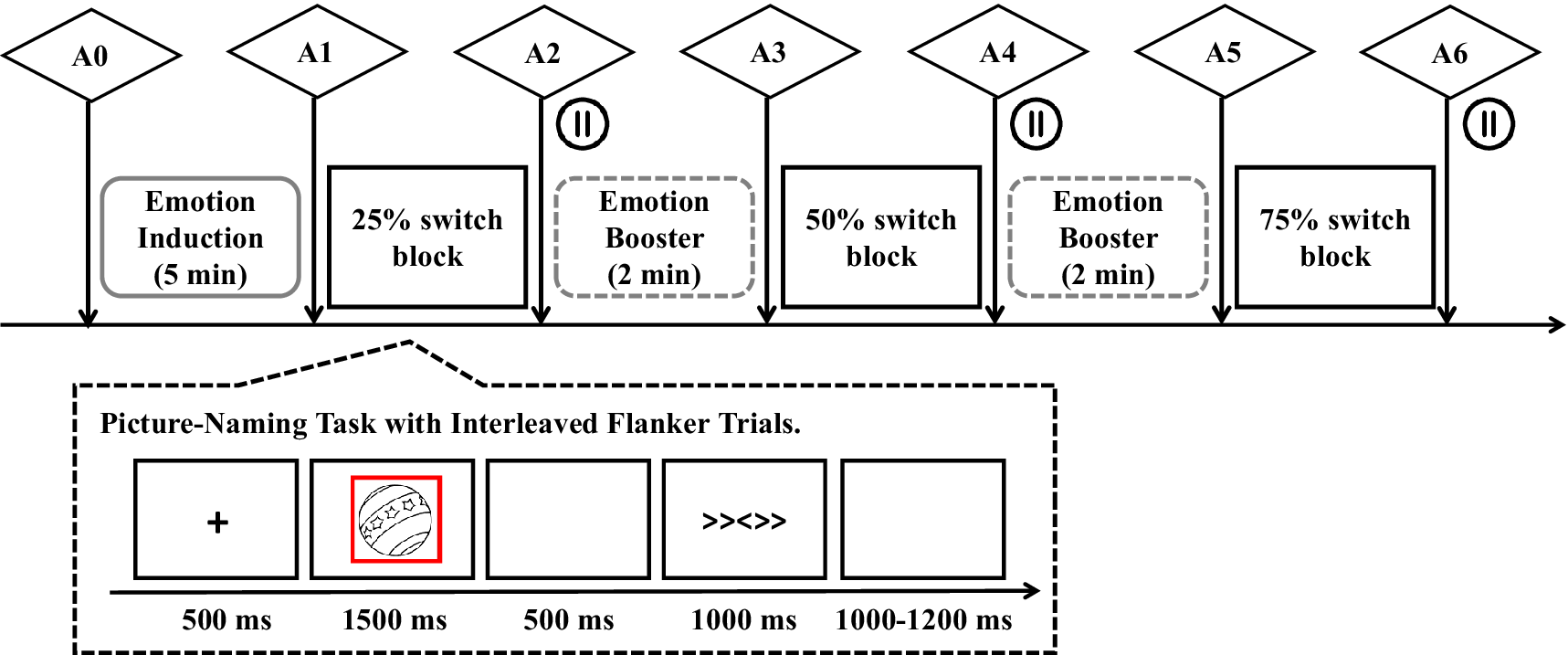
We investigated the adaptability of language control to executive control under different emotional states using a cross-task paradigm including picture-naming and flanker tasks. The experimental procedure was as follows: Participants first familiarized themselves with the 36 pictures and their corresponding English and Chinese names, presented one at a time. They then completed a learning check by verbally naming each picture in both languages. Once participants had learned the material, they completed 16 practice trials. Each trial began with a fixation cross for 500 ms, followed by a picture within a red or blue border. Participants named the picture into a microphone in the appropriate language based on the border color (red for English; blue for Chinese), with the color–language association being counterbalanced across participants. The picture remained on the screen until the participant named it or if they did not respond within 1,500 ms. Next, a blank screen of 500 ms appeared followed by a flanker trial for 1,000 ms, at which time the participant responded to the direction of the central arrow while ignoring the flanking arrows. Their responses were recorded using the F and J buttons, with the left/right mapping counterbalanced across participants. After their response or 1,000 ms, another blank screen appeared for 500 ms, followed by feedback (correct/incorrect/overtime) for 1,000 ms. Finally, a blank screen appeared for 1,000–1,200 ms before the next trial began. After the practice trial, the participants continued to the formal experiment, which followed the same procedure.
As illustrated in Figure 1, the formal experiment began with an emotion induction phase. Each participant experienced all three emotional conditions (positive, negative, and neutral), with the order of conditions counterbalanced across participants. For each emotion, participants listened to a five-minute music segment through headphones designed to evoke positive, negative, or neutral emotions, while recalling corresponding autobiographical events and recording details on a provided sheet of paper to enhance emotional engagement. The participants were allowed to keep the paper after the experiment. To maintain the emotional state, an additional two minutes from the same music was randomly selected and played between task blocks. Throughout the experiment, emotional states were assessed in real-time using a 9-point scale, with valence (1 = extremely unpleasant, 9 = extremely pleasant) and arousal (1 = extremely fatigued, 9 = extremely energetic) as the main dimensions. For each emotional condition, participants completed six self-assessments (labeled A1–6 in Figure 1). The first assessment (A0) was conducted before the start of each five-minute induction session.
Experimental procedure in each emotion condition.
Note: Participants took a short break after completing each picture-naming task interspersed with flanker tasks. A0–A6 indicate self-assessments of valence and arousal levels, with A0 being conducted before the induction session and A1–A6 during the experimental blocks. The color of the border serves as a language cue, with a red border indicating English and a blue border indicating Chinese. This color-language association was counterbalanced across participants.

While in each emotional state, participants completed three cross-task adaptation blocks (low: 25%, medium: 50%, high: 75%). For each participant, the order of these three blocks was identical across emotional states, but counterbalanced across participants. As aforementioned, the procedure of the formal experiment was the same as the practice phase, except that no feedback was provided. Each block consisted of 130 trials: 2 warm-up trials, 64 experimental trials (e.g., List 1) used for analysis, and 64 manipulation trials (e.g., List 2) used to establish the switching-frequency context. Both lists were alternately used as experimental trials or manipulation trials, with the assignment counterbalanced across participants. Importantly, in each switching-frequency context, the experimental trials always included 32 switch trials and 32 nonswitch trials. The switching-frequency contexts were created by varying the amount of switch and nonswitch trials. Specifically, in the low-frequency context, all 64 manipulation trials were nonswitch trials, and when combined with the 32 switch and 32 nonswitch experimental trials, this resulted in an overall switching proportion of 25% (32/128 = 25%). In the high-frequency context, all 64 manipulation trials were switch trials, and when combined with the experimental trials, this resulted in an overall switching proportion of 75% (96/128 = 75%). In the medium-frequency context, both the manipulation and experimental trials consisted of half switch and half nonswitch trials, yielding an overall switching proportion of 50% (64/128 = 50%). In all contexts, trial order was randomized, such that participants were unable to predict whether the upcoming response would be a switch or a nonswitch trial.
Flanker trials were interleaved after each picture-naming trial. Congruent and incongruent trials were presented in equal proportions (50% each) across both switch and repeat language trials, regardless of the switching-frequency context. Moreover, because each congruent and incongruent condition included two configurations, response-hand assignment was counterbalanced across participants to evenly control for potential response-mapping or irrelevant-dimension effects, thereby avoiding the variation in conflict type discussed by Kornblum et al. (Reference Kornblum, Hasbroucq and Osman1990).
2.4. Behavioral data and analyses
Data analyses were conducted in R (version 3.6). To evaluate the effectiveness of emotional induction, cumulative link mixed models (CLMMs) were fitted using the ordinal package (Christensen, Reference Christensen2022). Emotion (positive, negative, neutral), frequency of switching (low, medium, high), and assessment (A0–A6) were included as fixed effects, and their interactions were also considered to evaluate pleasure and arousal ratings. We started with the most complex model and gradually reduced its complexity. When the models did not converge, we removed the slope that explained the least variance until they converged. We determined the optimal model using the Akaike information criterion, where smaller values indicate better-fitting models (Symonds & Moussalli, Reference Symonds and Moussalli2011; Tremblay & Newman, Reference Tremblay and Newman2015). The final model included random intercepts and slopes for participants.
RTs and accuracy on each flanker trial were recorded. Given the participants’ high accuracy rates (96.10% ± 3.10), no further analyses were conducted. RTs were analyzed using linear mixed-effects models, implemented with the lme4 and lmerTest packages (Bates et al., Reference Bates, Maechler, Bolker and Walker2014; Kuznetsova et al., Reference Kuznetsova, Brockhoff and Christensen2017). We excluded the following data from the RT analyses: the first two trials of each block, incorrect responses, RTs below 200 ms, and RTs ±3 SD beyond the mean. The excluded data accounted for 11.01% of the overall data. To examine the effects of emotional state and switching-frequency context on flanker performance, we constructed a linear mixed-effects model. Emotion (positive, negative, neutral), switch frequency (low, medium, high), and congruency (congruent, incongruent) were included as fixed effects. Additionally, participants, items, and block order were modeled as random effects. We conducted a three-way ANOVA to examine any main effects and interactions with statistical significance assessed using the Wald chi-square test (p < .05). For significant interactions, follow-up pairwise comparisons were performed using the emmeans package (Lenth et al., Reference Lenth, Buerkner, Herve, Jung, Love, Miguez, Riebl and Singmann2022). The p-values obtained were adjusted for multiple comparisons using false discovery rate correction.
2.5. Electrophysiological data and analyses
EEG data were recorded from 64 electrodes positioned according to the extended 10–20 system, using Curry 9 (NeuroScan, Inc.) at a 1,000 Hz sampling rate, referenced to the Cz electrode. M1 and M2 electrodes were placed on the left and right mastoids, with offline re-referencing to their average. Impedances were kept below 5 kΩ. Data were filtered offline with a high-pass filter of .1 Hz and a low pass filter of 30 Hz. The signals recorded by the peripheral electrodes were poor and were thus removed so that subsequent data analyses would not be affected by these electrodes. Finally, 40 electrodes were left after removing the peripheral electrodes with more artifacts (FPz, FP1, FP2, AF3, AF4, AF7, AF8, F7, F8, FT7, FT8, T7, T8, TP7, TP8, P7, P8, PO7, PO8, Oz, O1, O2) (Liu et al., Reference Liu, Huang, Schwieter and Liu2023, Reference Liu, Huang, Xing, Schwieter and Liu2024). Ocular artifacts were reduced using Independent Component Analysis (ICA) via EEGLAB (Makeig et al., Reference Makeig, Bell, Jung and Sejnowski1995), with an average of 1.90 ± .96 independent components rejected per participant. The continuous recordings were analyzed in flanker-locked −200 to 600 ms epochs. Correspondingly, the epochs were referenced to a 200 ms prestimulus baseline. Signals exceeding ±100 μV in any given epoch were automatically discarded. All preprocesses were performed by EEGLAB (Brunner et al., Reference Brunner, Delorme and Makeig2013; Delorme & Makeig, Reference Delorme and Makeig2004).
ERP components were defined based on grand means and analyzed within traditional time windows. The N2 (200–330 ms) was examined at frontal-central sensors (F3, F1, Fz, F2, F4, FC3, FC1, FCz, FC2, FC4, C3, C1, Cz, C2, C4) (Grundy et al., Reference Grundy, Anderson and Bialystok2017; Jiao et al., Reference Jiao, Liu, Bruin and Chen2020), while the P3 (330–450 ms) was analyzed at central-parietal sensors (C3, C1, Cz, C2, C4, CP3, CP1, CPz, CP2, CP4, P3, P1, Pz, P2, P4, PO6, PO3, POz, PO4, PO6) (Grundy et al., Reference Grundy, Anderson and Bialystok2017; Jiao et al., Reference Jiao, Liu, Bruin and Chen2020; Liu et al., Reference Liu, Meng, Liu, Liu, Schwieter and Chen2025).Footnote 1 Generalized linear mixed-effects models were used to analyze each time window, with emotion (positive, negative, neutral), switch frequency (low, medium, high) and congruency (congruent and incongruent) included as fixed effects and participants as a random effect.
Finally, to examine the relationship between behavioral RTs and ERP components, we conducted Spearman correlation analyses between the mean amplitude and latency of the N2 and P3 components for each participant across all conditions.
2.6. Granger causality analyses
A GC analysis, commonly used to assess causal influence between two time series (Liu, Schwieter, et al., Reference Liu, Schwieter, Wang and Liu2022; Teckentrup et al., Reference Teckentrup, Van Der Meer, Borchardt, Fan, Neuser, Tempelmann and Kroemer2019), was employed to examine the predictive effect of language control in the picture-naming task on executive control in the flanker task. Before conducting the GC analysis, we performed source estimation, as the interpretation of connectivity estimated from EEG recordings is highly confounded by spatial leakage of source activity (Schoffelen et al., Reference Schoffelen, Hultén, Lam, Marquand, Uddén and Hagoort2017). First, we converted the EEG data from SET format to SPM readable dat/mat, then assigned channel types “EEG” and locations, and added event triggers. The preprocessing protocol included the following settings: highpass filtering at .1 Hz, lowpass filtering at 30 Hz, marking eyeblink artefacts, epoching depending on trial type (−200 to 650 ms), removing trials containing eyeblinks or noise exceeding ±100 μV, separating trials into individual files, and averaging the data. Next, source reconstruction (A landmark-based coregistration and common coordinate system from the Montreal Neurological Institute, MNI; “EEG BEM” for forward models) and extraction of single-trial source-level waveforms and 8196 ROI coordinates were applied.
The steps of the GC analysis were as follows: First, waveform data were extracted from the “top voxels.” In the picture-naming and flanker tasks, the most significantly different voxels were identified using the neutral condition as a baseline, comparing positive versus neutral and negative versus neutral conditions. The selection criterion was the voxel with the highest t-value in each comparison. For instance, with respect to the contrast between positive_low_congruent trials and neutral_low_congruent trials, the voxel with the highest t-value was selected. Ultimately, 12 “top voxels” were chosen from the picture-naming task and another 12 from the flanker task (see Supplementary Table S2). Second, trial-level data were processed to ensure that they satisfied the covariance stationarity requirement for GC analysis. This processing involved the following steps: (1) demeaning by subtracting the mean across all trials from each individual trial; (2) normalizing by dividing each trial by the SD at each time point (calculated across all trials at that time point) and (3) detrending by removing the overall trend from individual trials. Third, a nonparametric GC analysis was conducted on a subject-by-subject basis. Finally, a matrix was constructed containing the Granger coefficients for all participants, as determined by the regression analyses between the two nodes across different frequency bands. All analyses were performed using SPM12 and FieldTrip.
3. Results
3.1. Behavioral results
3.1.1. Emotion induction effectiveness check
The results of the emotion (positive, negative, neutral) × switch frequency (low, medium, high) × assessment (A0–A6) CLMM showed a significant interaction between emotion × assessment for both pleasure and arousal ratings (pleasure: χ2 (12) = 180.51, p < .001; arousal: χ2 (12) = 70.52, p < .001). At baseline (A0), there were no significant differences in pleasure (|z|s < 3.43, ps > .937) or arousal (|z|s < 1.18, ps > .464). However, after the initial emotion induction procedure (A1–A6), positive states exhibited significantly higher levels of pleasure (|z|s > 4.16, ps < .001) and arousal (|z|s > 4.70, ps < .001) compared to neutral states. Similarly, negative states showed significantly lower levels of pleasure (|z|s > 5.46, ps < .001) and higher levels of arousal (|z|s > 7.06, ps < .001) compared to neutral states. No significant differences were found between positive and negative states in arousal ratings. These results indicate that the emotion induction phase elicited the intended emotional states (as shown in Supplementary Figure S1).
3.1.2. Reaction times
The results of the RT analyses showed a significant main fixed effect of emotion. RTs were faster in negative states (M = 416 ± 77 ms) compared to both positive (M = 421 ± 78 ms, b = −.01, SE = .003, z = −2.83, p = .013) and neutral states (M = 418 ± 79 ms, b = −.01, SE = .003, z = −2.54, p = .030). Additionally, there was a main effect of congruency (F = 2033.47, p < .001), demonstrating a typical flanker effect, such that RTs were faster for congruent trials (M = 397 ± .71 ms) than for incongruent trials (M = 440 ± .79 ms) (see Supplementary Table S3 for full statistics).
3.2. Electrophysiological results
The results of the analyses on the N2 and P3 components are presented in Supplementary Table S4, and the GC analyses are shown in Supplementary Table S5. Significant interactions for both ERP and GC measures are summarized in Table 1. To investigate whether neural activity predicted behavioral performance, we analyzed the relationship between RTs and the mean amplitudes and peak latencies of the N2 and P3 components. The results of these correlation analyses are reported in Appendix S1.
Significant interactions of ERP components (N2, P3) and GC connectivity (alpha and beta)

Our ERP analyses showed a significant main effect of emotion on both the N2 and P3 components. For N2, negative states (M = −.17 ± 7.38 μV) elicited a larger N2 effect than neutral states (M = .21 ± 7.18 μV, b = −.41, SE = .135, z = −3.06, p = .006). For P3, positive states (M = 2.17 ± 6.71 μV) elicited a smaller P3 effect than negative states (M = 2.53 ± 7.42 μV, b = −.66, SE = .134, z = −4.90, p < .001) and neutral states (M = 2.83 ± 7.51 μV, b = −.37, SE = .135, z = −2.76, p = .016). Additionally, congruency had a significant main fixed effect on N2 (F = 6.78, p = .009), as evidenced by a flanker effect, with incongruent trials (M = −.11 ± 7.22 μV) eliciting a larger N2 effect than congruent trials (M = .18 ± 7.12 μV) (see Supplementary Table S4 for the complete N2 and P3 statistics).
Importantly, a significant interaction between emotion × switch frequency was observed for N2 (see Figure 2). In negative states, the medium-switching frequency context (M = .35 ± 7.40 μV) elicited a smaller N2 effect compared to low- (M = −.57 ± 7.47 μV, b = .90, SE = .233, z = 3.86, p < .001) and high-switching frequency contexts (M = −.30 ± 7.23 μV, b = .69, SE = .234, z = 2.96, p = .009).
Mean waveforms time-locked to the lnset of Flanker task on N2 (200–300 ms).
Note: Colored asterisks in the ERP waveforms indicate significant differences between conditions (p < .05). Bar graphs display mean voltages for N2 and P3 in the corresponding conditions averaged across sites. Error bars show the standard error of means. Pos = Positive, Neg = Negative, Neu = Neutral, Med = Medium. ** p < .01, *** p < .001.

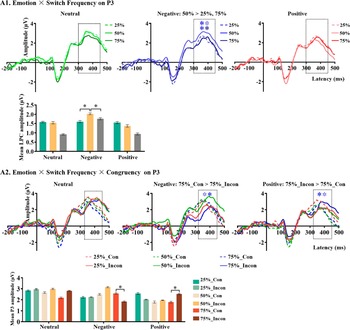
A three-way interaction between emotion × switch frequency × congruency was observed only on P3. Follow-up analyses were split by emotion. In positive states, a significant interaction between switch frequency × congruency revealed a flanker effect in the high-switching frequency context (incongruent: M = 2.49 ± 6.75 μV > congruent: M = 1.87 ± 6.70 μV, b = .61, SE = .306, z = 1.98, p = .048). In negative states, the significant main effect of switch frequency showed that the medium-switching frequency context (M = 2.96 ± 7.85 μV) elicited a larger P3 effect compared to both the low- (M = 2.31 ± 7.33 μV, b = .63, SE = .232, z = 2.71, p = .019) and high-switching frequency contexts (M = 2.32 ± 7.03 μV, b = .63, SE = .234, z = 2.69, p = .020) (see Figure 3A1). Moreover, an interaction between switch frequency × congruency indicated a reversed flanker effect in the high-switching frequency context (congruent: M = 2.67 ± 6.70 μV > incongruent: M = 1.96 ± 7.05 μV, b = .68, SE = .338, z = 2.01, p = .044) (see Figure 3A2). All follow-up analyses, both significant and nonsignificant, can be found in Supplementary Table S6.
Mean waveforms time-locked to the onset of the Flanker task on P3 (330–450 ms). (A1) interaction of emotion × switch frequency, (A2) interaction of emotion × switch frequency × congruency.
Note: Colored asterisks in the ERP waveforms indicate significant differences between conditions (p < .05). Bar graphs display mean voltages for P3 in the corresponding conditions averaged across sites. Error bars show the standard error of means. Pos = Positive, Neg = Negative, Neu = Neutral, Med = Medium, Con = Congruent, Incon = Incongruent. * p < .05.

3.3. Granger causality results
Figures 4A1 and 4A2 show peak GC estimates in alpha oscillations (8–13 Hz) and beta oscillations (13–30 Hz). Accordingly, we conducted a mixed-effects model of emotion (positive, negative), switching frequency (low, medium, high), and congruency (congruent, incongruent) on both alpha and beta frequency bands (see full results in Supplementary Table S5). All follow-up analyses, both significant and nonsignificant, can be found in Supplementary Table S7.
Granger causality analysis from picture-naming to Flanker tasks. Panels A1 and A2 show the positive and negative states Granger causality spectrum. Panels B1 and B2 illustrate the comparison of Granger causality spectra between high_con and high_incon conditions in positive and negative states, respectively. Panel C1 shows the causal strength of alpha oscillations (8–13 Hz) and panel C2 displays causal strength of beta oscillations (13–30 Hz). Panel D illustrates the emotion × switch frequency interaction.
Note: Spectra and bar diagrams show GC strength between tasks, with alpha (8–13 Hz) and beta oscillations (13–30 Hz) highlighted. Error bars represent SEM. * p < .05.

3.3.1. Alpha oscillations (8–13 Hz)
Regarding alpha oscillations, a significant three-way interaction between emotion × switching frequency × congruency was observed. Further analyses revealed that in positive conditions, connection strength was greater in incongruent conditions (M = .129 ± .12) than in congruent conditions (M = .114 ± .12, b = .01, SE = .007, z = 2.31, p = .021). Additionally, the interaction between switching frequency × congruency indicated that in high-switching frequency contexts, connection strength was greater in incongruent conditions (M = .147 ± .14) than in congruent conditions (M = .108 ± .11, b = .04, SE = .011, z = 3.51, p < .001) (see Figures 4B1 and 4C1). Conversely, in negative conditions, connection strength was greater in congruent conditions (M = .140 ± .13) than in incongruent conditions (M = .109 ± .11, b = .03, SE = .006, z = 4.89, p < .001). The interaction between switching frequency × congruency showed that in high-switching frequency contexts, connection strength in congruent conditions (M = .167 ± .14) was significantly higher than in incongruent conditions (M = .085 ± .09, b = .08, SE = .011, z = 7.28, p < .001) (see Figure 4B2 and 4C1).
3.3.2. Beta oscillations (13–30 Hz)
With respect to beta oscillations, the results revealed a significant main effect of switching frequency, showing that connection strength was lower in the medium-switching frequency (M = .116 ± .12) than in both low- (M = .124 ± .13, b = −.01, SE = .003, z = −2.50, p = .033) and high-switching frequency conditions (M = .125 ± .128, b = −.01, SE = .003, z = −2.84, p = .013) (see Figure 4D). In addition, the three-way interaction between emotion × switching frequency × congruency was significant. Further analyses revealed that in positive states, a main effect of congruency indicated higher connection strength in incongruent conditions (M = .126 ± .13) than in congruent conditions (M = .118 ± .12, .01, SE = .004, z = 2.20, p = .028). The interaction between switching frequency × congruency revealed that in high-switching frequency contexts, connection strength in incongruent conditions (M = .126 ± .13) was greater than in congruent conditions (M = .118 ± .12, b = .03, SE = .006, z = 4.75, p < .001) (see Figure 4B1 and 4C2). By contrast, in negative conditions, a significant main effect of switching frequency was found, suggesting that connection strength was lower in medium- (M = .104 ± .11) than in low- (M = .130 ± .13, b = −.03, SE = .005, z = −5.67, p < .001) and high-switching frequency conditions (M = .129 ± .13, b = −.03, SE = .005, z = −5.52, p < .001). The interaction between switching frequency × congruency showed that in high-switching frequency contexts, connection strength was greater in congruent conditions (M = .146 ± .15) than in incongruent conditions (M = .113 ± .11, b = .03, SE = .007, z = 5.11, p < .001) (see Figure 4B2 and 4C2).
Overall, in the beta frequency band, we found that under negative states, connection strength was greater in low- and medium-switching frequency contexts than in high-switching frequency contexts. Additionally, in both the alpha and beta frequency bands, results showed that in high-switching frequency contexts under positive states, connection strength was higher in incongruent trials than in congruent trials; however, under negative states, connection strength was higher in congruent trials than in incongruent trials.
4. Discussion
The present study is the first to combine emotional states and language-switching frequency contexts to examine their joint influence on domain-general control. The results showed that negative states elicited faster RTs and greater N2 effects compared to neutral states. In switching contexts of medium frequency, negative states induced smaller N2 and larger P3 effects than did low- and high-switching frequencies. In high-switching frequency contexts, the P3 effect and GC connectivity results in the alpha and beta oscillations indicated that positive states elicited the typical flanker effect, while negative states showed a reversed flanker effect.
Overall, these findings suggest that negative states enhance the speed of executive control and that emotional states show different effects depending on the frequency of language switching. In medium-switching contexts, negative states improve overall executive control by optimizing resource allocation, requiring fewer cognitive resources for conflict monitoring and allocating more resources to resolve later-stage conflicts. Additionally, both positive and negative states modulate domain-general control in high-switching contexts but rely on different strategies. Specifically, positive states tend to promote proactive control by allocating more resources to anticipate conflicts, while negative states may favor reactive control by prioritizing the use of available information (e.g., congruent trials) to maintain task goals. These findings highlight the complex interaction between emotional states and language-switching frequency in modulating cognitive control. We will further elaborate on these findings in the next subsections.
4.1. Negative states optimize resource allocation in medium-switching contexts
Our findings showed that RTs in negative states were faster than in positive and neutral states, and that negative states triggered a larger N2 effect compared to neutral states. Because the N2 effect reflects conflict monitoring (Grundy et al., Reference Grundy, Anderson and Bialystok2017; Jiao et al., Reference Jiao, Liu, Bruin and Chen2020), these findings suggest that negative states may enhance an individual’s conflict monitoring and potentially facilitate the overall executive control process. In addition, we found a potential facilitatory effect of negative states on overall executive control in medium-switching contexts. Specifically, under negative states, medium-switching frequency contexts elicited smaller N2 and larger P3 effects compared to both low- and high-switching frequency contexts, indicating a pattern distinct from the other two switching conditions. A smaller N2 may suggest that individuals allocated fewer cognitive resources to early conflict detection.
Regarding the P3, it is essential to clarify the functional role of the P3 component in this study. Our analyses revealed that P3 amplitudes negatively correlated with RTs in some conditions, primarily in incongruent trials, indicating that greater P3 amplitudes may reflect more efficient allocation of cognitive resources, leading to faster conflict resolution. Moreover, a stable positive correlation between P3 latency and RTs was observed in most conditions, suggesting that P3 latency might reflect the temporal characteristics of cognitive control. Thus, P3 amplitude may represent the efficiency of resource allocation (Polich, Reference Polich2007; Polich & Herbst, Reference Polich and Herbst2000), while P3 latency may reflect the temporal features of the cognitive control process (Verleger, Reference Verleger1997). Therefore, in medium-switching frequency contexts, individuals in negative states appeared to allocate fewer cognitive resources to early conflict monitoring (reflected by smaller N2 effects), but recruited more resources during the later conflict resolution stage (reflected by larger P3 effects), which may have contributed to relatively more effective conflict resolution.
One possible interpretation is that these patterns may reflect a compensatory mechanism that is triggered by negative states, which in turn, may serve to recruit additional resources to offset adverse effects and support task performance (Jiang et al., Reference Jiang, Meng and Chen2024). Liu et al. (Reference Liu, Liu, Jiang, Schwieter and Chen2026) examined language switching performance under different emotional states (positive, negative, and neutral) with varying switching frequencies (25%, 50%, and 75%); findings showed that in the 50% switching context under negative states, switch costs disappeared, yet the N2 effect increased and the P3 effect decreased (compared to the 25% switching context, in which the N2 effect was greater and the LPC effect was smaller). These findings suggest that in the moderately demanding medium-switching context, the control system may integrate both top-down and bottom-up regulation to selectively counteract negative emotional interference, thereby optimizing language-switching efficiency. In the present study, we found that in medium-switching contexts, the compensatory mechanism associated with negative states not only facilitated language task performance but may also have produced a “carryover effect” on subsequent cognitive behavior. Individuals in negative states appear to strategically adjust their cognitive control to reduce unnecessary monitoring demands, enhance conflict resolution and ultimately improve performance efficiency in subsequent tasks.
The GC results indicated that negative states modulated a global, selectively allocated cognitive resource strategy. Specifically, the connectivity strength of beta between the language switching task and the flanker task was lower in medium-switching frequency contexts than in low- and high-switching frequencies, particularly under negative states. Beta activity reflects the stability of state monitoring, and its decrease typically marks a transition (Chen & Huang, Reference Chen and Huang2016; Engel & Fries, Reference Engel and Fries2010; Schmidt et al., Reference Schmidt, Ruiz, Kilavik, Lundqvist, Starr and Aron2019). This pattern suggests that in medium-switching frequency contexts, negative states may support overall task performance in a manner that does not rely on a continuous increase in inter-task resource allocation. Combined with the ERP results, these patterns suggest that during conflict resolution, individuals reduce early conflict monitoring and allocate more resources to resolve subsequent conflicts, thereby enhancing task performance efficiency.
In contrast, in both low- and high-switching frequency contexts, negative states were associated with larger N2 and smaller P3 effects. In low-switching frequency contexts, infrequent switching required relatively low cognitive demands, suggesting that individuals already possessed sufficient executive resources to perform the task. Consequently, negative states may not have induced substantial adjustments in control strategies or resource redistribution. In high-switching frequency contexts, the need for continuous conflict monitoring mobilizes cognitive resources to a high degree, which may reduce the extent to which negative states further modulate overall executive control. Although stronger beta connectivity was observed in both low- and high-switching frequency contexts, indicating stable inter-task coordination, it was not accompanied by an overall enhancement of executive control performance. Importantly, these results do not indicate that negative states impair cognitive function; rather, they suggest that, unlike in medium-switching contexts, negative states may not confer context-specific adaptive enhancements in cognitive control.
4.2. Positive and negative states differentially affect cognitive control strategies in high-switching contexts
In high-switching contexts with greater cognitive demands (75% switching), emotional states appeared to guide distinct cognitive control strategies, as manifested in corresponding patterns of resource utilization. The results showed that in the high-switching frequency context, a typical flanker effect was observed in positive states, with higher P3 amplitude in incongruent trials than in congruent trials. Because the P3 component reflects efficiency of cognitive resource allocation, these results suggest that individuals in positive states can mobilize more cognitive resources to proactively address task conflicts. This finding aligns with our hypothesis that positive states may prompt individuals to adopt more proactive regulation strategies, allocating resources in advance to optimize conflict resolution. Conversely, under negative states, a reversed flanker effect was observed in high-switching frequency contexts, with P3 amplitude being greater for congruent trials than for incongruent trials. This may reflect a reactive strategy, in which individuals may rely on existing information (e.g., congruent trials) rather than proactively adjusting resources to handle conflicts. These results are consistent with Hypothesis 2, showing that the influence of emotional states on control strategy selection occurs primarily in high-switching contexts. According to the dual competition model (Pessoa, Reference Pessoa2009), emotionally salient stimuli consume limited executive resources, which can reduce availability for other functions such as inhibition or task switching. In our study, with emotional arousal controlled to be equally high, emotional states had little to no effect in low-switching contexts, likely because resources were sufficient. In contrast, under high-switching conditions, the increased demands on executive resources allowed emotional states to significantly affect behavior, with positive states promoting proactive control and negative states favoring reactive control.
Similarly, the GC results revealed distinct connectivity patterns in positive and negative states for the alpha (8–13 Hz) and beta (13–30 Hz) frequency bands. Alpha oscillations are crucial for attention, working memory and cognitive control, for which enhanced activity suppresses irrelevant information and optimizes target processing (Jensen & Mazaheri, Reference Jensen and Mazaheri2010; Van Diepen et al., Reference Van Diepen, Foxe and Mazaheri2019). Beta oscillations maintain current cognitive or behavioral states, with increased activity stabilizing and preventing premature shifts (Chen & Huang, Reference Chen and Huang2016; Engel & Fries, Reference Engel and Fries2010; Schmidt et al., Reference Schmidt, Ruiz, Kilavik, Lundqvist, Starr and Aron2019). Specifically, in positive states, the connectivity strength of alpha and beta oscillations in incongruent trials during high-switching frequency contexts was significantly higher than in congruent trials, indicating that individuals actively mobilized cognitive resources to address conflicts and adjust task strategies. This result is consistent with the view that positive states may be associated with proactive regulation. In contrast, in negative states, the connectivity in congruent trials was stronger, reflecting individuals’ reliance on existing information to maintain task stability, and supporting the hypothesis that negative states lead to more reactive control. Importantly, the consistency between GC connectivity and stimulus-locked P3 effects suggests that these emotional influences are not limited to transient, trial-level responses. Instead, they may reflect sustained control strategies that are shaped by the interaction between emotional states and language-switching frequency.
Overall, a key finding of this study is that individuals flexibly modulate domain-general control in response to switching demands under different emotional states, which carries over to influence executive control. In medium-switching frequency contexts, negative states optimize resource allocation, thereby enhancing executive control efficiency. However, in high-switching frequency contexts with greater cognitive demands, emotional states influence task-handling strategies: In negative states, individuals tend to adopt reactive control, whereas in positive states, they are more likely to utilize proactive control. Notably, under neutral states, no significant effects of switching frequency on executive control were found, contrary to our hypothesis. Liu et al. (Reference Liu, Liu, Jiang, Schwieter and Chen2026), however, showed that RTs in a language switching task followed a gradient aligned with switching frequency, with responses fastest in 25% contexts and slowest in 75% contexts. Taken together, although switching frequency can induce control adjustments, these adjustments may not be sufficiently sustained to influence subsequent executive control. In contrast, under emotional states, individuals may be more likely to regulate cognitive control in response to switching-frequency contexts, and these adjustments may carry over to influence performance in subsequent executive control tasks.
4.3. The Emotion Adaptive Control model
In our experiment, we manipulated language-switching frequency to construct different control contexts, thereby operationalizing the “interactional context” concept proposed by the Adaptive Control Hypothesis (Green & Abutalebi, Reference Green and Abutalebi2013). The framework describes an adaptive system in which multiple cognitive control components (e.g., goal maintenance, conflict monitoring and interference suppression) support bilingual control. Although this paradigm may also involve general task-switching processes, it captures the core mechanism by which the language control system selectively coordinates shared components. Accordingly, the various switching-frequency contexts employed in this study offer a context-based framework for examining how adaptively regulated control demands vary across bilingual interactional settings, although the extent to which switching frequency fully reflects adaptive control necessitates further investigation.
Our findings hold important theoretical implications. Here, we put forth the Emotion Adaptive Control (EAC) model (see Supplementary Figure S5). The model is informed by the results of the present study and builds on Braver’s (Reference Braver2012) dual mechanisms framework, which distinguishes between proactive and reactive control and highlights the flexibility which individuals use to adjust their cognitive control strategies based on task demands. The EAC model highlights potential interactive effects the emotional states and contextual demands (e.g., language-switching frequency) have on cognitive control, illustrating how these two factors may jointly modulate adaptive cognitive control mechanisms. The model proposes that when contextual demands are low, such as in low-switching frequency contexts, emotional states exert a limited influence on control processes, likely because individuals have sufficient cognitive resources, reducing the need for substantial emotion-driven adjustments. When contextual demands are more moderate, such as in medium-switching frequency contexts, individuals in negative states may selectively modulate control system resources to optimize resource allocation and enhance overall executive control within the context. And when contextual demands are greatest, such as in high-switching frequency contexts, emotional states guide individuals to adopt different cognitive strategies, with positive states activating proactive control strategies and negative states relying on reactive control strategies. In sum, the EAC model highlights the potential interactive regulatory role of emotion and contextual demands, offering a tentative novel perspective on adaptive control in bilingual language use within complex environments.
Finally, we acknowledge several limitations. First, the present study only examined the performance of unbalanced Chinese-English bilinguals. Therefore, our findings should be interpreted within the context of this population. Future research should examine the applicability of our results among other populations, including balanced bilinguals and other bilingual groups, thereby extending and validating the scope of the framework. Second, research on language-switching frequency and its interaction with emotional states remains limited, particularly with regard to their influence on executive control. The present study provides a preliminary exploration, and further research is needed to more fully understand how emotional states and switching-frequency contexts jointly shape cognitive control processes.
5. Conclusion
In the present study, we found that in medium-switching frequency contexts, negative states enhanced executive control efficiency by optimizing the allocation of cognitive resources. However, when language-switching frequency was high, emotional states influenced cognitive control in distinct ways, such that positive states promoted proactive control and negative states favored reactive control. These findings have informed the development of the EAC model, a theoretical framework which highlights the role of emotional states in regulating domain-general control across language-switching frequency contexts. In sum, the present study underscores the interactive effects of emotional states and language-switching frequency on domain-general cognitive control, offering new insights into adaptive behavior and cognitive regulation.
Supplementary material
The supplementary material for this article can be found at http://doi.org/10.1017/S1366728926101345.
Data availability statement
The data that support the findings of this study are openly available in OSF at https://doi.org/10.17605/OSF.IO/X5GTY
Acknowledgments
This work was supported by the National Natural Science Foundation of China (Grant No. 31970976).
Competing interests
The authors declare none.
Ethical approval
The authors assert that all procedures of this work comply with the ethical standards of the relevant national and institutional committees on human experimentation and with the Helsinki Declaration of 1975, as revised in 2008. The study protocol was approved by the Institutional Review Board of the Faculty of Psychology at Beijing Normal University (Protocol ID: BNU202503110080).




 Open access

