





In the 1960s, Soviet scholars, educators and policy makers came to regard the human mind as a crucial economic resource. Concerned about the Soviet future in the era of digital automation, they contended that the Soviet state required a workforce that could build, program, control and maintain computer technology. They came to believe that a highly skilled, well-trained manpower capable of building and operating highly sophisticated technological systems required creative thinking.Footnote 1 ‘Creative thinking’ was an umbrella term referring to the ability to solve previously unencountered problems and reason independently. This article examines how creativity became an object of study in Soviet educational and cognitive psychology: how creative thinking was defined, measured and cultivated in Soviet citizens during the 1960s and 1970s.
Two currents were central to the rise of interest in creative thinking among scientists and officials. The first was the acceptance of the theory of the scientific–technical revolution among Soviet policy makers and social scientists. Historian and sociologist of science Egle Rindzevičiūtė has demonstrated how, during the post-Second World War era, the Soviet Union came to share with Western liberal democracies the discourse on the central role of technoscience in socio-economic change.Footnote 2 The roots of this discourse were in the modernization theory of MIT economic historian Walt Whitman Rostow and the theory of scientific–technical revolution. The latter postulated that ‘new techno sciences, based on automatic control and digital technologies, lead to the restructuring of society by intellectualizing labour and thus reducing the working class’.Footnote 3 With the beginning of de-Stalinization, the Soviet state eagerly adopted the scientific–technical revolution. For example, in 1956, the Communist Party approved a five-year plan that set a goal for Soviet industry ‘to fully exploit the ongoing “scientific–technical revolution” in furthering the Soviet economy’.Footnote 4 It was in this context of hypervigilance about the USSR's capacity to innovate that Soviet researchers, educators and policy makers came to see creativity as a desired cognitive disposition and as a set of mental operations to be studied and disciplined.
Another historical force that made possible the concentration on creativity was Soviet cybernetics. An interdisciplinary field in vogue in the 1960s and 1970s, Soviet cybernetics was concerned with research on computing and the introduction of quantitative methods to a vast array of human, social and life sciences. Historians Jamie Cohen-Cole and Paul Edwards have established how computing, cybernetics and information theory offered powerful analogies and research tools for studies of human cognition in the United States in the mid-century.Footnote 5 In the Soviet Union, cognitive psychology followed the same trajectory: it emerged with the intellectual and institutional support of cybernetics. Previously a purely interpretive field, from the 1960s onwards Soviet psychology of thinking drew on methods of information theory and artificial intelligence to quantify and model human cognition, including creative thinking.
This article is in four parts. The first outlines how creativity became of state importance. The Soviet Party, cognizant of the pressures of technoscientific change, articulated a demand for creativity as a desired mental disposition in the 1960s. That led the Academy of Pedagogical Sciences (APN) in Moscow to revise existing curricula, and develop new ones that emphasized problem solving and independent thinking skills.Footnote 6 Nonetheless, committed to cultivating creative reasoning in students, Soviet educators did not attempt to study the workings of the mind. As the second section shows, it was cybernetics that spurred the foray into quantitative studies of the mind. In particular, engineering psychologists first drew on developments in information theory to quantify human decision making. The third section focuses on the research on human creativity and problem solving conducted by Soviet engineering psychologist Veniamin Pushkin. His experimental studies of human thinking led him to claim that the artificial-intelligence program the Logic Theory Machine, created by US scholars Herbert Simon and Allen Newell, did not capture the real human cognitive mechanisms of creative thinking. As the fourth section demonstrates, Pushkin's theory of creative thinking found its way into the methodology of problem solving developed by Lev Landa, his colleague at the Council on Cybernetics and the APN. Named the algo-heuristic theory (AHT), Landa's methodology sought to optimize human problem solving, offering a typology of all problems and the corresponding mental algorithms required for their solution.
The AHT, I argue, was a culmination of the Soviet effort to make creative thinking visible, formalizable and accessible to the masses. Historians have introduced the term ‘algorithmic rationality’ to describe a ubiquitous mid-century idea that rational thinking could be achieved through the mindless following of rules.Footnote 7 This article, however, demonstrates that, in the Soviet Union, despite the ambition to make creative thinking explicit, scholars resisted the idea of reducing human thinking to standardized and uniform algorithms. Lev Landa had to navigate a thin line between making creative thinking explicit and turning it into a mindless process. His prescriptions for creative problems only partially determined one's thinking and bore more of a semblance to what Lorraine Daston describes as ‘thick rules’ – prescriptions used in early modern arts to refine rather than control reasoning – than to step-by-step procedures.Footnote 8 Steven Shapin's argument about the rise of creativity as a corporate imperative in the mid-century is helpful in understanding the epistemological underpinnings of Landa's theory.Footnote 9 Shapin argues that the definition of creativity as problem solving articulated by US mid-century leading cognitive psychologists matched Thomas Kuhn's concept of ‘normal science’, the practice of scientific puzzle solving that avoids diverging from the standard, normal and traditional. From the 1960s onwards, the Soviet Union saw the rise of the same corporate-like discourse around creative thinking, with the major difference being that creative thinking had to serve the state rather than corporate needs in the USSR. Landa's AHT exemplifies rule-bound creativity: it avoids turning creative thinking into a purely mechanical process but also keeps the thinker confined within the established paradigm. Following the AHT prescriptions, the mind thought in semi-autonomous conditions, serving the goals of the state but never putting them into question.
While in the United States, Cold War military funding was central to the growth of research in cybernetics, computing and rule-based approaches to policy making, Soviet work on the formalization of creative thinking existed outside the military infrastructure. Historians have paid sufficient attention to how US defence institutions contributed to the rise of the discourse on algorithmic rationality in the exact, human and social sciences. However, little attention has been paid to how algorithmic rationality travelled from warfare to welfare domains. In reconstructing the history of the AHT and the scientific theories and political moment that made Landa's methodology possible, this article follows the trajectory set by Jennifer Light and Bernard Geoghegan, who have demonstrated how cybernetics was mobilized by the US Cold War technocracy to solve welfare problems.Footnote 10 In line with their scholarship, I show how Soviet researchers employed the products of the military–industrial complex, such as information theory and artificial intelligence, to streamline the thinking of lay minds.
Making up creative minds
In the second half of the 1960s, Soviet educators and psychologists became preoccupied with creative thinking. Creativity had previously been an essential category in Marxist–Leninist philosophy. For instance, Vladimir Lenin extensively emphasized the importance of creative work in socialist society. However, Lenin's views on creativity differed profoundly from how Soviet researchers approached creative thinking in the 1960s. Lenin first and foremost associated creativity with cultural production and a means for disseminating socialist ideology across the newly formed Soviet Union. In the 1960s, however, Soviet scholars turned this ill-defined category into a subject of robust scholarly investigation, defining it as a problem-solving ability central to technoscientific innovation. This definition guided Soviet educators as they were updating the Soviet curriculum to emphasize the teaching of creative thinking skills. The spread and acceptance of the ideas of the scientific–technical revolution among public officials and human and social scientists played a central role in the effort to introduce the teaching of creative thinking skills across the Soviet Union.
In 1966, at the 23rd Congress, the Communist Party proclaimed that the unfolding scientific and technical revolution of the mid-twentieth century would require a new kind of worker. In the next three decades, automatic control and digital technologies would change the character of labour, making physical work obsolete and creating an urgent need for a workforce with high-level competencies and qualifications. At the congress, Leonid Brezhnev especially emphasized the central place of scientific knowledge in the Soviet economy in the second half of the twentieth century, referring to science as ‘the major productive source’.Footnote 11
The concern with meeting the needs of technoscientific change resulted in several Party directives to change the Soviet educational system to ensure a steady supply of a highly skilled workforce. These directives included making ten years of secondary education a state-wide requirement by 1970, placing more emphasis on polytechnical education in secondary schools, and teaching school and university students the practice of scientific research.Footnote 12 Party directives also prompted the APN (the USSR's central research institute in psychology, pedagogy, curriculum development and educational policymaking) to identify specific means to ensure that Soviet schools and universities could produce the workforce needed for the era of digital automation.
As part of the response to the Party directives, researchers at the Institute of Psychology (a unit within the APN) proposed that to be productive members of Soviet technocracy, students should learn to think like scientists.Footnote 13 In particular, APN psychologists suggested that students should master the very cognitive skills at the core of scientific practice: creative thinking, the ability to learn independently and problem-solving abilities. These three skills were seen as integral to each other. For instance, APN psychologist Isaac Lerner, one the founders of the problem-based approach in Soviet education, defined creative thinking as ‘an aptitude to make logical proofs, the capacity to reason consistently, and the ability to compare and contrast a problem solution with the task’.Footnote 14 Essentially, for Lerner and his APN colleagues, the paragon of a creative thinker was the scientist. Soviet psychologists shared their views. At the 1967 First All-Union Symposium on the Psychology of Scientific Creativity, Lerner's paper was only one of many that proposed that the creativity of the scientific mind came – above all – from its capacity for self-instruction and problem solving.
The concern with the importance of science and creativity for Soviet economic growth remained relevant in the 1970s. In 1971, the APN presented a plan for developing Soviet schools over the next thirty years. It set the cultivation of creative thinking in students as its primary goal, noting that Soviet education must be reoriented towards teaching the methods of scientific reasoning. The plan called for secondary education to cease being a ‘warehouse of ready-made facts’ and, instead, to strive to ignite the excitement of scientific pursuit in young Soviet citizens.Footnote 15 Even outside the APN, the focus on cultivating Soviet cognitive resources was a fixture of the Soviet state. In 1973, the State Committee for Science and Technology launched a Complex Research Programme on Scientific and Technical Progress and Its Social and Economic Implications to identify the fields of science and technology that would contribute to Soviet economic growth from 1976 to 1990. The programme outline highlighted that economic growth and technoscientific progress hinged on Soviet citizens’ aptitude for creative thinking.Footnote 16
Cybernetics and cognition
While APN researchers were committed to the development of creative-thinking skills in Soviet citizens, their work had little to do with understanding the mechanisms of human cognition. Limited to the formulation of new teaching methods and curriculum development, the nature of APN work reflected the dominance of educational concerns in Soviet psychology. Essentially, in the 1960s, Soviet psychology remained a pedagogical discipline. Its disciplinary status changed only in 1972, with the opening of the Institute of Psychology at the Academy of Sciences (AN) of the USSR in Moscow, the centre of Soviet civilian research. The formation of the new institute signified that the AN now recognized psychology as a discipline with the potential for tangible contributions to Soviet Big Science.Footnote 17 However, the first step toward distancing psychology from pedagogy and bringing it under the aegis of the AN had occurred ten years earlier, in 1962, with the opening of the Section on Psychology at the Council on Cybernetics at the AN. A young institution itself, the council was formed in 1959, during de-Stalinization, with the mandate to coordinate the development of civilian computing and introduce mathematical methods to all Soviet fields of the natural, human and exact sciences.Footnote 18 The Section on Psychology and Cybernetics sought to ‘cybernetize’ Soviet psychology by offering institutional and intellectual support for research that employed quantitative methods of analysis to understand human cognition, an emerging area of study in the Soviet Union during the 1960s and 1970s.
The council's director – admiral and professor of electrical engineering Aksel Berg – held a special interest in psychology. In the introduction to the 1961 programmatic collection of essays Cybernetics in the Service of Communism (Kibernetiku na Sluzhbu Kommunizmu), Berg identified psychology's value for cybernetics as being twofold. On the one hand, psychological studies of human learning, problem solving and pattern recognition could aid in the design of computers that would mimic these functions of the human mind.Footnote 19 On the other, knowledge about the human mind and behaviour was instrumental in the proper design and introduction of automation to Soviet industries.
Defining cybernetics as the science of control in large systems, Berg emphasized that despite automation, humans would remain a crucial element of large industrial and technological systems, for they would continue being responsible for their ultimate control.Footnote 20 Instead of making human labour obsolete, automation would make it more complex, supplying humans with even more challenging programming and management problems. Psychology, Berg maintained, provided cybernetics with the knowledge necessary to build a harmonious symbiotic relationship between humans and machines.Footnote 21 Here his views were consistent with Soviet Marxist ideology, which viewed technology as a means of perfecting ‘human natural capacities’, meaning that machines could expand human powers but never fully replace them.Footnote 22
The Section on Psychology and Cybernetics consisted of three commissions, all of which understood human cognition as information processing, where the mind codes, transforms and transmits information.Footnote 23 The first commission worked on mathematical simulation of human verbal reactions and neural activity. It was headed by neurophysiologist Evgeniĭ Sokolov and then, beginning in 1964, by psychologist Evgeniĭ Boiko. Psychologist Lev Landa directed the work of the second commission, overseeing research on the analysis of human learning and problem solving in terms of logical structures. Such analysis was instrumental in the development of special instructional algorithms to order how humans acquire new information and solve problems. Finally, the third commission – directed by Leningrad psychologist Boris Lomov – focused on engineering psychology, a subfield concerned with designing and introducing automated technology to complement human capabilities.Footnote 24
Engineering psychology was described by Lomov as a fundamental discipline responding to the state's pressing concerns of automation. It emerged at Leningrad State University (LGU) thanks to the efforts of Lomov and Boris Ananiev, his teacher and then senior colleague.Footnote 25 Both were educated at a time when Soviet psychology lacked the status of an independent discipline: Lomov defended his dissertation at the LGU's Philosophy Department in 1954, while Ananiev was a graduate of the Vladikavkaz Pedagogical Institute in North Ossetia, a Soviet Republic in the Caucasus mountains. Ananiev moved to Leningrad in 1928, a year after completing his postgraduate studies. There he joined the Brain Research Institute, founded by Russian neurophysiologist Vladimir Bekhterev in 1907. In 1944, Ananiev moved to LGU to found the chair of psychology in the Philosophy Department, where Lomov would defend his dissertation. About two decades later, in 1966, the two established the first Department of Psychology and Laboratory of Engineering Psychology in the Soviet Union, at LGU.
Engineering psychology provided a major stimulus for the growth of studies in human cognition within the USSR. Lomov and his colleagues upheld that automation required an understanding of how human cognition compares to machine capabilities. Focusing on the work of human operators – railway and airport dispatchers, pilots and locomotive engineers – Lomov's lab worked to establish which aspects of operating, maintaining and overseeing industrial equipment should be delegated to machines and which should be left to humans. Should humans be mere recipients of computer-generated commands? Or should computers be tasked only with supplying humans with data so that the latter can make decisions using their rational judgement? Should machines be made to oversee their own work, or should evaluating their functionality be a domain of human expertise?Footnote 26
To answer these questions, Lomov and his colleagues at LGU drew on developments in information theory to perform the first in the USSR's quantitative experimental studies of human memory, perception, attention and decision making.Footnote 27 In particular, they were concerned with how operators processed information from monitors, sensors and other equipment. For instance, Lomov's lab measured the correlation between the bits of information received by an operator and the time the mind needs to process them, calculating the exact range of seconds required for tactile, audio or visual information.Footnote 28
Modelling problem solving: a debate over heuristics
Retaining his professorship in Leningrad, Lomov could visit Moscow's Council on Cybernetics only monthly during the 1960s.Footnote 29 However, he was far from being the only member of the council who employed quantitative methods to understand human cognition. His council colleague, Moscow-based engineering psychologist Veniamin Pushkin, also studied the cognitive mechanisms of operators. A doctoral graduate of the Philosophy Department at Moscow State University, Pushkin held his primary appointment at the APN, which, as shown above, was the centre of Soviet pedagogical research on problem solving and creative thinking. However, unlike most of his APN colleagues, Pushkin studied problem solving through the lens of engineering psychology rather than pedagogy: he sought to understand the cognitive mechanisms that allow railway and airport dispatchers to optimize transport flow. The work of the dispatchers, he upheld, was a paragon of highly complex problem solving for which, most of the time, operators have no ready-made instructions, algorithms or prescriptions to follow. Pushkin viewed problem solving as a characteristic of productive thinking that leads to solving a previously unencountered problem. Responsible for the development of new methods and patterns of activity, productive thinking allows an individual to orient to new circumstances.Footnote 30 Essentially, for Pushkin, productive thinking was the definition of creativity.
Like his colleagues at the Council on Cybernetics, Pushkin employed quantitative methods in his research. To formalize problem solving, he turned to US research on heuristic programming, a dominant approach to artificial intelligence (AI) in the mid-century that modelled how human minds manipulate symbolic information. From the Greek, the adjective ‘heuristic’ means ‘serving to discover’. Heuristic rules were first formulated by Hungarian-born Stanford mathematician George Polya. He maintained that mathematicians rarely use only deductive reasoning; on the contrary, they often perform mental shortcuts and employ guesswork.Footnote 31 His famous textbook How to Solve It presented a set of heuristic rules to introduce students to the art of taking such shortcuts. For instance, the book taught students how to identify patterns in solving different proofs, build analogies with other problems, and work backwards from something they suppose is true.Footnote 32
Computer scientist Allen Newell, one of the founders of the symbolic AI approach, took classes with Polya at Stanford in the early 1940s. When he collaborated with Herbert Simon at the RAND Corporation in 1958 to build their information processing program the Logic Theory Machine (LTM), both sought to create a computer program that would use the same kinds of heuristics that humans do.Footnote 33 As historians Stephanie Dick and Hunter Heyck have shown, a decision tree model of problem solving was at the heart of the LTM: the program tested different solution variants to move from the original problem to sub-problems.Footnote 34 The program gained acclaim for its heuristic rules, which allowed it to minimize the number of tested variants, an approach that came to be named ‘heuristic programming’. Far from being the only approach to AI in the mid-century, it was, nonetheless, the best-known among the Council on Cybernetics psychologists.Footnote 35
With his disciplinary background in experimental psychology, Pushkin found Simon and Newell's claims about the parity between the LTM and the mind to be poorly supported. It troubled him that the LTM – a model of the human mind, as Simon and Newell argued – was developed without any experimental studies of human cognition. Even though US scholars created thinking-aloud protocols documenting their thinking process and the reasoning of students solving mathematical problems, Pushkin found those insufficient for a comprehensive understanding of human thinking.Footnote 36 It seemed to him that Simon and Newell were much more invested in developing logical rules than in understanding the mind. His position was that the development of any program emulating human cognition had to be pre-dated by ‘the discovery of the psychological laws of thought’ through experiments that would ‘model thinking activity in work’.Footnote 37
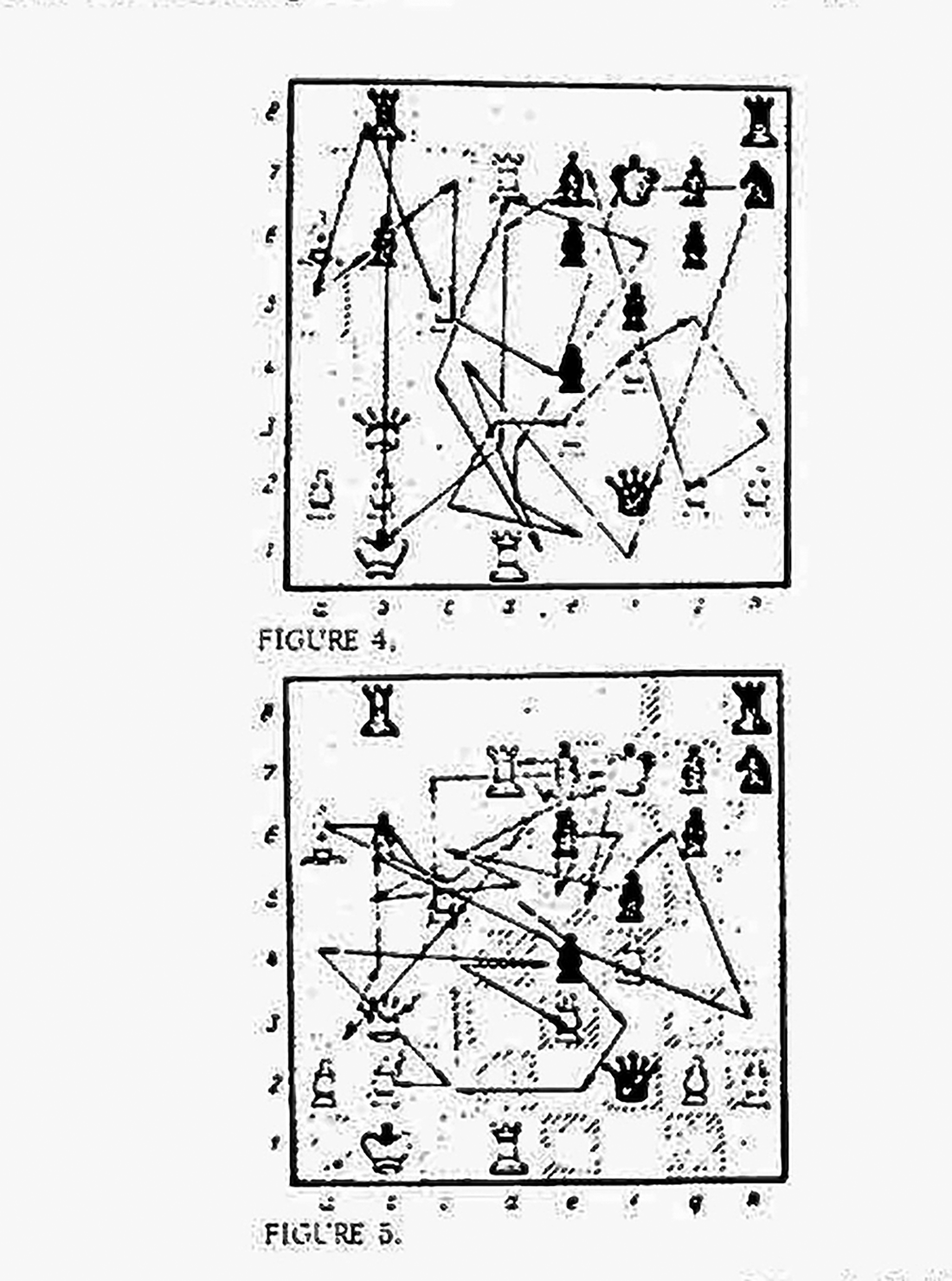
Pushkin's experimental studies led him to a more complex model of human thinking. In the first half of the 1960s, he conducted a series of experiments on chess players trying to find a winning combination, tracking their eye movements with a camera.Footnote 38 As an engineering psychologist, Pushkin considered chess playing a perfect model of how human operators control large systems: deciding on the next move on the chessboard boils down to the same cognitive mechanisms that dispatchers use when optimizing aeroplane flow.Footnote 39 These studies allowed Pushkin to conclude that, unlike Simon and Newell's LTM, the human mind does not narrow the search field to test solution variants; instead, it constructs ‘a dynamic information-processing model of the external world’.Footnote 40
Perfected in collaboration with mathematician Dmitrii Pospelov and philosopher Vadim Sadovskii, Pushkin's theory of ‘dynamic information processing’ postulated that to solve a previously unencountered problem, the mind identifies the elements of the problem to establish a problem space; then, as it establishes the relations between problem elements, it creates a mental model of how these elements relate to each other. For example, to decide on the next move, a chess player identifies relevant figures on the board and then establishes the relationships among them. Pushkin's experiments showed that chess players make repeated eye movements between the figures they determine to be problem elements. He interpreted the movements as evidence that, when solving a creative problem, the mind first expands the search field and then, instead of testing individual problem solutions, deals with a multitude of possible solutions at once. In Pushkin's theory, Simon and Newell's neat decision trees had little to do with the actual messiness of human cognition.Footnote 41
Pushkin's diagram documenting the patterns of eye movements in chess players searching for a winning combination for white. © 1968 International Federation of Automatic Control. Reproduced with the permission of IFAC from V.N. Pushkin, ‘Heuristic aspects of the “man-large system” problem’, IFAC Proceedings Volumes (1968) 2(4), pp. 715–21, Figures 4–5.
In line with his approach to human problem solving, Pushkin maintained that if heuristic programming truly wanted to emulate the mechanisms of human creative thinking, it had to focus on formalizing how the mind creates a dynamic model of a problem, and especially how it establishes the relations between different elements of a problem space.Footnote 42 Pushkin had an uneasy relationship with formalisms. While Newell and Simon's LTM was inadequate, he found more promise in research on dynamic programming, often described as ‘semiotic programming’ in Soviet literature. Dmitrii Pospelov and Yurii Klykov, both professors of mathematics at the Moscow Institute of Physics and Technology and the Moscow Engineering and Physics Institute, the two prestigious Soviet technical universities, were the best-known practitioners of this approach in the USSR.Footnote 43 They emphasized modelling the multitude of relations between the system's elements and breaking it into a range of subsystems interconnected by information channels.Footnote 44 While Newell and Simon's LTM presented problem solving as a top-down hierarchical process, dynamic programming offered formal tools to capture the distributed nature of human thinking, where information can flow back and forth from different elements. Pushkin thought that Pospelov and Klykov's approach was ‘considerably closer to the real process of problem-solving in man than are the programs of Newell, Shaw, and Simon’.Footnote 45 However, his final verdict was that the existing logical schemata still could not entirely capture the workings of the mind.
Lev Landa's algo-heuristic theory: creative thinking for any mind
Although responding to the pressing matters of Soviet automation, Pushkin's work was of a fundamental character. Nonetheless, his ideas still found a practical application, as they became instrumental to the creation of the theory and methodology of problem solving developed by his colleague Lev Landa. Landa joined the Section on Psychology and Cybernetics as it opened in 1962 to coordinate research on programmed instruction, a promising new field at the intersection of education, psychology and cybernetics.
Established in the 1940s by the US behaviourist B.F. Skinner, programmed instruction (initially unrelated to cybernetics) was created to apply the principles of behaviourist psychology to improve human learning. Skinner proposed breaking down learning material into small incremental units, testing students’ comprehension of each unit and allowing them to proceed only after they gave the correct answer.Footnote 46 Referring to the sequence of units as ‘programs’, Skinner commissioned their development only to specialists with training in behaviourist psychology and the taught subject. The program was then delivered by a teacher, a special textbook or mechanical teaching machines, which Skinner built in the 1950s. Programmed instruction, Skinner argued, was a scientific method of making learning a rational and controllable process.Footnote 47
Skinner's ideas arrived in the Soviet Union in the early 1960s, a time when Soviet scientists were encouraged to integrate Western theories and approaches into their research.Footnote 48 The ideas of rationality and control appealed to APN scholars, but other behaviourist premises were at odds with Soviet ideology. Soviet scholars could not accept how behaviourism blurred the line between human thinking and basic reflexes, ignored the role of social factors in human behaviour and learning, and offered a model of the self entirely dependent on external conditions.Footnote 49 Since cybernetics operated with concepts of feedback and control, terms also central to programmed instruction, Soviet scholars replaced behaviourism with cybernetics as the organizing theory of programmed teaching and learning.
Soviet cybernetics-inflected programmed instruction (or programmirovannoe obuchenie) came to be more concerned with the teaching of rational methods of problem solving than with instilling specific knowledge. Landa became interested in reasoning methods during his graduate studies at the APN Institute of Psychology. His 1955 dissertation, ‘The psychology of reasoning-methods formation (based on how seventh- and eighth-grade students solve geometry proofs)’ examined cognitive operations used by secondary-school students to solve mathematical proofs. People, he explained, usually concentrate on what, not how, they think; in other words, they care about knowledge, ignoring the kinds of operations that their minds perform upon knowledge.Footnote 50 His dissertation, on the other hand, was the first effort in the Soviet Union to make explicit the cognitive operations behind problem solving.
Cybernetics, especially control theory, became a natural intellectual ally of his work.Footnote 51 According to cybernetic theories of control, automatic control requires breaking down the process into elementary steps, with ‘the initial, intermediate, and final stages of the process as well as the operative factors which determine its course at each stage’ made visible.Footnote 52 This is exactly what Landa did in his approach to programmed instruction – identifying the most elementary cognitive operations that allow the mind to arrive at a solution to a problem. However, whereas control theory was concerned with developing algorithms for machines, Landa focused on algorithms for humans. Comparing his work to that of Newell and Simon, he stated that while their LTM was ‘a precise program of operations’ for the JOHNNIAC mainframe computer, his precise programs of operations were developed for humans.
Landa employed mathematical logic and information theory to ensure that his algorithms offered the most rational mental paths to problem solutions.Footnote 53 In particular, information theory aided him in calculating how a learner could get a maximum amount of information, removing uncertainty, while performing the minimum possible number of mental steps. For example, Landa used Claude Shannon's logarithmic formula to measure uncertainty (H) H = p 1logp 1 – p 2logp 2 – p 3logp 3…pnlogpn . to calculate an algorithm for solving a middle-school problem in Russian grammar.Footnote 54 A typical exercise lists sentences and asks students to which, out of five syntactic types, each of these sentences belongs. Landa marked sentences with letters to designate whether they did or did not have a characteristic such as having a subject, predicate, predicate in the first or third person, or predicate in singular or plural. Calculating the probability of each characteristic he concluded that it was most likely that a simple sentence would have a subject. Hence the first step students needed to do was to identify whether a sentence has a subject in order to decrease the uncertainty.
In the second half of the 1960s, like many other psychologists at the APN and the Council on Cybernetics, Landa became interested in creative thinking and its teaching. The result was his algo-heuristic theory (AHT), which offered a comprehensive classification of all possible cognitive operations accompanying human mental activity. Landa argued that all problems encountered by the human mind can be broken down into four types: algorithmic, semi-algorithmic, heuristic and semi-heuristic. To solve each in the optimal way, the mind needs to employ corresponding mental operations: algorithmic or heuristic problems should be solved with algorithmic or heuristic procedures, and so on. According to the AHT, heuristic problems required the most creative thinking, while algorithmic problems and mental procedures were the most uncreative.
Landa's AHT synthesized distinctive Soviet and American approaches to artificial intelligence. Like Pushkin, Landa believed that Simon and Newell's Logic Theorist failed to account for human creative thinking. Nonetheless, he thought that they offered a comprehensive account of algorithmic and semi-algorithmic operations and even called their heuristic programs incomplete algorithms, noting that they highly determined the problem-solving process.Footnote 55 On the other hand, in Landa's opinion, Pushkin's theory captured creative thinking most successfully. He used an example of the ‘Mark Twain problem’ described by German gestalt psychologist Karl Dunker in 1926. When Huckleberry Finn dressed as a girl and entered a stranger's cabin, he was greeted by a woman; eventually his reaction to being called a girl's name and inability to thread a needle made her suspicious. Dunker asked, what should the woman do to determine if she was dealing with a boy or a girl?Footnote 56 Landa explained that to solve this problem, one would need first to identify two fields in which to search for a solution: ‘1) actions which could put him (her) in typical circumstances in which the two sexes behave differently, and 2) actions which could put him (her) in unusual circumstances in which boyish behaviour (the woman suspected that she was dealing with a boy) would be evoked'.Footnote 57 Thus Landa argued that solving creative problems required the discovery of a new conceptual field, agreeing with Pushkin that creative thinking cannot be described as ‘limiting the field of choice and the number of alternatives chosen and tested’. To solve a creative task, Landa explained, the mind needs to cross ‘the boundaries of one field into a new field, one not given beforehand and not suggested by the problem’.Footnote 58
Landa's typology of problems and corresponding mental procedures classified heuristic problems as truly creative. To assist students in solving them, he developed heuristic prescriptions that offered a nudge toward the discovery of the appropriate course of action: ‘examine the object from various vantage points’, ‘recall a similar problem’, ‘try to apply some other method if the previous one was not successful’.Footnote 59 These offered hints but did not necessarily guarantee a solution.
Next were semi-heuristic problems and corresponding cognitive procedures. Similarly, one needed to discover a new conceptual field which may contain a solution. But unlike heuristic problems, one may use prior experience in solving semi-heuristic tasks. For instance, for someone with previous experience of tricking an individual into revealing their real gender, the Huckleberry Finn problem would become a semi-heuristic one.
Semi-algorithmic problems and mental procedures were next on the continuum of more or less creative problems and cognitive operations. These present a conceptual field within which one can search for a solution using a trial-and-error process, as described by Simon and Newell. Landa's prescriptions helped one limit the number of tested alternatives. Everyone who followed semi-algorithmic prescriptions solved such problems correctly, even though their solutions were not identical.Footnote 60
According to the AHT, algorithmic problems and mental operations were most remote from creative thinking. Solving an algorithmic problem does not require choosing between different alternatives or discovering a new conceptual field, but simply following the rules offered by an algorithmic prescription. Finding the common denominator of two numbers is an example of an algorithmic problem. To solve such a problem, one needed to follow an algorithmic prescription that fully determined the solver's thinking.
In Landa's typology, algorithmic prescriptions fully controlled the mind's actions, while heuristic prescriptions only offered a beaconing light on one's path to solving a problem. Landa developed a list of heuristic rules to aid the process of solving creative problems. The following are three examples of the rules written for middle-school students doing geometry proofs:
1 Think over, to yourself, all the sufficient attributes of the figure to be proved that you know; compare some or even each of them with the given information and with the diagram, and then decide which of them seems to be best for proving what you need to prove. Then search among the sufficient attributes for the chosen attribute; and so on. If one attribute does not work, or seems not to be promising, try another one.
2 If the diagram contains none of the figures or elements which are necessary in order to use the attributes which you thought of above, then construct the ones you need.
3 If the question: ‘What else could these elements be?’ leads you to see certain elements as elements of a geometrical figure which is not in the given diagram, but the properties of which could be useful in your proof, then construct this figure.Footnote 61
Essentially, these rules taught students to assess whether they needed to go beyond the conceptual field of a given problem. The first rule prompted the search for a solution within the given problem field. The second and third explained how, sometimes, one needs to search for a new conceptual field to solve a problem. While Landa successfully wrote his algorithmic prescriptions in the notation of mathematical logic, his heuristic rules existed only in verbal form, similar to Polya's heuristics in How to Solve It and consistent with Pushkin. Since his prescriptions were written for humans, translating them into logical notation was unnecessary.Footnote 62 Landa's AHT aimed to demystify the process of creative thinking, making it explicit and accessible to any mind.
Conclusion
In the 1960s, creativity became an educational goal and an object of cognitive studies in the Soviet Union. The urgent need for automation allowed creativity to crystallize into an essential category for the Soviet state. Defined in purely instrumental terms, creativity became an umbrella term for problem solving for technoscientific innovation. At the same time, the rise of cybernetics and its spread across human and social sciences, including psychology, allowed for the development of a quantitative approach to human cognition. Soviet scholars drew on methods from information theory and artificial-intelligence research to measure and model how human minds make decisions and solve problems. These social, political and cultural shifts paved the way for the development of Lev Landa's theory and methodology of problem solving, which strived to demystify creative thinking and make it accessible to every mind.
While the purpose of the AHT was to fulfil the Soviet state's dream of cultivating creative thinking on a mass level, it found its practical application only on the other side of the Iron Curtain. In 1975, Landa's son Boris, a Soviet dissident, married an American woman and left the Soviet Union for the United States, where he became a citizen. With this, Landa's reputation as a trustworthy Soviet citizen was at risk. A year later, he followed his son and settled in New York City. This geographical transition was accompanied by a remarkable shift in Landa's career. As a newly minted New Yorker, he now used his AHT to develop training materials for bank and insurance companies’ clerks. His exclusive offer was that his algorithmic and heuristic prescriptions could improve a company's productivity by 75–90 percent.Footnote 63
This final episode from the history of the AHT bolsters the claim that Landa's methodology was an instrument of cultivating rule-bound creativity, first in Soviet and then in US citizens. Far from being challenging, nonconformist, or groundbreaking, this type of creativity served (and continues to serve) corporate and state goals. No historical record indicates that the AHT has ever been used in teaching advanced science or engineering. In other words, it never aided in training new Marxes, Watsons and Einsteins; rather, the AHT cultivated semi-autonomous problem solving within well-defined limits of corporate and industry settings.
Acknowledgements
The Mellon Sawyer Seminars on Histories of AI were paramount to the gestation of this article. I would like to thank its organizers – Syed Mustafa Ali, Stephanie Dick, Sarah Dillon, Matthew Jones, Jonnie Penn and Richard Staley – for building such a vibrant community of scholars. Stephanie Dick's and Richard Staley's generous help with this essay's argument and analysis were especially important. Finally, I am indebted to the brilliant comments received from the three anonymous reviewers.


 Open access

