


Most of the species in the maple family (Aceraceae) are well known for their attractive foliage, and are widely cultivated throughout the temperate zone of the Northern Hemisphere (Sun, Reference Sun and Angus2018). The two genera, Acer and Dipteronia, comprise 129 and two species, respectively; both genera and 101 species (63 endemic) occur in China (Sun, Reference Sun and Angus2018). The Aceraceae are well represented in East Asia generally, and Acer is a widespread genus in the temperate zone of the Northern Hemisphere and some tropical regions (van Gelderen et al., Reference van Gelderen, De Jong and Oterdoom1994; Xu et al., Reference Xu, Chen, De Jong, Oterdoom, Chin, Wu and Peter2008; Sun, Reference Sun and Angus2018). The IUCN Red List of Maples (Gibbs & Chen, Reference Gibbs and Chen2016) evaluated 123 species (including the two species of Dipteronia), and found 54 species to be globally threatened. The threatened species list of China's higher plants (Qin et al., Reference Qin, Yang, Dong, He, Jia and Zhao2017) categorizes 45 taxa of Acer (including four subspecies and four varieties) as threated, with four taxa Critically Endangered and 14 taxa Endangered.
Acer yangbiense Y. S. Chen & Q. E. Yang (Yangbi maple), a species described in 2003, is narrowly distributed in Malutang, Yangbi County, Yunnan Province, south-west China (Chen et al., Reference Chen, Yang and Zhu2003; Zhao et al., Reference Zhao, Sun and Yang2011). Despite extensive surveys only five wild individuals of A. yangbiense have previously been located and it is currently categorized as Critically Endangered on the IUCN Red List (Gibbs & Chen, Reference Gibbs and Chen2016; Qin et al., Reference Qin, Yang, Dong, He, Jia and Zhao2017) and categorized by the Yunann Government as one of the Plant Species with Extremely Small Populations, requiring urgent conservation (Ma et al., Reference Ma, Chen, Grumbine, Dao, Sun and Guo2013; Sun, Reference Sun2013). Because of habitat degradation resulting from rapid economic growth and overexploitation of natural resources, and potential stresses associated with climate change, conservation and rescue of threatened and narrowly distributed plant species in China is of some urgency (Sun et al., Reference Sun and Angus2018). For rescuing A. yangbiense, in situ, near situ and ex situ conservation and population reinforcement and reintroduction have been employed since 2008 (Sun & Yin, Reference Sun and Yin2009; Yang et al., Reference Yang, Zhao, Yang and Sun2015; Sun, Reference Sun and Angus2018). In addition, a parentage analysis of the five extant individuals and artificially propagated seedlings of A. yangbiense indicated that more individuals could be extant (Yang et al., Reference Yang, Zhao, Yang and Sun2015). We therefore carried out further surveys for A. yangbiense, as a result of which we have been able to reassess the species' conservation status.
During April–June 2016, based on former investigations, and information from local foresters in Yangbi county, we surveyed for A. yangbiense in the Cangshan and Laoheshang Mountains, in forests similar to those in which the species was originally found. In locations where we found the species, we recorded habitat characteristics, position (with a GPS), number of individuals, any apparent threats (using the Threats Classification Scheme; IUCN, 2018), sex, and the presence of any fruits. The extent of occurrence (EOO) of A. yangbiense in each locality was calculated following IUCN guidelines (IUCN, 2017), using Google Earth (Google, Reference Google2018) to measure the area contained within the shortest continuous imaginary boundary that encompassed all individuals. During October 2016–March 2018 we revisited the localities in which seedlings were observed in April–June 2016, to investigate the survival of these seedlings.
We measured diameter at breast height (DBH, measured at 1.3 m above the ground) of all individuals. Analysis of size-class distributions followed Chien et al. (Reference Chien, Zuidema and Nghia2008) and Qian et al. (Reference Qian, Yang, Tang, Momohara, Yi and Ohsawa2016). The populations in the two mountain ranges were each categorized into 10 size classes: seedlings as < 1.3 m height or DBH < 2 cm, eight 10-cm classes over DBH 10–90 cm, and with the two individuals with a DBH of 90–160 cm as a single class. Using data on population size and size-class distributions, we assessed the extinction risk of A. yangbiense using the IUCN Red List criteria (IUCN, 2017).
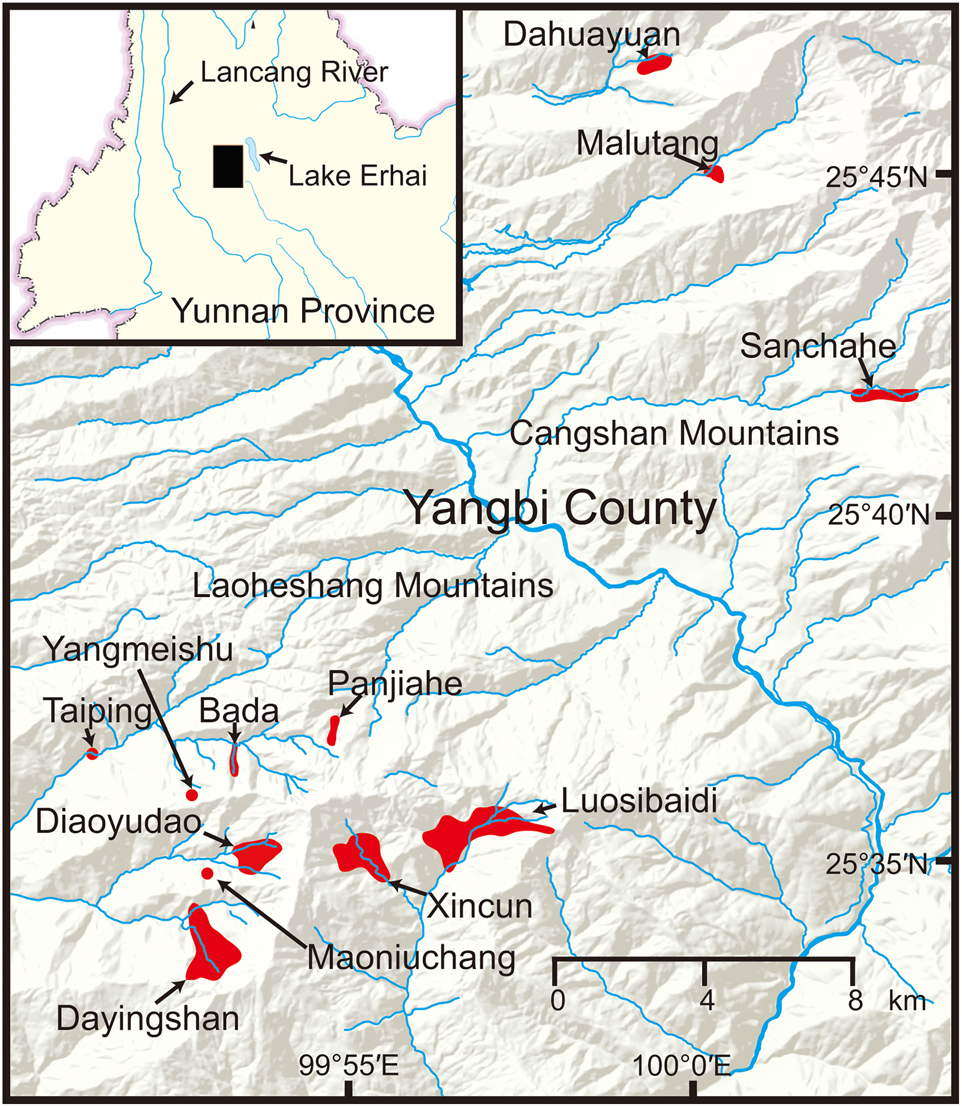
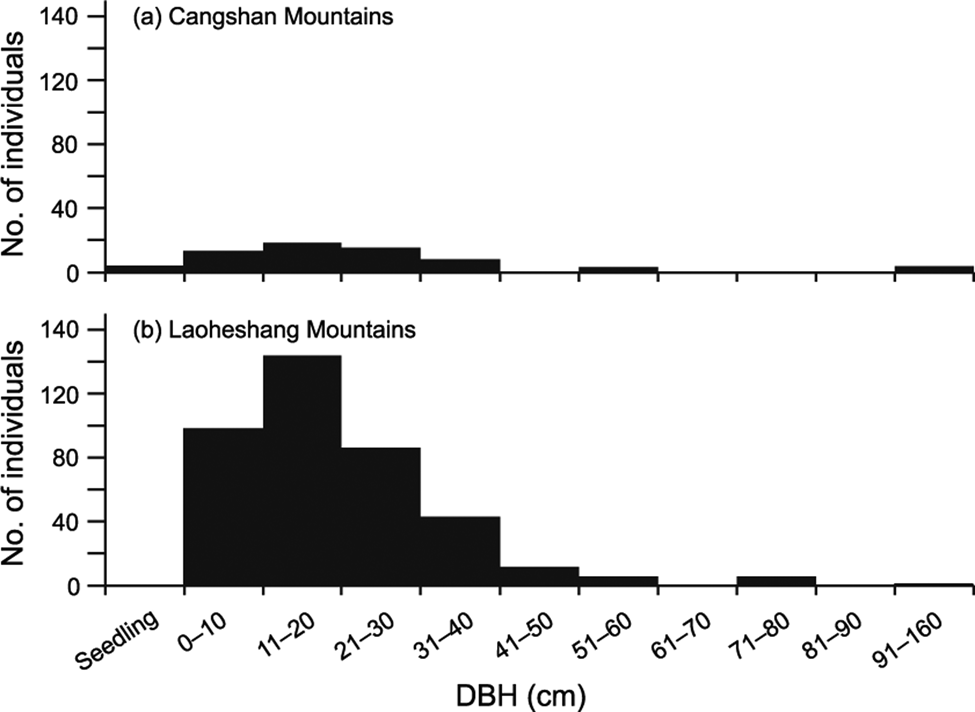
We located 577 individual A. yangbiense in 12 localities, in 11 of which the species had not previously been recorded: 62 individuals in three localities in Cangshan Mountains, within Cangshan National Nature Reserve, and 515 individuals in nine localities in unprotected areas in Laoheshang Mountains (Fig. 1, Table 1). The species' EOO in these localities ranged from 0.01 (with only one or two individuals) to 1.5 km2. The total EOO of A. yangbiense is c. 226 km2. The principal threats we identified were small-holder farming (2.1.2), goat herding (2.3.2) and logging and wood harvesting (5.3.1). We observed that many individuals had been felled or lopped, with branches or even main stems cut. Most A. yangbiense were found near streams and on shady slopes in evergreen broadleaved forests. The main accompanying plant species were Illicium simonsii Maxim., Acer kungshanense Fang & C.Y. Chang, Acer davidii Franch, Ageratina adenophorum (Spreng.) King & H. Rob., Urtica fissa E. Pritz, Alnus nepalensis D. Don and Juglans sigillata Dode. In both Cangshan and Laoheshang Mountains the distribution of DBH exhibits an inverse J-shape, with a peak at 20 cm (Fig. 2). We found only four seedlings, in Malutang during 2016–2018, surrounded by farmlands and roads.
The 12 localities in the Cangshan and Laoheshang Mountains where we found Acer yangbiense (Table 1), including Malutang, the only locality known prior to 2016.
The frequency distribution of the DBH of A. yangbiense in the Cangshan (a) and Laoheshang (b) Mountains. Trees that had regrown naturally following previous felling were not included. Seedlings were individuals < 1.3 m tall or with DBH < 2 cm.
Characteristics of the 12 localities where Acer yangbiense was found in the Cangshan and Laoheshang Mountains in Yangbi County, Yunnan, China (Fig. 1), with the number of individual plants found.

* The only locality known prior to 2016.
We have documented additional localities and individuals of A. yangbiense, and an inverse J-shaped DBH distribution potentially indicates a healthy population with natural recruitment (Geldenhuys, Reference Geldenhuys, Piearce and Gumbo1992; Sokpon & Biaou, Reference Sokpon and Biaou2002). However, the 10 cm DBH class contains fewer individuals than the 20 cm class and we only located four seedlings, suggesting that the species may have recently declined and that regeneration may be poor. Local people indicated to us that 20 years previously, prior to felling of the species for building material and sale, A. yangbiense was more common.
We observed that A. yangbiense is androdioecious, with three types of flowers: male, female and sterile androgynous flowers (the latter were few). Most trees bore male flowers only, few trees bore both male and female flowers, and others were not old enough for flowering. Of the 577 trees located, only 5.37% bore both male and female flowers. The reproductive system in Acer is diverse, and its evolution in the genus unclear (Renner et al., Reference Renner, Beenken, Grimm, Kocyan and Ricklefs2007). The low number of trees bearing female flowers could potentially exacerbate the threatened status of A. yangbiense.
Based on our findings, we reassess the extinction risk (IUCN, 2017) for A. yangbiense as Endangered based on criteria C2a(i); i.e with < 2,500 mature individuals (C) and with a continuing decline inferred in numbers of mature individuals (2) and no subpopulation estimated to contain more than 250 mature individuals (a(i)). In addition, with < 5,000 mature individuals in the wild and < 500 in each isolated population, an extremely limited distribution range, pressures from habitat destruction, and occurrence in an area of high plant diversity and poor economic development (Ma et al., Reference Ma, Chen, Grumbine, Dao, Sun and Guo2013; Sun, Reference Sun2016; Yang & Sun, Reference Yang and Sun2017; Sun et al., Reference Sun and Angus2018), A. yangbiense should continue to be considered as one of the Plant Species with Extremely Small Populations.
Seedlings of A. yangbiense had previously been propagated from only one tree (Yang et al., Reference Yang, Zhao, Yang and Sun2015). In 2016, based on information from our surveys, seeds were collected from several localities. Circa 50,000 seedlings were propagated in 2017, and in 2018 several thousand were reintroduced into wild areas near the species' original habitat. In addition, however, establishment of in situ protection for the currently unprotected localities needs to be prioritized.
Acknowledgments
We thank the Dali Prefecture Cang Shan County Protection Administration and the Forestry Bureau of Yangbi County for their assistance. This study was supported by NSFC-Yunnan Joint Fund (Grant No. U1302262), Full Cover Conservation Project of Native Plants in Southwestern China (KFJ-3W-No1), National Science and Technology Basic Resources Investigation Special Project (Grant No. 2017FY100100), Key Laboratory Construction of Yunnan Science and Technology Talents and Platform Program (Grant No. 2018DG004) and National Key R&D Program of China (Grant No. 2017YFC0505200).
Author contributions
Surveys and writing: CH, LT; revision: KS, WS.
Conflicts of interest
None.
Ethical standards
Investigation and collection of specimens were with the permission and under the supervision of the local government, and this research abided by the Oryx guidelines on ethical standards.


 Open access

