




Introduction
During the South Korean impeachment protests 2024–2025, a striking phenomenon emerged in public squares across the country. Light sticks normally used at K-pop concerts illuminated civic gatherings, while fan chants and hashtags circulated as political slogans. Fans who had previously organized collective streaming, voting, and online campaigns mobilized these same practices in a political context. What appeared in the streets was therefore not merely a political protest but a transformation of fandom culture into a form of civic participation.
This phenomenon raises an important analytical question: how do affective practices cultivated in fandom become reorganized into civic narratives and democratic values? Rather than treating fandom-based protest participation simply as a case of political mobilization, this article approaches it as a semiotic process through which affective attachments are progressively transformed into collective meanings and ethical orientations.
In December 2024, South Korea experienced a major political upheaval when President Yoon Suk-yeol unexpectedly declared martial law at midnight, only to withdraw it shortly afterward. On December 14, 2024, the National Assembly voted to impeach the president, a decision upheld by the Constitutional Court in April 2025. During this period, Gwanghwamun Square in Seoul and the vicinity of the National Assembly in Yeouido were once again filled with large candlelight demonstrations (Reuters 2025; The Guardian 2025). Research on Korean protest culture suggests that candlelight demonstrations rely on material-semiotic infrastructures—candles, placards, and visual symbols—that shape the sensory and civic experience of collective gatherings (Kim Reference Kim2025).
In contrast to earlier candlelight movements, the protests of 2024–2025 introduced a new cultural and affective dimension shaped by K-pop fandom. Fans gathered in public squares wielding light sticks—official LED cheering devices used in K-pop concerts—and transformed concert chants, fan slogans, and fandom colors into expressions of democratic sentiment. International media vividly captured these scenes: K-pop light sticks fired up impeachment protests in South Korea (Reuters 2024); K-pop light sticks and dance became visible symbols of anti-presidential protests (The Guardian 2024); young women spearheaded protests against the president (Le Monde 2024); and protests blended civic discipline with K-pop aesthetics (Frankfurter Allgemeine Zeitung 2024).
While such scenes have often been interpreted as striking visual spectacles or generational expressions of youth culture, they also reveal a deeper transformation in the relationship between culture and politics. Activities traditionally associated with idol fandom—cheering, chanting, and waving light sticks—were recontextualized as symbolic instruments of democratic participation. Public squares thus became experimental spaces where the expressive repertoires of K-pop fandom were translated into civic engagement.
The intersection of fandom and democracy is therefore not coincidental; it reflects broader transformations in the relationship between culture and politics in contemporary societies. As Jenkins (Reference Jenkins2006a) argues, fandom has long been recognized as a key component of participatory culture. Fans are not merely passive consumers but active social participants who engage in creative production and collective organization driven by emotional investment. In this sense, fandom generates not only cultural engagement but also a reservoir of affective energy capable of circulating across social domains. In the context of K-pop fandom, such energy manifests globally through shared intensities of enthusiasm, solidarity, and identification that extend far beyond music consumption.
Yet the analytical challenge lies not simply in documenting this overlap between fandom and protest, but in explaining the mechanism through which such a transformation becomes possible. How do affective experiences generated in concerts, online fan communities, and everyday fan practices become reorganized into narratives of collective action and ultimately stabilized as democratic values? Addressing this question requires moving beyond descriptive accounts of participatory culture toward a semiotic explanation of how affect is converted into value within social practices.
To address this problem, the article advances a semiotic explanation of how affective practices become reorganized into civic meaning. It proposes a generative semiotic model explaining how affective intensities cultivated in K-pop fandom are progressively transformed into civic practices and democratic values. In doing so, the study contributes to social semiotics by extending Greimas’s generative trajectory of meaning to account for affective civic practices. Building on Greimas’s (Reference Greimas1987) generative trajectory, the article develops an expanded analytical framework tracing the movement from affect to value through four interrelated levels: affect → passion → narrative → value. Within this framework, affect refers to the initial intensities of attraction and fascination; passion designates the modalized attachments that sustain commitment; narrative captures the configuration of collective actions and roles; and value represents the stabilization of ethical orientations within a broader axiological order.
Conceptualizing this process requires reconsidering emotion not as a psychological residue preceding meaning but as part of a broader semiotic economy through which meanings and values are selected, circulated, and stabilized within social practices (Keane Reference Keane2003). In this sense, affect constitutes a structuring force within semiosis: it orients attention, organizes attachments, and conditions the emergence of narrative and value structures.
This theoretical perspective draws on several strands of the Paris School of semiotics. Tensive semiotics (Zilberberg and Fontanille Reference Zilberberg and Fontanille1998) provides a framework for understanding the intensities that structure affective experience, while the semiotics of passions (Greimas and Fontanille Reference Greimas and Fontanille1991) explains how affect becomes modalized into stable attachments. Floch’s (Reference Floch1990) semiotics of consumption values further offers a model for analyzing how practices are organized around competing value systems. Taken together, these approaches allow the generative trajectory of meaning to be reconsidered from the perspective of affective dynamics within social practices.
At the same time, the study engages with affect theory, particularly the work of Ahmed (Reference Ahmed2004) and Massumi (Reference Massumi2002), who conceptualize affect as a social intensity circulating between bodies, objects, and signs. From this perspective, the rhythms of cheering, the colors of light sticks, and the gestures of chants function as semiotic dispositifs through which affect becomes materially and politically articulated. Bringing together French semiotics, affect theory, and social semiotics thus opens the possibility of developing what may be called an affective social semiotics capable of explaining how emotional practices become organized into collective values.
Based on this theoretical orientation, the study addresses the following research questions:
(1) What semiotic processes transformed the affective culture of K-pop fandom into democratic values during the 2024–2025 impeachment protests?
(2) How do cheering practices transition into civic performances through semiotic and narrative mechanisms?
(3) How does the movement from affect to value reshape our understanding of democratic participation within a social-semiotic framework?
Methodologically, the study analyzes narrative data from an open-ended online survey conducted among South Korean K-pop fans in September 2025. The open-ended format allowed respondents to describe their experiences in their own terms, enabling the identification of recurring affective and narrative patterns through semiotic analysis. The analysis examines expressions of affect, passion, action, and value in respondents’ narratives in order to reconstruct how fan practices—spanning concert halls, digital platforms, and public protest spaces—become organized around democratic values. Through this approach, the article seeks to illuminate the semiotic structure through which affect circulates across cultural and political domains, generating new configurations of meaning in contemporary democratic life.
K-pop and K-pop fan culture
The formation of K-pop and its industrial context
K-pop is widely recognized as a new form of entertainment that emerged in the 1990s, characterized by genre experimentation in Korean popular music and the rise of idol groups. In the 2000s, major entertainment companies such as SM, YG, and JYP developed an integrated business model that combined a trainee system, performance-oriented group formations, sophisticated choreography and visual concepts, and a structured cycle of fan clubs, fan meetings, concerts, and merchandise. As a result, K-pop evolved into a complex cultural industry ecosystem encompassing production systems, distribution mechanisms, and highly organized fan participation (Jeon et al. Reference Jeon, Oh, Wang and Kim2023). This industrial configuration established the institutional and organizational foundations through which fandom could emerge as an active and coordinated cultural force rather than a passive audience. This foundation paved the way for K-pop’s swift digital and global expansion in the following decade.
Since the 2010s, K-pop’s global reach has been closely linked to the rise of digital platforms. Jin (Reference Jin2023) describes the Korean Wave (Hallyu) as a “transnational media phenomenon intertwined with digital technologies,” illustrating how K-pop has enabled cross-border consumption and participation through platforms such as YouTube, X, V LIVE, and various fan sites. Similarly, Kim (Reference Kim2018) argues that K-pop creates a dispersed sense of “liveness” that extends beyond physical concert venues into social media interactions, streaming practices, and real-time commentary. These developments suggest that K-pop should be understood not only as a musical genre but also as a multimedia performance system sustained by digitally mediated fan engagement and continuous affective interaction.
From its inception, K-pop’s strategy was not confined to the domestic market. Initial efforts targeted East Asian audiences—particularly in Japan and China—followed by multilingual approaches and multinational group compositions aimed at North American and European tours. According to the 2024 Global Hallyu Survey conducted by the Korea Foundation for International Cultural Exchange (KOFICE), the global Hallyu fan base grew from 9.26 million in 2012 to approximately 180 million in 2024, with the majority still concentrated in the Asia–Oceania region (KOFICE 2024). Countries such as Indonesia, the Philippines, Thailand, and Vietnam have emerged as major hubs where K-pop consumption and fan practices are deeply interconnected.
While the report does not provide specific regional fan counts, it highlights Europe as one of the fastest-growing regions for Hallyu engagement, with countries such as France, the United Kingdom, and Germany showing high rates of cultural-content experience—typically between 55 and 75 percent across music, drama, and film—indicating a steadily expanding presence of K-pop and Korean cultural content in the region (KOFICE 2024).
The mid-2010s marked a significant turning point when groups such as BTS and BLACKPINK gained substantial traction in North America and Europe. Stadium tours, appearances at major global festivals, and headline concerts across European cities demonstrate that the region is no longer a peripheral market but a vital hub for fandom, touring, and cultural exchange. Through these developments, K-pop fandom has evolved into a transnational network in which affective attachments circulate across diverse cultural, linguistic, and political contexts (Jin Reference Jin2023; Yoon Reference Yoon2023).
This industrial and global trajectory illustrates that K-pop fandom operates as a form of affective infrastructure capable of mobilizing emotional as well as organizational resources far beyond music consumption. Through translation, dissemination, fundraising, advocacy projects, and collective action, fans accumulate and circulate significant affective and operational resources (Yoon Reference Yoon2023; Go and Garinto Reference Go and Garinto2026). These capacities demonstrate that fandom is not merely a site of cultural consumption but also a potential reservoir of collective action and value formation. This study focuses on how these accumulated capacities were transformed into democratic practices during a specific sociopolitical event—the 2024–2025 impeachment protests in South Korea.
Research on K-pop fan culture
Research on K-pop fandom has evolved along three main strands. The first strand focuses on participatory culture, drawing on Jenkins (Reference Jenkins2006b) to depict K-pop fans as active producers and participants within digital platforms. Jin (Reference Jin2023) characterizes Hallyu fandom as a transnational media practice shaped by digital platforms and fan communities, emphasizing fans’ roles as “cultural mediators” who translate, subtitle, remix, and circulate content. Similarly, Kim (Reference Kim2018) argues that the experience of live performance extends beyond the concert hall to include social media interactions, streaming behaviors, and real-time comment cultures—forms of participation that intensify emotional immersion and collective engagement.
The second strand addresses affect, gender, and identity. Oh and Kim (Reference Oh and Kim2023) analyze K-pop fandom as an affective space in which global female fans navigate gendered power relations while sharing emotional experiences. They argue that K-pop resonates with affective wounds, desires, and relational experiences, illustrating how fandom intersects with gender politics and the creative industries. From this perspective, fandom is not simply a space for “liking” cultural products but a site where gender, emotion, labor, and consumption intersect.
The third strand explores fandom as a site of social and political practice. Jang and Song (Reference Jang and Song2017) demonstrate how Filipino K-pop fans act as informal cultural diplomats through promotional activities, charity initiatives, and Korea–Philippines cultural exchange events. Gutierrez-Jauregi, Aramendia-Munieta, and Gómez-Cámara (Reference Gutierrez-Jauregi, Aramendia-Munieta and Gómez-Cámara2026), in their comparative study of Latin American, European, and Asian fandoms, reveal that K-pop fan activities engage with discourses of multiculturalism, racial and gender identities, and social solidarity. Taken together, these studies indicate that K-pop fandom increasingly functions as a public sphere in which affective engagement intersects with questions of identity, community, and political participation.
Recent research has expanded this field to include psychological and community-oriented perspectives. Ismail and Khan (Reference Ismail and Khan2023) find that participation in K-pop fandom fosters a sense of belonging, connectedness, and identity formation, highlighting its contribution to psychological well-being and social bonding. Such findings challenge the stereotype of fandom as excessive consumption and instead reveal it as a cultural arena in which affective resources and social capital are accumulated, shared, and redistributed.
Despite these advances, relatively few studies have examined the semiotic mechanisms through which affective engagement is progressively reorganized into structured passion, narrative action, and value within fandom practices. While previous research has demonstrated fandom’s capacity for sociopolitical action, the micro-level transformations through which affective practices—such as cheering, light-stick performances, color symbolism, chants, and hashtags—acquire new meanings and values remain insufficiently theorized. In particular, the trajectory through which affect becomes organized as passion, translated into narrative action, and ultimately stabilized as value has rarely been explored within fans’ lived experiences.
This study addresses this gap by integrating K-pop fan narratives with the French semiotic tradition, particularly the generative trajectory of meaning. By doing so, it reconstructs fan practices as flows of meaning that move from affect to value. The analysis therefore proposes a model that connects affective semiotics with value semiotics, offering a framework for understanding how emotional engagement within fandom can be reorganized into civic meaning and democratic value.
From affect to value: the generative trajectory of meaning
Social semiotics conceptualizes meaning not as a fixed product of signs or representations but as a continual negotiation among texts, practices, and values (Kress and van Leeuwen Reference Kress and van Leeuwen1996). Signs are socially motivated; they acquire meaning through communal choices and actions. Meaning therefore emerges not only from linguistic systems but from the broader set of semiotic practices through which humans engage with the world.
This viewpoint aligns closely with the Greimassian semiotic tradition. Greimas (Reference Greimas1987) posited that meaning is produced as it traverses a generative trajectory, moving from an axiological level that organizes fundamental value oppositions, to a narrative level that configures actors and actions, and ultimately to discursive surface forms. While the classical model identifies three primary levels (axiological, narrative, and discursive), later developments enriched this framework by incorporating affective, pragmatic, and enunciative dimensions.
Tensive semiotics (Zilberberg and Fontanille Reference Zilberberg and Fontanille1998), the semiotics of passions (Greimas and Fontanille Reference Greimas and Fontanille1991), and the semiotics of practices and consumption values (Floch Reference Floch1990; Fontanille Reference Fontanille2008) collectively demonstrate that meaning is produced not only through structural and narrative organization but also through affect, passion, embodied action, and value systems. These approaches promote a multilayered understanding of meaning that encompasses sensory intensities, affective orientations, narrative programs, practical activities, and axiological structures.
Although social semiotics and Paris School semiotics emphasize different analytical emphases, they converge on a fundamental idea: meaning emerges from the dynamic interplay among affect, narrative, and value. Social semioticians such as Hodge and Kress (Reference Hodge and Kress1988) and Van Leeuwen (Reference Van Leeuwen2005) emphasize that meaning is generated by social actors within specific contexts through the use of semiotic resources. Conversely, the Paris School—following Greimas (Reference Greimas1987) and further developed by Fontanille (Reference Fontanille2008)—focuses on how meaning is structurally produced through successive levels of affect, narrative configuration, and axiological organization.
This study argues that understanding affective practices requires not only identifying what individuals say and do but also examining the semiotic mechanisms through which affect is progressively transformed into narrative action and stabilized as value.
Building on these insights, this article proposes an expanded version of the Greimassian generative trajectory that traces the transformation of affect into value through four interrelated levels: affect → passion → narrative → value. This model does not describe empirical cases directly here; rather, it provides the analytical framework that will guide the interpretation of fan narratives in the subsequent sections.
Affective level
In classical Greimassian semiotics, affect was often treated as a pre-discursive bodily reaction. Zilberberg and Fontanille (Reference Zilberberg and Fontanille1998), however, reconceptualized affect as a dynamic interplay of tension and tonicity, arguing that affect infuses meaning with rhythm and movement. At this level, meaning emerges from sensory parameters such as rhythm, intensity, speed, and density, which organize collective affective experiences rather than purely linguistic or cognitive structures. Consequently, affect arises from embodied sensations. Collective rhythmic behaviors, synchronized gestures, shifting intensities, and modulations of sensory environments illustrate how affective resonance can emerge within shared contexts. What Greimas (Reference Greimas1987) termed the sensible form refers precisely to these shaped experiences of emotion.
Passional level
According to Greimas and Fontanille (Reference Greimas and Fontanille1991), passion emerges when affect becomes socially organized and culturally codified. Whereas affect refers to immediate bodily intensity, passion denotes modalized emotion—configured through modalities such as wanting (vouloir), having to (devoir), being able to (pouvoir), and knowing (savoir). Passion therefore transforms sensation into motivation.
Building on this idea, Landowski (Reference Landowski2004) describes passion as a relational process through which emotions circulate, adapt, and stabilize within shared social orientations. In this context, affective energies can be restructured into dispositions such as solidarity, responsibility, attachment, or moral concern. Emotion is thus redirected toward action and integrated into broader social meanings.
Narrative level
In this study, the narrative level is conceptualized as the stage at which affectively structured attachments are reorganized into action-oriented configurations. Rather than merely applying existing models, this analysis reconstructs how fan practices themselves generate narrative coherence through collective action.
At this level, passion crystallizes into action programs and discursive organization. Meaning emerges through dynamic relationships among a subject, its valued object, and the helpers and opponents that shape the subject’s pursuit (Greimas Reference Greimas1987).
From this perspective, embodied practices—such as collective gestures, coordinated movements, or patterned routines—become narrativized when they enter a discursive field and acquire intentional structure (Fontanille Reference Fontanille2008). These actions gain directionality and coherence, forming sequences that articulate goals, roles, and motivations. The narrative level thus marks the transformation of modalized emotion into organized practice.
Axiological level
From the perspective of this study, the axiological level does not simply represent a final stage of interpretation, but a process in which repeated practices stabilize into socially shared value orientations. The analysis therefore focuses on how fan practices actively produce value, rather than merely expressing pre-existing ethical frameworks.
At this level, practices become stabilized as value regimes through which actions and meanings are evaluated. Floch’s (Reference Floch1990) consumption value square—practical, utopian, ludic, and critical—provides a useful framework for analyzing how such value orientations are structured and differentiated.
In this process, forms, symbols, gestures, and practices may undergo revalorization (Petitimbert Reference Petitimbert2022), shifting from aesthetic or playful functions to ethical, communal, or critical significance. The axiological level thus marks the point at which practices are integrated into broader value systems that organize evaluation and judgment.
Together, these four levels—affect, passion, narrative, and value—constitute a generative semiotic trajectory through which affective intensities are reorganized into structured practices and stabilized as value commitments. This model provides the theoretical foundation for the empirical analysis that follows, where it is applied to the interpretation of fan narratives.
This process is particularly evident in how fans articulate values such as solidarity, responsibility, and democratic engagement in their narratives.
Generative semiotic analysis of K-pop fan practices
This chapter presents the methodological design, descriptive characteristics of the respondents, as well as the generative semiotic analysis across four levels: affect, passion, narrative, and value. The purpose of this chapter is to demonstrate how fans’ affective experiences are gradually reorganized into civic practices and ultimately stabilized as democratic values through the semiotic trajectory proposed in this study.
Research method and analytical procedure
To investigate how the affective practices of K-pop fans are transposed into democratic values, this study utilized an open-ended qualitative survey designed to capture narrative descriptions of fandom experiences rather than predefined attitudinal responses. This approach allows participants to articulate their affective experiences, interpretations, and actions in their own words, thereby providing rich material for semiotic analysis. It is particularly appropriate for this study, which aims to reconstruct processes of meaning-making rather than measure predefined attitudes. Open-ended narratives make it possible to capture how affective experiences are articulated, transformed, and organized into semiotic structures within participants’ own discourse.
The questionnaire was divided into two sections:
(1) six items capturing demographic characteristics, and
(2) twelve open-ended questions encouraging participants to describe their fandom experiences across four semiotic levels—affective, passional, narrative, and axiological.
The demographic section included: ① gender, ② age, ③ education level, ④ occupation, ⑤ years of engagement as a K-pop fan, and ⑥ primary types of fan practices.
The 12 open-ended questions prompted respondents to elaborate on ① intense emotional experiences as fans, ② moments when cheering or support evolved into conviction or responsibility, ③ instances of critique or action related to social events, ④ perceptions of democratic shifts within fan culture, ⑤ personal meanings derived from fan activities, ⑥ connections between solidarity and civic values, ⑦ moments when fandom resembled democratic practice, ⑧ transformations of fan symbols into democratic symbols, ⑨ affective responses to the 2024–2025 impeachment protests, ⑩ occasions when fan practices felt similar to social practices, ⑪ instances where affect led to social awareness, civic action, or democratic values, and ⑫ experiences using light sticks, hashtags, or chants at protests.
To ensure valid responses, the survey recruitment page stated:
Please respond only if you have actively been a fan of a specific K-pop group or artist for at least three years.
Only those who agreed proceeded to complete the questionnaire.
The survey was conducted via Google Forms from September 12 to 22, 2025. The link was shared through fan community boards, online cafés, and social media platforms (Weverse, Instagram, X/Twitter). Participation was voluntary and anonymous, and respondents were informed that their data would be used solely for research purposes.
A total of 118 responses were collected and included in the analysis. The open-ended responses generated 2,218 sentences, each of which was treated as a minimal semantic unit.
The analytical framework followed a generative semiotic approach structured across four levels: affect, passion, narrative, and value. First, sensory and emotional expressions were identified at the affective level. Second, these expressions were examined to determine structured emotional orientations—such as anger, solidarity, responsibility, and injustice—at the passional level. Third, the analysis focused on respondents’ self-descriptions as fans, citizens, and social actors, along with their practices (e.g., participation, boycotts, donations, and hashtag campaigns) at the narrative level. Finally, the study interpreted how these narratives revealed value transpositions among Floch’s four consumption values—ludic, utopian, practical, and critical—at the axiological level.
News articles, protest images, and online memes were consulted only to contextualize the responses; however, the primary analytical focus remained strictly on the fans’ written narratives, which constitute the core empirical material of this study.
Descriptive results: demographic characteristics
Demographic characteristics
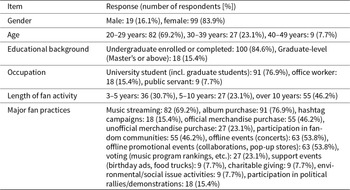
As shown in Table 1, a total of 118 respondents participated in the survey.
A total of 118 respondents participated in the study, with women making up the majority at 83.9 percent (99 participants). The age distribution was predominantly among young adults: 69.2 percent were aged 20–29 years, 23.1 percent were 30–39 years, and 7.7 percent were 40–49 years. Educational attainment was notably high, with 84.6 percent of participants either currently enrolled in or graduated from university, and 15.4 percent holding or pursuing a graduate degree. In terms of occupation, 76.9 percent identified as university or graduate students.
Fan engagement was also characterized by long-term involvement, with 46.2 percent having more than 10 years of experience, followed by 30.7 percent with 3–5 years, and 23.1 percent with 5–10 years.
Key fan practices included album purchases (76.9%), music streaming (69.2%), and participation in offline events or collaborations (53.8%). Additionally, many fans engaged in community activities (46.2%) and merchandise-related efforts (46.2% for official items and 23.1% for unofficial). Notably, 15.4 percent participated in political rallies or demonstrations, while 7.7 percent were involved in environmental or social-issue activities.
These results indicate that K-pop fandom is not limited to cultural consumption but also functions as a social arena in which emotional engagement, community practices, and civic participation intersect. This provides an empirical foundation for the generative semiotic analysis presented in the following sections.
Respondents’ demographic characteristics

Table 1 Long description
The table summarizes survey respondents’ demographics and reported fan activities, listing counts and percentages for each category. The sample is predominantly female (99 respondents, 83.9%) and mostly aged 20 to 29 years (82, 69.2%), with smaller shares aged 30 to 39 (27, 23.1%) and 40 to 49 (9, 7.7%). Most have an undergraduate background (100, 84.6%), while 18 (15.4%) are at the graduate level. Occupations are mainly university students including graduate students (91, 76.9%), followed by office workers (18, 15.4%) and public servants (9, 7.7%). Fan activity length is most often over 10 years (55, 46.2%), compared with 3 to 5 years (36, 30.7%) and 5 to 10 years (27, 23.1%). The most common fan practices are album purchase (91, 76.9%) and music streaming (82, 69.2%), with offline concerts and offline promotional events each reported by 63 (53.8%). Several activities are less common, including support events, charitable giving, and environmental or social issue activities (each 9, 7.7%), while political rallies or demonstrations are reported by 18 (15.4%). Percentages reflect this specific respondent group and may not generalize beyond the sample.
Collection and organization of narrative data
The 12 open-ended items generated 2,218 analyzable sentences, providing rich affective, emotional, and narrative material for qualitative analysis. These responses captured experiences related to concert-induced emotions, meanings of fan practices, encounters with social events, participation in protests, symbolic transformations, and emotional interpretations of democracy.
First, all narratives were cleaned to eliminate blank, duplicated, or irrelevant answers and were then combined into a single textual corpus. Each response was divided into minimal semantic units—typically one sentence or clause conveying a distinct experiential or evaluative meaning.
Initial codes were assigned to represent the type of affect, practice, or value expressed. The analysis employed the semiotic concept of isotopy, which refers to the recurrence of semantically related elements across a discourse that enables the coherence of meaning patterns. By identifying recurring affective, thematic, and evaluative elements across the narratives, the study traced how individual expressions formed consistent semiotic trajectories.
Through iterative comparison and refinement of these recurring elements, the corpus was grouped into four analytic levels: affect, passion, narrative, and value. This process made it possible to reconstruct how dispersed fan experiences form structured meaning flows rather than isolated emotional expressions.
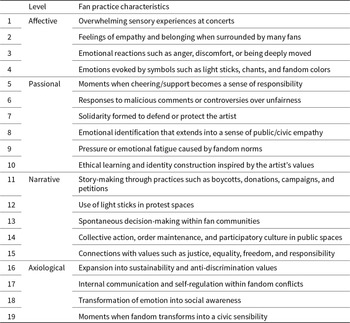
Nineteen characteristics of fan practices were inductively identified and organized under these levels, as shown in Table 2, while remaining theoretically informed by the generative semiotic framework adopted in this study.
Characteristics of fan practices
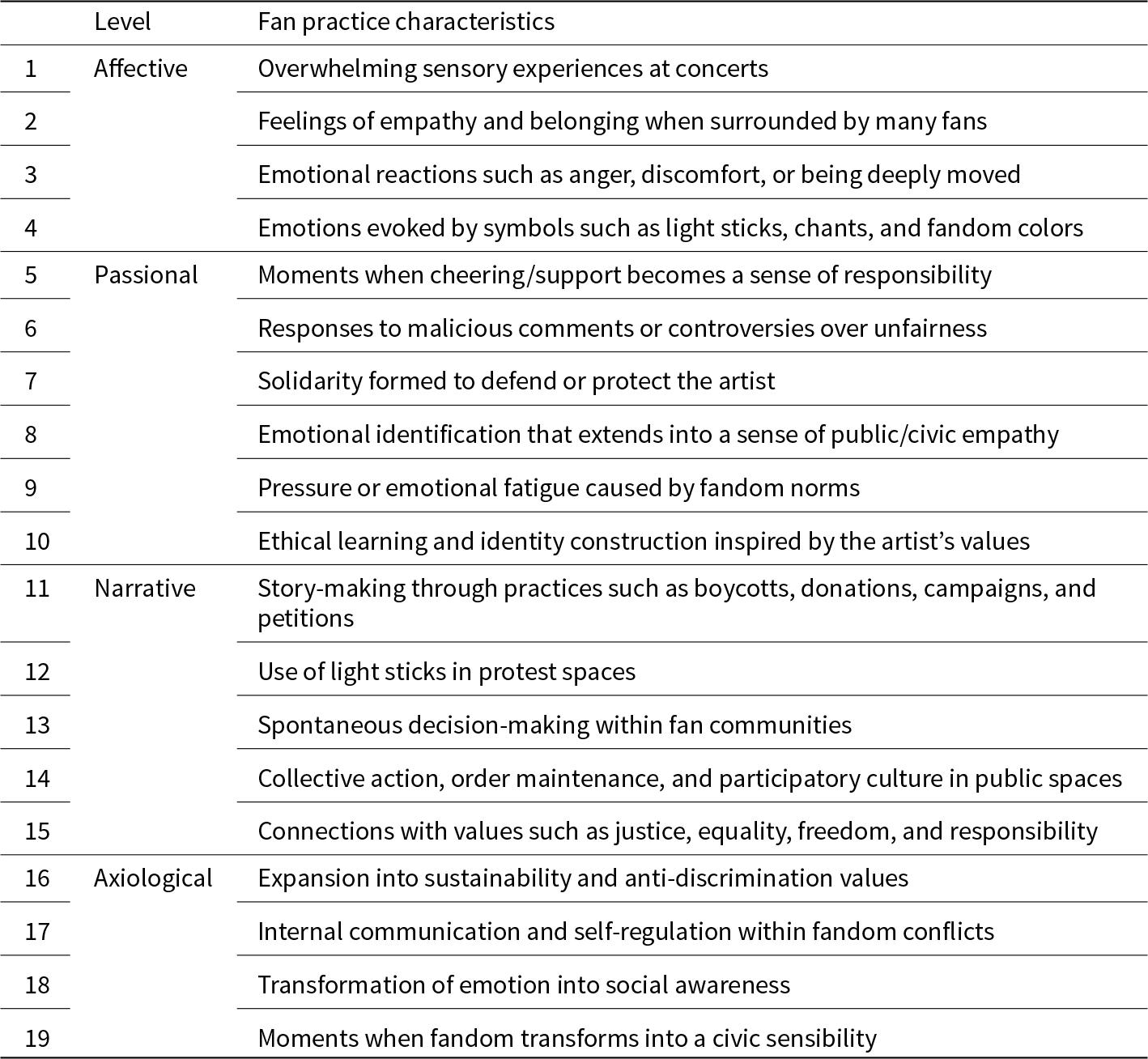
Table 2 Long description
The table categorizes fan practice characteristics across four levels: Affective, Passional, Narrative, and Axiological. Affective items focus on intense concert sensations, empathy and belonging in crowds, strong reactions, and emotions tied to symbols like light sticks, chants, and fandom colors. Passional items shift toward responsibility in cheering, responses to malicious comments or perceived unfairness, solidarity to protect the artist, civic-minded empathy, fatigue from fandom norms, and ethical learning shaped by the artist’s values. Narrative items describe story-making and coordinated practices such as boycotts, donations, campaigns, petitions, protest use of light sticks, spontaneous community decisions, and maintaining order and participation in public spaces. Axiological items emphasize broader value commitments, including justice, equality, freedom, responsibility, sustainability, anti-discrimination, internal self-regulation during conflicts, turning emotion into social awareness, and fandom becoming a civic sensibility. Overall, the progression suggests a movement from personal emotion to organized collective action and then to enduring public-oriented values. The entries are qualitative examples rather than counts, so the table indicates themes and scope, not frequency or strength of each characteristic.
This structuring enabled the study to interpret fans’ individual accounts not as isolated expressions of taste or fleeting emotions, but as components of a coherent semiotic trajectory: affect → passion → narrative → value.
Specifically, accounts of protest participation, the political reinterpretation of light sticks, and practices such as boycotts and donations illustrate clear transitions from emotional intensity to civic action. These observations provide the empirical basis for the generative semiotic interpretation developed in the “Generative trajectory of meaning analysis” section.
Generative trajectory of meaning analysis
This section analyzes K-pop fan practices across four semiotic levels of meaning: (1) the affective level, (2) the passional level, (3) the narrative level, and (4) the axiological level. Its purpose is to show how affective intensities expressed in fandom are progressively reorganized into emotional commitments, collective actions, and democratic values. More specifically, it examines how the emotions, symbols, and actions of K-pop fans contributed to democratic meanings during the sociopolitical event of the 2024–2025 impeachment protests. Rather than treating respondents’ accounts as isolated testimonies, the analysis reconstructs them as elements of a generative semiotic trajectory linking affect, passion, narrative, and value. The analysis integrates theoretical frameworks with respondents’ narratives, demonstrating how personal experiences become legible as collective civic meaning.
Affective level: sensory and emotional expressions
As previously outlined in the generative trajectory of meaning, this level focuses on the emergence of affect as bodily sensation and pre-reflective intensity. Affect represents the earliest form of meaning, derived from bodily and sensory intensities that precede the linguistic articulation of emotion. In Zilberberg and Fontanille’s (Reference Zilberberg and Fontanille1998) tensive semiotics, affect is defined as an energetic structure shaped by the interplay of tonicity (the intensity of force) and tension (the directional orientation of sensation).
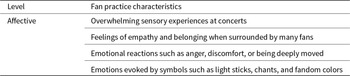
Thus, emotion is not merely what one feels but how the body vibrates—how sensory rhythms are organized and experienced. Respondents vividly illustrated these affective moments. Their descriptions revealed recurring sensory and emotional isotopies such as vibration, immersion, and collective rhythm, which structured this level and allowed the affective characteristics to emerge as a coherent cluster. For instance, one respondent noted, “When the music started, my whole body reacted before I could even think,” highlighting the pre-reflective intensity of affective engagement. At this level, four major characteristics of fan practices were identified (see Table 3).
Affective-level characteristics of fan practices

Table 3 Long description
The table describes characteristics of fan practices at the affective level, focusing on emotions and sensory responses. It lists overwhelming sensory experiences at concerts as a key feature. It also highlights feelings of empathy and belonging when surrounded by many other fans. Additional characteristics include emotional reactions such as anger, discomfort, or being deeply moved. Finally, it notes that symbols and rituals like light sticks, chants, and fandom colors can evoke strong emotions. Only the affective level is included, so no comparisons across other levels are provided.
Descriptive data on major fan practices—such as streaming, cheering, attending offline events, and engaging in merchandise activities—indicate that fans’ engagements are rooted in repetitive sensory routines. These practices establish the embodied and rhythmic conditions through which affective intensity first arises in fandom. Respondents frequently described concert experiences as “a shock that cannot be put into words,” “a vibration that shakes your body when tens of thousands sing together,” and “a moment when my heart pounded and tears came out without thinking.” One respondent recalled, “When the music began, my entire body trembled; I couldn’t speak and just cried.” These expressions indicate that affect first appears as bodily resonance before it is interpreted cognitively or articulated discursively. This affect transcends individual feeling; it emerges within a rhythmic field shared among stage, audience, and crowd, creating a collective sensory environment.
Several respondents highlighted the moment when “people of different races and ages swayed to the same rhythm,” identifying it as central to their concert experience. This suggests that affect is not merely a personal emotional state but a relational phenomenon produced through sensory synchronization with others. In Ahmed’s (Reference Ahmed2004) framework, this can be understood as the circulation of affect in real time: emotions do not remain inside individuals but move across bodies, objects, and spaces, forming shared waves within the collective.
This affective structure extends beyond the concert hall into the protest site, where emotional rhythm is transformed into civic feeling. Building on the material repertoire of earlier candlelight movements, fans’ use of light sticks expanded the symbolic landscape of protest by introducing an affectively charged and aesthetically differentiated device into the square (Kim Reference Kim2025). Experiences with light sticks at protest sites symbolically connected emotional energy to action. One participant noted, “When I stood in the square holding my light stick, its glow was no longer for the idol.” As the affective expressions of concerts—light, rhythm, and movement—migrated into political contexts, the semiotic form of affect acquired new layers of social significance. What had once been a gesture of support for an idol was recontextualized as a civic performance akin to holding a candle, and the rhythm of emotion became the rhythm of civic feeling.
Thus, at the affective level, meaning arises not from linguistic discourse or cognitive evaluation but through the resonance of sensory forces—sound, color, light, vibration, and movement—that reverberate across bodies. At this stage, affect remains pre-reflective, but it already establishes the shared sensibility from which later civic meanings can emerge. Affect therefore constitutes the first stage in the generative trajectory of meaning: a latent but socially circulating energy that makes subsequent passion, action, and value possible.
Passional level: emotional orientations and commitments
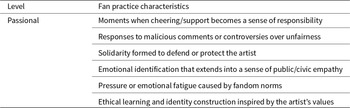
As outlined earlier in the generative model, the passional level represents the organization of affect into culturally and ethically shaped emotions. The intense sensations generated at the affective level do not remain fleeting waves; over time, they are structured into more durable orientations, obligations, and judgments. Greimas and Fontanille (Reference Greimas and Fontanille1991) argue in Sémiotique des passions that passion refers to “modalized emotion”—emotion organized within social and ethical contexts through modalities such as wanting, having to, being able to, and knowing. Respondents’ narratives clearly illustrate this transition from affect to passion. At this level, six major characteristics were identified (Table 4).
Passional-level characteristics of fan practices

Table 4 Long description
The table lists characteristics associated with the passional level of fan practice. At this level, cheering and support can feel like a responsibility rather than a casual choice. Fans may actively respond to malicious comments and controversies about perceived unfairness. Solidarity is emphasized, with fans organizing to defend or protect the artist. Emotional identification extends outward into public or civic empathy, suggesting concern beyond the fan community. The table also notes downsides, including pressure and emotional fatigue linked to fandom norms. It highlights ethical learning and identity building influenced by the artist’s values. The entries are descriptive themes rather than measured frequencies, so the table does not indicate how common each characteristic is.
Survey responses indicated that practices such as sustained streaming, voting, and defending artists from malicious comments were not merely habits but emotionally structured commitments. The shift from affect to passion was evident through recurring themes of obligation, protection, and ethical orientation, which appeared across narratives regardless of fandom or age. These practices show how routine engagement becomes invested with desire (vouloir) and duty (devoir), marking a transition from raw intensity to socially organized passion.
Many respondents described how simple affection evolved into a sense of obligation. One individual noted, “What began as joyful support eventually felt like a responsibility—I felt as though I had to do it.” This statement exemplifies the transformation of affect into commitment, showing how emotional attachment gradually becomes organized as a sense of responsibility. Another respondent explained, “At some point, supporting the artist felt like a responsibility rather than a choice,” further illustrating the modalization of affect into a durable and socially structured commitment.
Others described experiences of unfair treatment, expressing not only anger but also a compulsion to “correct the injustice,” regarding action as “the natural duty of a fan.” In such cases, emotion no longer functions merely as a reaction; it becomes a moral orientation that evaluates situations and compels intervention. This transformation is reinforced within fan communities, where the recognition of “others we must protect together” deepens emotional commitment.
Passion also emerged in situations of perceived danger or injustice. Regarding controversies surrounding the Busan EXPO concert, one respondent stated, “I felt safety was being ignored, and I couldn’t stay silent.” Fans did not simply express anger; they collectively demanded changes and ultimately succeeded in altering the concert venue. Here, emotion becomes organized as a shared demand, marking the fan’s shift from spectator to engaged participant.
In other cases, passion took the form of ethical aspiration. Respondents expressed a desire to emulate the artist’s sincerity or to adopt the artist’s attitudes as personal guidelines. In these instances, affect became integrated into self-formation, evolving into a future-oriented passion that shaped identity and conduct.
At the same time, implicit norms within fan communities also generated normative passions. Statements such as “If I didn’t stream, I felt guilty” or “I felt like a bad fan if I missed voting” illustrate how emotion becomes entangled with obligation and self-regulation. The tension between voluntariness and duty is precisely what defines passion at this level: fans do not simply feel, they come to experience themselves as subjects who ought to act in certain ways.
Throughout these narratives, passion appears as an emotion that is no longer merely private or momentary but socially oriented, ethically inflected, and action-directing. If the affective level concerns what fans feel together, the passional level concerns what those feelings come to demand. This transition provides the basis for the narrative level, where commitment becomes organized into concrete practices and collective programs of action.
Narrative level: practices, actions, and role configurations
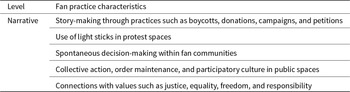
In the generative trajectory outlined above, the narrative level refers to the configuration of actors, actions, and programs through which passion is translated into practice. Once emotion acquires ethical direction at the passional level, it can be organized into concrete actions. According to Greimas’s (Reference Greimas1987) generative trajectory of meaning, this movement from affect to passion to narrative marks the moment at which emotion is no longer merely internalized but is externalized as sequence, choice, and action. Respondents’ narratives clearly demonstrate this transition. At this level, five key characteristics were identified (see Table 5).
Narrative-level characteristics of fan practices

Table 5 Long description
The table lists characteristics of fan practices at a single level of analysis called narrative. It describes fans as engaging in story-making through actions such as boycotts, donations, campaigns, and petitions. It also notes the use of light sticks within protest spaces as a recognizable practice. Fan communities are characterized by spontaneous decision-making alongside collective action and order maintenance in public settings. These practices are framed as participatory culture in public spaces and are linked to values including justice, equality, freedom, and responsibility. Because only one level is provided, the table supports description of themes rather than comparisons across levels or measurement of frequency.
Narrative isotopies such as collective coordination, symbolic re-signification, and shared episodes illustrate how passional orientations are transformed into organized action. Among the various fan practices identified—boycotts, donations, hashtag campaigns, collaborative projects, and participation in protests—respondents often described these actions not as isolated events but as meaningful episodes in a collective journey.
These accounts show how passionate motivations crystallize into narrative actions, allowing fans to express their experiences as coherent civic stories. One participant noted, “As I took part in donations and hashtag campaigns, I realized what I was doing. It felt like a story I could explain, not just fan activity.” This formulation is significant because it shows the moment when action becomes narratable: what was once emotion-driven participation is reconfigured as a meaningful sequence with intention and direction. As one participant described, “We organized donation campaigns and shared information in real time,” illustrating how individual emotions are transformed into coordinated collective action.
Experiences with light sticks at protest sites symbolically condensed this narrative shift. One respondent reflected, “When I held my light stick in the square, its glow was no longer for my idol.” Similarly, another respondent stated, “Using light sticks at protests felt natural, like continuing what we always did as fans,” highlighting the continuity between fandom practices and civic performance. Another respondent noted, “Holding a light stick at the protest made me feel both like a fan and a citizen.”
The light stick, once associated with concert arenas, was thus redefined as a civic emblem. Its meaning is no longer derived solely from fandom support but from its role within a public performance of democracy. Here, affect is translated into action, and action becomes integrated into a civic narrative.
Spontaneous collective decision-making within fan communities also functioned as a narrative mechanism. Statements such as “Everyone moved in the same direction without needing instruction” illustrate how the community acted as a collective subject, forming decentralized and quasi-democratic structures of coordination. Practices such as selecting hashtags, coordinating boycotts, or setting donation criteria resembled democratic procedures, with emotion serving as the motivating energy of collective action.
Narratives also emerged in descriptions of orderly collective behavior in protest spaces. One respondent wrote, “As people made space for one another, maintained order, and chanted together, it felt like we were writing the same story.” This illustrates how emotion functions not merely as an individual impulse but as a force that links separate actions into a shared sequence. Fans thus perceived their community as a “small society,” one capable of civic conduct in both everyday and extraordinary contexts.
Thus, the narrative level is the stage at which emotions are organized into collective action and social meaning. Light, sound, color, gestures, hashtags, and crowds move from the domain of fandom into the construction of civic semiotics. At this level, the fan is no longer only a feeling subject but an acting subject, positioned within shared programs of participation, coordination, and public expression. This narrative organization paves the way for the axiological level, where actions are stabilized as values.
Axiological level: value transpositions in fan practices
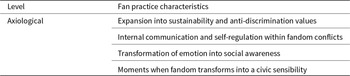
As with the preceding levels in the generative trajectory, the axiological level organizes the meanings produced through affect, passion, and narrative. At this level, meaning is stabilized as value orientation: practices and commitments come to be evaluated within broader ethical and social frameworks. While the narrative level expresses emotion through action and story, the axiological level consolidates these actions into relatively durable regimes of value. Floch’s (Reference Floch1990) four value regimes—ludic, practical, utopian, and critical—provide a useful framework for interpreting how fans’ affective and narrative practices are organized into meaningful systems of evaluation. Four major characteristics were identified at this level (Table 6).
Axiological-level characteristics of fan practices

Table 6 Long description
The table lists characteristics of fan practices at a single level labeled axiological. It describes fandom expanding beyond entertainment into sustainability and anti-discrimination values. It also notes internal communication and self-regulation used to manage conflicts within the fandom. Another characteristic is the transformation of emotional engagement into broader social awareness. Finally, it highlights moments when fandom shifts into a civic sensibility, implying participation or concern aligned with public life. Because only one level is provided, the table supports description of themes rather than comparison across levels or measurement of frequency.
At the axiological level, themes of justice, solidarity, sustainability, and civic responsibility appeared with marked regularity across the respondents’ narratives. This suggests that such values are not incidental outcomes of fandom but relatively stable semantic orientations. Emotion no longer appears merely as liking or support; it becomes a principle of judgment that informs everyday action. In this sense, the analysis reveals a recursive dynamic in which affect generates value, and value in turn reorients subsequent practice.
The practices identified in the descriptive results can be interpreted through Floch’s four value regimes. Routine streaming, voting, and information-sharing correspond primarily to the practical regime; concert participation and creative fan activities reflect ludic values; collaborative charity and solidarity actions exemplify utopian values; and participation in protests or advocacy aligns with critical values. This distribution does not imply rigid categories, but it shows how fan practices become evaluatively organized as part of a broader value structure. Emotion thus exceeds personal preference and becomes a criterion for assessing the world, oneself, and one’s responsibilities toward others. At the axiological level, a respondent reflected, “Through fandom, I learned what solidarity and responsibility mean in real life,” illustrating how repeated practices become stabilized as ethical orientations.
Practical values: the durability of action and its extension into the public sphere Practical value emerges when daily fan practices—such as streaming, album purchases, event participation, and information-sharing—extend into civic domains. One respondent noted, “When I brought my light stick to the protest, it no longer felt like fan activity.” Another remarked, “Donating or joining petitions became a natural extension of being a fan.” In these cases, affect provides the basis for repeated action, and action gradually acquires public significance. This corresponds to Floch’s (Reference Floch1990) practical regime, in which usefulness, continuity, and operational consistency become central to value.
Utopian values: the imaginary of the affective community At the utopian level, affective experiences are stabilized as visions of collective belonging. Respondents described concerts as moments when “emotion was shared without words” and protests as occasions when “seeing each other’s light sticks provided comfort.” For some, it was “a moment when everyone was connected through purple light”; for others, it was “a sense of unity across age, gender, and nationality.” These formulations suggest that fandom does not merely produce temporary empathy but also an imagined community organized around values such as solidarity, equality, and freedom.
Ludic values: when pleasure becomes a form of civic energy Ludic values—joy, play, enthusiasm, and aesthetic pleasure—take on civic significance when they become intertwined with public participation. Respondents frequently described the protest atmosphere as “energetic,” “uplifting,” or even “joyful.” Waving a light stick became a creative and affectively autonomous expression of democratic participation. Here, playfulness does not weaken political seriousness; rather, it provides an alternative affective mode through which public engagement becomes sustainable, expressive, and collectively shareable.
Critical values: emotion as the basis of ethical judgment The most explicitly political aspect of the axiological level is the emergence of critical values. Respondents referred to discriminatory advertising, exploited labor, controversies surrounding Zionism, environmental concerns related to plastic albums, and unfair agency practices. Their feelings developed into ethical judgments, shifting from statements such as “I like this” to evaluations such as “This is right” or “This is wrong.” In Greimassian terms, this marks the point at which modalized passion becomes stabilized as value. Emotion here is no longer only affective attachment but a basis for critique, evaluation, and public positioning.
Thus, fans’ emotional experiences traverse the entire generative trajectory—from initial affective intensities, to directional passions, to narrative actions, and ultimately to social values. Respondents described how “liking the artist became a sense of civic responsibility,” how “donation and solidarity felt natural,” and how “the moment the light stick glowed marked the beginning of a new value.” Taken together, these narratives show that fandom can no longer be understood simply as a sphere of cultural consumption. It also operates as an affective economy of democracy in which emotions are circulated, re-signified, and stabilized as solidarity, justice, equality, and freedom.
Discussion and conclusion
This study examines how K-pop fans’ emotional experiences evolve into social practices and democratic values across four semiotic levels: affect, passion, narrative, and value. The findings indicate that fans’ emotions are not merely private or internal states; rather, they acquire meaning through interaction with others, communal norms, and sociopolitical events. What this study demonstrates is that fandom-based emotion does not remain at the level of individual attachment but can be progressively reorganized into collective commitment, civic action, and democratic value. Emotions gradually expand, generating a trajectory of meaning that moves from bodily resonance to ethical orientation and public engagement. By tracing this process, the study shows how affective intensities rooted in sensory and aesthetic experience acquire narrative and axiological depth when recontextualized within civic space.
The flow of meaning from affect to value
The most significant finding of this study is that fan practices are initially grounded not only in language or explicit ideology but also in sensory experience and bodily rhythm. The intense sensations experienced at concerts—the richness of sound, the synchronization of movement, and the waves of light—create a pre-linguistic moment in which affective energy first emerges. These affective states constitute the earliest sensory pathway through which fans relate to the world. Although such feelings are initially unnamed, they already generate a latent form of meaning through shared presence and resonance.
Over time, however, these sensory experiences gain direction. Affect develops into emotions that exceed excitement or pleasure alone. When confronted with unfairness, danger, or injustice, fans do not remain passive; they respond through moral orientations. Emotion thus begins to generate ethical language. The transformation of affection for an artist into a sense of obligation to “protect,” “defend,” or “speak out” marks the emergence of passion. At this stage, fans recognize the ethical implications embedded in their own affective experiences. This finding suggests that fandom does not merely intensify emotion; it organizes emotion into socially recognizable commitments.
Once emotion crystallizes into passion, it becomes a driving force for action. As the respondents’ narratives show, fans express these commitments through concrete practices such as hashtag campaigns, donations, boycotts, and participation in protests. While such activities are often externally classified as either “fan activities” or “social actions,” fans themselves frequently do not perceive a strict boundary between the two. Emotion leads to action, and action acquires narrative form. When respondents described standing at protest sites with their light sticks as “the beginning of a story,” they revealed that affect had already been reorganized into a narratable civic sequence.
As actions accumulate and narratives solidify, emotion is ultimately stabilized as a system of values. On a practical level, fans engage in streaming, voting, and donating as routinized behaviors; on a ludic level, they introduce joy and aesthetic vitality into social practices; on a utopian level, shared emotional experiences contribute to the imagination of an ideal community; and on a critical level, emotions become the basis for ethical judgments regarding discrimination, climate issues, labor injustice, and public responsibility. Through these processes, affect is reorganized within a broader axiological structure rather than remaining a fleeting private state. Floch’s consumption value square helps clarify how these value orientations become differentiated and stabilized within fandom.
Throughout these stages, recurring themes of resonance, obligation, coordination, and civic responsibility indicate that the trajectory from affect to value is not random but semantically patterned across respondents’ narratives. Moreover, this process is not strictly linear. Affect generates passion, passion unfolds into narrative, and narrative stabilizes into value—but value can also reorient future affective responses. This recursive movement suggests that fandom functions as a semiotic ecology in which emotions and values continuously shape one another. In this sense, fandom can be understood not simply as a site of attachment but as a dynamic affective infrastructure through which democratic sensibilities are cultivated and reproduced.
Implications and limitations
This study shows that affect can serve as a foundation for democratic practice when examined through the semiotic dynamics of K-pop fandom. While affect is often treated in political communication as irrational, unstable, or easily manipulated, the present analysis demonstrates that affect within fandom may function as a structured social sensibility organized through ethical judgment and civic participation. The findings therefore challenge reductive oppositions between emotion and reason, or between fandom and citizenship, by showing that affective attachment can become a resource for democratic meaning-making.
The principal theoretical contribution of this article lies in proposing a semiotic model of the transformation from affect to value. By integrating the Paris School of semiotics with affect theory, the study demonstrates that democratic engagement in fandom should not be understood merely as the expression of political opinion or psychological disposition. Rather, it emerges through a generative semiotic trajectory in which affective intensities are organized into passion, translated into narrative action, and stabilized as value. In this sense, the article contributes not only to fandom studies but also to social semiotics by offering an operational framework for analyzing how emotional practices become civic meanings.
In addition, this study offers one of the first empirical applications of the Greimassian generative trajectory to fan practices. The analysis of sensory symbols—such as light sticks, colors, illumination, chants, and coordinated gestures—demonstrates how semiotic forms may shift, expand, and be revalorized when they move from concert settings into protest contexts. The political re-signification of fandom symbols thus provides a concrete illustration of how affective practices can be reorganized within new civic and ethical horizons.
At the same time, this study has several limitations. Because it relies primarily on textual narratives collected through an open-ended online survey, it cannot fully capture the embodied and non-verbal dimensions of affect as they unfold in real time at concerts or protest sites. Certain affective isotopies conveyed through gesture, voice, movement, or spatial intensity may therefore remain only partially visible in the corpus. In this respect, the present study should be understood as an analysis of narrated affect rather than a full ethnography of affective embodiment.
The study is also limited by the composition of its sample. The 118 respondents were predominantly women in their twenties, and the analysis focused specifically on the sociopolitical context of the 2024–2025 impeachment protests. Accordingly, caution is required in generalizing these findings to all fandoms or all forms of civic mobilization. Further research is needed to determine whether similar affect-to-value trajectories emerge in other political events, other fan communities, or other national contexts.
Future studies may extend this work through additional data sources such as in-depth interviews, field observations, visual materials, and social media discourse. Longitudinal or cross-national studies would also be valuable for examining how affective commitments develop over time and how they are mediated by platform environments, digital circulation, and transnational fan networks. Such research would help clarify whether the generative semiotic trajectory identified here represents a broader pattern in the relationship between fandom, affect, and democratic participation.
Taken together, the findings suggest that K-pop fandom can no longer be understood solely as a domain of cultural consumption. It also constitutes a space in which affect, practice, and value circulate across the boundaries of culture and politics. By tracing the semiotic movement from affect to value, this study argues that fandom may operate as an affective economy of democracy—one in which emotions are not opposed to civic life but actively participate in its formation.
Funding statement
This research was supported by the Research Funds of Mokpo National University in 2024.

 Open access

