

INTRODUCTION
Elected representatives receive a salary in almost every parliamentary democracy; but in many cases they are also allowed to undertake other employment in addition to their parliamentary duties (Geys and Mause Reference Geys and Mause2013). Known as outside earnings, or second jobs, or most commonly in the academic literature as “moonlighting,” such outside interests are subject to a variety of rules concerning both what is permissible and the levels of transparency involved (see Djankov et al. Reference Djankov, La Porta, Lopez-de-Silanes and Shleifer2010). For their defenders, outside interests provide connections with the “real world” and prevent politicians becoming an isolated political class (these arguments are discussed in Rush Reference Rush1997) as well as ensuring that able and high-earning individuals are recruited into politics (see, for example, Caselli and Morelli Reference Caselli and Morelli2004; Geys and Mause Reference Geys and Mause2014). Conversely, other studies indicate that outside interests can reduce parliamentary activity (see, for example, Galiarducci et al. Reference Galiarducci, Nannicini and Naticchioni2010) as well as engender potential conflicts of interest.
As Geys and Mause (Reference Geys and Mause2013) note, research into the causes and effects of moonlighting has been facilitated by the increasing transparency of legislatures, creating opportunities for a developing research agenda on the issue. One striking absence from that agenda, however, has been the views of those being represented about the appropriate income arrangements of those doing representing.
This article focuses on the United Kingdom, where the rules concerning outside interests have been repeatedly reformed over the last 30 years (see Allen Reference Allen2008, Reference Allen2011a, Reference Allen2011b). Subject to these rules, however, British Members of Parliament (MPs) remain able to earn extra-parliamentary income and the issue remains controversial, generating sporadic “scandals” and calls for further reform.Footnote 1 In 2013, for example, Labour Party leader Ed Miliband pledged that if his party won the next general election, they would impose a cap on MPs’ outside earnings, and a poll found a clear majority (62%) thought that MPs should focus on their parliamentary jobs full-time; fewer than a quarter (21%) supported the proposition that “continuing to do second jobs, such as medicine, law, or running a business, keeps them in touch with ordinary people, and is better than having a House of Commons made up of just full-time politicians.” The same poll found a majority (56%) in favor of an outright ban on “second jobs.”Footnote 2
Such polling is useful but it potentially does not pick up the nuances of citizens’ attitudes, as British MPs’ second incomes–-where these exist–-come in a wide variety of forms. Most involve fairly small sums of money. In 2012, less than one in 10 MPs earned £10,000 (approximately $15,000) or more per year in addition to their parliamentary salaries. Some MPs, however, have “second” incomes, which are larger than their parliamentary incomes: In the 2012–2013 parliamentary session, 17 MPs were found to be in receipt of at least £100,000 (approximately $150,000) on top of their basic parliamentary salary of around £66,396 (approximately $100,000) (Independent Parliamentary Standards Authority (IPSA) 2013, 19).Footnote 3 In addition, whereas some of these second jobs are in fact first jobs, at least in the sense that they were the MPs’ profession before they became an MP—and exactly the sort of “real world” professions that people who complain about an out-of-touch political class often say they want to see represented in politics—other second incomes are non-executive directorships or similar positions with businesses acquired after becoming an MP.Footnote 4
Standard survey questions measuring attitudes to second jobs per se overlook these nuances and most citizens are unlikely to have thought deeply on the issue. They might, however, respond differently to politicians when given information about their second incomes. Our aim in this article therefore was to test differing reactions to both size and source of legislators’ second incomes.
METHOD
We ran a series of survey experiments, testing the public's reactions to small changes in the profiles of hypothetical politicians. We created a low-information environment where respondents had to compare two politicians and choose which one they would prefer as their representative. The electoral context was pared back to one where biographical information about the politicians was the only material available to respondents. We sought to give each characteristic the maximum chance of having an impact on preference without introducing another layer of complexity by interacting with political party. “Needless complexity,” as Mutz (Reference Mutz2011, 125) noted, “seldom makes for better experimental research.”
The experiments comprised a series of split-sample surveys. Following Sanbonmatsu (Reference Sanbonmatsu2002), our research design included comparing profiles of two hypothetical politicians, initially described as follows:
Politician A is 48 years old. After university, where he studied physics, he trained as an accountant, and set up a company, which he then sold. He is married with three children. He is an avid cricket fan, and was a keen player in his youth; he is now a passionate advocate for sporting facilities for young people. He also has interests in the health service and pensions. He became an MP in 2001 and is a member of the Heath Select Committee and is known to be a hard-working constituency MP.
Politician B is 45 years old. Before entering politics he was a lawyer, although he no longer practices. He is passionate about the environment and education. His wife is a primary school teacher and they have two children and he is a trustee of an educational charity that supports apprenticeships. He has been an MP since 2005 and he is known for his focus on education policy, and is the one of the more rebellious and independent-minded MPs in the House of Commons.
Both are plausible profiles for British politicians. Both are middle aged, university-educated professional men; both are married with children; they are both relatively recently elected (as is much of the House of Commons); both are interested in high profile policy areas; and although one is identified as constituency-focused, the other as rebellious, both are characteristics that the British public say that they like.Footnote 5
All the respondents were drawn from the YouGov Plc UK panel of some 350,000+ adults who have agreed to take part in such surveys. All figures have been weighted to be representative of all UK adults (aged 18+ years), using YouGov's standard weighting.Footnote 6 Each respondent was shown just one pair of profiles and was asked the following: Without knowing which party they stand for, which politician would you prefer as your MP:
 \begin{equation*}
{\rm A}\quad \quad {\rm Neither}\quad \quad {\rm B}
\end{equation*}
\begin{equation*}
{\rm A}\quad \quad {\rm Neither}\quad \quad {\rm B}
\end{equation*}
We ran the split-sample survey experiments over five days between July 15 and July 19, 2013 and applied two experimental manipulations, one to the source of income, and the other to its size. In total, these manipulations involved 15 variants of the profiles (described in Table 1), involving three levels of income and four sources of income, across some 9,283 respondents. The experiments were added to extant commercial surveys and the subgroup sizes therefore vary according to the size of the original survey, question response rate, and the number of subsamples on each day—but each subsample is of at least 430 respondents (with a mean score of over 600), easily large enough for analysis. Randomization was undertaken by the survey company. In general, we follow Mutz (Reference Mutz2011, 138) that “the beauty of random assignment is not that it guarantees equivalence between experimental and control groups on all possible variables, but rather that the expected sum of any differences between groups across all variables is zero. . .”—but in addition we conducted analysis of sub-groups, which demonstrated almost no significant differences between sub-groups, on a range of demographic and political characteristics.Footnote 7
Summary of Experimental Manipulations
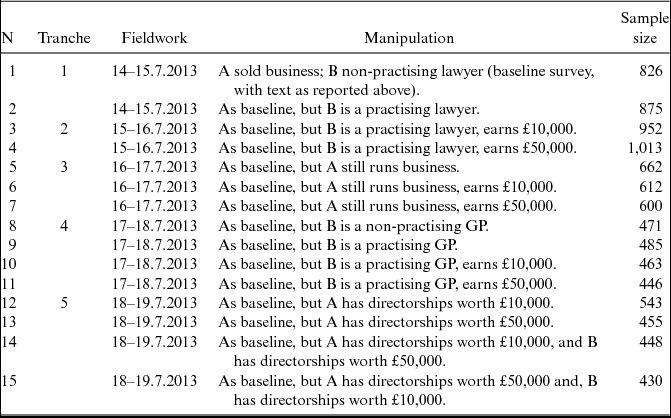
The central research question is whether citizens respond negatively or positively to moonlighting on the part of their elected representatives. Citizens may react negatively to MPs moonlighting, viewing outside earnings as a conflict of interest or a distraction, or instead they might view MPs with second incomes positively, seeing them as a connection with the “real world” beyond politics. But we were also interested in how reactions varied by both source and scale of income. We therefore changed the profiles so that the source varied in four ways, covering three different pre-existing occupations (lawyer, doctor, and businessman), all of which are typical political backgrounds for an MP, along with non-executive directorships acquired after becoming an MP.Footnote 8 We also altered the scale of income varying between no specified income, £10,000 and £50,000. The lower figure was selected because the proposed cap on MPs’ external incomes would prevent them accounting for no more than 15% of their total income; and a figure of £10,000 would be both a nontrivial additional income and narrowly below that limit. For our upper figure, a sum of £50,000 was both over that cap and being a substantial income (representing almost twice of average male earnings). We summarize the various subsamples in Table 1.
The experiments were conducted across five tranches (also indicated in Table 1). The majority of the findings reported below compare from within tranches, although in some cases we are comparing across tranches, especially when we compare with our baseline survey.Footnote 9
FINDINGS
Shown the baseline profiles presented above, we found 38% of respondents to half of the first survey (chosen randomly) preferred A, 45% went for B, and 17% chose Neither. In other words, B led by 7 percentage points. It does not matter why B led by 7 points; this is our baseline survey, with which we then compare other similar profiles. The other half of respondents (manipulation 2) saw the same text as above, except that the second line of B's profile read, “and he continues to practice, arguing that this keeps him in touch with the world outside Westminster.”Footnote 10 As Table 2 shows, this had the effect of decreasing support for B so that A now led by 1 percentage point.
Popularity of Practising Lawyer (B) Relative to Rival (A)

Notes. ***Difference between the baseline and the test group significant at the 0.001 level of Chi-square test.
**Difference between the baseline and the test group significant at the 0.01 level of Chi-square test.
We then changed B's profile yet again to add a sum of money. For manipulation 3, half of the sample (chosen randomly) saw B's profile as a practising lawyer but with this added the following: “This brings him in approximately an additional £10,000 per year in income.” As Table 2 shows, A's lead now extended to 6 percentage points. The other half of the sample (manipulation 4) saw the sum of “£50,000” instead; A's lead extended even further to +11. Overall, increasing B's work as a lawyer was enough to lower his support by 11 percentage points, and to raise support for A by 7 percentage points, a difference of 18 percentage points between the relative positions of the politicians.
We found similar effects in the fourth tranche of experiments, in which we changed politician B's text, replacing “a lawyer” with “a GP” (manipulation 8).Footnote 11 As shown in Table 3, this made a significant difference to the initial standing of the politicians. Whereas in our first experiment, B had led A by 7 percentage points, B's lead was now 23 percentage points. However, when we changed the extent to which our fictional GP continued to work, their popularity began to wane. Continuing to practice, but with no mention of money (manipulation 9), and the lead dropped to 18 points; earning £10,000 (manipulation 10) and the lead was 13 points; an income of £50,000 (manipulation 11) reduced the lead to 7 percentage points. Even then the GP was still the preferred politician (and by exactly the same amount as a lawyer who did not practice at all), but that is why doctors make such popular politicians anyway.Footnote 12 The overall effect of increasing the extent to which they worked as a GP from not at all to earning £50,000 was 17 percentage points, basically the same scale of effect as when we had changed the income of the lawyer.
Popularity of Practising GP (B) Relative to Rival (A)

Notes. **Difference between the baseline and the test group significant at the 0.01 level of Chi-square test.
*Difference between the baseline and the test group significant at the 0.05 level of Chi-square test.
The third tranche of experiments took our initial profiles, and changed the profile of politician A. Instead of having sold his company, it now read, “which he continues to run, arguing that this keeps him in touch with the world outside Westminster.” Again, we altered the income levels (manipulations 5–7). As Table 4 shows, in this case the effect was nonexistent. Politician B's lead varied from 6 to 10 percentage points, never statistically significantly different from the baseline survey. The additional income did not make him more popular, but equally it appeared to have done no harm.
Popularity of Businessman (A) Relative to Rival (B)

The final tranche of experiments tested for the effect of directorships gained since becoming an MP. For a quarter of respondents (chosen randomly) in tranche 5, the following text was added to the end of the original profile of politician A:
Since becoming an MP he has become a non-executive director of a company, who pays him £10,000 per year. He argues that this keeps him in touch with the world outside Westminster.
Without that text, in our baseline survey B had led A by 7 percentage points. As Table 5 shows, adding that text to A's profile (manipulation 12) extended that lead to 35 percentage points. When we changed the amount to £50,000 for another quarter of respondents (manipulation 13), it produced a lead of 29 percentage points, a difference of 22 percentage points. Both are much larger effects than we found for any of the GP, lawyer, or businessman experiments. In other words, respondents reacted with more hostility to income gained since becoming an MP than they did from income from pre-existing occupations. But with directorships the sum of money did not especially matter: The difference between the findings for £10,000 and £50,000 in directorships was not statistically significant. Both were equally unpopular.
Popularity of Non-Practising Lawyer (B) Relative to Rival (A) with Directorships

Note. ***Difference between the baseline and the test group significant at the 0.001 level of Chi-square test.
We found the sums of money involved did matter, however, if both politicians earned money from directorships. For the final two subsamples, we added £50,000 in directorships to profile A and £10,000 to B, and then swapped the sums around. As Table 6 shows, when A earned £50,000 from directorships and B just £10,000 (manipulation 15), B led A by 32 points, a deviation from the baseline of 25 percentage points. The other way round (manipulation 14), A led B by 20 percentage points, an almost identical deviation from the baseline of 27 points. We also found that once both politicians were identified as earning money from directorships that the percentage of respondents selecting the Neither option increased to at least 30%, higher than in any of the other experiments, further evidence of the extent to which politicians with income from directorships were disliked.
Popularity of Non-Practising Lawyer (B) Relative to Rival (A) with Directorships

Note. ***Difference between the baseline and the test group significant at the 0.001 level of Chi-square test.
DISCUSSION
Employing a series of survey experiments revealed that both size and source of the money earned by politicians mattered to citizens.Footnote 13 There was a clear difference between the public's reactions to different types of pre-existing occupations. In the case of both law and medicine, there was a hefty penalty for continuing to practice. The scale of that penalty increased as the extent to which the MP was still involved increased. The same was not true in the case of the businessman experiment. We suspect—although we cannot be sure–-that this is because respondents feel (perhaps wrongly) that medicine or law are professions which it is acceptable to ask someone to give up temporarily when they become an MP but to which they can then later return; they perhaps feel differently about an on-going business someone has set up. We would need more research to be sure about its cause, but regardless of its origin, the presence of this difference clearly indicates that the public do react differently to different forms of second income. This was seen even more strikingly with the non-executive directorships. Earning even £10,000 from a non-executive directorship was more harmful than earning £50,000 from the law or medicine. Moreover, for directorships there was no increasing negative effect once the income extended beyond £10,000. We would need further work to tease out exactly why directorships are so harmful to the standing of a politician. We suspect—although again we cannot be sure—that it is a combination of both the fact that the directorship has been acquired after becoming an MP—and is thus seen as a spoil of office, rather than a pre-existing occupation—and also because of the potential of corruption that might arise from sitting MPs serving on company boards. We cannot, however, be sure of which of these two factors is the strongest. It is also worth noting that even though the scale of the negative effects we discovered varied, we did not discover any positive effects, that is, the view that voters like their politicians to have such outside engagements is clearly false.
Detecting such differences is not, of course, the same as arguing that they will be an influence on the choice that voters make when they go to the ballot box. For that to occur, voters have to be aware of such behavior—we suspect most are not—and to give them higher salience than other issues that might determine their vote. But they do matter in terms of how we design legislatures in order to meet citizens’ expectations about permissible behavior by legislators. Most narrowly of all, this article suggests that attempts to cap British MPs’ outside interests are flawed—at least at the level of cap currently proposed, which is too high. But it also shows, more widely, that citizens can be more nuanced in their reactions to such outside interests than blanket discussion of caps or bans would indicate—and more nuanced than previously revealed by blunt survey instruments.



