





Introduction
Weeds, by virtue of their adaptability and resilience, are the most important biotic constraints to crop production (Anwar et al. Reference Anwar, Islam, Yeasmin, Rashid, Juraimi, Ahmed and Shrestha2021). They pose a significant threat to crop productivity by competing with crops for sunlight, water, and nutrients (Chauhan Reference Chauhan2020; Kropff and van Laar Reference Kropff and Van Laar1993). In the United States alone, weeds cost an estimated annual loss of US$33 billion in crop production (Pimentel et al. Reference Pimentel, Zuniga and Morrison2005). Various methods are employed to control weeds, including cultural, mechanical, biological, and chemical. Herbicides are the predominant method of managing weeds in crop production. Manual weed control is expensive, time-consuming, labor-intensive, and impractical in high-input agricultural systems (Chauhan et al. Reference Chauhan, Matloob, Mahajan, Aslam, Florentine and Jha2017). Mechanical weed control, while an effective alternative, is often limited by factors such as soil conditions, crop type, weather, and the potential for crop damage (Pavlovic et al. Reference Pavlović, Vrbničanin, Anđelković, Božić, Rajković and Malidža2022). Consequently, growers rely heavily on applying herbicides to have profitable crops. Although herbicides do not offer a complete solution to the complex challenges of weed management in agricultural crops, they have been effective in protecting crops from weed interference and have contributed to making agricultural production more efficient and economical, resulting in larger farms (Gianessi and Reigner Reference Gianessi and Reigner2007). Nevertheless, intensive herbicide use has raised concerns about environmental impacts and food safety. Overreliance on herbicides has resulted in shifts in weed species composition and increased evolution of herbicide-resistant weed species (Heap Reference Heap2025; Vencill et al. Reference Vencill, Nichols, Webster, Soteres, Mallory-Smith, Burgos, Johnson and McClelland2012). Furthermore, herbicide residues can persist in soil and water systems, potentially affecting nontarget plants, aquatic organisms, raw food products, and human health (Parven et al. Reference Parven, Meftaul, Venkateswarlu and Megharaj2025). Consequently, there is a growing consensus around the need to develop and implement more precise and environmentally sustainable weed management methods to mitigate the negative effects of overreliance on herbicides.
In recent years, advancements in precision agriculture and artificial intelligence have significantly influenced the development of unmanned aerial vehicles (UAVs) as a way for acquiring imagery for crop and pest monitoring, and for applying herbicides (Huang et al. Reference Huang, Thomson, Hoffmann, Lan and Fritz2013). Capturing remote sensing data for weed detection and real-time identification through machine learning algorithms have been demonstrated with imaging UAV systems (Huang et al. Reference Huang, Reddy, Fletcher and Pennington2018; Zhang and Kovacs Reference Zhang and Kovacs2012). Such systems can also be integrated with remotely piloted aerial application systems (RPAAS) for site-specific herbicide delivery (Hunter et al. Reference Hunter, Gannon, Richardson, Yelverton and Leon2019). The integration of imaging UAV and RPAAS has emerged as a promising approach to address challenges associated with intensive herbicide use. This combined technology enables accurate identification of weed species, delineation of weed-infested patches, and discrimination between crops and weeds (He Reference He2018; Islam et al. Reference Islam, Yoshida, Nishiyama and Sakai2023; Mink et al. Reference Mink, Dutta, Peteinatos, Sökefeld, Engels, Hahn and Gerhards2018). Consequently, the technology facilitates site-specific herbicide application, thereby reducing overall herbicide and labor inputs, minimizing environmental impacts, and enhancing crop safety and resource optimization (Hiremath et al. Reference Hiremath, Khatri and Jagtap2024; Rai et al. Reference Rai, Zhang, Ram, Schumacher, Yellavajjala, Bajwa and Sun2023).
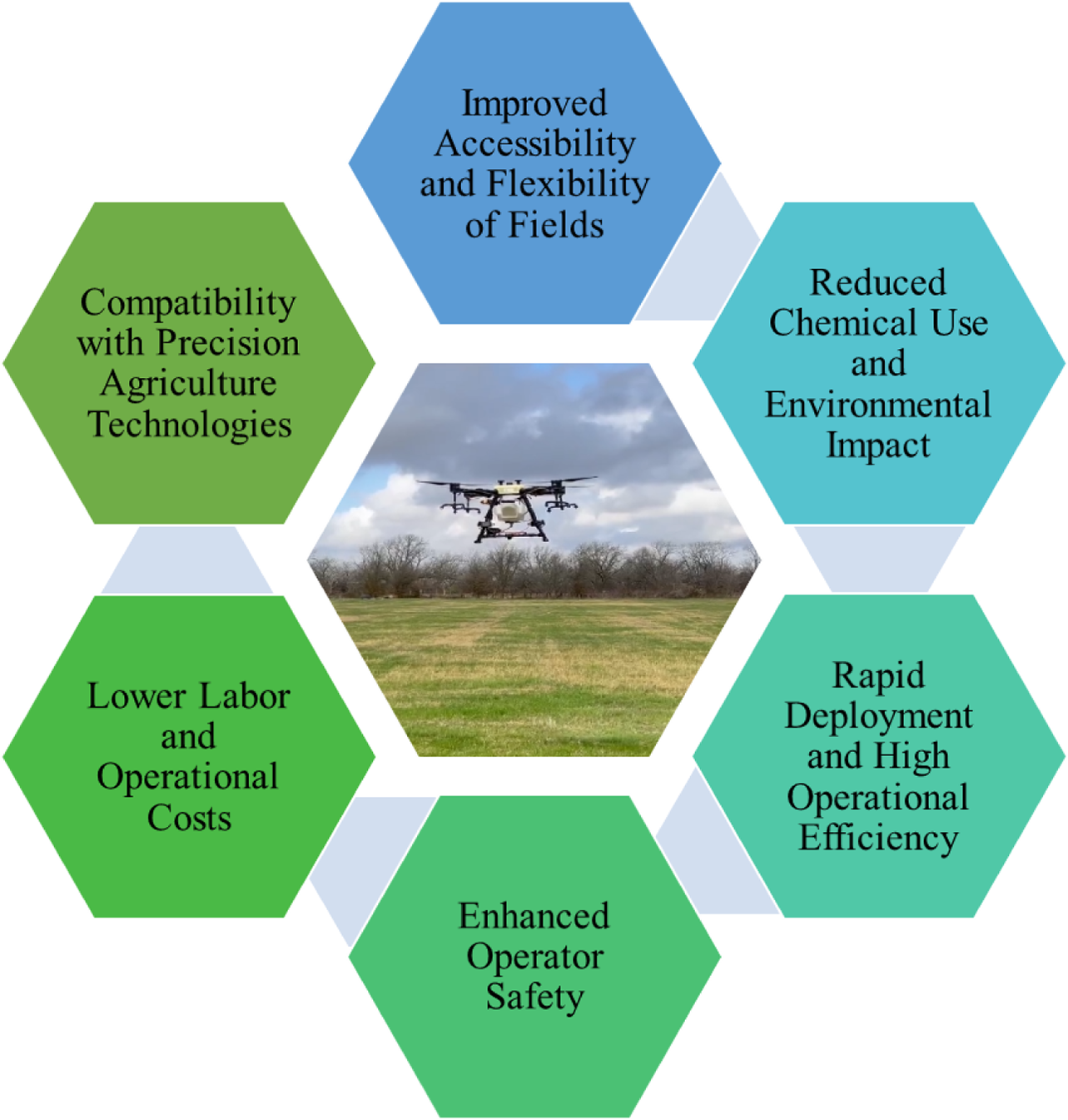
The use of UAVs for applying herbicides presents multiple benefits (Figure 1). For example, UAVs are capable of efficiently covering large areas and reaching locations that are otherwise inaccessible to ground-based equipment (Islam et al. Reference Islam, Yoshida, Nishiyama and Sakai2023; Mink et al. Reference Mink, Dutta, Peteinatos, Sökefeld, Engels, Hahn and Gerhards2018). The economic implications of adopting UAVs for weed management are substantial, with the potential to enhance both the profitability and sustainability of agricultural practices. Yet commercial UAV-based herbicide applications are still in their early stages in the United States, presenting both opportunities and challenges. There is a literature gap outlining the optimization of this technology for effective and widespread adoption. Numerous studies have evaluated the effects of UAV-based herbicide applications on weed management, but the findings have not yet been compiled into a comprehensive review. Assessing the current state of knowledge is essential to enhance the effective integration of this technology in weed management programs. Therefore, this paper presents a review of spray-drone technology used in weed management by identifying consistent performance patterns, key operational parameters, emerging opportunities in site-specific detection, and the major research gaps that must be addressed to optimize spray-drone systems for field-scale weed control and future integrated weed management programs.
Benefits and use of spray drones for herbicide application.

Carrier Volume
It has been well documented that carrier volume can influence coverage, droplet deposition, and effectiveness of herbicide applications, including those made using UAVs. UAVs typically carry as much herbicide as they can to cover as much hectarage as possible, but they are limited by tank capacity and battery life (Jeevan et al. Reference Jeevan, Pazhanivelan, Kumaraperumal, Ragunath, Arthanari, Sritharan, Karthikkumar and Manikandan2023). The typical amount of a herbicide a drone can carry ranges from 10 to 45 L ha-1, whereas ground-based tanks generally can hold 94 to 200 L ha-1 (Cao et al. Reference Cao, Yu, Xu, Du, Guo and Zhang2021; Paul et al. Reference Paul, Palanisamy, Peramaiyan, Kumar, Bagavathiannan, Gurjar, Vijayakumar, Djanaguiraman, Pazhanivelan and Ramasamy2024a). Because UAVs can carry a limited amount of herbicide, it is generally desirable to improve operational capacity by using low flow rates and finer droplets that enhance spray coverage (Costa et al. Reference Costa, Martin, Torres, Floyd, Fritz, Straw and Bagavathiannan2025; Shan et al. Reference Shan, Wang, Wang, Xie, Wang, Wang, Chen and Lan2021). Costa et al. (Reference Costa, Martin, Torres, Floyd, Fritz, Straw and Bagavathiannan2025) found that applying herbicides with a backpack sprayer at 102 L ha⁻1 resulted in greater spray coverage and droplet deposits on crabgrass (Digit aria sanguinalis L. Scop.) compared to UAV-based applications at 10 or 15 L ha⁻1. When applied to direct-seeded rice (Oryza sativa L.), ground-based applications of herbicides at 500 L ha⁻1 achieved greater droplet deposition than UAVs that could apply at 30 or 45 L ha⁻1 (Paul et al. Reference Paul, Palanisamy, Peramaiyan, Kumar, Bagavathiannan, Gurjar, Vijayakumar, Djanaguiraman, Pazhanivelan and Ramasamy2024a). Similarly, Kumar et al. (Reference Kumar, Singh, Singh and Bhullar2022) reported that pyroxasulfone and mesosulfuron + iodosulfuron-methyl sodium applied at 34 L ha⁻1 with a UAV resulted in less spray coverage and a 63% to 69% reduction in droplet density on littleseed canarygrass (Phalaris minor Retz.) in wheat (Triticum aestivum L.), compared with applying it with a backpack sprayer at 375 L ha⁻1. Conversely, in transplanted irrigated rice, Jeevan et al. (Reference Jeevan, Pazhanivelan, Kumaraperumal, Ragunath, Arthanari, Sritharan, Karthikkumar and Manikandan2023) observed that although pyrazosulfuron ethyl and bispyribac-sodium applied with a backpack sprayer at a carrier volume of 150 L ha⁻1 provided greater spray coverage than when the herbicide was applied with a UAV and a carrier volume of 38 L ha⁻1, the number of spray deposits did not differ between either method of application.
The chemistry and physicochemical properties of herbicides, nozzle type, droplet size, adjuvants, and the surface characteristics of the targeted weed species can all be affected by the volume of herbicide a UAV can carry (Chen et al. Reference Chen, Lan, Zhou, Ouyang, Wang, Huang, Deng and Cheng2020; Shan et al. Reference Shan, Wang, Wang, Xie, Wang, Wang, Chen and Lan2021). For example, contact herbicides typically require greater amounts of herbicide to achieve effective weed control compared with systemic herbicides (Shan et al. Reference Shan, Wang, Wang, Xie, Wang, Wang, Chen and Lan2021). Shan et al. (Reference Shan, Wang, Wang, Xie, Wang, Wang, Chen and Lan2021) observed that when using a UAV at a low carrier volume of 8 L ha-1, spray coverage increased as droplet size increased from 150 µm to 300 µm. However, at carrier volumes of >15 L ha-1, spray coverage decreased with increasing droplet size, suggesting that larger droplets improved coverage only when the volume of herbicide was low. Chen et al. (Reference Chen, Qi, Li and Lan2019) reported that isoproturon, clodinafop-propargyl, and mesosulfuron applied with a UAV at carrier volumes of 15 or 22 L ha⁻1 resulted in reduced Japanese foxtail (Alopecurus japonicus Nees ex Steud.) control compared to applications with a backpack at 225 L ha-1. However, the UAV system achieved efficacy that was comparable to that of backpack sprayers in controlling broadleaf weed species such as catchweed bedstraw (Galium aparine L.).
Currently, herbicide labels do not list specific application requirements for UAVs. In most cases, UAV operators follow label instructions for piloted aerial applications, which typically recommend the device carry 18.7 to 46.8 L ha⁻1. However, there is growing interest in establishing UAV-specific label requirements and evaluating the feasibility of reducing carrier volumes below 18.7 L ha⁻1 to improve operational efficiency without compromising spray deposition, efficacy, or increasing drift potential.
Coverage, Deposition, and Effective Swath
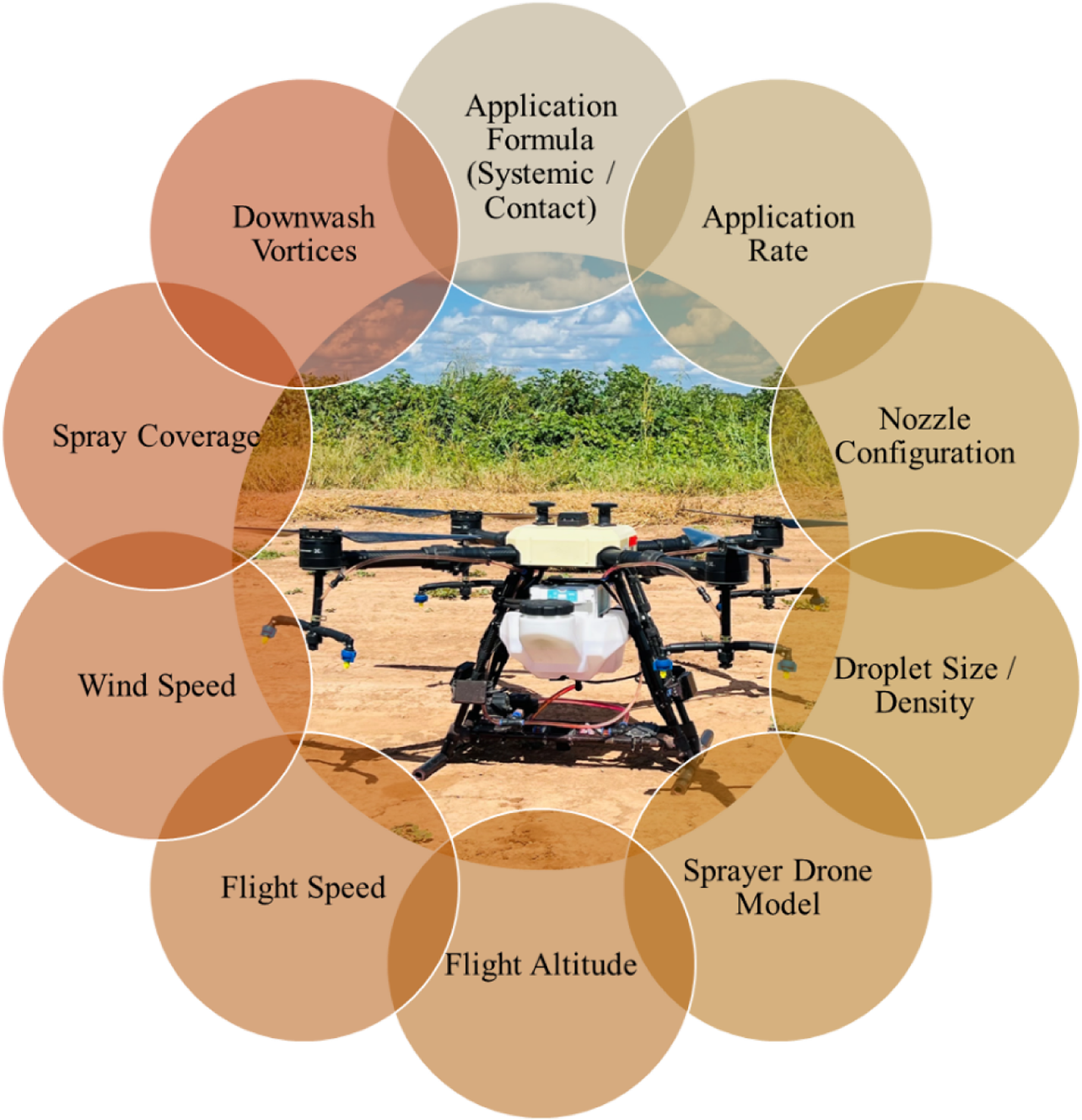
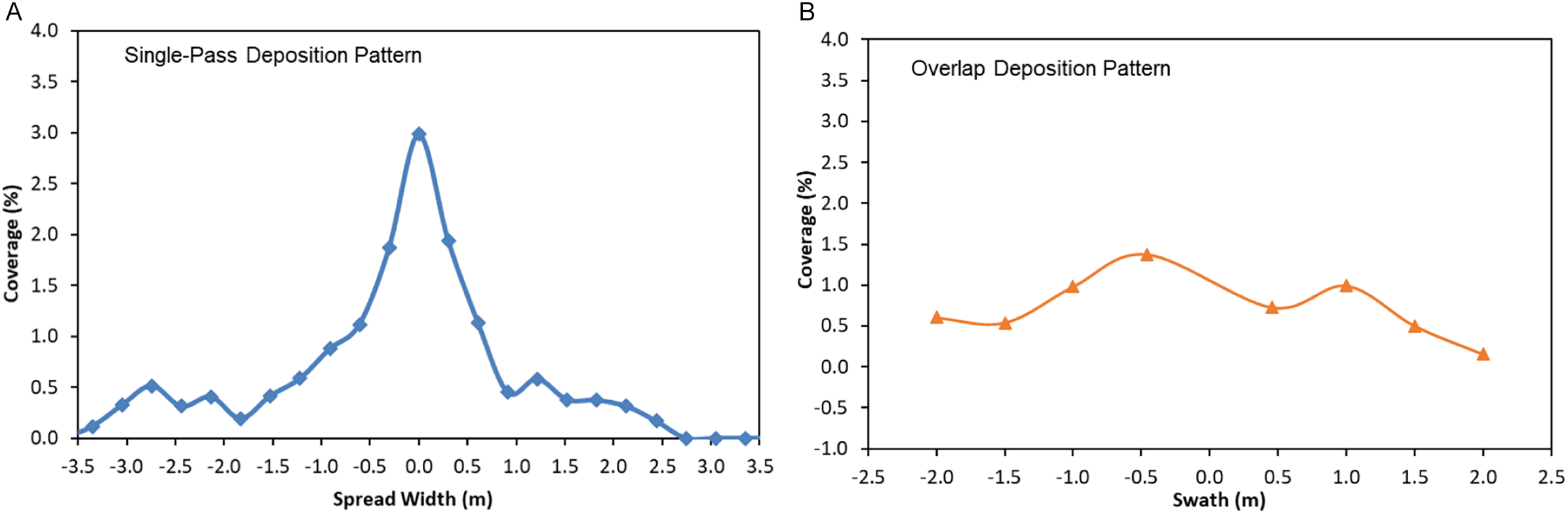
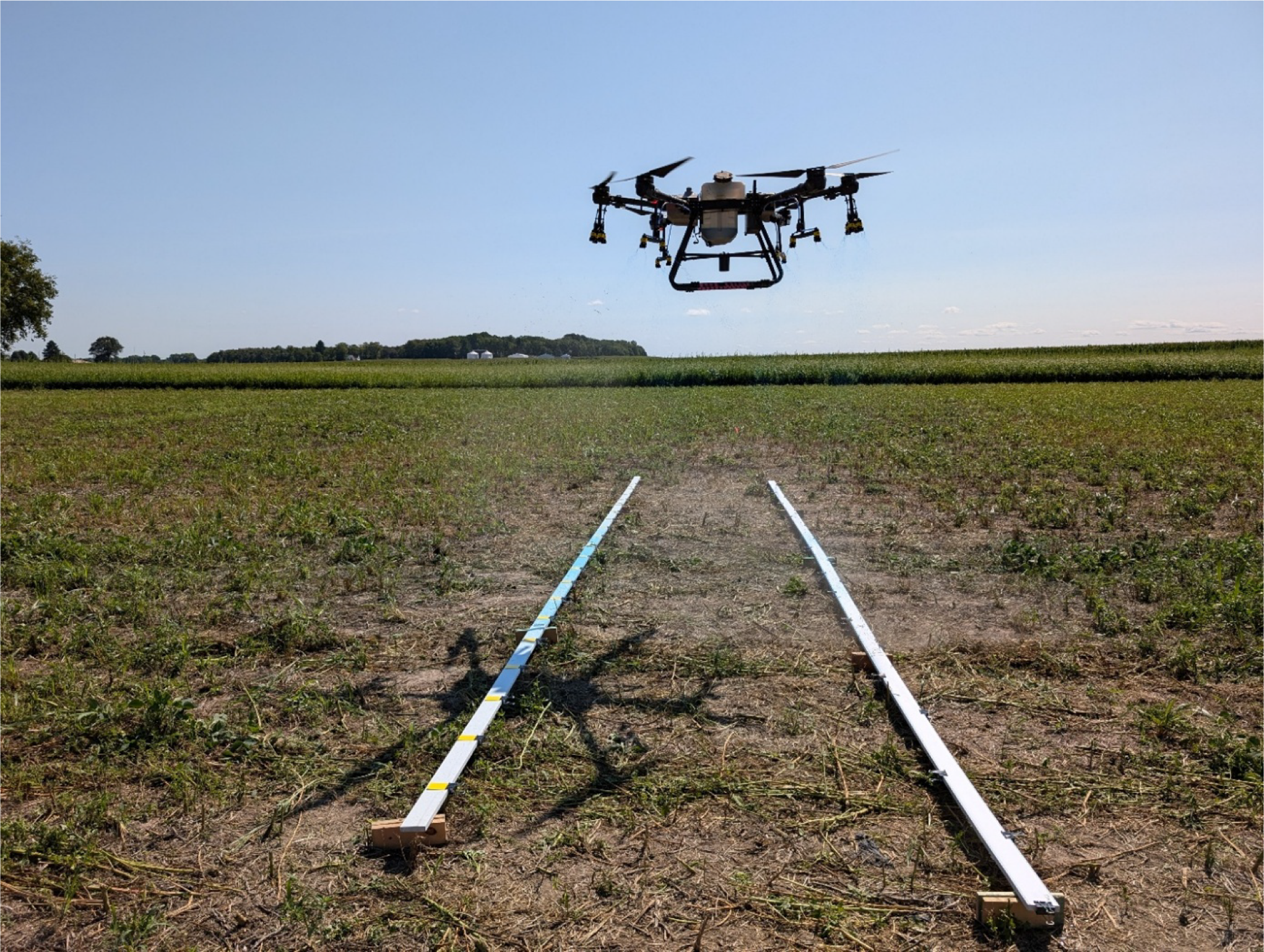
Ensuring that a UAV can spray a herbicide in an adequate, effective swath is crucially important in achieving optimal spray deposition and efficacy. An effective swath is the widest possible swath that achieves acceptable variability in spray deposition uniformity, as indicated by the coefficient of variation (ASE 2012). For herbicides that are broadcast-applied, selecting an appropriate, effective swath is necessary to avoid both underapplying and overapplying the product. A swath is also specific to UAV design and model, and is influenced by herbicide tank volume, application height and speed, and nozzle type/droplet size (Figure 2). Single-pass spray patterns from UAVs typically follow a bell-shaped curve (Figure 3A) in which most of the deposition is concentrated in the middle of the swath and coverage is reduced toward the ends of the swath (Byers et al. Reference Byers, Virk, Rains and Li2024; Martin et al. Reference Martin, Woldt and Latheef2019; Sinha et al. Reference Sinha, Johnson, Power, Moodie, Warhurst and Barbosa2022). As a result, herbicides broadcast-applied with a UAV requires adequate overlap from adjacent passes to minimize in-swath deposition variability (Figure 3B). Determining an effective swath is critical for ensuring that herbicides are applied with adequate coverage and uniformity and to achieve the desired efficacy from herbicide applications. Understanding and visualizing spray deposition across the swath from a UAV application is also crucial in assessing the magnitude of coverage and/or deposition (Figure 4). Coverage and deposition, although related, represent fundamentally different aspects of spray performance. Coverage describes the proportion of the target surface area that receives spray droplets, often expressed as percent area covered or droplet count per unit area. Deposition, however, measures the actual mass or quantity of herbicide active ingredient delivered to the target surface. An application may produce low coverage yet still achieve adequate deposition if the droplets are larger, more concentrated, or retained more efficiently. Distinguishing between these two metrics is essential when interpreting UAV spray performance and relating droplet behavior to weed control outcomes. UAVs tend to cover less area than ground-based boom sprayers due to low-volume applications and from being higher over the crop (Cavalaris et al. Reference Cavalaris, Karamoutis and Markinos2022; da Cunha and da Silva Reference da Cunha and da Silva2023). Contact herbicides typically exhibit limited translocation and are not redistributed within the plant. As a result, they cause membrane disruption, burning, and necrosis of leaf and stem tissues, effects that generally manifest within minutes to a few hours. Effective weed control with these herbicides depends on thorough coverage of the plant surface, necessitating higher carrier volumes. Achieving adequate coverage often requires adjusting the UAV operating parameters, such as increasing the carrier volume and reducing the application height. In contrast, systemic herbicides are less dependent on spray coverage when droplets are evenly distributed within the swath. However, emerging evidence from recent UAV studies reported equivalent levels of weed control or desiccation with contact herbicides such as paraquat and glufosinate, even at reduced carrier volumes. This indicates that coverage may not necessarily equate to deposition of herbicide active ingredients. With UAV-based applications, more concentrated droplets delivered at low carrier volumes may enhance leaf-surface retention and create a steeper diffusion gradient, thereby improving absorption and resulting in comparable efficacy despite reduce areal coverage. For example, glufosinate at 10 L ha⁻1 applied with a UAV achieved greater control of ryegrass (Lolium multiflorum L.) than conventional CO2-pressurized backpack spraying at 100 L ha⁻1, a result attributed to increased droplet deposition on the abaxial leaf surface under UAV operation (Palacios-Zuñiga et al. Reference Palacios-Zuñiga, Polito, Araújo, Schröder, Burkert, Avila and Camargo2024). These findings support the emerging view that lower-volume UAV applications could still deliver effective deposition and biological activity, even for herbicides traditionally considered coverage-dependent. However, it is important to note that although glufosinate is considered a contact herbicide due to its rapid activity and limited phloem translocation, it can translocate through the xylem in grass species because of its high hydrophilicity (log kow: −3.9) (Kumaratilake et al. Reference Kumaratilake, Lorraine-Colwill and Preston2002; Takano et al. Reference Takano, Beffa, Preston, Westra and Dayan2020), which may have contributed to the reported results.
Key spray drone parameters determining weed control performance.

Example of a single-pass spray deposition pattern (A) and overlap deposition pattern (B) for an effective swath of 2 m from a UAV application (Simerjeet Virk, unpublished data).

Spray drone parameter testing (effective swath, spray deposition and coverage).

Based on the spray deposition pattern shown in Figure 3A, site-specific or targeted herbicide applications using UAVs may achieve better coverage and/or deposition, leading to improved efficacy, because most of the spray is deposited directly under the UAV and distributed more uniformly within a narrower swath. When an SUV sprays a herbicide in a broadcast application, the deposition variability within the swath (represented by the coefficient of variation) is usually greater than that of ground-based methods due to a highly variable spray flux and the effect of rotors. Several researchers have reported unusually high coefficient of variation values (>30%) associated with spray applications with UAVs, indicating high in-swath deposition variability (Byers et al. Reference Byers, Virk, Rains and Li2024). Managing deposition variability across the spray swath is a challenging task for UAV applications, but it is vital for effective herbicide applications. In addition to these factors, crop type, weed type, and canopy structure can also influence spray deposition, because it is easier for spray particles to penetrate through the foliage of narrow and taller plants than broadleaf and shorter plants.
To obtain effective herbicide applications with UAVs, proper calibration to determine the target carrier volume and an effective swath that minimizes variability in spray deposition must be determined. The calibration process also needs to include the effect of operational parameters such as volume, height, speed, and droplet size, on the spray deposition to guide the selection of optimal parameters for more efficacious herbicide applications. Additionally, because the effective swath for UAVs is generally narrower than the wider swaths recommended by manufacturers (Byers et al. Reference Byers, Virk, Rains and Li2024; Sinha et al. Reference Sinha, Johnson, Power, Moodie, Warhurst and Barbosa2022) proper testing and calibration are required. The calibration process involves verifying the flow rate from the nozzles or atomizers and determining the effective swath through field testing. The rate verification process is relatively straightforward and generally takes 10 to 15 min; however, the field testing process can take anywhere from 30 min to 2 h depending on the method used to analyze spray cards, determine mean coverage and coefficients of variation, and making appropriate adjustments to the drone parameters to obtain an acceptable variability in swath.
Droplet Size and Drift
Pesticide spray drift is a major agricultural concern due to off-target movement of pesticides and its implications for water quality, environmental safety, loss of efficacy, pollinators’ visitation, and human health. An assessment of drift potential from various application practices is essential to reducing potential risks (Felsot et al. Reference Felsot, Unsworth, Linders, Roberts, Rautman, Harris and Carazo2010; Kouame et al. Reference Kouame, Butts, Werle and Johnson2023, Reference Kouame, Thrash, Bateman, Lorenz and Butts2025). As a result, understanding the drift potential of herbicide applications via spray drone is necessary to develop best application practices, inform regulatory changes, and safeguard the technology for future use.
Chen et al. (Reference Chen, Douzals, Lan, Cotteux, Delpuech, Pouxviel and Zhan2022) conducted a review of the spray drone literature and identified numerous factors that influence drift potential from spray drones. These factors include, among others, nozzle selection, pressure, nozzle layout on the platform, adjuvant and formulation, downwash airflow, payload, pitch of the platform, flight speed and direction, flight height, and wind speed and direction (parallel versus perpendicular to crop rows [Brown and Giles Reference Brown and Giles2018; Chahine et al. Reference Chahine, Dupont, Sinfort and Brunet2014]; in-wind versus cross-wind [Chen et al. Reference Chen, Douzals, Lan, Cotteux, Delpuech, Pouxviel and Zhan2022]). Two additional review papers identified that applications via spray drones resulted in less downwind spray drift than piloted aerial applications, greater than commercial ground spray equipment, and similar to orchard air-blast applications (Bonds et al. Reference Bonds, Pai, Hovinga, Stump, Haynie, Flack and Bui2024; Goulet-Fortin et al. Reference Goulet-Fortin, He, Donaldson, Gottesbueren, Wang, Lan, Gao, Gan, Jiang and Laabs2024). The spray drift potential from spray drones still resulted in significantly less exposure of pesticides to the operator compared with drift from other methods such as backpack applications (Bonds et al. Reference Bonds, Pai, Hovinga, Stump, Haynie, Flack and Bui2024). To put this in perspective, in an individual study conducted in western Nebraska with a wind speed of 3.8 m s−1, the drift from a spray drone reached nondetectable levels approximately 25 and 18 m downwind for when the spray was set to medium and extremely coarse, respectively (Martin et al. Reference Martin, Tang, Yang, Latheef, Fritz, Kruger and Houston2024). Previous research evaluating spray drift from piloted aerial applications observed detectable spray drift up to 61 m downwind and a 5-fold to 8-fold increase in downwind drift compared to a commercial ground sprayer (Butts et al. Reference Butts, Fritz, Kouame, Norsworthy, Barber, Ross, Lorenz, Thrash, Bateman and Adamczyk2022). This indicates that spray drift potential increases in the order of ground equipment < spray drone < piloted aerial, with spray drones having approximately a 2-fold to 5-fold more downwind spray drift potential than a ground application, thereby corroborating conclusions drawn from the review papers. Additionally, research with both piloted aerial and spray drone equipment have indicated an upwind swath offset as an ideal best management practice to reduce off-target pesticide movement to susceptible areas from these applications (Butts et al. Reference Butts, Fritz, Kouame, Norsworthy, Barber, Ross, Lorenz, Thrash, Bateman and Adamczyk2022; Martin et al. Reference Martin, Tang, Yang, Latheef, Fritz, Kruger and Houston2024).
Similar to conventional application equipment (both piloted aircraft and ground sprayers), droplet size is one of the largest drivers affecting spray drift potential (Delavarpour et al. Reference Delavarpour, Koparan, Zhang, Steele, Betitame, Bajwa and Sun2023; Martin et al. Reference Martin, Tang, Yang, Latheef, Fritz, Kruger and Houston2024). Increasing the droplet size emitted from a spray drone resulted in increased deposition within the targeted area and decreased downwind spray drift (Chen et al. Reference Chen, Lan, Zhou, Ouyang, Wang, Huang, Deng and Cheng2020; Martin et al. Reference Martin, Perine, Grant, Abi-Akar, Henry and Latheef2025). Additionally, drift reduction adjuvants can increase droplet size and reduce drift potential from a spray drone application, similar to other application practices (Kannan et al. Reference Kannan, Martin, Srinivasan and Zhang2024).
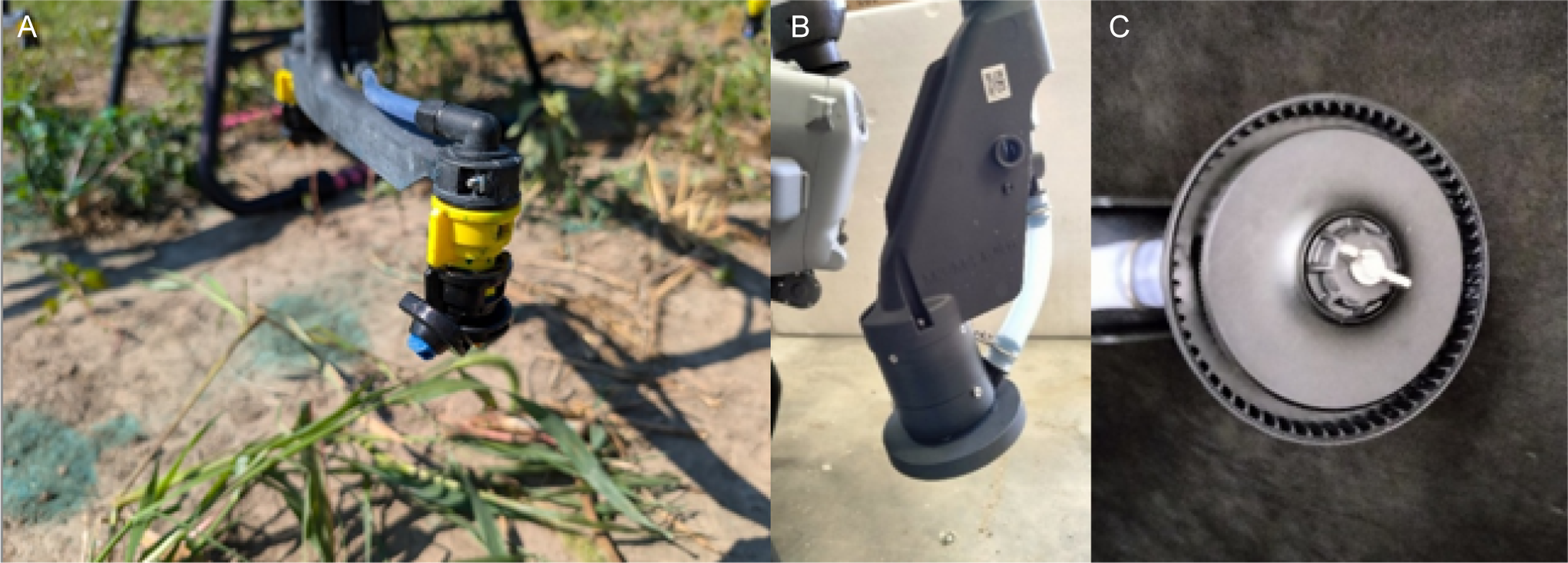
Although droplet size is a critical component in determining and mitigating spray drift potential, research has demonstrated that it is difficult to accurately sample and measure spray droplet size from spray drones while accounting for rotor wash, bias may result in coarser droplet sizes when using traditional laser diffraction or imaging techniques (Fritz and Butts Reference Fritz, Butts and Brown2025). Despite this, several efforts have been made to measure droplet size. In one study, droplet size directly underneath a spray drone using hydraulic nozzles was measured using water-sensitive papers and compared with measurements collected in a laboratory using laser diffraction (Butts et al. Reference Butts, Fritz, Davis and Spurlock2024). Patterns emerged indicating that field-collected droplet sizes were consistently biased in favor of finer droplet sizes, ranging from approximately 40% to 85% of the diameter of sprays measured in the laboratory. Further research demonstrated complex interactions among operational parameters, including flight height and speed, that influence droplet size, complicating the issuance of recommendations for the dynamic spray application process from spray drones (Martin et al. Reference Martin, Woldt and Latheef2019). Other research explored droplet size formation from centrifugal nozzles (also referred to as rotary atomizer or spinning disk nozzles) (Wang et al. Reference Wang, Han, Li, Andaloro, Chen, Hoffmann, Han, Chen and Lan2020; Xu et al. Reference Xu, Jin, Zhong, Luo and Song2025) (Figure 5). The researchers determined that emitted droplet size would increase if the centrifugal nozzle rotational speed was decreased, or the flow rate was increased, or both. However, significant variability among centrifugal nozzle designs was identified (Wang et al. Reference Wang, Han, Li, Andaloro, Chen, Hoffmann, Han, Chen and Lan2020; Xu et al. Reference Xu, Jin, Zhong, Luo and Song2025).
Spray drone hydraulic nozzle (A), spray lance shell (B), and centrifugal disk module (C).

Rotor downwash can also influence drift potential. Based on computational fluid dynamics modeling, rotor downwash improved spray uniformity and mitigated a crosswind effect, thereby reducing drift potential (Feng et al. Reference Feng, Xu, Yang, Zheng, Li, Liu, Zhao and Jiang2024). Researchers recommended using application setups that can increase downwash to aid in drift management. Further research demonstrated positive attributes of rotor downwash to improve spray deposition, penetration, and droplet distribution uniformity, while reducing spray drift potential (Zhan et al. Reference Zhan, Chen, Xu, Chen, Han, Lan and Wang2022). An optimal flight height of 2 m and a high payload enhanced the uniformity of droplet deposition and uniformity, while reducing spay drift potential (Zhan et al. Reference Zhan, Chen, Xu, Chen, Han, Lan and Wang2022). Also, in a wind tunnel study, evaluating the impact of rotor wash on droplet formation during spray drone pesticide applications, researchers reported that rotor wash can cause greater spray break-up, leading to smaller droplets that are more prone to off-target movement (Fritz and Butts Reference Fritz, Butts and Brown2025).
Numerous other factors have been identified as influencing drift potential from drones. For example, research showed that drift potential was reduced when herbicides were applied with a drone when a crop canopy was present versus herbicides applied to bare soil (Goulet-Fortin et al. Reference Goulet-Fortin, He, Donaldson, Gottesbueren, Wang, Lan, Gao, Gan, Jiang and Laabs2024). Alternatively, when the nozzle tilt angle was increased to coordinate with the drone pitch tilt, the drift potential decreased, indicating this should be another consideration in drift reduction strategies from spray drones (Yu et al. Reference Yu, Yun, Choi, Dafsari and Lee2021).
Although many research projects have explored the effects of individual application factors on herbicide drift from a drone, numerous studies have also examined drift from a variety of application factors. Regardless of operating conditions (droplet size, flight speed, and cross-wind velocity), off-target herbicide movement occurred across all conditions, but spray drift was not detectable beyond 5 m downwind of the intended application area (Hunter et al. Reference Hunter, Gannon, Richardson, Yelverton and Leon2020). Researchers recommended using nozzles that produce coarser droplets and slower flight speeds (such as 3 m s−1) to further minimize off-target movement. Decreasing the droplet size and increasing the flight height also resulted in a 4-fold greater spray drift (droplet density) measured at nearly 12 m downwind when a drone was used to spray turfgrass (Koo et al. Reference Koo, Gonçalves and Askew2024). Wind-tunnel research has demonstrated that the downwind drift potential from the spray of a drone increased as a result of the following factors in decreasing order of importance: increasing wind speed > decreasing droplet size > initial payload capacity (Grant et al. Reference Grant, Perine, Abi-Akar, Lane, Kent, Mohler, Scott and Ritter2022). Other research illustrated that a drone that uses centrifugal nozzles (also known as a rotary atomizer or spinning disk nozzles) resulted in highly variable downwind spray drift; however, 1% ground drift deposits were often observed around 10 m downwind (Butler-Ellis et al. Reference Butler-Ellis, Lane, O’Sullivan, Wheeler and Harwood2025). Other studies showed lower a lateral wind speed and larger spray droplets (either from adding a drift reduction adjuvant or altering the centrifugal rotational speed of the nozzle) resulted in less downwind spray drift (Semenišin et al. Reference Semenišin, Steponavičius, Kemzūraitė and Savickas2025; Wang et al. Reference Wang, Han, Li, Andaloro, Chen, Hoffmann, Han, Chen and Lan2020). Furthermore, downwind herbicide drift potential was variable depending on the drone platform (TTA M6E (Beijing TT Aviation Technology Co., Ltd., Beijing, China), XAG XP2020 (XAG Co., Ltd., Guangzhou, China), DJI T30 (DJI, Shenzhen, China)) and interactions with environmental and operational conditions (Semenišin et al. Reference Semenišin, Steponavičius, Kemzūraitė and Savickas2025). Environmental conditions (atmospheric stability, relative humidity, air temperature, etc.) in particular can be highly variable, but they have been either minimally or not investigated for their specific influence on herbicide drift applied from a drone. As such, future research should extensively collect environmental data and quantify their relationship with measured drift potential from drone applications. Overall, drift potential and droplet size formation are affected by a dynamic environment and operating system, and it is challenging to account for all factors to fully optimize the application of herbicides with a UAV.
Herbicide Efficacy
Herbicides applied using UAVs are expected to provide effective weed control. First, the single-pass spray patterns from UAVs generally display a bell-shaped distribution, with deposition concentrated at the center of the swath and reduced coverage at the edges. Ensuring sufficient overlap between adjacent passes can minimize deposition variability within the swath and further enhance the effectiveness of broadcast herbicide applications using UAVs. Furthermore, using low carrier volumes produces more concentrated droplets, which could enhance leaf-surface retention and create a steeper diffusion gradient, potentially improving absorption and maintaining efficacy even with reduced areal coverage.
The majority of studies on UAV-applied herbicides have focused on the efficacy of foliar-applied herbicides. A few studies have focused on the performance of the spray drone on soil-applied residual herbicides. Avhale et al. (Reference Avhale, Govindan, Gnanasekaran, Maduraimuthu, Ramalingam and Patil2024) reported lower weed density, biomass, and greater weed control with pretilachlor and pyrazosulfuron applied preemergence with a UAV to wet, direct-seeded rice, compared to herbicides applied with a conventional backpack sprayer. Paul et al. (Reference Paul, Arthanari, Pazhanivelan and Kavitha2023) also found that pretilachlor and pyrazosulfuron provided similar weed control as that of a conventional backpack sprayer when applied with a UAV to dry, direct-seeded rice. Weed density, biomass, and efficacy following pendimethalin (750 and 1,000 g ha-1) applied to greengram [Vigna radiata (L.) R. Wilczek] with a UAV and carrier volumes of 50, 60, or 70 L ha⁻1 were comparable to those achieved using a backpack sprayer with pendimethalin at 1,000 g ha⁻1 and a carrier volume of 500 L ha⁻1 (Madhusree et al. Reference Madhusree, Ramesh, Rathika, Meena and Raja2023). Similar results were reported when pendimethalin was applied to soybean [Glycine max (L.) Merr.] (Hiremath et al. Reference Hiremath, Khatri and Jagtap2024) and pyrazosulfuron-ethyl applied to transplanted irrigated rice (Jeevan et al. Reference Jeevan, Pazhanivelan, Kumaraperumal, Ragunath, Arthanari, Sritharan, Karthikkumar and Manikandan2023), when applied with a UAV, provided weed control equivalent to that of conventional ground-based application methods.
The equivalent weed control achieved with soil-applied herbicides using a UAV was often attributed to their ability to distribute the herbicide more uniformly across the target area (Jeevan et al. Reference Jeevan, Pazhanivelan, Kumaraperumal, Ragunath, Arthanari, Sritharan, Karthikkumar and Manikandan2023). However, the efficacy of UAV-applied preemergence herbicides may decrease when soil conditions are suboptimal. For example, when a UAV was used to apply diflufenican + isoproturon and flufenacet + diflufenican + flurtamone to wheat growing in soils with large particles (sandy) and low moisture, control of Japanese foxtail was lower than when the herbicides were applied with a backpack sprayer (Chen et al. Reference Chen, Qi, Li and Lan2019). Conversely, the same study reported that flufenacet + diflufenican + flurtamone applied from a UAV achieved greater control (95%) of Japanese foxtail than ground-based methods (80%) in fields with finer soil particles (clay), higher moisture levels, and little straw residue.
The effectiveness of postemergence herbicides applied via UAVs is influenced by multiple factors, including spray coverage, droplet size, droplet density, droplet deposition, the herbicide’s mode of action, and the biology of the target weed species. Applications of systemic herbicides such as bispyribac sodium, cyhalofop-butyl, foramsulfuron, glyphosate, metribuzin, and quinclorac, and herbicide mixtures such as isoproturon + mesosulfuron + florasulam, imazamox + imazethapyr, mesosulfuron-methyl + iodosulfuron-methyl sodium, and penoxsulam + cyhalofop-butyl, with a UAV have demonstrated weed control efficacy that is comparable to that of conventional ground-based application methods (Abd Ghani et al. Reference Abd Ghani, Juraimi, Su, Ahmad-Hamdani, Islam and Motmainna2024; Chen et al. Reference Chen, Qi, Li and Lan2019, Reference Chen, An, Chen and Zhuang2023; Costa et al. Reference Costa, Martin, Torres, Floyd, Fritz, Straw and Bagavathiannan2025; Hiremath et al. Reference Hiremath, Khatri and Jagtap2024; Jeevan et al. Reference Jeevan, Pazhanivelan, Kumaraperumal, Sivamurugan and Kancheti2024; Kumar et al. Reference Kumar, Singh, Singh and Bhullar2022; Palacios-Zuñiga et al. Reference Palacios-Zuñiga, Polito, Araújo, Schröder, Burkert, Avila and Camargo2024; Paul et al. Reference Paul, Palanisamy, Peramaiyan, Kumar, Bagavathiannan, Gurjar, Vijayakumar, Djanaguiraman, Pazhanivelan and Ramasamy2024a, Reference Paul, Arthanari, Pazhanivelan, Kavitha and Djanaguiraman2024b, Reference Paul, Arthanari, Peramaiyan, Kumar, Bagavathiannan and Sabarivasan2025; Pranaswi et al. Reference Pranaswi, Jagtap, Shinde, Khatri and Shetty2024).
Potential for Site-Specific Applications
The emergence of using UAVs in precision agriculture has shown great promise for site-specific weed management, offering early detection, spatial mapping, and species-specific management with high accuracy (Huang et al. Reference Huang, Reddy, Fletcher and Pennington2018; Singh et al. Reference Singh, Rana, Bishop, Filippi, Cope, Rajan and Bagavathiannan2020; Vijayakumar et al. Reference Vijayakumar, Gurjar, Bagavathiannan and Kumar2025). A key factor in the success of site-specific weed management is accurate weed recognition, which directly influences spray efficacy, herbicide use, and environmental sustainability (Gurjar et al. Reference Gurjar, Sapkota, Torres, Ceperkovic, Kutugata, Kumar, Zhou, Martin and Bagavathiannan2025; Hunter et al. Reference Hunter, Gannon, Richardson, Yelverton and Leon2019; Li et al. Reference Li, Zhang, Zhou, Yu and Li2024a). Weeds can be distinguished from crops using various techniques such as color thresholding, vegetation indices, canopy height models, structure-from-motion, and more advanced techniques such as convolutional neural networks (Louargant et al. Reference Louargant, Villette, Jones, Vigneau, Paoli and Gée2017; Wierzbicki et al. Reference Wierzbicki, Kedzierski and Fryskowska2015). However, the effectiveness of these methods is highly dependent on crop-weed combinations, growth stage, and environmental conditions (Coleman et al. Reference Coleman, Bender, Hu, Sharpe, Schumann, Wang, Bagavathiannan, Boyd and Walsh2022).
Traditional image processing methods, such as thresholding and vegetation indices, rely on spectral differences between vegetation and background (crop, soil, residue) to identify weeds. For example, Woebbecke et al. (Reference Woebbecke, Meyer, von Bargen and Mortensen1995) classified monocot and dicot weeds with color indices under varying soil, residue, and light conditions. Similarly, Yu et al. (Reference Yu, Jin, Guo, Guo, Zhang, Xu and Chen2022) achieved 93% weed detection accuracy in a rice crop using a vegetation index based on green, red-edge, and near-infrared indices. Recent advancements in remote sensing have enabled the use of structural data to improve crop-weed discrimination. Gurjar et al. (Reference Gurjar, Sapkota, Torres, Ceperkovic, Kutugata, Kumar, Zhou, Martin and Bagavathiannan2025) developed a custom weed detection model using the canopy height model and red-band reflectance to detect hemp sesbania [Sesbania herbacea (Mill.) McVaugh], Amazon sprangletop [Leptochloa panicoides (J. Presl) Hitchc.], yellow nutsedge (Cyperus esculentus L.), and barnyardgrass [Echinochloa crus-galli (L.) P. Beauv.] in rice fields for site-specific weed management. Detection accuracy varied by species, ranging from 62% (barnyardgrass) to 95% (hemp sesbania). Shahbazi et al. (Reference Shahbazi, Ashworth, Callow, Mian, Beckie, Speidel, Nicholls and Flower2021) employed a light detection and ranging (LiDAR) sensor to detect wild oat (Avena fatua L.) and sowthistle (Sonchus oleraceus L.) growing among wheat plants, achieving 100% accuracy when weeds were taller than the crop. Despite these advances, detection accuracy is still limited by environmental variability and crop-weed spectral similarity (Sapkota et al. Reference Sapkota, Singh, Cope, Valasek and Bagavathiannan2020). While canopy height models and LiDAR can improve detection of taller weeds as late-season escapes, accuracy is species-specific and typically less effective early in the season. Moreover, image resolution, flight altitude, and three-dimensional reconstruction quality influence detection performance (Wierzbicki et al. Reference Wierzbicki, Kedzierski and Fryskowska2015). The efficiency of site-specific weed management can be improved through species-specific applications enabled by hyperspectral sensors, which offer higher spectral and spatial resolution to more accurately differentiate among weed species. An increasing number of portable hyperspectral imaging sensors are being developed for UAVs, facilitating the detection of subtle spectral variations that reflect plant biophysical and biochemical characteristics (Huang et al. Reference Huang, Reddy, Fletcher and Pennington2018).
Recent progress in computer vision and deep learning has greatly improved weed recognition by enabling models to learn features directly from image data. Coleman et al. (Reference Coleman, Bender, Hu, Sharpe, Schumann, Wang, Bagavathiannan, Boyd and Walsh2022) reviewed 50 yr of weed detection research and emphasized the deep learning model’s potential in facilitating site-specific weed management. Similarly, Bagavathiannan and von Redwitz (Reference Bagavathiannan and von Redwitz2025) proposed a framework for selectively managing weeds while preserving beneficial species through precision methods. Numerous studies have applied computer vision and deep learning techniques to imagery obtained with an unmanned aircraft system for weed identification. For instance, Guo et al. (Reference Guo, Cai, Zhou, Xu and Yu2024) used transfer learning to detect barnyardgrass at tillering and panicle initiation stages with 68% accuracy. Li et al. (Reference Li, Guo, Sun, Chen and Cao2024b) reported a detection accuracy of 98% (mean average precision at 50% intersection-over-union threshold, or mAP@50 for short) using a YOLOv10n instrument to identify Chinese arrowhead (Sagittaria trifolia) at the 1-leaf to 3-leaf stage in rice fields. In corn (Zea mays L.), Yadav et al. (Reference Yadav, Thomasson, Hardin, Searcy, Braga-Neto, Popescu, Martin, Rodriguez, Meza and Enciso2023) used a YOLOv3 device to detect volunteer cotton (Gossypium hirsutum L.), achieving an F 1 score of 79% and mAP of 80%. Zhang et al. (Reference Zhang, Wang, Hu, Liu, Chen and Su2020) evaluated the residual neural network (ResNet) architecture for general weed detection in sod production, with detection accuracies ranging from 57% to 90%. Barnhart et al. (Reference Barnhart, Lancaster, Goodin, Spotanski and Dille2022) used the YOLOv5 model to detect Palmer amaranth [Amaranthus palmeri (S.) Wats.] in soybean and achieved an mAP of 77% and F 1 score of 72%. They noted that detection accuracy decreased as weed height, diameter, and density increased, highlighting challenges for high-density infestations and overlapping canopies. These results show that deep learning methods can be highly effective, but their performance still depends on species type, weed growth stage, and, importantly, the quality and quantity of images used in training the deep learning models.
The use of high-resolution images for model training is ideal for detecting small or early stage weeds. However, unmanned aerial systems often capture wide-area images at high altitudes, which can reduce spatial resolution and hinder detection accuracy. Other challenges include scale variation, weed sparsity, and object size variability (López-Granados 2011). Large and diverse data sets are essential for training robust models. Sapkota et al. (Reference Sapkota, Popescu, Rajan, Leon, Reberg-Horton, Mirsky and Bagavathiannan2022) trained a Mask R-CNN on both real and synthetic unmanned aerial system imagery of cotton-weed mixtures. The model performed better with original images (mAP@50 = 0.64) than with synthetic images alone (mAP@50 = 0.60); combining real and synthetic images for model training revealed that synthetic data can support, but not fully replace, real imagery.
Selecting an appropriate workflow for an unmanned aerial system is essential for balancing precision, responsiveness, and operational efficiency in the field. The workflow involves two approaches: 1) preflight imaging followed by offline analysis and subsequent spraying or mechanical operation; or 2) real-time or near real-time weed recognition and spraying. The offline approach allows for high-resolution mapping, species distribution analysis, and model-based decision-making (Costa et al. Reference Costa, Martin, Torres, Floyd, Fritz, Straw and Bagavathiannan2025; Torres et al. Reference Torres, Martin, Sapkota, Gurjar, Kutugata, Nolte and Bagavathiannan2023). However, it involves a time lag between data collection and treatment execution, which may lead to changes in weed growth dynamics or environmental conditions. Delays in implementing control measures can result in discrepancies between the processed imagery and the current field scenario, where targeted weed species may have grown larger (Nikolić et al. Reference Nikolić, Rizzo, Marraccini, Gotor, Mattivi, Saulet, Persichetti and Masin2021). Consequently, the control measures may lose efficacy, thereby reducing their effectiveness in managing weed populations. In contrast, real-time or near real-time systems enable immediate action, minimizing latency between detection and treatment (Khan et al. Reference Khan, Tufail, Khan, Khan, Iqbal and Wasim2021). These systems require onboard processing capabilities, lightweight models (e.g., YOLO or MobileNet), and robust edge computing platforms. However, these hardware constraints often limit model complexity and detection accuracy. In addition, real-time systems face operational challenges. UAV battery life is limited, and without prior information about weed patch locations, the drone sprayer must cover the entire field to locate and treat weeds. This results in idle flying and longer operation times, reducing overall efficiency.
Site-specific weed management with ground-based sprayers differs from that when spray drones are used in many ways. For example, in contrast to UAV-based workflows, preapplication imaging is not necessary for ground-based targeted applications because weeds are often detected in real time. Such imaging, however, could still be employed to develop prescription maps that can be uploaded into an application system. Ground-based spray systems that detect and spray emerged weeds on bare soil, based on chlorophyll fluorescence detection, have been used for several decades in fallow systems (Felton and McCloy Reference Felton and McCloy1992; Haggar et al. Reference Haggar, Stent and Isaac1983) with technologies such as DetectSpray (John Deere, Moline, IL), WeedSeeker (PTx Trimble, Tremont, IL) (Blackshaw et al. Reference Blackshaw, Molnar, Chevalier and Lindwall1998a, Reference Blackshaw, Molnar and Lindwall1998b) and WEED-IT (Biller Reference Biller1998; Wang et al. Reference Wang, Zhang, Dowell, Sun and Peterson2001). The See & Spray Select sprayer recently introduced by John Deere for weed detection and targeted applications in fallow or preplant scenarios is based on machine vision and is equipped with cameras mounted directly to the boom (Avent et al. Reference Avent, Norsworthy, Butts and Drescher2025a; Lazaro et al. Reference Lazaro, Houston and Patzoldt2024). Recent advancements in computer vision and deep learning have enabled weed detection within crops, enabling selective spraying. Similar to the use of deep learning algorithms for targeted applications with spray drones, several researchers developed smart sprayer prototypes using machine learning algorithms such as YOLOv7 (Balabantaray et al. Reference Balabantaray, Behera, Liew, Chamara, Singh, Jhala and Pitla2024); DenseNet, GoogLeNet, and ResNet (Jin et al. Reference Jin, Liu, Yang, Xie, Bagavathiannan, Hong, Xu, Chen, Yu and Chen2023a, Reference Jin, McCullough, Liu, Yang, Zhu, Chen and Yu2023b); YOLOv4 (Upadhyay et al. Reference Upadhyay, Sunil, Zhang, Koparan and Sun2024); and MobileNet-v2 (Calvert et al. Reference Calvert, Olsen, Whinney and Azghadi2021). Commercialized targeted sprayers for in-season weed control in corn, soybean, and cotton crops include See & Spray (https://www.deere.com/en/sprayers/see-spray/), Greeneye Technology (https://greeneye.ag/), and ONE SMART SPRAY (https://www.onesmartspray.com/), which is a joint venture of Bosch-BASF Smart Farming (Avent et al. Reference Avent, Norsworthy, Zimmer, Young, Contreras, Everman, Hager, Patzoldt, Schwartz-Lazaro, Houston and Butts2025b; Barnhart et al. Reference Barnhart, Proctor, Werle, Miller, Lancaster, Roozeboom and Dille2025; Leise et al. Reference Leise, Singh, La Menza, Knezevic and Jhala2025; Spaeth et al. Reference Spaeth, Sökefeld, Schwaderer, Gauer, Sturm, Delatrée and Gerhards2024). These systems integrate cameras, vision-processing units, and height sensors mounted along the boom. Another distinction from site-specific weed management from a drone is that newer targeted ground sprayers often feature dual-boom and dual-tank plumbing systems (Lazaro et al. Reference Lazaro, Houston and Patzoldt2024; Leise et al. Reference Leise, Singh, La Menza, Knezevic and Jhala2025), allowing simultaneous broadcast and targeted applications. In contrast to single-tank systems that apply mixtures of all herbicides (residual and postemergence) to weeds, these dual-tank systems can simultaneously broadcast residual herbicides and apply postemergence herbicides in a targeted, single pass (Barnhart et al. Reference Barnhart, Proctor, Werle, Miller, Lancaster, Roozeboom and Dille2025; Lazaro et al. Reference Lazaro, Houston and Patzoldt2024), with the added advantage of avoiding potential antagonistic interactions when certain herbicides are combined.
Herbicide and Cost Savings
The use of UAVs for targeted weed control involves herbicide and cost savings, but the extent and amount of savings depends on several factors, including the type of herbicide used, the severity and spatial distribution of weed infestations within the field, and the accuracy of the weed prescription map (Castaldi et al. Reference Castaldi, Pelosi, Pascucci and Casa2017; Hunter et al. Reference Hunter, Gannon, Richardson, Yelverton and Leon2019). Castaldi et al. (Reference Castaldi, Pelosi, Pascucci and Casa2017) reported a decrease in herbicide savings from site-specific UAV-based patch spraying as weed-infested area increased, with mesotrione and nicosulfuron applications achieving 14% to 39% savings compared with conventional broadcast spraying. Jensen et al. (Reference Jensen, Smith and Defeo2020) found that UAV-guided site-specific spraying in fallow fields treated 93% of weeds and reduced herbicide use by 45% compared with broadcast applications. Application of pretilachlor and bispyribac-sodium to direct-seed rice using a UAV reduced herbicide use and labor by 50%, and overall weed management costs by 13% compared with backpack spraying (Paul et al. Reference Paul, Arthanari, Peramaiyan, Kumar, Bagavathiannan and Sabarivasan2025). In a corn crop, site-specific weed control guided by an imaging UAV prescription map resulted in a 26.2% reduction in the total area sprayed with herbicide compared to a conventional ground-based application (Sapkota et al. Reference Sapkota, Popescu, Rajan, Leon, Reberg-Horton, Mirsky and Bagavathiannan2022). Nikolic et al. (Reference Nikolić, Rizzo, Marraccini, Gotor, Mattivi, Saulet, Persichetti and Masin2021) tested artificial neural network (ANN OpenCV) and visible atmospherically resistant index (VARI) to generate prescription maps for site-specific application of two herbicide combinations (foramsulfuron + isoxadifen-ethyl and nicosulfuron + rimsulfuron). Savings reported by their research were a function of the method used to generate the map and the herbicide program. For example, when using ANN OpenCV, the authors reported cost savings ranging from US$26.59 ha−1 to US$55.03 ha−1 and from US$18.55 ha−1 to US$38.39 ha−1 for foramsulfuron + isoxadifen-ethyl and nicosulfuron + rimsulfuron applications, respectively, compared with a broadcast application to corn. But when using VARI to generate prescription maps, authors reported cost savings ranging from US$40.91 ha−1 to US$58.51 ha−1 and from US$28.54 ha−1 to US$40.82 ha−1 for foramsulfuron + isoxadifen and nicosulfuron + rimsulfuron applications, respectively, compared with broadcast application in corn.
The potential for herbicide savings is influenced by flight altitude, camera specifications, the spatial resolution of the prescription map, and the crop growth stage (Castaldi et al. Reference Castaldi, Pelosi, Pascucci and Casa2017). Castaldi et al. (Reference Castaldi, Pelosi, Pascucci and Casa2017) reported a classification accuracy of 53% using UAV imagery with a spatial resolution of 0.05 m, and an accuracy of 69% with a spatial resolution of 0.09 m, resulting in greater herbicide savings. Above a corn crop, the use of high-resolution UAV imagery (1.4 mm/pixel) enabled 94% weed detection, yielded 47% herbicide savings with early (2-leaf to 4-leaf) targeted spraying and 12% with late (6-leaf to 8-leaf) applications compared to broadcast spraying (Allmendinger et al. Reference Allmendinger, Spaeth, Saile, Peteinatos and Gerhards2024). Similarly, Castaldi et al. (Reference Castaldi, Pelosi, Pascucci and Casa2017) achieved a 39% herbicide reduction in applications to corn (Castaldi et al. Reference Castaldi, Pelosi, Pascucci and Casa2017). In sod fields with mixed grass weeds, an imaging UAV-RPAAS integrated system treated 20% to 60% less area than broadcast spraying but missed up to 26% of target weeds (Hunter et al. Reference Hunter, Gannon, Richardson, Yelverton and Leon2019). In this perennial system of sod fields, mowing height, monoculture, etc. limit the feasibility of using UAVs.
Challenges with Current Spray Drone Herbicide Application Technologies and Research Needs
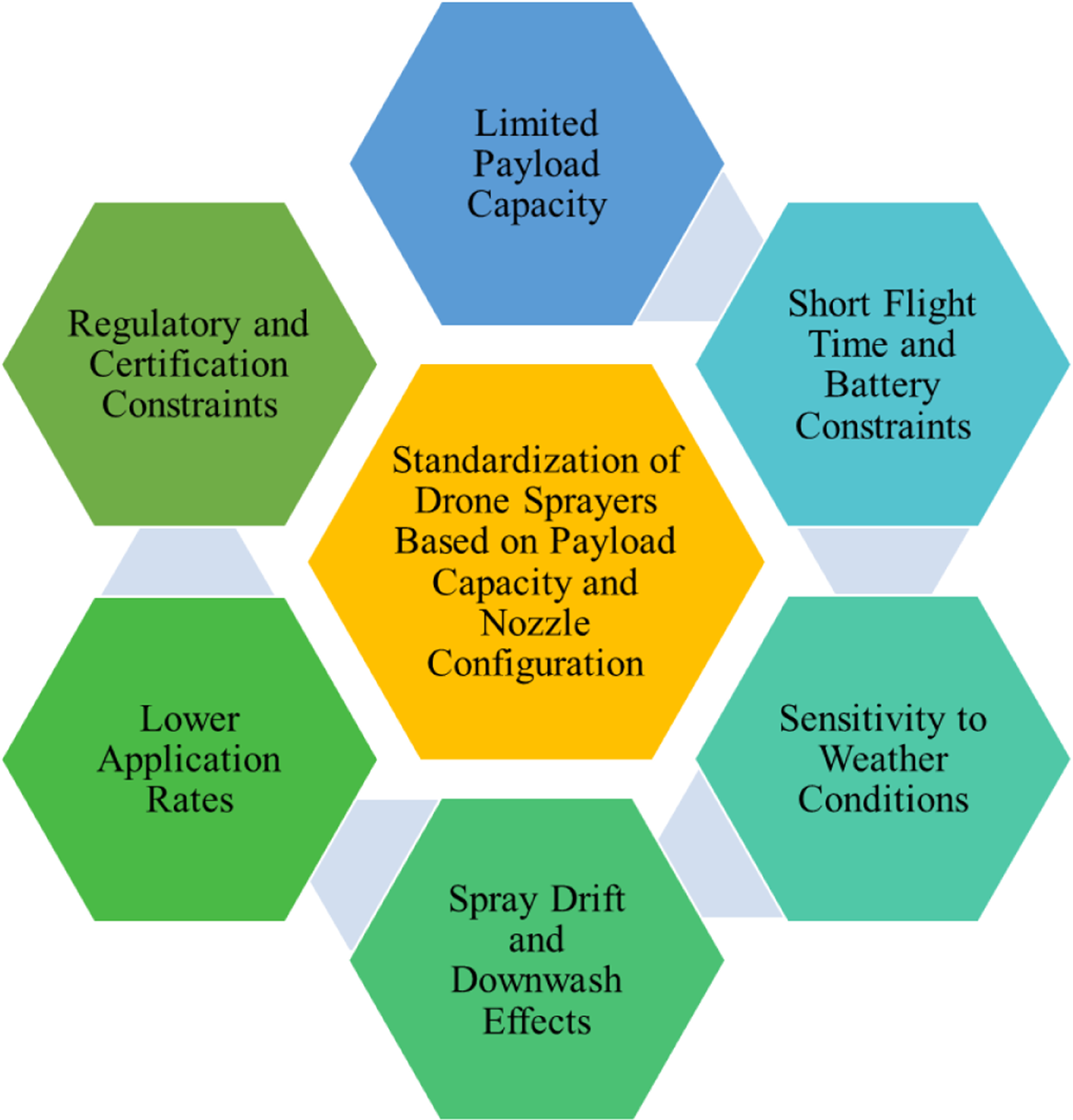
The application of herbicides with spray drones is expected to become a key component of precision weed management, but its limitations must be recognized to ensure realistic expectations (Figure 6). Pesticide applications with UAVs require compliance with U.S. Federal Aviation Administration regulations, including those under 14 CFR §107 (guidelines for commercial drone operation <25 kg) and 14 CFR §137 (guidelines for agricultural aircraft operations such as herbicide application), in addition to individual state requirements (Freeman and Freeland Reference Freeman and Freeland2015). Technical complexity is another challenge, as operations require multiple software platforms, algorithms, and a high level of digital literacy. Limited payload (10 to 40 kg), short battery life, and frequent refilling contribute to downtime (Kharim et al. Reference Kharim, Wayayok, Shariff, Abdullah and Husin2019), while GPS errors, sensor failures, and weather conditions such as wind and rain can further reduce precision and reliability (Hunter et al. Reference Hunter, Gannon, Richardson, Yelverton and Leon2020). Given these limitations, UAV-based herbicide applications are unlikely to fully replace ground methods or piloted aircraft in large-scale farming in the near future, but they hold strong potential for enhancing weed detection and managing herbicide resistance. UAVs equipped with cameras can map weed escapes for targeted control before they set seeds, thereby reducing the spread of herbicide-resistant weeds. Wider adoption will require user-friendly systems that automate image capture, weed detection, and prescription map generation to ensure the vehicles are used with a level of ease similar to ground-based systems. Most current research has focused on UAV-based broadcast applications of foliar systemic herbicides, underscoring the need for studies to assess applications of contact and preemergence herbicides and their interactions with UAV parameters. The effects of herbicide formulations and adjuvants on spray coverage also remain underexplored, particularly under varying environmental conditions. Little research, particularly with newer, commercially popular platforms has assessed crop injury and off-target movement, underscoring the need to evaluate UAV applications with various herbicides, mixtures, and adjuvants under diverse field conditions. While some studies indicate that higher perpendicular wind speeds may reduce spray coverage and increase drift through turbulence (Hunter et al. Reference Hunter, Gannon, Richardson, Yelverton and Leon2020), little research has examined how varying wind direction and speed affect spray deposition and uniformity with a UAV. Once the herbicide is released, droplets are subject to vertical and horizontal forces, making it critically necessary to study how application speed influences rotor downwash, which should remain directed at the target rather than dispersing as outwash. As the research and development of UAV systems advances, deposition itself must become a primary measurement, because it is essential to establish clear relationships between droplet deposition and weed control; reliance on spray coverage alone has often failed to provide consistent or reliable explanations for control outcomes.
Challenges and limitations associated with the use of spray drones for herbicide application.

Significant gaps remain in understanding the effects of spray drone–applied herbicides on droplet size and drift potential. The operation and limited data-logging capabilities of current spray drones make it challenging to conduct research and to minimize confounding effects (Butler-Ellis et al. Reference Butler-Ellis, Lane, O’Sullivan, Wheeler and Harwood2025). Future research needs to acknowledge and account for these confounding factors to provide a complete context for spray drone application implications. Despite these complications, research exploring new spray drone platforms, particularly ones that implement centrifugal nozzles, is required to better assess their impacts on spray dynamics and understand the challenges that face current commercial remotely piloted application systems. Development of new platforms have numerous application characteristics that can vary. These include the number of nozzles (two vs. four centrifugal nozzles), nozzle placement (one on each rotor arm vs. all placed on the back two rotor arms), flight speed (up to 20 m s⁻1), flight heights (3.0 to 4.6 m), and increased payload capacities (up to 100 kg or more) resulting in subsequent variance in downwash force. These application parameters and their interactions cam significantly affect spray deposition, herbicide effectiveness, and spray drift potential. Further research measuring spray droplet size near the nozzle, as well as at deposition locations within the intended swath, is also required, particularly to make associations with current industry spray classification standards (ANSI/ASABE 2020) to verify manufacturer claims. Additionally, research into the optimization of airflow dynamics and spray system components from drones (e.g., pumps, hoses, nozzles, etc.), adjusting operational parameters, and establishing adequate buffer zones is required to mitigate the potential impacts from off-target pesticide movement (Chen et al. Reference Chen, Douzals, Lan, Cotteux, Delpuech, Pouxviel and Zhan2022). Alternatively, some spray drones are capable of spreading dry materials, so additional research exploring the role, feasibility, and effectiveness of herbicide-coated fertilizers should be conducted to provide additional options for spray drift reduction. Similarly, further research on the use of spray drones to cover crops in a broadcast manner is needed and could have significant utility for growers. Further large-scale field studies are also needed to clarify the potential and limitations of UAV-based herbicide applications.
Practical Implications
Herbicides applied via spray drones demonstrate significant potential for enhancing weed control to crops where the terrain or field conditions limit access by conventional ground-based equipment, and frequently achieve comparable or superior efficacy despite carrying substantially less herbicide. The advantages include timely application, potential for site-specific herbicide application, lower labor demands, and cost savings, all driven by imaging technologies that enable precise detection and targeted spraying. However, the efficacy of a UAV-delivered herbicide depends on spray deposition and droplet size, which are influenced by flight height, speed, carrier volume, nozzle type, crop stage, and environmental factors, particularly wind speed and direction. These interacting variables vary with weed distribution and morphology, adding complexity to application outcomes. This review shows that spray distribution, coverage, droplet density, deposition, and weed control efficacy in UAV-based applications generally decline with increasing flight speed and altitude. These reductions are more pronounced when finer droplets are produced by the spraying system. At higher flight speeds or lower carrier volume, spraying a large percentage of fine droplets could reduce spray coverage by a UAV due to an increased risk of off-target movement. While UAV applications may produce fewer droplets due to reduced carrier volumes, the higher concentration of active ingredient in each droplet could lead to improved weed control. This could be particularly significant for systemic than contact herbicides (which generally require a higher carrier volume to achieve optimal coverage of the target weed). There is still much to be learned about the degree to which each UAV operational parameter contributes to overall weed control efficacy, as well as the specific factors that are most critical for different production systems. Regardless, effective management of these parameters is essential to optimize the performance of UAV-based herbicide applications.
Competing Interests
The authors declare they have no competing interests.

 Open access

