





1 Introduction
Ramsey’s theorem for cardinality n and k colours (
$\mathsf {RT}^{n}_{k}$
 ) states that any k-colouring c of the size n subsets of natural numbers
$[\mathbb {N}]^n$
) states that any k-colouring c of the size n subsets of natural numbers
$[\mathbb {N}]^n$
 is constant on all size n subsets of some infinite set
$H \subseteq \mathbb {N}$
is constant on all size n subsets of some infinite set
$H \subseteq \mathbb {N}$
 . Such a set H is said to be homogeneous (for c). We view
$\mathsf {RT}^{n}_{k}$
. Such a set H is said to be homogeneous (for c). We view
$\mathsf {RT}^{n}_{k}$
 as a computational problem with instances c and corresponding solutions H. Specker constructed a computable 2-colouring of pairs with no infinite computable solution. In particular, Ramsey’s theorem fails in a universe where all sets are computable. Jockusch [Reference Jockusch12] then established better bounds on the complexity of solutions, thereby initiating the endeavour of analysing Ramsey’s theorem using various yardsticks of complexity, ranging from computability-theoretic (notions of reducibility) to proof-theoretic (notions of provability).
Much recent attention has been given to reductions which are (uniformly) computable, not merely pointwise computable. Among these, the most prominent is Weihrauch reducibility. The advantage of such frameworks is twofold: first, “natural” reductions in mathematics tend to be uniformly computable, if computable at all; second, uniformly computable reductions can explain differences between problems which are pointwise computable (a.k.a. computably true) or “computably equivalent,” such as the infinite pigeonhole principles
$\mathsf {RT}^{1}_{k}$
 .
.
Different reductions to Ramsey’s theorem utilise different aspects of the given homogeneous set. Some reductions only require the homogeneous colour, which can be computed with access to finitely many elements of the solution and the colouring. On the other extreme, some reductions make use of a principal enumeration of the solution (as a fast-growing function). In a Weihrauch reduction to Ramsey’s theorem, it does not matter whether the homogeneous set is given as a principal enumeration, an enumeration, or a characteristic function, because one can always compute a principal enumeration by unbounded search. However, such a procedure is not total: the search fails to terminate if its input is an enumeration or characteristic function of a finite set. This motivates us to consider a variant of Weihrauch reducibility where the reduction functionals are required to be total. We call this notion total Weihrauch reducibility. In this article we systematically compare variants of Ramsey’s theorem under total Weihrauch reducibility.
The variants of Ramsey’s theorem that we study are defined, roughly, as follows. An instance of each of the problems
$\mathsf {RT}^{n}_{\infty }\chi $
 ,
$\mathsf {RT}^{n}_{\infty }\mathsf {c}$
,
$\mathsf {RT}^{n}_{\infty }\mathsf {c}$
 ,
$\mathsf {RT}^{n}_{\infty }\mathsf {e}$
,
$\mathsf {RT}^{n}_{\infty }\mathsf {e}$
 , and
$\mathsf {RT}^{n}_{\infty }\mathsf {pe}$
, and
$\mathsf {RT}^{n}_{\infty }\mathsf {pe}$
 is a colouring
$c: [\mathbb {N}]^n \to \mathbb {N}$
is a colouring
$c: [\mathbb {N}]^n \to \mathbb {N}$
 which has some infinite homogeneous set
$H \subseteq \mathbb {N}$
which has some infinite homogeneous set
$H \subseteq \mathbb {N}$
 . We do not require c to have bounded range. An
$\mathsf {RT}^{n}_{\infty }\chi $
. We do not require c to have bounded range. An
$\mathsf {RT}^{n}_{\infty }\chi $
 -solution to c is the characteristic function of any such H. An
$\mathsf {RT}^{n}_{\infty }\mathsf {c}$
-solution to c is the characteristic function of any such H. An
$\mathsf {RT}^{n}_{\infty }\mathsf {c}$
 -solution to c is the colour of any such H. An
$\mathsf {RT}^{n}_{\infty }\mathsf {e}$
-solution to c is the colour of any such H. An
$\mathsf {RT}^{n}_{\infty }\mathsf {e}$
 -solution to c is an enumeration of any such H, i.e., a function
$f: \mathbb {N} \to \mathbb {N}$
-solution to c is an enumeration of any such H, i.e., a function
$f: \mathbb {N} \to \mathbb {N}$
 whose range is H. An
$\mathsf {RT}^{n}_{\infty }\mathsf {pe}$
whose range is H. An
$\mathsf {RT}^{n}_{\infty }\mathsf {pe}$
 -solution to c is the principal enumeration of any such H, i.e., the increasing function
$f: \mathbb {N} \to \mathbb {N}$
-solution to c is the principal enumeration of any such H, i.e., the increasing function
$f: \mathbb {N} \to \mathbb {N}$
 whose range is H.
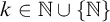
For
$k \in \mathbb {N} \cup \{\mathbb {N}\}$
 ,
$\mathsf {RT}^{n}_{k}\chi $
,
$\mathsf {RT}^{n}_{k}\chi $
 is the restriction of
$\mathsf {RT}^{n}_{\infty }\chi $
is the restriction of
$\mathsf {RT}^{n}_{\infty }\chi $
 to colourings with range bounded by k (for
$k \in \mathbb {N}$
to colourings with range bounded by k (for
$k \in \mathbb {N}$
 ) or to colourings with bounded range (for
$k = \mathbb {N}$
) or to colourings with bounded range (for
$k = \mathbb {N}$
 ).
$\mathsf {RT}^{n}_{<\infty }\chi $
).
$\mathsf {RT}^{n}_{<\infty }\chi $
 is the variant of
$\mathsf {RT}^{n}_{\mathbb {N}}\chi $
is the variant of
$\mathsf {RT}^{n}_{\mathbb {N}}\chi $
 with instances being pairs
$(c,k)$
with instances being pairs
$(c,k)$
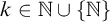
 such that k bounds the range of c. For
$k \in \mathbb {N} \cup \{\mathbb {N}\}$
such that k bounds the range of c. For
$k \in \mathbb {N} \cup \{\mathbb {N}\}$
 ,
$\mathsf {RT}^{n}_{k}\mathsf {c}$
,
$\mathsf {RT}^{n}_{k}\mathsf {c}$
 ,
$\mathsf {RT}^{n}_{k}\mathsf {e}$
,
$\mathsf {RT}^{n}_{k}\mathsf {e}$
 , and
$\mathsf {RT}^{n}_{k}\mathsf {pe}$
, and
$\mathsf {RT}^{n}_{k}\mathsf {pe}$
 are defined analogously.
We summarise our results as follows. The pigeonhole principles (i.e., those involving colourings of singletons) form a grid (Figure 1), where the vertical axis corresponds to the number of colours allowed and the horizontal axis corresponds to how solutions are represented, with
$\mathsf {RT}^{1}_{k}\chi \leq ^{\mathrm {t}}_{\mathrm {W}} \mathsf {RT}^{1}_{k}\mathsf {c} \leq ^{\mathrm {t}}_{\mathrm {W}} \mathsf {RT}^{1}_{k}\mathsf {e} \leq ^{\mathrm {t}}_{\mathrm {W}} \mathsf {RT}^{1}_{k}\mathsf {pe}$
 . All such reductions turn out to be strict except for the equivalences
$\mathsf {RT}^{1}_{\mathbb {N}}\mathsf {e} \equiv ^{\mathrm {t}}_{\mathrm {W}} \mathsf {RT}^{1}_{\mathbb {N}}\mathsf {c}$
. All such reductions turn out to be strict except for the equivalences
$\mathsf {RT}^{1}_{\mathbb {N}}\mathsf {e} \equiv ^{\mathrm {t}}_{\mathrm {W}} \mathsf {RT}^{1}_{\mathbb {N}}\mathsf {c}$
 and
$\mathsf {RT}^{1}_{\infty }\mathsf {e} \equiv ^{\mathrm {t}}_{\mathrm {W}} \mathsf {RT}^{1}_{\infty }\mathsf {c}$
and
$\mathsf {RT}^{1}_{\infty }\mathsf {e} \equiv ^{\mathrm {t}}_{\mathrm {W}} \mathsf {RT}^{1}_{\infty }\mathsf {c}$
 .
.
There are no additional
$\leq ^{\mathrm {t}}_{\mathrm {W}}$
 -reductions other than those implied by transitivity.

Figure 1 Long description
The diagram consists of four main vertical columns of mathematical terms connected by upward and leftward arrows.
1. The rightmost column contains R T sub chi terms, starting at the bottom with R T sub 2 super 1 chi, pointing up to R T sub 3 super 1 chi, then through a vertical ellipsis to R T sub less than infinity super 1 chi, R T sub N super 1 chi, R T sub infinity super 1 chi, and finally R T sub 2 super 2 chi at the top right.
2. The second column from the right contains R T sub c terms, starting with R T sub 2 super 1 c, pointing up to R T sub 3 super 1 c, then through an ellipsis to R T sub less than infinity super 1 c. This column merges into equivalence relations R T sub N super 1 e equivalent to R T sub N super 1 c and R T sub infinity super 1 e equivalent to R T sub infinity super 1 c.
3. The third column contains R T sub e terms, starting with R T sub 2 super 1 e, pointing up to R T sub 3 super 1 e, then through an ellipsis to R T sub less than infinity super 1 e, which points to the equivalence nodes mentioned above.
4. The leftmost column contains R T sub p e terms, starting with R T sub 2 super 1 p e, pointing up to R T sub 3 super 1 p e, then through an ellipsis to R T sub less than infinity super 1 p e, R T sub N super 1 p e, R T sub infinity super 1 p e, and finally R T sub 2 super 2 p e at the top left.
Diagonal arrows point from right to left between columns, such as R T sub 2 super 1 chi pointing to R T sub 2 super 1 c, and R T sub 2 super 1 c pointing to R T sub 2 super 1 e. At the top, multiple arrows converge on R T sub 2 super 2 p e from R T sub infinity super 1 p e, R T sub N super 1 e equivalent to R T sub N super 1 c, and R T sub 2 super 2 chi.
Apart from the aforementioned equivalences, our results suggest that the columns of the grid should be thought of as far apart. It is easy to see that
$\mathsf {RT}^{1}_{2}\mathsf {c}$
 is not reducible to
$\mathsf {RT}^{n}_{\infty }\chi $
is not reducible to
$\mathsf {RT}^{n}_{\infty }\chi $
 (Corollary 3.3). Using a notion of guessability (where guesses need to be total), we show that
$\mathsf {RT}^{1}_{2}\mathsf {e}$
(Corollary 3.3). Using a notion of guessability (where guesses need to be total), we show that
$\mathsf {RT}^{1}_{2}\mathsf {e}$
 is not reducible to
$\mathsf {RT}^{n}_{<\infty }\mathsf {c}$
is not reducible to
$\mathsf {RT}^{n}_{<\infty }\mathsf {c}$
 (Corollary 3.7). The gap between enumerations and principal enumerations extends to problems beyond Ramsey’s theorem:
$\mathsf {RT}^{1}_{2}\mathsf {pe}$
(Corollary 3.7). The gap between enumerations and principal enumerations extends to problems beyond Ramsey’s theorem:
$\mathsf {RT}^{1}_{2}\mathsf {pe}$
 is not reducible to any problem with solutions represented by enumerations (Proposition 3.9).
The picture for problems for colourings of pairs (and longer tuples) differs significantly from that for colourings of singletons. One expects
$\mathsf {RT}^{n}_{k}\mathsf {c}$
 to be weak, since there is no obvious way of recovering a homogeneous set for a colouring of n-tuples (for
$n \geq 2$
to be weak, since there is no obvious way of recovering a homogeneous set for a colouring of n-tuples (for
$n \geq 2$
 ) from its colour. We confirm this expectation by showing that
$\mathsf {RT}^{1}_{3}\chi $
) from its colour. We confirm this expectation by showing that
$\mathsf {RT}^{1}_{3}\chi $
 (and therefore
$\mathsf {RT}^{2}_{2}\mathsf {e}$
(and therefore
$\mathsf {RT}^{2}_{2}\mathsf {e}$
 and
$\mathsf {RT}^{2}_{2}\chi $
and
$\mathsf {RT}^{2}_{2}\chi $
 ) is not reducible to
$\mathsf {RT}^{n}_{2}\mathsf {c}$
) is not reducible to
$\mathsf {RT}^{n}_{2}\mathsf {c}$
 (Corollary 3.5). In fact,
$\mathsf {RT}^{2}_{2}\chi $
(Corollary 3.5). In fact,
$\mathsf {RT}^{2}_{2}\chi $
 ,
$\mathsf {RT}^{2}_{2}\mathsf {c}$
,
$\mathsf {RT}^{2}_{2}\mathsf {c}$
 , and
$\mathsf {RT}^{2}_{2}\mathsf {e}$
, and
$\mathsf {RT}^{2}_{2}\mathsf {e}$
 are incomparable, in contrast to
$\mathsf {RT}^{1}_{2}\chi \leq ^{\mathrm {t}}_{\mathrm {W}} \mathsf {RT}^{1}_{2}\mathsf {c} \leq ^{\mathrm {t}}_{\mathrm {W}} \mathsf {RT}^{1}_{2}\mathsf {e}$
are incomparable, in contrast to
$\mathsf {RT}^{1}_{2}\chi \leq ^{\mathrm {t}}_{\mathrm {W}} \mathsf {RT}^{1}_{2}\mathsf {c} \leq ^{\mathrm {t}}_{\mathrm {W}} \mathsf {RT}^{1}_{2}\mathsf {e}$
 . Among these separations, the most technical is perhaps our proof (using a priority argument) that
$\mathsf {RT}^{2}_{2}\chi $
. Among these separations, the most technical is perhaps our proof (using a priority argument) that
$\mathsf {RT}^{2}_{2}\chi $
 is not reducible to any problem with solutions represented by enumerations (Theorem 3.17).
We turn to results concerning the
$\mathsf {RT}^{n}_{\infty }$
 problems. Here we view our primary contribution as the separation
$\mathsf {RT}^{1}_{\infty } \not \leq _{\mathrm {W}} \mathsf {RT}^{2}_{\mathbb {N}}$
problems. Here we view our primary contribution as the separation
$\mathsf {RT}^{1}_{\infty } \not \leq _{\mathrm {W}} \mathsf {RT}^{2}_{\mathbb {N}}$
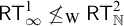 (Lemma 4.17), strengthening the
$n = 1$
(Lemma 4.17), strengthening the
$n = 1$
 case of a result of Soldà and Valenti [Reference Soldà and Valenti15, Theorem 7.20]. We use a priority argument rather than algebraic properties of the Weihrauch degrees. The right-hand side of the aforementioned separation is in some sense optimal because
$\mathsf {RT}^{1}_{\infty }$
case of a result of Soldà and Valenti [Reference Soldà and Valenti15, Theorem 7.20]. We use a priority argument rather than algebraic properties of the Weihrauch degrees. The right-hand side of the aforementioned separation is in some sense optimal because
$\mathsf {RT}^{1}_{\infty }$
 is Weihrauch reducible to
$\mathsf {RT}^{3}_{2}$
is Weihrauch reducible to
$\mathsf {RT}^{3}_{2}$
 . This reduction may have been known but we did not find a valid proof in the literature. In any case, we refine the Weihrauch reduction to a total Weihrauch reduction
$\mathsf {RT}^{1}_{\infty }\mathsf {e} \leq ^{\mathrm {t}}_{\mathrm {W}} \mathsf {RT}^{3}_{2}\mathsf {pe}$
. This reduction may have been known but we did not find a valid proof in the literature. In any case, we refine the Weihrauch reduction to a total Weihrauch reduction
$\mathsf {RT}^{1}_{\infty }\mathsf {e} \leq ^{\mathrm {t}}_{\mathrm {W}} \mathsf {RT}^{3}_{2}\mathsf {pe}$
 (Theorem 3.25).
We have further results delineating the difference in strength between
$\mathsf {RT}^{n}_{\infty }\mathsf {e}$
 and
$\mathsf {RT}^{n}_{\mathbb {N}}\mathsf {e}$
and
$\mathsf {RT}^{n}_{\mathbb {N}}\mathsf {e}$
 , at least for
$n = 1,2$
, at least for
$n = 1,2$
 . One such result states that
$\mathsf {RT}^{2}_{2}\mathsf {c}$
. One such result states that
$\mathsf {RT}^{2}_{2}\mathsf {c}$
 (even
$\mathsf {LPO}'$
(even
$\mathsf {LPO}'$
 ) is not reducible to
$\mathsf {RT}^{2}_{\mathbb {N}}\mathsf {e}$
) is not reducible to
$\mathsf {RT}^{2}_{\mathbb {N}}\mathsf {e}$
 (even
$\mathsf {RT}^{n}_{\mathbb {N}}\mathsf {e}$
(even
$\mathsf {RT}^{n}_{\mathbb {N}}\mathsf {e}$
 ). Since
$\mathsf {RT}^{n}_{\infty }\mathsf {c} \leq ^{\mathrm {t}}_{\mathrm {W}} \mathsf {RT}^{2}_{\infty }\mathsf {e}$
). Since
$\mathsf {RT}^{n}_{\infty }\mathsf {c} \leq ^{\mathrm {t}}_{\mathrm {W}} \mathsf {RT}^{2}_{\infty }\mathsf {e}$
 (Theorem 3.1(5)), this suggests that
$\mathsf {RT}^{2}_{\infty }\mathsf {e}$
(Theorem 3.1(5)), this suggests that
$\mathsf {RT}^{2}_{\infty }\mathsf {e}$
 is significantly stronger than
$\mathsf {RT}^{2}_{\mathbb {N}}\mathsf {e}$
is significantly stronger than
$\mathsf {RT}^{2}_{\mathbb {N}}\mathsf {e}$
 . We also show that
$\mathsf {LPO}' \leq ^{\mathrm {t}}_{\mathrm {W}} \mathsf {RT}^{1}_{\infty }\mathsf {e}$
. We also show that
$\mathsf {LPO}' \leq ^{\mathrm {t}}_{\mathrm {W}} \mathsf {RT}^{1}_{\infty }\mathsf {e}$
 (Proposition 3.15), which, when combined with the above separation, implies that
$\mathsf {RT}^{1}_{\infty }\mathsf {e}$
(Proposition 3.15), which, when combined with the above separation, implies that
$\mathsf {RT}^{1}_{\infty }\mathsf {e}$
 (equivalently,
$\mathsf {RT}^{1}_{\infty }\mathsf {c}$
(equivalently,
$\mathsf {RT}^{1}_{\infty }\mathsf {c}$
 ) is not reducible to
$\mathsf {RT}^{n}_{\mathbb {N}}\mathsf {e}$
) is not reducible to
$\mathsf {RT}^{n}_{\mathbb {N}}\mathsf {e}$
 .
.
Next, we discuss a result in the continuous Weihrauch degrees. It is well-known that
$\mathsf {RT}^{2}_{2}$
 is not Weihrauch reducible to
$\mathsf {RT}^{1}_{\infty }$
is not Weihrauch reducible to
$\mathsf {RT}^{1}_{\infty }$
 , as the latter is computably true while the former is not. We strengthen this by showing that there is no continuous Weihrauch reduction (Corollary 3.23). Our proof (using a priority argument) shows that
$\mathsf {RT}^{2}_{2}$
, as the latter is computably true while the former is not. We strengthen this by showing that there is no continuous Weihrauch reduction (Corollary 3.23). Our proof (using a priority argument) shows that
$\mathsf {RT}^{2}_{2}$
 is not continuously guessable in a certain sense.
Finally, we return to the setting of Weihrauch reducibility in Section 4. Our results completely determine the relationships between
$\mathsf {RT}^{2}_{\mathbb {N}}$
 ,
$\mathsf {SRT}^{2}_{\mathbb {N}}$
,
$\mathsf {SRT}^{2}_{\mathbb {N}}$
 , and the jumps
$\mathsf {C}_{\mathbb {N}}'$
, and the jumps
$\mathsf {C}_{\mathbb {N}}'$
 (
$\equiv _{\mathrm {W}} \mathsf {RT}^{1}_{\infty }$
(
$\equiv _{\mathrm {W}} \mathsf {RT}^{1}_{\infty }$
 ),
$(\mathsf {RT}^{1}_{<\infty })'$
),
$(\mathsf {RT}^{1}_{<\infty })'$
 ,
$(\mathsf {RT}^{1}_{\mathbb {N}})'$
,
$(\mathsf {RT}^{1}_{\mathbb {N}})'$
 , and
$(\mathsf {CRT}^{1}_{\mathbb {N}})'$
, and
$(\mathsf {CRT}^{1}_{\mathbb {N}})'$
 , as depicted in Figure 2. One such result
$\mathsf {RT}^{1}_{\infty } \not \leq _{\mathrm {W}} \mathsf {RT}^{2}_{\mathbb {N}}$
, as depicted in Figure 2. One such result
$\mathsf {RT}^{1}_{\infty } \not \leq _{\mathrm {W}} \mathsf {RT}^{2}_{\mathbb {N}}$
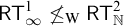 (Lemma 4.17) was mentioned above. Another notable result is the separation
$(\mathsf {RT}^{1}_{\mathbb {N}})' \not \leq _{\mathrm {W}} \mathsf {RT}^{2}_{\mathbb {N}}$
(Lemma 4.17) was mentioned above. Another notable result is the separation
$(\mathsf {RT}^{1}_{\mathbb {N}})' \not \leq _{\mathrm {W}} \mathsf {RT}^{2}_{\mathbb {N}}$
 (Lemma 4.1). This separation implies that
$(\mathsf {CRT}^{1}_{\mathbb {N}})'$
(Lemma 4.1). This separation implies that
$(\mathsf {CRT}^{1}_{\mathbb {N}})'$
 cannot be Weihrauch equivalent to
$\mathsf {SRT}^{2}_{\mathbb {N}}$
cannot be Weihrauch equivalent to
$\mathsf {SRT}^{2}_{\mathbb {N}}$
 , contrary to [Reference Brattka and Rakotoniaina7, Theorem 4.3] for
$n=1$
, contrary to [Reference Brattka and Rakotoniaina7, Theorem 4.3] for
$n=1$
 ,
$k=\mathbb {N}$
,
$k=\mathbb {N}$
 . Instead, we show that
$\mathsf {SRT}^{2}_{\mathbb {N}}$
. Instead, we show that
$\mathsf {SRT}^{2}_{\mathbb {N}}$
 is Weihrauch equivalent to
$(\mathsf {CRT}^{1}_{<\infty })'$
is Weihrauch equivalent to
$(\mathsf {CRT}^{1}_{<\infty })'$
 (Theorem 4.3). We also have results suggesting that
$(\mathsf {RT}^{1}_{\mathbb {N}})'$
(Theorem 4.3). We also have results suggesting that
$(\mathsf {RT}^{1}_{\mathbb {N}})'$
 is much weaker than
$(\mathsf {CRT}^{1}_{\mathbb {N}})'$
is much weaker than
$(\mathsf {CRT}^{1}_{\mathbb {N}})'$
 : for all
$k \in \mathbb {N}$
: for all
$k \in \mathbb {N}$
 ,
$(\mathsf {CRT}^{1}_{\mathbb {N}})'$
,
$(\mathsf {CRT}^{1}_{\mathbb {N}})'$
 is not reducible to the iterated jump
$(\mathsf {RT}^{1}_{\mathbb {N}})^{(k)}$
is not reducible to the iterated jump
$(\mathsf {RT}^{1}_{\mathbb {N}})^{(k)}$
 (Corollaries 4.8 and 4.16 both imply this). Our proof shows furthermore that there can be no omniscient continuous Weihrauch reduction.
There are no additional
$\leq _{\mathrm {W}}$
 -reductions other than those implied by transitivity.

In Section 4, we also study the problems
$\mathsf {SRT}^{2}_{\infty }$
 and
$\mathsf {D}^{2}_{\infty }$
and
$\mathsf {D}^{2}_{\infty }$
 . We show that they are Weihrauch equivalent to
$(\mathsf {RT}^{1}_{\infty })'$
. We show that they are Weihrauch equivalent to
$(\mathsf {RT}^{1}_{\infty })'$
 and
$(\mathsf {CRT}^{1}_{\infty })'$
and
$(\mathsf {CRT}^{1}_{\infty })'$
 (Theorem 4.14).
2 Preliminaries
We briefly recall notions from the theory of Weihrauch reducibility. We refer the reader to [Reference Brattka and Rakotoniaina7] for a detailed introduction.
To compare mathematical problems under Weihrauch reducibility, we begin by formalising them as partial multivalued functions
$f: \subseteq X \rightrightarrows Y$
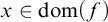
 , where X and Y are represented spaces (as defined below). We refer to such f as problems. We refer to each
$x \in \mathrm {dom}(f)$
, where X and Y are represented spaces (as defined below). We refer to such f as problems. We refer to each
$x \in \mathrm {dom}(f)$
 as an (f-)instance and each element of
$f(x) \subseteq Y$
as an (f-)instance and each element of
$f(x) \subseteq Y$
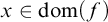
 as an (f-)solution (to x). If f is single-valued, we will abuse notation and refer to the unique solution to
$x \in \mathrm {dom}(f)$
as an (f-)solution (to x). If f is single-valued, we will abuse notation and refer to the unique solution to
$x \in \mathrm {dom}(f)$
 as
$f(x)$
as
$f(x)$
 .
.
A represented space
$(X,\delta _X)$
 is a set X together with a representation
$\delta _X: \subseteq \mathbb {N}^{\mathbb {N}} \to X$
is a set X together with a representation
$\delta _X: \subseteq \mathbb {N}^{\mathbb {N}} \to X$
 that assigns names
$p \in \mathbb {N}^{\mathbb {N}}$
that assigns names
$p \in \mathbb {N}^{\mathbb {N}}$
 to the element
$\delta (p) \in X$
to the element
$\delta (p) \in X$
 . The partial function
$\delta _X$
. The partial function
$\delta _X$
 is required to be surjective, i.e., every element of X has some name (possibly many). If
$\delta _X$
is required to be surjective, i.e., every element of X has some name (possibly many). If
$\delta _X$
 is clear from context, we typically omit it by writing X instead of
$(X,\delta _X)$
is clear from context, we typically omit it by writing X instead of
$(X,\delta _X)$
 . In our proofs, we often abuse notation by referring to
$p \in \mathbb {N}^{\mathbb {N}}$
. In our proofs, we often abuse notation by referring to
$p \in \mathbb {N}^{\mathbb {N}}$
 as an element of X. For example, we may say that
$p \in \mathbb {N}^{\mathbb {N}}$
as an element of X. For example, we may say that
$p \in \mathbb {N}^{\mathbb {N}}$
 is an f-instance whenever
$\delta _X(p) \in \mathrm {dom}(f)$
is an f-instance whenever
$\delta _X(p) \in \mathrm {dom}(f)$
 .
.
We say that
$F: \subseteq \mathbb {N}^{\mathbb {N}} \to \mathbb {N}^{\mathbb {N}}$
 is a realiser for
$f: \subseteq X \rightrightarrows Y$
is a realiser for
$f: \subseteq X \rightrightarrows Y$
 if whenever p names some
$x \in X$
if whenever p names some
$x \in X$
 , then
$F(p)$
, then
$F(p)$
 names some element of
$f(x)$
names some element of
$f(x)$
 . Notions such as computability or continuity of f can be defined via realisers, e.g., f is computable if it has a computable realiser F.
There are several benchmark problems, to which one compares problems of interest. Let
$0^{\mathbb {N}} \in \mathbb {N}^{\mathbb {N}}$
 denote the sequence which is constantly
$0$
denote the sequence which is constantly
$0$
 . The following single-valued problems will appear in this article:
-
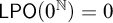
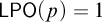
• $\mathsf {LPO}: \mathbb {N}^{\mathbb {N}} \to 2$
 ,
$\mathsf {LPO}(0^{\mathbb {N}}) = 0$
and
$\mathsf {LPO}(p) = 1$
otherwise;
,
$\mathsf {LPO}(0^{\mathbb {N}}) = 0$
and
$\mathsf {LPO}(p) = 1$
otherwise; -
• $\mathsf {lim}: \subseteq (\mathbb {N}^{\mathbb {N}})^{\mathbb {N}} \to \mathbb {N}^{\mathbb {N}}$
,
$\mathsf {lim}((p_n)_{n \in \mathbb {N}}) = \lim _{n \in \mathbb {N}} p_n$
if the limit exists.



Another important class of problems is the class of choice problems. While such problems can be formulated for a wide variety of spaces, we only need the following. For
$k \in \mathbb {N}_{\geq 2} \cup \{\mathbb {N}\}$
 , the choice problem
$\mathsf {C}_{k}$
, the choice problem
$\mathsf {C}_{k}$
 is defined roughly as follows: Given an enumeration of a proper subset of k, produce any number which is not enumerated (see [Reference Brattka, Gherardi and Pauly5, Section 11.7] for a precise definition).
Definition 2.1. A problem f is Weihrauch reducible to a problem g, written
$f \leq _{\mathrm {W}} g$
 , if there are computable functions
$\Phi ,\Psi : \subseteq \mathbb {N}^{\mathbb {N}} \to \mathbb {N}^{\mathbb {N}}$
, if there are computable functions
$\Phi ,\Psi : \subseteq \mathbb {N}^{\mathbb {N}} \to \mathbb {N}^{\mathbb {N}}$
 such that if p is a name for some
$x \in \mathrm {dom}(f)$
such that if p is a name for some
$x \in \mathrm {dom}(f)$
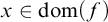 , then:
-
1. $\Phi (p)$
is a name for some
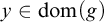
$y \in \mathrm {dom}(g)$
; -
2. if q is a name for some g-solution of y, then $\Psi (q,p)$
is a name for some f-solution of x.


We say that f is continuously Weihrauch reducible to g, written
$f \leq ^\ast _{\mathrm {W}} g$
 , if there are continuous functions
$\Phi ,\Psi : \subseteq \mathbb {N}^{\mathbb {N}} \to \mathbb {N}^{\mathbb {N}}$
, if there are continuous functions
$\Phi ,\Psi : \subseteq \mathbb {N}^{\mathbb {N}} \to \mathbb {N}^{\mathbb {N}}$
 satisfying (1) and (2).
We say that f is strongly Weihrauch reducible to g, written
$f \leq _{\mathrm {sW}} g$
 , if there are computable functions
$\Phi ,\Psi : \subseteq \mathbb {N}^{\mathbb {N}} \to \mathbb {N}^{\mathbb {N}}$
, if there are computable functions
$\Phi ,\Psi : \subseteq \mathbb {N}^{\mathbb {N}} \to \mathbb {N}^{\mathbb {N}}$
 as above, satisfying (1) and
-
(3) if q is a name for some g-solution of y, then $\Psi (q)$
is a name for some f-solution of x.

In other words,
$\Psi $
 does not have access to the initial f-instance p, only some g-solution q of y.
A problem f is totally Weihrauch reducible to a problem g, written
$f \leq ^{\mathrm {t}}_{\mathrm {W}} g$
 , if there are total computable functions
$\Phi ,\Psi : \mathbb {N}^{\mathbb {N}} \to \mathbb {N}^{\mathbb {N}}$
, if there are total computable functions
$\Phi ,\Psi : \mathbb {N}^{\mathbb {N}} \to \mathbb {N}^{\mathbb {N}}$
 such that (1) and (2) hold.
In all the above reductions, we say that f is reducible to g via
$\Phi $
 and
$\Psi $
and
$\Psi $
 . We refer to
$\Phi $
. We refer to
$\Phi $
 and
$\Psi $
and
$\Psi $
 as the pre-processing function and the post-processing function, respectively.
Observe that if
$f \leq ^{\mathrm {t}}_{\mathrm {W}} g$
 , then
$f \leq _{\mathrm {W}} g$
, then
$f \leq _{\mathrm {W}} g$
 . To our knowledge, the reducibility
$\leq ^{\mathrm {t}}_{\mathrm {W}}$
. To our knowledge, the reducibility
$\leq ^{\mathrm {t}}_{\mathrm {W}}$
 is new and should not be confused with the reducibility
$\leq _{\mathrm {tW}}$
is new and should not be confused with the reducibility
$\leq _{\mathrm {tW}}$
 defined by Brattka and Gherardi [Reference Brattka and Gherardi3]. Roughly speaking,
$f \leq _{\mathrm {tW}} g$
defined by Brattka and Gherardi [Reference Brattka and Gherardi3]. Roughly speaking,
$f \leq _{\mathrm {tW}} g$
 only requires that
$\Phi $
only requires that
$\Phi $
 and
$\Psi $
and
$\Psi $
 work on total realisers of g.
Remark 2.2.
$\leq ^{\mathrm {t}}_{\mathrm {W}}$
 is not invariant under computably equivalent representations. To see this, recall [Reference Brattka and Gherardi3, Examples 3.2 and 4.4]: For
$p \in \mathbb {N}^{\mathbb {N}}$
is not invariant under computably equivalent representations. To see this, recall [Reference Brattka and Gherardi3, Examples 3.2 and 4.4]: For
$p \in \mathbb {N}^{\mathbb {N}}$
 such that
$p(n) \geq 1$
such that
$p(n) \geq 1$
 for infinitely many n, let
$p-1 \in \mathbb {N}^{\mathbb {N}}$
for infinitely many n, let
$p-1 \in \mathbb {N}^{\mathbb {N}}$
 denote the sequence which is obtained by concatenating
$p(0)-1, p(1)-1, \dots $
denote the sequence which is obtained by concatenating
$p(0)-1, p(1)-1, \dots $
 , where
$-1$
, where
$-1$
 is treated as the empty string. Define the representation
$\mathsf {id}^\wp : \subseteq \mathbb {N}^{\mathbb {N}} \to \mathbb {N}^{\mathbb {N}}$
is treated as the empty string. Define the representation
$\mathsf {id}^\wp : \subseteq \mathbb {N}^{\mathbb {N}} \to \mathbb {N}^{\mathbb {N}}$
 by
$\mathsf {id}^\wp (p) = p-1$
by
$\mathsf {id}^\wp (p) = p-1$
 . It is easy to see that the representations
$\mathsf {id}^\wp $
. It is easy to see that the representations
$\mathsf {id}^\wp $
 and
$\mathsf {id}$
and
$\mathsf {id}$
 are computably equivalent.
Let
$F: \subseteq \mathbb {N}^{\mathbb {N}} \to \mathbb {N}^{\mathbb {N}}$
 be a computable partial function with no total computable extension. We consider the problems
$F: \subseteq (\mathbb {N}^{\mathbb {N}},\mathsf {id}) \to (\mathbb {N}^{\mathbb {N}},\mathsf {id})$
be a computable partial function with no total computable extension. We consider the problems
$F: \subseteq (\mathbb {N}^{\mathbb {N}},\mathsf {id}) \to (\mathbb {N}^{\mathbb {N}},\mathsf {id})$
 and
$F_{\mathsf {id},\mathsf {id}^\wp }: \subseteq (\mathbb {N}^{\mathbb {N}},\mathsf {id}) \to (\mathbb {N}^{\mathbb {N}},\mathsf {id}^\wp )$
and
$F_{\mathsf {id},\mathsf {id}^\wp }: \subseteq (\mathbb {N}^{\mathbb {N}},\mathsf {id}) \to (\mathbb {N}^{\mathbb {N}},\mathsf {id}^\wp )$
 . The former has no total computable realiser, while the latter does (given
$p \in \mathbb {N}^{\mathbb {N}}$
. The former has no total computable realiser, while the latter does (given
$p \in \mathbb {N}^{\mathbb {N}}$
 , attempt to compute
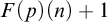
$F(p)(n)+1$
, attempt to compute
$F(p)(n)+1$
 for
$n = 0,1,\dots $
for
$n = 0,1,\dots $
 in order; output
$0$
in order; output
$0$
 while waiting). Since the property of having a total computable realiser is easily seen to be preserved downwards under
$\leq ^{\mathrm {t}}_{\mathrm {W}}$
while waiting). Since the property of having a total computable realiser is easily seen to be preserved downwards under
$\leq ^{\mathrm {t}}_{\mathrm {W}}$
 , we deduce that
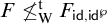
$F \not \leq ^{\mathrm {t}}_{\mathrm {W}} F_{\mathsf {id},\mathsf {id}^\wp }$
, we deduce that
$F \not \leq ^{\mathrm {t}}_{\mathrm {W}} F_{\mathsf {id},\mathsf {id}^\wp }$
 .
.
Observe that
$\leq ^{\mathrm {t}}_{\mathrm {W}}$
 is a pre-order. We denote the induced equivalence relation by
$\equiv ^{\mathrm {t}}_{\mathrm {W}}$
is a pre-order. We denote the induced equivalence relation by
$\equiv ^{\mathrm {t}}_{\mathrm {W}}$
 . An equivalence class under
$\equiv ^{\mathrm {t}}_{\mathrm {W}}$
. An equivalence class under
$\equiv ^{\mathrm {t}}_{\mathrm {W}}$
 is called a
$\equiv ^{\mathrm {t}}_{\mathrm {W}}$
is called a
$\equiv ^{\mathrm {t}}_{\mathrm {W}}$
 -degree. As usual the pre-order
$\leq ^{\mathrm {t}}_{\mathrm {W}}$
-degree. As usual the pre-order
$\leq ^{\mathrm {t}}_{\mathrm {W}}$
 induces a partial order on the
$\equiv ^{\mathrm {t}}_{\mathrm {W}}$
induces a partial order on the
$\equiv ^{\mathrm {t}}_{\mathrm {W}}$
 -degrees, which we also denote by
$\leq ^{\mathrm {t}}_{\mathrm {W}}$
-degrees, which we also denote by
$\leq ^{\mathrm {t}}_{\mathrm {W}}$
 .
.
Unlike
$\leq ^{\mathrm {t}}_{\mathrm {W}}$
 , the reducibilities
$\leq _{\mathrm {W}}$
, the reducibilities
$\leq _{\mathrm {W}}$
 ,
$\leq ^\ast _{\mathrm {W}}$
,
$\leq ^\ast _{\mathrm {W}}$
 , and
$\leq _{\mathrm {sW}}$
, and
$\leq _{\mathrm {sW}}$
 are well-studied. Our interest in
$\leq ^\ast _{\mathrm {W}}$
are well-studied. Our interest in
$\leq ^\ast _{\mathrm {W}}$
 and
$\leq _{\mathrm {sW}}$
and
$\leq _{\mathrm {sW}}$
 is purely technical, insofar as they help us understand
$\leq _{\mathrm {W}}$
is purely technical, insofar as they help us understand
$\leq _{\mathrm {W}}$
 and
$\leq ^{\mathrm {t}}_{\mathrm {W}}$
and
$\leq ^{\mathrm {t}}_{\mathrm {W}}$
 . We next list some well-known constructions and results.
For each
$k \in \mathbb {N}_{\geq 1} \cup \{\mathbb {N}\}$
 , we fix computable pairing functions
$\langle \cdot \rangle : (\mathbb {N}^{\mathbb {N}})^k \to \mathbb {N}^{\mathbb {N}}$
, we fix computable pairing functions
$\langle \cdot \rangle : (\mathbb {N}^{\mathbb {N}})^k \to \mathbb {N}^{\mathbb {N}}$
 . We denote the concatenation of finite strings or of finite strings and elements of
$\mathbb {N}^{\mathbb {N}}$
. We denote the concatenation of finite strings or of finite strings and elements of
$\mathbb {N}^{\mathbb {N}}$
 using
$^{\frown }$
using
$^{\frown }$
 .
.
Definition 2.3 (Constructions on representations)
Suppose
$(X,\delta _X)$
 and
$(Y,\delta _Y)$
and
$(Y,\delta _Y)$
 are represented spaces.
-
• We represent elements of $X \times Y$
by
$\langle p,q \rangle \mapsto (\delta _X(p),\delta _Y(q))$
. -
• For $k \in \mathbb {N}_{\geq 1} \cup \{\mathbb {N}\}$
, we represent elements of
$X^k$
by
$\langle p_i \rangle _{i \in k} \mapsto (\delta _X(p_i))_{i \in k}$
. -
• Let $X^\ast = \bigcup _{i \in \mathbb {N}} (\{k\} \times X^k)$
. We represent elements of
$X^\ast $
by
$k^{\frown } \langle p_i \rangle _{i \in k} \mapsto (k,p_0,\dots ,p_{k-1})$
. -
• The jump $X'$
of the represented space
$(X,\delta )$
is the same underlying set X with the representation
$\delta ' = \delta \circ \mathsf {lim}$
. -
• Recall the definition of $p-1$
from Remark 2.2. The completion of
$(X,\delta _X)$
is the space
$\overline {X} = X \cup \{\bot \}$
(assuming
$\bot \notin X$
) equipped with the representation
$\delta _{\overline {X}}: \mathbb {N}^{\mathbb {N}} \to \overline {X}$
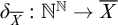
, defined by $$\begin{align*}\delta_{\overline{X}}(p) = \begin{cases} \delta_X(p-1) & p-1 \text{ defined and } p-1 \in \mathrm{dom}(\delta_X) \\ \bot & \text{otherwise}. \end{cases} \end{align*}$$













Definition 2.4 (Constructions on problems)
Suppose we have problems
$f:\subseteq X\rightrightarrows Y$
 and
$g: \subseteq Z \rightrightarrows W$
and
$g: \subseteq Z \rightrightarrows W$
 .
.
-
• The parallel product $f \times g$
is defined by
$f \times g: \subseteq X \times Z \rightrightarrows Y \times W$
,
$(f \times g)(x,z) = f(x) \times g(z)$
, and
$\mathrm {dom}(f \times g) = \mathrm {dom}(f) \times \mathrm {dom}(g)$
. -
• The (infinite) parallelisation $\widehat {f}$
of f is defined by
$\widehat {f}: \subseteq X^{\mathbb {N}} \rightrightarrows Y^{\mathbb {N}}$
,
$\widehat {f}((x_n)_n) = \prod _{n \in \mathbb {N}} f(x_n),$
and
$\mathrm {dom}(\widehat {f}) = \mathrm {dom}(f)^{\mathbb {N}}$
. -
• The jump $f'$
of f is defined to be the same problem as f, except that the domain is
$X'$
instead of X. In other words, a sequence
$(p_n)_{n \in \mathbb {N}}$
of elements of
$\mathbb {N}^{\mathbb {N}}$
names an instance w of
$f'$
if
$\lim _n p_n$
exists and names some f-instance x. The
$f'$
-solutions for w are exactly the f-solutions for x. Note that each
$p_n$
may not name an f-instance, though for some problems one can assume this without loss of generality. -
• Iterated jumps are denoted by $f^{(k)}$
, e.g.,
$f^{(3)} = f"'$
.










Fact 2.5. Let f and g be problems.
-
1. If $f \leq _{\mathrm {sW}} g$
, then
$f' \leq _{\mathrm {sW}} g'$
. If
$f \not \leq ^\ast _{\mathrm {W}} g$
, then
$f' \not \leq ^\ast _{\mathrm {W}} g'$
. -
2. If $f \leq _{\mathrm {W}} g$
, then
$\widehat {f} \leq _{\mathrm {W}} \widehat {g}$
. -
3. $\widehat {f \times g} \equiv _{\mathrm {sW}} \widehat {f} \times \widehat {g}$
.



Proof. The first part of (1) was proved in [Reference Brattka, Gherardi and Marcone4, Proposition 5.6]. The second part of (1) follows from [Reference Brattka, Hölzl and Kuyper6, Theorem 11] and the fact that every continuous function is computable relative to some
$p \in \mathbb {N}^{\mathbb {N}}$
 . (2) and (3) were proved in [Reference Brattka and Gherardi2, Propositions 4.2 and 4.5].
We now introduce the variants of Ramsey’s theorem studied in this article. Fix a computable family of bijections
$\theta _n: \mathbb {N} \to [\mathbb {N}]^n$
 . Let
$\mathcal {C}_n$
. Let
$\mathcal {C}_n$
 denote the space of all functions from
$[\mathbb {N}]^n$
denote the space of all functions from
$[\mathbb {N}]^n$
 to
$\mathbb {N}$
to
$\mathbb {N}$
 , thought of as colourings, represented by
$\delta _n: p \mapsto (\theta _n(i) \mapsto p(i))$
, thought of as colourings, represented by
$\delta _n: p \mapsto (\theta _n(i) \mapsto p(i))$
 . These spaces contain the instances for our variants of Ramsey’s theorem. As for the solutions, for each
$c \in \mathcal {C}_n$
. These spaces contain the instances for our variants of Ramsey’s theorem. As for the solutions, for each
$c \in \mathcal {C}_n$
 , let
$\mathcal {H}_c$
, let
$\mathcal {H}_c$
 be the set of infinite c-homogeneous subsets of
$\mathbb {N}$
be the set of infinite c-homogeneous subsets of
$\mathbb {N}$
 . We represent
$\mathcal {H}_c$
. We represent
$\mathcal {H}_c$
 in the following ways:
-
• $\delta _\chi : \subseteq 2^{\mathbb {N}} \to \mathcal {P}(\mathbb {N})$
, where
$\delta _\chi (p)$
is the set whose characteristic function is p; -
• $\delta _e: \mathbb {N}^{\mathbb {N}} \to \{\text {non-empty subsets of }\mathbb {N}\}$
, where
$\delta _e(p)$
is the range of p; -
• the restriction $\delta _{pe}: \subseteq \mathbb {N}^{\mathbb {N}} \to \{\text {infinite subsets of }\mathbb {N}\}$
of
$\delta _e$
to strictly increasing functions p.






For each non-empty
$A \subseteq \mathbb {N}$
 , the elements of
$\delta _e^{-1}(A)$
, the elements of
$\delta _e^{-1}(A)$
 are enumerations of A. If A is infinite, the unique strictly increasing element of
$\delta _e^{-1}(A)$
are enumerations of A. If A is infinite, the unique strictly increasing element of
$\delta _e^{-1}(A)$
 is called the principal enumeration of A.
Definition 2.6. For all
$n \geq 1$
 , we define:
-
• $\mathsf {RT}^{n}_{\infty }\chi : \subseteq (\mathcal {C}_n,\delta _n) \rightrightarrows (\mathcal {P}(\mathbb {N}),\delta _\chi )$
,
$\mathsf {RT}^{n}_{\infty }\chi (c) = \mathcal {H}_c$
; -
• $\mathsf {RT}^{n}_{\infty }\mathsf {c}: \subseteq (\mathcal {C}_n,\delta _n) \rightrightarrows \mathbb {N}$
,
$\mathsf {RT}^{n}_{\infty }\mathsf {c}(c)$
consists of all colours j such that c has an infinite homogeneous set of colour j; -
• $\mathsf {RT}^{n}_{\infty }\mathsf {e}: \subseteq (\mathcal {C}_n,\delta _n) \rightrightarrows (\mathcal {P}(\mathbb {N})\setminus \{\emptyset \},\delta _e)$
,
$\mathsf {RT}^{n}_{\infty }\mathsf {e}(c) = \mathcal {H}_c$
; -
• $\mathsf {RT}^{n}_{\infty }\mathsf {pe}: \subseteq (\mathcal {C}_n,\delta _n) \rightrightarrows (\{\text {infinite subsets of }\mathbb {N}\},\delta _{pe})$
,
$\mathsf {RT}^{n}_{\infty }\mathsf {pe}(c) = \mathcal {H}_c$
; -
• for $k \geq 2$
(
$k = \mathbb {N}$
resp.),
$\mathsf {RT}^{n}_{k}\chi $
,
$\mathsf {RT}^{n}_{k}\mathsf {c}$
,
$\mathsf {RT}^{n}_{k}\mathsf {e}$
, and
$\mathsf {RT}^{n}_{k}\mathsf {pe}$
are defined by restricting the respective problem above to the colourings with codomain k (finite range resp.); -
• $\mathsf {RT}^{n}_{<\infty }\chi : \subseteq (\mathcal {C}_n,\delta _n) \times \mathbb {N} \rightrightarrows (\mathcal {P}(\mathbb {N}),\delta _\chi )$
, where for all
$c: [\mathbb {N}]^n \to k$
,
$\mathsf {RT}^{n}_{<\infty }\chi (c,k) = \mathcal {H}_c$
.
$\mathsf {RT}^{n}_{<\infty }\mathsf {c}$
,
$\mathsf {RT}^{n}_{<\infty }\mathsf {e}$
, and
$\mathsf {RT}^{n}_{<\infty }\mathsf {pe}$
are defined analogously.














Many of the above problems are Weihrauch equivalent to well-studied problems. For
$k \in \mathbb {N}_{\geq 2} \cup \{<\!\infty ,\mathbb {N}\}$
 ,
$\mathsf {RT}^{n}_{k}\chi $
,
$\mathsf {RT}^{n}_{k}\chi $
 ,
$\mathsf {RT}^{n}_{k}\mathsf {e}$
,
$\mathsf {RT}^{n}_{k}\mathsf {e}$
 , and
$\mathsf {RT}^{n}_{k}\mathsf {pe}$
, and
$\mathsf {RT}^{n}_{k}\mathsf {pe}$
 are easily seen to be (strongly) Weihrauch equivalent to
$\mathsf {RT}^{n}_{k}$
are easily seen to be (strongly) Weihrauch equivalent to
$\mathsf {RT}^{n}_{k}$
 . On the other hand,
$\mathsf {RT}^{n}_{k}\mathsf {c}$
. On the other hand,
$\mathsf {RT}^{n}_{k}\mathsf {c}$
 is related to the following choice problems. For
$k \in \mathbb {N}_{\geq 2}$
is related to the following choice problems. For
$k \in \mathbb {N}_{\geq 2}$
 ,
$\mathsf {RT}^{1}_{k}\mathsf {c}$
,
$\mathsf {RT}^{1}_{k}\mathsf {c}$
 equals the cluster point problem
$\mathsf {CL}_k$
equals the cluster point problem
$\mathsf {CL}_k$
 , which is (strongly) Weihrauch equivalent to the jump
$\mathsf {C}_{k}'$
, which is (strongly) Weihrauch equivalent to the jump
$\mathsf {C}_{k}'$
 of
$\mathsf {C}_{k}$
of
$\mathsf {C}_{k}$
 [Reference Brattka, Gherardi and Marcone4, Theorem 9.4]. Similarly,
$\mathsf {RT}^{1}_{\infty }\mathsf {c}$
[Reference Brattka, Gherardi and Marcone4, Theorem 9.4]. Similarly,
$\mathsf {RT}^{1}_{\infty }\mathsf {c}$
 equals
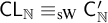
$\mathsf {CL}_{\mathbb {N}} \equiv _{\mathrm {sW}} \mathsf {C}_{\mathbb {N}}'$
equals
$\mathsf {CL}_{\mathbb {N}} \equiv _{\mathrm {sW}} \mathsf {C}_{\mathbb {N}}'$
 . For all
$k \in \mathbb {N}_{\geq 2} \cup \{<\!\infty ,\mathbb {N}\}$
. For all
$k \in \mathbb {N}_{\geq 2} \cup \{<\!\infty ,\mathbb {N}\}$
 , observe that
$\mathsf {RT}^{1}_{k}\mathsf {c}$
, observe that
$\mathsf {RT}^{1}_{k}\mathsf {c}$
 is Weihrauch equivalent to
$\mathsf {RT}^{1}_{k}$
is Weihrauch equivalent to
$\mathsf {RT}^{1}_{k}$
 (and so to
$\mathsf {RT}^{1}_{k}\chi $
(and so to
$\mathsf {RT}^{1}_{k}\chi $
 ,
$\mathsf {RT}^{1}_{k}\mathsf {e}$
,
$\mathsf {RT}^{1}_{k}\mathsf {e}$
 , and
$\mathsf {RT}^{1}_{k}\mathsf {pe}$
, and
$\mathsf {RT}^{1}_{k}\mathsf {pe}$
 ).
).
In Section 4, we will study some of the following problems using Weihrauch reducibility. A colouring
$c: [\mathbb {N}]^n \to \mathbb {N}$
 is stable if, for every
$A \in [\mathbb {N}]^{n-1}$
is stable if, for every
$A \in [\mathbb {N}]^{n-1}$
 , the limit
$\lim _{s> \max A} c(A \cup \{s\})$
, the limit
$\lim _{s> \max A} c(A \cup \{s\})$
 exists. We call this limit the stable (c-)colour of A. A set
$H \subseteq \mathbb {N}$
exists. We call this limit the stable (c-)colour of A. A set
$H \subseteq \mathbb {N}$
 is (c-)limit-homogeneous if every
$A \in [H]^{n-1}$
is (c-)limit-homogeneous if every
$A \in [H]^{n-1}$
 has the same stable colour.
Definition 2.7. For all
$n \geq 1$
 , we define:
-
• $\mathsf {RT}^{n}_{\infty }$
is simply
$\mathsf {RT}^{n}_{\infty }\chi $
; -
• $\mathsf {CRT}^{n}_{\infty }: \subseteq (\mathcal {C}_n,\delta _n) \rightrightarrows \mathbb {N} \times \mathcal {P}(\mathbb {N})$
,
$\mathsf {CRT}^{n}_{\infty }(c) = \{(j,X): c\restriction [X]^n = \{j\}\}$
; -
• $\mathsf {SRT}^{n}_{\infty }$
and
$\mathsf {CSRT}^{n}_{\infty }$
are the restrictions of
$\mathsf {RT}^{n}_{\infty }$
and
$\mathsf {CRT}^{n}_{\infty }$
to stable colourings, respectively; -
• $\mathsf {D}^{n}_{\infty }: \subseteq (\mathcal {C}_n,\delta _n) \rightrightarrows \mathcal {P}(\mathbb {N})$
,
$\mathsf {D}^{n}_{\infty }(c)$
is the set of infinite c-limit-homogeneous sets, where
$c: [\mathbb {N}]^n \to \mathbb {N}$
is stable; -
• for $k \geq 2$
(
$k = \mathbb {N}$
resp.),
$\mathsf {RT}^{n}_{k}$
,
$\mathsf {CRT}^{n}_{k}$
,
$\mathsf {SRT}^{n}_{k}$
,
$\mathsf {CSRT}^{n}_{k}$
, and
$\mathsf {D}^{n}_{k}$
are defined by restricting the respective problem above to the colourings with codomain k (finite range resp.); -
• $\mathsf {RT}^{n}_{<\infty }: \subseteq (\mathcal {C}_n,\delta _n) \times \mathbb {N} \rightrightarrows \mathcal {P}(\mathbb {N})$
, where
$\mathsf {RT}^{n}_{<\infty }(c,k) = \mathsf {RT}^{n}_{\infty }(c)$
for all
$c \in \mathrm {dom}(\mathsf {RT}^{n}_{\infty })$
with codomain k. The problems
$\mathsf {CRT}^{n}_{<\infty }$
,
$\mathsf {SRT}^{n}_{<\infty }$
,
$\mathsf {CSRT}^{n}_{\infty }$
, and
$\mathsf {D}^{n}_{<\infty }$
are defined analogously.
















Observe that for
$n \geq 1$
 and
$k \in \mathbb {N}_{\geq 2} \cup \{<\!\infty ,\mathbb {N}\}$
and
$k \in \mathbb {N}_{\geq 2} \cup \{<\!\infty ,\mathbb {N}\}$
 , we have
$\mathsf {RT}^{n}_{k} \leq _{\mathrm {sW}} \mathsf {CRT}^{n}_{k}$
, we have
$\mathsf {RT}^{n}_{k} \leq _{\mathrm {sW}} \mathsf {CRT}^{n}_{k}$
 ,
$\mathsf {SRT}^{n}_{k} \leq _{\mathrm {sW}} \mathsf {CSRT}^{n}_{k}$
,
$\mathsf {SRT}^{n}_{k} \leq _{\mathrm {sW}} \mathsf {CSRT}^{n}_{k}$
 , and
$\mathsf {SRT}^{n}_{k} \equiv _{\mathrm {W}} \mathsf {CSRT}^{n}_{k} \leq _{\mathrm {W}} \mathsf {CRT}^{n}_{k} \equiv _{\mathrm {W}} \mathsf {RT}^{n}_{k}$
, and
$\mathsf {SRT}^{n}_{k} \equiv _{\mathrm {W}} \mathsf {CSRT}^{n}_{k} \leq _{\mathrm {W}} \mathsf {CRT}^{n}_{k} \equiv _{\mathrm {W}} \mathsf {RT}^{n}_{k}$
 .
.
We end this preliminary section by stating a basic structural property of the
$\equiv ^{\mathrm {t}}_{\mathrm {W}}$
 -degrees. Since we do not use this property later, we refer the reader to [Reference Brattka, Gherardi and Pauly5, Definition 11.1.2] for relevant background.
Proposition 2.8. The
$\equiv ^{\mathrm {t}}_{\mathrm {W}}$
 -degrees form a lattice with the same meet and join operations as that of the Weihrauch lattice.
Proof. Let
$f_0$
 and
$f_1$
and
$f_1$
 be problems. To show that
$f_0 \sqcap f_1 \leq ^{\mathrm {t}}_{\mathrm {W}} f_i$
be problems. To show that
$f_0 \sqcap f_1 \leq ^{\mathrm {t}}_{\mathrm {W}} f_i$
 , pre-process with
$(p_0,p_1) \mapsto p_i$
, pre-process with
$(p_0,p_1) \mapsto p_i$
 , and post-process with
$((j,q),(p_0,p_1)) \mapsto q$
, and post-process with
$((j,q),(p_0,p_1)) \mapsto q$
 . Suppose g is a problem such that
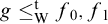
$g \leq ^{\mathrm {t}}_{\mathrm {W}} f_0,f_1$
. Suppose g is a problem such that
$g \leq ^{\mathrm {t}}_{\mathrm {W}} f_0,f_1$
 . For each i, fix
$\Phi _i$
. For each i, fix
$\Phi _i$
 and
$\Psi _i$
and
$\Psi _i$
 which witness
$g \leq ^{\mathrm {t}}_{\mathrm {W}} f_i$
which witness
$g \leq ^{\mathrm {t}}_{\mathrm {W}} f_i$
 . Then
$g \leq ^{\mathrm {t}}_{\mathrm {W}} f_0 \sqcap f_1$
. Then
$g \leq ^{\mathrm {t}}_{\mathrm {W}} f_0 \sqcap f_1$
 : Pre-process with
$p \mapsto (\Phi _0(p),\Phi _1(p))$
: Pre-process with
$p \mapsto (\Phi _0(p),\Phi _1(p))$
 and post-process with

To show that
$f_i \leq ^{\mathrm {t}}_{\mathrm {W}} f_0 \sqcup f_1$
 , pre-process with
$p \mapsto (i,p)$
, pre-process with
$p \mapsto (i,p)$
 and post-process with
$((j,q),p) \mapsto q$
and post-process with
$((j,q),p) \mapsto q$
 . Suppose g is a problem such that
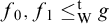
$f_0,f_1 \leq ^{\mathrm {t}}_{\mathrm {W}} g$
. Suppose g is a problem such that
$f_0,f_1 \leq ^{\mathrm {t}}_{\mathrm {W}} g$
 . For each i, fix
$\Phi _i$
. For each i, fix
$\Phi _i$
 and
$\Psi _i$
and
$\Psi _i$
 which witness
$f_i \leq ^{\mathrm {t}}_{\mathrm {W}} g$
which witness
$f_i \leq ^{\mathrm {t}}_{\mathrm {W}} g$
 . Then
$f_0 \sqcup f_1 \leq ^{\mathrm {t}}_{\mathrm {W}} g$
. Then
$f_0 \sqcup f_1 \leq ^{\mathrm {t}}_{\mathrm {W}} g$
 : Pre-process with

and post-process with

3 Variants of Ramsey’s theorem under
$\leq ^{\mathrm {t}}_{\mathrm {W}}$

Theorem 3.1. We have the following reductions:
-
1. For $k \in \mathbb {N}_{\geq 2} \cup \{<\!\infty ,\mathbb {N},\infty \}$
,
$\mathsf {RT}^{1}_{k}\chi \leq ^{\mathrm {t}}_{\mathrm {W}} \mathsf {RT}^{1}_{k}\mathsf {c} \leq ^{\mathrm {t}}_{\mathrm {W}} \mathsf {RT}^{1}_{k}\mathsf {e} \leq ^{\mathrm {t}}_{\mathrm {W}} \mathsf {RT}^{1}_{k}\mathsf {pe}$
. -
2. For all n and all $k \geq 2$
,
$\mathsf {RT}^{n}_{k}\chi \leq ^{\mathrm {t}}_{\mathrm {W}} \mathsf {RT}^{n}_{k+1}\chi \leq ^{\mathrm {t}}_{\mathrm {W}} \mathsf {RT}^{n}_{<\infty }\chi \leq ^{\mathrm {t}}_{\mathrm {W}} \mathsf {RT}^{n}_{\mathbb {N}}\chi $
. Analogous statements hold for
$\mathsf {RT}^{n}_{k}\mathsf {c}$
,
$\mathsf {RT}^{n}_{k}\mathsf {e}$
, and
$\mathsf {RT}^{n}_{k}\mathsf {pe}$
. -
3. $\mathsf {RT}^{1}_{\mathbb {N}}\mathsf {c} \equiv ^{\mathrm {t}}_{\mathrm {W}} \mathsf {RT}^{1}_{\mathbb {N}}\mathsf {e}$
and
$\mathsf {RT}^{1}_{\infty }\mathsf {c} \equiv ^{\mathrm {t}}_{\mathrm {W}} \mathsf {RT}^{1}_{\infty }\mathsf {e}$
. -
4. For all n and all $k \in \mathbb {N}_{\geq 2} \cup \{<\!\infty ,\mathbb {N},\infty \}$
,
$\mathsf {RT}^{n}_{k}\chi $
,
$\mathsf {RT}^{n}_{k}\mathsf {c}$
, and
$\mathsf {RT}^{n}_{k}\mathsf {e}$
are all
$\leq ^{\mathrm {t}}_{\mathrm {W}}$
-reducible to
$\mathsf {RT}^{n}_{k}\mathsf {pe}$
. -
5. For all n, $\mathsf {RT}^{n}_{\infty }\mathsf {c} \leq ^{\mathrm {t}}_{\mathrm {W}} \mathsf {RT}^{2}_{\infty }\mathsf {e}$
. -
6. For all n, $\mathsf {RT}^{n}_{\mathbb {N}}\mathsf {pe} \leq ^{\mathrm {t}}_{\mathrm {W}} \mathsf {RT}^{n+1}_{2}\mathsf {pe}$
,
$\mathsf {RT}^{n}_{\mathbb {N}}\mathsf {e} \leq ^{\mathrm {t}}_{\mathrm {W}} \mathsf {RT}^{n+1}_{2}\mathsf {e}$
, and
$\mathsf {RT}^{n}_{\mathbb {N}}\chi \leq ^{\mathrm {t}}_{\mathrm {W}} \mathsf {RT}^{n+1}_{2}\chi $
. -
7. For all n and all $k \in \mathbb {N}_{\geq 2} \cup \{<\!\infty ,\mathbb {N},\infty \}$
,
$\mathsf {RT}^{n}_{k}\mathsf {c} \leq ^{\mathrm {t}}_{\mathrm {W}} \mathsf {RT}^{n+1}_{k}\mathsf {c}$
.

















Proof. (1): In all these desired reductions, we will pre-process with the identity. Fix
$k\in \mathbb {N}_{\geq 2}\cup \{<\!\infty ,\mathbb {N},\infty \}$
 . To show
$\mathsf {RT}^{1}_{k}\mathsf {e}\leq ^{\mathrm {t}}_{\mathrm {W}}\mathsf {RT}^{1}_{k}\mathsf {pe}$
. To show
$\mathsf {RT}^{1}_{k}\mathsf {e}\leq ^{\mathrm {t}}_{\mathrm {W}}\mathsf {RT}^{1}_{k}\mathsf {pe}$
 , post-process with the projection. For
$\mathsf {RT}^{1}_{k}\mathsf {c}\leq ^{\mathrm {t}}_{\mathrm {W}}\mathsf {RT}^{1}_{k}\mathsf {e}$
, post-process with the projection. For
$\mathsf {RT}^{1}_{k}\mathsf {c}\leq ^{\mathrm {t}}_{\mathrm {W}}\mathsf {RT}^{1}_{k}\mathsf {e}$
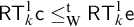 , the post-processing takes the given colouring c and an enumeration f and returns
$c(f(0))$
, the post-processing takes the given colouring c and an enumeration f and returns
$c(f(0))$
 . If f enumerates an
$\mathsf {RT}^{1}_{k}\mathsf {e}$
. If f enumerates an
$\mathsf {RT}^{1}_{k}\mathsf {e}$
 -solution to c, then
$c(f(0))$
-solution to c, then
$c(f(0))$
 is an
$\mathsf {RT}^{1}_{k}\mathsf {c}$
is an
$\mathsf {RT}^{1}_{k}\mathsf {c}$
 -solution to c. Finally, to see that
$\mathsf {RT}^{1}_{k}\chi \leq ^{\mathrm {t}}_{\mathrm {W}}\mathsf {RT}^{1}_{k}\mathsf {c}$
-solution to c. Finally, to see that
$\mathsf {RT}^{1}_{k}\chi \leq ^{\mathrm {t}}_{\mathrm {W}}\mathsf {RT}^{1}_{k}\mathsf {c}$
 , the post-processing takes the given colouring c and a number j and returns the characteristic function
$\chi $
, the post-processing takes the given colouring c and a number j and returns the characteristic function
$\chi $
 defined by
$\chi (x) = 1$
defined by
$\chi (x) = 1$
 if
$c(x) = j$
if
$c(x) = j$
 , otherwise
$\chi (x) = 0$
, otherwise
$\chi (x) = 0$
 . If j is an
$\mathsf {RT}^{1}_{k}\mathsf {c}$
. If j is an
$\mathsf {RT}^{1}_{k}\mathsf {c}$
 -solution to c, then
$\chi $
-solution to c, then
$\chi $
 is an
$\mathsf {RT}^{1}_{k}\chi $
is an
$\mathsf {RT}^{1}_{k}\chi $
 -solution to c.
(2): In all these desired reductions, we will post-process with the projection. To show
$\mathsf {RT}^{n}_{k}\chi \leq ^{\mathrm {t}}_{\mathrm {W}} \mathsf {RT}^{n}_{k+1}\chi $
 , pre-process with the identity. To show
$\mathsf {RT}^{n}_{k+1}\chi \leq ^{\mathrm {t}}_{\mathrm {W}} \mathsf {RT}^{n}_{<\infty }\chi $
, pre-process with the identity. To show
$\mathsf {RT}^{n}_{k+1}\chi \leq ^{\mathrm {t}}_{\mathrm {W}} \mathsf {RT}^{n}_{<\infty }\chi $
 , the pre-processing function produces the given colouring and the bound
$k+1$
, the pre-processing function produces the given colouring and the bound
$k+1$
 . To show
$\mathsf {RT}^{n}_{<\infty }\chi \leq ^{\mathrm {t}}_{\mathrm {W}} \mathsf {RT}^{n}_{\mathbb {N}}\chi $
. To show
$\mathsf {RT}^{n}_{<\infty }\chi \leq ^{\mathrm {t}}_{\mathrm {W}} \mathsf {RT}^{n}_{\mathbb {N}}\chi $
 , pre-process by forgetting the given bound.
(3): First, we show that
$\mathsf {RT}^{1}_{\mathbb {N}}\mathsf {e} \leq ^{\mathrm {t}}_{\mathrm {W}} \mathsf {RT}^{1}_{\mathbb {N}}\mathsf {c}$
 and
$\mathsf {RT}^{1}_{\infty }\mathsf {e} \leq ^{\mathrm {t}}_{\mathrm {W}} \mathsf {RT}^{1}_{\infty }\mathsf {c}$
and
$\mathsf {RT}^{1}_{\infty }\mathsf {e} \leq ^{\mathrm {t}}_{\mathrm {W}} \mathsf {RT}^{1}_{\infty }\mathsf {c}$
 . Given
$c: \mathbb {N} \to \mathbb {N}$
. Given
$c: \mathbb {N} \to \mathbb {N}$
 , define
$d: \mathbb {N} \to \mathbb {N}$
, define
$d: \mathbb {N} \to \mathbb {N}$
 by taking
$d(x)$
by taking
$d(x)$
 to be the least number (
$\leq x$
to be the least number (
$\leq x$
 ) which has the same c-colour as x. If c has bounded range, so does d. Also, if c is an
$\mathsf {RT}^{1}_{\infty }\mathsf {e}$
) which has the same c-colour as x. If c has bounded range, so does d. Also, if c is an
$\mathsf {RT}^{1}_{\infty }\mathsf {e}$
 -instance (i.e., some colour appears infinitely often in c), then d is an
$\mathsf {RT}^{1}_{\infty }\mathsf {c}$
-instance (i.e., some colour appears infinitely often in c), then d is an
$\mathsf {RT}^{1}_{\infty }\mathsf {c}$
 -instance. The post-processing takes a colouring c and a colour
$s_0$
-instance. The post-processing takes a colouring c and a colour
$s_0$
 and produces the following enumeration f:

If
$s_0$
 appears infinitely often in d, then infinitely many
$s_i$
appears infinitely often in d, then infinitely many
$s_i$
 will be enumerated.
(4): First notice that for any given infinite c-homogeneous set H, the principal enumeration of H can compute the characteristic function of H, an enumeration of H (via the identity function) and the colour of H (by computing the first n elements of H). Therefore, by using such a scheme for the post-processing, and the identity map for the pre-processing, one may obtain that
$\mathsf {RT}^{n}_{k}\mathsf {c},\mathsf {RT}^{n}_{k}\chi ,\mathsf {RT}^{n}_{k}\mathsf {e}\leq ^{\mathrm {t}}_{\mathrm {W}}\mathsf {RT}^{n}_{k}\mathsf {pe}$
 .
.
(5): To show that
$\mathsf {RT}^{n}_{\infty }\mathsf {c} \leq ^{\mathrm {t}}_{\mathrm {W}} \mathsf {RT}^{2}_{\infty }\mathsf {e}$
 , let
$\{p_{i}\}_{i\in \mathbb {N}}$
, let
$\{p_{i}\}_{i\in \mathbb {N}}$
 denote the primes in increasing order and
$\lceil \cdot \rceil :[\mathbb {N}]^{<\mathbb {N}}\to \mathbb {N}$
denote the primes in increasing order and
$\lceil \cdot \rceil :[\mathbb {N}]^{<\mathbb {N}}\to \mathbb {N}$
 be the function such that
$\lceil A\rceil =\prod _{i\in A}p_{i}$
be the function such that
$\lceil A\rceil =\prod _{i\in A}p_{i}$
 . This is evidently a primitive recursive embedding of
$[\mathbb {N}]^{<\mathbb {N}}$
. This is evidently a primitive recursive embedding of
$[\mathbb {N}]^{<\mathbb {N}}$
 into
$\mathbb {N}\setminus \{0\}$
into
$\mathbb {N}\setminus \{0\}$
 . Given
$c: [\mathbb {N}]^n \to \mathbb {N}$
. Given
$c: [\mathbb {N}]^n \to \mathbb {N}$
 , define
$d(x,y) = 0$
, define
$d(x,y) = 0$
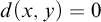 if all of the following hold: (1)
$x=\lceil A\rceil $
if all of the following hold: (1)
$x=\lceil A\rceil $
 ,
$y=\lceil B\rceil $
,
$y=\lceil B\rceil $
 for some
$A,B$
for some
$A,B$
 finite subsets of
$\mathbb {N}$
finite subsets of
$\mathbb {N}$
 ; (2)
$A \subseteq B$
; (2)
$A \subseteq B$
 or
$B \subseteq A$
or
$B \subseteq A$
 ; (3) A and B both have size at least n; and (4) A and B are c-homogeneous. Otherwise, define
$d(x,y) = \lceil \{x,y\} \rceil $
; (3) A and B both have size at least n; and (4) A and B are c-homogeneous. Otherwise, define
$d(x,y) = \lceil \{x,y\} \rceil $
 .
.
Assuming that c is an
$\mathsf {RT}^{n}_{\infty }\mathsf {c}$
 -instance, we first show that there exists a d-homogeneous set. Let J be an infinite c-homogeneous set. Then for all sufficiently large m,
$\{\lceil J_\ell \rceil : \ell \geq m\}$
-instance, we first show that there exists a d-homogeneous set. Let J be an infinite c-homogeneous set. Then for all sufficiently large m,
$\{\lceil J_\ell \rceil : \ell \geq m\}$
 , where
$J_\ell =\{x\in J: x\leq \ell \}$
, where
$J_\ell =\{x\in J: x\leq \ell \}$
 is infinite d-homogeneous (with colour
$0$
is infinite d-homogeneous (with colour
$0$
 ).
).
For the post-processing, given an enumeration f and a colouring c, first compute
$f(0)$
 . If
$f(0) = \lceil A \rceil $
. If
$f(0) = \lceil A \rceil $
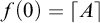 for some A of size at least n, then apply c to the first n elements of A and return the resulting colour. Otherwise, return
$0$
for some A of size at least n, then apply c to the first n elements of A and return the resulting colour. Otherwise, return
$0$
 . If f enumerates an infinite d-homogeneous set H, then H must have d-colour
$0$
. If f enumerates an infinite d-homogeneous set H, then H must have d-colour
$0$
 and
$\bigcup _{\lceil A\rceil \in H}A$
and
$\bigcup _{\lceil A\rceil \in H}A$
 is an infinite c-homogeneous set J. The above procedure then produces the c-colour of J.
(6): Given
$c: [\mathbb {N}]^n \to \mathbb {N}$
 , the pre-processing function computes
$d: [\mathbb {N}]^{n+1} \to 2$
, the pre-processing function computes
$d: [\mathbb {N}]^{n+1} \to 2$
 by
$d(A) = 0$
by
$d(A) = 0$
 if
$c\restriction [A]^n$
if
$c\restriction [A]^n$
 is constant, otherwise
$d(A) = 1$
is constant, otherwise
$d(A) = 1$
 . If c has bounded range, then all infinite d-homogeneous sets have colour
$0$
. If c has bounded range, then all infinite d-homogeneous sets have colour
$0$
 because of Ramsey’s theorem. The post-processing can be the projection because every d-homogeneous set of colour
$0$
because of Ramsey’s theorem. The post-processing can be the projection because every d-homogeneous set of colour
$0$
 is clearly also c-homogeneous.
(7): The pre-processing function takes a colouring
$c: [\mathbb {N}]^n \to \mathbb {N}$
 and computes the colouring
$d: [\mathbb {N}]^{n+1} \to \mathbb {N}$
and computes the colouring
$d: [\mathbb {N}]^{n+1} \to \mathbb {N}$
 defined by
$d(A) = c(A\setminus \{\max A\})$
defined by
$d(A) = c(A\setminus \{\max A\})$
 . If the pre-processing function is given some bound b, it outputs said bound as well. Notice that if b bounds the range of c, then b bounds the range of d as well (as they are equal). Also, it is easy to see that an infinite subset of
$\mathbb {N}$
. If the pre-processing function is given some bound b, it outputs said bound as well. Notice that if b bounds the range of c, then b bounds the range of d as well (as they are equal). Also, it is easy to see that an infinite subset of
$\mathbb {N}$
 is c-homogeneous of colour j if and only if it is d-homogeneous of colour j. Therefore we can post-process with the projection.
Note that all pre-processing and post-processing functions defined in the proof of Theorem 3.1 are primitive recursive, not merely total computable.
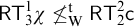
The remaining results in this section will imply that there are no other reductions between the problems depicted in Figure 1:
-
• $\mathsf {RT}^{1}_{2}\mathsf {c} \not \leq ^{\mathrm {t}}_{\mathrm {W}} \mathsf {RT}^{1}_{\infty }\chi , \mathsf {RT}^{2}_{2}\chi $
(Corollary 3.3); -
• $\mathsf {RT}^{1}_{k+1}\chi \not \leq ^{\mathrm {t}}_{\mathrm {W}} \mathsf {RT}^{1}_{k}\mathsf {pe}$
and
$\mathsf {RT}^{1}_{\mathbb {N}}\chi \not \leq ^{\mathrm {t}}_{\mathrm {W}} \mathsf {RT}^{1}_{<\infty }\mathsf {pe}$
(essentially known, see Proposition 3.11); -
• $\mathsf {RT}^{1}_{3}\chi \not \leq ^{\mathrm {t}}_{\mathrm {W}} \mathsf {RT}^{2}_{2}\mathsf {c}$
(Corollary 3.5); -
• $\mathsf {RT}^{1}_{2}\mathsf {e} \not \leq ^{\mathrm {t}}_{\mathrm {W}} \mathsf {RT}^{1}_{<\infty }\mathsf {c}, \mathsf {RT}^{2}_{2}\mathsf {c}$
(Corollary 3.7); -
• $\mathsf {RT}^{1}_{2}\mathsf {pe} \not \leq ^{\mathrm {t}}_{\mathrm {W}} \mathsf {RT}^{2}_{2}\mathsf {e}, \mathsf {RT}^{1}_{\infty }\mathsf {e}$
(Corollary 3.10); -
• $\mathsf {RT}^{2}_{2}\mathsf {c} \not \leq ^{\mathrm {t}}_{\mathrm {W}} \mathsf {RT}^{2}_{2}\mathsf {e},\mathsf {RT}^{1}_{\infty }\mathsf {pe}$
(Corollary 3.14 and Proposition 3.16); -
• $\mathsf {RT}^{2}_{2}\chi \not \leq ^{\mathrm {t}}_{\mathrm {W}} \mathsf {RT}^{2}_{2}\mathsf {e}, \mathsf {RT}^{1}_{\infty }\mathsf {pe}$
(Theorem 3.17 and Corollary 3.23); -
• $\mathsf {RT}^{2}_{2}\mathsf {e} \not \leq ^{\mathrm {t}}_{\mathrm {W}} \mathsf {RT}^{1}_{\infty }\mathsf {pe}$
(Corollary 3.23); -
• $\mathsf {RT}^{1}_{\infty }\chi \not \leq ^{\mathrm {t}}_{\mathrm {W}} \mathsf {RT}^{2}_{2}\mathsf {pe}$
(essentially known, see Proposition 3.24).









Proposition 3.2.
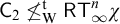
$\mathsf {C}_{2} \not \leq ^{\mathrm {t}}_{\mathrm {W}} \mathsf {RT}^{n}_{\infty }\chi $
 .
.
Proof. Suppose for a contradiction that
$\Phi $
 and
$\Psi $
and
$\Psi $
 witness
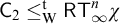
$\mathsf {C}_{2} \leq ^{\mathrm {t}}_{\mathrm {W}} \mathsf {RT}^{n}_{\infty }\chi $
witness
$\mathsf {C}_{2} \leq ^{\mathrm {t}}_{\mathrm {W}} \mathsf {RT}^{n}_{\infty }\chi $
 . Let g denote the empty enumeration, i.e., the
$\mathsf {C}_{2}$
. Let g denote the empty enumeration, i.e., the
$\mathsf {C}_{2}$
 -instance with solution set
$\{0,1\}$
-instance with solution set
$\{0,1\}$
 . Since
$\Psi $
. Since
$\Psi $
 is total computable, we may fix some number s such that
$\Psi (0^s,g \restriction s)\downarrow = j$
is total computable, we may fix some number s such that
$\Psi (0^s,g \restriction s)\downarrow = j$
 . We extend
$g\restriction s$
. We extend
$g\restriction s$
 to a
$\mathsf {C}_{2}$
to a
$\mathsf {C}_{2}$
 -instance f by enumerating
$0$
-instance f by enumerating
$0$
 (if
$j \neq 1$
(if
$j \neq 1$
 ) or
$1$
) or
$1$
 (if
$j = 1$
(if
$j = 1$
 ). Then j is not a
$\mathsf {C}_{2}$
). Then j is not a
$\mathsf {C}_{2}$
 -solution for f, yet
$0^s$
-solution for f, yet
$0^s$
 may be extended to an
$\mathsf {RT}^{n}_{\infty }\chi $
may be extended to an
$\mathsf {RT}^{n}_{\infty }\chi $
 -solution to
$\Phi (f)$
-solution to
$\Phi (f)$
 , yielding a contradiction.
In the above proof,
$\mathsf {RT}^{n}_{\infty }\chi $
 can be replaced with any problem h whose codomain is represented by
$\delta _\chi $
can be replaced with any problem h whose codomain is represented by
$\delta _\chi $
 with the following property.
There is some
$p \in 2^{\mathbb {N}}$
 such that for every h-instance x, p lies in the closure of (the set of
$\delta _\chi $
such that for every h-instance x, p lies in the closure of (the set of
$\delta _\chi $
 -names for elements of)
$h(x)$
-names for elements of)
$h(x)$
 .
.
Corollary 3.3.
$\mathsf {RT}^{1}_{2}\mathsf {c} \not \leq ^{\mathrm {t}}_{\mathrm {W}} \mathsf {RT}^{n}_{\infty }\chi $
 for all n.
Proof. By the previous proposition, it suffices to show that
$\mathsf {C}_{k} \leq ^{\mathrm {t}}_{\mathrm {W}} \mathsf {RT}^{1}_{k}\mathsf {c}$
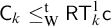 . The pre-processing function sends a given enumeration f to the following colouring c:
$c(x)$
. The pre-processing function sends a given enumeration f to the following colouring c:
$c(x)$
 is the least number which has not been enumerated by f by stage x. If f is an instance of
$\mathsf {C}_{k}$
is the least number which has not been enumerated by f by stage x. If f is an instance of
$\mathsf {C}_{k}$
 , then c is an instance of
$\mathsf {RT}^{1}_{k}\mathsf {c}$
, then c is an instance of
$\mathsf {RT}^{1}_{k}\mathsf {c}$
 . We post-process by taking the projection.
Proposition 3.4. Let
$g: \subseteq X \rightrightarrows Y$
 be a problem. Suppose
$B: \subseteq X \to \overline {Y}^k$
be a problem. Suppose
$B: \subseteq X \to \overline {Y}^k$
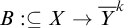 is a continuous function such that for all
$x \in \mathrm {dom}(g)$
is a continuous function such that for all
$x \in \mathrm {dom}(g)$
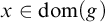 , the finite sequence
$B(x)$
, the finite sequence
$B(x)$
 contains some g-solution for x. Then
$\mathsf {RT}^{1}_{k+1} \not \leq ^\ast _{\mathrm {W}} g$
contains some g-solution for x. Then
$\mathsf {RT}^{1}_{k+1} \not \leq ^\ast _{\mathrm {W}} g$
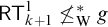 . If, on the other hand, there is some such
$B: \subseteq X \to \overline {Y}^\ast $
. If, on the other hand, there is some such
$B: \subseteq X \to \overline {Y}^\ast $
 , then
$\mathsf {RT}^{1}_{\mathbb {N}} \not \leq ^\ast _{\mathrm {W}} g$
, then
$\mathsf {RT}^{1}_{\mathbb {N}} \not \leq ^\ast _{\mathrm {W}} g$
 .
.
Proof. Suppose towards a contradiction that
$\Phi $
 and
$\Psi $
and
$\Psi $
 witness
$\mathsf {RT}^{1}_{k+1}\leq ^\ast _{\mathrm {W}} g$
witness
$\mathsf {RT}^{1}_{k+1}\leq ^\ast _{\mathrm {W}} g$
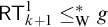 . We shall construct an initial segment
$c_k: \subseteq \mathbb {N} \to k+1$
. We shall construct an initial segment
$c_k: \subseteq \mathbb {N} \to k+1$
 of an
$\mathsf {RT}^{1}_{k+1}$
of an
$\mathsf {RT}^{1}_{k+1}$
 -instance by iterating through
$j < k$
-instance by iterating through
$j < k$
 , as follows. Let
$c_0$
, as follows. Let
$c_0$
 be the empty colouring. Having constructed
$c_j$
be the empty colouring. Having constructed
$c_j$
 , we extend it to
$c_{j+1}$
, we extend it to
$c_{j+1}$
 as follows: If there is some finite extension
$c_{j+1}$
as follows: If there is some finite extension
$c_{j+1}$
 of
$c_j$
of
$c_j$
 such that
$\Psi (B(\Phi (c_{j+1}))_j,c_{j+1})(x)\downarrow = 1$
such that
$\Psi (B(\Phi (c_{j+1}))_j,c_{j+1})(x)\downarrow = 1$
 for some x, then extend
$c_j$
for some x, then extend
$c_j$
 to the least such
$c_{j+1}$
to the least such
$c_{j+1}$
 . Otherwise, define
$c_{j+1} = c_j$
. Otherwise, define
$c_{j+1} = c_j$
 .
.
For each
$j < k$
 , let
$x_j$
, let
$x_j$
 be the least number such that
$\Psi (B(\Phi (c_k))_j,c_k)(x_j)\downarrow = 1$
be the least number such that
$\Psi (B(\Phi (c_k))_j,c_k)(x_j)\downarrow = 1$
 , if one exists. The set
$\{c_k(x_j): j < k\}$
, if one exists. The set
$\{c_k(x_j): j < k\}$
 is a proper subset of
$k+1$
is a proper subset of
$k+1$
 , so we may fix some
$i < k+1$
, so we may fix some
$i < k+1$
 which differs from every
$c_k(x_j)$
which differs from every
$c_k(x_j)$
 . Define
$c: \mathbb {N} \to k+1$
. Define
$c: \mathbb {N} \to k+1$
 by extending
$c_k$
by extending
$c_k$
 with
$i^{\mathbb {N}}$
with
$i^{\mathbb {N}}$
 . Then
$\Phi (c) \in \mathrm {dom}(g)$
. Then
$\Phi (c) \in \mathrm {dom}(g)$
 . Fix some
$j < k$
. Fix some
$j < k$
 such that
$B(\Phi (c))_j \in Y$
such that
$B(\Phi (c))_j \in Y$
 is a g-solution for
$\Phi (c)$
is a g-solution for
$\Phi (c)$
 . Either
$x_j$
. Either
$x_j$
 is undefined and for all x, it is not the case that
$\Psi (B(\Phi (c))_j,c)(x)\downarrow = 1$
is undefined and for all x, it is not the case that
$\Psi (B(\Phi (c))_j,c)(x)\downarrow = 1$
 , or
$x_j$
, or
$x_j$
 is defined and
$\Psi (B(\Phi (c))_j,c)(x_j) = 1$
is defined and
$\Psi (B(\Phi (c))_j,c)(x_j) = 1$
 . In both cases,
$\Psi (B(\Phi (c))_j,c)$
. In both cases,
$\Psi (B(\Phi (c))_j,c)$
 is not an
$\mathsf {RT}^{1}_{k+1}$
is not an
$\mathsf {RT}^{1}_{k+1}$
 -solution for c.
To prove the second statement in the proposition, consider
$B(\Phi (0^{\mathbb {N}})) \in \overline {Y}^\ast $
 . Fix some
$s \in \mathbb {N}$
. Fix some
$s \in \mathbb {N}$
 such that for all
$\mathsf {RT}^{1}_{\mathbb {N}}$
such that for all
$\mathsf {RT}^{1}_{\mathbb {N}}$
 -instances p extending
$0^s$
-instances p extending
$0^s$
 ,
$B(\Phi (p))$
,
$B(\Phi (p))$
 has the same length k as
$B(\Phi (0^{\mathbb {N}}))$
has the same length k as
$B(\Phi (0^{\mathbb {N}}))$
 . Let
$X_0$
. Let
$X_0$
 be the set of all
$x \in \mathrm {dom}(g)$
be the set of all
$x \in \mathrm {dom}(g)$
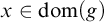 such that
$B(x)$
such that
$B(x)$
 has length k. Since
$\mathsf {RT}^{1}_{\mathbb {N}}$
has length k. Since
$\mathsf {RT}^{1}_{\mathbb {N}}$
 is a fractal, we have
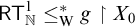
$\mathsf {RT}^{1}_{\mathbb {N}} \leq ^\ast _{\mathrm {W}} g\restriction X_0$
is a fractal, we have
$\mathsf {RT}^{1}_{\mathbb {N}} \leq ^\ast _{\mathrm {W}} g\restriction X_0$
 . However,
$\mathsf {RT}^{1}_{k+1} \not \leq ^\ast _{\mathrm {W}} g\restriction X_0$
. However,
$\mathsf {RT}^{1}_{k+1} \not \leq ^\ast _{\mathrm {W}} g\restriction X_0$
 by applying the first statement in the proposition. This yields the desired contradiction.
For the following application, we only need the weaker version of Proposition 3.4, where
$\overline {Y}^k$
 and
$\overline {Y}^\ast $
and
$\overline {Y}^\ast $
 are replaced by
$Y^k$
are replaced by
$Y^k$
 and
$Y^\ast $
and
$Y^\ast $
 , respectively.
Corollary 3.5. For all n and all
$k \geq 2$
 ,
$\mathsf {RT}^{1}_{k+1} \not \leq _{\mathrm {W}} \mathsf {RT}^{n}_{k}\mathsf {c}$
,
$\mathsf {RT}^{1}_{k+1} \not \leq _{\mathrm {W}} \mathsf {RT}^{n}_{k}\mathsf {c}$
 and
$\mathsf {RT}^{1}_{\mathbb {N}} \not \leq _{\mathrm {W}} \mathsf {RT}^{n}_{<\infty }\mathsf {c}$
and
$\mathsf {RT}^{1}_{\mathbb {N}} \not \leq _{\mathrm {W}} \mathsf {RT}^{n}_{<\infty }\mathsf {c}$
 .
.
Proof. For
$\mathsf {RT}^{n}_{k}\mathsf {c}$
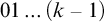
 , define B to be the constant function
$01\dots (k-1)$
, define B to be the constant function
$01\dots (k-1)$
 . For
$\mathsf {RT}^{n}_{<\infty }\mathsf {c}$
. For
$\mathsf {RT}^{n}_{<\infty }\mathsf {c}$
 , if B is given an
$\mathsf {RT}^{n}_{<\infty }\mathsf {c}$
, if B is given an
$\mathsf {RT}^{n}_{<\infty }\mathsf {c}$
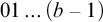
 -instance with bound b on the colours used, it returns the sequence
$01\dots (b-1)$
-instance with bound b on the colours used, it returns the sequence
$01\dots (b-1)$
 of length b.
Proposition 3.6. Suppose
$g: \subseteq X \rightrightarrows Y$
 is a problem and
$B: \subseteq X \to Y^\ast $
is a problem and
$B: \subseteq X \to Y^\ast $
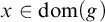
 is a continuous function such that for all
$x \in \mathrm {dom}(g)$
is a continuous function such that for all
$x \in \mathrm {dom}(g)$
 , the finite sequence
$B(x)$
, the finite sequence
$B(x)$
 contains some g-solution for x. Then
$\mathsf {RT}^{1}_{2}\mathsf {e} \not \leq ^{\mathrm {t}}_{\mathrm {W}} g$
contains some g-solution for x. Then
$\mathsf {RT}^{1}_{2}\mathsf {e} \not \leq ^{\mathrm {t}}_{\mathrm {W}} g$
 .
.
Proof. Suppose towards a contradiction that
$\Phi $
 and
$\Psi $
and
$\Psi $
 witness
$\mathsf {RT}^{1}_{2}\mathsf {e} \leq ^{\mathrm {t}}_{\mathrm {W}} g$
witness
$\mathsf {RT}^{1}_{2}\mathsf {e} \leq ^{\mathrm {t}}_{\mathrm {W}} g$
 . Consider the finite sequence
$B(\Phi (0^{\mathbb {N}}))$
. Consider the finite sequence
$B(\Phi (0^{\mathbb {N}}))$
 . Since
$\Phi $
. Since
$\Phi $
 is computable, we may fix some
$s_0$
is computable, we may fix some
$s_0$
 such that for all c extending
$0^{s_0}$
such that for all c extending
$0^{s_0}$
 , the sequence
$B(\Phi (c))$
, the sequence
$B(\Phi (c))$
 has the same length k. Since
$\Psi $
has the same length k. Since
$\Psi $
 is total, for each
$j < k$
is total, for each
$j < k$
 ,
$\Psi (B(\Phi (0^{\mathbb {N}}))_j,0^{\mathbb {N}})$
,
$\Psi (B(\Phi (0^{\mathbb {N}}))_j,0^{\mathbb {N}})$
 enumerates some number. Since
$\Psi $
enumerates some number. Since
$\Psi $
 is computable, we may fix some
$s> s_0$
is computable, we may fix some
$s> s_0$
 such that for each
$j < k$
such that for each
$j < k$
 ,
$\Psi (B(\Phi (0^s))_j,0^s)$
,
$\Psi (B(\Phi (0^s))_j,0^s)$
 enumerates some number below s. Then
$0^s1^{\mathbb {N}}$
enumerates some number below s. Then
$0^s1^{\mathbb {N}}$
 is an
$\mathsf {RT}^{1}_{2}\mathsf {e}$
is an
$\mathsf {RT}^{1}_{2}\mathsf {e}$
 -instance,
$\Phi (0^s1^{\mathbb {N}})$
-instance,
$\Phi (0^s1^{\mathbb {N}})$
 is a g-instance, and for every
$j < k$
is a g-instance, and for every
$j < k$
 ,
$\Psi (B(\Phi (0^s1^{\mathbb {N}}))_j,0^s1^{\mathbb {N}})$
,
$\Psi (B(\Phi (0^s1^{\mathbb {N}}))_j,0^s1^{\mathbb {N}})$
 enumerates a number of colour
$0$
enumerates a number of colour
$0$
 and is therefore not an
$\mathsf {RT}^{1}_{2}\mathsf {e}$
and is therefore not an
$\mathsf {RT}^{1}_{2}\mathsf {e}$
 -solution for
$0^s1^{\mathbb {N}}$
-solution for
$0^s1^{\mathbb {N}}$
 . This contradicts the fact that some
$B(\Phi (0^s1^{\mathbb {N}}))_j$
. This contradicts the fact that some
$B(\Phi (0^s1^{\mathbb {N}}))_j$
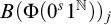 is a g-solution for
$\Phi (0^s1^{\mathbb {N}})$
is a g-solution for
$\Phi (0^s1^{\mathbb {N}})$
 .
.
Corollary 3.7.
$\mathsf {RT}^{1}_{2}\mathsf {e} \not \leq ^{\mathrm {t}}_{\mathrm {W}} \mathsf {RT}^{n}_{<\infty }\mathsf {c}$
 for all n.
Remark 3.8. Propositions 3.4 and 3.6 can be reformulated using a variant of guessability (introduced by Pauly [Reference Pauly13]). For the latter it is important that the codomain of B is
$Y^\ast $
 instead of the completion
$\overline {Y}^\ast $
instead of the completion
$\overline {Y}^\ast $
 ; indeed,
$\mathsf {RT}^{1}_{k}\mathsf {e}$
; indeed,
$\mathsf {RT}^{1}_{k}\mathsf {e}$
 is k-guessable in the sense of [Reference Pauly13, Definition 4].
Proposition 3.9. The following problems are not
$\leq ^{\mathrm {t}}_{\mathrm {W}}$
 -reducible to any problem with codomain
$(\mathcal {P}(\mathbb {N})\setminus \{\emptyset \},\delta _e)$
-reducible to any problem with codomain
$(\mathcal {P}(\mathbb {N})\setminus \{\emptyset \},\delta _e)$
 : (1)
$\mathsf {RT}^{1}_{2}\mathsf {pe}$
: (1)
$\mathsf {RT}^{1}_{2}\mathsf {pe}$
 and (2)
$\widehat {\mathsf {C}_{2}}$
and (2)
$\widehat {\mathsf {C}_{2}}$
 .
.
Proof. (1): Given a total computable function
$\Psi $
 , we shall construct
$c: \mathbb {N} \to 2$
, we shall construct
$c: \mathbb {N} \to 2$
 such that for every
$n \in \mathbb {N}$
such that for every
$n \in \mathbb {N}$
 , there is some s such that
$\Psi (n^s,c)$
, there is some s such that
$\Psi (n^s,c)$
 does not extend to an
$\mathsf {RT}^{1}_{2}\mathsf {pe}$
does not extend to an
$\mathsf {RT}^{1}_{2}\mathsf {pe}$
 -solution for c. Begin by fixing
$t_0$
-solution for c. Begin by fixing
$t_0$
 such that
$\Psi (0^{t_0},0^{t_0})$
such that
$\Psi (0^{t_0},0^{t_0})$
 enumerates some number (less than
$t_0$
enumerates some number (less than
$t_0$
 ). Now
$\Psi (0^{\mathbb {N}},0^{t_0}1^{\mathbb {N}})$
). Now
$\Psi (0^{\mathbb {N}},0^{t_0}1^{\mathbb {N}})$
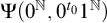 either enumerates some number greater than
$t_0$
either enumerates some number greater than
$t_0$
 , or enumerates some numbers out of order. Fix some
$s_0$
, or enumerates some numbers out of order. Fix some
$s_0$
 such that
$\Psi (0^{s_0},0^{t_0}1^{s_0})$
such that
$\Psi (0^{s_0},0^{t_0}1^{s_0})$
 witnesses either of these. Define
$\sigma _1 = 0^{t_0}1^{s_0}$
witnesses either of these. Define
$\sigma _1 = 0^{t_0}1^{s_0}$
 .
.
In general, suppose that at stage n, we have constructed some
$\sigma _n$
 . Fix
$t_n$
. Fix
$t_n$
 such that
$\Psi (n^{t_n},\sigma _n 0^{t_n})$
such that
$\Psi (n^{t_n},\sigma _n 0^{t_n})$
 enumerates some number x (less than
$|\sigma _n 0^{t_n}|$
enumerates some number x (less than
$|\sigma _n 0^{t_n}|$
 ). Let
$i < 2$
). Let
$i < 2$
 denote the colour
$(\sigma _n 0^{t_n})(x)$
denote the colour
$(\sigma _n 0^{t_n})(x)$
 . Then fix some
$s_n$
. Then fix some
$s_n$
 such that
$\Psi (n^{s_n},\sigma _n 0^{t_n} (1-i)^{s_n})$
such that
$\Psi (n^{s_n},\sigma _n 0^{t_n} (1-i)^{s_n})$
 enumerates some number greater than
$|\sigma _n 0^{t_n}|$
enumerates some number greater than
$|\sigma _n 0^{t_n}|$
 , or enumerates some numbers out of order. Define
$\sigma _{n+1} = \sigma _n 0^{t_n} (1-i)^{s_n}$
, or enumerates some numbers out of order. Define
$\sigma _{n+1} = \sigma _n 0^{t_n} (1-i)^{s_n}$
 .
.
Finally, define
$c = \bigcup _n \sigma _n$
 . For any non-empty set
$X \subseteq \mathbb {N}$
. For any non-empty set
$X \subseteq \mathbb {N}$
 , there is some
$n \in X$
, there is some
$n \in X$
 and some enumeration g of X which extends
$n^{s_n}$
and some enumeration g of X which extends
$n^{s_n}$
 . Since
$\Psi (n^{s_n},c)$
. Since
$\Psi (n^{s_n},c)$
 cannot extend to an
$\mathsf {RT}^{1}_{2}\mathsf {pe}$
cannot extend to an
$\mathsf {RT}^{1}_{2}\mathsf {pe}$
 -solution for c,
$\Psi (g,c)$
-solution for c,
$\Psi (g,c)$
 is not an
$\mathsf {RT}^{1}_{2}\mathsf {pe}$
is not an
$\mathsf {RT}^{1}_{2}\mathsf {pe}$
 -solution for c.
(2): Given a total computable function
$\Psi $
 , we shall construct an instance
$f = (f_i)_i$
, we shall construct an instance
$f = (f_i)_i$
 of
$\widehat {\mathsf {C}_{2}}$
of
$\widehat {\mathsf {C}_{2}}$
 such that for every
$n \in \mathbb {N}$
such that for every
$n \in \mathbb {N}$
 , there is some s such that
$\Psi (n^s,f)$
, there is some s such that
$\Psi (n^s,f)$
 does not extend to a
$\widehat {\mathsf {C}_{2}}$
does not extend to a
$\widehat {\mathsf {C}_{2}}$
 -solution for f.
At the beginning of stage n, we have fully defined
$f_i$
 for
$i < n$
for
$i < n$
 . There may also be finitely many
$f_i$
. There may also be finitely many
$f_i$
 which are partially defined as a finite initial segment of the empty enumeration. At stage n, let
$g = (g_i)_i$
which are partially defined as a finite initial segment of the empty enumeration. At stage n, let
$g = (g_i)_i$
 denote the
$\widehat {\mathsf {C}_{2}}$
denote the
$\widehat {\mathsf {C}_{2}}$
 -instance defined by
$g_i = f_i$
-instance defined by
$g_i = f_i$
 if
$f_i$
if
$f_i$
 is fully defined, otherwise
$g_i$
is fully defined, otherwise
$g_i$
 is the empty enumeration.
Since
$\Psi $
 is total,
$\Psi (n^{\mathbb {N}},g)(n)$
is total,
$\Psi (n^{\mathbb {N}},g)(n)$
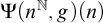 is defined. We define
$f_n$
is defined. We define
$f_n$
 by enumerating
$0$
by enumerating
$0$
 (if
$\Psi (n^{\mathbb {N}},g)(n) \neq 1$
(if
$\Psi (n^{\mathbb {N}},g)(n) \neq 1$
 ) or
$1$
) or
$1$
 (if
$\Psi (n^{\mathbb {N}},g)(n) = 1$
(if
$\Psi (n^{\mathbb {N}},g)(n) = 1$
 ). We also extend finitely many
$f_i$
). We also extend finitely many
$f_i$
 (without enumerating any number) to ensure that
$\Psi (n^{\mathbb {N}},f)(n) = \Psi (n^{\mathbb {N}},g)(n)$
(without enumerating any number) to ensure that
$\Psi (n^{\mathbb {N}},f)(n) = \Psi (n^{\mathbb {N}},g)(n)$
 .
.
The remainder of the verification proceeds as above.
Corollary 3.10. For all n,
$\mathsf {RT}^{1}_{2}\mathsf {pe} \not \leq ^{\mathrm {t}}_{\mathrm {W}} \mathsf {RT}^{n}_{\infty }\mathsf {e}$
 and so
$\mathsf {RT}^{1}_{2}\mathsf {pe} \not \leq ^{\mathrm {t}}_{\mathrm {W}} \mathsf {RT}^{n}_{\infty }\mathsf {c}$
and so
$\mathsf {RT}^{1}_{2}\mathsf {pe} \not \leq ^{\mathrm {t}}_{\mathrm {W}} \mathsf {RT}^{n}_{\infty }\mathsf {c}$
 .
.
Proof. The second statement follows from the first, by applying Theorem 3.1(5).
Proposition 3.11. For all n and all
$k \geq 2$
 ,
$\mathsf {RT}^{n}_{k+1}\chi \not \leq ^{\mathrm {t}}_{\mathrm {W}} \mathsf {RT}^{n}_{k}\mathsf {pe}$
,
$\mathsf {RT}^{n}_{k+1}\chi \not \leq ^{\mathrm {t}}_{\mathrm {W}} \mathsf {RT}^{n}_{k}\mathsf {pe}$
 and
$\mathsf {RT}^{n}_{\mathbb {N}}\chi \not \leq ^{\mathrm {t}}_{\mathrm {W}} \mathsf {RT}^{n}_{<\infty }\mathsf {pe}$
and
$\mathsf {RT}^{n}_{\mathbb {N}}\chi \not \leq ^{\mathrm {t}}_{\mathrm {W}} \mathsf {RT}^{n}_{<\infty }\mathsf {pe}$
 .
.
Proof. It is known that
$\mathsf {RT}^{n}_{k+1} \not \leq _{\mathrm {W}} \mathsf {RT}^{n}_{k}$
 and
$\mathsf {RT}^{n}_{\mathbb {N}} \not \leq _{\mathrm {W}} \mathsf {RT}^{n}_{<\infty }$
and
$\mathsf {RT}^{n}_{\mathbb {N}} \not \leq _{\mathrm {W}} \mathsf {RT}^{n}_{<\infty }$
 ([Reference Brattka and Rakotoniaina7, Theorem 4.22 and Corollary 4.23] and [Reference Hirschfeldt and Jockusch10, Theorem 3.3]). The desired results follow from the facts that
$\mathsf {RT}^{n}_{k}\chi \equiv _{\mathrm {W}} \mathsf {RT}^{n}_{k}$
([Reference Brattka and Rakotoniaina7, Theorem 4.22 and Corollary 4.23] and [Reference Hirschfeldt and Jockusch10, Theorem 3.3]). The desired results follow from the facts that
$\mathsf {RT}^{n}_{k}\chi \equiv _{\mathrm {W}} \mathsf {RT}^{n}_{k}$
 ,
$\mathsf {RT}^{n}_{<\infty }\mathsf {pe} \equiv _{\mathrm {W}} \mathsf {RT}^{n}_{<\infty }$
,
$\mathsf {RT}^{n}_{<\infty }\mathsf {pe} \equiv _{\mathrm {W}} \mathsf {RT}^{n}_{<\infty }$
 , and
$\mathsf {RT}^{n}_{\mathbb {N}}\chi \equiv _{\mathrm {W}} \mathsf {RT}^{n}_{\mathbb {N}}$
, and
$\mathsf {RT}^{n}_{\mathbb {N}}\chi \equiv _{\mathrm {W}} \mathsf {RT}^{n}_{\mathbb {N}}$
 .
.
We have now justified the relationships in Figure 1 between
$\mathsf {RT}^{1}_{k}\mathsf {pe}$
 ,
$\mathsf {RT}^{1}_{k}\mathsf {e}$
,
$\mathsf {RT}^{1}_{k}\mathsf {e}$
 ,
$\mathsf {RT}^{1}_{k}\mathsf {c}$
,
$\mathsf {RT}^{1}_{k}\mathsf {c}$
 , and
$\mathsf {RT}^{1}_{k}\chi $
, and
$\mathsf {RT}^{1}_{k}\chi $
 for
$k \in \mathbb {N} \cup \{<\!\infty ,\mathbb {N}\}$
for
$k \in \mathbb {N} \cup \{<\!\infty ,\mathbb {N}\}$
 . We turn our attention to
$\mathsf {RT}^{2}_{2}\mathsf {pe}$
. We turn our attention to
$\mathsf {RT}^{2}_{2}\mathsf {pe}$
 ,
$\mathsf {RT}^{2}_{2}\mathsf {e}$
,
$\mathsf {RT}^{2}_{2}\mathsf {e}$
 ,
$\mathsf {RT}^{2}_{2}\mathsf {c}$
,
$\mathsf {RT}^{2}_{2}\mathsf {c}$
 , and
$\mathsf {RT}^{2}_{2}\chi $
, and
$\mathsf {RT}^{2}_{2}\chi $
 .
.
Proposition 3.12. For all n and all
$k \geq 2$
 ,
$(\mathsf {RT}^{n}_{k}\chi )' \leq ^{\mathrm {t}}_{\mathrm {W}} \mathsf {RT}^{n+1}_{k}\chi $
,
$(\mathsf {RT}^{n}_{k}\chi )' \leq ^{\mathrm {t}}_{\mathrm {W}} \mathsf {RT}^{n+1}_{k}\chi $
 ,
$(\mathsf {RT}^{n}_{k}\mathsf {c})' \leq ^{\mathrm {t}}_{\mathrm {W}} \mathsf {RT}^{n+1}_{k}\mathsf {c}$
,
$(\mathsf {RT}^{n}_{k}\mathsf {c})' \leq ^{\mathrm {t}}_{\mathrm {W}} \mathsf {RT}^{n+1}_{k}\mathsf {c}$
 ,
$(\mathsf {RT}^{n}_{k}\mathsf {e})' \leq ^{\mathrm {t}}_{\mathrm {W}} \mathsf {RT}^{n+1}_{k}\mathsf {e}$
,
$(\mathsf {RT}^{n}_{k}\mathsf {e})' \leq ^{\mathrm {t}}_{\mathrm {W}} \mathsf {RT}^{n+1}_{k}\mathsf {e}$
 , and
$(\mathsf {RT}^{n}_{k}\mathsf {pe})' \leq ^{\mathrm {t}}_{\mathrm {W}} \mathsf {RT}^{n+1}_{k}\mathsf {pe}$
, and
$(\mathsf {RT}^{n}_{k}\mathsf {pe})' \leq ^{\mathrm {t}}_{\mathrm {W}} \mathsf {RT}^{n+1}_{k}\mathsf {pe}$
 .
.
Proof. Given a sequence
$(c_i)_i$
 (not necessarily convergent), we begin by replacing each
$c_i$
(not necessarily convergent), we begin by replacing each
$c_i$
 with
$d_i: [\mathbb {N}]^n \to k$
with
$d_i: [\mathbb {N}]^n \to k$
 , defined by
$d_i(A) = c_i(A)$
, defined by
$d_i(A) = c_i(A)$
 if
$c_i(A) < k$
if
$c_i(A) < k$
 , otherwise
$d_i(A) = 0$
, otherwise
$d_i(A) = 0$
 . The result of pre-processing is the colouring
$d: [\mathbb {N}]^{n+1} \to k$
. The result of pre-processing is the colouring
$d: [\mathbb {N}]^{n+1} \to k$
 , defined by
$d(A) = d_{\max A}(A\setminus \{\max A\})$
, defined by
$d(A) = d_{\max A}(A\setminus \{\max A\})$
 .
.
We claim that if
$(c_i)_i$
 converges to a colouring
$c: [\mathbb {N}]^n \to k$
converges to a colouring
$c: [\mathbb {N}]^n \to k$
 , then every infinite d-homogeneous set H is also c-homogeneous, with the same colour. This would mean that if we post-process by taking the projection, we obtain the claimed reductions. Suppose
$A \in [H]^n$
, then every infinite d-homogeneous set H is also c-homogeneous, with the same colour. This would mean that if we post-process by taking the projection, we obtain the claimed reductions. Suppose
$A \in [H]^n$
 . Then for all
$i> \max A$
. Then for all
$i> \max A$
 in H,
$d(A \cup \{i\}) = d_i(A)$
in H,
$d(A \cup \{i\}) = d_i(A)$
 has the same colour, say
$j < k$
has the same colour, say
$j < k$
 . Choose such i which is sufficiently large so that
$c_i(A) = c(A) < k$
. Choose such i which is sufficiently large so that
$c_i(A) = c(A) < k$
 . Then
$d_i(A) = c_i(A) = c(A)$
. Then
$d_i(A) = c_i(A) = c(A)$
 , so
$c(A) = j$
, so
$c(A) = j$
 .
.
Proposition 3.13.
$\mathsf {LPO}' \not \leq ^{\mathrm {t}}_{\mathrm {W}} \mathsf {RT}^{n}_{\mathbb {N}}\mathsf {e}$
 for all n.
Proof. Suppose for a contradiction that
$\Phi $
 and
$\Psi $
and
$\Psi $
 witness
$\mathsf {LPO}' \leq ^{\mathrm {t}}_{\mathrm {W}}\mathsf {RT}^{n}_{\mathbb {N}}\mathsf {e}$
witness
$\mathsf {LPO}' \leq ^{\mathrm {t}}_{\mathrm {W}}\mathsf {RT}^{n}_{\mathbb {N}}\mathsf {e}$
 . We shall construct an
$\mathsf {LPO}'$
. We shall construct an
$\mathsf {LPO}'$
 -instance
$(f_s)_s$
-instance
$(f_s)_s$
 in stages. Begin by defining
$f_0 = 1^{\mathbb {N}}$
in stages. Begin by defining
$f_0 = 1^{\mathbb {N}}$
 . At stage s, suppose we have determined
$f_t$
. At stage s, suppose we have determined
$f_t$
 for
$t \leq s$
for
$t \leq s$
 . Below, we will abuse notation and use
$(f_t)_{t \leq s}$
. Below, we will abuse notation and use
$(f_t)_{t \leq s}$
 to denote an oracle for
$(f_t)_{t \in \mathbb {N}}$
to denote an oracle for
$(f_t)_{t \in \mathbb {N}}$
 with the partial information
$(f_t)_{t \leq s}$
with the partial information
$(f_t)_{t \leq s}$
 . That is, if a computation queries any
$f_t$
. That is, if a computation queries any
$f_t$
 for
$t> s$
for
$t> s$
 , then it diverges.
Case 1. If there is some
$m \in \mathbb {N}$
 such that
$\Psi (m^s,(f_t)_{t \leq s})\downarrow = 1$
such that
$\Psi (m^s,(f_t)_{t \leq s})\downarrow = 1$
 and it is not the case that
$\Psi (m^{s-1},(f_t)_{t \leq s-1})\downarrow = 1$
and it is not the case that
$\Psi (m^{s-1},(f_t)_{t \leq s-1})\downarrow = 1$
 , then we define
$f_{s+1}$
, then we define
$f_{s+1}$
 as follows:
$f_{s+1}(x) = 0$
as follows:
$f_{s+1}(x) = 0$
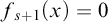 if
$x \leq s$
if
$x \leq s$
 and
$f_{s+1}(x) = 1$
and
$f_{s+1}(x) = 1$
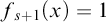 otherwise.
Case 2. If no such m exists, we define
$f_{s+1} = f_s$
 .
.
This completes the construction of
$(f_s)_s$
 . We claim that if Case 1 occurs infinitely often, then
$f = \lim _s f_s$
. We claim that if Case 1 occurs infinitely often, then
$f = \lim _s f_s$
 equals
$0^{\mathbb {N}}$
equals
$0^{\mathbb {N}}$
 ; otherwise, f contains some
$1$
; otherwise, f contains some
$1$
 . Suppose first that Case 1 occurs infinitely often. Given
$x \in \mathbb {N}$
. Suppose first that Case 1 occurs infinitely often. Given
$x \in \mathbb {N}$
 , fix some stage
$s> x$
, fix some stage
$s> x$
 at which Case 1 occurs. We define
$f_{s+1}(x) = 0$
at which Case 1 occurs. We define
$f_{s+1}(x) = 0$
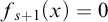 . For all
$t> s+1$
. For all
$t> s+1$
 ,
$f_t(x) = 0$
,
$f_t(x) = 0$
 as well, so
$f(x) = 0$
as well, so
$f(x) = 0$
 .
.
On the other hand, suppose Case 1 occurs only finitely often. For all
$x \in \mathbb {N}$
 which is greater than all stages at which Case 1 occurs, we have
$f_s(x) = 1$
which is greater than all stages at which Case 1 occurs, we have
$f_s(x) = 1$
 for all
$s \in \mathbb {N}$
for all
$s \in \mathbb {N}$
 .
.
It remains to argue that the failure of
$\Phi $
 and
$\Psi $
and
$\Psi $
 is witnessed in either situation. If Case 1 occurs infinitely often, there must be infinitely many m for which
$\Psi (m^{\mathbb {N}},(f_s)_s)=1$
is witnessed in either situation. If Case 1 occurs infinitely often, there must be infinitely many m for which
$\Psi (m^{\mathbb {N}},(f_s)_s)=1$
 . By Ramsey’s theorem applied to the restriction of
$\Phi (f)$
. By Ramsey’s theorem applied to the restriction of
$\Phi (f)$
 to the set of such m, some such m must be contained in some infinite
$\Phi (f)$
to the set of such m, some such m must be contained in some infinite
$\Phi (f)$
 -homogeneous set. Fix such an m and fix some t such that
$\Psi (m^t,(f_s)_s)\downarrow = 1$
-homogeneous set. Fix such an m and fix some t such that
$\Psi (m^t,(f_s)_s)\downarrow = 1$
 . Then,
$m^{t}$
. Then,
$m^{t}$
 may be extended to an
$\mathsf {RT}^{n}_{\mathbb {N}}\mathsf {e}$
may be extended to an
$\mathsf {RT}^{n}_{\mathbb {N}}\mathsf {e}$
 -solution for
$\Phi (f)$
-solution for
$\Phi (f)$
 , but
$\mathsf {LPO}(f) = 0$
, but
$\mathsf {LPO}(f) = 0$
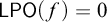 .
.
If Case 1 only occurs finitely often, then let us fix an arbitrary infinite
$\Phi (f)$
 -homogeneous set H. Since
$\Psi $
-homogeneous set H. Since
$\Psi $
 is total,
$\Psi (m^{\mathbb {N}},(f_s)_s)$
is total,
$\Psi (m^{\mathbb {N}},(f_s)_s)$
 is defined for each
$m \in H$
is defined for each
$m \in H$
 . Fix some
$m \in H$
. Fix some
$m \in H$
 such that
$\Psi (m^{\mathbb {N}},(f_s)_s) \neq 1$
such that
$\Psi (m^{\mathbb {N}},(f_s)_s) \neq 1$
 . Fix some t such that
$\Psi (m^t,(f_s)_s)\downarrow = \Psi (m^{\mathbb {N}},(f_s)_s)$
. Fix some t such that
$\Psi (m^t,(f_s)_s)\downarrow = \Psi (m^{\mathbb {N}},(f_s)_s)$
 . Then,
$m^t$
. Then,
$m^t$
 may be extended to an
$\mathsf {RT}^{n}_{\mathbb {N}}\mathsf {e}$
may be extended to an
$\mathsf {RT}^{n}_{\mathbb {N}}\mathsf {e}$
 -solution for
$\Phi (f)$
-solution for
$\Phi (f)$
 , but
$\mathsf {LPO}(f) = 1$
, but
$\mathsf {LPO}(f) = 1$
 .
.
It is easy to see that
$\mathsf {LPO}' \leq ^{\mathrm {t}}_{\mathrm {W}} (\mathsf {RT}^{1}_{2}\mathsf {c})'$
 , so by Propositions 3.12 and 3.13 we have the following corollary.
Corollary 3.14.
$(\mathsf {RT}^{1}_{2}\mathsf {c})' \not \leq ^{\mathrm {t}}_{\mathrm {W}} \mathsf {RT}^{n}_{\mathbb {N}}\mathsf {e}$
 and
$\mathsf {RT}^{2}_{2}\mathsf {c} \not \leq ^{\mathrm {t}}_{\mathrm {W}} \mathsf {RT}^{n}_{\mathbb {N}}\mathsf {e}$
and
$\mathsf {RT}^{2}_{2}\mathsf {c} \not \leq ^{\mathrm {t}}_{\mathrm {W}} \mathsf {RT}^{n}_{\mathbb {N}}\mathsf {e}$
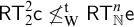 for all n.
The occurrence of
$\mathsf {RT}^{n}_{\mathbb {N}}\mathsf {e}$
 in Proposition 3.13 cannot be replaced with
$\mathsf {RT}^{n}_{\infty }\mathsf {e}$
in Proposition 3.13 cannot be replaced with
$\mathsf {RT}^{n}_{\infty }\mathsf {e}$
 . This follows from the proposition below, which refines the known reduction
$\mathsf {LPO}' \leq _{\mathrm {W}} \mathsf {C}_{\mathbb {N}}'$
. This follows from the proposition below, which refines the known reduction
$\mathsf {LPO}' \leq _{\mathrm {W}} \mathsf {C}_{\mathbb {N}}'$
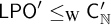 [Reference Soldà and Valenti15, Propositions 7.26 and 7.29].
Proposition 3.15.
$\mathsf {LPO}' \leq ^{\mathrm {t}}_{\mathrm {W}} \mathsf {RT}^{1}_{\infty }\mathsf {c}$
 .
.
Proof. Given
$(f_s)_s$
 , the pre-processing function defines a colouring
$c: \mathbb {N} \to \mathbb {N}$
, the pre-processing function defines a colouring
$c: \mathbb {N} \to \mathbb {N}$
 as follows. Given
$x \in \mathbb {N}$
as follows. Given
$x \in \mathbb {N}$
 , if
$\min \{y < x: f_x(y) = 1\}$
, if
$\min \{y < x: f_x(y) = 1\}$
 exists and equals
$\min \{y < x-1: f_{x-1}(y) = 1\}$
exists and equals
$\min \{y < x-1: f_{x-1}(y) = 1\}$
 , then define
$c(x) = y+1$
, then define
$c(x) = y+1$
 . Otherwise, define
$c(x) = 0$
. Otherwise, define
$c(x) = 0$
 .
.
Suppose
$(f_s)_s$
 is an
$\mathsf {LPO}'$
is an
$\mathsf {LPO}'$
 -instance. Let
$f = \lim _s f_s$
-instance. Let
$f = \lim _s f_s$
 . If
$\mathsf {LPO}(f) = 1$
. If
$\mathsf {LPO}(f) = 1$
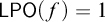 , let y be the least number such that
$f(y) = 1$
, let y be the least number such that
$f(y) = 1$
 . Then
$c(s) = y+1$
. Then
$c(s) = y+1$
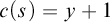 for all sufficiently large s. On the other hand, suppose
$f = 0^{\mathbb {N}}$
for all sufficiently large s. On the other hand, suppose
$f = 0^{\mathbb {N}}$
 . For each
$y \in \mathbb {N}$
. For each
$y \in \mathbb {N}$
 ,
$c(s) \neq y+1$
,
$c(s) \neq y+1$
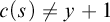 for all sufficiently large s. Furthermore, there are infinitely many s such that
$c(s) = 0$
for all sufficiently large s. Furthermore, there are infinitely many s such that
$c(s) = 0$
 : either
$\{\min \{y<x: f_x(y) = 1\}: x \in \mathbb {N}\}$
: either
$\{\min \{y<x: f_x(y) = 1\}: x \in \mathbb {N}\}$
 is infinite, in which case
$c(x) = 0$
is infinite, in which case
$c(x) = 0$
 whenever the minimum changes value, or
$\{\min \{y<x: f_x(y) = 1\}: x \in \mathbb {N}\}$
whenever the minimum changes value, or
$\{\min \{y<x: f_x(y) = 1\}: x \in \mathbb {N}\}$
 is finite, in which case
$c(s) = 0$
is finite, in which case
$c(s) = 0$
 for all sufficiently large s. Therefore c is an
$\mathsf {RT}^{1}_{\infty }\mathsf {e}$
for all sufficiently large s. Therefore c is an
$\mathsf {RT}^{1}_{\infty }\mathsf {e}$
 -instance.
The post-processing function works as follows. Given a colour j, we return
$0$
 if
$j = 0$
if
$j = 0$
 and return
$1$
and return
$1$
 otherwise. Our analysis in the previous paragraph implies that this works correctly.
We do not know if the right-hand side of Corollary 3.14 can be replaced by
$\mathsf {RT}^{n}_{\infty }\mathsf {e}$
 . For
$n = 1$
. For
$n = 1$
 , it follows from the proposition below that
$(\mathsf {RT}^{1}_{2}\mathsf {c})' \not \leq ^{\mathrm {t}}_{\mathrm {W}} \mathsf {RT}^{1}_{\infty }\mathsf {e}$
, it follows from the proposition below that
$(\mathsf {RT}^{1}_{2}\mathsf {c})' \not \leq ^{\mathrm {t}}_{\mathrm {W}} \mathsf {RT}^{1}_{\infty }\mathsf {e}$
 (even
$\mathsf {RT}^{1}_{\infty }\mathsf {pe}$
(even
$\mathsf {RT}^{1}_{\infty }\mathsf {pe}$
 ).
).
Proposition 3.16.
$(\mathsf {RT}^{1}_{2}\mathsf {c})' \not \leq _{\mathrm {W}} \mathsf {RT}^{1}_{\infty }$
 .
.
Proof. It is known that
$\mathsf {RT}^{1}_{2}\mathsf {c}$
 is not continuously Weihrauch reducible to
$\mathsf {C}_{\mathbb {N}}$
is not continuously Weihrauch reducible to
$\mathsf {C}_{\mathbb {N}}$
 . Since we did not find a source (specifically for the topological separation), we give a proof. Given continuous functions
$\Phi $
. Since we did not find a source (specifically for the topological separation), we give a proof. Given continuous functions
$\Phi $
 and
$\Psi $
and
$\Psi $
 which witness the reduction, we shall construct a colouring
$c: \mathbb {N} \to 2$
which witness the reduction, we shall construct a colouring
$c: \mathbb {N} \to 2$
 as follows.
Case 1. For all n and all finite partial colourings
$\sigma : \subseteq \mathbb {N} \to 2$
 , there is some
$\tau \supseteq \sigma $
, there is some
$\tau \supseteq \sigma $
 such that
$\Phi (\tau )$
such that
$\Phi (\tau )$
 enumerates n. Then we construct c in stages, as follows. At stage n, suppose we have constructed a finite partial colouring
$\sigma _n$
enumerates n. Then we construct c in stages, as follows. At stage n, suppose we have constructed a finite partial colouring
$\sigma _n$
 . Define
$\sigma _{n+1}$
. Define
$\sigma _{n+1}$
 to be the least extension of
$\sigma _n$
to be the least extension of
$\sigma _n$
 such that
$\Phi (\sigma _{n+1})$
such that
$\Phi (\sigma _{n+1})$
 enumerates n. Define
$c = \bigcup _n \sigma _n$
enumerates n. Define
$c = \bigcup _n \sigma _n$
 . Then
$\Phi (c)$
. Then
$\Phi (c)$
 is not a
$\mathsf {C}_{\mathbb {N}}$
is not a
$\mathsf {C}_{\mathbb {N}}$
 -instance because it enumerates every
$n \in \mathbb {N}$
-instance because it enumerates every
$n \in \mathbb {N}$
 .
.
Case 2. Otherwise, fix some n and some
$\sigma : \subseteq \mathbb {N} \to 2$
 such that for all
$\tau \supseteq \sigma $
such that for all
$\tau \supseteq \sigma $
 ,
$\Phi (\tau )$
,
$\Phi (\tau )$
 does not enumerate n. In particular, n is a
$\mathsf {C}_{\mathbb {N}}$
does not enumerate n. In particular, n is a
$\mathsf {C}_{\mathbb {N}}$
 -solution for
$\Phi (\sigma ^{\frown } 0^{\mathbb {N}})$
-solution for
$\Phi (\sigma ^{\frown } 0^{\mathbb {N}})$
 , so
$\Psi (n,\sigma ^{\frown } 0^{\mathbb {N}})$
, so
$\Psi (n,\sigma ^{\frown } 0^{\mathbb {N}})$
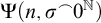 produces the unique
$\mathsf {RT}^{1}_{2}\mathsf {c}$
produces the unique
$\mathsf {RT}^{1}_{2}\mathsf {c}$
 -solution
$0$
-solution
$0$
 for
$\sigma ^{\frown } 0^{\mathbb {N}}$
for
$\sigma ^{\frown } 0^{\mathbb {N}}$
 . Fix some sufficiently large s such that
$\Psi (n,\sigma ^{\frown } 0^s)$
. Fix some sufficiently large s such that
$\Psi (n,\sigma ^{\frown } 0^s)$
 produces
$0$
produces
$0$
 . Then
$\Psi (n,\sigma ^{\frown } 0^s 1^{\mathbb {N}})$
. Then
$\Psi (n,\sigma ^{\frown } 0^s 1^{\mathbb {N}})$
 produces
$0$
produces
$0$
 but
$0$
but
$0$
 is not an
$\mathsf {RT}^{1}_{2}\mathsf {c}$
is not an
$\mathsf {RT}^{1}_{2}\mathsf {c}$
 -solution for
$\sigma ^{\frown } 0^s 1^{\mathbb {N}}$
-solution for
$\sigma ^{\frown } 0^s 1^{\mathbb {N}}$
 , yielding a contradiction.
Since
$\mathsf {RT}^{1}_{2}\mathsf {c}$
 is not continuously Weihrauch reducible to
$\mathsf {C}_{\mathbb {N}}$
is not continuously Weihrauch reducible to
$\mathsf {C}_{\mathbb {N}}$
 , we conclude by [Reference Brattka, Hölzl and Kuyper6, Theorem 11] that
$(\mathsf {RT}^{1}_{2}\mathsf {c})' \not \leq _{\mathrm {W}} \mathsf {C}_{\mathbb {N}}' \equiv _{\mathrm {W}} \mathsf {RT}^{1}_{\infty }$
, we conclude by [Reference Brattka, Hölzl and Kuyper6, Theorem 11] that
$(\mathsf {RT}^{1}_{2}\mathsf {c})' \not \leq _{\mathrm {W}} \mathsf {C}_{\mathbb {N}}' \equiv _{\mathrm {W}} \mathsf {RT}^{1}_{\infty }$
 .
.
Theorem 3.17.
$(\mathsf {RT}^{1}_{2}\chi )'$
 is not
$\leq ^{\mathrm {t}}_{\mathrm {W}}$
is not
$\leq ^{\mathrm {t}}_{\mathrm {W}}$
 -reducible to any problem with codomain
$(\mathcal {P}(\mathbb {N})\setminus \{\emptyset \},\delta _e)$
-reducible to any problem with codomain
$(\mathcal {P}(\mathbb {N})\setminus \{\emptyset \},\delta _e)$
 .
.
Proof. Let g be a problem with codomain
$(\mathcal {P}(\mathbb {N})\setminus \{\emptyset \},\delta _e)$
 . Suppose that
$\Phi $
. Suppose that
$\Phi $
 and
$\Psi $
and
$\Psi $
 witness
$(\mathsf {RT}^{1}_{2}\chi )'\leq ^{\mathrm {t}}_{\mathrm {W}} g$
witness
$(\mathsf {RT}^{1}_{2}\chi )'\leq ^{\mathrm {t}}_{\mathrm {W}} g$
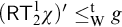 . We employ a finite injury priority argument, constructing for each s,
$f_{s}:\mathbb {N}\to \{0,1\}$
. We employ a finite injury priority argument, constructing for each s,
$f_{s}:\mathbb {N}\to \{0,1\}$
 such that
$f(x)=\lim _{s}f_{s}(x)$
such that
$f(x)=\lim _{s}f_{s}(x)$
 exists for all x. In the informal description, we shall think of f as a
$\Delta _{2}^{0}$
exists for all x. In the informal description, we shall think of f as a
$\Delta _{2}^{0}$
 function instead of specifying the definition of
$f_{s}$
function instead of specifying the definition of
$f_{s}$
 for each s. Fix some ordering of all non-empty finite sets,
$D_{0},D_{1},\dots $
for each s. Fix some ordering of all non-empty finite sets,
$D_{0},D_{1},\dots $
 , such that if
$D_{i}\subseteq D_{j}$
, such that if
$D_{i}\subseteq D_{j}$
 , then
$i\leq j$
, then
$i\leq j$
 .
.
Intuitively, the ‘advantage’ that an enumeration has over the characteristic function is that an enumeration may delay revealing (small) elements for arbitrarily long. Since
$\Psi $
 is total, it must continue to reveal more bits of the characteristic function even with constant enumerations as its oracle. However, if the constant enumeration does not name a valid g-solution,
$\Psi $
is total, it must continue to reveal more bits of the characteristic function even with constant enumerations as its oracle. However, if the constant enumeration does not name a valid g-solution,
$\Psi $
 is not obliged to produce a valid solution to
$f=\lim _{s}f_{s}$
is not obliged to produce a valid solution to
$f=\lim _{s}f_{s}$
 . The tension here would be to make the enumeration ‘sufficiently slow’ whilst producing a potential solution to g in the limit.
The idea is that we will diagonalise against any possible g-solution X (a finite or infinite set) as follows. Initially let f be the all zero colouring. Let the sequence of finite sets
$D_{i_{1}}\subsetneq D_{i_{2}}\subsetneq \dots \subseteq X$
 be such that
$X=\bigcup _{j}D_{i_j}$
be such that
$X=\bigcup _{j}D_{i_j}$
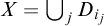 ,
$|D_{i_{j}}|=j$
,
$|D_{i_{j}}|=j$
 and
$\max D_{i_{j+1}}>\max D_{i_{j}}$
and
$\max D_{i_{j+1}}>\max D_{i_{j}}$
 for each j. We shall denote
$\max D_{k}=d_{k}$
for each j. We shall denote
$\max D_{k}=d_{k}$
 for each
$k\in \mathbb {N}$
for each
$k\in \mathbb {N}$
 . The goal now is to construct some enumeration
$\delta $
. The goal now is to construct some enumeration
$\delta $
 of X so that
$\Psi (\delta ,(f_{s})_{s})$
of X so that
$\Psi (\delta ,(f_{s})_{s})$
 is not the characteristic function of an f-homogeneous set. First consider the function
$\Psi (d_{i_{1}}^{\mathbb {N}},(f_{s})_{s})$
is not the characteristic function of an f-homogeneous set. First consider the function
$\Psi (d_{i_{1}}^{\mathbb {N}},(f_{s})_{s})$
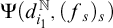 . If there is some
$t\in \mathbb {N}$
. If there is some
$t\in \mathbb {N}$
 and
$x,y\in \mathbb {N}$
and
$x,y\in \mathbb {N}$
 such that
$x<y$
such that
$x<y$
 and
$\Psi (d_{i_{1}}^{t},(f_{s})_{s})(x)=\Psi (d_{i_{1}}^{t},(f_{s})_{s})(y)=1$
and
$\Psi (d_{i_{1}}^{t},(f_{s})_{s})(x)=\Psi (d_{i_{1}}^{t},(f_{s})_{s})(y)=1$
 , then we define
$f(y)=1-f(x)$
, then we define
$f(y)=1-f(x)$
 , ensuring that
$\{x,y\}$
, ensuring that
$\{x,y\}$
 cannot be extended to a homogeneous set. Therefore, we have successfully diagonalised against X.
However, as observed earlier,
$\Psi (d_{i_{1}}^{\mathbb {N}},(f_{s})_{s})$
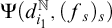 is not at all obliged to produce any elements as
$D_{i_{1}}$
is not at all obliged to produce any elements as
$D_{i_{1}}$
 may not be a g-solution. So suppose
$\Psi (d_{i_{1}}^{\mathbb {N}},(f_{s})_{s})(x)=1$
may not be a g-solution. So suppose
$\Psi (d_{i_{1}}^{\mathbb {N}},(f_{s})_{s})(x)=1$
 for at most one
$x\in \mathbb {N}$
for at most one
$x\in \mathbb {N}$
 . While we must give ‘new information’ in the enumeration (to ensure it is a valid solution), we can exploit the fact that we can force
$\Psi $
. While we must give ‘new information’ in the enumeration (to ensure it is a valid solution), we can exploit the fact that we can force
$\Psi $
 to commit on arbitrarily long initial segments of
$\mathbb {N}$
to commit on arbitrarily long initial segments of
$\mathbb {N}$
 .
.
Then once we have seen that
$|\{x<z\mid \Psi (d_{i_{1}}^{\mathbb {N}},(f_{s})_{s})(x)=1\}|<2$
 for some ‘sufficiently large’ z (chosen by the construction), we wish to begin adding
$d_{i_{2}}$
for some ‘sufficiently large’ z (chosen by the construction), we wish to begin adding
$d_{i_{2}}$
 to the enumeration. That is, we begin to consider
$D_{i_2}$
to the enumeration. That is, we begin to consider
$D_{i_2}$
 . Now we carefully choose the oracle that we will consider. The idea is for us to repeat the first bit,
$d_{i_1}$
. Now we carefully choose the oracle that we will consider. The idea is for us to repeat the first bit,
$d_{i_1}$
 , long enough to force
$\Psi $
, long enough to force
$\Psi $
 to commit on the string that we have seen so far before adding the next bit. That is, we will monitor
$\Psi (d_{i_{1}}^{t}\!^{\frown } d_{i_{2}}^{\mathbb {N}},(f_{s})_{s})$
to commit on the string that we have seen so far before adding the next bit. That is, we will monitor
$\Psi (d_{i_{1}}^{t}\!^{\frown } d_{i_{2}}^{\mathbb {N}},(f_{s})_{s})$
 , where t is such that
$\Psi (d_{i_1}^{t},(f_{s})_{s})(x)\downarrow $
, where t is such that
$\Psi (d_{i_1}^{t},(f_{s})_{s})(x)\downarrow $
 for sufficiently many x. If the characteristic function now produces at least two elements, say
$x<y$
for sufficiently many x. If the characteristic function now produces at least two elements, say
$x<y$
 , we may then define
$f(y)=1-f(x)$
, we may then define
$f(y)=1-f(x)$
 as before, ensuring that
$\Psi $
as before, ensuring that
$\Psi $
 never produces an f-homogeneous set on enumerations beginning with
${d_{i_{1}}^{t}}^{\frown } d_{i_{2}}^{t'}$
never produces an f-homogeneous set on enumerations beginning with
${d_{i_{1}}^{t}}^{\frown } d_{i_{2}}^{t'}$
 for some sufficiently large
$t'$
for some sufficiently large
$t'$
 . If the second bit does not produce such an
$x,y$
. If the second bit does not produce such an
$x,y$
 , then we will repeat this strategy to add the next bit (of the potential solution to g).
To ensure no injury to higher priority requirements, each finite set
$D_{i}$
 of size n is given some ‘restraint’
$r(i)$
of size n is given some ‘restraint’
$r(i)$
 that it must respect. Additionally this restraint defines the length of the string we wait for
$\Psi $
that it must respect. Additionally this restraint defines the length of the string we wait for
$\Psi $
 to commit to on the enumeration of the first
$n-1$
to commit to on the enumeration of the first
$n-1$
 elements. That is, we are looking for
$\Psi $
elements. That is, we are looking for
$\Psi $
 to produce two elements
$x,y$
to produce two elements
$x,y$
 such that
$x<y$
such that
$x<y$
 and
$y\geq r(i)$
and
$y\geq r(i)$
 . Then the element y cannot have been ‘used’ by any higher priority requirement, and we may safely define
$f(y)=1-f(x)$
. Then the element y cannot have been ‘used’ by any higher priority requirement, and we may safely define
$f(y)=1-f(x)$
 without injuring any higher priority requirements. That is, the colour of
$x<r(i)$
without injuring any higher priority requirements. That is, the colour of
$x<r(i)$
 can only be changed by
$D_{i'}$
can only be changed by
$D_{i'}$
 with
$i'<i$
with
$i'<i$
 . The restraints will be maintained stage-wise and have the property that for all
$i,s\in \mathbb {N}$
. The restraints will be maintained stage-wise and have the property that for all
$i,s\in \mathbb {N}$
 ,
$r(i)[s]\leq r(i)[s+1]$
,
$r(i)[s]\leq r(i)[s+1]$
 and
$r(i)[s]<r(i+1)[s]$
and
$r(i)[s]<r(i+1)[s]$
 . When we act for
$D_i$
. When we act for
$D_i$
 , each
$r(i')$
, each
$r(i')$
 will be kicked to some ‘large’ value for each
$i'>i$
will be kicked to some ‘large’ value for each
$i'>i$
 as is standard in a movable marker construction.
In the construction, we ensure that any solution
$X\subseteq \mathbb {N}$
 , possibly finite, has an enumeration
$\delta $
, possibly finite, has an enumeration
$\delta $
 such that
$\Psi (\delta ,f)$
such that
$\Psi (\delta ,f)$
 does not output a valid solution by doing the strategy as described for each finite set. The idea is that to deal with
$D_i$
does not output a valid solution by doing the strategy as described for each finite set. The idea is that to deal with
$D_i$
 , we consider the (unique) sequence of sets that build up the set one by one in order of its principal enumeration. We then use the strategy as described for this sequence of sets. We now detail the formal construction.
Construction: Fix some ordering of all finite non-empty sets,
$D_{0},D_{1},\dots $
 , such that if
$D_{i}\subseteq D_{j}$
, such that if
$D_{i}\subseteq D_{j}$
 , then
$i\leq j$
, then
$i\leq j$
 . For each
$D_i$
. For each
$D_i$
 we will consider the following unique sequence of sets:
$D_{i_1}\subsetneq D_{i_2}\subsetneq \cdots \subsetneq D_{i_n}=D_i$
we will consider the following unique sequence of sets:
$D_{i_1}\subsetneq D_{i_2}\subsetneq \cdots \subsetneq D_{i_n}=D_i$
 , where
$n=|D_i|$
, where
$n=|D_i|$
 and
$d_{i_1}<d_{i_2}<\cdots <d_{i_n}$
and
$d_{i_1}<d_{i_2}<\cdots <d_{i_n}$
 (recall that
$d_{i_j}=\max D_{i_j}$
(recall that
$d_{i_j}=\max D_{i_j}$
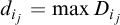 ). During the construction, each
$D_{i}$
). During the construction, each
$D_{i}$
 will be either active, inactive, or waiting. These states correspond to when the strategy for
$D_{i}$
will be either active, inactive, or waiting. These states correspond to when the strategy for
$D_{i}$
 is currently in progress, or has already acted, or not yet begun, respectively. For
$D_{i}$
is currently in progress, or has already acted, or not yet begun, respectively. For
$D_{i}$
 which are currently active, we will also use
$\delta _{i}[s]\in \mathbb {N}^{\mathbb {N}}$
which are currently active, we will also use
$\delta _{i}[s]\in \mathbb {N}^{\mathbb {N}}$
 to denote the current enumeration of
$D_{i}$
to denote the current enumeration of
$D_{i}$
 being used as an oracle in the computation
$D_{i}$
being used as an oracle in the computation
$D_{i}$
 is monitoring for its strategy.
-
At stage 0: Declare all $D_i$
to be in the waiting state and leave each
$\delta _i[0]$
undefined. Define
$r(j)[0]=j$
for all
$j\in \mathbb {N}$
. Let f be the all zero colouring. -
At stage s + 1: Let $i\leq s+1$
be the least such that one of the following holds:-
(i) $D_{i}$
is currently active and there exists
$x,y$
such that
$x>y\geq r(i-1)[s]$
, and
$\Psi (\delta _{i}[s],(f_{t})_{t\leq s})(x)=\Psi (\delta _{i}[s],(f_{t})_{t\leq s}) (y)=1$
. For such an i, we act for
$D_{i}$
, declaring
$f(y)=1-f(x)$
. Also define for each e,
$r(e)[s+1]$
to be
$r(e)[s]$
if
$e<i$
, and the least number
$>\max \{r(e)[s],r(e-1)[s+1]\}$
otherwise. Declare
$D_{i}$
to now be inactive, and for each
$j>i$
, declare
$D_{j}$
to be in the waiting state and
$\delta _{j}[s+1]$
to be undefined. Finally, for
$e\leq i$
, define
$\delta _{e}[s+1]=\delta _{e}[s]$
and proceed to the next stage. -
(ii) $D_{i}$
is in the waiting state and for each
$j<n$
, where
$n=|D_{i}|$
,
$D_{i_{j}}$
is currently active. Then do the following for the least
$i<s$
such that one of the following applies (do nothing and go to the next stage if no such i exists):-
• If $|D_i|>1$
, then let l be the least such that for each
$x<r(i)[s]$
,
$\Psi (\delta _{i_{n-1}}[s]\restriction l,(f_{t})_{t\leq s})(x)\downarrow $
. Such an l must exist, since
$\Psi $
is assumed to be total. Then define
$\delta _{i}[s+1]=(\delta _{i_{n-1}}[s]\restriction l)^{\frown } d_{i}^{\mathbb {N}}$
. Finally, define for each e,
$r(e)[s+1]=r(e)[s]$
, and if
$e\neq i$
,
$\delta _{e}[s+1]=\delta _{e}[s]$
, whenever defined, and proceed to the next stage. -
• If $|D_i|=1$
, then declare
$D_i$
active.
-
-






















Verification: Now we verify that the construction works; each
$D_{i}$
 acts only finitely many times;
$f:\mathbb {N}\to \{0,1\}$
acts only finitely many times;
$f:\mathbb {N}\to \{0,1\}$
 is
$\Delta _{2}^{0}$
is
$\Delta _{2}^{0}$
 ; and for any set X that is a solution to the instance
$\Phi ((f_{s})_{s})$
; and for any set X that is a solution to the instance
$\Phi ((f_{s})_{s})$
 , there is some enumeration
$\delta $
, there is some enumeration
$\delta $
 of X such that
$\Psi (\delta ,(f_{s})_{s})$
of X such that
$\Psi (\delta ,(f_{s})_{s})$
 is not a solution to f.
From the construction, once
$D_{i}$
 acts, it is declared inactive and never again acts unless it gets initialised and placed in the waiting state by some higher priority requirement. Evidently, this ensures that each
$D_{i}$
acts, it is declared inactive and never again acts unless it gets initialised and placed in the waiting state by some higher priority requirement. Evidently, this ensures that each
$D_{i}$
 acts at most finitely often and thus, for each i,
$\lim _{s}r(i)[s]<\infty $
acts at most finitely often and thus, for each i,
$\lim _{s}r(i)[s]<\infty $
 . Additionally, after stage
$s^{*}$
. Additionally, after stage
$s^{*}$
 , where
$r(i)[s^*]=\lim _{s}r(i)[s]$
, where
$r(i)[s^*]=\lim _{s}r(i)[s]$
 ,
$f(x)$
,
$f(x)$
 is never changed again for all
$x<r(i)[s^{*}]$
is never changed again for all
$x<r(i)[s^{*}]$
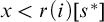 . Therefore, f is
$\Delta _{2}^{0}$
. Therefore, f is
$\Delta _{2}^{0}$
 and
$(f_{s})_{s}$
and
$(f_{s})_{s}$
 is a valid instance to
$(\mathsf {RT}^{1}_{2}\chi )'$
is a valid instance to
$(\mathsf {RT}^{1}_{2}\chi )'$
 .
.
Now suppose that
$X\subseteq \mathbb {N}$
 is a solution to the g-instance
$\Phi ((f_{s})_{s})$
is a solution to the g-instance
$\Phi ((f_{s})_{s})$
 . Note that X can be infinite or finite. Let
$D_{i_1}\subsetneq D_{i_{2}}\subsetneq \dots \subseteq X$
. Note that X can be infinite or finite. Let
$D_{i_1}\subsetneq D_{i_{2}}\subsetneq \dots \subseteq X$
 be a sequence of finite sets such that for each n,
$|D_{i_{n}}|=n$
be a sequence of finite sets such that for each n,
$|D_{i_{n}}|=n$
 ,
$d_{i_{n}}<d_{i_{n+1}}$
,
$d_{i_{n}}<d_{i_{n+1}}$
 , and
$X=\bigcup _{j}D_{i_j}$
, and
$X=\bigcup _{j}D_{i_j}$
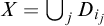 . For each j, let
$t_{j}$
. For each j, let
$t_{j}$
 be the least stage such that
$r(i_{j})[t_{j}]=\lim _{s}r(i_{j})[s]$
be the least stage such that
$r(i_{j})[t_{j}]=\lim _{s}r(i_{j})[s]$
 .
.
From the construction, for stages
$s>t_{j}$
 , no
$D_{k}$
, no
$D_{k}$
 for any
$k\leq i_{j}$
for any
$k\leq i_{j}$
 acts at stage s. That is to say, if
$D_{i_{j}}$
acts at stage s. That is to say, if
$D_{i_{j}}$
 was declared inactive at stage
$t_{j}$
was declared inactive at stage
$t_{j}$
 , then it must have acted during stage
$t_{j}$
, then it must have acted during stage
$t_{j}$
 . Since
$D_{i_j}$
. Since
$D_{i_j}$
 acted, there exists
$x,y$
acted, there exists
$x,y$
 such that
$x>y\geq r(i_j-1)[t_{j}-1]$
such that
$x>y\geq r(i_j-1)[t_{j}-1]$
 and
$\Psi (\delta _{i_j}[t_{j}-1],f)(x)=\Psi (\delta _{i_j}[t_j-1],f)(y)=1$
and
$\Psi (\delta _{i_j}[t_{j}-1],f)(x)=\Psi (\delta _{i_j}[t_j-1],f)(y)=1$
 and
$f(y)[t_{j}]=1-f(x)$
and
$f(y)[t_{j}]=1-f(x)$
 . Then for all
$e\geq i_j$
. Then for all
$e\geq i_j$
 and
$s\geq t_{j}$
and
$s\geq t_{j}$
 ,
$r(e)[s]>x,y$
,
$r(e)[s]>x,y$
 . Therefore no
$D_e$
. Therefore no
$D_e$
 with
$e>i_j$
with
$e>i_j$
 can further change
$f(x)$
can further change
$f(x)$
 or
$f(y)$
or
$f(y)$
 . Similarly, by the definition of
$t_j$
. Similarly, by the definition of
$t_j$
 , none of
$D_{k}$
, none of
$D_{k}$
 for any
$k<i_j$
for any
$k<i_j$
 acts after stage
$t_j$
acts after stage
$t_j$
 . This implies that
$f(y)=1-f(x)$
. This implies that
$f(y)=1-f(x)$
 and therefore
$\Psi (\delta _{i_j}[t_{j}],(f_{s})_{s})$
and therefore
$\Psi (\delta _{i_j}[t_{j}],(f_{s})_{s})$
 does not output a valid solution. In particular, for any set
$X\supseteq D_{i_{j}}$
does not output a valid solution. In particular, for any set
$X\supseteq D_{i_{j}}$
 ,
$\Psi ((\delta _{i_j}[t_j]\restriction l)^{\frown } \delta ^{X},(f_{s})_{s})$
,
$\Psi ((\delta _{i_j}[t_j]\restriction l)^{\frown } \delta ^{X},(f_{s})_{s})$
 , where
$\delta ^X$
, where
$\delta ^X$
 is the principal enumeration of X and l is chosen such that
$\Psi (\delta _{i_j}[t_j]\restriction l,(f_{s})_{s})(z)\downarrow $
is the principal enumeration of X and l is chosen such that
$\Psi (\delta _{i_j}[t_j]\restriction l,(f_{s})_{s})(z)\downarrow $
 for each
$z< r(i_j)[t_j]$
for each
$z< r(i_j)[t_j]$
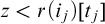 cannot be a valid solution to f.
On the other hand, if
$D_{i_{j}}$
 does not act during stage
$t_j$
does not act during stage
$t_j$
 , its state never again changes for all stages
$s\geq t_j$
, its state never again changes for all stages
$s\geq t_j$
 . That is, either
$D_{i_{j}}$
. That is, either
$D_{i_{j}}$
 remains forever in the waiting state, implying that some
$D_{i_{k}}$
remains forever in the waiting state, implying that some
$D_{i_{k}}$
 , where
$k<j$
, where
$k<j$
 is inactive (since
$D_{i_{1}}$
is inactive (since
$D_{i_{1}}$
 cannot be in the waiting state for cofinitely many stages), or
$D_{i_{j}}$
cannot be in the waiting state for cofinitely many stages), or
$D_{i_{j}}$
 itself remains in the active state for cofinitely many stages. In the former case,
$D_{i_j}$
itself remains in the active state for cofinitely many stages. In the former case,
$D_{i_j}$
 is necessarily a superset of some
$D_{i_k}$
is necessarily a superset of some
$D_{i_k}$
 which remains inactive and thus we are done. Thus, we may assume that for all j,
$D_{i_j}$
which remains inactive and thus we are done. Thus, we may assume that for all j,
$D_{i_j}$
 remains in the active state for all stages
$s\geq t_j$
remains in the active state for all stages
$s\geq t_j$
 . For each j, since we never act for any higher priority set after stage
$t_j$
. For each j, since we never act for any higher priority set after stage
$t_j$
 , or for
$D_{i_j}$
, or for
$D_{i_j}$
 itself, then for all j,
$|\{x\mid \Psi (\delta _{i_j}[t_j],(f_{s})_{s})(x)=1\}\cap \{y\mid y\geq \lim _{s}r(i_{j}-1)[s]\}|=0$
itself, then for all j,
$|\{x\mid \Psi (\delta _{i_j}[t_j],(f_{s})_{s})(x)=1\}\cap \{y\mid y\geq \lim _{s}r(i_{j}-1)[s]\}|=0$
 . Therefore
$\Psi (\lim _{j}\delta _{i_j}[t_j],(f_{s})_{s})$
. Therefore
$\Psi (\lim _{j}\delta _{i_j}[t_j],(f_{s})_{s})$
 produces only a finite set which cannot be a valid solution to
$(f_{s})_{s}$
produces only a finite set which cannot be a valid solution to
$(f_{s})_{s}$
 but
$\lim _{j}\delta _{i_j}[t_j]$
but
$\lim _{j}\delta _{i_j}[t_j]$
 is an enumeration of X.
It follows from Proposition 3.12 that:
Corollary 3.18.
$\mathsf {RT}^{2}_{2}\chi $
 is not
$\leq ^{\mathrm {t}}_{\mathrm {W}}$
is not
$\leq ^{\mathrm {t}}_{\mathrm {W}}$
 -reducible to any problem with codomain
$(\mathcal {P}(\mathbb {N})\setminus \{\emptyset \},\delta _e)$
-reducible to any problem with codomain
$(\mathcal {P}(\mathbb {N})\setminus \{\emptyset \},\delta _e)$
 .
.
Next, observe that
$\mathsf {RT}^{2}_{2} \not \leq _{\mathrm {W}} \mathsf {RT}^{n}_{\infty }\mathsf {c}, \mathsf {RT}^{1}_{\infty }$
 because the former problem is not computably true, unlike the latter problems. We show below that there are not even continuous Weihrauch reductions (Corollary 3.23).
Definition 3.19. Let
$f:\subseteq X\rightrightarrows Y$
 be a problem. We define
$\breve {f}_\omega : \subseteq X \rightrightarrows \overline {Y}^{\mathbb {N}}$
be a problem. We define
$\breve {f}_\omega : \subseteq X \rightrightarrows \overline {Y}^{\mathbb {N}}$
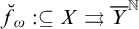 by
$(p_n)_n \in \breve {f}_\omega (x)$
by
$(p_n)_n \in \breve {f}_\omega (x)$
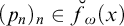 if and only if
$p_n \in f(x)$
if and only if
$p_n \in f(x)$
 for some
$n \in \mathbb {N}$
for some
$n \in \mathbb {N}$
 . We say that f is continuously countably guessable if
$\breve {f}_\omega $
. We say that f is continuously countably guessable if
$\breve {f}_\omega $
 is continuous.
Remark 3.20. Following the treatment of completions by Pauly and Soldà [Reference Pauly, Soldà, Patey, Pimentel, Galeotti and Manea14], we note that the Weihrauch degree of
$\breve {f}_\omega $
 does not depend on the choice of completion
$\overline {Y}$
does not depend on the choice of completion
$\overline {Y}$
 .
.
Remark 3.21. For each problem f, the problem
$\breve {f}_\omega $
 is Weihrauch reducible to the stashing
$\Sigma f$
is Weihrauch reducible to the stashing
$\Sigma f$
 [Reference Brattka1, Definition 1.6], by pre-processing with
$x \mapsto (x)_n$
[Reference Brattka1, Definition 1.6], by pre-processing with
$x \mapsto (x)_n$
 .
.
It is easy to see that
-
• being continuously countably guessable is closed downwards under continuous Weihrauch reduction, and
-
• if a problem is computably true, i.e., every instance x has an x-computable solution, then it is continuously countably guessable.
Lemma 3.22.
$(\mathsf {RT}^{1}_{2})'$
 is not continuously countably guessable.
Proof. Suppose
$\Psi $
 is a continuous map such that if
$(c_s)_s$
is a continuous map such that if
$(c_s)_s$
 is an
$(\mathsf {RT}^{1}_{2})'$
is an
$(\mathsf {RT}^{1}_{2})'$
 -instance, then
$\Psi ((c_s)_s) = (p_n)_n$
-instance, then
$\Psi ((c_s)_s) = (p_n)_n$
 , where each
$p_n \in \overline {\mathbb {N}^{\mathbb {N}}}$
, where each
$p_n \in \overline {\mathbb {N}^{\mathbb {N}}}$
 . We shall construct an
$(\mathsf {RT}^{1}_{2})'$
. We shall construct an
$(\mathsf {RT}^{1}_{2})'$
 -instance
$(c_s)_s$
-instance
$(c_s)_s$
 with limit colouring c such that all requirements

are satisfied.
Construction: Arrange these requirements in order of priority. At stage s of our construction, we shall define
$c_s: \mathbb {N} \to 2$
 . During the construction, we will refer to
$p_n$
. During the construction, we will refer to
$p_n$
 , with the understanding that we only have partial information about
$p_n$
, with the understanding that we only have partial information about
$p_n$
 given by applying
$\Psi $
given by applying
$\Psi $
 to the colourings
$c_s$
to the colourings
$c_s$
 defined thus far. For each n, the strategy for
$R_n$
defined thus far. For each n, the strategy for
$R_n$
 may act to protect certain numbers which have been enumerated into
$p_n$
may act to protect certain numbers which have been enumerated into
$p_n$
 . We will use
$P_n[s]$
. We will use
$P_n[s]$
 to denote the set of numbers protected by
$R_n$
to denote the set of numbers protected by
$R_n$
 at stage s.
Begin by defining all
$P_n[0]$
 to be empty.
-
Stage s: Define $c_s$
as follows:
$c_s(x)=0$
unless there are some
$y<x$
and
$n<s$
such that
$x,y\in P_n[s]$
and
$x,y\notin P_m[s]$
for any
$m<n$
. If such y (and n) exist, then pick the least such y and define
$c_s(x)=1-c_s(y)$
.For $n \leq s$
, we define
$P_n[s+1]$
as follows. If x is enumerated into
$p_0$
and
$|P_0[s]|\leq 1$
then define
$P_0[s+1]=P_0\cup \{x\}$
. For each
$0<n\leq s$
, if some x is enumerated into
$p_n$
then take the least such x and do as follows:-
• If there are some $y<z$
such that
$y,z\in P_n[s]$
and
$y,z\notin P_m[s]$
for any
$m<n$
, then define
$P_n[s+1]=P_n[s]$
. -
• Otherwise, define $P_n[s+1]=P_n[s]\cup \{x\}$
.
This completes stage s of the construction.
-



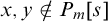







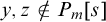



Verification: We first show that for each requirement
$R_{n}$
 , the limit
$P_n = \lim _s P_n[s]$
, the limit
$P_n = \lim _s P_n[s]$
 exists and is finite. It is clear from construction that
$P_0$
exists and is finite. It is clear from construction that
$P_0$
 exists and
$|P_0| \leq 2$
exists and
$|P_0| \leq 2$
 . Suppose for all
$m < n$
. Suppose for all
$m < n$
 ,
$P_m = \lim _s P_m[s]$
,
$P_m = \lim _s P_m[s]$
 exists and is finite. We claim that
$P_n = \lim _s P_n[s]$
exists and is finite. We claim that
$P_n = \lim _s P_n[s]$
 exists and
$\left |P_{n}\cup \bigcup _{m<n}P_{m}\right |\leq \left |\bigcup _{m<n}P_{m}\right |+2$
exists and
$\left |P_{n}\cup \bigcup _{m<n}P_{m}\right |\leq \left |\bigcup _{m<n}P_{m}\right |+2$
 . Indeed, after every
$P_m$
. Indeed, after every
$P_m$
 for
$m < n$
for
$m < n$
 has stabilised, at most two numbers outside
$\bigcup _{m<n} P_m$
has stabilised, at most two numbers outside
$\bigcup _{m<n} P_m$
 can be added to
$P_n$
can be added to
$P_n$
 .
.
Next, we prove by induction on x that for each x,
$c(x) = \lim _s c_s(x)$
 exists. We have
$c_s(0) = 0$
exists. We have
$c_s(0) = 0$
 for all s. As for
$x> 0$
for all s. As for
$x> 0$
 , if there are some
$y < x$
, if there are some
$y < x$
 and n such that
$x,y \in P_n\setminus \bigcup _{m<n} P_m$
and n such that
$x,y \in P_n\setminus \bigcup _{m<n} P_m$
 , then for the least such y, we have
$\lim _s c_s(x) = 1-c(y)$
, then for the least such y, we have
$\lim _s c_s(x) = 1-c(y)$
 .
.
Finally, we show that each
$R_{n}$
 is satisfied. Suppose
$p_n$
is satisfied. Suppose
$p_n$
 is infinite, otherwise we are done. Then there must be exactly two elements in
$P_{n}\setminus \bigcup _{m<n}P_{m}$
is infinite, otherwise we are done. Then there must be exactly two elements in
$P_{n}\setminus \bigcup _{m<n}P_{m}$
 , say
$y < x$
, say
$y < x$
 . As shown above, we must have
$c(x) = 1-c(y)$
. As shown above, we must have
$c(x) = 1-c(y)$
 and thus
$p_n$
and thus
$p_n$
 is not c-homogeneous.
Corollary 3.23.
$(\mathsf {RT}^{1}_{2})' \not \leq ^\ast _{\mathrm {W}} \mathsf {RT}^{n}_{\infty }\mathsf {c}$
 and
$(\mathsf {RT}^{1}_{2})' \not \leq ^\ast _{\mathrm {W}} \mathsf {RT}^{1}_{\infty }$
and
$(\mathsf {RT}^{1}_{2})' \not \leq ^\ast _{\mathrm {W}} \mathsf {RT}^{1}_{\infty }$
 .
.
Proof.
$\mathsf {RT}^{n}_{\infty }\mathsf {c}$
 and
$\mathsf {RT}^{1}_{\infty }$
and
$\mathsf {RT}^{1}_{\infty }$
 are both computably true, hence continuously countably guessable.
To complete the justification for the relationships in Figure 1, we apply a result of Soldà and Valenti [Reference Soldà and Valenti15] in the Weihrauch degrees. We will later strengthen their result. As a consequence, we will strengthen the following result as well (see Corollary 4.18).
Proposition 3.24.
$\mathsf {RT}^{1}_{\infty }\chi \not \leq ^{\mathrm {t}}_{\mathrm {W}} \mathsf {RT}^{2}_{2}\mathsf {pe}$
 .
.
Proof. By [Reference Soldà and Valenti15, Theorem 7.20], it is known that
$\mathsf {C}_{\mathbb {N}}' \not \leq _{\mathrm {W}} \mathsf {RT}^{2}_{2}$
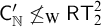 . The desired result follows from the equivalences
$\mathsf {RT}^{1}_{\infty }\chi \equiv _{\mathrm {W}} \mathsf {RT}^{1}_{\infty } \equiv _{\mathrm {W}} \mathsf {C}_{\mathbb {N}}'$
. The desired result follows from the equivalences
$\mathsf {RT}^{1}_{\infty }\chi \equiv _{\mathrm {W}} \mathsf {RT}^{1}_{\infty } \equiv _{\mathrm {W}} \mathsf {C}_{\mathbb {N}}'$
 and
$\mathsf {RT}^{2}_{2}\mathsf {pe} \equiv _{\mathrm {W}} \mathsf {RT}^{2}_{2}$
and
$\mathsf {RT}^{2}_{2}\mathsf {pe} \equiv _{\mathrm {W}} \mathsf {RT}^{2}_{2}$
 .
.
We have now justified all relationships in Figure 1. We end this section by giving an upper bound for
$\mathsf {RT}^{1}_{\infty }\mathsf {e}$
 . This upper bound is optimal among the problems
$\mathsf {RT}^{n}_{k}\mathsf {pe}$
. This upper bound is optimal among the problems
$\mathsf {RT}^{n}_{k}\mathsf {pe}$
 for
$n \geq 1$
for
$n \geq 1$
 and
$k \in \mathbb {N} \cup \{<\!\infty ,\mathbb {N}\}$
and
$k \in \mathbb {N} \cup \{<\!\infty ,\mathbb {N}\}$
 , as a consequence of Lemma 4.17 (which is our aforementioned strengthening of [Reference Soldà and Valenti15, Theorem 7.20]).
Theorem 3.25.
$\mathsf {RT}^{1}_{\infty }\mathsf {e}\leq ^{\mathrm {t}}_{\mathrm {W}}\mathsf {RT}^{3}_{2}\mathsf {pe}$
 .
.
Proof. We first show that
$\mathsf {RT}^{1}_{\infty }\mathsf {e}$
 is equivalent to
$\mathsf {RT}^{1}_{\infty }\mathsf {e}^{*}$
is equivalent to
$\mathsf {RT}^{1}_{\infty }\mathsf {e}^{*}$
 , which we define as
$\mathsf {RT}^{1}_{\infty }\mathsf {e}$
, which we define as
$\mathsf {RT}^{1}_{\infty }\mathsf {e}$
 with the restriction that instances have a unique colour which occurs infinitely often. Evidently,
$\mathsf {RT}^{1}_{\infty }\mathsf {e}^{*}\leq ^{\mathrm {t}}_{\mathrm {W}}\mathsf {RT}^{1}_{\infty }\mathsf {e}$
with the restriction that instances have a unique colour which occurs infinitely often. Evidently,
$\mathsf {RT}^{1}_{\infty }\mathsf {e}^{*}\leq ^{\mathrm {t}}_{\mathrm {W}}\mathsf {RT}^{1}_{\infty }\mathsf {e}$
 . Let
$f:\mathbb {N}\to \mathbb {N}$
. Let
$f:\mathbb {N}\to \mathbb {N}$
 , an instance of
$\mathsf {RT}^{1}_{\infty }\mathsf {e}$
, an instance of
$\mathsf {RT}^{1}_{\infty }\mathsf {e}$
 be given. We construct
$f^{*}:\mathbb {N}\to \mathbb {N}$
be given. We construct
$f^{*}:\mathbb {N}\to \mathbb {N}$
 , an instance of
$\mathsf {RT}^{1}_{\infty }\mathsf {e}^{*}$
, an instance of
$\mathsf {RT}^{1}_{\infty }\mathsf {e}^{*}$
 as follows.
For each
$i,s\in \mathbb {N}$
 , we maintain that at each stage s,
$x_{i,s}<x_{i+1,s}$
, we maintain that at each stage s,
$x_{i,s}<x_{i+1,s}$
 , and
$x_{i,s}\leq x_{i,s+1}$
, and
$x_{i,s}\leq x_{i,s+1}$
 (if defined). The intention here is that there is exactly one
$x_{i}=\lim _{s}x_{i,s}$
(if defined). The intention here is that there is exactly one
$x_{i}=\lim _{s}x_{i,s}$
 such that
$x_{i}<\infty $
such that
$x_{i}<\infty $
 , and
$x_{i}$
, and
$x_{i}$
 is part of an infinite f-homogeneous set. Initially set
$x_{i,0}\uparrow $
is part of an infinite f-homogeneous set. Initially set
$x_{i,0}\uparrow $
 for all
$i\in \mathbb {N}$
for all
$i\in \mathbb {N}$
 . At each stage s, let
$x_{i,s}$
. At each stage s, let
$x_{i,s}$
 be the least x in
$(\max _{j<i}x_{j,s}, s]$
be the least x in
$(\max _{j<i}x_{j,s}, s]$
 such that
$f(x)=i$
such that
$f(x)=i$
 and for each
$y \in [x,s]$
and for each
$y \in [x,s]$
 ,
$f(y)\geq i$
,
$f(y)\geq i$
 , if such x exists, and let
$x_{i,s}\uparrow $
, if such x exists, and let
$x_{i,s}\uparrow $
 otherwise.
For each
$y\in \mathbb {N}$
 , define
$f^{*}(y)=x_{i,y}$
, define
$f^{*}(y)=x_{i,y}$
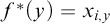 if
$f(y)=i$
if
$f(y)=i$
 and
$x_{i,y}\downarrow $
and
$x_{i,y}\downarrow $
 . Otherwise, define
$f^{*}(y)=y$
. Otherwise, define
$f^{*}(y)=y$
 . Now we verify that
$f^{*}$
. Now we verify that
$f^{*}$
 is a valid instance of
$\mathsf {RT}^{1}_{\infty }\mathsf {e}^{*}$
is a valid instance of
$\mathsf {RT}^{1}_{\infty }\mathsf {e}^{*}$
 . First, observe that if there are infinitely many y such that
$f(y)=i$
. First, observe that if there are infinitely many y such that
$f(y)=i$
 , then for each
$j>i,\,\lim _{s}x_{j,s}=\infty $
, then for each
$j>i,\,\lim _{s}x_{j,s}=\infty $
 . Second, if there are only finitely many y for which
$f(y)=j$
. Second, if there are only finitely many y for which
$f(y)=j$
 , then either
$x_{j,s}\uparrow $
, then either
$x_{j,s}\uparrow $
 for cofinitely many s, or
$\lim _{s}x_{j,s}$
for cofinitely many s, or
$\lim _{s}x_{j,s}$
 exists and is bounded by
$\max \{y\mid f(y)=j\}$
exists and is bounded by
$\max \{y\mid f(y)=j\}$
 .
.
Let i be the least i such that there are infinitely many y for which
$f(y)=i$
 . Clearly,
$\lim _{s}x_{i,s}=y$
. Clearly,
$\lim _{s}x_{i,s}=y$
 for the least y such that
$f(y)=i$
for the least y such that
$f(y)=i$
 and
$f(z)\geq i$
and
$f(z)\geq i$
 for each
$z\geq y$
for each
$z\geq y$
 . It is thus evident that y is the unique
$f^{*}$
. It is thus evident that y is the unique
$f^{*}$
 -colour repeated infinitely often.
Given an
$\mathsf {RT}^{1}_{\infty }\mathsf {e}^{*}$
 -solution
$S^{*}:\mathbb {N}\to \mathbb {N}$
-solution
$S^{*}:\mathbb {N}\to \mathbb {N}$
 for
$f^{*}$
for
$f^{*}$
 , we define an
$\mathsf {RT}^{1}_{\infty }\mathsf {e}$
, we define an
$\mathsf {RT}^{1}_{\infty }\mathsf {e}$
 -solution
$S:\mathbb {N}\to \mathbb {N}$
-solution
$S:\mathbb {N}\to \mathbb {N}$
 for f as follows. Let
$S(0)=S^{*}(0)$
for f as follows. Let
$S(0)=S^{*}(0)$
 . For each
$x\in \mathbb {N}$
. For each
$x\in \mathbb {N}$
 , if
$f(x)=f(S^{*}(0))$
, if
$f(x)=f(S^{*}(0))$
 , then define
$S(x)=x$
, then define
$S(x)=x$
 , otherwise define
$S(x)=S^{*}(0)$
, otherwise define
$S(x)=S^{*}(0)$
 . Clearly, the range of S is an infinite f-homogeneous set of colour
$f(S^{*}(0))$
. Clearly, the range of S is an infinite f-homogeneous set of colour
$f(S^{*}(0))$
 , and S is computable uniformly in
$S^{*}$
, and S is computable uniformly in
$S^{*}$
 and f.
Now we show that
$\mathsf {RT}^{1}_{\infty }\mathsf {e}^{*}\leq ^{\mathrm {t}}_{\mathrm {W}}\mathsf {RT}^{3}_{2}\mathsf {pe}$
 . Given
$f: \mathbb {N} \to \mathbb {N}$
. Given
$f: \mathbb {N} \to \mathbb {N}$
 , we compute the following colouring
$g:[\mathbb {N}]^{3}\to 2$
, we compute the following colouring
$g:[\mathbb {N}]^{3}\to 2$
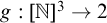 :
:

Assuming f is an
$\mathsf {RT}^{1}_{\infty }\mathsf {e}^{*}$
 -instance, we shall prove that all infinite g-homogeneous sets have colour
$0$
-instance, we shall prove that all infinite g-homogeneous sets have colour
$0$
 . Suppose
$\{x_{0}<x_{1}<x_{2}<\dots \}$
. Suppose
$\{x_{0}<x_{1}<x_{2}<\dots \}$
 is g-homogeneous. Pick the least i such that there is some
$x\leq x_{i}$
is g-homogeneous. Pick the least i such that there is some
$x\leq x_{i}$
 for which
$f(x)$
for which
$f(x)$
 is the unique f-colour, n, repeated infinitely often. Also pick
$j>i$
is the unique f-colour, n, repeated infinitely often. Also pick
$j>i$
 such that for all
$x\geq x_{j}$
such that for all
$x\geq x_{j}$
 , either
$f(x)=n$
, either
$f(x)=n$
 , or
$f(x)\neq f(x')$
, or
$f(x)\neq f(x')$
 for any
$x'\leq x_{i}$
for any
$x'\leq x_{i}$
 . Finally, pick
$k>j$
. Finally, pick
$k>j$
 such that there is some x, where
$x_{j}\leq x\leq x_{k}$
such that there is some x, where
$x_{j}\leq x\leq x_{k}$
 and
$f(x)=n$
and
$f(x)=n$
 . Since n is the unique f-colour that repeats infinitely often, such
$i,j$
. Since n is the unique f-colour that repeats infinitely often, such
$i,j$
 , and k must exist. By definition of g, we have
$g(x_{i},x_{j},x_{k})=0$
, and k must exist. By definition of g, we have
$g(x_{i},x_{j},x_{k})=0$
 as desired.
For the post-processing, suppose we are given some
$S: \mathbb {N} \to \mathbb {N}$
 . We shall compute some
$H: \mathbb {N} \to \mathbb {N}$
. We shall compute some
$H: \mathbb {N} \to \mathbb {N}$
 as follows. First compute and compare the sets
$\{f(x')\mid x' \leq S(0)\}$
as follows. First compute and compare the sets
$\{f(x')\mid x' \leq S(0)\}$
 and
$\{f(y') \mid S(1) \leq y' \leq S(2)\}$
and
$\{f(y') \mid S(1) \leq y' \leq S(2)\}$
 . If they do not have exactly one colour in common, then S cannot be an
$\mathsf {RT}^{3}_{2}\mathsf {pe}$
. If they do not have exactly one colour in common, then S cannot be an
$\mathsf {RT}^{3}_{2}\mathsf {pe}$
 -solution for g, so we simply return
$H = \mathrm {id}$
-solution for g, so we simply return
$H = \mathrm {id}$
 . Otherwise, we may identify the unique colour n in common and the least
$x \leq S(0)$
. Otherwise, we may identify the unique colour n in common and the least
$x \leq S(0)$
 such that
$f(x) = n$
such that
$f(x) = n$
 . Define
$H(0)=x$
. Define
$H(0)=x$
 . For each
$i>0$
. For each
$i>0$
 , define
$H(i)=i$
, define
$H(i)=i$
 if
$f(i)=n$
if
$f(i)=n$
 , and x otherwise. In this case, it is clear that the range of H is f-homogeneous of colour n.
Suppose S is an
$\mathsf {RT}^{3}_{2}\mathsf {pe}$
 -solution for g. We shall show that the range of H is infinite, in other words, that n appears infinitely often in f. It suffices to verify that for any
$0<i<j$
-solution for g. We shall show that the range of H is infinite, in other words, that n appears infinitely often in f. It suffices to verify that for any
$0<i<j$
 ,
,

Suppose for a contradiction that there exists
$i,j$
 such that the above fails. In particular,
$\{f(x')\mid x'\leq S(0)\}\cap \{f(y')\mid S(i)\leq y'\leq S(j)\}$
such that the above fails. In particular,
$\{f(x')\mid x'\leq S(0)\}\cap \{f(y')\mid S(i)\leq y'\leq S(j)\}$
 contains some
$n'\neq n$
contains some
$n'\neq n$
 . However, this implies that
$\{f(x')\mid x'\leq S(0)\}\cap \{f(y')\mid S(1)\leq y'\leq S(j)\}$
. However, this implies that
$\{f(x')\mid x'\leq S(0)\}\cap \{f(y')\mid S(1)\leq y'\leq S(j)\}$
 contains both n and
$n'$
contains both n and
$n'$
 , contrary to our assumption on S.
4 Weihrauch jump inversions for colourings of pairs
Brattka and Rakotoniaina [Reference Brattka and Rakotoniaina7, Proposition 4.1] proved that
$(\mathsf {CRT}^{n}_{k})' \leq _{\mathrm {sW}} \mathsf {CSRT}^{n+1}_{k}$
 for
$k \geq 1$
for
$k \geq 1$
 . They also claimed that
$(\mathsf {CRT}^{n}_{\mathbb {N}})' \leq _{\mathrm {sW}} \mathsf {CSRT}^{n+1}_{\mathbb {N}}$
. They also claimed that
$(\mathsf {CRT}^{n}_{\mathbb {N}})' \leq _{\mathrm {sW}} \mathsf {CSRT}^{n+1}_{\mathbb {N}}$
 . However, their proof for finite k does not seem to generalise to
$k = \mathbb {N}$
. However, their proof for finite k does not seem to generalise to
$k = \mathbb {N}$
 . We show below that their claim is false, at least for
$n = 1$
. We show below that their claim is false, at least for
$n = 1$
 . This affects the following results in [Reference Brattka and Rakotoniaina7]: Proposition 4.1, Theorem 4.3, and Corollary 4.28 for
$n=1$
. This affects the following results in [Reference Brattka and Rakotoniaina7]: Proposition 4.1, Theorem 4.3, and Corollary 4.28 for
$n=1$
 ,
$k=\mathbb {N}$
,
$k=\mathbb {N}$
 , Corollary 4.2 for
$m=n=1$
, Corollary 4.2 for
$m=n=1$
 ,
$k=\mathbb {N}$
,
$k=\mathbb {N}$
 , as well as Theorem 7.9 for
$n=2$
, as well as Theorem 7.9 for
$n=2$
 (see also our Lemma 4.17, which refutes Theorem 7.9 for
$n=2$
(see also our Lemma 4.17, which refutes Theorem 7.9 for
$n=2$
 ).
).
Lemma 4.1.
$(\mathsf {RT}^{1}_{\mathbb {N}})' \not \leq _{\mathrm {W}} \mathsf {RT}^{2}_{\mathbb {N}}$
 . In particular,
$(\mathsf {CRT}^{1}_{\mathbb {N}})' \not \leq _{\mathrm {W}} \mathsf {RT}^{2}_{\mathbb {N}} \equiv _{\mathrm {W}} \mathsf {CRT}^{2}_{\mathbb {N}}$
. In particular,
$(\mathsf {CRT}^{1}_{\mathbb {N}})' \not \leq _{\mathrm {W}} \mathsf {RT}^{2}_{\mathbb {N}} \equiv _{\mathrm {W}} \mathsf {CRT}^{2}_{\mathbb {N}}$
 .
.
Proof. Suppose that
$\Phi $
 and
$\Psi $
and
$\Psi $
 witness
$\big(\mathsf {RT}^{1}_{\mathbb {N}}\big)'\leq _{\mathrm {W}}\mathsf {RT}^{2}_{\mathbb {N}}$
witness
$\big(\mathsf {RT}^{1}_{\mathbb {N}}\big)'\leq _{\mathrm {W}}\mathsf {RT}^{2}_{\mathbb {N}}$
 . In the discussion that follows, we directly construct a
$\Delta _{2}^{0}$
. In the discussion that follows, we directly construct a
$\Delta _{2}^{0}$
 instance f of
$\mathsf {RT}^{1}_{\mathbb {N}}$
instance f of
$\mathsf {RT}^{1}_{\mathbb {N}}$
 , which may be turned into a computable instance
$(f_{s})_{s\in \mathbb {N}}$
, which may be turned into a computable instance
$(f_{s})_{s\in \mathbb {N}}$
 of
$\big (\mathsf {RT}^{1}_{\mathbb {N}}\big)'$
of
$\big (\mathsf {RT}^{1}_{\mathbb {N}}\big)'$
 in the obvious way. Let
$g=\Phi ((f_{s})_{s\in \mathbb {N}})$
in the obvious way. Let
$g=\Phi ((f_{s})_{s\in \mathbb {N}})$
 . Throughout this discussion, we will also think of
$\Psi $
. Throughout this discussion, we will also think of
$\Psi $
 as a principal enumeration of an f-homogeneous set given as oracle a g-homogeneous set. To facilitate the discussion, we make the following definitions. Fix a finite set
$D=\{x_{0}<x_{1}<\dots <x_{n-1}\}$
as a principal enumeration of an f-homogeneous set given as oracle a g-homogeneous set. To facilitate the discussion, we make the following definitions. Fix a finite set
$D=\{x_{0}<x_{1}<\dots <x_{n-1}\}$
 and a string
$\sigma \in \mathbb {N}^{<\mathbb {N}}$
and a string
$\sigma \in \mathbb {N}^{<\mathbb {N}}$
 of length n.
-
• Define $H(D,\sigma )=\{y>\max D\mid g(x_{i},y)=\sigma (i)\text { for each }i\}$
. -
• The pair $(D,\sigma )$
is consistent if for each
$i,j$
, where
$i<j<n$
,
$g(x_{i},x_{j})=\sigma (i)$
. -
• Finally, for each $k\in \mathbb {N}$
, define
$P_{k}(D,\sigma )=\{x_{i}\in D\mid \sigma (i)=k\}$
.






It is easy to see that if
$(D,\sigma )$
 is consistent, then
$P_{k}(D,\sigma )$
is consistent, then
$P_{k}(D,\sigma )$
 is a g-homogeneous set (possibly empty) of colour k for each
$k\in \mathbb {N}$
is a g-homogeneous set (possibly empty) of colour k for each
$k\in \mathbb {N}$
 .
.
We first restrict ourselves to the case, where g uses only two colours, say
$0,1$
 . Following from the definitions, if
$H(D,\sigma )$
. Following from the definitions, if
$H(D,\sigma )$
 is infinite, then for any
$y\in H(D,\sigma )$
is infinite, then for any
$y\in H(D,\sigma )$
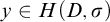 , at least one of
$H(D\cup \{y\},\sigma ^{\frown }0)$
, at least one of
$H(D\cup \{y\},\sigma ^{\frown }0)$
 or
$H(D\cup \{y\},\sigma ^{\frown }1)$
or
$H(D\cup \{y\},\sigma ^{\frown }1)$
 is infinite. Moreover, if
$(D,\sigma )$
is infinite. Moreover, if
$(D,\sigma )$
 is also consistent, then one of
$P_{0}(D,\sigma )$
is also consistent, then one of
$P_{0}(D,\sigma )$
 or
$P_{1}(D,\sigma )$
or
$P_{1}(D,\sigma )$
 must be extendable to an infinite g-homogeneous set. In particular, by ensuring that f colours only finitely many bits with the colours of
$\Psi (P_{0}(D,\sigma ),(f_{s})_{s\in \mathbb {N}})(0)$
must be extendable to an infinite g-homogeneous set. In particular, by ensuring that f colours only finitely many bits with the colours of
$\Psi (P_{0}(D,\sigma ),(f_{s})_{s\in \mathbb {N}})(0)$
 or
$\Psi (P_{1}(D,\sigma ),(f_{s})_{s\in \mathbb {N}})(0)$
or
$\Psi (P_{1}(D,\sigma ),(f_{s})_{s\in \mathbb {N}})(0)$
 if they have converged, ensures that
$\Phi $
if they have converged, ensures that
$\Phi $
 and
$\Psi $
and
$\Psi $
 fail to witness
$(\mathsf {RT}^{1}_{\mathbb {N}})'\leq _{\mathrm {W}}\mathsf {RT}^{2}_{\mathbb {N}}$
fail to witness
$(\mathsf {RT}^{1}_{\mathbb {N}})'\leq _{\mathrm {W}}\mathsf {RT}^{2}_{\mathbb {N}}$
 . Evidently, it may be that neither
$\Psi (P_{0}(D,\sigma ),(f_{s})_{s\in \mathbb {N}})(0)$
. Evidently, it may be that neither
$\Psi (P_{0}(D,\sigma ),(f_{s})_{s\in \mathbb {N}})(0)$
 nor
$\Psi (P_{1}(D,\sigma ),(f_{s})_{s\in \mathbb {N}})(0)$
nor
$\Psi (P_{1}(D,\sigma ),(f_{s})_{s\in \mathbb {N}})(0)$
 has converged as we have yet to provide ‘sufficient information’ in the oracle. We ‘add’ information by defining a new finite set
$D'=D\cup \{\mu y\in H(D,\sigma )\}$
has converged as we have yet to provide ‘sufficient information’ in the oracle. We ‘add’ information by defining a new finite set
$D'=D\cup \{\mu y\in H(D,\sigma )\}$
 . Let
$\sigma '=\sigma ^{\frown } i$
. Let
$\sigma '=\sigma ^{\frown } i$
 such that
$H(D',\sigma ^{\frown } i)$
such that
$H(D',\sigma ^{\frown } i)$
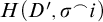 is infinite. Note that provided that
$H(D,\sigma )$
is infinite. Note that provided that
$H(D,\sigma )$
 is infinite, at least one of
$H(D',\sigma ^{\frown } 0)$
is infinite, at least one of
$H(D',\sigma ^{\frown } 0)$
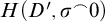 or
$H(D',\sigma ^{\frown } 1)$
or
$H(D',\sigma ^{\frown } 1)$
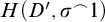 is infinite. Observe also that if
$(D,\sigma )$
is infinite. Observe also that if
$(D,\sigma )$
 is consistent, then so are
$(D',\sigma ^{\frown }i)$
is consistent, then so are
$(D',\sigma ^{\frown }i)$
 for both
$i=0,1$
for both
$i=0,1$
 . In this way, given a consistent
$(D,\sigma )$
. In this way, given a consistent
$(D,\sigma )$
 so that
$H(D,\sigma )$
so that
$H(D,\sigma )$
 is infinite, we can obtain a sequence of consistent
$(D_m,\sigma _m)$
is infinite, we can obtain a sequence of consistent
$(D_m,\sigma _m)$
 for which
$H(D_{m},\sigma _{m})$
for which
$H(D_{m},\sigma _{m})$
 is infinite for each
$m\in \mathbb {N}$
is infinite for each
$m\in \mathbb {N}$
 . Then at least one of
$\bigcup _{m}P_{0}(D_{m},\sigma _{m})$
. Then at least one of
$\bigcup _{m}P_{0}(D_{m},\sigma _{m})$
 or
$\bigcup _{m}P_{1}(D_{m},\sigma _{m})$
or
$\bigcup _{m}P_{1}(D_{m},\sigma _{m})$
 must be an infinite g-homogeneous set. That is, if
$\Psi (P_{0}(D_{m},\sigma _{m}),((f_{s})_{s\in \mathbb {N}})(0),\Psi (P_{1}(D_{m},\sigma _{m}),(f_{s})_{s\in \mathbb {N}})(0)$
must be an infinite g-homogeneous set. That is, if
$\Psi (P_{0}(D_{m},\sigma _{m}),((f_{s})_{s\in \mathbb {N}})(0),\Psi (P_{1}(D_{m},\sigma _{m}),(f_{s})_{s\in \mathbb {N}})(0)$
 never converges,
$\Phi $
never converges,
$\Phi $
 and
$\Psi $
and
$\Psi $
 must also fail to witness the reduction
$(\mathsf {RT}^{1}_{\mathbb {N}})'\leq _{\mathrm {W}}\mathsf {RT}^{2}_{\mathbb {N}}$
must also fail to witness the reduction
$(\mathsf {RT}^{1}_{\mathbb {N}})'\leq _{\mathrm {W}}\mathsf {RT}^{2}_{\mathbb {N}}$
 .
.
We extend the ideas above to the general case as follows. During stage s of the construction, we say that a pair
$(D_{i},\sigma )$
 fires if the following conditions hold:
-
• $(D_{i},\sigma )$
is consistent. -
• $|H(D_{i},\sigma )\restriction s|>|H(D_{i},\sigma )\restriction (s-1)|$
. -
• For any $k<|D_{i}|$
,
$|\{n\in rng(g[s])\mid \Psi (P_{n}(D_{i},\sigma ),f)(0)\downarrow \}|>|\{n\in rng(g[s])\mid \Psi (P_{n}(D_{i}\restriction k,\sigma \restriction k),f)(0)\downarrow \}|$
.




Then we wish to define
$f(s)$
 to be the least colour which avoids the current colour of each of
$\Psi (P_{n}(D_{j},\tau ),(f_{t})_{t<s})(0)\downarrow $
to be the least colour which avoids the current colour of each of
$\Psi (P_{n}(D_{j},\tau ),(f_{t})_{t<s})(0)\downarrow $
 for ‘higher priority’
$(D_{j},\tau )$
for ‘higher priority’
$(D_{j},\tau )$
 . If we are not careful, we may end up in a situation, where f defined by us has no infinite homogeneous set. In particular, g may continually use new colours n, and pick new elements via
$\Psi (P_{n}(D,\sigma ),(f_{t})_{t\in \mathbb {N}})(0)$
. If we are not careful, we may end up in a situation, where f defined by us has no infinite homogeneous set. In particular, g may continually use new colours n, and pick new elements via
$\Psi (P_{n}(D,\sigma ),(f_{t})_{t\in \mathbb {N}})(0)$
 , causing us to restrain infinitely many colours from f. Whilst g is also not a valid instance of
$\mathsf {RT}^{2}_{\mathbb {N}}$
, causing us to restrain infinitely many colours from f. Whilst g is also not a valid instance of
$\mathsf {RT}^{2}_{\mathbb {N}}$
 in this case,
$\Phi $
in this case,
$\Phi $
 and
$\Psi $
and
$\Psi $
 do not necessarily fail since f as constructed by us is also not a valid instance of
$(\mathsf {RT}^{1}_{\mathbb {N}})'$
do not necessarily fail since f as constructed by us is also not a valid instance of
$(\mathsf {RT}^{1}_{\mathbb {N}})'$
 . To circumvent this, we will define
$f(x)=0$
. To circumvent this, we will define
$f(x)=0$
 for each
$x<s$
for each
$x<s$
 at stage s whenever we witness that
$|rng(g[s])|>|rng(g[s-1])|$
at stage s whenever we witness that
$|rng(g[s])|>|rng(g[s-1])|$
 . This ensures that if
$|rng(g)|=\infty $
. This ensures that if
$|rng(g)|=\infty $
 , then f is the all zero colouring and thus a valid instance of
$(\mathsf {RT}^{1}_{\mathbb {N}})'$
, then f is the all zero colouring and thus a valid instance of
$(\mathsf {RT}^{1}_{\mathbb {N}})'$
 . Finally, provided that
$|rng(g)|<\infty $
. Finally, provided that
$|rng(g)|<\infty $
 , there must be some ‘highest priority’
$(D_{i},\sigma )$
, there must be some ‘highest priority’
$(D_{i},\sigma )$
 which fires infinitely often during the construction. For such a pair, we shall argue that for at least one
$n\in rng(g)$
which fires infinitely often during the construction. For such a pair, we shall argue that for at least one
$n\in rng(g)$
 ,
$P_{n}(D_{i},\sigma )$
,
$P_{n}(D_{i},\sigma )$
 is extendable to an infinite g-homogeneous set and that f colours only finitely many bits with one of the colour of
$\Psi (P_{n}(D_{i},\sigma ),(f_{s})_{s\in \mathbb {N}})(0)$
is extendable to an infinite g-homogeneous set and that f colours only finitely many bits with one of the colour of
$\Psi (P_{n}(D_{i},\sigma ),(f_{s})_{s\in \mathbb {N}})(0)$
 whenever defined. We now detail the construction.
Construction: Let
$\{D_{i}\}_{i\in \mathbb {N}}$
 be a list of the finite sets with the property that if
$D_{i}\subseteq D_{j}$
be a list of the finite sets with the property that if
$D_{i}\subseteq D_{j}$
 , then
$i\leq j$
, then
$i\leq j$
 , and arrange the pairs
$(D_{i},\sigma )$
, and arrange the pairs
$(D_{i},\sigma )$
 , where
$\sigma \in \mathbb {N}^{|D_{i}|}$
, where
$\sigma \in \mathbb {N}^{|D_{i}|}$
 in order of priority as follows.
$(D_{i},\sigma )<(D_{j},\tau )$
in order of priority as follows.
$(D_{i},\sigma )<(D_{j},\tau )$
 if
$i<j$
if
$i<j$
 , or if
$i=j$
, or if
$i=j$
 and
$\sigma <_{lex}\tau $
and
$\sigma <_{lex}\tau $
 . (Note that if
$i=j$
. (Note that if
$i=j$
 , then
$|\sigma |=|\tau |=|D_{i}|$
, then
$|\sigma |=|\tau |=|D_{i}|$
 .) Define
$C(\emptyset ,\epsilon )[s]=0$
.) Define
$C(\emptyset ,\epsilon )[s]=0$
 for all s.
-
Stage s: For a consistent pair $(D_{i},\sigma )$
, do the following that applies.-
• If for each $(D_{j},\tau )\leq (D_{i},\sigma )$
, where
$|D_{j}|=|\tau |<s$
, and each
$n\in rng(g[s])$
,
$\Psi (P_{n}(D_{j},\tau ),(f_{t})_{t<s})(0)\uparrow $
. Define
$C(D_{i},\sigma )[s]=0$
. -
• Otherwise, define $C(D_{i},\sigma )[s]$
to be the least y larger than the current colours of
$\Psi (P_{n}(D_{j},\tau ),(f_{t})_{t<s})(0)$
for any
$(D_{j},\tau )\leq (D_{i},\sigma )$
and
$n\in rng(g[s])$
, whenever defined.
If $|rng(g[s])|>|rng(g[s-1])|$
, then for each
$x\leq s$
, define
$f_{s}(x)=0$
. Otherwise, there must be some
$(D_{i},\sigma )$
, where
$0<|D_{i}|=|\sigma |<s$
which fires. Let the pair
$(D_{i},\sigma )$
be the highest priority pair which fires and also such that for any consistent pair
$(D_{j},\tau )$
, where
$|D_{j}|=|\tau |<s$
,
$D_{j}\supsetneq D_{i}$
, and
$\tau \supsetneq _{pref}\sigma $
,
$(D_{j},\tau )$
does not fire at stage s. Then let y be the least such that y is larger than
$C(D_{j},\tau )[s]$
(wherever defined) for each
$D_{j},\tau $
such that
$D_{j}\supseteq D_{i}$
,
$\tau \supseteq _{pref}\sigma $
, and
$|D_{j}|=|\tau |<s$
. Define
$f_{s}(s)=y$
and for each
$x<s$
, if
$f_{s-1}(x)>y$
, define
$f_{s}(x)=y$
. Otherwise, let
$f_{s}(x)=f_{s-1}(x)$
. -






















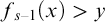


Verification: Now we verify that the construction works. It is easy to see from the construction that
$f=\lim _{s}f_{s}$
 exists, as we have that
$f_{s}(x)\geq f_{s+1}(x)$
exists, as we have that
$f_{s}(x)\geq f_{s+1}(x)$
 for any
$x,s\in \mathbb {N}$
for any
$x,s\in \mathbb {N}$
 . Then we have that
$\lim _{s}C[s]$
. Then we have that
$\lim _{s}C[s]$
 also exists. Now, if
$|rng(g)|=\infty $
also exists. Now, if
$|rng(g)|=\infty $
 , then we obtain that f is the all zero colouring, and thus,
$\Phi $
, then we obtain that f is the all zero colouring, and thus,
$\Phi $
 and
$\Psi $
and
$\Psi $
 must fail to witness
$(\mathsf {RT}^{1}_{\mathbb {N}})'\leq _{\mathrm {W}}\mathsf {RT}^{2}_{\mathbb {N}}$
must fail to witness
$(\mathsf {RT}^{1}_{\mathbb {N}})'\leq _{\mathrm {W}}\mathsf {RT}^{2}_{\mathbb {N}}$
 . We may thus assume that
$|rng(g)|=N<\infty $
. We may thus assume that
$|rng(g)|=N<\infty $
 . Now let
$(D_{i},\sigma )$
. Now let
$(D_{i},\sigma )$
 be the highest priority pair satisfying the following:
-
• $(D_{i},\sigma )$
fires infinitely often. -
• For each $(D_{j},\tau )$
such that
$D_{j}\supsetneq D_{i}$
and
$\tau \supsetneq _{pref} \sigma $
,
$(D_{j},\tau )$
fires only finitely often.


To see why such a pair
$(D_{i},\sigma )$
 must exist, suppose for a contradiction that for any pair
$(D_{i},\sigma )$
must exist, suppose for a contradiction that for any pair
$(D_{i},\sigma )$
 which fires infinitely often, there is some
$(D_{j},\tau )$
which fires infinitely often, there is some
$(D_{j},\tau )$
 , where
$D_{j}\supsetneq D_{i}$
, where
$D_{j}\supsetneq D_{i}$
 and
$\tau \supsetneq _{pref}\sigma $
and
$\tau \supsetneq _{pref}\sigma $
 such that
$(D_{j},\tau )$
such that
$(D_{j},\tau )$
 also fires infinitely often. We then obtain infinite sequences
$D_{i_{0}}\subsetneq D_{i_{1}}\subsetneq \dots $
also fires infinitely often. We then obtain infinite sequences
$D_{i_{0}}\subsetneq D_{i_{1}}\subsetneq \dots $
 and
$\sigma _{0}\subsetneq _{pref}\sigma _{1}\subsetneq _{pref}\dots $
and
$\sigma _{0}\subsetneq _{pref}\sigma _{1}\subsetneq _{pref}\dots $
 , such that
$|\{n\in rng(g)\mid \Psi (P_{n}(D_{i_{k}},\sigma _{k}),f)(0)\downarrow \}|$
, such that
$|\{n\in rng(g)\mid \Psi (P_{n}(D_{i_{k}},\sigma _{k}),f)(0)\downarrow \}|$
 is strictly increasing in k, a contradiction to the assumption that
$|rng(g)|<\infty $
is strictly increasing in k, a contradiction to the assumption that
$|rng(g)|<\infty $
 .
.
For the pair
$(D_{i},\sigma )$
 which satisfies the desired properties, it follows that for at least one
$n\in rng(g)$
which satisfies the desired properties, it follows that for at least one
$n\in rng(g)$
 ,
$P_{n}(D_{i},\sigma )$
,
$P_{n}(D_{i},\sigma )$
 is extendable to an infinite g-homogeneous set of colour n. Now consider some stage large enough such that all of the following holds:
-
• For each $(D_{j},\tau )\leq (D_{i},\sigma )$
,
$C(D_{j},\tau )$
never again changes. -
• For each $(D_{k},\gamma )$
such that
$D_{k}\supsetneq D_{i}$
and
$\gamma \supsetneq _{pref}\sigma $
,
$C(D_{k},\gamma )$
never again changes and
$(D_{k},\gamma )$
never again fires.



By choice of
$(D_{i},\sigma )$
 and the definition of C, such a stage must exist. After such a stage, there must be some fixed y such that whenever
$(D_{i},\sigma )$
and the definition of C, such a stage must exist. After such a stage, there must be some fixed y such that whenever
$(D_{i},\sigma )$
 fires, the new bit of f is defined to be y, and all earlier bits with values larger than y is now changed to y. By choice of
$(D_{i},\sigma )$
fires, the new bit of f is defined to be y, and all earlier bits with values larger than y is now changed to y. By choice of
$(D_{i},\sigma )$
 , we obtain that
$f(x)\leq y$
, we obtain that
$f(x)\leq y$
 for all
$x\in \mathbb {N}$
for all
$x\in \mathbb {N}$
 , thus, f as defined is a valid instance of
$(\mathsf {RT}^{1}_{\mathbb {N}})'$
, thus, f as defined is a valid instance of
$(\mathsf {RT}^{1}_{\mathbb {N}})'$
 .
.
It remains to argue that for each n, where
$\Psi (P_{n}(D_{i},\sigma ),(f_{s})_{s\in \mathbb {N}})(0)\downarrow =x_{n}$
 , there are only finitely many bits coloured
$f(x_{n})$
, there are only finitely many bits coloured
$f(x_{n})$
 in f. From the construction, it is evident that after the stage where each of
$\Psi (P_{n}(D_{i},\sigma ),(f_{t})_{t\in \mathbb {N}})(0)\downarrow $
in f. From the construction, it is evident that after the stage where each of
$\Psi (P_{n}(D_{i},\sigma ),(f_{t})_{t\in \mathbb {N}})(0)\downarrow $
 , we must define
$f(s)>f(x_{n})$
, we must define
$f(s)>f(x_{n})$
 for each n if we defined
$f(s)$
for each n if we defined
$f(s)$
 due to a lower priority pair than
$(D_{i},\sigma )$
due to a lower priority pair than
$(D_{i},\sigma )$
 firing. Now for higher priority pairs
$(D_{j},\tau )$
firing. Now for higher priority pairs
$(D_{j},\tau )$
 , by choice of
$(D_{i},\sigma )$
, by choice of
$(D_{i},\sigma )$
 , either
$(D_{j},\tau )$
, either
$(D_{j},\tau )$
 fires only finitely often, or it must be that
$D_{j}\subsetneq D_{i}$
fires only finitely often, or it must be that
$D_{j}\subsetneq D_{i}$
 and
$\tau \subsetneq _{pref}\sigma $
and
$\tau \subsetneq _{pref}\sigma $
 . The former only potentially colours finitely many more bits of f with one of
$f(x_{n})$
. The former only potentially colours finitely many more bits of f with one of
$f(x_{n})$
 , and may thus be ignored. In the latter case, it follows from the construction that whenever
$f(s)$
, and may thus be ignored. In the latter case, it follows from the construction that whenever
$f(s)$
 is defined due to
$(D_{j},\tau )$
is defined due to
$(D_{j},\tau )$
 firing, it is defined to be larger than the value
$C(D_{i},\sigma )[s]$
firing, it is defined to be larger than the value
$C(D_{i},\sigma )[s]$
 , and thus cannot cause infinitely many bits of f to be coloured with one of the
$f(x_{n})$
, and thus cannot cause infinitely many bits of f to be coloured with one of the
$f(x_{n})$
 . Recall that
$C(D_{i},\sigma )[s]$
. Recall that
$C(D_{i},\sigma )[s]$
 is defined to be some number larger than
$f_{s}(x_{n})$
is defined to be some number larger than
$f_{s}(x_{n})$
 for each
$n\in rng(g[s])$
for each
$n\in rng(g[s])$
 , where the computation
$x_{n}$
, where the computation
$x_{n}$
 is defined. In particular, none of
$\Psi (P_{n}(D_{i},\sigma ),f)$
is defined. In particular, none of
$\Psi (P_{n}(D_{i},\sigma ),f)$
 are extendable to an enumeration of an infinite f-homogeneous set. Since at least one of
$P_{n}(D_{i},\sigma )$
are extendable to an enumeration of an infinite f-homogeneous set. Since at least one of
$P_{n}(D_{i},\sigma )$
 must be extendable to an infinite g-homogeneous set of colour n,
$\Phi $
must be extendable to an infinite g-homogeneous set of colour n,
$\Phi $
 , and
$\Psi $
, and
$\Psi $
 must fail to witness
$(\mathsf {RT}^{1}_{\mathbb {N}})'\leq _{\mathrm {W}}\mathsf {RT}^{2}_{\mathbb {N}}$
must fail to witness
$(\mathsf {RT}^{1}_{\mathbb {N}})'\leq _{\mathrm {W}}\mathsf {RT}^{2}_{\mathbb {N}}$
 .
.
If we consider
$\mathsf {CRT}^{n}_{<\infty }$
 instead of
$\mathsf {CRT}^{n}_{\mathbb {N}}$
instead of
$\mathsf {CRT}^{n}_{\mathbb {N}}$
 , we recover analogues of [Reference Brattka and Rakotoniaina7, Proposition 4.1 and Theorem 4.3], with analogous proofs. We include details for completeness.
Proposition 4.2. For all
$n \geq 1$
 and
$k \geq 2$
and
$k \geq 2$
 , we have

Proof. An instance of
$(\mathsf {CRT}^{n}_{\infty })'$
 is a sequence
$(p_s)_{s \in \mathbb {N}}$
is a sequence
$(p_s)_{s \in \mathbb {N}}$
 which converges to an instance of
$\mathsf {CRT}^{n}_{<\infty }$
which converges to an instance of
$\mathsf {CRT}^{n}_{<\infty }$
 . Without loss of generality, we may assume that each
$p_s$
. Without loss of generality, we may assume that each
$p_s$
 names a pair
$(k_s,f_s)$
names a pair
$(k_s,f_s)$
 such that
$k_s \in \mathbb {N}$
such that
$k_s \in \mathbb {N}$
 ,
$f_s: [\mathbb {N}]^n \to \mathbb {N}$
,
$f_s: [\mathbb {N}]^n \to \mathbb {N}$
 , and
$f := \lim _s f_s$
, and
$f := \lim _s f_s$
 uses only colours
$< \lim _s k_s$
uses only colours
$< \lim _s k_s$
 . We pre-process by computing the colouring
$g: [\mathbb {N}]^{n+1} \to \lim _s k_s$
. We pre-process by computing the colouring
$g: [\mathbb {N}]^{n+1} \to \lim _s k_s$
 by
$g(A \cup \{s\}) = \min \{k_s-1,f_s(A)\}$
by
$g(A \cup \{s\}) = \min \{k_s-1,f_s(A)\}$
 for all
$A \in [\mathbb {N}]^n$
for all
$A \in [\mathbb {N}]^n$
 and
$s> \max (A)$
and
$s> \max (A)$
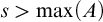 . Since
$\lim _s k_s$
. Since
$\lim _s k_s$
 exists, g is stable and has finite range (as
$\max _s k_s$
exists, g is stable and has finite range (as
$\max _s k_s$
 exists). Next, we claim that for each
$A \in [\mathbb {N}]^n$
exists). Next, we claim that for each
$A \in [\mathbb {N}]^n$
 and
$s> \max (A)$
and
$s> \max (A)$
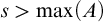 ,
$\lim _s g(A \cup \{s\}) = f(A)$
,
$\lim _s g(A \cup \{s\}) = f(A)$
 . To prove this, fix some
$t \in \mathbb {N}$
. To prove this, fix some
$t \in \mathbb {N}$
 such that
$k_s = k_t$
such that
$k_s = k_t$
 for all
$s> t$
for all
$s> t$
 . Since
$\lim _s f_s$
. Since
$\lim _s f_s$
 uses only colours
$< \lim _s k_s$
uses only colours
$< \lim _s k_s$
 , we may fix
$t^\ast \geq t$
, we may fix
$t^\ast \geq t$
 such that
$f_s(A) < \lim _s k_s$
such that
$f_s(A) < \lim _s k_s$
 for all
$s> t^\ast $
for all
$s> t^\ast $
 . Then for all
$s> t^\ast $
. Then for all
$s> t^\ast $
 , we have
$f_s(A) < k_s$
, we have
$f_s(A) < k_s$
 and so
$g(A \cup \{s\}) = f_s(A)$
and so
$g(A \cup \{s\}) = f_s(A)$
 . This proves our claim.
It follows that every g-limit-homogeneous set is also f-homogeneous. Therefore
$(\mathsf {RT}^{n}_{<\infty })' \leq _{\mathrm {sW}} \mathsf {D}^{n+1}_{\mathbb {N}}$
 . To show that
$(\mathsf {CRT}^{n}_{<\infty })' \leq _{\mathrm {sW}} \mathsf {CSRT}^{n+1}_{\mathbb {N}}$
. To show that
$(\mathsf {CRT}^{n}_{<\infty })' \leq _{\mathrm {sW}} \mathsf {CSRT}^{n+1}_{\mathbb {N}}$
 , we use the same pre-processing and post-processing as above. It suffices to observe that by the claim, if
$H \subseteq \mathbb {N}$
, we use the same pre-processing and post-processing as above. It suffices to observe that by the claim, if
$H \subseteq \mathbb {N}$
 is g-homogeneous of colour
$\ell $
is g-homogeneous of colour
$\ell $
 , then H is f-homogeneous of colour
$\ell $
, then H is f-homogeneous of colour
$\ell $
 .
.
Finally, to show that
$(\mathsf {RT}^{n}_{k})' \leq _{\mathrm {sW}} \mathsf {D}^{n+1}_{k}$
 , suppose we are given a convergent sequence
$(f_s)_{s \in \mathbb {N}}$
, suppose we are given a convergent sequence
$(f_s)_{s \in \mathbb {N}}$
 such that
$f_s: [\mathbb {N}]^n \to \mathbb {N}$
such that
$f_s: [\mathbb {N}]^n \to \mathbb {N}$
 and
$f := \lim _s f_s$
and
$f := \lim _s f_s$
 uses only colours
$< k$
uses only colours
$< k$
 . We pre-process by first replacing each
$f_s$
. We pre-process by first replacing each
$f_s$
 with the colouring
$g_s: [\mathbb {N}]^n \to k$
with the colouring
$g_s: [\mathbb {N}]^n \to k$
 , defined by
$g_s(A) = f_s(A)$
, defined by
$g_s(A) = f_s(A)$
 if
$f_s(A) < k$
if
$f_s(A) < k$
 , otherwise
$g_s(A) = 0$
, otherwise
$g_s(A) = 0$
 . Observe that
$\lim _s g_s = f$
. Observe that
$\lim _s g_s = f$
 . Next, we apply the pre-processing in the previous paragraph to the convergent sequence
$(k,g_s)_{s \in \mathbb {N}}$
. Next, we apply the pre-processing in the previous paragraph to the convergent sequence
$(k,g_s)_{s \in \mathbb {N}}$
 . This yields some colouring
$g: [\mathbb {N}]^{n+1} \to k$
. This yields some colouring
$g: [\mathbb {N}]^{n+1} \to k$
 . As reasoned above, g is stable (and is hence a
$\mathsf {D}^{n+1}_{k}$
. As reasoned above, g is stable (and is hence a
$\mathsf {D}^{n+1}_{k}$
 -instance) and every g-limit-homogeneous set is homogeneous for
$\lim _s g_s = f$
-instance) and every g-limit-homogeneous set is homogeneous for
$\lim _s g_s = f$
 .
.
Theorem 4.3. For all
$n \geq 1$
 and
$k \geq 2$
and
$k \geq 2$
 , we have

Proof. By the previous proposition, it suffices to show that
$\mathsf {CSRT}^{n+1}_{\mathbb {N}} \leq _{\mathrm {W}} (\mathsf {CRT}^{n}_{<\infty })'$
 ,
$\mathsf {D}^{n+1}_{\mathbb {N}} \leq _{\mathrm {sW}} (\mathsf {RT}^{n}_{<\infty })'$
,
$\mathsf {D}^{n+1}_{\mathbb {N}} \leq _{\mathrm {sW}} (\mathsf {RT}^{n}_{<\infty })'$
 , and
$\mathsf {D}^{n+1}_{k} \leq _{\mathrm {sW}} (\mathsf {RT}^{n}_{k})'$
, and
$\mathsf {D}^{n+1}_{k} \leq _{\mathrm {sW}} (\mathsf {RT}^{n}_{k})'$
 . To reduce
$\mathsf {D}^{n+1}_{\mathbb {N}}$
. To reduce
$\mathsf {D}^{n+1}_{\mathbb {N}}$
 to
$(\mathsf {RT}^{n}_{<\infty })'$
to
$(\mathsf {RT}^{n}_{<\infty })'$
 , suppose we are given a stable colouring
$f: [\mathbb {N}]^{n+1} \to \mathbb {N}$
, suppose we are given a stable colouring
$f: [\mathbb {N}]^{n+1} \to \mathbb {N}$
 with bounded range. Compute a sequence
$(k_s,g_s)_{s \in \mathbb {N}}$
with bounded range. Compute a sequence
$(k_s,g_s)_{s \in \mathbb {N}}$
 by
by

Then
$\lim _s k_s = \max \{f(B)+1: B \in [\mathbb {N}]^{n+1}\}$
 and
$\lim _s g_s(A) = \lim _s f(A \cup \{s\})$
and
$\lim _s g_s(A) = \lim _s f(A \cup \{s\})$
 (which exists because f is stable). Furthermore,
$g := \lim _s g_s$
(which exists because f is stable). Furthermore,
$g := \lim _s g_s$
 uses only colours
$< \lim _s k_s$
uses only colours
$< \lim _s k_s$
 . Observe that every g-homogeneous set is f-limit-homogeneous. This shows that
$\mathsf {D}^{n+1}_{\mathbb {N}} \leq _{\mathrm {sW}} (\mathsf {RT}^{n}_{<\infty })'$
. Observe that every g-homogeneous set is f-limit-homogeneous. This shows that
$\mathsf {D}^{n+1}_{\mathbb {N}} \leq _{\mathrm {sW}} (\mathsf {RT}^{n}_{<\infty })'$
 .
.
The proof that
$\mathsf {D}^{n+1}_{k} \leq _{\mathrm {sW}} (\mathsf {RT}^{n}_{k})'$
 proceeds similarly: Given a stable colouring
$f: [\mathbb {N}]^{n+1} \to k$
proceeds similarly: Given a stable colouring
$f: [\mathbb {N}]^{n+1} \to k$
 , compute
$(g_s)_{s \in \mathbb {N}}$
, compute
$(g_s)_{s \in \mathbb {N}}$
 as above.
To show that
$\mathsf {CSRT}^{n+1}_{\mathbb {N}} \leq _{\mathrm {W}} (\mathsf {CRT}^{n}_{<\infty })'$
 , we use the same pre-processing as above. Given
$(k,H)$
, we use the same pre-processing as above. Given
$(k,H)$
 such that H is an infinite g-homogeneous set of colour k, we may use f to compute an infinite f-homogeneous set M of colour k as follows. The set
$M= \bigcup _i M_i$
such that H is an infinite g-homogeneous set of colour k, we may use f to compute an infinite f-homogeneous set M of colour k as follows. The set
$M= \bigcup _i M_i$
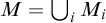 will be defined inductively using sets
$M_i \in [H]^{n+i}$
will be defined inductively using sets
$M_i \in [H]^{n+i}$
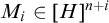 . Begin by choosing
$M_0$
. Begin by choosing
$M_0$
 to be the first n elements of H. Having defined
$M_i \in [H]^{n+i}$
to be the first n elements of H. Having defined
$M_i \in [H]^{n+i}$
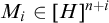 , search for the least
$s> \max (M_i)$
, search for the least
$s> \max (M_i)$
 such that
$f(A \cup \{s\}) = k$
such that
$f(A \cup \{s\}) = k$
 for all
$A \in [M_i]^n$
for all
$A \in [M_i]^n$
 . Such s exists because for each
$A \in [M_i]^n$
. Such s exists because for each
$A \in [M_i]^n$
 , we have
$A \in [H]^n$
, we have
$A \in [H]^n$
 and so
$k = g(A) = \lim _s f(A \cup \{s\})$
and so
$k = g(A) = \lim _s f(A \cup \{s\})$
 . Then
$M = \bigcup _i M_i$
. Then
$M = \bigcup _i M_i$
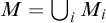 is infinite and f-homogeneous of colour k.
For
$n = 1$
 , we observe that the right side of the equivalences in Theorem 4.3 cannot be replaced with
$\mathsf {SRT}^{2}_{<\infty }$
, we observe that the right side of the equivalences in Theorem 4.3 cannot be replaced with
$\mathsf {SRT}^{2}_{<\infty }$
 or
$\mathsf {D}^{2}_{<\infty }$
or
$\mathsf {D}^{2}_{<\infty }$
 .
.
Lemma 4.4.
$\mathsf {D}^{2}_{\mathbb {N}} \not \leq _{\mathrm {W}} \mathsf {RT}^{2}_{<\infty }$
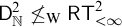 .
.
Proof. This follows easily from a result of Hirschfeldt and Jockusch [Reference Hirschfeldt and Jockusch10]: If
$\mathsf {D}^{2}_{\mathbb {N}} \leq _{\mathrm {W}} \mathsf {RT}^{2}_{<\infty }$
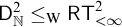 , there would be some open set U and some
$k \geq 2$
, there would be some open set U and some
$k \geq 2$
 such that
$\mathsf {D}^{2}_{\mathbb {N}}|_U \leq _{\mathrm {W}} \mathsf {RT}^{2}_{k}$
such that
$\mathsf {D}^{2}_{\mathbb {N}}|_U \leq _{\mathrm {W}} \mathsf {RT}^{2}_{k}$
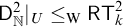 . However,
$\mathsf {D}^{2}_{\mathbb {N}}$
. However,
$\mathsf {D}^{2}_{\mathbb {N}}$
 is a fractal (this can be checked directly or by applying Theorem 4.3 and the fact that jumps are fractals [Reference Brattka, Gherardi and Marcone4, Proposition 5.8]) so that implies
$\mathsf {D}^{2}_{\mathbb {N}} \leq _{\mathrm {W}} \mathsf {RT}^{2}_{k}$
is a fractal (this can be checked directly or by applying Theorem 4.3 and the fact that jumps are fractals [Reference Brattka, Gherardi and Marcone4, Proposition 5.8]) so that implies
$\mathsf {D}^{2}_{\mathbb {N}} \leq _{\mathrm {W}} \mathsf {RT}^{2}_{k}$
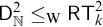 , contrary to [Reference Hirschfeldt and Jockusch10, Theorem 3.4].
Corollary 4.5.
$\mathsf {SRT}^{2}_{<\infty } <_{\mathrm {W}} \mathsf {SRT}^{2}_{\mathbb {N}}$
 and
$\mathsf {D}^{2}_{<\infty } <_{\mathrm {W}} \mathsf {D}^{2}_{\mathbb {N}}$
and
$\mathsf {D}^{2}_{<\infty } <_{\mathrm {W}} \mathsf {D}^{2}_{\mathbb {N}}$
 .
.
Our next result shows that [Reference Brattka and Rakotoniaina7, Corollary 4.10] remains valid. We give a brief proof (see [Reference Brattka and Rakotoniaina7] for relevant background).
Corollary 4.6 [Reference Brattka and Rakotoniaina7, Corollary 4.10]
$\mathsf {SRT}^{n+1}_{k} \leq _{\mathrm {W}} \mathsf {RT}^{n}_{k} \ast \mathsf {lim}$
 for all
$n \geq 1$
for all
$n \geq 1$
 ,
$k \in \mathbb {N} \cup \{\mathbb {N}\}$
,
$k \in \mathbb {N} \cup \{\mathbb {N}\}$
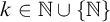 .
.
Proof. This was proved for
$k \in \mathbb {N}$
 in [Reference Brattka and Rakotoniaina7]. For
$k = \mathbb {N}$
in [Reference Brattka and Rakotoniaina7]. For
$k = \mathbb {N}$
 , observe that
$\mathsf {CRT}^{n}_{<\infty } \leq _{\mathrm {sW}} \mathsf {CRT}^{n}_{\mathbb {N}}$
, observe that
$\mathsf {CRT}^{n}_{<\infty } \leq _{\mathrm {sW}} \mathsf {CRT}^{n}_{\mathbb {N}}$
 and
$\mathsf {CRT}^{n}_{\mathbb {N}} \equiv _{\mathrm {W}} \mathsf {RT}^{n}_{\mathbb {N}}$
and
$\mathsf {CRT}^{n}_{\mathbb {N}} \equiv _{\mathrm {W}} \mathsf {RT}^{n}_{\mathbb {N}}$
 , so
, so

The desired result then follows from Theorem 4.3.
Next, we show that
$\mathsf {SRT}^{2}_{<\infty } \not \leq _{\mathrm {W}} \mathsf {D}^{2}_{\mathbb {N}}$
 . Our results establish the positions of
$(\mathsf {RT}^{1}_{\mathbb {N}})'$
. Our results establish the positions of
$(\mathsf {RT}^{1}_{\mathbb {N}})'$
 and
$(\mathsf {CRT}^{1}_{\mathbb {N}})'$
and
$(\mathsf {CRT}^{1}_{\mathbb {N}})'$
 relative to
$\mathsf {SRT}^{2}_{\mathbb {N}}$
relative to
$\mathsf {SRT}^{2}_{\mathbb {N}}$
 and
$\mathsf {D}^{2}_{\mathbb {N}}$
and
$\mathsf {D}^{2}_{\mathbb {N}}$
 .
.
Lemma 4.7.
$\mathsf {SRT}^{2}_{2}$
 is not omnisciently continuously Weihrauch reducible to
$\mathsf {RT}^{1}_{\mathbb {N}}$
is not omnisciently continuously Weihrauch reducible to
$\mathsf {RT}^{1}_{\mathbb {N}}$
 , i.e., for every continuous
$\Psi $
, i.e., for every continuous
$\Psi $
 , there is an
$\mathsf {SRT}^{2}_{2}$
, there is an
$\mathsf {SRT}^{2}_{2}$
 -instance f such that for all
$\mathsf {RT}^{1}_{\mathbb {N}}$
-instance f such that for all
$\mathsf {RT}^{1}_{\mathbb {N}}$
 -instances g, there is a solution H for g such that
$\Psi (H,f)$
-instances g, there is a solution H for g such that
$\Psi (H,f)$
 is not a solution for f.
This lemma strengthens the known result that
$\mathsf {SRT}^{2}_{2}$
 is not omnisciently Weihrauch reducible to
$\mathsf {D}^{2}_{<\infty }$
is not omnisciently Weihrauch reducible to
$\mathsf {D}^{2}_{<\infty }$
 ([Reference Dzhafarov8, Theorem 3.2], see also [Reference Dzhafarov and Patey9, before Definition 1.8]).
Proof. Suppose for a contradiction that
$\Psi $
 satisfies the negation of the desired statement.
Given some function f, we say that a finite set D is 0-ready if
$\Psi (D,f)$
 satisfies
$(*)$
satisfies
$(*)$
 , some property (depending on f) to be specified. For
$n \geq 1$
, some property (depending on f) to be specified. For
$n \geq 1$
 , we say a finite set D is n-ready if all of the following hold:
-
• $\Psi (D,f)$
satisfies
$(*)$
; -
• $D=\bigsqcup _{i<k}D_{i}$
, where each
$D_{i}$
is
$(n-1)$
-ready; -
• for each possible subset $E=\{x_{0},x_{1},\dots ,x_{k-1}\}$
of D, where
$x_{i}\in D_{i}$
,
$\Psi (E,f)$
satisfies
$(*)$
.








We claim that if D is n-ready, then for any
$(n+1)$
 -colouring of (singletons from) D, there is some homogeneous set
$E \subseteq D$
-colouring of (singletons from) D, there is some homogeneous set
$E \subseteq D$
 such that
$\Psi (E,f)$
such that
$\Psi (E,f)$
 satisfies
$(*)$
satisfies
$(*)$
 . This claim can be proved by induction on n, as follows. For
$n = 0$
. This claim can be proved by induction on n, as follows. For
$n = 0$
 , simply take
$E = D$
, simply take
$E = D$
 . For
$n \geq 1$
. For
$n \geq 1$
 , consider an
$(n+1)$
, consider an
$(n+1)$
 -colouring g of an n-ready set D. Fix
$(n-1)$
-colouring g of an n-ready set D. Fix
$(n-1)$
 -ready sets
$D_i$
-ready sets
$D_i$
 which witness that D is n-ready. If g uses at most n colours on any
$D_i$
which witness that D is n-ready. If g uses at most n colours on any
$D_i$
 , then we conclude by applying the inductive hypothesis to
$g\restriction D_i$
, then we conclude by applying the inductive hypothesis to
$g\restriction D_i$
 . Otherwise, for each i, we choose some
$x_i \in D_i$
. Otherwise, for each i, we choose some
$x_i \in D_i$
 of colour
$0$
of colour
$0$
 . Then the set of
$x_i$
. Then the set of
$x_i$
 ’s satisfies the desired property. This completes the proof by induction.
Once we have defined an
$\mathsf {SRT}^{2}_{2}$
 -instance f, by assumption on
$\Psi $
-instance f, by assumption on
$\Psi $
 , there is an
$\mathsf {RT}^{1}_{\mathbb {N}}$
, there is an
$\mathsf {RT}^{1}_{\mathbb {N}}$
 -instance g such that for all infinite g-homogeneous sets H,
$\Psi (H,f)$
-instance g such that for all infinite g-homogeneous sets H,
$\Psi (H,f)$
 is a solution for f. If the range of g is bounded by
$n+1$
is a solution for f. If the range of g is bounded by
$n+1$
 and D is n-ready, then regardless of the value of
$g(x)$
and D is n-ready, then regardless of the value of
$g(x)$
 for each
$x\in D$
for each
$x\in D$
 , we still successfully obtain a diagonalisation. Note that the definition of n-ready depends solely on
$\Psi $
, we still successfully obtain a diagonalisation. Note that the definition of n-ready depends solely on
$\Psi $
 and f. We also note that this n-ready technique will be used in the proof of Lemma 4.15.
Let
$f:[\mathbb {N}]^{2}\to \{0,1\}$
 be defined as follows. We will search for n-ready sets, where
$\Psi (A,f)$
be defined as follows. We will search for n-ready sets, where
$\Psi (A,f)$
 satisfies the property
$(*)$
satisfies the property
$(*)$
 if
$\Psi (A,f)$
if
$\Psi (A,f)$
 produces at least two elements larger than
$s_{n-1}$
produces at least two elements larger than
$s_{n-1}$
 , that is, the stage at which an
$(n-1)$
, that is, the stage at which an
$(n-1)$
 -ready set was found in the construction. The idea is that, each element x initially looks like it has stable colour
$0$
-ready set was found in the construction. The idea is that, each element x initially looks like it has stable colour
$0$
 , until some n-ready set is found, after which all elements
$<s_{n}$
, until some n-ready set is found, after which all elements
$<s_{n}$
 are now defined to have stable colour
$1$
are now defined to have stable colour
$1$
 . It follows from the property
$(*)$
. It follows from the property
$(*)$
 that for any n-ready set
$D_{n}$
that for any n-ready set
$D_{n}$
 that is found,
$\Psi (E,f)\downarrow $
that is found,
$\Psi (E,f)\downarrow $
 cannot be extended to a solution to f for any
$E\subseteq D_n$
cannot be extended to a solution to f for any
$E\subseteq D_n$
 .
.
Construction: Define
$s_0=0$
 and begin searching for a
$1$
and begin searching for a
$1$
 -ready set, while defining
$f(x,y)=0$
-ready set, while defining
$f(x,y)=0$
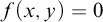 for
$x,y\leq s$
for
$x,y\leq s$
 . Once a
$1$
. Once a
$1$
 -ready set is found, say at stage
$s_1$
-ready set is found, say at stage
$s_1$
 , call this set
$D_1$
, call this set
$D_1$
 and define
$f(x,y)=1$
and define
$f(x,y)=1$
 for
$x<s_1$
for
$x<s_1$
 and
$y\geq s$
and
$y\geq s$
 . Start searching for a
$2$
. Start searching for a
$2$
 -ready set disjoint from
$D_1$
-ready set disjoint from
$D_1$
 . Recursively suppose that
$D_{n}$
. Recursively suppose that
$D_{n}$
 , an n-ready set has been found at stage
$s_{n}$
, an n-ready set has been found at stage
$s_{n}$
 . Then we continue searching for an
$(n+1)$
. Then we continue searching for an
$(n+1)$
 -ready set
$D_{n+1}$
-ready set
$D_{n+1}$
 , disjoint from
$D_{m}$
, disjoint from
$D_{m}$
 for each
$m\leq n$
for each
$m\leq n$
 , with the property
$(*)$
, with the property
$(*)$
 . While searching define
$f(x,y)=0$
. While searching define
$f(x,y)=0$
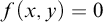 for
$s_{n}\leq x< y\leq s$
for
$s_{n}\leq x< y\leq s$
 . Once
$D_{n+1}$
. Once
$D_{n+1}$
 is found, let
$s_{n+1}$
is found, let
$s_{n+1}$
 be the current stage number and similarly define
$f(x,y)=1$
be the current stage number and similarly define
$f(x,y)=1$
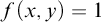 for each
$x,y$
for each
$x,y$
 , where
$s_{n}\leq x<s_{n+1}$
, where
$s_{n}\leq x<s_{n+1}$
 and
$y\geq s_{n+1}$
and
$y\geq s_{n+1}$
 .
.
Verification: It is clear that f is an instance of
$\mathsf {SRT}^{2}_{2}$
 , therefore, we may fix an
$\mathsf {RT}^{1}_{\mathbb {N}}$
, therefore, we may fix an
$\mathsf {RT}^{1}_{\mathbb {N}}$
 -instance g as above. We claim that every infinite g-homogeneous set H contains an n-ready set. This claim can be proved by induction on n, as follows. The claim for
$n = 0$
-instance g as above. We claim that every infinite g-homogeneous set H contains an n-ready set. This claim can be proved by induction on n, as follows. The claim for
$n = 0$
 follows from our choice of g, in particular that
$\Psi (H,f)$
follows from our choice of g, in particular that
$\Psi (H,f)$
 is a solution for f. For
$n \geq 1$
is a solution for f. For
$n \geq 1$
 , begin by applying the inductive hypothesis to generate a sequence
$D_0, D_1, \dots $
, begin by applying the inductive hypothesis to generate a sequence
$D_0, D_1, \dots $
 of
$(n-1)$
of
$(n-1)$
 -ready subsets of H such that
$\max (D_i) < \min (D_{i+1})$
-ready subsets of H such that
$\max (D_i) < \min (D_{i+1})$
 for all i. (This can be done because every final segment of H is still infinite g-homogeneous.) Observe that
$\bigsqcup _{i<k} D_i$
for all i. (This can be done because every final segment of H is still infinite g-homogeneous.) Observe that
$\bigsqcup _{i<k} D_i$
 satisfies
$(*)$
satisfies
$(*)$
 for all sufficiently large k, because
$\bigsqcup _{i \in \mathbb {N}} D_i$
for all sufficiently large k, because
$\bigsqcup _{i \in \mathbb {N}} D_i$
 is infinite g-homogeneous and so
$\Psi (\bigsqcup _{i \in \mathbb {N}} D_i,f)$
is infinite g-homogeneous and so
$\Psi (\bigsqcup _{i \in \mathbb {N}} D_i,f)$
 is infinite. Consider the finitely branching tree T consisting of all strings
$\sigma $
is infinite. Consider the finitely branching tree T consisting of all strings
$\sigma $
 such that (1) for each
$i < |\sigma |$
such that (1) for each
$i < |\sigma |$
 ,
$\sigma (i) \in D_i$
,
$\sigma (i) \in D_i$
 and (2)
$\mathrm {rng}(\sigma )$
and (2)
$\mathrm {rng}(\sigma )$
 does not satisfy
$(*)$
does not satisfy
$(*)$
 . If T has an infinite path P, then P is infinite g-homogeneous, so
$\Psi (P,f)$
. If T has an infinite path P, then P is infinite g-homogeneous, so
$\Psi (P,f)$
 is infinite. But this means that
$\mathrm {rng}(\sigma )$
is infinite. But this means that
$\mathrm {rng}(\sigma )$
 satisfies
$(*)$
satisfies
$(*)$
 for some initial segment
$\sigma $
for some initial segment
$\sigma $
 of P. This contradiction implies (by König’s lemma) that T has finite height. It follows that for sufficiently large k, the set
$\bigsqcup _{i<k} D_i$
of P. This contradiction implies (by König’s lemma) that T has finite height. It follows that for sufficiently large k, the set
$\bigsqcup _{i<k} D_i$
 is n-ready. This concludes the proof of our claim.
Thus in the construction, we must always succeed in finding n-ready sets for each
$n\in \mathbb {N}$
 , say
$D_0,D_{1},\dots $
, say
$D_0,D_{1},\dots $
 . Note that
$D_{n}$
. Note that
$D_{n}$
 may not be g-homogeneous.
Nonetheless, since g is an
$\mathsf {RT}^{1}_{\mathbb {N}}$
 -instance, there is some k such that
$g(x)<k$
-instance, there is some k such that
$g(x)<k$
 for each
$x\in \mathbb {N}$
for each
$x\in \mathbb {N}$
 . In particular, for each
$n\geq k$
. In particular, for each
$n\geq k$
 ,
$D_{n}$
,
$D_{n}$
 may only be coloured with colours
$< k$
may only be coloured with colours
$< k$
 . By our previous claim, there must be some subset
$E_{n}$
. By our previous claim, there must be some subset
$E_{n}$
 of
$D_{n}$
of
$D_{n}$
 such that
$E_{n}$
such that
$E_{n}$
 is g-homogeneous. By the infinite pigeonhole principle, there is a sequence of disjoint sets
$E_{n_{0}},E_{n_{1}},\dots $
is g-homogeneous. By the infinite pigeonhole principle, there is a sequence of disjoint sets
$E_{n_{0}},E_{n_{1}},\dots $
 , where
$E_{n_{i}}\subseteq D_{n_i}$
, where
$E_{n_{i}}\subseteq D_{n_i}$
 , all of which satisfy
$(*)$
, all of which satisfy
$(*)$
 and have the same g-colour. Then
$\bigsqcup _{i}E_{n_{i}}$
and have the same g-colour. Then
$\bigsqcup _{i}E_{n_{i}}$
 is an infinite g-homogeneous set but
$\Psi (E_{n_{0}},f)\downarrow $
is an infinite g-homogeneous set but
$\Psi (E_{n_{0}},f)\downarrow $
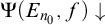 is not extendable to a solution of f, contradicting our assumption on g.
Corollary 4.8. For all
$k \in \mathbb {N}$
 ,
$\mathsf {SRT}^{2}_{2} \not \leq _{\mathrm {W}} (\mathsf {RT}^{1}_{\mathbb {N}})^{(k)}$
,
$\mathsf {SRT}^{2}_{2} \not \leq _{\mathrm {W}} (\mathsf {RT}^{1}_{\mathbb {N}})^{(k)}$
 . Therefore
$\mathsf {SRT}^{2}_{<\infty } \not \leq _{\mathrm {W}} (\mathsf {RT}^{1}_{<\infty })' \equiv _{\mathrm {W}} \mathsf {D}^{2}_{\mathbb {N}}$
. Therefore
$\mathsf {SRT}^{2}_{<\infty } \not \leq _{\mathrm {W}} (\mathsf {RT}^{1}_{<\infty })' \equiv _{\mathrm {W}} \mathsf {D}^{2}_{\mathbb {N}}$
 .
.
Proof. If
$\Phi $
 , and
$\Psi $
, and
$\Psi $
 witness
$\mathsf {SRT}^{2}_{2} \not \leq _{\mathrm {W}} (\mathsf {RT}^{1}_{\mathbb {N}})^{(k)}$
witness
$\mathsf {SRT}^{2}_{2} \not \leq _{\mathrm {W}} (\mathsf {RT}^{1}_{\mathbb {N}})^{(k)}$
 , then consider the
$\mathsf {SRT}^{2}_{2}$
, then consider the
$\mathsf {SRT}^{2}_{2}$
 -instance f given by Lemma 4.7. There is a solution H for the
$\mathsf {RT}^{1}_{\mathbb {N}}$
-instance f given by Lemma 4.7. There is a solution H for the
$\mathsf {RT}^{1}_{\mathbb {N}}$
 -instance
$\lim ^{(k)}(\Phi (f))$
-instance
$\lim ^{(k)}(\Phi (f))$
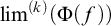 such that
$\Psi (H,f)$
such that
$\Psi (H,f)$
 is not a solution for f.
Corollary 4.9. Under Weihrauch reducibility,
$\mathsf {SRT}^{2}_{\mathbb {N}}$
 and
$(\mathsf {RT}^{1}_{\mathbb {N}})'$
and
$(\mathsf {RT}^{1}_{\mathbb {N}})'$
 are incomparable problems (strictly) above
$\mathsf {D}^{2}_{\mathbb {N}}$
are incomparable problems (strictly) above
$\mathsf {D}^{2}_{\mathbb {N}}$
 and (strictly) below
$(\mathsf {CRT}^{1}_{\mathbb {N}})'$
and (strictly) below
$(\mathsf {CRT}^{1}_{\mathbb {N}})'$
 .
.
Proof. Since
$\mathsf {RT}^{1}_{<\infty } \leq _{\mathrm {sW}} \mathsf {RT}^{1}_{\mathbb {N}} \leq _{\mathrm {sW}} \mathsf {CRT}^{1}_{\mathbb {N}}$
 , we have
$(\mathsf {RT}^{1}_{<\infty })' \leq _{\mathrm {sW}} (\mathsf {RT}^{1}_{\mathbb {N}})' \leq _{\mathrm {sW}} (\mathsf {CRT}^{1}_{\mathbb {N}})'$
, we have
$(\mathsf {RT}^{1}_{<\infty })' \leq _{\mathrm {sW}} (\mathsf {RT}^{1}_{\mathbb {N}})' \leq _{\mathrm {sW}} (\mathsf {CRT}^{1}_{\mathbb {N}})'$
 . We have
$(\mathsf {RT}^{1}_{<\infty })' \equiv _{\mathrm {W}} \mathsf {D}^{2}_{\mathbb {N}}$
. We have
$(\mathsf {RT}^{1}_{<\infty })' \equiv _{\mathrm {W}} \mathsf {D}^{2}_{\mathbb {N}}$
 by Theorem 4.3. The incomparabilities follow from Lemma 4.1 and Corollary 4.8.
Finally, we analyse the problems
$\mathsf {RT}^{1}_{\infty }$
 ,
$(\mathsf {RT}^{1}_{\infty })'$
,
$(\mathsf {RT}^{1}_{\infty })'$
 and
$(\mathsf {CRT}^{1}_{\infty })'$
and
$(\mathsf {CRT}^{1}_{\infty })'$
 .
.
Proposition 4.10.
$\mathsf {C}_{\mathbb {N}} \leq _{\mathrm {sW}} \mathsf {CRT}^{1}_{\mathbb {N}} \leq _{\mathrm {sW}} \mathsf {RT}^{1}_{\infty }$
 , so
$\mathsf {RT}^{1}_{\infty } \equiv _{\mathrm {W}} \mathsf {C}_{\mathbb {N}}' \leq _{\mathrm {sW}} (\mathsf {CRT}^{1}_{\mathbb {N}})' \leq _{\mathrm {sW}} (\mathsf {RT}^{1}_{\infty })'$
, so
$\mathsf {RT}^{1}_{\infty } \equiv _{\mathrm {W}} \mathsf {C}_{\mathbb {N}}' \leq _{\mathrm {sW}} (\mathsf {CRT}^{1}_{\mathbb {N}})' \leq _{\mathrm {sW}} (\mathsf {RT}^{1}_{\infty })'$
 .
.
Proof. First we show that
$\mathsf {C}_{\mathbb {N}}\leq _{\mathrm {sW}}\mathsf {CRT}^{1}_{\mathbb {N}}$
 . Let W be an instance of
$\mathsf {C}_{\mathbb {N}}$
. Let W be an instance of
$\mathsf {C}_{\mathbb {N}}$
 , interpreted as an enumeration. We construct
$f:\mathbb {N}\to \mathbb {N}$
, interpreted as an enumeration. We construct
$f:\mathbb {N}\to \mathbb {N}$
 as follows:
$f(s)$
as follows:
$f(s)$
 is the least element yet to be enumerated by W by stage s. Since W is an instance of
$\mathsf {C}_{\mathbb {N}}$
is the least element yet to be enumerated by W by stage s. Since W is an instance of
$\mathsf {C}_{\mathbb {N}}$
 , it follows that f is eventually constant, and
$\lim _{s}f(s)$
, it follows that f is eventually constant, and
$\lim _{s}f(s)$
 is the least element not enumerated by W. That is, the colour of the homogeneous set is the solution to W.
Now we show that
$\mathsf {CRT}^{1}_{\mathbb {N}}\leq _{\mathrm {sW}}\mathsf {RT}^{1}_{\infty }$
 . Given f, an instance of
$\mathsf {CRT}^{1}_{\mathbb {N}}$
. Given f, an instance of
$\mathsf {CRT}^{1}_{\mathbb {N}}$
 , define

To see that g is an instance of
$\mathsf {RT}^{1}_{\infty }$
 , note that it must have an infinite homogeneous set of colour
$\langle 0,y\rangle $
, note that it must have an infinite homogeneous set of colour
$\langle 0,y\rangle $
 for the y such that f has an infinite homogeneous set of colour y. Furthermore, any infinite homogeneous set of g necessarily has colour
$\langle 0,y\rangle $
for the y such that f has an infinite homogeneous set of colour y. Furthermore, any infinite homogeneous set of g necessarily has colour
$\langle 0,y\rangle $
 for some y. In fact, any infinite homogeneous set of g is of the form
$\{\langle x,y\rangle \mid f(x)=y\}$
for some y. In fact, any infinite homogeneous set of g is of the form
$\{\langle x,y\rangle \mid f(x)=y\}$
 . Given such a set, it is easy to obtain both the infinite homogeneous set of f and its colour.
The following results imply that the reductions in Proposition 4.10 are strict. We thank Manlio Valenti for suggesting the following proof and allowing us to include it here. This proof uses the following well-known problems:
-
• König’s lemma, denoted $\mathsf {KL}$
, has as instances infinite finitely branching subtrees
$T \subseteq \mathbb {N}^{<\mathbb {N}}$
(represented via characteristic functions), such that
$\mathsf {KL}(T)$
is the set of infinite paths through T. -
• For each $A \subseteq \mathbb {N}^{\mathbb {N}}$
, the problem
$\mathsf {id}_A$
is the restriction of the identity function to A.


Lemma 4.11.
$\mathsf {RT}^{1}_{2}$
 is not continuously Weihrauch reducible to
$\mathsf {C}_{\mathbb {N}}$
is not continuously Weihrauch reducible to
$\mathsf {C}_{\mathbb {N}}$
 .
.
Proof. Suppose
$\mathsf {RT}^{1}_{2}$
 is continuously Weihrauch reducible to
$\mathsf {C}_{\mathbb {N}}$
is continuously Weihrauch reducible to
$\mathsf {C}_{\mathbb {N}}$
 via
$\Phi $
via
$\Phi $
 and
$\Psi $
and
$\Psi $
 . Fix some
$p \in \mathbb {N}^{\mathbb {N}}$
. Fix some
$p \in \mathbb {N}^{\mathbb {N}}$
 such that
$\Phi $
such that
$\Phi $
 and
$\Psi $
and
$\Psi $
 are p-computable. It follows that
$\mathsf {RT}^{1}_{2} \times \mathsf {id}_{\{p\}} \leq _{\mathrm {W}} \mathsf {C}_{\mathbb {N}}$
are p-computable. It follows that
$\mathsf {RT}^{1}_{2} \times \mathsf {id}_{\{p\}} \leq _{\mathrm {W}} \mathsf {C}_{\mathbb {N}}$
 : Given an
$\mathsf {RT}^{1}_{2}$
: Given an
$\mathsf {RT}^{1}_{2}$
 -instance f and p, one can compute the
$\mathsf {C}_{\mathbb {N}}$
-instance f and p, one can compute the
$\mathsf {C}_{\mathbb {N}}$
 -instance
$\Phi (f)$
-instance
$\Phi (f)$
 ; given a
$\mathsf {C}_{\mathbb {N}}$
; given a
$\mathsf {C}_{\mathbb {N}}$
 -solution q to
$\Phi (f)$
-solution q to
$\Phi (f)$
 and
$(f,p)$
and
$(f,p)$
 , one can compute
$\Psi (f,q)$
, one can compute
$\Psi (f,q)$
 .
.
Parallelising both sides, we obtain (using [Reference Brattka, Gherardi and Marcone4, Fact 3.5 and Proposition 3.8] and [Reference Brattka and Rakotoniaina7, Fact 2.3, Proposition 3.4(2), and Theorem 5.13]) that

However, the above cannot hold because there is an infinite p-computable finitely branching tree
$T \subseteq \mathbb {N}^{<\mathbb {N}}$
 with no
$p'$
with no
$p'$
 -computable path (constructed by relativising a classical argument (see, e.g., [Reference Jockusch, Lewis and Remmel11, Corollary 5.2])). This contradiction shows that
$\mathsf {RT}^{1}_{2}$
-computable path (constructed by relativising a classical argument (see, e.g., [Reference Jockusch, Lewis and Remmel11, Corollary 5.2])). This contradiction shows that
$\mathsf {RT}^{1}_{2}$
 is not continuously Weihrauch reducible to
$\mathsf {C}_{\mathbb {N}}$
is not continuously Weihrauch reducible to
$\mathsf {C}_{\mathbb {N}}$
 .
.
Lemma 4.12.
$\mathsf {RT}^{1}_{\infty }$
 is not continuously Weihrauch reducible to
$\mathsf {RT}^{1}_{\mathbb {N}}$
is not continuously Weihrauch reducible to
$\mathsf {RT}^{1}_{\mathbb {N}}$
 .
.
Proof. Since
$\mathsf {RT}^{1}_{\mathbb {N}} \equiv _{\mathrm {W}} \mathsf {RT}^{1}_{\mathbb {N}}\mathsf {c}$
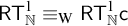 , it suffices to show that
$\mathsf {RT}^{1}_{\infty } \not \leq ^\ast _{\mathrm {W}} \mathsf {RT}^{1}_{\mathbb {N}}\mathsf {c}$
, it suffices to show that
$\mathsf {RT}^{1}_{\infty } \not \leq ^\ast _{\mathrm {W}} \mathsf {RT}^{1}_{\mathbb {N}}\mathsf {c}$
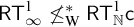 . Suppose for a contradiction that
$\Phi $
. Suppose for a contradiction that
$\Phi $
 and
$\Psi $
and
$\Psi $
 witness
$\mathsf {RT}^{1}_{\infty }\leq ^\ast _{\mathrm {W}} \mathsf {RT}^{1}_{\mathbb {N}}\mathsf {c}$
witness
$\mathsf {RT}^{1}_{\infty }\leq ^\ast _{\mathrm {W}} \mathsf {RT}^{1}_{\mathbb {N}}\mathsf {c}$
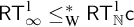 . Fix X to be an oracle such that
$\Phi $
. Fix X to be an oracle such that
$\Phi $
 and
$\Psi $
and
$\Psi $
 are both X-computable. We shall work relative to X in the remainder of the proof. We define f an (X-computable) instance of
$\mathsf {RT}^{1}_{\infty }$
are both X-computable. We shall work relative to X in the remainder of the proof. We define f an (X-computable) instance of
$\mathsf {RT}^{1}_{\infty }$
 as follows. Let
$g=\Phi (f)$
as follows. Let
$g=\Phi (f)$
 , with the understanding that we only have partial information about g given by applying
$\Phi $
, with the understanding that we only have partial information about g given by applying
$\Phi $
 to the initial segment of f defined thus far. Define
$f(0)=0$
to the initial segment of f defined thus far. Define
$f(0)=0$
 . For each
$s>0$
. For each
$s>0$
 , if
$|rng(g[s])|>|rng(g[s-1])|$
, if
$|rng(g[s])|>|rng(g[s-1])|$
 , then define
$f(s)=0$
, then define
$f(s)=0$
 . Otherwise, define
$f(s)$
. Otherwise, define
$f(s)$
 to be the least y distinct from
$\Psi (n,f\restriction s)$
to be the least y distinct from
$\Psi (n,f\restriction s)$
 for each
$n\in rng(g[s])$
for each
$n\in rng(g[s])$
 such that the computation has converged.
Now we verify that the construction works. If
$|rng(g)|=\infty $
 , then we evidently have that f has a homogeneous set of colour
$0$
, then we evidently have that f has a homogeneous set of colour
$0$
 and is thus a valid instance of
$\mathsf {RT}^{1}_{\infty }$
and is thus a valid instance of
$\mathsf {RT}^{1}_{\infty }$
 . Since
$|rng(g)|=\infty $
. Since
$|rng(g)|=\infty $
 , then g fails to be an instance of
$\mathsf {RT}^{1}_{\mathbb {N}}\mathsf {c}$
, then g fails to be an instance of
$\mathsf {RT}^{1}_{\mathbb {N}}\mathsf {c}$
 and thus
$\Phi $
and thus
$\Phi $
 cannot be part of a reduction from
$\mathsf {RT}^{1}_{\infty }$
cannot be part of a reduction from
$\mathsf {RT}^{1}_{\infty }$
 to
$\mathsf {RT}^{1}_{\mathbb {N}}\mathsf {c}$
to
$\mathsf {RT}^{1}_{\mathbb {N}}\mathsf {c}$
 . Conversely, if
$|rng(g)|<\infty $
. Conversely, if
$|rng(g)|<\infty $
 , then it must have some
$\mathsf {RT}^{1}_{\mathbb {N}}\mathsf {c}$
, then it must have some
$\mathsf {RT}^{1}_{\mathbb {N}}\mathsf {c}$
 -solution n. For such an n, either
$\Psi (n,f)$
-solution n. For such an n, either
$\Psi (n,f)$
 converges, in which case f clearly stops colouring new elements with the colour
$\Psi (n,f)$
converges, in which case f clearly stops colouring new elements with the colour
$\Psi (n,f)$
 eventually, or
$\Psi (n,f)$
eventually, or
$\Psi (n,f)$
 never converges. In either case, we obtain that
$\Phi $
never converges. In either case, we obtain that
$\Phi $
 and
$\Psi $
and
$\Psi $
 fail to witness
$\mathsf {RT}^{1}_{\infty }\leq ^\ast _{\mathrm {W}}\mathsf {RT}^{1}_{\mathbb {N}}\mathsf {c}$
fail to witness
$\mathsf {RT}^{1}_{\infty }\leq ^\ast _{\mathrm {W}}\mathsf {RT}^{1}_{\mathbb {N}}\mathsf {c}$
 .
.
Corollary 4.13.
$\mathsf {RT}^{1}_{\infty } <_{\mathrm {W}} (\mathsf {CRT}^{1}_{\mathbb {N}})' <_{\mathrm {W}} (\mathsf {RT}^{1}_{\infty })'$
 and
$\mathsf {C}_{\mathbb {N}} <_{\mathrm {sW}} \mathsf {CRT}^{1}_{\mathbb {N}} <_{\mathrm {sW}} \mathsf {RT}^{1}_{\infty }$
and
$\mathsf {C}_{\mathbb {N}} <_{\mathrm {sW}} \mathsf {CRT}^{1}_{\mathbb {N}} <_{\mathrm {sW}} \mathsf {RT}^{1}_{\infty }$
 .
.
Proof. The above reductions were established in Proposition 4.10. The strictness of the latter two reductions follow from the previous two lemmas. The strictness of the first two reductions follow from applying [Reference Brattka, Hölzl and Kuyper6, Theorem 11] to the previous two lemmas.
Theorem 4.14. The principles
$\mathsf {SRT}^{2}_{\infty },\left (\mathsf {CRT}^{1}_{\infty }\right )',\mathsf {D}^{2}_{\infty },\left (\mathsf {RT}^{1}_{\infty }\right )'$
 are all Weihrauch equivalent.
Proof. We show the sequence of reductions
$\mathsf {D}^{2}_{\infty }\leq _{\mathrm {W}}\left (\mathsf {RT}^{1}_{\infty }\right )'\leq _{\mathrm {W}}\left (\mathsf {CRT}^{1}_{\infty }\right )'\leq _{\mathrm {W}}\mathsf {SRT}^{2}_{\infty }\leq _{\mathrm {W}}\mathsf {D}^{2}_{\infty }$
 . The first three reductions are straightforward, as explained in the following paragraph.
First we note that the reduction
$\left (\mathsf {RT}^{1}_{\infty }\right )'\leq _{\mathrm {W}}\left (\mathsf {CRT}^{1}_{\infty }\right )'$
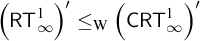 is trivial. Now, we show that
$\mathsf {D}^{2}_{\infty }\leq _{\mathrm {W}}\left (\mathsf {RT}^{1}_{\infty }\right )'$
is trivial. Now, we show that
$\mathsf {D}^{2}_{\infty }\leq _{\mathrm {W}}\left (\mathsf {RT}^{1}_{\infty }\right )'$
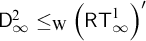 . Given
$f:[\mathbb {N}]^{2}\to \mathbb {N}$
. Given
$f:[\mathbb {N}]^{2}\to \mathbb {N}$
 , for each
$x,s\in \mathbb {N}$
, for each
$x,s\in \mathbb {N}$
 , define
$g_{s}(x)=f(x,s)$
, define
$g_{s}(x)=f(x,s)$
 . If f is stable and there is some infinite f-limit-homogeneous set, then it is evident that
$(g_{s})_{s\in \mathbb {N}}$
. If f is stable and there is some infinite f-limit-homogeneous set, then it is evident that
$(g_{s})_{s\in \mathbb {N}}$
 is a valid instance of
$\left (\mathsf {RT}^{1}_{\infty }\right )'$
is a valid instance of
$\left (\mathsf {RT}^{1}_{\infty }\right )'$
 . Let
$g=\lim _{s}g_{s}$
. Let
$g=\lim _{s}g_{s}$
 . It is easy to verify that any g-homogeneous set is also an f-limit-homogeneous set, thus, we have that
$\mathsf {D}^{2}_{\infty }\leq _{\mathrm {W}}\left (\mathsf {RT}^{1}_{\infty }\right )'$
. It is easy to verify that any g-homogeneous set is also an f-limit-homogeneous set, thus, we have that
$\mathsf {D}^{2}_{\infty }\leq _{\mathrm {W}}\left (\mathsf {RT}^{1}_{\infty }\right )'$
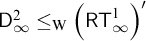 . To obtain the reduction
$\left (\mathsf {CRT}^{1}_{\infty }\right )'\leq _{\mathrm {W}}\mathsf {SRT}^{2}_{\infty }$
. To obtain the reduction
$\left (\mathsf {CRT}^{1}_{\infty }\right )'\leq _{\mathrm {W}}\mathsf {SRT}^{2}_{\infty }$
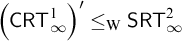 , define the pre-processing to take
$(f_{s})_{s\in \mathbb {N}}$
, define the pre-processing to take
$(f_{s})_{s\in \mathbb {N}}$
 to the function
$g(x,s)=f_{s}(x)$
to the function
$g(x,s)=f_{s}(x)$
 and define the post-processing to return the homogeneous set
$\{x_{0},x_{1},\dots \}$
and define the post-processing to return the homogeneous set
$\{x_{0},x_{1},\dots \}$
 given as a solution to g together with
$g(x_{0},x_{1})$
given as a solution to g together with
$g(x_{0},x_{1})$
 as the colour.
The remainder of the proof of this theorem is devoted to proving
$\mathsf {SRT}^{2}_{\infty }\leq _{\mathrm {W}}\mathsf {D}^{2}_{\infty }$
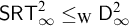 . Let
$f:[\mathbb {N}]^{2}\to \mathbb {N}$
. Let
$f:[\mathbb {N}]^{2}\to \mathbb {N}$
 be an instance of
$\mathsf {SRT}^{2}_{\infty }$
be an instance of
$\mathsf {SRT}^{2}_{\infty }$
 . We will define an instance of
$\mathsf {D}^{2}_{\infty }$
. We will define an instance of
$\mathsf {D}^{2}_{\infty }$
 ,
$g:[\mathbb {N}]^{2}\to \mathbb {N}$
,
$g:[\mathbb {N}]^{2}\to \mathbb {N}$
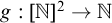 .
.
The main challenge lies in ‘thinning’ out the limit-homogeneous set to obtain a homogeneous set. Roughly speaking, given two elements
$x,y$
 , if they currently look like they have the same stable colour (with respect to f), but different from the value of
$f(x,y)$
, if they currently look like they have the same stable colour (with respect to f), but different from the value of
$f(x,y)$
 , then we would like to ‘change’ the stable colour of one of x or y (with respect to g, defined by us) to some unique value ensuring that they are never a part of the same limit-homogeneous set. Conversely, if the current stable colours of
$x,y$
, then we would like to ‘change’ the stable colour of one of x or y (with respect to g, defined by us) to some unique value ensuring that they are never a part of the same limit-homogeneous set. Conversely, if the current stable colours of
$x,y$
 agree with
$f(x,y)$
agree with
$f(x,y)$
 , then we ensure that they continue to ‘agree’ in the new colouring g. We provide the formal details below.
-
Stage s: For each $x<s$
, define
$g(x,s)$
as follows:-
• If there is some $y<x$
such that
$f(y,x)=f(x,s)=f(y,s)$
, then pick the least such y and define
$g(x,s)=g(y,s)$
. -
• Otherwise, define $g(x,s)$
to be the least
$n\notin \{g(y,s)\mid y<x\}$
.
-






Verification: We now verify that the construction works. First we show that g is a valid instance of
$\mathsf {D}^{2}_{\infty }$
 by proving that g is stable and has an infinite limit-homogeneous set. We conclude the verification by showing that any limit-homogeneous set with respect to g is a homogeneous set with respect to f.
Firstly,
$\lim _{t}g(0,t)$
 exists as
$g(0,t)=0$
exists as
$g(0,t)=0$
 for all
$t\in \mathbb {N}$
for all
$t\in \mathbb {N}$
 . Inductively suppose that there is some x so that for all
$y<x$
. Inductively suppose that there is some x so that for all
$y<x$
 ,
$\lim _{t}g(y,t)$
,
$\lim _{t}g(y,t)$
 exists. Now pick s large enough so that for each
$z\leq x$
exists. Now pick s large enough so that for each
$z\leq x$
 , for each
$y<x$
, for each
$y<x$
 , and for each
$t\geq s$
, and for each
$t\geq s$
 ,
$f(z,s)=f(z,t)$
,
$f(z,s)=f(z,t)$
 and
$g(y,s)=g(y,t)$
and
$g(y,s)=g(y,t)$
 . Such an s must exist by the inductive hypothesis and the assumption that f is stable. Since the definition of
$g(x,t)$
. Such an s must exist by the inductive hypothesis and the assumption that f is stable. Since the definition of
$g(x,t)$
 only possibly depends on the values of
$f(y,t),f(x,t),f(x,y)$
only possibly depends on the values of
$f(y,t),f(x,t),f(x,y)$
 , and
$g(y,t)$
, and
$g(y,t)$
 , by the choice of s, it follows that
$g(x,s)=g(x,t)$
, by the choice of s, it follows that
$g(x,s)=g(x,t)$
 for any
$t\geq s$
for any
$t\geq s$
 .
.
To show that there is some infinite limit-homogeneous set with respect to g, let
$x^{*}$
 be the least such that
$x^{*}$
be the least such that
$x^{*}$
 is contained in some infinite homogeneous set with respect to f. Also let
$H=\{x^{*}<x_{0}<x_{1}<\dots \}$
is contained in some infinite homogeneous set with respect to f. Also let
$H=\{x^{*}<x_{0}<x_{1}<\dots \}$
 be one such infinite homogeneous set containing
$x^{*}$
be one such infinite homogeneous set containing
$x^{*}$
 . We claim that for each
$i\in \mathbb {N}$
. We claim that for each
$i\in \mathbb {N}$
 ,
$\lim _{t}g(x_{i},t)=\lim _{t}g(x^{*},t)$
,
$\lim _{t}g(x_{i},t)=\lim _{t}g(x^{*},t)$
 . By the assumption that H is homogeneous and that f is stable,
$f(x^{*},x_{i})=\lim _{t}f(x^{*},t)=\lim _{t}f(x_{i},t)$
. By the assumption that H is homogeneous and that f is stable,
$f(x^{*},x_{i})=\lim _{t}f(x^{*},t)=\lim _{t}f(x_{i},t)$
 . Then, there exists some
$s^{*}$
. Then, there exists some
$s^{*}$
 such that for all
$t\geq s^{*}$
such that for all
$t\geq s^{*}$
 ,
$f(x^{*},s^{*})=f(x_{i},s^{*})=f(x^{*},t)=f(x_{i},t)$
,
$f(x^{*},s^{*})=f(x_{i},s^{*})=f(x^{*},t)=f(x_{i},t)$
 , and for each
$y<x^{*},\,f(y,s^{*})=f(y,t)$
, and for each
$y<x^{*},\,f(y,s^{*})=f(y,t)$
 . In particular, for all such
$t\geq s^{*}$
. In particular, for all such
$t\geq s^{*}$
 , whenever
$g(x_{i},t)$
, whenever
$g(x_{i},t)$
 is being defined, there is always some
$y<x_{i}$
is being defined, there is always some
$y<x_{i}$
 such that
$f(x_{i},y)=f(y,t)=f(x_{i},t)$
such that
$f(x_{i},y)=f(y,t)=f(x_{i},t)$
 . From the definition of g,
$g(x_{i},t)$
. From the definition of g,
$g(x_{i},t)$
 is defined to be
$g(y,t)$
is defined to be
$g(y,t)$
 for the least y which satisfies the aforementioned property. Clearly, if
$x^{*}$
for the least y which satisfies the aforementioned property. Clearly, if
$x^{*}$
 is the least y, then we are done. Suppose for a contradiction that the least such y is less than
$x^{*}$
is the least y, then we are done. Suppose for a contradiction that the least such y is less than
$x^{*}$
 . By the choice of
$s^{*}$
. By the choice of
$s^{*}$
 we have that
$f(x_{i},t)=\lim _{s}f(x_{i},s)$
we have that
$f(x_{i},t)=\lim _{s}f(x_{i},s)$
 and
$f(y,t)=\lim _{s}f(y,s)$
and
$f(y,t)=\lim _{s}f(y,s)$
 . Since H is homogeneous, it also follows that for any
$m,n\in \mathbb {N},\,f(x_{m},x_{n})=f(x_{i},t)=f(y,t)$
. Since H is homogeneous, it also follows that for any
$m,n\in \mathbb {N},\,f(x_{m},x_{n})=f(x_{i},t)=f(y,t)$
 . However this would imply that
$\{y\}\cup \{x_{n}\mid x_{n}\geq s^{*}\}$
. However this would imply that
$\{y\}\cup \{x_{n}\mid x_{n}\geq s^{*}\}$
 is an infinite homogeneous set with respect to f, contradicting the minimality of
$x^\ast $
is an infinite homogeneous set with respect to f, contradicting the minimality of
$x^\ast $
 . Therefore, H is an infinite limit-homogeneous set with respect to g.
Finally, we show that any limit-homogeneous set with respect to g is a homogeneous set with respect to f. That is,
$\lim _{t}g(x,t)=\lim _{t}g(y,t)$
 , then
$f(x,y)=\lim _{t}f(x,t)=\lim _{t}f(y,t)$
, then
$f(x,y)=\lim _{t}f(x,t)=\lim _{t}f(y,t)$
 . Let
$x,y\in \mathbb {N}$
. Let
$x,y\in \mathbb {N}$
 be given so that
$\lim _{t}g(x,t)=\lim _{t}g(y,t)$
be given so that
$\lim _{t}g(x,t)=\lim _{t}g(y,t)$
 . Without loss of generality, suppose that
$y<x$
. Without loss of generality, suppose that
$y<x$
 . For any
$t\in \mathbb {N}$
. For any
$t\in \mathbb {N}$
 , following the definition of
$g(x,t)$
, following the definition of
$g(x,t)$
 , if
$g(x,t)=g(y,t)$
, if
$g(x,t)=g(y,t)$
 , then
$f(x,y)=f(x,t)=f(y,t)$
, then
$f(x,y)=f(x,t)=f(y,t)$
 . Since
$\lim _{t}g(x,t)=\lim _{t}g(y,t)$
. Since
$\lim _{t}g(x,t)=\lim _{t}g(y,t)$
 , then there must be an s so that for all
$t\geq s$
, then there must be an s so that for all
$t\geq s$
 ,
$g(x,t)=g(y,t)$
,
$g(x,t)=g(y,t)$
 , and thus,
$f(x,y)=f(x,t)=f(y,t)$
, and thus,
$f(x,y)=f(x,t)=f(y,t)$
 .
.
Note that
$\mathsf {RT}^{2}_{2} \not \leq _{\mathrm {W}} \left (\mathsf {RT}^{1}_{\infty }\right )'$
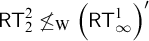 because every instance of the latter has a solution computable in one Turing jump of the instance, while the former has a computable instance with no
$\emptyset '$
because every instance of the latter has a solution computable in one Turing jump of the instance, while the former has a computable instance with no
$\emptyset '$
 -computable solution.
We end by showing that
$(\mathsf {CRT}^{1}_{\mathbb {N}})'$
 is the best upper bound for
$\mathsf {RT}^{1}_{\infty }$
is the best upper bound for
$\mathsf {RT}^{1}_{\infty }$
 in terms of Weihrauch reducibility, among the problems we have considered.
Lemma 4.15.
$\mathsf {RT}^{1}_{\infty }$
 is not omnisciently continuously Weihrauch reducible to
$\mathsf {RT}^{1}_{\mathbb {N}}$
is not omnisciently continuously Weihrauch reducible to
$\mathsf {RT}^{1}_{\mathbb {N}}$
 , i.e., for every continuous
$\Psi $
, i.e., for every continuous
$\Psi $
 , there is an
$\mathsf {RT}^{1}_{\infty }$
, there is an
$\mathsf {RT}^{1}_{\infty }$
 -instance f such that for all
$\mathsf {RT}^{1}_{\mathbb {N}}$
-instance f such that for all
$\mathsf {RT}^{1}_{\mathbb {N}}$
 -instances g, there is a solution H for g such that
$\Psi (H,f)$
-instances g, there is a solution H for g such that
$\Psi (H,f)$
 is not a solution for f.
Proof. Suppose for a contradiction that
$\Psi $
 satisfies the negation of the desired statement. We use the technique of searching for n-ready sets as in Lemma 4.7. We restate the definition of n-ready sets here for convenience. Note that we will use a different
$(*)$
satisfies the negation of the desired statement. We use the technique of searching for n-ready sets as in Lemma 4.7. We restate the definition of n-ready sets here for convenience. Note that we will use a different
$(*)$
 property from the one used in Lemma 4.7.
A finite set D is 0-ready if
$\Psi (D,f)$
 satisfies
$(*)$
satisfies
$(*)$
 . For
$n \geq 1$
. For
$n \geq 1$
 , a finite set D is n-ready if it satisfies all of the following:
-
• $D=\bigsqcup _{i<k}D_{i}$
, where each of
$D_{i}$
is
$(n-1)$
-ready. -
• For each possible subset $E=\{x_{0},x_{1},\dots ,x_{k-1}\}$
of D where
$x_{i}\in D_{i}$
,
$\Psi (E,f)$
satisfies
$(*)$
. -
• $\Psi (D,f)$
also satisfies
$(*)$
.






In this case we define
$(*)$
 as the property that
$\Psi (A,f)$
as the property that
$\Psi (A,f)$
 produces at least one element not of f-colour
$0$
produces at least one element not of f-colour
$0$
 . One may show (as we did in the proof of Lemma 4.7) that if D is n-ready, then for any
$(n+1)$
. One may show (as we did in the proof of Lemma 4.7) that if D is n-ready, then for any
$(n+1)$
 -colouring of D, there is some homogeneous set
$E \subseteq D$
-colouring of D, there is some homogeneous set
$E \subseteq D$
 such that
$\Psi (E,f)$
such that
$\Psi (E,f)$
 satisfies
$(*)$
satisfies
$(*)$
 .
.
Construction: We begin by searching for a
$1$
 -ready set
$D_1$
-ready set
$D_1$
 while defining
$f(s)=1$
while defining
$f(s)=1$
 at stage s. Let the stage that
$D_{1}$
at stage s. Let the stage that
$D_{1}$
 is found be
$s_{1}$
is found be
$s_{1}$
 . Define
$f(s_1)=0$
. Define
$f(s_1)=0$
 and begin searching for a
$2$
and begin searching for a
$2$
 -ready set disjoint from
$D_1$
-ready set disjoint from
$D_1$
 . Recursively suppose that an n-ready set,
$D_{n}$
. Recursively suppose that an n-ready set,
$D_{n}$
 , has been found at stage
$s_{n}$
, has been found at stage
$s_{n}$
 . While searching for an
$(n+1)$
. While searching for an
$(n+1)$
 -ready set
$D_{n+1}$
-ready set
$D_{n+1}$
 disjoint from
$D_m$
disjoint from
$D_m$
 for
$m<n+1$
for
$m<n+1$
 , define
$f(x)=n+1$
, define
$f(x)=n+1$
 for each
$x>s_{n}$
for each
$x>s_{n}$
 . Once
$D_{n+1}$
. Once
$D_{n+1}$
 is found, say at stage
$s_{n+1}$
is found, say at stage
$s_{n+1}$
 , define
$f(s_{n+1})=0$
, define
$f(s_{n+1})=0$
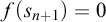 , and
$f(x)=n+2$
, and
$f(x)=n+2$
 for subsequent
$x>s_{n+1}$
for subsequent
$x>s_{n+1}$
 while beginning to search for an
$(n+2)$
while beginning to search for an
$(n+2)$
 -ready set.
Verification: Observe that if there is some
$n \geq 1$
 for which no n-ready set is ever found, then
$f(x)=n$
for which no n-ready set is ever found, then
$f(x)=n$
 for cofinitely many x. On the other hand, if for each
$n \geq 1$
for cofinitely many x. On the other hand, if for each
$n \geq 1$
 , some n-ready set is found, then
$f(x)=0$
, some n-ready set is found, then
$f(x)=0$
 for infinitely many x. Thus, f as defined is an
$\mathsf {RT}^{1}_{\infty }$
for infinitely many x. Thus, f as defined is an
$\mathsf {RT}^{1}_{\infty }$
 -instance. Therefore, by assumption on
$\Psi $
-instance. Therefore, by assumption on
$\Psi $
 , we may fix an
$\mathsf {RT}^{1}_{\mathbb {N}}$
, we may fix an
$\mathsf {RT}^{1}_{\mathbb {N}}$
 -instance
$g: \mathbb {N} \to k$
-instance
$g: \mathbb {N} \to k$
 such that for all infinite g-homogeneous sets H,
$\Psi (H,f)$
such that for all infinite g-homogeneous sets H,
$\Psi (H,f)$
 is a solution for f.
Unlike Lemma 4.7, we have two cases to consider.
First suppose that some n-ready set
$D_{n}$
 is found for every n. For all
$n \geq k$
is found for every n. For all
$n \geq k$
 , there is a g-homogeneous set
$E_n \subseteq D_n$
, there is a g-homogeneous set
$E_n \subseteq D_n$
 such that
$\Psi (E_n,f)$
such that
$\Psi (E_n,f)$
 satisfies
$(*)$
satisfies
$(*)$
 . By the infinite pigeonhole principle, there is a disjoint sequence
$E_{n_0},E_{n_1},\dots $
. By the infinite pigeonhole principle, there is a disjoint sequence
$E_{n_0},E_{n_1},\dots $
 , where
$E_{n_i} \subseteq D_{n_i}$
, where
$E_{n_i} \subseteq D_{n_i}$
 , such that each
$E_{n_i}$
, such that each
$E_{n_i}$
 satisfies
$(*)$
satisfies
$(*)$
 and
$\bigsqcup _{i}E_{n_{i}}$
and
$\bigsqcup _{i}E_{n_{i}}$
 is g-homogeneous. Then
$\Psi (\bigsqcup _{i}E_{n_{i}},f)$
is g-homogeneous. Then
$\Psi (\bigsqcup _{i}E_{n_{i}},f)$
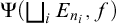 produces an element not of f-colour
$0$
produces an element not of f-colour
$0$
 , yet all infinite f-homogeneous sets have colour
$0$
, yet all infinite f-homogeneous sets have colour
$0$
 . This contradicts our choice of g.
Otherwise, let
$n \geq 1$
 be the least such that an n-ready set is never found. Recall that by construction,
$f(x)=n$
be the least such that an n-ready set is never found. Recall that by construction,
$f(x)=n$
 for cofinitely many x. It then follows from our choice of g that for every infinite g-homogeneous set H, there is some initial segment D of H such that
$\Psi (D,f)$
for cofinitely many x. It then follows from our choice of g that for every infinite g-homogeneous set H, there is some initial segment D of H such that
$\Psi (D,f)$
 satisfies
$(*)$
satisfies
$(*)$
 . This fact allows us to prove (by induction on n, following the proof of Lemma 4.7) that every infinite g-homogeneous set contains an n-ready set. This contradicts the case assumption, however.
Corollary 4.16. For each
$k \in \mathbb {N}$
 ,
$\mathsf {RT}^{1}_{\infty } \not \leq _{\mathrm {W}} (\mathsf {RT}^{1}_{\mathbb {N}})^{(k)}$
,
$\mathsf {RT}^{1}_{\infty } \not \leq _{\mathrm {W}} (\mathsf {RT}^{1}_{\mathbb {N}})^{(k)}$
 .
.
Lemma 4.17.
$\mathsf {RT}^{1}_{\infty } \not \leq _{\mathrm {W}} \mathsf {RT}^{2}_{\mathbb {N}}$
 .
.
Proof. Suppose that
$\Phi $
 and
$\Psi $
and
$\Psi $
 witness
$\mathsf {RT}^{1}_{\infty }\leq _{\mathrm {W}}\mathsf {RT}^{2}_{\mathbb {N}}$
witness
$\mathsf {RT}^{1}_{\infty }\leq _{\mathrm {W}}\mathsf {RT}^{2}_{\mathbb {N}}$
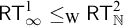 . In the discussion that follows, we shall think of
$\mathsf {RT}^{1}_{\infty }$
. In the discussion that follows, we shall think of
$\mathsf {RT}^{1}_{\infty }$
 as the Weihrauch equivalent problem
$\mathsf {RT}^{1}_{\infty }\mathsf {c}$
as the Weihrauch equivalent problem
$\mathsf {RT}^{1}_{\infty }\mathsf {c}$
 . That is,
$\Psi $
. That is,
$\Psi $
 simply produces a colour which it believes f will colour infinitely many elements with. The proof here will closely follow the techniques of the proof of Lemma 4.1. See the proof of Lemma 4.1 for a detailed discussion of these techniques. Here we recall the main definitions used: Let
$g=\Phi (f)$
simply produces a colour which it believes f will colour infinitely many elements with. The proof here will closely follow the techniques of the proof of Lemma 4.1. See the proof of Lemma 4.1 for a detailed discussion of these techniques. Here we recall the main definitions used: Let
$g=\Phi (f)$
 . For a finite set
$D_{i}=\{x_{0}<x_{1}<\dots <x_{n-1}\}$
. For a finite set
$D_{i}=\{x_{0}<x_{1}<\dots <x_{n-1}\}$
 and a string
$\sigma \in \mathbb {N}^{<\mathbb {N}}$
and a string
$\sigma \in \mathbb {N}^{<\mathbb {N}}$
 of length n,
-
• $H(D_{i},\sigma )=\{y>\max D_{i}\mid g(x_{k},y)=\sigma (k)\text { for each }k\}$
. -
• $(D_{i},\sigma )$
is consistent if for each
$k<k'<n$
,
$g(x_{k},x_{k'})=\sigma (k)$
. -
• For each $m\in \mathbb {N}$
,
$P_{m}(D_{i},\sigma )=\{x_{k}\in D_{i}\mid \sigma (k)=m\}$
.






During stage s of the construction, we say that a pair
$(D_{i},\sigma )$
 fires if the following conditions hold:
-
• $(D_{i},\sigma )$
is consistent. -
• $|H(D_{i},\sigma )\restriction s|>|H(D_{i},\sigma )\restriction (s-1)|$
. -
• For any $k<|D_{i}|$
,
$|\{n\in rng(g[s])\mid \Psi (P_{n}(D_{i},\sigma ),f)(0)\downarrow \}|>|\{n\in rng(g[s])\mid \Psi (P_{n}(D_{i}\restriction k,\sigma \restriction k),f)(0)\downarrow \}|$
.




As in Lemma 4.1, the construction will define f based on the pairs
$(D_{i},\sigma )$
 which fires. The main idea is to ensure that for some pair
$(D_{i},\sigma )$
which fires. The main idea is to ensure that for some pair
$(D_{i},\sigma )$
 , at least one of
$P_{n}(D_{i},\sigma )$
, at least one of
$P_{n}(D_{i},\sigma )$
 is extendable to an infinite g-homogeneous set whilst colouring only finitely many bits in f with some colour
$\Psi (P_{n}(D_{i},\sigma ),f)$
is extendable to an infinite g-homogeneous set whilst colouring only finitely many bits in f with some colour
$\Psi (P_{n}(D_{i},\sigma ),f)$
 . The main difference is that f now needs to be computable (rather than
$\Delta _{2}^{0}$
. The main difference is that f now needs to be computable (rather than
$\Delta _{2}^{0}$
 ), but the range of f may now possibly be infinite. We now describe the construction.
Construction: Let
$\{D_{i}\}_{i\in \mathbb {N}}$
 be an enumeration of all the finite sets such that if
$D_{i}\subseteq D_{j}$
be an enumeration of all the finite sets such that if
$D_{i}\subseteq D_{j}$
 , then
$i\leq j$
, then
$i\leq j$
 . During the construction, we shall monitor the pairs
$(D_{i},\sigma )$
. During the construction, we shall monitor the pairs
$(D_{i},\sigma )$
 for which
$|D_{i}|=|\sigma |$
for which
$|D_{i}|=|\sigma |$
 and
$\sigma $
and
$\sigma $
 mentions only values currently present in
$rng(g)$
mentions only values currently present in
$rng(g)$
 . Arrange the pairs in order of priority as follows:
$(D_{i},\sigma )<(D_{j},\tau )$
. Arrange the pairs in order of priority as follows:
$(D_{i},\sigma )<(D_{j},\tau )$
 if
$i<j$
if
$i<j$
 , or if
$i=j$
, or if
$i=j$
 and
$\sigma <_{lex}\tau $
and
$\sigma <_{lex}\tau $
 . Now define
$C(\emptyset ,\epsilon )[s]=0$
. Now define
$C(\emptyset ,\epsilon )[s]=0$
 for all s.
-
Stage s: For consistent pairs $(D_{i},\sigma )$
, do the following that applies.-
• If for each $(D_{j},\tau )\leq (D_{i},\sigma )$
, and each
$n\in rng(g[s])$
,
$\Psi (P_{n}(D_{j},\tau ), f)\uparrow $
. Define
$C(D_{i},\sigma )[s]=0$
. -
• Otherwise, define $C(D_{i},\sigma )[s]$
to be the least y larger than the current values of
$\Psi (P_{n}(D_{j},\tau ),f)$
for any
$(D_{j},\tau )$
and
$n\in rng(g[s])$
whenever the computation is defined.
Let $(D_{i},\sigma )$
be the highest priority pair satisfying the following:-
• $(D_{i},\sigma )$
fires at stage s:
$|H(D_{i},\sigma )[s]|>|H(D_{i},\sigma )[s-1]|$
,
$(D_{i},\sigma )$
is consistent, and for any
$k<|D_{i}|$
,
$|\{n\in rng(g[s])\mid \Psi (P_{n}(D_{i},\sigma ),f)\downarrow \}|>|\{n\in rng(g[s])\mid \Psi (P_{n}(D_{i}\restriction k,\sigma \restriction k),f)\downarrow \}|$
. -
• For any $(D_{j},\tau )$
, where
$D_{j}\supsetneq D_{i}$
and
$\tau \supsetneq _{pref}\sigma $
,
$(D_{j},\tau )$
does not fire at stage s.
If no such pair $(D_{i},\sigma )$
exists or if
$|rng(g[s])|>|rng(g[s-1])|$
, then define
$f(s)=0$
. Otherwise, define
$f(s)$
to be
$C(D_{j},\tau )[s]$
for the lowest priority pair
$(D_{j},\tau )$
such that
$C(D_{j},\tau )[s]\downarrow $
, and
$D_{j}\supseteq D_{i}$
and
$\tau \supseteq _{pref}\sigma $
. -

















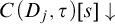


Verification: Now we verify that the construction works. First, if
$|rng(g)|=\infty $
 , then we evidently have that f has a homogeneous set of colour
$0$
, then we evidently have that f has a homogeneous set of colour
$0$
 , and
$\Phi $
, and
$\Phi $
 and
$\Psi $
and
$\Psi $
 fail as a reduction from
$\mathsf {RT}^{1}_{\infty }$
fail as a reduction from
$\mathsf {RT}^{1}_{\infty }$
 to
$\mathsf {RT}^{2}_{\mathbb {N}}$
to
$\mathsf {RT}^{2}_{\mathbb {N}}$
 . Now suppose that
$|rng(g)|=N$
. Now suppose that
$|rng(g)|=N$
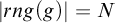 . Then let
$(D_{i},\sigma )$
. Then let
$(D_{i},\sigma )$
 be the highest priority pair which fires infinitely often and so that for any
$(D_{j},\tau )$
be the highest priority pair which fires infinitely often and so that for any
$(D_{j},\tau )$
 such that
$D_{j}\supsetneq D_{i}$
such that
$D_{j}\supsetneq D_{i}$
 and
$\tau \supsetneq _{pref}\sigma $
and
$\tau \supsetneq _{pref}\sigma $
 ,
$(D_{j},\tau )$
,
$(D_{j},\tau )$
 fires only finitely often.
To see why such a
$(D_{i},\sigma )$
 exists, first observe that for any g-homogeneous set X of colour n, there must be some s so that
$H(X\restriction s,n^{s})$
exists, first observe that for any g-homogeneous set X of colour n, there must be some s so that
$H(X\restriction s,n^{s})$
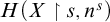 fires infinitely often, or
$\Psi (H\restriction s,f)\uparrow $
fires infinitely often, or
$\Psi (H\restriction s,f)\uparrow $
 for all s, a contradiction. Now suppose that for any
$(D_{i},\sigma )$
for all s, a contradiction. Now suppose that for any
$(D_{i},\sigma )$
 which fires infinitely often, there is some
$(D_{j},\tau )$
which fires infinitely often, there is some
$(D_{j},\tau )$
 such that
$D_{j}\supsetneq D_{i}$
such that
$D_{j}\supsetneq D_{i}$
 and
$\tau \supsetneq _{pref}\sigma $
and
$\tau \supsetneq _{pref}\sigma $
 which fires infinitely often. This immediately contradicts the definition of a pair firing as we assumed that
$|rng(g)|=N<\infty $
which fires infinitely often. This immediately contradicts the definition of a pair firing as we assumed that
$|rng(g)|=N<\infty $
 .
.
Finally, for the highest priority pair
$(D_{i},\sigma )$
 which satisfies our desired properties, we necessarily have that for any n such that
$\Psi (P_{n}(D_{i},\sigma ),f)\downarrow $
which satisfies our desired properties, we necessarily have that for any n such that
$\Psi (P_{n}(D_{i},\sigma ),f)\downarrow $
 , f only colours finitely many bits with
$\Psi (P_{n}(D_{i},\sigma ),f)\downarrow $
, f only colours finitely many bits with
$\Psi (P_{n}(D_{i},\sigma ),f)\downarrow $
 . This follows from the fact that any higher priority
$(D_{j},\tau )$
. This follows from the fact that any higher priority
$(D_{j},\tau )$
 which fires infinitely often is necessarily such that
$D_{j}\subsetneq D_{i}$
which fires infinitely often is necessarily such that
$D_{j}\subsetneq D_{i}$
 and
$\tau \subsetneq _{pref}\sigma $
and
$\tau \subsetneq _{pref}\sigma $
 . That is, whenever
$f(s)$
. That is, whenever
$f(s)$
 is defined due to some such
$(D_{j},\tau )$
is defined due to some such
$(D_{j},\tau )$
 firing, we have that
$f(s)\geq C(D_{i},\sigma )[s]>\Psi (P_{n}(D_{i},\sigma ),f)$
firing, we have that
$f(s)\geq C(D_{i},\sigma )[s]>\Psi (P_{n}(D_{i},\sigma ),f)$
 for any n where the computation converges. Since
$\lim _{s}C[s]$
for any n where the computation converges. Since
$\lim _{s}C[s]$
 clearly exists, we obtain that f has no infinite homogeneous set of colour
$\Psi (P_{n}(D_{i},\sigma ),f)$
clearly exists, we obtain that f has no infinite homogeneous set of colour
$\Psi (P_{n}(D_{i},\sigma ),f)$
 for any
$n\in rng(g)$
for any
$n\in rng(g)$
 for which the computation converges. Thus,
$\Phi $
for which the computation converges. Thus,
$\Phi $
 and
$\Psi $
and
$\Psi $
 fail to witness
$\mathsf {RT}^{1}_{\infty }\leq _{\mathrm {W}}\mathsf {RT}^{2}_{\mathbb {N}}$
fail to witness
$\mathsf {RT}^{1}_{\infty }\leq _{\mathrm {W}}\mathsf {RT}^{2}_{\mathbb {N}}$
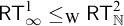 as one of
$P_{n}(D_{i},\sigma )$
as one of
$P_{n}(D_{i},\sigma )$
 must be extendable to an infinite g-homogeneous set.
Lemma 4.17 strengthens a result of Soldà and Valenti [Reference Soldà and Valenti15, Theorem 7.20] for
$n = 1$
 (
$\mathsf {C}_{\mathbb {N}}' \not \leq _{\mathrm {W}} \mathsf {RT}^{2}_{k}$
(
$\mathsf {C}_{\mathbb {N}}' \not \leq _{\mathrm {W}} \mathsf {RT}^{2}_{k}$
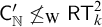 for all
$k \geq 2$
for all
$k \geq 2$
 ). We can now strengthen Proposition 3.24.
Corollary 4.18.
$\mathsf {RT}^{1}_{\infty }\chi \not \leq ^{\mathrm {t}}_{\mathrm {W}} \mathsf {RT}^{2}_{\mathbb {N}}\mathsf {pe}$
 .
.
Proof. The desired result follows from Lemma 4.17 and the equivalences
$\mathsf {RT}^{1}_{\infty }\chi \equiv _{\mathrm {W}} \mathsf {RT}^{1}_{\infty } \equiv _{\mathrm {W}} \mathsf {C}_{\mathbb {N}}'$
 and
$\mathsf {RT}^{2}_{\mathbb {N}}\mathsf {pe} \equiv _{\mathrm {W}} \mathsf {RT}^{2}_{\mathbb {N}}$
and
$\mathsf {RT}^{2}_{\mathbb {N}}\mathsf {pe} \equiv _{\mathrm {W}} \mathsf {RT}^{2}_{\mathbb {N}}$
 .
.
Acknowledgments
The authors thank the referee for their helpful comments.
Funding
K.M.N. was supported by the Ministry of Education, Singapore, under its Academic Research Fund Tier 2 (MOE-T2EP20222-0018) and Academic Research Fund Tier 1 (RG104/24). E.H. was partially supported by the Austrian Science Fund (FWF) through grant 10.55776/STA139.


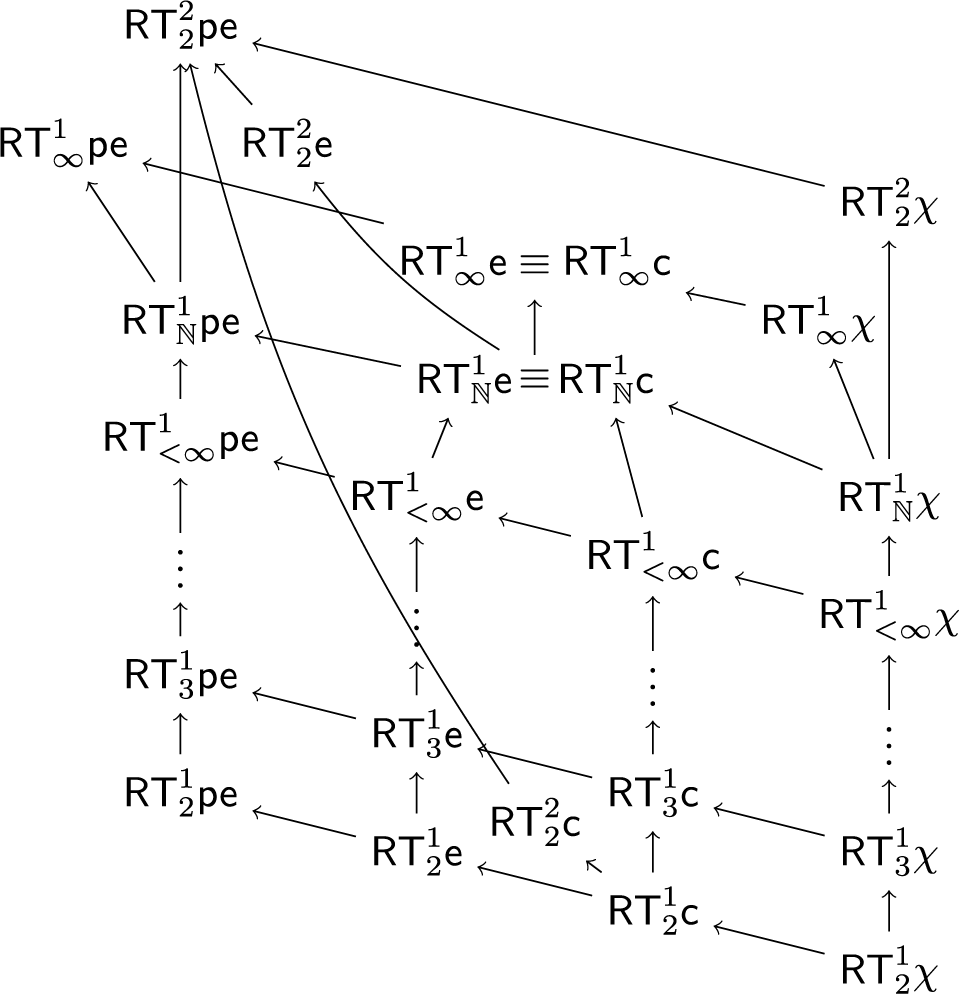

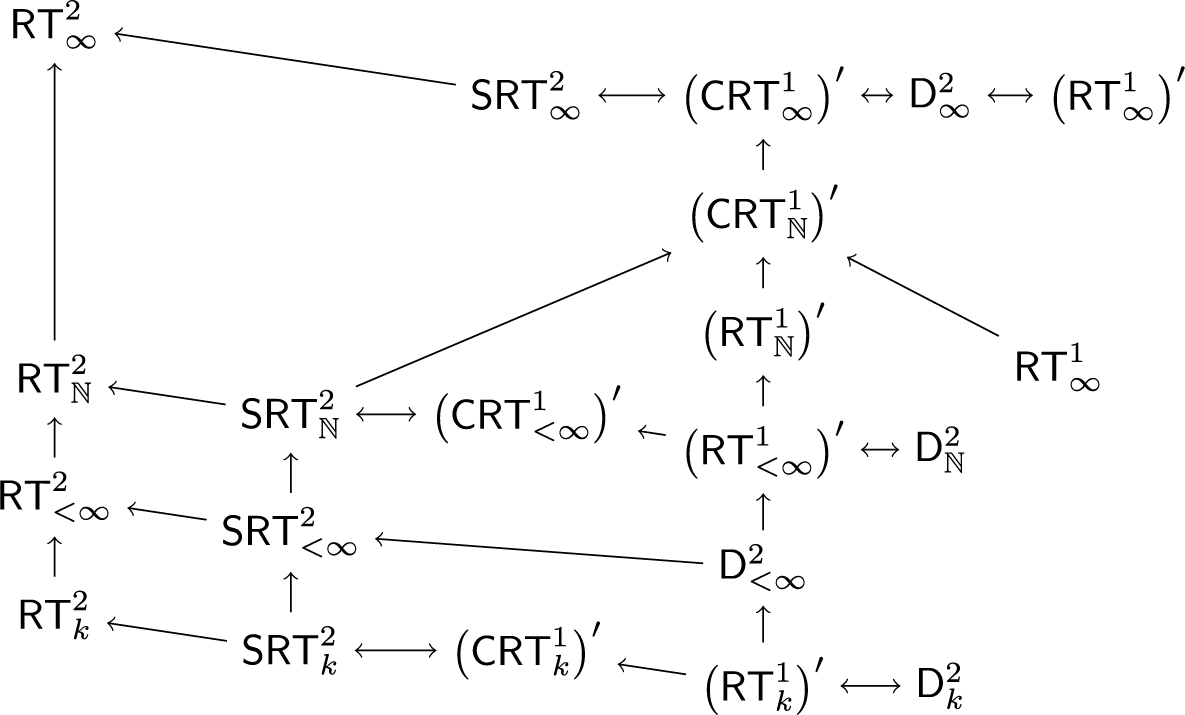


 Open access

