

Introduction
Tannins are phenolic secondary compounds of plants and are usually classified into two groups based on their chemical structures: hydrolysable and condensed tannins (Min et al., Reference Min, Barry, Attwood and McNabb2003). Hydrolysable tannins contain a carbohydrate core (often glucose) esterified with gallic acid or ellagic acid. Condensed tannins (CT) are the most common tannin type found in forage legumes, trees and shrubs (Barry and Mcnabb, Reference Barry and Mcnabb1999) and are oligomers or polymers of flavanoid units linked by carbon-carbon bonds (Hagerman, Reference Hagerman1988) CT can complex with numerous types of molecules including proteins, polysaccharides, and minerals (McSweeney et al., Reference McSweeney, Palmer, McNeil and Mand Krause2001). The multiple phenolic hydroxyl groups of CT lead to the formation of complexes primarily with proteins and to a lesser extent with polysaccharides (Makkar, Reference Makkar2003).
CT have both adverse and beneficial nutritional effects in herbivores depending on their chemical structure and dietary concentration (Makkar, Reference Makkar2003; Min et al., Reference Min, Barry, Attwood and McNabb2003). Adverse effects of tannins include lower intake and digestibility of protein and carbohydrates, inhibition of digestive enzymes and lower animal performance (Butter et al., Reference Butter, Dawson, Buttery, Caygill and Mueller-Harvey1999; Getachew et al., Reference Getachew, Makkar and Becker2000). The beneficial effects of CT are associated with their capacity to prevent bloat, increase digestive utilisation of dietary protein for ruminants and act as anthelmintics and antioxidants (Mueller-Harvey, Reference Mueller-Harvey, Caygill and Mueller-Harvey1999; Makkar, Reference Makkar2003).
The potential of CT to increase the digestive utilisation of dietary protein for ruminants is associated to their ability to bind proteins under the rumen pH conditions (pH 5.5 to 7.0), preventing the excessive microbial degradation of proteins. The tannin-protein complexes are dissociated in the acidic pH of the abomasum (pH 2.5 to 3.5) and in alkaline conditions of the distal small intestine (pH ≈ 7.5) releasing protein for digestion and absorption (Barry et al., Reference Barry, Manley and Duncan1986).
The use of CT, as feed additives, to improve the digestive utilisation of dietary protein in ruminants has been successfully explored by several authors. Salawu et al. (Reference Salawu, Acamovic, Stewart, Hvelplund and Weisbjerg1999) used three commercial tannin sources (quebracho, mimosa and myrabolam) as silage additives and Frutos et al. (Reference Frutos, Hervás, Giráldez, Fernández and Mantecón2000) used commercial quebracho tannin extracts as additive for protecting soya-bean meal protein against rumen degradation. Tannins extracted from Cistus ladanifer L. (CL) reduce in sacco rumen protein degradability (Dentinho et al., Reference Dentinho, Melo, Bessa and Ribeiro2000). CL is a very abundant shrub in marginal fields of Mediterranean countries. It contains a high level of CT (Dentinho et al., Reference Dentinho, Melo, Bessa and Ribeiro2000) and is practically not used in direct grazing due to its low nutritive value (Rodriguez et al., Reference Rodriguez, Castro, Lucena, Moreno and Leal1989). In the present study, we explored the utilisation of a phenolic extract from CL to reduce rumen degradation of soya-bean meal protein.
Material and methods
Preparation of phenolic extract
Phenolic compounds were extracted from CL (leaves and soft stems) harvested in March 2002 in the Southwest of Portugal. CL samples were freeze-dried and ground to pass through a 3-mm screen. Nine portions of 75 g each were weighed into 1-l round bottom flasks. To remove fats and pigments, 300 ml of petroleum ether was added to each sample, which was then stirred (KS 260, IKA®-Werke, Germany) for 30 min (Terril et al., Reference Terrill, Windham, Evans and Hoveland1990). This washing procedure was repeated twice. The supernatant was discarded and the residue was extracted three times with an acetone:water solution (7:3, v/v) (adapted from Hagerman (Reference Hagerman1988)). The first extraction was made with 750 ml on an orbital shaker (KS 260, IKA®-Werke, Germany) for 2 h, and the other two extractions with 250 ml, for 1 h. The supernatant containing the phenolic compounds was pooled and the acetone was removed by rotary evaporation at 30 °C. This extract was then stored at − 20 °C and freeze-dried.
Preparation of soya-bean meal products
Six samples of 500 g of soya-bean meal (solvent extracted and 440 g/kg of crude protein (CP) were weighed into plastic bags and sprayed using a compressor (Model Montecarlo OL 231, ABAC, UK), with 300 ml of CL phenolic extract dissolved in acetone:water (70:30 v/v). The extract was added in the following doses: 0, 9.8, 19.5, 39.0, 78.0 and 117 g aiming at obtaining soya-bean meals products with 0 (S0), 12.5 (S12.5), 25 (S25), 50 (S50), 100 (S100) and 150 (S150) g TP per kg. The samples were air-dried for 24 h to remove acetone and then oven-dried at 40 °C for 24 h.
Rumen in sacco degradability
Nylon bags from nitrogen free polyester with pore size of 50 μm diameter (50 mm × 100 mm; ANKOM Technology, Spain) were filled with 5 g of one of the six soya-bean products. Six bags, each containing one of the soya-bean meal products, were simultaneously incubated in the rumens of three cannulated rams, before the morning feeding for 2, 4, 6, 8, 16, 24, 48 or 72 h. In order to be technically feasible, the eight different incubation periods were started on separate days. Experimental conditions, including feeding management, was standardised during the whole trial. Animals were fed lucerne hay (153 g CP per kg of dry matter (DM) and 536 g neutral-detergent fibre (NDF) per kg DM) and a commercial concentrate (Table 1) in a proportion of 60/40 (w/w) at maintenance (50 g DM per kg M0.75 per day). Rams were fed twice daily (0930 and 1730 h) two equal portions. After incubation, the bags were washed twice in a washing machine (Model AWG 652 Whirlpool, USA), with cold water during 20 min and dried to constant weight at 45 °C in a forced air oven. Zero-time losses were estimated by washing in the same washing machine (20 min), three bags per sample without previous rumen incubation. The disappearance values of DM and nitrogen (N) were fitted to the Ørskov and McDonald (Reference Ørskov and McDonald1979) model, p = a+b (1-e-ct) where a represents the soluble or rapidly degradable fraction, b represents the non-soluble degradable fraction which disappears at a constant fractional rate c per unit of time and where a+b ≤ 1. The P = a+ [bc/(c+k)] equation was used to estimate effective degradability (P) where k (the outflow rate from the rumen) was assumed to be 0.08 per h (Ørskov and McDonald, Reference Ørskov and McDonald1979).
Composition of the concentrate fed to the three rumen cannulated sheep used for the in sacco experiment

† Provided per kg: retinol 1500 mg; cholecalciferol 27.5 mg; alpha-tocopherol 2700 mg; Mg 25 g; Fe 15 g; Zn 25 g; Mn 15 g; I 500 mg; Se 50 mg; Co 250 mg.
Intestinal in vitro digestibility
Intestinal protein digestibility (ivID) was determined by the three-step in vitro procedure developed by Calsamiglia and Stern (Reference Calsamiglia and Stern1995). In this method, one nylon bag for each soya-bean meal product was suspended in the rumen of three cannulated rams for 16 h. This process was repeated three times. The residues were washed and dried to constant weight at 45 °C. For each animal, residues of the three bags were pooled to ensure sufficient soya-bean meal residue for further incubation and added to form a composite sample. The composite samples were analysed for N using a Kjeldhal method (International Organization for Standardization (ISO), 1997). The intestinal digestion was simulated on pooled sample residues. Sample residues containing 15 mg of N were incubated for 1 h in 10 ml of 0.1 mol/l HCl solution containing 1 g/l of pepsin (Sigma P-7012; Sigma, St Louis, USA), after which pH was neutralised with 0.5 ml of 1 mol/l NaOH. Afterwards, 13.5 ml of a pH 7.8 phosphate buffer containing 37.5 mg of pancreatin (Sigma P-7545) were added to the solution and incubated at 38 °C for 24 h. Then, 3 ml of a 100% (w/v) trichloroacetic acid (TCA) solution was added to stop enzymatic action and precipitate undigested proteins. The samples were centrifuged at 10 000 g for 15 min and the supernatant was analysed for soluble nitrogen (sol-N). Pepsin-pancreatin digestion of protein was calculated as TCA – soluble N divided by the amount of sample N (nylon bag residue) used in the assay. The incubation procedure was performed twice.
Chemical analyses
CL phenolic extract was analysed in duplicate for DM (ISO, 1999), N using the Kjeldhal method (ISO 5983, 1997) and total sugar (Clegg, Reference Clegg1956).
Extraction and analysis of phenolic compounds were carried out in four replicates as described by Khazaal et al. (Reference Khazaal, Markantonatos, Nastis and Ørskov1993). Samples (200 mg) of CL were extracted by ultrasonication (Model 200 TH/2l, VWR International, Lisboa, Portugal) using 10 ml of 70% aqueous acetone in an ice bath for 10 min. The extract obtained was centrifuged at 1400 g at 4 °C for 30 min and the supernatant was used as ‘original extract’ for TP and CT assays. TP were determined by Folin-Ciocalteu's reagents, according to Julkunen-Tiito (Reference Julkunen-Tiitto1985) and the concentration was measured as tannic acid equivalent using tannic acid (100 773, Merck KGaA, Darmstadt, Germany) as standard.
Total extractable CT were measured using the vanillin assay (CTv) of Broadhurst and Jones (Reference Broadhurst and Jones1978). CTv were expressed as catechin equivalent using catechin (Sigma C-1788) as standard. Total tannins were measured by a protein precipitation assay, the radial diffusion method (TTdr), performed in agarose plates with a protein, the bovine serum albumin (Sigma A-7906) (Hagerman, Reference Hagerman1987).
Soya-bean meal samples were analysed for DM (ISO, 1999), N (ISO, 1997), total sugar (Clegg, Reference Clegg1956) and for sol-N by solubilisation in artificial saliva (Dulphy and Demarquilly, Reference Dulphy, Demarquilly and INRA Publ.1981) and for NDF and acid-detergent fibre by the methods of Van Soest et al. (Reference Van Soest, Robertson and Lewis1991). NDF was assayed with sodium sulphite, without alpha amylase and expressed with residual ash. The in vitro organic matter digestibility (OMD) was determined by the Tilley and Terry method modified by Alexander and McGowan (Reference Alexander and McGowan1966). Bag residues of the in sacco degradability trial were analysed for N (ISO, 1997)
Statistical analysis
The general linear model (GLM) procedure (Statistical Analysis Systems Institute, 2004) was used to regress the changes in chemical composition (total N, sol-N, sugar, NDF, ADF and OMD), rumen degradation parameters (a, b, c) of DM and CP, P, rumen undegradable protein (RUP), ivID and total protein availability (TPA) according to the inclusion level of TP. The model used was:

where Y i is the value of studied parameters, β0 the mean response of Ywhen X = 0, β1 is the linear effect coefficient, β2 is the quadratic effect coefficient, X i the value of the predictor variable, ɛi is the random error.
Results
The CL extract obtained was a crude extract that contained sugar (163 g/kg DM), N (3.5 g/kg DM) and high levels of TP, condensed and total tannins (Table 2).
Chemical composition of phenolic crude extract of Cistus ladanifer L
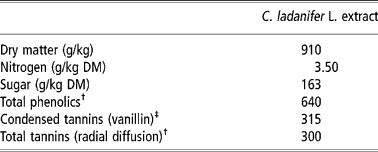
† Tannic acid equivalent in g/kg dry matter (DM).
‡ Catechin equivalent in g/kg DM.
The chemical composition of soya-bean meal products is presented in Table 3. Increasing concentrations of phenols linearly decreased total N (R 2 = 0.93, P < 0.001) and OMD (R 2 = 0.96, P < 0.01) and linearly increased NDF (R 2 = 0.83, P < 0.001). For sol-N a quadratic decrease with phenolics concentration (R 2 = 0.97, P < 0.001) was observed.
Chemical composition and in vitro organic matter digestibility (OMD) (g/kg DM) of soya-bean meal treated with different doses of a polyphenolic extract of Cistus ladanifer L. (n=2)†

† Abbreviations are: N = nitrogen (g/kg DM), Sol-N: soluble N (g/kg of total- N), SUG = sugar (g/kg DM), NDF = neutral-detergent fibre (g/kg DM), ADF = acid-detergent fibre (g/kg DM), OMD = organic matter digestibility. S0, S12.5, S25, S50, S100, S150: soya-bean meal treated with total phenol concentrations (g/kg) of 0, 12.5, 25, 50, 100 and 150, respectively.
Table 4 shows in sacco DM and N degradation parameters and effective degradability (P), computed assuming a ruminal passage rate of 0.08 per h, of soya-bean meal treated with different doses of CL extract. A quadratic effect of the CL extract doses was observed leading to a decrease in fraction a (R 2 = 0.96, P = 0.0001) and an increase in fraction b of N (R 2 = 0.92, P = 0.005). The CL extract linearly decreased the DM a fraction (R 2 = 0.80, P < 0.0001), whereas b was linearly increased (R 2 = 0.66, P < 0.001). Consequently, the potential degradability (a+b) remained unchanged (data not showed). The rate of degradation c of DM and N linearly decreased with the inclusion of CL extract (respectively R 2 = 0.59, P = 0.0005 and R 2 = 0.44, P = 0.0065). The P of DM and N of treated soya-bean meals linearly decreased at higher CL extract levels (respectively R 2 = 0.85 P < 0.0001; R 2 = 0.94 P < 0.0001) mainly due to a reduction of the soluble or rapidly degradable fraction a. The effect was greater in N than in DM degradability.
In sacco soluble or rapidly degradable fraction (a), non-soluble degradable fraction (b) and fractional degradation rate of the b fraction (c) (per h) (Ørskov and McDonald, Reference Ørskov and McDonald1979) and effective degradability (P) of dry matter (DM) and nitrogen (N) of soya-bean meal treated with different doses of a polyphenolic extract of Cistus ladanifer L (n=3)†

† S0, S12.5, S25, S50, S100, S150: soya-bean meal treated with total phenol concentrations (g/kg) of 0, 12.5, 25, 50, 100 and 150, respectively. P: effective rumen degradability of DM and N calculated with outflow rate k = 0.08 per h.
The ivID, RUP and TPA are presented in Table 5. Soya-bean meal protein without tannins had a low ivID (0.61) and quadratically decreased with TP (R 2 = 0.99, P < 0.0001). The RUP quadratically increased with the TP inclusion level (R 2 = 0.94, P = 0.0417). The TPA was computed from the RUP and ivID and linearly decreased with the inclusion of TP (R 2 = 0.45, P = 0.0033).
Intestinal digestibility of protein (relative to apparent rumen undegradable protein) (ivID), rumen undegradable (RUP) and total availability of protein (TPA) of soya-bean meal treated with different doses of a polyphenolic extract of Cistus ladanifer L. (n=3)†

† S0, S12.5, S25, S50, S100, S150: soya-bean meal treated with total phenol concentrations (g/kg) of 0, 12.5, 25, 50, 100 and 150, respectively.
‡ Rumen undegradable protein × protein intestinal digestibility.
Discussion
Total phenols and tannins concentrations in crude extract were lower than those observed in commercial quebracho extract (Sarl André Hiriar, France) that was also analysed in our laboratory (770 g TP per kg DM, and 330 g TTdr per kg DM). However, CT determined by the vanillin method were lower in quebracho than those observed in the CL extract (315 v. 950 g/kg DM). The values obtained by radial diffusion for both CL extract and commercial quebracho were similar.
The decrease of total N with the increase of phenolic concentration in soya-bean meal was due to a dilution effect of the CL extract addition. The linear reduction of OMD and the quadratic reduction observed for sol-N, cannot completely be attributed to a dilution effect but, presumably, is also the result of the soluble proteins binding with CT. The NDF fraction in soya-bean meal increased with the CL extract inclusion probably because of the formation of ‘artefact neutral fibre’ as a result of fibre-tannin interactions. Formation of tannin complexes with protein and fibre components remain in the NDF and ADF fraction, thereby increasing the apparent lignin concentration, as reported by Carre and Brillouet (Reference Carre and Brillouet1986) and Van Soest et al. (Reference Van Soest, Conklin and Horvath1987). However, we did not observe any increase in ADF proportion with the incorporation of CL extract, which may suggest that the formed complexes may be soluble in acid-detergent solution but stable in neutral-detergent solution.
The CL extract had a depressive effect on rumen effective degradability of both DM and N of soya-bean meal. However, this effect is greater in N than in DM degradability, probably due to the particular affinity of CT for proteins (Makkar, Reference Makkar2003). The soluble or rapidly degradable fraction a of DM and N from soya-bean meal without tannins was much higher than that reported by Frutos et al. (Reference Frutos, Hervás, Giráldez, Fernández and Mantecón2000). In the current study, this fraction may have been overestimated because no correction was made for the small particles washed out from the bags (mechanical losses). Nevertheless, the great negative relationship between total phenolic concentrations and fraction a of DM and N is evident and suggests a physical binding of CT with soluble proteins and carbohydrates.
The fractional degradation rate c of DM and N linearly decreased with the level of CL extract. These results are consistent with those obtained by Frutos et al. (Reference Frutos, Hervás, Giráldez, Fernández and Mantecón2000) who found a depression in the in sacco degradation rate of soya-bean meal treated with 150 and 250 g/kg of quebracho tannins. Reduction of in sacco degradation rates of feeds induced by the presence of CT have been reported in other studies (Aharoni et al., Reference Aharoni, Gilboa and Silanikove1998; Min et al., Reference Min, Barry, Attwood and McNabb2003). The depression in the degradation rate has been related either to the reduction in the attachment of microbes to feed particles (Makkar et al., Reference Makkar, Singh and Dawra1988; McAllister et al., Reference McAllister, Bae, Jones and Cheng1994) or to a specific inhibition of microbial growth and enzyme activity (McSweeney et al., Reference McSweeney, Palmer, McNeil and Mand Krause2001). Still, the in sacco results should be interpreted with caution as pointed out by Khazaal et al. (Reference Khazaal, Markantonatos, Nastis and Ørskov1993). This technique may not be suitable for evaluating feeds with anti-nutritive effects because only the physical binding of polyphenols could be detected in a nylon bag incubated in a large environment (rumen), whereas other effects such as toxicity to microbes or binding to their enzymes would be diluted.
The ivID of soya-bean meal protein without tannins was very low (0.61). Using the same technique, Calsamiglia and Stern (Reference Calsamiglia and Stern1995) and Frutos et al. (Reference Frutos, Hervás, Giráldez, Fernández and Mantecón2000) reported ivID for soya-bean meal protein of 0.89 and 0.94, respectively. Predicting intestinal digestibility in function of RUP and acid-detergent insoluble N (Agricultural and Food Research Council, 1993) the value obtained is 0.85. The ivID values of our current study remain considerably lower and reasons for such low values are unclear. Nevertheless, the increasing level of CL extract linearly decreased the protein ivID.
When using soya-bean meal treated with 10 to 250 g of quebracho tannins per kg, Frutos et al. (Reference Frutos, Hervás, Giráldez, Fernández and Mantecón2000) observed a reduction in ivID for the highest level only, whereas protein ivID was depressed even at the lower phenolic doses in our study (12.5, 25 and 50 g/kg). Differences in intestinal digestibility of soya-bean meal treated with CL extract and soya-bean meal treated with quebracho may be associated with differences in the chemical structure of CT, as it determines the biological effects of tannins (Min et al., Reference Min, Barry, Attwood and McNabb2003). Based on differences in tannin ability to bind protein in the rumen, Perez Maldonado et al. (Reference Perez-Maldonado and Norton1996) suggested that the post-ruminal reversibility of the process may also differ between tannins. Although, we did not find any differences in the radial diffusion test between quebracho and CL tannins, CL tannins probably formed protein/tannin complexes which are more stable at low pH. Alternatively, in this in vitro system, CL tannins dissociated at pH 1.9 could have higher affinity than quebracho tannins to bind pepsin and, after neutralisation at pH 7.8, to bind prancreatin. In fact, several studies suggest that the inhibition of digestive enzymes by dissociated tannins may occur (Makkar et al., Reference Makkar, Singh and Dawra1988; McSweeney et al., Reference McSweeney, Palmer, McNeil and Mand Krause2001; Silanikove et al., Reference Silanikove, Nitsan and Perevolotsky1994).
TPA linearly increased with the inclusion of TP. Although, these values suffer from the oversimplification, which is intrinsic to in sacco and in vitro methods, the results suggest that between 12.5 and 100 g/kg of TP inclusion in soya-bean meal, the desirable rumen effects counterbalance the negative post-ruminal effects.
Conclusions
From this study we conclude that CL phenolic extract causes a reduction in rumen degradation of soya-bean meal protein, thus increasing the flux of potential feed protein into the post-ruminal compartments. However, the phenolic extract has a negative effect on ivID. Nevertheless, the estimated total availability of protein increased even with lower levels of CL extract inclusion. Nevertheless, animal studies are required to evaluate whether the reduction in rumen degradable protein does not limit microbial protein synthesis.
Acknowledgements
This study was supported by ‘Programa Operacional Ciência, Tecnologia, Inovação’ (project POCTI 3/3.2/CA/1982/95) funded by Ministry of Science and Technology, Fundação para a Ciência e Tecnologia, Portugal.



