





Introduction
Non-suicidal self-injury (NSSI) among adolescents is a public health concern in many countries (Westers & Culyba, Reference Westers and Culyba2018). Seeking to understand what prompts NSSI, researchers have identified emotion dysregulation and the inability to handle negative emotions as important predictors of NSSI (Fox et al., Reference Fox, Franklin, Ribeiro, Kleiman, Bentley and Nock2015; Laye-Gindhu & Schonert-Reichl, Reference Laye-Gindhu and Schonert-Reichl2005; Wolff et al., Reference Wolff, Thompson, Thomas, Nesi, Bettis, Ransford, Scopelliti, Frazier and Liu2019). An important but understudied aspect of emotion dysregulation is the connections between dysregulated anger and NSSI. Although some assume dysregulated anger drives NSSI (Chapman et al., Reference Chapman, Gratz and Brown2006), others have argued for the opposite direction (Robinson et al., Reference Robinson, Garisch, Kingi, Brocklesby, O’Connell, Langlands and Wilson2019). Thus, our focus is on these ties and potential bidirectionality.
NSSI is the intentional destruction of body tissue without suicidal intention (Nock & Favazza, Reference Nock, Favazza and Nock2009). NSSI is distinguishable from deliberate self-harm, which can include suicide attempts. NSSI includes acts such as cutting, scraping, and carving the skin; self-battery, pulling hair, and preventing wounds from healing (Nock, Reference Nock2009). Lifetime prevalence during adolescence ranges from ∼13 to ∼23%, depending on the country and when it is measured (Jacobson & Gould, Reference Jacobson and Gould2007). In Sweden, more than a third of sampled adolescents reported engaging in at least one form of NSSI in the year prior to data collection (Zetterqvist et al., Reference Zetterqvist, Lundh, Dahlström and Svedin2013). Onset typically occurs between 12 and 14 years of age (Cipriano et al., Reference Cipriano, Cella and Cotrufo2017; Gandhi et al., Reference Gandhi, Luyckx, Baetens, Kiekens, Sleuwaegen, Berens, Maitra and Claes2018), peaking around age 15 (Barrocas et al., Reference Barrocas, Hankin, Young and Abela2012; Gandhi et al., Reference Gandhi, Luyckx, Baetens, Kiekens, Sleuwaegen, Berens, Maitra and Claes2018; Tilton-Weaver et al., Reference Tilton-Weaver, Latina and Marshall2023). For some adolescents, NSSI may continue to increase after age 15 (Tilton-Weaver et al., Reference Tilton-Weaver, Latina and Marshall2023). That is, Tilton-Weaver et al. (Reference Tilton-Weaver, Latina and Marshall2023) found a latent group of adolescents whose NSSI did not abate after age 15, as well as trajectories with stable low levels and with levels peaking at age 15 and abating afterward. Unfortunately, there were no identified differences that could explain why one group abated and the other continued to increase. Rather, analyses showed that where the two latent groups differed, the abating trajectory was faring worse, in terms of difficult social experiences and problems regulating themselves.
According to theory and evidence, adolescents who self-injure report doing so for a variety of reasons, with regulation of negative affect reported as the most common reason (Gratz, Reference Gratz2003; Taylor et al., Reference Taylor, Jomar, Dhingra, Forrester, Shahmalak and Dickson2018). Accordingly, several influential models conceptualize NSSI as a maladaptive coping strategy (e.g., Chapman et al., Reference Chapman, Gratz and Brown2006; Hasking et al., Reference Hasking, Whitlock, Voon and Rose2017). For example, the experiential avoidance model of NSSI poses that NSSI functions as an avoidance strategy, as it serves the desire to reduce unwanted internal experiences (Chapman et al., Reference Chapman, Gratz and Brown2006). By reducing unwanted internal experiences, such as emotional arousal (Klonsky, Reference Klonsky2007), the behavior of NSSI becomes negatively reinforced. This is thought to create a long-term vicious cycle of repeated engagement in NSSI and increased feelings of distress.
Chapman et al. (Reference Chapman, Gratz and Brown2006) suggest four major reasons as to why a vicious cycle may ensue. First, avoidance behaviors such as NSSI may trigger paradoxical effects of increasing rather than decreasing avoided internal experiences (also known as rebound effects; Hayes et al., Reference Hayes, Wilson, Gifford, Follette and Strosahl1996; Wegner et al., Reference Wegner, Schneider, Carter and White1987). Increased distress may then trigger additional episodes of NSSI. Second, avoidance hampers new learning (e.g., learning that one can tolerate feeling distressed). Third, NSSI may develop into a habitual rule-governed response, such as that an individual always responds with NSSI to certain stimuli. Last, the individual may habituate to negative consequences that could follow NSSI (e.g., social exclusion and/or negative reactions from others).
NSSI is not only thought to reinforce itself but also to exacerbate other dysregulated responses (Chapman et al., Reference Chapman, Gratz and Brown2006). Indeed, previous research has found a close link between engaging in NSSI and other dysregulated behaviors, including, for example, substance abuse (Serras et al., Reference Serras, Saules, Cranford and Eisenberg2010), binge eating (Ross et al., Reference Ross, Heath and Toste2009), and aggression (Shafti et al., Reference Shafti, Taylor, Forrester and Pratt2021). One dysregulated response in particular that has been associated with various detrimental outcomes is anger dysregulation (Roberton et al., Reference Roberton, Daffern and Bucks2012).
Anger and NSSI
Anger dysregulation can be defined as intense experiences of anger that are either habitually avoided, through active efforts to suppress or not letting the emotional experience unfold (i.e., over-regulation), or expressed outwardly, due to a lack of strategies to sufficiently contain an anger response (i.e., under-regulation; Roberton et al., Reference Roberton, Daffern and Bucks2012). Problems related to anger dysregulation are pervasive and have primarily been linked to increased rates of violence (Deffenbacher et al., Reference Deffenbacher, Oetting, Lynch and Morris1996), increased risk for coronary heart disease (Siegman, Reference Siegman1993), and pain conditions (Quartana & Burns, Reference Quartana and Burns2007).
There are several potential links between anger dysregulation and NSSI. First, in adolescent samples, engaging in NSSI is related to anger dysregulation (Laye-Gindhu & Schonert-Reichl, Reference Laye-Gindhu and Schonert-Reichl2005), including both outward expressions of hostility and anger suppression (Cipriano et al., Reference Cipriano, Claes, Gandhi, Cella and Cotrufo2020). Indeed, displays of anger dysregulation in the form of reactive aggression are also related to engaging in NSSI (O’Donnell et al., Reference O’Donnell, House and Waterman2015; Sahlin et al., Reference Sahlin, Kuja-Halkola, Bjureberg, Lichtenstein, Molero, Rydell, Hedman, Runeson, Jokinen, Ljótsson and Hellner2017; Shafti et al., Reference Shafti, Taylor, Forrester and Pratt2021). Second, in clinical adult populations, anger appears to trigger NSSI both immediately preceding NSSI and more distally (Dillon et al., Reference Dillon, Glenn, Dennis, LoSavio, Cassiello-Robbins, Gromatsky, Beckham, Calhoun and Kimbrel2021). This is consistent with studies showing that one of the most frequently reported reasons for adolescents’ engagement in NSSI is because they want to reduce or eliminate strong negative emotions (i.e., a function of NSSI; Klonsky, Reference Klonsky2007). As there are few longitudinal studies of dysregulated anger and NSSI among adolescents, the direction of the tie has largely been assumed – that anger dysregulation leads to NSSI.
The directionality of the link between anger dysregulation and NSSI has yet to be fully explored. The dominant interpretation, theoretically, has been that emotion dysregulation, more generally, precedes NSSI (Chapman et al., Reference Chapman, Gratz and Brown2006; Fox et al., Reference Fox, Franklin, Ribeiro, Kleiman, Bentley and Nock2015; Hasking et al., Reference Hasking, Whitlock, Voon and Rose2017; Wolff et al., Reference Wolff, Thompson, Thomas, Nesi, Bettis, Ransford, Scopelliti, Frazier and Liu2019). One model, in particular, argues for this direction. The emotion cascade model (Selby et al., Reference Selby, Anestis and Joiner2008; applied to NSSI by Hasking et al., Reference Hasking, Whitlock, Voon and Rose2017) posits that focus on negative emotions (via rumination) leads to a feedback loop in which negative emotions are intensified. An inability to reduce the intense, negative emotions then leads to NSSI.
By comparison, less is known about the opposite direction – whether NSSI is related to increases in anger dysregulation. However, there are good reasons to consider both directions. Indeed, bidirectional paths have been found between NSSI and emotion regulation, more generally (Robinson et al., Reference Robinson, Garisch, Kingi, Brocklesby, O’Connell, Langlands and Wilson2019), and psychological distress (Buelens et al., Reference Buelens, Luyckx, Gandhi, Kiekens and Claes2019). Theoretically, Robinson et al. (Reference Robinson, Garisch, Kingi, Brocklesby, O’Connell, Langlands and Wilson2019) articulated the following reasons why emotion dysregulation and NSSI could be bidirectional, with specific attention to NSSI driving dysregulation. First, they argued that NSSI limits the need to develop other emotion regulation skills, diminishing the ability to regulate emotions after NSSI. Second, they suggest that engagement in NSSI reduces the ability to tolerate distress, as it acts to immediately reduce arousal. Reduced tolerance could intensify subjective evaluations of negative events, making them even more difficult to deal with. A third proposed reason is that the use of emotion-avoidant strategies, which include NSSI, is associated with negative beliefs about emotional self-efficacy, including diminishing the belief that distress can be tolerated or managed in another way (Hasking et al., Reference Hasking, Whitlock, Voon and Rose2017; Salters-Pedneault et al., Reference Salters-Pedneault, Tull and Roemer2004). Thus, engaging in NSSI may reinforce existing negative beliefs about emotional self-efficacy. Finally, because many adolescents who self-injure fear and face interpersonal rejection (Esposito et al., Reference Esposito, Bacchini and Affuso2019), they may experience diminishing interpersonal support and hence fewer opportunities to learn other regulation strategies.
In this study, we examined three forms of anger dysregulation: dysregulated expressions of anger, anger suppression, and low anger reflection. Dysregulated expressions of anger refer to uncontrolled outward expressions of anger that can involve aggressive behaviors (McLaughlin et al., Reference McLaughlin, Hatzenbuehler and Hilt2009). Anger suppression, by comparison, is when anger is experienced, but not outwardly expressed (Kerr & Schneider, Reference Kerr and Schneider2008). Individuals may suppress anger when they feel unable to express anger or feel that they should not express anger. Anger reflection, which is considered an adaptive component of anger regulation, refers to being able to think clearly about what triggers anger and how an individual responds to it. Gratz and Roemer (Reference Gratz and Roemer2004) describe it as part of accepting emotional experiences, through being aware of and understanding negative emotions. Being aware of and understanding emotional experiences, which sometimes require reflection, are seen as critical components of effective emotion regulation. Moreover, reflection is a key aspect of mindfulness interventions, which have been applied to NSSI to reduce negative emotional reactions (Argento et al., Reference Argento, Simundic, Mettler, Mills and Heath2022). Thus, low levels of reflection indicate poor anger regulation.
Two of these three forms of anger dysregulation have been linked to NSSI. Among adolescents and young adults, greater levels of NSSI have been tied to dysregulated (outward) expressions of anger (Laye-Gindhu & Schonert-Reichl, Reference Laye-Gindhu and Schonert-Reichl2005) and to anger suppression (Turner et al., Reference Turner, Arya and Chapman2015). Although the links between anger reflection (or lack thereof) and NSSI have not been tested, a link is implicated by research showing that mindfulness is associated with reductions in NSSI (Per et al., Reference Per, Schmelefske, Brophy, Austin and Khoury2022). Mindfulness includes being able to accept and reflect on emotional experiences and stay in the “moment” (Heppner et al., Reference Heppner, Spears, Vidrine, Wetter, Ostafin, Robinson and Meier2015). This suggests that anger reflection could also be associated with NSSI.
This study
The overarching goal of our study was to examine the directionality of associations between NSSI and anger dysregulation using longitudinal data. Our data covered early to middle adolescence when NSSI may emerge or increase (Gandhi et al., Reference Gandhi, Luyckx, Baetens, Kiekens, Sleuwaegen, Berens, Maitra and Claes2018) and when some emotional lability is common (Larson et al., Reference Larson, Moneta, Richards and Wilson2002). In this study, we prospectively examined if (a) NSSI predicts the three forms of anger dysregulation; (b) any of the three forms of anger dysregulation predict NSSI; or (c) NSSI and anger dysregulation are related bidirectionally.
In addition, because of potential gender differences in NSSI (e.g., Zetterqvist et al., Reference Zetterqvist, Lundh, Dahlström and Svedin2013), we examined if these associations differed across boys and girls. Gender differences in socialization patterns suggest that girls tend to inhibit outward expressions of negative emotions, but boys do not (Gore et al., Reference Gore, Aseltine and Colten1993). This difference is thought to contribute to the well-known patterns of greater internalizing for girls and externalizing for boys (Rose & Rudolph, Reference Rose and Rudolph2006). We speculated then, that links between dysregulated outward expressions of anger and NSSI will be stronger for boys than for girls. Also, we expected the links between anger suppression and NSSI to be greater for girls than for boys.
Methods
Sample
Data for this study were drawn from the first three waves (hereafter T1, T2, T3) of a cross-sequential study conducted in central Sweden. Data were annual assessments spanning two years, collected from 17 public schools in three cities in Sweden. The initial target sample (T1) was all students in grades seven and eight, who ranged in age from 12 to 18 years old. Of the 3,262 students targeted, 2,768 students were present for data collection (77% response rate). At T2 and T3, students in the successive grades at the same schools were targeted for inclusion. Of 3,352 targeted at T2, 2,961 participated (88% responses). At T3, 4,038 were targeted, with 3,022 participating (75% response).
From the available data, we selected cases with at least one wave of data and involving at least one incidence of NSSI at least once during the three waves of the study. This resulted in an analytic sample of 1,304 adolescents. These adolescents ranged in age from 12 to 18 years (M age = 13.68, SD = .67), with more girls included than boys (58% girls). They were primarily Swedish in origin (89% born in Sweden, of whom 87% had at least one parent born in Sweden). Non-Swedish parents were born in Scandinavia (2%), outside of Scandinavia in Europe (7%), and outside of Europe (17%). Most reported living with two parents who were married or cohabitating (73%), most of whom were not divorced or separated (69%). In terms of income, most lived in households with at least one car (91%), at least one household computer (100%), reported sharing a bedroom (89%), with enough disposable income to have at least one vacation trip in the previous year (87%).
Measures
Non-suicidal self-injury
NSSI was measured using a nine-item, shortened version of the Deliberate Self-Harm Inventory (Lundh et al., Reference Lundh, Karim and Quilisch2007), with stem added to ask for non-suicidal injuries only (Tilton-Weaver et al., Reference Tilton-Weaver, Marshall and Svensson2019). Adolescents responded to items about the extent to which they had inflicted nonlethal injuries on themselves 6 months prior to data collection, without suicidal intent. We created mean scores from the responses, which could range from 0 (never) to 6 (6 or more times). Items included cutting; scratching with sharp objects; burning with cigaret, lighter or matches; carving; scratching until wounded or bleeding; biting; sticking sharp objects into skin; hitting and banging the head; and preventing wounds from healing. The scale has good reliability in this sample for all three-time points (αT1 = .86, αT2 = .85, αT3 = .87).
Anger dysregulation
We assessed difficulty regulating anger using items adapted from Assor et al. (Reference Assor, Eilot, Roth and Deci2009), whose items were focused on fear. Participants were asked, “What happens when you get REALLY ANGRY with someone?” They indicated their agreement (I don't agree at all = 1 to I agree completely = 4) to the items comprising each scale. Sample items are “I feel that I’m lacking control over myself” and “I behave aggressively, even though I don't want to” for dysregulated expressions; “I try to ignore my feelings” and “I keep the anger deep inside me” for anger suppression; and “I try to understand why I’m angry” and “I think about whether it would help if the person sees I’m angry” for anger reflection.
Confirmatory factor analyses showed that all three were distinct dimensions. In addition, the factors were factorially invariant over the three times of assessments. The fit indices and factor loadings are reported in a supplementary table (Table S1).
Cronbach’s alpha values indicated that the scales had good internal consistency: αT1 = .81, αT2 = .80, αT3 = .83 for dysregulated expressions; αT1 = .81, αT2 = .80, αT3 = .83 for anger suppression; and αT1 = .78, αT2 = .78, αT3 = .74 for anger reflection.
Procedures
After gaining approval for the study from the Uppsala Regional Ethics Board (reference number: 2013/384), all parents were informed about the aim and duration of the study. They were given the opportunity to decline their adolescents’ participation (via a postage-paid card, phone call, or email). At T1, 121 parents declined their child’s participation in the study; at T2, 10 additional parents declined, and at T3, another 65 parents declined (total n = 196).
Data were collected in the classrooms, during regular school hours, by trained research assistants. These assistants informed the participants of the aim and duration of the study as well as the participants’ rights and responsibilities. Students were told that participation was voluntary, that their answers were confidential, and that they had the right to withdraw from participation at any time. To ensure confidentiality, teachers left the rooms. Students were given 180 minutes to complete the questionnaire, with a break and refreshments provided in the middle of this time. Each class received 300 Swedish crowns (approximately 30 US dollars) as an honorarium.
Missing data analyses
Missing data was handled in two different steps. First, prior to the initiation of this study, data missing within waves were imputed for all items collected within the larger project (the three Cities Study), using a modern, two-step method. Within each wave, where less than 1% of the data were missing, principal components (Lang et al., Reference Lang, Chestnut and Little2015) were computed from all available data. These components were then used as auxiliary variables in the MICE package of R (van Buuren & Grotthuis-Oudshoorn, Reference van Buuren and Groothuis-Oudshoorn2011) to impute 100 datasets (Howard et al., Reference Howard, Rhemtulla and Little2015). The modal or mean imputed value was then calculated to replace each missing data point. These values represent the “best population estimate of the value needed to reproduce the population parameters” (Kärnä et al., Reference Kärnä, Voeten, Little, Poskiparta, Kaljonen and Salmivalli2011, p. 55).
The next step, used in this study, used Full Information Maximum Likelihood (FIML) estimation to account for data missing between waves. As missing data analyses indicated that data was not missing completely at random (MCAR) (see details below), estimation using FIML was aided by including auxiliary variables related to systematic differences between missing and non-missing values (Enders, 2011). We took an inclusive strategy, using variables that were not already included in the model (Collins et al., Reference Collins, Schafer and Kam2001), including measures on symptoms of depression and anxiety, delinquent behavior, and stress. Of the participants selected (N = 1,304), 76.2% had data for at least two waves of data and 48.2% had data across all three waves.
Little´s (Reference Little1988) test of the mechanism of missingness was significant, χ2 (145) = 317.67, p < .001, meaning that the data could not be assumed to be MCAR. Logistic regressions comparing those who were missing data (1) to those who were not (0) showed that participants with missing data at T1 were girls (b = −.73, SE = .31, Wald = 5.29, p = .02) and reported more dysregulated expressions of anger at T2 (b = .44, SE = .17, Wald = 6.65, p = .01) than those who were not missing data, χ2 (16) = 30.43, p = .02. They also reported having more cars at T3 than those who were not missing data (b = .74, SE = .36, Wald = 4.09, p = .04; χ2 (16) = 29.98, p = .02).
Those missing data at T2 reported engaging in more NSSI (b = .45, SE = .14, Wald = 10.78, p = .001) and having more dysregulated expressions of anger (b = .44, SE = .17, Wald = 7.24, p = .007) at T1 than those who were not missing data, χ2 (16) = 38.79, p = .001.
Participants missing data at T3 were older (b = .68, SE = .13, Wald = 22.88, p < .001) and engaged in more NSSI (b = .39, SE = .12, Wald = 10.49, p = .001) at T1 than those who were not missing data χ2 (16) = 66.06, p < .001. The same participants were older (b = .58, SE = .13, Wald = 20.88, p < .001), with mothers who were born outside of Sweden (b = .35, SE = .13, Wald = 7.05, p = .008), and reported more NSSI (b = .24, SE = .13, Wald = 4.57, p = .03) at T2, compared to participants with data at T3, χ2 (16) = 48.80, p < .001.
To summarize, compared to participants with information at each wave, adolescents with missing information tended to be girls, older, with foreign-born mothers, and reported engaging in more NSSI and dysregulated anger. We conclude that this likely led to some restricted variance in the model estimates, which would likely reduce the magnitude of estimates and power to detect significant paths.
Plan of analysis
Prior to initiating the main analyses, IBM SPSS 28.0 (IBM Corp., 2021) was used for data management and testing of missingness patterns. For main analyses and model building Mplus 8.7 was used (Muthén & Muthén, Reference Muthén and Muthén1998-2017). As the NSSI values were non-normally distributed (see Table 1), we used Maximum Likelihood Estimation with robust standard errors, which also yields corrections to Chi-square tests. The main analyses were conducted in two separate steps.
Descriptive statistics for study variables

Note. **p < .01.
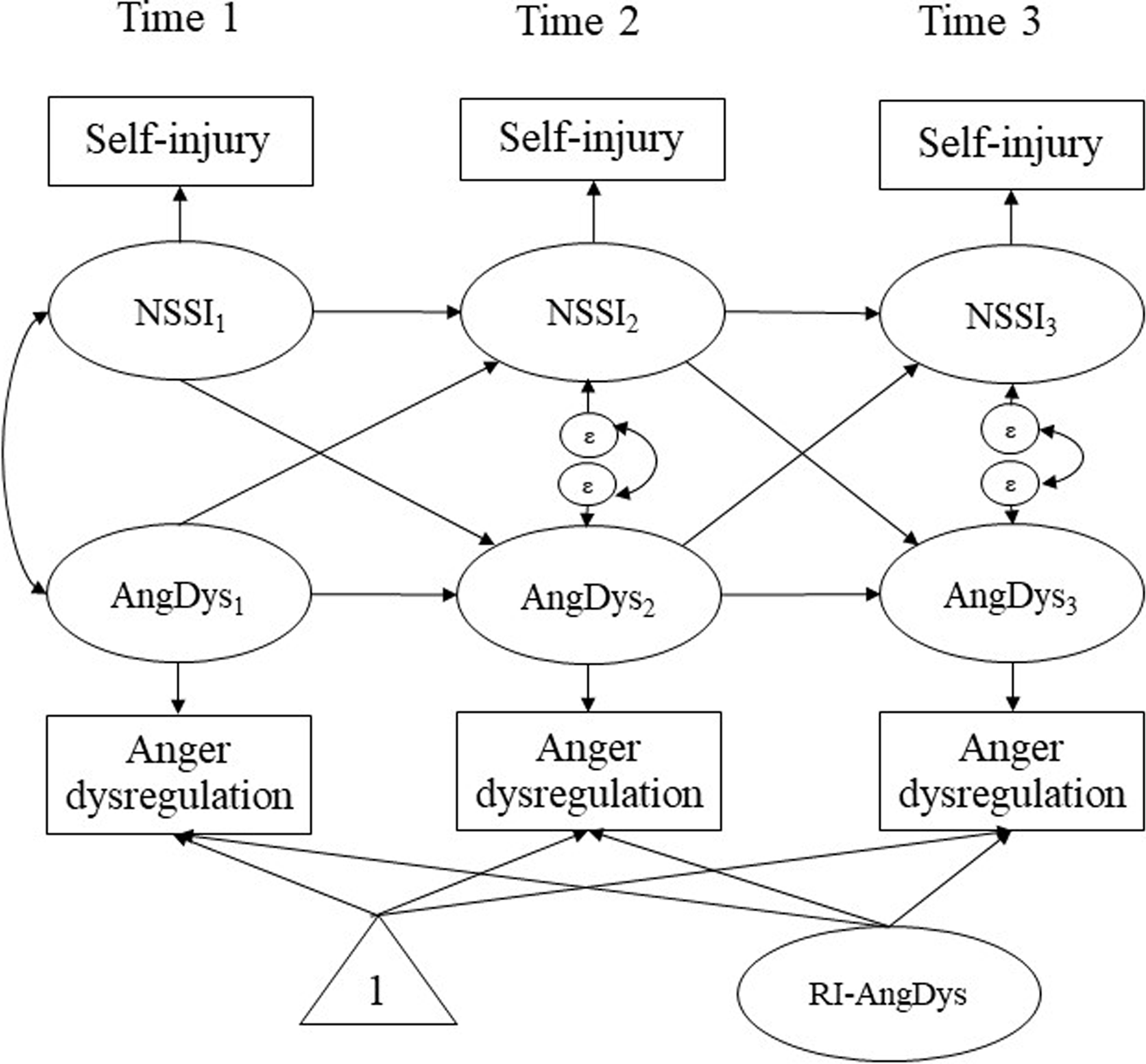
First, to address the question of directionality between NSSI and the three forms of anger dysregulation, we modeled the time-lagged sequence among variables using random-intercept cross-lagged panel models (RI-CLPM). The models included the three annual assessments (see Figure 1 for a depiction of these models). Prior to deciding to use RI-CLPM, a model-building series was conducted by comparing the RI-CLPM to the traditional cross-lagged panel model (CLPM; Mulder & Hamaker, Reference Mulder and Hamaker2021). Both RI-CLPM and CLPM are used to inspect the reciprocal influence of two or more variables over time, and consists of contemporaneous associations (i.e., associations among variables at the same time-point), autoregressive paths (i.e., lagged associations between the same variable over time), and cross-lagged paths (i.e., lagged associations between variables over time). By including autoregressive parameters, the traditional CLPM is thought to account for the temporal stability of the assessed constructs. However, these models do not account for stable, trait-like differences between individuals, which we often see in many psychological constructs (Hamaker et al., Reference Hamaker, Kuiper and Grasman2015). By adding random intercepts for each observed variable in the model, the RI-CLPM extends upon the traditional CLPM, by decomposing the variance into trait-like between-person differences and state-like within-person differences separately (Hamaker et al., Reference Hamaker, Kuiper and Grasman2015). This allows for investigation of within-person dynamics of the cross-lagged associations in the model.
Three-time point bivariate random-intercept cross-lagged panel model to test the cross-lagged associations between non-suicidal self-injury and anger dysregulation. Note. The triangle represents constants for the mean structure. AngDys = anger dysregulation; RI = random intercept. Due to nonsignificant variance in the random intercept for non-suicidal self-injury, this random intercept could not be included in the model.
To assess the magnitude of the effects we made post hoc comparisons of the lagged paths, by comparing the unconstrained lags to lags that were constrained to equality using the Sattora-Bentler Chi-square difference tests (Satorra & Bentler, Reference Satorra, Bentler, von Eye and Clogg1994). This procedure was done separately for each lag (i.e., T1–T2 and T2–T3).
Second, we used multiple-group analyses to test for gender differences, following Mulder and Hamaker’s (Reference Mulder and Hamaker2021) recommendations for significance testing of multigroup versions of RI-CLPM. The lagged coefficients in the models for boys and for girls were constrained to equality and compared to unconstrained models, using the Sattora-Bentler Chi-square difference tests (Satorra & Bentler, Reference Satorra, Bentler, von Eye and Clogg1994). A significant difference test indicates that the lagged coefficients differ across genders.
Model fit for the estimated models were assessed by inspecting the following fit indices: Chi-square tests, comparative fit index (CFI > .90; Hu & Bentler, Reference Hu and Bentler1999), Tucker-Lewis index (TLI > .90; Hu & Bentler, Reference Hu and Bentler1999), root-mean-square error of approximation (RMSEA ≤ .10; MacCallum et al., Reference MacCallum, Browne and Sugawara1996), and standardized root mean square residual (SRMR ≤ .08; Hu & Bentler, Reference Hu and Bentler1999).
When developing syntax for model building, we used segments from previously developed syntax. More specifically, we used syntax segments from a tutorial on RI-CLPM with Mplus by Hamaker (Reference Hamaker2018) and syntax provided by Mulder and Hamaker (Reference Mulder and Hamaker2021), for multigroup comparisons. Analytic syntax for this study can be made available upon request from the main author.
Results
Preliminary analyses
Descriptive statistics and correlation coefficients for the study variables are shown in Tables 1 and 2, respectively. As shown in Table 1, NSSI was non-normally distributed, with rather low levels of mean scores, as would be expected in a community sample. NSSI also tended to be engaged more by girls than by boys. Dysregulated anger was also low, on average, and did not differ significantly between genders. Levels of anger suppression and reflection were a bit higher, on average, with girls reporting more suppression than boys (at T1 and T2) and boys reporting less reflection than girls.
Correlations among study variables

Note. Gender coded as 0 = girls, 1 = boys.
*p < .05 **p < .01
Correlations between study variables (seen in Table 2) showed that, in addition to these gendered patterns, NSSI was relatively rank-order stable between adjacent waves. Anger reflection had levels of rank order stability similar to NSSI, whereas dysregulated expressions of anger were slightly more stable and suppression was slightly less stable. In addition, higher levels of NSSI were related to more dysregulated expressions across all three waves, except at T3. More NSSI at T2 was related to higher levels of anger suppression across all three waves; whereas at T3, more NSSI was only related to more anger suppression in the same wave. T1 NSSI was related to less anger reflection across all waves and T2 NSSI was related to less reflection on anger only at T1 and T2. Dysregulated expressions of anger were relatively independent of suppression and reflection (few significant correlations, all .16 or less in magnitude). By comparison, anger suppression and reflection showed slightly more significant correlations, where more suppression was related to more reflection.
Results of RI-CLP models
Model fit indices and model comparisons are provided in Table 3. Model comparisons for multi-group models based on gender are shown in Table 4.
Model building sequence and comparison of model fit indices

Note. Model comparisons are made between one model and the model above (e.g., RI-CLPM versus CLPM). The models with best fit indices are shown in bold type.
a Autoregressive-, and cross-lagged paths constrained over time (i.e., time-invariant).
Model comparisons for multi-group models based on gender

Note. Multigroup models were compared with lagged paths freely estimated and the same paths constrained to equality across genders.
Models with dysregulated expressions of anger
When comparing the RI-CLPM model for dysregulated expressions of anger with a nested CLPM model – by constraining the random intercepts and their covariances to zero (Hamaker, Reference Hamaker2018) – the Sattora-Bentler Chi-square difference test indicated that the RI-CLPM provided a better model fit. This suggests that between-person trait-like differences needed to be considered. However, when comparing the RI-CLPM model to a more parsimonious model – by constraining lagged parameters over time – all model fit indices deteriorated, suggesting that time constraints are not feasible for this data. As such we chose the RI-CLPM model as our main model.
As can be seen in the bottom half of Table 5, the lagged parameter estimates revealed that NSSI consistently predicted increases in dysregulated expressions of anger (T1–T2: β = .17, SE = .06, p < .001; T2–T3: β = .13, SE = .05, p = .012). By contrast, dysregulated expressions did not predict increased engagement in NSSI at any of the lags. Post hoc analyses, constraining NSSI and anger dysregulation paths to equality (within each lag), were significant for both time-lags (T1–T2: χ2Δ (2) = 33.43, p < .001; T2–T3: χ2Δ (2) = 43.42, p < .001). This suggests that the magnitude of the paths differ, such that NSSI more strongly predicted change in anger dysregulation than the other direction. See Table 5 below for standardized estimates for model paths.
Standardized estimates of model paths for dysregulated expressions of anger, anger suppression, and anger reflection
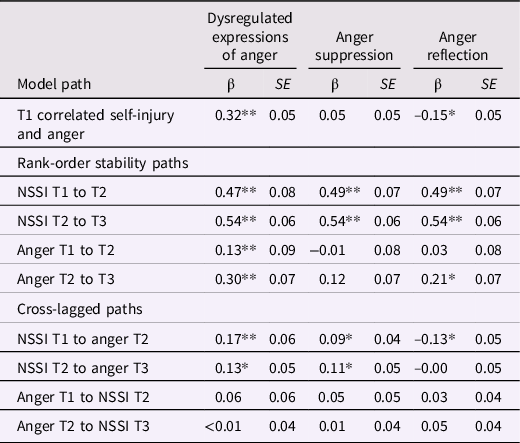
Note. Estimates are standardized beta coefficients.
*p < .05. ** p < .01.
Multigroup analysis to test for gender differences showed that there were no significant differences between boys and girls in the lagged estimates, χ2Δ (12) = 13.55, p = .33). We also noted that the cross-lagged parameters that were significant in the main model were also significant and in the same direction for both boys and girls in the grouped models.
Models with anger suppression
Model comparisons for the anger suppression models revealed similar results as for the dysregulated expressions of anger, with model fit indices suggesting the RI-CLPM model as the best-fitting model (see Table 3 for specific results).
Only the paths from NSSI to anger suppression were significant, where NSSI at one wave predicted increases in anger suppression at a later wave (T1–T2: β = .09, SE = .04, p = .038; T2–T3: β = .11, SE = .05, p = .019). Cross-lagged paths in the opposite direction, from suppression to change in NSSI were nonsignificant. Post hoc constraints testing the magnitude of the cross-lags showed that the paths from NSSI to anger suppression were stronger than the other direction (T1–T2: χ2Δ(2) = 45.42, p <. 001; T2–T3: χ2Δ(2) = 52.00, p <. 001). Multigroup comparisons of models for boys and girls showed that there were no significant differences in lagged estimates, χ2Δ(12) = 12.63, p = .40.
Models with anger refection
Model comparisons indicated that the RI-CLPM provided the best fit to the data, as evidenced by significant improvement in Chi-square scores in comparisons to the CLPM model, and significant deterioration in comparison to the time-constrained RI-CLPM. Only one lagged path was significant. T1 NSSI significantly predicted decreases in anger reflection at T2 (β = −.13, SE = .05, p = .01). Post hoc analyses comparing T1–T2 lags showed the path from NSSI to anger reflection as significantly stronger than the other direction (T1–T2: χ2Δ (2) = 82.26, p <. 001). As with the anger expressions and suppression, the lagged estimates did not significantly differ between boys and girls when compared with multigroup models, χ2Δ (12) = 13.01, p = .37.
Discussion
Although the relations between NSSI and many forms of emotion regulation have been studied, to our knowledge this is the first study systematically exploring the relations between anger dysregulation and NSSI among adolescents. Extending previous research on adults (Dillon et al., Reference Dillon, Glenn, Dennis, LoSavio, Cassiello-Robbins, Gromatsky, Beckham, Calhoun and Kimbrel2021), our results revealed longitudinal associations between NSSI and the three forms of anger dysregulation we studied, but only in one direction, from NSSI to anger dysregulation. Moreover, for anger reflection, this tie was only seen in the first lag. These patterns of results have several potential implications for theoretical frameworks.
The patterns call for testing directionality when examining the relations between NSSI and anger and other forms of dysregulation, rather than assuming a single causal direction from dysregulation to injury. This call comes with caveats, however. These patterns may have emerged because causal paths from dysregulated emotions to NSSI occur more immediately and do not endure long-term. Moreover, we note that in our time frame, NSSI was relatively stable (estimates ranging from .47 to .54), suggesting less variability in change than for anger dysregulation (estimates ranging from −.01 to .30). Akin to range restriction, low variability in change can reduce the magnitude of predictive estimates. Thus, it may be important to study ties from anger dysregulation to NSSI in shorter time frames or when NSSI is less stable. Alternatively, it is also possible that the nonsignificant lags mean that the ties are not consistent across the sample. If such heterogeneity in process exists, it could be identified in future research by identifying moderating conditions or using mixture models.
Nonetheless, our findings suggest that engaging in NSSI may have long-term consequences for anger regulation, especially for dysregulated outward expressions and anger suppression. It is possible that the longer-term connections from NSSI to anger dysregulation represent feedback cycles. This would be consistent with several theoretical framings suggesting that momentary processes can create enduring change in emotional and cognitive processing. For example, the experiential avoidance model of NSSI (Chapman et al., Reference Chapman, Gratz and Brown2006) posits that NSSI behaviors are maintained and even intensified by continual escape conditioning, where internal experiences are repeatedly avoided through recurring acts of NSSI. This would create a strengthened association between unwanted emotional experiences (e.g., anger) and NSSI that might be seen over longer intervals. Similarly, the anger-avoidance model by Gardner and Moore (Reference Gardner and Moore2008) conceptualizes anger-driven aggression and anger suppression as two ways to avoid the emotion of anger with similar negative reinforcement patterns. We suggest that future research incorporate burst designs into longitudinal frameworks, where these ideas that moment-to-moment processes affect longer-term development can be tested. We also suggest extending our findings to considering directionality in other forms of anger dysregulation in particular (e.g., an inability to identify the source or redirect anger), and emotion regulation, more generally.
Another interesting aspect of our study is that we found more significant links between NSSI and the two maladaptive forms (dysregulated expressions and anger suppression) than with anger reflection. This is consistent with findings from emotion regulation research showing that putatively maladaptive regulation strategies, such as suppression, have a stronger association with general psychopathology than putatively adaptive strategies (Aldao & Noelen-Hoeksema, Reference Aldao and Nolen-Hoeksema2010; Reference Aldao and Nolen-Hoeksema2012). An avenue for future research is to consider why this is the case. We offer a few suggestions.
We suggest first that anger dysregulation and NSSI are linked by lowered tolerance of distress. Both anger suppression and outward expression of anger (i.e., aggression) have been described as ways to avoid the internal experience of anger (Gardner & More, Reference Gardner and Moore2008). By comparison, low anger reflection may mean ignoring anger, rather than actively avoiding it. As avoidance is thought to decrease tolerance of distress (Robinson et al., Reference Robinson, Garisch, Kingi, Brocklesby, O’Connell, Langlands and Wilson2019), it is a likely candidate for mediation. As NSSI is itself an avoidance strategy and is associated with other avoidance behaviors (Anderson & Crowther, Reference Anderson and Crowther2012; Howe-Martin et al., Reference Howe-Martin, Murrell and Guarnaccia2012), NSSI may not only increase the risk for future NSSI (as seen in our study) but may also reinforce the use of other strategies sharing the same function of avoiding unwanted emotions. Hence, reduced tolerance of stress could operate as a mediator in both directions.
Other mediating mechanisms are also likely. To this point, we have focused on intrapersonal issues, but recognize that interpersonal problems, generated by either NSSI or by dysregulated anger (e.g., peer rejection, isolating self from others) could act as mediating mechanisms. Future research could illuminate the mechanisms and conditions underlying the directions we have found.
The lack of gender differences contributes to the body of knowledge on this issue. Although some studies have found gender differences in NSSI (see Bresin & Schoenleber, Reference Bresin and Schoenleber2015) and in emotion regulation strategies (e.g., rumination, see Rudolph, Reference Rudolph, Nolen-Hoeksema and Hilt2009), the empirical account is limited when it comes to research on anger among adolescents. As suggested by Sharkin (Reference Sharkin1993), the lack of attention to anger issues and the role played by gender may be due to basing many theoretical accounts of NSSI on clinical cases. As such, these ideas may not generalize to community samples.
There are several limitations of our study. First, we were limited to three waves of data, which excludes nonlinear models for the within-person part of RI-CLP models. Second, there are likely other moderators besides gender that could identify variations in paths. For example, culture may be an important moderator. Our sample was predominantly Swedish, where outward expressions of negative emotions, including anger, are dampened because of cultural beliefs that angry interactions should be avoided (Pedersen, Reference Pedersen2010; Scroope, Reference Scroope2017). Comparatively, in cultures where outward expressions of anger (e.g., annoyance, frustration) are tolerated, the connections between outward expressions of anger and NSSI may be weaker, as may be connections to conditions generated by outward expressions of anger.
We also had some selective attrition that needs to be considered when interpreting results. There was little consistency across waves, though, with only higher levels of NSSI and dysregulated expressions of anger differentiating cases with missing data from non-missing. As these patterns suggest that some of the higher levels of NSSI and dysregulated expressions of anger were missing, the most likely consequence of selective participation is some loss of variation at higher levels. This is most likely to work like range restriction, reducing the magnitude of associations and contributing to Type II error. This is another reason to interpret nonsignificant results with some caution.
Despite these limitations, our study had important strengths. Our sample was a large community sample, with three waves of data collection. We also examined several dimensions of anger, albeit not all. These strengths lend confidence in our results.
Conclusions
Our study suggests important avenues for advancing research and clinical practice. Researchers studying NSSI during adolescence can borrow, theoretically, from the clinical literature on adults, to consider anger dysregulation as an intrapersonal issue linked to NSSI, but not solely causing NSSI. In addition, adopting Robinson and colleagues’ (Robinson et al., Reference Robinson, Garisch, Kingi, Brocklesby, O’Connell, Langlands and Wilson2019) theoretical framing of anger dysregulation to emotion dysregulation more generally, could offer insight into the emergence, maintenance, and cessation of NSSI during adolescence. In addition, we also suggest developing ideas about what might link NSSI to change in anger dysregulation. Beyond Robinson and colleagues’ ideas, developmental literature on NSSI and related internalizing problems (e.g., Hasking et al., Reference Hasking, Whitlock, Voon and Rose2017; Rudolph, Reference Rudolph, Nolen-Hoeksema and Hilt2009) offers promising avenues, such as studying how anger dysregulation may exacerbate other negative emotional experiences (e.g., increasing shame), intrapersonal issues (e.g., rumination), and interpersonal stressors (e.g., conflict with friends). Such integrations of developmental and clinical research offer potential for advancing knowledge and treatment of NSSI.
Supplementary material
The supplementary material for this article can be found at https://doi.org/10.1017/S0954579423000858.
Acknowledgments
This study was made possible by access to data from the Three Cities Study, a longitudinal research program at the Department of Law, Psychology, and Social work at Örebro University, Sweden. The program from which these data were taken was supported by a grant from the Swedish Research Council Environment, Agricultural Science and Spatial Planning (FORMAS). This study was also supported by a grant from the Swedish Research Council for Health, Working Life, and Welfarex (FORTE) to the second author (dnr 2021-0100).
Competing interests
None.


 Open access

