




Introduction
In south-eastern Europe, an extraordinary archaeological landscape is emerging from the wetland environments around a dozen lakes in the contemporary border region of Albania, Greece and North Macedonia (Figure 1). This region, often referred to as the ‘cradle of European agriculture’, holds profound cultural and historical significance; nestled between the Aegean and the Adriatic seas, agricultural societies from West Asia made their way into Europe through this landscape, starting more than 8500 years ago (Maniatis Reference Maniatis, Stefani, Merousis and Dimoula2014; Reingruber et al. Reference Reingruber, Bonga, Thissen, Marić, Bulatović and Marković2023).
Prehistoric lakeside settlements in the Albania, North Macedonia and Greece border region around Lake Ohrid, the Prespa Lakes and ancient Lake Maliq dating from 6000–500 BC. Red dots indicate sites dated by radiocarbon dating; green dots indicate dendrochronology; black dots are undated. The Dunavec site is situated near ancient Lake Maliq, where drainage started in the 1960s (figure by Johannes Reich).

Recent research in the Korça area, particularly at the sites of Vashtëmi, Kallamas and Sovjan, as well as along the Albanian shore of Lake Ohrid (including the Neolithic settlement at Pogradec and the pile-dwelling settlements of Lin 1, Lin 3 and Udënisht), has greatly enhanced our understanding of settlement chronologies in the region (Allen & Gjipali Reference Allen, Gjipali, Gjipali and Perzhita2013; Naumov et al. Reference Naumov2019; Lera et al. Reference Lera2020; Naumov Reference Naumov, Hafner, Dolbunova, Mazurkevich, Pranckenaite and Hinz2020; Oberweiler et al. Reference Oberweiler2020; Hafner et al. Reference Hafner2021; Maczkowski et al. Reference Maczkowski2021).
Excavations of lakeside settlements in this region were first conducted in the 1960s and have continued to the present, identifying the settlements of Maliq, Dunavec, Sovjan (Albania), Dispilio (Greece) and Ploča Mičov Grad (North Macedonia) in the process (Prendi Reference Prendi1966, Reference Prendi and Bunguri2018; Korkuti Reference Korkuti1995, Reference Korkuti2010, Reference Korkuti2013; Lera & Touchais Reference Lera and Touchais2006; Voulgari Reference Voulgari, Stefani, Merousis and Dimoula2014, Reference Schwarzberg and Becker2017; Gori Reference Gori2015; Gori & Krapf Reference Gori and Krapf2015; Gori & Ivanova Reference Gori and Ivanova2017; Prendi & Bunguri Reference Prendi and Bunguri2018; Elezi Reference Elezi, Tasić, Urem-Kotsou and Burić2020; Lera et al. Reference Lera2020; Naumov Reference Naumov, Hafner, Dolbunova, Mazurkevich, Pranckenaite and Hinz2020). Since 2019, a series of investigations have been conducted as part of the European Research Council Synergy Grant-funded EXPLO project, ‘Exploring the dynamics and causes of prehistoric land use change in the cradle of European farming’ (Hafner et al. Reference Hafner2021; Maczkowski et al. Reference Maczkowski2021; Reich et al. Reference Reich2021; Bolliger et al. Reference Bolliger2023).
Interdisciplinary research under the EXPLO project seeks to unravel the intricate relationships between early agrarian communities and their environment from a long-term perspective. As part of this, new excavations were carried out at Dunavec, a Middle/Late Neolithic (c. 6000–5000 BC) settlement that forms a temporal bridge for recent research between Early Neolithic settlements, such as Vashtëmi and Podgori, and later settlements at Sovjan and Maliq (Late Neolithic, Eneolithic, Bronze and Iron Age). The relative periodisation of Neolithisation is rarely linked to absolute dating, which means that precise dating of the individual phases remains a desideratum (Ruka & Galaty Reference Ruka and Galaty2022). The archaeology at Dunavec draws temporal and cultural parallels both with other pile-dwelling settlements and with land-based settlements at sites such as Kallamas (Prespa Lake), Lin 3 (Ohrid Lake), Dispilio (Kastoria, Greece) and the settlements of Podgori II and Dërsnik in the Korça Plain, underlining the importance of Dunavec in a broader, regional context. Intensive surveys in 2022 and 2023 conducted by an Albanian-Swiss team part of the EXPLO-Project have now rediscovered the submerged cultural layers at Dunavec, allowing the absolute chronology of this site to be established for the first time.
Previous investigations at Dunavec
The fertile plain of the Korça Basin in south-eastern Albania, with the former Lake Maliq at its heart, has been the focus of substantial archaeological research (Korkuti Reference Korkuti1995, Reference Korkuti2013; Fouache et al. Reference Fouache2010; Prendi & Bunguri Reference Prendi and Bunguri2018). Dunavec and several other waterlogged prehistoric settlements border the former shoreline of the lake (Korkuti Reference Korkuti1995, Reference Korkuti2013; Denèfle et al. Reference Denèfle, Lézine, Fouache and Dufaure2000; Fouache et al. Reference Fouache, Dufaure, Denèfle, Lézine, Léra, Prendi and Touchais2001, Reference Fouache2010, Reference Arnaud-Fassetta and Carcaud2019; Pearson Reference Pearson2006; Albrecht et al. Reference Albrecht, Vogel, Hauffe and Wilke2010). The draining process, involving convict labour, commenced in 1946 with the dual aim of combatting malaria outbreaks (by removing breeding grounds for infected mosquitoes) and creating new agricultural land (Carter & Turnock Reference Carter and Turnock1993; Pearson Reference Pearson2006). Starting in 1959, substantial drainage canals were excavated, uncovering archaeological cultural layers and wooden structures at the Dunavec and Maliq sites that were typologically dated to the sixth–fifth millennia BC (Korkuti Reference Korkuti1995, Reference Korkuti2013; Hasa Reference Hasa2018a & Reference Hasab, Reference Hasa2019; Prendi Reference Prendi2018; Prendi & Bunguri Reference Prendi and Bunguri2018; Elezi Reference Elezi, Tasić, Urem-Kotsou and Burić2020). Regrettably, the archaeological materials and structures unearthed during these extensive earthworks were not properly documented.
Archaeological surveys (mostly surface collecting) were subsequently carried out in 1961 and 1964 by Frano Prendi and Zhaneta Andrea, providing the first evidence of prehistoric settlements at Dunavec, but neither the finds nor the features were published. The first formal excavations at the Dunavec site took place in 1971 and 1973 under the direction of Muzafer Korkuti (Figure 2) and waterlogged archaeological layers were discovered at approximately 8m below the surface. In total, an area of 516m2 with a cultural layer measuring up to 2.7m in thickness was meticulously investigated. These excavations yielded a diverse array of archaeological artefacts, including well-preserved organic remnants of prehistoric settlements (Korkuti Reference Korkuti1995). Despite the technical challenges presented by infiltrating groundwater, two profiles were documented, establishing a surface planum and identifying eight distinct layers. The uppermost layers (6–8) contained stratified archaeological materials and provided the basis for identifying two phases—‘Dunavec I’ and ‘Dunavec II’. Layer 6 (Dunavec II), the uppermost cultural layer, was 1–1.2m thick, and layers 7 and 8 (Dunavec I) combined were 1–1.5m in thickness. Notably, during excavation of the ‘Dunavec I’ phase, 87 wooden piles were documented, believed to be remnants of ancient buildings (Korkuti Reference Korkuti1995). These piles were irregularly distributed and measured between 0.1m and 0.37m in diameter, and the relative heights of the protruding piles were used to further divide this horizon into two subphases. Burnt daub with traces of a wooden substructure was also unearthed in both subphases. No piles were found for the ‘Dunavec II’ phase, which was subdivided into three ‘settlement horizons’ (Korkuti Reference Korkuti1995).
A photograph from the 1971 excavation at Dunavec, Korça, Albania (reproduced with permission, after Korkuti Reference Korkuti1995, plate V).

During Korkuti’s excavations in the 1970s, substantial quantities of pottery were uncovered, these were characterised by different styles that allowed for typological classification and comparison with other sites in the Balkans. Indeed, the site of Dunavec plays a pivotal role in prehistoric archaeology in Albania, standing as the birthplace of Albanian wetland and settlement archaeology (Elezi Reference Elezi, Tasić, Urem-Kotsou and Burić2020).
Recent studies: methods and data
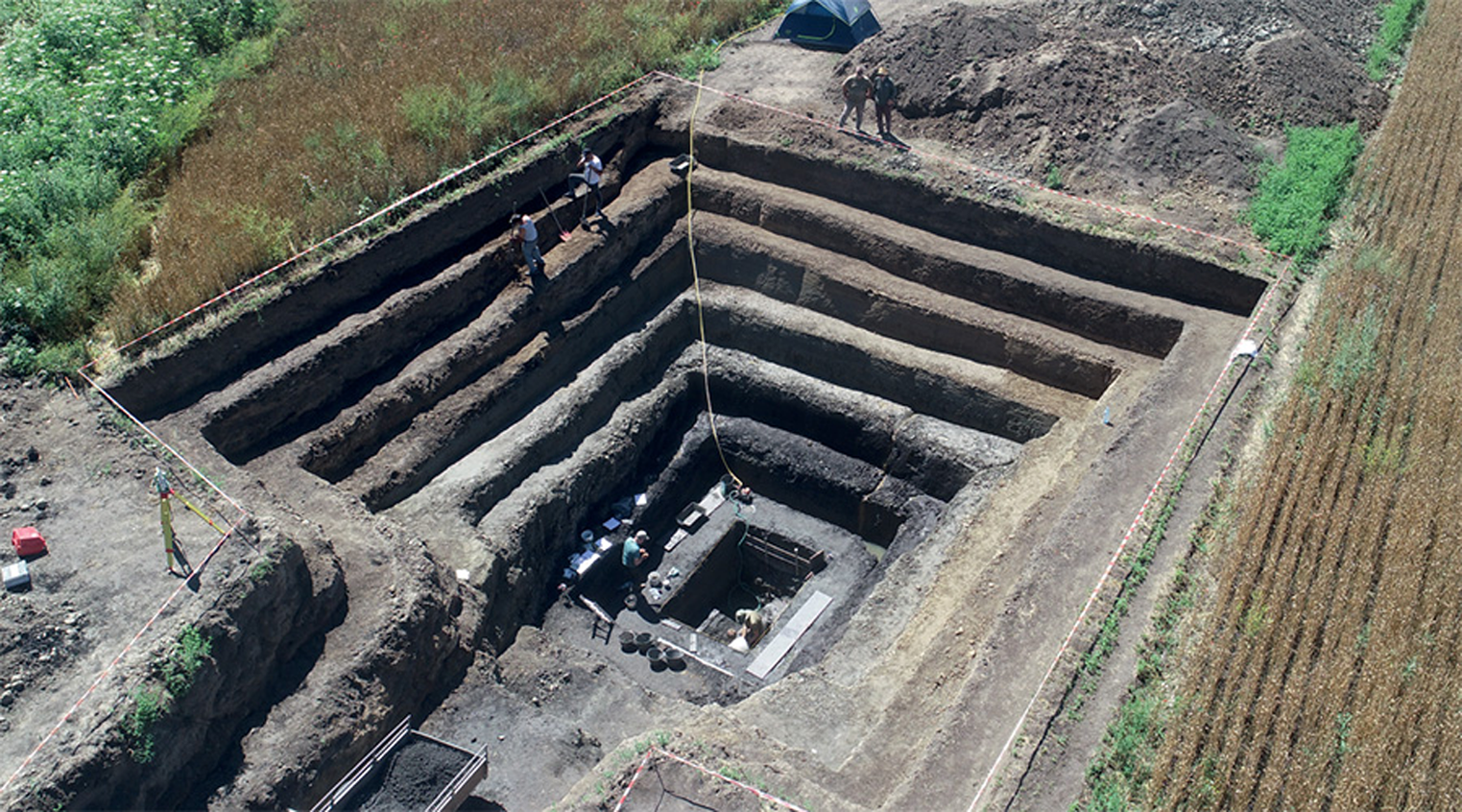
In 2022 and 2023, new surveys and excavations were undertaken as part of the EXPLO project (Figures 3 & 4) with the primary aim of reaffirming findings from the 1970s and documenting the settlement using modern methods and technology. A survey consisting of a small excavation section, conducted in 2022, relocated Korkuti’s excavation site; it confirmed the excellent condition of subsurface organic preservation and located and sampled wooden piles (n = 8) for dendrochronological and radiocarbon dating. In 2023, a 16 × 16m trench was opened to reach untouched archaeological layers beyond Korkuti’s excavations, when the single pile identified in the trench was also sampled increasing. For safety reasons, the trench profile was adjusted inward by 1m for every 1m of depth. The systematic excavation of a series of 1m-wide by 1m-deep benches was therefore implemented to ensure safety standards were consistently met throughout the excavation process (Figure 5).
Plan and profile of the 2022 excavation showing the locations of piles 1–8, and cross-sections of wooden piles from the ‘Dunavec I’ phase (after Korkuti Reference Korkuti1995) (figure by Adrian Anastasi, Krist Anastasi & Andrea Bieri).

Dunavec, Korça, Albania. Extent of the 1971–1973 Korkuti excavation transects and the 2022 and 2023 trenches (figure by Adrian Anastasi and Krist Anastasi).

Excavation photographs: A) Structure from Motion (SfM) orthophoto from 6 July 2023; B) aerial impressions of the excavation from 6 July 2023; C) students from the Institute of Archaeological Sciences, University of Bern, cleaning the profiles; D) view of the ongoing excavation from 29 June 2023 (figure by Andrea Bieri).

Documentation of the 2023 deep trench used a Structure from Motion (SfM) workflow (see methods in Over et al. Reference Over2021; Reich et al. Reference Reich2021), using a Canon 5D Mark IV DSLR camera and a DJI Phantom 4 Pro V2.0 drone. SfM is a photogrammetric technique that reconstructs 3D structures from a series of overlapping 2D images taken from different viewpoints. This allows us to create models of our findings. The precise co-ordinates of the field points were determined using a Leica GNSS device, utilising the EPSG:32634 WGS 84/UTM zone 34N co-ordinate system. An additional 13 fixed points were surveyed and marked at various levels with a Leica total station to facilitate daily total station setup and the accurate positioning of SfM models throughout the documentation process. The standard deviation of measured points ranged only between 3mm and 4mm. Agisoft Metashape Professional software (v.2.0.1) was employed for SfM model calculations, with an error deviation in the calculated models of between 3mm and 8mm.
Dendrochronological measurement was carried out following standard procedures (Schweingruber Reference Schweingruber1988) on a measuring table with a precision of 0.01mm under a binocular microscope at the Institute of Archaeological Sciences of the University of Bern. Measuring and cross-dating were performed with the software Dendroplus (2013 version, Ulrich Ruoff, unpublished) and DD+ (v.2.5.4; Bleicher et al. Reference Bleicher2023).
In total, nine wood samples were collected during the fieldwork campaigns in 2022 (n = 8) and 2023 (n = 1). Wood anatomical thin sections were cut from all samples to identify the species. All wood samples come from deciduous oak (Quercus sp.). Two of the wood samples (ID 30287 & 2401, Quercus sp., deciduous) from Dunavec were radiocarbon dated to establish the approximate calendar age of the piles. Individual tree-rings from wood samples 30287 and 2401 were dissected with a scalpel and razor blade and submitted for radiocarbon dating at the Laboratory for the Analysis of Radiocarbon with AMS (LARA) at the University of Bern (for sample preparation procedure see Szidat et al. Reference Szidat, Salazar, Vogel, Battaglia, Wacker, Synal and Türler2014). The calendar-year distance between the sampled tree-rings is indicated by the tree-ring count. These counts in years were then used to model the radiocarbon dates using Bayesian wiggle matching, whereby the calibration range of the radiocarbon dates is constrained through the definition of a chronological sequence between the radiocarbon dates based on the tree-ring counting. Compared to simply calibrating individual radiocarbon dates, wiggle matching can substantially narrow the calibrated calendar end-date range of wood samples. The precision can be to within a few decades, depending on the shape of the radiocarbon calibration curve in a given period. For a more detailed description of wiggle matching see Bayliss (Reference Bayliss2007) and Bayliss and Marshall (Reference Bayliss and Marshall2022). The tree-ring radiocarbon dates from Dunavec were wiggle matched in OxCal 4.4 using the D_Sequence command (Bronk Ramsey et al. Reference Bronk Ramsey, van der Plicht and Weninger2001; Bronk Ramsey Reference Bronk Ramsey2009) and an adapted IntCal20 calibration curve (Reimer et al. Reference Reimer2020). Labelled as ‘IntCal20plus’ (see Maczkowski et al. Reference Maczkowski2024), this curve removes the IntCal20 data for the end of the fifty-fourth and beginning of the fifty-third centuries BC and substitutes annual radiocarbon data that takes into account the sharp increase in atmospheric radiocarbon in 5259 BC, one of the so-called Miyake events (Brehm et al. Reference Brehm2022).
Results
The survey in August 2022 identified and precisely mapped the archaeological interventions conducted by Muzafer Korkuti in the 1970s. Opening a small trench along the bank of a drainage canal within the confines of the previous excavations allowed us to document and sample eight well-preserved oak piles from the deepest archaeological stratum (Figures 3 & 4). The excavation in 2023—outside the boundaries of the 1970s excavations—revealed an additional single pile in the excavated trench, confirming that wooden structural remains are more widespread at Dunavec and are also amenable to dendrochronological analysis (see Hafner et al. Reference Hafner2021 for discussion). Substantial evidence of intensive settlement activity at the site has emerged through the identification of cultural layers, primarily composed of organic materials. These layers, accumulated during the Neolithic occupation in the middle of the sixth millennium BC (see ‘Absolute dating’ section below), provide rich material, underlining the significance of Dunavec.
The high-resolution documentation of the 2023 excavation corroborates the overall stratigraphic sequence initially proposed by Korkuti (Reference Korkuti1995), but modern excavation methods have enabled the discernment of finer stratigraphic subdivisions, particularly in the eastern profile (Figure 6). The layers discussed on Figure 6 are not the same as those discussed earlier in this article. To keep the overview we add the old number of Korkuti (Reference Korkuti1995) in brackets. It is now apparent that layers 1–3 (1–3 in Korkuti Reference Korkuti1995) consist of mixed sediments deposited during the canal construction. Layers 4–6 were not documented by Korkuti. In contrast, layers 7 and 8 (4–5 in Korkuti Reference Korkuti1995) exhibit purely geological origins, devoid of any archaeological traces in both the 1973 and 2023 excavations.
Comparison of the eastern profile from 2023 with the western profile from 1973. The preserved cultural layers form layers 11–13 in the 2023 excavation (illustration by Mirco Brunner, Adrian Anastasi, Kristi Anastasi & Andrea Bieri).

While Korkuti successfully documented several settlement phases in layer 6 in 1973, referred to as ‘Dunavec II’, no archaeological finds or features could be identified from the corresponding layers 9 and 10 (6 in Korkuti Reference Korkuti1995) in the 2023 campaign. Layers 11–13 correspond to the two lowest layers (7 & 8) of the 1973 excavation, also known as the ‘Dunavec I’ horizon. As with the 1973 findings, the preservation of organic material within these layers is excellent. This horizon is located at a depth of 8.5m, has a thickness of 0.4–0.5m and was documented over an area of 5m2 (Figure 5 & 6). This cultural layer contains pottery, lithics, building elements such as burnt clay, and organic material including wood and botanical remains. During the documentation of this layer no finer subdivision into further layers could be determined. Sediment samples taken from the eastern profile are currently being analysed for microstratigraphy at the School of Archaeology at Oxford University. The analyses will provide further insights into the composition of this cultural layer. Below this, layer 14 comprises a clay-rich compact stratum, marking the end of the settlement layers. No cultural layers were identified below this point. In addition to pottery and flint artefacts with stratigraphic associations, wooden piles were documented, along with heavily burnt daub originating from the layers 11–13.
Absolute dating
Dendrochronological analysis in combination with radiocarbon dating on samples from the wooden piles has yielded new chronological insights at Dunavec. Direct dendrochronological dating to the calendar year was not possible due to the lack of absolute, dendrochronologically dated reference chronologies that reach back to the sixth millennium BC in south-eastern Europe. Bayesian modelling, employing wiggle matching (Bronk Ramsey Reference Bronk Ramsey2009), has facilitated the anchoring of the ‘floating’ tree-ring sequences from Dunavec, as done in similar studies in the region (Hafner et al. Reference Hafner2021; Maczkowski et al. Reference Maczkowski2021; Bolliger et al. Reference Bolliger2023).
Dendrochronological cross-dating was tentatively possible between two wood samples with greater ring numbers (lab nos. 2401 & 30287, see online supplementary material (OSM) Dendro list). No clear correlation could be detected between the other wood samples nor with other floating chronologies from the region (Hafner et al. Reference Hafner2021; Maczkowski et al. Reference Maczkowski2021; Bolliger et al. Reference Bolliger2023). Two tree-rings, separated by a 66-year interval, were radiocarbon dated from pile 30287 (field ID no. 8), sampled during the 2022 survey. The pile has preserved sapwood rings but no last growth ring (waney edge) and was directly associated with the lowest layer from the 1973 excavation. Bayesian modelling produced an end-date range for its last measured ring between 5303 and 5236 cal BC (95.4% probability) (Figure 7; OSM).
Dunavec, Korça, Albania. Results from the radiocarbon wiggle matching: upper panel) results of the wiggle matching (Bronk Ramsey Reference Bronk Ramsey2009) of two radiocarbon dates from wood sample no. 30287 collected in 2022; lower panel) wiggle matching output of 26 radiocarbon dates from wood sample no. 2401. Modelled in OxCal v4.4.4 against a refined IntCal20 (Reimer et al. Reference Reimer2020), where the calibration data around 5259 BC is replaced with annual measurements from Brehm et al. (Reference Brehm2022) (see Results section for details).

The other radiocarbon-dated pile, number 2401 sampled from the 2023 trench, has 103 tree-rings from pith to waney edge. Twenty-six individual rings were radiocarbon dated. Some rings required resampling as initial results indicated a low carbon content, resulting in larger radiocarbon measurement uncertainties (up to ±50 radiocarbon years). Wiggle matching yielded a unimodal end-date range distribution for the last ring at 5283–5267 cal BC (95.4%) (Figure 7).
As all but one of the radiocarbon measurements are based on individual rings and the calibrated date range is close to the Miyake event of 5259 BC (Brehm et al. Reference Brehm2022), we also calibrated the dates using the IntCal20plus curve (Maczkowski et al. Reference Maczkowski2024). This narrowed the end-date range for pile no. 30287 by a decade, to a bimodal probability distribution covering the range 5303–5245 cal BC (95.4%), with a highest posterior density interval at 5303–5278 cal BC (53.1%) (Figure 7). For wood sample no. 2401 the resulting posterior density interval narrowed the end-date range to the intervals 5287–5284 cal BC (9.5%) and the more likely 5282–5272 cal BC (86%). The annual radiocarbon series from wood sample 2401 did not provide evidence for the 5259 BC Miyake event, indicating instead that the tree was probably felled around two decades before the event.
Archaeological finds
In addition to the wooden structural features, we successfully recovered and documented a diverse array of artefacts, including pottery and flint, from layers 11–13. The precision of our excavations, facilitated by artificial spits ranging from 50–100mm, allowed for exact measurement and documentation of the surface of each spit using the SfM technique. This method ensured the accurate stratigraphic localisation of artefacts.
A substantial portion of the artefact assemblage consists of ceramic sherds (Figure 8). These ceramics provide invaluable insights into the production, decorative styles and functional aspects of pottery during the Middle/Late Neolithic at Dunavec. The spectrum of finds closely aligns with the assemblage reported by Korkuti (Reference Korkuti1995) for the ‘Dunavec I and II’ horizons (Figure 9).
Ceramic finds from the 2023 survey: 1) vessel fragment decorated with fluting; 2 & 3) polished black monochrome pottery fragments; 4) flat pot base; 5) biconical vessels with relief-decoration burnished band on the neck; 6 & 7) fragments with relief decoration; 8 & 9) fragments decorated with incision; 10) foot of rhyton; 11) high trunco-conical base; 12 & 13) fragments of large vessels decorated with barbotine (photographs by Adrian Anastasi, Ilir Gjipali; figure by Krist Anastasi).

Ceramic finds from the 1973 excavation: 1) rim of a bowl; 2) fragment painted in brown on ochre background; 3) wall of monochrome black burnished vessel; 4) biconical cup fragment; 5 & 6) fragments decorated with incision; 7 & 10) fragments decorated with impression; 8, 9 & 12) fragments of vessels decorated in relief application; 11 & 15) vessel fragments decorated with barbotine; 13) foot of a rhyton; 14) red-painted fragment of a ‘cult table’ (photographs by Adrian Anastasi, Ilir Gjipali; figure by Krist Anastasi).

They can be broadly categorised into two main groups: thick-walled and thin-walled ceramics. Thick-walled ceramics, which may also include some medium-walled examples, typically served as vessels for cooking and storing food products. Among the various ornamental styles, barbotine (a rough surface coated with silt) stands out as the most prevalent during this period, with other types being comparatively rare. Thin-walled ceramics are distinguished by their exceptional craftsmanship, showcasing a wide array of decorative techniques. Most frequent are monochrome black polished ceramics, characterised by their: glossy finish; relief decorations with deep, intricate lines; incised designs; and fluted patterns that gently rise from the vessel’s surface. A few fragments bear impressed motifs. Grey on black and solid black dominate the colour palette, though a few sherds are adorned with red paint. Some sherds exhibit a metallic lustre that covers either a portion or the entire surface (Figure 8: nos. 2, 3 & 5). Observed vessel forms correspond with categories identified in the excavations by Korkuti (Reference Korkuti1995). These include spherical shapes, those with an S-profile, cups of diverse shapes, bowls, plates, fruit bowls and biconical cups. The biconical cups display a unique joining method—either in a soft, rounded manner or forming an angle—that was favoured during the Dunavec I period.
Discussion
Dunavec is a key site for the typo-chronological classification of the Middle/Late Neolithic in Albania and the surrounding areas. The precise dating reported here, and at the Lake Ohrid (Yermokhin et al. Reference Yermokhin2025), now confirms that the lake areas of the western Balkans were favoured for settlements in the sixth millennium BC. The early dates indicate that these areas were inhabited by some of the earliest agricultural communities in Europe, who adapted to life near water and overcame the challenges posed by annual or climate-induced rises in lake levels.
The cross-border lake region between present-day Albania, Greece and North Macedonia lies 600–800m above sea level in the mountainous terrain between the Aegean and the Adriatic seas, and was of central importance for the northward expansion of agriculture into Central Europe. Despite the climatic conditions compared with the coastal regions of the Aegean and Adriatic, early agricultural communities not only passed through but settled in the region (Reingruber et al. Reference Reingruber, Bonga, Thissen, Marić, Bulatović and Marković2023; Naumov & Reingruber Reference Naumov and Reingruber2024). As a result, the lakes of the western Balkans preserve unique and invaluable insights into early agricultural practices in Europe.
Previously, the Dunavec I settlement phase was placed at around 4830 BC based on a single radiocarbon date (Korkuti & Prendi Reference Korkuti and Prendi1992: 15), though it remains unclear whether this date is calibrated or should actually be expressed in BP. No additional details regarding the material nor the sampling location are available but a later publication mentions one radiocarbon date of 4800±200 from a bone sample (Korkuti Reference Korkuti1995: 258). A 2010 Albanian translation of Korkuti’s ‘Neolithikum und Chalkolithikum in Albanien’ also mentions the date 4800±200 BC, but related to the Dunavec II phase (Korkuti Reference Korkuti2010: 277), while a later publication suggests a date of 4800±250 BP for Dunavec, but does not provide a laboratory number (Prendi & Bunguri Reference Prendi and Bunguri2018: 344). Considering the above, this previous information on the absolute dating of Dunavec II is likely unreliable.
The results presented here demonstrate that, even more than half a century after Korkuti’s initial excavation and various amelioration activities, organic preservation from the lowest horizon at Dunavec (‘Dunavec I’) remains excellent. The combined results from dendrochronological investigations and radiocarbon dating indicate that the oldest settlement horizon falls in the range of 5300–5250 cal BC, which is within the previous roughly assumed earlier typochronological chronological placement of this phase (see Guilaine & Prendi Reference Guilaine and Prendi1991: 578). This timeframe covers a period that finds a parallel at Dispilio (Lake Kastoria, Greece) (Maczkowski et al. Reference Maczkowski2024). Notably, the rythons and anthropomorphic vessels from ‘Dunavec I’, as documented by Korkuti, exhibit striking similarities to those found at Dispilio (Korkuti Reference Korkuti1995; Facorellis et al. Reference Facorellis, Sofronidou and Hourmouziadis2014; Voulgari Reference Voulgari, Stefani, Merousis and Dimoula2014, Reference Schwarzberg and Becker2017). This is important because Dispilio also has similar dendro-dating to Dunavec (Maczkowski et al. Reference Maczkowski2024). Other Albanian sites, such as Cakran, Kolsh, Katundas, Podgorie, Blaz and Cetush, although lacking absolute dates (Korkuti Reference Korkuti1995; Prendi & Bunguri Reference Prendi and Bunguri2018), share comparable pottery assemblages with similar materials. As a result, the settlement phases dating to approximately 5300–5250 cal BC at Dunavec, based on the combined arguments from dendrochronology, radiocarbon dating and typological considerations, offer a crucial chronological anchor, representing one of the most significant Neolithic assemblages for the late sixth millennium BC in Albania.
Conclusion
Six decades after its initial discovery, fieldwork at Dunavec has reaffirmed the site’s remarkable preservation conditions and shed light on multiple settlement layers. The full extent of the site remains unknown, and the stratigraphy appears more intricate than previously portrayed by Korkuti in 1995. Further excavations are essential to unravel this complexity.
Our research provides the first high-resolution calendar dating of structural settlement remains (wooden piles) at the site, with modelled end-date ranges at 5303–5245 cal BC (95.4%) and 5287–5272 cal BC (95.4%) likely representing the same phase. Further dendrochronological investigations and additional dating on wood and other short-lived plant materials is necessary, but the finds and detailed stratigraphic documentation of our excavations help to refine both the absolute and relative chronology of human activity in the western Balkans. The excavations at Dunavec underscore the potential for future research on waterlogged prehistoric settlements in the region, offering prospects for deepening our understanding of Neolithic communities and how they changed through time.
Data availability
The data resulting from these analyses are openly accessible in a public repository on Open Science Framework: https://www.doi.org/10.17605/OSF.IO/MF8K5
Acknowledgements
We thank Anja Buhlke, Jonas Maibach and Johannes Reich for exchange of information regarding excavation and documentation techniques. We are especially appreciative of the remarkable contributions made by exceptional students Caterina Vögeli, Loic Spycher, Till Häfeli, Jannick Bünter, Silvia Götti and Alain Schaffner from the University of Bern. Our thanks also go to Agim Pere and the dedicated workers from the village of Maliq.
Funding statement
The 2023 fieldwork and subsequent dendrochronological and radiocarbon analyses were conducted in the framework of the European Research Council Synergy project ‘Exploring the dynamics and causes of prehistoric land use change in the cradle of European farming’. This project is financially supported by the European Union’s Horizon 2020 research and innovation programme, under the grant agreement no. 810586 (project EXPLO).
Online supplementary material (OSM)
To view supplementary material for this article, please visit https://doi.org/10.15184/aqy.2025.62 and select the supplementary materials tab.


 Open access

