




Introduction
Seyhan and Engin are an İstanbulite couple in their early seventies. They are both retired, and they live on their pensions. Like other retirees in Turkey struggling to keep up with the rising cost of living, they have been going through tough times in the last few years. I meet them at a bakery in their neighborhood, Esentepe, and soon enough we start talking about inflation, which seems inevitable for a conversation taking place in the summer of 2023. I ask them if they visit the bakery we are sitting at regularly, admiring the taste of the éclairs that I ordered. “We only go to orduevis [officers’ clubs] these days,” says Engin. “They are the only affordable option left.” “At least we know we won’t be surprised by the prices,” adds Seyhan. “They’ve also gotten more expensive, but not to the extent of regular cafés and restaurants. And there’s the added benefit of familiarity.”Footnote 1
Upon Seyhan and Engin’s invitation, I meet them a week later at the heavily securitized gates of the Balmumcu Gendarmerie Orduevi, which, Seyhan informs me, is a fifteen-minute walk from their apartment. They plead with one of the guards at the entrance for my admittance since I do not have a military identity document (ID), and, after some deliberation, we are let in. Engin tells me that while admittance is forbidden for civilians, the guards generally do not turn down elderly patrons’ guests. It is a sweltering afternoon in early July, and as we walk alongside the tree-covered path towards the main campus, we notice families emerging from the pool complex with towels wrapped around their shoulders. Engin and Seyhan then give me an extended tour of the facilities: we stroll by a state-of-the-art gym, a meticulously kept library, a well-stocked grocery store whose prices seem to be stuck in the 2010s, a full-service hair and beauty salon, a dedicated chocolatier, a busy children’s park, a photography studio, a second, smaller pool with a poolside restaurant, a cosmopolitan-looking café that serves Belgian waffles and specialty coffees, and, finally, an outdoors eatery with an à la carte menu and a full view of the Bosporus where we end up settling.Footnote 2
The orduevi feels like a country club for military families. Seyhan tells me that they often take refuge here on hot summer days, since, like the rest of İstanbul, their neighborhood is bereft not only of tree cover but also of outdoor spaces where one can spend time without spending money. Families continue to saunter down the pool complex as we chat, a testament to its popularity among parents entertaining their children during the summer break. In the adjacent table, two college-aged women are eating ice cream sandwiches and facetiming a friend who sounds jealous of their newly acquired tans. At other tables, I see women knitting in groups, professionals typing away at their laptops, children eating burgers, and cigarette smoke rising from all directions and disappearing in the wind. “The only real downside to this place,” says Engin, “is that they don’t serve alcohol because the gendarmerie is tied to the Ministry of the Interior. Which is why I always sneak in my own beer in this flask.”Footnote 3
During the radical economic downturn that Turkey has been going through since 2020, Turkish military families saw their leisure opportunities become restricted to military social institutions like orduevis. According to the latest Organisation for Economic Co-operation and Development (OECD) consumer price index figures, cumulative inflation in Turkey between December 2019 and November 2025 stands at 609.7 percent, about twelve times higher than the next highest OECD country (OECD 2026). For the İstanbulite military families that I have come to know, orduevis present an alternative to everyday urban activities that are commonly associated with middle-class sociality, and the amenities they offer point to a privileged experience of the city when military families’ purchasing power is at an all-time low. Having a military ID in İstanbul means that one can walk to the nearest orduevi and get a haircut, work out, or play a quick round of billiards. It means one can enjoy brunch while taking in the unmatched views of the Bosporus Strait that the Kalamış and Beylerbeyi orduevis offer or sip a cocktail at the Harbiye Orduevi’s rooftop bar. If feeling so inclined, it means one can even ride horses in the immaculate equestrian grounds of the Maslak Orduevi. And during the hot summer months, it means one can cool off at a nearby orduevi pool, relax at the secluded Altınkum beach where Marmara meets the Black Sea, or take one’s family on a two-week vacation at one of the spotless military summer camps spread across the country’s coasts at a nominal fee.
Such opportunities allow military families to access goods and services at below-the-market rates while maintaining class positionalities that reflect military and social hierarchies. Military social institutions mimic the rank and disciplinary structure of the armed forces (with separate orduevis for officers and non-commissioned officers as well as distinct dining areas for junior and senior officers inside orduevis); they are built in accordance with the temporal and spatial markers that organize military life (with clearly demarcated dormitories, cafeterias, and social spaces); and they require their attendees to adhere to distinct forms of self-discipline (ranging from dress codes to rules of conduct at restaurants and pools). Familiarity with such institutional norms brings a level of comfort to those who patronize these establishments. Moreover, the enduring availability of modern, affordable, and family-friendly amenities allows military families to uphold the belief that they may be able to sustain their middle-class lifestyles even amidst radical economic downturn.
The oversized presence of the Turkish armed forces in republican history has been the subject of a vast literature that has analyzed the forces’ role as an actor and arbiter in Turkish politics (Cizre Reference Cizre and Kasab2008; Jacoby Reference Jacoby2003; Satana and Özpek Reference Satana, Özpek and Teczür2022); as an agent of violence that enacts spatial and socio-environmental transformations (Jongerden Reference Jongerden2007; Oğuz Reference Oğuz2023); and as an institution where hegemonic norms of masculinity are established (Altınay Reference Altınay2004; Sünbüloğlu Reference Sünbüloğlu2013). Scholars have also paid attention to the human dimensions of the armed forces, focusing on disabled veterans reclaiming their political agency (Açıksöz Reference Açıksöz2020); active officers and their spouses enduring secularist policing inside military spaces (Arık Reference Arık2018, Reference Arık2021; Dağtaş Reference Dağtaş2016); and conscripts being sent off to service amid public fanfare (Arjomand Reference Arjomand2017; Navaro-Yashin Reference Navaro-Yashin2002). Even though military families constitute a sizable demographic in Turkey, the norms and institutions that organize their everyday lives have not been subject to in-depth academic scrutiny.
As a social group that has enjoyed an extensive array of entitlements and as affiliates of an institution tasked with a modernizing mission, military families in Turkey have been socio-economically and ideologically interpellated into the role of nation builders. The confluence of these phenomena has historically found its most vivid representation inside military establishments like orduevis and summer camps where military family members cultivated the tastes, habits, and sensibilities that equate to white, modern, secular, and middle-class citizenship. Building on ethnographic fieldwork among military family members between 2021 and 2024, this article analyzes the social lives of these families through the perspective of leisure. It brings military institutions, habits, and ideologies of leisure into anthropological focus, and explores what makes military families a social group unto their own.
In seeking to understand the material and immaterial bases of military families’ class positionalities for this research, I carried out long-form interviews with military family members, joined them in their visits to military social institutions, and studied the photograph albums of interlocutors who were kind enough to open their family archives. I placed a particular emphasis on the experiences of the baby boomer generation; mostly coming of age around the 1960s, this generation witnessed both the evolution of military social institutions and the demographic changes that have unfolded inside them since the 2010s. Because their lifelong experiences provide the most expansive insights into the privileges, sensibilities, and ideologies that are nurtured in these venues, the article primarily spotlights the lifeworlds of baby boomers and their close kin.
In İstanbul, the majority of my interlocutors come from a housing development (site, in Turkish) in the European side of the city that was built by the now-defunct Türkiye Emlak Kredi Bankası (Turkish Real Estate Credit Bank) for military officers forced into early retirement after the 1960 coup. Amounting to more than 800 apartments in about seventy buildings, these properties were paid for by military families in multi-year installments, and they facilitated the emergence of a unique ex-military community. Having lived close to these developments in my childhood, I had been part of some of these families’ social circles as well as their trips to military social institutions. Developing this research project nearly three decades later with those impressions in mind, I connected with military families who at one point resided in this site, their friends and relatives, as well as military families from different parts of İstanbul. In total, this study draws on in-person interviews with thirty-one individuals from seventeen different military families who are spread around İstanbul, Western Turkey, Europe, and the United States (US).
Scholars across disciplines have demonstrated how leisure can serve as a generative analytical lens in the exploration of sociohistorical relationships between bodily discipline and national wellbeing (Akın Reference Akın2004; Daley Reference Daley2003); racial segregation and spatial politics (Goldberg Reference Goldberg2016; Jefferson Reference Jefferson2020); labor and class formation (Smith Reference Smith1981; Thompson Reference Thompson1966); gender and pastimes (Milcoy Reference Milcoy2017; Tebbutt Reference Tebbutt2017); race and parenting (Mukherjee Reference Mukherjee2023; Ramos-Zayas Reference Ramos-Zayas2020); ideology and consumerism (Biddle-Perry Reference Biddle-Perry2017; Deeb and Harb Reference Deeb and Harb2013); cultural capital and social hierarchies (Bourdieu Reference Bourdieu1987); and cultural trends and whiteness (Spracklen Reference Spracklen2013). By drawing on practices, ideologies, and spaces of leisure, these works have shown how social difference is conceptualized and actualized in everyday life. In a similar vein, this article examines the sensibilities and performances of leisure that define military families’ social lives and argues that military family members realize their place in Turkey’s racial, economic, and cultural hierarchies in orduevis and summer camps where they practice white, modern, and middle-class citizenship.
I employ the conceptual framework of whiteness in this article not as a phenotypical trait, but as a fluid and unstable social practice co-constituted by race and class. Whiteness, in this framework, is systematically naturalized through the ordinariness of everyday life, transforming mundane, hierarchical social relationships and their racialized affects into a moral economy that justifies a multigenerational sense of privilege (Berg and Ramos-Zayas Reference Berg and Ramos-Zayas2015; Ceron-Anaya et al. Reference Ceron-Anaya, Pinho and Ramos-Zayas2023). The study of whiteness in non-North American contexts demonstrates that whiteness may culturally be read as a capitalist ethos, meaning that social status is often perceived through specific modes of class-based behaviors rather than skin color alone (Echeverría Reference Echeverría2019; Ramos-Zayas Reference Ramos-Zayas2020; Saavedra Espinosa Reference Saavedra Espinosa2017). Whiteness may also be cemented through the creation of white geographies where Western architectural and cultural forms are highlighted to justify spatial and social exclusion (Ceron-Anaya Reference Ceron-Anaya2019). The case of military families in Turkey is instructive in this regard since exclusive military social spaces and modern leisure practices have been key to these families’ cultivation of habits and sensibilities that mark them as white. Moreover, in the new socio-economic hierarchy of Turkey, this particular form of white habitus appears in military family members’ racially colored narratives as the main differentiator between the established patrons of these institutions and their newcomers.
In what follows, I will first demonstrate how military families secure their class positionality through economic entitlements such as generous pensions, house and car ownership subsidies, and access to exclusive grocery stores, cafés, and restaurants that are sheltered from market influences. In this first part, I will argue that military families establish their economic well-being via institutional benefits that end up shaping the life trajectories of consecutive generations. Then, in three short sections, I will explore how military families accumulate the cultural capital that defines the affective and ideological makeup of their orientation towards republican values. In this second part, I will demonstrate how military families come to know themselves as white, secular, middle-class nation builders via the performance of militarized forms of modern seaside leisure and bodily discipline, Western forms of art entertainment, and hierarchical relations of service in orduevis and summer camps. Finally, I will illustrate how Turkey’s novel socio-economic hierarchies have upended the symbolic economy of privilege inside military social institutions and engendered an aesthetic and moral understanding of difference that is often tinged with racial undertones. In this third and final part, I will demonstrate that the cultural capital that military families gained in military social institutions, which appears as an assemblage of values and sensibilities that they regard as the Turkish Republic’s true patrimony, remains a defining and differentiating form of self-knowledge in the face of downward social mobility.
Economic safety rails
As we were waiting for our second round of teas at the neighborhood bakery, Seyhan told me that she spent her childhood moving across Turkey as a military daughter, finally ending up in İstanbul after her father faced early retirement in the aftermath of the 1960 coup. Where they settled was the emerging development built in Esentepe, which was then an outpost of the city but is now a major hub of urban activity. Seyhan said that she came of age in this site among other military families in a close-knit community where everyone knew each other intimately. Initially offered exclusively to expelled military officers, apartments here were being sold for around US$350,000 in the market at the time of writing (Sahibinden 2026).
The accumulation of such wealth via real estate has ensured that military families’ enduring middle-class status, and its transfer, continues to create economic opportunities for military officers’ surviving kin. İffet and Nejat, ex-neighbors and children of military officers who also settled in this site in the 1960s, explained that they were able to realize their lifelong dream and retire in Bodrum, a popular coastal town in southwestern Turkey, after the passing of their parents and the sale of their apartments. Esin, an interior designer from the same generation, recounted that she redecorated and moved back into her parents’ apartment instead. Ertan, an engineer in his late sixties, said that he purchased an apartment on the Anatolian side of İstanbul that was closer to his workplace after the sale of his parents’ property. The wealth created through real estate helped these military family members sustain a level of financial stability that is difficult to maintain otherwise for pensioners in contemporary Turkey.
This generation of İstanbulite military children relied on auxiliary military institutions to bolster their class positions as well. Ordu Kooperatifi (ORKO; Military Cooperative), the military cooperative that had various branches across İstanbul, is an apt case in point. Offering groceries, household items, kitchen goods, prescription glasses, and pharmaceuticals among other products and services, ORKO functioned as a security blanket over military families’ budgets by keeping them safe from market forces until the 1990s. The cooperative membership (see Figure 1) came at a small annual fee, and those who used to shop at ORKO remember it not only as a trustworthy and budget-friendly establishment but also as a daily gathering space where one felt safe and recognized among familiar faces.
Ordu Kooperatifi (ORKO) membership card.
Source: Image courtesy of interlocutor

In a similar vein, Ordu Yardımlaşma Kurumu (OYAK; the military pension fund) continues to help military families maintain a stable middle-class lifestyle by providing generous pensions via fail-safe investments. In fact, these pensions often organize baby boomers’ life arrangements. After a military officer’s passing, two-thirds of their pension transfers to their widows and unmarried daughters, which preserves said relatives’ economic wellbeing. İffet, for example, recounted that after the death of her husband, she relied on the pension that she received from OYAK via her late father to raise her daughter, and, along the way, she met her current, long-time partner. She explained that to appease her teenage daughter who insisted that the two get married, she and her partner orchestrated a fake engagement ceremony since İffet did not want to lose her pension by officially remarrying.Footnote 4
Alongside the everyday benefits that military families receive inside orduevis, the economic foundations of military families’ lifestyles are upheld by these institutional entitlements. The large majority of the İstanbulite retirees whom I have introduced so far are university graduates, most of them own at least an apartment and an automobile, several resided in dorms provided by the military during their higher education, they have all shopped and socialized at military institutions throughout their lives, and some even hope to end up at the sought-after care facilities operated by the armed forces in their old age. It is safe to say that these baby boomers’ fathers’ military careers proved to be very rewarding for their kin, with their benefits spanning the course of republican history and now trickling down to a fourth generation.
The rewards of belonging to a military family in Turkey can hardly be quantified in economic terms, however. In attending orduevis and spending their vacations at military summer camps where they were introduced to Western forms of art, entertainment, and consumption, military family members also accumulated a distinct form of cultural capital. This cultural capital complemented military families’ economic standings, mirroring the armed forces’ long-standing hold over Turkey’s social and political life.
Introduction to organized leisure
Military summer camps began to emerge inside coastal military bases in the midcentury, offering two-week-long vacations to military families via an annual lottery system and at a nominal fee (see Figure 2). Initially designed as partitioned-off campsites inside military compounds with a limited number of tents and social amenities, summer camps grew in number and size during the 1960s and 1970s and eventually transformed into free-standing developments designed in the image of American military bases with semi-detached houses, pristine beaches, sports facilities, and dining, dancing, and entertainment halls by the 1980s.
Military summer camp application form, 2002.
Source: Image courtesy of interlocutor
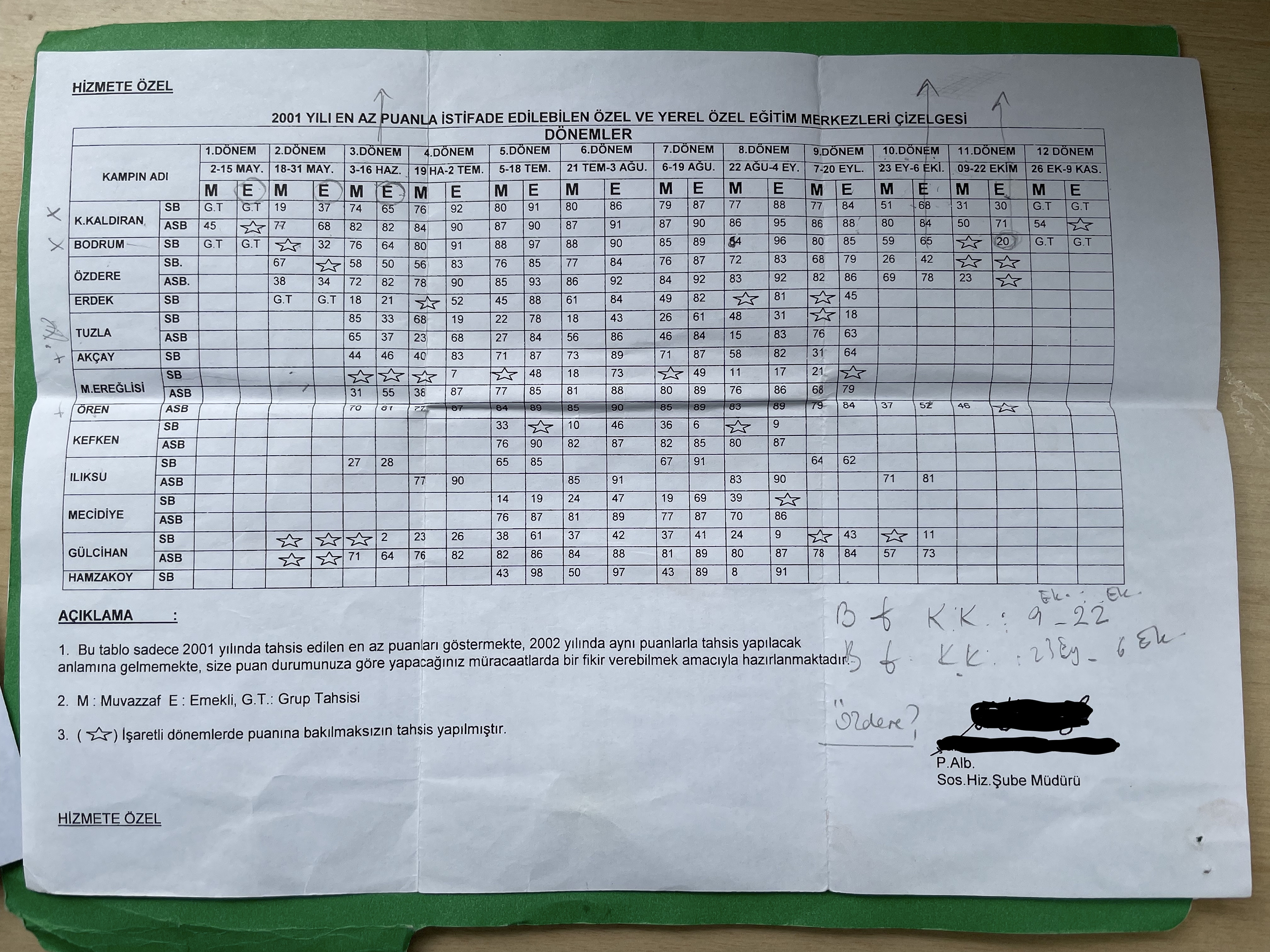
Figure 2 Long description
The table presents the scores for military summer camp applications across different camps and periods in 2001. It includes columns for each period from the first to the twelfth, with rows listing various camps such as Kaldiran, Bodrum, Ozdere, and others. Each cell contains numerical scores or symbols indicating performance or status. The table also includes notes explaining the scoring system and special conditions. The camps are evaluated over multiple periods, and the scores vary across these periods.
The social and architectural organization of military summer camps was indicative of a disciplinary framework that sought to manage social and environmental forces in tandem and bring about a modern and harmonious order to their interaction. For decades, families of active and retired officers spent their summer holidays at these camps where they experienced an idealized and militarized version of a modern summer vacation in which nature, nation, and leisure coalesced in idyllic unity. While this architectural framework primarily aimed to render the environment governable via cultural markers and foster the civic sensibilities of modern military subjects, it was also a product of the Americanization of leisure and seaside decorum in Turkey that began to take root in the 1950s (Bozdoğan Reference Bozdoğan and Gürel2016).
The story of İstanbulites’ engagement with modern seaside leisure is relatively new, as the earliest organized movement toward enjoying the sea’s benefits appears to be the public and private sea baths that emerged alongside the Bosporus around the mid-nineteenth century (Gürel Reference Gürel, Ögel, Tanman and Alışık2018; Toprak Reference Toprak, Ögel, Tanman and Alışık2018). Rising on timber stilts, these baths were gender-segregated spaces that allowed their patrons to spend time in the water sheltered from the public gaze. Modern sunbathing and swimming practices in İstanbul were popularized by occupant soldiers and Russian émigrés escaping the Bolshevik revolution in the late 1910s and early 1920s (Toprak Reference Toprak, Ögel, Tanman and Alışık2018), and the growing use of İstanbul’s beaches by different social classes in this period was followed by the gender desegregation of seaside leisure in line with republican reforms (Akçura Reference Akçura, Ögel, Tanman and Alışık2018). The development of Florya Beach was emblematic of seaside leisure’s reorganization in this era, with Mustafa Kemal’s summer house (1935) and Florya Gazinosu (1938) redefining the significance of this beach by bringing about popular legitimacy and day-long entertainment (Hamiloğlu Reference Hamiloğlu2022).
A dramatic shift in seaside leisure came in the postwar period with the Democrat Party (DP) overhauling Turkey’s tourism policies in line with Marshall Aid and United States Agency for International Development (USAID) priorities, therein securing the necessary funding for the hotels and highways that were to define leisure in Turkey in the following decades (Adalet Reference Adalet2018). The establishment of the Pension Fund in 1949, the General Directorate of Highways in 1950, and the Tourism Bank in 1950, along with Turkey’s admission into the North Atlantic Treaty Organization (NATO) in 1952 and the passing of the Tourism Industry Incentivization Law in 1953, were constitutive of this process that saw Turkish coasts slowly becoming hospitable to tourism. The prized Pension Fund–Hilton International joint venture, the İstanbul Hilton (1955), is often quoted as the symbol of postwar leisure since it brought together American know-how and financing with modern architectural elements and local labor at the heart of İstanbul (Wharton Reference Wharton and Gürel2016). However, seaside leisure was similarly redefined during this period with the appearance of Tourism Bank-run hotel chains and USAID-backed private motels along the archaeological routes in western Turkey.Footnote 5
Military summer camps rose to prominence at this historical juncture. In these hybrid spaces where leisure and discipline converged, military families developed classed and racialized sensibilities of leisure by being introduced to stylized aspects of seaside decorum such as beach attire and talent shows, and by exploring the social parameters and bodily confines of white, Western, and middle-class habitus. The rigid social and spatial organization that governed leisure activities, and the bodily discipline and decorum that was expected of campers regardless of age or rank were the main pillars of this multifaceted sensibility.Footnote 6
The early years of summer camps were marked by a pioneer spirit. Attendees were picked up by cemsesFootnote 7 and driven to camps where they were supplied only with barren tents, mobile beds, and chairs (see Figure 3). Families would haul their own bedding and pillows to furnish these tents alongside their breakfast and cleaning supplies, and use outdoors, alaturca toilets equipped by the military bases. Despite such meager comforts, Türkan, the daughter of a lieutenant colonel who spent many summers at military camps since her childhood in the 1950s, remembered this period as a time of plenty. She vividly recounted running to the sea with her siblings after having breakfast outside their tent, attending a hangar-like cafeteria where campers were served generous portions of fresh-cooked meals from huge cauldrons, and taking long naps in the afternoon while sheltering from the sun.
İzmir Yenikale military camp in the background in 1959.
Source: Image courtesy of interlocutor

Figure 3 Long description
Two individuals are rowing a boat on a body of water. The person in the foreground is holding an oar and appears to be smiling. The person in the background is also holding an oar and has long hair. In the distance, there is a military camp with several buildings and tents visible. The scene is set against a backdrop of trees and mountains.
Summer camps embodied military discipline since their makeshift beginnings. In Türkan’s words:
The discipline at the barracks applied to the camp as well. There was an instruction sheet hung on every door, you had strict lunch and dinner hours, and you couldn’t walk into certain quarters in your bathing suit. You also had to get out of the sea at 7 pm sharp because the conscripts would rush in to swim after all the campers were out.
In addition to the precise organization of space and daily activities, camps administered a rigid form of bodily discipline as well. As John Fiske (Reference Fiske2011) notes, the beach, as an anomalous category, stands between the sea and the city (and hence nature and culture), and thus can be read as a text where the overflow of meanings between the two are regulated according to social norms. In this sense, beaches at military summer camps reflected both the changing paradigm of leisure in Turkey and the alignment of social decorum and bodily discipline according to gendered military norms.
One symbolic register where this came into view was the regulation of facial hair. Until 2012, informal clothing and facial hair were banned for men who patronized military social institutions. The formal and clean-shaven look of the active and retired personnel inside these venues provided a clear antithesis to leftists, liberal, and conservative forms of grooming and self-representation found outside. This obligation was particularly instructive for young patrons. Barış, a forty-year-old technology worker who otherwise fondly remembers the times he spent at summer camps with his grandmother, recalled being scolded by an officer at the Bodrum summer camp’s beach as a teenager because of his newly showing mustache:
I remember feeling angry and embarrassed at the same time … It felt like I was in school, and the whole thing was so absurd given that I was just about to hop into the water. Who cares if my mustache was showing a little bit? I was thirteen and I just wanted to swim!
Western forms meet military norms
In addition to ordering military families’ relationships with seaside leisure, military camps also introduced their attendees to Western forms of art and entertainment. The performance of Western cultural forms inside these venues allowed military family members to cultivate tastes and sensibilities that separated them from their civilian counterparts, as the amalgamation of this form of cultural capital with militarist values generated distinct narratives of identity and national belonging. Türkan recounted that when she frequented summer camps near İzmir as a child, what she looked forward to the most was the children’s talent show on Wednesdays:
Saturday nights were reserved for the adults’ entertainment. You would have a military band playing jazz, waltz, or tango, and everyone would dance. Over time they started playing rock and roll too, and my older brother who was attending college in İstanbul used to show me the moves that he learned there. We didn’t have a name for it back then, but we even saw Orhan Boran [a Turkish media personality] do a stand-up show one summer. Children would take the stage on Wednesdays for their talent show. You would volunteer to either read a poem, play an instrument, or sing a song, and a sergeant would train you throughout the week. I remember accompanying with my little mandolin a general’s son who played the slide guitar – it was the first time that I had seen one. I was very excited. When the talent show was over, all the children would gather on the stage, and we would sing İzmir Marşı at the top of our lungs.Footnote 8
The entanglement of Westerns forms of art and entertainment with military discipline and patriotic values gave military camps their unique flavor of sociality. Camp goers not only found ample opportunity to explore these forms, but they also performed them in a way that highlighted their identity as patriotic modernizers. In our long conversation, Türkan mentioned that when she first saw the 1987 American movie Dirty Dancing that takes place at a summer resort in Catskills, New York, all her memories from military summer camps came flooding back and tears fell from her eyes. Such identification with American ideals and values, emanating from summer camp experiences that had indeed unfolded in discos and beaches molded in the image of American military bases, did not run counter to military families’ self-understandings as nation builders. Instead, it demonstrated the success of military summer camps as spaces where a distinct blend of modernity flourished.
Scholars who analyzed the reception of American cultural products in socialist countries during the Cold War have demonstrated that music, film, and even clothing from the US led culturally and politically hybrid lives in these spaces (Călugăreanu Reference Călugăreanu2015; Yurchak Reference Yurchak2006). While said products were associated with American values of consumerism and individualism, their enjoyment was often imbued with socialist ideals of progress and universalism. Yurchak (Reference Yurchak2006) argues that for the last Soviet generation in Russia, embracing the “imaginary West” via music, movies, and other cultural products did not necessarily mean identifying with bourgeois values. At a time when visiting the West itself was out of the question, Western cultural and material forms were in fact constantly reimagined and reinterpreted by the Soviet public, permeating the late Soviet culture with “a new imaginary dimension that was neither ‘Western’ nor ‘Soviet’” (Yurchak Reference Yurchak2006, 203).
The republican cultural universe has been oriented toward the West as a racial and civilizational home since the Republic’s inception (Ergin Reference Ergin2016; Maksudyan Reference Maksudyan2005), but what the West signified has varied in relation to geopolitical shifts. The ideological and infrastructural reach of the early republican state apparatus was meager: its embrace of modernist change mostly fell (and/or stopped) short of overhauling existing social hierarchies and cultural norms (Metinsoy Reference Metinsoy2021; Tuna Reference Tuna2018; Yılmaz Reference Yılmaz2013). A meaningful shift in the conceptualization of the West came in the 1950s with the DP’s desire to transform Turkey into a “mini-America” (Bora Reference Bora, Bora and Gültekingil2007; Danforth Reference Danforth2015), and the reflection of this shift in leisure was palpable: the promotion of new hotels only reachable by car, the celebration of Western beach attire and conduct, and the idealization of summer holidays as part of the nuclear family’s regular annual schedule all pointed to the Americanization of leisure in this period (Bozdoğan Reference Bozdoğan and Gürel2016).
Yet while the governance of military summer camps was informed by this broader cultural shift in leisure, the celebration of Western cultural forms inside these institutions marked military family members first and foremost as modern and rightful nation builders. Much like how socialist tourism depended on vouchers rather than disposable income and was guided by ideals of enlightenment and self-improvement as much as the desire to shop and sightsee (Gorsuch and Koenker Reference Gorsuch, Koenker, Gorsuch and Koenker2006), vacationing in military summer camps was more of an award than an entitlement, and the balancing of pleasure and purpose during these vacations was a delicate act – an act that was animated by the call of modern leisure and consumption on the one hand, and tempered by notions of dutiful, patriotic citizenship on the other.
Learning to patronize
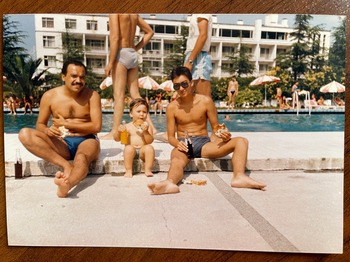
Habits and sensibilities of consumption cultivated inside military establishments complemented the conversancy that military families gained with Western cultural forms in these spaces. Military family members acquired these sensibilities thanks partly to the types of products that were on offer, and partly to the conventions that surrounded their service and consumption. As seen in Figure 4, Western leisure and consumption practices have been inseparable inside military social institutions. Hamburgers, grilled cheese sandwiches, sodas, and hot dogs have been a staple of pool and seaside leisure in orduevis and summer camps since the 1970s, and they remain popular articles of consumption today.
Family enjoying sodas and grilled cheese sandwiches at Kalender Orduevi in 1985.
Source: Image courtesy of interlocutor

Figure 4 Long description
A family of four, including two adults and two children, sits by a pool at the Kalender Orduevi in 1985. The adults and one child are seated on the edge of the pool, while the other child stands in the water. They are all enjoying sodas and grilled cheese sandwiches. In the background, other people are seen swimming and relaxing by the pool. The setting includes white buildings with balconies and lush greenery, indicating a leisurely environment.
The early and widespread availability of these items in military spaces underlines both the American influence in their management and the eagerness of the armed forces in responding to evolving consumer demands. Some of my interlocutors noted that it was not until the late 1980s when the liberalizing Turkish economy brought foreign consumer goods to their neighborhoods that they started questioning if military social institutions were indeed contemporaneous with the West. In fact, many cited the proliferation of modern grocery stores during this period as the primary reason behind the demise of ORKO, the military cooperative. Selin, an academic in her early fifties who currently lives in the US, recalled the disenchantment that ORKO’s younger customer base felt during the 1980s and 1990s. She recounted that after being acquainted with Western consumer products sold in these stores, she no longer wanted to step foot in ORKO, which felt “dusty and somewhat outmoded.” She said, “After 7-Eleven opened up in our neighborhood and we saw its aisles filled with American products, we started feeling alienated from ORKO and somewhat from the orduevis too.”Footnote 9
The arrival of American fast-food chains such as McDonald’s, Wendy’s, and Pizza Hut alongside European supermarkets such as SPAR and Carrefour created a shift in the shopping and dining habits of middle-to-upper-class İstanbulites in this period. Furthermore, the emergence of private television channels and the rise of advertising in national media heightened the desirability of Western consumer products (Ahıska and Yenal Reference Ahıska and Yenal2006). For military family members like Selin, this trend led to a dissatisfaction with the goods and services offered inside military establishments, and the consumption of newly available Western products became a marker of full citizenship in the new economy.Footnote 10
Selin’s disillusionment was echoed by others who came of age in the same era. Some, however, were also quick to add that orduevis and summer camps made repeated attempts to keep their offerings up to date. The adoption of weekend brunches and the opening of waffle and specialty coffee shops were examples of this ongoing effort. And while consumption trends may have transformed the content of the offerings at these institutions, low prices and the military hierarchies that undergirded service relations continued to define the consumer experience for many.
Until recently, all food and beverage service in military summer camps and orduevis had been performed by conscripts carrying out their mandatory military service. Addressing all adult male guests as “Komutanım” (Sir) and women as “Hanımefendi” (Madam), these conscripts treated all patrons with utmost respect and docility. It was in these spaces that military family members learned how to receive service from those at the bottom of the military and social hierarchies. While these experiences were critical for mastering unequal class relations, they were also taxing for some younger patrons. Barış, for example, recounted that dining at the prestigious Harbiye Orduevi had an edifying aspect in the 1980s and 1990s:
Dinners at Harbiye were rather uncomfortable. They took place in a huge ballroom with round tables, and everyone had to be super dressed up. The soldiers were extremely servile, and all you heard from them was “Yes, Sir.” Appetizers like Russian salad, [sheep] brain salad, and fried liver all arrived at your table in a three-story rolling cart from which you would pick whatever you wanted. If you ordered grilled fish, it would come adorned with halved lemons wrapped up in white cotton sheets so that your hands wouldn’t get sticky. I remember forcing myself to use my knife and fork very courteously and not leave any breadcrumbs on the table. These dinners were also the only occasions I ever had to wear button-down shirts as a kid. So, even though it was this elevated experience, I don’t think I ever really enjoyed it. It was too formal and stressful.
Service relations inside these spaces indeed did not come naturally to all. Those who were introduced to military social institutions via marriage, particularly men who married into military families, often recalled feeling uneasy about the expectations in these spaces. Engin, who comes from a working-class background, described his initial discomfort with norms that were second nature to military families. He said:
I wasn’t used to such amenities. The beaches at the camps, for example: I didn’t go to the beach in my youth – we didn’t have the means. And it’s uncomfortable inside military establishments. You can’t act as you please. For a long time, you couldn’t even enter them with a day-old beard or attend dinner without a suit and tie. And people are always rude to the soldiers who serve them. I try to put them at ease, ask where they are from, and see if we can have a regular conversation.
Engin’s discomfort pointed to the foreignness of the norms that govern service relations inside military institutions even for men who had already served in the army as conscripts and experienced military hierarchies firsthand. While he has been a regular at these establishments for decades now, Engin emphasized that he has never felt “fully comfortable” in them.
Mastering the social coordinates of service relations is an instrumental part of learning how to navigate an unequal society with class and racial privilege. As Ana Ramos-Zayas (Reference Ramos-Zayas2020) demonstrates in her work on elite parents, a fundamental aspect of growing up with privilege is becoming proficient in receiving service from the underprivileged in a way that both marks the patron as morally superior and normalizes existing hierarchies. Barış’s recollections regarding the norms that surrounded the dining experience at Harbiye Orduevi and Engin’s reservations about the treatment of conscripts are thus indicative of an unease emblematic of unequal social relations in action. Yet while these institutions were essential for military family members to grasp the subtleties of middle-class consumerism within a built-in hierarchy, they were more than a rehearsal ground for the performance of class positionality. They were also spaces in which moral and aesthetic difference between different types of military families and between civilian and military families were conceptualized and policed in a racialized manner.
Moral and aesthetic difference
As Hülya Arık (Reference Arık2018, Reference Arık2021) and Seçil Dağtaş (Reference Dağtaş2016) demonstrate in their works, political Islam was considered an existential threat within the Turkish military between the 1980s and 2000s, resulting in the intense scrutiny of officers (and their spouses) who were suspected to be misaligned with the principles of the institution. These principles crystalized in the image of the modern and secular military spouse, and the strict headscarf ban inside military spaces illustrated the pervasiveness of secularist policing. Arık (Reference Arık2018) shows that lengthy questionnaires, unannounced house visits, and anonymous reports were routinely utilized to ascertain the religious affiliations of military families in active service, and that around 5,000 officers were expelled or pushed toward retirement during this period as a result. This gendered form of policing was a sharpened reflection of the secular/religious divide that shaped political discourse in Turkey during the 1990s and 2000s, an era when the armed forces had positioned itself as the guarantor of secularism.
The self-prescribed stewardship role of the armed forces went through a radical transformation in the early 2010s with the Ergenekon and Balyoz trials and the legal and political maneuverings of successive AKP governments (Kaptan Reference Kaptan2018). Military social institutions were opened to men with facial hair and women with head coverings during this period (Hürriyet 2016), and the subcontracting of food and beverage services to civilian providers in military venues followed suit in the mid-2010s amid a neoliberal transformation inside the armed forces (Akça Reference Akça, Elke and Abul-Magd2016). These changes not only brought in civilian personnel into these spaces but also startling price hikes. Alongside the everyday impacts of inflation and the rising cost of living, the social and economic transformations inside military establishments contributed to an overall sense of downward social mobility for military family members. Moreover, they engendered novel narratives of moral and aesthetic difference vis-à-vis the new patrons and providers inside these institutions.
Seyhan, for example, stated that these “new types of people” lacked a certain knowledge of military decorum. She said:
They are different because they were not brought up with the type of discipline and lifestyle that we have been. I see this the most in their interactions with their children, whom they call “Şehzadem” [my little sultan] or “Prensesim” [my little princess] in the middle of everyone.
Seyhan’s commentary on what she saw as an unrefined form of parenting seemed to target conservative families and/or veiled women whose behaviors did not conform to military etiquette. Türkan, on the other hand, first underlined a new economic reason that prevailed inside orduevis: “One civilian runs the bakery, and another one runs the boutique: these people are there for profit, not service.” Then, she linked this development to the changes in these institutions’ demographics: “These places have been swarming with swarthy folk since AKP came to power anyway [Kara kara insanlar dolmaya başladı AKP geldiginden beri zaten].”
Among the baby boomers whom I interviewed, statements such as Seyhan’s on childrearing decorum and Türkan’s on the darkness that permeated military social institutions were rather commonplace and they often targeted women in headscarves.Footnote 11 While Türkan’s commentary was also in reference to this group, what bothered her was not exactly the dark shade of headscarves and abayas she now encountered inside these spaces but the civilizational darkness that women who wore them conveyed.Footnote 12 And this darkness, as a referent, had a rather expansive and pervasive character. Other secular baby boomers expressed similar, racially coded sentiments in our interviews regarding the presumed dark hue of conservative men’s beards and the perceived complexion of Kurdish patrons, who were also unwelcome newcomers to military establishments in the eyes of baby boomers. And while these groups were considered the wrong type of people to be occupying these spaces to begin with due to their ethnic, religious, or political identities, statements such as Türkan and Seyhan’s also implied that what made them particularly stand out among the established patrons of orduevis and summer camps were their discordant moral and aesthetic judgments.
Military venues have always been discriminative in terms of who fit the definition of acceptable patrons: from grooming and dress codes to norms of conduct and self-expression, the supervision of who belonged in these spaces has historically reflected the Turkish army’s commitment to shaping the ideal citizen and its reading of the political status quo. Even though previously excluded social groups were now recognized as part of the military body politic inside these spaces, secular baby boomers whom I interviewed believed that these groups lacked the type of cultural capital that had marked themselves as white, modern, and rightful nation builders. And this type of cultural capital, in their narration, was in large part accumulated in orduevis and military summer camps to which they used to have exclusive access.
With the armed forces losing their long-held political standing in Turkish politics and the gradual proletarianization of the middle classes during the two-decade AKP rule, the privileges that military families have enjoyed throughout republican history have diminished greatly. And the bitterness of this experience has been kindling critical narratives of moral and aesthetic difference imbued with complex, racial undertones. These racially coded feelings of consternation among secular Turks in political and economic decline have been the object of different studies on Turkey. In Özyürek’s (Reference Özyürek2006) classical study of political life in the late 1990s’ Turkey when political Islam was becoming mainstream, Türkan and Seyhan’s generation of secular Turks was observed to be longing for a vanished future that once felt inevitable. Their “nostalgia for the modern,” Özyürek (Reference Özyürek2006) demonstrated, found expression in the privatization of the Kemalist ideology via novel symbols and imaginaries. Saraçoğlu (Reference Saraçoğlu2011), in his work on the reception of Kurdish workers in İzmir, noted that the racial discrimination that Kurds faced from secular Turks was largely fueled by neoliberal economic policies that subjugated both groups to similar market forces. Studies like these contextualized the rising racial exceptionalism in Turkish secular middle classes primarily with reference to the loss of political and economic standing. In the same period, secular Turks themselves were the object of racialized political critique as well. The “white Turk” label, which originated among the leftist intelligentsia in the 1990s as a class-based critique, was adopted by Islamist critics and AKP cadres in the 2000s who professed to be challenging a secularist hegemony established by the republican elite (Arat-Koç Reference Arat-Koç2018). While the military families I discuss in this paper are distinctly middle class, they were nevertheless targets of this critique by virtue of their historical and ideological ties to foundational republican institutions.
What seems to get somewhat lost in these broad-stroke analyses of racial difference – and what rises to the surface in the recent mixing of old and new patrons inside military social institutions – are the affective and cultural dimensions of race and class in contemporary Turkey. According to secular military families cognizant of their downward social mobility, what distinguishes them from their new equals is their cultural capital, which they regard as the Republic’s true patrimony. This patrimony appears as an assemblage of tastes, habits, and sensibilities that make up a modern, patriotic, and secular orientation toward the nation’s pasts and futures. The moral and aesthetic makeup of this orientation, formed though exclusive access to Western forms of art, leisure, and entertainment in line with republican values and military discipline, is ultimately what sets secular military families apart. Secular military families view the new patrons of military institutions as lacking in this regard, and their discernment often reads as racial commentary. This shift towards moral and aesthetic judgment demonstrates that for secular military families in social decline, the significance of a certain form of cultural capital has outlasted the economic and political benefits that they have enjoyed for the better part of their lives.
Summer’s end
Towards the end of 2024, I had a conversation with Eda, an engineer in her mid-forties who lives in the US. She recounted that the changes inside military social institutions had initially upset some of her family members as well, with her aunt and uncle being critical of the newcomers, and her father, who had married into her mother’s military family, also sharing their concerns, much to Eda’s surprise. However, she explained, her family’s outlook has completely shifted in the last few years. She said:
After my mother got Alzheimer’s and we found a caretaker who happened to wear a headscarf, they realized that this lady being allowed inside orduevis was a total blessing. My mother feels relaxed there, it’s one of the few places they can still afford to go, and my dad can no longer take her there alone.
Eda’s family is not alone in their predicament. Secular baby boomers in military families are not only experiencing unprecedented downward social mobility in the new socio-economic hierarchy of Turkey, but are also discovering that inside military institutions, they stand on equal ground with social groups who have historically been deemed unworthy of patronizing these venues. The blending of these groups has brought about informative juxtapositions for our understanding of race and class in contemporary Turkey. As Türkan and Seyhan’s statements above lay bare, novel, everyday forms of cultural difference are becoming more pronounced among secular military families since the symbolic economy of privilege has been upended inside military spaces. Secular baby boomers distinguish themselves from the new patrons of these institutions by emphasizing the modern sensibilities that they have historically accumulated in orduevis and military summer camps. And while these sensibilities often present themselves in aesthetic and moral distinctions, they are firmly rooted in racial and class difference.
From their architectural organization to the forms of socialization practiced inside them, military social institutions were engineered to nurture white, middle-class subjectivities. One feature of this desired habitus was the cultivation of a capitalist ethic through self-fashioning. Disciplining of the body and the mind, learning the cultural codes of patronage, mastering the rules of self-grooming and clothing, and becoming proficient in modest yet cosmopolitan childrearing were constitutive to the blossoming of liberal subjectivities. Another feature was the nature of the cultural capital that military families accumulated. The forms of leisure and entertainment that military families have historically enjoyed in these spaces were informed, above all, by whiteness. White, Western cultural forms were celebrated in military social spaces while local artistic traditions (e.g. folk music and dance) with ties to conservative and working-class populations were often left out.
Through the careful organization of space and sociality, orduevis and summer camps have thus functioned as white geographies since their early days. It was not only that the architectural layout of these spaces – with their lush greens and club houses and pools and basketball courts and entertainment halls that neatly organized the individual’s relationship to nature and society – was created in the image of whiteness. It was also that the institutions themselves were exclusive, hygienic, and moral fortresses that were walled off from the rest of society in a conspicuous fashion and that fostered, in material and affective terms, a collective understanding of social distinction. What is anthropologically revealing in terms of the co-constitution of race and class in today’s Turkey is the terms under which the introduction of “swarthy folk” into these spaces ignited narratives of aesthetic and moral difference colored in racial tones. The sharing of military spaces sparked feelings that ranged from disdain to disgust, which were further fueled by secular military families’ broader loss of economic standing. The forced proximity with new economic equals who had hitherto been considered racially and culturally unfit to occupy these white geographies ignited a renewed affective investment in what made secular baby boomers innately and unmistakably different.
Throughout this article, I explored the economic underpinnings of what makes Turkish military families a social group unto its own, along with the politics and aesthetics of a certain lifestyle that has been upheld by the social institutions of the Turkish armed forces. I demonstrated that this lifestyle earned its practitioners a form of cultural capital that signaled intimate familiarity with Western cultural forms and national political ideals, separating its beneficiaries not only from civilians who had no comparable pathway or proximity to political power but also from military families who were not orientated towards republican ideals in the right way. In examining the material and immaterial bases of military families’ class positionalities, I showed that for my interlocutors, their own blend of white, modern, and patriotic middle-class citizenship remained the only acceptable form of belonging to the military body politic, even in the face of nationwide socio-economic transformations that overhauled class relationships inside and outside of military social institutions.
The endless summer that secular military families have enjoyed at orduevi pools and summer camp beaches seems to be slowly coming to a close. The cocooned modernist experiment of leisure that they have been a part of, however, still has a lot to tell us about republican Turkey.
Acknowledgments
I am grateful for the kindness and generosity of my interlocutors whose memories and mementos are featured in this piece. I am also indebted to the anonymous reviewers of this essay and the editorial team at NPT for their helpful comments and suggestions.
Competing interests
The author declares none.



 Open access

