


Introduction and objectives
Evidence of Late Pleistocene (c. 120–11.7 ka cal BP) human activity in the interior of the Iberian Peninsula, particularly during the initial and middle phases of the Upper Palaeolithic (c. 45–20 ka cal BP), has been historically scarce (Delibes de Castro & Díez Martín Reference Delibes de Castro, Díez Martín, Delibes and Díez2006; Alcaraz-Castaño Reference Alcaraz-Castaño2023). This dearth of material is interpreted as an effective absence of occupation during these periods and is proposed to result from both the continental climate of inland Iberia (dominated by the northern and southern sub-plateaus, separated by the Central System mountain range) and the high altitude, averaging 600masl (metres above sea level) (Straus Reference Straus2018). Yet, recent research suggests that, at least for some areas surrounding the Central System range, the lack of data may actually reflect research biases or geomorphological factors (Alcaraz-Castaño Reference Alcaraz-Castaño2023; Sala et al. Reference Sala2024).
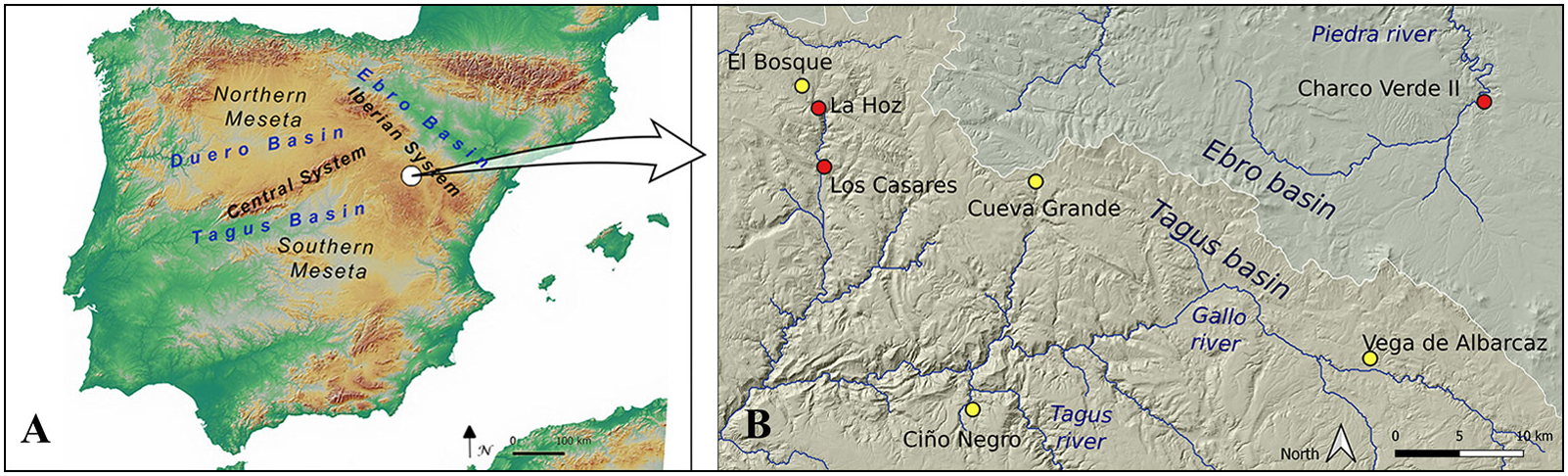
Around the Tajo-Ebro interfluve in the Castilian branch of the Iberian System range (Figure 1), averaging an altitude of 1200masl with minimum temperatures below zero degree centigrade for five months each year (Aupí Reference Aupí2021), the archaeological record for the Palaeolithic is particularly scarce. Besides the Upper Palaeolithic cave art sites of Los Casares and la Hoz (Alcolea-González & Balbín-Behrmann Reference Alcolea-González, Balbín, Escobar and Rodríguez Alvarez2013), Pleistocene sites with secure stratigraphy were unknown in this area until the recent discovery of Charco Verde II. At this site, a sequence of occupations has been uncovered, spanning the entire Magdalenian sequence and the Last Glacial Maximum (21.4–15.1 ka cal BP) (Aragoncillo-del Río et al. Reference Aragoncillo-del Río2023).
Study area in the Iberian Peninsula (A) with a relief map (B) showing the hydrographic network and the known (red) and newly identified sites (yellow) (modified from MDT05-cob1 2008-2015 CC-BY 4.0 scne.es; figure by authors).

Our main objective was to test whether this region, despite its harsh environmental conditions, could host a recurrent human habitation during the Late Pleistocene, as is attested in other inland territories and suggested by the Charco Verde II data. With that aim, our research project, based on systematic prospecting and selective excavation surveys, was intended to obtain new evidence of human occupations in the study region.
Results
Cueva Grande (Selas)
This site is halfway up the hillside at the headwaters of the Arandilla River in Jurassic limestone and dolomite cliffs at 1250masl. The single-room cavity, which is approximately 22m wide by 17m deep with a maximum height of 4m, was previously used as a sheepfold, until the twentieth century.
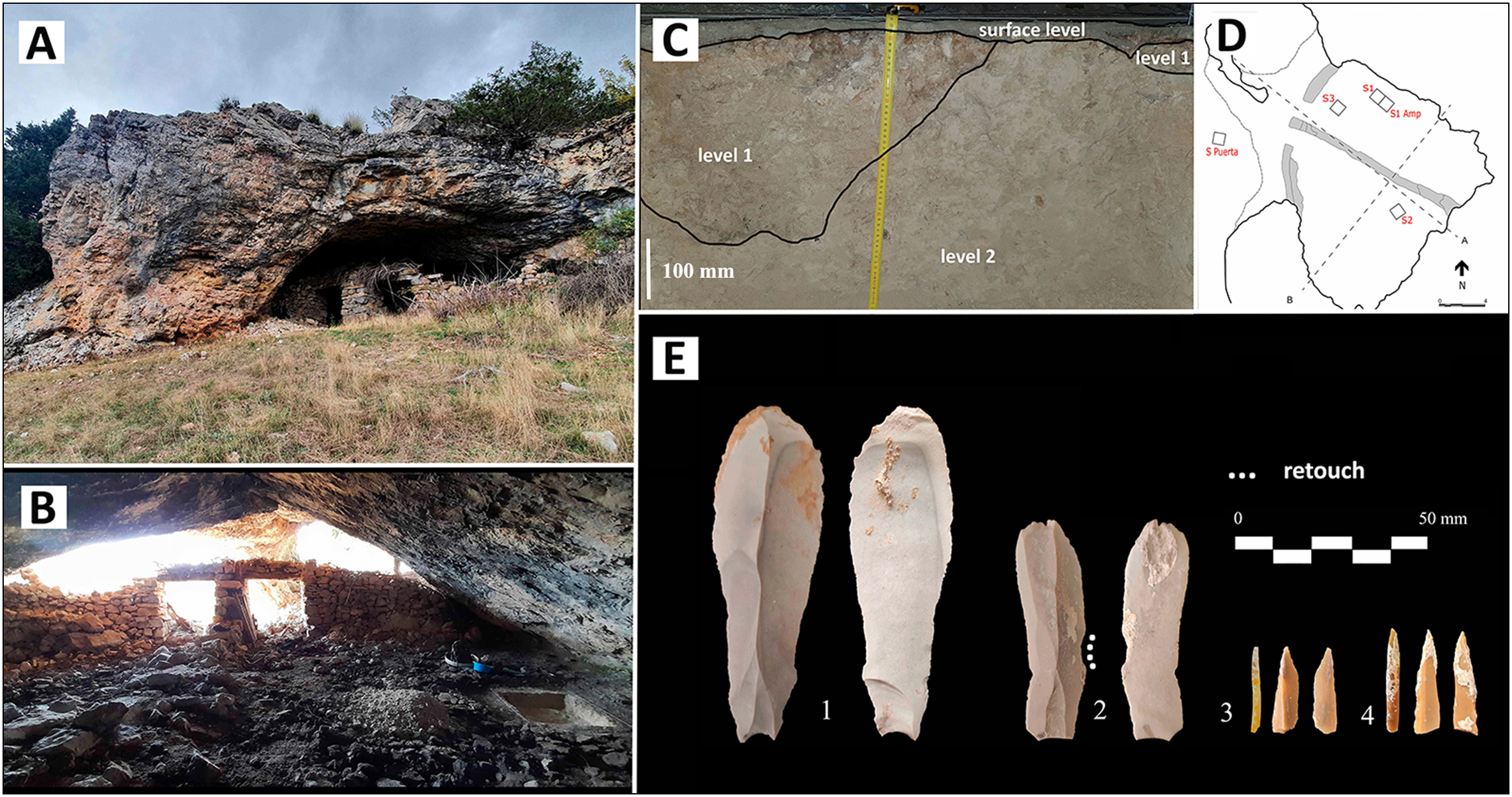
We excavated five square metres (five areas of 1m2 each) between 2022 and 2023. A discontinuous stratum, identified towards the cave entrance, yielded a small flint assemblage, a few faunal remains and some charcoal. Radiocarbon dating was carried out on two samples, one on charcoal (Pinus sp.) and another on an unidentified bone fragment. Results suggest a late Magdalenian chronology (Table 1), consistent with the high proportion of backed bladelets in the lithic assemblage (Figure 2).
Radiocarbon determinations for Cueva Grande, calibrated in OxCal 4.4 using IntCal20.

Exterior (A) and interior (B) views of Cueva Grande; C) S1 north-east stratigraphic profile; D) plan showing test pits; E) lithic artefacts (1, large blade; 2, retouched blade; 3 & 4, microgravettes) (figure by authors).

El Bosque (Anguita)
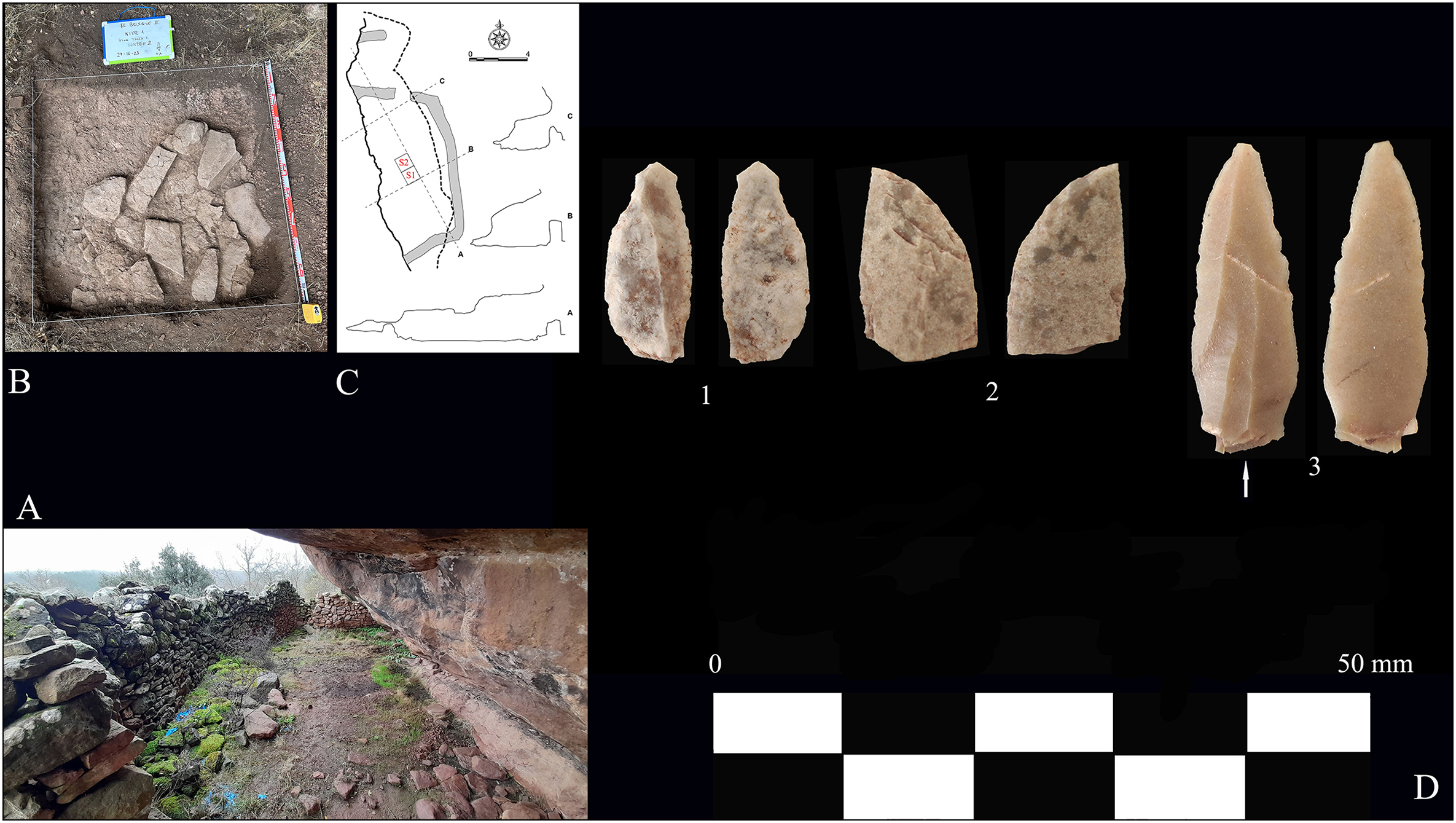
A shelter located on the right bank of the Val de Rata stream, cut into sandstone of the Buntsandstein facies, was also used as a sheepfold. The shelter faces east and has a surface area of about 40m2. Two square metres were excavated in a central area, where we found a single, superficial archaeological level. The associated lithic debitage and faunal remains do not allow for much chrono-cultural precision. The lithic assemblage, with only one retouched piece and 212 fragments related to blade production, points to a short-term occupation, possibly between the final Upper Palaeolithic and the Neolithic (c. 12.5–4.5 ka Cal BP) (Figure 3).
El Bosque Shelter: A) interior view; B) bottom of test pit 2; C) plan and elevations; D) lithic artefacts (1 & 3, bladelets; 2, retouched bladelet) (figure by authors).

Ciño Negro (Zaorejas)
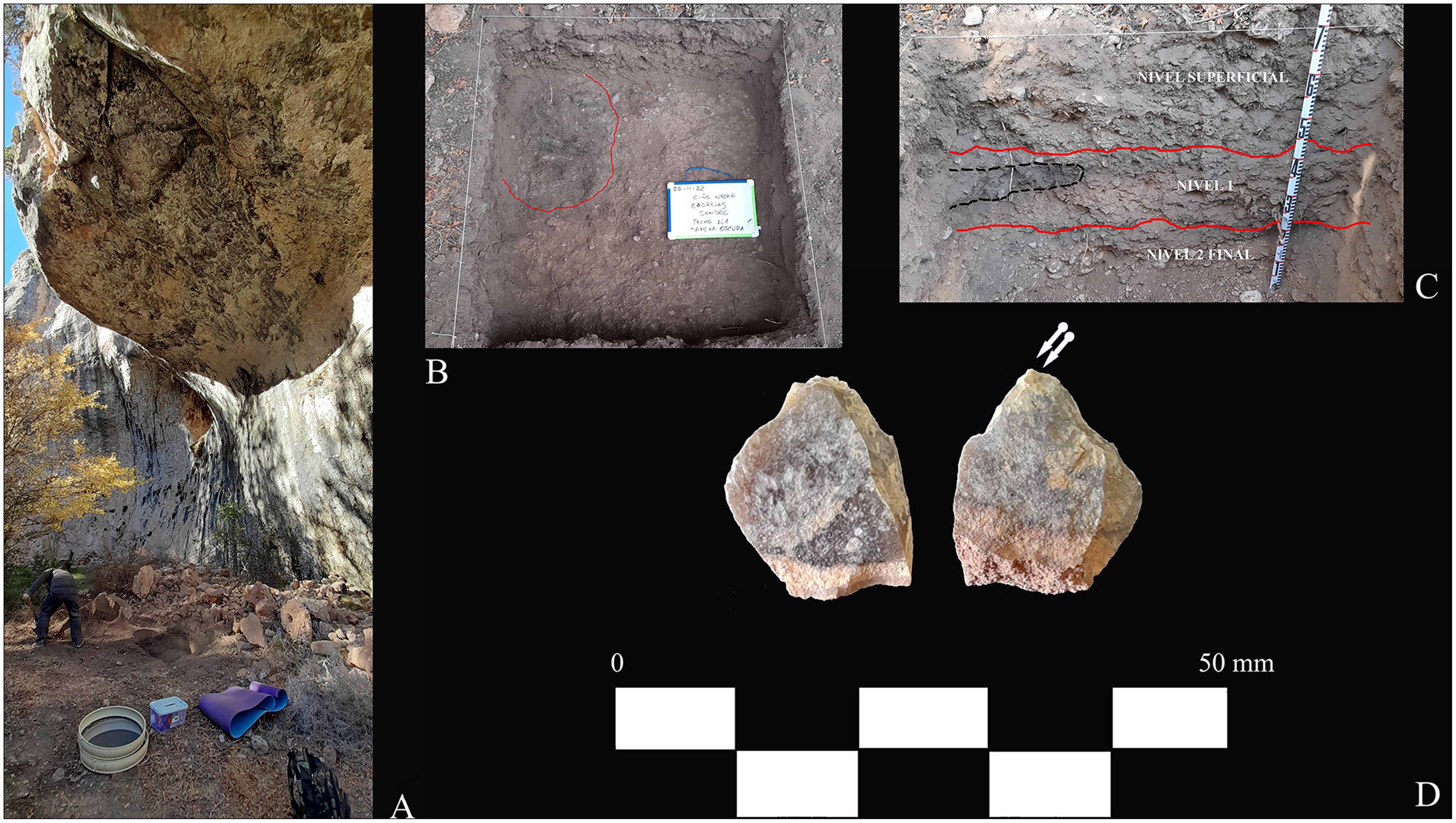
Located in Upper Cretaceous limestones on the left bank of the Ciño Negro River, near its confluence with the Tagus River, this shelter faces south-east and contains the remains of a possible sheepfold. One square metre was excavated in the central outer part, where we identified four stratigraphic levels in a 0.7m-deep section. Of these, only level 1 contains archaeological remains.
A combustion area measuring 0.4 × 0.45m was recorded in level 1, containing a burin on a truncation and abundant charcoal fragments. The type and size of the burin points either to a final moment of the Upper Palaeolithic or to the Early Holocene (Figure 4).
Ciño Negro shelter: A) interior view; B) location of the combustion area (red outline), after excavation of layer 2 of level 1; C) stratigraphy of the test pit, showing the combustion area in level 1 (dashed line); D) flint burin on truncation (figure by authors).

La Vega de Albarcaz (Prados Redondos)
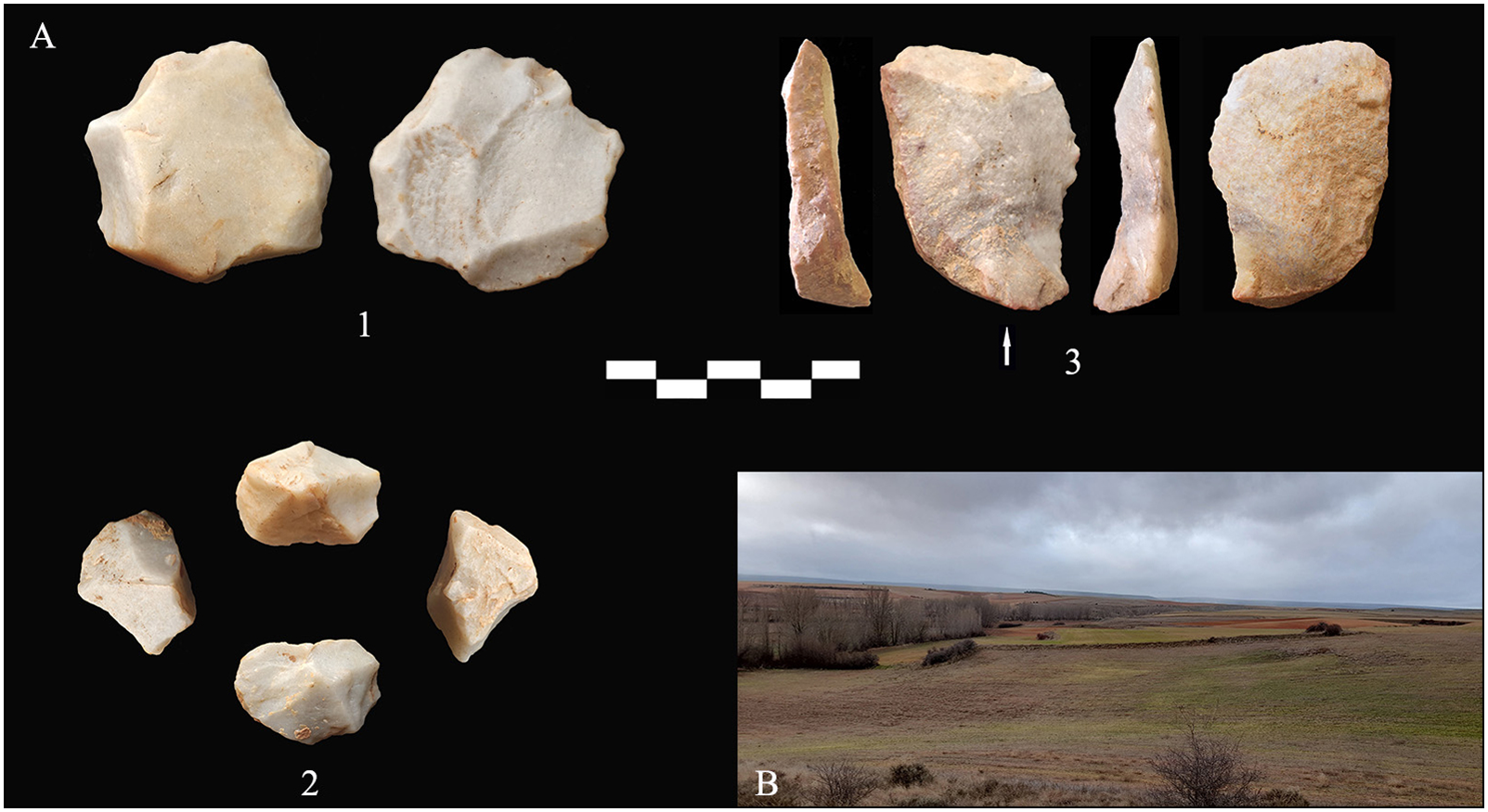
The site is situated on a fluvial terrace of about 40ha at 1144masl on the right bank of the Gallo River, a tributary of the Tagus, 20–23m above the current riverbed. An extensive surface survey of the terrace recovered an assemblage of 36 lithic pieces on flint (65%) and quartzite (35%). The material shows different degrees of abrasion and its chrono-cultural homogeneity cannot be assured. However, technological and typological features of the assemblage—including discoid and Levallois knapping methods, as well as the presence of sidescrapers and denticulates—strongly suggest a Middle Palaeolithic (c. 300–40 ka BP) attribution (Figure 5).
Vega de Albarcaz: A) quartzite artefacts (1, Levallois core; 2, discoid core; 3, naturally backed knife); B) view of the site from the east (figure by authors).

Prospects
Although our results are preliminary, they suffice to verify the potential of the study area and provide further support for the hypothesis that Late Pleistocene human occupation in the region was more prevalent than traditionally assumed (e.g. Aragoncillo-del Río et al. Reference Aragoncillo-del Río2023). This aligns with recent findings in other areas of the central Iberian Meseta that were once thought to have been uninhabited for extended periods of the Upper Palaeolithic (Alcaraz-Castaño et al. Reference Alcaraz-Castaño2021; Sala et al. Reference Sala2024). In addition, results from Anguita, and potentially Ciño Negro, indicate early Holocene occupations, which are equally scarce in the area.
Acknowledgements
We thank the Heritage Service of the Junta de Comunidades de Castilla-La Mancha for granting the prospection and excavation permits.
Funding statement
This research was funded by the European Research Council (ERC) under the European Union’s Horizon 2020 research and innovation programme (grant agreement no. 805478; MULTIPALEOIBERIA project), the Research Plan of the Faculty of Geography and History of UNED, the Department of Prehistory and Archaeology of UNED, and by the researchers’ own funds.


 Open access

