


1. Introduction
Sustainability has rapidly become a central objective in engineering and product development, driven by urgent environmental challenges and regulatory requirements (Reference Hapuwatte and JawahirHapuwatte & Jawahir, 2021). According to the IPCC, rapid and far-reaching changes are needed in all sectors to ensure a liveable and sustainable future (IPCC, 2023). This is reinforced by the EU’s Ecodesign for Sustainable Products Regulation. Therefore, all companies that want to sell products in the EU must take sustainability into account when developing their products (Regulation (EU) 2024/1781, 2024). The design phase is particularly relevant here, as it is during this phase that over 80% of a product’s environmental impact is determined (European Commission, Directorate-General for Environment, 2020).
Despite growing awareness, sustainability is often addressed too late in product development, typically through downstream methods such as Life Cycle Assessment (LCA), which rely on detailed product data. However, many of a product’s key characteristics are locked in much earlier during architectural design, for example, the decision between a modular or integral product. This underscores the importance of evaluating sustainability during architectural design, not just after a product is built (Reference Mesa, Esparragoza and MauryMesa et al., 2020).
1.1. Problem statement
Conventional eco-design guidelines tend to address general principles, but do not provide a structured way to evaluate the sustainability trade-off of different architecture decisions (Reference Mesa, Esparragoza and MauryMesa et al., 2020; Reference ZimmermannO. Zimmermann, 2011). In practice, this means architects and engineers mainly rely on experience and often lack systematic feedback on sustainability until late in development (Reference KoziolekKoziolek, 2011). There is thus a clear need for a way to reflect on the impact of architectural decisions on sustainability at the concept phase.
1.2. Contribution
To fill this gap, this paper presents a qualitative assessment scheme that systematically links typical architectural decisions, such as modularity or interface strategies, to key sustainability indicators and evaluates their impact. The aim is not to replace established tools, but to provide a lightweight, heuristic support tool that enables early consideration of the potential environmental impacts of architectural options. The goal is to foster awareness of potential environmental trade-offs when product architecture is still flexible and not yet committed to costly design paths.
2. Problem analysis and related work
2.1. Sustainability in product development
Sustainability can be considered in economic, social and ecological terms (Reference ElkingtonElkington, 1997). In this paper, sustainability is understood in its ecological dimension, i.e. in terms of its environmental impact, such as the
 $$C{O_2}$$
equivalent of products over their entire life cycle. In order to present information about the sustainability of products, there are sustainability indicators that represent this information (Reference Fiksel, Eason and FredericksonFiksel et al., 2012).
$$C{O_2}$$
equivalent of products over their entire life cycle. In order to present information about the sustainability of products, there are sustainability indicators that represent this information (Reference Fiksel, Eason and FredericksonFiksel et al., 2012).
Environmental sustainability is often assessed using life cycle assessment (LCA) in accordance with DIN EN ISO 14040. This serves to record and evaluate the environmental impact of a product throughout its entire life cycle (Deutsche Institut für Normung e.V., 2021). As the method requires detailed data on materials, energy flows and processes, it can only be applied meaningfully once product development has been completed. Recent research highlights that sustainability-oriented decisions in early product development involve multidimensional trade-offs that are difficult to evaluate systematically (Reference Parolin, McAloone and PigossoParolin et al., 2024). At the same time, existing approaches remain fragmented and often depend on data that is not yet available in concept phases (Reference Hunger, Arnold, Engesser and Gerald van den BoogaartHunger et al., 2025).
2.2. The role of architectural decisions
Since a large part of the ecological impact is already determined by early design decisions, system architecture plays a key role. In systems engineering, architectural design marks a critical phase in which key structural and behavioural decisions are made before detailed geometry or material specifications are fixed. According to ISO/IEC/IEEE 15288 architectural design is described by the so-called System Architecture Definition Process. The process includes the creation of concepts, evaluation and detailing of architectural variants. Concepts, properties, functions, system elements and interfaces that are essential for architectural decisions are identified. The aim of this process is to develop, evaluate and select system architectures that meet the requirements and interests of stakeholders and are represented in consistent models (International organisation for standardisation, 2023).
According to ISO/IEC/IEEE 42010, architectural decisions are defined as a collection of choices made in the overall context of an architecture – including the selection of concepts, technologies, layering and structural principles or interfaces (International organisation for standardisation, 2022). They are thus the central design elements of a system. They determine which components exist, how they interact with each other and how flexibly the system can be adapted over its life cycle (Reference ZimmermannZimmermann, 2011). Architecture design can thus be understood not only as a technical design, but also as a decision-oriented, traceable process that forms the basis for system optimisation throughout the entire life cycle.
2.3. Sustainability in system architecture
To date, relevant research has addressed sustainability from a software architecture perspective. However, research on sustainability in software architecture has mainly focused on technical and economic longevity and dealt with aspects such as maintainability, modifiability and further development capability. The ecological dimension, e.g. energy efficiency or resource utilisation, has received little attention. Architecture design decisions should be identified as important levers for sustainability, as they determine the long-term qualities of a system. Approaches such as architecture decision maps aim to visualise and track the impact of design decisions on sustainability, but their industrial application is still uncertain (Reference KoziolekKoziolek, 2011; Reference LagoLago, 2019).
Reference Mesa, Esparragoza and MauryMesa et al. (2020) investigate the relationship between modularity and sustainability in physical product architectures. They show that modularisation and open architectures can make significant contributions to sustainability, as they facilitate maintenance, repair, upgrading and reuse, thereby extending product life cycles. The paper proposes the so-called Modular Architecture Principles – design guidelines that are intended to enable sustainability aspects to be taken into account early in the design phase (Reference Mesa, Esparragoza and MauryMesa et al., 2020).
At the level of model-based systems engineering (MBSE), a recent systematic literature review shows that although the concept phase has the greatest leverage on costs, sustainability and environmental impact, common MBSE methods (e.g. SPES, OPM, OOSEM) do not provide for the direct integration of sustainability aspects. At the same time, it is shown that LCA is usually applied late (BOM-based) in practice and is therefore of limited use for architectural trade-offs in the concept phase; Design for X approaches (e.g. Design for Recycling) for circularity remain niche. The review describes several approaches in which artificial intelligence is used to support sustainable product development – for example, for material and design optimisation processes or in the concept of AI-based life cycle engineering (AI-LCE). At the same time, the authors emphasise that there is currently no integrated approach that systematically combines the potential of MBSE and AI to assess sustainability in concept phases (Reference Schneider, Riedel and BauerSchneider et al., 2022). However, case studies demonstrate that LCA can be connected to MBSE system models, yet the required modelling effort and data availability limit its suitability for early architectural trade-offs (Reference Lipšinić and PavkovićLipšinić et al., 2023). This underlines the need for lightweight qualitative guidance in concept phases. Accordingly, despite growing research on sustainable architectures, concrete decision-specific effects on ecological sustainability for physical systems remain largely undocumented beyond modularity. Against this background, this paper links key architectural decisions to ecological sustainability indicators and provides an early-phase qualitative assessment to support system architects.
3. Methodology
This research follows the Design Research Methodology (DRM) proposed by Reference Blessing and ChakrabartiBlessing and Chakrabarti (2009). The DRM provides a structured framework for design-oriented studies and distinguishes four main stages: Research Clarification, Descriptive Study I, Prescriptive Study, and Descriptive Study II. Each phase serves a specific purpose. It begins with the identification of the research gap and ends with the validation of a proposed method or framework (Reference Blessing and ChakrabartiBlessing & Chakrabarti, 2009). In the context of this work, the DRM was applied to develop and validate a qualitative evaluation scheme for assessing the impacts on ecological sustainability of system architecture decisions.
3.1. Research clarification
The Research Clarification phase aimed to position the study within the existing research landscape and to define its methodological focus. As outlined in Chapter 2, this research addresses the need for a qualitative assessment approach in the concept phase that links system architecture decisions to ecological sustainability indicators.
3.2. Descriptive study I: identifying architecture decisions and sustainability indicators
The Descriptive Study I phase focused on the conceptual identification and structuring of relevant architecture decisions and sustainability indicators that form the foundation of the evaluation scheme.
Both categories were derived from a literature analysis and from empirical knowledge within the Sustainable Lifecycle Engineering (SLE) research project (it’s-owl, n. d.).
3.2.1. Architecture decisions
A broad set of architecture decisions was identified that are representative of structural, technological, and functional system characteristics. These include, for example, modularity, standardisation of interfaces, redundancy, hardware–software coupling. Each of these decisions represents a fundamental architectural choice that influences the design space and the system’s potential for sustainability throughout its life cycle. Although correlations between them exist, they are conceptually non-redundant and were therefore assessed separately. The complete set of decisions and their literature sources are provided in Table 1.
3.2.2. Sustainability indicators
Following the work of Reference Wyrwich, Könemann, Tissen, Bohnenkamp, Hovemann and DumitrescuWyrwich et al. (2025), the sustainability indicators used in this study build on their concept for evaluating ecological aspects in product sustainability. These indicators include quantitative indicators for material use, energy consumption
 $$C{O_2}$$
equivalent, raw-material input, water consumption, waste and scrap generation, and use of recycled materials. They were complemented by qualitative attributes such as demountability, repairability, and use of hazardous substances (Reference Wyrwich, Könemann, Tissen, Bohnenkamp, Hovemann and DumitrescuWyrwich et al., 2025). To integrate circular-economy thinking, the evaluation scheme additionally incorporates the R-principles: recycle, remanufacture, repurpose, reuse, recover and refurbishment. The complete set of indicators is also provided in Table 1. Together, these indicators form a comprehensive set of ecological sustainability indicators for evaluating architecture decisions.
$$C{O_2}$$
equivalent, raw-material input, water consumption, waste and scrap generation, and use of recycled materials. They were complemented by qualitative attributes such as demountability, repairability, and use of hazardous substances (Reference Wyrwich, Könemann, Tissen, Bohnenkamp, Hovemann and DumitrescuWyrwich et al., 2025). To integrate circular-economy thinking, the evaluation scheme additionally incorporates the R-principles: recycle, remanufacture, repurpose, reuse, recover and refurbishment. The complete set of indicators is also provided in Table 1. Together, these indicators form a comprehensive set of ecological sustainability indicators for evaluating architecture decisions.
3.3. Prescriptive study: developing the evaluation scheme
In the Prescriptive Study phase, the results of Descriptive Study I were synthesised into a matrix that systematically relates architecture decisions to sustainability indicators. For each architecture decision, the assessment was conducted using two contrasting design alternatives representing the respective extremes of the decision space (e.g., integral vs. modular, low vs. high software share, local vs. cloud-based data processing). Intermediate configurations were not explicitly considered, as the aim was to capture the qualitative direction and relative strength of sustainability impacts between clearly distinguishable design options. For each decision, potential effects on ecological sustainability were conceptually analysed based on literature findings and experience. Each architecture decision was evaluated separately for each predefined ecological sustainability indicator using a four-level qualitative scale. For a given indicator, the coding is positive if the indicator improves relative to the contrasting design alternative; negative if it deteriorates under current design assumptions; case specific if the direction depends on contextual conditions (e.g., product, use case, …) or involves countervailing effects; and no direct impact if no relevant change occurs within the system boundaries. The system boundary is restricted to the product. The qualitative coding was based on conceptual reasoning and evidence from literature. Each assignment reflects the expected direction of influence between an architectural design decision and the respective sustainability indicator, rather than a quantitative magnitude. This procedure enables a transparent representation of trade-offs between individual indicators and supports a differentiated understanding of the sustainability implications of design alternatives, for example how modularity can enhance repairability and reuse but may increase material demand during manufacturing.
3.4. Descriptive study II: expert-based evaluation
The Descriptive Study II phase focused on evaluating and refining the developed evaluation scheme through expert focus groups. Multiple workshops were conducted with twelve sustainability experts, engineers and researchers from industrial domains including electrical and connection technology, home appliances, as well as applied research and sustainability institutes. Each architecture decision and its assigned sustainability impacts were discussed and validated in a group. Participants provided domain-specific insights from the industry with regards to systems engineering, product design, and sustainability assessment perspectives. This iterative discussion led to refinements of the initial classification. The resulting version of the evaluation scheme reflects a consensus-based expert assessment and represents a practically grounded, yet conceptually generalisable, model for early sustainability evaluation of system architecture.
4. Results
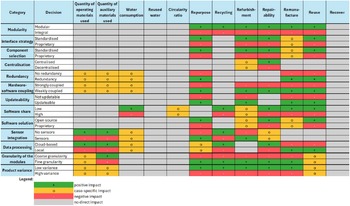
The results of the qualitative study are summarised in Table 1 and Table 2. They show how the respective architectural decisions were evaluated with regard to the selected sustainability indicators. In addition, the circularity potential indicator was removed from the presentation because it is only a summary of the assessments of the R principles and therefore overlaps in terms of content. In total, 624 individual assessments were conducted. Of these, 109 were classified as positive impact (≈17.5%), 109 as negative impact (≈17.5%), 116 as case-specific impact (≈18.6%), and 290 as no direct impact (≈46.5%). Given the number of assessments, detailed rationales are omitted; instead, the key effects per decision are synthesised below, with full ratings in Tables 1 and 2.
Modularity
Modular architectures show strong positive effects across all circularity indicators. They enable disassembly, component exchange, and product upgrades, directly supporting circular product strategies. However, modular systems require additional interfaces and housing structures, which increase material demand and energy use in production. In some cases, modularity may also lead to higher energy consumption during use due to added system weight and more interfaces with higher overall resistance.
Interface Strategy and Component Selection
Both interface strategy and component selection show similar, consistently positive effects on repairability and reuse. Standard interfaces simplify replacement and compatibility across product generations and between different products from different manufacturers.
Centralisation
Centralised control architectures improve repairability and durability by simplifying system structure and reducing the number of electronic subsystems. They also show benefits in material use and CO₂-equivalent reduction.
Redundancy
Redundant architectures increase reliability and decrease the necessity for repair, which can positively affect sustainability when failure rates are critical. In addition, functional parts that were not frequently used during the product’s lifespan can be reused. However, redundancy directly increases material consumption, production energy use, waste, and scrap.
Hardware–Software coupling
Weak coupling between hardware and software shows clear sustainability advantages. It enables software updates without hardware replacement, improving durability and reuse. Strong coupling leads to premature obsolescence, additional electronic waste, and reduced flexibility.
Updatability
Updatable systems, such as devices with over-the-air software update capability extend lifetime and enable reuse and refurbishment without requiring new hardware.
Software Share
The evaluation reveals a broad ecological impact of the software share across multiple sustainability indicators. A low software share, meaning a higher proportion of mechanical or purely electronic functions with limited embedded intelligence, shows consistently positive ecological effects in both the production, use phase and end of life. A low software share is associated with lower CO₂-equivalent, energy use, and material demand, as fewer electronic components are required. It also simplifies repair and the circularity of the product.
Software Solution
Open-source solutions reduce CO₂-equivalent and operational energy demand through broader reusability and extended support cycles. They also enhance repairability, repurpose and reuse due to accessible code and community-driven maintenance.
Sensor Integration
Sensor integration supports predictive maintenance and adaptive energy management, reducing energy consumption in use and improving repurpose and refurbishment potential. However, it increases material use, production energy, and waste generation, particularly through electronic components. It also negatively affects recycling due to complex material combinations.
Data Processing
Cloud-based data processing reduces on-board hardware requirements and thereby lowers production energy and material demand. It also improves repairability and recycling through simplified hardware. However, it reduces reuse and remanufacture potential due to dependency on remote infrastructures and limited hardware autonomy.
Granularity of the Modules
Fine-grained architectures improve repairability and reuse by allowing individual replacement of subcomponents. They increase production effort, material use, and energy consumption in operation due to higher system complexity and interface overhead.
Qualitative sustainability assessment of architecture decisions (part 1)

Table 1 Long description
A table comparing various architecture decisions and their impact on sustainability across multiple criteria. The table has 16 rows and 11 columns. The columns are Category, Sources, Decision, Waste/offcut quantity, Wastewater volume, Proportion of rejects, Substances of concern, CO2 equivalent, Dismantling depth, Energy consumption use, Energy consumption production, Durability, Amount of raw material, and Net weight. The rows are Modularity, Interface strategy, Component selection, Centralisation, Redundancy, Hardware-software coupling, Updateability, Software share, Software solution, Sensor integration, Data processing, Granularity of the modules, and Product variance. Each cell contains a decision or impact indicator, with color coding to indicate positive impact, case-specific impact, negative impact, or no direct impact.
Qualitative sustainability assessment of architecture decisions (part 2)

Product Variance
Higher product variance can improve energy efficiency during use and material savings through optimised product–market fit. However, it increases production complexity and energy use. Low product variance makes it easier to reuse less frequently used components and also simplifies circularity and repair processes, as the products are always constructed in the same way.
Approximately one fifth of all assessments were classified as case-specific, which limits their generalisability. The direction and magnitude of impacts depend on the specific product, the use case, the available infrastructure and additional boundary conditions. For example, the
 $$C{O_2}$$
equivalent was frequently labeled case-specific because it is strongly driven by material choices, energy intensity in production and use, and the effectiveness of circularity levers. Depending on the product and context, these factors contribute differently to
$$C{O_2}$$
equivalent was frequently labeled case-specific because it is strongly driven by material choices, energy intensity in production and use, and the effectiveness of circularity levers. Depending on the product and context, these factors contribute differently to
 $$C{O_2}$$
equivalent, so the net effect of individual architecture decisions cannot be uniformly prescribed and must be evaluated in context to the product.
$$C{O_2}$$
equivalent, so the net effect of individual architecture decisions cannot be uniformly prescribed and must be evaluated in context to the product.
Across all assessed decisions, a consistent trend becomes evident: Circularity-related indicators (repairability, reuse, etc.) respond positively to design strategies promoting modularity, standardisation, updateability, lower variance, weak coupling and open source software use. Resource-related indicators (material input, net weight, etc.) are positively influenced when products are designed to be integral, without sensors, with cloud-based or centralised data processing, and without redundancy. The effects in terms of energy consumption are not so clear to assess, as, for example, with low variance, consumption may be lower in the production phase but higher in the use phase.
5. Discussion
The results highlight the critical role of architectural decisions in shaping the sustainability potential of technical products in the concept phase. While downstream assessments (e.g. LCA) dominate sustainability evaluations in industry, our findings demonstrate that architectural choices have significant leverage over long-term environmental outcomes. By defining the system’s structure, interfaces, and degree of integration, architectural choices substantially influence
 $$C{O_2}$$
equivalent, material usage, energy demand, and circularity potential. This confirms that sustainability should not be treated as a downstream optimisation task, but as an integral part of architecture design from the very beginning.
$$C{O_2}$$
equivalent, material usage, energy demand, and circularity potential. This confirms that sustainability should not be treated as a downstream optimisation task, but as an integral part of architecture design from the very beginning.
The findings show that many architecture decisions involve inherent trade-offs that require clear system goals at the beginning of the concept phase. For instance, a modular architecture can strongly improve repairability, reuse, and remanufacturing, but may require more material and consume more energy. If the primary goal is circularity, modularity can be a suitable strategy, but if the aim is minimal material and energy consumption, a more integral design may be preferable. Hence, it is crucial to define sustainability priorities early on to make consistent and transparent architecture choices.
The applied qualitative assessment proved to be a suitable approach for early sustainability reflection, especially when detailed product data is not yet available. The matrix provides a structured overview of potential sustainability impacts and can be used as a communication and awareness tool to support design decisions among engineers and stakeholders in the concept phase.
However, several limitations must be acknowledged. The evalutation of this qualitative study is based on expert experience and logical reasoning, not on quantitative life-cycle data or real product measurements. However, the validity of these assessments is limited by the composition and background of the participating experts. Their perspectives may emphasize specific domains or reflect shared assumptions within the project context, which could lead to biased or clustered interpretations of certain design impacts. As such, the results provide directional guidance rather than precise impact values. Moreover, many of the identified relationships are context specific. Their relevance and direction can vary depending on the use case, product type, available infrastructure or operating environment. Consequently, the results should not be interpreted as universally valid, but rather as a qualitative orientation that can guide further discussion and assessment within specific design contexts. By limiting the system boundary to the product, the local–cloud comparison is biased toward device-level effects. Background systems are excluded from this study, yet they can materially affect overall sustainability and should be considered when assessing system architecture.
Despite these limitations, the presented matrix helps to make sustainability implications of architecture decisions explicit, thereby promoting more transparent and sustainability-aware decision-making in systems engineering.
6. Conclusion
The study bridges the gap between early architectural design and subsequent sustainability assessment by introducing a lightweight, qualitative assessment scheme that systematically links key architectural decisions to environmental indicators. The results (Tables 1 and 2) show clear patterns: circularity goals benefit in particular from modularity, standardisation, updatability, low variance, weak hardware-software coupling and open-source software. Resource conservation tends to be achieved through more integrated designs, low sensor technology, centralised or cloud-based data processing and the avoidance of redundancy. In terms of energy consumption, there are context-specific trade-offs across the life cycle phases that require early prioritisation of objectives.
The contribution of this work lies in a reflection and communication tool suitable for the concept phase that structures architectural discussions, creates transparency about ecological trade-offs. Future work should include quantitative validation (e.g., LCA and operational data), context-specific weighting of indicators, integration with MBSE toolchains and workflows, and industry case studies. Overall, the evaluation scheme anchors sustainability as an explicit design objective in the architecture phase and enables consistent, traceable decisions toward more environmentally responsible products.
Acknowledgement
This article is part of the research project Sustainable Lifecycle Engineering. The project is funded by the Ministry of Economic Affairs, Industry, Climate Action and Energy of North Rhine-Westphalia and the technology-network “Intelligent Technical Systems Ost-Westfalen-Lippe” (it’s OWL) and is managed by the Project Management Agency Jülich (PTJ). The authors are responsible for the content.


 Open access

