

Introduction
How should we understand the use of ‘violent extremism’ as a framework for analysing harms in women’s lives? Since the adoption of Security Council resolution 2242 (2015) on women, peace, and security that sets out specific demands for states to adopt gender sensitive approaches to counterterrorism (CT) and countering violent extremism (CVE), we have seen an unprecedented interest in the connection between gender and violent extremism (VE) and an expansion in gender focused CVE programmes, policies, and scholarship across the globe.Footnote 1 Further to this, some scholars and activists have been advocating for widening the definition of VE to draw urgent attention to the wide range of misogynistic and gendered violence that women face,Footnote 2 while others have warned against this, due to the connection of this framework to neocolonialism, white feminism, and Islamophobia.Footnote 3 At the global level, there was never a consensus on what ‘VE’ is, or how it relates to similar concepts like terrorism. The United Nations has not provided a definition of VE (like with terrorism), in order to secure operational support for this agenda from diverse actors and partners.Footnote 4 However, Tariq and Sjoberg argued that ‘VE’ as a concept is at best meaningless and at worst harmful.Footnote 5 GentryFootnote 6 challenges engagement with this field of studies without problematising the meaning and uses of key terms, arguing that this in itself is ‘a moment of antagonism one in which political contestations are ignored in order to shore up the status quo power dynamic’. Despite these calls, scholars critical of terrorism studies, such as Gentry,Footnote 7 Khan,Footnote 8 and Oando and Achieng,Footnote 9 have not sufficiently engaged with how the concept of VE is understood or deployed by those women who are most affected by terrorism and counterterrorism initiatives. Recognising the tension around the terminology of terrorism and violent extremism, this paper does not attempt to define or establish a clear distinction between these two concepts. Instead of unsuccessfully seeking to resolve the tension around how violent extremism is or should be defined or used in academia and policy circles, our aim is to engage with how VE is experienced, and with what happens when we centre the lived experiences of women affected by this violence.
Considering the importance of interrogating VE in this field of study, this paper explores local meanings and understanding of VE among Muslim women in the Coast of Kenya, a community that is located at several important junctures, subject to recruitment by armed groups such as Al-Shabaab, experiencing violence as the state attempts to counter VE in their community, and often being terrorised by men’s violence across their lives. To analyse how these women understand ‘VE’, this paper uses body-mapping storytelling as a research method. The importance of using body-mapping comes at a time of growing academic and policy interest in the potential of the arts for challenging the dominance of Western epistemologies.Footnote 10 Centring Muslim women’s voices in theorising gender and VE is essential due to their positioning by patriarchal state institutions and the international community as both ‘the suspect’ and ‘the solution’ to political violence, with appeals to their perceived capacity to identify and combat extremism in their communities.Footnote 11 In the wake of September 11, Muslims in Kenya and around the world, including women, have been disproportionately targeted under the guise of counterterrorism by state violence and treated as a suspect community, leading to enhanced levels of public fear, racism, Islamophobia, and xenophobia.Footnote 12 Working with this community that is ‘most’ affected by VE, terrorism, and counterterrorism to articulate their understanding of these concepts based on their lived experiences has the potential to challenge top-down CVE strategies, colonial studies of VE, and also feminist critiques – which aim to explain their lives without their voices or input.
We argue that involving Muslim women through body-mapping as co-producers of knowledge around VE is important for its decolonising and empowering potential. Racism, Islamophobia, and colonialism are prevalent in knowledge production on VE, including in feminist scholarship.Footnote 13 Puar argues that the entrenchment of Islamophobia and racism in terrorism studies is not incidental but rather structural, normative, and ideological.Footnote 14 In engaging with Muslim women in Kenya, we are also conscious of warnings from figures like Linda Tuhiwai Smith that only studying those oppressed by structures of violence (and not those who benefit from those structures) is not sufficient to find answers regarding their cause.Footnote 15 However, given that most research in this field has been conducted with and by those who benefit from these structures and frameworks, we think that it is essential to involve Muslim women in defining and shaping the knowledge around VE.
Our study showed that although the participants found the terminology of VE in Kenya (including ensuing policies and programmes) to be problematic and stigmatising, they have nonetheless used this same concept to describe the violence that shapes their lives (including militants, Al-Shabaab, gangs, state and law enforcement, and men in their community). The use of VE in this way – to include other forms of violence – is not a call for expanding what counts as VE but rather pushback or an attempt at subversion against CVE frameworks and policies for which their community has been the main target in Kenya. By employing visual arts and a participatory approach, this article sets out to make sense of VE from a bottom-up perspective, based on women’s individual accounts and everyday experiences. Such an approach is important because VE has been typically defined from a top-down, Eurocentric, Western-based perspective.Footnote 16 Through body-mapping, our participants were able to problematise and resist the state-centric, colonial, Islamophobic, and patriarchal frameworks that disempowered them and to centre the multiple forms of violence that impact them. By engaging directly with those effected by VE, we found that the different forms of violence that the women identify as VE – from gender-based violence, gang violence, violence from armed groups, and state violence – were not experienced as discrete (personal, criminal, or political) forms of violence but rather as fundamentally intertwined and need to be understood as such. Our participants were not naïve enough to think that the whole counterterrorism industry was going to be dismantled anytime soon, especially not based on this study. But in drawing attention to their experiences of harms and how these impact them, they hoped that the Kenyan state and international actors would come to understand and start to address the insecurities and human rights violations that dominate their everyday lives, which are not only left untouched in the pursuit of groups such as Al-Shabaab but are also exacerbated by CVE policies.
Our paper contributions are manifold. First and foremost, the paper contributes to emerging decolonial and anti-racist scholarship and debates by scholars such as Khan,Footnote 17 Griffin and Khalid,Footnote 18 Puar,Footnote 19 Zakaria,Footnote 20 Abu-Lughod,Footnote 21 Oando and Achieng,Footnote 22 and Ahmed Ali and Mwambari,Footnote 23 who are drawing attention to the colonial, racist, and patriarchal underpinnings that dominate CVE policies and epistemologies by centralising subjugated knowledge and the marginalised voices of people who are located at the periphery of the field yet are the primary subject of securitisation, state-sponsored violence, and discrimination. In doing so, the paper also offers significant methodological contributions by using body-mapping storytelling as a feminist decolonial method to study VE from the bottom up and, in doing so, disrupt dominant understandings of VE within mainstream VE and security scholarship that are entrenched in colonial, racist, and patriarchal mindsets. Here our work also contributes to the new body of literature on the potential and value of participatory art-based approaches in researching experiences of violence in international security. This paper is also a call for critical scholars to engage with body-mapping as a decolonial approach to study bottom-up perspectives.
Finally, in discussing the findings, the paper brings together distinct bodies of literature and theories pertaining to VE and its connection to gender-based violence, gang violence, and state violence, thereby making a modest – but noteworthy – contribution to existing scholarly debates and literature in these distinct fields. In undertaking this exploration, we do not aim to rehabilitate the concept of VE, or to advocate for its continued use as a framework to understand political violence, particularly when considering the significant harm caused to women and their communities using CVE policies. As others have rightly noted, the terminology that constructed violent extremism is deeply colonial, and this has resulted in scholars such as KhanFootnote 24 calling for the abolition of terrorism studies. Rather, we argue that by adopting art-based methods and a participatory approach, we can ensure that critiques of CVE as a framework are grounded in the lived experience of the term’s use, which includes forms of adaptive resistance by women.
The paper starts with a discussion of the case selection and the methodology. Here we dedicate considerable attention to the body-mapping process and our approach. This is important to help others replicate our work but also because, as Lenette argued, cultural safety is not inherent in any method.Footnote 25 While body-mapping originated in the global south, due to whitewashing and increased interest among funders in art-based approaches, this method can be used in unsafe, tokenistic, and non-participatory ways. In the second section of the paper, based on two selected body maps and stories, we present the findings from our research. This will be followed, in the third section, by a discussion of the links between the different forms of violence that are experienced in the everyday and VE. Finally, we conclude the paper with the suggestion that anti-colonial critiques of VE should grapple with its productive use by Muslim women through their lived experience of patriarchal, racist, and neocolonial violence. Although such an understanding – and in this case use – of VE does not escape the colonial nature of this framework, to fail to do this would be another step in ignoring the voices, interests, and political demands of these women and essentialising their victimisation without engaging with their wishes for how responses should be crafted.
The research, case selection, and method
The research took place over twenty-four months from January 2019 to January 2022. In the first stage of the project, we conducted interviews and focus group discussions with key stakeholders to understand the main issues, and to plan and prepare for the participatory art-based workshops. In the second phase, we organised body-mapping workshops with male and female participants from the Muslim communities living in the coastal region in areas that are formally recognised by law enforcement agents and non-governmental organisations as hotspots for VE. Body-mapping was deemed appropriate for our study because of its feminist and decolonial premises (discussed below). While the choice of this method was made in discussion with the participants during the first phase of the research, initially, we were apprehensive about whether this method was culturally safe and appropriate for conducting research with the Muslim community due to its visual and embodied nature. To enhance cultural safety, we held the workshops as single-sex safe spaces, incorporated prayer time into our schedule, and used familiar materials such as African fabric, beads, and henna. Despite our initial concerns, we were reassured during the workshops by how enthused and engaged the participants were with this method and with the opportunity to unleash their undiscovered artistic potential. This paper is based on the data co-produced during one of the body-mapping workshops held in Mombasa in November 2019 with ten women from diverse Muslim communities. The selection of the participants was based on gender, race, ethnicity, age, and socio-economic backgrounds to capture the diversity of experiences among Muslims around the coast in Kenya. The research secured ethics approval in both the UK and Kenya to address potential differences in ethical understanding and practices of research. In line with the common protocols in visual research, we followed a continuous and relational approach to ethics that is based on mutual respect, dignity, human connection, and care.Footnote 26 We involved our participants in decision-making surrounding the project at all stages of the research and solicited their input, including on how their stories were represented in the final outputs and dissemination process.
Researching VE in Kenya
The choice of Kenya for our study was motivated by the fact that the country, particularly since 9/11, has been committed to counterterrorism and is a significant ally to the West in the Global War on Terror (GWOT).Footnote 27 VE in Kenya is mostly defined in line with policies and strategies of the GWOT, focusing on Islamist terrorism, with attempts to counter Al-Qaeda, Al-Shabaab, and ISIS (and ideologies associated with them). The National Strategy for Countering Violent Extremism launched in 2016, while acknowledging the broader application of the concept of VE, frames this issue, in the context of Kenya, as primarily a problem of violent Islamist extremism. Countering and preventing VE entails strategies based on defining this concept, either implicitly or explicitly. With rising interest among Western donors to tackle the new threat of VE, Kenya has become the scene of many Western-funded projects and initiatives on P/CVE targeting Islamist extremism and communities considered to be at risk of radicalisation to this type of violence.Footnote 28 As such, the Kenyan context offers a unique opportunity to study local understanding of VE and the tension and differences between this and Western or donor-led and state-imposed understanding of VE.
Working with the concept of VE is made more difficult in Kenya by the lack of translatable alternatives in the local language, the legacies of state violence, and heavy donor programming. In Kiswahili, the word ‘wenye msimamo mkali’ (severe position) is used to refer to VE but it is not a direct translation. The term ‘Ugaidi’ is used to refer to terrorism in Kenya, but the understanding of ‘Ugaidi’ in the local context has always related to government and donor programmes’ framing of this phenomenon and was most often associated with Al-Shabaab. For those with knowledge of the terminology of VE, this concept came to replace Ugaidi and is used interchangeably, at the local level, with this term, often to refer to groups such as Al-Shabaab. Hence, extrapolating local understanding of VE in Kenya is far from a simple task. During the first stage of research, we asked participants about their understanding of terrorism, VE, and extremism, and how these can be distinguished from each other. To make sense of this phenomenon, participants in a focus group discussion referred to VE with the simile of eating Ugali (a Kenyan staple food made of maize flour).
A: Doing something past the limit like if I love Ugali I am an extremist to Ugali and I eat Ugali in the morning, in the evening, yeah that becomes extreme.
B: Extremism is to go beyond.
C: So, you are not extreme just in yourself, or your choices but extremism is also about someone trying to change someone else.
All together (laughing): To make everybody eat Ugali.
However, during this exchange, it was clear that the participants struggled to identify the point at which eating Ugali can be considered ‘going beyond’ or extreme, with some of the participants arguing that the lack of Ugali in any meal was tantamount to the absence of food. They have also struggled to decide whether force or violence is needed in the definition of VE. This also suggests that although participants did not reject the framing of extremism, its conception was neither analogous to the Western framing of VE, nor entirely derivative of it.
The body-mapping method
Body-mapping is an art-based research method and a form of embodied storytelling that lends itself readily to exploration of bodily and psychological experiences.Footnote 29 Broadly speaking, body-mapping involves drawing the outlines of one’s body on a life size canvas, which is then filled with symbols, messages, images, and colours during an intense pensive and creative process.Footnote 30
In social sciences research, art-based methods are increasingly popular because of their presumed empowering and decolonising potential enabled through co-production.Footnote 31 A review of art-based research methods with indigenous people by Hammond et al. showed that these methods help ‘centre the research process around indigenous ontologies, enquiries and knowledges’ and can therefore ‘enable communities to break out of colonial cycle of being researched’.Footnote 32 The participatory paradigm in these methods is understood to challenge researchers’ position as experts and producers of knowledge and to redistribute power in research. Hence, people with lived experiences in art-based participatory studies are considered as co-researchers able to privilege their experiences, knowledge, and perspectives.Footnote 33 In our study, body-mapping enabled the co-researchers to paint and narrate their experiences and to explain and analyse their findings. This approach, by its very nature, privileges the participants’ own meaning-making processes. As such, in our study of VE, personal narratives of gender-based violence, gang violence, extremist violence, and state violence were shared and validated as expressions of VE. This would not have been possible using alternative non-participatory approaches or methods.
While no method can be deemed decolonial or feminist in and of itself, in recent literature, body-mapping has been deployed as a feministFootnote 34 and decolonial method.Footnote 35 The feminist decolonial potential of body-mapping is not only related to its capacity for empowering participants as co-researchers but also due to its embodied nature. Feminist scholars, over the last two decades, have been using body-mapping to access and focalise bodily knowledge, experiences, and emotions.Footnote 36 We conducted body-mapping in an immersive process, as a journey through the self to access situated bodily knowledges and feelings.Footnote 37 Body-mapping, because of its focus on those bodies that are invisible or consigned to the periphery of society, presents unique opportunities for retelling the self.Footnote 38 The decolonial potential of body-mapping is also evident in its reliance on arts and visuals, thus allowing for the inclusion in research of those marginalised and excluded due to linguistic, educational, and other barriers.Footnote 39 Body-mapping is exceptionally suited to decolonial and social justice research because of its ability to privilege marginalised voices and make visible obscured narratives.Footnote 40 Using body-mapping to explore a politically sensitive and contentious topic such as the meaning of VE for Muslim women in Kenya allowed us greater reflexivity, responding to the complex bundles of meaning that emerged from our co-researchers. Through this approach, we have been able to unpack understandings of VE and experiences of CVE which would have been missed if we had only conducted interviews or focus group discussions; as we will argue, these meanings are essential to comprehending Muslim women’s experiences of VE and CVE in Kenya.
Due to its embodied nature, discussing reflexivity and positionality in body-mapping is important. This is because when power hierarchies in body-mapping are not addressed, the differences between the researcher and the researched can become solidified, leading to ‘bodies get[ing] in the way of research’.Footnote 41 Due to the collaborative nature of body-mapping, in reflecting on power hierarchies and positionality, one needs to also consider power relations between the co-researchers themselves. The weeklong workshops were conducted in an immersive environment where the participants shared accommodation, meals, prayers, and multiple activities that included mindfulness exercises. While our co-researchers were from diverse backgrounds, their identity as Muslim women in Kenya became the common rallying factor. To create a safe space where the co-researchers felt comfortable and in control of their data and participation,Footnote 42 we started each day with a sharing circle focusing on feelings, learnings, and reflections and ended with a group feedback session. This environment enabled creating mutual connections between the co-researchers as well as enhanced trust in the research team. Considering positionality and reflexivity vis-à-vis the researchers is complex because of the diversity but also the size of our team, which involved three academic co-leads, including one from Kenya; an artist; and four research assistants, including an assistant artist. The diversity of all those involved in the workshops (participants and research team) and the careful planning in designing the methodology has to some extent helped disrupt power hierarchies in the process. The fact that the research team was female-dominated and that two of the academic co-leads and two research assistants were from a Muslim background might have also helped the participants establish trust as well as feel understood and at ease to express their views, even those that can be seen as controversial. In considering reflexivity, the experience of our team in researching sensitive topics and using creative methodologies must be also emphasised. Finally, to disrupt power hierarchies, researchers must adopt a participatory paradigm and a consultative and relational approach, which require a great deal of flexibility, humility, and risk-taking.
Muslim women’s perspectives on violent extremism using body-mapping
Body-mapping as a method produces an abundance of visual and textual data (body maps, photos, videos, audio-recordings, and written transcripts) that can be overwhelming to synthesise. There is also the pressure on researchers adopting a feminist and decolonial approach to authentically represent the voices and stories in their complexity. Collings et al. suggest that in analysing data from body-mapping, it is crucially important not to give primacy to textual analysis as ‘this can reinforce a Western cultural primacy of words over image and reduce the visual data to an illustrative rather than meaning making purpose’.Footnote 43 There are many approaches to the analysis of body-mapping. In our study, we opted for using narrative inquiry because this approach enables integrating visual and written data. More importantly, narrative inquiry allows each participant’s story to be analysed as a unit, instead of fracturing and truncating individual accounts for thematic analysis, and in doing this, elevates the voices of the participants in the research.Footnote 44 To prevent our voices from obscuring the narratives with which we were entrusted, we opted for presenting the stories of our participants in this article as separate from our analysis and attempts at academic theorisation. Analysing stories in this way preserves the integrity of the material and can give voice to individuals and the community that we worked with.
In the following section, we present our findings, using two of the ten body maps produced by the women in this study. These two body maps and stories included here were selected because they represented women’s ideas, experiences, and struggles with VE in their everyday lives. The full narratives and personal stories, including those used here, are available in our digital book of stories.Footnote 45 The names of the artists used below are pseudonyms, selected by them in line with the requirement for anonymity.
Adila was a forty-seven-year-old street vendor, a mother, and a grandmother from both Arab and Agha Khan ethnic origin from Mombasa. She had no schooling. After the death of her parents, Adila was raised by her aunt, with whom she had to negotiate access to education for her younger siblings in return for working as a househelp. Her married life was turbulent, marred by violence and financial and emotional neglect. But Adila was far from being a victim. She fought her way out of the abusive relationship and raised her two children by herself.
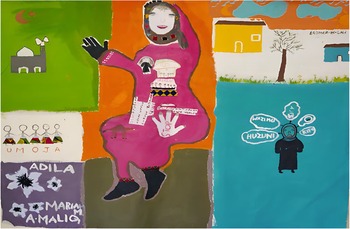
In her body map (Figure 1) Adila painted her story. On the right-hand side of her canvas, she drew herself in a sleeping posture with (Fikra) thoughts bubbling in her head, overwhelmed with sadness (Huzuni), and almost going crazy with worries (Wazimu) and dark thoughts about death (Kifo). She explained that this was her attempt to symbolise her constant struggle to save her son from the danger of violent groups.
‘I saved him’ by Adila.Footnote 46

Adila recounts:
My son used to frequent one of the mosques. He was a good boy. But when he was 14 years, he met foreign people at the mosque who came under the pretence of spreading ‘daawah’ (the message). They brainwashed him offering him a huge amount of money to travel to Somalia. I was suffering following my divorce and struggling financially. He tried to convince me, but I said No! Because I had suspected that they were Al-Shabaab… My neighbours have already warned me about people who are taking young boys to Somalia. Three of my friends had their children taken just like that. I went and told my brother-in-law but when he went to the mosque to confront them, they had already escaped.
But Adila’s woes were not over, because after this incident her son started to mix with the wrong crowd again and fell into bad company. She continued:
He first was spending a lot of time out. So, one day I decided to follow him to know what he was up to. It was then that I realised that he had been hanging out in ‘Maskani’ using ‘bhang’ and ‘khat’. I struggled with him and then I sought assistance from my brother-in-law. That time we put him in a boarding school. But when he failed Form Four, he went back to the Maskani. They were bigheads there and they used to take him to sell drugs. I really felt bad. I went and complained to the police, but the police didn’t do anything. I decided to take matters in my own hands. I went to the Maskani to confront this group. I quarrelled with them. They wanted to beat me, but Allah gave me strength and I beat them. Two men were holding me down like this and I used my legs to fight them. I screamed, and I took my son away from them.
To separate him from this group, Adila ended up convincing her son to take up employment in Qatar for two years.
Inside her body map, placed at the position of her heart, Adila drew herself angry and resolved. She drew the mosque as a reference to her son’s experience with recruitment to Al-Shabaab and the Maskani where her son was being led astray. The positioning of these drawings close to the heart was because this experience is ‘within [her], in [her] heart’.
The hand signal in red with the stop sign symbolises ‘stopping the bloodshed’ caused by violent groups. The Mouth/Lips picture is a reference to her experience of speaking out to defend her sisters’ education (Niliongea mdomo wangu kupinga kutokwenda shule – I used my mouth to speak against my sisters not going to school) and against Al-Shabaab and gangs (Nilipinga mtoto wangu kwa uhalifu).
Adila included a reference to her brother-in-law by drawing his house in blue with the inscription brother-in-law at the top to acknowledge his role in saving her son at a time when she was kept awake at night with worries, symbolised by the yellow (lit house). On the left-hand side, as a tribute to her community and the support she received from her neighbours, she drew unity (Umoja), symbolised by women decorated in African fabric and holding hands.
Adila reflected on the threat of VE in her community. She conjured:
Today, the main threat of violent extremism currently comes from gangs and youth sitting in ‘Maskani’ using drugs and alcohol. For me, I think that this danger is very similar to the danger from groups such as Al-Shabaab. In my neighbourhood there were these guys who used to sit around early in the morning at around 4 am. I normally sell juice in the morning. When I was taking juice to the market those guys used to attack me and other people… So, I went to talk to my neighbours, and we decided to report this issue to the police. Instead of doing something, the police were asking about my papers, my citizenship, and everything. I told them I was Kenyan, born in Kisumu and raised in Garissa. ‘Pwani Si Kenya’ I don’t feel that the coast is Kenya because the police doesn’t help us. Instead, they harass us.
Adila explained that in Kenya, ‘light-skinned people are called Al-Shabaab particularly if they wear the Abaya, Jilbab or Hijab’. This is why Adila drew herself as wearing the abaya. She explained:
I love this wearing hijab and abaya. This is my culture. I am a Muslim and an Arab. On my Hindu side of the family, they wear Sarwal (trousers), but I love buibui (hijab and abaya). I love my religion. Prayers help me through the difficulties in my every day. It helps me resist and to remain strong. It guides me when I am struggling to make a decision.
Rambo is a forty-three-year-old African Nubi woman, a mother to two children and a grandmother too. Like Adila she is a divorcee, and her short married life was also characterised by violence and abuse. Rambo is one of the very few female village elders. She earned this position because of her work in challenging illicit drug dens and gangs who were terrorising her community. Rambo was threatened with violence and then attacked and stabbed in her own home. This, however, has made her even more resolute to continue protecting her community, and through her intervention police patrols were organised, which helped maintain security to an extent. Under her leadership she initiated a unique peer education programme that aimed to distract young people from getting involved in drugs or becoming radicalised.
Based on her work as a village elder and her own experience, Rambo reflected on her understanding of VE.
For me personally, violent extremism is like when somebody hurts you deep inside. Violent extremism can be both physical and mental, such as being in an abusive marriage. I was in a very abusive marriage. My husband thought I was an object that he can push around because he had a good government job. Because I was less educated, he looked down on me and expected me to tolerate his abuse… The fear of talking about him and the fear of what he can do to me made me live in terror… It took me three years to overcome my fear. When I share my story, I know that I am giving a good example of fighting back as a woman rather than accepting hurt and living with it… I am who I am because I am a woman and a mother. Being a woman, you are a victim and being a victim, you also must learn to survive.
In my work as a village elder, I also encounter different forms of violent extremism in the community. Based on the cases I hear, we have religiously inspired violent extremist groups in mosques. One mosque has many unknown preachers coming as sheikhs with different types of teachings. This is not the same Islamic teaching that we used to know… The boys who frequent this mosque have extreme beliefs. … Other forms of violent extremism include the increasing spread of gangs… This is like a disease.
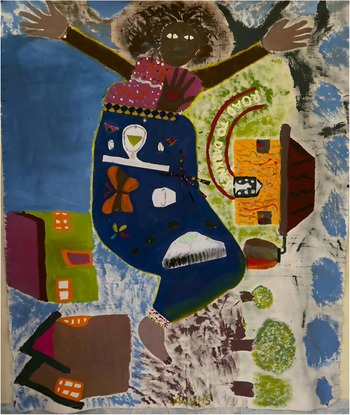
In her painting (Figure 2), Rambo was positioned in an open embrace to send a welcoming and supporting message to those who are experiencing adversity. She explains:
My hands (arms) are open, so that I can hug you when you come to me, as I am ready to face it together… If something is not right, I cannot keep quiet. It’s in me, I refuse to be intimidated. To stop something is to raise your hand to resist it. You must stop it first, and then you can help others. I come out of an abusive marriage, so I believe that I can stop other ills too, such as child abuse, rapes, and brutality (FGM), which children undergo. These topics really touch me.
In her body map, Rambo’s hair was painted loose for comfort. Inside her body at the level of her heart is a drawing of hand that says STOP as a reference to the need to be proactive in stopping violence and speaking out about it. The tree picture in her body map symbolises herself when she was trapped in an abusive marriage (the blackness underneath). She explained that this is to represent the idea that one must not lose hope because they are stronger than the darkness. On her body, she used the colourful African Kitenge and beads to symbolise her identity as a woman and celebrate her Nubian culture.
‘Hope’ by Rambo.Footnote 47

Rambo also discussed female genital mutilation (FGM) as a form of VE. This is an aspect of her culture that she is not proud of, but she is hopeful as it is in decline as a practice. In her body map, Rambo represented FGM by the hut on the right-hand side of her canvas with the message The Road to Darkness. This is because of the practice itself but also because girls undergoing FGM in her community are typically kept in the dark after the procedure. Rambo maintains a hopeful stand, arguing that there is always hope. She drew the blue sky on top of the hut, trees, flowers, and small birds, arguing that even in ‘darkness there is brightness outside… You cannot see the birds, but you are going to hear the sweet songs that are going to inspire you. There are people here watching over you and you are going to hear their voices.’
On the left-hand side of the canvas, Rambo drew the beach (the blue colour) and her house. The brown areas underneath depict ‘community spaces that are vulnerable for violence. This can be an abusive marriage, gangs, or youth radicalisation.’
Everyday violence and violent extremism: Exploring the link?
State approaches to tackling VE elevated this form of threat over all other forms that affect communities in their everyday lives. The violence of VE is treated as an exceptional form of violence requiring highly securitised and heavy-handed responses.Footnote 48 In the field of international relations, feminist research demonstrates how gendered ideologies play a significant role in informing the conduct of war, militarism, and violence, and call for a radical change in how security is conceptualised and delivered.Footnote 49 Feminist scholars have questioned the understanding of security that excludes women and conceals the gendered and racialised underpinnings of security practices.Footnote 50 Scholars such as BunchFootnote 51 have also condemned the rise of militarism and the use of CVE as an excuse for governments after September 11 to abandon their commitments to human security and human rights.
Aroussi highlighted that in defining violent extremism ‘it is important to understand not only what is counted but also what is left out’, condemning the disproportionate focus on this type of violence.Footnote 52 Gentry provided a foundational contribution to this debate, arguing that the boundaries of what is defined as VE are typically drawn around internalised cultural biases and racialised, masculinised, and heteronormative constructions.Footnote 53 VE as field of studies, she contends, is built on gendered, racial, imperial, and heteronormative aphasias. While the Kenyan government and the international community prioritise tackling violence by groups such as Al-Shabaab for our participants, such a hierarchy of violence fails to capture the insecurity that they experience in their everyday lives, including in their own homes and at the hand of state actors. This did not mean, however, that the participants rejected the notion that violence was important, or that they wanted a response to it. Rather, by redefining and reworking the concept of VE, they positioned a range of violences as equally pernicious and worthy of response.
Accessing bottom-up perspectives on VE using body-mapping opened us to unexpected narratives that were deeply personal but that at first sight may seem to resist theorisation. The data produced by the women who took part in the workshop included various forms of violence and insecurity experienced in their everyday lives as VE. The stories and body maps revealed experiences of radicalisation and recruitment by groups such as Al-Shabaab, gang violence, state violence, and police harassment, and more importantly gender-based violence. These findings, however, are partly similar to Villa-Vicencio, Buchanan-Clarke, and Humphrey’s study on local perceptions of VE, conducted using key informant interviews and focus group discussions, which showed that when participants were asked to provide their own understanding of VE, they ‘tended to define the term based on the most pressing causes of insecurity in their communities’, and particularly violence by local street gangs, Al-Shabaab, and Kenyan security forces.Footnote 54 The key difference between their study and our findings is in relation to the inclusion of gender-based violence as a form of VE. The accounts of our participants based on their everyday and lived experiences are also incongruent with how the Kenyan State and the international and donor community define and respond to VE. In the remainder of this article, we discuss the findings and implications of framing gender-based violence, gang violence, and state violence as VE.
Violence against women as violent extremism?
The story of Rambo highlighted domestic violence and female genital mutilation as forms of VE. The idea that violence against women is a form of VE was present in most of the stories and artworks that resulted from the workshop. Participants argued that practices such as family and domestic violence, denial of education, early forced marriages, and female genital mutilation were VE because they involve extreme beliefs and extreme violence, and because they are based on the idea of superiority of men and the desire to control and dominate women. But what is the link between violence against women and VE, and how should we interpret these findings?
Feminist scholars have condemned the public–private dichotomy that pervades state responses to violence and highlighted how violence against women is a continuum experienced from the private to the public and from the national to the international, linked by the same gendered structures and patterns of male patriarchal domination, violence, and oppression.Footnote 55 However, in the past two decades, with the growing interest in sexual violence in armed conflicts and the development of the theory of rape as a weapon of war, violence by armed groups, including that by VE organisations, was removed from the continuum of violence to the realm of the exceptional, to require not only carceral but also securitised and militarised responses.Footnote 56 These feminist attempts to draw attention to violence against women committed in this context have inadvertently legitimised and accelerated the international community’s interventions in the global south, under the guise of saving women. Abu-Lughod, Hammami, and Shalhoub-Kevorkian in The Cunning of Gender Violence have critiqued the current international focus on sexual violence in the context of armed conflicts and VE, highlighting how such efforts have resulted in colonialist and racist discourses and interventions that intentionally exclude the violence that women experience at the hands of state actors, settler colonialism, and Western interventions.Footnote 57 They highlighted how the exceptionalism of the sexual and gender-based violence frame is disempowering and harmful for women in the global south and particularly Muslim women, yet is essential to the Western position as the saver of Muslim women and the tool through which interventions in the global south become not only justified but imperative.
While previously, the violence of VE was seen as non-gender specific – in that it can affect anyone and everyone regardless of gender – and gender was invisible in policies, programmes, and research on VE, this has recently changed since the adoption of Resolution 2242.Footnote 58 In the UN Action to Prevent Violent Extremism report, which followed resolution 2242, former UN Secretary General Ban Ki-Moon made a direct connection between gender equality, women’s empowerment, and preventing VE, declaring that it is ‘no coincidence that societies for which gender equality indicators are higher are less vulnerable to violent extremism’.Footnote 59 This position in the Plan of Action has influenced the development and subsequent uptake of the idea of ‘feminism-as-counterterrorism’. Feminism-as-counterterrorism connects misogyny and violence against women and terrorism.Footnote 60 It is based on the premise that gender equality can be used as a national and international security strategy to counter and prevent violent extremism.
The rise of feminism-as-counterterrorism and the focus on sexual violence as a weapon of war have led to increased involvement of Western women in scholarship, research, and policies on countering and preventing VE.Footnote 61 Feminist scholars looking at the consequences of feminist engagement with security-focused institutions and the UN Security Council on women from the global south have condemned such efforts as governance feminism,Footnote 62 securofeminism,Footnote 63 conflict feminism,Footnote 64 carceral feminism,Footnote 65 and white feminism,Footnote 66 highlighting their colonial and racist underpinnings. ZakariaFootnote 67 and KapurFootnote 68 called the war on terror America’s first feminist war. ShepherdFootnote 69 pointed out to the white supremacist logic underpinning the engagement and complicity of Western feminists in this field, arguing that governance feminism is a form of white feminism that is incorporated in the structures and institutions of global governance and contributes to and strengthens white supremacy through the domination of women of colour under the guise of saving women and advancing women’s rights.
Despite these critiques around the securitisation of sexual and gender-based violence, in the past few years, the connection between VE and violence against women has become a pressing question for many researchers and practitioners. Feminist scholars have condemned the prioritisation of state security concerns about VE at the expense of violence against women, a key threat to women’s security.Footnote 70 Scholars such as Marcus,Footnote 71 Pain,Footnote 72 and JohnsonFootnote 73 have argued that violence against women and particularly intimate partner violence, while fitting with the applied definition of VE or terror on multiple levels, are not recognised as a form of VE and as such have called for reconsidering the policies and practices on CVE. Scholars such as Díaz and Valji pointed out that around the world, violent extremist groups are known to engage in misogynistic violence, and thus approaches to VE must address violence against women.Footnote 74 They argued that gender-based violence is typically treated as a problem of individuals and overlooked in state and international community responses to VE, even though gender-based violence and entrenched gender inequality norms are both a manifestation of VE and a key driver for this phenomenon.Footnote 75 This argument was pushed even further by scholars such as Johnston and True, who in a study looking at Muslim majority countries and Muslim communities in Indonesia, Bangladesh, the Philippines, and Libya connected misogyny and violence against women to VE.Footnote 76 TrueFootnote 77 suggested that ‘misogynistic attitudes toward women and support for violence against women are crucial and overlooked factors in propelling people to also support violent extremist groups and cause’.
However, we caution against the slippage between violence against women and VE, especially in the light of the absence of convincing evidence and theory about their causal connection. Moreover, we do not suggest that the definition of VE should be broadened to encompass all violence against women. While the ideas of feminism as CVE and that of broadening countering and preventing VE policies to include gender-based violence may seem attractive, we must not be naïve to ignore the implications of extending the arms of the state and its security agents, who are notorious for their disregard for human lives and rights, including those of women. Huckerby enumerates the many risks associated with using gender equality as an instrument of CVE, including backlash against women’s rights in local contexts; the securitisation and politicisation of gender issues; and security threats for activists, as the close association with the state’s security apparatus can render women targets for VE groups.Footnote 78 In the context of Kenya, where police brutality, extrajudicial killings, and the forcible disappearances of suspected terrorists are common, linking violence against women to VE would result in securitising services for victims, making women even more reluctant to report crimes to avoid disentanglement with the anti-terror police and state security apparatus.Footnote 79
Expanding the realm of what is considered as VE to include gender-based violence is also problematic because what counts as VE is always built around highly racialised and sexualised discourses and religious biases, reinforced through the contested concept of radicalisation.Footnote 80 As such, our findings should be understood in the context of the lived experiences of violence and insecurity in Kenya. Our participants included gendered harms within their definition of VE because it is the type of violence that affects them directly and daily in their context and that they feel needs to be prioritised in a context where they see what counts as VE as being taken seriously. Our findings do not suggest that responses to VE should become deeply wed to responses to gender-based violence in order to address each issue. Rather, they show that those who experience violence that they find extreme deploy the concept of VE because it is in their vernacular; the salience of the framing reflects their use of dominant terminology for violence that is given priority in the space that they occupy. It would be easy to reject their use as being duped by patriarchal CVE institutions, or to suggest that they are simply insufficiently reflective on the power at play in their use of VE to understand the violence that they face. Doing so would make us fall into the racialised trap of instrumentalisation that Mesok warned about.Footnote 81 Rather, we suggest that in a context where VE is taken seriously, and gender-based violence is not, their demand has contextual significance and requires responses that we may otherwise be uncomfortable with as feminists.
Gang violence as violent extremism
Gang violence was also highlighted by the participants as a form of VE. Adila, in her story, discussed her struggles with gangs, and Rambo almost paid with her life when she raised her voice against criminal groups. These experiences of constant fear of gang violence resonate with almost all the other participants in our study, who also did not differentiate between local gangs and international violent extremist groups. Such understanding, however, does not necessarily suggest a connection between the two. Within the literature, the possible link between violent extremist groups and criminal gangs has been examined with concern.Footnote 82 In Kenya, while a study by Sahgal and ZeuthenFootnote 83 showed a weak connection between violent extremists and criminal groups, other research by PetrichFootnote 84 and BadurdeenFootnote 85 argued for the existence of a strong and complicated nexus between criminal activities and VE in this same context. Studies in this area also compared and contrasted the differences and similarities between these two groups in terms of recruitment, membership, subculture, structure, and behaviour, pathways, and disengagement.Footnote 86 However, this body of literature makes no attempt to call for labelling gang violence as VE, neither because of possible or presumed similarities between the groups nor for strategic reasons, that is, for it to be treated more seriously by the state. In fact, scholars such as Decker and Pyrooz caution against conflating gangs with other types of extremist groups.Footnote 87 This call from scholars to separate gang violence from VE is unlike the attempts by feminist researchers discussed in the previous section in relation to framing gender-based violence as VE.
It must be noted that gang violence in Kenya cannot simply be reduced to a problem of criminality but is historically connected to political violence.Footnote 88 State-sponsored vigilantes and militia groups peaked during the era of Daniel Arap Moi.Footnote 89 Numerous studies highlighted how politicians in Kenya routinely deploy vigilante groups, using ethnopolitical and religious discourses to incite violence against rivals, especially during successive elections.Footnote 90 These attempts often resulted in clashes such as rifts between the police and supporters of the Islamic Party of Kenya in Mombasa in 1992,Footnote 91 the Wagalla massacre in Wajir,Footnote 92 the Kaya Bombo killings in the coastal region,Footnote 93 and street and gang violence with the emergence of groups such as Mungiki, Kamjesh, Jeshi la Mzee, Sungu Sungu and the Baghdad Boys, controlled by different political interests during successive elections.Footnote 94 In the 2007 elections, these practices almost brought the country to its knees and nearly resulted in a civil war. In this way, violence by criminal organised groups can be understood as VE when it is based on an ideology that subscribes to the subjugation, hatred, and domination of one group over others and legitimises the use of violent acts to this end.Footnote 95 This thus reveals that the label VE is essentially a political term derived from a top-down perspective of political elites determining certain activities as problematic but not others.
Nonetheless, whether violence by criminal groups is or is not considered as VE by scholars, practitioners, and those with the power to label and define what VE means, this does not make our findings less relevant. On the contrary, our findings are validated by the lived experiences of violence, fear, and insecurity among our participants, which led them to label gang violence as a form of VE. If we fall back on emphasising that these women simply do not understand or are insufficiently attentive to what the labelling of VE is doing, this is to reproduce the colonial and patriarchal power structures that expose them to violence in the first place. Centring their own discursive choices presents an alternative to top-down understandings of VE that demands engagement from those claiming to speak in the interests of those harmed by CVE initiatives.
State violence as violent extremism?
Human rights violations, discrimination, struggles in getting official documentation such as identity cards and passports, ethnic profiling, harassment, arbitrary detentions, forced disappearances, extrajudicial killings, and police brutality against Muslims were discussed by all the participants of this research, highlighting this treatment as a form of VE by the Kenyan state. These accounts were especially stronger among male participants and those of Somali origin (males and females).Footnote 96 The women who took part in the body-mapping workshop discussed how they are routinely racially profiled by the security forces, scrutinised, and mistreated because of wearing the Islamic dress and because of physical appearance. Adila in her accounts discussed her experience of harassment and intimidation by the Kenyan police and the marginalisation of Coast and Coastal communities by the Kenyan state. The abuse of power by the Kenyan police is also evident in the case of Rambo, whose husband has used his influence to arrest her. But how should we understand these findings, and what are the key implications from considering violence by the state and state agents as VE?
While we acknowledge the differences between the concepts of terrorism and violent extremism and we do not wish to fall into a slippage between these two, we find some of the literature critical of terrorism and of the GWOT, and particularly that which is focused on state terrorism, pertinent to our discussion here. Generally, in policy documents and the literature in this field, the term violent extremism is not ascribed to state actions but to individuals and non-state actors and groups.Footnote 97 In political theory, states are presented as having a monopoly over the legitimate use of violence and the principle of sovereignty protects them from interference by others. However, critical scholars have condemned the failure to engage with and to label state actions, particularly by liberal Western democracies, as terrorism.Footnote 98 Schotten argues that the idea of sovereignty in the European and Western context, from its inception, was a settler colonial enterprise created in the pursuit of biopolitics, built on the idea of the hierarchical valuation of settlers’ lives over others.Footnote 99 Settler colonialism, according to SchottenFootnote 100 and Blakely and Raphael,Footnote 101 was the first recognisable manifestation of terrorism. Rooted in a parallel ‘civilizationist moralism that valorizes some lives while marking others as and for death’,Footnote 102 the war on terror made Muslims the target of its racialised, moralised, civilisational logic. Butler,Footnote 103 in her work on terrorism and biopolitics in the aftermath of 9/11, distinguishes between grievable and ungrievable lives, where one is valued and deemed worthy of mourning and others cannot be mourned because they never counted as life at all. Puar argues that the GWOT facilitated a process of racialisation of Muslims in the West and around the globe whereby persons who appear Middle Eastern, Arab, or Muslim are grouped together and signalled out as terrorists and non-citizens.Footnote 104 Underpinning this discussion of terrorism is a racialised, classed, gendered, and civilisational logic that is linked to violent extremism and is pertinent to understanding our participants’ accounts of their lived experience of this violence.
While Kenya is not a Western country, as discussed before, it is a strong ally for the United States and the West in the GWOT. Since 1980s, Kenya has been the scene of several attacks linked to international VE networks, most notably the 1998 bombing of the United States embassy by Al-Qaida that killed over two hundred people and injured thousands of others. But after 2011, Kenya has also experienced an increased number of attacks sponsored by Al-Shabaab, a militant group based in Somalia. Kenya is a country notorious for police brutality and excessive use of force, particularly by the anti-terror police. The Kenyan approach to CVE has been criticised for following the same logic and framework to justify the excessive use of state violence against dissent as experienced during colonial times.Footnote 105
The Kenyan approach to tackling VE is focused on Islamist threats, and as such the country’s large Muslim minority has become the target of its CVE policies and operations. The focus on Muslim communities had the repelling effect of constructing a suspect community along the religious and ethnic enclaves.Footnote 106 Over the last ten years, Muslim communities, and particularly those who are ethnically Somali, have borne the brunt of security and CVE operations.Footnote 107 The Kenyan approach to CVE has been condemned in scholarly literature for its blatant human rights abuses. For example, Lind, Mutahi, and Oosterom have compared the Kenyan approach to killing a mosquito with a hammer.Footnote 108 One example of such policies was Operation Usalama Watch, conducted in April 2014 in the Eastleigh, Nairobi, against the Muslim and mainly Somali communities to flush out suspected Al-Shabaab supporters. This operation involved a large number of security officers and resulted in the detention of over four thousand people through ethnic profiling with reports of widespread violence centring on human rights abuses.Footnote 109 This level of violence and discourse of fear have exacerbated feelings of alienation and of ‘non-citizenship’ among Muslims, as evident in Adila’s phrase ‘pwani si Kenya’ (The coast is not Kenya). It is then not surprising that actions by the state and its agents were highlighted by participants in our study as VE. Our findings suggest that existing approaches to VE have both produced further violence and failed to address the forms of extreme violence that women in these spaces face. The choice to adopt the language of the state, in positioning a range of harms as VE, including CVE strategies themselves, expresses their priorities in terms that already have salience. These forms of harm are treated as violent extremism because extremist violence is taken seriously, and because it is seen in our participants’ views to come from a normatively unacceptable position. Without taking their voices into account it would be easy to either reject the framing of violence due to the coloniality of its deployment, or to simply push for ‘more effective’ CVE, neither of which fit the participants’ needs.
Conclusion
The framework of VE remains an aspect shaping the lives of Muslim women in the Coast of Kenya. By using body-mapping with ten Muslim women in Kenya, our study has shown that these women not only challenge and resist the violent and colonial policing of their communities that comes from the VE framework but also adopt forms of adaptive resistance, recrafting the term to fit their priorities and experiences. Using this participatory art-based approach has shown that for the women in our study, VE was a productive term to describe the violence and insecurity that they experience in their immediate context, including at the hands of the men in their lives as well as gangs and state violence. This finding poses an important tension for critical scholarship on the concept of VE. While our participants noted the problematic and incoherent nature of the terminology of VE, they also did not shy away from its use. Rather, they felt that it was a useful term to deploy to understand the various forms of patriarchal violence that they experienced day to day. Their use was not ignorant of the harms produced by CVE initiatives, engaging with a context where the concept of VE remains a key factor shaping their lived reality. As a community bearing the brunt of CVE initiatives in Kenya, they attempted to deploy the language of VE as an act of resistance, both to the violent policing produced by CVE and the patriarchal violence visited upon them by men in their lives. This was not an attempt to rehabilitate the concept of VE, and we do not interpret their resistance as presenting a case for expanding its use to GBV or other forms of gendered harm. Instead, we highlight their adaptive resistance as challenging top-down accounts that might aim to explain the impact of CVE on these women’s lives without their voices or input.
We do not see these findings as presenting a case to ‘save’ VE as a framework. As the participants noted, the language also produced harms in their lives. However, what it does suggest is that the language of VE had productive uses for women who lived in spaces governed by the logics of CVE. In essence, we view these findings as an invitation to critical scholarship to engage more fully, honestly, and substantially with the voices of those affected by countering VE initiatives. Methodologically, we have shown how the use of body-mapping storytelling can disrupt colonial, racist, and patriarchal accounts of VE, while ensuring that critique gives space for the more varied and resistive use of the framework. Our findings suggest that when this is done in a rigorous fashion, particularly through the adoption of art-based methods, the experiences that are uncovered show far greater agentic space than has so far been acknowledged.
Video Abstract
To view the online video abstract, please visit: https://doi.org/10.1017/S0260210525101678.
Acknowledgements
We wish to express our sincere gratitude to all participants in this study for their commitment and invaluable contributions. We also acknowledge with appreciation the significant role of artist Xavier Verhoest and Art2be Kenya in leading the artistic component of this research. Our thanks extend to the Technical University of Mombasa and to the research assistants whose support was instrumental throughout the planning, data collection, and analysis phases of the project. We are further indebted to the editors and anonymous reviewers for their constructive feedback and insightful comments on earlier drafts of this article. This research was supported by the British Academy under the Tackling UK International Challenges award (IC3\10). We gratefully acknowledge the British Academy for enabling this work.

 Open access

