

In the early nineteenth century, just prior to US and British abolition of the transatlantic slave trade, four million slaves lived and worked in the Americas. Distributed in almost equal measure across South America, the Caribbean, and the North American mainland, all were Africans or, if born in the Americas, descended from survivors of three centuries of slave trading on the African coast. In the six decades between the onset of formal abolition and effective suppression of the transatlantic traffic in 1867, slave ships disembarked a further 2.8 million slaves, overwhelmingly, as is well known, in Brazil and Cuba. Less well known is that after the inflows into Brazil and Cuba the third largest stream of coerced migrants in the nineteenth century – 180,969, or around the number entering Charleston during the whole era of the trade – comprised ‘recaptive captives’. Governments from Haiti in the west, Britain in the north, Argentina in the south, and colonial Mauritius to the east generated this stream by directly intervening in the late transatlantic slave trade. Intervention took the form of raiding coastal barracoons on both sides of the Atlantic, detaining slave vessels at sea, or receiving survivors of wrecked slave ships. Most recaptives subsequently went through a formal registration process and became known first as ‘Captured Negroes’, and then, after 1822 as ‘Liberated Africans’ by the English and ‘emancipados’ by the Cubans and Brazilians. The very first of the group came ashore in Philadelphia in 1800 and the last in St Helena in 1863.
By 1888, a quarter-century after the last capture of a transatlantic vessel with slaves on board (the Haydee taken into St Helena in August, 1863), the racial slavery that had characterized the Americas since Columbian contact was finally abolished. In the nine decades since 1800 between seven and eight million people around the Atlantic world had passed through a variety of emancipation processes, and tracking their experiences from slavery to a ‘freedom’, however constrained, has become a major field of scholarly endeavor. While Liberated Africans formed a small share of this total – and a scarcely larger share of the 2.8 million Africans carried across the Atlantic in the same period – they nevertheless offer a unique opportunity to explore identity and freedom in the nineteenth-century Atlantic world. All were born in Africa and provide an unrivaled picture of African responses to emancipation. By contrast, four-fifths of the millions emancipated in the Spanish mainland Americas (1810s), the British Caribbean (1834), the French Caribbean (1848), the Dutch Americas (1863), the United States (1865), Cuba (1886), and Brazil (1888) were native to the Americas. Moreover, for no other large group moving out of slave status is the historical record so abundant. Nearly 100,000 individual descriptions, including African names and some indication of African language have survived and for more than half of these the records indicate what they did immediately upon leaving enslaved status.
One of the most interesting characteristics of the 180,969 Liberated Africans is the range of the terms of labor associated with their new status. Some faced conditions that differed little from enslaved people living around the world. At the other extreme might be the large numbers of Mende, Sherbro, and Temne, who absconded from Sierra Leone once they had left their slave ships to return to their home countries, or the very few who emerged as major merchants in Freetown, or who led broadly self-sufficient existences on smallholdings in the Freetown hinterland.Footnote 1 Between these extremes lies an unexplored treasure chest of statuses and experiences that offers insights into constructions of identities and race, labor relationships, and changing conceptions of freedom over the course of the nineteenth century. The records they left behind can be used to illuminate the process of enslavement in Africa, trans-shipment to the Americas, and the creation of new African and African-American communities. In terms of identities and culture, we might view these emancipados as surrogates for the millions of Africans who necessarily disappeared into American slavery without leaving any trace in the historical record. We are able to outline at least some of the responses of Liberated Africans to their new environments and are able to contrast such responses to the expectations of imperial and colonial authorities under whom most spent their new lives.
But to generate these insights we have to perform three preliminary tasks. The first is to track the size and direction of this subcomponent of the African diaspora. Second, we need to offer a preliminary analysis of their ‘Disposal’ (the label that the Sierra Leone clerks applied to the final column of the liberated Africans’ register, which provided details on what happened to these Africans after the court proceedings). Third, we must recognize that recaptives would not necessarily accept the role that officials assigned to them, and even when they did, that role – an ‘apprenticeship’ for example – was usually limited to a term of years. What can we say about the ultimate fate of recaptive Africans? More, it turns out, than for any other major category of ex-slaves in the nineteenth century. We can address the question of just how ‘liberated’ they were, seek common threads in their disparate histories, as well as throw new light on the values of the broader Atlantic world in which most had to make a new home.
SIZE AND DISTRIBUTION
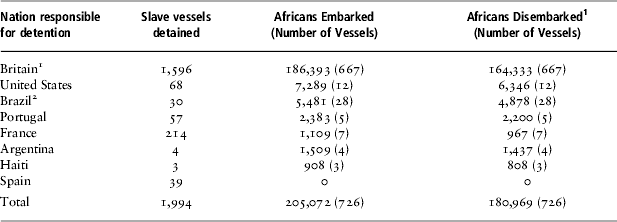
Table A.1 in the Appendix at the end of this article provides a summary of how Liberated Africans came into existence as well as a basis for assessing the effectiveness of efforts to suppress the slave trade. Column 1 counts all vessels captured after 1807 whether or not they had slaves on board at the time of detention.Footnote 2 Columns 2 and 3 count slaves, but include only those vessels that either had slaves on board at the time of detention, or whose slaves were taken into custody after landing. Column 2 estimates the number embarked, and column 3, those who survived long enough to be disembarked after capture. A comparison of columns 1 and 2 indicates that only one in three of the slave vessels that were intercepted actually carried slaves at the time of capture. We now know that about 9,000 separate ventures either carried slaves from Africa to the Americas or attempted to do so after 1807.Footnote 3 Of this 9,000, Table A.1 suggests that less than one-quarter were detained. And as 2.8 million enslaved Africans disembarked in the same period of whom just 181,000 became recaptives then we can say that the combined antislave trade squadrons of the Atlantic naval powers managed to divert only about six per cent of those carried off from Atlantic Africa.Footnote 4
The great majority of recaptives passed through administrative processes that formally documented their new status. The best known was adjudication in international courts (termed Courts of Mixed Commission) that resulted from a series of treaties between the British and five other nations (Spain, Brazil, United States, Portugal, and the Netherlands). Such courts were established at different times in Freetown (Sierra Leone), Luanda (Angola), Cape of Good Hope, Rio de Janeiro, Paramaribo (Surinam), Kingston (Jamaica), Havana, and New York. Together they condemned 567 vessels and declared 84,700 Africans liberated – close to half of all recaptives. The great majority of these – 66,600 – were registered by the various Mixed Commission Courts at Sierra Leone, with another 12,200 in Havana, 5,800 in Rio de Janeiro and 137 in Luanda.Footnote 5 None of the Mixed Courts in other locations actually freed any slaves. A slightly smaller group of 75,600 emerged into Liberated African status via British Admiralty Courts. These were strictly domestic tribunals that had jurisdiction over maritime matters. Almost every maritime nation had such institutions. In the UK they were called Vice-Admiralty courts with the High Court of Admiralty acting as the appellate court in London. Similar courts in the US liberated 6,346 people. Those of other nations liberated a further 8,000 Africans. Brazil (4,878) formed the core of this group, but Portuguese tribunals in Africa (2,000), and French courts (967) also contributed.Footnote 6 And historians have largely ignored the contribution of the new government of Haiti whose navy detained three slave ships between 1811 and 1819 containing 808 Africans. Finally, at least 2,400 other Africans should be included in the group even though they passed through no formal process – mostly as a result of surviving the wreck of their slave ships on islands in the British Caribbean while en route to Cuba.
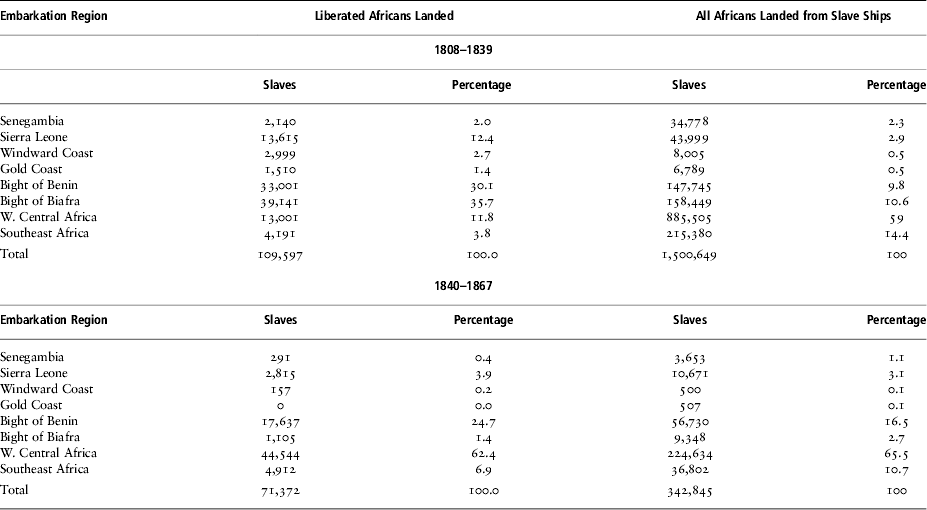
Where did Liberated Africans come from and where did they go? Redistributing the data in Table A.1 provides a preliminary answer to these questions and reveals several interesting patterns. First, how representative of the total slave trade was this group of 180,969? Table A.2 shows the coastal regions of embarkation for the recaptives, and compares their distribution with that of the whole 2.8 million deportees carried off from Africa after 1807. Because the coastal origins of slaves changed sharply over time, the Table presents two periods – before 1840 and after 1839. In the earlier of the two, when 62 per cent of recaptures occurred, an overwhelming proportion came from West Africa – mostly Sierra Leone, and the Bights of Benin and Biafra. After 1839, by contrast, an even larger proportion of the recaptives came from Africa south of the equator. In this second period they were much more representative of the mix of all people pulled into the slave trade. Portuguese refusal to ban all slave trading at once was the main reason for the shift in the coastal origins of recaptives. The Anglo-Portuguese treaty of 1815 meant that most of the traffic south of the equator remained legal until 1830 and therefore off-limits for the British navy. And not until the very end of the 1830s did the strength of the British antislave trade squadron south of the line match its northern counterpart. It is also significant that in 1839, Britain initiated major ground operations in West Africa in the form of a large raid on the slave factory at Lomboko, Sierra Leone.Footnote 7 Moreover this was also the year that Yoruba recaptives made the first voyage back to Badagry from Sierra Leone.Footnote 8 Slave traders thus increasingly found a more hospitable environment south of the equator.
Coastal region of embarkation tells us only a little about who the recaptives were, but we do not have to leave the question of origins there. The transatlantic slave trade was always dominated by a relatively small number of major embarkation locations. Except for Sierra Leone and the Windward Coast, slave vessels did not usually buy slaves from scattered points along a wide stretch of coastline. In the nineteenth century, this tendency toward geographic concentration became even more pronounced. Just two major ports dominated each of three of the four major coastal regions in Africa that embarked slaves – the Bight of Benin, the Bight of Biafra, and Upper Guinea. More than four out of five deportees leaving the Bight of Benin passed through Ouidah and Lagos. Nearly three-quarters leaving the Bight of Biafra left from Bonny and Old Calabar, and two thirds from Upper Guinea went through Gallinas and the Rio Pongo before 1840. The large West-Central Africa region had a somewhat less concentrated pattern of departures in the early period (1808–39), but Ambriz, Luanda, Benguela, the Congo River, and Cabinda accounted for two-thirds of departures over the whole period. Thus, from 1808 to 1839, there was a more than 50 per cent chance that a liberated African would have passed through Ouidah, Lagos, Bonny and Calabar – ranging over just three hundred miles of what is today Benin and Nigeria.
Beyond coastal geography, there is the question of the geographic profile of the origins of slaves in the interior. A database derived from the registers of liberated Africans kept by the Mixed Commission and Vice-Admiralty courts contains information on 92,230 individuals including African names for almost all of them and, in some cases, a designation for ‘country’. So far the identification of the ethnolinguistic associations of 33,000 of this group offers the prospect of outlining such a profile. Many of these names provide new details of links between origins and coastal points of departure.Footnote 9 Space constraints here dictate a very brief overview of our findings with the main presentation reserved for a separate paper. Naming patterns suggest that the vast majority of slaves came from within two hundred miles of the Western African coast. Kissi, Mandingo, Susu, Mende, Temne, Fula, and Sherbro made up more than 70 per cent carried off from the Gallinas and Rio Pongo.Footnote 10 Preliminary results indicate that 95 per cent of the 8,301 departures from the Bight of Benin ports of Ouidah and Lagos were Yoruba-speakers, a proportion well in excess of current estimates. Egba, Ijebu, and Oyo subgroups predominate with the area west of the two ports underrepresented. Further east the Igbo were equally dominant accounting for 88 per cent of the 8,410 so far identified as leaving Bonny and Old Calabar. This also is a higher ratio than the current literature supports.Footnote 11 For Luanda, Benguela, Ambriz, Cabinda, and the Congo River, the major points of departure for West Central Africa, the new material also challenges the prevailing scholarly consensus. While only about 3,000 recaptives can be traced to this huge region, an 1855 register of slaves and slave ownership in Angola is an important additional source. This new material suggests that the Lunda Empire in north-eastern Angola was probably much less important as a source of slaves in the nineteenth century than scholars have thought.Footnote 12 In fact, the great majority of recaptives appear to have originated north and south of Portuguese Angola, from among the Kimbundu, Kikongo, and Umbundu speaking people, rather than from the Lunda territory. This constitutes a shift from the pre-1830 picture drawn by Joseph Miller, where caravans of slaves marched from regions as distant as the Zambezi River.Footnote 13
The ultimate origins of the recaptives is important not just for African history, but for anyone interested in the influence of Africa on the Americas and in the making of the Atlantic world. Well over half, or 45,000 of the group for whom it is possible to trace African origins was on its way to Cuba at the time of their detention. Another 17,000 were heading for Salvador da Bahia, 10,000 to Rio de Janeiro, and 1,500 to the French Caribbean. There is no reason why the cultural backgrounds of these Africans should have been any different from the coerced migrants whose transatlantic voyage was not interrupted by a naval cruiser. Any conclusions that can be drawn from the pool of recaptives will hold for the larger group that completed the transatlantic voyage as intended.
Having sketched out the size and origins of the recaptive diaspora we should now track what subsequently happened to them. As Table A.1 shows many died before they reached Sierra Leone or St Helena, much less the Americas. Indeed the great majority of those on board captured vessels experienced a voyage that was little different in mortality and morbidity from those that were sold into the slave markets of Brazil, Cuba, or the French Caribbean. A voyage from, say, Bonny to Sierra Leone after capture could take almost as long as a voyage from Bonny to the eastern Caribbean.Footnote 14 Those surviving to be entered into the registers of Liberated Africans faced a wide range of possible fates, and in assessing outcomes we have to take into account the motivations of both judicial authorities and recaptives themselves.
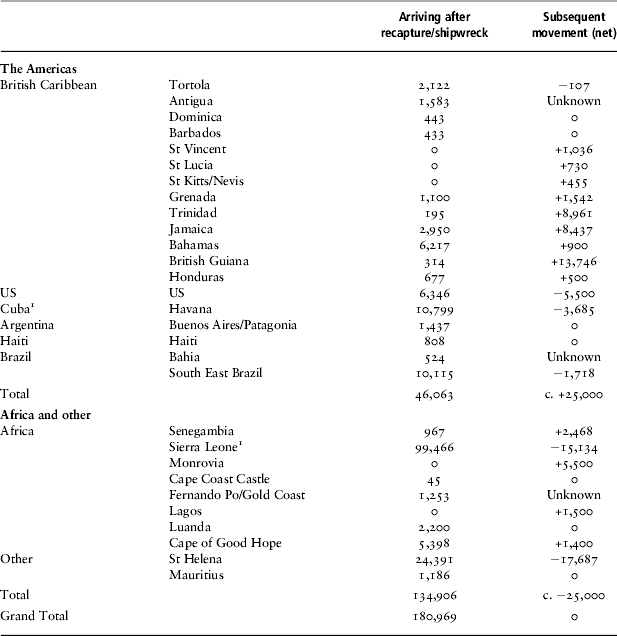
Table A.3 shows where the recaptives were taken after their vessels were intercepted. The Table breaks down the initial destinations of the recaptives into the two broad categories of first, the Americas, shown in the top half of the Table, and second, ‘Africa and other’ (in effect the Old World) in the lower half. The first column of numbers shows initial arrivals in each region while the second displays the subsequent relocation of the liberated Africans into (shown by a plus sign) and out of (shown by a minus sign) each region. But the second column certainly lacks the precision of the first. Where the cells are marked ‘unknown’ we can assume that movements either way would have been very small: there is no evidence of large movements of Liberated Africans out of Antigua, Bahia, or the Cape of Good Hope. One major exception to this statement, however, is Sierra Leone. Table A.3 shows 99,466 arriving in Freetown, and 15,134 leaving, but the latter figure is understated. Many of the recaptured Africans originated from the area surrounding the British colony and simply opted to return home. Until 1813, clerks in Sierra Leone kept annual lists headed ‘Alterations to the Register of Liberated Negroes’. For 77 cases they recorded ‘left the colony’ or ‘returned to his [or her] country’, and for a further 78 the entry is ‘runaway’. All but three of the first group and twenty of the runaways were native to Sierra Leone and the surrounding areas. More important are the missing unique registration numbers in the ‘Alterations’ lists. These are explained by a note at the end of the document, ‘[t]hose captured negroes that are not accounted for have deserted to native towns in the back parts of the country’.Footnote 15 Some Yoruba left Sierra Leone for Fula regions in an attempt to get back home, but the overwhelming share of the missing group were adults who had arrived on vessels captured as they left Gallinas, the Rio Pongo, and other embarkation points in and adjacent to Sierra Leone. Table A.2, column 1, indicates that 22,000 Liberated Africans had originally embarked in regions adjacent to Sierra Leone. If even half of this number opted to subsequently leave the colony then the 15,134 departures from Sierra Leone in Table A.3 should be increased to perhaps 26,000.
A comparison of upper and lower panels in Table A.3 indicates that almost three-quarters of recaptive Africans initially disembarked in sub-Saharan Africa (including St Helena), though usually far away from home base. Sierra Leone took in more than the rest of the Atlantic world combined, and of those carried to the Americas, most disembarked in the major plantation regions outside the US. Just as they had dominated the slave trade, British, Brazilian, and Spanish territories also received most of the Liberated Africans who initially landed in the Americas. This pattern becomes even more pronounced when we allow for the subsequent movement of recaptives after their disembarkation. Column 2 of Table A.3 shows that at least 25,000 did not remain in their first disembarkation region – in some cases voluntarily, and in some cases, not. There were three types of secondary movement: one, as already noted, resulted from recaptives attempting to go home, and flowed from Sierra Leone to other parts of Africa; a second essentially followed the path of the transatlantic slave trade and went from Sierra Leone and St Helena to the British Caribbean (including British Guiana); a third redistributed the recaptives from one part of the Americas to another, usually from Brazil and Cuba to again, the British West Indies.Footnote 16 Yet it needs to be stressed that even after making reasonable allowance for the unknowable number of Africans who left Sierra Leone to return to their African home, most Liberated Africans remained close to their initial landing site. Thus, Sierra Leone was easily the largest ultimate (as well as initial) destination of Liberated Africans. But the British Caribbean was easily the second largest. Adding initial arrivals and relocated individuals together, the British Caribbean received probably 55,000 recaptives (compared to a net influx into Sierra Leone of approximately 60,000).
Within the British Americas it is hardly surprising that the three largest sugar- producing colonies in the 1840s – Jamaica, British Guiana, and Trinidad – claimed over 80 per cent of the relocated recaptives. Agents for these colonies lobbied aggressively for immigrants in the aftermath of British abolition of slavery, especially after the premature expiry of the apprenticeship period in 1838. From 1840 to 1862 almost all 31,000 Liberated Africans who left St Helena and Sierra Leone (at least by sea) went to one of these three colonies. A further 5,000 entered Trinidad and British Guiana from Havana and Rio de Janeiro after negotiations between British, Spanish, and Brazilian governments. Breaking this pattern were the six thousand taken from west to east – from Key West, Florida, where in the late 1850s those detained by the US Navy were held after capture – to Liberia. Nine hundred came to the Bahamas from Cuba, and several hundred others were sent south to Patagonia from Buenos Aires in the late 1820s. Plantation agriculture can explain nothing of these last three cases.
LIBERATION AND VOLITION
How much volition there was in any of these movements is of central interest. More broadly, what was the status of Liberated Africans after they emerged from the legal process triggered by their interception? Just how ‘liberated’ were Liberated Africans? Scholars can point easily enough to examples of recaptives laboring for others in an apparently permanent slave-like dependence, as in Antigua, Tortola, or in Rio de Janeiro. At the other end of the spectrum were settlements or villages in which recaptives engaged in subsistence agriculture, mainly in Sierra Leone. Generalizations are indeed a challenge. Our analysis counterposes the expectations of those responsible for the detention of the slave vessels with the likely expectations of the Liberated Africans themselves. Africans who became recaptives, and Europeans trying to suppress the slave trade could agree that freedom meant the absence of slavery. Beyond this, however, there was no consensus on what terms of labor should replace slavery.
On the European side, section VII of the British Slave Trade Abolition Act required that recaptives either enlist in the armed forces or be bound ‘whether of full Age or not, as Apprentices, for any Term not exceeding Fourteen Years’. Further, this arrangement should have ‘the same Force and Effect as if the party thereby bound voluntarily so enlisted or entered [the apprenticeship]’. The Act also denied enlisted men a pension upon discharge, and in addition empowered the Government to establish ‘Regulations for the future Disposal and Support of such Negroes as shall have been bound Apprentices … after the term of their Apprenticeship shall have expired … as may prevent such Negroes from becoming at any Time chargeable’ to the public purse.Footnote 17 An Order in Council issued in March 1808 laid out the guidelines. Masters and mistresses should be ‘prudent and humane’ and should impart ‘trades, handicrafts or employment’ that would enable the apprentices ‘to gain their livelihood … when their apprenticeship should expire’.Footnote 18 Military Recruitment was to have priority, however, perhaps because the Act was passed in the middle of the Napoleonic Wars.
At a deeper level the motives behind section VII were the same as those behind the poor law, the truncated apprenticeship that followed slavery in British territories from 1834, and various devices such as head taxes and restrictions on land use that were to evolve in the non-settler parts of all European Empires in the nineteenth and twentieth centuries. Section VII was both harbinger of and a link between domestic and overseas policies toward labor. The intention in all cases was to extract more labor service from people than they would have been prepared to volunteer, even with higher wages but with as little as possible overt compulsion. By the early nineteenth century, British elites were convinced of the superiority of free labor. They wanted employers and a contented though subservient laboring population instead of slave owners and slaves, and an environment where fear of want had replaced dread of the lash.Footnote 19 An apprenticeship was viewed as a way of repairing perceived damage that slavery inflicted on the work ethic and thus it prepared the apprentice for wage earning. Slave owners, however, were more likely to see apprenticeship as a way of prolonging slavery.
Other countries followed the British lead. A Portuguese decree issued in 1818 in the aftermath of the Anglo-Portuguese slave trade abolition treaties adopted the above provisions, and while the 1831 Brazilian slave trade abolition act specified that all recaptives should return to Africa, this never in fact happened and there, too, most emancipados served out fourteen-year terms.Footnote 20 The US, as noted, went one step further and actually did dispatch more than five thousand to Monrovia. These were all on board vessels detained by US cruisers after 1819 – prior to which any Africans removed from a slave ship had usually been sold into the slave populations of the Southern States.Footnote 21 The Liberian stream comprised mainly children who were apprenticed out to American and Americo-Liberian families. The term of the apprenticeship varied from seven to fourteen years, with presumably age having a major influence on individual terms. A disproportionate share of the newcomers worked for and participated in church missions thanks to the US government subsidizing the indentures. This no doubt helps explain why US settlers in Liberia generally welcomed the new arrivals, but some of the new arrivals, ironically, ended up working in the small sugar cane sector that appeared briefly in mid-century Liberia. Finally the Argentine government assigned the status of ‘libertos’ to most of the nearly 1,500 recaptives removed from Brazilian slave vessels by Argentinian privateers between 1825 and 1828 – the slave trade having been abolished at independence in 1810. But libertos were also required to serve as ‘apprentices’ for ten years and were sold by the privateers at an open market.
It is difficult to know how the 181,000 Africans felt about any of this.Footnote 22 Ex-slaves in the US aspired to 40 acres and a mule, and their post-1838 counterparts in Jamaica, Trinidad, and Guiana quickly left the plantations to till their own smallholdings when the opportunity arose. The English working class was perhaps not much different given that Chartists in the 1840s organized a lottery, the winners of which would receive a small farm. And mid-century US workers viewed wage work as a step toward acquiring land in the west. Whereas today's migrants move to improve incomes, for long-distance voluntary migration in the early modern period gaining access to new land resources was paramount, or, put another way, access to conditions that might give the migrant more control over his or her own life. We might assume that the goals of Liberated Africans after violent removal from their native societies were not much different. Recaptive responses examined in more detail below make clear that many were unhappy with their new status, as well as the enslaved condition that they had recently left behind. It seems safe to say that there was nothing in the various slave trade abolition acts that met their aspirations with the single exception that for the most part they would not become chattel slaves and were provided with food and shelter for varying periods. The strength of this feeling was apparent in 1812 when six ‘natives of Africa’ on board the condemned slaver S Miguel Triunfante petitioned against being entered in the Liberated African register ‘having declared themselves freemen and never that they were slaves’. The court agreed and indeed they do not appear in the register.Footnote 23
Examining all the Liberated African data together establishes that which side of the Atlantic the recaptive disembarked had a major impact on African abilities to shape their post-disembarkation experiences. In the British Caribbean ‘liberation’ from a slave ship initially meant many years of unpaid labor. The main difference from slavery was that the status was not heritable, was usually time limited and females could not be employed in agriculture. Thus in Tortola and the Bahamas, a 14-year indenture was the norm (with some, mainly females, set at seven and ten in the Bahamas) until 1828, but thereafter shorter terms were still enforced for new arrivals down to 1860 – 27 years after the British abolished slavery. In Brazil, still under Portuguese jurisdiction when the first emancipados arrived in 1821, a decree modeled on the 1807 act complete with a 14-year apprenticeship term was still in effect.Footnote 24 However, the first Brazilian abolition law, of 7 November 1831, made no mention of a fixed term and simply required – like its US predecessor – that all slaves removed from slave ships be sent back to Africa. In fact this never happened. Instead, emancipados were informed of their status and then hired out – sometimes via public auction – to ‘private persons and public institutions’ without a term limit. It was eventually decided that those recaptured before the 1831 law were liberated after 14 years, but anyone who became a recaptive after the 1831 law was subject to permanent indentured servitude mostly on public works. Decrees of 1853 freed the minority of emancipados still working in the private sector with the rest receiving similar status in 1864, but by then both groups on average had worked as involuntary laborers far beyond 14 years.Footnote 25 As already noted, Cuban emancipados detained by the Spanish colonial authorities or handed over to the latter by the Mixed Commission Court in Havana fared even worse than slaves because they were not permitted access to Coartación – the right to purchase their own freedom. Of the 10,799 arrivals in Cuba shown in Table A.3, various captain-generals eventually freed just over 2,000 and the British removed a further 4,000 to mainly Trinidad between 1833 and 1849, but none of the remainder was liberated before 1870.Footnote 26 Freedom, however defined, was a remote prospect.
On the other side of the Atlantic, by contrast, the terms were much shorter. The first 167 recaptives taken into Sierra Leone were on board the Eliza and the Baltimore, US slave ships that the British captured in March 1808. The slaves were initially sold as ‘apprentices’ and down to 1811 they were advertised for resale in the Sierra Leone Gazette and African Herald. The documents do not indicate the length of indentures though we know that Zachary Macaulay, abolitionist and former governor, thought seven years was appropriate. A new governor, Thomas Perronet Thompson, who arrived after the detention of the first slave ships, declared such apprenticeship arrangements to be equivalent to slavery. He also claimed that abolitionists like Zachary Macaulay, James Stephen, and William Wilberforce who supported the apprenticeship plan were thereby guilty of sustaining slavery and the slave trade. Thompson canceled the indentures and the recaptives showed up in the registers for the first time in 1809.Footnote 27 Yet Thompson and his successors attempted to regularize the institution rather than abolish it. They set the length of an apprenticeship according to age, in a parallel to the treatment of wards of the parish under the English poor law. The disposal column of the Sierra Leone-based registers for the first 1,991 recaptives landed at Freetown has information for 581 individuals that apparently survived on a random basis. In addition, down to 1814 the colonial authorities kept an annual ‘Alterations’ list intended to record changes in status. Combining these sources makes it possible to extract some information on what happened to 1,731 of the first 4,207 recaptives processed by the Freetown Vice-Admiralty court.Footnote 28 Not all of these recaptives were apprenticed, but for those who were, the registers record the term of service for 393 individuals. The clerks estimated just under half of these (176) to be adults (15 years of age and older) and this group was apprenticed for a mean of 3.04 years. No recaptive over 17 was assigned a term of more than three years. The remaining 217, all under 15 years of age, received longer terms ranging indeed, up to the 14 years specified in the abolition act. Age and term were thus inversely related, with five year-olds averaging 13-year apprenticeships and 14 year-olds averaging 3.7 years and so on.Footnote 29
They may have disagreed on the terms and conditions, but both abolitionists and their critics, such as Thompson and Justice Robert Thorpe, wanted the Sierra Leone recaptives to serve a term of indentured servitude, and of course the British West India regiments needed recruits. Nevertheless the preferences of recaptives together with the Sierra Leone environment prevented the full implementation of the apprenticeship system. Not only was the indenture term shorter than what the British elite thought desirable, but the great majority of women were not subject to any apprenticeship. Reflecting European constructions of gender, the 1808 Order in Council stated, ‘they (women) are not to be employed … in the labours of Agriculture’, but the disposal column describes three-quarters of them prior to 1814 as ‘Living with a Liberated African’, ‘settled in the colony’, ‘settled in the mountains’, or ‘living with her countrymen’. The person or village is often identified.Footnote 30 Among 453 men for whom information survives at the end of 1811, 106 were enlisted in the Royal African Corps or Royal Navy, 134 were ‘laborers’ and 122 were still under apprenticeship (all of them arriving in 1809–11). Only three were tradesmen and most of the remainder were described as ‘living in the colony’. More important, for most years between 1814 and the beginning of coerced migration from Sierra Leone and St Helena to the British sugar colonies a quarter century later, the great majority of both men and women appear to have gone direct from the Liberated African yard to a recaptive village. The 1818 census summary enumerated 6,406 Liberated Africans (excluding enlisted men), but only 9 per cent were apprenticed, all but 103 of this group being children. Two years later the apprentice ratio had fallen below 8 per cent, again almost all children. By this time even most of the children were distributed across the recaptive villages. Despite the grand intentions of the 1807 Act, the 1808 Order in Council, and the stated motives of the abolitionists, apprenticeship for adults was rare.
The contrast with the experiences of the first Africans ‘liberated’ in the Americas (Tortola, Bahamas) is striking. While the imperial legislation applied to both sides of the Atlantic – section VII specified a maximum term, but no minimum – the lack of an export economy and the availability of land for settlement in Sierra Leone ensured that recaptives exercised options that did not exist in the Americas. The initial three-year term and then the dropping of even this requirement for adults on the African side recognized this reality. In the plantation Americas the demand for labor and the wariness of the slave-owning elite toward free blacks dictated that liberty for recaptives was more severely curtailed and in some cases barely perceptible.
Forced recruitment for the army in Sierra Leone continued. The 1808 Order in Council stated that the armed forces had first refusal on able-bodied men, and the most common single disposal label until 1815 was ‘enlisted’ in the armed forces – usually in the eight West India regiments that until 1807 had ‘recruited’ mainly slaves.Footnote 31 Of the grand total of 7,833 recaptives arriving in Freetown before 1816 (when the Bance Island recruiting station closed), 2,211 were drafted into the armed forces, including over 100 women and girls.Footnote 32 It seems that in this period most men under thirty were enlisted. Choice was no more an option in recaptive recruitment than it was for seamen impressed until 1812 by the Royal Navy. Recruits served in the West Indies, received pay, and, upon discharge after the Napoleonic wars did in fact receive pensions despite the terms of abolition act. Some took up the option of returning to Sierra Leone where they founded the villages of Waterloo, Gibraltar Town, and Wellington. Recruiting at a reduced level continued into peacetime, however. In the 1840s, an average of 150 a year were enlisted and if this was typical for the whole 1816–40 period then the total number enlisted over the whole Liberated African era included could have reached 12,000 for the army alone in Sierra Leone with a few thousand others serving on naval vessels. An unknown number, but many hundreds, entered the West India regiments from among those liberated in West Indies.Footnote 33
From 1816, almost all Liberated Africans were being sent to villages outside Freetown or into the mountains regardless of age and with no attempt to restrict their activities. As John Peterson describes it, settlement in villages began in late 1808 to accommodate those who were neither enlisted nor apprenticed. Three (Wilberforce, Leicester, and Regent), were in existence by early 1815, but with the sharp reduction in enlistment and the collapse of apprenticeship there were twenty by 1820. Other than government-supplied provisions these communities functioned independently of official supervision and, until 1816, imperial approval.Footnote 34 In July 1820, 846 recaptives were living in villages that received no government support and this number increased rapidly thereafter. Neither the 1807 Act nor the 1808 Order-in-Council provided for (or even anticipated) such an African-based response to abolition of the slave trade, particularly the exodus home. Although soil fertility was poor and some abolitionist observers by 1840 were scathing most villages became self-sufficient, developed a degree of ethnolinguistic homogeneity, and offered low probabilities of re-enslavement.Footnote 35
As Table A.2 shows, more than four out of five recaptives originated in regions far removed from where their vessel was taken after capture. For most, the possibility of returning to their homeland was indeed faint. Given that, as one Sierra Leone observer wrote, ‘Liberated Africans have no desire to leave their native soil’, it was not just apprenticeship and forced recruitment that constrained their options.Footnote 36 New communities in a strange land comprised a distant second-best choice for most recaptives. Settlers did, however, gravitate toward or create villages in which people were most like themselves. Such a pattern was facilitated by the fact that new villages often resulted from a sudden inflow of people who had voyaged on the same slave vessel, and that slave vessels at this time rarely embarked slaves at more than one location. Indeed the Church Missionary Society encouraged recaptives to form homogeneous parishes or towns and Africans from captured vessels were more likely to be kept together in the aftermath of liberation. By contrast, slaves sold from a slave vessel that completed its journey to the plantation Americas were typically dispersed across the region and faced assimilation into largely African-American communities. There must have been many more ‘shipmate’ connections established and maintained among recaptives on both sides of the Atlantic than among those not recaptured. Also 80 per cent of the slave vessels that disembarked in Sierra Leone had arrived by 1845 and it follows from Table A.2 that three-fifths of these village settlements must have had heavily Yoruba or Igbo components. It is rather surprising that while Sierra Leone has received a share of Africanists’ attentions disproportionate to its size and population, scholarship on the creation and evolution of such communities is still in its infancy. Scholars of the diaspora have largely chosen to work on migration to the Americas rather than within Africa.Footnote 37 Liberated African settlements in the Bahamas and Trinidad tended to supplement the colonial plantation economies and, like Africans elsewhere in the Americas, quickly ‘went about the process of inventing functional African-Caribbean cultures’.Footnote 38 Their counterparts in Sierra Leone were more independent and self-contained both culturally and economically.
The major problem for the Sierra Leone settlers was the low laboring wages in a colony that exported small amounts of camwood and palm oil and yet had an average of 2,000 people a year added to its labor force in the 1830s and 1840s.Footnote 39 A sugar plantation colony, Sierra Leone was not. Despite low wages and exile it is possible that of all the Liberated African options around the two Atlantic basins, the communities that formed in Freetown's hinterland came closer to meeting the aspirations of the recaptives themselves (as opposed to what abolitionists, planters, and imperial governments wished them to aspire to). Recaptive villagers in Sierra Leone had some volition.Footnote 40 They could leave the colony, look for waged work, enlist, participate in petty trade (in several cases, like John Ezzidio's, not so petty), or live on subsistence land. In the early 1840s, the additional option of emigrating to Jamaica, British Guiana, or Trinidad in return for a one-year indenture emerged as ex-slaves in the Caribbean abandoned the plantations to which they had been tied and the British briefly attempted to generate free migration from Africa. A further incentive for recaptives was the offer of a free return passage after a stay of five years. When this proved insufficient in the face of ill reports of the new environment, free migration virtually ended.
The experience of the Sierra Leone settlers should be seen as similar to other attempts of the tropical plantation colonies to attract transatlantic migrants as slavery came to an end. By 1860 over 28,000 Madeirans had entered British Guiana, 3,800 British and Germans settled in Jamaica, and 2,500 Kru migrated from the Windward Coast to mainly British and French Guiana, all for terms ranging from one to five years. The Spanish had some initial success in attracting Canary Islanders to Cuba. But here as elsewhere in the Caribbean migration peaked before 1850 and African and European migrants alike, facing identical terms of labor, moved away from fieldwork on plantations at the earliest opportunity.Footnote 41 Broadly, European laborers’ unwillingness to perform waged work in the sugar fields after the mid-1600s helped underpin the transatlantic slave trade to the French and British colonies. And in the mid-1800s, when slavery was no longer permitted, the refusal of Europeans and Africans to migrate voluntarily to the sugar colonies triggered seventy years of contract labor that saw a million people leave India and China.Footnote 42 Before the twentieth century, it was never possible to grow sugar commercially in the Americas without either slave labor or contract labor enforced by criminal sanctions.
As voluntary transatlantic migration dried up the British reinstituted a racially based coercive migration strategy. They revived their compulsory assignment policy of the early Freetown era and began dispatching newly arrived recaptives directly to the Caribbean. Negative incentives were employed in the form of cutting off provisions to those who refused to go. Between 1842 and 1863, more than 30,000 were sent to the major British West Indian sugar colonies from Sierra Leone, St Helena and Rio de Janeiro. All of it was involuntary.Footnote 43 British officials made the decision – often before the recaptives stepped off the slave vessel. This phase of transatlantic migration has been termed the new slave trade, and there was indeed little difference, prima facie, between British procedures and the French practice between 1848 and 1861 of buying slaves on the African coast and selling them as contract laborers in Reunion and the French Caribbean.Footnote 44 Offsetting this to some extent was the option of changing employer in the Caribbean and the extension of the offer of free return passage after five years. While this was frequently not honored, several hundred did return to Sierra Leone (not shown in Table A.3).Footnote 45 No such offer was available in St Helena where perhaps 95 per cent of the surviving recaptives relocated across the Atlantic. The cool climate, lack of arable land, and relatively high death rate on the island make it unlikely that many Africans would have chosen to remain even if given the opportunity.Footnote 46 With a base pool of arrivals only one quarter the size of that in Sierra Leone, St Helena dispatched approximately the same numbers to the Caribbean and 1,400 in addition to the Cape of Good Hope.
Children, too, were caught up in this process. According to the court registers those under the age of 15 made up over a third of the inflow to Sierra Leone and more than half of those taken to Liberia under the US flag. Initially apprenticed in and around Freetown, children were sent to the growing number of villages after 1815.Footnote 47 By January 1819, 2,104 were attending school and for more than two decades thereafter almost all would have received some formal education.Footnote 48 There is no evidence that children were sent out of the colony until the voluntary phase of migration to the West Indies began in the early 1840s, at which point some ‘recruitment’ took place in the schools. When voluntary migration withered and recaptives were dispatched to the Caribbean direct from the Liberated African yard, children as well as adults were included. This pattern held through to 1848 when information on disposal ends. In St Helena formal education appears not have existed and obviously the question of volition cannot have arisen. For children, though not for adults (except convict transportation) there are again parallels to be found in the rest of the Atlantic. The government dispatched 160,000 British orphans to the Americas, South Africa, and Australasia between the early seventeenth and second half of the twentieth centuries without obtaining their consent.Footnote 49
For Africans liberated in the Americas, the terms of labor improved slowly. Very few learned skills and, if they remained with the employer long enough to complete their indenture, they became unskilled laborers or domestic help.Footnote 50 In the first few years after 1807, the registers of Liberated Africans in Tortola, as in Freetown, specify the occupation of the master. Carpenter, sawyer, mason, fisherman, sailor, yeoman, and domestic are most commonly specified. But commissioners sent out first to Tortola and later to Antigua and the Bahamas between 1821 and 1827 found the great majority of ‘apprentices’ to be unskilled. The British government canceled all existing apprenticeships in 1828 and for several years they required only one-year terms for Liberated African migrants.Footnote 51 But they also arranged that as many as possible were taken to the major sugar-producing colonies where their very presence increased the supply of labor, lowered wages, and reduced the costs of planters. Trinidad, British Guiana, Grenada, and Jamaica, it should be noted, still produced 40 per cent of the total sugar output of Cuba in 1860, though by then the labor force was becoming Asian, at least in Trinidad and British Guiana. At mid-century, the situation worsened in the Americas as well as Africa. The Heroina was the last slave ship to wreck in the Bahamas – in 1860 – and yielded 389 survivors. Adults were made to serve five-year terms, children six, and most went to employers in Nassau. In the following year the British Colonial Office approved Trinidad legislation imposing a three-year term for newly arrived adult recaptives despite the fact that since 1849 only children had been apprenticed.Footnote 52 We have found no record of schooling of any kind for Liberated Africans in any British West Indian colony with the exception of a handful in Jamaica apprenticed to the Basel mission, one of whom was Catherine Zimmerman Mulgrave.Footnote 53
CONCLUSION
In summary, of the nearly 100,000 recaptives brought into Freetown, it is likely that substantially more than half settled in Sierra Leone or returned to the societies from which their forced migration had begun, mostly the former.Footnote 54 In St Helena as we have seen all but a handful were moved to plantation colonies, but for a time, both here and in Sierra Leone, enough stayed behind that they comprised by far the largest ratio of Liberated Africans to host populations of any society in the Atlantic world after 1808. Overall, relatively few went to the West Indies either voluntarily or involuntarily. The bottom half of Table A.3 suggests less than one quarter of the 135,000 total disembarking in the Old World moved to the Americas. Sierra Leone offered land for communities and some prospect of returning to their West African homelands. Whatever their motives, recaptives exercised a degree of choice in opposition to the preferences of a British colonial system that wanted all recaptives serving out long indentures in Caribbean cane fields. In the Americas about 11,000 or one-quarter of Liberated African arrivals were moved to the British sugar colonies, again largely without having had any input on the decision. But the rest remained in the regions in which they disembarked despite planter hostility and those in Tortola and the Bahamas were able to resist pressures to relocate in Trinidad.Footnote 55 In total the British had some control over the fates of 156,000 of the 181,000 landed recaptives shown in column 3 of Table A.3, yet less than one-third of these (46,500) ever worked in the British Caribbean export sector. If British policy was to get labor for the sugar colonies as some have argued, it was not very successful, in part because many Africans were able to resist.Footnote 56
Villages and subsistence lands in the Freetown hinterland notwithstanding, the great majority of Africans liberated from slave ships were pulled at least partially into the Atlantic wage economy. The people summarized in column 2 of Table A.3 were certainly in this category. ‘Working for others’ after dispatch to the Caribbean meant abiding by severe vagrancy laws that had no counterpart in any African society. Other recaptives who can be unequivocally identified as working for others – in this case without wages – were the 11,000 or so Africans liberated in Brazil, but who were not subsequently relocated to the British Caribbean. Mixed Commission Court emancipados in Cuba who were not removed to British colonies spent years in slave-like conditions, usually on a sugar plantation. Except for a few communities in the Bahamas, all those grouped in the upper half of Table A.3 – those who first disembarked in the Americas in column 1 and those who moved there in column 2 – became waged laborers. The Cape of Good Hope and Mauritius groups in the second half of the Table should be added to this group and an unknown but large share of Sierra Leone village residents would have entered the waged labor market, sporadically perhaps, for the first time in their lives. There is a vibrant literature on African reconstructions of religion, family, language, and identity in various diasporic environments, but very little on the central issue of African responses to first engagement with an Atlantic labor market. Liberated Africans may be used as a surrogate or sample for the large numbers of enslaved Africans that were not intercepted, but perhaps more important is the range of the terms of labor that they experienced – the ‘degrees of freedom’ that were possible. Liberated Africans were to be found in every category that historians have defined as falling between full chattel slavery at one end of the spectrum and a wage-free full personal freedom at the other. Historians interested in this topic have almost always first chosen a society in which slavery was abolished and then tried to follow the path of individuals who moved from slave status to some non-slave status in the aftermath of abolition.Footnote 57 The 181,000 Liberated Africans by contrast offer the prospect of a different approach. These individuals entered just about every slave society in the Americas between 1808 and 1866 – and many lived right through the suppression not only of the slave trade but slavery itself in the Americas.
APPENDIX
About 172,000, or 95 per cent, of all post-1807 recaptives were removed from slave ships by naval vessels charged with suppressing the slave trade. For most of these see STDB, (http://slavevoyages.org/tast/database/search.faces?yearFrom=1808&yearTo=1866&fate=10.11.12.13.14.15.16.17.18.19.20.21.22.23.24.25.26.45.46.47.50.51.52.53.54.102.103.104.106.108.109.110.111.112.113.114.118.120.121.122.123.124.125.126.127.128.130.132.134.135.136.138.141.142.144.148.149.154.155.156.159.160.161.162.163.164.165.166.171.172.173.174.176.177.178.179.180.181.182.183.184.185.194.198.201.202.211), new edition, forthcoming 2014. The remainder of the 172,000 were on board 16 vessels that were sailing to São Tomé or Principé at the time of capture, or were picked up on land before embarkation in Africa or after disembarkation in the Americas. For this article we have excluded several hundred recaptives taken by French Caribbean authorities prior to 1831, a further 1,200 carried into the Southern United States between 1807 and 1819, and the 15,000 or so taken into custody by the Cuban government after 1835, all on the assumption that their subsequent lives would have been little different from that of slaves. For Cuban emancipados, see I. R. de Montaud, ‘En los borrosos confines de la libertad: el caso de los negros emancipados en Cuba, 1817–1870’, Revista de Indias, 71:251 (2011), 159–92, which views emancipados as similar to slaves. David Murray stated that ‘their fate was mocked by their very name and their tragedy certainly approximated that of Africans who were not liberated from slave ships’, in Odious Commerce, 297. Recaptives taken into custody in Brazil on the other hand are included because almost all were kept out of the hands of plantation owners. See D. Williams, The Broken Paths of Freedom: A Spatial History of Free Africans in Nineteenth-Century Brazilian Slave Society (forthcoming). We have also excluded the slaves purchased by the French on the African coast and delivered as ‘contract laborers’ to Reunion and the French Caribbean between 1848 and 1861 as well as Dutch purchases of slaves from the Asante for military service in the East Indies. In both cases Africans were eventually liberated after several years of compulsory service and an argument could be made for including both groups. For the French case, see notes 39 and 40 above, and for the Dutch see most recently G. Austin, J. Baten, and B. Van Leeuwen, ‘The biological standard of living in early nineteenth-century West Africa: new anthropometric evidence for northern Ghana and Burkina Faso’, Economic History Review, 65:4 (2013), 1280–1302.
Africans and Vessels Detained in the Atlantic Slave Trade, 1800–67, by Flag of the Capturing Nation (number of vessels with slaves on board). Notes: 1The phrase ‘disembarked’ includes recaptives who were on board captured slave vessels when the latter arrived at the port of adjudication. It also includes six slave vessels that were shipwrecked on British territory, but for which no legal proceedings have been found, 16 vessels engaged in the intra-African slave trade to Sao Tome and Ile Principe, and 67 cases of Africans removed from canoes and slave barracoons along the African coast. Neither the intra-African slave traders, nor the in-shore captures, comprising 3,550 recaptives, are included in STDB, (www.slavevoyages.org). 2 Includes Africans recaptured on land after disembarking from the slave vessel. Source: Liberated Africans spreadsheet available from D. Eltis; B. Mamigonian, ‘To be a Liberated African’, 280 and 283.
African Coastal Regions of Embarkation of Liberated Africans Compared to those of all Slaves, two periods, 1808–67. Source: Columns 2 and 3 are derived from the link provided in the Appendix above; columns 3 and 4 are derived from the STDB, (http://slavevoyages.org/tast/assessment/estimates.faces?yearFrom=1808&yearTo=1866), new edition, forthcoming 2014.

Regions of Disembarkation of Liberated Africans: Initial Point of Arrival Compared to Ultimate Destinations, 1800–67. Note: 1 Arrivals in Cuba and Sierra Leone are the number disembarked wherever possible. Such numbers were usually greater than those surviving long enough to be entered in the registers of the Mixed Commission Courts and the British Vice-Admiralty Courts. In the case of Havana, some condemned vessels had disembarked slaves prior to capture and therefore not all those on board became emancipados. Source: Column 4: J. H. Kopytoff, Preface, 61; Adderley, ‘New Negroes’, 241–8; Asiegbu, Slavery, 189; Murray, Odious Commerce, 271–97; G. W. Roberts and J. Byrne, ‘Summary statistics on indenture and associated migration affecting the West Indies, 1834–1918’, Population Studies, 20:1 (1966), 125–34.