




Non-technical Summary
We describe a new collection of two types of rare echinoderms called paracrinoids from reef facies in the Ordovician (approximately 450 million years ago) Kimmswick Limestone of Missouri. Both genera, Implicaticystis and Wellerocystis, were previously known from a handful of specimens that were poorly preserved and crudely prepared so that several important morphological features remained unknown. In contrast, the new material is much better preserved and has been carefully prepared using an airbrasive machine with the softest powder. As a result, we have been able to identify key morphological features such as the gonopore and hydropore for the first time and use this new information to comment on the classification and origin of paracrinoids in general. Paracrinoids have previously been classified using either the presence of erect or recumbent feeding structures, or by the presence or absence of respiratory structures. We argue that both erect and recumbent feeding structures are known to occur together in several other groups of early echinoderms and evolved repeatedly. The crinoid Hybocystites has both in the same individual. In contrast, Implicaticystis and its relatives have unique thecal plates with concave external surfaces, internal buttresses, and unique pore structures unknown in any other type of echinoderm. Hence, it is preferable to use the presence or absence of these pore-structures in classification. We also suggest that the sister group of paracrinoids could have included eocrinoids such as Columbocystis, rhipidocystids, and cryptocrinitids.
Introduction
The Kimmswick Formation (Upper Ordovician, Sandbian–Katian) of east-central Missouri contains small reef-like buildups within dominant massive grainstone facies. The reef facies preserved a community of encrusting stromatoporoids, bryozoans, tabulate and rugose corals, as well as a diverse echinoderm fauna (Wittmer et al., Reference Wittmer, Guensburg, Stock, Darrough and Brett2017). It was formerly well exposed in a road cut on highway MO-21 near Shady Valley, Missouri, south of St. Louis, in Rock Township, Jefferson County (Wittmer et al., Reference Wittmer, Brett, Chiarello, Guensburg, Darrough and Stock2023). Here we report on two of several paracrinoids in this fauna; those that are exceptionally well-preserved specimens add significantly to our knowledge of the genera involved.
Wellerocystis was first described by Foerste, Reference Foerste1920, on two specimens, also from Jefferson County, Missouri. The genus is monotypic and both of Foerste’s specimens are weathered, obscuring important characters. When North American paracrinoids were reviewed the genus was still known from only three specimens and neither gonopore, hydropore, nor any appendage morphology had been identified (Parsley and Mintz, Reference Parsley and Mintz1975, p. 93). Here we describe 18 additional partial thecae, all from a single exposure, that add new anatomical information for this taxon.
A second, co-occurring paracrinoid, Implicaticystis Frest and Strimple, Reference Frest and Strimple1982, is better known and more diverse but again certain informative characters were unknown. Frest and Strimple (Reference Frest and Strimple1982) described the type species, I. symmetricus, and transferred Comarocystites shumardi Meek and Worthen, Reference Meek and Worthen1865, to the then new genus. They also attributed some isolated plates from the Starfish Bed, Threave Glen, Girvan, Scotland to Implicaticystis. The type species was known from five thecae and I. shumardi from six. The additional three specimens of I. symmetricus described here preserve parts of the stem and feeding structures as well as anal cover plates.
The most recent review of the paracrinoids (Limbeck et al., Reference Limbeck, Bauer, Deline and Sumrall2024) implemented quantitative methodologies to investigate morphological disparity and phylogenetic relationships within the Paracrinoidea. Wellerocystis proved particularly difficult to place in their phylogenetic scheme based on the available less-complete dataset. We hope that the additional morphological information provided here helps solve that particular problem.
Traditional taxonomic division of the Class Paracrinoidea previously has been based on two rival ideas. Kesling (Reference Kesling and Moore1968) used the structure of the feeding organs. Paracrinoids with erect ambulacra were attributed to the Brachiata Jaekel, Reference Jaekel1900; those without to the Varicata Jaekel, Reference Jaekel1900. In contrast, Parsley and Mintz (Reference Parsley and Mintz1975) used the presence or absence of respiratory pore structures to subdivide the class into two orders: the Comarocystitida (with pores) and the Platycystitida (without pores). Implicaticystis is a comarocystitid and we are able to add new information about the functioning of its pore structures. Pending additional quantitative treatment, similar oral frame plating, ambulacral morphology, and the lack of thecal pores suggest to us that Wellerocystis branches near Platycystites Miller, Reference Miller1889, in paracrinoid phylogeny.
Finally, Limbeck et al.’s (Reference Limbeck, Bauer, Deline and Sumrall2024) review did not investigate the sister relationships of the Paracrinoidea, which are by no means clear. Our findings here and experience working with early echinoderms in general suggests Columbocystis Bassler, Reference Bassler1950, rhipidocystids, and cryptocrinitids, be included in such an analysis.
Geologic setting, preservation and taphonomy
Stratigraphic context
The Kimmswick Limestone is the uppermost unit of the Galena Group (Upper Ordovician, Sandbian–lower Katian) and accumulated in a shallow subtropical sea. The former exposure of the reef facies, from which all our material came, was described and analyzed in detail by Wittmer et al. (Reference Wittmer, Brett, Chiarello, Guensburg, Darrough and Stock2023). Basically, the stabilization of sediment by encrusting stromatoporoids within the reefs provided an ideal environment for directly attached and cryptic echinoderms, including the paracrinoids described here. Full details are in Wittmer et al. (Reference Wittmer, Brett, Chiarello, Guensburg, Darrough and Stock2023).
Preservation and taphonomy
Those of us who have prospected for fossil echinoderms commonly locate material by concentrating efforts on bedding surfaces or within certain beds. Productive argillaceous matrices often separate carbonate and siliciclastic matrices. Specimens preserved in this way are often amenable to preparation. This is not the case for the nearly pure carbonate Kimmswick Limestone, where echinoderms are collected along weathered joint faces perpendicular to bedding. Since the Kimmswick is nearly flat lying in the study area, joints tend to be vertical. Kimmswick echinoderms generally provide what might be called ‘what you see is what you get’ occurrences. These circumstances present unusual consequences for understanding Kimmswick preservation. Kimmswick echinoderms typically project, stand proud, from vertical joint surface topography. They are exposed by the same slow dissolution weathering that created the joints themselves. The reason for this differential weathering is apparently related to low-solubility, high-magnesium content of echinoderm stereom. Most other skeletal components in the Kimmswick (stromatoporoids, brachiopods, bryozoans, rugose corals) are more soluble low-magnesium calcite. Unlike echinoderms exposed in the aforementioned soft siliciclastic or argillaceous matrices, little preparation is possible for Kimmswick echinoderms.
Evidence (see Wittmer et al., Reference Wittmer, Brett, Chiarello, Guensburg, Darrough and Stock2023) indicates a shallow high energy environment for deposition of the Kimmswick. Consequently, sturdy elements, such as paracrinoid thecae, predominate Kimmswick echinoderm finds.
Locality information
The Shady Valley location occurs along a narrow strip of exposure at 38.4110671, −90.4931415 on the Shady Valley exit ramp off MO-21 North, south of the city of St. Louis.
Materials and methods
All specimens were collected from the above exposure by GD and prepared carefully using an airbrasive machine with the softest powder. For photography, specimens were coated with NH4Cl sublimate. Most photographs were taken with an Olympus Tough TG6 camera using the ‘microscope mode’ which automatically takes up to eight stacked photographs at different focal lengths. Stereophotographs were taken with a Nikon Coolpix camera and a Kyowa binocular microscope. Line drawings of plate arrangements were produced directly from photographs.
Terminology follows Parsley and Mintz (Reference Parsley and Mintz1975), with the exception of ambulacral (axial) morphology, where the prefix ‘pseudo’ precedes arm, brachial, and pinnule, reflecting evidence that these blastozoan anatomies are not homologous with terminology applied to crinoids (see Guensburg et al., Reference Guensburg, Sprinkle, Mooi and Lefebvre2021).
Repositories and institutional abbreviations
All specimens described here are conserved in the Field Museum, Chicago, IL, USA (FMNH). The holotype and other comparative specimens of Wellerocystis are deposited in the United States National Museum of Natural History, Smithsonian Institution, Washington, DC, USA (USNM). The type set of Implicaticystis symmetricus Frest and Strimple, 1978, is in the Department of Geology, University of Iowa (SUI).
Systematic paleontology
Class Paracrinoidea Regnéll, Reference Regnéll1945
Family Malocystitidae Neumayr, Reference Neumayr1889
Diagnosis
Paracrinoids lacking pore-structures, with recumbent ambulacra.
Remarks
Since its first description, Wellerocystis has been associated with Malocystites Billings, Reference Billings1857. Both genera are characterized by imperforate thecal plates and ambulacra extending over the thecal surface. In Malocystites the terminal pseudopinnules were recumbent on the thecal surface. In Wellerocystis pseudopinnules were erect and the first pseudopinnular plates are preserved on three specimens described below.
Genus Wellerocystis Foerste, Reference Foerste1920
Type species
Wellerocystis kimmswickensis Foerste, Reference Foerste1920, by original designation (Foerste, Reference Foerste1920, p. 36).
Other species
None; the genus is monotypic.
Diagnosis
Malocystitids with two primary ambulacra each with up to three branches all giving rise to erect pseudopinnules.
Occurrence
Upper Ordovician (Sandbian–Katian), Missouri, USA.
Wellerocystis kimmswickensis Foerste, Reference Foerste1920
Wellerocystis kimmswickensis Foerste, Reference Foerste1920, Kimmswick Limestone, Missouri, USA. (1–6) FMNH PE93484. (1) Oral, (2) basal, (3–6) posterior, right, left, and anterior lateral views, respectively, of complete theca showing four ambulacral branches, small mouth, and larger anus (1), raised ambulacral ridges (4–6) composed of uniserial ambulacral plates (5), surface scars where ambulacra are missing (4–6), and lumen beneath ambulacral plates (1) that connect to the thecal interior near the peristome, circular stem facet (2), and relatively large thecal plates (3–6). Note food groove in ambulacra (1, 4). Theca coated with ammonium chloride; scale bars = 5 mm.

Holotype
FMNH UC10727.
Diagnosis
As for genus, which is monotypic.
Occurrence
Kimmswick Limestone (Upper Ordovician, Sandbian–Katian) reef facies, roadcut off Highway 21 on east side of northbound exit ramp to Shady Valley, Jefferson County, Missouri, USA.
Description
Stem unknown, but circular judging from the aboral facet (Figs. 1.2, 2.8). Stem facet up to 4 mm across in FMNH PE93476 and FMNH PE93482, thecae 19 and 25 mm across, respectively, and shared by three basal plates.
Wellerocystis kimmswickensis Foerste, Reference Foerste1920, Kimmswick Limestone, Missouri, USA. (1) FMNH PE93483 showing anal pyramid; (2, 6) FMNH PE93471, a small globular theca showing fine granular ornament, (6) detail of granules; (3–5) FMNH PE93473 showing lumen beneath E ambulacrum with J-shaped lateral tube (3 above right) leading to interpseudobrachial pores, three of which show adjacent to pseudopinnular facets (5); note lumen connects with internal cavity of the theca (3 below left). (7) FMNH PE93470 showing two ambulacral branches on either side of the anus: the left preserves the first pseudopinnular and the right the main, proximalmost, food groove. (8) Aboral view of FMNH PE93476, showing the circular stem facet with small lumen. (9) Oblique oral view of FMNH PE93472, showing three of the four ambulacral branches with main food grooves and lateral side branches to poorly preserved facets. Scale bars = 5 mm, except for (4, 5) = 1 mm and (6, 9) = 2 mm.
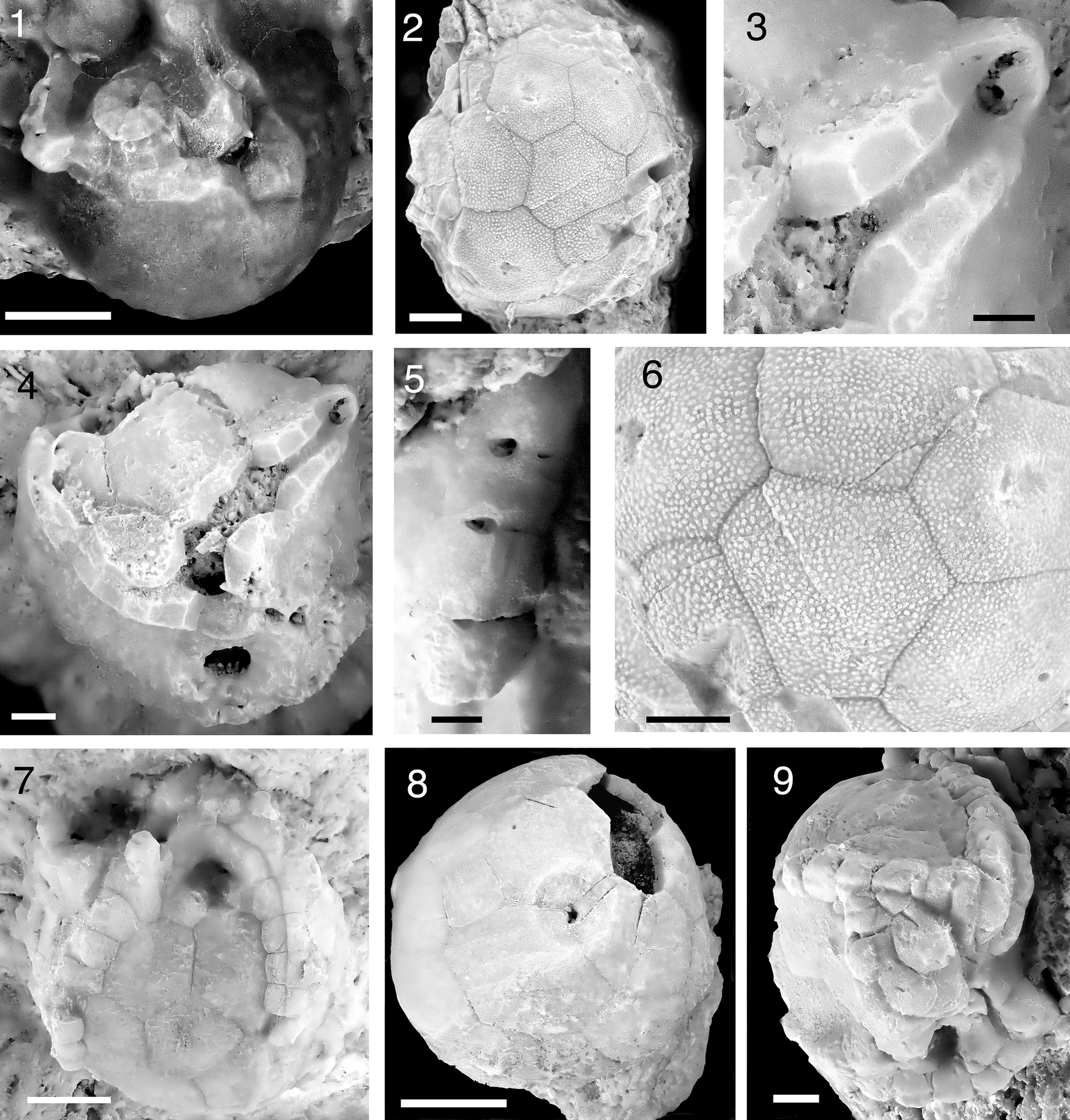
Theca globular to inverted pyriform, with finely granular surface (Fig. 2.2, 2.6) composed of thin plates that lack any pore-structures. Theca reaches 30 mm high in FMNH PE93478. Plates are of two generations, although relatively few secondaries occur as isolated intercalates. Plates above the basal circlet are arranged in vertical columns rather than in alternating horizontal circlets (Fig. 1.3, 1.5). Plates are between 0.5 and 1.0 mm thick in FMNH PE93480a, half a theca about 15 mm in diameter.
The periproct is a large, circular orifice, 3 mm across in FMNH PE93481 (Fig. 3.3) and surrounded by four plates including the right posterior oral. Two ambulacral branches surround it adorally and laterally in FMNH PE93470 (Fig. 2.7). It is covered by a simple pyramid of eight triangular plates, 3.2 mm in diameter in FMNH PE93483 (Figs. 2.1, 4).
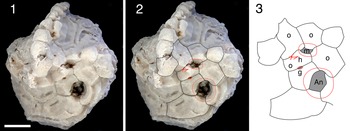
Wellerocystis kimmswickensis Foerste, Reference Foerste1920, Kimmswick Limestone, Missouri, USA, FMNH PE93481. (1) Oral view; (2) the same with outlines of plates and orifices; (3) interpretive diagram showing peristome (m), periproct (An), gonopore (g), hydropore (h) with mouth frame composed of four oral plates (o). Scale bar = 5 mm.

Wellerocystis kimmswickensis Foerste, Reference Foerste1920, Kimmswick Limestone, Missouri, USA. Stereophotos of FMNH PE93483 showing mouth (m), periproct (an), and biserial ambulacral cover plates (cp). This ambulacral branch curves clockwise down the right side of the anal pyramid and off to the left below. Facets are on the outside of the curve. Scale bar = 2 mm.

The mouth is significantly smaller than the periproct, oval, elongate perpendicular to the oro-anal plane of symmetry and 1.5 mm by 1.0 mm in PE93481 (Fig. 3.3). The mouth is surrounded by four plates, two anterior and two posterior. The right posterior contributes to the borders of both the mouth and anus. Irregular grooves in the left posterior oral almost certainly represent the hydropore (Fig. 3.3). The more rounded gonopore (Fig. 3.3) reaches 0.7 mm wide and lies across the suture between the left posterior oral and the plate below, which contributes to the periproct border.
Two prominently raised ambulacra composed of recumbent pseudobrachial plates (nonhomologous with crinoid brachials; see Guensburg et al., Reference Guensburg, Blake, Sprinkle and Mooi2016, Reference Guensburg, Sprinkle, Mooi and Lefebvre2021) leave the mouth to left and right. They branch almost immediately, to the right as viewed in growth direction (Fig. 1.1). Both may branch a second time (Fig. 2.9) to give six ambulacral branches (USNM S3107 Parsley and Mintz, Reference Parsley and Mintz1975, pl. 13, figs 9–13, p. 112). One of our examples (FMNH PE93486) apparently has seven branches, although the seventh included only three pseudobrachials (Fig. 5.3). The basic pattern appears to be four ambulacral branches. In FMNH PE93484 (Fig. 1.1) a single ambulacral plate lies between the oral opening and the point where food grooves branch. One branch continues in the same direction, whereas the other lies at right angles to the first. In Carpenter’s (Reference Carpenter1884, Reference Carpenter1891) ambulacral terminology, the branches to the right of the mouth are B, which continues straight, and C, which branches towards the observer and often curves around the aboral side of the periproct. Similarly, to the left of the mouth ambulacrum D continues straight and E grew at right angles to it away from the observer.
Wellerocystis kimmswickensis Foerste, Reference Foerste1920, Kimmswick Limestone, Missouri, USA. (1) Basal view of FMNH PE93477 showing three basals with no lumen to the stem facet; although the small basal is damaged it fits against the other two without any gap. (2) Basal view of FMNH PE93482 showing three basals with a quadrate space centrally in the stem facet filled tightly by a small plate. (3) FMNH PE93486 showing a small seventh branch of the ambulacra with three ambulacral plates; note the difference in size between the ambulacral plates above and below the seventh branch; one other ambulacral branch shows the same relative reduction in the size of more distal ambulacral plates. Scale bars = 2 mm.

Wellerocystis kimmswickensis Foerste, Reference Foerste1920, Kimmswick Limestone, Missouri, USA. Stereophotos of FMNH PE93483 showing four ambulacral plates with biserial cover plates over the food groove. Growth direction is down the figure. Scale bar = 1 mm.

The ambulacra tend to spiral clockwise and have a food groove adjacent to the inner margin of the spiral (Figs. 1.1, 1.4, 1.5, 2.7, 2.9). They are formed of uniserial plates (Figs. 1.6, 2.5, 6), which are generally not well preserved but show traces of the lateral food grooves to facets for pseudopinnules in FMNH PE93470 and FMNH PE93472 (Fig. 2.7, 2.9, respectively). Between the ambulacral and thecal plates on which they lie is a tubular channel (lumen of Parsley and Mintz, Reference Parsley and Mintz1975) (Figs. 1.1, 2.3, 2.4). The lumen gives rise to lateral branches along the inter-pseudobrachial sutures (Fig. 2.3 top right), which apparently open to the exterior of the theca (Fig. 2.5) but this may be due to weathering. The main lumen opens to the interior of the theca proximally (Figs. 1.1 left, 2.3 bottom left, 2.4). When the flooring plates are missing, these channels indicate the former path of the ambulacra (Fig. 2.3, 2.4). The first uniserial pseudopinnular plate of combined ambulacra DE is preserved on FMNH PE93470 (Fig. 2.7). Two other examples preserve this first pseudopinnular plate but otherwise, the erect pseudopinnules are unknown. Small irregular biserial cover plates are present over the main ambulacral food groove of ambulacrum C in FMNH PE93483 (Figs. 4 below, 6). The stem is unknown, but the thecal facet suggests stem morphology similar to those of Amygdalocystites and Platycystites (see Guensburg, Reference Guensburg1984).
Material
Eighteen specimens, FMNH PE93469– PE93486. All partial or complete thecae.
Remarks
Paracrinoids frequently have asymmetrical thecae basally. Several specimens of Wellerocystis do, but others apparently have symmetrical thecae (Fig. 1.5), suggesting that in Wellerocystis this general feature appears to have been environmentally influenced. Only one example (FMNH PE92484) has cover plates to the anus and food grooves preserved, and three examples have one first pseudopinnular plate still attached to the ambulacra. Although clearly associated with the reefs, Wellerocystis appears to have been subject to more rapid taphonomic disintegration than the specimens of Implicaticystis. One of the three specimens of the latter genus (FMNH PE93468) has parts of two pseudoarms with pseudopinnules attached, anal cover plates, and a short section of stem. Interestingly, in specimen FMNH PE93477 of Wellerocystis the three basals completely occlude the lumen of the stem facet (Fig. 5.1). In FMNH PE93482 the lumen is blocked by a small plate that fits tightly (Fig. 5.2). Parsley and Mintz (Reference Parsley and Mintz1975, p. 93) reported that in Wellerocystis the stem facet lacked a lumen and only two of our examples show any trace of a lumen (Figs. 1.2, 2.8). We suspect a lumen to have been consistently present but frequent calcite overgrowths obscure this morphology in specimens.
Wellerocystis apparently consistently had three basals. In FMNH PE93484 (Fig. 1.2) there are clearly two larger basals and a smaller one, which is anterior on the theca. In FMNH PE93477, the smaller basal is also apparently anterior and occludes a smaller area of the lumen than do the two larger basals. Despite the differences in size of basals, angles between the basal:basal sutures in the stem facet are closer to 120° than 72°, 144° and 144°, as predicted by the ‘zygous rule’ (Paul, Reference Paul2024).
The basic number appears to have been four ambulacra. Both Foerste (Reference Foerste1920) and Kesling (Reference Kesling and Moore1968) reported that the holotype of W. kimmswickensis had only three ambulacra. However, Parsley and Mintz (Reference Parsley and Mintz1975, p. 93, pl. 13, fig. 4) showed that it does have four ambulacra, but ambulacrum B is very poorly preserved. As far as we can tell, none of our specimens had fewer than four ambulacra, and one (FMNH PE93486) has a very short diminutive seventh branch (Fig. 5.3). This specimen is also interesting in that the height of the main ambulacral plates declines significantly across the junction where the seventh branch begins (Fig. 5.3). The ambulacral plate adoral to the tip of the seventh branch is 3.4 mm high, the one immediately after the junction is 1.9 mm high, and subsequent plates are 2.6 mm high. It is reminiscent of regeneration of crinoid arms after loss. One other ambulacrum shows a similar decline in plate size at a comparable place along its length. One wonders if somehow this specimen lost part of its ambulacra and subsequent growth produced smaller plates. Modern comatulid crinoids often replace a lost arm branch with two (Breimer, Reference Breimer, Moore and Teichert1978, p. T36). Could the seventh branch be another result of this possible pseudoarm loss?
The function of the lumen beneath the ambulacra and its lateral branches along inter-pseudobrachial sutures is unknown. It seems unlikely that the inter-pseudobrachial pores (Fig. 2.5), which are visible in several specimens, were originally open to the seawater externally. This would have provided a direct connection from the internal thecal cavity to the outside. It seems likely that the pores were covered with thin stereom or at least soft tissue in life. Such structures undoubtedly would have enhanced respiratory gas exchange, but they show no special adaptations for this function. Nevertheless, Wellerocystis entirely lacks any other respiratory structures, so any additional exchange may have benefitted these paracrinoids. The most likely function for the inter-pseudobrachial canals is nutrition. The pseudobrachial plates are some of the most solid in Wellerocystis. Coelomic fluids in channels on either side of such massive plates could well have brought dissolved chemicals necessary to maintain healthy soft tissue.
Family Comarocystitidae Bather, Reference Bather1899
Diagnosis
Paracrinoids with concave thecal plates; sutural pores numerous; pseudoarms exothecal or epithecal (Parsley and Mintz, Reference Parsley and Mintz1975, p. 28).
Remarks
Comarocystitids are unique in having concave external surfaces to their thecal plates. They bear specialized and complex respiratory pore-structures consisting of exothecal foerstepores, which develop at the plate sutures initially, and rhombic sets of internal buttresses that Frest and Strimple (Reference Frest and Strimple1982, p. 358) called pararhombs. The uniserial pseudoarms are either erect and bear uniserial pseudopinnules or recumbent on the theca in Sinclairocystis Bassler, Reference Bassler1950.
Genus Implicaticystis Frest and Strimple, Reference Frest and Strimple1982
Type species
Implicaticystis symmetricus Frest and Strimple, Reference Frest and Strimple1982, by original designation (Frest and Strimple, Reference Frest and Strimple1982, p. 361).
Other species
Implicaticystis shumardi Meek and Worthen, Reference Meek and Worthen1865; Implicaticystis sp. Paul, Reference Paul1965.
Implicaticystis symmetricus Frest and Strimple, Reference Frest and Strimple1982
Implicaticystis symmetricus Frest and Strimple, Reference Frest and Strimple1982, Kimmswick Limestone, Missouri, USA. (1, 2) FMNH PE93466; lateral views showing the thecal outline, concave thecal plates and abundant foerstepores; arrows (2) point to three foerstepores that penetrate through the theca (see Fig. 8). (3) FMNH PE93468; lateral view of another specimen in which the foerstepores appear to have been covered. (4–6) FMNH PE93467; (4) right lateral view showing the periproct (upper left) and short section of stem (below); (5) posterior lateral view showing entire specimen with sections of pseudoarms; (6) basal view showing crenulate periphery to columnals and basal plates. Scale bars = 5 mm.

Implicaticystis symmetricus Frest and Strimple, Reference Frest and Strimple1982, Kimmswick Limestone, Missouri, USA. FMNH PE93466. Detailed view of several foerstepores associated with a single pararhomb in which the foerstepore tubes can be seen to penetrate through the theca to the red background. The leftmost three are highlighted in Figure 7.2. Scale bar = 1 mm.

Holotype
SUI 39522.
Diagnosis
Modified from Frest and Strimple (Reference Frest and Strimple1982, p. 368). Implicaticystis with regularly hexagonal plates, intercalates lacking; with up to four or more foerstepore canals per plate suture and with four plate circlets between basals and peristomials. Theca elongate pyriform and radially symmetrical.
Occurrence
Kimmswick Limestone (Upper Ordovician, Sandbian–Katian) reef facies, roadcut off Highway 21 on east side of northbound exit ramp to Shady Valley, Jefferson County, Missouri, USA.
Description
Stem circular (Fig. 7.6), heteromorphic (Fig. 7.4), 3.5 mm in diameter, apparently with an oval lumen. Columnals very thin with peripherally crenulate articulation surfaces (Fig. 7.6) and apparently originally keeled latera (Fig. 7.5). About 2.5 mm length remains in FMNH PE93467, which retains 10–12 columnals and shows no sign of tapering in this length.
Theca ovoid, composed of regularly hexagonal concave plates, the external surfaces of which are sculptured with rows of raised oval foerstepores separated by radiating channels (Fig. 7.1). Theca reaches 23 mm wide by 31 mm high in FMNH PE93466 (Fig. 7.1). Basals four, two large and two small in FMNH PE93467 (Fig. 7.6), then four circlets of ‘lateral’ plates, with the peristomials, adorally. Largest plates reach 10 mm by 11 mm in FMNH PE93466 (Fig. 7.1). All larger plates have short oval domes covering pores that are elongate perpendicular to the nearest plate suture when undamaged (Fig. 7.3, 7.4). Pores were added simultaneously at the sutures and the number of pores increased regularly with each row added at least until the latest stages of growth. Thus, most plate sectors show a central pore, then two in a row, then three, and finally four nearest the suture (Fig. 7.3 center left). Distinct channels radiate from the plate centers to the plate angles between these triangular fields of pores (Fig. 7.3). Plate sutures are sharp-crested ridges giving the theca a distinctive polygonal appearance (Fig. 7.1, 7.3, 7.4).
The periproct is oval, wider (4 mm) than high (3 mm) in FMNH PE93467 and covered by a simple anal pyramid of six robust plates, five of which are still in place (Fig. 7.4, 7.5). The mouth is small (Fig. 7.4), apparently surrounded by five plates: two anterior, two posterior, and one on the right. A large plate to the left does not quite reach the edge of the mouth. An additional smaller orifice to the left of the mouth may be the thecal entrance of the channel (lumen of Parsley and Mintz, Reference Parsley and Mintz1975) that underlies other paracrinoid ambulacra.
One ‘hemipinnate’ pseudoarm rises above the periproct in FMNH PE93467 with seven pseudobrachials 1.5 mm long by 2.0 mm high in 9.5 mm length (Fig. 7.5). The pseudoarm is gently curved and each pseudobrachial gives rise to an incomplete uniserial pseudopinnule at least 10 mm long with up to 11 pseudopinnular plates not more than 1 mm in diameter (Fig. 7.5). Parts of two other erect pseudoarm branches are present, but which is which remains uncertain.
Material
Three specimens, FMNH PE93466–PE93468.
Remarks
The preservation of these specimens allows us to add to the original description of the foerstepores and pararhombs of Implicaticystis given by Frest and Strimple (Reference Frest and Strimple1982) and compare them with Parsley’s (Reference Parsley1978) interpretation of foerstepores in Comarocystites. Foerstepores in Implicaticystis show on the external surface as single oval tubercles elongated perpendicular to the nearest plate suture. Thus, they occur in parallel rows within triangular sectors on each plate. Generally, the number of pores increases regularly up to four in a row but becomes less regular if the plate is large enough to contain five or six rows (Fig. 7.1 top left). The pores in each row alternate with those of adjacent rows. When well preserved, the pores are covered by a thin epistereom (Fig. 7.3, 7.4). Progressive weathering reveals a central hole, which enlarges as weathering progresses. The maximum size of the hole corresponds to the radius of a circular tube that extends towards the opposite plate across the common sutures. At plate edges these tubes are often clearly visible, and in PE93466 at least four in one plate can be seen through when viewed at the appropriate angle (Fig. 8). At least one newly formed open tube can be seen across the plate suture in Figure 7.1 (upper left). From these last observations, the external pores of foerstepores must open into tubes but the relationship to the internal lamellae of the pararhombs is uncertain.
Pararhombs are internal lamellae that are widest at their bases away from the plate surface. They pass across the plate sutures between adjacent plates. Thus, they are longest in the center of the suture and shortest near the angles of the polygonal plates. The two plates meet at an angle like opposite sides of a ridged roof. The pararhomb lamellae provide structural strength across the sutures propping adjacent plates up against external pressure, just as an A-frame of a house roof does. The swellings at the base of the lamellae acted as the horizontal brace of an A-frame. If tubes connecting foerstepores of adjacent plates lie in the grooves between the lamellae, the external pattern of the foerstepores should reveal the internal pattern of the lamellae. So, when the plates are very small and the first tube developed, there were probably no lamellae at all.
Pararhombs should start with a pair of lamellae of equal length. However, all the illustrations of real lamellae (Frest and Strimple, Reference Frest and Strimple1982, pl. 1, figs. 8, 10, text-fig. 3, p. 365) show a single central lamella. At the next stage a pair of foerstepores was added, followed by two more lamellae. Then three pores were added, the central one aligned with the central groove between the first pair of lamellae. This pattern proceeded with regular addition of foerstepores up to rows with four pores. After that, addition of new foerstepore tubes became less regular. Views of the internal surfaces of plates of Implicaticystis (Frest and Strimple, Reference Frest and Strimple1982, fig. 3) show that addition of internal lamellae was not always regular. Similar irregular lamellae were visible on the latex casts of the Scottish plates (Paul, Reference Paul1965, pl. 1, figs. 3, 4, 6). Thus, the predictions of the pattern of foerstepores do not match the known patterns of pararhomb lamellae.
Frest and Strimple (Reference Frest and Strimple1982, text-fig. 2F) interpreted the foerstepore tubes as lying in a separate layer (their mesostereom) above the internal pararhomb lamellae. This interpretation is possible if the two plates were level, but in mature Implicaticystis the plate edges meet at about 90 degrees. Straight tubes, as seen in our Figure 8, would penetrate into the thecal cavity in such an arrangement. They could not lie in a separate layer within the plates. We conclude that the true structure of the respiratory structures of Implicaticystis has yet to be determined and will probably require CT scanning or more destructive methodology to achieve.
Foerstepores of Comarocystites differ in that the external blisters were underlain by a pair of curved spaces, not a simple tube (Parsley, Reference Parsley1978, fig. 4). The two kidney-shaped spaces were connected commonly at their adsutural ends (Parsley, Reference Parsley1978, p. 476). Parsley interpreted the two kidney-shaped canals to lie over different interlamellar spaces of the pararhombs. Thus, the short connecting canal between them would have allowed body fluids from one interlamellar space to flow through them and back into an adjacent interlamellar space. Such a one-way circulation would enhance respiratory efficiency and allow centrally located foerstepores in the plates to continue functioning. The tubes in Implicaticystis would only work efficiently near the plate sutures. This may explain why they started as open pores at either end of the tubes, but became sealed by epistereom as the plates grew larger and the tubes became farther from the plate sutures.
Discussion
Classification of paracrinoids
Historically two alternative classifications of paracrinoids have been proposed, each emphasizing different anatomies and each producing radically different results. Kesling (Reference Kesling and Moore1968) used the nature of the food-gathering system to group those genera with erect ambulacra into the order Brachiata Jaekel, Reference Jaekel1900, and those with ambulacra recumbent on the thecal surface into the order Varicata Jaekel, Reference Jaekel1900. Parsley and Mintz (Reference Parsley and Mintz1975) preferred to use the presence or absence of respiratory pore-structures: those with pore-structures formed the Comarocystitida, those without the Platycystitida.
Sister groups of early echinoderms with erect or recumbent ambulacra are common among blastozoans. Glyptocystitoid Rhombifera frequently have recumbent ambulacra; hemicosmitoid Rhombifera always have erect ambulacra. Similarly, coronates have erect ambulacra, whereas blastoids have recumbent ambulacra. Beyond blastozoans, the hybocrinid crinoid Hybocystites Wetherby, Reference Wetherby1880, has three erect ambulacra, A, C, and D of Carpenter’s (Reference Carpenter1884, Reference Carpenter1891) ambulacral terminology, and two recumbent ambulacra, B and E, in the same individuals. Clearly, the evolutionary change required to convert an erect ambulacrum into a recumbent one, or vice versa, was not a major change and the transition has arisen repeatedly in numerous lineages besides paracrinoids.
Furthermore, using ambulacral structure separates the comarocystitid genus Sinclairocystis from Comarocystites and Implicaticystis (see above). These three genera share several unique synapomorphies. They are the only echinoderms of which we are aware that have concave thecal plates, internal buttresses called pararhombs, and unique respiratory structures called foerstepores. It seems to us that these features unite the three genera into a wel-founded family, the Comarocystitidae. On both grounds, division of the Paracrinoidea into the orders Comarocystitida and Platycystitida is preferable to using the ambulacral structure.
Similarly, branched ambulacra arose at least three times in the rhombiferan family Callocystitidae (Paul, Reference Paul2014) and in two different ways. Parsley (Reference Parsley1978, fig. 1, p. 474) and Frest and Strimple (Reference Frest and Strimple1982, fig. 1, p. 362) showed the branching pattern of Comarocystites and Implicaticystis in which the two lateral food grooves divide in a symmetrical Y-shaped pattern leading to two pseudoarm facets both on a single oral plate. That pattern is significantly different from the one seen in Wellerocystis (Fig. 1.1) in which the food grooves divide at approximately right angles and only after the first flooring plate bearing the first pseudopinnular was formed. Thus, the number of ambulacra (2, 3, or 4) would seem to oversimplify the number of character states present among paracrinoid ambulacra. Furthermore, Wellerocystis can have as many as seven ambulacral branches. So, does Wellerocystis have four ambulacra (B, C, D, and E) or does it have two ambulacra (BC and DE combined) that branch up to three or four times?
Finally, the number of oral plates has been considered important in paracrinoid classification, but again in true echinoderm style, exceptions occur. The plate terminology used by Parsley and Mintz (Reference Parsley and Mintz1975) is not helpful in recognizing homologies of oral plates between paracrinoids and other early echinoderms.
Origin of the paracrinoids
The unique combination of characters that unites the paracrinoids makes them a distinct and easily recognizable echinoderm class, but equally renders it difficult to recognize any sister groups between classes. Indeed, Regnéll (Reference Regnéll1945) stated explicitly that he recognized the paracrinoids as a distinct taxon because he posited that they combined some of the characters (implied homologies) of crinoids and cystoids. Taxonomically, the problem of recognizing closely related classes has been avoided by elevating the taxonomic level of the class, as Parsley and Mintz (Reference Parsley and Mintz1975) did in erecting the subphylum Paracrinozoa. Phylogenetically, recognizing sister group(s) requires identifying some shared advanced characters or homologues of such characters, apomorphies. One possible additional character is that, at least in Wellerocystis, thecal plates tend to be organized more in vertical columns rather than in horizontal ring-like circlets that alternate. Indeed, Parsley and Mintz (Reference Parsley and Mintz1975, p. 92) described Wellerocystis as having “nine uneven vertical/oblique rows” of plates above the three basals. If the theca is orientated so the main axis is vertical, thecae with circlets of plates have vertical sutures between plates of the same circlet; thecae with columns of plates have horizontal sutures between plates of the same column. Evidence of horizontal sutures can be seen in several specimens of Wellerocystis (Fig. 1.3, 1.6), but vertical sutures do also occur (Fig. 1.5).
Another inevitable feature of vertical columns of plates that alternate in position from column to column, is that columns are likely to have different numbers of plates. Vertical columns of plates with different numbers of plates are known in some rhipidocystid ‘eocrinoids’, such as Mandalacystis Lewis et al., Reference Lewis, Sprinkle, Bailey, Moffit and Parsley1987, with three marginals on one side and four on the other, or Rhipidocystis Jaekel, Reference Jaekel1900, with four marginals on one side and five on the other (see Rozhnov, Reference Rozhnov, David, Guille, Féral and Roux1994). Furthermore, rhipidocystids have three basals, as does Wellerocystis and other paracrinoids.
Search for a paracrinoid sister taxon and the systematic position of Columbocystis
The systematic position of Columbocystis Bassler, Reference Bassler1950, has been controversial. It was originally assigned to the family Springerocystidae Bassler, Reference Bassler1950, within the class Eocrinoidea. Ubaghs (Reference Ubaghs and Moore1968, p. S486–S487) maintained the family and class assignments, but Sprinkle (Reference Sprinkle1973, p. 138) transferred both the genus and family to the paracrinoids on the grounds that Columbocystis had asymmetrical facets for its (unknown) feeding structures. Parsley (Reference Parsley1975) regarded Columbocystis as of uncertain affinities. Parsley and Mintz (Reference Parsley and Mintz1975, p. 8) rejected Sprinkle’s assignment in a footnote that implied the ambulacral facets of Columbocystis were similar to those of Achradocystites Volborth, Reference Volborth1870, and might have given rise to biserial brachioles. Indeed, Achradocystites is now known to have had erect, biserial, pinnate pseudoarms with biserial brachioles (Rozhnov, Reference Rozhnov, Zamora and Rábano2015). Asymmetrical ambulacral facets developed on two oral plates seem indicative of biserial feeding structures. This may well imply that Columbocystis is closely related to Achradocystites and Heckerites Rozhnov, Reference Rozhnov1987, but it tends to separate Columbocystis from all other North American paracrinoids. In addition, photographic illustrations of Columbocystis (Bassler, Reference Bassler1950, fig. 2, p. 275; Sprinkle, Reference Sprinkle1973, fig. 33, p. 138) suggest it had five oral plates, which is unusual for early blastozoans. Parsley (Reference Parsley1975, p. 352) explicitly stated that it had six oral plates, four forming the mouth frame, although even his interpretive diagram (Parsley, Reference Parsley1975, fig. 1, p. 353) does not show the suture between the posterior pair of plates in CD interambulacrum. Such uncertainty about important oral characters does not help determine the affinities of controversial taxa. Limbeck et al. (Reference Limbeck, Bauer, Deline and Sumrall2024, fig. 4, p. 7) placed Columbocystis basally in all three trees they produced, but in only one (the maximum likelihood tree) was it a sister group to all other North American paracrinoids.
Acknowledgments
CRCP thanks P. Mayer, Invertebrate Collection Manager, Field Museum, for the loan of the specimens described herein. GD thanks his wife D. Darrough, for assistance in the field and we are all grateful for her IT skills in ensuring that all versions of the manuscript reached all contributors. We also thank R.L. Parsley and an anonymous reviewer, plus the associate editor B. Lefebvre, for many useful comments that improved the original version of the manuscript.
Competing interests
The authors declare there are no conflicts of interest.



 Open access

