





Study Highlights
-
• Heritage speakers (HSs) and Spanish-dominant bilinguals produce differential object marking (DOM) variably
-
• HSs and Spanish-dominant speakers show similar effects of linguistic variables
-
• Dominance predicts between-speaker differences in both groups
-
• Between-speaker variability may be somewhat greater in heritage bilinguals
-
• Boosted DOM in inanimate contexts suggests HSs advance language change predictably
1. Introduction
Bilingual development can lead to variation in linguistic knowledge and patterns of language use when compared to other acquisition contexts. The grammars of the so-called heritage speakers (HSs) have occupied a central position in research on bilingual grammars. HSs are bilinguals (or multilinguals) who acquire a home language as an L1 – that is, their heritage language (HL) – that is not a majority language in the greater society in which they were raised. HSs attain proficiency in the socially dominant language, either as an early L2 or an additional L1 (Kupisch & Rothman, Reference Kupisch and Rothman2018), and typically become more dominant in the majority societal language relative to the home language. The environmental complexity of HL acquisition often results in patterns of language that seem to diverge from baseline grammars (see Polinsky & Scontras, Reference Polinsky and Scontras2020; Putnam et al., Reference Putnam, Kupisch, Pascual, Cabo, Miller, Bayram, Rothman and Serratrice2018; Montrul, Reference Montrul2016). However, these divergent patterns are characterized by interindividual and intraindividual variability (e.g., Kupisch & Rothman, Reference Kupisch and Rothman2018).
The nature of variability in heritage grammars is poorly understood. As decades of variationist sociolinguistics research have demonstrated, variation in language tends to be systematic – specifically, probabilistic (e.g., Cedergren & Sankoff, Reference Cedergren and Sankoff1974; Labov, Reference Labov1994). Recent approaches have shown the benefit of considering variable grammatical patterns in HSs as akin to variation in other native speaker groups (Scontras et al., Reference Scontras, Polinsky and Fuchs2018; Nagy & Lo, Reference Nagy and Lo2019). Thus, there is a call to examine variable patterns in HSs more closely to reach a more comprehensive understanding of heritage grammars. The goal of this paper is to explain systematic patterns of morphosyntactic variation by exploring group-level and individual-level factors influencing Spanish HSs’ production of differential object marking (DOM).
2. Background
2.1. Explaining variability in heritage grammars
Examining HL acquisition outcomes offers insight into how extralinguistic and linguistic factors affect bilingual language acquisition and use. Variability in heritage grammars may arise from an array of processes: early language attrition, crosslinguistic influence, structural reconfiguration and/or contact-induced change (Polinsky, Reference Polinsky2018; Putnam & Sánchez, Reference Putnam and Sánchez2013; Montrul, Reference Montrul2022, especially Chapter 2). As Flores and Rinke (Reference Flores and Rinke2020, p. 25) have explained, “variability and variation in HL grammars cannot be equated with deviance” especially when language-internal variation exists in the baseline. Indeed, recent studies have discovered patterns of variability that are probabilistically – that is, systematically – constrained by linguistic factors in HSs’ use of morphosyntax (e.g., Nagy & Lo, Reference Nagy and Lo2019; Shin, Reference Shin2022). These approaches go beyond explanations, such as crosslinguistic influence or early language attrition by examining variable patterns in HL populations as one would variation in other native speaker groups.
Researchers have conceptualized variability in heritage grammars in a few different ways. One type of variability is divergence from the baseline, which describes the patterns of language knowledge or use in HSs that deviate or diverge from patterns in the input they receive in their HL – that is, the “baseline” grammar (see, e.g., Benmamoun et al., Reference Benmamoun, Montrul and Polinsky2013a). Findings from Montrul et al. (Reference Montrul, Bhatt and Bhatia2012) exemplify divergence from the baseline: HSs of Hindi in the United States produce greater rates of omission of ergative agreement marking in Hindi compared to Hindi–English bilinguals raised in India who migrated to the United States as adults. The latter group represents an appropriate baseline as they were also bilingual but had been raised in a Hindi-dominant environment and, thus, represent an approximation of the input Hindi HSs would receive as children (see also Benmamoun et al., Reference Benmamoun, Montrul and Polinsky2013b).
Another type of variability encompasses differences between HSs. This inter-speaker variability refers to the fact that some HSs show linguistic patterns that differ from others: for example, some HSs of Spanish may produce no errors in gender agreement and assignment, while others exhibit variable grammatical gender knowledge (Montrul et al., Reference Montrul and Sánchez-Walker2013). Such inter-speaker variability is often linked to differences in language experience and/or proficiency (e.g., Montrul, Reference Montrul2004; Polinsky, Reference Polinsky2006), and language background profiles are known to vary across HSs (e.g., Polinsky & Kagan, Reference Polinsky and Kagan2007; Albirini, Reference Albirini2014). However, differences in language proficiency do not always provide an explanation of inter-speaker variability. Instead, proficiency may reflect how some HSs have fewer opportunities to use their HL compared to others. Less frequent HL use leads to decreased activation of morphosyntactic features in the HL, which, in turn, may lead to between-speaker differences in grammatical performance (Putnam & Sánchez, Reference Putnam and Sánchez2013; Perez-Cortes et al., Reference Perez-Cortes, Putnam and Sánchez2019).
The grammatical patterns produced by HSs are often variable within individual speakers as well. As an example of this intra-speaker variability, one adult HS of Polish in Łyskawa’s (Reference Łyskawa2015) study produced mismatched case agreement with 52% of tokens. The question remains why this individual speaker – and others like them – would produce baseline-like case agreement in many but not all instances. Although individual-level variation is very common in HL studies, it has received greater attention in recent HL research. Perez-Cortes and Giancaspro (Reference Giancaspro, Perez-Cortes and Higdon2022) discuss approaches to understanding both inter- and intra-speaker variability in heritage grammars from the perspective of frequency effects. The authors claim lexical frequency effects as one explanation for variation in morphosyntactic performance observed at the level of the individual speaker as well as at the group level.
In the present study, I explore systematic patterns of variation in HSs of Spanish including divergence from a baseline group, inter-speaker variability and intra-speaker variability. To do so, I examine the morphosyntactic phenomenon known as DOM, which has been the focus of many studies on different HLs (see Montrul, Reference Montrul2022, for a comprehensive overview). DOM in Spanish has been shown to have variable contexts of use across monolingual and bilingual speakers (e.g., Requena, Reference Requena2023a, Reference Requena2023b), and it exhibits both inter- and intra-speaker variability in bilinguals (e.g., Montrul & Sánchez-Walker, Reference Montrul and Sánchez-Walker2013). These different aspects of variability have been largely overlooked in the HL literature (cf. Perez-Cortes & Giancaspro, Reference Perez-Cortes and Giancaspro2022). Thus, Spanish DOM emerges as an ideal testing ground for questions of variation in HSs.
2.2. DOM in Spanish
DOM is a crosslinguistic morphosyntactic phenomenon of constituent marking conditioned by semantic and/or discourse-pragmatic factors (e.g., Bossong, Reference Bossong, Kibbee and Wanner1991; Aissen, Reference Aissen2003; Torrego, Reference Torrego1998). In Spanish, DOM is characterized by the use of the multifunctional morpheme a with direct objects (DOs). Several factors constrain the use of DOM, including the animacy and the definiteness/specificity of the DO. In (1) below, the a-marker appears with a human, specific DO. However, nonspecific, human DOs (example 2) usually occur without a-marking. DOM occurs with a specific, animal DO in (3), but not in (4), a difference demonstrating variable marking of nonhuman animate DOs.Footnote 1 Finally, the DO coche (‘car’) remains unmarked in example (5), as inanimate DOs are rarely marked, although marking can still occur.


Previous researchers have discussed the crosslinguistic constraints on DOM as hierarchical in nature. Aissen (Reference Aissen2003) provides the Animacy Scale in (6) and the Definiteness Scale in (7). The higher a DO lies on the Animacy and Definiteness scales, the more likely it is to be marked.


According to Aissen (Reference Aissen2003), DOM rarely occurs with nonspecific DOs or inanimate common noun DOs in Spanish. Moreover, all human DOs above nonspecifics on the definiteness scale tend to be marked, along with animal-referent DOs when expressed as pronouns or proper names. Aissen further identifies three types of DOs that are optionally (or variably) marked in Spanish: definite, animal-referent DOs; specific, animal-referent DOs and inanimate DOs referenced by a proper name.
The complexity previous researchers have encountered in attempting to explain Spanish DOM likely reflects the fact that Spanish DOM shows a more probabilistic distribution rather than a deterministic one. Previous studies have shown variable, but probabilistically distributed DOM patterns both within and across Spanish varieties. Corpus-based studies have found significantly higher rates of DOM with animate DOs relative to inanimate DOs in different Spanish varieties (Tippets, Reference Tippets and Ortiz-Lopez2011; Balasch, Reference Balasch, Michnowitz and Dodsworth2011; Alfaraz, Reference Alfaraz2011). Importantly, human-referent DOs are not marked categorically, with rates of marked specific, human DOs ranging from 41% in Venezuelan Spanish (Balasch, Reference Balasch, Michnowitz and Dodsworth2011) to 96% in Mexico City Spanish (Tippets, Reference Tippets and Ortiz-Lopez2011).
Some studies have found that monolingual speakers overextend DOM to inanimate DOs, especially in Argentine Spanish (Dumitrescu, Reference Dumitrescu1997; Montrul, Reference Montrul, Colantoni and Rodríguez Louro2013) and Mexican Spanish (Company, Reference Company, Wishcer and Diewald2002). However, naturalistic corpora of several varieties – including Mexican and Argentine – exhibit rates of inanimate marking lower than 10% (e.g., Tippets, Reference Tippets and Ortiz-Lopez2011; see Bautista-Maldonado & Montrul, Reference Bautista-Maldonado and Montrul2019, for similar experimental findings). Experimental evidence reveals that overextension of DOM to inanimate DOs in monolingual Mexican Spanish may be at an early stage of change as speakers do not produce much overextension, but they also show no comprehension differences between marked and unmarked inanimate DOs (Arechabaleta Regulez & Montrul, Reference Arechabaleta Regulez and Montrul2021).
More variability in DOM use appears in contexts of nonhuman animate DOs and nonspecific DOs. Two studies have shown significantly lower rates of DOM with nonhuman animate DOs relative to human referents (Callen & Miller, Reference Callen and Miller2022; Lizárraga Navarro & Mora-Bustos, Reference Lizárraga-Navarro and Mora-Bustos2010). The Mexican adults in Callen and Miller’s (Reference Callen and Miller2022) study of child–caregiver interactions mark 48% of all animal-referent DOs, while Lizárraga Navarro and Mora-Bustos (Reference Lizárraga-Navarro and Mora-Bustos2010) found that only 34.5% were marked in adult speech. The latter study had fewer tokens and considered trees as “animate” referents, while the former only analyzed animal-referent DOs. Variable DOM also occurs in the case of nonspecific, human DOs with rates up to 68% in Mexico City Spanish (Tippets, Reference Tippets and Ortiz-Lopez2011) and as low as 17% in Cuban Spanish (Alfaraz, Reference Alfaraz2011).
Given these findings, the nominal features of animacy and specificity appear to be most influential in the distribution of DOM. Diachronic studies have found verbal properties to be integral in the historical development of DOM in Spanish (von Heusinger & Kaiser, Reference von Heusinger, Kaiser, Kaiser and Leonetti2007; 2011). DOM with human-referent DOs in Medieval Spanish occurred predominantly with verbs biased toward animate DOs (e.g., herir ‘injure’). DOM in human-referent contexts generalized gradually to verbs with weaker animacy biases by the 20th century (von Heusinger & Kaiser, Reference von Heusinger, Kaiser, Kaiser and Leonetti2007). While verbal properties influencing DOM remain mostly unexplored in contemporary Spanish varieties (cf. Romero Heredero & García García, Reference Romero Heredero and García García2023), verb-specific patterns may play a role in HSs and other speakers of Spanish (see discussion below).
2.3. Acquisition of Spanish DOM in childhood
The acquisition of DOM in childhood may shed light on patterns of DOM in HSs. Studies of monolingual Spanish-speaking children show early acquisition of DOM in the contexts that are most marked in adult speech. Young children (1;7–2;5) in Ticio and Avram’s (Reference Ticio and Avram2015) study showed high rates of DOM with animate DOs, although their patterns were not yet adult-like. Rodríguez-Mondoñedo (Reference Rodríguez-Mondoñedo2008) found that monolingual children showed nearly adult-like use of DOM with specific, human-referent DOs by age 3;1. Both previous studies show very little overextension of DOM to inanimate contexts in children’s speech. Requena (Reference Requena2023a) further demonstrates that low rates of overextension (around 4.5%) in young children’s speech parallel those found in child-directed speech (CDS).
Callen and Miller (Reference Callen and Miller2022) compared monolingual children’s use of DOM to the input from their caregivers. The authors determined that children show adult-like rates of DOM with animal-referent and human-referent DOs by age 3. The monolingual and bilingual children in Requena’s (Reference Requena2023a) longitudinal study also demonstrated somewhat adult-like patterns of a-marking with human and nonhuman animates within an even younger age range, although token counts in the bilingual data are relatively low. These previous findings of DOM in Spanish-speaking children establish that the constraint of animacy on DOM is acquired early in childhood.
Regarding definiteness and specificity, Ticio and Avram (Reference Ticio and Avram2015) showed that children gradually acquire these properties, although adult-like knowledge was not evident by age 2;5. These findings align with those of Callen and Miller (Reference Callen and Miller2022): younger children (ages 2;7–2;11) showed non-adult-like use of DOM with nonspecific DOs, while older children (ages 3;5–5;2) used adult-like patterns of DOM according to specificity. Beyond nominal properties, Callen and Miller (Reference Callen and Miller2022) also found that verb-specific patterns of DOM in child speech nearly mirrored those found in caregiver speech. The authors concluded that lexically constrained patterns play a significant role in early development before children learn the full range of constraints on DOM.
2.4. Patterns of DOM in speakers of HLs
Speakers of HLs with DOM structures often show variability in their production of DOM when their dominant language does not have DOM. Some studies find cross-generational differences in DOM production. Coşkun Kunduz and Montrul (Reference Coşkun Kunduz and Montrul2022) found that child and adult HSs of Turkish from the United States show lower rates of DOM compared to adult migrant bilinguals from Turkey. Montrul and Bateman (Reference Montrul and Bateman2020) found similar generational differences in DOM use in heritage Romanian. These findings suggest that lower rates of DOM production in Turkish and Romanian HSs cannot be traced to variation in baseline grammars.
Other studies have found more baseline-like patterns of DOM structures in HSs. Di Salvo and Nagy (Reference Di Salvo and Nagy2023) find no cross-generational differences in variable DOM use in the spontaneous speech of HSs and baseline migrant speakers of Campanian and Calabrian Italian (see also Di Salvo & Nagy, Reference Di Salvo, Nagy, Bayley, Preston and Li2022). Mai et al. (Reference Mai, Kwan and Yip2018) and Mai et al. (Reference Mai, Zhao and Yip2021) discovered grammatical but restricted use of ba and zoeng constructions in both HSs and baseline speakers of Mandarin and Cantonese. Thus, we see that the complexity and variability of DOM structures extends beyond HSs of Spanish to other HL varieties.
Experimental studies of DOM in HSs of Spanish have mostly focused on comparisons with baseline grammars. Regarding inanimate DOs, studies have shown similarities between heritage and baseline groups, with both overextending DOM to inanimate contexts less than 4% of the time (Montrul, Reference Montrul2004; Montrul & Bowles, Reference Montrul and Bowles2009; Cuza et al., Reference Cuza, Miller, Pérez Tattam and Ortiz Vergara2019). The baseline speakers and HSs in Montrul and Sánchez-Walker’s (Reference Montrul and Sánchez-Walker2013) study also exhibited few between-group differences, although all groups produced DOM with inanimate DOs at somewhat higher rates (around 8–11%). Nevertheless, these studies find no significant differences between HSs and baseline speakers in the use of DOM in inanimate contexts.
In animate DO contexts, child HSs of Spanish tend to omit DOM more often than monolingual Spanish-speaking children (Montrul & Sánchez-Walker, Reference Montrul and Sánchez-Walker2013; Cuza et al., Reference Cuza, Miller, Pérez Tattam and Ortiz Vergara2019). Adult HSs also tend to produce DOM inconsistently and less frequently with human DOs compared to monolingual adult Spanish speakers (Montrul, Reference Montrul2004; Montrul & Bowles, Reference Montrul and Bowles2009; Montrul & Sánchez-Walker, Reference Montrul and Sánchez-Walker2013; Hur, Reference Hur, Mardale and Montrul2020). In these same studies, higher proficiency and greater HL exposure correlate with higher rates of DOM with human DOs (especially Montrul & Bowles, Reference Montrul and Bowles2009; Montrul & Sánchez-Walker, Reference Montrul and Sánchez-Walker2013; Hur, Reference Hur, Mardale and Montrul2020). These findings show that HSs of Spanish are more likely to omit DOM and tend to do so more frequently than Spanish-dominant speakers (SDSs).
Some studies have sought to trace restricted DOM in heritage Spanish grammars to structural changes in the baseline grammars. The migrant bilingual speakers – that is, the baseline group – in Montrul and Sánchez-Walker’s (Reference Montrul and Sánchez-Walker2013) study produced significantly lower rates of DOM in human DO contexts compared to monolingual Spanish speakers (see also Montrul, Reference Montrul2014). However, cross-generational similarities are not always found. Evidence of structural changes in DOM was not found in Jegerski and Sekerina’s (Reference Jegerski and Sekerina2020) study with Spanish–English migrant bilinguals with much shorter residence in the United States. Similarly, Cuza et al. (Reference Cuza, Miller, Pérez Tattam and Ortiz Vergara2019) found that HS children produced DOM with animate DOs significantly less frequently than their long-term US-resident parents (65% vs. 100%, respectively). Given these inconsistent findings, it seems plausible that DOM patterns may be subject to inter-speaker variability within the baseline speaker group.
Recent approaches to HLs have sought to explain how lexical effects may contribute to inter- and intra-speaker variability in heritage grammars (e.g., Giancaspro et al., Reference Giancaspro, Perez-Cortes and Higdon2022; Hur et al., Reference Hur, Lopez Otero and Sanchez2020). Hur (Reference Hur, Lopez Otero and Sanchez2020) investigated verb frequency effects on HSs’ production of DOM in Spanish. Intermediate-level HSs were significantly more likely to produce DOM with more frequent verbs, but advanced HSs showed no such effect. Hur (Reference Hur, Lopez Otero and Sanchez2020) ascribed this proficiency-related difference to the notion that intermediate HSs activate the DOM-relevant feature of animacy less often than advanced HSs and Spanish-dominant bilinguals. However, the advanced HSs’ variable patterns suggest that factors beyond lexical frequency may play a role in HSs’ use of DOM.
One factor besides lexical frequency that may influence HSs’ use of DOM relates to a verb’s tendency to take mostly animate DOs, mostly inanimate DOs or variably (either animate or inanimate DOs). Montrul and Sánchez-Walker (Reference Montrul and Sánchez-Walker2013) make note of such verb-related trends in the HSs’ data, reporting that verbs mostly taking animate objects yielded more omission of DOM (with animate DOs) compared to verbs with no animacy bias. Additionally, the HSs extended DOM to inanimate DOs more often with these animacy-neutral verbs compared to inanimate-only verbs. While these analyses revealed no statistically significant patterns, they suggest that verb-specific effects may influence HSs’ production of DOM.
Other studies show verb-related patterns affecting DO production in Spanish-speaking children. Callen and Miller’s (Reference Callen and Miller2022) study revealed that verbs showed individual variation in DOM rates and concluded young monolingual children may rely on verb-specific patterns in their input. Additionally, Shin (Reference Shin2022) found that HS children omit DOs more frequently with verbs that occur frequently without DOs in the input. Thus, we see that verb-related lexical effects influence not only DOM but also production of DOs more generally in children acquiring Spanish. Building on these previous findings, the present study aims to explore lexically particular patterns in adult HSs’ DOM use as a primary research question (RQ).
From this overview, DOM in HSs of Spanish exhibits baseline divergence, inter-speaker variability and intra-speaker variability. To address these different types of variability, this study considers the following factors: language dominance, all levels of the Animacy Scale and verb-specific animacy biases. By exploring these factors, we seek to discover systematic patterns of variation in DOM in HSs of Spanish at both the group and individual levels. Specifically, by considering variability in both baseline and HSs’ morphosyntactic performance, the present study offers deeper insight into variable outcomes of HL acquisition.
2.5. The present study
For the present study, two experiments were conducted. Experiment 1 explores SDS’ animacy preferences for specific transitive verbs in Spanish via a written sentence completion task (SCT). In Experiment 2, English-dominant HSs of Spanish and Spanish-dominant bilinguals from Mexico completed an oral elicited production task (EPT) with transitive actions across three animacy conditions (human, animal and inanimate). The results of Experiment 1 were incorporated into the analysis of Experiment 2 to explore how verb-specific animacy preferences influence Spanish–English bilinguals’ DOM production.
3. Experiment 1
3.1. RQ and predictions
This experiment was designed to discover verb-specific preferences for animate or inanimate objects in Spanish–English bilinguals from Mexico. The task chosen was a written SCT. Similar experimental tasks have been used to investigate other types of verb biases in English (Gahl & Garnsey, Reference Gahl and Garnsey2004) and in Spanish (Dussias et al., Reference Dussias, Marful, Gerfen and Molina2010). In fact, Gahl and Garnsey show that such experimental results align with corpus-based findings. The RQ for Experiment 1 is the following:
RQ1: Of the verbs selected for Experiment 2, which verbs demonstrate clear (dis)preferences for animate direct objects?
We predict that the verbs will show a range of preferences for animate DOs. Some verbs like abrazar (‘hug’) and besar (‘kiss’) are more likely to take animate objects because they are associated with reciprocal actions between human entities. More verbs, however, are predicted to show biases toward inanimate DOs because inanimate referents are the prototypical themes of transitive events (e.g., Company, Reference Company, Wishcer and Diewald2002).
3.2. Methods and materials
3.2.1. Participants
One hundred and eleven Spanish–English bilingual participants from Mexico were recruited via Prolific (prolific.co), a website used to find and compensate online research participants. Their age range was 19–63 (Median: 25). All but one participant reported their country of birth and country of residence as Mexico; one remaining participant listed the United States as their country of residence and Mexico as their country of birth. All participants indicated their first language as Spanish and reported fluency in English. Twenty-one participants reported fluency in one or more additional languages, including French (n = 12), German (n = 5), Italian (n = 5) and Portuguese (n = 1).
3.2.2 Stimuli
A total of 48 sentences were created for the SCT. The 16 target transitive sentences had the structure (adjunct + plural lexical DP + transitive verb) followed by an underlined blank space to indicate the part of the sentence to be completed. These trials were designed to elicit DOs (see examples 8 and 9). Two separate lists of transitive verbs were employed task: List 1 included all 16 verbs used in Experiment 2 with finite verb forms for the 3pl present indicative. List 2 included 10 of the verbs from Experiment 2 and an additional six different verbs; List 2 verb forms appeared in the 3pl preterite form. Then, 60 participants completed the task with List 1 and 51 participants completed the task with List 2.


The remaining sentences consisted of 32 filler/distractor sentences. Half of these fillers were designed to elicit subjects and indirect object clitics of ditransitive sentences (see example 10). The remaining 16 sentences were designed to elicit dative experiencer verbs and dative clitics (see example 11).


3.2.3. Procedure
Participants completed the SCT on Qualtrics (https://www.qualtrics.com). Participants saw one page of eight sentences at a time for a total of six pages. Beneath each sentence was a text box where participants could type their responses. Participants were instructed to type at least two words for each sentence and received no prompting of particular words or syntactic categories. Participants were reminded to ensure their responses would make sense in the sentence’s context. The order of all 48 sentences was randomized for each participant across the entire task.
3.2.4. Response coding
Each response was coded manually. Because participants filled in a blank space instead of producing a full sentence, the presence or absence of the a-marker was not considered. The primary response types of interest include animal, human and inanimate according to the referent of the DO in the participants’ responses. Additional codes for response type included adverbial, prepositional, clausal and other; these nontarget response types were not included in the analysis.
4. Results
4.1. General results
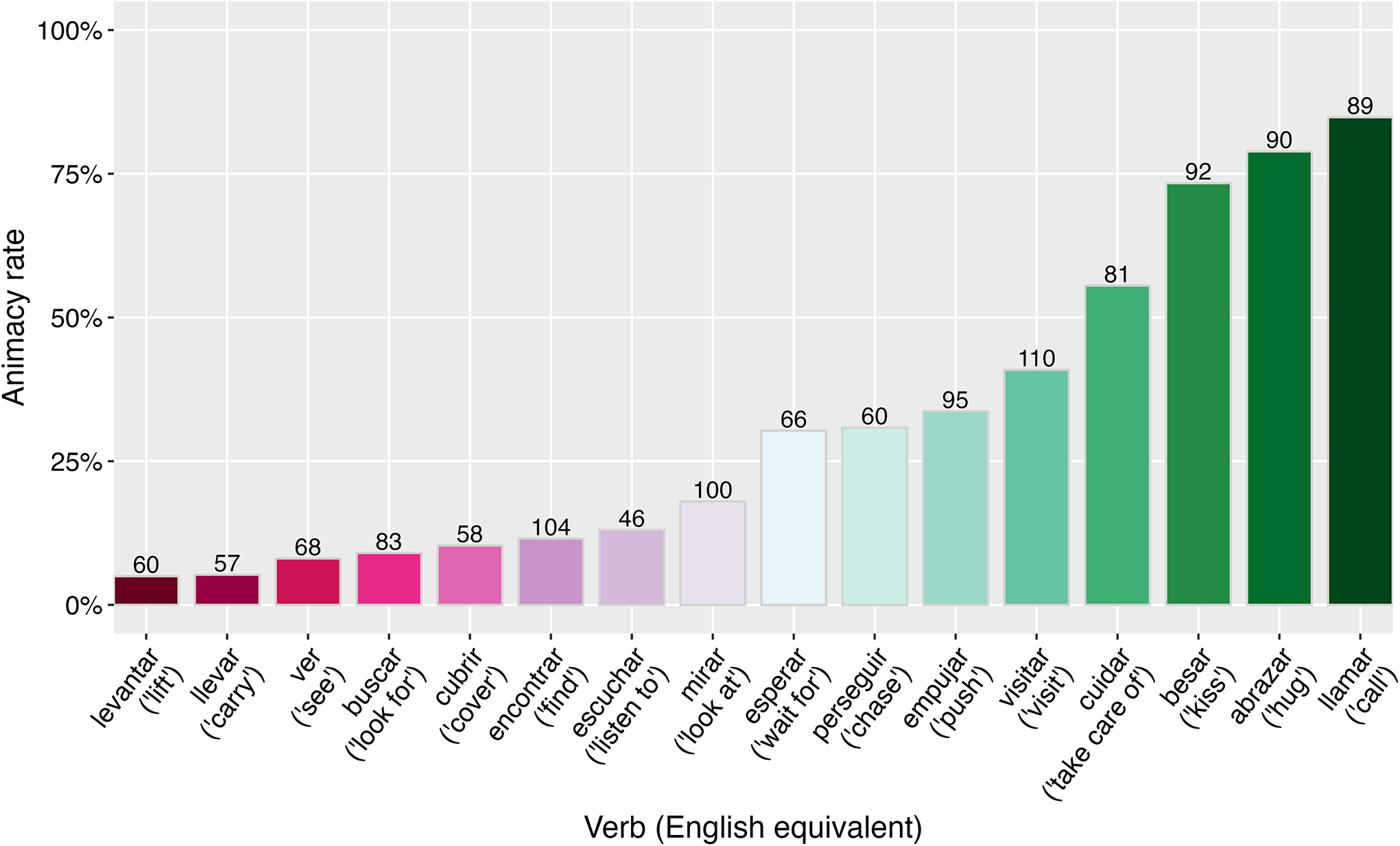
Of 1,776 total responses, 1,534 responses included a common noun DO. Response rates according to animacy were the following: 62.9% inanimate, 30.6% human and 6.5% animal (see also Table S1). To calculate animacy rates for each verb, responses were coded as follows: human as 1, animal as 0.5 and inanimate as 0. Animal responses were coded as 0.5 to reflect variable DOM patterns with nonhuman animate DOs. Overestimating animal responses as equal to human responses would misrepresent verbs like perseguir (‘chase’), which showed the highest rate of animal responses – 45% or 27/60 responses. Importantly, median differences – that is, distributional differences – between List 1 and List 2 animacy rates are not significant, according to an exact Wilcoxon rank-sum test for the 10 verbs shared by both lists (W = 46, p = .7959). The animacy rates for the 16 verbs included in Experiment 2 visualized in Figure 1 (see also Table S1).Footnote 2 Only four of the 16 verbs elicited animacy biases greater than 50%. An additional four verbs showed biases below 10%. List differences for all verbs can be found in Table S2.
Verb-specific animacy rates obtained in Experiment 1 for each verb used in Experiment 2. Animacy rates were averaged across responses with the following coding: human (1), animal (0.5) and inanimate (0).
Note: Values above bars represent total number of responses per verb.

4.2. Implications for Experiment 2
Regarding RQ1, the range of animacy preferences (5%–84.8%) provides a distribution broad enough to implement verb preference as a continuous predictor in modeling data from Experiment 2. However, the median preference of these 16 verbs is about 24.15%, which reflects that half of the verbs show a clear dispreference for animate DOs. Thus, the verbs included in Experiment 2 are skewed toward a preference for inanimate objects. However, as inanimate referents are the most prototypical DOs (e.g., Company, Reference Company, Wishcer and Diewald2002), this skew is somewhat unavoidable.Footnote 3
It remains evident that certain verbs have relatively strong preferences for animate or inanimate DOs. These lexically particular preferences may play a role in HSs’ use of DOM, as a verb’s likelihood of occurring with animate or inanimate DOs relates to its likelihood of occurring with DOM. Thus, verbs like besar (‘kiss’) may have a stronger link with DOM than verbs like llevar (‘carry) in the grammars of HSs and, potentially, all Spanish speakers. This prediction for HSs is motivated by findings related to lexical effects in HLs (e.g., Perez-Cortes & Giancaspro, Reference Perez-Cortes and Giancaspro2022). The following sections outline the methodology employed to examine verb-related patterns in English-dominant HSs and Spanish-dominant bilinguals.
5. Experiment 2
5.1. RQs and predictions
The objective of this experiment is to determine the sources of variability of Spanish DOM in Spanish–English bilinguals. An EPT was employed with two bilingual groups: HSs who grew up in an English-dominant environment and a baseline group of Spanish–English bilinguals who grew up in a Spanish-dominant environment. The RQs are the following:
RQ2: How does the Animacy Scale contribute to between-group and between-speaker differences in the production of DOM?
RQ3: What role do verb-specific animacy biases play in bilingual speakers’ use of DOM?
RQ4: What is the relationship between an individual’s dominance in Spanish and production of DOM?
RQ2 asks about between-group differences to examine potential divergence from the baseline in the heritage grammar. Across speaker groups, we predict higher rates of DOM with human referents and lower rates with inanimate referents. Moreover, rates of DOM with animal referents are expected to be similar in both groups because children acquire this animal-human distinction by age 3 (Callen & Miller, Reference Callen and Miller2022). However, HSs may omit DOM more frequently in human contexts than SDSs do (e.g., Montrul & Sánchez-Walker, Reference Montrul and Sánchez-Walker2013). We expect between-speaker differences at different levels of the Animacy Scale to also explain some of the variation observed at the group-level, especially in the HS group.
RQ3 seeks to address variation within individual speakers, as well as potential divergence from baseline. Hypothetically, a verb with a greater bias toward animate DOs should exhibit higher rates of DOM. Both groups may show this effect for animal-referent DOs and, potentially, inanimate DOs, as studies have shown some overextension of DOM to inanimate contexts (Montrul & Sánchez-Walker, Reference Montrul and Sánchez-Walker2013; Tippets, Reference Tippets and Ortiz-Lopez2011). However, Spanish-dominant bilinguals may not show this pattern for human DOs because they tend to produce DOM nearly categorically in this context in experimental studies (e.g., Hur, Reference Hur, Mardale and Montrul2020; Jegerski & Sekerina, Reference Jegerski and Sekerina2020). Thus, a significant interaction between verb animacy preference and speaker group would suggest that this factor affects intra-speaker variation in HSs. However, more DOM omission with animate-biased verbs is also possible (Montrul & Sánchez-Walker, Reference Montrul and Sánchez-Walker2013).
Finally, RQ4 asks about between-speaker variability by examining dominance in Spanish relative to English. Monolingually raised Spanish speakers who move to a more English-dominant environment can experience attrition in their use of DOM with human referents, but not with inanimate DOs (Montrul & Sánchez-Walker, Reference Montrul and Sánchez-Walker2013). Thus, we predict that higher dominance in Spanish will correlate with higher rates of DOM with human-referent and animal-referent DOs, but lower rates with inanimate DOs.
5.2. Methods and materials
5.2.1. Participants and recruitment
One hundred and eighty-two participants were recruited on Prolific (Prolific.co). For HSs, the following Prolific-implemented screening criteria were used:
-
• living in the United States;
-
• speak Spanish as their first language;
-
• be fluent in English;
-
• have no history of language-related disorders;
-
• have been “raised with two or more languages.”
Additionally, if a participant had resided in the United States after 7 years of age, they were considered an HS. This criterion was determined based on an additional screening questionnaire developed by the present author. Of 99 participants, 69 were identified as HS and invited to complete the main experiment, but only 48 participated in the main experiment.
The remaining 83 participants completed the same pre-screener to determine their identity as early Spanish–English bilingual speakers who were raised in a Spanish-dominant environment. For inclusion in this group, participants had to:
-
• be living in Mexico;
-
• speak Spanish as their first language;
-
• be fluent in English;
-
• have no history of language-related disorders;
We chose to recruit bilinguals from Mexico because 46 of the 48 HSs had at least one parent from Mexico. There was no guaranteed way to recruit Spanish-dominant bilinguals who were living in the United States but had grown up in Mexico – that is, the ideal baseline group – on Prolific. To qualify for inclusion as an SDS, participants must have reported being born in Mexico and residing for no more than 5 years outside of Mexico. All participants who qualified were recruited to complete the main experiment, but only 28 completed all tasks in the study. Additional demographic data from the questionnaire for both groups can be seen in Table 1.
Demographic and language background information for both groups of participants in Experiment 2

a Ratings were provided on a scale of 1–7, and are shown for speaking proficiency only for both languages.
b Two HS participants did not provide responses for English-speaking proficiency.
5.2.2. Elicited production task
An EPT was created to prompt participants to produce sentences with transitive predicates. This task was designed with the Gorilla Experiment Builder (www.gorilla.sc; Anwyl-Irvine et al., Reference Anwyl-Irvine, Dalmaijer, Hodges and Evershed2021). The EPT included five practice items, 48 target items and 48 filler items. The order of the target and filler trials was randomized for each participant. Target items were evenly divided into three animacy conditions: human, animal and inanimate. The same 16 verbs were employed in all three conditions. Filler trials displayed intransitive actions with a singular agent. The target transitive trials were presented with plural human subjects to elicit verb forms ending in /n/ because the a-marker can be obscured perceptually after verbs ending in vowels. On each trial, participants saw a question such as ¿Qué hacen las niñas? (‘What are the girls doing?’) and instructions to use a particular verb (Dígalo usando “abrazar” ‘Say it using “hug”’) (see examples in Figure 2; also see Table S3). Written prompts were included because pilot participants found auditory prompts redundant, and written prompts are more likely to help participants remember which verb to use.
Example trials for each animacy condition in the elicited production task. The images were created using the Storyboard That platform (www.storyboardthat.com).

Participants’ oral responses were transcribed and coded by the current author. The data from eight HSs were entirely excluded because participants did not provide any DOs. Twenty-five trials from the remaining participants were excluded because no response was provided (~0.8% of the data). Additional trials were excluded due to audio quality (21 trials; ~0.6% of the data); non-transitive sentence structures (278 trials; ~8.5%); use of verbs other than the verb provided (11 trials; 0.33%); use of an unintended referent as the DO (98 trials; ~3%) and English responses (3 trials; ~0.09%).
5.2.3. Language history questionnaire
All participants completed the Language History Questionnaire version 3 (Li et al., Reference Li, Zhang, Yu and Zhao2020) in their preferred language. The primary measures of interest were participants’ self-reported frequency of use of Spanish and English. However, because some participants entered values exceeding 100%, values for each language were divided by the sum of percentage points for English and Spanish responses to obtain the data represented in Table 1. Because it seems that individual participants had different interpretations of these questions, these data were not included in any statistical analyses of the EPT data.
5.2.4. Verbal category fluency task
A verbal category fluency task (VCFT) was designed to assess participants’ lexical production in both English and Spanish. Category fluency tasks have been used in psycholinguistic research as an objective measure of relative language abilities (e.g., Sanoudaki & Thierry, Reference Sanoudaki and Thierry2015), and studies have shown performance on such tasks relate to language exposure affecting both the L1 and L2 (Linck et al., Reference Linck, Kroll and Sunderman2009). Relative language measures involving lexical access are becoming more common in studies of HSs (e.g., Hur et al., Reference Hur, Lopez Otero and Sanchez2020). All participants completed the English version of the task before the Spanish version. The two VCFTs were separated by a picture-naming task not discussed here. Each VCFT contained one practice trial and four target trials. During the task, the name of the category for each trial appeared on screen for 5 seconds, after which participants had 30 seconds to produce as many items in that category as possible. Trial order was randomized for each participant.
Participants’ responses were used to calculate a score for each participant’s dominance in Spanish relative to English. Each unique response in a category counted as one point. Half points (0.5) were given to specific items (e.g., dining table) belonging to a generic class (e.g., table) with overlapping lexical material, while the generic class item received a 1 if the participant also uttered it during the task. However, if a participant uttered dining table without producing table as a separate example, then dining table was coded as 1. To calculate relative dominance, the score from each participant’s Spanish VCFT was divided by the sum of their English and Spanish scores. Thus, a score above 0.5 indicates a higher number of Spanish responses, suggesting higher dominance in Spanish. Descriptive statistics of the VCFT for both groups can be seen in Table 1.
6. Results
6.1. Generalized linear mixed-effects model
The EPT data were modeled using the glmer function for generalized mixed-effects logistic regression from the lme4 package in RStudio for R (Bates et al., Reference Bates, Maechler, Bolker and Walker2015; Posit Team, 2024; R Core Team, 2023). The binary dependent variable was the presence or absence of the a-marker in participants’ responses. The fixed effects considered were Animacy, Group, Verb Animacy Preference (VerbPref; from Experiment 1) and Relative Dominance Score (Dominance; from the VCFT). The following random effects were considered: random intercepts for Participant and Trial (i.e., each image from the EPT), as well as by-Participant random slopes for Animacy. Continuous variables – VerbPref and Relative Dominance Score – were centered and scaled using z-scores. The Group factor comprised two levels (HS and SDS) with sum contrasts. Helmert contrast coding (Schad et al., Reference Schad, Vasishth, Hohenstein and Kliegl2020) was used for the three-level Animacy factor because Animacy is an ordinal variable (Aissen, Reference Aissen2003).Footnote 4
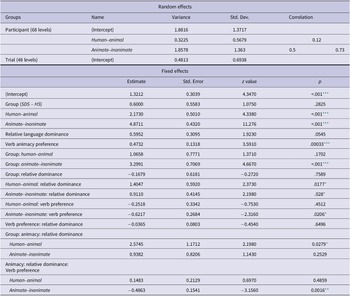
For optimal model selection, random effects were subjected to likelihood ratio tests (LRTs) to ascertain whether each effect improved the fit of the generalized linear mixed-effects model (GLMM; significance threshold: p = .05). All random effects significantly improved the model fit. Subsequently, fixed effects selection was performed iteratively using the drop1 function in R’s stats package – which also employs LRTs – starting with the maximal fixed-effects structure until the only terms that remained were those that significantly improved the model fit. The fixed effects significance threshold of p = .1 was chosen for exploratory analysis (see Gries, Reference Gries2021) of VerbPref and Dominance. Table 2 summarizes the optimal GLMM results.Footnote 5 The three-way Group-Animacy-Dominance interaction was the only term returned by drop1 with an LRT p-value between .05 and .1 (p = .0532), suggesting that it moderately improves the fit, so it was included in the GLMM.Footnote 6 The implications of the less conservative threshold are addressed below in the context of this interaction. All remaining fixed effects either improved the model fit significantly or were lower-order constituents of interactions that significantly improved the fit.
Summary of results of GLMM of elicited production data (total number of observations: 2,805)

Note: The term animate refers to the sum of human and animal trials.
* indicates a p-value below 0.05,
** indicates p-value below 0.01 and
*** indicates a p-value below 0.001.
6.1.1. Group and animacy
Figure 3 depicts the Animacy-based patterns from the EPT for both speaker groups. The model returned a significant main effect of Animacy. Estimated marginal means (EMMs) were computed with pairwise contrasts for Animacy using the emmeans package (Lenth, Reference Lenth2024) with Tukey’s method for multiple comparisons. All pairwise contrasts returned significant (all ps ≤ .001). Thus, human DOs were more likely to occur with DOM than both animal and inanimate DOs, and animal referents were more likely to be marked compared to inanimate referents.
Observed group-level patterns of a-marking in Experiment 2 according to DO animacy.

The main effect of Group was not significant. However, a significant Animacy-by-Group interaction emerged with a between-group difference in the likelihood of a-marking between animate and inanimate DOs. Pairwise EMMs revealed a significant Group difference for the human–inanimate contrast (estimate = 3.78, SE = .957, p = .0001) and the animal–inanimate contrast (estimate = 2.77, SE = .634, p < .0001), but not for the human–animal contrast (p = .1990). The estimates indicate that the SDSs were significantly less likely to use DOM with inanimate DOs and more likely to use DOM with human DOs compared to the HSs. However, both groups produced similar DOM patterns with animal referents. Between-group differences related to Animacy are considered further in the Discussion section.
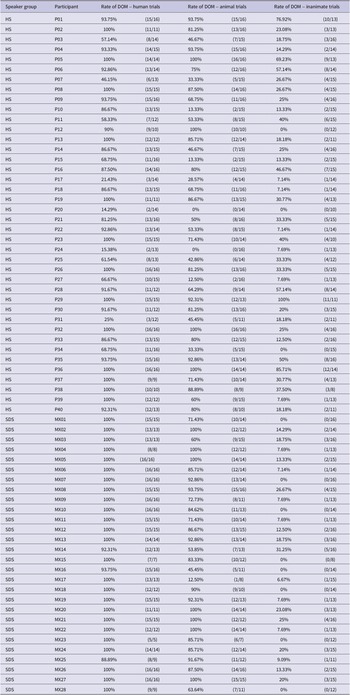
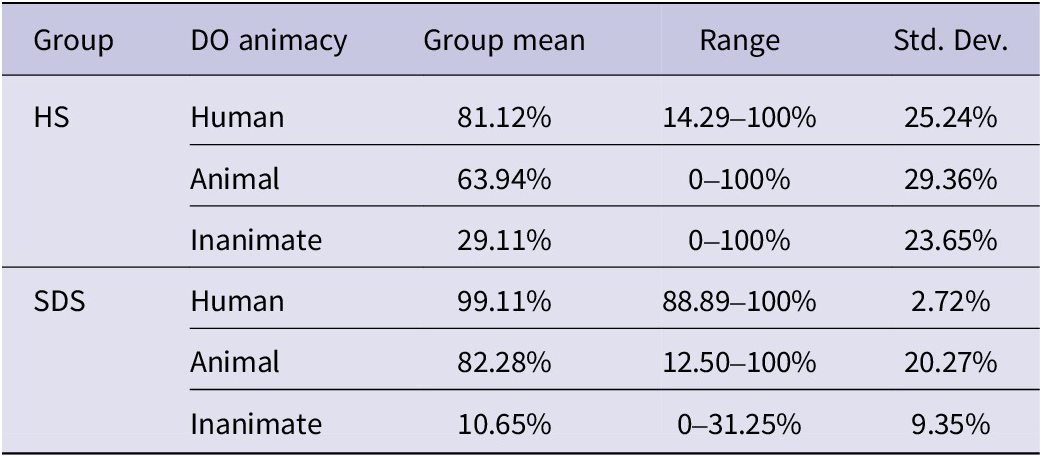
Moreover, between-speaker differences in Animacy-based patterns emerged. By-Participant random slopes for the Animacy factors significantly improved the fit of the GLMM, evidenced by an LRT (χ 2(5) = 42.03, p < .001). This improved fit suggests that by-Participant differences in Animacy-related patterns account for significantly more variance in the data. Table 3 includes all individual participants’ average responses for each level of Animacy. Table 4 shows the group means, ranges and standard deviation values for each Group. Notably, 23 HSs fall within the SDS range for human-referent DOM; 38 fall within the SDS range for animal-referent DOM and 26 fall within the SDS range for inanimate-referent DOM.
Individual rates of marking for each participant across the three levels of animacy. Numbers in parentheses indicate the number of marked trials out of total number of trials

Descriptive statistics of elicited production results by speaker group and by animacy condition

6.1.2. Verb animacy preference
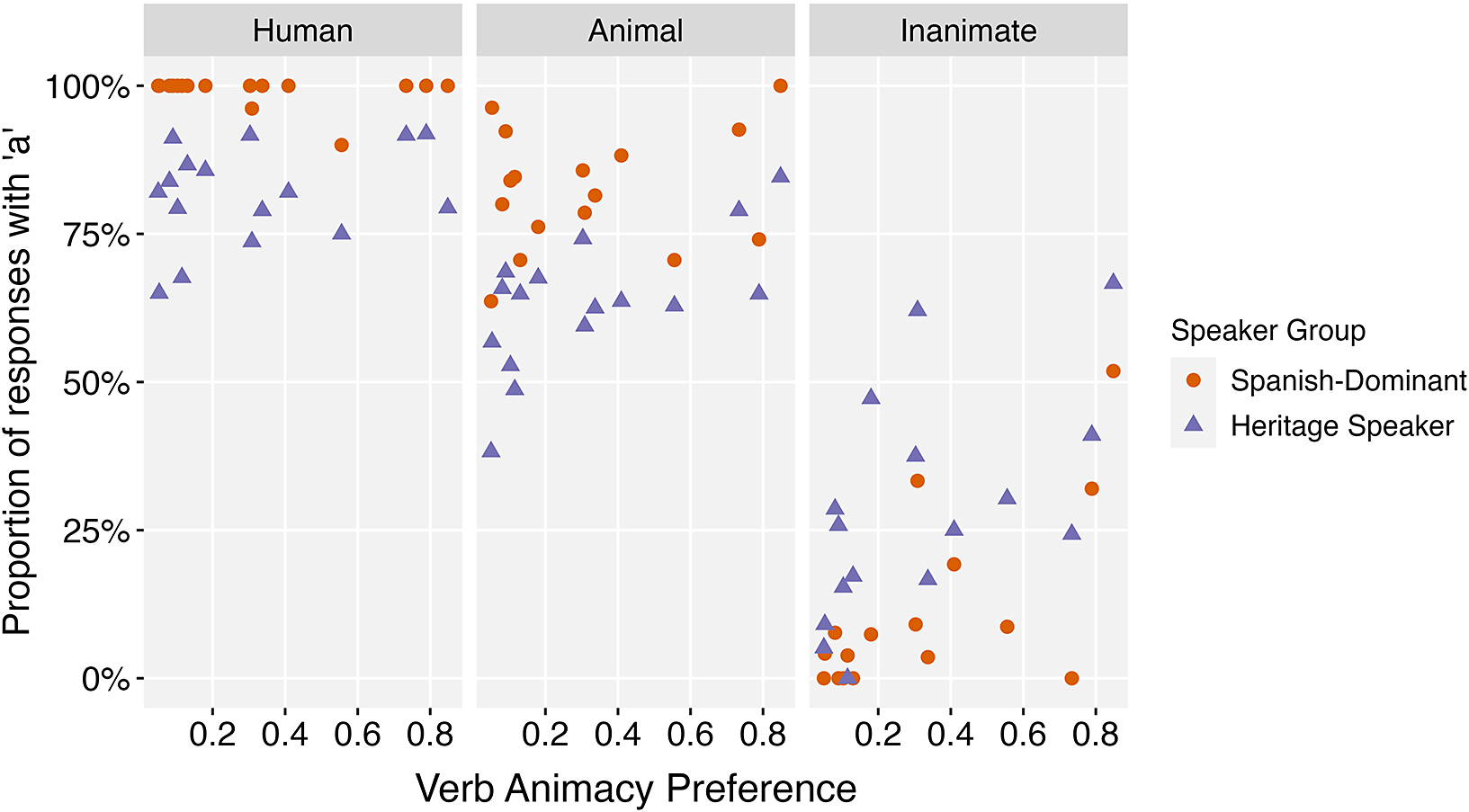
The VerbPref results by Group and by Animacy have been visualized in Figure 4. The main effect of VerbPref was found to be a significant predictor of DOM in the GLMM. Thus, DOM is significantly more likely as a verb’s bias toward animate DOs increases. There is also a significant interaction between VerbPref and Animacy. Tukey-adjusted EMMs of the Verb Preference effect for each contrast of Animacy revealed that the VerbPref trend approaches significance for the human–inanimate contrast (estimate = −.738, SE = 0.335, p = .0709), but is not significant for the animal–inanimate or human–animal contrasts (both ps > .1).Footnote 7 The negative coefficient for the human–inanimate contrast suggests that the effect of VerbPref may trend somewhat more positively on inanimate trials relative to human trials.
Observed verb-level patterns of a-marking according to Verb Animacy Preference, Animacy and Group in Experiment 2. Each point represents the value for one of the 16 verbs.
Note: x-axis represents proportion of animate responses from Experiment 1.

All predictors involving Group-by-VerbPref interactions were excluded from the GLMM because the drop1 function deemed them as “droppable” from the model. All LRTs for dropping these predictors were nonsignificant (all ps > .1), which indicates that Group-related differences in the conditioning of DOM by VerbPref do not explain a significant amount of variance in the model. Thus, it is likely that both groups of bilinguals make use of VerbPref in similar ways. VerbPref is addressed in the next section summarizing Relative Dominance results and Group-related similarities and differences are discussed further in the general Discussion.
6.1.3. Relative dominance
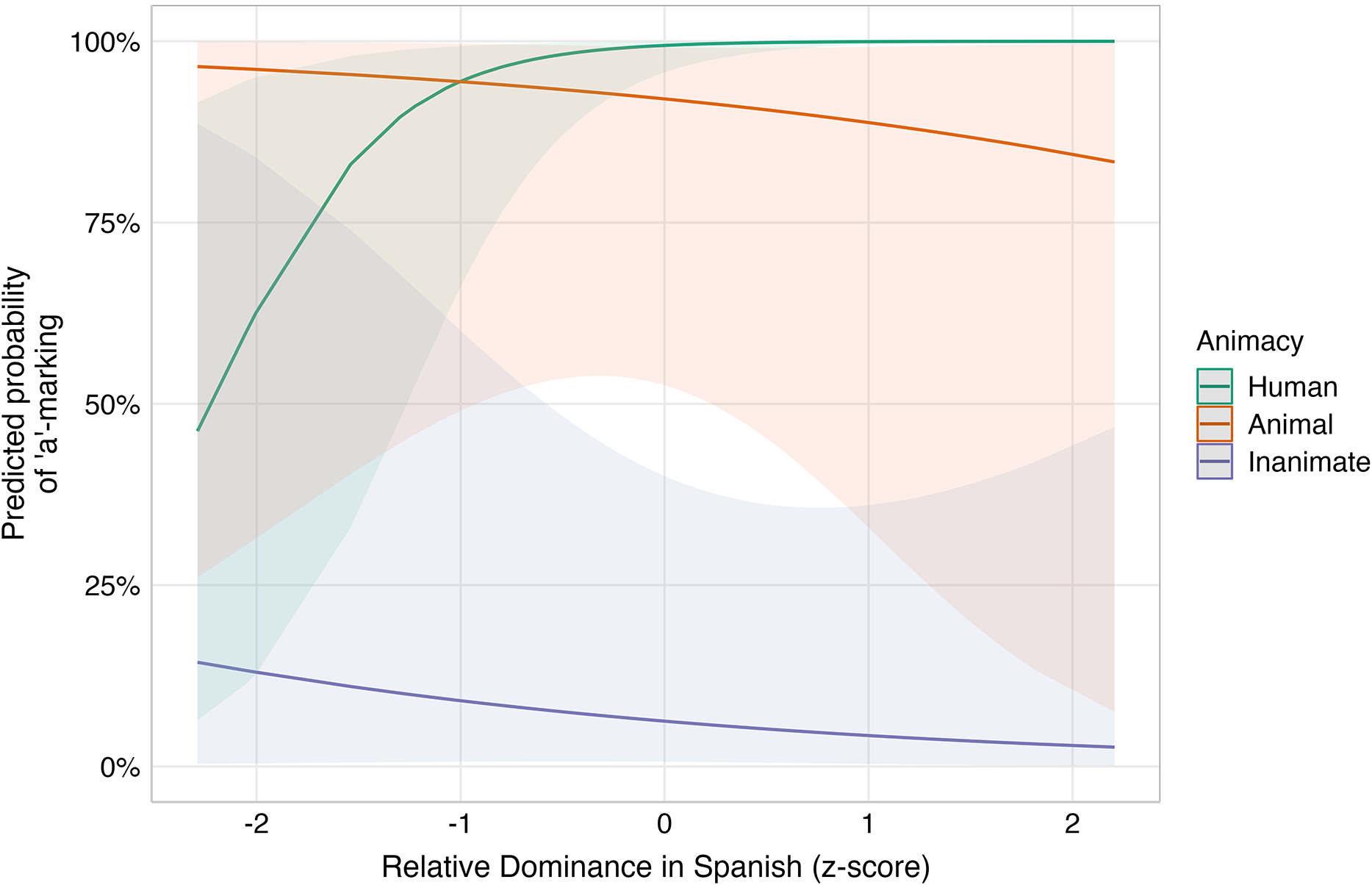
The main effect of Relative Dominance did not emerge as significant, although it approaches significance (p = .0545), indicating that the likelihood of DOM increases somewhat with higher Dominance. Moreover, a significant two-way interaction between Animacy and Dominance emerged and suggests that the likelihood of DOM increases as Dominance increases, particularly for human trials (see Figure 5). EMMs adjusted with Tukey’s method revealed that the Dominance effect is significantly more positive for the human–inanimate contrast (estimate = 1.605, SE = .648, p = .0352) and the human–animal contrast (estimate = 1.407, SE = .592, p = .0459). Thus, the trend of the Dominance effect is significantly more positive on human trials relative to inanimate and animal trials, while the Dominance trends for inanimate and animal trials are somewhat negative. No significant difference in the Dominance effect was found for the animal–inanimate contrast (p = .8039).
GLMM-predicted effects of the interaction between Relative Dominance, Group and Animacy in Experiment 2.

Although two-way interactions for Group-by-Dominance and VerbPref-by-Dominance were not significant, a significant three-way interaction for Group-Dominance-Animacy emerged. EMMs with Bonferroni correction revealed only a moderate Group difference in Dominance for animal trials (estimate = −.974, SE = 0.456, p = .0973) and no significant differences for either inanimate or human trials (both ps > .1). Moreover, this three-way interaction only moderately improved the fit of the GLMM (χ 2(2) = 5.8663, p = .0532). Thus, it appears that Dominance does not significantly influence Group-related differences for Animacy.
Dominance and Animacy also interacted jointly with VerbPref. The EMMs for this three-way interaction revealed that, as VerbPref increases, the Dominance effect becomes significantly more positive on inanimate trials (estimate = .973, SE = .308, p = .0048) and moderately more negative on animal trials (estimate = −.709, SE = .298, p = .0521). Thus, higher Dominance in Spanish is associated with significantly greater likelihood of DOM on inanimate trials but somewhat lower likelihood on animal trials with verbs that have a higher animacy preference (see Figure S1).
7. Discussion
The present study set out to explore patterns of variability in the grammatical production in Spanish–English bilinguals. Experiment 1 aimed to discover verb-specific preferences for animate and inanimate DOs in Spanish. Experiment 2 examined the use of Spanish DOM in English-dominant HSs of Spanish who grew up in the United States and Spanish–English bilinguals who grew up in Mexico. The findings are discussed in the context of four RQs.
7.1. RQ1: Verb-specific animacy preferences
The results of Experiment 1 demonstrate that certain verbs have clear preferences for animate and inanimate DOs. These lexical preferences provide potential insight into previous findings on verb-related effects on DOM. Specifically, Montrul and Sánchez-Walker (Reference Montrul and Sánchez-Walker2013) observed a trend that verbs that take either animate or inanimate DOs (e.g., visitar ‘visit’) yielded more DOM with animate DOs than verbs that almost exclusively take animate objects (e.g., abrazar ‘hug’). In Experiment 1, the “either-or” verbs show gradient verb-object co-occurrence probabilities such that some verbs have a relatively higher preference for animate objects such as visitar ‘visit’ (40.91%) compared to others like ver ‘see’ (8.09%). By classifying all either-or verbs together, Montrul and Sánchez-Walker did not account for this gradient animacy bias. As gradient lexical frequency effects have been found to correlate with HSs’ grammatical production (e.g., Hur, Reference Hur, Mardale and Montrul2020; Hur et al., Reference Hur, Lopez Otero and Sanchez2020), a continuous measure of lexically particular biases seems more suitable for explaining such variability (see discussion of RQ3 below).
7.2. RQ2: Animacy effects (between-group and between-speaker variability)
The EPT obtained from Experiment 2 provide evidence that the Animacy Scale (Aissen, Reference Aissen2003) constrains both bilingual groups’ use of DOM in predicted ways. In both groups, animal-referent DOs were less likely to be marked than human, but both animal and human referents were more likely to be marked than inanimates. Group-related differences in animacy patterns emerged, such that HSs were less likely than SDSs to mark human-referent DOs. This pattern corroborates previous findings of similar group-related patterns (e.g., Montrul & Bowles, Reference Montrul and Bowles2009; Hur, Reference Hur, Mardale and Montrul2020; Jegerski & Sekerina, Reference Jegerski and Sekerina2020). Overall, these findings support the notion that HSs of Spanish maintain knowledge of the gradient constraint of animacy on DOM.
Between-speaker variability in DOM according to DO animacy also emerged. By-participant slopes for the animacy factor revealed that inter-speaker variability in the animacy conditioning of DOM accounts for a significant portion of variance in the mixed-effects model. Table 3 reveals between-speaker differences based on animacy. This variability ranges from P29 who produced 100% DOM with human and inanimate referents – and 92.31% with animal referents – to P20 who marked 14.29% of human DOs and never marked animal or inanimate referents (both HSs). Some participants produced distinct patterns of DOM for each level of animacy (e.g., P2 and MX15), while other participants produced similar DOM rates across all three levels of animacy (e.g., P29 and P11). Another pattern highlights within-speaker variability: some participants’ DOM patterns for animal and human are nearly identical (e.g., MX04 and P32), while animal and inanimate DOs pattern closely together in other speakers (e.g., MX17 and P10). Thus, both between- and within-speaker variation in animacy conditioning emerges in both bilingual groups. This finding suggests that DOM may be more probabilistic rather than categorical across Spanish-speaking populations.
The present study also reveals smaller between-group differences for animal referents relative to human referents. Importantly, some previous studies have grouped animal and human referents together when analyzing DOM production (Jegerski & Sekerina, Reference Jegerski and Sekerina2020; Ticio, Reference Ticio2015). Requena (Reference Requena2023a) demonstrates how collapsing across levels of animacy renders comparisons between baseline speakers and HSs unreliable. In the present study, both the SDSs and HSs demonstrated similar variable patterns of DOM with animal referents. Thus, this study provides evidence that variable grammatical patterns in the baseline can be maintained in heritage grammars. Future studies investigating grammatical patterns in HSs should consider linguistic variation either to highlight variable patterns or, at the very least, to ensure comparability of stimuli and conditions in (psycho)linguistic experiments.
Finally, the group-related differences for a-marking of inanimates deviate from previous studies of DOM with HSs of Spanish. The HSs in Experiment 2 were more likely to produce a-marking with inanimate DOs compared to SDSs. Previous studies have not shown such between-group differences in inanimate DO marking. Indeed, the SDSs’ DOM rates with inanimate DOs in the present study (group mean: 10.65%) align with those in all speaker groups (range: 8%–12.5%) in Montrul and Sánchez-Walker (Reference Montrul and Sánchez-Walker2013). However, the HSs in the present study show a much higher group mean of 29.07%, including one participant who produced DOM 100% of the time with inanimate DOs.
One possible explanation for the boosting of DOM with inanimate DOs is that HSs may experience morphosyntactic priming. Because the EPT included twice as many animate trials relative to inanimate trials, and the same 16 verbs were used in all three animacy conditions, the HSs may have been susceptible to priming (see Hurtado & Montrul, Reference Hurtado and Montrul2021) due to lexical boost effects (e.g., Rowland et al., Reference Rowland, Chang, Ambridge, Pine and Lieven2012). Indeed, HS participants who produced more a-marking with inanimate DOs also tended to produce more a-marking in the other two animacy conditions. However, this proposal does not explain why the SDSs in the present study showed no such boosting of DOM on inanimate trials, so it remains speculative.
Another explanation for HSs’ over-marking of inanimate DOs is that they are advancing linguistic change (Kupisch & Polinsky, Reference Kupisch and Polinsky2022). Other HL studies have found boosting of variable grammatical patterns present in baseline grammars (Nagy & Lo, Reference Nagy and Lo2019; Felser & Uygun, Reference Felser and Uygun2022). Nagy and Lo (Reference Nagy and Lo2019) ascribe HSs’ more frequent use of a Cantonese noun classifier in singular contexts to language change. Arechabaleta Regulez and Montrul (Reference Arechabaleta Regulez and Montrul2021) found little overextension of DOM to inanimate DOs in monolingual Mexican Spanish speakers’ production, but no differences in their comprehension of marked and unmarked inanimate DOs. HSs’ boosting of DOM with inanimate DOs in production suggests a more advanced stage of this overextension, as production has been claimed to follow comprehension in morphosyntactic change in progress (Lundquist et al., Reference Lundquist, Rodina, Sekerina and Westergaard2016). To test this hypothesis of linguistic change more directly, a baseline group of migrant bilinguals with extended residence in the United States would need to be examined.
7.3. RQ3: Verb animacy preferences (within-group variability)
The findings from Experiment 2 reveal an important role for verb-particular effects in Spanish DOM building upon verb-related trends found in Montrul and Sánchez-Walker (Reference Montrul and Sánchez-Walker2013) as well as recent findings on the important role of lexical effects in heritage grammars (e.g., Giancaspro et al., Reference Giancaspro, Perez-Cortes and Higdon2022; Perez-Cortes & Giancaspro, Reference Perez-Cortes and Giancaspro2022). Participants were significantly more likely to produce DOM with verbs that had higher preferences for animate DOs, regardless of animacy. This finding diverges from Montrul and Sánchez-Walker’s study in which animate-biased verbs yielded higher rates of DOM omission with human referents compared to verbs with more variable animacy biases.
However, similar to Montrul and Sánchez-Walker’s findings, the results of the present study show that higher preference for animacy significantly increases the likelihood of a-marking with inanimate DOs in both bilingual groups. This pattern follows from the historical patterns of DOM with animate DOs. The earliest observable patterns of DOM in Spanish reveal that a-marked human-referent DOs occurred most frequently – but still variably – with animate-biased verbs (around the 12th–14th centuries) and gradually spread to verbs with lower animacy preferences (von Heusinger & Kaiser, Reference von Heusinger, Kaiser, Kaiser and Leonetti2007). If DOM in (Mexican) Spanish is beginning a change-in-progress regarding inanimate DOs (e.g., Company, Reference Company, Wishcer and Diewald2002), these verb-specific effects may play a role in that change.
Importantly, lexically particular patterns play a role in both SDSs’ and HSs’ use of DOM. The absence of significant group differences for the effect of verb animacy preference suggests that HSs produce baseline-like lexically constrained patterns of DOM. Verb animacy preferences may also explain within-speaker variability. Given the significant between-speaker variability related to the animacy constraint, it remains possible that some speakers have a stronger ranking of the verb preference constraint relative to animacy in their individual grammars. Future studies may be able to explain potential intra-speaker variability further along these lines.
HSs’ divergence from SDSs in this study suggests restructuring of DOM in the heritage grammar. Specifically, in the case of inanimate- and human-referent DOs, the HSs seem to use DOM probabilistically while the SDSs produce more deterministic patterns of DOM. While both groups seem to constrain their DOM use by verb animacy biases to some extent, the HSs may overgeneralize this effect across levels of animacy, although they still maintain baseline-like knowledge of the relative conditioning of DOM following the Animacy Scale. The HSs may overgeneralize the verb animacy bias constraint because their relatively less frequent exposure to Spanish input renders a verb’s co-occurrence with DOM a more reliable cue for DOM than animacy alone.
Importantly, the HSs’ patterns of DOM do not stem from influence of English or Spanish nor early language attrition. Instead, these divergent grammatical patterns based on lexical properties stem from variation present in the baseline group (i.e., the SDSs in Experiment 2), although the baseline shows a more restricted distribution. This explanation of lexically specific patterns coincides with Flores and Rinke’s (Reference Flores and Rinke2020) recommendation to consider variation in the baseline as a potential source of variation in heritage grammars.
7.4. RQ4: Relative language dominance (between-speaker variability)
Bilingual participants’ language dominance – in Spanish relative to English – played a significant role in Experiment 2. Participants with higher dominance scores were particularly more likely to produce DOM with human DOs than those with lower dominance scores. Between-group differences in the effect of dominance did not arise. This dominance-related inter-speaker variability may be explained by the proposal that individuals with higher dominance in Spanish are expected to use or hear DOM more often than individuals with lower dominance, and, thus, they can activate the DOM-relevant feature of animacy more easily (Putnam & Sánchez, Reference Putnam and Sánchez2013; Perez-Cortes et al., Reference Perez-Cortes, Putnam and Sánchez2019).
Our results demonstrate that language dominance affects both English-dominant HSs of Spanish and bilinguals raised in a Spanish-dominant environment. This finding suggests that a continuous measure of language dominance may reveal important patterns of between-speaker variability in grammatical production in bilinguals beyond HL populations. Dominance is similarly expected to affect L1 Spanish speakers who migrated to an English-dominant environment later in life. Between-speaker differences in language dominance are likely why some studies have found divergent patterns of DOM production when comparing Spanish-dominant migrant bilinguals to HSs raised in the United States (Jegerski & Sekerina, Reference Jegerski and Sekerina2020; Hur, Reference Hur, Mardale and Montrul2020), while others have found nonsignificant differences (Montrul & Sánchez-Walker, Reference Montrul and Sánchez-Walker2013; Montrul, Reference Montrul2014).
Finally, verb animacy preferences also seem to contribute to dominance-related DOM patterns in the present study. With verbs that have stronger biases for animate DOs, higher Spanish dominance correlated significantly with a higher likelihood of marking inanimate DOs. Thus, dominance explains between-speaker variation in the effect of verb-particular animacy preferences. From this pattern, it seems that overgeneralizing DOM to inanimate contexts with animate-biased verbs is a more baseline-like pattern rather than a pattern traceable only to less Spanish-dominant HSs.
8. Conclusions
The present study provides evidence for baseline-like variation in DOM production in English-dominant HSs of Spanish. The approach taken in this study seeks to highlight similarities between HL and baseline speaker groups, while still considering between-group differences. Findings regarding HSs’ divergence from baseline coincide with findings from previous research. Moreover, the present study reveals systematic patterns of DOM constrained by the same linguistic factors – animacy and verb-specific biases – in both groups of bilinguals, but to different extents in each group. Between-speaker variability is also observed in both groups of bilingual speakers. By considering individual differences in language dominance in both the baseline and heritage groups, we may gain a better understanding of HSs’ divergence from and maintenance of baseline grammars.
Importantly, the divergent patterns of DOM found in the HSs are systematic as they are predictable by effects of individual verbs. Building on recent HL approaches (e.g., Shin, Reference Shin2022; Perez-Cortes & Giancaspro, Reference Perez-Cortes and Giancaspro2022), this finding offers further evidence for systematic lexical effects in heritage grammars. Variable baseline patterns offer a better explanation for the variability in HSs’ DOM use than potential influence of the majority language or early language attrition. In sum, the findings of this study demonstrate that apparent variability in heritage grammars can be structured, and approaching variation in HL grammars as one would variation in other native grammars offers deeper insight into patterns of HL acquisition and maintenance.
Supplementary material
To view supplementary material for this article, please visit http://doi.org/10.1017/S1366728924000555.
Data Availability Statement
The data that support the findings of this study are openly available via the Open Science Framework at https://doi.org/10.17605/OSF.IO/UHCQN.
Acknowledgments
The author is grateful to all the participants who took part in this study. Many thanks to Karen Miller, Rena Torres Cacoullos and Naomi Shin for their thoughtful comments on previous versions of this article. The author would like to thank Matt Carlson for his suggestions regarding data visualization and analysis. Data collection for this study was funded by the Department of Spanish, Italian and Portuguese at Penn State.
Competing interest
The author(s) declare none.





 Open access

