




Introduction
‘The situation in the hospital is still impossible to describe because these words do not exist in the dictionary’, wrote a doctor to a European Commission official in June 1965.Footnote 1 The hospital in question was built in Mogadishu in 1962 as part of the development aid package that was provided by the newly established European Economic Community (EEC). The fourth part of the Treaty of Rome (25 March 1957) stated that one of the objectives of the EEC was to promote ‘the economic and social development’ of non-European territories that had colonial relations with one of the six member states.Footnote 2 These territories, which were associated with the Community, included the French colonies of Africa, the French overseas departments that were scattered across the Atlantic and the Pacific, the Belgian colonies of Rwanda-Urundi and Congo, Dutch New Guinea and Italy’s United Nations trusteeship of Somalia. At the time of the Treaty, Somalia was the only territory associated with the EEC that was certain of its imminent independence, because the trusteeship that had been established in April 1950 with the explicit aim of preparing the territory for self-government was due to expire in 1960.Footnote 3 To finance projects in the associated territories, the EEC established a European Development Fund (EDF). Funded by the six member states, it was managed directly by a Directorate-General of the European Commission, the Direction Générale développément (DGVIII).Footnote 4 From 1959 (the year in which the EDF began to operate) until 1969, the EEC allocated more than $70 million (about 6 per cent of total EDF disbursements) to the health sectors of the associated countries, which was then used to finance medical research, train new doctors and construct around sixty hospitals. The 730-bed Mogadishu hospital was the largest single project in this area and was intended to be the most modern medical institution on the African continent.Footnote 5
Apart from its size and importance within the EDF projects, this hospital deserves scholarly attention because it offers a privileged perspective on several historiographical themes, such as Cold War aid competition, Western medical aid, the concrete implementation of EEC development aid and the complex transition from colonial to postcolonial rule. Since the 1950s, development interventions by the United States and Soviet Union in newly independent African countries were a crucial component of Cold War competition and a method for advancing alternative and competitive ideas about modernisation.Footnote 6 Health improvement measures in the so-called Global South also formed part of these competing visions of modernity.Footnote 7 The governments of both socialist and capitalist countries conceived of health development primarily in terms of constructing large hospitals or launching large-scale campaigns to eradicate individual diseases.Footnote 8 The literature on medical diplomacy has been blossoming recently, especially with regard to the socialist bloc.Footnote 9 Some of this research has specifically focused on the construction, staffing and management of hospitals as sites through which to understand the lived experience of East–South relations.Footnote 10 Comparatively less is known about the hospitals that were provided by countries from the Western bloc. Historiography of Western medical aid has so far focused primarily on the institutional history of the World Health Organization (WHO) and its support for eradication campaigns against malaria and smallpox.Footnote 11 Building upon existing studies of socialist medical aid, the case of the EEC hospital in Mogadishu can thus shed light on the challenges of Western medical assistance.
The European Commission sometimes presented EEC aid as a third, Eurafrican way that was distinct from Cold War bipolarism.Footnote 12 The EEC had Eurafrican origins, stemming from an intellectual tradition dating back to the inter-war period that advocated mutual association between Europe and Africa. The Treaty of Rome also made the EEC Eurafrican in a more concrete sense by associating the colonies of its member states with the Common Market.Footnote 13 This was largely due to the French government’s desire to maintain the French empire while sharing the costs with the other EEC countries. The Yaoundé Association and its successors, as well as the EDF disbursements, fostered a special relationship between the EEC and the African continent. Nevertheless, the concept of Eurafrica as a distinct geopolitical project had already faded by the early 1960s due to nationalist pressures in African countries and anti-imperialist movements in Western Europe.Footnote 14 As the case of the Mogadishu hospital shows, EEC aid was an integral part of Western aid. When the Somali government refused to pay for the hospital’s running costs and threatened to transfer the management of the new building to the Soviet Union, the EEC did not hesitate to seek financial support from the United States, but to no avail. In turn, the Somali government played on Cold War rivalries to secure a greater financial commitment from the EEC than it was initially prepared to give. The negotiations over the Mogadishu hospital perfectly reflect how ‘officials in the superpowers used development aid as a Cold War weapon while constituencies in recipient nations used the Cold War as a development weapon’.Footnote 15
So far, scholars working on the EEC’s development policy have either written institutional histories of the DGVIII or considered EEC cooperation only in terms of its diplomatic significance.Footnote 16 Martin Rempe’s research on the impact of EEC aid in Senegal has been instrumental in highlighting some of its specificities compared to other international organisations and to colonial antecedents.Footnote 17 The social history of EEC aid remains underexplored, and this article’s focus on the functioning of a hospital staffed by a heterogeneous European medical team offers new insights in this field. Compared to other development projects, hospitals required doctors, nurses, administrative and auxiliary staff to work closely together and cooperate on a daily basis in order to function. Therefore, hospitals offer a vantage point from which to understand what it meant to introduce a European development project in a territory previously controlled by a single European state: in short, to look at EEC aid in the making. In Mogadishu, this project was complicated not by the relationships between Europeans and Somalis but rather by relationships between Europeans, or as some doctors called it, ‘European tribalism’.
Tensions arose because of not only the different nationalities and cultural backgrounds of hospital workers but also the different and sometimes contradictory ways in which the various actors involved understood decolonisation. Doctors arriving from the Belgian colonies accused Italian doctors of maintaining colonial practices but were themselves accused of being colonialists by the Somali government. Analysing a development project that was approved before Somalia’s independence and implemented thereafter allows us to better understand this transitional period and its contradictions. These contradictions were even more pronounced in the complex field of public health policy, within which both international agencies and national governments were attempting to break with colonial precedents but were still strongly constrained by the institutional legacies of the colonial medical past.Footnote 18 This study also allows us to deepen our knowledge of the Italian presence in post-independence Somalia by looking at the remarkable influence that some Italian doctors maintained within the Somali government.Footnote 19
Although the doctor quoted at the beginning of this article stated that the situation in the hospital was impossible to describe, he and his colleagues assiduously tried to recount their experiences to the European Commission. This dense correspondence, preserved in the historical archives of the European Commission and of the European Union, is supplemented by other documents from numerous Belgian and Italian archives. These diverse collections of sources make it possible to study the social history of this aid operation in all its various aspects: in other words, to carry out its anatomy. The article is divided into three sections. The first section focuses on the origins and the construction of the hospital up until the arrival of the European doctors in 1964. The second part examines the main conflicts that arose between doctors during the first, most difficult years of the hospital’s operation. The third and last section explores how the conflicts were gradually smoothed over and how the hospital was finally handed over to Somali doctors at the beginning of the 1970s.
Early Problems in a ‘Modern Hospital’ (1958–64)
At the end of November 1958, a DGVIII mission, led by Director-General Helmut Allardt, visited Mogadishu to study potential development projects that could be financed by the EDF. On this occasion, Somali Prime Minister Abdullahi Issa Mohamud informed Allardt of the unanimous decision of the Council of Ministers to request the construction of a ‘modern hospital’. In accordance with EDF procedures, which required proposals to be submitted by the metropolitan authorities, the request was presented by the representatives of the Italian Ministry of Foreign Affairs in January 1959.Footnote 20 At this time, Mogadishu’s 60,000 inhabitants could access three Italian-built hospitals: the De Martino with 644 beds; the Forlanini, which specialised in tuberculosis and infectious diseases, with 544 beds; and the Rava hospital for gynaecology, obstetrics and paediatrics, with 36 beds.Footnote 21 The new 730-bed hospital was to replace the De Martino, which was too close to the sea and exposed to humidity, salt and the southern monsoon, and which the Italians had been planning to replace since the 1930s.Footnote 22 The EEC hospital was to be built on a dune three kilometres from the sea and would be cheaper to maintain.Footnote 23 Abandoning the separate pavilions of the De Martino, the new hospital was designed as a single, multi-storey, ‘rational’ building that followed the ‘functional’ hospital model that had become widespread in the Global North between the two world wars.Footnote 24
From the outset, however, the project raised doubts amongst the representatives of international organisations. Representatives of the UN, WHO and UNICEF who were based in Mogadishu assessed the project negatively and argued that the running costs of the hospital would be too high and that the existing hospitals were already sufficient for the city.Footnote 25 A report written by a Dutch doctor sent to Somalia on behalf of the WHO stated that a modern hospital of this kind was unsuitable for Africa and even convinced the Dutch government to oppose the project. The project was finally approved only by a majority vote of the Commission in early July 1959.Footnote 26 This early opposition to the project testifies to the persistence of alternative visions of health and development in the field of primary healthcare, which first emerged in the 1930s. These critiques would gain momentum in the 1970s and materialised into an international consensus with the Alma-Ata Declaration of 1978.Footnote 27 The EEC hospital’s approval by a majority vote is thus an example of how the need for balanced health services was sacrificed to Cold War logic and the expectations of postcolonial leaders. The latter regarded the construction of large urban hospitals as an unquestionable symbol of modernity that would meet the needs of the new elites and could be presented to the wider population as a tangible result. The contract notice, estimated to cost $2.15 million, was won by Deg-Fer, an Italian company based in Reggio Emilia. Deg-Fer was particularly active in Africa and specifically in Mogadishu, where it also built a sports centre and a hotel in 1960.Footnote 28 The first stone was laid on 18 June 1960 during the celebrations held to mark the country’s independence.Footnote 29
Abdirashid Ali Shermarche, who obtained a degree in political science from La Sapienza University in Rome in 1959 on a scholarship from the Italian administration, became the first prime minister of independent Somalia. In the words of the Italian ambassador, he ‘entered the international arena with great vigour and vivacity’.Footnote 30 He confirmed Somalia’s association with the EEC and obtained an astonishing increase in the EDF funds allocated to his country.Footnote 31 At the same time, Somalia received Soviet aid as soon as it became independent.Footnote 32 Cold War rivalry was particularly tense in Mogadishu: the hospital itself had been designed by the EEC explicitly to emulate Soviet infrastructure development plans in the Gulf of Aden.Footnote 33
This Cold War dynamic became more acute after the hospital was completed in early 1962, when the Somali government refused to close the De Martino hospital. The government declared that the 1959 financing agreement for the new hospital, which included a commitment to closing the De Martino hospital, was not binding because it had been signed by the Italian Trusteeship. This left the EEC with two alternatives: either the EDF would cover the running costs of the new hospital, or the Somalian government, which was unable to pay for both hospitals, would ask the Soviet Union and the United Arab Republic for financial support.Footnote 34 Since the EDF was not allowed to cover the running costs of its projects, in April 1962 the DGVIII asked Belgium, West Germany, the Netherlands, Italy and the United States to provide the doctors and pay their salaries for the new hospital.Footnote 35 In the same month, Italy also tried to find additional funding for the hospital in the tripartite meeting it held with the United States and the United Kingdom on Somalia.Footnote 36 Despite an initial positive response from Germany and a promise from the United States to seek alternative sources of funding, the DGVIII found no one willing to pay for its hospital.Footnote 37
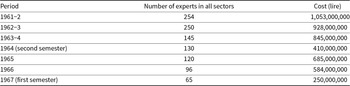
Italy, the country most involved in the project, faced public pressure to reduce its financial commitment to Somalia after the end of the Trusteeship. Law no. 1528, adopted on 29 December 1961, outlined a decrease in Italy’s financial commitment to Somalia for the following six financial years, which would ultimately halve the financial assistance over five years (see Table 1).Footnote 38 In April 1962, there were twenty-four doctors in Mogadishu: fifteen were Italians, as well as five Egyptian and four Soviets who replaced the Italian doctors who had left due to the reduction in Italian assistance.Footnote 39 The Italian Foreign Ministry proposed replacing twelve Italian technicians with an equal number of doctors, but the Somali government refused. The ambassador in Mogadishu, Enrico Guastone Belcredi, advised the Ministry not to proceed unilaterally with the withdrawal of personnel, arguing instead that it was ‘better not to disrupt our technical assistance’ and to accept the presence of a dozen Egyptian and Soviet doctors and try to make it ‘go unnoticed’.Footnote 40 By this time, the Somali government had already requested potential technical assistance for the new hospital from the Soviet Union, Egypt, Yugoslavia, Czechoslovakia and the WHO.Footnote 41 Meanwhile, the Soviet Union had built and staffed two fifty-bed hospitals in Somalia and offered to pay for the EEC hospital if it could be guaranteed that all the doctors would be Soviet citizens – a request that the Somali government rejected.Footnote 42
Table 1. Italian technical assistance to Somalia (1961–7). Source: Relazioni Culturali Tra Italia E Somalia E Assistenza Tecnica, Undated (Dec. 1967), 4, ASDMAE, DGAP X, 33

The threat of Soviet involvement prompted the European Commission to make an exception to the EDF rules. Moreover, it persuaded Belgium and the Netherlands to provide doctors through bilateral aid, despite the fact that Belgium had no diplomatic relations with Somalia and the Netherlands had voted against the project.Footnote 43 In March 1964, the EEC took charge of the hospital equipment and provided most of the funding for thirty-one doctors over three years. The EEC provided eleven doctors and paid the difference between the EEC salary and the salaries of the doctors provided through bilateral aid from Italy (15), Belgium (3) and the Netherlands (2).Footnote 44 Finding candidates was not easy, as the contractual conditions proposed by the EEC were less advantageous than in other African hospitals, which meant that many positions remained vacant in the following years.Footnote 45
Prime Minister Abdirashid Ali Shermarche requested that priority be given to doctors who had already worked in Somalia.Footnote 46 In order to expedite the opening of the hospital, he sent the list of the fifteen Italian doctors already in Mogadishu and the positions they were to occupy.Footnote 47 The Commission, while reserving the possibility of assessing their qualifications, accepted this request in principle.Footnote 48 Vincenzo Sessa, a doctor in the Italian army who had worked in Somalia before 1959, was recruited as director and returned to Mogadishu in May 1964 to open the hospital.
Sessa’s mission soon proved impossible. First, he found that the problem of recruiting nurses for the new hospital had not been treated with the same care as that of recruiting doctors. The original plan was to transfer the seventeen nuns of the Consolata congregation who were working as nurses at the De Martino.Footnote 49 This choice was dictated by economic considerations because nuns cost less than professional nurses who had been trained in Europe. However, the Mother Superior of the Consolata opposed the idea, despite insistent requests by the DGVIII, the Vatican Secretariat of State, the Italian Foreign Ministry, the Prefect of the Congregation for the Propagation of the Faith and the Bishop of Mogadishu.Footnote 50 The Congregation’s reports note that the nuns’ living and working conditions in Somalia were becoming increasingly difficult, ‘especially in the hospitals’.Footnote 51 In general, the Congregation wanted to leave Somalia: they complained that Islam had spread within the population and denounced the ‘impressive increase of filo-communists’.Footnote 52 When Sessa arrived in Mogadishu, the issue of nurse recruitment remained unresolved. The slow pace of the Somali government in inviting tenders for equipment and staffing the new hospital with local nurses further complicated matters.Footnote 53
The Italian doctors working at the De Martino themselves did not cooperate for fear of losing their privileges at the new hospital. A Belgian doctor reported to the European Commission that an Italian colleague had said he ‘did not want the hospital to work at all’ since he was a doctor at the De Martino and had several wealthy private clients who made his work far more profitable than the EEC contract.Footnote 54 The resistance of Italian doctors also tried Ali Shermarche’s patience. During a meeting with the Italian ambassador at the end of July 1964, he complained that many Italian doctors were resorting to sources of income that were ‘not always acceptable’ and ‘to the detriment of [the Italians’] good name’. If less than a year earlier he had suggested that the European Commission recruit doctors from among the Italians already in Mogadishu, he had now changed his mind: a ‘replacement of the various elements’ was ‘desirable, especially those who have been in Somalia for a long time and are too compromised’ and who ‘look after their own interests’. The Italian ambassador echoed these sentiments.Footnote 55 In addition, the rest of the European medical team arrived in July 1964 to find that the hospital was not operational, that they were mocked by the local Italian doctors and, crucially, that they would not be paid until September. Finding the situation unbearable, Sessa shot himself on 9 September 1964.Footnote 56
‘European Tribalism’ (1964–5)
‘Years of badly done, badly planned work and extreme difficulty in getting things moving have washed over me. As a good soldier, with peace of mind and a clear conscience, I pay the price.’Footnote 57 These last words, written by Sessa shortly before his suicide, clearly identify the situation at the hospital as a key motivating factor. This fact was confirmed by both the Somali Commission of Inquiry that was set up to investigate his death and the Italian Embassy in Mogadishu.Footnote 58 After Sessa’s death, the European Commission recommended Giovanni Bottero, the head of general medicine and the oldest doctor at the De Martino, as an interim director of the new hospital.Footnote 59
Bottero, who was Ali Shermarche’s private doctor, was in fact one of the Italian doctors who tacitly opposed the EEC hospital. When one of the Belgian doctors asked him if there was anything he could do while waiting for the hospital to become operational, Bottero allegedly replied that ‘the climate in Mogadishu is nice, so you just have to enjoy the beach’. The gynaecologists, one Belgian and one Dutch, and the Belgian paediatrician had managed to open their units autonomously in September, but on 21 September they received a formal order from the Somali government, at Bottero’s instigation, to close them.Footnote 60 The Belgian and Dutch doctors were thus forced to spend their time reading, going to the beach and taking Italian lessons, but they also sent a letter of complaint to the DGVIII: ‘We will remember the Italian professori for a long time!’Footnote 61 The letter was signed by three Belgian doctors who had already run hospitals in Belgian colonies – anaesthetist Réné Albert Van Bellinghen, gynaecologist Guy Pieters and paediatrician Jules Charles Émile Parent – and by the younger but highly qualified Dutch gynaecologist J.W. Boesaart, who was working in Africa for the first time.Footnote 62 Parent wrote ‘what a mess (quel b . . .)’ next to his own signature.
The DGVIII sent Pierre Bolomey and Alois Heinemann to Mogadishu in October to assess the situation, and these two officials had been carefully chosen from among its non-Italian members. According to Bolomey, the rift between Italian and non-Italian doctors could be resolved by opening the hospital.Footnote 63 However, the hospital could not be opened, not only because it lacked equipment and staff but also because there was no money to pay for it.Footnote 64 Furthermore, in a memorandum that the Belgian doctors gave to Bolomey, they objected to the fact that the staff hierarchy placed all doctors under the authority of two Italian head doctors (primari), Giovanni Bottero and Guido Böhm. They claimed that this hierarchy, which allowed a specialist in internal medicine and a surgeon to oversee all other medical specialities, was nowhere to be found ‘in truly modern hospitals in Europe’.Footnote 65 The DGVIII had originally decided to structure the medical staff in a pyramid rather than divided into autonomous sectors to reduce costs, with only two doctors being paid as head doctors.Footnote 66 However, Bottero and Böhm used this structure to prevent the ‘foreigners’ (stranieri, used to refer to the other European doctors) from working freely.
On 29 October 1964, almost thirty months after the hospital’s completion, Bolomey forced the opening of the hospital’s first clinics with the explicit aim of keeping the doctors busy.Footnote 67 The European doctors who had arrived in Mogadishu in July 1964, when the hospital was originally scheduled to open, finally began working two hours a day after three months of forced unemployment.Footnote 68 The hospital’s opening also served to score points in the race to deliver development aid. Rumours that the Somali government intended to abandon the Yaoundé Convention that it had recently signed with the EEC were circulating in Egyptian and Soviet propaganda.Footnote 69 On 5 November 1964, the Somali prime minister, Abdirizak Haji Hussein, formally requested that the EDF cover the hospital’s operating costs for an additional five years, which would amount to approximately $5 million.Footnote 70
The European Commission proposed Italo Gentilini, the former director of the De Martino in the 1940s, as the new hospital director.Footnote 71 His candidature was opposed by Bottero, who did not want to hand over the reins, and by some Italians with considerable influence in the Somali government: the director of the National Somali Bank and member of the national leadership of the fascist party Movimento Sociale Italiano, Francesco Palamenghi-Crispi, and the adviser to the Somali Ministry of Planning, Enrico Crostarosa. They claimed that Gentilini was not authoritative enough and that Italy needed to put forward younger candidates.Footnote 72
Concerned about this opposition, Gentilini agreed to take up his duties only if the European Commission would send a representative to permanently support him.Footnote 73 The lack of equipment and nurses, as well as the overall funding situation, remained significant problems.Footnote 74 At the end of November, the Somali Minister of Health unilaterally announced Gentilini’s appointment without consulting him and without waiting for the arrival of the EEC representative.Footnote 75 Bolomey again travelled to Mogadishu in order to convince the Minister to postpone the opening of the hospital until January.Footnote 76
The hospital was officially inaugurated on 4 January 1965.Footnote 77 Four days later, the EEC member states were asked to decide whether to continue the EDF contribution to the hospital: the Netherlands voted against, Belgium abstained, the others voted in favour.Footnote 78 Following a decision on 21 January 1965, the European Commission assumed the costs of all non-Somali medical and technical personnel for three years.Footnote 79 The EEC’s commitment, however, did not make everyday life in the hospital any easier.
The first problem was that the Somali government, after receiving European funding, tried to keep the hospital under its control. It refused to recognise the authority of Antoine Carlin, whom the EEC had sent in January to assist Gentilini as the hospital’s administrative director. Carlin was a French general of whom little is known except that he spoke Italian, having lived in Ethiopia and in Tripoli.Footnote 80 The Commission tried to strengthen Carlin’s position and authorised him to hold talks with the government on behalf of the DGVIII.Footnote 81 Carlin had to contend with increasing interference in the running of the hospital by the Somali Ministry of Health, which intercepted all correspondence from Brussels.Footnote 82
Somali control over the hospital was also manifested in the medical fees. The government refused the EEC’s request for the hospital to be managed autonomously by the director.Footnote 83 Despite having built and staffed the hospital, the EEC had little control over its functioning. The Somali government imposed high fees on patients at the EEC hospital while continuing to subsidise the De Martino.Footnote 84 This turned the EEC hospital into a clinic for the upper classes, whose fees were collected directly by the Ministry of Finance, which left the hospital with no money for basic medications. Giving birth at the hospital cost as much as 50 litres of premium petrol and an appendectomy cost the equivalent of 225 litres. EEC doctors had to turn people away because they could not pay: ‘This gives the population a very bad impression of the “aid” offered by Europe’, remarked gynaecologist Boesaart.Footnote 85 The EEC hospital was known as ‘the hospital for the wealthy, ministers and deputies’, while the De Martino, which was now being run by Soviet, Egyptian and Chinese doctors, was known as ‘the hospital for the poor’.Footnote 86 In fact, wealthy people sought treatment abroad because they were unconvinced that the EEC hospital could offer an adequate level of care.Footnote 87
The EEC hospital fared badly in the competition for patients. While the De Martino was forced to turn people away due to lack of space, the EEC hospital had an average of just 104 patients in its first six months, 40 of whom were treated in the gynaecological department.Footnote 88 The latter had been opened during the night of 24–5 January on the initiative of the Ministry of Health and Gentilini, despite warnings from Boesaart and Pieters that the unit could not operate under ‘average safety conditions’. The two gynaecologists were forced to keep the unit open, even though they could not provide the mothers with proper linen or anything to quench their thirst at night, nor could they give the newborns a single gram of milk other than breast milk.Footnote 89 Tragedy was just around the corner. The wife of a WHO doctor, who went into post-operative shock after gynaecological surgery in the hospital, was saved ‘by a hair’s breadth’: her husband wrote that ‘if the patient had been anybody else, she would not be alive at this moment’. The maternity ward was not equipped with transfusion kits, bottles of plasma or physiological solution, and the staff were not trained to care for a critically ill patient. Blood and other transfusion kits were supplied by the United States Embassy Dispensary, and several friends donated blood to help in the emergency.Footnote 90 However, a woman died after haemorrhaging, and Boesaart and Pieters, who had originally denounced the unit as unsafe, were taken to court to be held responsible.Footnote 91
The second problem was the struggle between the Italian medical head doctors and the other doctors, which was exacerbated by the hospital’s opening. While Böhm and Bottero claimed to have technical supervision over all the departments, some doctors declared that they would never have signed a contract if they had known that they would be accountable to anybody other than the hospital director.Footnote 92 The gynaecologists complained that Böhm prevented them from operating, taking over gynaecological cases himself and leaving only some obstetric operations to the more qualified ‘foreigners’.Footnote 93 These doctors were forced into seven months of inactivity.Footnote 94 ‘In modern hospital organisation [specialists] enjoy complete autonomy’, Gentilini acknowledged before asking the European Commission: ‘Do you decide? Are you leaving me as the arbitrator? For my personal peace and security, I would prefer you to give us precise instructions.’Footnote 95 The Commission replied that specialists must work ‘completely independently under the sole authority of the medical director’.Footnote 96
Gentilini, however, was unable to enforce the orders. He believed that the hospital could function if Böhm and Bottero were removed but, as he confidently said, one ‘would have to start by blowing up the Italian embassy in Mogadishu’ in order to get rid of them.Footnote 97 The head doctors continued to behave as they wished. They spent barely any time at the hospital and kept their private clients.Footnote 98 As early as August 1964, Sessa had written to Bottero and Böhm instructing them to stop seeing their private clients. On 26 October 1964, during his mission on behalf of the DGVIII, Bolomey reminded all the doctors of their obligation to work full-time. On 4 March 1965, Carlin reiterated that freelance work would lead to a breach of contract. All this fell on deaf ears, and several Italian doctors justified themselves on the basis of their low wages.Footnote 99 Gentilini also allowed surgeon Böhm to practise gynaecology and paediatric surgery, pulmonologist Bottero to practise internal medicine and paediatrics and urologist Lucio Lupattelli to practise gynaecology and obstetrics. The first child operated on by Böhm on 4 February died after an allegedly simple operation.Footnote 100 ‘A hospital that started with a suicide of honour and opened its surgical department with a murder does not bode well. Intelligenti pauca!’ Boesaart and Pieters commented.Footnote 101 At the end of May 1965, the DGVIII ordered the creation of a medical committee to monitor the observance of deontological norms.Footnote 102 But even when this new body voted against the head doctors, Böhm and Bottero did not respect the decision.Footnote 103
Among the many words used by the doctors in their correspondence, the most common was ‘mess’, sometimes referred to specifically as an ‘Italian-style mess’ (bordel à l’italienne).Footnote 104 In contrast, Italian doctors who were already in Mogadishu when the hospital was built saw the new hospital as an unwanted interruption to their otherwise quiet lives. Böhm wrote in a memorandum:
Italian doctors have been in Somalia for decades. They have always performed well and have earned the esteem and trust of the rulers and the population. On the rare occasions when some have not behaved well, they have been immediately repatriated by the Italian authorities.
Since Somalia’s independence, they have collaborated in the old Hospitals with Doctors of the most varied origins (such as Egyptians, Russians, Pakistanis, Poles, etc., and more recently Chinese). There has always been agreement and, above all, tolerance, understanding, cooperation and mutual respect.
Ever since the arrival of some of the EEC doctors, always the same and by now well known, they have started to disorganise the entire hospital system and above all to offend, insult and try to devalue the work of Italian doctors, the Chiefs of Service in particular and of Italians in general . . .
The task of the Technical Assistants is also to set a good example and to prepare the Somali Doctors both technically and morally. What good example can come of that?Footnote 105
Others, however, thought otherwise. Carlin wrote that Gentilini had no authority, that the non-Italian doctors formed a united bloc and were sometimes ‘too sensitive’, whereas the Italian doctors were scheming with one another.Footnote 106 Some Italian doctors who were ‘backed in high places’ were convinced that they were ‘untouchable’.Footnote 107 The northern European doctors thought that they were constantly sabotaged by the Italians and felt that both Carlin and Gentilini were unable to enforce the rules. They found the Italians’ attitude reminiscent of a ‘fascist spirit’, as well as ‘a certain “mafia” spirit’.Footnote 108 In contrast to their Italian colleagues, they conceived of the hospital as a laboratory for both European integration and decolonisation. Pieters accused Gentilini of ‘discriminating on a national level at a time when Europe is being built’.Footnote 109 Boesaart complained that northern doctors were treated as ‘“stranieri” in the midst of an Italian milieu, rather than as colleagues within an EEC milieu’.Footnote 110 With the integration process still in the making, it was not a given that European technicians would cooperate on a development project. Pieters and Van Bellinghen would later write that they had been ‘victims of European tribalism’, interestingly using one of the most common orientalist labels.Footnote 111
Nonetheless, the northern European doctors acknowledged that there was a minority of Italian doctors who wanted to ‘work in a modern way’.Footnote 112 On 2 July 1965, one doctor, the head of the anaesthesia service, resigned because of his disappointment with the lack of willingness to work as a team on the part of some of his colleagues. The loss of one of the few collaborative Italian doctors prompted Carlin to ask the Commission for permission to remove Böhm and Bottero. He preferred that the Somali authorities declared him ‘an undesirable in the Territory’, assuming that the government would have protected the two Italian doctors, rather than to be ‘“nibbled away” [at] little by little’.Footnote 113 The European Commission supported the move but clashed with the Somali Ministry of Health, which asserted its desire to ‘have complete freedom to decide on future recruitment and the retention of existing staff’.Footnote 114 During the summer holidays of 1965, Bottero spent three weeks with the prime minister as his personal doctor.Footnote 115 Because of this close personal relationship, Carlin could not touch the Italian doctors.
The Somalisation of the Hospital (1966–70)
In September 1965, the Somali government asked the EEC to recall thirteen doctors, but Böhm and Bottero were not among them. When asked to revise the list, the Somali government reduced it to four doctors – Ralf Vosseler, Lupattelli, Pieters and Van Bellinghen – who were to be removed ‘at all costs’, as well as Director Gentilini, who was guilty of being ‘too condescending’ (trop bon). The DGVIII was only able to secure a delay to Gentilini’s departure.Footnote 116 The four doctors were accused of intolerance ‘of discipline’, disrespect ‘for hierarchy’, ‘unorthodox behaviour towards in-patients and patients under treatment, little attachment to their duties’ and ‘lack of friendliness towards the public and colleagues’.Footnote 117 The DGVIII wanted to replace these doctors with colleagues of the same nationality.Footnote 118 The Belgian representative to the EEC bought time but, as he explained to Foreign Minister Paul-Henri Spaak, he did not want to replace them: ‘The Mogadishu hospital is an unfortunate operation, and the opinion has often been expressed that it would have been much better to abandon it as soon as the difficulties began. This was not done, and the Community felt obliged to continue, on the pretext that Mogadishu had a Soviet hospital.’Footnote 119
While it is undeniable that the request to remove the Belgian doctors favoured the Italian head doctors, it is also true that the removal of Vosseler and Lupattelli, the latter being Böhm’s right-hand man, was also strongly desired by Carlin because of their behaviour.Footnote 120 In sum, this decision was likely driven by a genuine attempt by the Somali government to remove the most contentious doctors on both sides without directly affecting the Italian ‘big bosses’. This did not mean that things remained the same. The Somali government finally agreed to reduce the hospital’s fees. It made this concession to the EEC because it was unable to fulfil its financial duties, namely covering the salaries of the Somali staff. Consequently, the government requested a one-year moratorium to the EEC until May 1966, in exchange for fulfilling a number of requests that Brussels had long called for. First, the fees for hospital stays, visits and exams were cut by half. Second, these fees would now be retained in a special fund controlled by the hospital. Third, half of the beds were made available free of charge. The Somali government also committed itself to equalising the fees between the De Martino and the EEC hospital.Footnote 121 As a result, the number of in-patients suddenly increased after September 1965 and almost tripled within two months, though never reaching the hospital’s full capacity (see Graph 1). This workload prevented the Italian doctors from maintaining their ‘quiet little life’, which consisted of ‘a vague service in the hospital and a private clientele treated with the utmost respect’.Footnote 122 As a further demonstration of dissatisfaction, Giovanni Bottero resigned and left the hospital at the beginning of December 1965.Footnote 123 At the end of the same month, Pieters and Van Bellinghen also returned to Europe.

Graph 1. Number of hospitalised persons registered on the last day of each month. Source: Comité du FED, Note D’information Complémentaire: Fonctionnement de L’hôpital de Mogadiscio, Feb. 1967, 1–2, HAEC, BAC 9/1974_1643.
On 31 January 1966, Pieters and Van Bellinghen were received at the DGVIII headquarters. Pieters claimed that the hospital was ill suited ‘to the medical needs of the country’: too big, too far from the city and too expensive to maintain. He praised the multinational composition of the medical team as ‘an effective decolonisation effort’ that was nevertheless jeopardised from the outset by Böhm and Bottero and the recruitment of unqualified Italian doctors from Somali territory.Footnote 124 Pieters and Van Bellinghen argued that the two head doctors regarded them as dangerous competitors because they had already managed a hospital. Moreover, Van Bellinghen’s work as an anaesthetist had made him a witness to some of the hospital’s worst medical practices. The Somali authorities also knew about Pieters’s history in Congo.Footnote 125 In February 1961, he had signed the death certificate of Patrice Lumumba, writing that the Congolese leader had died in the forest. This fact led several African countries to reject Pieters’s candidacy, both before and after his time in Somalia.Footnote 126 It is likely that Lumumba’s death certificate was used as an additional pretext to force Pieters to leave Mogadishu.
Prime Minister Haji Hussein intended to remove all doctors who had served in African colonies because they were ‘incapable of understanding the evolution of a people’.Footnote 127 The Somali government also claimed that Pieters had not adapted to the ‘black Muslim mentality’ and that the personal lives of both Pieters and Van Bellinghen were ‘in danger’.Footnote 128 Carlin admitted that non-Italian doctors, although better qualified, ‘too often consider[ed] only the “disease” and ignored the “patient”’, and that they suffered from a superiority complex. The consequent disregard for religion and ‘tradition’ led to problems with patients and their families.Footnote 129 It is difficult to understand the exact nature of these problems because, although the doctors were open about many aspects of hospital life, they mostly maintained professional confidentiality about operations and patients in their letters. The fact that in 1964 Bottero refused an order for medications from the gynaecology department because it contained Narcovene suggests that caesarean sections were opposed in the hospital.Footnote 130
In 1966, things began to calm down. Carlin reported that the recriminations had ceased.Footnote 131 Boesaart and Parent, who had been granted leave until May 1966, never returned. Despite the fact that several medical posts remained vacant, that shortage of qualified nurses persisted and that local unqualified staff were paid irregularly, if at all, Carlin’s reports to the DGVIII did not reveal any new major problems.Footnote 132
On 1 April 1967, the Somali Ministry of Health appointed Heinz Bayer as the new director of the hospital, replacing Gentilini. Bayer had worked at the Charité in Berlin from 1939 to 1949, then spent ten years as head of otorhinolaryngology in the government service of Ceylon and five years as a full professor and director of the Ear, Nose and Throat Clinic in Kabul, before arriving in Mogadishu in 1964 as part of the European team.Footnote 133 The other two candidates for the post, Böhm and Lanzo, who had replaced Bottero in July 1966, left the hospital shortly afterwards.Footnote 134 On 25 July 1967, at the end of the EDF’s three-year financial commitment to the hospital, the European Commission and the Somali government signed a new agreement in which the latter committed itself to taking on the entire cost of the hospital within two years.Footnote 135
Bayer ran the hospital in an authoritarian manner, abolishing the medical committee and forbidding doctors to write directly to their embassies without first going through his office.Footnote 136 He introduced an attendance register, which was filled in by everyone except two Italian doctors, ophthalmologist Federico Longo and otologist Nicolò Di Fonzo. The former, who had been in Somalia since July 1958 and had worked at the De Martino until 1964, allegedly went to the EEC hospital for a few hours a day and was ‘extremely unpopular within the Ministry of Health’. Di Fonzo had apparently committed grievous errors during several operations and Bayer wanted ‘a young EEC (French, German, Benelux) person who is not burdened with a colonial mentality’ to replace him.Footnote 137
Bayer’s direction led to a reckoning with the Italian doctors, who accused him of being strict with them while being more lenient with the Somali doctors. The number of Somali doctors at the EEC hospital had indeed increased rapidly, reaching fourteen by the end of 1967, which made them the majority. Some departments, such as paediatrics, were completely Somali.Footnote 138 Most of the Somalis had been trained in Italy, although assistant surgeon Mohamed Scek Ali Munasser, whom Bayer personally praised for his independence and ‘sense of responsibility’, had studied in Rome from 1957 to 1959 thanks to a scholarship from the Italian Trusteeship, but then spent two years specialising in Moscow.Footnote 139
On 27 October 1967, seven Italian doctors signed a long collective petition against Bayer, enclosing forty-five documents. According to a DGVIII official, this was ‘a real conspiracy of the Italian doctors against Professor Bayer’ in which ‘fortunately’ only a third of the Italians participated: ‘it’s a great step forward’, he commented.Footnote 140 The DGVIII clearly supported Bayer but asked him for greater dialogue, claiming that the EEC ‘could not afford a new hospital crisis’.Footnote 141 Bayer was also supported by the Somali government, and on 21 November 1967, the Somali Ministry of Health invited the Italians to collaborate. But when six doctors resigned on 3 December 1967, the first minister repeatedly accused the DGVIII of ‘unfairness’ towards them. The Somali Ministry of Health claimed that this change of heart was due to pressure from the Italian Embassy and Somalia’s need for Italian funding.Footnote 142 The prime minister did not want to dismiss the six Italian doctors because Italy’s foreign minister, Amintore Fanfani, was expected to visit Somalia in January to discuss Italy’s future commitments.Footnote 143 The Italian Embassy repeatedly intervened ‘with the necessary firmness’ against Bayer, arguing that he needed to adopt ‘methods more in keeping with the guiding principles of this important Community initiative inserted in an environment where the special ties that exist between Somalia and Italy retain all their weight and value’.Footnote 144 The EEC hospital was not even mentioned during the meeting between the Somali prime minister, Muhammad Haji Ibrahim Egal, and Fanfani.Footnote 145 The Italian doctors’ departure was eventually delayed until February 1968.Footnote 146
As the situation improved and the number of European doctors working at the hospital dwindled, the archival trail dries up. We know that at the end of 1968 the director of the EDF asked Italy, France and West Germany to cover the cost of the doctors through bilateral aid after the expiry of the agreement in the summer of 1969, arguing that Somalia was ‘a veritable battleground for peaceful competition between Russians, Americans, Chinese and Europeans’.Footnote 147 Finally, the EEC agreed to extend its commitment until 31 May 1970. In the summer of 1969, Minister of Health and Labor Mohamed Scek Mohamed Dahir travelled to Brussels, Paris, Bonn and Rome to negotiate bilateral aid to support the hospital after the cessation of EEC funding. The Ministry’s annual budget at the time was 20.5 million Somali shillings, and almost a third of this was needed for the EEC hospital. The alternative proposed at the time was to hand the hospital over to the Czech Republic, Egypt, China or even Pakistan.Footnote 148 On 15 October 1969, Ali Shermarche was assassinated, and six days later Siad Barre seized power, establishing a dictatorial regime that would last until 1991. By November 1970, thirty-six of the forty-two doctors at Mogadishu hospital were Somali, including the director.Footnote 149
Conclusion
The functioning of the Mogadishu hospital was the result of constant negotiations between very different actors at many levels. At the diplomatic level, these negotiations took place between the Somali government and the EEC, and the former had the upper hand. Threatening to enlist the help of the EEC’s Cold War adversaries, Somalia forced the EEC to pay most of the hospital’s running costs throughout the 1960s. It also decided when to open wards, when to reduce fees and which doctors were to be transferred and when, regardless of recommendations from Brussels. While the Somali government managed to keep avoiding the financial burden, it never relinquished control of the hospital. The other side of the coin was the country’s almost non-existent financial resources, which made it economically dependent on foreign aid for both economic growth and political consensus. Both so-called donors and the Somali government wanted development aid to materialise through tangible construction. The competition for aid and the lack of a consistent and sustainable health policy led to questionable results. In 1967, when the Somali Ministry of Health was struggling to cover its share of the costs of the EEC hospital and regularly failing to pay the salaries of its workers, two more hospitals were built in Mogadishu. The Soviet Union built a new 200-bed hospital for the Somali army, while Italy built and West Germany equipped a 130-bed hospital for the police.Footnote 150
The Somali government was thus far from being independent, and the story of the EEC hospital also reveals the persistence of Italian influence after July 1960. This influence, however, did not go through the official channels of diplomacy but was more informal and involved specific individuals, such as the leading doctors in the hospital. Despite Gentilini’s words about the need to bomb the Italian Embassy to get rid of Böhm and Bottero, the latter were in fact protected by their personal contacts with Somali politicians and not by the Embassy, which had already taken a stand against them in 1964. The Embassy only (unsuccessfully) intervened directly on behalf of certain Italian doctors at the end of 1967 on the grounds that they were allegedly being discriminated against by the new German director of the hospital. If the departure of Italian doctors was delayed, it was only because of the planned visit of the Italian foreign minister.
The impotence of the European Commission with regard to its own development project is undeniable. Letters, orders and visits from DGVIII officials had little impact on the fate of the hospital and its doctors. This has several historiographical implications. First, it suggests that the rhetoric of DGVIII officials did not define the character of EEC development aid to the extent to which existing studies have assumed.Footnote 151 Local contexts shaped EEC development projects, rather than the discourses and (self-)representation of the institution funding them from Brussels.
Moreover, examining the concrete implementation of a development project allows for a more nuanced appreciation of neocolonial continuities and postcolonial ruptures. In the Mogadishu hospital, those who openly positioned themselves as de-colonisers against the recalcitrant Italian doctors were Belgian doctors who had not only worked in colonies but also been deeply involved in efforts to thwart the independence of new states, such as Pieters in the Lumumba affair. Therefore, the case of the Mogadishu hospital demonstrates that continuity in colonial personnel did not necessarily mean continuity in colonial practices.Footnote 152 Former colonial officials could act as decolonising agents in new contexts and institutions.
Although it is important not to assume continuities between the colonial and postcolonial context, both the colonial legacy and the struggle for independence deeply shaped the strategy adopted by the Somali government with regard to the hospital. For example, Belgian doctors were removed by the Somali government. Their removal was down to the influence of a few Italian doctors but also rooted in the government’s discomfort with the behaviour of the Belgian doctors, their colonial past and their medical practice, which they believed revealed a superiority complex and indifference to the local context. The Somali government was adept at exploiting the doctors’ colonial pasts to discredit them at the most opportune moments.
Finally, the tensions between doctors working at the hospital bring to the fore a crucial aspect of EEC development assistance that has been so far overlooked. Just as European integration was a long process whose fate in the 1960s was anything but decided, so too were European development projects similarly uncertain. Bringing together European specialists (in this case doctors) to carry out a development project was a task with innumerable obstacles, including nationalist rivalries and suspicions, as well as fears and expectations about decolonisation. We should avoid running the risk of reading history backwards and regarding the establishment of EEC development policy as a linear process. The experience of development that doctors at the hospital lived through was as much about participating in the aid competition of the Cold War world in order to carve out a space within postcolonial contexts as it was about European cooperation under the auspices of a newly established organisation.
There is a tragic irony in the more recent history of the Mogadishu hospital. On 17 June 1993, during the second United Nations operation in Somalia (UNOSOM II), UN forces bombed the hospital, suspecting that the leader of the Somali National Alliance, Mohammed Farah Aidid, had taken refuge there. At the time of the attack, there were approximately 380 patients and 230 hospital staff. Eleven artillery shells and US Cobra helicopter gunships hit the hospital, killing scores of civilians.Footnote 153 Accounts of the attack are generally silent on the origins of the hospital and do not mention that it was built by the EEC, but one account claims that the Digfer Hospital, as it was known with a mis-transliteration of the Italian building company, was ‘built by the Soviet Union in the 1960s’.Footnote 154 Apart from being destroyed by French, Italian, Moroccan and US weapons, the building’s European roots had already been forgotten by the 1990s and misattributed to its Cold War counterpart, whose attempts to become involved in the hospital in the 1960s were fiercely resisted. In recent years, the hospital has been restored and staffed by the Turkish Cooperation and Coordination Agency (TIKA). The former Digfer Hospital is now known as the Recep Tayyip Erdogan Hospital: inaugurated on 25 January 2015, it is the largest hospital in Somalia, although it ‘only’ has 200 beds. According to Galip Yilmaz, TIKA’s coordinator in Somalia, it is ‘the most advanced and modern hospital in East Africa’.Footnote 155
Acknowledgements
This research has been long in the making. I received valuable feedback from participants at the international conference ‘Worlds of Social Policies: Local and Global Dimensions of Change since 1945’ (Lisbon, 6–7 February 2020), the international workshop ‘Debating Humanitarianism’ (Florence, 28–9 May 2024) and the international conference ‘Towards a History of European Developmentalism: Development, Modernization and Europeanization from the 19th to the 21st century’ (Hamburg, 19–21 March 2025). Special thanks to Silvia Salvatici and Annalisa Urbano, who read and commented on previous drafts. I also wholeheartedly thank the anonymous reviewers and Siobhán Hearne, whose insights significantly helped refine the article into its final form.
Funding
Part of the research for this article has been supported by the project ‘HumanEuroMed – Humanitarianism and Mediterranean Europe: A Transnational and Comparative History (1945–1990)’, funded by the European Research Council under the European Union’s Horizon 2020 research and innovation programme (Grant Agreement 101019166).


 Open access

