


Introduction
‘Scythian animal style’ represents a distinct and dynamic artistic tradition characterised by stylised depictions of animals, sometimes in multifigure compositions, rendered in gold, bronze and other materials across a wide range of utilitarian, ritual and funerary artefacts (Jacobson Reference Jacobson1995; Aruz et al. Reference Aruz, Farkas and Fino2006; Menghin et al. Reference Menghin2007). These motifs are not purely decorative; they possibly encode symbolic and social meanings tied to cosmology, status and identity (cf. Farkas Reference Farkas1977; Cunliffe Reference Cunliffe2019; Sharkey Reference Sharkey2022). From bridle fittings and weapons to clothing appliqués, felt items, vessels and rock art, the style served as a unifying visual language across the mobile pastoralist societies of the Eurasian Steppe from the seventh to the second centuries BC. The literature on the Scythian animal style is extensive, reflecting more than a century of scholarly effort to trace its origins and development (cf. Artamonov Reference Artamonov1970; Ryabkova Reference Ryabkova2005; Simpson & Pankova Reference Simpson and Pankova2020; Kantorovich Reference Kantorovich2022; Amir & Roberts Reference Amir and Roberts2023). Frameworks once considered authoritative have been revised or overturned in light of new archaeological discoveries. The once-prevalent model of a gradual eastward diffusion of Scythian-type cultures—with the animal style as one of its defining features—lost traction after the discovery of early examples of animal-style artefacts in southern Siberia (cf. Gryaznov Reference Gryaznov1980; for a consideration of the nuances of the term ‘Scythian’, see Caspari Reference Caspari, Baumer, Novák and Rutishauser2022). The most plausible current framework for an origin of Scythian animal style is the Central Asian hypothesis (Terenozhkin Reference Terenozhkin1976; Yablonsky Reference Yablonsky, Davis-Kimball, Bashilov and Yablonsky1995a; Cunliffe Reference Cunliffe2019), which sees the Scythian animal style as emerging from indigenous steppe traditions rooted in South Siberia and Inner Asia, particularly among early nomadic groups (Savinov Reference Savinov2017). Yet, even within this framework, considerable ambiguity persists, particularly given the imprecise or unknown dating of many animal-style artefacts.
In this context, the discovery of animal-style artefacts at the Tunnug 1 site in Tuva, securely dated to the late ninth century BC, is especially pertinent. These finds belong to the era of early nomadic culture formation and appear to represent an emerging aesthetic tradition. As so few securely dated ‘Scythian-type’ monuments from this period have been documented—and perhaps only very few exist—such artefacts are invaluable for understanding the indigenous development of the animal style. They offer a rare glimpse into the genesis of a visual system that would later spread across the steppe and become emblematic of Scythian identity.
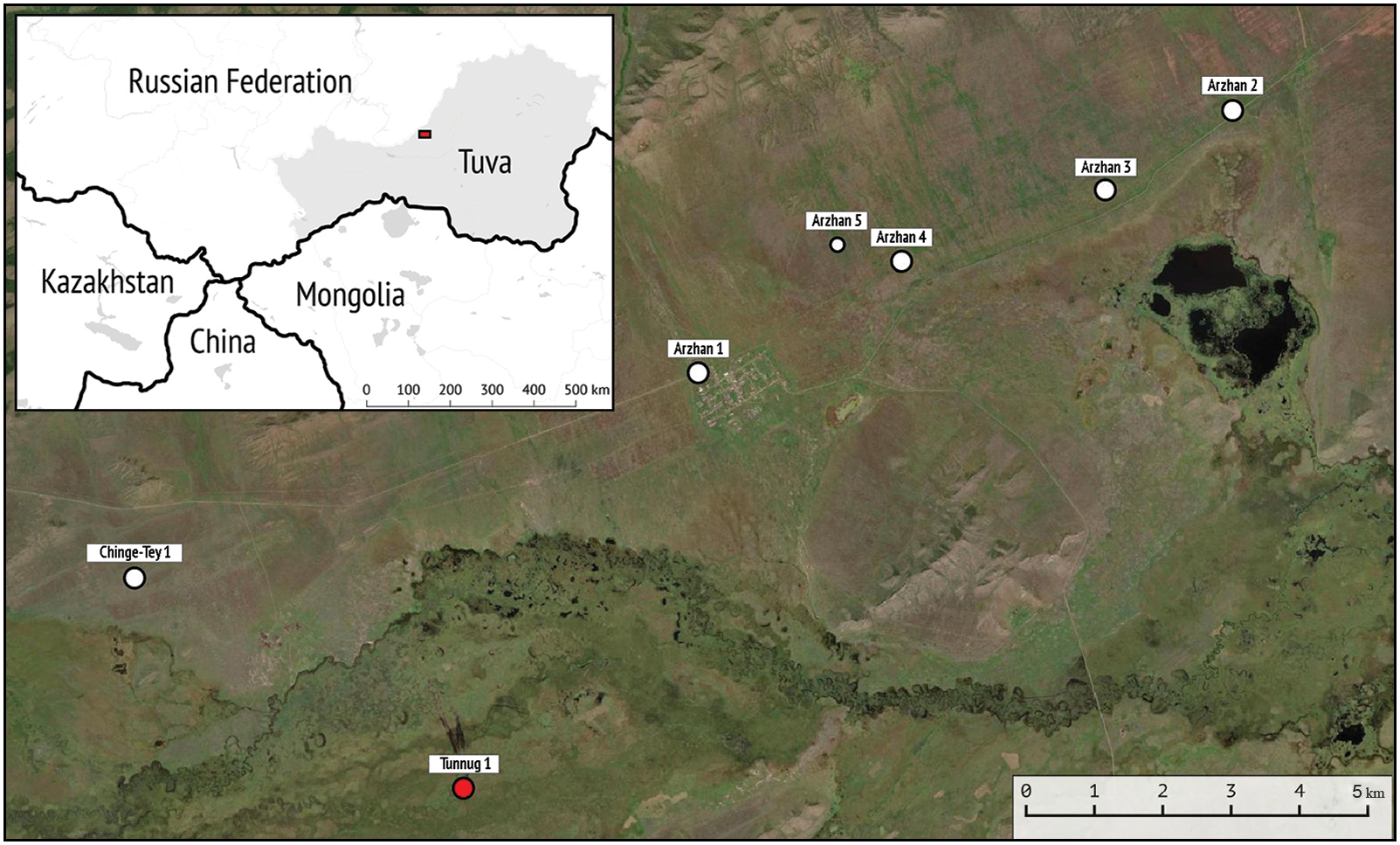
The Tunnug 1 site is located in the Republic of Tuva within the Uyuk Valley, also called Valley of the Kings, a landscape densely dotted with large Early Iron Age (eighth–third centuries BC) burial mounds (Caspari Reference Caspari2020; Vavulin et al. Reference Vavulin, Chugunov, Zaitceva, Vodyasov and Pushkarev2021) (Figure 1). Tunnug 1 stands as one of the earliest monuments where the full expression of the ‘Scythian triad’—weapons, horse tack, animal-style motifs—is attested. Together with Arzhan 1 and the partially excavated Arzhan 5, Tunnug 1 constitutes a separate ‘Arzhan horizon’ and defines the earliest instance of what can be understood as Scythian material culture (Caspari et al. Reference Caspari, Sadykov, Blochin and Hajdas2018; Sadykov et al. Reference Sadykov, Caspari and Blochin2020). The periphery (cf. Caspari et al. Reference Caspari, Sadykov, Blochin, Buess, Nieberle and Balz2019) and the central portion of the mound have been systematically excavated, revealing both disturbed and undisturbed burials and a well-preserved complex of human and horse sacrifices (Sadykov et al. Reference Sadykov2024). Precise dating to 833–800 BC (Caspari et al. Reference Caspari, Sadykov, Blochin, Bolliger and Szidat2020) makes Tunnug 1 one of the most securely dated sources for investigating the origins, development and early iconographic repertoire of the Scytho-Siberian animal style. In this article, we present the first comprehensive publication of the animal-style artefacts from Tunnug 1, including contextual data and detailed analyses of metal-alloy compositions, and examine the wider implications of these finds.
The main kurgans in the ‘Valley of the Kings’ in Tuva (figure by authors).

The animal-style artefacts
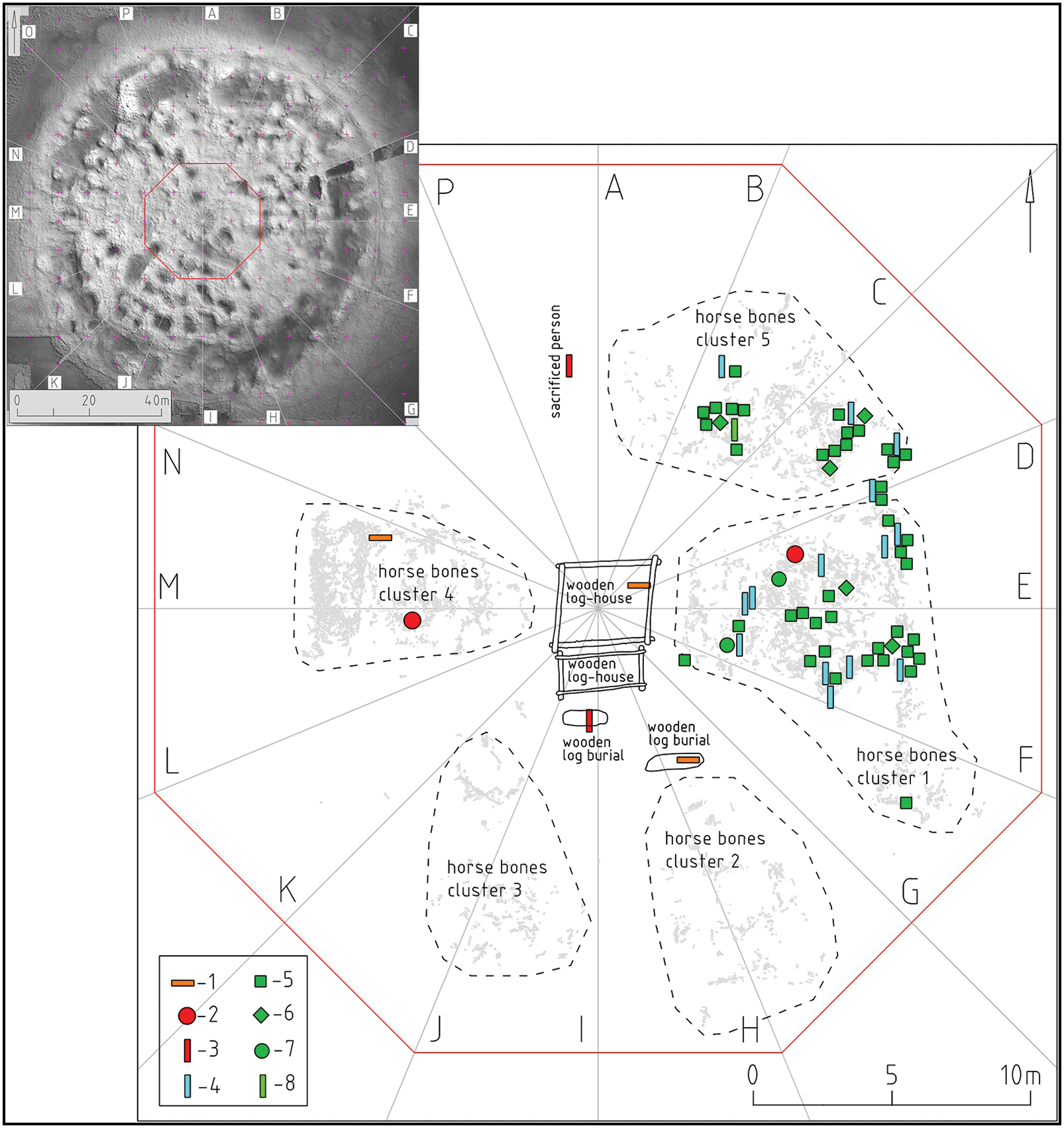
Only four types of animals are depicted in the animal-style artefacts found in the Tunnug 1 kurgan. Figure 2 shows the placement of all discussed artefacts on a schematic plan of the site.
Plan of the Tunnug 1 kurgan showing the locations of animal-style artefacts from burials and the sacrificial complex: 1) rams; 2) feline appliqués; 3) daggers with felines; 4) cheekpieces in the form of coiled snakes; 5) strap distributors with images of four bird heads; 6) beads in the shape of a bird head; 7) appliqués with a bird head in profile; 8) cheekpiece with a bird head pommel (figure by authors).

Ovicaprids
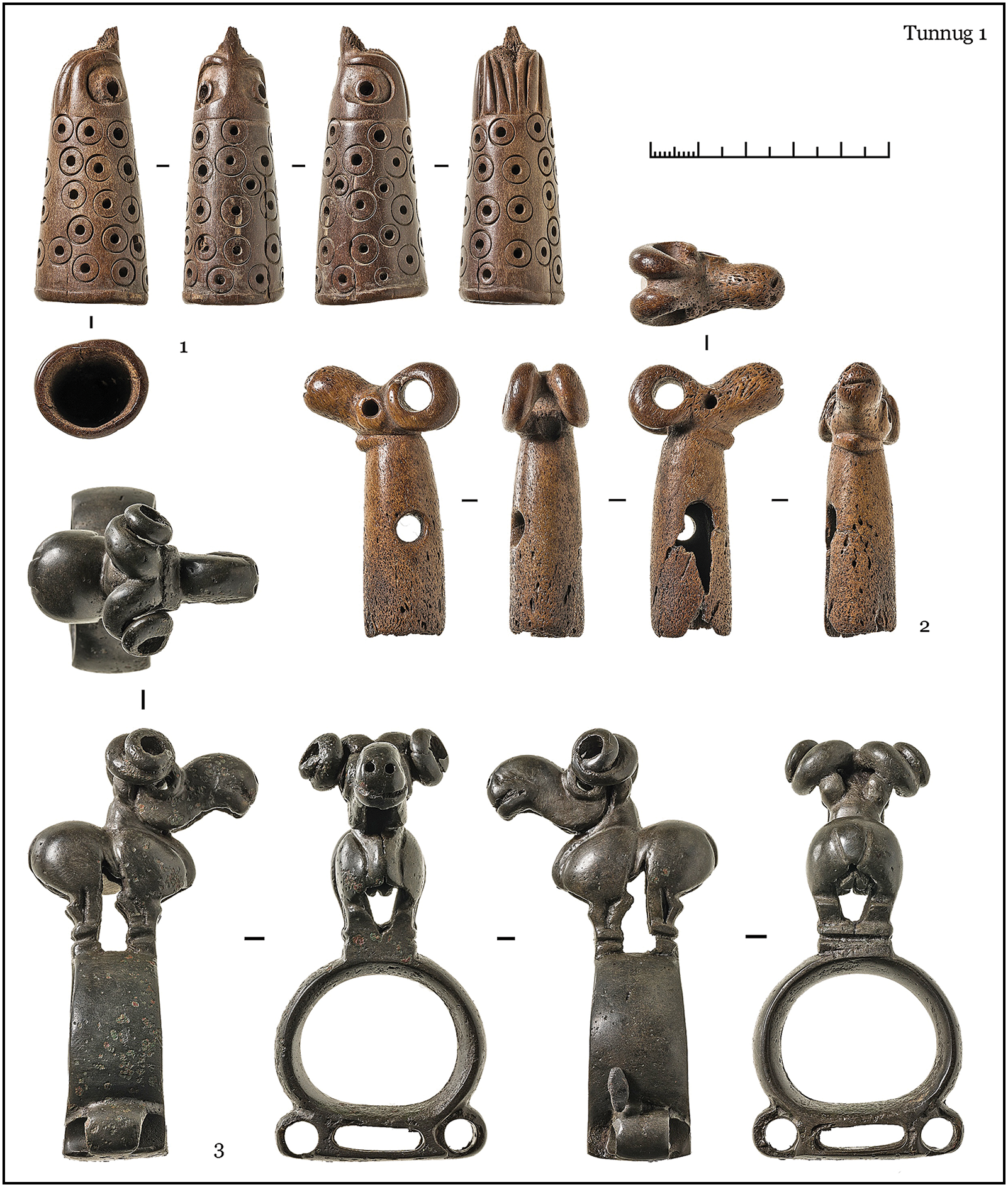
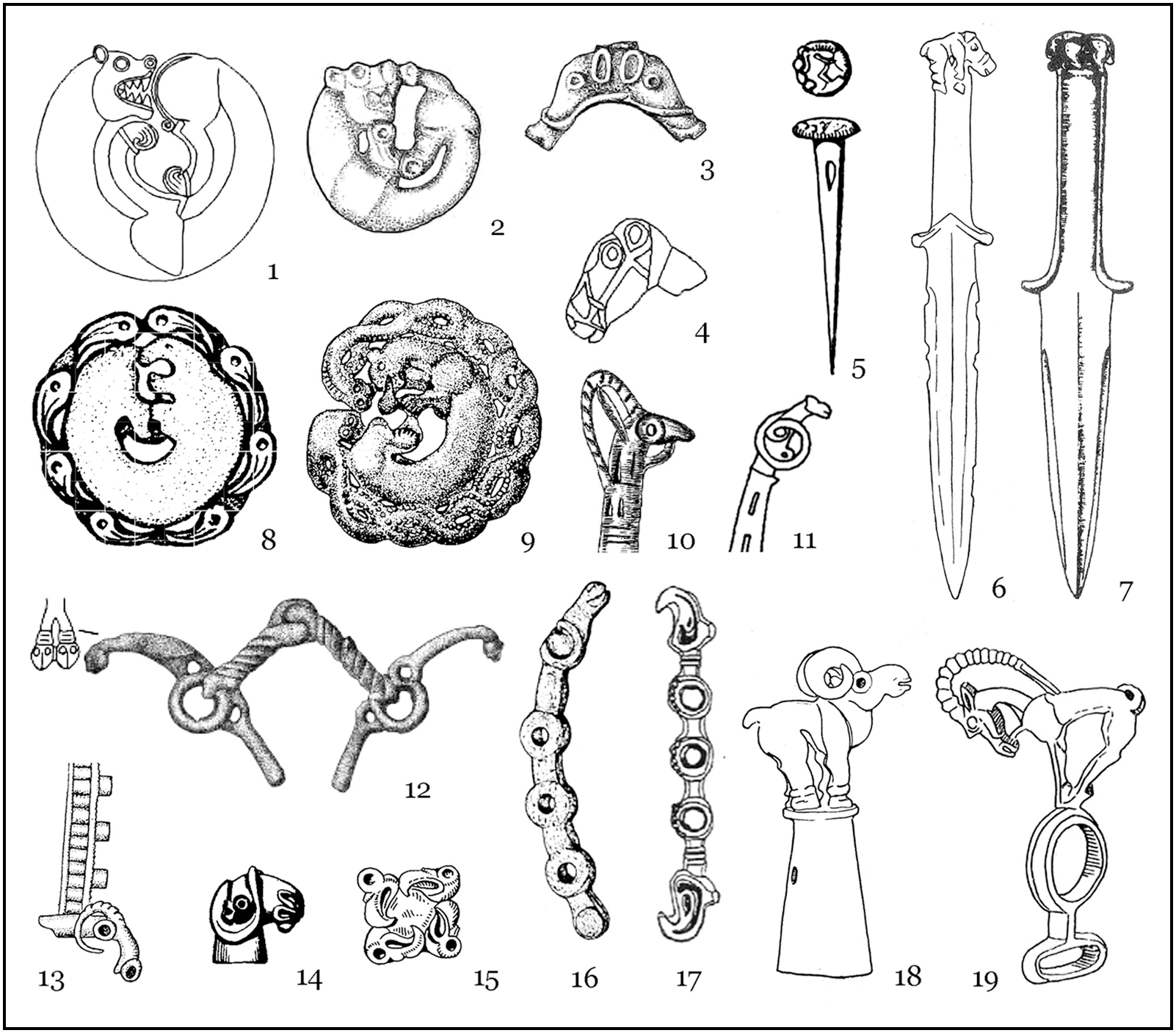
Three artefacts from Tunnug 1—two confirmed and one probable—depict ovine or caprine ungulates. The first is a complete figure atop a ring with additional holes (Figure 3, no. 3), representing a fine example of the canonical Scythian ram image (Figure 4, no. 18) best known from Arzhan 1 (Gryaznov Reference Gryaznov1980). Shared distinctive features suggest that this artefact belongs to the same artistic tradition, and possibly even the same workshop: convex rings (with holes) marking the eyes, round holes for the nostrils and sharply defined lines for the legs and tail. The metal composition is also similar (Khavrin Reference Khavrin, Piotrovsky and Yu2003), but the attachment method is unusual: a large ring set perpendicular to the main figure, featuring an elliptic 28–33mm-diameter hole and three smaller holes beneath it, likely for fastening. The artefact was found among horse-sacrifice remains on the surface of the kurgan, in cluster 4. The second artefact is a small bone finial carved in the shape of a ram’s head (Figure 3, no. 2). The piece was recovered from a disturbed context in the northern central log-cabin-style burial. No direct parallels are apparent, and its function remains unclear, though it contains remnants of poorly preserved wood and shares the same artistic tradition as the first artefact. The third object is another bone finial (Figure 3, no. 1), discovered at the foot of an undisturbed log coffin alongside a few beads. Poor preservation of organic material at the site means it is unclear whether the object was originally part of a larger artefact. The piece terminates in a head, with clearly rendered eyes and additional features, while the rest of the surface is decorated with circular patterns. The ram is not immediately recognisable, resembling a fish or bird at first glance, but contemporaneous iconographic comparisons suggest that arcs around the eyes often represent horns (Figure 4, nos. 10, 11, 13, 14, 16), sometimes accompanied by circular motifs (Ryabkova Reference Ryabkova2014: fig. VII). While the eyes on this finial are also marked by holes surrounded by convex rings, the overall style appears distinct from the tradition represented by the other two artefacts.
Artefacts incorporating ovicaprids: 1) bone finial from a burial in a coffin; 2) bone finial from a mixed context in a wooden chamber; 3) bronze finial from cluster 4 (figure by authors).

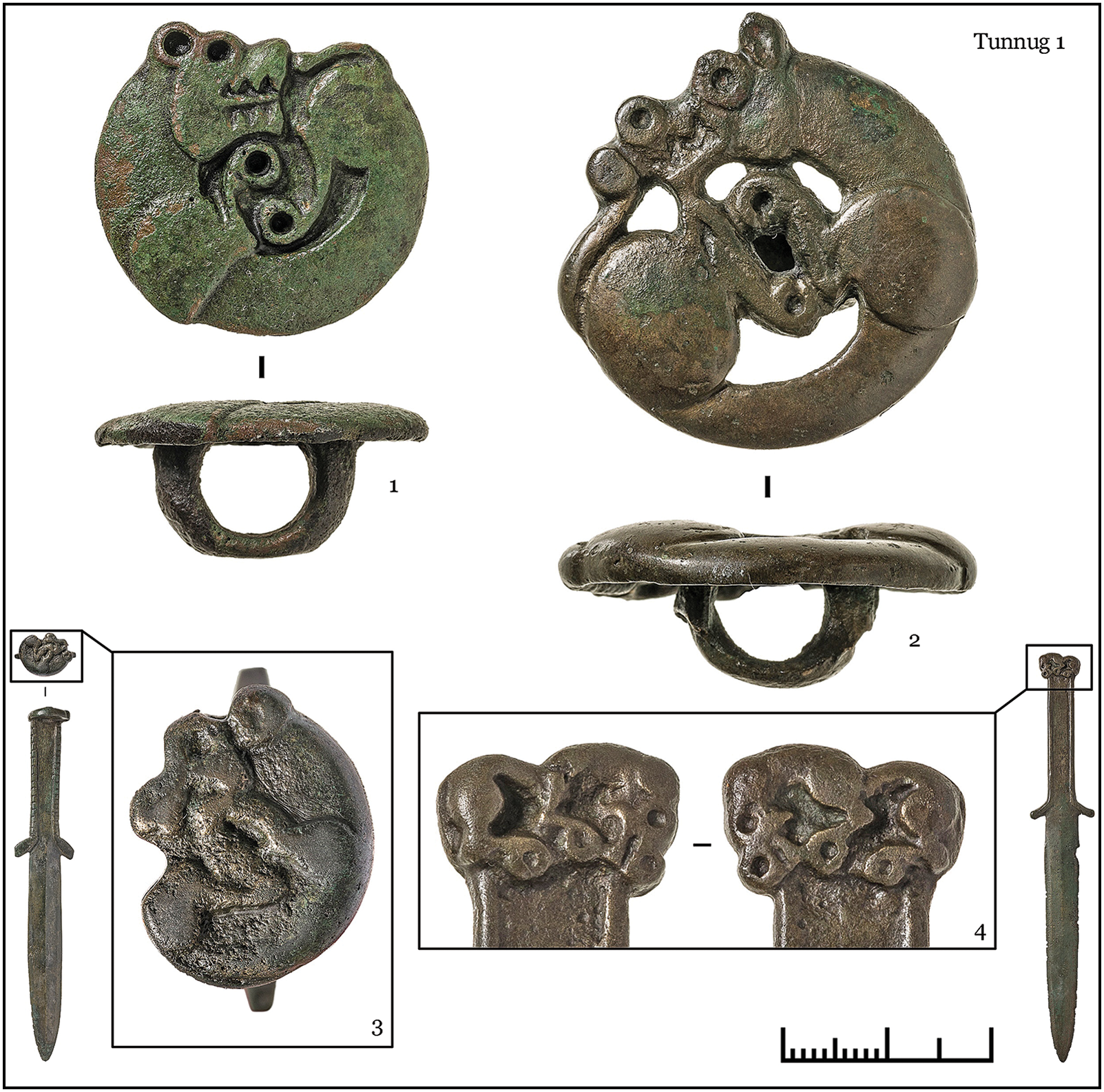
Bronze artefacts incorporating felines: 1) appliqué from cluster 1; 2) appliqué from cluster 4; 3) dagger pommel from a burial in a wooden log; 4) pommel from a human sacrifice in sector PA (figure by authors).

Felines
The coiled feline predator is among the most striking and likely earliest motifs in Scythian art; four representations of such felines were discovered at Tunnug 1. Two are harness appliqués. The first (Figure 5, no. 1), with a diameter of 30mm, was found east of the kurgan’s centre among horse bones in cluster 1. The depiction is clear, concise and graphic. The figure coils clockwise, with the tail touching the nose; the shoulder and head are rendered in high relief. The mouth shows teeth and a long tongue, while the paws end in convex rings. The second harness appliqué (Figure 5, no. 2), 40mm in diameter, was discovered west of the centre among the horse bones in cluster 4. This openwork piece coils counterclockwise. The mouth features visible teeth, and relief rings mark the eye, nose, paw ends and tail, which again touches the nose. A coiled predator (Figure 5, no. 3) also appears on the flattened end of the pommel of a dagger. This placement is unusual, though examples are known from the Tagar culture (eighth–second BC) (Figure 4, no. 5). The figure, 27mm in diameter, coils counterclockwise and is rendered with minimal detail. The dagger itself is small (190mm long) and was found in a burial south of the two central log-cabin burials. Another predator, shown in profile (Figure 5, no. 3), appears on a dagger recovered from the clay surface of the kurgan. This dagger does not come from a burial but is associated with a nearby human sacrifice. A knife, typically paired with a dagger, was also found in the same location. The figure is small and not very detailed, but key features—such as the relief rings marking the paws, nose, eye and ear—identify it as the same type of feline animal rendered on the harness appliqués. The closest known parallel to this dagger comes from Arzhan 1, although the animal depicted there is a boar (Figure 4, no. 6; Gryaznov Reference Gryaznov1980). Additional parallels, particularly with similarly designed hilts, are primarily found at early Tagar culture sites (e.g. Kuzmin Reference Kuzmin and Kozintsev1994).
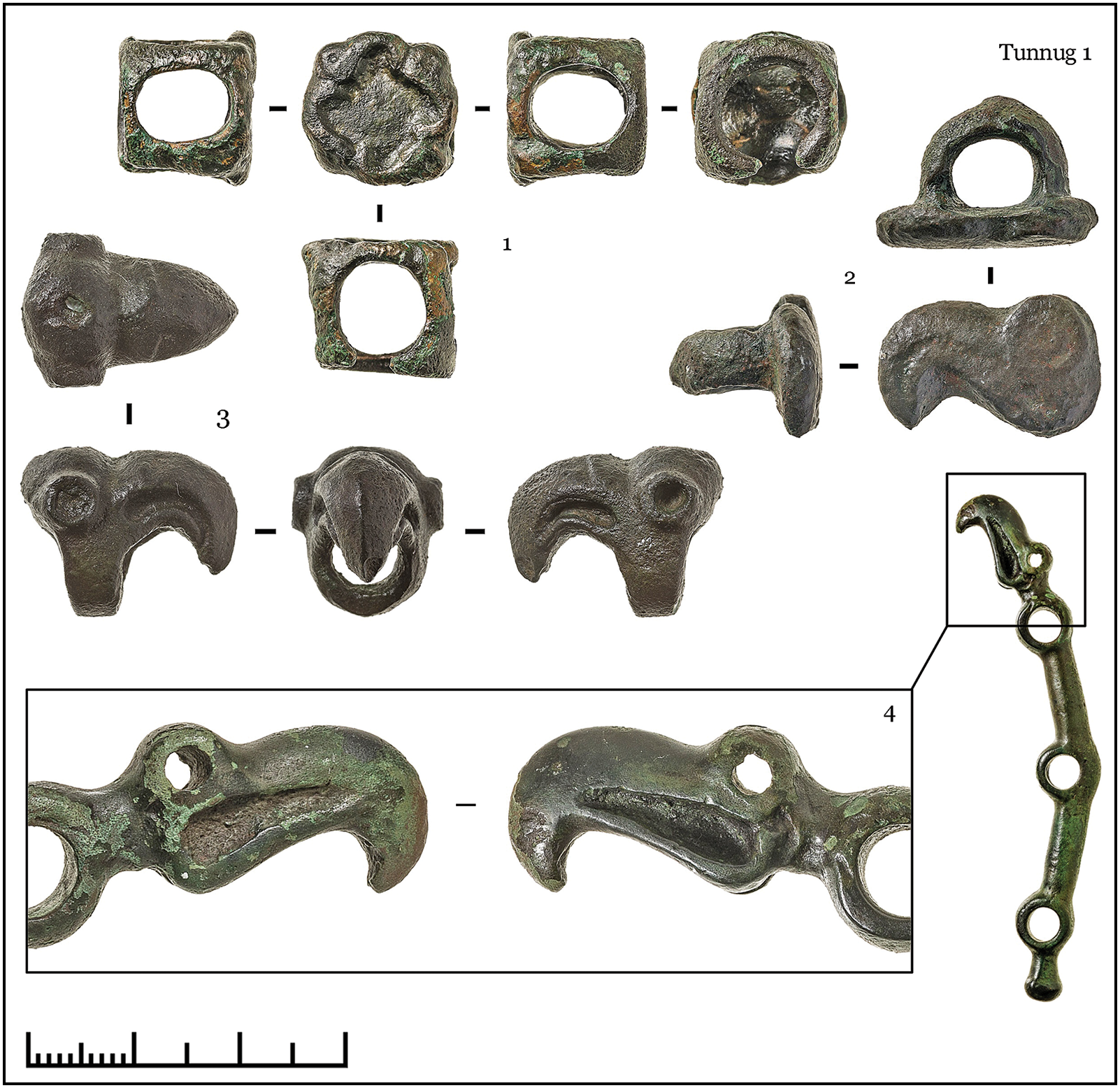
Artefacts incorporating bird heads: 1) strap distributor; 2) appliqué; 3) bead; 4) cheekpiece (figure by authors).

Aves
Heads of birds of prey are the most common motif among the animal-style artefacts found at Tunnug 1. They appear in several standardised forms and are predominantly located east and north-east of the kurgan’s geometric centre, among horse bones in clusters 1 and 5. The most frequent type is a strap distributor with five or six holes, featuring four joined bird heads along the upper edge (Figure 6, no. 1). A comparable motif, though arranged in the opposite direction, is also known from Uygarak, Kazakhstan (Figure 4, no. 15). To date, 41 such items have been discovered in clusters 1 and 5 (see Sadykov et al. Reference Sadykov2024: fig. 3). Two flat appliqués depicting a bird head in profile (Figure 6, no. 2) were also found in cluster 1. The bird displays a strongly curved beak but no cere—a protuberance at the base of the upper part of the beak—a feature common in later Scythian animal-style representations. Five three-dimensional bird-head beads (Figure 6, no. 3), all depicting similar birds of prey, were recovered from clusters 1 and 5. A single three-holed bronze cheekpiece with a bird head (Figure 6, no. 4) was found in cluster 5. While distant parallels exist, animal-head endings are more typically found on bone cheekpieces, making this bronze example relatively uncommon. However, similar items are known from later sites in the western steppes (see Figure 4, no. 17).
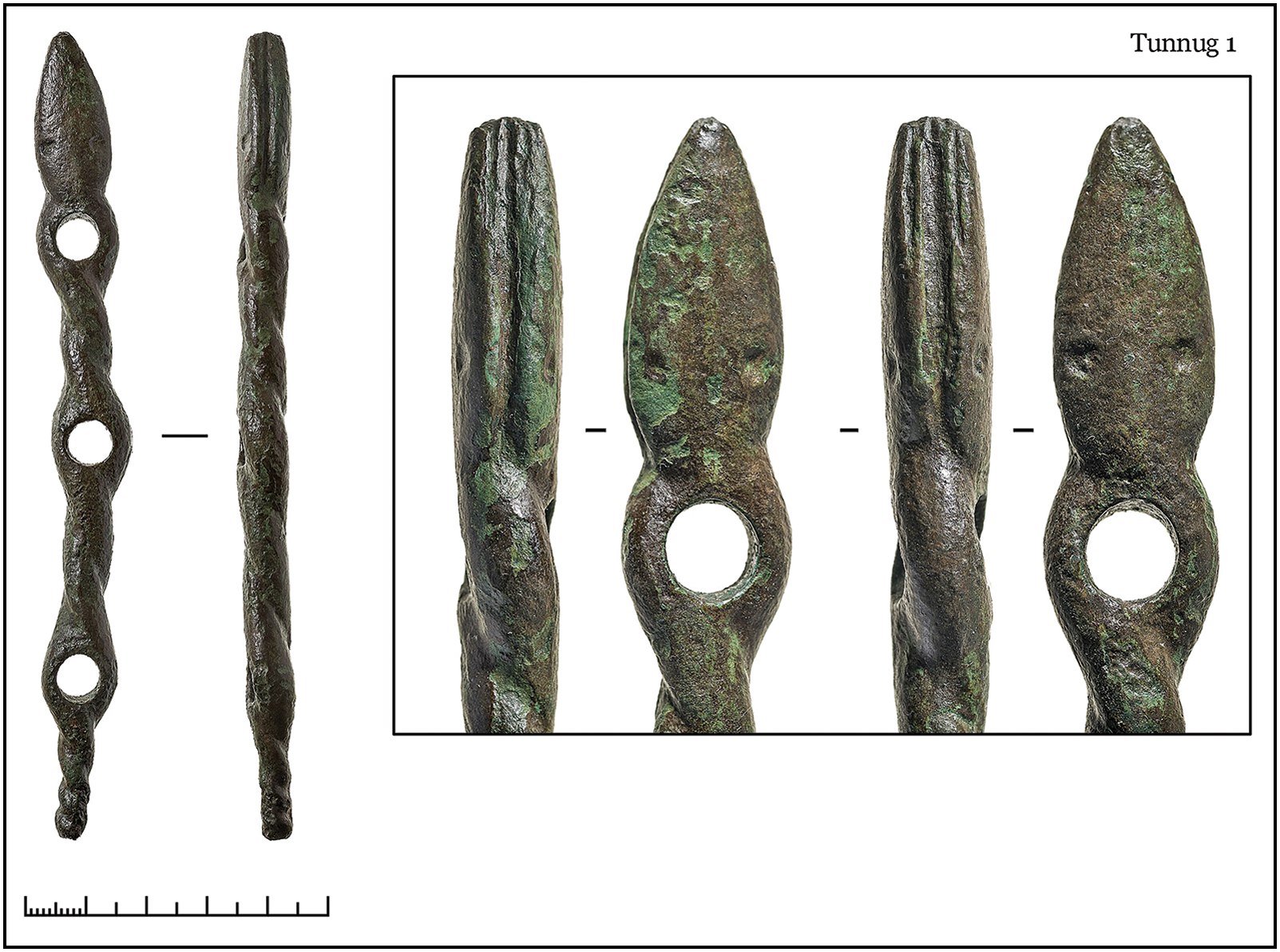
Bronze cheekpiece in the form of two twisted snakes (figure by authors).

Serpents
Snakes are generally rare in Scythian iconography (Alekseev Reference Alekseev2019) but are represented at Tunnug 1 in a number of uniform finds. The most common type of bronze cheekpiece at the site is the three-holed twisted variant, here referred to as the Tunnug-type cheekpiece, which has a serpentine form. No close parallels to this type are currently known. A total of 15 examples have been found, primarily in clusters 1 and 5 (Figure 2), with one located outside the kurgan’s stone wall. While nearly identical in design, the cheekpieces show some variation in size and detail, with several depicting eyes and mouths on their upper end (Figure 7), suggesting not one but two intertwined snakes. A distant, though chronologically close, parallel is a cheekpiece from Hasanlu (Iran), dated to the late ninth century BC (Figure 4, no. 12; Medvedskaya Reference Medvedskaya2013: fig. 3: 2). While this is a singular example, it points to the possibility of shared visual themes. Other examples include a bronze artefact in the Tokyo National Museum that depicts a coiled predator surrounded by two intertwined snakes (Figure 4, no. 9) and a pair of horse fittings in the Metropolitan Museum of Art (Bunker et al. Reference Bunker, Watt and Sun2002: fig. 172), further suggesting that such imagery may have belonged to a broader iconographic canon during this period.
Analogous artefacts from: 1, 4, 6, 18) Arzhan 1 (after Gryaznov Reference Gryaznov1980); 2, 3) Arzhan 5 (after Rukavishnikova Reference Rukavishnikova2017); 5) Tagar (after Kiselev Reference Kiselev1951); 7) Bagulya (after Kuzmin Reference Kuzmin and Kozintsev1994); 8) stray find from Xinjiang or Northern China (after Bogdanov Reference Bogdanov2006); 9) stray find from the Ordos Region (after Bogdanov Reference Bogdanov2006); 10) Podkuninskiye Gory (after Poliakov Reference Poliakov2022); 11) Jingjiecun (after Rawson et al. Reference Rawson, Chugunov, Grebnev and Huan2020); 12) Hasanlu IVB (after Medvedskaya Reference Medvedskaya2013); 13) Tevsh (after Rawson et al. Reference Rawson, Chugunov, Grebnev and Huan2020); 14) Kelermes (after Galanina Reference Galanina1983); 15) Uygarak (after Vishnevskaya Reference Vishnevskaya1973); 16) Yanghai-1 (after Shulga & Shulga Reference Shulga and Shulga2020); 17) Kuban burial ground, burial 39 (after Ryabkova Reference Ryabkova2014: fig. 6.2); 19) Tasmola 5 (after Kadyrbaev Reference Kadyrbaev and Margulan1966). Artefacts 4, 14, 15 and 16 are bone (antler), all others are bronze (figure by authors).

Discussion
The corpus of Scythian animal-style artefacts from Tunnug 1 allows us to observe that the earliest iterations depict only real animals rather than fantastical or hybrid creatures. Mixed creatures such as the griffin were likely introduced later, possibly through external contacts (Chugunov Reference Chugunov2020; O’Sullivan & Hommel Reference O’Sullivan, Hommel, Nimura, Chittock, Hommel and Gosden2020). However, a pronounced degree of stylisation was present from the outset, often emphasising specific anatomical features. The range of animals depicted during this initial phase was notably restricted. At Tunnug 1, only four animal motifs appear, each linked to specific artefact types. A slightly different but equally limited set of motifs is found at the culturally, chronologically and geographically proximate site of Arzhan 1, further reinforcing the notion of a narrowly defined animal repertoire in early Scythian animal style. The early repertoire may thus be expanded to include the boar (Figure 4, no. 6), which appears not only at Arzhan 1 but also at the smaller and partially excavated site of Arzhan 5 (Figure 4, no. 3; Rukavishnikova Reference Rukavishnikova2017). The importance of the boar is further underscored at Tunnug 1, where boar tusks and antler or bronze imitations were integrated into the harnesses of sacrificed horses (Sadykov et al. Reference Sadykov2024). A depiction of a bridled horse head was also found at Arzhan 1 (Figure 4, no. 4), though this may belong to a different artistic tradition (Savinov Reference Savinov2002: 65–67), suggesting that the Scytho-Siberian tradition was not yet fully formed.
None of the three kurgans of the ‘Arzhan horizon’—Tunnug 1, Arzhan 1 and Arzhan 5—feature depictions of deer, one of the most emblematic animals in later Scythian art and a central motif on the deer stones of South Siberia and western Mongolia (Bayarsaikhan Reference Bayarsaikhan2022). It is possible that, at this early stage, the deer motif remained primarily associated with petroglyphic traditions and potentially with tattoos (Gryaznov 1984; Jettmar Reference Jettmar and Genito1994; Caspari et al. Reference Caspari, Deter-Wolf, Riday, Vavulin and Pankova2025), only later being transposed into other media such as bronze, bone or gold.
Only the feline motif is common across the three kurgans, appearing in a standing posture or in a coiled form. At Tunnug 1, this motif is represented in both forms on harness appliqués and dagger pommels. Depictions of felines endure throughout the entire period of production (eighth–second centuries BC) of Scythian animal-style items (Bogdanov Reference Bogdanov2006; Dzhumabekova & Bazarbaeva Reference Dzhumabekova and Bazarbaeva2011; Kantorovich Reference Kantorovich2022). While the origins of the motif may lie in China (Jacobson Reference Jacobson1988: 211), the first millennium BC saw its spread across the entire Eurasian Steppe, from Kazakhstan (Yablonsky Reference Yablonsky, Davis-Kimball, Bashilov and Yablonsky1995b) to the Caucasus (Petrenko Reference Petrenko, Davis-Kimball, Bashilov and Yablonsky1995).
The coiled feline appliqués appear in two distinct clusters of horse sacrifices at Tunnug 1, each crafted from a different metal alloy (see online supplementary materials (OSM) Table S1). The dagger pommels bearing this motif were also found in different contexts: a burial and a human sacrifice. This planigraphic diversity indicates that this symbol was not exclusive to a certain community or social stratum but, from its first appearance, was widespread among the entire population. The motif stems, perhaps, from mythology, with variations in the telling dictating which details artisans emphasised. On the well-preserved appliqué (Figure 5, no. 1), for example, the feline is portrayed with bared teeth and a long tongue—not a typical predator feature.
The bird-head motif, like the feline, is prevalent in early Scythian art. These two motifs may have been narratively or symbolically linked, as suggested by composite depictions (e.g. Figure 4, no. 8). While many such artefacts are chance finds lacking archaeological context, some were recovered from securely dated closed contexts, including the site of Yuhuangmiao in north-eastern China (Shulga Reference Shulga2021; Huan & Brosseder Reference Huan and Brosseder2024).
Almost all the animal-style artefacts recovered from Tunnug 1 are associated with horse harnesses for mounted riding. One exception is the ram figure mounted on a large ring, which was found among horse bones but might more plausibly be identified as a chariot decoration. This artefact stands out not only for its iconography and artistic execution but also for its technological and functional characteristics, which do not fit well with either horse harnesses or human adornment. A set of similar ram figures were documented in the Arzhan 1 kurgan, where a yoke made from deer antler was also found (Smirnov Reference Smirnov2021), suggesting the presence of a chariot (Savinov Reference Savinov2002: 65). However, all the rams in Arzhan 1 were mounted on finials, not rings. Although no direct parallels could be identified, closely related figures of ibexes (Figure 4, no. 19) are known from Kazakhstan, specifically from kurgan 2 at the Tasmola V site (the eponymous site of the early Scythian-period Tasmola culture; Kadyrbaev Reference Kadyrbaev and Margulan1966). Although possibly displaced by looting, illustrations of the Tasmola V finds (Kadyrbaev Reference Kadyrbaev and Margulan1966: 325) could reveal the remains of a chariot originally placed on the ground surface beneath the mound. The ring-mounted figures were likely attached to the chariot poles, with the figure facing forward, while the lower holes were used for additional fastening. The use of chariots (or chariot models) in installations on the kurgan surface during the ninth century BC should not be surprising given their contemporaneous use in funerary or post-funerary rituals during the Western Zhou period in China (c. 1045–771 BC; Rawson et al. Reference Rawson, Huan and Taylor2021). By this time, chariots likely no longer held significant military importance among highly mobile horsemen but they may have persisted in ritual contexts.
The ovicaprid depictions at Tunnug 1 appear to embody two distinct artistic traditions. The full-figure bronze ram (Figure 3, no. 3) clearly aligns with the ‘Arzhan-Mayemir’ artistic style, which is also widely represented on deer stones and in rock art. In contrast, the bone finial recovered from a burial context (Figure 3, no. 1) is rendered in a more abstract manner and includes the distinct iconographic feature of arcs or horns encircling the eyes. This ‘horns-around-the-eyes’ motif is already attested in the pre-Scythian period in Inner Asia, particularly on knife pommels belonging to the so-called ‘Karasuk’ bronze-artefact tradition. Examples are found in southern Siberia (e.g. Figure 4, no. 10; Poliakov Reference Poliakov2022), Mongolia (Gantulga Reference Gantulga2024) and northern China (e.g. Figure 4, no. 11; Rawson et al. Reference Rawson, Chugunov, Grebnev and Huan2020). The term ‘Tevsh style’ has recently been used to describe this pre-Scythian animal-style tradition (Chugunov et al. Reference Chugunov, Rawson and Grebnev2020) (Figure 4, nos. 10, 11, 13), and some examples derive from well-dated burials of the Late Shang period in China (c. 1250–1045 BC).
In subsequent periods, the ‘horns-around-the-eyes’ motif appears in the so-called griffin-ram imagery on three-holed bone cheekpieces in Inner Asia (e.g. Figure 4, no. 16; Kovalev Reference Kovalev1999) and later becomes widespread in early Scythian contexts across Europe (e.g. Figure 4, no. 14) (Galanina Reference Galanina1983). This distinctive iconography could potentially trace the movements of a specific historical Scythian group—perhaps the Askuza, mentioned in Assyrian sources—from Inner Asia to the North Caucasus and ultimately to the Black Sea region (Kovalev Reference Kovalev, Molodin and Epimakhov2014).
At both Arzhan 1 and Arzhan 5, all documented animal-style artefacts were cast from tin bronze. This uniformity in material composition contributed to the long-standing assumption that the bearers of the early Scythian animal-style tradition consistently employed tin bronze (cf. Khavrin Reference Khavrin, Piotrovsky and Yu2003; Rukavishnikova Reference Rukavishnikova2017), implying active access to, and perhaps control over, tin resources. Metallurgical analysis of the Tunnug 1 assemblage challenges this assumption and suggests a more complex picture of supply networks and material use in the early Scythian world. The assemblage of animal-style items at Tunnug 1 reveals a clear spatial distinction between two alloy types. The association between distinct metal-alloy compositions and different clusters of sacrificial remains at Tunnug 1 has already been highlighted (Sadykov et al. Reference Sadykov2024). Our analysis shows that this pattern is also evident in the distribution of animal-style artefacts (Table S1): only the objects recovered west of the kurgan centre—specifically, the ovicaprid and the feline from cluster 4 and the two daggers—are cast from tin bronze. All remaining animal-style objects, regardless of motif, were made from arsenic bronze, with no detectable tin content. This suggests that the use of tin bronze was neither universal nor necessarily indicative of chronological or cultural primacy in the development of the Scythian animal style. Rather, the metallurgical variability at Tunnug 1 may reflect localised technological traditions, differential access to alloying materials or even functional considerations influencing alloy selection. The fact that arsenic bronze was used for a substantial portion of the animal-style assemblage raises important questions regarding resource procurement, inter-regional exchange and technological choices among early Scythian-type communities.
Evidence from Tunnug 1 strongly parallels, and thus supports, the hypothesis that Arzhan 1 was the product of a broad confederation of social groups, with cultural diversity reflected in the material record (Gryaznov Reference Gryaznov1980). Both the distribution and typology of finds at the site appear to align with such a model. Some groups participating in the construction of the kurgan and in the rituals performed there may not have had an animal-style tradition, others may have used distinctive metal alloys indicating different technological traditions. A considerable number of artefacts at Tunnug 1 are decorated not with animal figures but with geometric motifs—circles, crosses and linear patterns. At this early stage, animal style was not universally shared among the builders of the kurgan but instead represented one among several distinct visual traditions. These traditions may have gradually converged through intensified interaction and shared ritual practices. The artistic variation and diversity within the assemblage of animal-style artefacts likely reflects the multigroup construction effort of Tunnug 1 and highlights the importance of local traditions in the development of broader steppe art.
In this context, the absence of certain items can be as revealing as their presence. One particularly telling absence at Tunnug 1 is that of animal-style artefacts made of gold. This is not due to a lack of gold in the burial complex; two undisturbed elite burials yielded numerous gold adornments, and fragments of gold foil were recovered among the horse sacrifices (Sadykov et al. Reference Sadykov2024). However, all recovered animal-style artefacts at the site are made from copper alloys or bone. A similar pattern is seen at Arzhan 1, which closely resembles Tunnug 1 in terms of chronology, social status and cultural affiliation. It is possible that any gold animal-style artefacts buried at Arzhan 1 may have been looted (Gryaznov Reference Gryaznov1980: 45–46), yet the absence of such objects from the intact contexts at Tunnug 1 renders this scenario less likely and raises the possibility that gold had not yet been adopted as a medium for animal-style representation in this early phase. The lack of gold animal-style objects is matched by the absence of animal-style adornments for the human body. Aside from the finials and daggers, all animal-style artefacts found at Tunnug 1 are associated with horse harnesses or horse-drawn transport. The concept of covering elite individuals in elaborate animal-style appliqués, plaques and other ornaments, appears to have emerged later. Thus, the earliest instances of animal-style artefacts were linked to horses and warfare, suggesting a narrower symbolic focus than is apparent in later periods, when animal motifs became central to expressions of identity through personal adornment.
Conclusion
The Scytho-Siberian animal style represents a multifaceted and intricate artistic phenomenon that invites exploration through a variety of methodological lenses. However, the formulation of well-supported hypotheses and conclusions depends heavily on access to reliably excavated and well-dated material. A critical limitation in the field of art historical inquiry into Scythian animal style is the limited corpus of contextualised artefacts. The objects discussed in this article therefore provide crucial new evidence for the testing and refining of existing hypotheses surrounding the emergence and development of animal-style traditions. The early animal style represented at Tunnug 1 appears to be predominantly linked to functional objects, such as horse harnesses and weaponry, and to focus on a limited range of animals and raw materials, with the use of gold as a medium and personal adornment as a platform for animal-style representations emerging only at a later stage. The diversity of representational styles found at Tunnug 1 supports the hypothesis that different social groups with different artistic and technological traditions came together in the Siberian Valley of the Kings to conduct funerary rituals. The animal-style artefacts from Tunnug 1 therefore both contribute to and highlight the need for the continued exploration, refinement and contextualisation of Scythian archaeology within the broader archaeological and cultural landscape of the Eurasian Steppe in the first millennium BC.
Data availability
All relevant data are contained within the manuscript and its supplementary information.
Acknowledgements
We wish to thank D. Fomicheva (Institute for the History of Material Culture, Russian Academy of Sciences) for assistance, Y. Rumyantsev for the photographs and K. Chugunov (Hermitage Museum, St Petersburg) for valuable advice.
Funding statement
This research was funded by the Russian Academy of Sciences (FMZF-2025-0008 and FMZF-2025-0012), the Russian Geographical Society (N 12/04/ 2024-ИИМК) and the Foundation for ArchaeoExploration.
Author Contributions: using CRediT categories
Timur Sadykov: Conceptualization-Equal, Data curation-Equal, Formal analysis-Equal, Funding acquisition-Equal, Investigation-Equal, Methodology-Equal, Project administration-Equal, Resources-Equal, Software-Equal, Supervision-Equal, Validation-Equal, Visualization-Equal, Writing - original draft-Equal. Jegor Blochin: Data curation-Equal, Formal analysis-Equal, Funding acquisition-Equal, Investigation-Equal, Methodology-Equal, Project administration-Equal, Resources-Equal, Software-Equal, Supervision-Equal, Writing - original draft-Equal. Sergey Khavrin: Data curation-Equal, Formal analysis-Equal, Funding acquisition-Equal, Investigation-Equal, Methodology-Equal, Resources-Equal. Gino Caspari: Conceptualization-Equal, Data curation-Equal, Formal analysis-Equal, Funding acquisition-Equal, Investigation-Equal, Methodology-Equal, Project administration-Equal, Resources-Equal, Supervision-Equal, Validation-Equal, Writing - original draft-Equal, Writing - review & editing-Equal.
Online supplementary material (OSM)
To view supplementary material for this article, please visit https://doi.org/10.15184/aqy.2025.10214 and select the supplementary materials tab.


 Open access

