

Introduction
In this paper, we investigate the relation between early, mid-lifecourse and later-life events and economic activity, and pathways to retirement among the birth cohort 1941–1960 of French men and women. This cohort has been exposed to two trends related to the structure of the modern welfare state and its subsequent entrenchment. The first trend is the institutional use of chronological age to organise the educational, work and retirement domains of individual lives. More precisely, this trend has been described by Kohli as referring to ‘the evolution, during the last two centuries, of an institutional program regulating one's movement through life both in terms of a sequence of positions and in terms of a set of biographical orientations by which to organise one's experiences and plans’ (Kohli, Reference Kohli2007: 255) and it can be summarised as the ‘standardisation of the lifecourse’. According to this paradigm, exit from the labour market in later life is largely determined by institutional measures relating to retirement rules and regulations, such as the minimum statutory age for retirement, and the duration of pension contributions required to receive a full pension. In contrast to the standardisation of the lifecourse, the second trend can be broadly defined as the dominance of individual and differentiated trajectories. In this paradigm, economic activity and withdrawal from the labour market in later life is no longer a uniform lifecourse event occurring at a fixed point in time and in accordance with a single institutional mechanism that defines ‘retirement’. Different pathways and timings of retirement co-exist and reflect more generally the heterogeneity of trajectories over the lifecourse. In a destandardised lifecourse, the concept of retirement becomes distorted, thereby changing patterns of economic activity in later life.
The paper addresses two research questions which can be situated within the theoretical framework of (de)standardisation. First, what were the patterns of entry into adult life of the French birth cohort 1941–1960 and are they related to characteristics of professional careers? Second, are economic activity status and retirement patterns of men and women in the cohort observed associated with earlier lifecourse trajectories? The research undertaken adds to the literature on understanding economic activity in later life and transitions to retirement in the following way. First, the specificities of the French context provide the opportunity to examine how standardised and destandardised lifecourses influence the economic activity of older men and women. Institutional reforms in France since the 1980s have closed off many pathways to retirement, such as pre-retirement schemes, and pension eligibility criteria remain a strong determinant of exit behaviour. Secondly, since the research undertaken concerns the perception of the pathways to retirement given by respondents in the context of survey data (as opposed to administrative data that record transitions in terms of pension eligibility), the results add valuable information on how men and women with different timings of early lifecourse events experienced the passage to retirement.
Theory and concepts
Standardisation and destandardisation of the lifecourse
In recent years, the lifecourse paradigm has increasingly been evoked to help understand how prior life histories of individuals impact on their later-life outcomes (Giele and Elder, Reference Giele, Elder, Giele and Elder1998; Marshall and Mueller, Reference Marshall, Mueller, Heinz and Marshall2003; Elder et al., Reference Elder, Kirkpatrick, Crosnoe, Mortimer and Shanahan2003; Mayer, Reference Mayer2009; Dewilde, Reference Dewilde2012). Central to the theoretical paradigm of the lifecourse is the place of historical contexts in shaping individuals’ lives (Elder, Reference Elder1975). Although the lifecourse refers to the outcomes of individual actions, these outcomes are shaped by culture, institutions and structural conditions (Mayer, Reference Mayer and Svallfors2005). The challenge in lifecourse research is therefore to link the macro- and micro-influences on patterns and outcomes of individual lives. The lifecourse paradigm is influential in explaining how macro-contexts impact on the trajectories of individuals. This can be seen, for example, in the period of full-employment during the 1950s and 1960s in Western Europe that shaped the careers and patterns of exit from the labour market of cohorts born before the Second World War. Coupled with a buoyant Welfare State, these socio-economic conditions also influenced the expectations of men and women in both private and public spheres (Bonvalet et al., Reference Bonvalet, Clément and Ogg2015). Moreover, cultural influences, often reinforced institutionally, defined the division of labour between men and women and the respective roles that they played at home and at work (Loretto and Vickerstaff, Reference Loretto, Vickerstaff, Parry and Tyson2010). Later cohorts experienced socio-economic contexts that were characterised by economic crises and the retrenchment of the Welfare State. In addition, cultural expectations on gender changed, as witnessed by an ever-increasing participation of women in the labour force.
Within the lifecourse paradigm, the notion of ‘linked lives’ has been invoked to capture the interdependence of lives through networks of social relationships within and outside the family, including work colleagues who provide a ‘distinct orienting context’ (Marshall and Mueller, Reference Marshall, Mueller, Heinz and Marshall2003: 11). Moving through the lifecourse with their peers, members of a cohort share their experience of the lifecycle during the same historical time (Alwin, Reference Alwin2012; Nilsen, Reference Nilsen2014). Individuals are therefore equipped with a ‘social timetable of the lifecourse (e.g. entry into marriage, retirement), which is defined by age criteria in norms and social roles’ (Elder, Reference Elder1975: 165). When life events chronologically follow in a uniform order and occur more or less at the same point in the lifecourse for the majority of the population, this is referred to as the standardisation of the lifecourse (Brückner and Mayer, Reference Brückner and Mayer2005). Typically throughout much of the 20th century, key points in the lifecourse such as the end of education, entry into the labour market, family formation and retirement were ‘standardised’ in the sense that they were ordered sequentially and occurred at similar chronological ages. Moreover, in a standardised lifecourse each period of the lifecourse is characterised by relative stability, particularly in family life (as witnessed by low divorce and separation rates) but also during periods of full employment. The standardisation of the lifecourse is a particularly useful concept when studying the trajectories of the birth cohort 1941–1960, since to a greater extent, this cohort entered adult life in a historical context where the standardisation of the lifecourse was particularly present, but where signs of destandardisation (see below) were also beginning to be present.
In contrast to the standardisation of the lifecourse, several scholars have pointed to the emergence of a ‘de-standardisation’ pattern which can be traced from the second half of the 20th century (Barbier, Reference Barbier, Koch and Fritz2003; Brückner and Mayer, Reference Brückner and Mayer2005; Elzinga and Liefbroer, Reference Elzinga and Liefbroer2007; Maestripieri, Reference Maestripieri, Kutsar and Kuronen2015). ‘De-standardisation’ refers to the process whereby ‘life states, events and their sequences can become experiences which either characterise an increasingly smaller part of the population or occur at more dispersed ages and with more dispersed durations’ (Brückner and Mayer, Reference Brückner and Mayer2005: 32–33). A de-standardisation of the lifecourse has been associated with the generation of post-Second World War baby-boomers, for whom ‘the complexity of family life increased dramatically’ (Pruchno, Reference Pruchno2012).
Within the (de)standardisation of the lifecourse debate, the place of work and retirement has been the focus of several researchers. According to Kohli (Reference Kohli1985), the institutionalisation of the lifecourse can be seen in patterns of labour force participation which have been shown to include important components of a standardised paradigm. In this paradigm, the institutionalisation of age differentiation within the lifecourse structures the involvement of individuals within the labour force and ultimately their withdrawal from it in the form of retirement. Retirement is therefore conceived as an imposed, i.e. institutionalised, age differentiation measure that regulates exit from the labour force in later life and the associated welfare security provision of a pension. Brückner and Mayer (Reference Brückner and Mayer2005) cite universal retirement eligibility at a given age as an example of the standardisation of the lifecourse, as well as increasing standardisation with regard to the participation of women in the labour force. However, changing patterns of exit from the labour force, particularly during the 1980s and 1990s when pathways to early retirement were opened by many governments, can be seen as contributing to a de-standardisation of the lifecourse. The rise in rates of unemployment is a further factor associated with the de-standardisation of the lifecourse.
There has been considerable debate concerning which of these two processes is taking place within societies, as well as whether they take place simultaneously. For Germany, Brückner and Mayer (Reference Brückner and Mayer2005) found some evidence to support the de-standardisation hypothesis for the transition to adulthood as witnessed by increasing de-coupling of family events but on the whole, the institutional environment continued to structure the ‘school–training–work nexus’. Between the polarity of standardisation and de-standardisation lies a ‘third way’ which postulates that although the heterogeneous quality of the lifecourse has increased, this does ‘not necessarily imply a decline in the social structuring of the human lifecourse, and that there is today a normative (institutionalised) lifecourse pattern that is at the same time individualised (destandardised)’ (Cavalli, Reference Cavalli2007: 55). The exposure to aspects of both standardised and destandardised paradigms by post-war birth cohorts has been documented in the Swiss context (Lalive d'Epinay, Reference Lalive d'Epinay and Heller1994) with the conclusion that individuals retain a normative interpretation of their lifecourse, although one which may be more difficult to achieve in the face of structural changes.
The gendered characteristics of lifecourse events and their relation to economic activity
Much literature related to family configurations and employment in later life focuses on mid-life patterns of family and work, and how these may or may not impact on retirement timing, in particular the decision to retire early or to work beyond a given age that relates to pension eligibility. For example, examining the relationship between child-bearing and retirement in Western Germany, Hank (Reference Hank2004) found that having children delays women's exit from the labour force, particularly when the first birth occurs relatively late or for mothers who were employed during the earlier child-rearing years. Women who have experienced mid-life career breaks to care for children have been found to be more likely to have low-quality jobs and precarious working conditions in later life than men (Madero-Cabib, Reference Madero-Cabib2013) and these working conditions can be important in determining whether they remain economically active (Madero-Cabib et al., Reference Madero-Cabib, Gauthier and Le Goff2016; see also Burnay, Reference Burnay2019). Further evidence of the effect of a mid-life career break for women has been provided by Finch (Reference Finch2014), who reports that women who have had short breaks from paid employment to care for a child are associated with working past retirement age. Additionally, the study by Finch found that other family configurations, such as a long marriage, a late divorce or remaining single with children, are associated with remaining in paid work past retirement age, whereas career interruptions for men (through loss of a job or illness) appear to be among the most important determinants of working past retirement age (Finch, Reference Finch2014).Footnote 1
These and other studies point to the influence of gender in earlier lifecourse family and professional career histories that in part determine the patterns of economic activity for men and women in later life. They also suggest that in a lifecourse perspective, it may be important for research on the impact of lifecourse events on economic activity in later life to increase the time-span from mid-life to earlier lifecourse events, and to include events that are associated with the transition to adulthood and early family formation. The timing of family formation and first job (the latter, of course, having importance in terms of building up pension contributions) can have a significant effect upon patterns of labour market activity and inactivity in later life.
French context
France is an interesting country to study the impact of family and professional lifecourse events on extending the working life on account of several factors. Firstly, the labour force participation of women has increased significantly over the past 50 years, even though fertility levels have remained relatively high. In 1962, less than 46 per cent of women between the age of 30 and 50 were in the labour force, but by 2013 this figure had risen to 80 per cent (Maruani and Meron, Reference Maruani and Meron2012). This influx has resulted in increasing rates of women between the age of 55 and 64 in the labour force: in 2014 rates of labour force activity and employment for women were 48 and 42 per cent, respectively, almost as high as for men (53 and 48%, respectively). Although these figures are lower than Northern European countries, labour force activity and employment rates for women aged 55–64 are equivalent to the European median, whereas this is not the case for French men who are approximately nine points below the European median (Eurostat, 2014). To a certain degree, the increase reflects the more accessible availability of child care in France compared with many other European countries. Secondly, rates of labour force activity in later life have also seen an increase on account of reforms to the pension system. The number of insurance contributions required to receive a full pension have been increased for workers in the private sector together with a change in the way that pensions are calculated, whereby the years taken into account have been extended from 10 to 25. This change has had an adverse effect for individuals with interrupted careers, many of whom are women. Public-sector workers (i.e. civil servants and workers/employees in public companies) are subject to different criteria than private workers, and most public-sector workers are eligible for retirement at earlier ages than private-sector workers. Different incentives are in place both in the private and public sector to retain older workers in employment, such as la retraite progressive (whereby a portion of the state pension is received when an individual works part-time beyond the official retirement age), le cumul emploi-retraite (which allows a retired individual who receives a state pension to also receive an income from paid employment) and la surcote, which increments the value of a pension for workers who have paid full insurance contributions and who continue to work past the legal age of retirement. These measures have been progressively introduced during the past 20 years, and therefore the legal possibility to take retirement or to continue to work past retirement age has been subject to change during the period of study (2005–2011).
The French birth cohorts 1941–1960 which are the subject of study (see below) included respondents for whom entry into the labour market therefore took place under favourable economic conditions with very low unemployment rates, i.e. the period of les trente glorieuses (the 30 glorious years) which began at the end of the Second World War and lasted until the global economic shock of 1973. The ‘baby-boomer’ cohorts were more exposed to the period of economic instability of the following three decades. Some of the workers in the cohort 1941–1960 would have been protected in their jobs from the more adverse effects of the economic climate of the 1980s onwards, such as redundancy. Others would have felt the brunt of factory closures, delocalisation and changing work practices.
Data
The data are from the three waves of the French component of the Generations and Gender ProgrammeFootnote 2 survey (10,079 participants between the ages of 18 and 79 in Wave 1, 2005; 6,534 of these participants in Wave 2, 2008; 5,436 of these participants in Wave 3, 2011). The survey was designed specifically to examine key lifecourse events that affect relationships between parents and children and between partners. These events include the birth of children, partnership formation and dissolution, the transition to adulthood and economic activity. The sub-sample selected for this analysis includes 2,016 respondents who participated in all three wavesFootnote 3 in the birth cohort 1941–1960, i.e. between the ages of 45 and 64 at Wave 1 in 2005. The lower limit of 45 in Wave 1 corresponds approximately to that of an ‘ageing worker’ in the sense that age discrimination, such as a lack of training and the difficulty of re-finding a job after a spell of inactivity are accentuated (see Lössbroek and Radl, Reference Lössbroek and Radl2019). In 2005, 65 years and above was the legal retirement age in France for which no regressive calculations were applied in the calculation of pensions for individuals with missing periods of employment, whereas individuals with full careers could legally retire at age 60.Footnote 4
At Wave 1 (2005), the survey contained retrospective questions on key events related to the transition to adulthood, although not in the form of life-history calendars. These questions included the month and year at which the respondent left the parental household, finished full-time education, took her/his first job, started living with his/her first partner or spouse and birth of the first child. Additionally, at Waves 2 and 3 (2008 and 2011) the data contain information on life calendar events relating to paid work (full-time and part-time), spells of unemployment and sickness, recorded from first job until 2011 or retirement. At each wave (2005, 2008, 2011) questions relating to economic activity included job category (recoded into standard occupational classification) and employment sector. Respondents were also asked the reasons why they left their last job and this question provides important information on how exit from the labour force and retirement took place.
Method
The first step in the analysis relates to the construction of a typology summarising five early lifecourse events that occurred in relation to the transition to adulthood: departure from the parental household, end of full-time education, first job, co-habitation with a partner and birth of first child. In a standardised lifecourse perspective, these events tend to occur chronologically, the first event being the end of full-time education and the last event the birth of a child. The age at which the five life events occurred are examined for each respondent according to whether they took place around the mean or two standard deviations above and below. It should be noted that the mean age is calculated separately for men and women within five-year age groups (1941–1945, 1946–1950, 1951–1955, 1956–1960). Taking the end of full-time education as an example, the indicator corresponds to the difference between the end of full-time education for an individual respondent and the age of end of full-time education for all respondents of the same age group and gender. This information is then combined to create a typology that summarises the different stages in the passage to adulthood by focusing on age differences in the timing of the events. The aim is to identify different behaviours that result from several events. In a first step, multiple correspondence analysis is used to identify the number of factors that best explain the timing of the events. The second stage proceeds with a hierarchical classification analysis that represents the factor loadings of the axes retained in the multiple correspondence analysis.Footnote 5 Having classified the early lifecourse events of the respondents in this way, the next step is to use this information to provide descriptive statistics for men and women. The data allow an initial portrait of the association between early lifecourse events and work life history, job category and employment sector. Finally, the information concerning earlier- and later-life transitions is next combined with observations of the respondent's situation at the end of the panel (2011) to explain economic activity and pathways to retirement.
Generally, the literature on the impact of lifecourse events on patterns of economic activity has examined how retirement decisions are made in relation to eligibility rules for state pensions in a given country. In the main, this entails categorising retirement timing as ‘early’ retirement, retirement ‘on-time’ and ‘late’ retirement. In addition to pension eligibility rules, retirement timing research also stresses the importance of health, employee practices and working conditions. Often compiled from administrative data or from life-history calendars, information on retirement timing is important for understanding the determinants of extending the working life. At the same time, attempts to categorise retirement as occurring ‘early’, ‘on-time’ or ‘late’ inevitably suffer to a certain degree from the difficulty in establishing a common bench-mark from which this timing can be interpreted. Measurement poses challenges given that within countries different pension regimes (e.g. private- and public-sector workers) have different criteria for pension eligibility and specifically with regard to age. Moreover, and importantly, it is often difficult to determine whether retirement timing is the choice of the individual or whether it is imposed by employers or legal requirements relating to pension rights. As Scherger (Reference Scherger2015) and Madero-Cabib and Kaeser (Reference Madero-Cabib and Kaeser2016) have pointed out, an individual who works past a given legal retirement age may not do so ‘voluntarily’ but out of necessity to acquire more income or to avoid the application of a regressive calculation of their pension income due to missing insurance contributions (Aubert et al., Reference Aubert, Duc and Ducoudré2013).
Given these difficulties and in order to examine more closely how the cessation of economic activity that is related to retirement takes place, it is important to take into account not only the official administrative date at which retirement (in the sense of the first payment of a pension) takes place, but also a subjective evaluation by individuals of the conditions in which retirement took place, i.e. the different situations of individuals who are not in paid employment at the moment when they claim and draw their pension. This is done by examining the responses to the question of why the respondent ceased to be economically active, and analysing the responses that relate to ‘chosen’ reasons for retirement, ‘compulsory’ reasons and ‘other reasons’. It is important to stress that ‘retirement’ in the French context is generally understood as an administrative category that relates to access to acquired rights concerning receipt of a pension. Three pathways to retirement can be distinguished according to the respondent's subjective interpretation of ‘retirement’. The first pathway to retirement can be termed as chosen, which can be interpreted as the respondent having more or less a margin to determine the timing of retirement. Second, the respondent indicates that she or he had to take compulsory retirement because of reaching the maximum age for employment defined in her or his sector of activity, even though they may have wanted to continue working.Footnote 6 A final category is retained for all other retired respondents, some who were economically inactive and were not seeking employment before being retired, e.g. because of invalidity or long-term sickness, but including individuals for whom retirement is taken when a factory closes or a business ceases trading, when the employer imposes a pre-retirement plan upon the employee or when the employee reaches the end of a short-term contract of employment. Unemployed individuals who are no longer required to look for a job are included. We have labelled this category as ‘other’ retirement.
Results
We first present the results concerning the timing of transition into adulthood (Figure 1). In general, the timing of the five events was more bunched for women than for men, meaning that the five lifecourse events occurred in quicker succession for women than for men. For women, the events also occurred at an earlier age than for men although both the younger men and women in the sub-sample (those born in 1960) experienced a later age of entry into the first and last of the five events (end of education and birth of first child) than the older men and women. Other observations regarding the timing of the five events in early adulthood include the proximity of the end of full-time education and first job for men whereas for women, this proximity is only observed among the younger generations, a finding which is related to the increase in labour force participation among the younger cohorts. Concerning evidence of a standardised lifecourse, the transition to adulthood shows the presence of a uniform order of events, but difference in temporality (this latter trend pointing towards destandardisation, notably for women).
Mean age of the five events leading to the transition into adulthood.

We next present the classification analysis of the five events that represent the transition to adulthood. The results are contained within a variable with five categories: a group (Group 1) for whom the five life events occurred early (16%); a group (Group 2) for whom the age of end of full-time education and first job is situated around the mean whereas family formation started relatively early (20%); a group (Group 3) for whom the age of the five life events occurred around the mean (32%); a group (Group 4) for whom the entry into adulthood occurred relatively late (17%); and a group (Group 5) for whom the age of end of full-time education and first job is situated around the mean (as in Group 3) but for whom there exists an absence of the family events, such as not having formed a partnership or not having a child or, marginally, not having left the parental home (15%).Footnote 7
Details of the distribution of the five groups according to the mid-life and later-life work history, job category and employment sector are given in Tables 1–4. Examination of work history up until the age of 45, i.e. the first part of a working career (Table 1), shows that before the age of 45, and as expected, strong gender differences can be observed, with a high proportion of men who had continuously been economically active (whether in employment, unemployed but seeking employment or on parental leave), 91 per cent, compared to only 49 per cent of women. These gender differences are mostly due to women being home-makers at some stage. Economic activity rates were at their highest among men in Group 1 (96%) and lowest among women in this group (32%). Economic activity rates among women were at their highest in Group 5 (69%), whereas they were at their lowest for men in this group (78%): 4.4 per cent of men and 5.6 per cent of women had experienced withdrawal from the labour market as a result of long-term sickness or disability before the age of 45 with the exception of male respondents in Group 5-11.6 per cent had experienced an interruption in their professional career because of ill-health. A period of unemployment (at least three months) had been experienced by 16 per cent of men and 20 per cent of women. However, men in Groups 2 and 3 (9 and 10%, respectively) were significantly less likely to have experienced unemployment than men who had made an early or late transition to adulthood.
Transition to adulthood and mid-life work history until the age of 45

Notes: N = 2,016 respondents in 2005, 2008 and 2011, birth cohorts 1941–1960. 1. Whether in employment or seeking employment or parental leave; respondents not in this category have experienced a spell of at least three months of long-term sickness or as a home-maker. 2. Periods of at least three months of unemployment. 3. Read: 96.2 per cent of men in Group 1 had been continuously economically active from their first job until the age of 45 compared to 3.8 per cent of men who had experienced at least three months of long-term sickness or as a home-maker).
Source: Generations and Gender Programme survey, France.
Transition to adulthood and later-life work history after the age of 45 (since the age of 45 until 2011 or retirement)
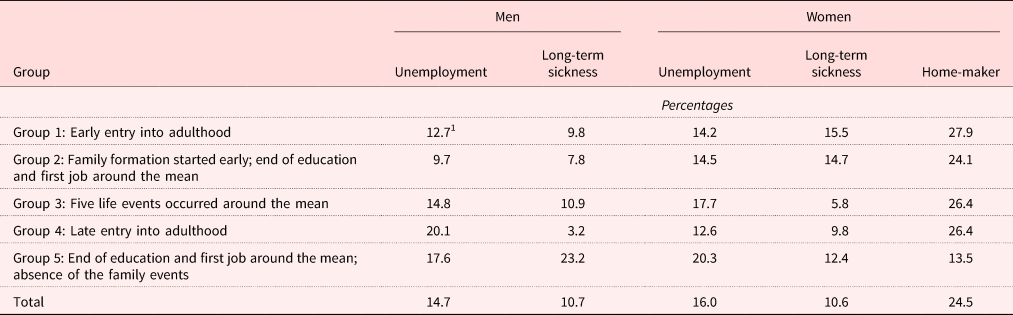
Notes: N = 2,016 respondents in 2005, 2008 and 2011, birth cohorts 1941–1960. 1. Read: 12.7 per cent of men in Group 1 had experienced at least three months of unemployment after the age of 45.
Source: Generations and Gender Programme survey, France.
Transition to adulthood and job category (if employed in 2011 or last job for inactive respondents)

Notes: N = 2,016 respondents in 2005, 2008 and 2011, birth cohorts 1941–1960. 1. Read: 13 per cent of men in Group 1 were (or had) a job category of ‘higher managerial and scientific’ status.
Source: Generations and Gender Programme survey, France.
Transition to adulthood and employment sector

Notes: N = 2,016 respondents in 2005, 2008 and 2011, birth cohorts 1941–1960. 1. Read: 16.2 per cent of men in Group 1 were (or had been) employed in the public sector.
Source: Generations and Gender Programme survey, France.
We now examine mid-life work history, i.e. between the age of 45 and retirement, focusing on spells of unemployment, long-term sickness or home-maker (at least three months). The proportion of men and women who had experienced unemployment was equivalent (15 and 16%, respectively), as was the proportion of men and women who had experienced a spell of long-term sickness (11%). Among men, the highest proportion of unemployment experienced was in Group 4 (20%), and men in this group also had the lowest rates of long-term sickness (3%). For women, rates of unemployment were lowest in Group 4 (13%) and highest in Group 5 (20%), again following the same pattern observed before the age of 45. Women in Groups 1 and 2 had the highest rates of long-term sickness (15%). Rates of long-term sickness for men were the highest in Group 5 (23%), replicating the pattern observed before the age of 45.
The job category that the respondent declared at Wave 3 (if employed in 2011 or last job for inactive respondents) is an indication of how lifecourse events are associated with occupational activity in later life. Overall, at one end of the scale, equal proportions of men and women are to be found (or were to be found) in unqualified or low-qualification jobs (approximately one-fifth of the sample), and these jobs are held (or were held) especially by respondents in the first group of the typology who both started their family formation and their work career early and who had a low level of education (Group 1, 44% of men, 42% of women). At the other end of the scale, men and women who had pursued further education, notably those respondents in the fourth group of the typology, are to be found in higher proportions in high-level job categories (managers and scientific jobs), 31 per cent both for men and women. These characteristics are also to be found for the men in the second group (33%).
Concerning the employment sector (if employed in 2011 or last job for inactive respondents), the general trend observed is that higher proportions of men are (or were) self-employed (18% compared to 10% of women) whereas higher proportions of women are (or were) employed in the public sector (30% of women compared to 21% of men). Men and women in Group 1 have the highest representation in the private sector (67 and 66%, respectively) and are the least present in the public sector (16 and 24%, respectively). Higher proportions of men in Group 5 are to be found in the public sector (25%).
To summarise, a portrait of the professional characteristics of men and women at mid-life and beyond can be given based on the information available concerning how respondents began their adult life together with the first and the second part of their working career. Both men and women in the first group (early entry into adulthood) appear to have cumulated the disadvantages inherent with low levels of education, and they are to be found predominately in unqualified jobs, in the private sector and with a period of unemployment before the age of 45. In Group 2, for whom partnership and family life also commenced early, men appear to benefit more in terms of their professional career than women: higher proportions of men have high-level jobs in the private sector and uninterrupted periods of activity up until age 45. In contrast, women in Group 2 are predominately employees or qualified workers; often they have interrupted their professional career to look after children and in addition they are more likely to have experienced a period of unemployment and the evolution of their professional career has more in common with Group 1 than the other groups.
Men and women in Group 4 (late entry into adulthood) pursued their education longer than in the other groups and in addition they also began their conjugal and family lives at a later age. Within this group, higher proportions of men and women had high-level jobs, despite unemployment especially for men before and after the age of 45. Gender effects are also found within Group 5, which is characterised by an absence of a partner and/or children in the early lifecourse: women are less likely to have experienced a period of unemployment in the first and the second part of their career. This profile contrasts sharply with that of men, for whom an interrupted professional career for reasons of ill-health was more common. Finally, not being in a couple and/or being childless (Group 5), as well as making the transition to adulthood late (Group 4), is associated with an ascendant professional career for women (i.e. fewer interruptions and higher job category). This finding and the fact that in Group 2 men who have children early do not appear to face as many obstacles during their professional career compared to women reflect earlier research which has shown that within couples, the progression of a professional career for men ‘benefits’ from the home-maker status of their partners, whereas the presence of children can be an obstacle to professional career progression for women (de Singly, Reference de Singly2004). At the end of the panel (Wave 3, 2011), men and women are found to be economically active in equal proportions (whether in employment or seeking employment; 41% in 2011).
By means of logistic regression (Table 5), we examine the determinants of being economically active at Wave 3 for men and women. Several dimensions of explanatory variables are entered into the model: first, the typology of the five groups concerning transitions into adulthood; second, variables that indicate work life history: continuously economically active before the age of 45, unemployment before the age of 45; professional interruptions that occurred after the age of 45 (unemployment, long-term sickness and home-maker status, the latter for women only); and finally, the job category and employment sector of respondents at the end of the panel.
Logistic regression (response variable = economically active)

Notes: N = 2,016 respondents in 2005, 2008 and 2011, birth cohorts 1941–1960. Response variable = Economically active (whether in employment or seeking employment) in 2011 (Wave 3). Active men: N = 384; inactive men: N = 508; active women: N = 471; inactive women: N = 653. OR: odds ratio. 95% CI: 95 per cent confidence interval. Ref.: reference category.
Source: Generations and Gender Programme survey, France.
Significance levels: * p < 0.05, ** p < 0.01, *** p < 0.001.
The results show that the transition to adulthood had a significant effect on the probability of being economically active for both men and women: the probability of being economically active is higher for those who had a late entry into adulthood (Group 4) compared to those whose entry into adulthood occurred around the mean age (Group 3, this latter group being the reference category). Women in Group 5 are more likely to be economically active. Both men and women who had been economically active continuously before the age of 45 (the first part of the working career) are less likely to be economically active in later life; after age 45, as expected, men and women who had experienced a period of unemployment are more likely to be economically active whereas a period of long-term sickness in the second part of the working career is significantly less associated with economic activity. The probability of men being economically active is significantly higher among higher managerial and intermediate workers (compared to qualified employee/workers), as well as for men who are self-employed (compared to the private sector). In contrast, men and women in the public sector have a lower probability of being economically active.
The final step in the analysis presents descriptive statistics on the different pathways to retirement (chosen retirement, compulsory retirement and ‘other’ retirementFootnote 8) for men and women (Table 6). We examine the same explanatory variables as in Table 5: transitions into adulthood; continuously economic activity and unemployment before the age of 45; unemployment, long-term sickness and home-maker status for women after 45 until retirement; job category and employment sector at the end of the panel.
Men and women report different pathways to retirement and they do not have the same constraints according to how they made the transition to adulthood and the subsequent evolution of their professional career. Because women are more likely to experience an interrupted professional career they have to wait longer before being eligible to take retirement: ‘other’ retirement is more common for women (49%) compared to men (38%). Therefore, low rates of chosen retirement are found among women, specifically for those who began their transition to adulthood early (Group 1, 13%). Rates of chosen retirement are also lower among women with a lower job category status. For men, rates of chosen retirement are significantly lower in Group 5 (12%) and higher for those in higher managerial jobs (38%) or among the self-employed (48%). Retirement, experienced as an obligation to stop working, appears to be more frequent for men and women whose earlier career pattern was continuous (37%) and for those whose last job was in the public sector: 44 and 42 per cent, respectively, for men and women. Women whose careers were in the higher-level job categories also have high rates of having experienced compulsory retirement. As far as the ‘other’ retirement patterns are concerned, early, mid-life and later-life career patterns appear to influence strongly the passage to retirement and the possibility of choosing the moment of retirement. For example, women in Group 1 are over-represented in this category (70%) and so are men in Group 5 (56%), as well as all respondents who had experienced an interrupted career before and after the age of 45 (especially concerning unemployment), or a spell of long-term sickness after the age of 45. In contrast, respondents with higher job category levels or those in the public sector are under-represented in the ‘other’ retirement category.
Pathways to retirement, and early, mid-life and later-life events

Notes: N = 996 respondents (470 men, 526 women) in 2005, 2008 and 2011, birth cohorts 1941–1960. Group 1: Early entry into adulthood. Group 2: Family formation started early; end of education and first job around the mean. Group 3: Five life events occurred around the mean. Group 4: Late entry into adulthood. Group 5: End of education and first job around the mean; absence of the family events. 1. Read: 32.8 per cent of men in Group 1 ‘chose’ the moment of their retirement.
Source: Generations and Gender Programme survey, France.
In summary, the salient points regarding how the respondents experienced the passage to retirement can be resumed as follows: there is a strong effect for both men and women of being unemployed in the second part of a professional career leading to compulsory retirement; and the type of employment sector also significantly influences the passage to retirement (‘chosen’ for the self-employed, ‘compulsory’ for the public sector). Beyond these points, it should be noted that the passage to adulthood is an important explanatory variable when examining the passage to retirement, together with the type of profession which in turn is strongly associated with the length of time spent in education and the entry into a career.
Discussion and conclusion
The aim of this paper has been to explore the effect of early and later-life transitions of French individuals on economic activity and pathways to retirement among the birth cohort 1941–1960. The results show an association between early and mid-lifecourse events on economic activity in later life, with a late entry into adulthood being the most significant pathway influencing the maintenance of economic activity. Furthermore, the variation observed between different professional and employment sectors is directly linked with early lifecourse events. At the same time, the type of job category, occupational profession and employment sector have a significant role on economic activity in later life and pathways to retirement. These differences can be clearly observed in relation to gender. Women whose family formation occurred early, together with women who had an absence of family events (partnership or childlessness), were much more likely to be economically active in later life than men with the same characteristics.
These results highlight the interplay of macro- and micro-influences on patterns and outcomes over the lifecourse. In a macro-perspective, different pathways to retirement are largely determined and modified by the economic conditions in place and the political decisions taken during the adult lifecourse of the cohort studied. A pattern of standardisation can be observed in the conditions under which individuals experience the passage to retirement. This result demonstrates the central place of historical contexts in shaping the lives of individuals (Elder, Reference Elder1975). This process can be seen in France in relation to retirement reforms to date which have aimed to create universal rules and regulations governing access to pensions for all workers regardless of the occupational sector. At the same time, the situation of individuals at the end of their professional careers has more in common with a destandardised perspective of the lifecourse, since individual responses to maintaining economic activity or retirement are conditioned by work histories, linear and ascendant for some, interrupted for others.
It is clearly difficult to disentangle the effects of standardised and destandardised lifecourse patterns on economic activity in later life. As Kohli (Reference Kohli2007) suggests, institutional factors that regulate the lifecourse continue to orientate the experience of economic activity in later life. The results suggest that in the French context and in relation to the cohort studied, in addition to individual factors such as health, it is the institutional legal and administrative frameworks relating to occupational sectors that ‘push’ or ‘retain’ certain employment categories in economic activity. An important example of this effect can be seen in the association between later entry into adulthood and employment in the public sector. Some workers may wish to extend their working life because of late entry at the beginning of their career but they are prevented from doing so because they are employed in the public sector. This means a more deterministic pathway to retirement that is governed by institutional factors rather than by individual choice. In this respect, the results tend to confirm the observation by Cavalli (Reference Cavalli2007) that institutionalised (standardised) lifecourse patterns exist simultaneously with individualised (destandardised) patterns.
Further research is needed to assess the influence of conjugal, family trajectories and the gendered differentiated effects of career patterns within couples on patterns of retirement. These respective trajectories need to be examined, as this research has shown, within the context of specific institutional opportunities and constraints. However, notwithstanding the limitations of the current research in this respect, the typology of the transition to adulthood points to the influence of conjugal and family effects on patterns of economic activity in later life. The absence of key early family-related events, such as not leaving the parental household, not entering a partnership or not having children, suggest gendered patterns of economic activity, with men more likely to have interrupted careers and women more likely to invest in professional activity and remain economically active. In contrast, the typology of transitions to adulthood suggests that early couple and family formation can be beneficial for the career trajectories of men and detrimental for women. These two pathways of the transition to adulthood are those that are strongly characterised by gender differences in economic activity over the lifecourse and transitions to retirement. A further important finding is that the absence of interrupted professional careers appears to lead to a smoother transition to retirement for both men and women. Similarly, there are no strong gender differences for individuals who start adult life ‘late’, for whom a higher-qualified professional career is more likely as well as the extension of the working life.
As far as possible policy implications are concerned, the results suggest that institutional reforms directed towards extending working life (in France measures such as le cumul emploi-retraite, la retraite progressive or la surcote) can only be successful if men and women are in stable jobs towards the end of their working lives. A stable job influences above all the ability to choose retirement timing for workers in the private sector or to take compulsory retirement for those workers in the public sector. Moreover, gender differences of opportunity exist, since the results show that women are more likely to accumulate the effects of interrupted professional careers and also to be more present than men in lower-qualified jobs. There are clear policy implications here in terms of parity for men and women in professional occupations. However, both men and women who begin their professional and family careers early are more likely to have lower-qualified jobs, insecure jobs and interrupted professional career trajectories, all of which impact on the timing of their access to retirement pensions.
To conclude, workers are exposed to different levels of risks which in turn determine periods of interrupted economic activity over the lifecourse, and moreover these risks are accentuated in the latter period of professional careers, in particular for manual and low-qualified workers. Additionally, workers in the private sector are more exposed to these risks than self-employed or public-sector workers. Periods of unemployment or long-term sickness in the second part of careers also strongly determine pathways to retirement. The characteristics of the employment sector and different types of professional occupation largely determine pension eligibility and hence pathways to retirement.
Acknowledgements
This paper is based on work from COST Action IS1409 ‘Gender and health impacts of policies extending working life in western countries’ supported by COST (European Cooperation in Science and Technology). We are grateful for the comments of two anonymous referees on an earlier version of the paper.
Ethical standards
No ethical approval was required for this study.


 Open access

