




Policy Significance Statement
Linking of administrative records and predictive analytics to identify families for preventive early intervention increasingly is promoted by governments. Informed consent to use of their data is important to parents, and there is less acceptance of public services using data linkage among marginalized social groups. Implementation of operational data linkage among services working with families has the potential to undermine social legitimacy and trust, with consequences for a cohesive and equal society. Addressing this through explaining the merits of data linkage is likely to bolster social license among parents in higher occupation, qualification, and income groups while generating further disengagement and avoidance of public services among marginalized parents. Rather, meaningful dialogue that shapes the parameters of data linkage is required.
1. Introduction
Electronic linkage of public records and predictive analytics for the operational purpose of identifying families for preventive early intervention increasingly is promoted by governments, part of a transition to data-steered social policy in the UK and internationally. Sharing and linking the separate sources of nationally and locally held information about citizens—health, education, social care, police, housing, immigration, taxation and social security records, and so forth—and operationalizing them through algorithmic data analytics is championed as offering the possibility of improved and more efficient public service delivery, and enabling predictive risk modeling to pre-empt problems and improve outcomes (e.g., NL Digitaal Government, 2019; Privacy Council Office Canada, 2018; Stats NZ, 2018). The COVID-19 pandemic has accelerated this trend, notably boosting calls for services and agencies to share and join up their routinely collected data. This raises questions not just about service efficacy, but importantly about the extent to which transitions to such data use occur without a democratic mandate and transgress legal, ethical, and data quality norms (van Zoonen, Reference van Zoonen2020). Shaw et al. (Reference Shaw, Sethi and Cassel2020) argue that data sharing, data linkage, and the application of analytics need to earn “social license”—that is the agreement and trust of citizens, for “COVID-era” data initiatives, and they advise the need for transparency and public involvement. Yet, as van Zoonen argues, moves toward data-driven social policy largely take place out of political and social view. Data linkage and predictive analytic practices are centered on top-down monitoring, containment, and control: “Citizens in the system are subjected to those processes, as a group and sometimes individually, without knowing it” (van Zoonen, Reference van Zoonen2020, pp. e10–e19). This raises questions about power, social inequalities, and whose interests are serviced with these practices.
In the UK, the Government’s National Data Strategy was updated at the end of 2020 to exhort public services to share their administrative records, citing the way that data linkage has been essential for public health responses during the COVID-19 pandemic, and how this situation has underlined the need for: “the presumption is that, with appropriate safeguards, data should be shared to drive better outcomes” (Department for Digital, Cultural, Media and Sport, 2020). The House of Lords Public Services Committee (2020) similarly has emphasized data sharing for public services working with children and families specifically:
We are concerned that agencies do not share the data that they need to support vulnerable children and to determine which children need their help. The Government should issue new guidance on data-sharing powers and duties to protect vulnerable children, and, if necessary, introduce legislation to ensure that such data is shared (Department for Digital, Cultural, Media and Sport, 2020, p. 43)
Yet, it is all families who are implicated in across-the-board data sharing, data linking, and application of predictive modeling, not just the families with “vulnerable children.” Population-level data comprise data from individual families, from all families nationally or from all living in a particular local authority area. These data are linked together across different service sources at population level and subject to predictive analytics to flag up individual families for preventive intervention.
Other lessons from the pandemic are the revelation of stark social divisions and material inequalities cutting across British society (Johnson et al., Reference Johnson, Joyce and Platt2021), and a lack of trust in public institutions among minority groups demonstrated in vaccine hesitancy, including those with lower qualifications and income, and especially among Black people (Ansell et al., Reference Ansell, Bauer, Gingrich and Stilgoe2021; Office for National Statistics, 2021). While supporting the improved flow of information across government, the British Academy notes potential for the exacerbation of low and unstable levels of trust among disadvantaged groups and hence challenges for social cohesion:
The steepest declines in perceptions of unity and solidarity have been in some (but not all) of the most deprived communities, among key workers and in certain ethnic minority groups … Reduced trust in national government also leads to reduced societal trust, enabling division and the targeting or scapegoating of particular groups. Thus, trust and cohesion are linked … There may also be questions about trust in governments’ use of other measures, such as technology or data linkage (British Academy, 2021, pp. 76, 128).
Advocates of extensive joining up of public records to support operational service interventions often regard data and its collection as neutral and objective, without recognizing how they can reflect discrimination and intensify the social inequalities they capture (Benjamin, Reference Benjamin2019; Eubanks, Reference Eubanks2018; Wachter-Boettcher, Reference Wachter-Boettcher2017). There is evidence that inequalities are encoded into the data gathering, linking, and predictive practices that drive early intervention (Redden et al., Reference Redden, Dencik and Warne2020). The transition to data-steered social policy has subjected already marginalized groups to more disadvantage, with built-in discrimination in databases. There are bias and errors in the data sources that are merged, and in the design of data modeling and predictive analytics applied. Particular subgroups of parents and families are disproportionately represented in social security, social care, and criminal justice systems, leading to the encoding of existing social divisions of class, race, and gender in their datasets. In the UK, for example, predictive risk modeling used in child protection embeds an equation of socioeconomic disadvantage with risk, discriminating against poor families (Vannier Ducasse, Reference Vannier Ducasse2020), while attention has been drawn to the unsupported overidentification of young Black men in what amounts to digital racialized and gendered profiling in police databases that are shared with other agencies (Amnesty International United Kingdom Section, 2018; Wroe, Reference Wroe2021)—an injustice that is repeated in data-driven social policy systems internationally (e.g., Benjamin, Reference Benjamin2019; Eubanks, Reference Eubanks2018; Keddell, Reference Keddell2014; Wachter-Boettcher, Reference Wachter-Boettcher2017).
In this article, we address questions about trust and social cohesion in the push for more extensive data linkage for operational purposes. What are the views of those directly affected (parents of dependent children) about what is acceptable or unacceptable in relation to information about them? How far does use of data linkage and predictive analytics for operational service intervention lie within social acceptance norms? And is the extent of trust in their use by services shaped by parents’ social location, by social divisions?
We begin with a discussion of the interlocking of early intervention initiatives directed at families and the use of data-driven operational practices in the UK, whereby government seeks to pre-empt dysfunctional parenting and poor outcomes for children by linking together administrative records from public services and subjecting them to predictive risk modeling to identify and target families. We then outline the concept of social license as a framing for our survey investigation of parents of dependent children before moving on to consider how transparency is regarded as a policy solution to embedding trust in the process, and parents’ views about the joining together of administrative records.
2. Data Linkage for Early Intervention in the UK
The way that parents bring up their children is a long-standing social policy concern, identified as a cause of and solution to the state of the nation, and as a driver of social cohesion. Over past decades, this focus has intensified and shifted, from implementing support for all parents in transmitting acceptable values to their children, toward a focus on children and families at risk, and early intervention in particular families’ lifestyles and behavior. Early intervention aims to pre-empt rather than react; to prevent any risk of social, educational, health, and behavioral deficiencies that, it is asserted, might otherwise occur at some point in the future, or at least address them early on when they occur to prevent them escalating (Edwards and Gillies, Reference Edwards and Gillies2004; Gillies et al., Reference Gillies, Edwards and Horsley2017). For example, the UK’s Early Intervention Foundation was established by government in 2013 to “champion and support the use of effective early intervention to improve the lives of children and young people at risk of experiencing poor outcomes.”Footnote 1 Their focus on evaluating various parenting skills delivery packages has more recently been augmented by attention to the potential of administrative data for targeting and tracking early intervention (Scourfield et al., Reference Scourfield, Corliss, Wijedasa, Robling and Clayton2019). Such data-driven family policy initiatives are legitimated by what White and Wastell (Reference White and Wastell2017) refer to as “prevention science,” a mix of technological, biological, and behavioral sciences and morality that is fueling a realignment of the relationship between families, the state and professions without open debate. Indeed, there are concerns that mass data collection and automated analysis have become a governance end in itself, for top-down monitoring and control (Dencik et al., Reference Dencik, Redden, Hintz and Warne2019; van Zoonen, Reference van Zoonen2020). It is as if, in itself, collecting more information and merging data is the solution to social problems.
What goes on in families has become keyed into a wider endeavor of governance with and through data. In addition to UK government exhortations to link administrative records noted in our Introduction, the Early Intervention Foundation calls for local authorities to set up information-sharing “assessment hubs”: “It is essential that data are shared between health services and the local authority at population level and, where necessary, at an individual level to ensure that families who need services are offered them” (Messenger and Molloy, Reference Messenger and Molloy2014, p. 7). At the time of writing, there are plans for local authority “family hubs” and digital “red books” containing information about babies from birth that can be used to identify parents deemed to need support (Department of Health and Social Care, 2021). Central government has initiated a Local Data Accelerator Fund for Children and Families (Ministry of Housing, Communities and Local Government, 2021a), where local authorities can bid for funding for data sharing and matching projects that support identification of families for “earlier intervention before risk escalates” (Ministry of Housing, Communities and Local Government, 2021a, p. 7). The prospectus for the Fund provides the examples of Liverpool City Council combining 35 feeds of data from children’s social services, schools, the criminal justice system, and health and benefits data in order to identify those who could benefit from early intervention, and Bristol City Council Insight team’s establishment of a multiagency data “warehouse” as an analytic hub to help predict children at risk of criminal or sexual exploitation, becoming not in education, employment, or training (NEET), or being a victim or perpetrator of serious violence (p. 8).
Like Liverpool and Bristol, a number of local authorities have embarked upon linking up sets of administrative and other data in order to identify “high-risk” families for forms of local authority provided or contracted early intervention in the way that parents bring up their children (McIntyre and Pegg, Reference McIntyre and Pegg2018). There is some evidence, however, that the majority of authorities only have “basic” data matching software or the “building blocks” of data linkage and analytics rather than more “mature,” advanced systems (Ministry of Housing, Communities and Local Government, 2021a, p. 7). It is impossible to discuss this with any accuracy, however, since there is no central record available of which local authorities are doing what when it comes data sharing, operational linking and matching, and predictive analytics in the family policy field, and indeed no shared vocabulary between local authorities about what they are doing.
Local authority interest in multiagency data sharing and linking to identify and intervene was heralded by the Troubled Families program, reborn as Supporting Families in its latest phase (Ministry of Housing, Communities and Local Government, 2021b). The Troubled Families program was set up by central government to intensively intervene in families who meet a combination of specified criteria that are treated as evidence of their current or future risk of dysfunctionality (Crossley, Reference Crossley2018). Local authorities are encouraged to identify families as part of the program, because it is run on a Payment by Results basis—an attractive prospect for cash-strapped local authorities in the context of austerity. The suggested criteria for the Troubled Families program range widely across the domains of social security, housing, education, health, social services, police and criminal justice, and other public provisions (Ministry of Housing, Communities and Local Government, 2020), and under the Supporting Families version of the program, the emphasis is on “building stronger data,” posed as part of a “moral mission” to support “vulnerable” families (Ministry of Housing, Communities and Local Government, 2021b).
The integration and analysis of administrative records for extracting profiles based on whole populations, and for predictive analysis flagging up particular families, may be carried out in-house by the public sector. More often, there is a range of different types and extents of involvement of commercial data analytic companies (Redden et al., Reference Redden, Dencik and Warne2020) in creating and operating the data hubs, data linkage, algorithmic analytics, and so forth in the social policy domain. As we noted above though, there is no easily accessible means, such as a public register, for parents to find out what is happening with their own data. What little public consultation there has been about sharing and linkage of administrative records has usually focused on anonymized data for research purposes, and/or involved general population focus group discussion (e.g., Moody and Lugg, Reference Moody and Lugg2017; NatCen, 2018). All parents are stakeholders in the use of administrative records for data linkage and predictive analytics for targeting service intervention, but they appear to have played no part in assessments of the legitimacy of the application of data techniques to information about them and their families. The integration and outsourcing of operational practices involved in early intervention lie outside of automatic social acceptance norms, social trust and consensus, so social license for them needs to be ascertained.
3. Social License
Considerations of data linkage and predictive analytics for operational service intervention have been turning to the concept of social license in a context where there is concern internationally and nationally, about the existence and sustenance of trust for these practices (e.g., Caldicott, Reference Caldicott2016; Leonard, Reference Leonard2018; World Economic Forum, 2018). The concept’s growing traction is evident, notably in New Zealand, for example, in discussion of plans for data sharing between sectors (Data Futures Partnership, 2017) and Statistics New Zealand’s Integrated Data Infrastructure (Gulliver et al., Reference Gulliver, Jonas, McIntosh, Franslow and Waayer2018), but also concerning data linkage and automated intelligence in Canada (Paprica et al., Reference Paprica, Nunes de Melo and Schull2019) and Australia (Leonard, Reference Leonard2018). In the UK, as the focus of our discussion here, the Office for Statistics Regulation (2018, p. 14) asserts:
Proactively seeking to build and maintain social licence around data use should, in the long-term, also help to increase public understanding of the benefits and risks of data sharing and linking. The public will then be in a better position to engage in debates about new proposals for data use, and to judge the consequences of breaches, if they occur, either with government data or that held by private bodies.
The concept of social license concerns social legitimacy and acceptance of practices that lie outside general norms. It draws attention to the issue that formal legal authority to share and link data does not automatically command social trust and consensus. For example, Carter et al. (Reference Carter, Laurie and Dixon-Woods2015) drew on the concept of social license to explain public concern about the UK “care.data” initiative, involving the sharing of personal medical records for secondary purposes. They argued that the lack of public social license for the initiative was related to poor provision of trustworthy information, the rupturing of normative GP-patient relations, and little evidence of any public good. Similar social license points have been made about public backlashes over Australian Bureau of Census plans to link individually identified data with other public records (Easton, Reference Easton2017), and US health care organization plans to share data with Google for advanced analytics (Wachter and Cassel, Reference Wachter and Cassel2020). Legal license is not necessarily a foundation for social license.
Crucially, social license as a conceptual approach treats broad acceptance of legitimacy and the trust that sustains it as relational, emerging from situated perceptions and understandings. As such, it is a dynamic process. The focus on a consensus of social approval draws on sociological theorizing about the relationship between professionals and society. Notably, Hughes (Reference Hughes1958) conceptualized professional groups as socially licensed to carry out particular activities; that is, the public affords permission to professions to adopt practices that lie beyond normative conventions without incurring any social sanction. Another source of the concept of social license is the examination of corporate responsibility in extraction industries, where the environment or communities may be harmed by their activities (e.g., Thomson and Boutilier, Reference Thomson and Boutilier2011). In this field, there is a strand of literature that stresses the need to build and maintain a consensus of social license among relevant stakeholders, especially the particular population affected, even if operating within the law. Social license, then, points to the need for agencies undertaking activities that could give rise to public concern and controversy to go further than compliance with legal requirements, to make ongoing efforts to secure and maintain social license.
In the contexts of emphasis on data linkage and analytics in the field of family policy and early intervention, and concern about the existence and sustenance of trust and ethical practice, we undertook an investigation of social license among the population implicated: parents of dependent children. If policymakers and service providers are to begin to engage with social license as a dynamic process, there needs to be some knowledge of the bases from which they are starting. If social license already exists and engagement is directed toward maintaining it, then that will involve a different sort of dialogue with stakeholders than understanding where it does not exist and needs to be built. Relatedly, dialogue with those most likely to be implicated in a policy action may look very different from engagement with those who are least likely to be. Alternatively, the social license knowledge base may mean that policymakers and service providers understand that a policy action should not be pursued because of unintended consequences.
4. Our Survey
Our Parental Social License for Data Linkage for Service Intervention project Footnote 2 investigates the dynamics of social license and trust for the operational use of data linkage and predictive analytics to identify families for service intervention. It aims to provide an understanding of social license for these data practices among those implicated: parents of dependent children (<16 years). As part of our research, we commissioned from NatCen an online and telephone probability-based panel survey, designed to be representative of parents across the UK, to gain an understanding about what parents deem to be acceptable or unacceptable in relation to data linkage and analytics, and to assess if there is any discernible consensus indicating parental social license. This is the source of the data that we draw on in this article, specifically relating to the elements that addressed early intervention.
The NatCen panel is recruited from the British Social Attitudes survey, a high-quality random probability-based face-to-face survey. The research panel is designed to be representative of the population and produce reliable estimates of opinions. It employs a sequential mixed mode fieldwork design, and weights for nonresponse. Full details about the methodology of NatCen’s probability-based research panel are available at https://www.natcen.ac.uk/media/1484228/Developing-the-NatCen-Panel-V2.pdf. Questions for our data linkage survey were piloted through an online parents group initially, updated through an analysis of subsequent government, corporate, advocacy, and media publications, and refined in discussion with NatCen. Randomization of statement sets within questions and flipping of answer option order was used to counter mode effects.
The questions asked in the “attitudes to joining data” survey covered in principle views on a range of aspects of data linkage and analytics for operational purposes. We asked about awareness of the collection and linking of administrative records, assessments of a range of early intervention rationales for data linkage and analytics, and acceptance of and trust in various bodies and services to undertake linkage of different types of information. The rationale statements (e.g., reasons for linkage, and reasons for trust or lack of it) were drawn from our discourse analysis of the contents of reports and online materials from national and local governments, data analytic companies, charities and advocacy groups, and mainstream media that related to early intervention (see Edwards et al., Reference Edwards, Gillies and Gorin2021b).
Explanation of data linkage was treated as a process throughout the survey. It began with a description of administrative records as information collected by government departments and public service providers about people who use their services, and provided examples. Examples of data linkage and analytics drawn from our report and online materials analysis (Edwards et al., Reference Edwards, Gillies and Gorin2021b) were provided as the survey progressed, including short vignettes about a local council wanting to support parenting skills, a social worker judging whether a family needs further investigation, and a police authority wanting to prevent crime and antisocial behavior. For the most part, we used a Likert scale for responses, apart from responses to questions about awareness which were dichotomous.
The probability-based sample consisted of 843 parents, of whom 57% were mothers and 43% were fathers. Looking at the various household types that parents lived in, the majority were families of two parents with children, at 74.5%. Eleven per cent were lone parents, and 24% of the parents lived in households comprising five or more people. Twelve per cent of the sample were younger parents, aged between 18 and 29 years. Turning to indicators of social class, such as occupation, education, and income, 44% of the parents were in managerial and professional occupations, and 50% were educated to degree level or above, while 38.5% were in lower semi-routine and routine occupations and 10% had no qualifications. The majority of parents, 65%, earned £3700 per month or under, with 60% of the sample owning their homes, while the remainder rented, split between local authority/housing association or privately. Ethnically, 73% of parents were White British, with 19% of our sample from minority ethnic groups, 5% of whom were Black. These social divisions among the overall sample of parents obviously involve small numbers, and so care must be taken here, but as will be clear from our discussion below, the profiles of the extension of (lack of) social license for operational data linkage among Black and other marginalized groups of parents stand out.
The concept of social license concerns social legitimacy and approval of practices that lie outside general norms of what is acceptable, as discussed above—a consensus of social agreement giving social license. This raises the question of what level of agreement constitutes a consensus? A consensus is something more than a simple majority. In line with our conceptual approach, we adopted the consensus baseline for analyzing our survey data, in which we took account of the number of response choices available to a question in order to determine what constitutes a social license consensus (see Edwards and Gillies, Reference Edwards and Gillies2004; Finch and Mason, Reference Finch and Mason1991). For a two-response-option question, rather than more than 50% being taken as a consensus, if one of the options gathers half as many responses again (75%), then where this was a positive response to data linkage and predictive analytics we took that to represent a widespread granting of social license. For a three-option question, we took a 50% or greater positive response as indicative of social license. We conducted the consensus baseline analysis at the level of the sample of parents as a whole, and also looked within this, to subpopulation groups of parents (family types, social class indicators, and ethnic groups) to see if they may or may not reach a consensus baseline for granting social license at an appreciably higher or lower level than the rest.
5. Transparency About Data Linkage
Openness, accountability, and transparency has emerged as a theme in government-commissioned reports on the use of data linkage and algorithmic analyses. For the most part, this theme is centered on openness between services in sharing data and accountability as legal compliance. But there is some equation of transparency with public trust, with recommendations that people should be told about what is happening to their data and how they are used (e.g., Centre for Data Ethics and Innovation, 2020; Information Commissioner’s Office, 2020). The UK government’s Centre for Data Ethics and Innovation, for example, asserts that transparency in the use of algorithms will build public trust and recommends informing people about the process of developing and using algorithms. This is transparency of a certain kind, akin to lifting the lid off a black box, so that the public may look inside but not touch. Consent on the part of those concerned to sharing and linking of their data is not a feature. Yet informed consent to operational use of their family administrative records is important for parents of dependent children.
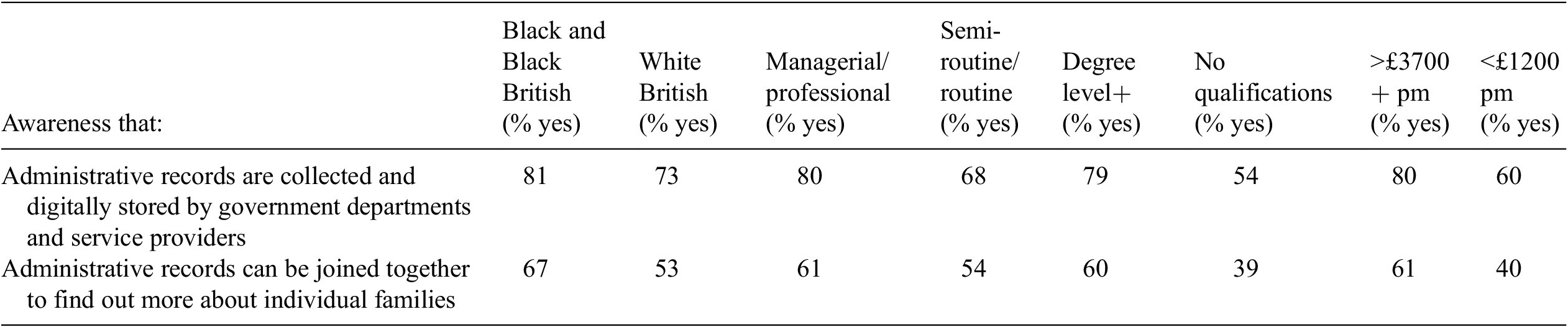
A majority of the parents surveyed for our research said that they were aware that administrative records are collected and digitally stored by government departments and public service providers (72%), but only just over half knew that digital administrative records from different sources can be joined together to find out more about individual families (53%). There were gradients here by ethnicity and social class indicators for both awareness of digital records and data linkage. Black and Black British parents were more aware than their White British counterparts, and parents with higher occupation, education, and income were more aware than other parents (see Table 1).
Awareness of digital administrative records and of data linkage by ethnicity, occupation, education, and income
There was consensus among the parents that families generally do not know or understand how their administrative records are used, with 60% making this judgement (with a consensus threshold of 50%). There was overwhelming agreement that Government should publicize that they are joining together administrative records about families, and how they use that information (81% with a consensus threshold of 50%). But going further than ideas about transparency engendering trust, there was also consensus that parents need to be asked permission for administrative records about their family to be joined together (60% with a consensus threshold of 50%). Some marginalized groups of parents had an even stronger consensus about the need for parents to give consent to data linkage, notably Black parents and lone parents (each at 66%).
The hopeful notion in reports, that openness and transparency as awareness will engender public trust, is not so simple when it comes to parents of dependent children (or indeed more widely; Kennedy et al., Reference Kennedy, Oman, Taylor, Bates and Steedman2020). There are social divisions between the assessments of groups of parents, which raises issues about the implications of data linkage for social legitimacy and trust among the parents who are most likely to be subject to early intervention.
6. Data Linkage for Early Intervention and Social Divisions
Data linkage and predictive analytics for early intervention are promoted in reports and online materials from national and local governments, and data analytic companies, and other supportive bodies, as: delivering powerful control of superior knowledge in the hands of local authorities; timeliness, especially through incoming “real-time” data about families allowing for quick “early warning” risk prevention; and economic efficiency, optimizing existing resources and making savings through prevention rather than crisis management (see the discourse analysis in Edwards et al., Reference Edwards, Gillies and Gorin2021b). These rationales for undertaking data linkage and risk modeling are driven by austerity-tightened finances, by prevention science as the answer to straightened services, and by political and public concerns about child protection and abuse (Jupp, Reference Jupp2017). Under these conditions, rather than providing universal support services for families, public service providers aim to target specific families that they judge may face and cause difficulties, with dedicated early interventions to prevent the risk of problems embedding themselves, and thus to constrain costs.
Our survey put a series of dominant rationales about the benefits of joining together administrative records for early intervention to parents, drawing on our analysis of reports and online materials about data linkage and family services (see Edwards et al., Reference Edwards, Gillies and Gorin2021b). We asked about the extent to which they thought that it was acceptable or unacceptable, respectively, to: identify families that might need support whether or not they have asked for it; save time and money by preventing family problems before they developed; promote efficiency by targeting services at families that have been identified as needing support; and identify families where children could be at risk of abuse to intervene and prevent it happening. At this abstract, overarching rationales level, the parents surveyed granted social license for joining together administrative records for early intervention, but they were more circumspect when considering the specifics of trusting particular public services to do this, and private sector involvement in the process.
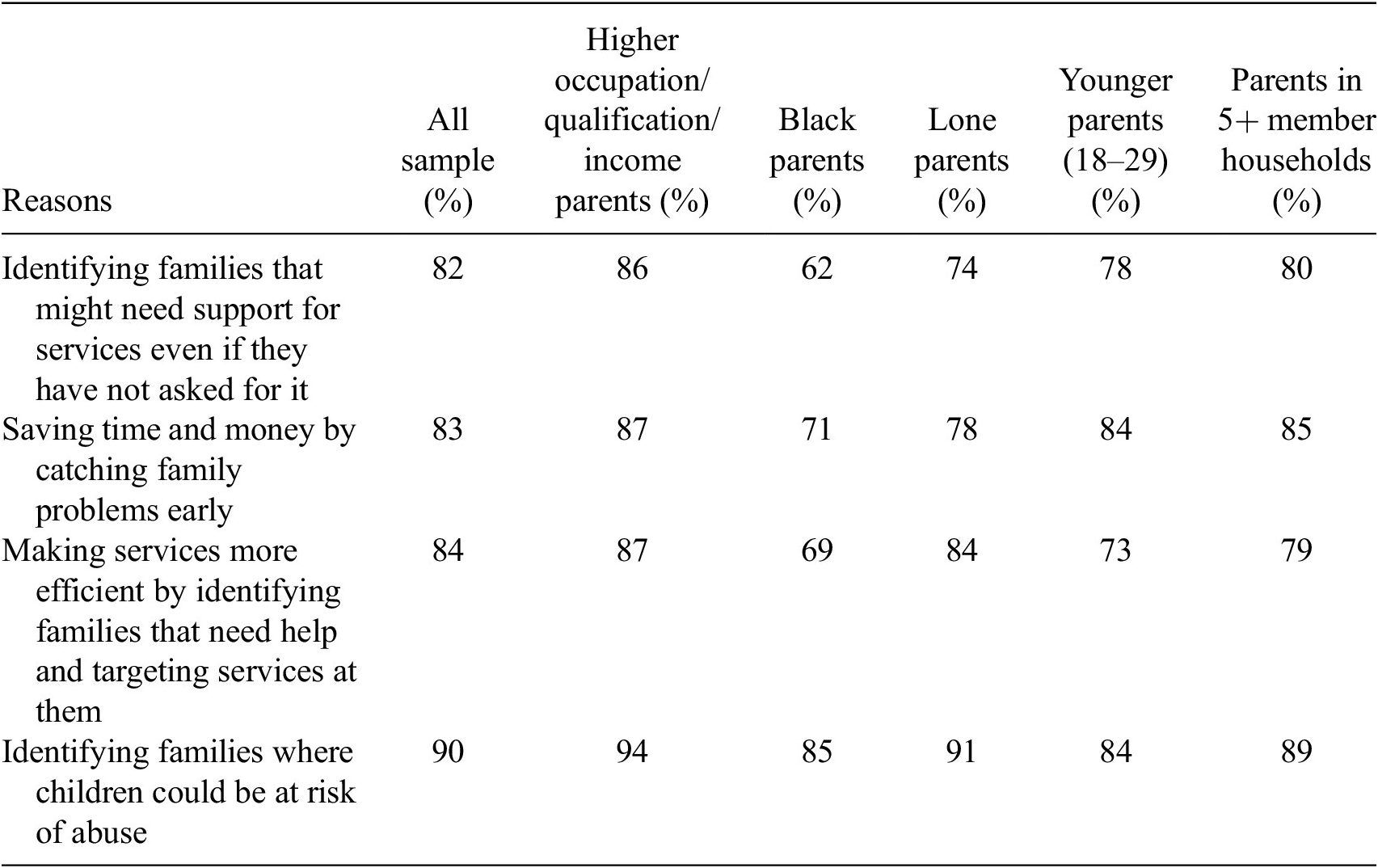
Among parents as a whole in the sample, there was a consensus for joining families’ administrative records to enable early intervention at a general level, with the level of agreement representing social license. As shown in Table 2, identifying families that might need support, catching problems early on, efficiently targeting services, and identifying risk of child abuse, and so forth, was seen as acceptable reasons for joining together administrative records, with over 80% of parents agreeing (with a consensus baseline of 50%). It is important to note, however, that, although still representing social license, the levels of agreeing are uneven between different social groups of parents (Table 2). In particular, it is variably lower among lone parents and younger parents in the sample, and consistently lower among Black parents, especially for identification and targeting of families.
Acceptability of reasons for joining together administrative records (50% consensus threshold)
The picture for the granting of social license changes when it comes to considering the use of data linkage by specific public services. We asked parents about whether or not they trusted particular organizations to join together administrative records to identify families for targeted public services. Trust is an important element of social license. It is bound up with considerations of information being used in legitimate and fair ways by agencies. As Leonard (Reference Leonard2018) points out, different social groups are likely to see the relationship between trust and fairness in different ways. This is because they are not all positioned in the same way in society and thus in relation to intervention services, which are targeted at particular types of families. This forms part of the wider collective contextual dynamics with which parents’ granting or withholding of social license for data linkage and predictive analytics articulates. Indeed, while parents may grant social license for joining families’ administrative records to enable early intervention in a generalized sense, when it comes to considering the use of data linkage by specific public services, there are differences between the services concerned in whether or not they extend trust, and importantly any trust and legitimacy extended is variable between different social groups of parents.
Looking at Table 3, around half of parents overall said that they trusted children’s social work teams, local council education services, early years services, police and criminal justice, or immigration services to join together administrative records for targeting families, with only social work and early years services (just) achieving the social license consensus baseline of 50% or above. For the other services, there was no social license for data linkage. Looking deeper into the patterning of this, trust in services to join together information mirrored the overall constrained social license pattern among parents who were in managerial and professional occupations, and had higher levels of qualifications and higher incomes, but there was even less likely to be a social license consensus for data linkage for operational purposes among marginalized social groups of parents.
Trust in organizations to join together administrative records to identify families to target public services (50% consensus threshold)
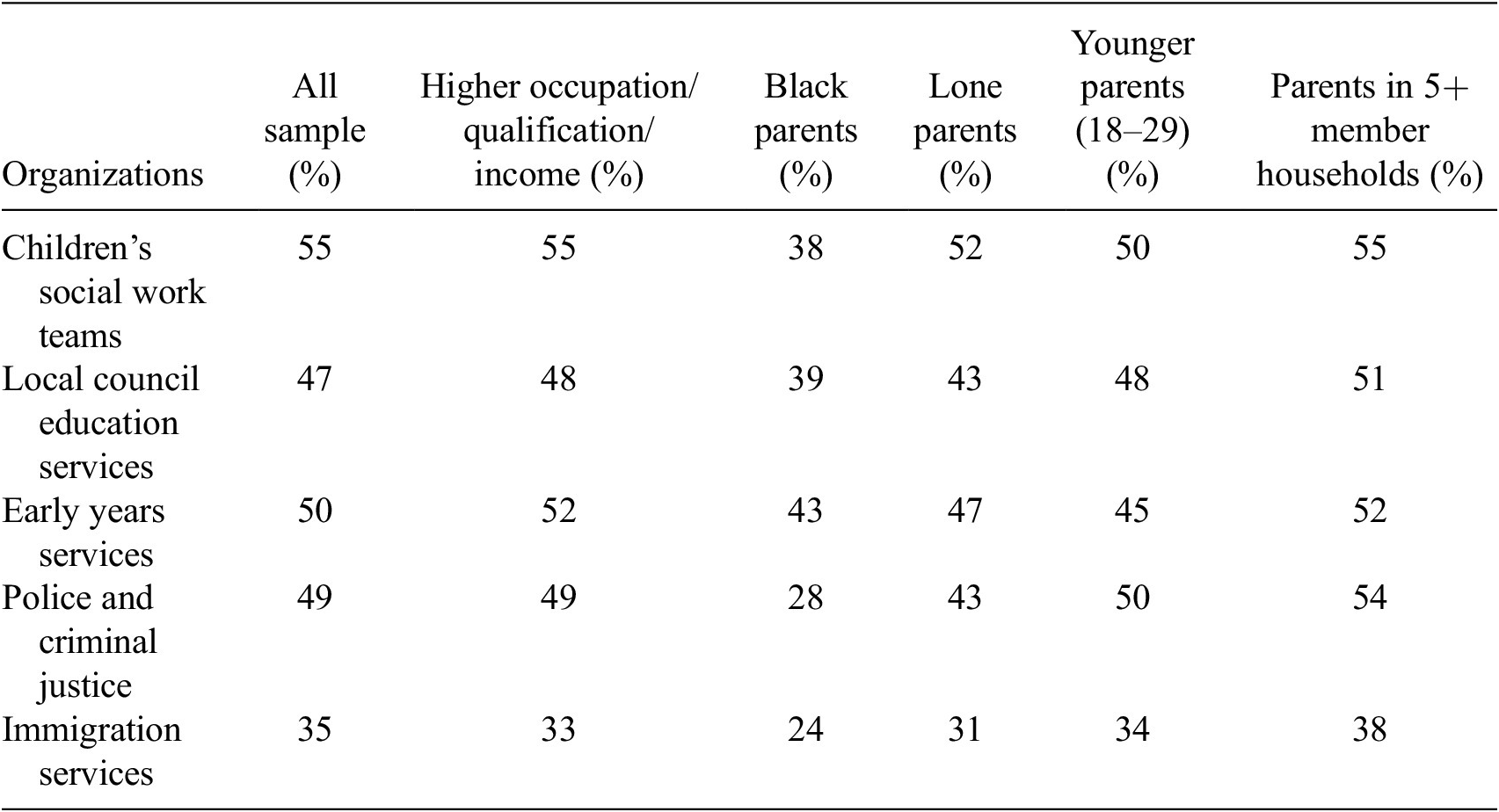
In particular, Black parents do not hold a consensus of trust in any public services concerning their use of data linkage, especially not police and criminal justice and immigration services where trust drops to under a third (28% and 24%, respectively). These concerning figures likely reflect the far lower levels of confidence that Black people in Britain have in the police in comparison with White and Asian counterparts (Office for National Statistics, 2020)—another feature of the wider contextual dynamics for social license. But specifically in relation to data linkage, the Black parents also held an overwhelming consensus that information collected about services users is not always accurate, with 79% disagreeing with the statement that joined together administrative records provide factual and unbiased information for delivering services. They also judged that data linkage leads to discrimination against some families (57% agreed), and that using families’ administrative records may discourage them from accessing services when they need them (62% agreed). Clearly, there is no social license for data linkage for early intervention among Black parents.
Other marginalized social groups of parents did not extend social license to aspects of data linkage for early intervention either, notably lone parents, younger parents, and parents in larger families. Table 3 shows that there is no social license among lone parents for many public services to link data. Rather, there is a consensus that the information collected about services users is not always accurate (63%), that data linkage will lead to discrimination against some families (52%), and that it can put families off accessing services when they need them (52%; all with a consensus threshold of 50%). Similarly, younger parents did not extend social license for data linkage by many public services, and held consensus that the information collected about services users is not always accurate (57%) and that joined together administrative records leads to discrimination against some families (60%). Parents in larger families did grant social license for a variety of public services to use data linkage, being more trusting than the sample as a whole (see Table 3), but nonetheless hold a consensus that the information collected about services users is not always accurate (62%), and that data linkage can put families off accessing services when they need them (54%; all with a consensus threshold of 50%).
Early intervention relies on predictive analytics, and the necessary operational data linkage practices are often carried out as part of public–private collaborations. Data warehousing or hubs or lakes, and data integration and analytics, are outsourced to multinational data analytic companies, contracted by local authorities for use of their commercial systems of profiling and algorithmic risk assessments (Edwards et al., Reference Edwards, Gillies and Gorin2021b; Redden et al., Reference Redden, Dencik and Warne2020). Yet there is no parental social license for outsourcing to commercial companies for the use of algorithms to support targeting of public services, with a consensus against this among the sample as a whole (55% with a consensus threshold of 50%). This consensus about data analytic company involvement holds roughly similarly across social groups, with 57% of parents in the higher occupation, qualification, and income group, 60% of Black parents, 62% of lone parents, 51% of younger parents, and 53% of parents in households with five or more members regarding it as unacceptable.
Overall, then, data linkage for the operational purpose of early intervention is acceptable to parents of dependent children at an abstract level, but they are more circumspect when considering the specifics of trusting particular public services to do this, and there is no social license for the involvement of commercial companies. There is less social license for joining together families’ administrative records among marginalized social groups of parents, with some holding little trust in public services implementing data linkage. This points to a worrying level of distrust toward government and public services among those in society who are most marginalized and whose families are likely to be identified for service interventions. This lack of social license should be a concern for policy prescriptions about sharing and linking families’ administrative records for early intervention.
7. Concluding Implications
The way forward in ensuring public trust in data-steered policy through linking administrative records and algorithmic analysis, and by implication social license for early intervention, is posed by government and associated bodies as the provision of information on the benefits and transparency about their use. There is little discussion of this as an active and sustained process, as a meaningful engagement of the subjects of data linkage in a dialogue about setting the parameters of its curation and use by and between services. Rather, public understanding strategies largely are conceived of as a one-way, top-down, exercise, raising public awareness rather than reflecting people’s concerns within governance frameworks (Leonard, Reference Leonard2018; Shaw et al., Reference Shaw, Sethi and Cassel2020; Waller and Waller, Reference Waller and Waller2020). This sort of didactic explanatory “involvement” is highly unlikely to lead to social license.
Our analysis of parental social license for preventive early intervention shows informed consent to use of their administrative records is important to parents of dependent children. Informing and asking for consent raises the possibility that consent may be withheld by some parents, given the concerns about bias and discrimination among marginalized groups of parents in particular. Indeed, there is less acceptance of public services using data linkage among parents from these groups. Government needs to be transparent about how they link and use families’ data and to gain parents’ informed consent. Addressing this through generalized policy messages about the merits of data linkage has the potential to bolster already existing social license among parents in higher occupation, qualification, and income groups while running the risk of further disengagement, alienation, and avoidance of essential public services among marginalized groups of parents who, collectively, are more likely to be the focus of identification for early intervention. Policymakers need to realize that information about this use of data and efforts toward obtaining informed consent are likely to be received and judged quite differently among different social groups of parents.Footnote 3
Also of concern in the embracing of transparency as an answer to the problem of social license is that this carries its own perils in simultaneously occluding and embedding social divisions and inequalities in the assertion of control through monitoring (Monahan, Reference Monahan2021). Rather than data warehousing and predictive risk modeling being a neutral knowledge-generating (and cost-cutting) exercise, the concerns of marginalized groups of parents about the accuracy of data and discrimination are not groundless. Indeed, the issue of social license among marginalized parents that we draw attention to above seems all the more pressing in a context where, as noted, there are bias and errors in the data sources that are merged, and in the design of data modeling and predictive analytics applied. Such discrimination contributes to further inequalities and lack of trust among marginalized groups of parents of dependent children. Moreover, social legitimacy is put at risk for an operational practice that has shown little evidence of efficacy. Edwards et al.’s (Reference Edwards, Gharbi, Berry and Duschinsky2021a) review of evidence-based early help in the UK leads them to suggest that what is easiest to measure is pursued at the expense of addressing the complexity and dynamics at play in family life, including poverty, that could make a difference. Furthermore, studies drawing on extensive longitudinal data to test predictive modeling techniques (e.g., Clayton et al., Reference Clayton, Sanders, Schoenwald, Surkis and Gibbons2020; Salganik et al., Reference Salganik, Lundberg and Kindel2020) are finding a worrying lack of accuracy in forecasting future outcomes, with one international mass academic collaboration concluding:
Policymakers using predictive models in settings such as criminal justice and child-protective services should be concerned by these results. In addition to the many serious legal and ethical questions raised by using predictive models for decision-making, the results of the Fragile Families Challenge raise questions about the absolute level of predictive performance that is possible for some life outcomes, even with a rich dataset (Salganik et al., Reference Salganik, Lundberg and Kindel2020, p. 8402).
In conclusion, policymakers need to go beyond exhortations for enacting and improving transparency to enter into robust discussions about the risks as well as the benefits of operational data linkage and predictive analytics for early intervention, and to consider and address unintended social consequences. It is vital that they pay real and meaningful attention to the extent of social license and trust for data linkage among marginalized groups of parents in society. At a collective level, these are parents who are most likely to be implicated in such efforts toward early intervention, disproportionately affected by data linking and predictive analytic activities but lacking any mechanism to have their concerns taken seriously enough to reshape the speeding up of data-driven policy and service delivery. Implementation of sharing and linking of data among public services working with children and families has the potential to undermine even further social legitimacy and trust among marginalized social groups of parents, with consequences for a cohesive and equal society. Beginning from a position that asks whether data linkage and predictive analytics for early intervention will undermine social trust, then a responsible question is raised for policymakers about whether or not it should be done at all.
Funding Statement
The research on which this article is based is funded by the UKRI Economic and Social Research Council under grant number ES/T001623/1.
Competing Interests
The authors declare none.
Author Contributions
Conceptualization: R.E. and V.G.; Data curation: equal contributions by all authors; Formal analysis: equal contributions by all authors; Funding acquisition: R.E. and V.G.; Investigation: R.E. and V.G., support by S.G.; Methodology: R.E. and V.G., support by S.G.; Project administration: R.E. as lead, support by other authors; Resources: R.E. as lead, support by other authors; Validation: equal contributions by all authors; Writing—original draft: R.E. as lead, support by other authors; Writing—review & editing: R.E. as lead, support by other authors.
Data Availability Statement
The data used in this article were commissioned from NatCen through their online and telephone probability-based panel survey. Data from the survey will be deposited in and available on registration with the UK Data Archive at the end of the research project, in September 2022.


 Open access


Comments
No Comments have been published for this article.