

Introduction
‘Childlessness’ is typically defined as the absence of biological, adopted or foster children in an individual’s life (Gouni et al. Reference Gouni, Jarašiūnaitė-Fedosejeva, Kömürcü Akik, Holopainen and Calleja-Agius2022). It can be classified as voluntary or involuntary and as temporary or definitive. In China, the prevalence of childlessness among older adults is on the rise. In 2005, there were 3.52 million childless individuals aged 60 and above (Sun and Wang Reference Sun and Wang2008) and that number is projected to reach 79 million by 2050 (Zhang Reference Zhang, Zang and Zhao2017). Rural China faces a higher statistic, with 4.9 per cent of older adults being childless compared to 2.7 per cent in urban areas (Teerawichitchainan and Ha Reference Teerawichitchainan and Ha2024). In rural China, childless older men – most of whom have never married and live in impoverished conditions – are emerging as an increasingly visible social group (Attané Reference Attané2018; Zhou and Hesketh Reference Zhou and Hesketh2017). In 2020, 4.49 per cent of rural men aged 50 and above were never married and were likely childless (Zhang and Wang Reference Zhang and Wang2024). Additionally, the growing proportion of never-married men in younger cohorts indicates a likely rise in the number of childless older men in the future. Projections indicate that the number of unmarried men aged 30 and above will exceed 10 million by 2030 and reach approximately 35 million by 2050 (Mu Reference Mu2021). Rural men constitute a significant portion of this trend due to the negative impact of socio-economic disadvantages on their marital and child-bearing prospects. This highlights the critical need to deepen our understanding of the factors contributing to male childlessness in rural China, both to explain its rising prevalence and to address the disadvantages that may lead to involuntary childlessness among rural men.
Remaining childless is increasingly recognized as a complex lifecourse process shaped by the interplay of multi-level factors across key life domains such as family, education and employment. These influences vary across countries and population groups, with timing, sequence and duration of life events playing central roles (Keizer et al. Reference Keizer, Dykstra and Jansen2008; Mynarska et al. Reference Mynarska, Matysiak, Rybińska, Tocchioni and Vignoli2015). As men and women progress through different life stages, they encounter distinct opportunities and challenges that are shaped by broader historical changes (Hagestad and Call Reference Hagestad and Call2007). In the growing but still limited body of research on childless men, several biographic factors have been associated with a high likelihood of remaining childless in later life, such as a delayed start to independent living, education or marriage (Hagestad and Call Reference Hagestad and Call2007). Also important is the number of years spent in a partnership (with fewer years signalling greater likelihood of being childless) and number of relationships (having been in multiple relationships signalling increased likelihood of remaining childless) (Keizer et al. Reference Keizer, Dykstra and Jansen2008). These findings highlight the importance of lifecourse timing in shaping pathways to childlessness.
Yet, beyond individual-level trajectories, structural conditions are also believed to influence family life and may help explain patterns of male childlessness. Such conditions include historical disruptions (e.g. wars, economic downturns, political revolutions) (Dykstra and Hagestad Reference Dykstra and Hagestad2007; Maříková Reference Maříková2023), weaker norms that stipulate that all people are expected to start families (Keizer et al. Reference Keizer, Dykstra and Poortman2011), skewed sex ratios and family welfare policies (Zhou and Hesketh Reference Zhou and Hesketh2017). Despite these insights, little is known about how structural forces interact and accumulate over the lifecourse to shape childlessness, especially in resource-limited settings where these factors may interact in a more complex way and lead to far-reaching effects.
This study takes China as a context to explore structural constraints that can limit individuals’ ability to shape their family lives – even as macro-level conditions change. China offers a particularly relevant setting for examining later-life childlessness among rural men, where the interplay of long-standing traditional cultural norms and structural transformations is especially pronounced. In rural areas, child-bearing is not merely a personal choice but a socially structured obligation (Peng Reference Peng2010; Yu and Liang Reference Yu and Liang2022). Norms around masculinity place strong emphasis on men’s duty to continue the family lineage, with marriage widely regarded as a prerequisite for reproduction (Lee Reference Lee1953; Yu Reference Yu2013). These expectations are further reinforced by traditional family hierarchies, where the eldest son is expected to assume household responsibilities, care for younger siblings and often marry before his younger brothers. Failing to meet these expectations can result in social stigma, discrimination and pressure from one’s family to marry (Wu Reference Wu2010). These cultural expectations have unfolded alongside – and been shaped by – a series of profound socio-economic transformations in China since the 1950s, including the planned economy (late 1949–1970s), the Cultural Revolution (1966–1976), the Reform and Opening Up (1978–present) and the one-child policy (1979–2015) periods. Such transitions have left a lasting impact on rural households, influencing patterns of opportunity and exclusion over time. Against this backdrop, this study focuses on three interrelated structural conditions that affect men’s pathways to childlessness in rural China: spatial (e.g. remoteness and infrastructure), economic (e.g. poverty and employment) and sociocultural (e.g. marriage norms, masculinity, familial obligations).
This study aims to explore the lifecourse and structural factors contributing to childlessness among older men in a rural area of northern China. It answers two research questions: (1) What structural factors across different life stages contribute to later-life childlessness among rural men? (2) How do societal transitions shape their prospects for union formation and fatherhood over time? Narrative life stories were collected from 13 childless older men residing in a remote and resource-constrained village, and a lifecourse analysis was conducted to examine the structural factors shaping marital and child-bearing prospects over the lifespan. The study findings can hopefully amplify the voices of childless older men in rural areas by capturing how they make sense of the perceived causes of childlessness. In the context of declining fertility rates, such knowledge has implications for identifying individuals at risk of involuntary childlessness and supporting those who wish to have children.
Factors contributing to childlessness from a lifecourse perspective
The lifecourse perspective has been employed to speculate on the effects of broader structural conditions on low fertility and childlessness. It holds the potential to examine the interplay between historical time and biographic time by situating individuals’ lives within specific socio-historical contexts (Elder Reference Elder1998; Settersten Reference Settersten2018). Existing childlessness research has examined the impact of major historical events, such as the Great Depression of the 1930s, the oil shock crises of the 1970s and wars, on fertility patterns and permanent childlessness (Abu-Musa et al. Reference Abu-Musa, Kobeissi, Hannoun and Inhorn2008; Sobotka et al. Reference Sobotka, Skirbekk and Philipov2011). These historical times represent distinct socio-economic structures that shape fertility decisions, though their effects vary across countries and population groups (Caltabiano et al. Reference Caltabiano, Comolli and Rosina2017; Matysiak et al. Reference Matysiak, Sobotka and Vignoli2021). Explanations of sub-replacement fertility in many Western societies between 1920 and 1940 attribute that trend to rapid structural changes such as secularization, rationalization and individualization, alongside changing attitudes towards marriage and sexuality, increasing work–family–leisure conflicts and rising consumerism (Van Bavel Reference Van Bavel2010). These explanations suggest how broader societal shifts intersect to shape pathways to childlessness, highlighting the context-dependent nature of the circumstances leading to that outcome. Thus, this study approaches childlessness as a socially patterned process shaped by enduring institutional inequalities and historical contingencies. This perspective prompts us to examine which structural forces have continued to reproduce disadvantage and how they have operated for rural men in China over the past decades.
Moreover, the lifecourse perspective conceptualizes childlessness as a dynamic process shaped by past behaviours and circumstances, which helps identify factors at both intra- and inter-individual levels. Several timing-related concepts, such as life transitions, life events and turning points, help identify key incidents and conditions that shape life trajectories over time (Elder Reference Elder1998). These concepts have enabled investigations into how early-life experiences and their timing affect subsequent childlessness pathways and experiences (Hadley Reference Hadley2018; Hagestad and Call Reference Hagestad and Call2007; Stegen et al. Reference Stegen, Switsers and De Donder2021). For instance, delayed parenthood was identified as a significant factor contributing to childlessness (Gouni et al. Reference Gouni, Jarašiūnaitė-Fedosejeva, Kömürcü Akik, Holopainen and Calleja-Agius2022; Morrell Reference Morrell1994). Additionally, the interdependence of life domains has been noted in studies examining routes to childlessness (Dykstra and Hagestad Reference Dykstra and Hagestad2007). Childlessness is associated with non-reproductive life domains, such as education, employment, family, leisure, welfare and religion (Bernardi et al. Reference Bernardi, Huinink and Settersten2019; Buhr and Huinink Reference Buhr and Huinink2014; Kohli Reference Kohli2019; Lee and Zeman Reference Lee and Zeman2024; Pérez Reference Pérez2021). Furthermore, the concept of linked lives (Elder Reference Elder1998) highlights the role of social relationships, demonstrating that marital and child-bearing prospects are influenced by significant others. Building on these insights, this study focuses on cumulative disadvantages, where the failure to overcome one barrier, such as early-life exclusion, can lead to additional challenges, like missed marriage opportunities.
Methodology
Study context
The village of inquiry was selected based on its population ageing, inclusion in the national poverty alleviation campaign and demographic presence of childless older men. The village was also selected based on accessibility, as the first author had contextual familiarity with the site through existing ties to local development initiatives. The first author has a personal connection to the study site through a family member’s involvement in local poverty alleviation efforts. In 2024, the village comprised 310 households and 833 registered residents. Among them, 213 individuals are aged 60 or older (26% of the population), with those aged 80 or above comprising 4 per cent. A demographic characteristic of this village is the significant presence of unmarried childless older men primarily from disadvantaged socio-economic backgrounds. The village is situated in a remote mountainous region of Hebei province, covering an area of approximately 4,000 hectares, of which 1 per cent is arable land. Surrounded by mountains, households are scattered across three small valleys along three north–south roads. The agricultural economy relies on a single annual corn crop; additionally, 43 households engage in small-scale, free-range livestock farming, raising over 6,000 sheep. Migrant labour is the main income source of this village.
Since the 1950s, the community has undergone significant social, economic and political transformations. During the People’s Commune period, 14 production teams were established, an institutional structure that continues to form the basis of contemporary local governance. In 1982, a household responsibility system was implemented as part of post-Mao economic reform, distributing land to households based on family size. Residents were allocated fewer than 670 square metres of land, scattered across various locations within the community. Since 2015, this village, as a nationally designated poverty-stricken area, has benefited from a series of targeted poverty reduction measures under China’s poverty alleviation campaign. Key initiatives have focused on developing infrastructure, education, health care and income-generating opportunities. The campaign also provided tailored support to groups in vulnerable situations, such as childless older men, through social welfare programmes and financial subsidies. This effort continues to the present, with an additional emphasis on monitoring and sustainability. As of 2024, 274 individuals were officially registered as living in poverty, constituting about 33 per cent of the population.
Recruitment strategy
To recruit participants, we first contacted the community committee and the stationed poverty alleviation team, providing them with an information letter that outlined the study objective and participant selection criteria. Eligible participants were defined as men aged 60 and above, residing in the village, possessing intact cognitive abilities and having no biological, adopted or foster children. The age threshold of 60 and above was chosen as it marks eligibility for state welfare programmes for childless older adults. It also represents a critical life transition, as many rural men over the age of 60 return home after struggling to find urban employment due to age discrimination. Applying a purposive sampling method, the community committee staff assisted in compiling a list of 20 childless older men, which served as the basis of our potential participant pool. Given the dispersed locations of potential participants, we prioritized interviews with individuals living closer to the community committee office and gradually extended our visits to those residing in more remote mountainous areas. Many older men were still engaged in work, such as herding sheep or performing odd jobs like grave construction. To make the data collection process more efficient, we confirmed participants’ availability in advance via phone calls or by consulting neighbours.
Data collection
This study utilized the life story method (also known as life history) (Gramling and Carr Reference Gramling and Carr2004) for data collection to capture a holistic and qualitative account of participants’ lives, focusing on the lived experiences of childless individuals. This life story approach encourages participants to share personal experiences and foregrounds their voices by emphasizing the meanings they assign to their lives and the societal values those meanings reflect (McAdams Reference McAdams1993). Previous studies have adopted the life story method to encourage participants to provide retrospective accounts of the reasons for and experiences of childlessness (Stegen et al. Reference Stegen, Switsers and De Donder2021), housing challenges (Ng et al. Reference Ng, Tilse and Wilson2020) and social networks (Hadley Reference Hadley2021a). These individual life story narratives are also socially constructed and embedded within sociocultural norms, such as those related to masculinity, the lifecourse and parenthood (Allen and Wiles Reference Allen and Wiles2013). In our study, a conversational guide was developed to facilitate the interviews, covering thematic areas including residential, educational, family, work and social welfare histories, important life events, social relations and support networks in late adulthood. Following the pilot interview, the guide was refined to clarify wording, ensuring that participants could better understand and respond; data from the pilot interview were included in the analysis. Participants recounted past life events and offered their interpretations of these events and the choices they made throughout their lives. Chronologies in each life story were established by asking participants their age during specific events, the sequence of those events or their place of residence at the time. By the twelfth interview, participants’ life stories showed significant similarities, with no new information emerging. After the initial twelve, one additional interview was conducted and included in the analysis. As the participants represented 65 per cent of the total number of childless older men in the village and further recruitment was made challenging due to some individuals being preoccupied with sheep tending or experiencing cognitive decline that precluded informed consent, data collection was concluded.
Most interviews lasted between 40 and 60 minutes, with the last two participants’ interviews shortened to 10 minutes due to their busy schedules. The total text volume of transcripts was approximately 61,000 words in Chinese. During the interviews, one or two village committee members were present to provide basic background information on the participants and assist with scheduling and confirming interview times. For participants with hearing issues or communication difficulties due to dialect, support was provided by village committee staff and extended family members (e.g. nephews and nieces-in-law). Childless participants were given modest tokens after the conclusion of the interviews.
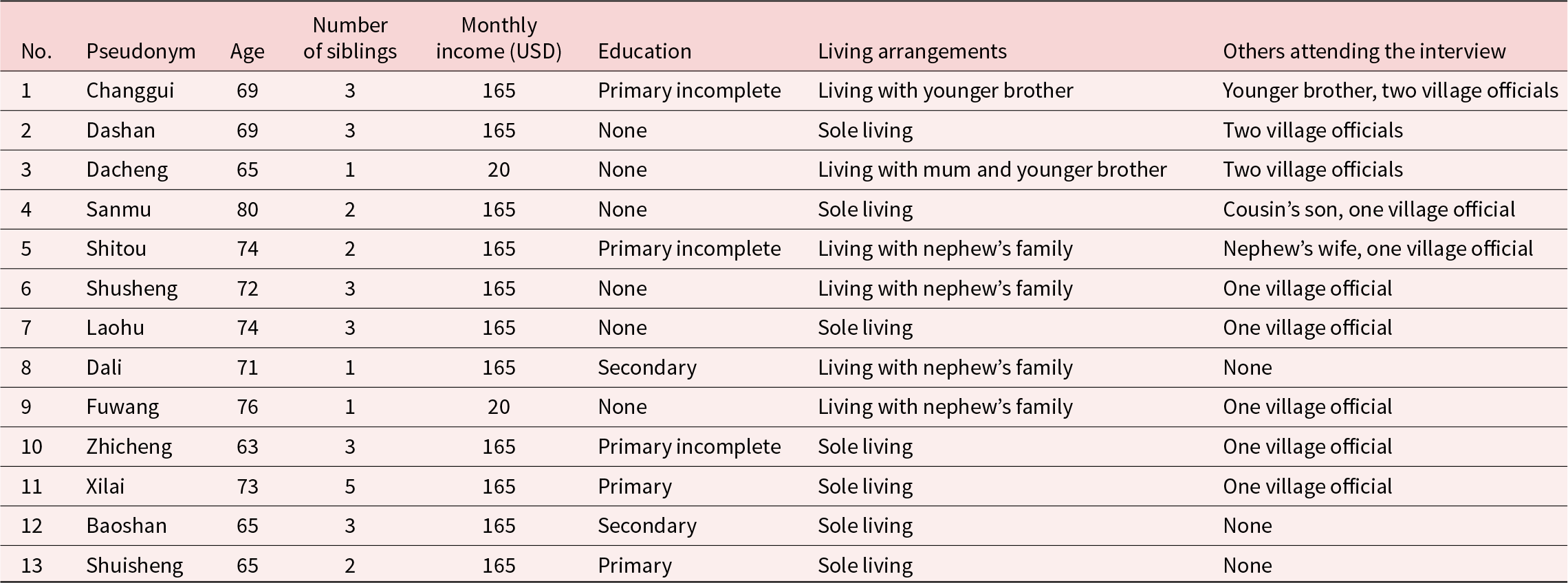
Table 1 provides basic information about the participants. All childless participants had lost their working ability and were classified as impoverished households. Eleven of the 13 participants were part of the state welfare programme for poverty alleviation. Two of the 13 participants were ineligible for such benefits due to their savings, which led to them having lower incomes than the other participants in the sample.
Demographic information of study participants
This study was approved by the Institutional Review Board of the School of Social Development and Public Policy at Fudan University. All interviews were audio recorded, with informed consent obtained from participants and other present individuals before recording. In line with ethical approval, we did not require signed consent forms from the childless participants. Verbal consent was obtained in a private or semi-private setting before each interview. This approach was sensitive to participants’ limited literacy by allowing them to avoid the potential emotional distress of being asked to complete a task (e.g. signing documents) that they might not have been comfortable or capable of doing. Participants were informed of the study’s purpose, confidentiality and voluntary participation, as well as their right to withdraw. Local officials and family members present during the interviews were informed of the confidentiality policy and agreed not to disclose any interview content. Before the interviews, we explained the importance of confidentiality to the local officials assisting with the study. After the interviews, we reiterated this policy and the officials signed a consent form to confirm their agreement to participate and uphold confidentiality. During the interviews, we remained reflexively aware of our own cultural assumptions related to masculinity and lifecourse to allow participants’ own perspectives and meanings to emerge. Additionally, we showed sensitivity to participants’ vulnerability, especially when reflecting on past life events in areas of marriage and relationships that could trigger emotional distress. The data were managed following ethical protocols: identifiable information was permanently removed through an anonymization process and the processed data were stored in a repository on a Chinese server, with access limited to this research project and the researchers affiliated with Fudan University.
The participation of two village officials was essential for conducting this study, as their involvement was a precondition for accessing participants. Their presence also provided practical support, including help with understanding local dialects, coordinating logistics and establishing trust between the researchers and the participants. In this rural setting, many participants and officials had known each other for years and had both formal and informal ties, as their families had lived in the same village for generations. This familiarity appeared to foster a sense of ease during interviews. Several participants spoke openly about their daily lives and difficulties, and some saw the interview as an opportunity to communicate their needs to officials responsible for local welfare. However, the presence of officials and family members in some interviews may have influenced participants’ willingness to discuss sensitive issues such as family conflict.
The interviews were conducted by the first author, a trained qualitative researcher in gerontology, primarily in Mandarin. The local dialect spoken in the village was closely related to Mandarin and did not present significant comprehension challenges. For participants who used more dialect-specific terms, clarification was obtained during the interviews through follow-up questions or brief assistance from family members or village officials, or after the interviews by consulting village officials to verify meanings. As previous research has shown, a researcher’s identity can shape rapport and influence childless participants’ willingness to disclose sensitive information (Hadley Reference Hadley2020). In this study, the interviewer was a childless man in his thirties from a working-class background. His gender and parental status may have fostered a sense of shared experience, particularly in relation to social norms of masculinity and the stigma associated with childlessness. This likely encouraged participants to discuss experiences of marginalization, social exclusion and family responsibility. The interviewer was also familiar with the area through existing ties to local development initiatives, which likely helped build trust and promote openness during the interviews. Yet, his younger age and urban residence status may have constrained disclosure on certain topics, such as intimacy, poverty and dependence on others for care and support.
Analysis
The audio recordings were transcribed verbatim, with minor adjustments for readability and clarity. Field notes were also incorporated as a crucial part of the analysis. A timeline technique (Gramling and Carr Reference Gramling and Carr2004) was employed to code participants’ life stories by visually depicting the events and transitions in chronological order and including interpretations of the events depicted. Timelines are often represented as linear graphic depictions of life, beginning with ‘birth’ and concluding with ‘death/present’ and can be created by researchers based on the data provided by participants (Boyd et al. Reference Boyd, Faan Hill, Holmes and Purnell1998). Given that most participants had limited formal education and faced physical challenges, we as the researchers constructed the timelines based on life story interviews. Reflective sessions were held by the entire research team during and after the data collection period. These discussions did not include direct participation from interviewees. However, when clarification was necessary, primarily to address ambiguities or inconsistencies in the timing of key life events or changes in family circumstances that were not related to interpretive meaning, participants were informally contacted for brief follow-up conversations.
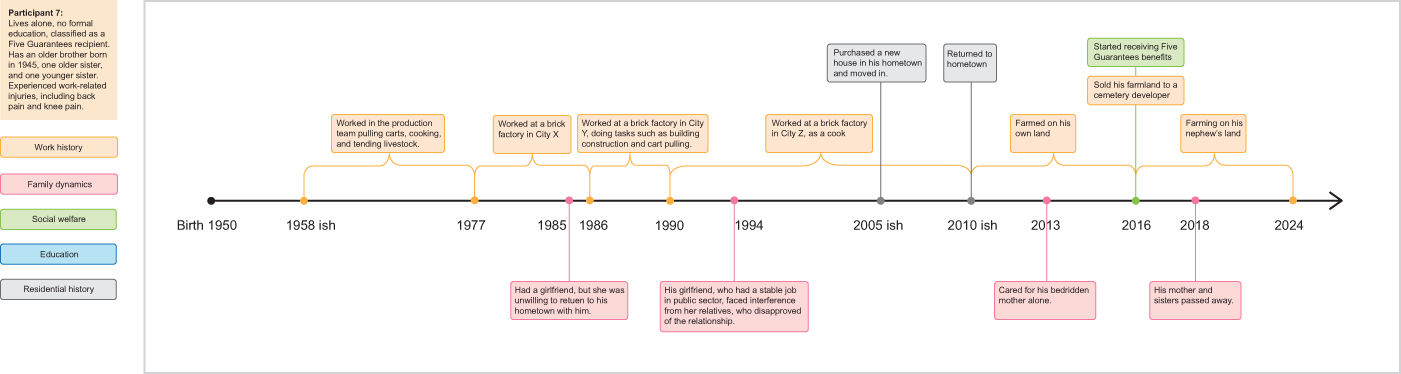
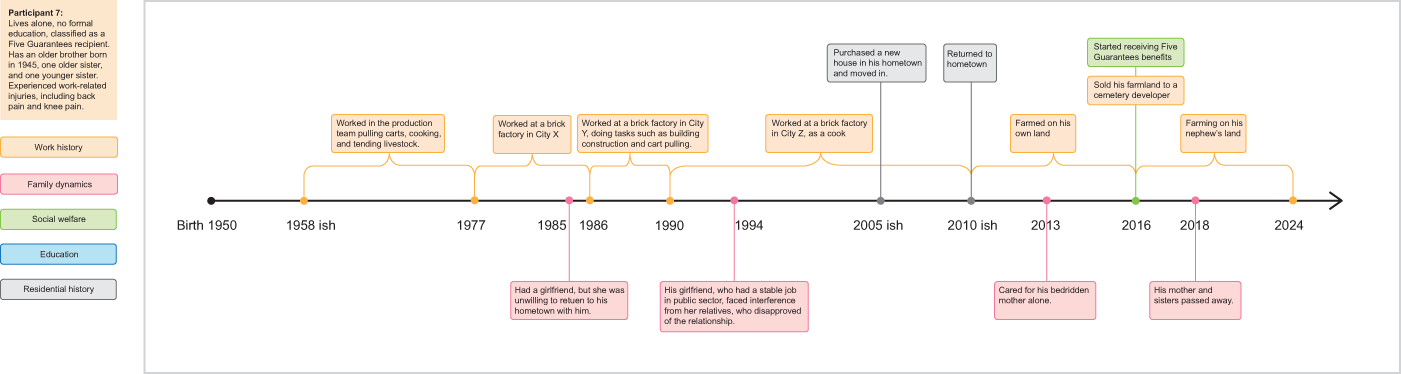
The analysis was qualitative and guided by a lifecourse perspective to examine how participants narrated key personal transitions, turning points and trajectories as they experienced them over time. Visual timelines were used to support data interpretation and cross-case comparison. These tools were developed from the narrative interview data to highlight the temporal and relational dimensions of participants’ lived experiences. The first two authors constructed individual timelines for each participant based on the interview data, without the participants being present. The process began by drawing a horizontal line on a landscape-oriented sheet of paper, with the participant’s birth year on the far left and the current year on the far right. Significant life events were plotted along this line, noting the ages or chronological years when these events occurred. This information was derived from life story interviews and used to construct individual timelines. Unlike traditional timeline methods, this study did not include peaks or dips to illustrate positive or negative life events, as such abstract representations were challenging for participants to interpret. Key life domains included commonly expected areas such as residential moves, education, work, personal health, family dynamics, births and deaths, property ownership and social welfare. We iteratively compared the structure and content of the manually drawn timelines to enhance consistency and evaluate the degrees of similarity in participants’ life trajectories. All timelines were digitized using Feishu, a graphic design tool, to improve visual clarity. Figure 1 provides an example.
Example timeline.
Additionally, we coded participants’ life histories for personal experiences, such as being unable to attend school due to household poverty, engaging in physically demanding agricultural labour from a young age, working as migrant labourers without stable income or social protection, or withdrawing from marriage prospects to provide long-term care for ill family members. These micro-level narratives were then interpreted through the lens of major policy periods and the distinct political and economic arrangements of those periods. In this micro-to-macro interpretive process, we paid particular attention to participants’ perceived causes of childlessness. Additionally, the interpretations were supplemented by our contextual knowledge of rural China’s socio-political history to situate individual experiences within wider structural conditions. Through cross-case comparison, we identified recurring constraints that extended beyond individual circumstances and jointly shaped participants’ pathways to childlessness.
We began by (re-)listening to interview recordings and (re-)reading field notes to generate and iteratively refine our codes. We examined each narrative for internal coherence (e.g. the logical sequence of life events and turning points) and verified whether participants’ references to institutional and historical contexts aligned with known policy periods and socio-political developments. Throughout the analytic process, we documented our evolving interpretations and noted how they shifted over time. Differences in interpretation during the analysis were addressed through iterative discussions among the authors. The third author, a senior scholar in Chinese family studies, reviewed interpretations and facilitated joint decision-making to resolve any disagreements. We use original interview quotes and provide detailed contextual descriptions in this article.
Findings
Our study identified the factors contributing to later-life childlessness among rural men and how these factors shaped their resources and opportunities for union formation and child-bearing from a lifecourse perspective. This section presents the findings by life stage, illustrating how structural factors intersected with participants’ life events to lead them to remain childless across the lifespan. While structured by life stage for clarity, the findings emphasize the interconnected and cumulative effects of structural disadvantages on marital and child-bearing prospects.
Early life: geographic constraints, agricultural tax burdens and education exclusion
The participants’ experiences of remaining unmarried and childless in later life can be traced back to socio-economic disadvantages encountered during childhood and adolescence, rooted in geographic constraints and political-economic arrangements. The mountainous terrain and limited arable land of the village severely restricted farming opportunities, making it difficult to cultivate high-yield cash crops. These geographic limitations were further exacerbated by China’s long-standing agricultural tax policy, which required rural families to contribute nearly half of their annual grain harvest to the state. This tax burden, imposed on rural households from the early years of the People’s Republic of China until 2006, placed economic pressure on them, leaving insufficient resources to meet their basic needs or invest in their children’s education and wellbeing. This also constrained their ability to support future marriage arrangements, including housing preparation and the ability to save for wedding costs, which men are traditionally expected to cover. Changgui, a 69-year-old man, recalled:
We had to pay the agricultural tax with our grain, but our harvests were never high. I drove the livestock cart to the grain depot in [township’s name], more than ten miles away. I had to leave early in the morning and rush back home the same day. The grain quality sometimes was poor; the depot didn’t accept it [the grain]. (Participant 1)
Under such circumstances, participants were often excluded from pursuing formal education, with ten having been unable to complete primary school. Between 1952 and 1984, primary education in China typically covered ages 6 to 11 and secondary education ages 11 to 16 or 17. Participants’ families struggled to afford essential school-related expenses, such as food and clothing coupons required under China’s planned economy. Reflecting on his educational experience, Zhicheng (aged 63) shared:
I only attended school until the third grade. Attending school was so difficult back then. Without coupons for clothes and grain, we couldn’t even attend school properly. I remember classmates running barefoot in the snow. Some wore clothes with holes, their skin exposed. It was freezing. Some days we had something to eat, and some days we didn’t. (Participant 10)
The situation was even more challenging in larger families, where scarce resources had to be distributed among multiple siblings, further limiting individual access to education. Additionally, parental health issues in the families of two participants exacerbated these financial challenges, as illness and disability often hindered parents from contributing to the household economy, intensifying financial strain. In such conditions, young men often had to delay opportunities for forming a relationship, which could have otherwise laid the foundation for marriage later in life.
Regardless of their educational background, most participants joined local production teams at a young age – the only available form of labour participation in rural areas at the time – to earn work points and support their families. Work points were used to calculate individual labour contributions and determined a household’s share of collective income and essential goods. Families with two adult earners and multiple dependent children often struggled, as the limited number of work points earned could not meet the household’s basic needs. In such cases, families accumulated debt to the production team, which was gradually repaid once younger members entered the labour force. Typical tasks for children included farming, cooking, tending livestock and other collective duties. Fuwang, a 76-year-old man, described:
After I left school at nine or ten years old, my father arranged for me to work for the production team. Later, when the production team acquired over 40 sheep, I took care of 20 of them. (Participant 9)
Education exclusion deprived participants of the literacy skills necessary to secure higher-paying and more skilled jobs. As their life trajectories unfolded, they remained confined to low-skilled manual labour in urban areas, primarily in the construction and transportation sectors. This also restricted participants’ ability to become socially competitive in the rural marriage market.
These excerpts highlight how participants, born into resource-constrained rural areas and shaped by the political-economic arrangements of China’s planned economy, experienced education exclusion (i.e. receiving no formal education by virtue of an early transition from school to work) with minimal state and family support. The absence of rural welfare provisions during this critical period placed participants at a significant disadvantage, reducing their ability to accumulate the financial, social and symbolic capital often necessary for marriage. This led to long-term challenges such as restricted access to higher-paying employment, difficulties in social integration and diminished marital prospects, which contributed to childlessness in later life. These issues are further explored in the subsequent thematic findings.
Early adulthood: labour market exclusion and the lack of rural welfare
The structural factors contributing to later-life childlessness among our participants can also be traced back to their early adulthood – an important life phase, typically between the ages of 18 and 30, during which individuals are expected to achieve independence, establish careers and form their own families. Participants’ early adulthood coincided to varying extents with the Cultural Revolution (1967–1977), a period of limited progress in national economic development. Our findings suggest that the structural factors they encountered during this time were largely shaped by the institutional arrangements in place. During this period, participants were confined to production team labour, earning work points to sustain their basic livelihood with limited autonomy to pursue alternative employment opportunities. This exclusion was further reinforced by the dual household registration (hukou) system, established in the late 1950s, which classified individuals as either urban or rural residents. Access to state-provided resources such as employment, housing, education and food subsidies was tied to one’s registered location. The system controlled population movement, particularly from rural to urban areas, by requiring official approval for hukou transfers, which were rarely granted. Rural-to-urban migrants without official urban residence permits were categorized by authorities as ‘blind influx’ (in Chinese: Mang Liu) and were subject to administrative detention and compulsory repatriation to their registered hukou locality under the Custody and Repatriation system, which was abolished in 2003 following widespread public criticism. Thus, persistent economic hardship constrained participants’ prospects for marriage.
The inadequate social welfare for rural families created disadvantages that affected participants’ marital opportunities. For instance, the lack of basic child welfare placed a considerable burden on young participants, compelling some to sacrifice their marital prospects to assume care-giving responsibilities for their younger siblings. Changgui, the oldest son in his family, provided care resources for his four younger siblings. Despite exposure to matchmaker introductions in his twenties, care responsibilities disrupted his potential marriage opportunities. Later in life, he prioritized supporting his youngest brother in building a new house for marriage, thus missing out on the opportunity to establish his own family. Reflecting on the constraints that shaped his marital prospects, he noted:
Back then, I never intended to look for a partner. I had too many siblings – there were five of us, including two sisters. A matchmaker introduced someone, but we were just too poor with so many siblings. By the time our situation improved, and I thought about finding someone, I was already too old [estimated to be around 61]. (Participant 1)
Moreover, the absence of accessible and timely health care in rural areas led to the progressive loss of work capacity among some participants during early adulthood, severely impacting their marriage prospects and long-term self-sufficiency. Early-life health conditions resulting from accidents were often left untreated or poorly managed, exacerbating participants’ physical limitations over time. For example, Dacheng (aged 65) initially developed a leg condition diagnosed as arthritis in his late twenties, which, due to the absence of proper medical intervention, progressed to rickets – a critical turning point in his life. As he grew older, he developed vision and hearing impairments, which went untreated and further worsened the impact of his existing leg disability. This health condition severely restricted his ability to engage in agricultural work, resulting in persistent financial hardship and a loss of independence. Living with his bedridden mother and younger brother who also has a disability, he reflected on his circumstances and remarked:
I can barely sustain myself, let alone raise a child …. This family is in crisis. I don’t know how to do that [register to receive health insurance reimbursement]. Reimbursement is such a hassle. I must spend a certain amount to ensure the cost is eligible for reimbursement. (Participant 3)
Another example highlighting the long-term consequences of inadequate rural health care on life trajectories is Zhicheng. At 19, he sustained a leg injury in an accident that restricted his physical mobility. By 25, he sought employment in nearby cities, working in railway construction and brick factories. However, his injury prevented him from performing well in labour-intensive occupations. Adding to his disability-related difficulties was his limited education; he dropped out of school after the third grade, which severely restricted his opportunities for less physically demanding, knowledge-based work. For these reasons, his earning capacity was substantially lower than that of his peers. These intertwined physical and economic disadvantages constrained his prospects for marriage and family formation. He described his experience as follows:
After my leg injury, I spent five or six years recovering before going out to work. I could only earn around 40–50 yuan, just a small amount. Some of my relatives were doing jobs that earned several hundred yuan, but I couldn’t manage that kind of work. Forty to 50 yuan wasn’t enough to cover expenses. Whenever parents at home got sick, all the money would be gone … I tried to find a partner, but my leg didn’t function well. Who would want someone with a leg disability? They wouldn’t agree to it [marry me]. Girls here don’t go for someone like me. (Participant 10)
While many rural individuals experience hardship, the study’s participants endured early and severe challenges. Disabilities that emerged early in life disrupted pathways towards employment and family formation before these could fully take shape. These impairments, due to their intensity, contributed to cumulative disadvantages over the lifecourse. Unlike others who encountered difficulties later in life or faced less-severe health issues, these men experienced enduring barriers from a young age, with no access to recovery mechanisms or support systems. Over time, this made it increasingly difficult for them to pursue marriage and parenthood.
Midlife: urban–rural dual structure and sociocultural norms
The participants’ later-life childlessness can be linked to their mid-life experiences. Most participants entered mid-life in the early 1980s, coinciding with the societal transitions driven by China’s Reform and Opening-Up policy, which was officially announced in 1978. A key feature of this transition in rural areas was the introduction of the household responsibility system, which allowed land to be contracted to family households and was implemented in 1983 in the village under study. This policy change granted rural households greater autonomy over land use and decision-making, which boosted agricultural output and increased economic gains. During the initial phase of this reform, participants obtained their own but limited land and continued to engage in farming. However, their earnings remained insufficient to meet their essential economic needs as the village provided little arable land. This indicates that while policy reforms had started to unlock the region’s economic potential, the economic benefits of such took time to materialize for rural residents. Thus, participants’ marriage prospects were largely confined to the rural marriage market during this period, where rural women generally sought economically better-off partners. This is exemplified in the following excerpt from Dali, a 71-year-old man:
I can’t drive, and getting up into the mountains isn’t easy because transportation is inconvenient. As for finding a partner, our situation isn’t good enough, so [either former or potential] partners wouldn’t come. This place is too remote, deep in the mountains. Back then, the location held us back. (Participant 8)
From the 1990s onward, the effects of the nation’s economic reforms became more evident, with increased employment opportunity surfacing, especially in urban areas. Consequently, 8 of the 13 participants in our study temporarily migrated to cities or towns, taking up physically demanding jobs in sectors such as construction and transportation. Despite their efforts to improve their economic circumstances and pursue marriage and family formation, their prospects were constrained by two structural factors: the entrenched urban–rural dual structure and the social stigma surrounding rural men’s economic status and marriageability.
The urban–rural dual structure, reinforced by the hukou household registration policy, divided urban and rural residents into distinct groups. Urban residents benefited from preferential access to public policies, resources and services in areas such as education, housing, health care, employment and pensions, while rural migrants remained excluded from these opportunities. As a result, participants remained closely tied to their rural origins. For instance, Laohu (aged 74), who began working as a migrant labourer at the age of 27, took on short-term jobs in brick factories across three cities. However, by the age of 60 he could no longer secure employment due to age-related discrimination. He experienced two romantic relationships – one in City X and another in City Z. Reflecting on his experience in City X, he recalled:
The manager at work [acting as a matchmaker] told me the introduction was nearly settled. I suggested that the woman visit my parents in my rural hometown first, and then I would return to City X. But she refused to come. After that, I didn’t go back to City X either; instead, I went to City Y, and the relationship eventually ended. (Participant 7)
His partner’s reluctance to visit his rural hometown reflects a societal preference for urban residency, which is often associated with better living conditions and greater social opportunities. Similarly, his second relationship in City Z ended due to pressure from his partner’s family, who prioritized a stable and secure occupation for their future son-in-law – something the participant did not have, as his life was marked by job instability, insecure housing and limited family support. Thus, this urban–rural dual structure marginalized rural men in the marriage market, hindering their ability to establish long-term relationships.
Beyond structural inequalities, participants also encountered social stigma, which further diminished their marital opportunities. In the marriage market, rural men were often perceived as having lower levels of educational attainment, social standing and economic stability, as illustrated by Xilai (aged 73), who failed in finding a suitable partner:
When I was working in City X, someone introduced me to a woman, but she said my family didn’t have any savings. Nowadays, people don’t care as much about being rich or poor, as long as they love the person. But back when I was young, that wasn’t the case. You had to have something, like a bride price, for it [a marriage attempt] to work. (Participant 11)
Another example of how social stigma affected marriage is Baoshan (aged 65), who moved into his wife’s family’s household after their marriage. In rural areas, prevailing societal norms dictate that men should possess financial independence and provide a residence for their family. Baoshan’s deviation from this norm likely contributed to his unfavourable treatment by his parents-in-law, who may have perceived his financial situation as inadequate. His experience illustrates how these deeply ingrained cultural expectations are internalized, shaping family dynamics, leading individuals to devalue themselves or forgo further marital opportunities, and reinforcing prevailing norms of marital suitability within the village. As Baoshan recalled:
I had a partner once and moved to live with her family for a few years. But her parents didn’t treat me well – they looked down on me. I didn’t want to live like that, so I left and came back home. After that, even when matchmakers approached me, I refused to consider marriage. I’d rather stay single forever than marry into a family like that. (Participant 12)
As illustrated in the previous excerpts, mid-life marked a significant transition for many participants as they began migrating for work. Despite engaging in seasonal migration to urban areas and aspiring to find suitable partners, this shift appeared to free them from some of the structural factors they had experienced earlier in life, such as limited land resources, substantial agricultural tax burdens and scarce paid work opportunities in their rural hometowns. However, participants continued to encounter structural factors in the marriage market within the context of the entrenched urban–rural dual structure. These challenges included social stigma and precarious professional lives, which they experienced despite having engaged in years of labour-intensive work. As they transitioned into late adulthood, their inability to work and existing or anticipated care needs further diminished their opportunities for marriage or remarriage in later life.
With a focus on the effects of time and place, our findings indicate that participants’ youth coincided with a period of planned economy, restricting their opportunities for economic improvement and union formation. Later, as market reforms and economic development expanded opportunities for social mobility, the participants lacked the necessary education, skills and resources to benefit from these changes. Although many engaged in urban labour migration, their earnings remained insufficient to transform their socio-economic status. By late adulthood, most had returned to rural hometowns with minimal accumulated assets, entering their 60s with limited financial security.
While many rural men experienced similar structural factors, the childless men in this study were caught in a tightly interlocked set of constraints during mid-life that limited their opportunities for marriage and family formation. Precarious employment led to unstable income and housing, which made these men particularly vulnerable in the rural marriage market, where men are expected to provide financial security and stable living arrangements. Their rural background, combined with limited access to urban welfare, placed them at a disadvantage in the urban marriage market, where they often faced persistent social stigma. Even when romantic connections were made, relationships were difficult to sustain due to perceptions of rural men as less stable or less desirable partners. Additionally, the social expectations that men should marry in their twenties or thirties and be the financial providers for their families further restricted their options. These intersecting structural and cultural constraints left little space for forming stable partnerships during mid-life.
Discussion
This study examined how structural factors contributed to later-life childlessness among men in a rural area of northern China. Specifically, it found that participants experienced severe and disruptive life events at critical stages, such as early-life disability or the need to assume care-giving responsibilities for ill parents, which adversely affected their schooling, labour market participation and prospects for union formation. Their pathways to childlessness were further shaped by intersecting structural barriers that reinforced one another over time. Their precarious employment, persistent poverty, limited access to rural welfare and exclusion from urban services, combined with their society’s deeply ingrained societal norms around male provision and marriage, collectively marginalized them. This exclusion constrained their ability to participate socially and economically, ultimately closing off the path to marriage and parenthood. These experiences set them apart from most rural men, who do marry and have at least one child in a cultural context where marriage and fatherhood are regarded as essential markers of adulthood, masculinity and filial duty. Childlessness among our participants was not a matter of personal choice or delay but the result of cumulative structural disadvantages that disrupted key life transitions and constrained opportunities for marriage and parenthood. As seen through a lifecourse lens (Dannefer Reference Dannefer2003), our findings offer new insights into how intersecting lifecourse and structural factors shape childlessness among rural men – an often overlooked population. This dynamic is captured by the Chinese proverb ‘a rope snaps at its thinnest point’, suggesting how multiple structural factors converged to push individuals towards the most marginalized positions, and how a disruptive life event limited opportunities for marriage and parenthood. These findings illustrate the limits of individual resilience in the face of persistent and compounding structural constraints.
Our findings show that lifecourse pathways to childlessness were complex, shaped by the timing of critical life transitions and the interplay of multiple life domains. This aligns with lifecourse research, which emphasizes how the sequence and the timing of key events influence men’s trajectories towards childlessness. Previous studies have identified factors such as marrying late, divorcing early, never leaving the parental home (Hagestad and Call Reference Hagestad and Call2007) and never entering a union as associated with childlessness (Pérez Reference Pérez2021). Our study identified additional context-specific factors, including early exit from primary education, early-life disability and family crises during formative years, as leading to childlessness. These disruptions occurred in a context in which participants lacked institutional support, preventing them from accessing opportunities that might have led to life independence and union formation. While much of the existing literature focuses on education and employment as the primary life domains shaping family life (Ravanera and Roderic Reference Ravanera and Roderic2009), our study highlights the critical role of welfare institutions in shaping long-term outcomes. In particular, the absence of timely support can transform early disruptive life events into irreversible exclusion from lifecourse trajectories that might otherwise offer possibilities for independence and union formation.
Our findings indicate that China’s shifting socio-economic and political arrangements across historical periods contributed to cumulative structural disadvantages that shaped rural men’s pathways towards childlessness. Previous studies have provided valuable insights into how childlessness is influenced by broader historical contexts, including periods of war, political transition, austerity and economic downturns. For example, Maříková (Reference Maříková2023) found that some childless men in the Czech Republic viewed post-1989 social transformations as weakening traditional expectations around parenthood and fostering a greater sense of individual autonomy. Similarly, Hall (Reference Hall2023) showed that prolonged financial insecurity, housing precarity and unstable employment during the austerity period in the United Kingdom shaped how young men approached reproductive decisions. These studies highlight the importance of structural and historical contexts in shaping fertility outcomes. Building on this body of work, our study illustrates how changing policy environments in China, from the People’s Commune period to the early reform era and beyond, created long-term constraints that limited participants’ economic opportunities and reduced their chances of marriage and parenthood.
Moreover, our study found that economic hardship contributed to participants’ trajectories towards childlessness by exposing them to structural disadvantages rooted in specific historical conditions. For instance, during the early years of China’s market reform, some participants reported joining the migrant labour force after the initial wave of rural-to-urban migration, missing out on the early-stage economic gains. Others migrated earlier but were unable to benefit meaningfully due to poor health, low education and limited access to secure or well-paying work. Most worked in unstable, physically demanding jobs such as construction or informal service labour, often moving from city to city without long-term employment security. These factors constrained their ability to significantly improve their economic situation, support ageing parents or meet the financial expectations associated with marriage. Existing studies have found that men with lower income, limited education and unstable employment are more likely to remain childless, especially in contexts where financial capacity is central to partner selection and social recognition as a marriageable man (Fieder et al. Reference Fieder, Huber and Bookstein2011; Pérez Reference Pérez2021). Our findings show how economic disadvantage, shaped by historical timing and factors such as societal norms, contributed to childlessness.
Our study found that childlessness among rural Chinese men was deeply embedded in a cultural context where familial obligations took precedence over personal aspirations. A prominent example is the norm of ‘eldest brother as father’, which assigns care-giving and financial responsibility for younger siblings to the eldest son. Influenced by these cultural expectations, one participant delayed marriage to support his siblings’ futures, ultimately sacrificing his own. Some participants prioritized filial duties, particularly the care of ill parents during early adulthood, which constrained their independence and opportunities for marriage. These cases reflect a culturally shaped response to long-term resource shortages, where traditional values and economic hardship combine to encourage family members to prioritize household survival over individual goals. Our findings suggest that marriage and child-bearing within this cultural context can be viewed as strategic family decisions aimed at managing limited resources across generations. This contrasts with dominant Western cultures and societies with stronger welfare systems, where personal autonomy, self-fulfilment and egalitarian values more often guide decisions about relationships and parenthood (Tanturri et al. Reference Tanturri, Mills, Rotkirch, Sobotka, Takács, Miettinen, Faludi, Kantsa and Nasiri2015). Additionally, these findings underscore the significance of linked lives in shaping reproductive trajectories, a core principle in lifecourse research (Bauer and Kneip Reference Bauer and Kneip2013; Hagestad and Call Reference Hagestad and Call2007). In some cases, brothers jointly invested in helping one sibling marry and have a child, with the nephew taking on the symbolic role of a shared child within the extended family. This supports arguments that childlessness should be viewed along a continuum rather than defined solely by biological parenthood (Hadley Reference Hadley2021b), while highlighting the relational aspect of reproductive roles in contexts of structural scarcity.
This study makes theoretical contributions to the literature on structural factors shaping male childlessness by advancing a lifecourse perspective that foregrounds the timing, intensity and cumulative nature of disadvantage across interconnected life domains. The study also contributes by situating these trajectories within shifting policy contexts, highlighting how historical timing and institutional change shaped men’s exposure to opportunities and constraints across the lifecourse. Finally, it expands lifecourse frameworks by foregrounding welfare as a critical, yet often overlooked, domain, showing how the absence of rural social protection not only intensified early disadvantage but also foreclosed the possibility of recovery from illness or injury, contributing to childlessness.
This study has several limitations. First, it draws on interviews with 13 participants from a single rural village in northern China. While the qualitative approach enabled in-depth insights into the perceived causes of male childlessness, the findings reflect the perspectives of a specific group in a particular sociocultural setting and are not intended to represent all childless older men in rural China. Second, two interviews were relatively brief, likely due to participants’ scheduling conflicts, as they had prearranged social visits following the interviews. These shorter interviews may contain less detail than others in the sample. Third, while the timeline technique helped structure participants’ narratives, it did not include features such as identifying emotional peaks and lows. The absence of these elements may have limited the depth of insight into key turning points of participants’ life trajectories. Lastly, the richness of participants’ responses may have been limited by factors such as the framing of interview questions and the dynamics of the interview setting. Data interpretation may also have been influenced by dialect translation and our own backgrounds and understandings, which could lead to alternative interpretations by other researchers.
Future research should examine how evolving structural conditions shape the experiences of childless men in rural China. While this study focused on a generation shaped by distinct political-economic transitions, younger rural men now encounter different challenges shaped by more contemporary societal transitions (e.g. economic downturn and changing fertility norms). Research is also needed to investigate how childless men navigate social stigma over the lifecourse, particularly in relation to ageing, masculinity and mental wellbeing. In addition, studies should explore how childlessness intersects with household economy, employment and social welfare to affect health, especially in rural areas. The experiences of sexual minority men in rural China also warrant attention, as their childlessness may intersect with non-heteronormative identities and require distinct social and structural responses. Lastly, future research should examine the support systems needed to ensure the wellbeing of older childless men in rural areas as they age.
This study carries several policy implications. Policymakers should recognize that rural men’s limited opportunities for marriage and child-bearing are not solely the result of individual or family intentions and preferences but are shaped by intersecting, cumulative and mutually reinforcing structural disadvantages rooted in historical and institutional contexts. Addressing these issues requires an integrated policy response. First, interventions should be timed to critical life transitions, when support can most effectively mitigate long-term disadvantage. Strengthening rural welfare systems, expanding access to education, health care and stable employment, and reducing urban–rural disparities is essential to improving foundational conditions. Second, policies must also challenge entrenched social norms around marriageability and economic expectations, which reinforce exclusion. Finally, targeted support (e.g. workforce inclusion, disability benefits, family welfare initiatives) should be provided to those at risk of involuntary childlessness.
Conclusion
This study examined the lifecourse and structural factors contributing to later-life childlessness among older men in a rural area of northern China. Our findings highlight that rural men’s limited opportunities for marriage and child-bearing are shaped by intersecting, cumulative and mutually reinforcing structural disadvantages rooted in historical and institutional contexts. In addition, some participants experienced intensive and disruptive life events that further exacerbated their social and economic marginalization, with far-reaching consequences for their family lives. Our study extends existing research on the factors contributing to childlessness by providing empirical evidence from childless older men – an often-overlooked group in both gerontological and childlessness research – within the rural Chinese context. It also advances theoretical understanding of the structural factors underlying male childlessness by linking life trajectories, structural shifts and social relationships in producing cumulative disadvantages in union formation and child-bearing. Policy measures are needed to tackle the structural factors and mitigate the effects of disruptive life events that contribute to involuntary childlessness, thereby creating more equitable conditions for those pursuing family formation in resource constrained settings.
Acknowledgements
The authors would like to thank the study participants for sharing their experiences, the village officials for facilitating field access and the two anonymous reviewers for their comments that improved this article.
Financial support
This work has been financially supported by the Swedish Research Council, under grant agreement number 2022-06243.
Competing interests
None.
Ethical standards
This study received approval from the Institutional Review Board of the School of Social Development and Public Policy at Fudan University, under reference number FDU-SSDPP-IRB-2023-2-067.

 Open access

