


Iodine is needed for the production of thyroid hormones that are vital during pregnancy and infancy owing to their role in brain and neurological development(Reference Zimmermann1). While severe iodine deficiency can cause gross mental deficiency and infant mortality(Reference Zimmermann1), there is emerging evidence that mild-to-moderate maternal iodine deficiency is associated with impaired infant development, including lower intelligence quotient (IQ) and increased incidence of attention deficit hyperactivity disorder(Reference Vermiglio, Lo Presti and Moleti2). For these reasons, pregnant women are vulnerable to iodine deficiency(Reference Zimmermann1).
The iodine content of foods is dependent on the source of the food, whether from sea or land, the soil content (affected by geology, geography, pH and soil leaching) and farming practice(Reference Zimmermann1).
In the UK, milk and dairy products are the most important sources of dietary iodine, contributing as much as 42 % of adult intake(Reference Henderson, Irving and Gregory3). Higher milk-iodine concentration and increased milk consumption have been cited as the reasons for the eradication of endemic goitre in the UK in the 1960s, which was labelled as an ‘accidental public health triumph’ by Phillips(Reference Phillips4). Iodine sufficiency has been assumed in the UK for many years(Reference Wenlock, Buss and Moxon5, Reference Lee, Lewis and Buss6) and iodised salt is scarcely available(Reference Lazarus and Smyth7). However, there is emerging concern that the iodine status of the population, particularly of young women(Reference Rayman, Sleeth and Walter8–Reference Vanderpump, Lazarus and Smyth10) and pregnant women(Reference Lazarus and Smyth7), may be inadequate.
Although conventional milk is the usual choice, organic milk is increasing in popularity because of perceived health and environmental benefits(11). Due to the strict organic farming regulations that govern the use of mineral supplements in livestock feed(12, 13), organic milk may contain lower concentrations of trace minerals, thereby reducing or even reversing the potential health benefits. Studies in Europe have shown conventional milk to have a higher iodine concentration than organic milk(Reference Rasmussen, Larsen and Ovesen14, Reference Dahl, Opsahl and Meltzer15), but no such study has been explicitly conducted in Britain.
The present study therefore aimed to compare the iodine content of organic and conventional milk available for purchase in the UK. A secondary aim was to determine regional variations in milk-iodine content. Our hypotheses were that (1) the iodine concentration of organic milk would be lower than that of conventional milk owing to organic farming practices and (2) milk-iodine concentration would differ between regions due to likely variations in soil-iodine content and farming practice across the UK.
Materials and methods
Sampling
Samples of supermarket semi-skimmed ( < 2 % fat) own-brand conventional and own-brand organic milk were purchased from five leading supermarkets (total market share 79·4 %(16)) in sixteen areas (largely identifiable as counties) of the UK (fourteen of which were in the south of England, one in Wales (Cardiff; Fig. 1) and one in Northern Ireland (County Antrim)) in June, July and August 2009. The areas were combined into four regions for analysis: South East (n 8), South West (n 6), Wales (n 1; Fig. 1) and Northern Ireland (n 1). In addition to own-brand supermarket milk, three samples of popular milk brands were purchased, the majority of which were organic. Fewer samples of branded milk were purchased reflecting their lower UK market share(17). As milk-iodine content is known to vary by season(Reference Lee, Lewis and Buss6, Reference Phillips, Nelson and Barker18, 19), sampling was restricted to one season so that milk purchased at the beginning and end of the collection period would be comparable. Semi-skimmed milk was selected as it is the most popular choice in the UK(Reference Henderson, Gregory and Swan20) and its iodine concentration does not differ from that of skimmed or full-fat milk(19). Milk was deemed to be organic based on the label claim and if it had an organic certification symbol, such as that of The Soil Association.
Map showing the areas (shaded) from which milk was sampled and how the areas were combined into regions. Milk was purchased from supermarkets in towns shown by black dots. Milk was also purchased in County Antrim, Northern Ireland (not shown).
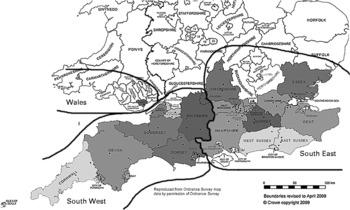
The areas sampled were chosen for logistical reasons but also because the inclusion of areas in the South East allowed the assessment of milk from densely populated regions, while the South West is both a region of major dairy farming(17, Reference Foster, Audsley and Williams21) and has a history of high goitre rates(Reference Phillips4). Northern Ireland and Wales were sampled to investigate potential regional variations, although sampling in Northern Ireland was restricted, as only two of the five chosen supermarket chains operated there.
The origin of milk was categorised as being from Wales, the West Country, Scotland, Northern Ireland or of unknown origin. The origin was determined from the label: where the geographical source of the milk was stated (e.g. milk from the West Country), this was assumed to be the case but otherwise, the European Union (EU) identification mark was used to trace the milk to the processing dairy(22) and in conjunction with Internet sources, the origin was determined where possible.
Sample analysis
Sample preparation and analysis were performed at LGC Limited, Teddington, Middlesex, UK. Sample aliquots were stored at − 80°C before being transported to LGC Limited. An aliquot of 0·5 g was mixed with 5 ml of 5 % tetramethylammonium hydroxide (TMAH) solution, prepared by dissolving solid TMAH ( ≥ 97 %; Sigma Aldrich, Gillingham, Dorset, UK) in ultrapure water. The vial was then placed in an oven at 90°C for 3 h(Reference Santamaria-Fernadez, Evans and Wolff-Briche23). To each sample, 0·5 ml of the internal standard was added (1300 ng/ml tellurium in 1 % TMAH; Romil, Cambridge, UK) and the samples were made up to 50 g with 1 % TMAHsolution. The digested samples were analysed for iodine concentration by inductively coupled plasma MS (Element2; ThermoFisher Scientific, Bremen, Germany) by external calibration using a stock standard, prepared in-house gravimetrically from high-purity potassium iodide (99·99 %; Alfa Aesar, VWR, Lutterworth, Leicestershire, UK) in 5 % TMAH solution. Subsequent dilutions were performed in 1 % TMAH. The uncertainty of the method was calculated as ± 10 % according to in-house United Kingdom Accreditation Service accredited methods, which are in accordance with International Organization for Standardization 17 025 and Eurachem/CITAC (Cooperation on International Traceability in Analytical Chemistry) guidelines. The accuracy of the results was verified using the certified reference material BCR 063R Skimmed Milk Powder (LGC Standards); (certified iodine content 810 ± 50 ng/g (dry weight basis)); the mean value for the certified reference material was 836·9 (sd 17·6) ng/g (n 12), a percentage recovery of 103·3 %. The CV for the twelve measurements of the certified reference material was 2·1 %. The means of the spiked recoveries for the certified reference material and the milk samples were 101·5 (sd 6·3) % (n 6) and 94·5 (sd 5·0) % (n 6) respectively.
Statistical analysis
Statistical analysis was done with the Statistical Package for Social Sciences (version 17.0; SPSS, Inc., Chicago, IL, USA). Iodine concentration was not normally distributed in either organic or conventional milk samples, as determined by the Shapiro–Wilk test; data were therefore transformed using the natural logarithm to allow parametric testing. Geometric means with their 95 % CI (computed by back transformation of log values) are reported along with the median. Independent t tests were used to test the difference between organic and conventional milk-iodine concentration and one-way ANOVA (with Bonferroni correction for post hoc analysis) was used for comparison of iodine concentration between the area of purchase and the region of origin of the milk. Statistical significance was set at P <0·05.
Results
Differences in iodine concentration
In total, ninety-two samples of organic milk and eighty samples of conventional milk were collected. Table 1 shows summary statistics (split by milk type) of iodine concentration for all samples, supermarket own-brand, other brands and by known region of origin.
(Mean values, medians, number of samples and 95 % confidence intervals)

NA, not applicable.
* Mean values of iodine concentration were significantly different from conventional milk of the same category (P < 0·001; independent t test).
† Mean values of iodine concentration were significantly different from conventional supermarket own-brand milk (P < 0·001; independent t test).
‡ Mean values of iodine concentration were significantly different from organic milk of West Country and unknown origin (P < 0·001; one-way ANOVA post hoc test).
§ Statistical analysis was performed on log-transformed data.
An independent t test showed that the iodine concentration of organic milk was significantly lower than that of conventional milk (P < 0·001), the median value of organic milk being 42·1 % lower than that of conventional milk. The difference remained when the analysis was restricted to supermarket own-brand milk samples (n 154; P < 0·001). Branded organic milk samples (n 15) were significantly lower in iodine concentration than the supermarket own-brand conventional milk samples (n 77, P < 0·001; Table 1).
Analysis by area of purchase
One-way ANOVA showed that there was no difference in iodine concentration among the sixteen areas of purchase of either supermarket own-brand organic or conventional milk samples (P = 0·75 and 0·49, respectively) or among the four regions (P = 0·36 and 0·66, respectively), i.e. the three regions shown in Fig. 1 and Northern Ireland.
Analysis by region of origin of the milk
Organic milk from the West Country, Wales and of unknown origin was significantly lower in iodine than conventional milk of the same origin (P < 0·001; Table 1). Due to the small number of samples originating from Wales and Northern Ireland, these regions were excluded from the one-way ANOVA for analysis by milk origin. Though no sampling was carried out in Scotland, eight of the organic milk samples were of Scottish origin. The iodine concentration of organic samples differed by region of origin (P < 0·001; Table 1); post hoc testing revealed that Scottish organic milk was significantly higher in iodine than both organic milk from the West Country (P < 0·001) and organic milk of unknown origin (P < 0·001). Conventional milk from the West Country exhibited a lower iodine concentration than milk of unknown origin, but the difference did not reach significance (P = 0·051). To prevent Scottish milk samples from skewing the results, statistical testing was repeated with Scottish milk excluded; the difference in iodine concentration between organic and conventional milk remained significant (P < 0·001) but the difference between the median values increased to 43·1 % (data not shown).
Discussion
This is the first sizeable study to evaluate differences in iodine concentration between organic and conventional milk. The main finding of the present study, that organic milk has a significantly lower iodine concentration than conventional milk, supports both our original hypothesis and the findings of other, smaller studies (fewer than twenty organic samples), in Denmark(Reference Rasmussen, Larsen and Ovesen14) and Norway(Reference Dahl, Opsahl and Meltzer15). Iodine concentrations of the Norwegian and Danish summer organic milk samples were 31·8 and 40·8 % lower than those of conventional milk, respectively, the latter being close to the 42·1 % found in the present study.
Milk-iodine concentration in the UK has increased from the levels in the 1920s(Reference Phillips4) through the use of iodine-supplemented feeds in dairy herds to protect livestock against deficiency(Reference Phillips4, Reference Phillips, Nelson and Barker18). Milk is also contaminated with iodine through the use of iodophor disinfectants used in sanitisation and teat dipping(Reference Galton, Petersson and Erb24). The UK has never introduced a formal iodisation programme to ensure optimal iodine status, despite goitre being historically endemic up until the 1960s(Reference Phillips4, Reference Kelly and Snedden25). Instead, the country has experienced iodisation through an adventitious increase in milk-iodine concentration(Reference Phillips4). The present finding that the iodine content of summer organic milk is over 40 % lower than that of conventional milk is a concern from a public-health perspective.
The UK adult reference nutrient intake for iodine is 140 μg/d(26) with no increment for pregnancy, a recommendation that is clearly outdated in the light of current WHO advice for pregnancy of 250 μg/d(Reference Andersson, de Benoist and Delange27). Given that milk and dairy products are the primary source of iodine in the UK, those who switch to organic milk, with its lower iodine concentration, are likely to have a reduced iodine intake. This is of particular concern during pregnancy when a woman needs additional iodine for three reasons: (1) her production of thyroid hormone increases by 50 % in order to have adequate supplies for her own and her baby's needs; (2) she needs to compensate for increased renal clearance of iodine; and (3) she needs to provide iodine for the fetus to use after the onset of fetal thyroid function(Reference Zimmermann1). Consumption of organic milk may reduce the chance of a woman meeting the higher iodine requirement of pregnancy. Based on our median milk iodine values, a portion (200 g) of conventional milk would provide approximately 50 μg compared with only 29 μg in a portion of organic milk; iodine intakes would probably be further compromised if other organic dairy products were consumed.
Although only a small proportion of liquid milk sold in the UK is organic(28), sales of organic milk increased more than 50-fold over the 10-year period between 1997 and 2007(29), and remained strong during the recent economic recession(11, 28). Increased advertising and promotion of organic milk is planned in the UK(28) and with a possible rise in organic milk use, there is potential for exacerbation of the mild iodine deficiency described in the UK, notably in schoolgirls(Reference Vanderpump, Lazarus and Smyth10), pregnant women(Reference Lazarus and Smyth7, Reference Kibirige, Hutchison and Owen30–Reference Barnett, Visser and Williams32) and women of child-bearing age(Reference Rayman, Sleeth and Walter8, Reference Bath, Walter and Taylor9).
The lower iodine concentration in organic milk can be explained by differing practices on organic and conventional farms. Organic farming regulations do not allow the routine use of vitamin and mineral preparations(12, 13). Regulations also stipulate that at least 60 % of the feed on organic farms must be fresh or conserved forage(12), thus limiting the use of concentrates and relying on soil minerals, which can be low in some areas. Due to these restrictions, deficiencies in some minerals, including iodine, can occur in organically farmed livestock(Reference Rosati and Aumaitre33). Nitrogen-fixing crops, such as clover, are important in organic farming and are used in place of artificial fertilisers(Reference Foster, Audsley and Williams21). White clover contains cyanogenic glucosides(Reference Bjarnholt, Laegdsmand and Hansen34) that are thought to exhibit goitrogenic properties(Reference Zimmermann1) and, as suggested by Rasmussen et al. (Reference Rasmussen, Larsen and Ovesen14), greater use of goitrogenic feed could lower milk-iodine concentration through the inhibition of the sodium-iodide symporter in the mammary gland of the cow. As iodophor disinfectants and teat dips are permitted in both organic(12) and conventional farming(35), it is unlikely that the difference in iodine concentration can be explained by their use.
Our hypothesis concerning regional differences in milk-iodine concentration was only partially supported. Although regional differences were found when milk was broadly grouped by milk origin, no difference was found by area of purchase. The latter finding may be explained by the supply-chain logistics in the milk industry, where milk is bulked in the processing dairy and delivered to stores within the same supermarket chain in neighbouring areas(Reference Foster, Audsley and Williams21). The inclusion of Scottish milk was unintentional and was revealed through interpretation of the EU identification mark(22). The finding that Scottish milk is higher in iodine than that from the West Country is interesting in that, historically, goitre and cretinism were common in the West Country but their incidence was lower in Scotland(Reference Kelly and Snedden25). As the present study did not collect details on farming methods (e.g. soil and feed type), it is not possible to explain the difference in iodine concentration between regions.
The present study has a number of limitations: samples were only collected in the summer months, so findings may not be representative of the levels in winter milk. However, as conventionally reared cattle are less reliant on mineral-supplemented feed during the summer(Reference Phillips4, Reference Phillips, Nelson and Barker18), any difference observed between the sample groups in the summer is likely to be matched, or exceeded during the winter. Milk was largely purchased from the south of England, and while this could be considered a limitation, the results indicate that the region of origin was a greater influence on iodine concentration than area of purchase. However, sample sizes for regional analysis were small and unequal and therefore regional differences should be interpreted cautiously. Furthermore, the present study used retail milk, which is pooled from farms, thus substantially masking regional differences.
In conclusion, the fact that organic milk has a lower concentration of iodine than conventional milk is a public-health concern. When individuals make the decision to switch to organic produce they often start with milk(28), believing this to be the best choice. Individuals who make such a choice should be aware that their iodine intake may be compromised, which may have implications for brain development during pregnancy and infancy. The authors are not suggesting that all individuals should switch to conventional milk, as there may be other benefits to organic produce in terms of lower levels of pesticide residues(36). Rather, individuals consuming organic milk (particularly pregnant women) should be aware of alternative food sources of iodine to ensure that requirements are met. Where these foods are not consumed, a nutritional supplement containing iodine should be considered (although kelp products are not recommended as they may contain excessive levels of iodine(Reference Zimmermann and Delange37)).
It would be prudent for the organic dairy industry to take seriously the deficit in iodine content of organic milk that the present study has revealed. The restrictions imposed by organic farming methods have nutritional implications both for organically raised animals(Reference Rosati and Aumaitre33) and for populations eating their produce. Though these restrictions may affect other trace mineral concentrations, the issue is likely to be most serious for iodine as a consequence of milk and dairy products being the principal source of iodine in the UK diet.
Acknowledgements
We thank Sarah Hill, Malcolm Burn and other analysts at LGC Limited, and Peter Williams in the Department of Mathematics at the University of Surrey for statistical analysis advice. Studentship funding for S. C. B. by The Waterloo Foundation and Wassen International supported the present work. The funding bodies did not have influence over any part of the study. S. C. B. and M. P. R. designed the study, S. C. B. and S. B. conducted milk sample collection, S. C. B. performed statistical analysis. M. P. R. had primary responsibility for final content. All authors prepared, reviewed and approved the final manuscript. None of the authors had a personal or financial conflict of interest.



