


Introduction
Palmer amaranth, a member of the pigweed family (Amaranthaceae), is a dioecious plant species native to the southwestern United States and northern Mexico (Sauer Reference Sauer1957). Palmer amaranth is among the most problematic summer annual broadleaf weed species across the mid-south, southeastern, and central United States (Van Wychen Reference Van Wychen2017; Vencill et al. Reference Vencill, Grey, Culpepper, Gaines and Westra2008; Webster Reference Webster2005). Palmer amaranth has several unique biological attributes, including extended period of emergence, aggressive growth rates (up to 3.5 cm d−1), high water-use efficiency, and prolific seed production (up to 0.6 million seeds per female plant) (Horak and Loughin Reference Horak and Loughin2000; Keeley et al. Reference Keeley, Carter and Thullen1987; Steckel et al. Reference Steckel, Sprague, Stoller and Wax2004; Ward et al. Reference Ward, Webster and Steckel2013). Palmer amaranth tolerates drought and shading that allows it to survive under dry and light-limited environments (Ehleringer Reference Ehleringer1983; Jha et al. Reference Jha, Norsworthy, Riley, Bielenberg and Bridges2008; Place et al. Reference Place, Bowman, Burton and Rufty2008; Wright et al. Reference Wright, Jennette, Coble and Rufty1999). Palmer amaranth also exhibits high genetic diversity within and among field populations (Ward et al. Reference Ward, Webster and Steckel2013). Season-long interference from Palmer amaranth at a density of 10 plants m−2 reduced soybean grain yield by 68% in Arkansas (Klingaman and Oliver Reference Klingaman and Oliver1994).
Palmer amaranth also has a strong tendency to evolve herbicide resistance, primarily due to high genetic diversity and prolific seed production (Chahal et al. Reference Chahal, Aulakh, Jugulam, Jhala, Price, Kelton and Sarunaite2015; Heap Reference Heap2020; Ward et al. Reference Ward, Webster and Steckel2013). Several Palmer amaranth populations have been documented in the United States as being resistant to one or more of the following herbicide sites of action (SOA): inhibitors of acetolactate synthase (ALS), 5-enolpyruvyl shikimate-3-phosphate synthase (EPSPS), dinitroanilines, photosystem II, 4-hydroxyphenyl pyruvate dioxygenase, protoporphyrinogen oxidase (PPO), and synthetic auxins (Chahal et al. Reference Chahal, Varanasi, Jugulam and Jhala2017; Garetson et al. Reference Garetson, Singh, Singh, Dotray and Bagavathiannan2019; Heap Reference Heap2020; Jhala et al. Reference Jhala, Sandell, Rana, Kruger and Knezevic2014; Kumar et al. Reference Kumar, Liu, Boyer and Stahlman2019, Reference Kumar, Liu and Stahlman2020; Ward et al. Reference Ward, Webster and Steckel2013). Glyphosate-resistant (GR) Palmer amaranth was first reported in Kansas in 2011 (Heap Reference Heap2020). Since then, glyphosate resistance has been found to be fairly widespread among Kansas Palmer amaranth populations (Kumar et al. Reference Kumar, Liu and Stahlman2020). Palmer amaranth resistant to multiple herbicide SOA, including 2,4-D, glyphosate, chlorsulfuron, atrazine, and mesotrione, has also become evident in Kansas in recent years (Kumar et al. 2019; Reference Kumar, Liu and Stahlman2020).
Recent introduction of glyphosate/dicamba-resistant (GDR) soybeans (Roundup Ready 2 Xtend®; Bayer Crop Science, St. Louis, MO) has allowed growers to use POST applications of low-volatile dicamba formulations (XtendiMax®, Bayer Crop Science, St. Louis, MO; FeXapan®, Corteva AgriScience, Indianapolis, IN; Engenia®, BASF Corporation, Research Triangle Park, NC; and Tavium®, Syngenta Crop Protection, Greensboro, NC) for controlling GR weed species, including Palmer amaranth. However, a Palmer amaranth population surviving POST dicamba applications at field use rates (560 g ae ha−1) was recently identified in a long-term study at the Kansas State University Ashland Bottoms (KSU-AB) research farm near Manhattan, KS (Dallas Peterson, personal observation). In addition, reduced susceptibility in Palmer amaranth populations (generated through recurrent selection by sublethal dicamba dose or drift exposure over two to three generations) to dicamba has also been reported (Tehranchian et al. Reference Tehranchian, Norsworthy, Powles, Bararpour, Bagavathiannan, Barber and Scott2017; Vieira et al. Reference Vieira, Luck, Amundsen, Werle, Gaines and Kruger2020). These reports clearly indicate that increased dicamba use for in-season weed control in GDR soybeans may escalate the potential risk of widespread evolution of dicamba resistance among Palmer amaranth populations. To prevent this risk and further enhance the long-term sustainability of this stacked-trait technology, herbicide programs that comprise multiple effective SOAs are needed for GR Palmer amaranth control in GDR soybean.
The use of effective PRE or preplant soil-residual herbicides can help reduce the selection pressure imposed by multiple POST dicamba applications in GDR soybeans. Previous studies have reported mixed results on the effectiveness of various PRE herbicides for Palmer amaranth control in soybean. For instance, some studies have shown that PRE-applied herbicides such as pyroxasulfone, flumioxazin, and sulfentrazone alone can provide 82% to 90% end-of-season control of Palmer amaranth in soybean (Hay et al. Reference Hay, Shoup and Peterson2019; Meyer et al. Reference Meyer, Norsworthy, Young, Steckel, Bradley, Johnson, Loux, Davis, Kruger, Bararpour, Ikley, Spaunhorst and Butts2015; Whitaker et al. Reference Whitaker, York, Jordan and Culpepper2010). In contrast, a study conducted in Arkansas indicated that PRE-alone herbicides, including dicamba, metribuzin, flumioxazin, sulfentrazone, S-metolachlor, and pyroxasulfone, at field-use rates only provided 50%, 60%, 61%, 50%, 65%, and 79% control of Palmer amaranth at 35 d after treatment, respectively (Houston et al. Reference Houston, Norsworthy, Barber and Brabham2019). Furthermore, PRE-applied premixes containing flumioxazin and pyroxasulfone or S-metolachlor and sulfentrazone have also shown long residual activity on Palmer amaranth, redroot pigweed (Amaranthus retroflexus L.), and smooth pigweed (A. hybridus L.) in soybean (Hay et al. Reference Hay, Shoup and Peterson2019; Mahoney et al. Reference Mahoney, Shropshire and Sikkema2014).
All these studies have evaluated the efficacy of PRE-applied herbicides across various soybean-producing regions (moisture-enriched environments) in the United States. However, limited information exists on the residual activity of newly available PRE-applied premixes (containing two or three different SOA herbicides) for GR Palmer amaranth control in GDR soybean in the central Great Plains (a moisture-limited environment). The main objectives of this research were to (1) determine the effectiveness of various PRE herbicide mixtures or premixes applied alone (i.e., one-pass) or followed by (fb) a POST treatment of glyphosate + dicamba mixture (i.e., two-pass) for GR Palmer amaranth control in GDR soybean, and (2) evaluate the ultimate impact of those herbicide programs on grain yields of GDR soybean.
Materials and Methods
Two separate field experiments were established in 2018 and 2019 to evaluate the effectiveness of PRE-applied premixes alone or in a program approach with a sequential POST treatment of glyphosate + dicamba mixture for GR Palmer amaranth control in GDR soybean. Experiment 1 was conducted at the KSU-AB research farm near Manhattan, KS (39.12468°N, 96.60814°W); and at Kansas State University Agricultural Research Center (KSU-ARC) near Hays, KS (38.85196°N, 99.34279°W). Experiment 2 was only conducted at KSU-ARC. Soil type at the KSU-AB site was a Reading silt loam with pH of 5.8 and 2.7% organic matter, whereas soil type at the KSU-ARC site was Roxbury silt loam with pH of 7.6 and 2.1% organic matter. The study site at the KSU-AB was under conventional tillage system (without any supplemental irrigation) in a corn (Zea mays L.) and soybean rotation. In contrast, the KSU-ARC study site was under no-till dryland system with a typical 3-yr crop rotation (wheat [Triticum aestivum L.] fb summer crop fb fallow) for longer than 10 yr.
Field preparation at the KSU-AB site included disking and conventional cultivation before soybean planting in both years, whereas a burndown treatment of paraquat at 560 g ha−1 was applied at the KSU-ARC site for weed control before soybean planting each year. The KSU-AB site had a natural seedbank of GR Palmer amaranth, whereas seeds of a known GR Palmer amaranth population (collected from Barton County, KS, during 2015 in a field survey) were uniformly spread across test plots at the KSU-ARC site each year.
All experiments were conducted in a randomized complete block design with four replications across sites and years. A plot size of 3.0 × 9.1 m was used across sites and years. A GDR soybean (Roundup Ready® 2 Xtend soybean) variety ‘AG39X7’ was planted at 321,100 seeds ha−1 in 76-cm spaced rows (4 rows plot−1) on June 4, 2018, and June 10, 2019, at the KSU-AB site. At the KSU-ARC site, GDR soybean variety ‘AG34X7’ was planted at 387,543 seeds ha−1 in 76-cm spaced rows (4 rows plot−1) on May 23, 2018, and June 5, 2019. All herbicide treatments in experiments 1 and 2 were applied with a CO2-operated backpack sprayer fitted with Turbo TeeJet® Induction nozzles (TTI 11015; Spraying Systems Co., Wheaton, IL) calibrated to deliver 140 L ha−1 at 276 kPa across sites and years.
Experiment 1
Herbicide programs evaluated in experiment 1 included PRE-applied sulfentrazone + S-metolachlor, saflufenacil + imazethapyr + pyroxasulfone, chlorimuron + flumioxazin + pyroxasulfone, metribuzin + flumioxazin + imazethapyr alone, or PRE applications of the aforementioned premixes fb an early POST (EPOST) treatment of glyphosate + dicamba mixture, and PRE fb EPOST or EPOST fb late POST (LPOST) treatment of glyphosate + dicamba mixture (Table 1). A nontreated control and hand-weeded check plots were also included.
List of herbicide programs (experiment 1) tested for glyphosate-resistant Palmer amaranth control in glyphosate- and dicamba-resistant soybean at the Kansas State University Ashland Bottoms research farm near Manhattan, KS, and the Agricultural Research Center near Hays, KS, in 2018 and 2019.
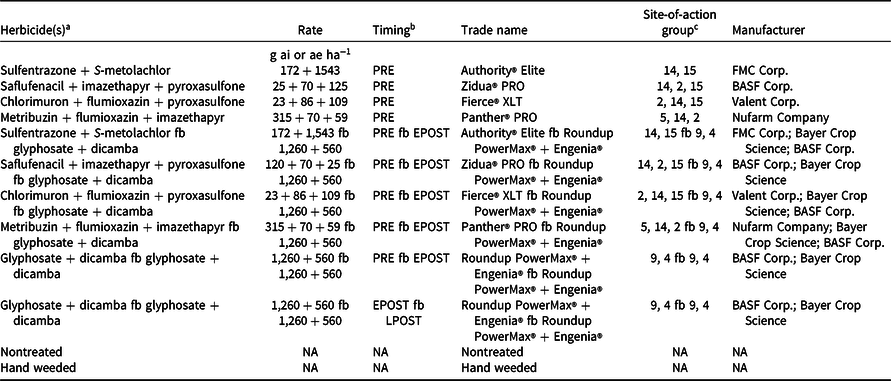
a Abbreviations: EPOST, early POST; fb, followed by; LPOST, late POST; NA, not applicable.
b PRE herbicides were applied immediately after soybean planting; EPOST herbicides were applied at the V3 to V4 growth stage of soybean; LPOST herbicides were applied at the V7 to V8 growth stage of soybean.
c The site-of-action group is a classification system developed by the Weed Science Society of America.
All PRE programs were applied immediately after soybean planting across both sites and years. At the KSU-AB site, the EPOST treatments were applied on June 25, 2018, and July 1, 2019, at V3 to V4 growth stages of soybean (8- to 12-cm tall Palmer amaranth in nontreated weedy checks) and LPOST treatments were applied on July 9, 2018, and July 15, 2019, at V7 to V8 growth stage of soybean (24- to 30-cm tall Palmer amaranth in nontreated weedy checks and <15-cm tall Palmer amaranth seedlings in PRE-alone treatments). At the KSU-ARC site, EPOST treatments were applied on June 13, 2018, and June 25, 2019, at V3 to V4 growth stages of soybean (6- to 10-cm tall Palmer amaranth in nontreated weedy checks) and LPOST treatments were applied on July 27, 2018, and July 9, 2019, at V7 to V8 growth stages of soybean (20- to 24-cm tall Palmer amaranth in nontreated weedy checks and <12-cm tall Palmer amaranth seedlings in PRE-alone treatments). In nontreated plots, Palmer amaranth density ranged from 65 to 98 plants m−2 and 34 to 67 plants m−2 at the time of EPOST application across both years at KSU-AB and KSU-ARC, respectively. Percent soybean injury and Palmer amaranth control were visually assessed on a scale of 0% to 100% (0%, no crop injury or control; 100%, complete plant death) at 3 wk after PRE (WAPRE), 6 WAPRE/3 wk after early POST (WAEPOST), and 9 WAPRE/6 WAEPOST.
Aboveground Palmer amaranth–shoot biomass was hand harvested using a 1-m2 quadrat from the center of each plot to determine shoot dry biomass (after oven drying at 45 C for 7 d) at soybean maturity. Palmer amaranth–shoot dry biomass from treated plots were expressed as a percent shoot biomass reduction compared with the nontreated weedy check using Equation 1:
 $$Y = \left[ {{{A - B} \over A}} \right] \times 100{\rm{ > }}$$
where Y represents Palmer amaranth–shoot biomass reduction (%), A is the shoot dry biomass from nontreated weedy check treatment, and B is the shoot dry biomass from a treated plot. Soybean grain yields (kg ha−1) were estimated by harvesting the middle two rows from each plot using a plot combine. Soybean grain yields were adjusted to 13% moisture.
Experiment 2
Field experiments were conducted in 2018 and 2019 at the KSU-ARC site to evaluate the efficacy of PRE-applied pyroxasulfone + sulfentrazone, pyroxasulfone + sulfentrazone plus carfentrazone-ethyl + sulfentrazone, pyroxasulfone + sulfentrazone plus metribuzin, sulfentrazone + metribuzin alone, or PRE applied pyroxasulfone + sulfentrazone, and pyroxasulfone + sulfentrazone plus carfentrazone-ethyl + sulfentrazone premixes fb EPOST treatment of glyphosate + dicamba mixture for GR Palmer amaranth control in GDR soybean (Table 2). A nontreated weedy check treatment was also included. The timings of all PRE and the EPOST treatments were the same as described for experiment 1 in both years. Palmer amaranth density in experiment 2 was lower compared with experiment 1, ranging from 28 to 41 plants m−2 at the time of EPOST application in nontreated plots. Data on percent crop injury and Palmer amaranth control at 3 WAPRE, 6 WAPRE/3 WAEPOST, 9 WAPRE/6 WAEPOST and soybean grain yields at maturity were recorded as described for experiment 1.
List of herbicide programs (experiment 2) tested for glyphosate-resistant Palmer amaranth control in glyphosate- and dicamba-resistant soybean at the Kansas State University Agricultural Research Center near Hays, KS, in 2018 and 2019. abc

a Abbreviations: EPOST, early POST; fb, followed by; LPOST, late POST; NA, not applicable.
b PRE herbicides were applied immediately after soybean planting; EPOST herbicides were applied at the V3 to V4 growth stage of soybean.
c The site-of-action group is a classification system developed by the Weed Science Society of America.
Statistical Analysis
All data collected in experiments 1 and 2 were checked for ANOVA assumptions (normality of residuals and homogeneity of variance) using PROC UNIVARIATE in SAS (SAS Institute, Cary, NC), and all data met those assumptions. Data from experiment 1 were analyzed and presented by each site to account for differences in soybean variety, seeding rates, environmental conditions, and agronomic practices. Data were subjected to ANOVA using the PROC MIXED procedure in SAS 9.3. For each site, the ANOVA model included herbicide treatments, year, and herbicide treatments by year interaction as fixed effects. Replication and interactions involving replication were considered random effects in the model. Interaction between herbicide treatment-by-year was nonsignificant (P ≥ 0.05) for all variables; therefore, data were pooled across years before final analysis for each site. For experiment 2, herbicide treatments and year were considered fixed effects, and replication and interactions involving replication were considered random effects in the ANOVA model. Data on Palmer amaranth control (%) from nontreated plots were excluded from the analyses for each site. Where the ANOVA indicated significant differences, treatment means were separated using a Fisher protected LSD test (α = 0.05).
Results and Discussion
The average monthly air temperature during 2018 and 2019 growing seasons at the KSU-AB site ranged from 10 to 26 C (Table 3). The seasonal accumulated precipitation was 657 mm in 2018 and 863 mm in 2019 (Table 3). The monthly average air temperature during 2018 and 2019 growing seasons at the KSU-ARC site was comparable to that at the KSU-AB site and ranged from 9 to 26 C (Table 3). In contrast, the total seasonal precipitation at the KSU-ARC site was relatively lower than at the KSU-AB site and was 593 mm in 2018 and 657 mm in 2019 (Table 3). Overall, the seasonal precipitation received at the KSU-ARC site in both experimental years was relatively higher compared with the 30-yr averaged seasonal precipitation (data not shown).
Averaged monthly air temperatures and total precipitation during the 2018 and 2019 growing seasons at Kansas State University Ashland Bottom research farm near Manhattan, KS, and the Agricultural Research Center near Hays, KS.

a Abbreviations: KSU-AB, Kansas State University Ashland Bottom; KSU-ARC, Kansas State University Agricultural Research Center; NA, not applicable.
Experiment 1
KSU-AB site
Palmer amaranth control and shoot biomass reduction
Timely early-season rainfall at the KSU-AB site in 2018 (18 mm within 5 d of planting) and 2019 (25 mm within 1 wk of planting) helped activate all PRE-applied soil-residual premixes. Averaged over years, PRE-applied saflufenacil + imazethapyr + pyroxasulfone, chlorimuron + flumioxazin + pyroxasulfone, and metribuzin + flumioxazin + imazethapyr provided excellent control (98% to 100%) of GR Palmer amaranth at 3 WAPRE among all PRE-alone programs tested (Table 4). Furthermore, Palmer amaranth control averaged 94% at 3 WAPRE application of sulfentrazone + S-metolachlor. Although not tested in premixes, Hay et al. (Reference Hay, Shoup and Peterson2019) previously reported 89% to 94% control of Palmer amaranth at 4 WAPRE-alone treatments of flumioxazin, sulfentrazone, pyroxasulfone, flumioxazin + pyroxasulfone, and sulfentrazone + S-metolachlor in double-crop soybean at a nearby KSU-AB site. In contrast, Houston et al. (Reference Houston, Norsworthy, Barber and Brabham2019) only observed 73% to 88% control of PPO-resistant Palmer amaranth in Arkansas at 4 WAPRE-alone treatments of flumioxazin, metribuzin, pyroxasulfone, S-metolachlor, sulfentrazone.
Glyphosate-resistant Palmer amaranth control, shoot biomass reduction, and grain yield of glyphosate- and dicamba-resistant soybean with various herbicide programs (experiment 1) averaged across 2018 and 2019 at the Kansas State University Ashland Bottom research farm near Manhattan, KS.a

a All data were averaged across 2018 and 2019 growing seasons.
b Abbreviations: EPOST, early POST; fb, followed by; LPOST, late POST; NA, not applicable; WAEPOST, weeks after early POST; WAPRE, weeks after PRE.
c PRE herbicides were applied immediately after soybean planting; EPOST herbicides were applied at the V3 to V4 growth stage of soybean; LPOST herbicides were applied at the V7 to V8 growth stage of soybean.
d Means within a column with similar letters are not significantly different based on Fisher protected LSD test (α = 0.05).
Differences in Palmer amaranth control reported by Houston et al. (Reference Houston, Norsworthy, Barber and Brabham2019) versus the findings of current study may be attributed to differences in herbicide SOAs being tested in both studies (herbicides with a single SOA by Houston et al. [Reference Houston, Norsworthy, Barber and Brabham2019]; herbicide premixes with two or three SOAs in the current study). In addition, the target Palmer amaranth population in the Houston et al. (Reference Houston, Norsworthy, Barber and Brabham2019) study had multiple resistance to EPSPS, ALS, and PPO inhibitors, whereas the Palmer amaranth population in current study was only resistant to EPSPS inhibitors. The least control (51%) was observed with PRE treatment of glyphosate + dicamba mixture at 3 WAPRE before EPOST sequential application. This compares with up to 71% control of PPO-resistant Palmer amaranth at 4 wk after dicamba PRE-alone treatment reported by Houston et al. (Reference Houston, Norsworthy, Barber and Brabham2019). Palmer amaranth control with all PRE-alone programs ranged from 92% to 94% at 9 WAPRE/6 WAEPOST (Table 4). All PRE fb EPOST (ie, two-pass programs) or sequential POST treatments (EPOST fb LPOST) of glyphosate + dicamba mixture provided excellent control (98% to 100%) of GR Palmer amaranth at 9 WAPRE/6 WAEPOST in GDR soybean. Consistent with percent visual control, all PRE fb EPOST programs or a sequential POST treatment of glyphosate + dicamba mixture prevented GR Palmer amaranth biomass production at soybean maturity. In contrast, all PRE-alone programs (ie, one-pass programs) with no follow-up POST program only reduced GR Palmer amaranth shoot biomass by 57% to 76% compared with the nontreated weedy check at soybean maturity.
Soybean grain yield
No visual crop injury was observed throughout either growing season with any of the PRE or POST programs tested. Compared with the nontreated weedy check, all herbicide programs improved soybean grain yield (Table 4). Season-long interference of GR Palmer amaranth reduced soybean grain yield by 58% in the nontreated weedy check as compared with all top yielding treatments. No significant differences in soybean grain yield were observed with a majority of the herbicide programs tested. However, soybean yield in PRE-alone treatments of sulfentrazone + S-metolachlor, saflufenacil + imazethapyr + pyroxasulfone, and chlorimuron + flumioxazin + pyroxasulfone averaged 4,342 kg ha−1 compared with 4,832 kg ha−1 with PRE-applied chlorimuron + flumioxazin + pyroxasulfone fb a POST treatment of glyphosate + dicamba mixture, suggesting the need for a two-pass program comprising an effective PRE-applied premix (i.e., a mixture of alternative herbicide SOAs other than glyphosate or dicamba) fb a POST treatment of glyphosate + dicamba mixture to protect soybean yield loss.
KSU-ARC Site
Palmer amaranth control and shoot biomass reduction
Averaged across years, early-season control of GR Palmer amaranth was excellent (98% to 99% control at 3 WAPRE) with PRE-alone treatments of chlorimuron + flumioxazin + pyroxasulfone and metribuzin + flumioxazin + imazethapyr, whereas it did not exceed 95% with PRE-applied sulfentrazone + S-metolachlor, saflufenacil + imazethapyr + pyroxasulfone (Table 5). In contrast, only 66% control was observed with a glyphosate + dicamba mixture applied PRE (before a sequential EPOST treatment of the same mixture).
Glyphosate-resistant Palmer amaranth control, shoot biomass reduction, and grain yield of glyphosate- and dicamba-resistant soybean with various herbicide programs (experiment 1) averaged across 2018 and 2019 growing seasons at the Kansas State University Agricultural Research Center near Hays, KS.a

a All data were averaged across 2018 and 2019 growing seasons.
b Abbreviations: EPOST, early POST; fb, followed by; LPOST, late POST; NA, not applicable; WAEPOST, wk after early POST; WAPRE, wk after PRE.
c PRE herbicides were applied immediately after soybean planting; EPOST herbicides were applied at the V3 to V4 growth stage of soybean; LPOST herbicides were applied at the V7 to V8 growth stage of soybean.
d Means within a column with similar letters are not significantly different based on Fisher protected LSD test (α = 0.05).
It is important to note that the KSU-ARC site had received approximately 41 and 20 mm precipitation within 5 d of soybean planting in 2018 and 2019, respectively. Timely precipitation in early season is extremely important for crop establishment and to activate PRE herbicides in the no-till dryland region of the central Great Plains, where residue from previous crop exists on the soil surface at the time of soybean planting and PRE applications. The early-season rainfall at the KSU-ARC site in both years helped provide good herbicide–soil contact for activation of PRE-applied premixes for weed control.
Similar to results at the KSU-AB site, Palmer amaranth control with PRE-alone programs also declined over the growing season. At final evaluation (9 WAPRE/6 WAEPOST), control was the greatest with PRE-applied metribuzin + flumioxazin + imazethapyr and chlorimuron + flumioxazin + pyroxasulfone among all PRE-alone programs, and it did not differ from all two-pass programs. All two-pass programs (i.e., PRE fb EPOST or EPOST fb LPOST) provided complete or nearly complete control (98% to 100%) of Palmer amaranth at final evaluation. Consistent with percent control, all two-pass programs prevented shoot biomass production of Palmer amaranth at soybean maturity. In contrast, only 35% to 70% reduction in Palmer amaranth shoot biomass was achieved with PRE alone programs.
Soybean grain yield
No visual crop injury was observed with any of the tested programs. Averaged over years, soybean grain yield was lower at the KSU-ARC site compared with the KSU-AB site. All herbicide programs significantly improved soybean grain yield compared with the nontreated weedy control; however, there were no significant differences in soybean grain yield among herbicide treatments tested (Table 5). Soybean grain yield with all tested programs ranged from 1,798 to 2,032 kg ha−1 (Table 5). A season-long infestation of GR Palmer amaranth reduced the soybean grain yield by 31% in the nontreated plots as compared with all top yielding treatments.
Experiment 2
Averaged over 2 yr, PRE-alone treatment of pyroxasulfone + sulfentrazone plus carfentrazone-ethyl + sulfentrazone and pyroxasulfone + sulfentrazone plus metribuzin provided excellent Palmer amaranth control (95% to 97%) at 3 WAPRE, whereas control did not exceed 93% with PRE-applied pyroxasulfone + sulfentrazone (Table 6). Similar to aforementioned experiments, control declined over the growing season and was 86% to 87% with PRE-alone treatment of pyroxasulfone + sulfentrazone plus carfentrazone-ethyl + sulfentrazone and pyroxasulfone + sulfentrazone plus metribuzin and 82% with PRE-applied pyroxasulfone + sulfentrazone at 9 WAPRE/6 WAEPOST. Among all tested programs, a PRE-alone treatment of sulfentrazone + metribuzin provided the least control (78% declining to 63%) of Palmer amaranth as the growing season progressed. In contrast to our results, Hay et al. (Reference Hay, Shoup and Peterson2019) previously reported good to excellent Palmer amaranth control (93% to 98%) throughout the season with PRE-applied sulfentrazone + metribuzin premix in double-crop soybean. This discrepancy in efficacy might be due to difference in use rates of this premix between these two studies (176 + 265 g ha−1 in the current study vs. 202 + 303 g ha−1 in the Hay et al. [Reference Hay, Shoup and Peterson2019] study). Furthermore, both PRE fb EPOST programs provided complete season-long control of Palmer amaranth.
Glyphosate-resistant Palmer amaranth control and grain yield of glyphosate- and dicamba-resistant soybean treated with various herbicide programs (experiment 2) averaged across 2018 and 2019 growing seasons at the Kansas State University Agricultural Research Center near Hays, KS.a

a All data were averaged across 2018 and 2019 growing seasons.
b Abbreviations: fb, followed by; NA, not applicable; WAPOST, wk after POST; WAPRE, wk after PRE.
c PRE herbicides were applied immediately after soybean planting; EPOST herbicides were applied at the V3 to V4 growth stage of soybean.
d Means within a column with similar letters are not significantly different based on Fisher protected LSD test (α = 0.05).
All tested programs improved soybean grain yield compared with the nontreated weedy check (Table 6). Averaged over 2 yr, season-long interference of GR Palmer amaranth in the nontreated weedy check reduced soybean yield by 39%, compared with all top yielding treatments. No significant differences in soybean yield were observed among tested programs, except for PRE-alone treatment of sulfentrazone + metribuzin. Soybean yield in PRE-alone treatment of sulfentrazone + metribuzin was 1,776 kg ha−1 compared with 2,098 kg ha−1 averaged yield with all PRE-alone or PRE fb EPOST programs.
Conclusions and Practical Implications
All two-pass herbicide programs (PRE fb EPOST) evaluated in experiments 1 and 2 provided excellent season-long control of GR Palmer amaranth and prevented shoot biomass production in GDR soybean. A PRE application of glyphosate + dicamba mixture provided low to moderate (51% to 70% control) residual activity on GR Palmer amaranth in early season across both locations. Although the majority of PRE-alone treatments provided 82% to 94% control at final evaluation, a sequential EPOST application of glyphosate + dicamba mixture was needed to achieve near-complete season-long control and shoot biomass reduction of GR Palmer amaranth in both experiments across sites. Although excellent control of GR Palmer amaranth was observed with a sequential treatment (EPOST fb LPOST) of glyphosate + dicamba mixture across both sites, growers should avoid this program because the repeated POST applications of dicamba will enhance the risk of widespread evolution of dicamba resistance in GR Palmer amaranth populations.
No differences were observed in soybean grain yield in one-pass versus two-pass programs; however, it is important to note that late-emerging cohorts of GR Palmer amaranth in PRE-alone programs may possibly contribute to the soil seedbank replenishment for future infestation. Reducing seed production is crucial in minimizing the risk of evolution and spread of herbicide-resistant weed biotypes (Neve et al. Reference Neve, Norsworthy, Smith and Zelaya2011; Taylor and Hartzler Reference Taylor and Hartzler2000). Overall, the use of the recently available PRE-applied premixes investigated in this study can serve as an important component of integrated weed management strategies for GR Palmer amaranth control in the region and will help prolong the utility of this stacked-trait soybean technology.
It is important to point out that the KSU-AB site was under conventional tillage system and moisture-enriched environment (eastern Kansas; annual average precipitation, 890 mm), whereas the KSU-ARC site was under no-till production system with a moisture-deficit environment (western Kansas; annual average precipitation, 609 mm). Early-season rainfall events in both experimental years activated all tested PRE-applied premixes and provided consistent control of GR Palmer amaranth across both sites. However, it is cautioned that inconsistent and infrequent early-season precipitation can reduce the effectiveness of these PRE-applied premixes during dry years in no-till dryland conditions in the central Great Plains similar to the KSU-ARC site.
Palmer amaranth populations with multiple resistance to five herbicide SOAs, including glyphosate and 2,4-D, along with a recent suspected case of dicamba resistance, recently were reported in Kansas (Kumar et al. 2019; Reference Kumar, Liu and Stahlman2020; Dallas Peterson, personal observation). Therefore, the standalone use of herbicides can no longer be a sustainable approach for managing this weed species.
Future studies should evaluate the effectiveness of integrated ecological tactics, including cover crops, diversified and competitive crop rotations, rotational use of new generation of multiple-herbicide–resistant crops, occasional tillage, and harvest weed seed control technologies (e.g., chaff lining, harvest weed seed destructor) in combination with effective herbicide premixes or mixtures for controlling GR Palmer amaranth seed banks in the soybean-based rotations in this region.
Acknowledgments
The authors thank Taylor Lambert and Cathy Minihan at Kansas State University for providing technical support in conducting the field experiments. This research was partially supported by the Kansas Soybean Commission (grant no. GAHY004641), Bayer Crop Science, and FMC Corp. No conflicts of interest have been declared. This publication is contribution no. 20-312-J from the Kansas Agricultural Experiment Station, Manhattan, KS.



