


1 The Revisionist Movement in Narcotic Historiography and Chinese Experience
Opium and its derivatives have been used as herbal medicines and tributes since ancient times, but they developed an unsavory reputation in the modern period.Footnote 1 For over a century, people have viewed narcotics as a devil that has impeded the modernisation of China. However, there are voices declaring that the beneficial effects of opium in history are also significant. Ann Dally emphasised that narcotics are often harmless, as there are numerous addicts that lead normal lives and it is only the prohibition of narcotics that makes them harmful.Footnote 2 More recently, Jay Levy’s research on the anti-drug efforts of the Swedish government confirms that anti-drug campaigns only worsened drug abuse in Sweden.Footnote 3 Since the end of the twentieth century, this topic has been extensively explored in the context of Asian history. Frank Dikötter and his colleagues argue that the beneficial effects of opium in history were significant and that it was substitutes for opium that brought harm.Footnote 4 The articles of Richard Newman and John Richards reveal that Asian peasants were not forced to produce narcotics for the benefits of colonists, as previously thought.Footnote 5 Moreover, even after Ann Dally was taken to court for her doubts about the traditional understanding of narcotics,Footnote 6 the search for alternative perspectives on narcotics persisted in Britain and has recently drawn public attention outside academia.Footnote 7 These voices converge into a revisionist movement in narcotic historiography, using a similar core methodology of historical studies to make up for people’s limited horizon on narcotic problems caused by contemporary medical sciences.Footnote 8
However, it should be noted that the revisionist movement in narcotic historiography has not been widely supported yet: in fact, it is still under fierce criticism.Footnote 9 For a proper and even-handed judgment of the history of narcotics, we must first visit an approach nested in health-history scholarship. Earlier endeavours have increased our understanding of the history of the drug problem. However, overgeneralisation always happens when we draw conclusions based on disparate and incomplete sources. Due to a lack of representative historical sources, it is difficult to ensure the typicality of materials in the process of arranging them. A promising methodology for overcoming the limitations of incomplete and imprecise historical materials lies within the statistical work on numerous judicial records in modern China. In recent studies of British history, scholars have highlighted judicial records as sources for medical history.Footnote 10 Although there are a considerable number of judicial records extant in modern China, researchers rarely base their work on statistical approaches, to say nothing of judicial records. Using the Judicial Records of Longquan,Footnote 11 which was found in 2007, this present study aims to develop an analysis of the drug problem in Longquan from 1900 to 1949, the ending of the Republic of China’s governance in mainland China. A comparison of drug-related cases and anti-drug efforts is made in later sections, which enables us to further understand the role of narcotics in history.
2 Perspectives on the Recently Discovered Judicial Records of Longquan
To begin with, this paper will provide a brief background on Longquan District in Zhejiang Province and the drug-taking conditions of its residents during the first half of the twentieth century. Surviving from the Second Sino-Japanese War (1937–45), Judicial Records of Longquan remains by far the largest compilation of judicial records (by word count) of the Qing dynasty (1836–12) and the Republic of China (1912–49). The period that Judicial Records of Longquan covered ranges from 1851 to 1949. For comparison, most archived materials in the Health Ministry of Zhejiang Province (Zhejiangsheng weishengchu) and the Archives Bureau of Longquan District (Longquanshi danganguan) only date back to 1940. Mainly written by hand, the Judicial Records of Longquan is comprised of 17 333 volumes and over 880 000 pages. Scholars from Zhejiang University discovered these records in the Archives Bureau of Longquan in 2007. However, they still remain beyond the reach of medical historians as less than one per cent of its contents have been published.Footnote 12 Further obscuring its access is the fact that almost all research developed so far based on the Judicial Records of Longquan is published in Chinese and does not focus on medical history.Footnote 13 In fact, there are many drug-related cases in Judicial Records of Longquan, because Longquan is one of the eight districts in Zhejiang Province that was most influenced by narcotics.Footnote 14
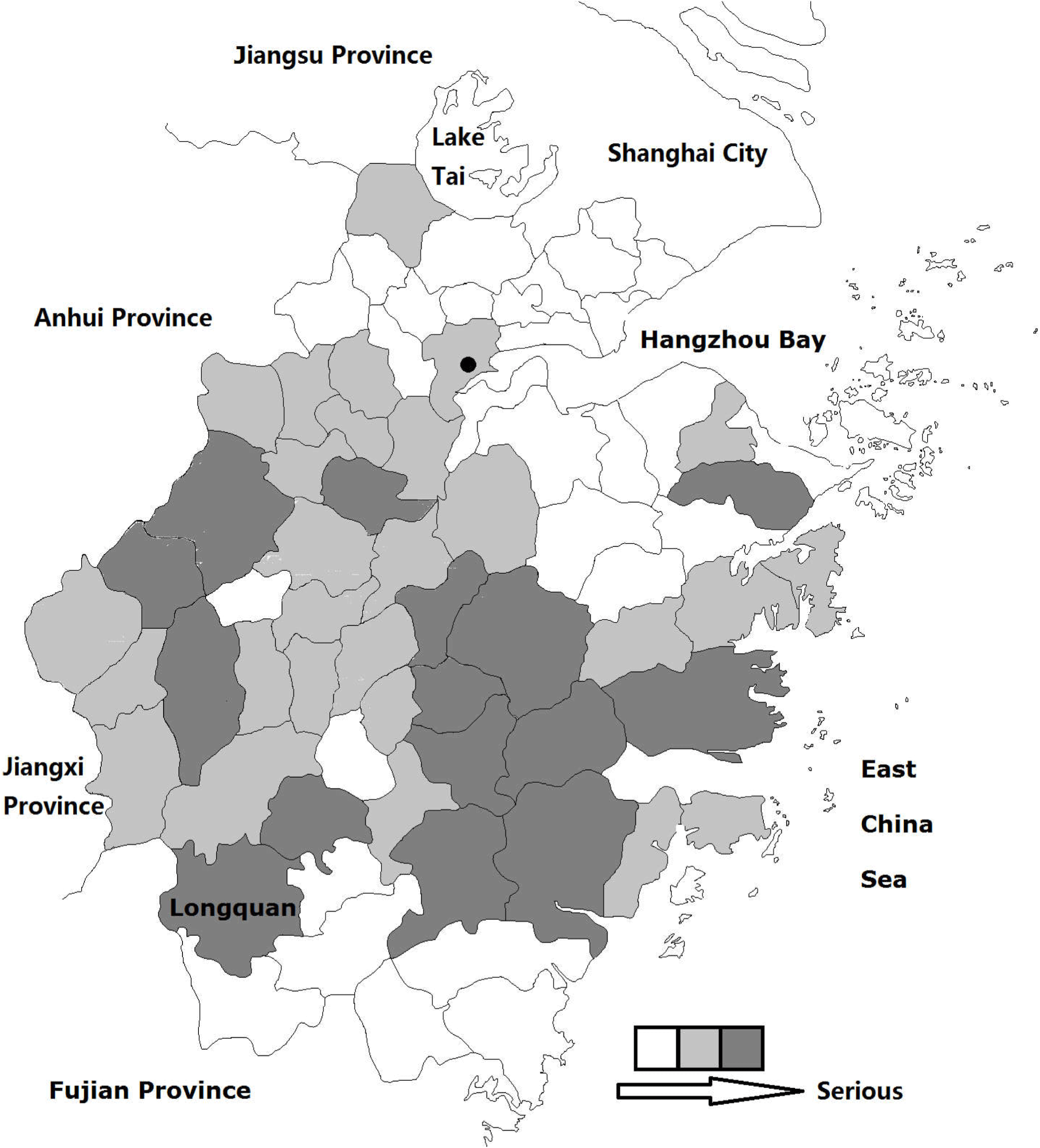
Geographical distribution of narcotics in Zhejiang Province before 1937. Redrawn with English translation based on Kangzhanqian zhejiangsheng gexian hongwan mafei liudu tu (Map of Red Pill and Morphine in Zhejiang Province before the Second Sino-Japanese War), collected in Jinhua: Heritage Office of Dongyang District. Source: Zuotang Guo (ed.), Dongyang wenshiziliao xuanji (Selected Historical Documents of Dongyang), vol. 13 (Dongyang: Zhengxie dongyangshi weiyuanhui wenshiziliao weiyuanhui, 1997), 344.
The developments of this research mainly follow the method of data statistics and analysis. As some cases in Judicial Records of Longquan are related to the drug problem but not directly, it is relatively difficult to decide the specific cases to use in this research. To qualify as drug-related cases in this study, the summary part of these records had to involve any of the following Chinese keywords:
Yapian (opium): 162 cases
Yan (opium):Footnote 15 70 cases
Mafei (morphine): 45 cases
Shida (inject): 24 cases
Hongwan (red pill): 19 cases
Xidu (drug-taking): 11 casesFootnote 16
Other cases were abandoned to ensure the replicability and reproducibility of the statistical process. After removing duplicate cases, there were 245 effective cases. It must be mentioned that the assumption of a drug-related case is restrictive and inadequate, for several cases did not clearly point out the drug-related information.
3 The Rise of Narcotics in Longquan
Applying the statistical method, the correlation between the occupation of defendants and the rise of narcotics can be shown directly (Table 1). The drug-related cases that we used (245 cases) accounted for 1.41of all cases (17,333 cases). Workers (4.96%) and businessmen (1.75%) were more likely to take drugs, while farmers (0.65%) were less likely.
Number of defendants in drug-related cases by occupation.

The principal feature of occupational distribution was the high frequency of pharmacists in drug-related cases (4 times) among all cases (20 times), accounting for 20%. Many pharmacists in Longquan sold or even took narcotics (LQ: 4566; 7197; 15041.3; 16159.3). Some earned their living by purchasing herbs and mountain products and reselling them (LQ: 4782). There have been some studies revealing that pharmacists made up a significant portion of drug offenders.Footnote 17 However, the statistical outcome based on Judicial Records of Longquan also demonstrates that of all the crimes committed by pharmacists, drug-related ones were the most likely. According to the local records, Longquan had no pharmacist trained in Western medicine during the Republic of China period, and only 139 traditional Chinese pharmacists in 1956.Footnote 18 Therefore, during the Republic of China, the number of pharmacists in Longquan was small, and a large percentage of them was involved in drug-related events. These numbers reveal that the role of pharmacists in the semi-colony was more significant than previously understood.
Another feature was the high rate of sailors among the defendants in drug-related cases. As most dealers were boatmen (LQ: 689.14), it is likely that drugs were carried by boats to Longquan. According to the defendants’ statements, the greatest number of drug dealers came from coastal cities like Wenzhuo and Taizhou. The name of a Wenzhouer, Yin Xiutao, appears more than once in drug-related cases in Judicial Records of Longquan (LQ: 4135: 7; 2366: 10). Boatmen from Yongjia District of Wenzhou City always participated in drug dealings (LQ: 16159.19; 13069: 4–6). Other defendants confessed that they obtained their drugs through their friends from Taizhou (LQ: 6884.12; 3611.1; 1685.3). Hilly areas make up around 90% of the land in Longquan.Footnote 19 , hence the emergence of drugs in Longquan depended on the trade from coastal areas (Wenzhou and Taizhou) to the hinterlands (Longquan).
Even though many drug sellers were from Wenzhou, the influence of Wenzhou was selective. Missionaries historically played a leading role in anti-drug movements,Footnote 20 and Wenzhou had the highest population of missionaries in Zhejiang Province from the Qing dynasty onwards. However, no missionaries can be found in anti-drug movements recorded in Judicial Records of Longquan. Therefore, the influence of Wenzhou on Longquan’s narcotic culture was limited and Longquan had a narcotic culture distinctive from Wenzhou.
4 Narcotics Gradually Lost Their Role as an Elite Status Symbol
Table 2 indicates the age of defendants in drug-related cases found in Judicial Records of Longquan, which can be utilised to illustrate the social conditions of drug users. In the Qing dynasty, opium was a symbol of elite and celebrity status. Although most people link drug addiction with poverty, some scholars believe this conception has been deliberately exaggerated by government.Footnote 21 This contradictory phenomenon deserves further investigation. The foremost task is to confirm whether the use of narcotics was still a symbol of elite and celebrity status in Longquan during the first half of the twentieth century.
Number of defendants in drug-related cases by age.

* There are no records of the total population of Longquan from 1900–49, as most of the archives of that period did not survive the Second World War.
** These two groups may not be suitable to calculate growth rates, because (1) the sample size is relatively small and (2) most drug users do not live to 70 years old.
It is generally accepted that younger people are more likely to use drugs, but, in fact, this opinion is debatable. As Table 2 illustrates, it was people aged 60–9 (37 people, 23.57%), rather than those under 29 years (29 people, 12.10%), who composed the largest group of drug addicts. Furthermore, despite numerous drug addicts being middle-aged (40–59 years old: 65 people, 41.40%), this group only accounted for a small portion of all middle-aged people in Longquan (1.82% and 1.71% in all cases). In contrast, those over 60 years old tended to appear in drug cases more frequently (2.38%, 2.30% and 4.17% in all cases). More significantly, the growth rate of the APDDAD (age percentage of drug-related defendants in all defendants) witnessed an explosive rise between the 50–9 group (grows 5.26%) and the 60–9 group (grows 129.12%). This shows that it is not younger people but older ones who become more easily addicted to narcotics. The reason may be that older people have more free time or more money, or they may have more aches and pains and suffering that draw them to narcotic relief.
Elderly people usually had appreciable economic capacities. In drug-related cases (224 cases), eleven defendants had lawyers assist them in litigation, comprising 4.91 percent. In contrast, in all cases in Judicial Records of Longquan only 2315 defendants had lawyers, comprising 1.19 percent overall (19,852 cases). Some lawyers, like Xie Xuan (LQ: 720; 5932; 5936), Ji Buyuan (LQ: 7197; 8067), Ding Zongxiang (LQ: 11150; 3967) and Lian Gongbai (LQ: 710; 10393), acted as agents in drug-related cases many times, revealing the large and regular requirements of defendants.
Drug users may have been a part of the upper class in Longquan, with appreciable economic resources, but it does not mean everyone could afford drugs. As one defendant said, he ‘chose morphine instead of opium only because the former was cheaper’ (LQ: 4327). Similar explanations may also apply to red pill (Hongwan). A report in the period of the Republic of China recorded that ‘the red pill is cheaper than opium and can be used 3 to 4 times a day’.Footnote 22 Moreover, a defendant directly admitted that he took the red pill ‘as the substitute of opium’ (LQ: 7169.8: Daiyong yapianyan). In addition, the drugs used in Longquan were limited to opium, red pill and morphine. More expensive drugs, like hallucinogens or Western sedatives, never appear in the Judicial Records of Longquan, stressing the limited purchasing power of the local people.
The transformation of the types of drugs used, from opium to morphine and red pill, may have occurred in the 1920s. As a defendant born in 1906 confessed, he ‘used to be an opium smoker. When I grew to teens (around 1920), I started taking morphine’ (LQ: 2596.10: Wo yiqian xi yapian de, xidao de shijisui da mafei). This transformation may have legal causes in addition to economic ones. A defendant was accused of taking a new kind of drug called Bailingwan (literally ‘panacea’). As there was a gap in laws regulating this new kind of drug, the judge could not pass any sentence on its use or determine if its use was as severe as taking opium. (LQ: 13280.3) In the early years of the emergence of red pill, the situation was similar. On the whole, during the period of the Republic of China, narcotics gradually lost their role as a symbol of elitist status, and they were used by people of lesser means.
5 Nonconformity between Drug-Related Cases Number and Anti-Drug Efforts
Early researchers of the effectiveness of anti-drug measures mainly reached their conclusions by examining the change in the number of drug-related cases. However, there are two explanations for the years with a high number of drug-related cases: these years represent the peak periods of anti-drug movements or anti-crime (all crimes including drug use) movements. To clarify this point, we use two lines on Figure 2, so readers can see the following:
(1) For the period 1910–29, the percentage of drug-related cases in all criminal cases is high, while the number of drug-related cases is not. Therefore, this period can be judged as a peak period of drug use.
(2) For the period 1930–5, although the percentage of drug-related cases grows rapidly, the number of drug-related cases also grows in a similar range. Therefore, this period can be excluded from being judged as a peak period of drug use.
We can roughly interpret the results of these statistics by summarising the three periods during which drug-related cases mainly occurred: (A) the beginning of the Republic of China, 1912–14; (B) a fluctuation period, 1916–24; and (C) the period of ‘Two-Year Movement on Drug Control and the Six-Year Movement on Smoke Control’ (Ernian jindu liunian jinyan) by the Kuomindang (The Nationalist Party of China), 1929–37.
Number and percentage of drug-related cases by year in Judicial Records of Longquan.
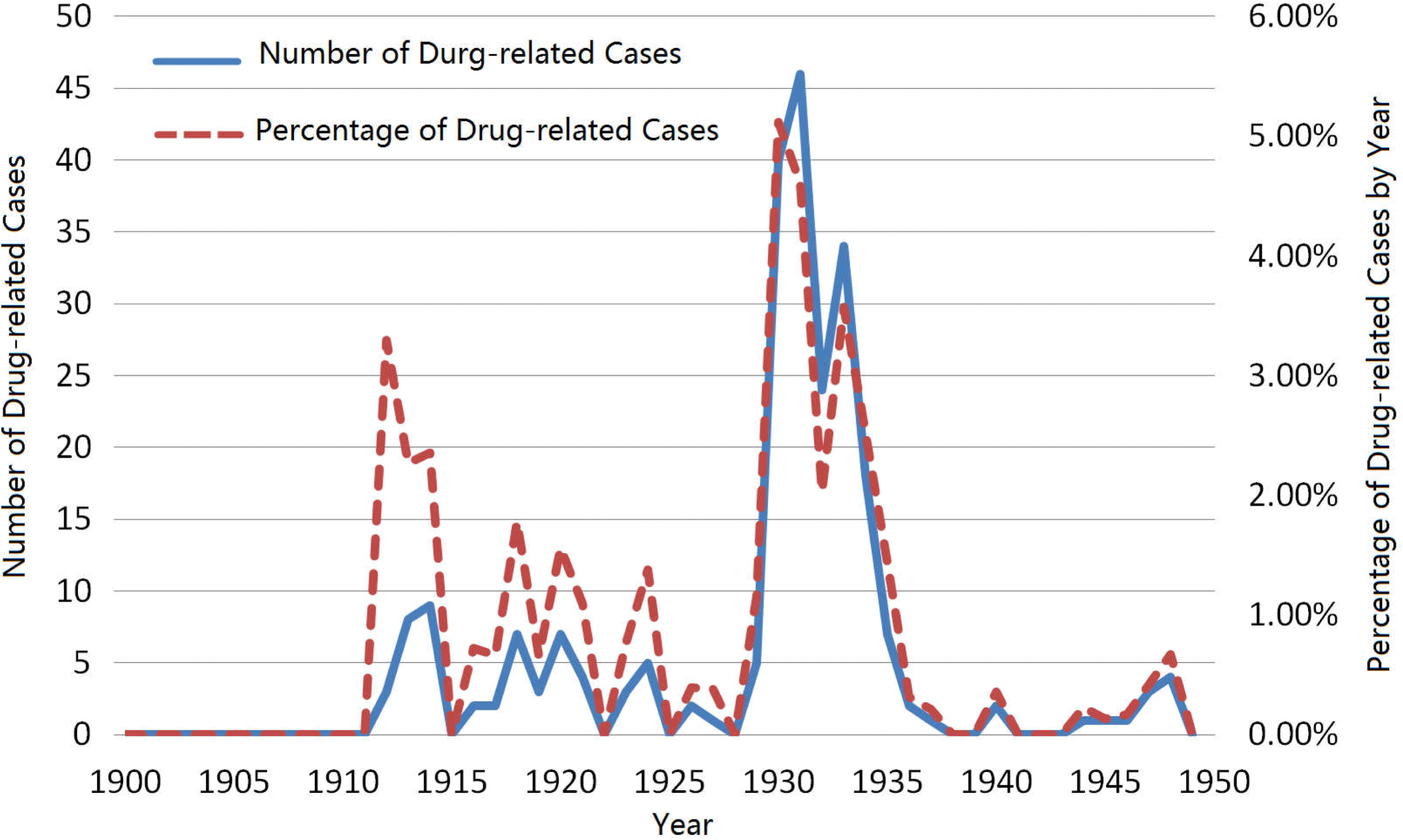
Despite the 1906 efforts of the Qing dynasty to initiate a nationwide opium-suppression movement,Footnote 23 drug-related cases cannot be found from 1900 to 1911 in Longquan; however, other cases still appeared in this period. Therefore, it was likely the local government falsely presented the appearance of a drug-free society, because Longquan promptly witnessed a sharp rise in drug use (from 0 to 9 cases, accounting for 3.30% of all cases) when the Qing dynasty was overthrown at the end of 1911.
From 1916 to 1924, there were still many drug-related cases, but not such a high percentage of all cases as before. As the authority of law decreased due to political unrest during this period, one drug user resisted arrest and escaped from his house in Longquan (LQ: 324; 13186). Another believed that the ‘power of the law will not reach his activities in remote mountains’ (Shangao Fayuan) and therefore totally ignored the court’s punishments. (LQ: 15874.3) The same situation also took place in Fujian Province, where the anti-drug movement ran from 1906 to 1920 and suddenly ended due to war.Footnote 24 In Longquan, the end of this peak period may also be due to the fall of Lu Yongxiang’s government, after which Zhejiang Province remained in chaos and the rule of law disappeared almost entirely.
An abrupt increase in the number of drug-related cases appeared starting in 1930, showing the impact of the Kuomindang’s anti-drug movement. This peak period not only represents the Kuomindang’s strict control of drugs but also shows the prosperity of the drug trade, which is illustrated by the diversification of the pills’ region-specific colours. As a judicial record of 10 March 1930 mentioned, white pills (baiwuan) and blue pills (lanwan) were found in Longquan, the ingredients of which were similar to morphine (LQ: 3020.13–14). A report from June 1931 also mentions a kind of bi-colour morphine powder (LQ:14627.19: Liangse mafei fen). There are no fewer than sixteen different colours of morphine in the judicial record of 7 May 1932 (LQ: 14441.15).Footnote 25 According to Gerda Edelman, Martin Lopatka and Maurice Aalders, the different colours of drugs reflect the diversification of their geographic origins.Footnote 26 Therefore, both drug production and drug bans increased in this period, leaving the number of drug-related cases at a high level for four years.
Based on the information in the analysis above, these peak periods do not conform to governments’ various efforts to control drugs during the period. There were no drug-related cases during the anti-drug period of the Qing government; and although we found a large number of drug-related cases during the anti-drug period of the Kuomindang, the percentage of drug-related cases never stands out, as presented by the dashed line in Figure 2. People always regarded the Two-Year Movement on Drug Control and the Six-Year Movement on Smoke Control as a successful solution to the deteriorating health situation, because of the growing number of anti-drug achievements. However, this view fails to take into account the fact that the number of cases of all criminal activity was growing during this period. The Two-Year Movement on Drug Control and the Six-Year Movement on Smoke Control were not launched to improve public health but, together with other political movements, to consolidate the Kuomingdang’s authority. This outcome emphasises the need to re-examine the role of narcotics in history, which may have been exploited and exaggerated by the government.
6 Narcotics as the Vehicle to Prompt Hygienic Modernity
The three peak periods of the number and percentage of drug-related cases in Longquan were based on political objectives, not the conditions of public health. Against this background, drug problems would naturally be on state-makers’ agendas. This situation led to problems in evaluating the position of narcotics in history objectively and without regard to political propaganda. Some Kuomindang officials did hope to improve health conditions by political efforts. However, in general, health mobilisation was often utilised by the Kuomindang for other purposes. An example is the New Life Movement (1934–8) in Jiangxi Province, in which the Kuomindang utilised mass mobilisation to demonstrate its legitimacy during the war.Footnote 27 In roughly the same period in Longquan, the Kuomindang’s anti-drug movements convinced people to devote themselves to mass mobilisation and obey the authority of government. As a result, people in Longquan always connected the reason for detoxification with the dawning of the Republican Era. Some drug users doubted that the accusations from plaintiffs were based on true facts, suspecting personal conflicts. In response, one plaintiff said that ‘everything I testified is based on reasonable facts because now it is the period of the Republican Era’. (LQ: 571.32: Dangjin gongheshidai, shishi yi liyou wei biaozhun) In another case, a plaintiff also responded to the doubts confidently, declaring that ‘the law supervises us not to give any perjury. Even though there may be some personal conflicts, just judgments will be made finally as now is the Republican Era’ (LQ: 9474.6: Di gongheshidai, conghuo mingfenenyi, jiegui xiaomie, er falü bi buxu renwei xuwei zhi gaofa). The words of these two plaintiffs reflect the Kuomindang’s efforts to promote Republicanism in the anti-drug movement. This would contribute to the building of political legitimacy, helping the government to maintain social order and reinforce its authority.Footnote 28
Besides political factors, economic factors motivated the government to demonise narcotics. As a report recorded, local officials shut down a morphine factory but were then punished by the government for doing so because the owner of the factory was Chiang Kai-shek, the president of the Kuomindang at the time.Footnote 29 Generally, the Kuomindang was delighted to receive the taxes derived from the drug trade, especially when facing the burden of battle, and it monopolised the drug market for economic benefits.Footnote 30 This monopoly led to an increase in the price of narcotics. Increasingly, a series of problems caused by drugs began to appear. For example, cases of morphine theft occurred frequently in Longquan after the Kuomingdang launched anti-drug movements (LQ: 933.5; 8164; 16662). The hygienic condition of syringes was also worrying. Due to the high prices and low incomes, many people ‘not only used the syringes for themselves to relax the drug addiction, but also rented their syringes of morphine to others’ (LQ: 4551.3: Chu ziji shida daiying wai fugei taren shida). The syringes’ renters ‘charge several silver dollars every time’ (LQ: 3020.14: Da yici geiwo jige tongyuan), meaning syringes were quite expensive and in most cases used for many years. A case in 1931 recorded that the defendant’s syringes ‘were bought in the previous dynasty, the Qing dynasty’ (Qian qing shi suo gou) and had been used for at least two years (LQ: 1685.3). Another judicial record demonstrates that the defendant’s ‘morphine syringe was bought from a silk trader from Taizhou during the Qing dynasty’ (LQ: 1685.3). Naturally, reusing syringes without cleaning them increased the likelihood of serious infections in users.
Narcotics did help patients relieve pain, but this fact was deliberately ignored by the government. It is true that the role of narcotics in history was adverse on the whole, otherwise parents would not have put their children into drug rehabilitation programmes (LQ: 4851; 2177). However, the negative role of narcotics was not as extreme as has been thought. There are two main functions of narcotics: first, businessmen in Shanghai always ‘highlighted the positive function of the red pill as a kind of detoxification substitute’ (Mei qi ming yue qiangshang jieyan wan)Footnote 31 ; and the second is as medicine. In the Judicial Records of Longquan, many defendants attributed their drug-taking to pain relief. It is likely that some of these explanations were excuses used by defendants to mitigate their crimes, because their words were often too sophisticated and many contained similar language. Also, their descriptions did not always meet the medical function of narcotics. For instance, one defendant declared he ‘took narcotics only because the medicine he had taken previously was useless’ (LQ: 12538.7: Shengbing chiyao wuxiao suoyi dazhen). Another defendant claimed he injected morphine because he could not walk, (LQ: 12302; 4626.27: Jiaoque) for which morphine is of no help. Nevertheless, sometimes defendants declared they used narcotics to cure illnesses for which narcotics can help. These kinds of illnesses and the frequency with which they occur in drug-related cases at the Judicial Records of Longquan are listed in Table 3.
Illness in drug-related cases in Judicial Records of Longquan and their percentages.

Moreover, many users may have disliked the bitterness of Traditional Chinese Medicine (TCM), and some defendants ‘boiled Traditional Chinese Medicine together with narcotics when suffering from illness’ (LQ: 5828.8: Yin bing suo qu zhe yan jin yao), which is usually effective. These phenomena reveal the beneficial role of narcotics in history.
In the beginning, it cannot be denied that narcotics played a positive role, but this role gradually turned negative. Based on the European experience, every case in which a kind of medicine becomes classified as a narcotic consists of three phases: ‘initial enthusiasm and therapeutic optimism; subsequent negative appraisal; and finally, limited use’.Footnote 32 Behind these phases, there are political objectives to which we must pay more attention. Ruth Rogaski’s work points out that the Chinese search for hygienic modernity was closely linked with a project of Chinese elites to awaken China from its national subjugation.Footnote 33 Related cases in East Asia also reflected how the government used the flag of nationalism to intervene in political propaganda as well as public-health campaigns.Footnote 34 Early studies have verified that the primary purpose of the Kuomindang’s anti-drug movement was its own political advantage instead of public- health benefits. The Kuomindang regarded narcotics as the main culprit in the fall of modern China and therefore demonised them.Footnote 35 Similar conditions may have also transpired in Longquan, leading to the demonisation of narcotics.
Yet the same demonisation that enhanced people’s awareness of public health accelerated the Chinese search for hygienic modernity. The Kuomindang exaggerated the negative effects of drugs and reminded everyone of their responsibility to obey the anti-drug efforts and political authority of the government. Nevertheless, these efforts also contributed to the transmission of public knowledge on health. For instance, according to Figure 1, narcotics were used most frequently in Lishui City (to which Longquan belongs) and Jinhua City. However, people also established the greatest number of local hospitals in these cities during the Republic of China. Lishui City had 27 local hospitals and Jinhua City had 26 local hospitals during that period. In contrast, Hangzhou, the capital of Zhejiang Province, only had 20 local hospitals.Footnote 36 Another study, by Zhu Deming, recorded the founding dates of health-related institutions such as clinics, hospitals, public-health centres and others in Lishui City.Footnote 37 We can see the connections between their foundation dates and the number of drug-related cases per year in Figure 3.
Number of drug-related cases and newly founded health institutions by year.

We have found three periods in which the majority of drug-related cases took place in Longquan. As we see in Figure 3, after the end of these periods, an increasing number of health institutions were founded. Although the founding of health institutions may not have been directly related to the anti-drug movement, once the Kuomindang placed more emphasis on the narcotics problem, more people paid attention to public health, which led to the foundation of health institutions. Consequently, the impact of narcotics on history is less harmful than previously suggested. It indirectly but positively promoted the modernisation of healthcare in China.
7 Concluding Statements and Reflections
The historical face of narcotics is neither completely angelic nor completely devilish. To some extent, it is like a vehicle that furthered the Chinese quest for hygienic modernity. As narcotics were utilised by the government to promote their authority, and indirectly advanced medical modernisation in China, their negative impact was excessively magnified. Although the main purpose of this paper is not to provide supporting evidence for the revisionist movement in narcotic historiography, we admit that excessive fear of narcotics is relatively redundant. Essentially, narcotic problems are ethical problems about drug dependence, and these can be understood better through the perspective of history.
The latest discussions reflect the persistent vitality of academia on this unresolved issue.Footnote 38 However, earlier researchers hardly addressed the covert role of narcotics, which may be because they concentrated mainly on external history. The debates of externalism and internalism in the history of science can never lean to one side totally,Footnote 39 and while the aforementioned trend has its strengths, it is not without its weaknesses, not least how research can easily become descriptive narrative.Footnote 40 Instead of accepting an established narrative, an analytical discussion may contribute more and allow researchers to be free from its influence. Although some progress has been made in this area, this obstacle must be overcome before we can go a step further for a full, critical inspection of narcotics in history.



