







1. Introduction
The flow past a fixed circular cylinder becomes unsteady beyond a critical Reynolds number close to  $47$, with the formation of the alternating von Kármán vortices (Mathis, Provansal & Boyer Reference Mathis, Provansal and Boyer1984). The Reynolds number (Re) is based on the body diameter ( $D$) and inflow velocity ( $U$). The above critical value is denoted by $Re^{\,f}_c$ in the following with reference to the fixed body. When the cylinder is mounted on an elastic support, vortex-induced vibrations (VIV), and thus flow unsteadiness, may occur in the subcritical-Re range, i.e. for $Re< Re^{\,f}_c$, possibly down to $Re\approx 20$, depending on the system parameters (Cossu & Morino Reference Cossu and Morino2000; Mittal & Singh Reference Mittal and Singh2005; Kou et al. Reference Kou, Zhang, Liu and Li2017; Dolci & Carmo Reference Dolci and Carmo2019; Boersma et al. Reference Boersma, Zhao, Rothstein and Modarres-Sadeghi2021).
Among the different forms of flow-induced vibrations (FIV), VIV represent a paradigm of fluid–structure interaction involving synchronization, or lock-in, between body motion and flow unsteadiness. Owing to their impact on engineering structures, they have been the object of a number of studies at higher Re, as reviewed, for example, by Williamson & Govardhan (Reference Williamson and Govardhan2004). Regardless of the Re value, VIV develop over a well-delimited range of the reduced velocity,  $U^\star$, defined as the inverse of the oscillator natural frequency non-dimensionalized by $D$ and $U$. Within this range, where lock-in is established, VIV amplitudes exhibit bell-shaped trends as functions of $U^\star$ and are generally of the order of $D$ in the cross-flow direction, and one or more orders of magnitude lower in the streamwise direction. A typical case of VIV at subcritical Re is visualized in figure 1. The flow, which is steady in the absence of vibration (figure 1a), becomes unsteady and synchronizes with cylinder oscillation once VIV appear (figure 1b).
Flow past a non-rotating, elastically mounted cylinder at  $Re=25$: instantaneous isocontours of spanwise vorticity ( $\omega _z\in [-0.4,0.4]$) for (a) $U^\star =4$ (no vibration) and (b) $U^\star =8$ (cross-flow vibration amplitude equal to $0.31D$). Positive/negative vorticity values are plotted in red/blue. The trajectory of the cylinder centre is indicated by a black line. Part of the computational domain is shown.

The present work explores the impact of a forced rotation of the elastically mounted cylinder at subcritical Re. The rotation breaks the symmetry of the system and may result in a profound alteration of its behaviour, as illustrated in prior studies for  $Re>Re^{\,f}_c$ (Stansby & Rainey Reference Stansby and Rainey2001; Yogeswaran & Mittal Reference Yogeswaran and Mittal2011; Bourguet & Lo Jacono Reference Bourguet and Lo Jacono2014; Zhao, Cheng & Lu Reference Zhao, Cheng and Lu2014; Seyed-Aghazadeh & Modarres-Sadeghi Reference Seyed-Aghazadeh and Modarres-Sadeghi2015; Wong et al. Reference Wong, Zhao, Lo Jacono, Thompson and Sheridan2017; Bourguet Reference Bourguet2020a; Munir et al. Reference Munir, Zhao, Wu and Tong2021). In particular, the rotation distorts the bell-shaped trends of VIV amplitudes versus $U^\star$, as well as body trajectories, i.e. from figure-of-eight to elliptical orbits. It can also trigger responses that resemble the galloping oscillations usually reported for non-axisymmetric bodies, with amplitudes increasing unlimitedly with $U^\star$. Such responses are accompanied by a reconfiguration of the flow and a myriad of multi-vortex wake patterns. These aspects remain to be examined at subcritical Re. In addition, the boundaries of the vibration region in the $({Re},U^\star )$ domain are expected to be reshaped by the rotation and need to be determined; this includes the question of the evolution of the lowest value of Re for the onset of flow unsteadiness. An attempt is proposed here on the basis of numerical simulations.
The subcritical-Re behaviour of the flow–structure system is investigated over a wide range of values of the rotation rate, defined as the ratio between cylinder surface and inflow velocities,  $\alpha \in [0,5]$, for reduced velocities up to $U^\star = 30$. This parameter space encompasses the appearance of the above-mentioned galloping-like responses at higher Re. Focus is placed on $Re\leqslant 30$, for which the flow past a rigidly mounted cylinder remains steady over the selected $\alpha$ range (Stojković, Breuer & Durst Reference Stojković, Breuer and Durst2002).
2. Formulation and numerical method
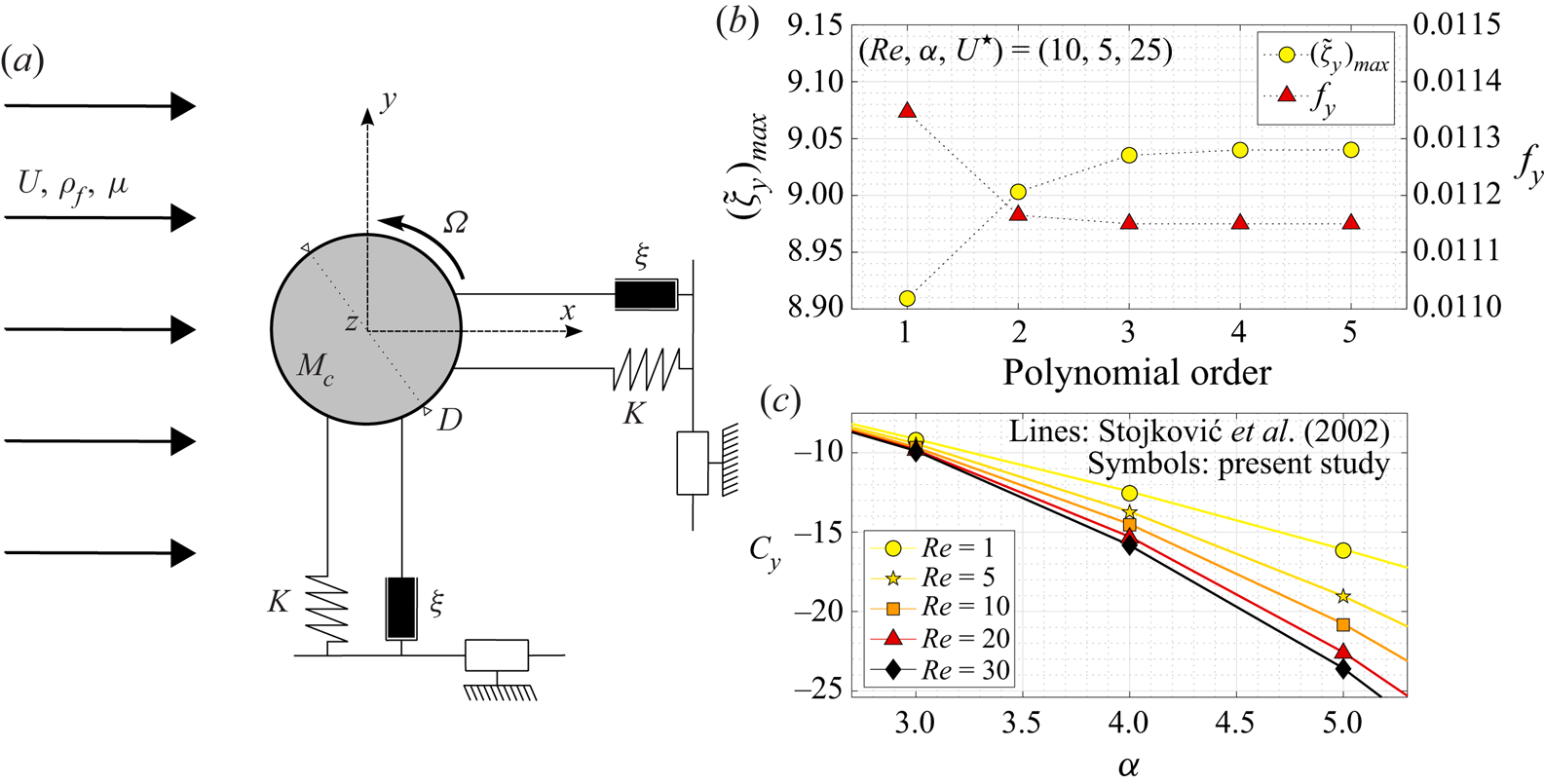
A sketch of the physical system is presented in figure 2(a). The elastically mounted circular cylinder of diameter  $D$ and mass per unit length $M_c$ is parallel to the $z$ axis and placed in an incompressible uniform cross-current of velocity $U$, density $\rho _f$ and viscosity $\mu$ aligned with the $x$ axis. The Reynolds number, $Re=\rho _f U D/\mu$, is kept below or equal to $30$. The flow is two-dimensional across the parameter space investigated. This point has been verified via three-dimensional simulations initialized with three-dimensional flow fields. The two-dimensional Navier–Stokes equations are employed to predict the flow dynamics. The cylinder is free to translate in the in-line (IL, $x$ axis) and cross-flow (CF, $y$ axis) directions. The structural stiffnesses ( $K$) and damping ratios ( $\xi$) of the elastic support are the same in both directions. All the physical variables are non-dimensionalized by $D$,
$D$,  $U$ and $\rho _f$. The IL and CF displacements, non-dimensionalized by $D$, are denoted by $\zeta _x$ and $\zeta _y$. The IL and CF force coefficients are defined as $C_{\{x,y\}}=2 F_{\{x,y\}} /(\rho _f D U^2)$, where $F_{x}$ and $F_{y}$ are the dimensional fluid forces per unit length, aligned with the $x$ and $y$ axes. The dynamics of the two-degree-of-freedom oscillator is governed by the following equations:
 \begin{equation} \ddot\zeta_{\{x,y\}} + \dfrac{4{\rm \pi}\xi}{U^\star} \dot{\zeta}_{\{x,y\}}+ \left(\dfrac{2{\rm \pi}}{U^\star}\right)^2 \zeta_{\{x,y\}} = \dfrac{C_{\{x,y\}}}{2m}, \end{equation}
where the dot  $\dot {\phantom {a}}$ designates the non-dimensional time derivative. The non-dimensional mass of the structure is defined as $m=M_c/(\rho _f D^2)$. The ratio between the mass of the structure and the mass of the displaced fluid is equal to $4 m / {\rm \pi}$. The reduced velocity is defined as ${U^\star }=1/f_n$, where $f_n=[D/(2{\rm \pi} U)]\sqrt {K/M_c}$ is the non-dimensional natural frequency in vacuum. The cylinder is subjected to a forced, anticlockwise, steady rotation about its axis. The rotation is controlled by the rotation rate $\alpha =\varOmega D / (2 U)$, where $\varOmega$ is the angular velocity of the cylinder. The values of $m$ and $\xi$ are set to $10$ and $0$, while $U^\star$ is varied from $2$ to $30$ and $\alpha$ ranges from $0$ to $5$.
$5$.
(a) Sketch of the physical system. (b) CF vibration amplitude and frequency as functions of the polynomial order for  $({Re},\alpha,U^\star )=(10,5,25)$. (c) CF force coefficient as a function of $\alpha$ for a rigidly mounted cylinder, over a range of Re; the present results are compared to those reported by Stojković et al. (Reference Stojković, Breuer and Durst2002).
The numerical method is the same as in previous studies concerning comparable systems at higher Re (Bourguet & Lo Jacono Reference Bourguet and Lo Jacono2014; Bourguet Reference Bourguet2020a). It is briefly summarized here and some additional convergence/validation results are presented. The coupled flow–structure equations are solved by the parallelized code Nektar, which is based on the spectral/ $hp$ element method (Karniadakis & Sherwin Reference Karniadakis and Sherwin1999). A large rectangular computational domain is considered ( $350D$ downstream and $250D$ in front, above and below the cylinder) to avoid any spurious blockage effects due to domain size. It is discretized into $3975$ spectral elements. A no-slip condition is applied on the cylinder surface.
A convergence study in a typical case of subcritical-Re vibrations at the highest rotation rate,  $({Re},\alpha,U^\star )=(10,5,25)$, is presented in figure 2(b). The evolutions of the CF vibration amplitude (where the tilde $\tilde {\phantom {a}}$ designates the fluctuation about the time-averaged value) and frequency ( $f_y$) as functions of the spectral element polynomial order show that an increase from order four to order five has no impact on the results. The convergence study was repeated up to $Re=30$ and a polynomial order equal to four was selected. A comparable procedure was employed to set the non-dimensional time step to $0.005$. In figure 2(c), a comparison of $C_y$ values over ranges of $\alpha$ and Re for a rigidly mounted cylinder, with the results reported by Stojković et al. (Reference Stojković, Breuer and Durst2002), confirms the validity of the present numerical method.
Each simulation is initialized with the established flow past a fixed body at the selected Re. Then the rotation is started and the body is released. The analysis is based on time series collected after convergence, over  $30$ oscillation cycles in the unsteady cases.
3. Flow–structure system behaviour at subcritical Reynolds number
The boundaries of the vibration/unsteady flow region are examined in § 3.1. Vibration amplitudes and frequencies, as well as body trajectories, are presented in § 3.2. Flow physics and synchronization with body motion are addressed in § 3.3. Some salient properties of fluid forces are reported in § 3.4.
3.1. Vibration/unsteady flow region
The evolution of the vibration region as  $\alpha$ is increased from $0$ to $5$ is depicted in figure 3(a–h). The coloured areas delimit the regions of the $({Re},U^\star )$ domain where the body oscillates and the flow is unsteady; outside of these regions the flow–structure system is steady. The impact of the rotation is not monotonic, as the vibration region first tends to shrink, up to $\alpha =1$, and then expands. For $\alpha =5$, it covers most of the parameter space investigated.
(a–h) Vibration/unsteady flow region as a function of Re and  $U^\star$, for $\alpha \in [0,5]$; the $\alpha$ value is specified in each panel, a dotted line indicates the value of $U^\star$ where the peak amplitude is reached, and horizontal stripes denote the vortex fragmentation region in panels (g) and (h). (i) Lowest value of the Reynolds number where vibrations/flow unsteadiness occur, and corresponding values of the ( j) reduced velocity and (k) CF vibration frequency, as functions of $\alpha$. The colour code associated with $\alpha$ ranges from dark brown ( $\alpha =0$) to light yellow ( $\alpha =5$). In panel (k), the natural frequency in vacuum and the corrected natural frequency, with an added-mass coefficient of $1$, are indicated by full and dash-dotted grey lines, respectively; the green dashed line represents the critical frequency of flow unsteadiness in the fixed cylinder case (Cossu & Morino Reference Cossu and Morino2000).
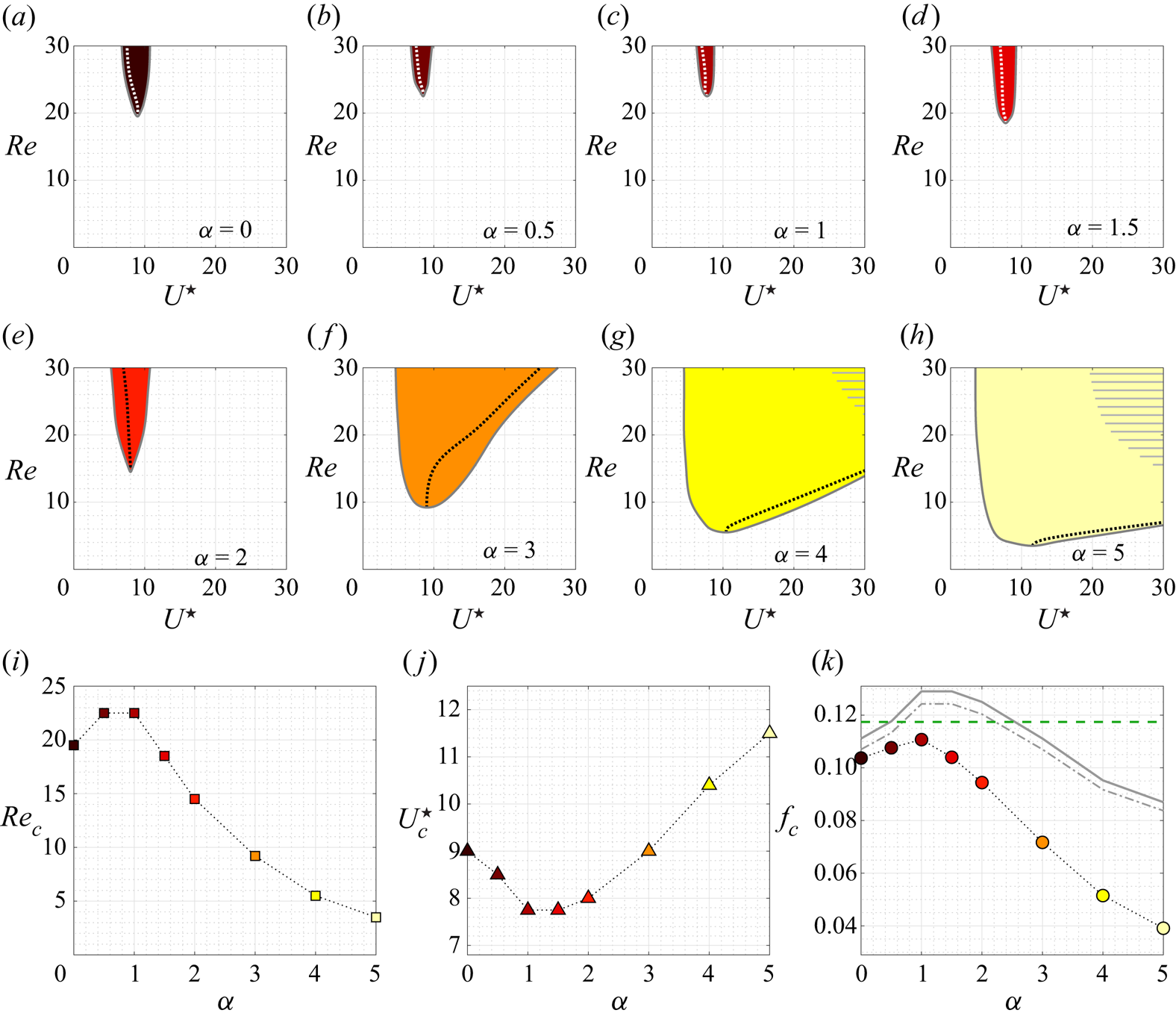
The lowest value of Re where vibrations arise ( $Re_c$) and the corresponding value of $U^\star$ ( $U^\star _c$) are plotted as functions of $\alpha$ in figure 3(i, j); $Re_c$ is the critical Re in the elastically mounted body case. It is recalled that the term ‘subcritical’ employed in this paper refers to the critical Re for flow unsteadiness in the fixed body case ( $Re^{\,f}_c=47$). From a value close to $20$ in the absence of rotation, also reported in prior works (e.g. Mittal & Singh Reference Mittal and Singh2005), $Re_c$ is found to increase slightly for low $\alpha$ and then decrease down to approximately $4$ for $\alpha =5$. As shown in figure 3(k), the CF oscillation frequency at the onset of vibrations ( $f_c$), which coincides with the flow unsteadiness frequency as discussed in § 3.3, globally follows the trend of the natural frequency in vacuum ( $1/U^\star _c$, grey full line) but remains lower. It also departs from the natural frequency modified by considering the potential added-mass coefficient $C_m=1$ (i.e. $\sqrt {m/(m+C_m{\rm \pi} /4)}/U^\star _c$, grey dash-dotted line). The frequency may substantially deviate from that observed in the wake of a fixed cylinder at $Re^{\,f}_c$ (green dashed line; Cossu & Morino Reference Cossu and Morino2000).
3.2. Vibration properties
The vibration amplitudes are examined in figure 4(a–h), which represents the maximum fluctuation of the CF displacement about its time-averaged value, as a function of  $U^\star$ over a range of Re. Each panel corresponds to a given rotation rate, $\alpha \in [0,5]$. For the non-rotating body, the gradual amplification of the bell-shaped curve, typical of VIV, as Re is increased, is accompanied by a shift of the peak amplitude towards lower $U^\star$ values. This is the onset of a trend that persists beyond the subcritical-Re range, as illustrated by the results reported at $Re=100$ in a prior work (blue dashed line; Bourguet Reference Bourguet2020a). The rotation modulates the width and magnitude of the amplitude bell-shaped curve, but its regular evolution with Re remains comparable for each $\alpha$, up to $\alpha =2$. In particular, the shift of the peak amplitude towards lower $U^\star$ values can be visualized in figure 3(a–e) (dotted lines). The influence of the rotation is more pronounced for higher $\alpha$: the $U^\star$ values associated with the peak amplitude and upper boundary of the vibration region are found to increase rapidly with Re, and exceed the limit of the parameter space under study, as also depicted in figure 3(f–h). Such behaviour was previously identified at supercritical Re and the responses were named galloping-like, in reference to the seemingly unbounded growth of their amplitudes with $U^\star$; a typical case is plotted in figure 4(h) ( $Re=100$, blue dashed line). The present results show that these large-amplitude oscillations may arise in the subcritical-Re range, close to the onset of vibrations, e.g. amplitudes larger than $10D$ are observed at $Re=10$ for $\alpha =5$. Additional simulations indicate that this phenomenon persists when a low level of structural damping is introduced (up to $\xi =5\,\%$) and $m$ is varied between $5$ and $20$.
$20$.
(a–h) CF vibration amplitude as a function of  $U^\star$, over a range of Re, for $\alpha \in [0,5]$; the $\alpha$ value is specified in each panel. The amplitudes previously reported at $Re=100$ (Bourguet Reference Bourguet2020a) are represented by blue dashed lines in panels (a) and (h). In panels (g) and (h), green arrows indicate the irregular evolutions associated with vortex fragmentation. (i) Ratio of IL and CF vibration amplitudes as a function of $U^\star$, for all studied cases where vibrations develop; the $\alpha$ value is indicated by symbol shape and the Re value by its colour. The grey dotted arrow denotes the trend observed when $\alpha$ is increased.

The ratio between the IL and CF vibration amplitudes is considerably impacted by the rotation, as shown in figure 4(i), where this ratio is plotted for all vibrating body cases as a function of  $U^\star$. Compared to the influence of $\alpha$, the effect of Re is found to remain marginal within the subcritical range examined here. In the absence of rotation, the IL responses are very small compared to the CF ones, as also noted in prior studies concerning subcritical-Re VIV (Mittal & Singh Reference Mittal and Singh2005). As indicated by the grey dotted arrow in figure 4(i), the amplitude ratio increases sharply with $\alpha$ and it reaches approximately $1.5$ in the high- $U^\star$ range.
The vibrations are periodic and dominated by a single frequency in each direction,  $f_x$ and $f_y$. The CF vibration frequency normalized by the natural frequency in vacuum, $f^\star =f_y/f_n$, is plotted as a function of $U^\star$ in figure 5(a). Three elements can be noted. First, the vibration frequency remains lower than $f_n$. Second, $f^\star$ globally decreases as $\alpha$ is increased (grey dotted arrow); it reaches very low values for high $\alpha$, especially compared to the critical frequency in the wake of a fixed cylinder (green dashed line). Third, the evolution of $f^\star$ with $U^\star$ at a given $\alpha$ progressively shifts from increasing trends in the low- $\alpha$ range to decreasing trends for higher $\alpha$. The present subcritical-Re vibrations generally exhibit lower frequencies than the responses encountered at higher Re. However, the proximity of the above properties (second and third points) with those reported at $Re=100$ (Bourguet Reference Bourguet2020a) emphasizes the continuity of the system behaviour between the subcritical- and supercritical-Re ranges.
(a) CF vibration frequency normalized by  $f_n$ and (b) IL/CF vibration phase difference as functions of $U^\star$, over a range of Re, for $\alpha \in [0,5]$; the $\alpha$ value is indicated by symbol shape and the Re value by its colour. In panel (a), the green dashed line denotes the critical frequency of flow unsteadiness in the fixed cylinder case (Cossu & Morino Reference Cossu and Morino2000), normalized by $f_n$, and the grey dotted arrow represents the trend observed when $\alpha$ is increased. In panel (b), the IL/CF vibration frequency ratio is specified and three typical trajectories are depicted (not at scale); green dotted arrows indicate the direction of motion.

The rotation breaks the CF symmetry of the system, which induces a switch of  $f_x/f_y$ from $2$ to $1$, and a transition from figure-of-eight trajectories of the body to elliptical orbits. The shape and orientation of the trajectory is determined by the phase difference, $\varPhi _{xy}=\phi _x-n\phi _y$, where $\phi _x$ and $\phi _y$ are the IL and CF response phases ( $n=1$ except for $\alpha =0$, where $n=2$). The evolution of $\varPhi _{xy}$ is represented in figure 5(b), along with typical trajectories. For $\alpha =0$, $\varPhi _{xy}$ varies between $0^\circ$ and $45^\circ$: the figure-of-eight trajectories are close to a crescent bent downstream and the body moves upstream when reaching CF oscillation maxima. Similar orbits were noted for subcritical-Re VIV of flexible cylinders (Bourguet Reference Bourguet2020b). Once the body rotates, $\varPhi _{xy}$ ranges from $180^\circ$ to $270^\circ$, and converges close to the latter value for high $\alpha$: the cylinder describes clockwise elliptical orbits, i.e. counter-rotating relative to the forced rotation.
3.3. Flow–body synchronization and wake patterns
The emergence of large-amplitude, galloping-like vibrations (e.g. figure 4h) raises the question of the synchronization with the flow, since galloping oscillations do not usually involve such a lock-in condition. It appears that the frequency of flow unsteadiness (determined from time series of the CF component of flow velocity in the wake) always coincides with the vibration frequency ( $f_y$). Flow–body synchronization is thus established in all cases. The persistence of lock-in and the fact that a quasi-steady approach, similar to that described in Bourguet (Reference Bourguet2020a), fails to predict the responses suggests that the interaction with flow unsteadiness plays a role in sustaining body motion, even if the vibrations resemble galloping oscillations.
In contrast with the fragmented multi-vortex patterns reported at higher Re (e.g. Munir et al. Reference Munir, Zhao, Wu and Tong2021), the present wakes are composed of a pair of counter-rotating vortices formed per oscillation cycle over most of the vibration regions, including for large response amplitudes (figure 6a–c). The antisymmetric organization observed for  $\alpha =0$ (figure 1b) is significantly distorted and the vortical structures may reach very large scales. Vortex fragmentation occurs close to the upper edge of the $({Re},U^\star )$ domain for high $\alpha$ (horizontally striped areas in figure 3g,h), as illustrated in figure 6(d). The transition between fragmented patterns, typically the addition/subtraction of one vortex per cycle as $U^\star$ is varied, is associated with irregular evolutions of vibration amplitudes (green arrows in figure 4g,h).
Instantaneous isocontours of spanwise vorticity for (a)  $({Re},\alpha,U^\star )=(25,2,8)$ ( $\omega _z\in [-0.3,0.3]$), (b) $({Re},\alpha,U^\star )=(5,5,12)$ ( $\omega _z\in [-0.03,0.03]$), (c) $({Re},\alpha,U^\star )=(10,5,25)$ ( $\omega _z\in [-0.03,0.03]$) and (d) $({Re},\alpha,U^\star )=(25,5,25)$ ( $\omega _z\in [-0.05,0.05]$). Positive/negative vorticity values are plotted in red/blue. The trajectory of the cylinder centre is indicated by a black line. Part of the computational domain is shown.

3.4. Fluid forces
The vibrations are accompanied by the appearance of fluctuations of fluid forces and by a modulation of their time-averaged values (denoted by a bar  $\bar {\phantom {a}}\,$). For example, $\bar {C}_x$, which is slightly negative in the absence of vibration for $\alpha =5$ at $Re=15$, is amplified up to $3.4$. Special attention is paid to the alteration of the Magnus effect, i.e. the CF force induced by the rotation. No major modification of $\bar {C}_y$ is observed for low $\alpha$. For each $\alpha >1$, $\bar {C}_y$ is found to increase consistently with the time-averaged magnitude of the relative flow velocity seen by the moving body, defined as $\boldsymbol {V}=\{1-\dot {\zeta }_x,-\dot {\zeta }_y\}^{\rm T}$. This trend can be visualized in figure 7(a). The values of $C_y$ for a rigidly mounted cylinder are indicated by green areas. As shown in figure 7(b), a normalization of $\alpha$ by the time-averaged magnitude of the relative velocity tends to collapse $\bar {C}_y$ values close to those measured in the absence of vibration (green area; the grey dashed line denotes the potential flow value, $C_y=-2{\rm \pi} \alpha$, for comparison). A reasonable estimate of $\bar {C}_y$ can thus be obtained based on the only knowledge of body dynamics. The above collapse does not persist at higher Re (e.g. $Re=100$); some deviations can already be noted at $Re\geqslant 25$. It appears to be a specific property of the low, subcritical-Re range.
Time-averaged CF force coefficient as a function of (a) the time-averaged magnitude of the relative flow velocity seen by the body and (b)  $\alpha$ normalized by the time-averaged magnitude of the relative flow velocity, over a range of Re, for $\alpha \in [0,5]$; the $\alpha$ value is indicated by symbol shape and the Re value by its colour. The green areas encompass $C_y$ values for a rigidly mounted body, over the range of Re investigated. In panel (b), the grey dashed line represents the potential flow value ( $C_y=-2{\rm \pi} \alpha$).

Another typical property relates to force–displacement phasing. For periodic vibrations without structural damping, the system may exhibit two possible states where the force is either in phase with the displacement, when  $f_{\{x,y\}}< f_n$, or in phase opposition, when $f_{\{x,y\}}>f_n$. While both phasing states are usually encountered at higher Re once the body rotates (i.e. $f_x=f_y$; Bourguet Reference Bourguet2020a), here, only the former state is observed.
4. Conclusions
The subcritical-Re FIV of a cylinder subjected to a forced rotation have been investigated numerically for  $Re\leqslant 30$, over wide ranges of $\alpha$ and $U^\star$ values. Compared to the non-rotating body case, the region of the $({Re},U^\star )$ domain where vibrations and flow unsteadiness occur shrinks for low rotation rates and then expands for higher $\alpha$. From a value close to $20$ in the absence of rotation, the Re associated with the onset of vibrations is found to decrease down to approximately $4$ for $\alpha =5$.
Under forced rotation, the vibration amplitudes are comparable in both directions, and even larger in the IL direction than in the CF direction for high  $U^\star$, which contrasts with the non-rotating body case. The typical trajectory of the rotating cylinder is an elliptical orbit, oriented in the opposite direction relative to the forced rotation, with a frequency lower than $f_n$. Up to $\alpha =2$, the bell-shaped curves of vibration amplitudes versus $U^\star$, typical of VIV, are modulated by the rotation but their regular growth with Re remains analogous to that reported for $\alpha =0$. The impact of the rotation on the scenario of vibration growth with Re is more pronounced for $\alpha >2$: while the upper $U^\star$ boundary of the vibration region rapidly increases with Re, vibration amplitudes seem to grow unboundedly with $U^\star$ and their frequencies reach very low values. These galloping-like responses, previously identified at higher Re, thus arise in the subcritical-Re range, close to the onset of vibrations. For example, amplitudes larger than $10$ diameters are encountered at $Re=10$ for $\alpha =5$.
Body motion and flow unsteadiness are synchronized in all cases, regardless of vibration amplitudes. Except close to the upper edge of the  $(\textit {Re},U^\star )$ domain, where vortices tend to fragment, the wake is composed of a pair of counter-rotating and possibly very large vortices per oscillation cycle. The occurrence of FIV is accompanied by the appearance of fluid force fluctuations and by a modification of their time-averaged values. In particular, the alteration of the Magnus effect at subcritical Re is found to be closely connected to the relative flow velocity seen by the vibrating body.
To summarize, the influence of the rotation on the flow–structure system behaviour is not monotonic, but the most prominent effect uncovered here is a substantial enhancement of subcritical-Re FIV for high  $\alpha$. This enhancement is twofold: a considerable expansion of the vibration region, down to very low Re, and a major amplification of the structural responses, with the emergence of galloping-like oscillations.
Acknowledgements
This work was performed using HPC resources from CALMIP (grants 2021-P1248 and 2022-P1248).
Funding
This research received no specific grant from any funding agency, commercial or not-for-profit sectors.
Declaration of interests
The author reports no conflict of interest.


 Open access

