


Vitamin A deficiency remains a global public health problem. WHO recently reported that an estimated 190 million pre-school children are vitamin A deficient in low-income countries(1). Night blindness is one of the most common manifestations of vitamin A deficiency, which is associated with a number of adverse health conditions such as decreased immunity and increased mortality, especially from measles, diarrhoea and malaria(Reference West and Darnton-Hill2). Many developing countries utilize complementary and overlapping strategies to reduce vitamin A deficiency among children, as well as among other members of the population, including periodic high-dose vitamin A supplementation, fortification of foods with vitamin A and promotion of homestead food production.
In Bangladesh, it has been shown previously that locally produced fruit and vegetables rich in provitamin A provide a valuable source of maternal vitamin A intake, particularly in communities in which vitamin A-rich food is scarce(Reference Bloem, Huq and Gorstein3, Reference Talukder, Kiess and Huq4). In 2005, 65 % of households in rural Bangladesh had a traditional home garden, and only 21 % had no garden(5). In addition, it has been shown in South Africa that production of yellow and dark-green leafy vegetables through the initiation of home-gardening programmes significantly improved the vitamin A status of pre-school children(Reference Faber, Venter and Benade6, Reference Faber, Phungula and Venter7). In a national vitamin A survey of 24 000 households in Bangladesh in 1997, it was shown that possession of a home garden was associated with a more than twofold reduced odds of having night blindness, especially in mothers(Reference de Pee, Talukder and Bloem8). The advantage of having gardens is that even very poor and landless people can produce food, whether it be on small patches of rented homestead land, roof tops, in containers or on roadsides, and with limited economic resources(Reference de Pee, Talukder and Bloem8, Reference Miura, Kunii and Wakai9). Home gardens may represent a more sustainable solution compared with periodic high-dose vitamin A supplementation.
Although the role of universal distribution of vitamin A capsules in combating vitamin A deficiency in Bangladesh is well known(Reference Bloem, Hye and Wijnroks10), the importance of home garden ownership has been less well characterized. We hypothesized that, among children who did not receive vitamin A recently, the risk of night blindness is greater in households that do not have a home garden compared with those having a home garden. To address this hypothesis we characterized the relationship between household possession of a home garden and night blindness in children in rural Bangladesh in the context of receiving or not receiving vitamin A capsules.
Participants and methods
Data were collected from households that were selected by the Nutrition Surveillance Project (NSP) in Bangladesh from February 2001 through December 2005. The NSP was based on the conceptual framework of UNICEF on the causes of malnutrition(Reference de Pee and Bloem11), with the underlying principle of providing information to guide policies and programmes to improve nutrition in Bangladesh and other developing countries(Reference Mason, Habicht and Tabatabai12). The NSP was established by Helen Keller International and by the Institute of Public Health Nutrition (IPHN) of the Government of Bangladesh in 1989(Reference Bloem, Moench-Pfanner and Panagides13). The NSP was based on stratified multistage cluster sampling of households in sub-districts of administrative divisions of the country in rural areas and slum areas of large cities. For the purpose of the present analysis, only data from rural areas were considered. Rural data were collected from four sub-districts of each of the six divisions of Bangladesh – Barisal, Chittagong, Dhaka, Khulna, Rajshahi and Sylhet. Although Chittagong Hill Tracts is administratively under the Chittagong Division, the Hill Tracts were treated as a special sampling frame to provide data specifically for that area of the country for the purposes of the present analysis. Data were collected every 2 months by two-person field teams employed by the IPHN and various non-governmental organizations. Throughout the period of data collection, the sub-districts remained the same but new households were selected for every round of data collection. For each of the six divisions in each round, four sub-districts were randomly chosen. From each of the sub-districts fifteen mouza (administrative districts) were randomly selected, and from each mouza twenty-five households were systematically sampled. In total, during each round, data were collected from about 10 500 households. A structured coded questionnaire was used to record data on children aged 0–59 months, including anthropometric measurements, date of birth and sex. The mother of the child or any other adult member of the household was asked to provide information on the household's composition, maternal age, maternal education and weekly household expenditures, along with other socio-economic, environmental, sanitation and health indicators.
In the present study, families who had at least one child aged 12–59 months were included. Families were excluded if there was only one child <12 months of age, because night blindness is more difficult to assess in infants. Birth dates of the children were obtained from birth certificates or from other records. When not available, the birth dates were estimated using a calendar of local and national events and converted to the Gregorian calendar. In order to assess night blindness, data collectors used local terms such as ‘ratkana’, ‘naitan’, ‘lali andha’, ‘aloandhari’, etc. They were also asked to mention symptoms of this problem to verify whether night blindness was a familiar term in the area. This was used as a clinical indicator of vitamin A deficiency. Children who also had trouble seeing during the daytime were excluded. A history of night blindness has been shown to be a reliable indicator of vitamin A deficiency, given that a high proportion of children reporting night blindness have low serum retinol levels also(Reference Sommer, Hussaini and Muhilal14). In households with more than one child having night blindness, only the youngest was included (i.e. households were not counted more than once). Families that were defined as having a home garden in the last 12 months were those who reported having a traditional garden, improved garden or a developed garden in the last 12 months. Traditional gardens typically grow seasonal gourd-type vegetables in scattered plots, whereas improved gardens are those that grow seasonal vegetables in fixed plots. Developed gardens grow a wide variety of fruit and vegetables (usually more than six varieties) throughout the year.
The participation rate of families in the surveillance system was >97 % and the main reason for non-response was that the family had moved out of the area or was absent at the time of interviews. Non-response because of refusal to participate in the surveillance system was very low (<1 %).
The study protocol complied with the principles enunciated in the Helsinki Declaration(15). The field teams were instructed to explain the purpose of the NSP and data collection to each child's mother or caregiver, and, if present, to the father and/or household head; data collection proceeded only after written informed consent was obtained. Participation was voluntary and all participants were free to withdraw at any stage of the interview. The protocol was approved by the Ethical Review Committee of the Bangladesh Medical Research Council, and the plan for secondary data analysis was approved by the Institutional Review Board of the Johns Hopkins School of Medicine.
Categorical variables were compared using the χ 2 test. Separate multivariable models were used to examine the relationship between the family having a home garden in the last 12 months and night blindness in children, stratified by the child's receipt of vitamin A supplementation in the last 6 months. Variables that were significantly associated with night blindness in children were included in the respective, final multivariable models. Population-based weighting was used in all analyses to account for differences in population size among the various divisions. The level of significance in the present study was P < 0·05.
Results
Of 158 898 children aged 12–59 months in rural Bangladesh, 45 606 (29 %) did not receive vitamin A capsules in the last 6 months. Among children who did and did not receive vitamin A capsules in the last 6 months, the proportions of those with night blindness were 0·07 % and 0·13 %, respectively. The demographic characteristics of households with and without night blindness in children are shown in Table 1. Households with mothers who were less educated, had younger children, had a lower weekly per capita household expenditure and did not have a home garden were more likely to have a child with night blindness. The prevalence of night blindness was highest in Barisal and Rajshahi and lowest in Dhaka and Chittagong divisions.
Risk factors for night blindness in children aged 12–59 months from families in rural Bangladesh
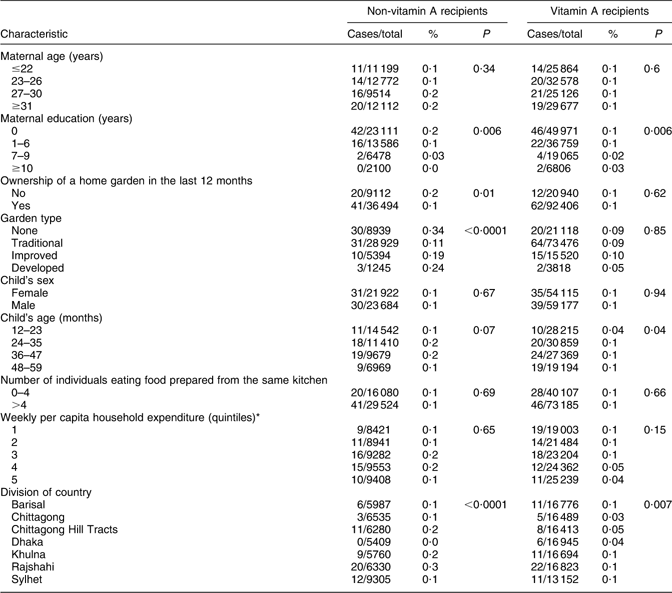
*Quintile 1 (the reference quintile) is the lowest and quintile 5 is the highest.
Multivariable models are shown for the relationship between having a home garden and night blindness in children, stratified by receipt of vitamin A supplementation in the last 6 months (Table 2). Among children who did not receive vitamin A, the lack of ownership of a home garden was related to night blindness in a multivariable logistic regression model adjusting for maternal education, child's age, weekly per capita household expenditure, location, season of data collection, height-for-age Z-score, diarrhoeal morbidity and breast-feeding status. The relationship between having a home garden and night blindness in children was not significant among children who received vitamin A supplementation in the last 6 months. Additional multivariable models were performed to examine the relationship between garden type and night blindness in children, stratified by receipt of vitamin A supplementation in the last 6 months, adjusting for potential confounders. Among children who did not receive vitamin A, the risk of having night blindness with a traditional, improved and developed garden compared with no garden was: OR = 0·30 (95 % CI 0·16, 0·60; P = 0·0002); OR = 0·43 (95 % CI 0·19, 0·99; P = 0·05); and OR = 0·35 (95 % CI 0·11, 1·16; P = 0·09), respectively. Among children who received vitamin A, the risk of having night blindness with a traditional, improved and developed garden compared with no garden was: OR = 0·72 (95 % CI 0·39, 1·32; P = 0·29); OR = 0·97 (95 % CI 0·42, 2·25; P = 0·94); and OR = 1·01 (95 % CI 0·23, 4·54; P = 0·98), respectively.
Separate multivariable models for the relationship of ownership of a home garden in the last 12 months with night blindness in children with and without vitamin A coverage in the last 6 monthsFootnote *

* Separate multivariable models are each adjusted for maternal education, child's age, weekly per capita household expenditure, location, height-for-age Z-score, season, diarrhoeal morbidity and breast-feeding status.
Discussion
The present study shows that the odds of night blindness among pre-school children who had not received vitamin A capsules were higher when the household did not have a home garden. Conversely, no significant relationship was found between having a home garden and night blindness among children who received high-dose vitamin A capsules in the last 6 months.
These findings suggest that home gardens provide added protection against clinical vitamin A deficiency among children who miss vitamin A supplementation through the national vitamin A supplementation programme. The health benefits of homestead food production include those from direct consumption of foods that are good sources of vitamin A, either produced in the garden directly or acquired with income generated from selling some of the garden's produce, or through reduced morbidity created indirectly by the garden's produce, such as better health care, education, housing or clothes(Reference de Pee, Talukder and Bloem8). In addition, since homestead food production is traditionally a woman's task, it can lead to empowerment of women, which can result in an increase in the household's expenditure on food and health care(Reference Bushamuka, de Pee and Talukder16). Home gardens had no apparent protective effect against night blindness in children who received vitamin A capsules, which suggests that the capsules already provided sufficient vitamin A to prevent night blindness. Because the vitamin A capsule supplementation programme does not have 100 % coverage and relies on government's goodwill and financial support, the combination of home gardens and vitamin A capsule coverage is important for children and may be more sustainable(Reference Moskow17). As this concept has been shown only in urban settings, there is a need for further substantiation in rural environments. The home garden also provides vitamin A to other household members. To provide adequate amounts of vitamin A, however, animal sources of vitamin A and fortified foods are also required because of increased bioavailability and bioconversion(Reference de Pee, Talukder and Bloem8).
Traditional gardens appear to confer the best protection from night blindness to children when compared with other types of gardens and no garden at all. Although one would expect the improved garden to be associated with the best protection, it is possible that there was limited power to consider this relationship since it had the smallest sample size.
The prevalence of night blindness was lower among children who received vitamin A capsules in the last 6 months. This observation is consistent with previous studies that showed that vitamin A supplementation of 60 mg every 4–6 months reduces the appearance of new cases of xerophthalmia among pre-school children by 60–90 %(Reference Sinha and Bang18–Reference Katz, West and Khatry21). Moreover, the prevalence of night blindness among children who did not receive vitamin A supplementation in the last 6 months was 0·13 %, which is lower than previous estimates. For example, in 1982–1983 the prevalence of night blindness in children was 3·6 % in rural settings and 2·8 % in urban settings(Reference Cohen, Rahman and Sprague22). This could be due to a number of factors. Over the past 20 years, there has been increasing coverage of the vitamin A capsule distribution project and improvements in overall socio-economic status. Thus, even those children who had not received vitamin A in the last 6 months could have received vitamin A in previous rounds. This would lead to an underestimation in the prevalence of the condition and could mean that the present risk estimates for the benefit of a home garden are potentially larger than reported, making the current estimates of risk conservative.
The analyses adjusted for factors that have previously been associated with night blindness in children (i.e. lower maternal education, younger children and location) and also for differences in socio-economic status using weekly per capita household expenditure. The association between the family having a home garden in the last 12 months and night blindness in children was strong among children without vitamin A supplementation even after adjusting for these factors. The strengths of the present study include the large sample size and a relatively extensive database pertaining to demographic and socio-economic indicators.
The present study has some limitations. The data from the NSP are cross-sectional. There could be unmeasured changes over time between ownership of a home garden at the time the data were collected and the conditions that originally led to the development of night blindness in children. In an attempt to overcome this limitation, however, ownership of a home garden in the last 12 months was chosen as the independent variable rather than current ownership of a garden, even though both were available in the NSP questionnaire. Further, the gap between production and consumption of the products grown from home gardens is unknown. This information will be valuable in future studies in order to design policy more specifically. Finally, although Bangladesh is fairly representative of a rural economy in South Asia, findings from the present study cannot necessarily be extrapolated to other countries. Future studies are needed to corroborate these findings in other settings in developing countries.
In conclusion, the presence of a home garden reduced the risk of night blindness among pre-school children, but only among those who did not receive vitamin A supplementation.
Acknowledgements
The present paper was supported by a writing workshop at Kappel-am-Albis, Switzerland, funded by Sight and Life, the humanitarian initiative of DSM. R.D.S. was funded in part by a Lew Wasserman Merit Award from Research to Prevent Blindness. The authors have no conflict of interest to declare. R.D.S., S.D.P. and M.W.B. conceived the topic; K.S. analysed the data; M.W.B. conducted data collection in Bangladesh; and K.K. and R.D.S. were involved in sourcing of funds for the study. All authors contributed to the writing of the manuscript.



