




1 Introduction
Whether a syllable of a word is stressed or not is typically governed either by its position in the word or by its weight. For example, we observe languages with stress on the first or last syllable of every word, or on the penultimate syllable of every word. If patterns are weight-sensitive, heavy syllables may attract stress (Hayes Reference Hayes1980, Reference Hayes1995, Gordon Reference Gordon, Hayes, Kirchner and Steriade2004, Kager Reference Kager2005, Goedemans & van der Hulst Reference Goedemans, van der Hulst, Everaert, Musgrave and Dimitriadis2009 and many others). Beyond determining a syllable's status as heavy or light, the segments in a word tend not to have an effect. For example, there are no stress rules which determine that syllables with a back vowel attract stress, or that words beginning with a coronal exhibit initial stress. Patterns in which segment quality affects stress are vanishingly rare, and when they exist it is because the segment quality has a direct effect on the weight of the syllable – syllables with low vowels being a little heavier than those with high vowels, for example (Kenstowicz Reference Kenstowicz1997, de Lacy Reference de Lacy2004). In this paper, I provide experimental evidence for an otherwise unattested pattern in which segment quality affects stress placement, but not via weight. In English, the quality of the vowel in a word's final syllable probabilistically affects the placement of stress in that word. In addition to being typologically unattested, this pattern is both structurally complex and phonetically unmotivated (see Hayes et al. Reference Hayes, Zuraw, Siptár and Londe2009, Becker et al. Reference Becker, Ketrez and Nevins2011, Moreton & Pater Reference Moreton and Pater2011), and cannot easily be captured using typical typologically motivated stress constraints. Although learners appear to be quite liberal in incorporating statistical generalisations from their lexicon in their phonological grammar (Hayes et al. Reference Hayes, Zuraw, Siptár and Londe2009 and subsequent research), one would expect English learners not to learn this pattern. It would be a good candidate for what Becker et al. call a ‘surfeit of the stimulus’ effect: a statistical generalisation exists in the lexicon, but does not seem to be productively applied to novel forms. In this paper, however, I demonstrate experimentally that English speakers do have productive knowledge of this probabilistic final-vowel effect.
In English, words ending in a final [i], such as cannery, recipe and spaghetti, have a strong statistical tendency to take antepenultimate stress (so words like spaghetti, with antepenultimate stress, are quite rare). This tendency is strongest in morphologically complex words, due to the suffix -ity, which demands antepenultimate stress, and the suffixes -y and -ly, which both attach as stressless final syllables to shorter words, yielding antepenultimate stress in words like yellowy and carelessly. However, the tendency is also present, though it is slightly weaker, in morphologically simple words. I compare this generalisation to the well-known, nearly exceptionless and typologically predictable part of the ‘Latin Stress Rule’ in English, by which heavy penultimate syllables attract main stress. Speakers exhibit productive knowledge of both generalisations.
I discuss possible analyses of the ‘final-[i] generalisation’ within a constraint-based Maximum Entropy grammar (Goldwater & Johnson Reference Goldwater, Johnson, Spenader, Eriksson and Dahl2003, Hayes & Wilson Reference Hayes and Wilson2008). Since this pattern diverges sharply from typical stress generalisations across languages, it does not seem appropriate to propose a new universal constraint (or constraints). Rather, I take the view that learners can induce at least some constraints during learning, perhaps to model ‘crazy’ patterns in their language.The final-[i] generalisation, which cannot be modelled using universal constraints, is such a case. Two possible ‘induced’ constraints are considered, each fitting into a classic constraint-based analysis of the English stress system. First I consider a cloned version of the existing Non-finality constraint. Non-finFt[i] would assign violations exactly like regular Non-fin, but only to [i]-final words. I compare the behaviour of Non-finFt[i] to a more parochial constraint, which diverges more from typical stress constraints. This is Antepenult[i], which simply states explicitly that words ending in [i] should have antepenultimate main stress, and assigns a violation when they do not.
These two constraints make divergent predictions for words that both have a heavy penult and are [i]-final, but learners have very little direct evidence for the behaviour of words of this type, since they happen to be quite rare in the lexicon. Since both analyses are compatible with the data learners have been exposed to, discovering which they select is informative about the acquisition process: do learners prefer to clone existing constraints, or do they prefer parochial constraints like Antepenult[i]?
Experiment 1 tests the productivity of the ‘final-[i] generalisation’, showing that experimental participants do use it when choosing stress for novel words. Experiment 2 tests participants’ knowledge of the Latin Stress Rule, and its interaction with the final-[i] generalisation. This experiment confirms that English speakers do have productive knowledge of the Latin Stress Rule (as previously demonstrated by Domahs et al. Reference Domahs, Plag and Carroll2014 and Olejarczuk & Kapatsinski Reference Olejarczuk and Kapatsinski2018), and reveals how the Latin Stress Rule and the final-[i] generalisation interact in speakers’ grammars. The results of Experiment 2 are consistent with the use of the parochial constraint, but not with the cloned Non-fin constraint. This result suggests that learners may prefer to induce totally new constraints during acquisition, rather than cloning existing ones, and opens up many questions for future research.
2 The two stress generalisations
The stress system of English has a long and rich history as the object of phonologists’ interest. Comprehensive analyses are given in Chomsky & Halle (Reference Chomsky and Halle1968), Liberman & Prince (Reference Liberman and Prince1977), Hayes (Reference Hayes1980), Selkirk (Reference Selkirk1984), Halle & Vergnaud (Reference Halle and Vergnaud1987), Kager (Reference Kager1989), Burzio (Reference Burzio1994) and Alcántara (Reference Alcántara1998). Throughout, a few major themes arise. Main stress nearly always falls on one of the final three syllables of a word, and within that three-syllable window both heavy penultimate syllables and heavy final syllables can attract main stress. The morphological structure of a word is important. Some affixes shift stress to a particular position within the word (e.g. -ity demands antepenultimate main stress, as in eˈlastic ~ elaˈsticity; see Teschner & Whitley Reference Teschner and Stanley Whitley2004 for a comprehensive discussion of this), but the stress of a base is sometimes preserved in the derived form as a secondary stress (Pater Reference Pater2000, Collie Reference Collie2008, Zamma Reference Zamma2012). Part of speech classification can also affect stress placement, so that nouns prefer penultimate stress or antepenultimate stress, while verbs prefer final stress (Kelly & Bock Reference Kelly and Kathryn Bock1988, Sereno & Jongman Reference Sereno and Jongman1995, Sonderegger & Niyogi Reference Sonderegger, Niyogi and Yu2013). Stress clashes (two stressed syllables in a row) are not often found in English. They are rare in words, and avoided in experimental contexts (Kelly & Bock Reference Kelly and Kathryn Bock1988), and can also trigger stress retraction at the word and phrase levels (e.g. Prince Reference Prince1983, Tilsen Reference Tilsen, Fuchs, Weirich, Pape and Perrier2012, Henrich et al. Reference Henrich, Alter, Wiese and Domahs2014). For the most part, the complexities of the English stress system are beyond the scope of this paper. Rather, the focus will be on the effects of penultimate weight, as well as the behaviour of trisyllabic or longer words containing only light syllables. Another property of English stress that is agreed upon throughout the literature cited above is that lexical exceptions abound. Some generalisations have more exceptions than others: exceptions to the preference for nouns to take penultimate stress and verbs to take final stress are plentiful, while exceptions to the preference for words with heavy penultimate syllables to take penultimate main stress are rare. All accounts of the system have used some mechanism for marking exceptions. Chomsky & Halle (Reference Chomsky and Halle1968) and Burzio (Reference Burzio1994) attribute different stress patterns to different underlying forms; for example, the difference between the words ˈcinema and baˈnana, both nouns with only light syllables, might be that baˈnana is underlyingly /bananna/, with a geminate which is not realised, but does make the second syllable heavy. Other approaches use diacritics which determine the underlying weight of a syllable (Hayes Reference Hayes1980), or specify some syllable as extrametrical on a word-by-word basis (Selkirk Reference Selkirk1984).
How exceptions should be marked in the lexicon will not be dealt with in this paper. Rather, the inherently probabilistic nature of the English stress system will be modelled using a Maximum Entropy (MaxEnt) grammar. MaxEnt predicts probability distributions over possible stress patterns, rather than predicting one to be grammatical and others to be ungrammatical. As Experiments 1 and 2 demonstrate below, speakers’ application of stress rules to new words is also probabilistic, confirming that such a system is appropriate for modelling speakers’ grammars as well as the behaviour of existing words.
Two stress generalisations will be the focus of this paper. The first is the well-known Latin Stress Rule in (1) (Chomsky & Halle Reference Chomsky and Halle1968, Liberman & Prince Reference Liberman and Prince1977, Hayes Reference Hayes1980, Reference Hayes1982, Halle & Vergnaud Reference Halle and Vergnaud1987, Kager Reference Kager1989, Burzio Reference Burzio1994).
-
(1)


The Latin Stress Rule is typologically ‘natural’, in that it requires heavy syllables to be stressed, and can be modelled with alignment, feet and non-finality. It does have exceptions: words like ˈgalaxy violate the first clause, and words like vaˈnilla the second clause. However, the first clause has vanishingly few exceptions – around 4% of words with heavy penults are not stressed on the penult – while there are nearly as many exceptions to the second clause as words that obey it. Pater (Reference Pater1994) argues that antepenultimate and penultimate stress compete when the penultimate syllable is light, and that neither is clearly the rule or clearly the exception. In fact, it is precisely in these light-penult words that the second generalisation can be easily observed.
The second generalisation, the final-[i] generalisation, is analysed for the first time in this paper, but has its roots in earlier work on English stress. Words with final syllables containing [i l̩ ɹ̩] appear to be special in the English stress system. Liberman & Prince (Reference Liberman and Prince1977) and Hayes (Reference Hayes1982) point out that only words with these final segments can host pre-antepenultimate main stress in monomorphemic words like ˈcaterˌpillar, ˈparaˌdiddle and ˈalleˌgory. Similar words with a different final nucleus, such as *ˈalleˌgorin or *ˈalleˌgorow, do not exist.Footnote 1 In the statistical examination of the lexicon described below, I examine the effects of these three final vowels on stress placement more generally. All three exhibit a tendency to push stress leftwards in both long and shorter words, but the effect of final [i] is particularly strong, as formulated in (2).
-
(2)

Nearly all (95%) of [i]-final words which are long enough to take antepenultimate stress do. Words like ˈcannery are much more common than words like caˈnary. Words with other final nuclei, e.g. [ə m̩ n̩ oʊ], do not show the same effect, so that words like vaˈnilla are roughly as common as words like ˈcinema.
In §2.1 and §2.2, the lexicon of English in the form of the CMU pronouncing dictionary (Weide Reference Weide1994) is examined, in order to more precisely characterise the regularities in stress assignment across words. The Latin Stress Rule and the effects of final [i l̩ ɹ̩] are the focus of this examination. Stress on two-syllable words, secondary stress and the effects of affixation will largely be ignored.
This section concludes by outlining previous analyses of the Latin Stress Rule, and considering how the final-[i] generalisation could be incorporated. Two proposals will be considered, as outlined in §1 above. The ‘cloning’ approach uses Non-finFt[i], which assigns violations to forms with a final [i] that also violate Non-finFt (meaning that their final syllable is parsed into a foot). The ‘parochial constraint’ approach uses Antepenult[i], which does not refer to foot structure, but rather directly demands that [i]-final words take antepenultimate stress.
2.1 Setting up the dictionary search
The CMU pronouncing dictionary (Weide Reference Weide1994), together with the SubtlexUS corpus (Brysbaert & New Reference Brysbaert and New2009), was used to examine the distribution of stress in long words (three syllables and longer) of English. The CMU pronouncing dictionary is a dictionary of American English lexical items, and contains about 134,000 phonetically transcribed entries, with each vowel annotated for primary, secondary or no stress. Because it is so exhaustive, it contains a great many entries that have a low enough frequency not to be present in most adult native speaker vocabularies. In some cases, it has independent entries for forms with inflectional morphology (both banana and bananas, for example). English inflectional morphology does not affect a word's stress, so a better model of the stress rules of English would be obtained by looking only at base forms, excluding inflected forms like bananas. In order to avoid hyper low-frequency entries and entries with inflectional morphology, a ‘cleaned-up’ version of the dictionary was used, namely the input corpus for Hayes’ (Reference Hayes2012) phonotactic probability calculator. This input file contains 18,034 entries, all of which are frequent enough to be in the English CELEX database (Baayen et al. Reference Baayen, Piepenbrock and van Rijn1995). This dataset also excludes entries with inflectional morphology, and certain transcription ‘errors’ are corrected, such as the presence of multiple primary stresses on a single word. A series of scripts was then used to annotate this lexicon further. The first step was to automatically code for morphological complexity.
2.1.1 Morphology
All words were coded for morphological complexity. This paper is not directly concerned with the effects of affixation, but it is important to know that any observed effects of weight, length and especially final vowel are not merely due to the influence of a particular morpheme. Particular affixes in English can influence the stress pattern of a word, either by attracting stress or by behaving as extrametrical (Chomsky & Halle Reference Chomsky and Halle1968, Halle & Vergnaud Reference Halle and Vergnaud1987, Burzio Reference Burzio1994). Words were automatically coded for whether or not they were morphologically complex, using the spelling of the word as a proxy. For example, words ending in the orthographic sequence tion were considered to end in the -tion affix. The list of suffixes and prefixes in Teschner & Whitley (Reference Teschner and Stanley Whitley2004: ch. 2) was used.Footnote 2 This method of marking words was surprisingly successful, considering how simplistic it was. Table I shows the results of a test in which 100 words were sampled from each category (morphologically simple, morphologically complex) for three- and four-syllable words. A native English speaker (the author) then checked these randomly sampled words (400 total) and noted the number of incorrect categorisations in each sample. A summary of the accuracy of the categorisation method is also reported: the ‘F1’ statistic. F1 is calculated based on both ‘Precision’ (of words categorised as complex, how many actually are?) and ‘Recall’ (of words that are actually complex, how many are categorised that way?). F1 values range from 0 to 1, with values closer to 1 being better.
Categorisations made by the automatic algorithm for each sample of 100 words (400 in total). The F1 score, a measure of goodness of categorisation, is given for three-syllable and four-syllable words.

2.1.2 Weight
Whether the Latin Stress Rule is observed depends on whether the penultimate syllable is heavy. Chomsky & Halle (Reference Chomsky and Halle1968) and subsequent work on English stress defines ‘heavy’ penultimate syllables as syllables with either a long vowel or at least one coda consonant. The long-vowel condition is relatively straightforward, but the coda-consonant condition is less so, as we will see below. In the search of Weide (Reference Weide1994) presented below, the monophthongs [ɑ æ ʌ ə ɔ ɛ ɨ ɪ ʊ i u], as well as the syllabic consonants [l̩ ɹ̩ m̩ n̩ ŋ̩], are categorised as short vowels, and the diphthongs [eɪ aɪ oʊ aʊ oɪ] as long. Note that the classification of [i] and [u] as short differs from other researchers, in particular Olejarczuk & Kapatsinski (Reference Olejarczuk and Kapatsinski2018), who treat syllables containing [i] and [u] as heavy. I categorise such syllables as light here, both because in the dictionary search words with [i] and [u] in penultimate position patterned with light-penult words rather than with heavy-penult words, and because Carpenter (Reference Carpenter2010, Reference Carpenter2016) finds experimentally that [i] and [u] do not attract stress for English speakers.
I turn now to the coda-consonant condition. According to the Maximal Onset Principle (Kahn Reference Kahn1976), intervocalic consonants should be syllabified in such a way that as many consonants as possible are assigned to an onset rather than a coda. For example, in a word like tapestry, with three consonants between the final two vowels ([tæpəstɹi]), all three consonants would be assigned to the onset of the final syllable, and the penultimate syllable would be codaless, and therefore light: [tæ.pə.stɹi]. Any string of consonants which can legally begin a word in English can begin a syllable (for example, [stɹ] in the word string), but a sequence of consonants which cannot begin a word must be broken up across a coda and an onset. For example, in a word like galaxy [gæləksi], the penult is inescapably heavy: [k] must belong to the coda of the penultimate syllable, giving [gæ.lək.si], since [ks] cannot begin a word in English.
However, Kahn proposes that the Maximal Onset Principle can be violated in English in the case of stressed syllables – stressed syllables prefer to be heavy, and therefore attract consonants to their coda position. For example, a word like digestive would be syllabified as [ˌdai.ˈʤɛs.təv], rather than [ˌdai.ˈʤɛ.stəv] – the [s] is parsed as the coda of the stressed syllable [ʤɛs], which otherwise would be light. Given this possibility, it is unclear how words like tapestry should be characterised – because the penultimate syllable is unstressed, it is light, but if it were stressed it would be heavy. These words are classified below as having ambiguous weight – either light or heavy, depending on context.
A second source of weight ambiguity involves words containing syllables closed by the sonorants [l ɹ m n ŋ]. If such a syllable is stressed, the sonorant forms a coda, making the syllable heavy (e.g. consultant [kn̩.ˈsʌl.tn̩t]), but if the syllable is stressless, the vowel–sonorant sequence is not permitted, and the syllable becomes light, with the sonorant occupying the nucleus position (consultation [ˌkɑn.sl̩.ˈtei.ʃn̩]). Unlike the other sonorant consonants, [ɹ̩] can be stressed as a sonorant nucleus (e.g. compersion [km̩.ˈpɹ̩.ʒn̩]); however, it is still disallowed as a coda in a stressless syllable (*[ˈɛ.nəɹ.ʤi] is realised as [ˈɛ.nɹ̩.ʤi]). For this reason, syllables with a sonorant nucleus or coda are ambiguous with respect to weight, as long as the following syllable begins with at least one consonant. The penult of mystery [ˈmɪ.stɹ̩.i], would not be heavy even if the stress shifted, since the [ɹ] would become an onset rather than a coda: [mə.ˈstɛ.ɹi].
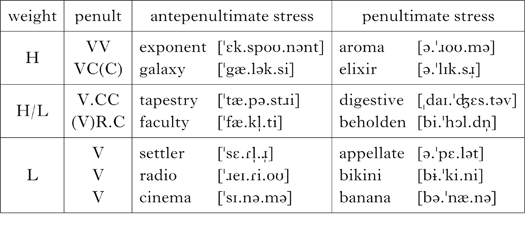
In the next section, the effect of the weight of the penult on the stress pattern of the whole word will be examined. Effects of the word's final vowel will also be considered, as well as the interaction between the final vowel and the weight of the penult. Five categories of penult weight will be specifically considered, with examples given in Table II: (i) penultimate syllables that are definitely heavy by virtue of having a long vowel (labelled VV), (ii) penults that are definitely heavy by virtue of having a coda consonant that cannot be resyllabified as an onset (labelled VC(C)), (iii) penults that are ambiguous because of consonants that can be syllabified as a coda or an onset, depending on stress (V.CC), (iv) penults that are ambiguous because of having a syllabic sonorant or a sonorant coda ((V)R.C) and (v) penults that are definitely light because they have a short vowel and lack any coda consonants or sonorants that could become a coda if the syllable were stressed (V).
Example words exhibiting different kinds of penultimate syllable weight. ‘R’ stands for any sonorant which can be syllabic, i.e. [l Ó m n N].
2.2 Corpus search results
A total of 6531 trisyllabic or longer words were found in Weide (Reference Weide1994). Main stress was almost always penultimate (2409 words) or antepenultimate (3520 words). A total of 168 words took final stress and 410 pre-antepenultimate stress, while a mere 24 words had main stress before the pre-antepenult (all morphologically complex, like anticipatory and professionalism). The remainder of this section will focus on describing the factors that condition the choice between penultimate and antepenultimate main stress. Unless otherwise noted, morphologically complex and morphologically simple words are both included in the counts – it will turn out that, for the trends described here, morphological complexity does not matter as much as might be imagined (see Olejarczuk & Kapatsinski Reference Olejarczuk and Kapatsinski2018 for a similar result.)
2.2.1 Weight
Figure 1 illustrates the effect of the weight of the penultimate syllable on stress placement. Of the trisyllabic and longer words with penultimate or antepenultimate stress, 3943 have definitely light penultimate syllables, and 1073 have definitely heavy penultimate syllables, with either a diphthong or at least one coda consonant. This leaves 913 ambiguous penults, of two types. The first have monophthongal vowels and no coda consonants, but are followed by a cluster whose first member could be ‘annexed’ as a coda if the penult were stressed. The second type contain a sonorant nucleus which could become a coda if stressed, or a sonorant coda which could become a nucleus if unstressed. Words with a definitely heavy penult take penultimate stress in around 95% of cases, regardless of whether it is the presence of a long vowel (VV) or one or more coda consonants (VC(C)) that makes the syllable heavy.Footnote 3 When the penult is definitely light (V), antepenultimate stress is the clear preference: penultimate stress appears in just 21% of cases. Penults with ambiguous weight fall between the definitely light and definitely heavy penults. Words with a short vowel followed by an onset cluster (V.CC) take penultimate main stress in about half of the cases, compared with 21% of light-penult words (χ 2 = 118.47, p < 1 × 10⁻²⁵), and 95–97% of heavy-penult words (χ 2 = 266.37, p < 1 × 10⁻²⁵). Words with a sonorant nucleus or coda ((V)R.C) take penultimate stress 65% of the time, still different from both light-penult words (χ 2 = 500.52, p < 1 × 10⁻²⁶) and heavy-penult words (χ 2 = 311.29, p < 1 × 10⁻²⁶), and also different from V.CC words (χ 2 = 15.72, p < 0.0001).
Effects of the five different types of penult weight on word stress (words of three syllables or more only).

Thus far, the basic conclusions of Pater (Reference Pater1994) seem to be correct: the first clause of the Latin Stress Rule (‘if a word's penultimate syllable is heavy, it takes penultimate main stress’) is nearly exceptionless, but the second clause (‘if the penultimate syllable is light, the word takes antepenultimate main stress’) exhibits a great many exceptions in the lexicon – 21% of all light penult words.
2.2.2 Final vowels
Figure 2 splits up words by the nucleus of their final syllable. Only a few nuclei appeared with appreciable frequency in the final syllable of words (whether it was open or closed). Syllabic nasals ([m̩ n̩ ŋ̩], but overwhelmingly [n̩]) are the most common (1736 words), followed by [ə] (1528), [i] (1080) and [l̩] (772).Footnote 4 Additionally, [eɪ] appears in 320 words, mostly with the suffix -ate, [ɹ̩] in 316, [aɪ] in 239 and [oʊ] in 161. (Note that these numbers are calculated over all trisyllabic and longer words, while Fig. 2 shows only those which have antepenultimate or penultimate main stress.) The remaining vowels of English all appear in the final syllables of fewer than 100 trisyllabic or longer words.
The effect of final nucleus on stress (words three syllables long and longer, with both light and heavy penults).

How common a particular stress pattern is depends on the word's final vowel. Words ending in schwa or a syllabic nasal prefer penultimate stress, although this preference is relatively weak, and these words exhibit a fairly flat distribution of stresses. Words that end in [i] or [l̩], however, strongly prefer antepenultimate stress.
Many [i l̩ ɹ̩ n̩]-final words in English are morphologically complex, containing a suffix which is stressless or which demands antepenultimate stress, e.g. -y (ˈyellow ~ ˈyellowy), -er (ˈyellow ~ ˈyellower), -ity (abˈsurd ~ abˈsurdity), -able (aˈvert ~ aˈvertable), -s/tion (conˈclude ~ conˈclusion). Figure 3 illustrates how the relationship between stress and final nucleus changes is different in morphologically simple and morphologically complex words, though recall from §2.1 that this classification is somewhat imprecise. Words with final [n̩] tend to take penultimate stress in morphologically complex words, but antepenultimate stress in morphologically simple words (χ 2 = 166.1). This difference reveals that the general preference for final [n̩] to take penultimate stress is probably because it tends to occur in suffixes that demand it, for example -s/tion in reˈpeat ~ repeˈtition. Complex final-[i] words exhibit a stronger preference for antepenultimate stress than simple words do (χ 2 = 29.6), though the preference for antepenultimate stress in the simple words is still very strong. Final [ə l̩ ɹ̩] seem to be more stable in their preferences across morphological complexity (χ 2 = 0.58, 2.21 and 5.36 respectively).
The effect of final nucleus on stress, with words classified as morphologically simple or complex.

2.2.3 Interaction between final nucleus and weight
We have seen that both the weight of the penult and the identity of the final nucleus affect a word's chances of taking penultimate or antepenultimate stress. How do these two factors interact? Figure 4 shows the effect of the final nucleus for each of the five weight categories discussed above. First, the middling probability of penultimate stress on words with ambiguous penults seen in Fig. 1 is an illusion. Once these words are split by final nucleus, it is clear that for most nuclei these penults prefer to be stressed. Second, words with final [i] prefer antepenultimate stress in every weight class, although there is very little data for words with heavy penults (just ten [i]-final words with VV penults, and six with VC(C) penults).
Final nucleus and penult weight interact to predict stress patterns.

The fact that non-[i]-final words with ambiguous penults overwhelmingly prefer penultimate stress suggests that the Latin Stress Rule ought to be formulated somewhat differently than in (1). In addition to a preference for heavy penults to be stressed, there appears also to be a preference for stressed penults to be heavy, such that penults which can only be light tend to be stressed less often than penults which can be heavy if stressed.
2.2.4 Summary
The weight of the penultimate syllable overwhelmingly affects stress placement in English. Heavy penults, and penults that can be heavy if they are stressed, strongly prefer to host the word's main stress, a tendency which has previously been shown to be productive by Domahs et al. (Reference Domahs, Plag and Carroll2014) and Olejarczuk & Kapatsinski (Reference Olejarczuk and Kapatsinski2018). The influence of the word's final vowel is a novel finding, however.Footnote 5 While the influence, especially of final [i], is robust across different types of penult weight and across morphologically complex and morphologically simple words, it is also somewhat unexpected. The content of a syllabic nucleus does not typically affect stress placement in the world's languages, and when it does it is the content of the stressed nucleus, as shown in Kenstowicz (Reference Kenstowicz1997).
Although previous discussion of the effects of final vowels in Liberman & Prince (Reference Liberman and Prince1977) and Hayes (Reference Hayes1982) suggests that final [i l̩ ɹ̩] should pattern together, this is not a strong tendency in the dictionary data. Instead, we see them patterning together in light-penult words, but not in ambiguous or heavy-penult words. A few other explanations of why final [i] might be special should be mentioned at this point, though they will be discussed in detail in §4.5 below. First, word-final [i], even when it is not clearly part of a suffix, may be parsed either as the suffix -y or as a pseudo-suffix of some kind. Second, final [i] may bear secondary stress, which would then push stress leftwards via stress clash. Finally, I will argue that learners are extremely good at noticing and encoding relatively arbitrary patterns evident in their lexicons. A proposal is made that learners are capable of inducing new, non-universal constraints to account for unusual patterns that they see, and two possibilities for how that induction could proceed are discussed.
The following section provides an analysis of the effects of weight and final vowel on stress in English, focusing on how the final-vowel effect could be acquired by learners. The effect of penult weight is analysed in Alcántara (Reference Alcántara1998) and Pater (Reference Pater2000), which will form the basis for the analysis below. That analysis will be transitioned to a probabilistic MaxEnt grammar, and two different possible analyses of the effects of the final vowel will be considered.
2.3 Constraint-based analyses of English stress
2.3.1 The Latin Stress Rule
Main stress in English is typically located within a three-syllable window at the right edge of the word. This is predicted by the joint action of the constraints in (3), an alignment constraint demanding that main stress be as close as possible to the right edge of the word, and a non-finality constraint demanding that the final syllable of a word be unfooted (Alcántara Reference Alcántara1998: 120–121, Pater Reference Pater2000: 240).
-
(3)

In the tableau in (4), candidates (e)–(g) have too many violations of Align-R, and are harmonically bounded by candidates (c) and (d).
-
(4)

Depending on the ranking of Non-finFt and Align-R, candidates (a)–(d) are all plausible surface candidates. Parses like (a) and (c), with a single-syllable foot, are only possible when that foot is heavy. This requirement is enforced by the FootBinarity constraint in (5).
-
(5)

In Hayes (Reference Hayes1995), English is analysed with moraic trochees, which can consist of a single heavy syllable (H́) or two light syllables (ĹL), but not a single light (*Ĺ) or a heavy plus a light (*ĹH, *H́L). FtBin penalises these disallowed foot shapes. Kager (Reference Kager1999) discusses several examples of stress patterns in other languages for which such a constraint is necessary.
If this constraint is sufficiently high-ranked, parses such as (4a, c, e) would only be allowed if the syllable bearing the foot were heavy, whereas parses like (b) and (d) would only be allowed if the two syllables in the foot were both light. LHL words could only be parsed with the penultimate syllable forming a foot, L(H́)L (cf. *(Ĺ)HL, *(ĹH)L). Words with only light syllables, such as those in the experiment, could only have penultimate stress with a right-aligned trochee, L(ĹL), as in (b), or antepenultimate stress, (ĹL)L, as in (d). Penultimate stress would be preferred when Align-R ⪢ Non-finFt, and antepenultimate stress when Non-finFt ⪢ Align-R.
These three constraints, Align-R, Non-finFt and FtBin, are already enough to analyse the Latin Stress Rule. Unlike stress–weight interactions in many languages, English seems to only care about the weight of a syllable when it is final or penultimate (see also Domahs et al. Reference Domahs, Plag and Carroll2014). The weight effects of the final syllable are not discussed here, but the interaction of these three constraints explains why it is the weight of the penult that matters in particular: with FtBin highly ranked, an LHL word can only be footed as L(H)L, since all other possible feet are either too large or too small. If the word has only light syllables, or if the word has more than one heavy syllable, the interaction of Align-R and Non-finFt ensures that the rightmost non-final foot will always be selected.
(6) illustrates the interaction of these three constraints. If the penultimate syllable is heavy, then a moraic trochee on the penultimate syllable will always be optimal, as the penult is perfectly placed to be aligned as far right as it can be without violating Non-finFt. If the penultimate syllable is light, antepenultimate main stress will always be optimal.
-
(6)

2.3.2 Making the grammar probabilistic
As Figure 1 above demonstrates, heavy penultimate syllables in English nearly always take main stress. The OT model in §2.3.1 predicts this. However, it makes an incorrect prediction for forms with a light penult, namely that they should always take antepenultimate stress. While there is a tendency towards antepenultimate stress for these forms in the lexicon, there is variation from word to word (Pater Reference Pater1994).
In order to model this variation, I use MaxEnt grammar (Goldwater & Johnson Reference Goldwater, Johnson, Spenader, Eriksson and Dahl2003, Hayes & Wilson Reference Hayes and Wilson2008), a version of Harmonic Grammar (Smolensky & Legendre Reference Smolensky and Legendre2006, Pater Reference Pater2009) which uses the logit transform to convert Harmony scores into a predicted probability distribution over candidates. MaxEnt grammar, like OT, uses violable constraints, but rather than the constraints being strictly ranked with respect to each other, they are assigned weights. Harmony scores (ℋ) are calculated by multiplying each weight by each violation and summing, as in (7a). Probabilities are then calculated by exponentiating this harmony score and summing over that exponentiated harmony score for all candidates, as in (7b).
-
(7)

(8) shows the same constraints as in (6), but now they are weighted instead of being ranked. In (8), some variation is introduced. Weights were fitted using the Excel Solver (Fylstra et al. Reference Fylstra, Lasdon, Watson and Waren1998, Harris Reference Harris1998) to the counts of each type of word observed in Weide (Reference Weide1994). The Excel Solver fits parameters for non-linear models using Conjugate Gradient Descent. The match could be improved with the addition of more constraints that are otherwise necessary for English stress, but are beyond the scope of this paper. However, the weights in (8) predict that all words with a light penult should prefer antepenultimate stress, while words with a heavy penult should prefer penultimate stress.
-
(8)

2.3.3 Final [i]
Patterns like the final-[i] generalisation are rare cross-linguistically. In fact, the case of English stress could plausibly be the only one.Footnote 6 For this reason, it seems ill-advised to propose a potentially universal constraint to account for the final-[i] generalisation – any such constraint would make the wrong prediction that other languages should exhibit similar patterns. Rather, this section starts with the assumption that at least some constraints are language-specific. Such constraints would presumably be induced during learning to account for unexplained patterns in the language data. It is of course possible that all constraints are induced, and none are truly universal, but serious discussion of this possibility is beyond the scope of this paper. The same holds for discussion of the mechanism for constraint induction (whether only some constraints are affected, or all). Rather, I will consider two potential general strategies that a learner could take: a conservative approach, building on constraints that are already in the grammar, and a more liberal approach, inducing totally new constraints. The two possibilities discussed here model the lexicon of English accurately, but make divergent predictions for a class of words underrepresented in the lexicon: words with both a heavy penult and a final [i].
A conservative approach to constraint induction would rely on constraints that already exist in the grammar, and would create minimally different versions of these constraints. The obvious choice for modelling the final-[i] generalisation would be to create a specialised version of Non-finFt. This could be achieved by ‘cloning’ Non-finFt during learning, and applying the cloned version to a smaller, arbitrary, class of words (Becker Reference Becker2009). Alternatively, to exactly the same end, a new constraint could be created by conjoining Non-finFt with a simple markedness constraint *[i]. The constraint arising from either of these processes would assign violations just to [i]-final forms which also violate Non-finFt. I formulate this constraint in (9).
-
(9)

Adding Non-finFt[i] to the tableau differentiates between LLL words that end in [i] and those that do not. Specifically, (10) shows the prediction that LLL words ending in [i] should take antepenultimate stress in 95% of cases, while LLL words not ending in [i] should take antepenultimate stress in just 70% of cases. However, Non-finFt[i] does not predict any effect for final [i] in heavy-penult words. Because the optimal output for LHL words is already a parse like L(H)L, which observes Non-finFt, adding additional pressure to observe Non-finFt[i] does not change the predicted probability. Even if the weight on Non-finFt[i] were extremely high, it would only serve to add even more probability to the penultimate-stressed LHLi forms. No weighting of these four constraints will predict that LHLi words should take less penultimate stress and more antepenultimate stress than their non-[i]-final counterparts. The weights in (10) were again found by running the Excel Solver, aimed at matching the numbers in the dictionary, though LHLi forms are so rare in the lexicon that they have very little effect on the resulting weights. The distribution of LHLi forms is shown in (10), but these percentages are calculated on the basis of just 16 forms. Percentages of other forms are based on between 700 and 2500 forms. While the Solver had all the data, including the 16 LHLi forms, to train on, because of the small number of these forms they had little effect on the final weights of the constraints. Weights changed by at most 0.2 when the LHLi forms were removed entirely from the training data.
-
(10)

If the final-[i] generalisation is represented in the minds of native speakers as a cloned version of Non-finFt, applying only to words ending in [i], then we would expect English speakers to prefer antepenultimate stress in LLL words, but not in LHL words. Rather, [i]-final LHL words should behave exactly like all other LHL words.
If learners are not especially conservative during constraint induction, and do not have pressure to work from existing constraints, we might expect a different strategy for enforcing stress on the antepenult in [i]-final words. The second possibility to be considered here is the parochial constraint in (11), Antepenult[i], which does not refer to foot structure at all, but simply demands that main stress be on the antepenultimate syllable on words that end in [i]. This constraint does not pattern with typical stress constraints. While it does refer to the right edge of the word, it ‘counts’, in that it identifies a specific syllable in the word, the antepenultimate. It also makes stress placement directly dependent on vowel quality, which is not typical of stress constraints. Finally, it does not ban a marked structure so much as demand that a particular surface structure hold. The idea here is that this constraint could be induced, given the actual data of English stress, but would not be available in any sort of universal constraint set.
-
(11)

The operation of Antepenult[i] is illustrated in (12). Weights are fitted to the numbers derived from the dictionary as discussed above. Like Non-finFt[i], Antepenult[i] fits the lexicon of English well. However, its predictions for LHLi forms diverge from those of Non-finFt[i]. While Non-finFt[i] predicts no effect of final [i] on stress in LHL words, Antepenult[i] predicts that LHLi words should exhibit more antepenultimate stress than non-[i]-final LHL words. In (12), LHLi forms are about 10% more likely to take antepenultimate stress than their non-[i]-final counterparts.
-
(12)

As (10) and (12) demonstrate, both Non-finFt[i] and Antepenult[i] can be used to model the distribution of stress patterns over [i]-final and non-[i]-final LLL and LHL words found in the lexicon of English. However, there are very few (just 16) [i]-final LHL words.Footnote 7 These 16 words do exhibit more antepenultimate stress – 31% – than the set of non-[i]-final LHL words in the lexicon, which take antepenultimate stress in just 1% of cases. This disparity suggests that LHLi words should be just as subject to the final-[i] generalisation as LLLi words, which would imply that the analysis with Antepenult[i] is preferable to the analysis with Non-finFt[i]. However, if learners have a strong preference for constraint cloning over induction of parochial constraints like Antepenult[i], it is entirely plausible that they would ignore the behaviour of these 16 forms.
In the rest of the paper, I present two experiments testing English speakers’ knowledge of the Latin Stress Rule and the final-[i] generalisation. Experiment 1 tests only LLL forms, comparing participants’ behaviour on [i]-final non-words to that on [ə]-final non-words. The results demonstrate that, despite its complexity and typological unusualness, English speakers do have productive knowledge of the final-[i] generalisation. They more often assign antepenultimate stress to [i]-final LLL non-words than to [ə]-final LLL non-words. Experiment 2 tests the interaction between the final-[i] generalisation and the Latin Stress Rule, focusing specifically on words with both a heavy penult and a final [i]. Results show that the English speakers more often assign antepenultimate stress to LHLi forms than to LHL forms not ending in [i]. This behaviour is consistent with the Antepenult[i] analysis, but not with the Non-finFt[i] analysis.
3 Experiment 1: final-vowel effects
3.1 Introduction
Both experiments in this paper were modelled on Guion et al. (Reference Guion, Clark, Harada and Wayland2003), in which the productivity of certain trends in the English stress system was tested by asking participants to pronounce novel English words. The challenge for a production task for the English stress system is that English orthography is non-transparent, and different participants may interpret a single orthographic string in many different ways. Vowels are especially difficult to represent unambiguously in English orthography, which is problematic because the quality of a vowel is one factor which can affect the stress of a word. On the other hand, it is difficult to present a novel word auditorily without giving it some stress pattern. Guion et al. solved this problem by presenting strings of individual syllables, each pronounced as a separate prosodic word, and asking participants to string the syllables together into a word. I adopt this methodology here.
While Guion et al. recorded participants’ productions in a lab setting, the present study was conducted online, using participants’ own computers to capture sound. This process was buggy, both because of the variation in the technical specifications of participants’ devices, and because participants in general performed the study with a great deal of background noise. To alleviate these concerns, participants were asked to ‘self-transcribe’ after their productions: they were presented with two stress options, and asked to choose the one that most closely matched their actual production. In this way, participants’ choices can be analysed directly, rather than their actual productions.
3.2 Methods
3.2.1 Participants
The experiment was presented online, and participants were recruited by word of mouth, and through Mechanical Turk (https://www.mturk.com/). Participants were asked their age, and only data from those reporting an age of 18 or over was kept. This final set of participants had an age range of 19 to 61 (mean 33). Only participants with IP addresses originating in the United States were accepted. Participants were asked where they were from, and ‘when you speak English, where do people think you are from?’. If their answer to the second question was a location within the United States, they were assumed to be a native speaker of American English. Participants were paid at a rate of $0.91 US for the experiment, which took about 20 minutes. Data was collected from a total of 104 participants, and data from 65 participants was used. The remaining participants were excluded because of problems with the sound recording and native speaker status. The process of excluding participants is described in detail in §3.3.
3.2.2 Items
Items were three syllables long, and consisted only of light syllables (i.e. codaless syllables with a monophthong). Both novel words and real words were used. Because participants were asked to pronounce a novel word after listening to three isolated syllables, real words were included in order to encourage participants to make their productions as much like real English words as possible – in particular to encourage them to reduce unstressed vowels in their productions. Real words used in the experiment were evenly divided between final vowels and stress patterns, and are shown in Table III.
Real words used in the experiment. Like the non-words, each was presented split into three single-syllable prosodic words, for example [æ][læ][skɅ] for Alaska.

Each item consisted of three auditorily presented individual syllables, and two auditorily presented versions of the full word, with different stress patterns (antepenultimate and penultimate). Participants first heard the syllables, then pronounced the word, then heard the two stress options and chose between them. An example item is shown in Fig. 5.
Example item in four stages. All presentation was auditory.

There were 32 novel words (80%) and 8 actual (20%) words. When they were actual words, the two stress choices were (i) the actual word, and (ii) an incorrectly stressed version of the actual word, e.g. [ˈkænədə] and [kəˈnædə] for Canada. All items (words and non-words) had the same stressed vowel in each stress version.
For the two stress versions of each item, the stimuli were transcribed in IPA and pronounced in a random order by a male native speaker of American English with IPA training, in the frame sentence ‘Say X again’. The words were then spliced out of the frame sentence.
Non-words were counterbalanced for their final vowel. Each item appeared sometimes with a final [i] and sometimes with a final [ə], e.g. [bæ] [mæ] [ki] and [bæ] [mæ] [kə], but no participant saw an item in both conditions. Two lists were made: in the first list, each non-word was randomly assigned a final vowel, such that half were [i] and half were [ə]. In the second list, each item appeared with the other final vowel. Participants were assigned one of the two lists at random. The lexical neighbourhood density of each non-word was measured using the Generalised Neighbourhood Model (Bailey & Hahn Reference Bailey and Hahn2001). All non-words used in the experiment had a generalised neighbourhood value of less than 0.01, corresponding to very sparse neighbourhoods.
The isolated syllables were constructed as follows. A female native speaker of American English (the author) read a list of individual syllables written in IPA. These recordings were then resynthesised in Praat (Boersma & Weenink Reference Boersma and Weenink2011), such that each vowel was approximately 400 ms long, and faded into silence over the final 100 ms. The pitch contour of the syllables was also resynthesised to be identical (a H* pitch accent followed by a L-L% boundary tone, shown in Fig. 6). The intensity of the syllables was also normalised.
Pitch contour for individual syllables presented to participants. All syllables were resynthesised to have this contour.

3.2.3 Procedure
The experiment was presented online, using software built on Experigen (Becker & Levine Reference Becker and Levine2013). When participants arrived at the site, they were first asked to electronically sign a consent form, and then completed a sound check to test that their microphone and speakers were working. They were instructed that they would hear a sequence of three syllables, and that they should speak the whole word fluently as if it were a real word. They were given an example non-word sequence of syllables and two examples of those syllables strung together into a pseudoword – one with antepenultimate stress and one with penultimate stress. Next, they were given a trial real-word sample (they were told in advance that it would be a real word). In each trial, they first heard the three syllables, were then asked to speak the word fluently, listened to the two stress options for that item and clicked a radio button to choose one. Items were counterbalanced in two lists, so that each item could appear with either final vowel, with each participant seeing each item only with one vowel. All participants saw an equal number of [i]-final and [ə]-final forms. Participants were randomly assigned to lists: 31 to List 1 and 34 to List 2. After finishing all trials, participants completed an exit questionnaire, in which they gave their age and native language. Items, recruitment and procedure were was approved by the Linguistics Human Subjects Review Board at the University of Massachusetts Amerst.
3.3 Results
Participants’ success in the production task was assessed in two parts. First, did they produce the syllables fluently together as a single word, with a single main stress? Second, did the stress they produced agree with the stress they reported producing? For each participant, ten (out of 32) non-word recordings were randomly selected. I listened to these, annotated whether the production had a single stressed syllable or not and transcribed the location of the main stress if it had one. Stress was transcribed based on vowel reduction and pitch. If a production had a full vowel in every syllable (e.g. [bæmækʌ]), or both of the first two syllables (e.g. [bæmækə]), it was classified as ‘incorrect’. Productions containing a pitch fall on any syllable but the last, or which had pauses between the syllables, were also classified as ‘incorrect’. A participant was excluded from analysis if more than three of the examined ten non-words were ‘incorrect’. In general, participants fell into two categories: one pronouncing all or almost all words incorrectly, and the other pronouncing all or almost all words correctly. Participants who did not successfully record any sound were also excluded. In total, 22 (out of 104) participants were excluded for these reasons. Two additional participants were excluded because their answers to the questionnaire indicated that they were not native speakers.
For the ‘correct’ productions, which followed the criterion of being a single prosodic unit in which at most one syllable bears main stress, participants’ accuracy at reporting their own stress pattern was assessed. For 65 participants, their choice of stress pattern in the forced-choice task agreed with my transcription of their produced stress at least nine times out of ten. Fifteen participants had less than 90% accuracy on the forced-choice task, and were therefore excluded from analysis, leaving data from 65 participants to be analysed. Finally, individual trials were excluded in which the participant did not listen to both stress options before responding. These constituted about 20% of trials, spread evenly across conditions: 260 in the [ə]-final condition, and 203 in the [i]-final condition. This left a total of 2202 trials.
Figure 7 shows the counts of each type of stress response for each type of final vowel. Overall, participants preferred antepenultimate stress for both [ə]-final non-words and [i]-final non-words, but this preference was slight in the [ə]-final case and relatively strong in the [i]-final case. The preference for antepenultimate stress in the [i]-final case does not match the extreme distribution found in the lexicon, but the overall pattern of schwa-final words exhibiting more penultimate stress than [i]-final words does reflect the lexical distribution.
Counts of stress choices for each final vowel in non-words.

A mixed-effects logistic regression was fitted to this data, with stress choice as the dependent variable, coded as 0 for antepenultimate stress and 1 for penultimate stress. Final vowel was the predictor, and random intercepts were included for both subjects and items. 1057 [ə]-final Negative coefficients indicate a preference for antepenultimate stress. There was a slight, but not significant, preference for antepenultimate stress over penultimate stress overall (Intercept = ―0.35, p = 0.059), and a stronger preference when the final vowel was [i] (β = ―1.18, p < 0.001).
3.4 Discussion
Overall, participants performed the task roughly in the manner expected. The majority of participants were able to fluently combine the syllables into a well-formed prosodic word. They generally produced the non-words with a single stress, either penultimate or antepenultimate, and did not volunteer final-stressed forms or forms with secondary stresses. This indicates that participants were following basic English stress phonology to perform the task: three-syllable English words rarely exhibit final stress, and secondary stresses appear primarily on heavy syllables, of which there were none in this experiment.
English speakers have implicit knowledge of the final-[i] generalisation, and modulate their produced stress patterns in accordance with it. They produce more antepenultimate stress when the word ends in [i], and relatively less antepenultimate stress when the word ends in [ə]. This indicates that participants internalised the generalisation observed in the English lexicon, that words with a final [i] prefer antepenultimate over penultimate stress.
Speakers did not match the lexicon perfectly, however. As can be seen in Fig. 7, they produced antepenultimate stress on [i]-final items in just 77% of cases, whereas in the lexicon [i]-final LLL words take antepenultimate stress in 95% of cases. The [ə]-final forms were much closer to the lexicon: 58% vs. 61%. This mismatch could arise for a number of reasons. First, speakers’ grammatical preference for antepenultimate stress in [i]-final forms could be somewhat less strong than would be motivated by the lexical statistics, either because learners prefer not to give high weights to more parochial constraints or because they attempt to match morphologically simple forms rather than complex ones (see Fig. 3). A second possibility is essentially an experimental artefact. Because participants were exposed to a consistent balanced set of antepenultimate and penultimate stresses throughout the experiment, they may have been more likely to produce lower-probability forms, in this case penultimate stress on [i]-final items (see Albright & Hayes Reference Albright and Hayes2003 for a similar finding). Importantly, if this is the correct explanation for participants’ data mismatch, it indicates that the probabilities of each stress type observed are not necessarily exactly those that a correct model of the phonological grammar would produce. The qualitative difference between [i]-final and [ə]-final items in the study does demand a grammatical explanation, but we cannot be sure at this point of the exact magnitude of difference between the types of words we should expect the grammar to produce.
One final concern arises. Are participants producing more antepenultimate stress on [i]-final items simply because they are parsing the final [i] as the suffix -y seen in ˈyellowy or ˈpillowy? This suffix is fairly productive, so perhaps participants are parsing, say, [bæ] [mæ] [ki] as the root [bæmək] (or [bəmæk]) plus the suffix -y. While there is no particular reason to believe that participants are doing this, it cannot be ruled out. As it turns out, Experiment 2 provides insight into this question, indicating that participants are not parsing the non-words morphologically, or at least that, if they are, this does not completely account for the difference between final [i] and final [ə].
If English speakers do have implicit knowledge of the final-[i] generalisation, how is the generalisation encoded in their grammar? Do speakers use a cloned version of Non-finFt, as discussed in §2.3.3 above? Or have they learned something like the more parochial constraint, Antepenult[i]? As discussed in §2.3.3, speakers’ behaviour on the LLL words of Experiment 1 cannot distinguish between these. These two constraints make different predictions about what should happen to [i]-final words with a heavy penultimate syllable. Non-finFt[i], which refers to foot structure, prefers stress on the antepenultimate syllable only in LLL words. Because of foot binarity, LLL words can only be footed as (LL)L, with antepenultimate stress, or L(LL), with penultimate stress. Non-finality prefers the former, as does Non-finFt[i], especially in words ending in [i]. On the other hand, LHL words can be footed as L(H)L, with stress on the heavy penult, but with the final syllable unfooted. Non-finFt[i] cannot exert a preference for antepenultimate stress in this case, because penultimate stress is already non-final.
4 Experiment 2: effects of penult weight
Experiment 2 examines the relationship between the Latin Stress Rule and the final-[i] generalisation in speakers’ knowledge. LLL and LHL words are tested, both with final [i] and with final [ə]. [i]-final LHL words are of particular interest: do they exhibit a preference for antepenultimate stress relative to their [ə]-final LHL counterparts? If so, this would constitute evidence against the Non-finFt[i] constraint, and for the parochial Antepenult[i] constraint, which ignores foot structure.
Experiment 2 used a similar methodology to Experiment 1. As in Experiment 1, items’ final vowel was manipulated (half were [i], half [ə]), but, additionally, the weight of the penultimate syllable of the items was manipulated.Footnote 8
4.1 Participants
Like Experiment 1, Experiment 2 was presented online, and participants were recruited through Mechanical Turk. All participants were over 18 years of age; the age range was 18 to 75 (mean 34). Exclusion criteria and pay were the same as for Experiment 1. Data was collected from a total of 101 participants, but a technical error caused a failure of sound recording for 34 of them. A further ten participants had recordings that were of such poor quality that they could not be assessed for transcription accuracy. As in Experiment 1, participants’ overall accuracy was assessed using ten out of 32 items from each participant. At this stage, 15 participants were excluded because they typically produced the items as multiple words with compound stress, or in some way other than as a fluent single word with a single stress. As in Experiment 1, participants fell into two categories, either producing all or nearly all items fluently with a single stress, or producing all or nearly all incorrectly. Finally, the remaining participants’ accuracy in transcribing their own stress patterns was assessed, and a total of four participants were excluded because they did not meet the accuracy threshold. After all exclusions (63 in total), data from just 38 participants was analysed. This is a very high exclusion rate, due mainly to the technical failure preventing recording for 30% of the participants. However, as we will see below, the study still had sufficient power to detect effects of both final vowel and penult weight.
4.2 Items
The non-word items from Experiment 1, all three syllables long and consisting of only light syllables, constituted the light-penult condition of the experiment. From each of these, a heavy-penult version was constructed by adding a coda to the penultimate syllable. Codas were chosen so that they did not form a legal onset cluster with the onset of the following syllable. Examples are given in Table IV.
Example item in four conditions.

Each item consisted of a written frame sentence, followed by the same item structure as in Experiment 1: three auditorily presented individual syllables, and two auditorily presented versions of the full word, with different stress patterns (antepenultimate and penultimate).Footnote 9 The same real words used in Experiment 1 were also included.
4.3 Procedure
The procedure was identical to that in Experiment 1, including the number of trials (32 non-words, 8 real words). Items were counterbalanced such that each final vowel × penult weight condition had equal representation (each participant saw eight items in each condition), and such that each item appeared in all four conditions across participants. Four lists were constructed, and participants were randomly assigned to them: eight to List 1, eleven to List 2, 16 to List 3 and only two to List 4. As in Experiment 1, items, recruitment and procedure were approved by the Linguistics Human Subjects Review Board at the University of Massachusetts Amherst.
4.4 Results
The 38 participants whose data was included in the analysis were all more than 75% accurate in reporting their produced stress. Participants did not always accurately produce a heavy penultimate syllable when one was present in the three-syllable prompt. In 18% of trials with codas on the penultimate syllable of the prompt, the participant left out the coda, producing a light penult instead. In 7% of trials with a light penult in the prompt, the participant produced a coda on the penult. Because of the relatively high level of mismatch between the prompts and participants’ productions, cases of mismatch were excluded from analysis (136 trials in total). Individual trials in which the participant did not listen to both stress options before responding were excluded. These constituted a smaller percentage of trials than in Experiment 1, a total of 24 (7 [ə]-final, L; 8 [ə]-final, H; 3 [i]-final, L; 6 [i]-final, H).
Participants preferred penultimate stress when the penult was heavy, and antepenultimate stress when it was light. In the lexicon, 95%–97% of words with a heavy penultimate syllable have penultimate main stress. Participants undermatched this distribution, producing penultimate stress on words with heavy penults in 75% of cases (though note that this number includes both [i]-final and [ə]-final items). This is illustrated in Fig. 8. Because participants erred more often on heavy penults than on light ones, there are more responses overall in the light-penult category.
Participants’ choice of stress patterns by weight.

As in Experiment 1, participants produced antepenultimate stress more when the final vowel was [i] than when it was [ə]. This effect was independent of the weight of the penultimate syllable – in both heavy and light conditions, [i]-final items were produced with more antepenultimate stress than [ə]-final items. This is illustrated in Fig. 9.
Participants’ choice of stress pattern for different final vowels, broken down by weight category. Regardless of the weight of the penult, participants prefer antepenultimate stress more for [i]-final items than for [ə]-final items.

The mixed-effects logistic regression in Table V was fitted with Final vowel and Penult weight and their interaction as fixed effects, and with random intercepts for participants and for items.Footnote 10
Logistic regression with two factors. Produced stress as a function of penult weight and final vowel.

Participants followed both the trend for [i]-final words to take antepenultimate stress and the trend for words with heavy penultimate syllables to take penultimate stress. The weight of the penultimate syllable had a stronger effect on stress placement than the final vowel (the magnitude of the coefficient on penult weight is about twice the magnitude of the coefficient on final vowel), but a heavy penult does not completely trump a final [i]. In fact, the two effects are statistically independent. The quality of the final vowel matters as much in the heavy-penult case as in the light-penult case.
4.5 Discussion
The results of Experiment 2 confirmed that participants have active knowledge of both the trend in the lexicon for heavy penults to be stressed (the Latin Stress Rule), and the trend for [i]-final words to take antepenultimate stress. There is very little information in the lexicon about how these two trends interact. In particular, very few words with a heavy penult and a final [i] exist in the lexicon. Participants chose the option which on the surface seems simplest: that these two trends act independently of each other, both applying equally to every form. This independence is visible in the experiment because of another phenomenon – namely that, in the experiments, both trends severely undershoot their strength in the lexicon. 95% of [i]-final words with light penults take antepenultimate stress in the lexicon, while participants produced antepenultimate stress on just 77% in Experiment 1, and 75% in Experiment 2. Likewise, words with heavy penults take penultimate stress in 95–97% of the cases in the lexicon, while participants produced penultimate stress on these items merely 81% of the time for [ə]-final items, and 68% of the time for [i]-final items. As in Experiment 1, this undershoot could either be because participants’ grammars do not match the lexicon, or because participants’ responses in the experiment do not perfectly mirror their grammars. Deciding between these will require further research.
Experiment 2 does provide evidence against another possibility though, namely that participants are parsing final [i]'s in non-words as the suffix -y. Though this was not part of the original design of the experiment, most of the items in Experiment 2 (27 out of 32) were constructed so that, in the heavy-penult condition, they do not form a legal word of English when the final vowel is removed. An example is [pæ] [læz] [ki/ə]. If the final [i] were parsed as the suffix -y, that would leave the root [pæləzk] or [pəlæzk], which ends in an illegal cluster, [zk]. Because the final vowel affected stress choices in the heavy-penult condition, where it was impossible to parse the final [i] as -y, this strongly suggests that the effect of the final vowel in the light-penult case is also grammatical, rather than a result of morphological parsing. To ensure that the effects of the final vowel were not being driven by the few words in the study which could have been legally parsed as a root + -y, these items were excluded from the dataset, and the regression was run again. P-values and coefficients were all very similar – values were all within ±0.05 of those reported in Table V above.
The trend for heavy penults to be stressed (the Latin Stress Rule) has been tested with nonce words in previous studies: Domahs et al. (Reference Domahs, Plag and Carroll2014) and Olejarczuk & Kapatsinski (Reference Olejarczuk and Kapatsinski2018) are two recent examples. Olejarczuk & Kapatsinski found, as did Experiment 2, that participants produced more penultimate stress on heavy-penult words than on light-penult words, but the mean proportion of penultimate stress on heavy-penult words was still very low – less than 50%. This study used sonorant codas in the penultimate syllable to make it heavy, as in [ma.dal.paz]. I argued in §2.2 that rhymes like [al] should be considered ambiguous, since they will be heavy when stressed, but reduced to a syllabic sonorant, and therefore light, when unstressed. This difference cannot really account for the different outcomes of the two studies, however, since Olejarczuk & Kapatsinski actually found more penultimate stress on non-words like [ma.dal.paz] than on non-words with an obstruent coda, such as [ni.bif.mim]. In fact, participants’ rate of penultimate stress in heavy penults in Experiment 2 falls neatly between the rates in the lexicon of penultimate stress in definitely heavy penults and in ambiguous penults. This suggests that participants perhaps treated both types of penults as heavy during learning.
On the other hand, Domahs et al. (Reference Domahs, Plag and Carroll2014) found penultimate stress in nearly 100% of items with heavy penults (40% for light-penult items). Both of these previous experiments differed in methodology from Experiments 1 and 2, most notably in that the stimuli were presented orthographically, rather than auditorily, as in Experiments 1 and 2. In Domahs et al. (Reference Domahs, Plag and Carroll2014), many different weight patterns were tested in the same experiment, rather than just the two patterns in Experiment 2 and in Olejarczuk & Kapatsinski (Reference Olejarczuk and Kapatsinski2018). Both previous experiments were conducted in a lab, and used a production methodology, while Experiments 1 and 2 were conducted online, and relied on the forced-choice methodology with two alternatives. It is unclear what effect the differences among these methodologies might have on experiment outcomes, but more investigation is in order.
One final issue remains: what is so special about final [i]? Why should it be final [i], and not [ə], or some other vowel, that drives stress leftwards? A few possibilities present themselves, though all come with their own problems. In §2, I mentioned words like ˈalliˌgator, ˈcapilˌlary and ˈpartiˌciple, and suggested, following Liberman & Prince (Reference Liberman and Prince1977) and Hayes (Reference Hayes1982), that final [i l̩ ɹ̩] all pattern together, to the exclusion of final [ə n̩]. However, the results of the search of Weide (Reference Weide1994) in §2.2 did not present a clear picture as to whether these three should be treated as a uniform class. In light-penult words, final [i l̩ ɹ̩] all exhibit a stronger preference for antepenultimate stress than do [ə n̩]. In words with truly heavy penults there are very few words that end with [i l̩ ɹ̩], but in words with ambiguously heavy penults (Fig. 4) their behaviour is inconsistent. [l̩]-final words with ambiguously heavy penults, like orˈchestral and ˈinterval, have a fairly strong tendency to take penultimate stress and [i]-final words strongly prefer antepenultimate stress, while [ɹ̩]-final words sit in the middle.
If final [i l̩ ɹ̩] do pattern together in driving stress leftwards, then Chomsky & Halle (Reference Chomsky and Halle1968) offer a possible explanation. They claim that [i l̩ ɹ̩] can be underlying consonants in English, so that words that end in them seem to have one fewer syllable. For example, cannery would underlyingly be /kænəɹj/, with the [i] being stored as a glide. Then, syllabification and stress would proceed to produce (ˈkæ.nəɹj), and, finally, a rule would transform the remaining glide into a vowel after stress has been assigned. The difference between antepenultimate-stressed words like ˈcannery and penultimate-stressed words like caˈnary would then be a matter of whether the final vowel is underlying or not: the underlying form of caˈnary would be [kænæɹi]. An obvious conclusion then is that [i l̩ ɹ̩] are special nuclei because they can switch back and forth between consonants and vowels with only a change in their syllabicity. No other feature changes are necessary. Other vowels, including [ə], do not have this privilege. The nasals do not fit the pattern, however – because nasals also can switch from a consonant to a vowel and back with just a change of syllabicity, final syllabic nasals should pattern with [i l̩ ɹ̩], but they do not.
Another possible explanation is that final [i], but not final [ə], actually bears secondary or tertiary stress, since it is a full vowel. This would mean words like ˈcinema, but not words like baˈnana, would contain a stress lapse. Meanwhile, ˈcanneˌry would be perfectly alternating, and caˈnaˌry would contain a stress clash. This explanation would also work for final [ɹ], since syllabic [ɹ̩] can be stressed (bird [bɹ̩d]). The other common final nuclei, [ə l̩ n̩], cannot be stressed, and so would not be subject to the same pressure. This does not fully explain the behaviour of final [l̩], since it does pattern with [i ɹ̩] in light-penult words. Additionally, the assumption that every final full vowel bears stress brings its own problems, such as how to account for stress judgements that ˈcannery differs from words like ˈmanaˌtee and ˈfiliˌgree: the latter two have stress on their final vowel, while ˈcannery does not.
Finally, one possibility is simply that learners of English, and indeed all languages, are exceptionally good at noticing more or less arbitrary patterns in their lexicons and incorporating them into their grammar, at least probabilistically. Other work on speakers’ probabilistic knowledge of their languages has demonstrated similar effects (e.g. Hayes et al. Reference Hayes, Zuraw, Siptár and Londe2009, Gouskova & Becker Reference Gouskova and Becker2013). The statistical trend for [i]-final words to take stress further to the left than they would otherwise comes at least partially from the morphological system of English. Many derivational suffixes, such as -ity, shift stress or demand that the derived word have a certain stress pattern. For example, -ity shifts stress to the antepenult, as in eˈlectric ~ ˌelecˈtricity. Other suffixes shift stress to the penult, such as -ic, e.g. ˈacid ~ aˈcidic. It happens to be the case that all derivational suffixes that end in a final [i] either shift the stress to the antepenult, e.g. -ity, -ology, -cracy, -pathy, or are stress-preserving, e.g. -ly in ˈcareful ~ ˈcarefully and -y in ˈwillow ~ ˈwillowy. Stress-preserving suffixes have the effect of shifting stress leftwards, because they do not change the syllable on which stress falls, but do add a syllable to the right edge of the word – so ˈwillowy and ˈhurriedly have antepenultimate stress. On the other hand, suffixes containing [ə] fall into both the antepenult-shifting category, e.g. -ious, -ica (ˈharmony ~ harˈmonica) and the penult-shifting category, e.g. -ic, -ive. There are also stress-preserving [ə]-final affixes, e.g. -ness, -less, -ish. It is important to note that the trend for [i]-final words to take antepenultimate stress is robust even in monomorphemic words, as is the difference between [ə]-final and [i]-final words. Additionally, Experiment 2 provided evidence that the productivity of the final-[i] generalisation is not due to morphology, since it remained productive in the case of non-words which could not legally be parsed into a root and an [i]-final suffix. However, since most long words are multimorphemic, the learning data available to a child acquiring the stress system of English would be mostly multimorphemic. Furthermore, children start learning the details of their native language's stress patterns before they are even one year old (Jusczyk et al. Reference Jusczyk, Cutler and Redanz1993), well before they have acquired the derivational morphology of the language. It is possible that children pick up on the trend for final [i] to push stress leftwards before they can parse out the difference between words like recipe, with no suffix, and words like willowy, with a suffix. If so, they might never bother to correct their grammar once they do learn the morphology.
5 Conclusion
This paper has presented both dictionary evidence and experimental evidence that the quality of a word's final vowel plays a role in assigning main stress in English. Specifically, a final [i] pushes main stress leftwards – in three-syllable words this means that stress has a strong tendency to be antepenultimate. Experiment 2 demonstrated that this preference for antepenultimate stress when the final vowel is [i] holds even when the penultimate syllable is heavy, working against the Latin Stress Rule – a preference for words with heavy penults to take penultimate main stress. I considered two possible analyses of the final-[i] generalisation, one using a cloned constraint Non-finFt[i], and another using a parochial constraint Antepenult[i], which does not refer to feet or word edges, but rather simply demands that words ending in [i] take antepenultimate main stress. These two analyses are equally good at predicting existing English data, but diverge in their predictions for heavy-penult [i]-final items. Non-finFt[i] predicts that these words should exhibit no preference for antepenultimate stress, instead behaving like their [ə]-final counterparts. Antepenult[i] instead predicts that these forms should also exhibit a preference for antepenultimate stress, which is the finding of Experiment 2.
Antepenult[i] is a simplistic parochial constraint, compared to other stress constraints in general use in the literature, and should not be considered universal. Instead, I suggest that this is a type of constraint that could be induced during the acquisition process to deal with unusual patterns like the final-[i] generalisation. More broadly, this paper adds to the growing body of evidence that language learners are extremely liberal in adding patterns present in their lexicon to their grammars (see Zuraw Reference Zuraw2000, Albright & Hayes Reference Albright and Hayes2003, Ernestus & Baayen Reference Ernestus and Baayen2003, Pierrehumbert Reference Pierrehumbert, Goldstein, Whalen and Best2006, Hayes et al. Reference Hayes, Zuraw, Siptár and Londe2009, Becker et al. Reference Becker, Ketrez and Nevins2011, Gouskova & Becker Reference Gouskova and Becker2013, Gouskova et al. Reference Gouskova, Newlin-Łukowicz and Kasyanenko2015 and many others). More research is needed to ascertain under what circumstances parochial constraints are used, and what their structure should be.
Appendix: Experimental items
The leftmost columns of Table VI contain IPA transcriptions of the three syllables presented individually to participants. Participants each heard either the [i]-final version or the [ə]-final version of each item. All consonants and stressed vowels were identical. The second and third columns contain the IPA transcription of each stress version which participants heard and chose between in the forced-choice task. The last column in (b) and (c) contains the consonant that was added to the penultimate syllable to make that syllable heavy in the Heavy condition of Experiment 2. Consonants were added as codas to the penultimate syllable. For example, [buʧəli] became [buʧədli].
(a) Items only in Experiment 1; (b) items only in Experiment 2; (c) items in both experiments. The item lists for Experiments 1 and 2 are not identical: items were adjusted slightly in Experiment 2 to maintain the low lexical neighbourhood density once penult codas were added.
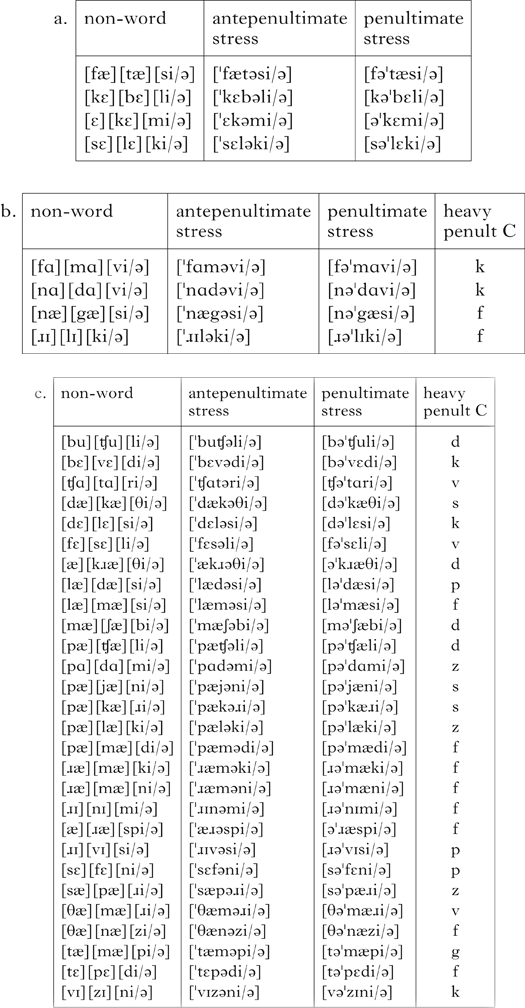


 Open access

