

After the historic 2008 election of Barack Obama, the first Black president of the United States, African Americans expected targeted policies to improve their social, political, and economic position (Clegg Reference Clegg2021; Saint-Vil Reference Saint-Vil2020). Instead, Obama’s major national legislative accomplishments were health care reform (the Affordable Care Act) and the Deferred Action for Childhood Arrivals (DACA) program, both by executive action.Footnote 1 Obama made immigration a part of his campaign promises and legislative agenda. While he advanced Black-centric policies and programs, those were kept from national media or succumbed by immigration (and health care) as a critical national issue. However, one of Obama’s signature race-centric programs is My Brother’s Keeper. Obama launched this program in 2014 in response to the death of Trayvon Martin. The program seeks to “address the persistent opportunity gaps boys and young men of color face” (The Obama Foundation 2024). The program was not without backlash and debate within and across the Black community (Lee Reference Lee2014).
While a group of Black women supported the program (#TeamEBONY 2014), some Black women and other women of color (WoC) petitioned the President to include women and girls in My Brother’s Keeper (The African American Policy Forum 2014; Cooper Reference Cooper, Cooper, Morris and Boylorn2017; Crenshaw Reference Crenshaw2014). In essence, this example showcases the heterogeneity among Black women, a heterogeneity that scholarship and media alike take for granted. In their book, All the Women are White, all the Blacks are Men, but Some of Us are Brave, Hull, Scott, and Smith (Reference Hull, Scott and Smith2015) center Black women’s experiences as Black women, not just Black people or women. As the title suggests, Black women fall through the cracks of race-only and gender-only analysis. Further, Black women’s multidimensionality is almost outside of epistemic possibility, given the overemphasis of a single-axis framework that treats race and gender as mutually exclusive. But Black women have told us they experience these social categories simultaneously (Combahee River Collective 1986). For these reasons, this paper centers Black women without comparison to any other group. Further, centering Black women’s attitudes, as Hill Collins states, “enriches our theoretical understanding of the meaning of the political” (Reference Hill Collins2000, 44). The literature within political science has found little gender differences between Black men and Black women. However, more recent work has focused on ideological and gender differences considering changes in voting patterns, especially among Black men (Jefferson Reference Jefferson2024; Simien Reference Simien2004, Reference Simien2005; Simien and Clawson Reference Simien and Clawson2004). But much of the social scientific literature paints Black women as one entity who move and breathe together without any ideological or attitudinal variation.
Black women have distinct structural and experiential experiences compared to Black men and other men of color, as well as white women, by nature of their specific intersectional race and gendered experiences (Brown Reference Brown2014; Brown and Gershon Reference Brown and Gershon2016a; Crenshaw Reference Crenshaw1989; Hancock Reference Hancock2004; Hull, Scott, and Smith Reference Hull, Scott and Smith2015; Junn and Brown Reference Junn, Brown, Beckwith, Wolbrecht and Baldez2008; Montoya et al. Reference Montoya, Bejarano, Brown and Gershon2021; Simien and Clawson Reference Simien and Clawson2004). In fact, from the onset, Black women have had to fight for their rights and a space at the table against white supremacy and patriarchy. Black women formed their own organizations to fight against white women’s dismissal of them during the women’s rights movement and against Black men’s dismissal of them during the Civil Rights Movement.
Black women, however, are not a monolith. The history of the formation of Black women’s and WoC organizations is fraught with differences among Black women by class (Davis Reference Davis1983), sexuality (Moraga and Anzaldúa Reference Moraga and Anzaldúa1983), nativity (Moraga and Anzaldúa Reference Moraga and Anzaldúa1983), and skin color (Larsen Reference Larsen2003). The Combahee River Collective (CRC) was founded by a group of Black queer women who felt left out by the National Black Feminist Organization (NBFO) due to their interconnected identities as Black, women, and queer and formed the CRC as a breakaway group. Even though both organizations pushed Black feminist ideals, there was considerable variation in ideology and lived experiences that allowed the CRC, for example, to understand intersectionality not only with other Black women but with third-world women, WoC — Black and non-Black — and working people.
We theorize that Black women’s unique standing in American politics influences their political behavior (Gillespie and Brown Reference Gillespie and Brown2019). We do not, however, believe that all Black women are the same. Black women make political choices based on their lived experiences and often stand up for the rights of the marginalized, not just their ingroup (Brown and Gershon Reference Brown and Gershon2016a). Following Black feminist thought, Black women’s lived experiences are different (Hill Collins Reference Hill Collins2000). Hence, we should expect variation in attitudes and policy preferences among Black women. Examining Black women’s experiences with discrimination, their commitment to intersectional and international “Third World” feminism and solidarity (Combahee River Collective 1986; Taylor Reference Taylor2017), which highlights the plight of WoC, and their commitment to Democratic Party ideals, then seems a worthwhile endeavor. We use the issue of immigration, which is contentious among and within racial and ethnic groups, to showcase Black women’s heterogeneity and commitment to democracy simultaneously. Because immigration as an issue brings up one’s immigrant experience, we disaggregate Black women by African American women and Black immigrant women. This allows us to examine Black women’s heterogeneity further.
There is a dearth of scholarship concerned about what lies beneath Black Americans’ attitudes on immigration. However, scholarship generally finds that Black Americans express support for progressive immigration policies compared to their white counterparts (Burns and Gimpel Reference Burns and Gimpel2000; Citrin et al. Reference Citrin, Green, Muste and Wong1997) but can also express ambivalence toward immigration and immigrants (Carter Reference Carter2019). A look at the American National Election Studies Cumulative Data (1948–2020) shows that Black Americans (23%), alongside Hispanics/Latinos (20%), are among the groups with the lowest percentage of people saying they want immigration levels decreased in 2020 compared to their white counterparts. An examination of feelings toward undocumented immigrants, shown in the top column of Figure 1, showcases that Black Americans, second only to Hispanics/Latinos, espouse warmer feelings toward undocumented immigrants compared to white Americans and all other racial/ethnic groups. Furthermore, Black women, since 2012, have expressed higher levels of favorable feelings toward undocumented immigrants compared to Black men (shown in the bottom column of Figure 1).
Thermometer – “Illegal Aliens,” by race/ethnicity (top) and Black Americans and gender (bottom), 2004–20.
Source: ANES Cumulative Data File (1948–2020).

Hence, there is a need to contextualize Black Americans’ as well as Black women’s immigration attitudes (Jones Reference Jones2024) due to their structural (Carter Reference Carter2019; Masuoka and Junn Reference Masuoka and Junn2013) and experiential experiences in the United States. We argue that Black women, due to their inclusive understanding of fighting racism and xenophobia, will have shared experience of discrimination with “outgroups” (in this case, immigrants), express higher levels of WoC linked fate, higher levels of intersectional solidarity, and have a strong Democratic Party identification.
Using the 2020 Collaborative Multiracial Post-election Survey (CMPS), we draw on theories of intersectionality, the vast literature on women and politics, and psychological scholarship to investigate Black women’s attitudes toward immigrants, immigration, and their related political behavior. We find that perceived ingroup discrimination was mostly insignificant or negatively influenced immigration attitudes, while perceived outgroup discrimination, alongside WoC linked fate and intersectional solidarity, was significantly associated with positive and progressive immigration attitudes. Democratic identification turned out to be an inconsistent predictor of Black women’s attitudes. The implications of this work expand our knowledge of Black women’s politics and how perceptions of shared discrimination, racial and gender consciousness, and Democratic identification function for African American women and Black immigrant women.
Black Political Attitudes and Behavior
Black American attitudes, while heterogenous and centrist (Dawson Reference Dawson1994; Gurin, Hatchett, and Jackson Reference Gurin, Hatchett and Jackson1989; Tate Reference Tate2010), continue to be more progressive on specific issues compared to their white counterparts (Gilens Reference Gilens1999), though there are profound intragroup differences and tensions as well (Cohen Reference Cohen1999). A key component of contemporary Black public opinion is Black Americans’ deep sense of alienation and distrust of government. This distrust of the US government informs Black Americans’ attitudes toward political action, often perceived as crucial to the community’s survival. The perceived progressivism of Black Americans is uniquely linked to ideas of collective discontent and feelings of having little power in society. Stemming from feelings of collective disenfranchisement, Black attitudes and political behavior stem from Black investment in their racial group (Dawson Reference Dawson1994; Huddy and Carey Reference Huddy and Carey2009; Kinder and Sanders Reference Kinder and Sanders1996; Philpot and Walton Reference Philpot and Walton2007; Sigelman and Welch Reference Sigelman and Welch1984; Tate Reference Tate1993; though see Gay, et al. Reference Gay, Hochschild and White2016; McClain and Carew Reference McClain and Carew2018; White and Laird Reference White and Laird2020).
Black Immigration Attitudes
As it relates to immigration, Black Americans display complex and ambivalent attitudes (Carter Reference Carter2019; Doherty Reference Doherty2006; Smith Reference Smith2014). Conventional scholarship explains Latino-Black relations using theories of racial and economic threats (Kaufmann Reference Kaufmann2007; McClain and Karnig Reference McClain and Karnig1990; McClain et al. Reference McClain, Lyle, Carter, Soto, Lackey, Cotton, Nunnally, Scotto, Grynaviski and Kendrick2007; Meier and Stewart Reference Meier and Stewart1991). For example, research suggests that Black Americans view immigrants as a threat to their economic mobility (Doherty Reference Doherty2006; Fetzer Reference Fetzer2000). Doherty (Reference Doherty2006) finds that Black people are more fearful than white people of immigrants taking away jobs, and more Black people say they or their family members experience unemployment because of immigrants. Ambivalent attitudes held by Black Americans are intricately tied to Black Americans’ racialized experience in the United States (Carter Reference Carter2019). Carter (Reference Carter2019) finds that Black Americans do not necessarily hold anti-immigrant sentiments (also see Wilkinson and Bingham Reference Wilkinson and Bingham2016) but feel that immigration gets placed above policies that target the needs of Black Americans. In other words, immigration is seen as an impediment to Black political, social, and economic mobility.
However, much of the scholarship on Black immigration attitudes does not account for gender. One exception is the work of Berg (Reference Berg2010), who examines immigration attitudes by education, race, socialization, and gender. While this study yields insignificant results when it comes to Black women, Berg establishes that there are some gendered differences in perceptions of group threat but that categories of race and class envelop these nuances. Specifically, Berg finds that highly educated women are more likely to have positive attitudes toward immigrants and immigration policy than men with similar education, and that women were more likely to be in community with immigrants than their male counterparts. Berg theorizes that these differences are due to the gendered socialization practices that encourage women to be communal and nurturing. Minimal scholarship currently explores or highlights gender as an analytic tool to understand attitudes toward immigration. Likewise, Black women’s attitudes toward immigration are mainly absent from the field.
Black Women’s Uniqueness and the Politics of Solidarity
Black women’s intersectional identity and orientation as distinct from their white and male counterparts dates back to the inception of the United States and the disparate treatment of Black women across time and space (Giddings Reference Giddings1984). Paula Giddings’ seminal work details the uniqueness of Black women and their accomplishments in US history and calls for the importance of Black women’s identification. Intersectionality and solidarity politics ground Black women’s attitudes and activism in the United States and frame our understanding of what makes Black women distinct.
The CRC (1986) provides a framework of intersectionality and intersectional solidarity to make sense of Black women’s precarity due to their structural locations. The CRC recognized identity politics as an articulation of Third World feminism that would “validate Black women’s experiences while simultaneously creating an opportunity for them to become politically active to fight for the issues most important to them” (Taylor Reference Taylor2017). Additionally, the CRC statement was a call for solidarity politics, in which Black women could strengthen their political commitments toward other communities’ struggles. The CRC statement was clear in its commitments to internationalism, in which they undertook the political identity of “women of color” and “third world women” (Matos, Greene, and Sanbonmatsu Reference Matos, Greene and Sanbonmatsu2021). The adherence to this kind of identity politics highlights the utility of connecting with women of different races, ethnicities, and from other countries. The founders and followers of the CRC practiced a commitment to a more diasporic politic that included not just US Black women but WoC across the globe.
Black women’s intersectional identity allows them to view the oppression and struggles of others outside of their group as part of the larger struggle against white supremacy and not as a zero-sum game (King Reference King1988; Taylor Reference Taylor2017). In their work, scholars Lizotte and Carey (Reference Lizotte and Carey2021) examine whether there are gender gaps between Black men and Black women on various policies. They found no gender differences among Black Americans as it relates to race-based policies, but do find that Black women support women’s and social welfare issues at higher rates. They attribute Black women’s higher support for both as connected to their intersectional gender and class identities.
The CRC does not define identity politics as exclusionary; only those experiencing a specific type of discrimination could fight against that particular problem (Taylor Reference Taylor2017). Hence, it makes theoretical sense that Black women can understand the oppression or discrimination that immigrants experience precisely because they, too, have either personally experienced discrimination as Black women, as Black immigrant women, and/or understand the structural oppression and discrimination as part of an extensive white supremacist system (Carter Reference Carter2019; Cortland et al. Reference Cortland, Craig, Shapiro, Richeson, Neel and Goldstein2017; Craig and Richeson Reference Craig and Richeson2012, Reference Craig and Richeson2014, Reference Craig and Richeson2016; Crenshaw Reference Crenshaw1989, Reference Crenshaw1991; Romney Reference Romney2021).
This aligns with scholarship in the social psychology of coalition-building and solidarity. Overall, this work has shown that shared experiences of discrimination increase positive intergroup relations. Examining Black-Latino relations, Craig and Richeson (Reference Craig and Richeson2012) showed that perceived discrimination toward oneself and one’s racial/ethnic group positively influences closeness and expressions of a common fate with another minoritized group. These works align with the common ingroup identity model (Gaertner et al. Reference Gaertner, Dovidio, Anastasio, Bachman and Rust1993), which suggests that salient discrimination against one’s racial group engenders more positive attitudes toward other racial groups, which may lead to what Craig and Richeson (Reference Craig and Richeson2012, 772) call a “common ‘disadvantaged racial minority’ identity.” However, when examining sexism as the basis of discrimination, Craig and colleagues (Reference Craig and Richeson2012) find that making sexism discrimination salient leads white women toward expressions of ingroup favoritism and intergroup racialized bias toward Black Americans and Latinos. In other words, when sexism was made salient, white women sought to increase their positive distinctiveness by both ingroup favoritism and outgroup derogation, as postulated by Tajfel and Turner’s (Reference Tajfel, Turner, Austin and Worchel1979) social identity theory. For white women, sexism and racialized discrimination do not appear to be a shared enough experience for them to positively relate to the racialized discrimination Black Americans and Latinos experience.Footnote 2
However, the literature on shared experiences as a catalyst for solidarity or coalition-building needs to adequately research how the intersection of social identities might influence expressions of coalition, solidarity, or competition. The literature in social psychology suggests that coalition and solidarity with out-group members increases when a) the perceived discrimination is happening along the same dimension (e.g., racialized identity; Craig and Richeson Reference Craig and Richeson2012) and when individuals express personal discrimination rather than group discrimination (Craig and Richeson Reference Craig and Richeson2014). Perceived discrimination based on different dimensions leads to negative evaluations and outgroup derogation instead (Craig et al. Reference Craig, DeHart, Richeson and Fiedorowicz2012). However, holding multiple and intersectional stigmatized identities may result in different outcomes (Cole Reference Cole2009). In other words, for Black women who experience race-gendered and possibly other identity-based discrimination, does discrimination work equally the same in influencing Black women’s attitudes toward an outgroup, in this case, immigrants, and their behavior toward immigration-related policies?
We argue that there is something unique about experiencing intersectional discrimination among Black women. We also know that Black women experience discrimination in unique ways. Kimberlé Crenshaw, the Co-Founder & Executive Director of the African American Policy Forum and intersectionality legal scholar, coined the term intersectionality when she described the case of DeGraffenreid v. General Motors (1976). In this case, Emma DeGraffenreid and four other Black women sued General Motors on the basis of discrimination. The Black women argued that they were being discriminated on account of being Black women. The courts failed to see that Black women experience discrimination dissimilar to Black men and white women. Black women’s experiences of discrimination at General Motors (and beyond) were duly erased by the Court, which stated: “[T]hey should not be allowed to combine statutory remedies to create a new ‘super-remedy’ which would give them relief beyond what the drafters of the relevant statutes intended. Thus, this lawsuit must be examined to see if it states a cause of action for race discrimination, sex discrimination, or alternatively either, but not a combination of both.”
In other words, for the courts, Black women could not possibly experience discrimination or have a legal remedy based on their intersectional identity as Black women, as that would be unfair to Black men and white women. The experience of double or triple oppression and discrimination faced by Black women as individuals who are part of two or more disadvantaged, stigmatized, and marginalized identities is, we argue, what allows for the possibility that Black women understand the struggle of both ingroup and outgroup members of society. In fact, within the scholarship, Black women, both at the mass and elite levels, have been shown to have the most inclusive attitudes and support policies that benefit all marginalized communities (Bejarano et al. Reference Bejarano, Brown, Gershon and Montoya2021; Brown Reference Brown2014; Brown and Gershon Reference Brown and Gershon2016b; Gershon et al. Reference Gershon, Montoya, Bejarano and Brown2019; Montoya et al. Reference Montoya, Bejarano, Brown and Gershon2021; Tormos Reference Tormos2017).
Given both the history and the ample scholarship on Black women as well as the ongoing social psychology scholarship on coalition-building, we argue that Black women’s experiences of discrimination, not just as Black individuals or women, will positively influence attitudes about immigrants and immigration policy preferences. In other words, perceived group discrimination and the knowledge that immigrants also experience discrimination are predictors of Black women’s progressive immigration attitudes.
H1a: Expressions of experiencing higher instances of racial and race-gendered discrimination among Black women will be correlated with more positive attitudes toward immigrants, and these types of discrimination will be associated with progressive immigration attitudes compared to Black women who express little to no discrimination (in-group discrimination).
H1b: Perceptions of high levels of out-group discrimination, especially discrimination against immigrants, among Black women, will be associated with progressive immigration attitudes compared to Black women who express lower levels of perception of out-group discrimination (out-group discrimination).
Black Women’s Intersectional Group Consciousness
Along the lines of the common ingroup identity model (Gaertner et al. Reference Gaertner, Dovidio, Anastasio, Bachman and Rust1993), which argues that shared discrimination might lead to a conceptualization of yourself as being part of a larger group of racially minoritized individuals, we examine the importance of Black women’s understanding of themselves as WoC as an identity that supersedes their specific race-gendered identity as Black women and one that is also historically attached to Black women and solidarity politics. Work on “people of color” indicates that an identity as a person of color (PoC), a superordinate identity, is meaningful for coalition-building (Pérez Reference Pérez2021; Pérez et al. Reference Pérez, Vicuña, Ramos, Phan, Solano and Tillett2022; Starr and Freeland Reference Starr and Freeland2023). Other works have shown the significance of superordinate identities in decreasing differences and increasing commonality (Levendusky Reference Levendusky2018; Transue Reference Transue2007). We test our hypothesis that Black women who express high levels of a WoC common fate will be associated with attitudes toward immigrants and immigration by using the measure of a WoC linked fate. WoC linked fate asks, “How much do you think what happens to [women of color] here in the US will have something to do with what happens in your life?”Footnote 3 We specifically opt for using WoC linked fate for two reasons. The first is a data limitation, as PoC linked fate was not asked in the 2020 CMPS. The second and theoretically important reason is that WoC linked fate is an intersectional measure, whereas PoC linked fate is not. The latter emphasizes the “of color” part of the identity, whereas the former emphasizes the gender and “of color” aspects. Our theory is not that Black women and immigrants share an “of color” identity. Thus, Black women will be more likely to have positive evaluations of immigrants and progressive immigration attitudes. It is due to Black women’s structural and lived experiences as Black women and WoC that connect the struggle of others to their struggle. As Matos and colleagues argue, a WoC identity and linked fate group consciousness derive from an understanding of solidarity that is intersectional in nature and liberatory in practice (Matos, Greene, and Sanbonmatsu Reference Matos, Greene and Sanbonmatsu2020, Reference Matos, Greene and Sanbonmatsu2021). As the authors postulate, “Intersectionality elucidates how different women of color leverage their own privileges and oppressions to act in solidarity with one another” (Matos, Greene, and Sanbonmatsu Reference Matos, Greene and Sanbonmatsu2021). Hence, the use of WoC linked fate rather than a PoC linked fate.
Scholarship on WoC linked fate shows that Black women are most likely to identify as WoC and express WoC linked fate at higher rates compared to Latinas and Asian American women (Carey and Lizotte Reference Carey and Lizotte2023; Matos, Greene, and Sanbonmatsu Reference Matos, Greene and Sanbonmatsu2021). Further, Carey and Lizotte (Reference Carey and Lizotte2023) show that strong attachment to WoC among Black women (as well as Latinas and Asian American women) results in support for police reforms, greater awareness of gender discrimination, and universal health care. The authors conclude by suggesting that strong expressions of WoC linked fate might be a mechanism for cross-racial coalitions among WoC. Research has also found that Black women hold higher rates of “minority linked fate,” which captures a shared sense of commonality among groups that goes beyond their in-group race or ethnicity (Gershon et al. Reference Gershon, Montoya, Bejarano and Brown2019). Gershon and colleagues (Reference Gershon, Montoya, Bejarano and Brown2019) find that Black women have the highest levels of minority linked fate compared to Black men, Latinas, and Latinos. Furthermore, expressing minority linked fate is positively associated with a perception that a group outside your race or ethnicity can represent your interests.
Newer work advances the significance and salience of a WoC identity as an organizing political space for coalitional and solidarity politics (Matos, Greene, and Sanbonmatsu Reference Matos, Greene and Sanbonmatsu2021). Matos, Greene, and Sanbonmatsu (Reference Matos, Greene and Sanbonmatsu2021) focus on comparing Black women, Afro-Latinas, and non-Afro-Latinas’ identity as WoC and the political consequences of such an identity. They find that almost all the Black women, including Afro-Latinas, identified with the WoC identity and that this identification informs how Black women evaluate potential WoC candidates. These findings not only substantiate the CRC’s practices of linking struggles as an investment in community-based solidarity politics but also ground these solidarity principles within current Black women’s political practices. If Black women are investing in a political identity as WoC, how is their WoC identity informing their attitudes regarding immigrants and immigration? While Matos et al. (Reference Matos, Greene and Sanbonmatsu2021) are measuring this intersectional group identity and trying to understand how it informs candidate selection preferences, this can be extended to see how the WoC identity informs Black women’s attitudes regarding immigrants and immigration. We hypothesize adherence to a WoC political identity, by way of linked fate, among Black women will be positively associated with support for immigrants and non-punitive immigration policies compared to Black women who have lower levels of a WoC common fate.
To more concretely test our hypothesis that Black women with high levels of intersectionality solidarity will yield more positive attitudes toward immigrants and immigration-related policies, we utilize Chaya Crowder’s (Reference Crowder2022) measure of intersectional solidarity.Footnote 4 Although Crowder’s work looks specifically at how white women’s understanding of intersectional solidarity influences their policy preferences, we extend her measure and argue that Black women with high levels of an understanding of intersectional solidarity will be positively correlated with their attitudes toward immigrants and immigration policy preferences. Crowder’s measure taps into various groups and concepts, including the difference between white and Black women’s experience with sexism, Black men’s role in sexism, and the need to fight racism as well as sexism, transphobia, and homophobia. Black women’s intersectional identity and experiences allow them to understand the interconnectedness of racism, sexism, classism, homophobia, and xenophobia. Their group position (Blumer Reference Blumer1958) provides for a structural understanding of marginalization and stigmatization.
H2a: Higher expressions of linked fate with other women of color among Black women will be correlated with more positive attitudes toward immigrants and immigration compared to Black women with low levels of WoC linked fate.
H2b: Higher expressions of intersectional solidarity among Black women will be correlated with more positive attitudes toward immigrants and immigration than those with lower levels of intersectional solidarity.
To showcase Black women’s high levels of intersectional solidarity, Figure 2 showcases the means across racial/ethnic and gender groups. Across all racial and ethnic groups, women have higher levels of intersectional solidarity in significant ways. Black women have higher means of intersectional solidarity (0.72) compared to all groups except for Asian American women (0.74), but the difference between Black women and Asian American and Pacific Islander (AAPI) women is insignificant (t(2796) = −1.27, p = 0.21). The difference between Black women and Black men (0.68) is significant (t(4669) = −6.55, p = 0.000), as well as Black women and white women (t(4173) = 12.41, p = 0.000) and Latinas (t(3669) = 4.21, p = 0.000).
Intersectional solidarity by race, ethnicity, and gender.
Source: 2020 CMPS.

Black Women as Partisans
Finally, we explore a third aspect of Black women’s politics: their Democratic partisan identification. Black women are thought to be unique in American politics. Black women voters are credited as the “backbone of the Democratic Party” (Swanson Reference Swanson2020) as they have the highest percentage of Democratic Party affiliation of any racial-ethnic gender group (Robnett and Tate Reference Robnett and Tate2023). They make up the most loyal Democratic voting bloc (Gillespie and Brown Reference Gillespie and Brown2019). As far back as the 1980s, Black public opinion studies revealed the importance of gender as a predictor of partisanship (Tate Reference Tate1993). In a 2012 survey, 55% of Black women said they were “strong Democrats,” compared to 47.5% of Black men, a statistically significant difference (Robnett and Tate Reference Robnett and Tate2023). Black women (98%) were more likely to vote for Hillary Clinton in the 2016 presidential election compared to Black men (81%). Black women’s support can sometimes make or break a Democratic candidate. This was displayed in Alabama’s 2017 special senate election, where Black women’s high turnout and 98% voting rate were critical in electing Doug Jones (Brown Reference Brown2017; Duster and Tuakli Reference Duster and Tuakli2017). In the 2024 presidential election, exit polls show that 92% of Black women voted for Vice President Kamala Harris compared to 78% of Black men, 47% of white women, and 61% of Latinas (Guskin, Alcantara, and Chen Reference Guskin, Alcantara and Chen2024; NBC News 2024). Hence, Black women’s positionality is linked to their more robust and more consistent support of the Democratic Party.
Similarly, Black women’s uniqueness as partisans is apparent through their political candidacy and roles as elected elites. Black women political candidates and elected elites experience a variety of unique experiences regarding barriers to entry, representation styles, political ambition, and candidate evaluations that speak to Black women’s commitments to a democratic system and justice for marginalized communities (Brown and Dowe Reference Brown, Dowe, Shames, Bernhard, Holman and Teele2020; Brown and Gershon Reference Brown and Gershon2021; Dowe Reference Dowe2020; Lemi and Brown Reference Lemi and Brown2019). These unique experiences prime Black women as political actors and partisans to actively participate in the political arena in search of justice for their own group and solidarity with other marginalized groups. These experiences as political actors are part of Black women’s politics. Black women’s high levels of support of the Democratic Party candidates and what the Democratic Party stands for — a party defined by its seeming commitment to serve and represent racial and ethnic minoritized groups — thus serves as an alternative predictor of Black women’s progressive and inclusive politics.
Black women also hold more progressive attitudes than their white women and Black male counterparts (Junn and Masuoka Reference Junn and Masuoka2020; Philpot and Walton Reference Philpot and Walton2007). According to Robnett and Tate (Reference Robnett and Tate2023), among Black American women, feelings of disenfranchisement and mistrust for the government influence their sense of “Black woman linked fate” and “woman linked fate.” Robnett and Tate (Reference Robnett and Tate2023) argue that Black women’s position in the US as politically active and consequential within Democratic politics, but underrepresented as leaders “along with the high levels of community leadership, may lend itself to a stronger sense of Black women consciousness and solidarity” (90). In fact, Robnett and Tate (Reference Robnett and Tate2023) find that positive feelings toward feminists and strong expressions of linked fate with other Black women significantly strengthen Black Americans’ identity as Democrats.
Black women’s propensity to embrace feminist, womanist, or gender-focused attitudes is a direct reflection of their normative and liberal desires for how the US government should operate. Black women’s identity as Black women and their support for feminist ideals strongly influence their more liberal policy stances and their Democratic partisanship, which informs what they think and how they behave in politics (Robnett and Tate Reference Robnett and Tate2023). We believe that Black women’s positionality and their strong and consistent support of the Democratic Party denotes an ideological position that prescribes gender and racial equity across a host of identities and privileges beliefs of equity and solidarity.
Thus, our third hypothesis is as follows.
H3: A stronger Democratic identity will be correlated with Black women’s higher levels of progressive and inclusive immigration attitudes than Black women who express weaker levels of Democratic identity.
Data and Methods
To test our hypotheses, we utilize the 2020 CMPS. The CMPS is a national survey of voters and non-voters on political and social issues conducted post-presidential elections. The 2020 CMPS was conducted via the Internet, and it is one of the few nationally representative surveys with enough respondents across racial and ethnic groups. The 2020 CMPS sample includes 2,450 Black women. Since this paper examines immigration, we also subset the data by Black women who self-identified as having roots in the United States for many generations (African American women; n = 2,047) and Black women who self-identified their roots outside of the United States (Black immigrant women; n = 692).
Dependent Variables
Our primary dependent variables are questions about immigrants and immigration. Using the 2020 CMPS, our first set of dependent variables asks respondents about their attitudes concerning immigrants. The first question is a feeling thermometer that ranges from 0 to 100 and asks respondents how warm or cold they feel toward undocumented immigrants. We normalized this variable to range from 0 to 1, with higher numbers expressing more warm feelings toward undocumented immigrants. The second variable asks respondents, “For each group, please indicate if you think they support or threaten your vision of American society.” The group in question is Immigrants. This is an ordered seven-point scale ranging from strongly threatens to strongly supports, normalized to range from 0 to 1.
The second set of dependent variables focuses on policy. They ask respondents to agree or disagree using a five-point Likert scale from strongly agree to strongly disagree about immigration policies. The statements include: 1) “Increasing security at the U.S.-Mexico border should be a national priority even if it means that some migrants will die attempting to cross” and 2) “This country should make it easier for immigrants to obtain visas and citizenship.” They range from most restrictive/punitive to most progressive/less punitive and have been normalized to range from 0 to 1.
Independent Variables
To test our first hypotheses, our main independent variables using the 2020 CMPS include discrimination measures. Per the social and political psychological literature, perceptions of shared discrimination are one way to increase coalition and solidarity among groups (Cortland et al. Reference Cortland, Craig, Shapiro, Richeson, Neel and Goldstein2017; Pérez, Vicuña, and Ramos Reference Pérez, Vicuña and Ramos2023). It is one factor where we can test whether in-group discrimination, personal discrimination, or perceptions of out-group discrimination increase or decrease positive attitudes toward immigrants and immigration policy preferences among Black women.
To control for in-group discrimination, we utilize a question about group discrimination against Blacks (racial group discrimination). We also model based on personal discrimination, which accounts for discrimination Black women face as Black women.Footnote 5 Given the literature in social psychology, personal discrimination might increase positive evaluations of outgroups compared to perceived group discrimination (Craig and Richeson Reference Craig and Richeson2014). To control for out-group discrimination, we control for discrimination against immigrants. Perception of immigrant discrimination may be perceived as racialized discrimination and thus in the same dimension as in-group discrimination. Niambi Carter’s (Reference Carter2019) work signals that Black Americans understand immigration and the treatment of immigrants as structural and part of a white supremacist system of oppression. Higher values on all discrimination variables indicate more discrimination.
We confirm that these constructs are independent constructs, although related to one another. The Spearman correlation (data are ordinal) between all three is positive and significant. Among Black women, the association between discrimination against Blacks and discrimination against immigrants is strong at 0.62, while personal discrimination is weakly associated with discrimination against Blacks (0.23) and discrimination against immigrants (0.20). Unsurprisingly, perceptions of group discrimination against Blacks and immigrants have a strong and positive association with one another, though they are not the same constructs. In fact, Black women can be discriminated against both because they are Black and either perceived as immigrants or, rather, they might be. Among Black immigrant women, the association between discrimination against Blacks and immigrants remains high at 0.55, while among African American women, the association drops to 0.42. (The other two associations remain low.) It goes from a strong correlation to a moderate association. Ultimately, perceptions of intergroup discrimination are associated with one another but are not tapping the same construct, especially not when we account for what subgroups of Black women may be experiencing discrimination based on two identity markers, versus those who are not.
Our second set of hypotheses argues that Black women’s WoC linked fate and levels of intersectional solidarity will positively influence their immigration attitudes and behavior. To test this hypothesis, we utilize a group consciousness measure of linked fate with WoC, which asks, “How much do you think what happens to the following groups [women of color] here in the U.S. will have something to do with what happens in your life?”
Table 1 showcases the correlation between linked fate measures for Blacks, Latinos, WoC, and women. As Table 1 shows, all measures are positively correlated and significant (indicated by bold numbers). Notably, the correlation matrix indicates that for both African American and Black immigrant women, women linked fate and WoC linked fate, a combination of race-gendered linked fate, are highly correlated but are not the same constructs. There are strong correlations between WoC, women, and Black linked fate for both sets of Black women. Whereas the correlation between Latino linked fate and WoC linked fate is much weaker than that of Latino and women linked fate. We read this to suggest that Black women understand WoC linked fate to be about their experience as Black women, not just Black and not just women. Unfortunately, the data does not allow us to decipher how correlated WoC linked fate and PoC linked fate are. Still, if we were to speculate, we’d argue that PoC linked fate would not be as correlated to women linked fate as WoC linked fate is, and that the two constructs are distinct.
Spearman correlation between linked fate measure among Black women

Source: 2020 CMPS
Table 1 also shows the correlation between intersectional solidarity and all other linked fate measures. Importantly, WoC linked fate and intersectional solidarity are tapping into distinct measures for Black immigrant and African American women, although the measures are moderately correlated and significant.
Finally, our third hypothesis focuses on Black women’s partisan identity as Democrats. We use a question about party identification: “Generally speaking, do you think of yourself as a Republican, a Democrat, an independent, or something else?” We also argue that Black women with strong party identification will be the most progressive on immigration, so our measure combines party identification and strength. The measure ranges from strong Republican to strong Democrat. As a secondary test, we also model whether the respondents said they were always a Democrat. The question asks, “Have you always called yourself a Democrat, or did you used to call yourself a Republican?” We recoded this variable to be a dummy variable, where 1 is “Always a Democrat,” and 0 is all else (“I used to call myself Republican” and “I used to call myself an Independent”).
We also control for trust in government, as it is essential in Black politics (always to never), whether the respondent is of immigrant background, and demographic controls (age, education, income, and ideology [liberal]). Although we would have liked to control for social class, given that Robnett and Tate (Reference Robnett and Tate2023) find social class to be a significant predictor of variation among Black women, the 2020 CMPS did not have a socioeconomic class measure. Thus, income is used as a proxy. All models are ordered logit, except for one regression modeling the feeling thermometer toward undocumented immigrants.
Results
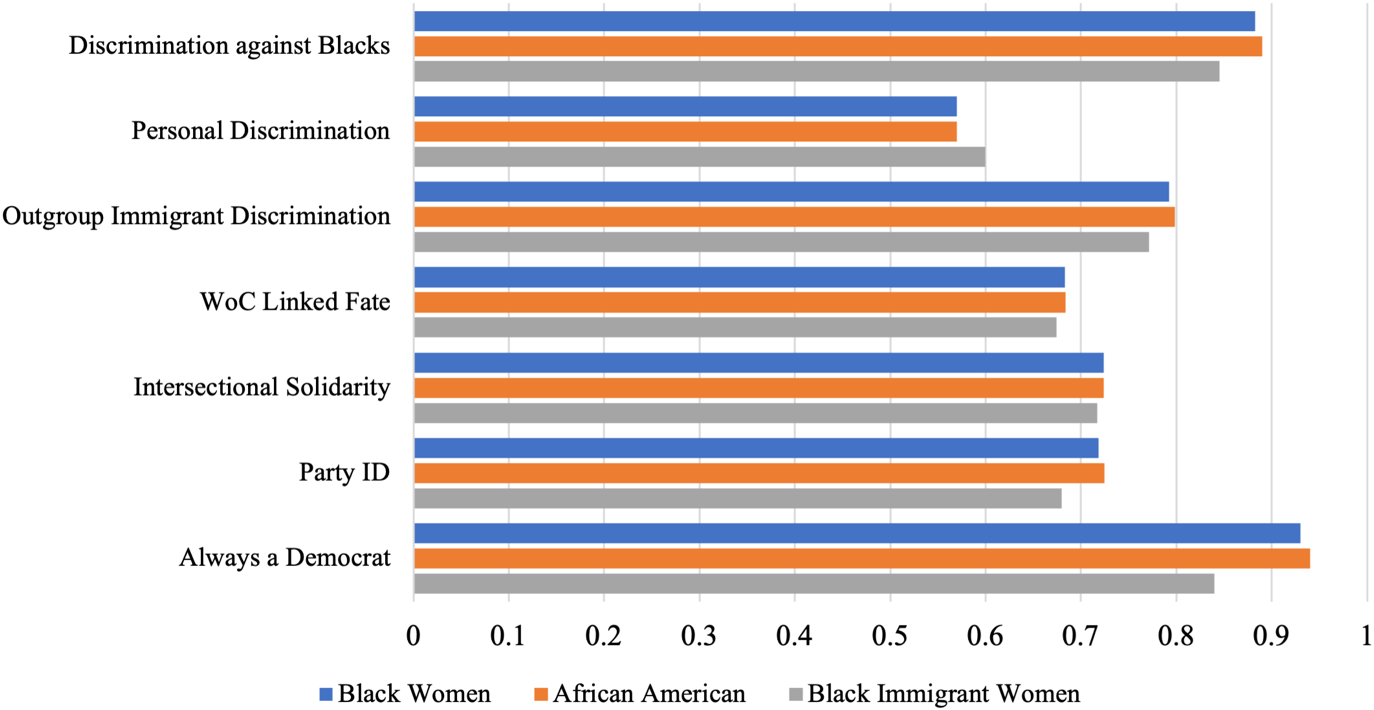
Our overall contention is that Black women’s immigration attitudes are more liberal and progressive when they perceive that Blacks experience discrimination and when they have shared experiences of discrimination with immigrants, have higher levels of WoC linked fate and intersectional solidarity, and have stronger Democratic Party identification compared to other Black women who do not share the same experiences and views. Figure 3 shows the averages across all independent variables. We have also modeled the averages by whether Black women whose roots have been in the United States for generations (labeled African American throughout), Black women who specified their roots elsewhere (labeled Black immigrant women throughout), and Black women as a group regardless of ethnicity (labeled Black women).Footnote 6 In all but three cases — personal discrimination, WoC linked fate, and intersectional solidarity — African American women and Black immigrant women had significantly different averages. In terms of discrimination against Blacks, African American and Black immigrant women are significantly different from each other (t(2640) = −4.02, p = 0.0001), with African American women expressing higher levels of Black group discrimination. African American women also had a significantly larger mean as it relates to immigrant discrimination (t(2601) = −2.17, p = 0.03). African American women had a higher mean toward a stronger Democratic identification (t(2614) = −4.82, p = 0.0000). Finally, they also have a higher mean as identifying as always a Democrat (t(1866) = −6.34, p = 0.0000).
Mean difference among Black women by main independent variables.
Source: 2020 CMPS.
Note: Always a Democrat and Personal discrimination are dichotomous. All others have been normalized to range from 0 to 1.
Regarding the primary dependent variables, Black women generally have positive attitudes toward immigrants as it relates to immigrants supporting their vision of American society. Black women had a mean level of 0.65, African American women had a slightly lower mean of 0.64, and Black immigrant women’s mean was higher at 0.69. The difference of means between African American and Black immigrant women was significant (t(2737) = 4.91, p = 0.000). Regarding the feeling thermometer, when asked about undocumented immigrants, Black women’s mean was 0.52 out of 1, so slightly over the midway point of not feeling cold or warm toward undocumented immigrants. Black immigrant women had a somewhat higher mean level of 0.56, and this difference was statistically significant (t(2737) = 4.09, p = 0.000) compared to African American women.
As it relates to policy preferences, Black women were over the midway point in disagreeing that increasing security at the US-Mexico border should be a national priority even if it means that some migrants will die attempting to cross (mean = 0.54), and agreeing that this country should make it easier for immigrants to obtain visas and citizenship (0.66). There is no difference between African American and Black immigrant women as it relates to the US-Mexico border. Still, there is a statistically significant difference between the two groups as it relates to the ease of visas, with African American women having a slightly lower mean (0.66) compared to Black immigrant women (0.69; t(2737) = 2.32, p = 0.021).
Immigration Attitudes Among Black Women
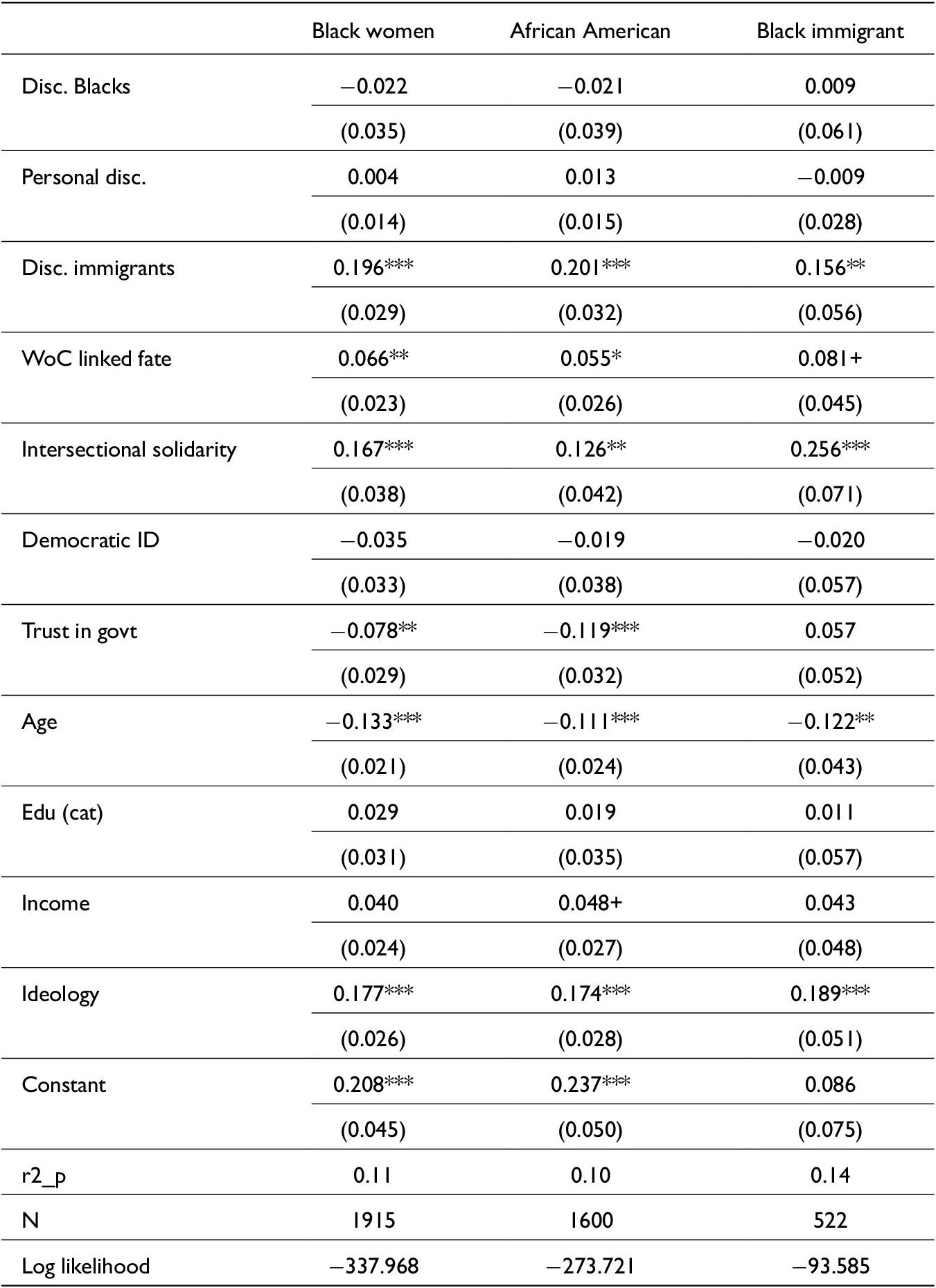
To test our first set of hypotheses, we ran an ordered logit model predicting two attitudinal outcomes about immigrants and two immigration policy outcomes. Table 2 shows the results based on the feeling thermometer about undocumented immigrants. We also modeled based on whether women were African American or whether their roots were outside of the United States. In all models, discrimination against Black Americans was insignificant. The sign is in the negative direction among African American women but does not reach statistical significance. This does not comport with our hypothesis (H1a). Still, it does comport with the psychological literature that suggests that perceived in-group discrimination does not increase a shared sense of solidarity, but that a perception of shared discrimination does. This was borne out in our findings, where outgroup discrimination toward immigrants was significant across all models in the positive direction, evidence of H1b. For Black women, believing that there is discrimination against immigrants increases the likelihood that they feel warmer toward undocumented immigrants. We also modeled Table 2, Model 1 with the inclusion of whether a respondent personally knows a Latino immigrant — given that there is a possibility that when Black women are thinking about immigrants, they are thinking about Latinos in particular (Brader, Valentino, and Suhay Reference Brader, Valentino and Suhay2008) — and controlling for those in the Southwest. Knowing a Latino immigrant was positively correlated and significant, while residing in the Southwest was not. Importantly, including these alternative predictors did not change any main results (see supplemental Table 1S).
Predictors of feeling thermometer toward undocumented immigrants
Source: 2020 CMPS
+ p < .10 * p < .05 ** p < .01 *** p <.001.
Expressions of WoC linked fate increase the likelihood that Black women — including African American women and Black immigrant women — feel more warmly toward undocumented immigrants. The results for Black immigrant women were significant at the 90% confidence interval, while for African American women, it was highly significant. All else equal, a one-unit increase in WoC linked fate increases the likelihood of warmer feelings toward undocumented immigrants by about 0.6 points. Intersectional solidarity was also highly significant across all models. Intersectional solidarity increased the possibility that Black women felt more warmly toward undocumented immigrants. By heritage, however, we can see in Figure 4 that the slopes differ while the intercepts are similar. The slope for African American women is slightly flatter. However, increased expressions of intersectional solidarity have the same effect; they increase expressions of warmer feelings toward undocumented immigrants. At the highest level of intersectional solidarity, feelings toward undocumented immigrants for Black women are at around 65, and for African American women, that number is around 59. Hence, our second set of hypotheses were confirmed.
The effect of intersectional solidarity on feelings toward undocumented immigrants.
Source: 2020 CMPS.

Finally, we hypothesized that strong Democratic identification positively correlates with progressive attitudes.Footnote 7 This was not the case for feelings toward undocumented immigrants. Democratic partisan identification was insignificant in any model; however, liberal ideology was. Higher levels of liberal ideology increase the likelihood of warmer feelings toward undocumented immigrants for Black women across all models. Other important factors are trust in government and age. Among African American women only, higher levels of distrust of the government decrease their warm feelings toward undocumented immigrants. Finally, older Black women were less likely to express warm feelings toward undocumented immigrants.
Overall, outgroup discrimination, WoC linked fate, and intersectional solidarity were positively related to expressions of warmer feelings toward undocumented immigrants among Black women, with some differences between African American women and Black immigrant women. In contrast, ingroup discrimination and Democratic partisanship were not significant.
To further test attitudes toward immigrants, we asked whether immigrants support or threaten Black women’s vision of American society (Table 1A in Appendix A). Figure 5 shows the results for this outcome variable (Imm Threat) and the two policy outcomes (US-Mexico Border, Table 2A, and Visas, Table 3A ). In line with the psychological literature, but not our hypothesis H1a, higher perceptions of ingroup discrimination were correlated with lower expressions that immigrants support their vision of American society. This finding seems to be dominated by African American women, although it is also significant for Black immigrant women, but only at the 90% confidence interval. However, ingroup Black discrimination was not significant when it came to attitudes about the US-Mexico border and easing visa restrictions for immigrants. Personal discrimination again was not significant across all models, except only marginally significant and positive in predicting opposition to prioritizing the US-Mexico border as a national issue. This finding goes against some psychological literature suggesting personal discrimination matters.
Predictors among all Black women on relevant immigration outcomes.
Source: 2020 CMPS.

Perceptions of outgroup immigrant discrimination were positive and highly significant across all models, with one exception among Black immigrant women in the US-Mexico border model, where it was not significant. Perceptions that immigrants are discriminated against are highly influential in Black women’s progressive immigration attitudes. Figure 6 shows the substantive results for all three outcome variables among all Black women. Focused on whether Black women think the US should make it easier for immigrants to obtain visas, a move from the lowest level of perception of discrimination against immigrants to the highest level increases the predicted probability from 19% to 41%. When Black women’s perception of discrimination against immigrants is at the highest level compared to the lowest level, the predicted probability that they disagree that increasing security at the US-Mexico border should be a US national priority rises to about 30% compared to about 14%, respectively.
Punitive and progressive outcomes by discrimination against immigrants.
Source: 2020 CMPS.

A look at WoC linked fate and intersectional solidarity suggests that increased levels of intersectional solidarity are more consistent in progressive immigration attitudes. WoC linked fate was only significant in the hypothesized positive direction in the US-Mexico border model and among African American women only (see Figure 7). Intersectional solidarity, however, was significant across all Black women in the vision of American society and easing visa restrictions models, but not in the US-Mexico border model. In the former models, higher levels of intersectional solidarity increase progressive immigration attitudes and preferences.
Comparing African American and Black immigrant women on relevant immigration outcomes.
Source: 2020 CMPS.

To further understand the ordered logit model in Figure 7, Figure 8 shows the predicted probabilities of the influence of intersectional solidarity on the ease of immigrant visas. As intersectional solidarity increases for African American and Black immigrant women, the predicted probability that they strongly agree that the US should make it easier for immigrants to obtain visas increases. For African American women, at the lowest level of intersectional solidarity, the probability that they strongly agree to ease the visa process is at about 15%. In comparison, at the highest level, it increases to 44%. For Black immigrant women, the intercept at the lowest level of intersectional solidarity is lower at about 5%. At the same time, at the highest level of intersectional solidarity, the probability that Black immigrant women will strongly agree that the visa process should be made more accessible increases to about 60%.
Ease of immigrant visas by intersectional solidarity and African American and Black immigrant women.
Source: 2020 CMPS.

Democratic partisan identification was less consistent in influencing Black women’s immigration attitudes. It was not at all important when it came to Black women’s perception of whether immigrants support their vision of American society; it was positive and significant among Black immigrant women as it relates to their opposition to prioritizing the US-Mexico border, but not among African American women, and finally, it was significant among all Black women in supporting easing visa restriction. Still, once we split the sample by heritage, Black immigrant women seem to be driving this significance. Liberal ideology, however, was once again consistently predicting progressive immigration attitudes among Black women.
Other important predictors include trust in government and age. Higher levels of distrust in government were negatively correlated with perceptions that immigrants support Black women’s vision of American society, a finding being driven by African American women. In other words, African American women who have higher levels of distrust in government are less likely to say that immigrants support their vision of American society. Higher levels of distrust in government, however, increase opposition that the US should make security at the US-Mexico border a priority among all Black women regardless of heritage. Again, as it relates to easing visa restrictions, African American women’s higher levels of distrust in government were correlated with less support that the US should make obtaining a visa easier for immigrants. Older Black women, writ large, held fewer progressive attitudes across all models and outcomes compared to younger Black women.Footnote 8
Discussion
To summarize, we find that in the instances where perceived ingroup racial discrimination is significant, it is negatively correlated with liberal immigration attitudes and policy preferences. Perceived ingroup discrimination against Blacks among Black women, as well as African American women, was negatively associated with expressing that immigrants support their vision of American society. This was the only outcome where perceived ingroup discrimination was significant and negative. Among Black immigrant women, it was slightly significant at the 90% confidence interval. Hence, H1a was not supported, but the findings do add to the psychological literature by examining Black women; this group holds an intersectional identity based on two marginalized and stigmatized social identities. Some evidence in the psychological literature suggests that being a member of a disadvantaged group can lead to positive evaluations of another group you perceive as also disadvantaged (e.g., the common ingroup identity model; Craig and Richeson Reference Craig and Richeson2012; Gaertner and Dovidio Reference Gaertner and Dovidio2012; Gaertner et al. Reference Gaertner, Dovidio, Anastasio, Bachman and Rust1993; Sanchez Reference Sanchez2008). However, research on social identity threat (Branscombe et al. Reference Branscombe, Ellemers, Spears, Doosje, Ellemers, Spears and Doosje1999) argues that the experience of discrimination can lead to feelings of threat and, thus, negative evaluations of disadvantaged outgroups to enhance one’s own group’s relative position and self-esteem (Sedikides and Gregg Reference Sedikides and Gregg2008; Tajfel and Turner Reference Tajfel, Turner, Austin and Worchel1979, Reference Tajfel, Turner, Worchel and Austin1986). Much of the literature, however, treats Black Americans and Latinos as two groups that are racially disadvantaged and thus share similar experiences based on the same social identity dimension. However, we know less about Black Americans’ understanding of immigrants. In this paper, the findings show that ingroup discrimination is, for the most part, insignificant among Black women’s evaluations of undocumented immigrants and most immigration attitudes. Thinking about their vision of American society is the only outcome where ingroup discrimination was significant and negative. It seems like immigrants might threaten this vision for Black women and African American women in particular, following the social identity threat literature. It could be the case that this question, in particular, primes social identity threat by mentioning a larger vision of American society, where Black women might feel “left behind” by the inclusion of immigrants or might think that their vision of American society should be grounded in something other than immigrant rights. Cortland and colleagues (Reference Cortland, Craig, Shapiro, Richeson, Neel and Goldstein2017), for example, state that “a salient experience of ingroup discrimination is unlikely to spontaneously elicit perceptions of similarity with outgroups stigmatized along a different dimension of identity” (549). Hence, it seems like immigration experiences for African American women are a different enough dimension of identity and one that might elicit a thought process around immigration being put ahead of other issues plaguing the African American community (Carter Reference Carter2019; Saint-Vil Reference Saint-Vil2020). Hence, there are limits to shared discrimination among different groups. In other words, perceived discrimination will lead to coalition or derogation of an outgroup (Allport and Kramer Reference Allport and Kramer1946). Our findings show that African American women do not perceive discrimination against Blacks as existing in the same dimension as discrimination against immigrants, which has implications for how to frame immigration to increase Black support of liberal immigration policies.
Perceptions of outgroup discrimination toward immigrants, on the other hand, were almost always significant and positive, as hypothesized (H1b). Across all outcomes and models, with one exception — as Black women’s perception that immigrants experience discrimination increases, so does their positive and progressive immigration attitudes. We theorized that because Black women have a unique experience under interlocking oppressive systems in the United States, they were especially likely to understand that other groups in the US also experience oppression. There is support within the psychological and political science literature that suggests that everyday experiences increase empathy, understanding, liking, and prosocial outcomes (Galinsky, Ku, and Wang Reference Galinsky, Ku and Wang2005; Goldstein and Cialdini Reference Goldstein and Cialdini2007; Goldstein et al. Reference Goldstein, Vezich, Shapiro and Simpson2014; Junn and Masuoka Reference Junn and Masuoka2008; Masuoka Reference Masuoka2008; Sedikides and Gregg Reference Sedikides and Gregg2008; Waters Reference Waters1999). Newer scholarship on shared marginalization and PoC solidarity finds that, on average, groups who feel a shared marginalization or discrimination with an out-group have more positive attitudes toward the out-group and support policies aimed toward the out-group (Pérez, et al. Reference Pérez, Vicuña, Ramos, Phan, Solano and Tillett2022). In Pérez et al. (Reference Pérez, Vicuña, Ramos, Phan, Solano and Tillett2022), solidarity, defined by positive attitudes toward outgroups, was activated by the belief that another minoritized group was similarly discriminated against. However, it is unclear whether Black women’s perceptions that immigrants are discriminated against are more about knowledge of the discrimination and the structural ways in which immigrants are disadvantaged, and/or whether Black women see immigrants’ discrimination as something that is a shared racialized experience. An avenue for future work might work to disentangle this puzzle.
Within the scholarship, Black women have been shown to champion issues that are outside of their own identity and constituents. Black women elites have been shown to have one of the most inclusive attitudes and policy concerns (Bejarano et al. Reference Bejarano, Brown, Gershon and Montoya2021; Brown Reference Brown2014; Brown and Gershon Reference Brown and Gershon2016b; Gershon et al. Reference Gershon, Montoya, Bejarano and Brown2019; Montoya et al. Reference Montoya, Bejarano, Brown and Gershon2021; Tormos Reference Tormos2017). In examining minority women in Congress, Brown and Gershon found that minority women, including Black women, highlighted their gender and race identities and their identification with groups that shared their experience, including other minorities, women, and the economically disadvantaged (2016b, 94–5). Moreover, Black women were the most likely to do so. In other words, Black women’s attitudes and political behavior by nature of their race and gender are distinct from Black men and other racial/ethnic women as well. This literature comports with Black women’s heightened levels of concern about discrimination against immigrants, and those beliefs influence their liberal immigration attitudes.
The one exception where perceived outgroup discrimination against immigrants is not significant is among Black immigrant women in relation to security at the US-Mexico border. However, it is in the positive and hypothesized direction, predicting opposition to the US prioritizing security at the US-Mexico border. It might be the case that Black immigrant women are trying to distance themselves from the issue of the US-Mexico border, which is likely being seen as a Latin American/Mexican issue (Brader, Valentino, and Suhay Reference Brader, Valentino and Suhay2008), given that they share the immigrant identity with those who cross the border. It could also be that because they share an immigrant identity, there is little variation in Black women’s perception that immigration discrimination exists. African American women perceived immigrants to experience slightly more discrimination (0.80) compared to Black immigrant women (0.77), and this difference is statistically significant at the 0.03 level. Finally, perceptions of immigrant discrimination might not be an “outgroup” discrimination measure for Black immigrant women. It might be an “ingroup” measure. However, this is unlikely given that Black immigrant women do not have high levels of an “immigrant identity.” When asked, “Do you describe yourself or think of yourself as an immigrant or part of the immigrant community?” Black immigrant women’s mean was 0.39 out of 1; they were closer to the second category, which is rarely. More exploration is necessary. Overall, however, higher perceptions of outgroup discrimination increase the likelihood that Black women hold more positive attitudes toward undocumented immigrants and more progressive immigration preferences.
Another interpretation of the mostly insignificant findings of perceived ingroup discrimination but significant findings of perceived outgroup discrimination is that Black women do not need a “shared” experience to espouse positive evaluations of immigrants and to support policies that would make their lives easier. A mainstay of Black feminist thought is that difference is not only allowed to exist but is valuable as a source of power (Lorde Reference Lorde1984). For Lorde, difference is a necessary component of liberation. Her essay, “Age, Race, Class, and Sex: Women Redefining Difference,” reminds us, “Institutionalized rejection of difference is an absolute necessity in a profit economy which needs outsiders as surplus people.” She continues, “we have all been programmed to respond to human difference between us with fear and loathing….” (1984, 115). Immigration is one issue in which we bear witness to the ways immigrants, especially undocumented immigrants, are treated as surplus people. For the most part, the findings show that Black women do not need to perceive the same kind of discrimination to understand that immigrants face discrimination and to be in solidarity with immigrants.
Beyond perceptions of discrimination, another argument is that Black women who express higher levels of WoC linked and intersectional solidarity, both forms of group consciousness, will express more positive immigration attitudes because their orientation is one in which they see the connections between their fate and other WoC, which is rooted in solidarity politics, and the connections between sexism, transphobia, classism, xenophobia, and racism (Combahee River Collective 1986; Crenshaw Reference Crenshaw1989; Hill Collins Reference Hill Collins2004; Lorde Reference Lorde1984). We found that higher expressions of a WoC linked fate were positively associated with warmer feelings toward undocumented immigrants, opposition to prioritizing security at the US-Mexico border (only among African American women), and insignificant when it came to Black women’s perception of whether immigrants support their vision of American society and easing visa restrictions for immigrants. In general, WoC linked fate appears to be working more consistently for African American women than Black immigrant women. It might be the case, as Matos, Greene, and Sanbonmatsu (Reference Matos, Greene and Sanbonmatsu2021) find, that a WoC identity or linked fate is more readily available in the US as a concept. Black immigrant women may not be as familiar with the history or might not use WoC linked fate to make immigration decisions. Both African American and Black immigrant women have similar levels of WoC linked fate and they are not significantly different from one another, so that does not explain why African American women’s WoC linked fate influences their immigration attitudes. On both occasions, WoC linked fate positively influenced African Americans’ more positive immigration attitudes toward undocumented immigrants and their opposition to prioritizing the US-Mexico border. For African American women, an understanding of the shared linked fate between themselves and other WoC who are immigrants could be driving this result.
Interestingly enough, opposing the US prioritizing security at the US-Mexico border is the only outcome where WoC linked fate is significant for African American women, but intersectional solidarity is not significant (except for slightly significant for Black immigrant women at the 90% confidence interval). It appears, then, that WoC linked fate is measuring something that intersectional solidarity is not among African American women’s preference for whether the US should prioritize securing the US-Mexico border. African American women might be understanding the structural and systemic nature of the over-militarization of the US-Mexico border in ways that link their experience with the over-criminalization of their bodies and communities. Similar to Carter’s (Reference Carter2019) argument that Black Americans, in general, understand immigration to exist within a white supremacist system that often pits communities of color against one another. In this instance, our hypothesis was partially supported depending on the outcome.
Intersectional solidarity, however, was significant and positive across all Black women and outcomes apart from the US-Mexico border, as stated above. Besides this exception, higher levels of intersectional solidarity influence Black women regardless of heritage and increase the likelihood of Black women holding more positive immigration attitudes. Intersectional solidarity is highly influential in higher expressions of warmer feelings toward undocumented immigrants, expressing that immigrants support their vision of American society, and supporting easing visa restrictions for immigrants. This supports hypothesis H2b. For the relevant outcomes, the coefficient for Black immigrant women is higher, indicating a steeper slope, whereas for African American women, the intercept was generally slightly higher. Overall, intersectional solidarity was significant for all Black women. Still, for Black immigrant women, expressions of high intersectional solidarity catapulted their more progressive immigration attitudes, surpassing African American women in all significant outcomes.
Overall, the findings for WoC linked fate and intersectional solidarity add to the literature by emphasizing the importance of group consciousness beyond racial consciousness. The substantial significance of intersectional solidarity, in particular, indicates that when investigating Black women and WoC’s politics, we must consider both racial and gender consciousness. One without the other is insufficient to expand the political and what we know about different groups’ attitudes and behavior. Intersectional solidarity is both about awareness and distress over the oppression that marginalized groups face (Crowder Reference Crowder2022); this awareness and distress allows Black women to support more progressive immigration attitudes even when they do not share the same experience or oppression alongside the same dimension.
Black women’s unique politics are often argued to be intricately linked with their commitments to the US delivering on its democratic ideals. Usually, this is measured by Black women’s commitment to the Democratic Party. We hypothesized that Black women with strong Democratic identification would likely engender more positive and progressive attitudes toward immigrants and immigration. Black women generally make up the most loyal Democratic voting bloc (Gillespie and Brown Reference Gillespie and Brown2019). African American women, in particular, are thought to be the backbone of the Democratic Party (Slaughter, Crowder, and Greer Reference Slaughter, Crowder and Greer2024). They have the highest percentage of Democratic affiliation of any other racial-ethnic gender group (Robnett and Tate Reference Robnett and Tate2023). In our work, Black women had a higher rate of saying that they have always been Democrats. Among Black women who said they were Democratic, almost 93% of them said they had always been a Democrat, compared to nearly 87% of Black men and 78% of white women. Although Black women make up a large percentage of the Democratic voting bloc, we did not assume that all Black women were going to be strong Democrats. We know that Black women’s Democratic vote choice should not be taken for granted (Bergeson-Lockwood Reference Bergeson-Lockwood2018). Our hypothesis (H3), for the most part, was unsupported. Higher levels of strong Democratic identification were only significant at the 95% confidence level among Black immigrant women’s attitudes toward whether the US should prioritize security at the US-Mexico border. At the 90% confidence level, it was significant among Black immigrant women in their attitudes about easing visa restrictions. It might be the case that for African American women, there wasn’t enough variation in party identification, and thus, Democratic identification was insignificant in influencing immigration attitudes.
In contrast, the Democratic identification of Black immigrant women was more varied. It is the case that African American women had stronger Democratic identification (0.72) compared to Black immigrant women (0.68), and this difference is significant. Among African American women, 58% of respondents chose “Not strong Democrat,” while 19% chose “Strong Democrat,” which results in 77% of African American women identifying as Democrats. Among Black immigrant women, that number is 64%, with 30% identifying as Independents. However, ideology is a more consistent significant predictor. Other than among Black immigrant women in the two cases where Democratic identification mattered, liberal ideology positively and significantly influences progressive immigration attitudes and warmer evaluations of undocumented immigrants.
Two factors that were consistently significant are trust in government and age. First, expressions of distrust in government were particular to African American women. Given their more extended history in the United States and the type of history where discrimination for African Americans, in general, was institutionalized and legal, their relationship to the government is distinct from newer arrivals or those whose roots are not in the United States. We know from prior literature that trust in government is essential for a functioning democracy. Over time, Americans, in general, and Black Americans, in particular, have increasingly distrusted the federal government (Nunnally Reference Nunnally2012; Putnam Reference Putnam2000; Tate Reference Tate2003). As Nunnally (Reference Nunnally2012) argues, there is a racial dimension of political and social trust among Black Americans. Her theory is embedded in lived experiences of discrimination, what she calls a theory of racial-psychological processing. The theory posits that Black Americans’ development of (dis)trust includes Black Americans learning about their racial status, the racial stereotypes of themselves and others, racial uncertainty in which Black Americans assess the likelihood of racial discrimination, and the actual experiences of racial discrimination. Hence, here too, we can link distrust in government as part of African American women’s socialization and discrimination in the United States.
This finding alone is important given that (dis)trust in government is often discussed as an issue that plagues Black Americans writ large and not African Americans in particular. Among African American women, higher levels of distrust in the government decreased warmer feelings toward undocumented immigrants, decreased expressions of immigrants supporting their vision of American society, and decreased support for easing visa restrictions for immigrants. In only one outcome is distrust in government in the positive direction and significant for African American women and Black immigrant women. Higher levels of distrust in government increased opposition to the US prioritizing security at the US-Mexico border. This makes substantive sense; if one does not trust the government to do something correctly or with integrity, then the government should not be doing it at all. In the case of the US-Mexico border, distrust in the government signals that Black women do not trust the government to get the border situation right.
Finally, age was consistently significant and negative. In other words, younger Black women were consistently more likely to hold warmer feelings toward immigrants and progressive immigration attitudes, whereas older Black women were less likely. This is probably a generational story. Older Black women, having lived through the Civil Rights Movement and other significant moments like the election of the first Black president, tend to be more distrustful of government. They may also align more with a more traditional and older Black leadership style (Gillespie Reference Gillespie2009; McCaskill and Bresnahan Reference McCaskill and Bresnahan2018), which often focuses on racial issues rather than intersectional issues that include gender. The inclusion of gender in racial matters has long been a source of tension for African American leadership and organizations. As Gay and Tate (Reference Gay and Tate1998) put it, “Hostility toward feminism has been further encouraged by the myth of the emasculating ‘black matriarch’ hampering the progress of Black men, as well as by the reductionist tendencies of civil rights organizations that insist that racism is the one evil that precipitates all other forms of oppression” (170). This is in direct opposition to Black feminist thought and the tenets of the CRC, which view oppression as interlocking, resulting in particular lived experiences that must consider the intersection of racism, sexism, classism, and homophobia, to name a few. As Crenshaw reminds us in her New York Times article about Obama’s My Brother’s Keeper, “Gender exclusivity isn’t new, but it hasn’t been so starkly articulated as public policy in generations. It arises from the common belief that black men are exceptionally endangered by racism…” Crenshaw links this myth of gender exclusivity to the federal government, further cementing the link between different generational understandings of race and gender and the plight of other marginalized communities with (dis)trust in government. Crenshaw states, “The White House is not the author of this myth, but is now its most influential promoter” (Crenshaw Reference Crenshaw2014).
Conclusion
Black public opinion on immigration is a growing area in Black politics, and we hope our work will inspire others to seriously consider how gender and intersectional identities matter for political behavior. Moreover, how intersectional identities influence ideas around shared discrimination, discrimination of other marginalized groups, and group consciousness. Our study highlights how race, ethnicity, and gender work together, in tandem, for Black women. An intersectionality framework stresses the importance of examining interlocking oppressions. We build on this to highlight the significance of intersectionality in building solidarities and coalition. Future research should determine whether these findings transfer to other out-group-related attitudes and policies.
Furthermore, additional research should be done on Black women’s heterogenous political and social identities and how they influence their attitudes and opinions. Questions that ask Black women about the importance of being a Black woman and how connected their fate is to other Black women should make their way to public opinion surveys. Future work might also consider whether the findings in this paper are unique to Black women and how the predictors are different for different groups, including white women, WoC, and Black men. One potential answer is that some predictors might be unique to Black women, but others are not. For example, we know that intersectional solidarity works to increase support for a policy that addresses the wage gap between white women, Black women, Black men, and white men, as well as other policies (Crowder Reference Crowder2022). More research should be done in this area.
Our findings contribute to Black politics and the literature on women and politics by attending to Black women on their own and the factors that might contribute to Black women’s politics. By studying Black women’s immigration attitudes, we expand the literature on Black public opinion by adding a gendered and intersectional lens. Reflecting the growing diversity of Black identity within the US, our study builds on previous political science work that has examined the Black diaspora in the US (Gooding Reference Gooding2019; Smith Reference Smith2014). However, our paper works to disaggregate even further by examining whether there are differences between African American women and Black women whose roots are outside the United States.
Supplementary material
The supplementary material for this article can be found at http://doi.org/10.1017/S1743923X25000157.
Acknowledgments
We want to thank the generous and thoughtful feedback of the anonymous reviewers; their feedback was invaluable in the revision of this article, as well as the careful guidance of the editor of Politics and Gender. We are grateful to Niambi Carter, Katherine McCabe, and Candis Watts Smith for early feedback on the paper and to the 2024 NCOBPS CMPS Mini-Conference participants in Los Angeles, CA, especially Jamil Scott, for her generous feedback.
Competing interest
The authors have no competing interests.
Appendix
Predictors of whether immigrants support vision of American society

Note: Weighted.
Source: 2020 CMPS
Predictors of opposing prioritizing the US-Mexico border
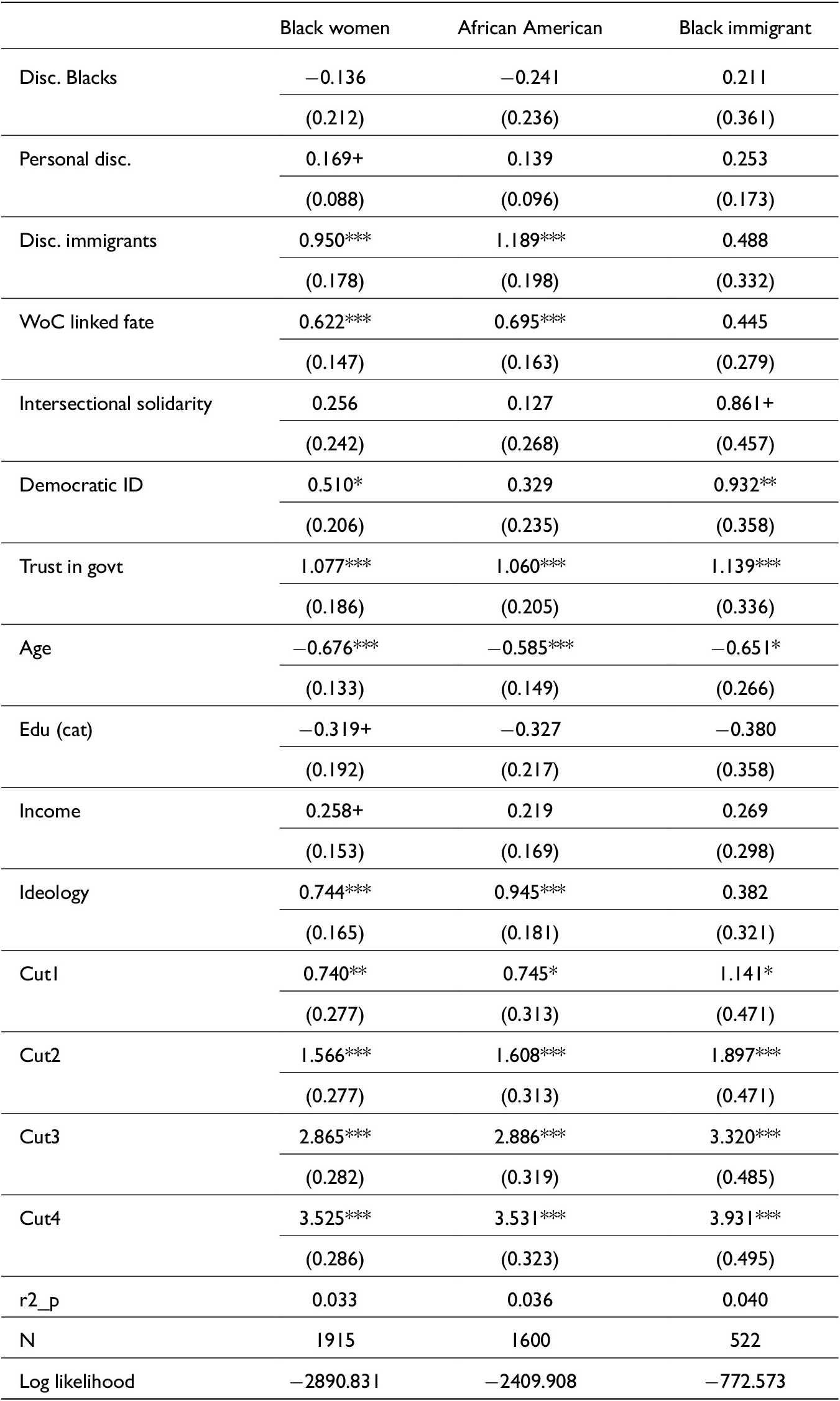
Note: Weighted.
Source: 2020 CMPS
Predictors of supporting ease of visas for immigrants

Note: Weighted.
Source: 2020 CMPS
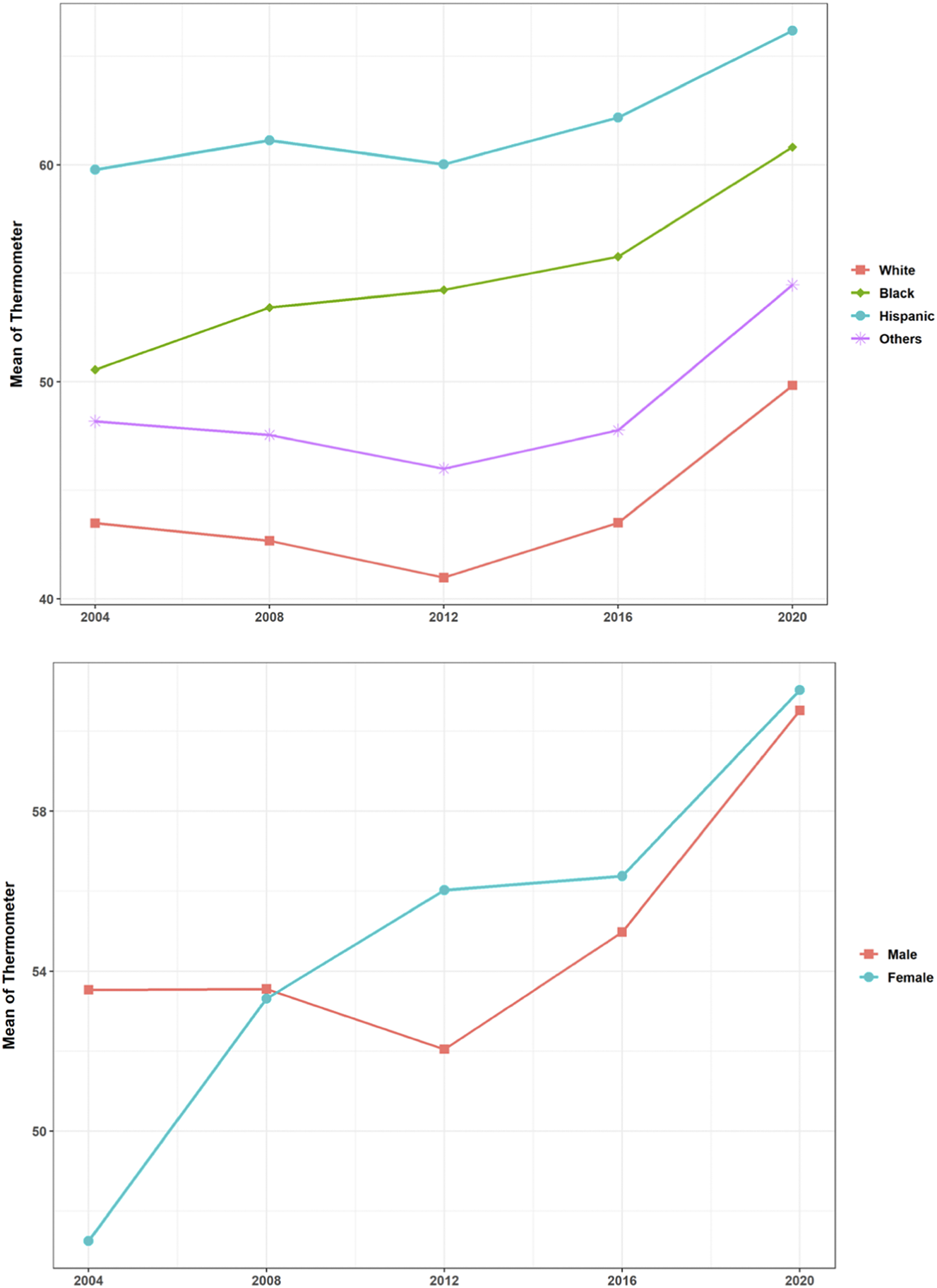
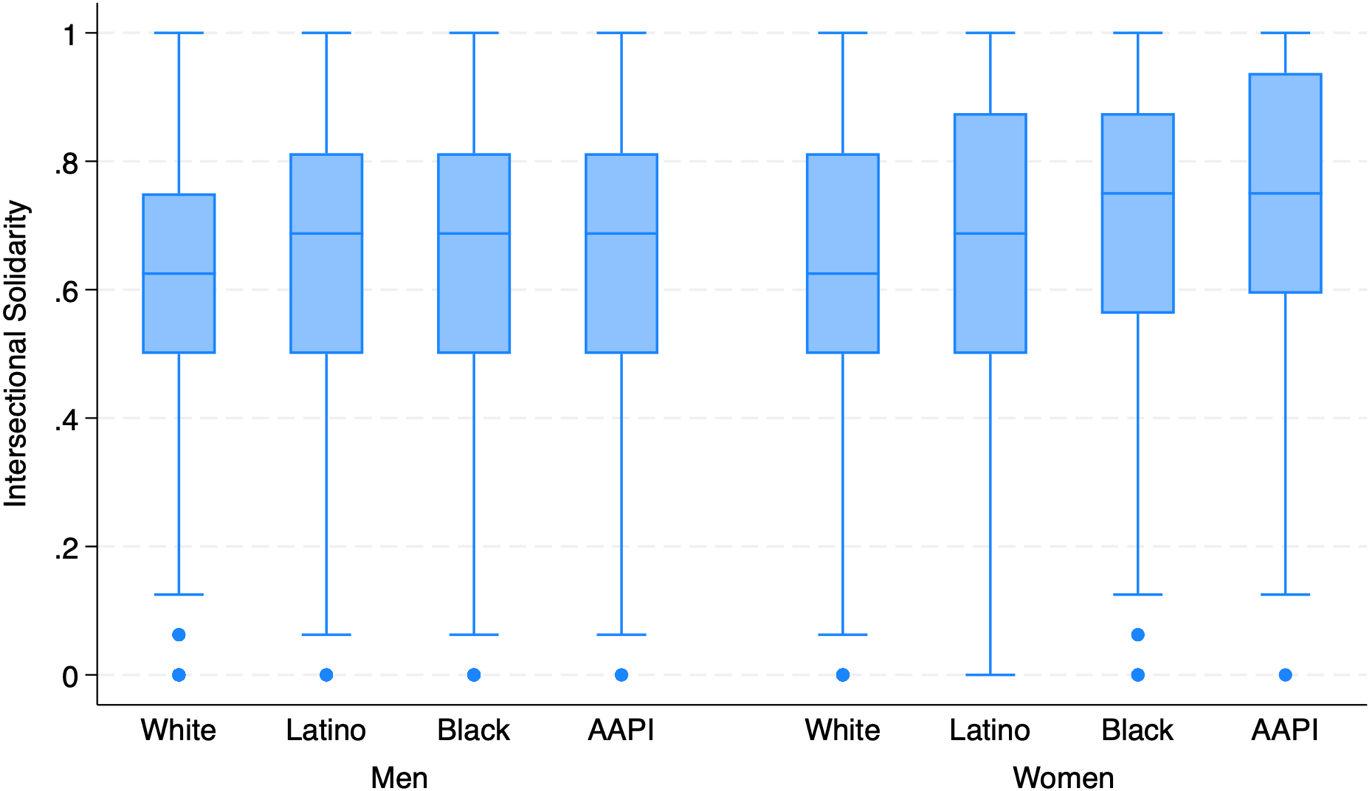
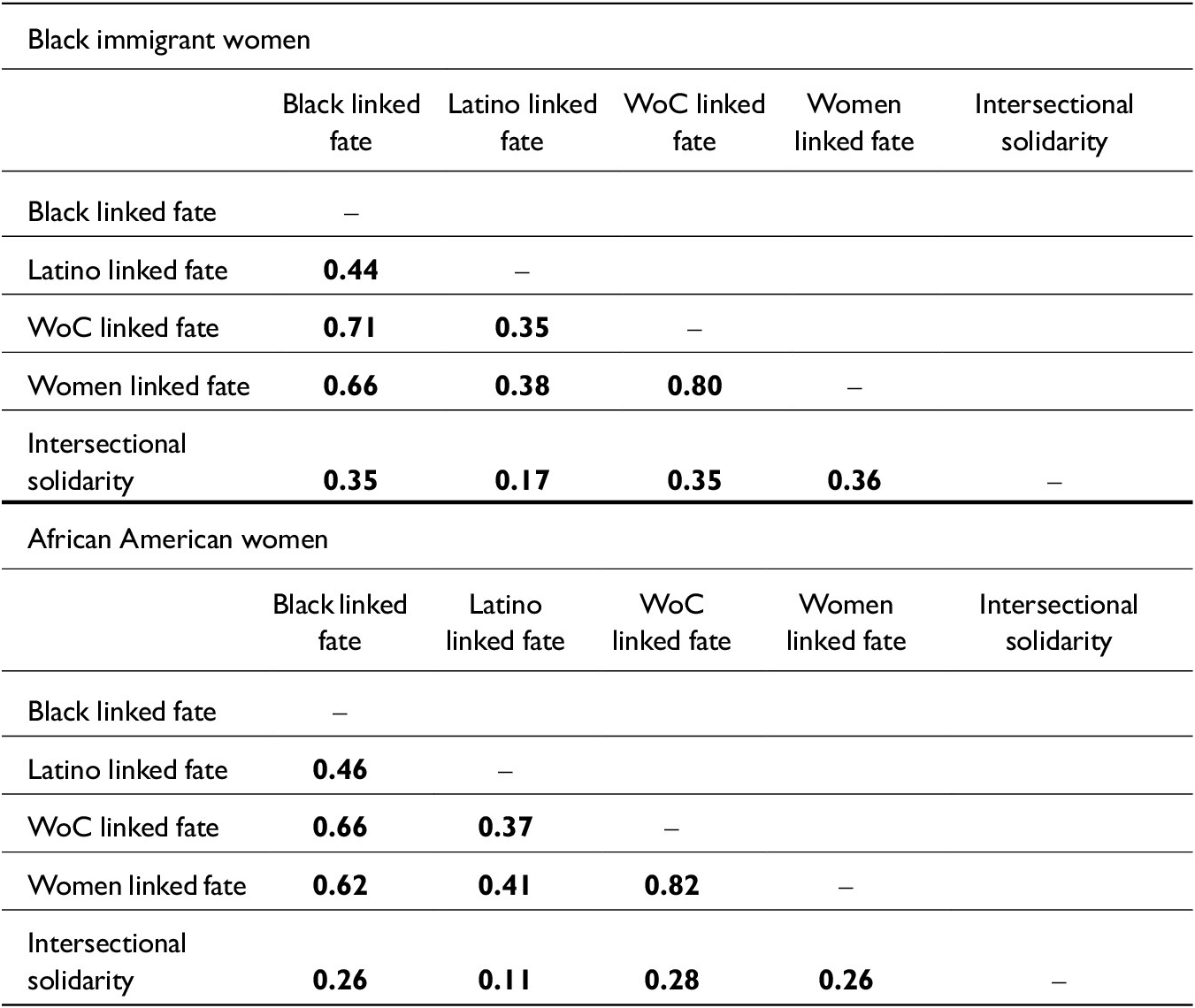
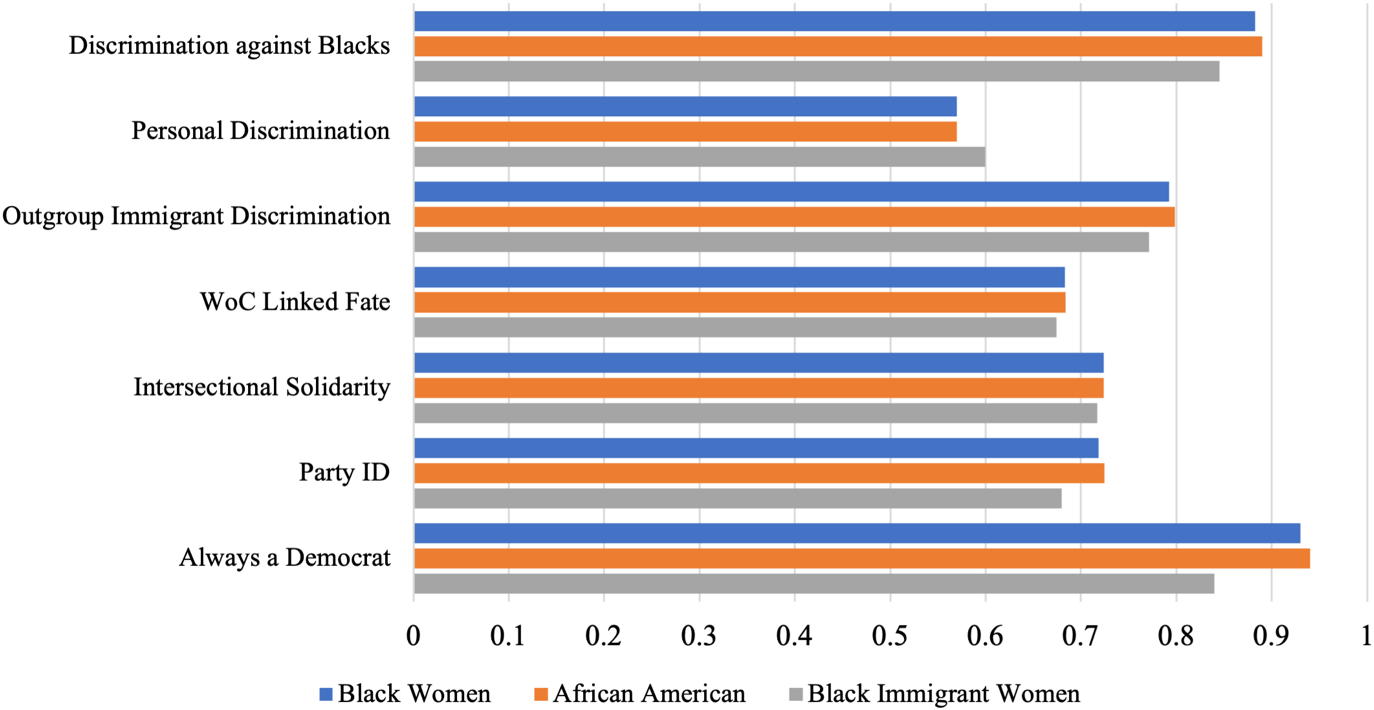
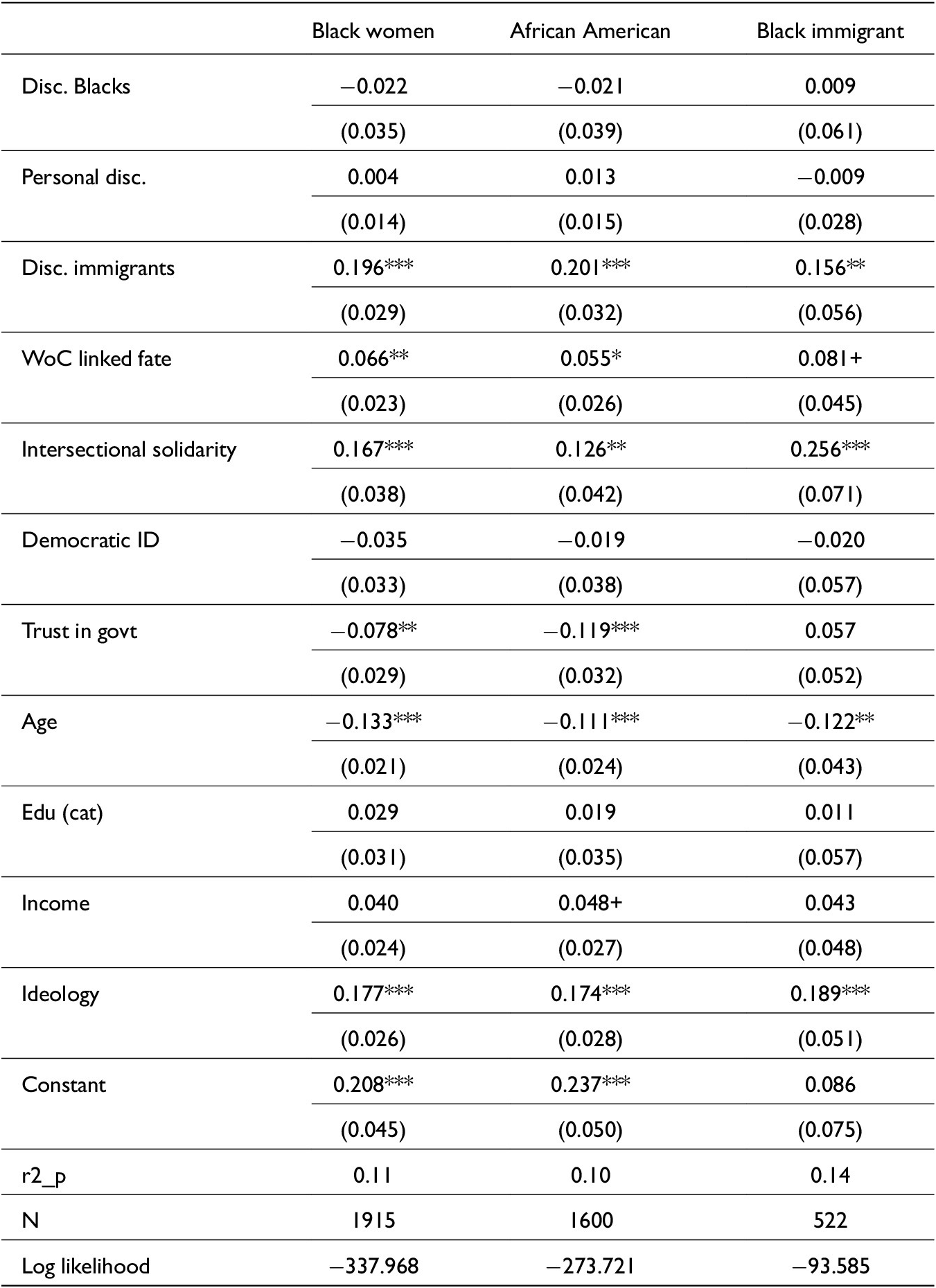
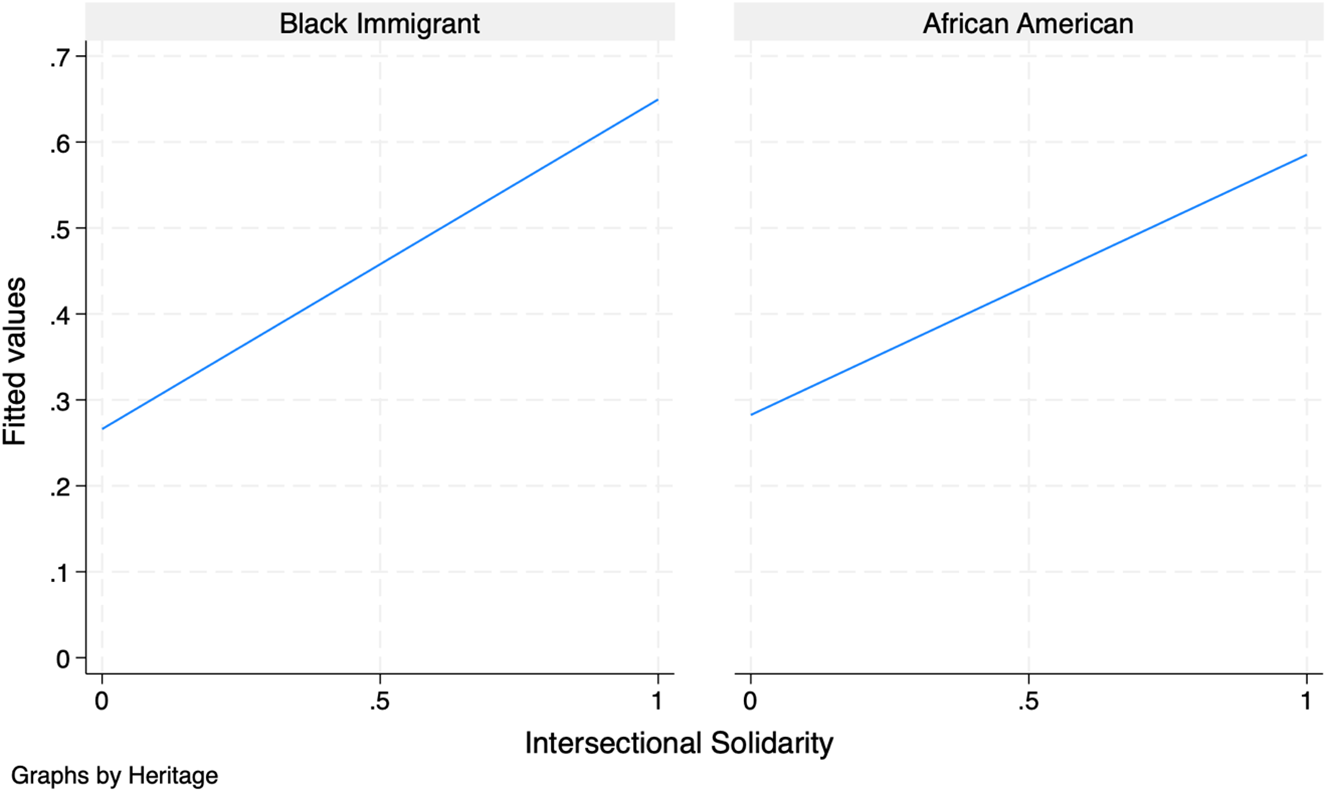
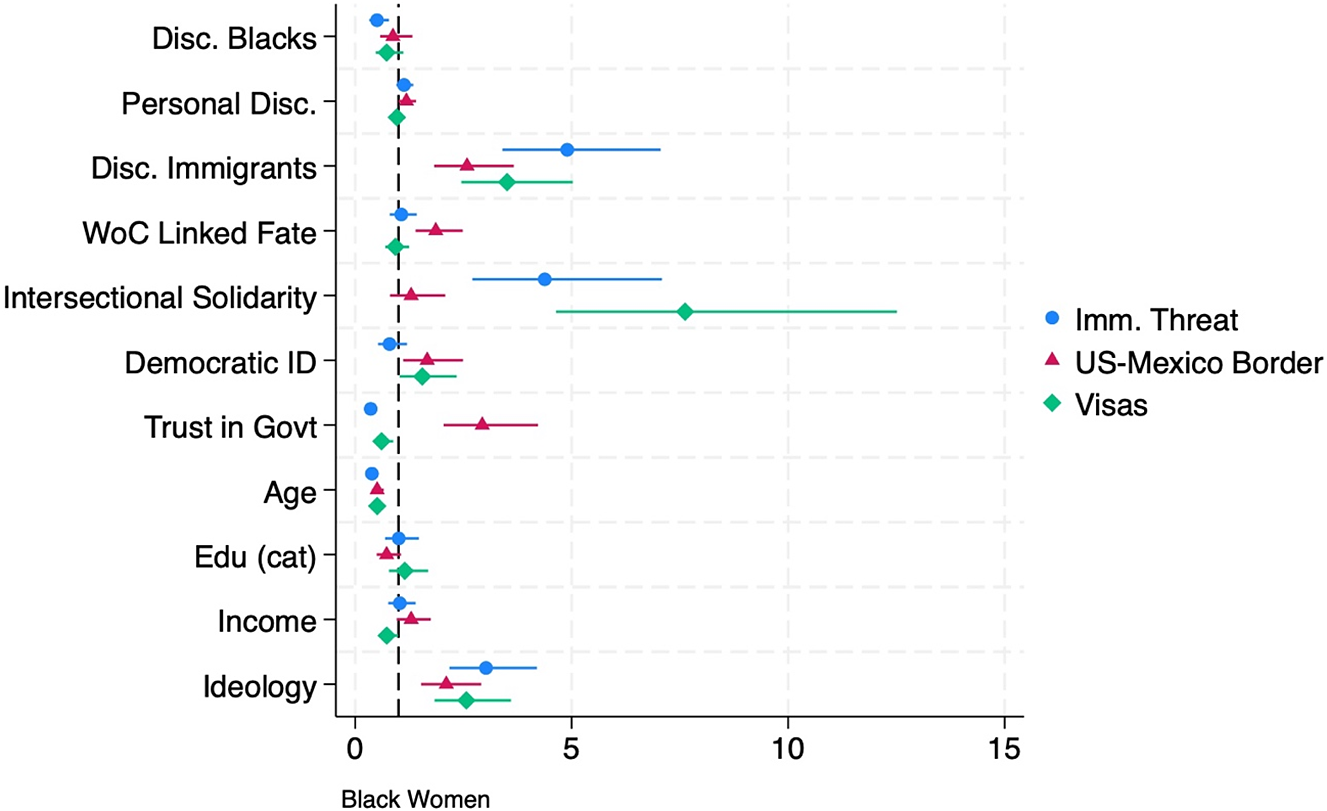
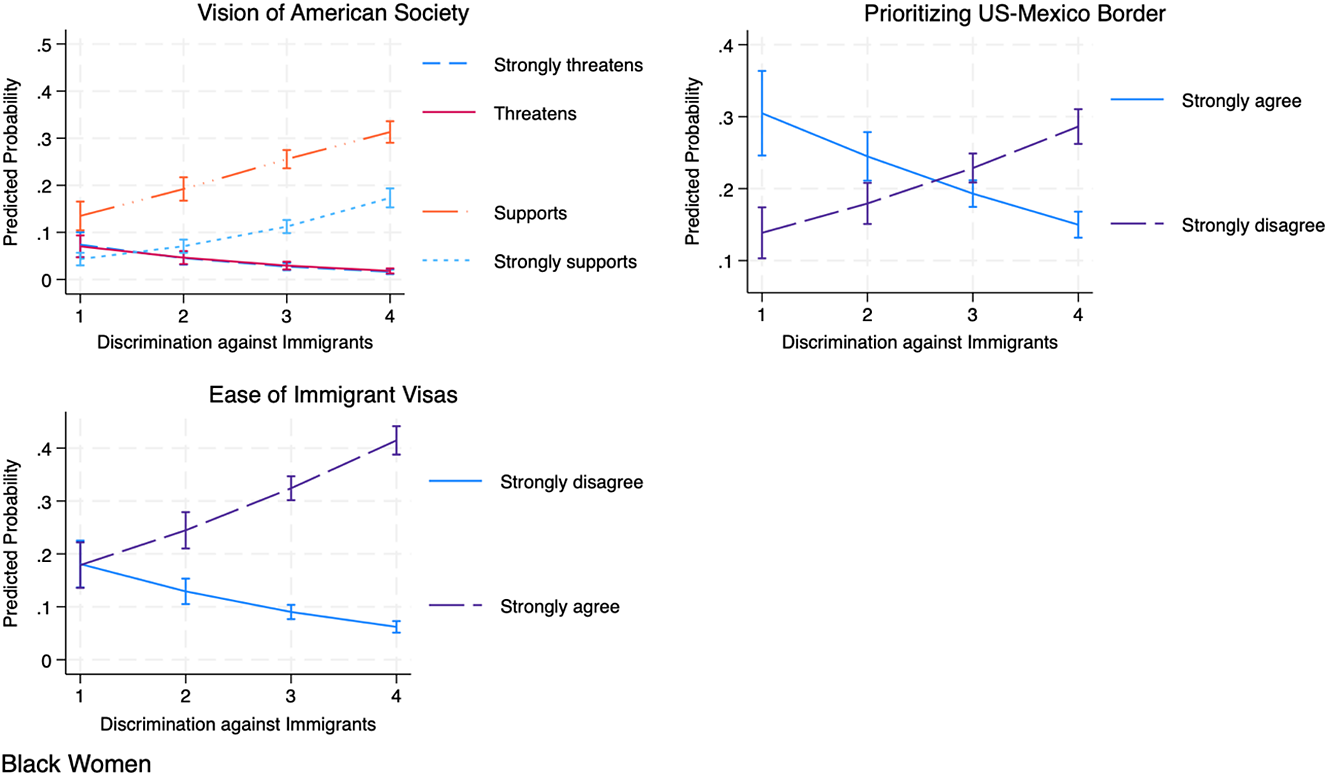
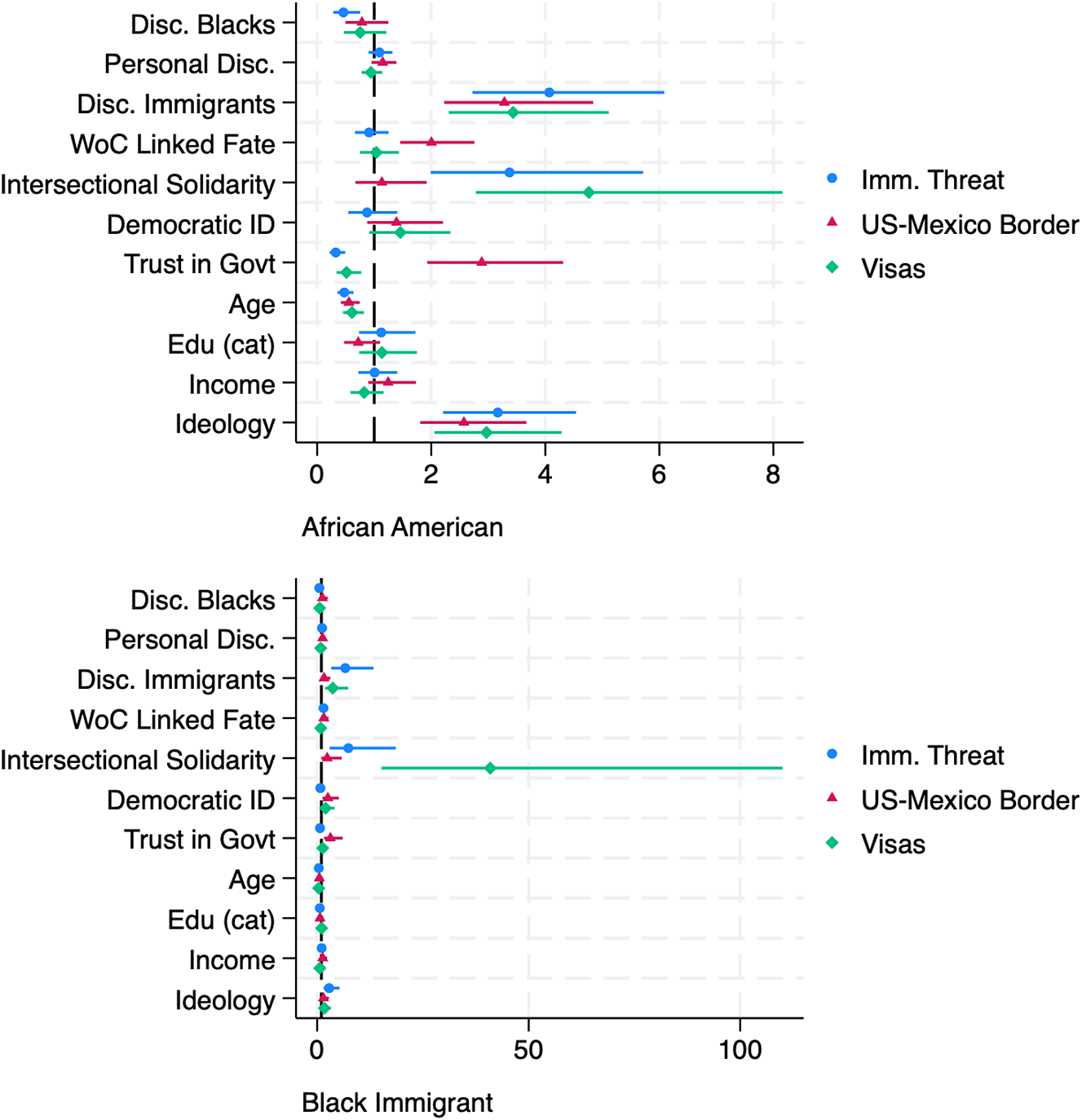

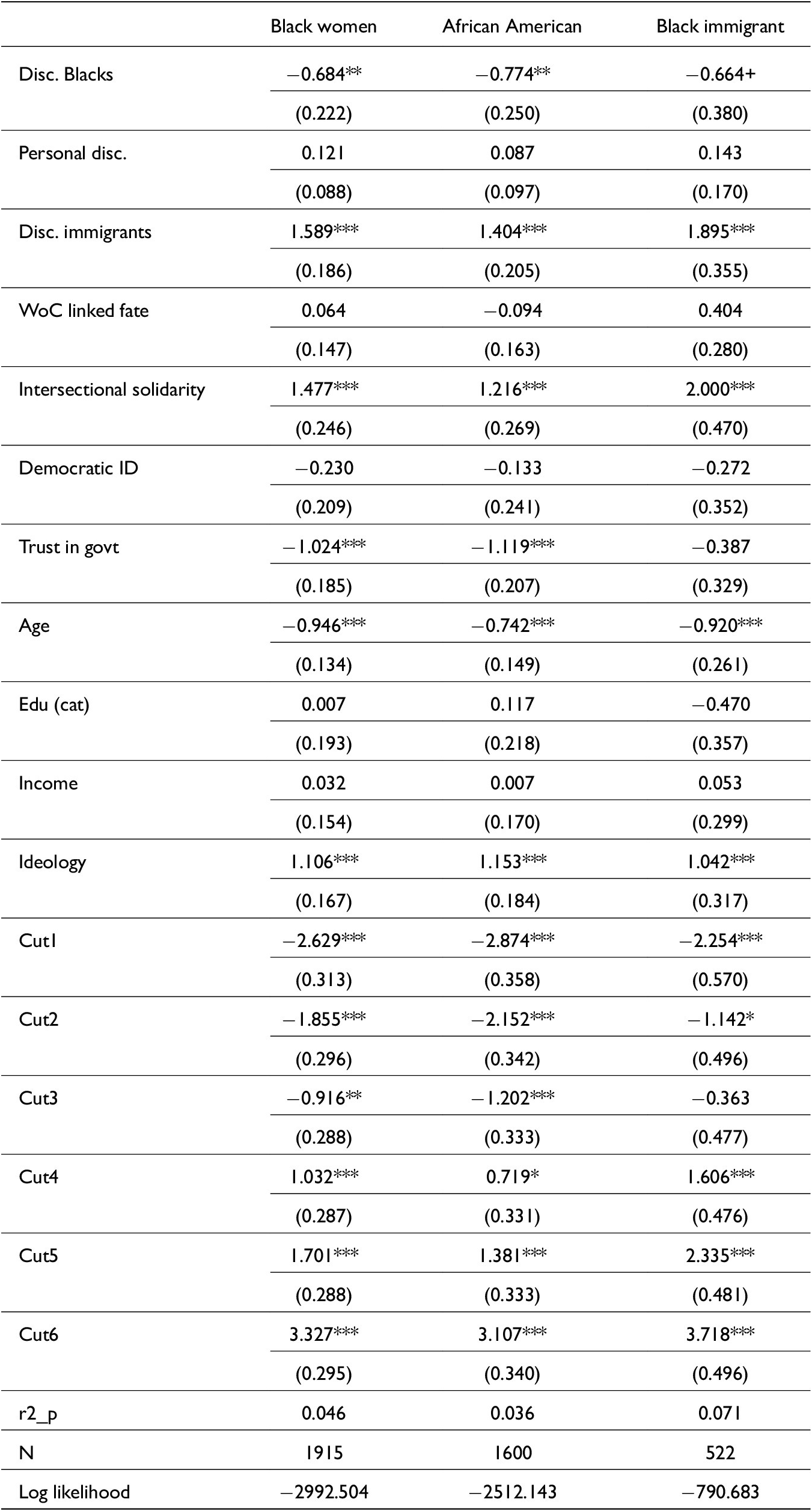
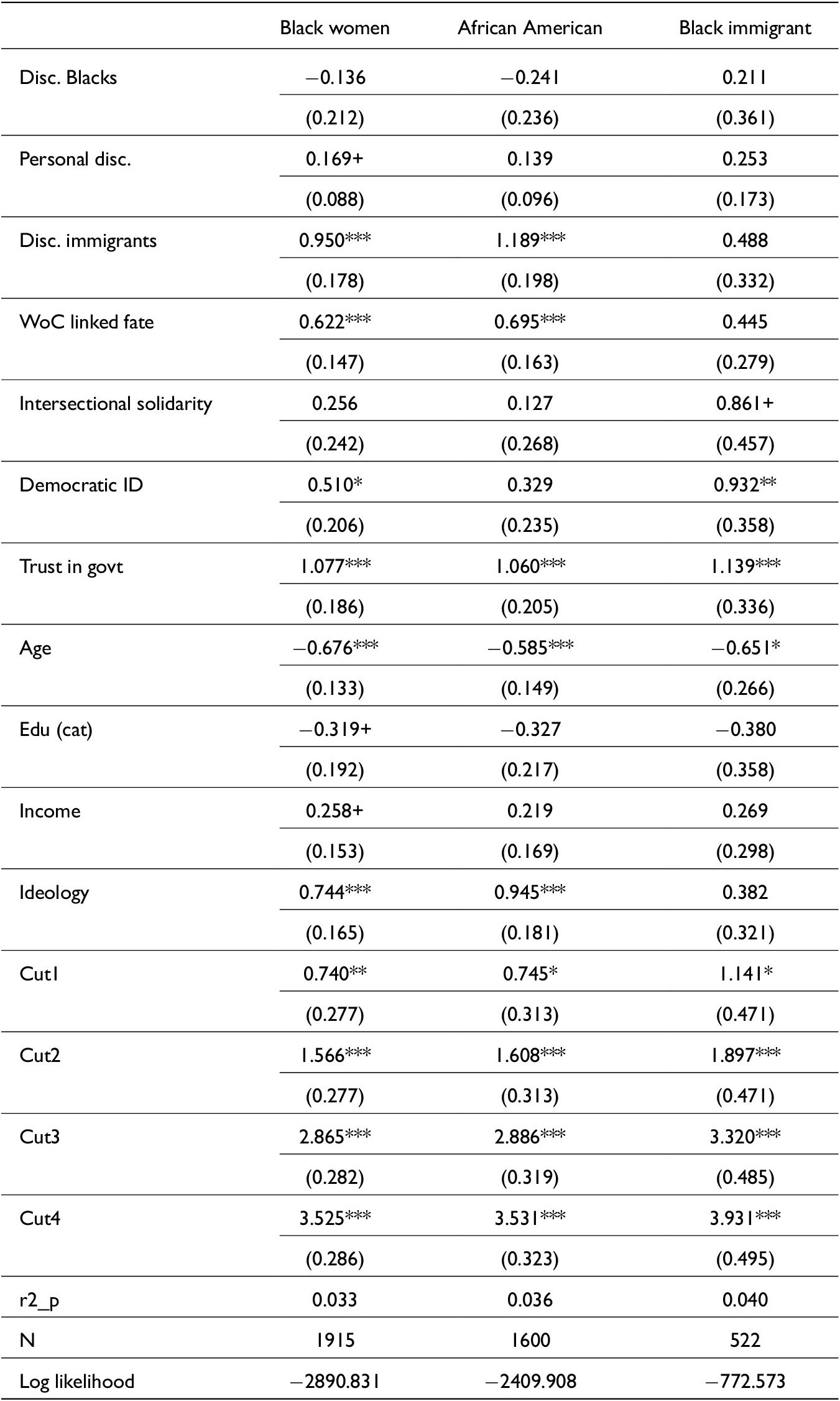
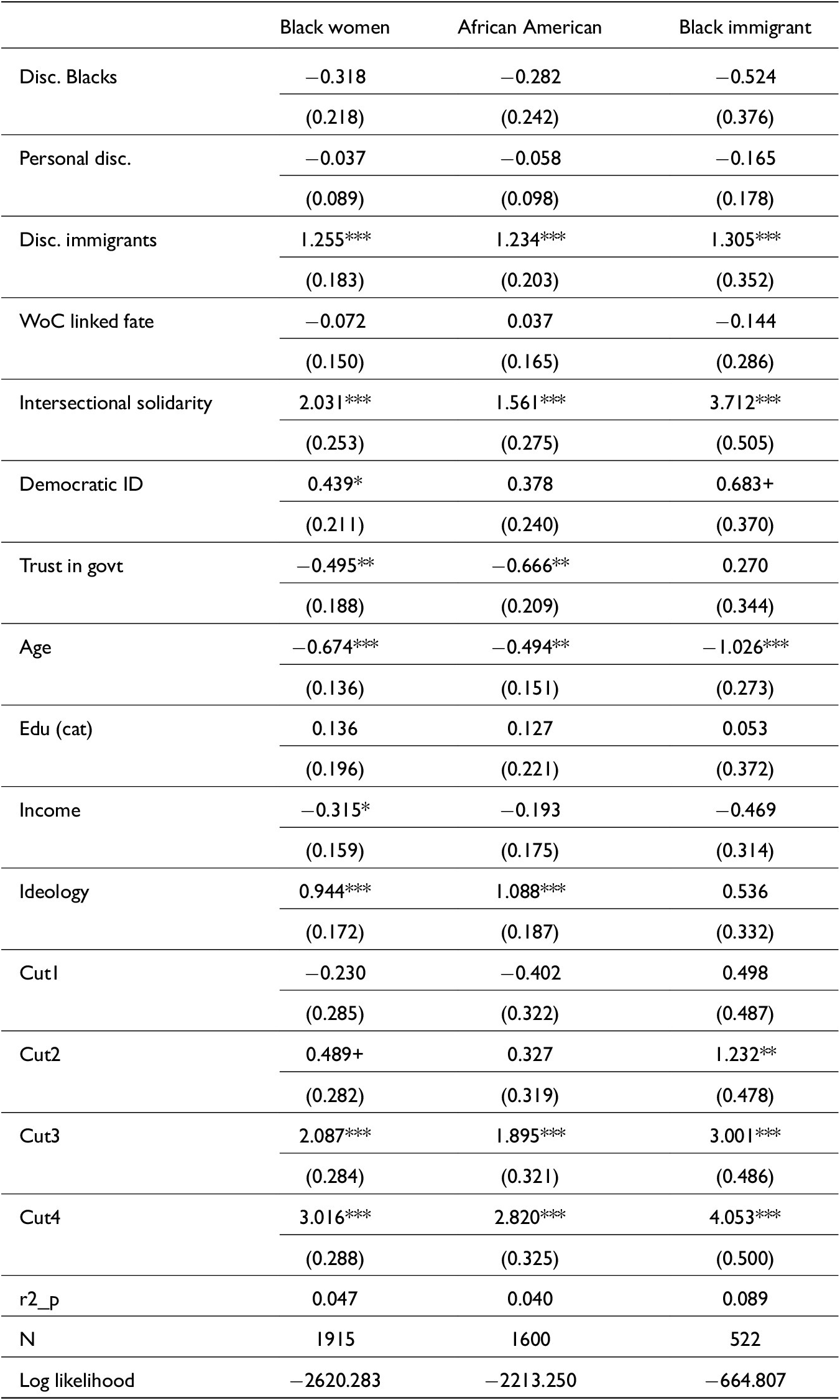


 Open access

