



Myocardial infarction (MI) remains a leading cause of morbidity and mortality in Western countries, and diet is an important modifiable risk factor( Reference Dalen and Devries 1 ). When investigating the intake of foods in relation to risk of MI, it is important to consider not only a specific food item but also the foods that may be replaced by or replace this food( Reference Astrup, Dyerberg and Elwood 2 ). This is essential because the health impact per se of the specific food item cannot be isolated from that of other foods that it replaces.
Among foods, red meat is of particular interest because of its contents of SFA, dietary cholesterol and haem Fe, which have all been adversely associated with MI risk( Reference Bernstein, Sun and Hu 3 – Reference Lee, Folsom and Jacobs 5 ). However, the existing literature on the association between intake of red meat and risk of MI is inconsistent( Reference Micha, Wallace and Mozaffarian 6 ), possibly because previous studies have not specified the replacement food in the statistical models. The most obvious alternatives to red meat are poultry and fish. As poultry and fish contain less SFA, dietary cholesterol and haem Fe than red meat, and because fatty fish is a main source of n-3 PUFA, replacement of red meat by these foods is expected to be beneficial in MI prevention( Reference Astrup, Dyerberg and Elwood 2 , Reference Jakobsen, Dethlefsen and Joensen 7 ). In addition, the various cuts of red meat and different subtypes of fish may be differentially associated with MI incidence as a consequence of their varying amounts of both health-promoting and potentially harmful constituents( Reference Li, Siriamornpun and Wahlqvist 8 ). Meat processing should also be taken into consideration, as a higher intake of processed red meat has been more consistently associated with a higher risk of MI compared with unprocessed red meat( Reference Micha, Wallace and Mozaffarian 6 ).
We conducted a follow-up study to investigate optimal substitutions between and within the following food groups for MI prevention: red meat, poultry and fish.
Methods
Study design and population
The Diet, Cancer and Health study was initiated in the period between December 1993 and May 1997 by inviting 79 729 women and 80 996 men of whom 57 053 consented to participate. All of them were 50–64-year-old citizens of the greater Copenhagen and Aarhus areas, born in Denmark and not previously registered in the Danish Cancer Registry. The protocols for the Diet, Cancer and Health study and for the present substudy were approved by the regional ethics committees on human studies in Aarhus and Copenhagen and by the Danish Data Protection Agency. A detailed description of the Diet, Cancer and Health cohort has been given elsewhere( Reference Tjonneland, Olsen and Boll 9 ).
Exposure assessment
Habitual diet over the past 12 months was assessed by a 192-item semi-quantitative FFQ filled in by the study participants before their visit to one of the two study centres in Copenhagen and Aarhus. Descriptions of the development and validation of the FFQ have been given elsewhere( Reference Overvad, Tjønneland and Haraldsdottir 10 , Reference Tjønneland, Overvad and Haraldsdottir 11 ). The participants reported the average dietary consumption of foods and beverages in twelve response categories ranging from ‘never’ to ‘eight times or more per day’. The FFQ was processed by an optical scan to check for reading errors and missing information. Any uncertainty was clarified with the study participant, and no missing values were accepted. The daily intake of different foods was calculated in FoodCalc( Reference Lauritsen 12 ), using sex-specific portion sizes( Reference Haraldsdottir, Tjonneland and Overvad 13 , Reference Tjonneland, Haraldsdottir and Overvad 14 ). In total, sixty-three questions covered the intake of meat and fish items and dishes, also providing detailed information on intakes of meat and fish subtypes. For the present study, meat was subdivided into red meat, consisting of both unprocessed and processed red meat, and poultry. Unprocessed red meat included fresh and minced beef, veal, pork and lamb. This group was further subdivided into lean (≤10 g/100 g) and fatty (>10 g/100 g) unprocessed red meat. Processed red meat consisted of red meat items that had undergone processing such as smoking, salting or curing. This included various kinds of sausages, salami, smoked or cooked ham, other cold cuts, bacon and liver pate. Poultry included chicken and turkey. Total fish included all unprocessed and processed fish as well as shellfish and was further subdivided into two groups according to the content of n-3 PUFA: fish with low contents of n-3 PUFA (≤1 g/100 g) included lean white fish, canned tuna and sardines, shellfish and cod roe, and fish with high contents of n-3 PUFA (>1 g/100 g) included darker fish such as salmon, trout and herring, fresh and canned mackerel, and lumpfish roe.
Covariates
At enrolment, the participants filled in a lifestyle questionnaire containing questions on health status, social factors, lifestyle habits and reproductive factors. The participants provided information on smoking habits, physical activity, length of schooling, medical history and known hypertension, hypercholesterolaemia and diabetes mellitus; women provided information on menopausal status and use of hormone replacement therapy (HRT) as well. Similar to the FFQ, the lifestyle questionnaire was checked for reading errors and missing information to be clarified with each study participant, although a few missing values were accepted in the lifestyle questionnaire.
At the visit to the study clinic, height, weight and waist circumference were recorded by trained health professionals. Information on alcohol consumption, intake of other foods and total energy intake was obtained from the FFQ.
Case ascertainment
The outcome measures were incident non-fatal and fatal MI. Participants registered with a first-time discharge diagnosis of MI or cardiac arrest believed to be caused by an MI (International Classification of Diseases, 8th revision, codes 410–410·99 and 427·27, and International Classification of Diseases, 10th revision, codes I21·0-I21·9 and I46·0-I46·9) were identified in the Danish National Patient Register and in the Danish Cause of Death Register using the unique ten-digit civil registration number assigned to all Danish citizens by the Central Population Register. From baseline until 2003, the medical records of potential cases were reviewed, and the cases were validated according to MI criteria set by the American Heart Association and the European Society of Cardiology for use in epidemiology( Reference Luepker, Apple and Christenson 15 ). From 1 January 2004 until 31 December 2009, participants with a MI diagnosis from a hospital ward were accepted as cases without further validation, as the positive predictive value of these register diagnoses from hospital wards is higher than 92 %( Reference Joensen, Jensen and Overvad 16 ). Other potential cases were validated by review of diagnosis and procedure codes in the National Patient Register and the Cause of Death Register. Information on vital status and emigration was obtained by linkage with the Danish Civil Registration System.
Exclusions
Participants diagnosed with cancer but not registered in the Danish Cancer Registry before baseline were subsequently excluded (owing to the original focus area of the study). Furthermore, participants with a diagnosis of MI or cardiac arrest before enrolment and participants who did not fill out the lifestyle questionnaire or had missing information on potential confounders were excluded.
Statistical methods
The study participants were followed up from the date of study entry until the date of MI diagnosis, emigration, death, loss to follow-up or 31 December 2009, whichever occurred first. The associations between meat and fish substitutions and incidence of MI were investigated by Cox proportional hazards models, in which hazard ratios (HR) and corresponding 95 % CI were calculated. Age was included as the underlying timescale. The analyses were carried out among all participants in sex-stratified analyses and separately for women and men. The observation time was calculated as the time between study entry and end of follow-up for each participant.
Baseline characteristics of the study participants were summarised using medians and 80 % central ranges for continuous variables and proportions for categorical variables. Intakes of meat and fish were energy adjusted, using the residual method( Reference Willett and Stampfer 17 ). The residual energy-adjusted variables were only used for descriptive purposes.
We investigated differences in intake of 150 g/week, which reflects a usual serving size of red meat. The substitution aspect was introduced into the statistical models by inclusion of a variable made up by the sum of the food groups red meat, poultry and fish in addition to each of these food groups separately, except for the food group to be substituted. Accordingly, the HR was interpreted as the estimated risk of MI per 150 g/week higher intake of one of the specific food groups and a concomitant 150 g/week lower intake of the food group excluded from the model. For sensitivity analyses, we also investigated substitutions in kJ/week.
All associations were investigated with adjustment for total energy (kJ/week; continuous) (model 1a) and further adjustment for the potential confounders: BMI (kg/m2; continuous), waist circumference (cm; continuous), alcohol abstinence (yes, no), alcohol intake (g/d; continuous), smoking status and amount (never, former, current <15 g tobacco/d, current 15–25 g tobacco/d and current >25 g tobacco/d), leisure-time physical activities (dichotomised; < or ≥3·5 h/week) and duration of schooling (<8, 8–10, >10 years) as a measure of socio-economic status, in addition to menopausal status (premenopausal, postmenopausal, unknown) and use of HRT (never, former, current) among women (model 1b). The continuous variables BMI, waist circumference and alcohol intake were entered using restricted cubic splines with three knots. We further adjusted for the following food and beverage groups: vegetables, fruits, sweets, soft drinks, lean dairy products, fatty dairy products, fatty potatoes, refined cereals, whole-grain cereals and nuts (all g/week; continuous) (model 2). To investigate possible effect modification, we initially carried out analyses separately for participants with and without a baseline history of hypertension (yes, no, do not know), hypercholesterolaemia (yes, no, do not know) and/or diabetes mellitus (yes, no, do not know). No substantial differences were found, and we adjusted for these conditions in an additional model (results not shown).
Possible differences in the underlying dietary patterns related to total intake of red meat and fish were investigated using radar charts. Among women and men in the lowest and highest quintiles of meat or fish intake, we compared median intake of other foods and beverages with the median intake among the entire group, using the latter as denominator to calculate percentage differences in intake. For the radar charts, the foods were investigated in g/week and were all energy adjusted using the residual method( Reference Willett and Stampfer 17 ). All statistical analyses were performed in Stata 14 (StataCorp LP).
Results
A total of 29 875 women and 27 178 men agreed to participate, corresponding to 35 % of those invited. Of these 57 053 participants, 567 with a cancer diagnosis before baseline not initially registered and 900 with a baseline diagnosis of previous MI were excluded. Furthermore, forty-two participants missing a full baseline examination and 373 participants with missing information on potential confounders were excluded. These exclusions left 29 142 female and 26 029 male participants in the present study.
During a median follow-up of 13·6 (5th–95th percentile 8·6–15·1) years for women and 13·5 (5th–95th percentile 5·0–15·1) years for men, 656 female and 1694 male cases were identified. Baseline characteristics of the cohort members and cases are presented in Table 1. Among both women and men, cases were older, had a slightly higher BMI, a larger waist circumference, were more likely to be alcohol abstainers and had lower alcohol intakes compared with the cohort. Furthermore, cases were more likely to be smokers, had lower levels of physical activity and had lesser education compared with the cohort. Among women, cases were more likely to be postmenopausal compared with cohort members, but no differences were observed regarding the use of HRT. Table 2 presents the energy-adjusted intakes of meat and fish among women and men.
Baseline characteristics of cohort and cases in the Diet, Cancer and Health study (Medians and 10th–90th percentiles or proportions)

* Among women.
† Among users.
Energy-adjusted intakes of meat, poultry and fish among women and men in the Diet, Cancer and Health study (Medians and 10th–90th percentiles)
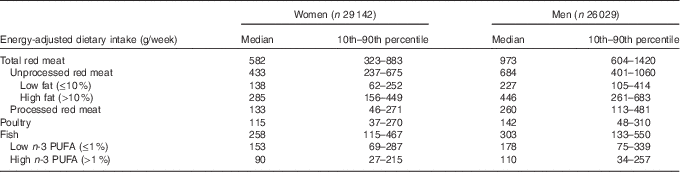
Table 3 shows the HR and 95 % CI per 150 g/week higher intake of a specific type of meat, poultry or fish and a concomitant 150 g/week lower intake of another specified type of meat, poultry or fish among all participants and separately for women and men. Among women, the results from the minimally adjusted models suggested that replacing red meat with poultry or fish was associated with a lower risk of MI (model 1a). However, after adjustment for MI risk factors, risk estimates were weakened and for poultry they were no longer statistically significant (model 1b). The HR were 0·93 (95 % CI 0·84, 1·04) for substitution of poultry for red meat and 0·89 (95 % CI 0·82, 0·98) for substitution of fish for red meat. Between subgroups of foods, replacing unprocessed red meat with fish was associated with a lower risk of MI, HR 0·87 (95 % CI 0·79, 0·97), but no association was found when replacing processed red meat with fish, HR 0·93 (95 % CI 0·82, 1·06). Replacing red meat with fatty fish was associated with a lower risk of MI, HR 0·76 (95 % CI 0·64, 0·89), but no association was found when replacing red meat with lean fish, HR 1·00 (95 % CI 0·89, 1·14). Similarly, replacing poultry with fatty fish was associated with a lower risk of MI, HR 0·81 (95 % CI 0·67, 0·98), whereas no association was found with lean fish, HR 1·08 (95 % CI 0·92, 1·27). Generally, adjustment for other foods and food groups associated with MI attenuated the results only slightly (model 2). No major changes were observed with further adjustment for baseline history of hypertension, hypercholesterolaemia and diabetes mellitus (results not shown). Within food groups, the HR for replacing lean fish with fatty fish was 0·75 (95 % CI 0·60, 0·94). Replacing processed red meat with unprocessed red meat was not associated with risk of MI, HR 1·07 (95 % CI 0·93, 1·22). Among men, no statistically significant associations were observed, but the findings indicated a pattern similar to that of women.
Myocardial infarction associated with substitutions of 150 g/week between and within the food groups of red meat, poultry and fish among women and men separately and combined in the Diet, Cancer and Health study (Hazard ratios (HR) and 95 % confidence intervals)

HRT, hormone replacement therapy.
* Sex-stratified.
† Adjusted for age and total energy.
‡ Model 1a further adjusted for alcohol abstinence, alcohol intake, BMI, waist circumference, smoking status, physical activity, duration of schooling, and for women adjusted for menopausal status and HRT use.
§ Model 1b further adjusted for vegetables, fruits, sweets, soft drinks, lean dairy products, fatty dairy products, fatty potatoes, refined cereals, whole-grain cereals and nuts.
Fig. 1 shows the underlying dietary patterns, represented by fourteen food and beverage groups, associated with low and high intakes of red meat and low and high intakes of fish among women and men separately. Panel a indicates that women in the lowest quintile of red meat intake consumed more fruits, vegetables, whole-grain cereals and lean and fatty dairy products and consumed less poultry, potatoes, fatty potatoes, soft drinks and alcohol than women in the highest quintile of red meat intake. A similar pattern was found among men. Panel b indicates that women in the highest quintile of fish intake consumed more poultry, fruits, vegetables and alcohol and less sugar, sweets and snacks than women in the lowest quintile of fish intake. A similar pattern was found among men.
Radar charts illustrating the percentage-wise differences in intake of fourteen groups of foods and beverages among women and men with the lowest and highest intakes of red meat (a) and fish (b); 100 % is equivalent to the median intake of a particular food or beverage item among all participants of similar sex.  , First quintile;
  , fifth quintile.

Discussion
In this follow-up study, we found an inverse association with MI among women when replacing red meat, poultry or lean fish with fatty fish. We found no association with MI when processed red meat was replaced with unprocessed red meat. A similar pattern, but no statistically significant associations, was found among men.
We compared the habitual diet of the study participants rather than investigating individual dietary changes over time. We compared participants who had an identical total energy intake and an identical total intake of red meat, poultry and fish, but for whom the intake of each of the three food groups differed. Controlling for the total amount of red meat, poultry and fish and at the same time including two of the three food groups in the statistical models allowed us to specify the substitutions between these three food groups. This is different from most other studies as meat and fish consumption has typically been investigated without considering replacement of food items. The substitution aspect is important, because individuals must alter their intake of specific foods primarily by changing their dietary composition rather than by changing their total energy intake, unless physical activity or body weight is changed considerably( Reference Willett, Howe and Kushi 18 ). As foods are beneficial, neutral or harmful in relation to MI development, the association between red meat and MI depends on the replacement food.
The results presented in this study are all based on substitutions of food intakes of 150 g/week, corresponding to one serving size, which is easily translated into dietary guidelines for the general population. We also investigated substitutions of equal amounts of energy from the different foods. Overall, the results were similar, and only the results from substitutions of equal weight are presented.
Owing to the inclusion criteria, participants of higher socio-economic status were slightly over-represented in the study cohort( Reference Tjonneland, Olsen and Boll 9 ), but the investigated associations are believed to be homogeneous across socio-economic groups. The follow-up of participants in the study was nearly complete, which limits the concern for selection bias. However, we cannot exclude selection bias if death from other causes with a disease aetiology similar to that of MI is associated with the probability of developing MI. Study participants who died of other atherosclerotic diseases such as stroke most likely had a higher risk of MI than participants in general due to similarities in the underlying aetiology of MI and other atherosclerotic diseases. Thus, underestimation of the associations cannot be excluded.
The dietary information was obtained from self-administered FFQ, which inherently give rise to random measurement error. This generally leads to underestimation of the true association and to loss of statistical power. The variation in the dietary data was sufficient to investigate substitutions of amounts of meat and fish translatable into serving sizes easy for the general population to comply with. The comprehensive information on intake of subtypes of meat and fish also enabled us to perform a detailed examination of subgroup-specific associations. Although FFQ may reflect the habitual eating pattern and we aimed to assess the long-term association between different food choices and development of MI, repeated measures would have been preferred over a single baseline measure. Multiple measures can correct some measurement error, and in addition dietary intake might have changed during the relatively long follow-up. The use of validated and complete registries for follow-up in addition to the confirmation and validation of each case of MI minimises the risk of misclassification of the outcome. Finally, the diagnoses were established independently of the FFQ, and information bias is thus unlikely to have affected our results.
The detailed information on potential confounders in the study limits the risk of residual confounding, but confounding from unmeasured risk factors of MI cannot be excluded. Adjustment for known MI risk factors in our models weakened the risk estimates. This indicates confounding from lifestyle habits, health status and reproductive factors. Adjustment for other foods and food groups further attenuated our results, although only slightly. Confounding from other foods is expected, as meat and fish choices are most often followed by different accompaniments, which are part of an underlying dietary pattern that might be differentially associated with MI. Some of these differences in dietary patterns are evident from the radar charts in Fig. 1. With adjustment for other dietary factors, the food substitution per se was investigated, but the results could not be easily applied to a meal context. The results from analyses on meat and fish substitutions without adjustment for diet should be interpreted in the context of the underlying dietary patterns.
Two previous studies on meat consumption and MI have investigated substitutions of meat with a specified replacement food. In a large follow-up study of US female nurses, Bernstein et al.( Reference Bernstein, Sun and Hu 3 ) found that replacing one serving per day of red meat with poultry or fish was associated with a statistically significant 19–24 % lower risk of CHD. Our finding of an inverse association for replacement of red meat with fatty fish among women is in agreement with this finding. In a community-based follow-up study of US women and men, Haring et al.( Reference Haring, Gronroos and Nettleton 19 ) found no association with CHD when red meat was replaced with poultry or fish and seafood or when processed meat was replaced with unprocessed red meat. The findings for poultry and processed meat replaced with unprocessed meat are in agreement with the observed results in this study. Our findings suggest that fatty fish is a better alternative to red meat and poultry than is lean fish. This could be explained by the higher content in fatty fish of n-3 PUFA with their presumed beneficial effects on CHD( Reference De Caterina 20 ). Thus, from a health perspective, a higher intake of fatty fish in place of red meat, poultry and lean fish is beneficial, but the potential sustainability challenges with an overall increased fish consumption should also be considered( Reference Li and Hu 21 ). Even though we only found statistically significant protective associations among women, a similar pattern was observed among men. The sex difference in the underlying risk of MI may partly explain the weak associations among men( Reference Mosca, Barrett-Connor and Wenger 22 ), as men have a higher baseline risk of MI than women and the measures of association are expressed relatively.
In conclusion, replacing red meat, poultry or lean fish with fatty fish was associated with a lower risk of MI. Thus, this study suggests that fatty fish is a favourable alternative to meat and lean fish items. Studies on individual dietary changes over time and subsequent risk of MI would add additional scientific value to elucidate the role of red meat, poultry and fish in MI development.
Acknowledgements
The authors thank the Danish Cancer Society and the staff at the Diet, Cancer and Health study for the collection and administration of data.
This work is part of the project ‘Diet and prevention of ischemic heart disease: a translational approach’ (DIPI, www.dipi.dk), which is supported by the Danish Council for Strategic Research (contract 0603-00488B). One-third of the fellowship was granted by the Graduate School of Health, Aarhus University. The primary data collection was funded by the Danish Cancer Society. The funding agencies had no role in the design, analysis or writing of this article.
The authors’ contributions are as follows: A. M. L. W., K. O. and M. U. J. contributed to the study design; A. T. and K. O. collected the data; A. M. L. W. performed the statistical analyses; A. M. L. W., M. D. H., A. T., E. B. R., E. B. S., K. O. and M. U. J. were involved in the interpretation of the data and critical revision of the manuscript; A. M. L. W. wrote the manuscript. A. M. L. W. had primary responsibility for the final content. All the authors read and approved the final version of the manuscript.
The authors declare no conflicts of interest.



