

The repeated expression of a subject, a type of topicalization, is a common feature across the world’s languages. In contemporary varieties of French, it is a well-known vernacular feature that has been studied extensively, labeled subject doubling, subject dislocation (henceforth SD) or left dislocation,Footnote 1 depending on syntactic criteria (Auger, Reference Auger1998; Nadasdi, Reference Nadasdi1995a; Thibault, Reference Thibault1983; Zahler, Reference Zahler2014). In contrast, in English, doubled expressions of the subject are rare. While they have been present since Old English (Traugott, Reference Traugott2007), the literature suggests this phenomenon has never made up more than 1% of all subjects: compare Old English (.7%) to Switchboard Corpus (.6%) (Liberman, Reference Liberman2008). Although doubled subjects have declined through the history of written varieties of English (Pérez Guerra & Tizón-Couto, Reference Pérez Guerra, Tizón-Couto, Shaer, Frey and Maienborn2004), it is reported in contemporary varieties of spoken English (Godfrey & Holliman, Reference Godfrey and Holliman1993). While the feature is sometimes mentioned for English dialects (e.g., Southard & Muller, Reference Southard and Muller1998), even in places where it is attested, such as in the southern United States, it is considered rare.
Tagliamonte and Jankowski (Reference Tagliamonte and Jankowski2019) reported high levels of SDFootnote 2 in the English spoken in Kapuskasing, Ontario, where locals have Anglophone and FrancophoneFootnote 3 heritage language background, and linked this usage to high levels of French-English bilingualism. A quantitative comparative analysis contrasting English-speaking Anglophones and English-speaking Francophones revealed a trend in apparent-time toward increasing SD, and parallelism in its linguistic patterns in the youngest age groups. SD was used more among young people of both heritage language cohorts, and their usage patterns conformed to a subject constraint well-known in studies of French (Tagliamonte & Jankowski, Reference Tagliamonte and Jankowski2019). They explained these findings as grammatical alignment (e.g., Chandler, Reference Chandler2007:117-124, 306; Cheshire, Reference Cheshire, Trudgill and Cheshire1998:139-140) based in part on a rising proportion of heritage Francophones in the community over the last decades of the twentieth century as well as simultaneous increasing bilingualism of residents regardless of heritage language, suggesting that the origin of SD in the Anglophones was influence from French. However, SD is found in many languages as well as being documented throughout the history of English and in contemporary English dialects. These facts present a puzzle: Is the explanation for SD found in language-specific influence or is it some more universal process? Further study was required to elucidate the nature of this feature in Ontario.
Emerging findings from analyses of linguistic features in other bilingual situations suggest that the local embedding of social factors, linguistic constraints, and typological considerations are key to understanding cross-linguistic contrasts. Quantitative studies that examine the structure of variation expose the importance of speaker choices in spontaneous interactions. For example, use of Spanish and Portuguese on the border of Northern Uruguay (Carvalho, Reference Carvalho2016:217) demonstrates that use of third-person singular pronouns in the two languages has “not converged into a single variable third-person singular pronoun system.” A comparison of English/Spanish subject omission in contemporary varieties (Torres Cacoullos & Travis, Reference Torres Cacoullos and Travis2019) demonstrates parallels in the probabilistic constraints, even in two languages where overall rates are known to differ. These findings champion the comparative variationist enterprise in exposing language-particular versus cross-language patterns and suggest that these methods applied to language contact situations will offer crucial insights to understanding language universals.
In this study, we build on the earlier research of the Kapuskasing bilingual situation (Tagliamonte & Jankowski, Reference Tagliamonte and Jankowski2019) by conducting a comparative study with SD in another community: Parry Sound. We also embellish the comparative enterprise by adding in considerations of sociolinguistic typology (Trudgill, Reference Trudgill2011). In this case, we compare distinct communities based on language contact, one highly bilingual, Kapuskasing, where the majority of the population are Francophone, versus another, Parry Sound, where the majority of the population are Anglophone and trace their ancestry to the United Kingdom. These two communities offer antithetic scenarios in Trudgill’s typology of community types: they are both small with tight social networks. However, Kapuskasing is high for language contact (type 6) and Parry Sound is low (type 1) (Trudgill, Reference Trudgill2011:148). This is an ideal situation for testing the origin of SD in each community and for contributing insight into SD more generally.
Dislocation, left dislocation, subject doubling
Many constructions can be considered “dislocation.” In this study, we focus on constructions on the left periphery in which a subject is repeated, resulting in a lexical NP or strong pronoun adjacent to a subject pronoun that further explains or identifies the subject, as in (1).

In most cases, the NP subject comes first; however, the first position can also be a strong pronoun, as in (2).

Many studies of this phenomenon distinguish between “doubling” and “dislocation” (e.g., Culbertson, Reference Culbertson2010). In some languages and varieties closely related to Standard and Colloquial French, such as Pied Noir (Roberge, Reference Roberge1990), Picard (Auger, Reference Auger2003), and Montréal French (Nagy, Blondeau, & Auger, Reference Auger2003), it is possible for quantified DPs to be doubled, whereas in Standard and Colloquial European French, it is not (e.g., Personne (*il) ne parle ‘Nobody speaks’). The inability to double a quantified DP has yielded a syntactic analysis of left dislocation for a sentence such as John il parle ‘John speaks,’ placing the DP outside the clause and “the clitic as a resumptive element in canonical subject position” (Culbertson, Reference Culbertson2010:105). If quantified DPs can be doubled, as they can in some varieties, then the structure is true “subject doubling” and the clitic is “an agreement marker with the DP in canonical subject position” (Culbertson, Reference Culbertson2010:105, based on Rizzi, Reference Rizzi1986). Given this analysis and the complete absence of doubling with quantified subjects in our data, it seems clear that the phenomenon in our colloquial English data is SD.Footnote 4
Situating the linguistic variable
SD is a well-known characteristic of topic prominent languages (e.g., Li & Thompson, Reference Li, Thompson and Li1976). English and French are considered subject-prominent languages. However, such languages also have ways of producing topic-comment structures, including adverbial expressions, passive voice, clefting, and fronting. Dislocation is only one of these strategies. A key fact for our study is that repeated subjects are frequent and robust in French but not in English.
In Canada, French and English are official languages; the presence of French varies by region. In the province of Québec, French is the majority language and double expressions of the subject are a prominent feature (Nadasdi, Reference Nadasdi1995a). In Ontario, French is a minority language in most places. In certain pockets, however, Francophones represent large proportions of the population (Mougeon, Beniak, & Valois, Reference Mougeon, Beniak and Valois1985), and their French also has the characteristic doubling of subjects. In contrast, SD is not a prominent feature in English generally nor in the English dialects of Ontario, though rare attestations and anecdotal reporting attest to its presence in rural varieties and nonstandard registers. In the next section, we review some of the patterns of repeated expressions of the subject in varieties where it has been studied.
Doubling and dislocation in French
In European varieties of French, subject doubling and dislocation are reported to have several linguistic patterns depending on variety and community. Nagy et al. noted that Sankoff posited doubling and dislocation to “represent different stages in the process of grammaticalization [such that] ‘The [third person] clitic would become a morphological component of the verb and would acquire quasi-obligatory status, even when a noun phrase with the same referent is present in the clause’” (Nagy et al., Reference Nagy, Blondeau and Auger2003:78, citing Sankoff, Reference Sankoff and Dittmar1982:85).
Blanquart (Reference Blanquart2012:25-26) cited De Cat’s claims (De Cat, Reference De Cat2007:220-242) that approximately a quarter of clauses in spoken French contained a dislocation, mostly definite noun phrases.Footnote 5 Her explanation for these constructions was emphasis or topic shift, used when speakers are expressing opinions, contrast, or turn-taking (Blanquart, Reference Blanquart2012:41). Doubling has been especially associated with northern French dialects in the Picard region of France,Footnote 6 where it was reported to be near obligatory (Coveney, Reference Coveney2005:103-105), held to convey social meaning, and had an age-grading pattern where middle-age speakers between the ages of 24-37 had the lowest rates. It has also been considered to have “particular significance as a badge of Picard identity” in the Picard French dialect, being “obligatory not only for NPs headed by a noun […], but even for pronouns such as the Picard equivalents of tout le monde and chacun” (Coveney, Reference Coveney2005:103). It has been a highly stigmatized feature, as evident in the attitudes of traditional grammarians and authors of second language teaching materials until the mid-twentieth century. Subject doubling in French “was already being criticized in the seventeenth century for the superfluous subject pronoun” (Coveney, Reference Coveney2005:97). In Swiss French, Fonseca-Greber (Reference Fonseca-Greber2000) reported that subject doubling occurred 77% of the time, even with indefinite subjects, as in (3):

In contrast, Zahler (Reference Zahler2014:868-869) found lower rates of doubling in spoken Parisian French (22%) compared to other varieties. She suggested that this was due to the formality of her data and the status of Parisian French as the standard variety.
In Canadian French, referring to this phenomenon as subject doubling, Sankoff (Reference Sankoff and Dittmar1982) reported an overall rate of 55% in Montréal, while Auger and Villeneuve (Reference Auger, Villeneuve, Remyse and Vincent2010) reported an overall rate of 45% in Saguenay. In Ontario (Pembroke, North Bay, Cornwall, and Hawkesbury), (Nadasdi, Reference Nadasdi1995a:7, Table 1) reported 27% overall. Nagy et al. (Reference Nagy, Blondeau and Auger2003:88-90) reported 37% subject doubling among Anglophones speaking French in Montréal. Those with the highest exposure and integration into Canadian French culture produced the most, suggesting parallel behavior with native Francophones.
Doubling and dislocation in English
In English, SD has the social meaning of rurality, though to our knowledge it is not overtly commented on by traditional grammarians or dialectologists. A few descriptions of Southern and Appalachian US dialects (e.g., Southard & Muller, Reference Southard and Muller1998; Wolfram & Christian, Reference Wolfram and Christian1976) mention SD. Yet it is salient enough to be used by authors and comedians to represent nonstandard, rural dialects. Examples (4-6) are from Mark Twain’s Huckleberry Finn (Southard & Muller, Reference Southard and Muller1998).Footnote 7


In some rural Ontario locations with no significant French influence, there is notable SD, and the same nonstandard, rural associations. For example, Canadian comedian Don Harron’s signature character, Charlie Farquharson, the personification of a rural Ontario farmer from Parry Sound, Ontario, appeared for over half a century on radio and television, including on the long-running (1969-1992) North American country music sketch comedy series Hee Haw. When performing as Farquharson, Harron regularly used SD among his cadre of lexical, syntactic, and phonological vernacular speech features for comedic effect, as in (7-8).Footnote 8


The point of departure for this study is to probe the linguistic patterns of SD in Ontario English in two situations. The characteristics of Kapuskasing and Parry Sound offer a singular opportunity to compare communities with maximally different language contact situations, where there is salient use of SD.
Circumscribing the variable context
Following variationist sociolinguistic methods, we circumscribe the variable context of SD using the principle of accountability (Labov, Reference Labov, Lehmann and Malkiel1982:30). We excluded false starts, such as sentence fragments that did not contain a predicate, and where the two co-referential elements for the subject were unclear. Although Nagy et al. (Reference Nagy, Blondeau and Auger2003:82) included all strong third-person subjects, both pronouns and noun phrases, we restrict the present analysis to noun phrase subjects only. This is because Tagliamonte and Jankowski (Reference Tagliamonte and Jankowski2019:4-5) found that noun phrases exhibited a rate of 10% SD (n = 6828) in Kapuskasing, whereas subjects outside of first- and third-person contexts, as in the second-person in (9), represented little more than 1% of the data.

The data
SD is used by individuals of all ages in both Kapuskasing and Parry Sound in animate referents, both proper names and noun phrases, as in (10-11), as well as with inanimate nouns, as in (12).


The presence of SD in Parry Sound and in both heritage language groups in Kapuskasing raises important questions: Is the linguistic and social patterning of SD parallel or different, and if so, how? By conducting a consistent analysis in Kapuskasing and Parry Sound, we aim to assess whether it is the same phenomenon or distinct. The results will permit us to understand whether SD is a feature of English or whether it developed in Kapuskasing English due to contact with French, where SD is a characteristic feature. More broadly, we hope to contribute to an understanding of the general process of dislocation in language more generally. Simply put, is influence from French the reason for the relative abundance of SDs in Kapuskasing, or is SD in Ontario English more generally the result of a pervasive phenomenon of topicalization in vernacular speech?
Data and method
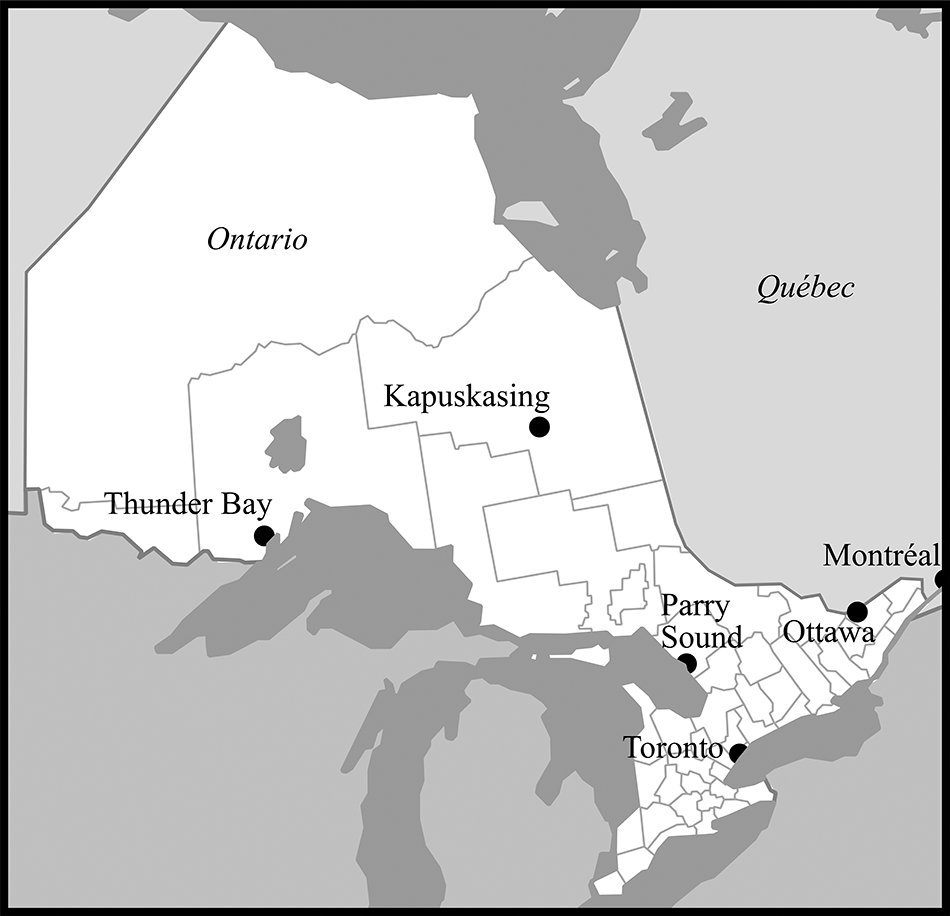
The data come from a long-term research program, the Ontario Dialects Project (ODP) (Tagliamonte, Reference Tagliamonte2013-2018).Footnote 9 We focus on the two communities, shown in Figure 1, with several Canadian cities indicated for reference: Montréal, Ottawa, Toronto, and Thunder Bay.
Map showing Kapuskasing and Parry Sound (Adapted from: https://commons.wikimedia.org/wiki/File:Ontario_Locator_Map.svg).
Kapuskasing
Kapuskasing has a population of 8,292 (Statistics Canada, 2017) and is 850 km (500 miles) from Toronto, making it relatively isolated from the urbanized south. Kapuskasing was founded in the 1920s with an economy driven by pulp and paper, which remains the dominant industry (Dunlap, Reference Dunlap2017; Town of Kapuskasing, 2010). The community has a strong religious tradition, a bent toward outdoor activities, and close-knit social networks (Tagliamonte & Jankowski, Reference Tagliamonte and Jankowski2019:4).
In 2016 the population was over 65% primary Francophone speakers, and over 70% of residents report knowledge of both English and French (Statistics Canada, 2017). This population mix is unusual; although French is one of Canada’s official languages, it is by far the minority language in the province of Ontario at only 4%. In Kapuskasing, however, Anglophones and Francophones have been living together in long-term contact since the early 1900s. The high rate of reported bilingualism as compared to the rest of Ontario (and Canada) is unique, offering the opportunity for studying the impact of potential French influence on English in a language contact situation.
Kapuskasing and Parry Sound corpora

Parry Sound
Parry Sound is 225 km (140 miles) from Toronto. In comparison to Kapuskasing, Parry Sound is relatively “old,” having been incorporated in 1887. It is a small town with a population of 6,321 (Statistics Canada, 2017). The area is predominantly Anglophone (93%), with ancestral roots from the British Isles and a few reports of other languages. While this area also had an early economy of pulp and paper, tourism has become its most prominent industry in the late twentieth century (see also Jankowski, Needle, & Tagliamonte, Reference Jankowski, Needle and Tagliamonte2022).
The Kapuskasing and Parry Sound corpora comprise conversational interviews conducted using sociolinguistic methods and collected during community-based fieldwork in 2016 and 2018 (Labov, Reference Labov and Labov1972; Tagliamonte, Reference Tagliamonte2006). The sample design is shown in Table 1.Footnote 10
The focal dimension of comparison is the heritage language group—Anglophone or Francophone in Kapuskasing versus Anglophone only in Parry Sound. While there are many other differences between the two towns, they both share the attribute of having salient use of SD. This is particularly germane for assessing the nature of this phenomenon in the Ontario context.
Coding and analysis
To assess the patterns of variation, we coded linguistic and social factors previously reported to condition SD use in French and English.
Linguistic factors
Many linguistic factors constraining SD have been attested in the literature (see Zahler, Reference Zahler2014). However, in this study we focus on the main factors found to be significant.
Type of subject
The nature of the subject noun phrase figures in every study and can be defined in many different and overlapping dimensions including animacy, definiteness, and specificity (Auger, Reference Auger1998; Nadasdi, Reference Nadasdi1995b). However, in studies that focus on third-person subjects only, subject type is most commonly categorized according to kind (e.g., proper versus common, and animacy; Auger & Villeneuve, Reference Auger, Villeneuve, Remyse and Vincent2010; Nagy et al., Reference Nagy, Blondeau and Auger2003). Across studies, full noun phrase subjects are found to have the most SD, and proper nouns favor it more than common nouns (e.g., Nagy et al., Reference Nagy, Blondeau and Auger2003:88). Tagliamonte and Jankowski (Reference Tagliamonte and Jankowski2019) showed that this constraint was operational in Kapuskasing English: SD was more frequent with human subjects than nonhuman subjects. This study categorized third-person noun phrases by type and animacy: proper names (13), other humans (14), collectives of humans (15), organizations (16), animals (17), places (18), and things (19).


Since dislocation by type of subject is reported across studies, this factor will offer key insights into different levels of contrast, whether at the community, dialect level, or by heritage language in a French-English contact setting.
Intervening material
Another pattern consistently reported is the effect of material intervening after the subject noun phrase and before the verb. Intervening material has been found to favor SD because of the additional processing load it requires (Auger & Villeneuve, Reference Auger, Villeneuve, Remyse and Vincent2010; Nagy et al., Reference Nagy, Blondeau and Auger2003:88-89; Zahler, Reference Zahler2014:363). Intervening material can derive from spoken language phenomena, including hesitations, pauses, and other disfluencies. Intervening material can also have linguistic substance, as for instance adverbs, clauses, and other periphrastic constructions can occur between a subject noun and verb (20), as well as the nonlexicalized particles that we transcribe as ah, uh, and um, as in (21).


While cognitive processing can be expected to apply uniformly across communities and social groups, it is unknown whether different sources of intervening material will have the same influence on SD.
Social factors
Social patterns have been reported for SD, but unlike the reported linguistic influences, their influence tends to be inconsistent across studies. To test the possible influence of social factors, we included year of birth, perceived gender, education level, occupation (blue versus white collar versus student) and for Kapuskasing, mother tongue of the different heritage language groups. The community-level patterns for these factors will enable us to theorize about the social meaning of SD in each location, and its origin in French and/or English.
Change in progress
A key pattern that emerged in Tagliamonte and Jankowski (Reference Tagliamonte and Jankowski2019) was a generational trend, with a significant change arising in the youngest individuals in Kapuskasing. Anglophones and Francophones exhibited a similar correlation of SD with proper names, but there was a marked difference between the oldest and youngest generation such that older Anglophones patterned distinctly from older Francophones. Tagliamonte and Jankowski hypothesized that the parallelism of the type of subject constraint among the youngest generation only was due to an increasingly common vernacular between Francophones and Anglophones. However, without a comparative perspective from an English-only community, such an interpretation could not be conclusive.
If the apparent-time trend in Kapuskasing is indeed the result of alignment, we would not expect the same shift in apparent-time among the youngest generation in Parry Sound where there is no language contact. Instead, if SD is a vernacular feature of English in general, we would expect older Anglophones in both Kapuskasing and Parry Sound to have parallel frequency and patterns of SD—and possibly the older Kapuskasing Francophones as well, since they are, after all, skilled speakers of English. Further, if SD in Kapuskasing is indeed diverging from English patterns under influence from French among the youngest generation, we would expect the younger Kapuskasing and younger Parry Sound individuals to differ with respect to their usage patterns—those in Kapuskasing patterning like French, those in Parry Sound patterning with the rest of the community.
Age-grading
In contrast to an interpretation of change in progress, previous studies of SD in French have reported an age-graded pattern. Coveney found that middle-aged individuals speaking the regional variety of French in Picardie had the lowest rates, which he suggests is the result of “stable age-grading” (Coveney, Reference Coveney2005:105). Tagliamonte and Jankowski (Reference Tagliamonte and Jankowski2019) found indications of age-grading in Kapuskasing English as well: middle-aged speakers used SD less than older and younger speakers. The U-shaped curve typical of age-grading is said to be an indication that the phenomenon is a vernacular norm of the speech community, whereby middle-aged individuals suppress nonstandard uses due to participation in the linguistic marketplace of the community (Sankoff, Reference Sankoff1978). If SD is age-graded, we would expect the middle-aged individuals of each heritage language cohort to have the lowest rates.
We now turn to the analysis of SD in Kapuskasing and Parry Sound, employing variationist techniques and the comparative method (Poplack & Tagliamonte, Reference Poplack and Tagliamonte2001:Chapter 5; Tagliamonte, Reference Tagliamonte, Chambers, Trudgill and Schilling-Estes2002), and situating the study in the context of sociolinguistic typology (Trudgill, Reference Trudgill2011).
Results
We begin with distributional analyses and then employ mixed effects statistical modeling in R (version 4.2.0; R Core Team, 2022) to determine the patterning of social and linguistic factors, their significance, and relative importance to the production of left-dislocated subjects.
Distributional analysis
A first step in the comparative endeavor is to evaluate use of SD by community, taking individual usage into account. Table 2 shows the proportion of SD in Kapuskasing’s two heritage language groups and Parry Sound’s monolingual English speakers.Footnote 11
Proportion of SD with NP subjects by cohort

Table 2 shows that Kapuskasing has twice the proportion of SD as Parry Sound, but there is no difference between Kapuskasing Anglophones and Francophones. Note too that the rate is less than one-third the rate reported in studies of Canadian French.
Figure 2 shows proportion of SD by community in a boxplot, which visualizes individual variance across each cohort of heritage language speakers, Parry Sound (PS), Kapuskasing Francophones (KAP.Francos) and Kapuskasing Anglophones (KAP.Anglos). Figure 2 exposes the much lower frequency of SD in Parry Sound, which is below not only the means (horizontal black lines), but also the dispersion for both Kapuskasing cohorts.
Proportion of SD by cohort.

The black dots in the Parry Sound plot on the far left of Figure 2 are individuals with higher frequency, suggesting a stylistic feature.Footnote 12 The two cohorts in Kapuskasing are more cohesive within groups, overlapping and without outliers. This view indicates a contrast in the community norm for SD over and above individual or heritage language group. The difference, both in frequency and dispersion by cohort in Parry Sound, also argues that although SD is present, it may be produced by a different mechanism than in Kapuskasing.
We begin with distributions to understand the social and linguistic patterns. Then we turn to conditional inference trees to visually model these multiplex comparisons. As the complex interactions in the data become apparent, and the focal patterns of contrast and cohesion emerge, we conduct random forests and mixed effects modeling to confirm whether the relevant patterns are statistically significant, and to what degree, when all of them are considered simultaneously. For discussion of how the combination of these techniques further explanatory adequacy, see Tagliamonte and Baayen (Reference Tagliamonte and Baayen2012) and Gries (Reference Gries2018).
Social patterns
As outlined earlier, previous studies of SD report notable social patterning.
Gender
An important factor in many studies is the difference between men and women (modeled as a binary factor). However, the constraint ranking is inconsistent across studies. In Canadian French in Saguenay, young women favor SD (e.g., Auger & Villeneuve, Reference Auger, Villeneuve, Remyse and Vincent2010). In Parisian French, older women are the highest users (Zahler, Reference Zahler2014:368, Table 6). In Montreal, a French-dominant and highly bilingual city, Anglophones speaking French have “questionable significance” of gender due to interactions with other factors such as acquisition and integration into the French milieu (Nagy et al., Reference Nagy, Blondeau and Auger2003:94). Figure 3 shows the effect of gender in the Kapuskasing and Parry Sound data.
Figure 3 shows that in Parry Sound men have more SD. In Kapuskasing, men have more SD among the Francophones, but among the Anglophones women have more. However, the differences here are modest, and this comparison does not take any other factors into account.
Proportion of SD by gender and cohort.

Occupation and education
Some studies of SD have reported higher usage with less educated speakers, at least among Anglophones speaking Canadian French (Nagy et al., Reference Nagy, Blondeau and Auger2003:94), where formality and more standard use appear to dampen the frequency of this nonstandard usage. Figure 4 assesses the influence of occupation, treated as a ternary contrast of blue collar (B), white collar (W), and students (S). Figure 5 assesses education, treated as a binary contrast between those with more than high school education (Y) or high school education or less (N).
Proportion of SD by occupation and cohort.

Proportion of SD by education and cohort.

Figure 4 reveals that the effect of occupation also varies by community. Among Kapuskasing Anglophones there is little difference between blue-collar workers, white-collar workers, or students. Among Kapuskasing Francophones and in Parry Sound, SD is higher among blue collar workers. Note too that students, who are all younger, have the highest use in Kapuskasing, while there are no students in Parry Sound who use dislocation. Figure 5 shows that the effect of education is consistent across all groups in each community—less educated individuals use more SD.
Date of birth
Of all the social patterns reported for SD, the most widely cited is age of the speaker, presented here according to date of birth binned into decades. Figure 6 shows the proportion in Parry Sound, the top panel compared to Kapuskasing Anglophones and Francophones stacked underneath. This visualization also provides the number of tokens in each binned age group. Recall from Table 2 that the Parry Sound materials offer a timeframe back to the late 1800s due to legacy materials. However, in Kapuskasing, we do not have this longitudinal perspective.
Proportion of SD by decade of birth and cohort.

Figure 6 reveals that in Parry Sound SD is never more than 10% of the data, with a relatively linear decline in use from individuals born from the early to late twentieth century. In contrast, Kapuskasing exhibits an age-graded pattern such that middle-aged individuals use SD least while older and younger speakers use it more. Moreover, this pattern is shared for both Kapuskasing heritage groups.
These social patterns expose a qualitative difference in the social embedding of SD in these communities. In Parry Sound, SD is not only low frequency but also receding and more frequently used by male speakers overall. In Kapuskasing, there are parallels between community groups and a classic age-graded pattern. We now turn to the internal linguistic constraints.
Linguistic patterns
At least two internal patterns have been reported for SD: type of noun subject and intervening material. Most reports document a preference for SD with proper nouns over other human subjects, animals, or inanimate nouns.
Type of subject
Figure 7 plots the use of SD in Kapuskasing Anglophones (KAP.Anglos) and Francophones (KAP.Francos) and in Parry Sound (PS) by type of subject and decade of birth. We display a five-way categorization for type of subject, distinguishing proper names, animate subjects (humans and animals), collectives (of animate subjects), inanimates (organizations and places), and things (concrete and abstract).
Figure 7 shows that proper names (black bars) stand out as having the most SD across cohorts but not in Parry Sound after 1960. In Parry Sound, there are notably high proportions among those born in the 1940s and 1950s; however, this is the result of heightened use among certain individuals.Footnote 13 In other contexts, use of SD is scant, despite many possible contexts in the data. In Kapuskasing, SD is relatively high for Francophones born in the 1920s. Middle-aged Francophones exhibit a dip in usage, but among Francophones born in the 1980s and 1990s, rates are higher, consistent with the overall distribution in Figure 6. Further, Anglophones and Francophones mirror each other. Figure 7 adds the additional perspective that proper names are not only a privileged context for SD in Kapuskasing but that this is consistent across dates of birth. The frequency with other animates (mostly humans) and collectives (e.g., families in [15]), is lower and more erratic, likely due to small Ns in some decades. An increase with inanimate nouns among Kapuskasing Francophones in recent decades is apparent (specifically organizations and places, as in companies in [16] and Barcelona in [18], but the token counts here are very small [n = 24]). The category “things,” as in (19) this stuff, rarely has SD, but in this case this category is very frequent in the data (n = 3089).
Proportion of SD by type of subject, decade of birth, and cohort.

Intervening material
Figure 8 shows the proportion of SD by the type of intervening material, cohort, and decade of birth. SD is present across all contexts. The main context in all cohorts is with nonlexical hesitations (black bars). This effect is strong in all decades of birth.
Intervening linguistic material, whether adverbs or other clausal elements, is also a dominating context. In both Kapuskasing Francophones and Anglophones, SD is more likely in these contexts. Partitive constructions, like one of them, have low frequency of SD, although Kapuskasing shows a small proportion of instances in this context in earlier decades. Across all communities and cohorts, where there is no intervening material (i.e., NONE), SD rarely occurs.
In summary, distributions of the empirical data provide evidence of contrasting and parallel patterns by nature of the intervening material. In all groups, SD arises from structural disruption, whether adverbs or clauses or hesitations. However, a key contrast is that SD in contexts of nonlexical hesitations is the dominating effect in Parry Sound, while in Kapuskasing, SD occurs in both hesitations and intervening linguistic material.
Proportion of SD by intervening material, cohort, and decade of birth.

Statistical modeling
We now turn to statistical modeling to assess the significance of factors when they are treated simultaneously. To uncover the importance of predictors and how they work together, we employ random forests and conditional inference trees (Strobl, Malley, & Tutz, Reference Carolin, Malley and Tutz2009). Then, we use mixed effects generalized linear modeling to evaluate the significance of patterns and interactions (e.g., Baayen, Reference Baayen2008). Interpretation of statistical modeling results compared across cohorts and generations (e.g., Tagliamonte, Reference Tagliamonte, Chambers, Trudgill and Schilling-Estes2002) helps us situate this feature socially, linguistically, and with respect to language contact, sociolinguistic typology, and language universals.
Random forest
We begin with a random forest analysis (Tagliamonte, Reference Tagliamonte, Chambers and Schilling-Estes2012) of all the data, which enables us to determine the relative importance of factors. Community is most important, consistent with the frequency differences shown in Table 2 and Figure 2. We therefore partitioned the data in the visualization of Figure 9 by heritage language cohort and community to expose the contrasts and similarities in strength of other factors. In these models, date of birth, education, and occupation are binned into the divisions that mirror the contrasting patterns in Figures 4-6.Footnote 14
Random forest analysis by cohort and community.

The random forest plots expose a conspicuous distinction between Kapuskasing and Parry Sound. In Parry Sound, the social factors of occupation, education, and speaker age are most important, followed by the internal factors of animacy and intervening material, and gender is the least important. In Kapuskasing, the presence of intervening material is the most important factor in both heritage language cohorts while social factors play a lesser role. The effect of animacy also differs markedly by cohort: among Anglophones, intervening material is the second-ranked factor, while for Kapuskasing Francophones it ranks among the lowest.
Panel (a). Conditional inference tree plotting linguistic and social factors with no intervening material. Panel (b). Conditional inference tree plotting linguistic and social factors with intervening material.

Conditional inference tree(s)
The distributional analyses in Figures 7 and 8 indicated the internal ranking by subject animacy and type of intervening material diverge across cohorts. The next step is to assess the internal structure of each variable using a conditional inference tree analysis, which provides a visualization of the complex interactions within the data.
The conditional inference trees in Figures 10a and 10b present a model that includes community, the two contextual factors (subject type and intervening material), and speaker age, binned as in Figure 9. To avoid small splits in the data, which would be compromised by low numbers, we set the algorithm for a minimal bucket of one hundred tokens.Footnote 15 The dark bars indicate the presence of SD. Because the tree is wide and splits in two at the top node, we present the results in two parts. Figure 10a shows the contexts with no intervening material between subject noun phrases and the verb (none). Figure 10b shows the contexts containing intervening material whether intervening linguistic material (interv) or hesitations (hesit).
The dominant effect, over and above that of community in the composite tree, was presence of intervening material, with a main split at the top of the tree (labeled “Between”), indicating a significant main difference in the number of dislocated subjects, depending on whether there is intervening material between the subject and verb. Contexts of intervening material are pivotal. “NP + (pronoun) + verb” sequences [none], as in “this guy (he) went,” contrast with “NP + intervening material + (pronoun) + verb” sequences [interv, hesitat]: “this guy at the time/uh uhm (he) went.” Comparing the frequency in each main branch makes it evident that SD rarely occurs in the “NONE” condition (Figure 10a). In contrast, SD occurs moderately but systematically in the condition “interv, hesitat” (Figure 10b).
In Figure 10a, patterns of animacy are most significant with a split at node 2 between proper names (proper) versus humans and other nouns, and another split at node 6 between human and other subjects, revealing the animacy hierarchy proper name > human > other. In Figure 10b, community differences are clearly the main contrast. Kapuskasing splits to the left and Parry Sound splits to the right. The same animacy hierarchy is found in each community, namely proper name > human > other; the difference is only in the frequency of SD. The last splits are due to the age cohort. In Parry Sound, older people “O” contrast with middle-aged and younger people, while in Kapuskasing older and younger people pattern together in contrast to the middle-aged group. This is consistent with the distributional patterns in Figure 6.
Mixed-effects logistic regression for the use of SD

Significance codes: 0 ‘
*** ’, 0.001 ‘
** ’, 0.01 ‘
* ’, 0.05 ‘.’, 0.1 ‘ ’, 1
In summary, Figures 10a and 10b reveal that SD predominately arises in contexts where there is a proper name and distance between the subject and the verb. These contextual influences are the same in all cohorts, but to different degrees. Further, the evidence from apparent-time (speaker age) continues to indicate two distinct trajectories. In Parry Sound, SD is obsolescent while in Kapuskasing it is age-graded.
Modeling
The next step is to subject the data to linear mixed effects modeling (Bates, Maechler, & Bolker, Reference Bates, Maechler and Bolker2011; Tagliamonte, Reference Tagliamonte, Chambers and Schilling-Estes2012:144-152) using the lme(4) package in R (version 4.2.0; R Core Team, 2022) in order to further explicate the findings of the distributional, random forest, and conditional inference tree analyses. The model presented in Table 3 includes the main predictors of community, age group, intervening material, and type of subject, with individual as a random effect. In earlier models, education and gender returned nonsignificant results, so these were pruned for the final model. Also included are interaction terms for community and the linguistic factors of animacy, community, and age group, both indicated in the distributional data. The stars indicate whether the factors are significant and to what degree, as per the significance codes listed at the bottom of the table. The model is based on ninety-five individuals and 12,835 tokens.Footnote 16 Baseline levels are listed first followed by predicted levels. Percent is the proportion of SD for each level, and n gives the number of observations for each level.
The model in Table 3 confirms the trends that were previously visualized in the distributional charts, random forests, and conditional inference trees. Community, age group/date of birth, animacy, intervening material, and occupation are significant, consistent with Figures 9 and 10. Proper names are highly significantly contrasted with other human and nonhuman noun phrase subjects. Subjects adjacent to pronouns are significantly different from those with intervening material (linguistic material or hesitations). Blue-collar workers are significantly different from white-collar workers and students. Finally, the interaction terms demonstrate there is little to no significant interaction across language cohorts with respect to animacy, but significant interactions by age group between Parry Sound and both Kapuskasing Anglophones and Francophones.
Summary of results
A key consideration in this study has been to evaluate the use of SD in two Ontario towns with a view to sociolinguistic typology and social characteristics of the communities, including population size, network types, and degree of language contact to understand language variation and change. Each analysis conducted has pointed to distinct patterns for Parry Sound as opposed to Kapuskasing. While there are some differences between Anglophones and Francophones in Kapuskasing, most patterns are largely parallel. The contexts that are significantly different provide clues for understanding the differences between Parry Sound and Kapuskasing. In particular, the interaction between community and intervening material confirms that the contrast between adjacent full NP subject + subject pronoun in Parry Sound is significantly different from Kapuskasing Francophones and Anglophones.
SD is reported in many languages and follows the implicational scale of the animacy hierarchy: proper names > humans > other subjects. Well studied in French, SD has been only cursorily reported in dialects of English in the United States and United Kingdom. This study has allowed us to espy two contrasting community types among people speaking English, one in a context of robust language contact between English and French (Kapuskasing) and one in a context of longitudinal monolingualism and low contact (Parry Sound). In both communities, individuals use SD; however, the linguistic and social distinctions by cohort differ, offering new explanations of this phenomenon from the perspective of sociolinguistic typology.
When all linguistic and social factors are modeled together and both communities and cohorts are included in the same analysis as independent variables, the presence of intervening material is the strongest predictor, with a community-level distinction depending on whether SD occurs in the context of intervening linguistic material versus nonlexicalized hesitations. There is also an additional divide by community: in Kapuskasing, SD has an age-graded pattern. In Parry Sound, it is obsolescent. In essence, SD in Kapuskasing and Parry Sound is a systematically conditioned feature of informal, vernacular usage but with distinct sociolinguistic patterns.
In Kapuskasing, where there is language contact, linguistic factors were the most prominent conditioning factor with a significant influence of speaker date of birth and language heritage. Dislocation with proper names stands out across generations as well as human subjects more generally. Notably, the Anglophone speakers in Kapuskasing preserve the Francophone norm of heightened use of SD with all human subjects. In Parry Sound, SD is present at low frequencies with only a mild tendency of use with proper names.
Discussion and conclusions
An earlier study of SD in Kapuskasing (Tagliamonte & Jankowski, Reference Tagliamonte and Jankowski2019) suggested that the pattern of change and subsequent parallelism between the young Anglophones and francophones was the result of alignment facilitated by local sociolinguistic conditions. The concept of “alignment” in language can be traced to Goffman (Reference Goffman1967:128). In more recent work, it is explained as the use of a linguistic feature to bring together more than one cultural value at the same time—“conceptual alignment” (Chandler, Reference Chandler2007:117-124, 306)—or “syntactic parallelism” (Cheshire Reference Cheshire, Trudgill and Cheshire1998:139) to signal congruous discourse between speakers in an interaction. Such “syntactic harmony […] typically occurs when the conversation is proceeding harmoniously, with speakers cooperating to produce felicitous discourse” (Cheshire, Reference Cheshire, Trudgill and Cheshire1998:139-140). The status of SD as a more widespread vernacular feature of English is equally compatible with this explanation. However, further research on the nature of SD in English is necessary to understand if and how it is used in other English-speaking communities. As far as Kapuskasing English is concerned, French linguistic features are evident in other areas of grammar, such as the discourse-pragmatic there as in “We lost a lot of jobs there” (Tagliamonte & Jankowski, Reference Tagliamonte and Jankowski2020), the polarity in the use of going to and will for future temporal reference, such that will is favored for negative constructions, as in “He won’t be back until next Sunday” (Roussel & Tagliamonte, Reference Roussel and Tagliamonte2022a), and, more recently, the use of you know as an utterance final tag (Roussel & Tagliamonte, Reference Roussel and Tagliamonte2022b). Both phenomena indicate that Kapuskasing is a type 6 community in Trudgill’s (Reference Trudgill2011) model and has a distinctive place in the panoply of English varieties in Ontario. The blend of English and French features suggests dual cultural comfort among interlocutors from both heritage language groups for communication with a French language flavor. The cross-system inventory of linguistic phenomena engaged in social alignment means that SD is only one of a suite of features that Kapuskasing Anglophones employ for this purpose and reinforces the idea that it is a vernacular norm.
The comparative sociolinguistic analysis between Kapuskasing and Parry Sound offers an insightful new perspective on SD. First, this comparison confirms that it is a low-frequency vernacular feature of English. Second, SD in these communities exhibits a prominent internal linguistic constraint—type of subject—reported for other languages as well as in Canadian French. Moreover, the patterning of this constraint is largely parallel between the reports in the literature and the English varieties reported here, which embody an animacy hierarchy from proper name to human subject to animate subject to inanimate subject, a common typological continuum for animacy across the world’s languages (e.g., Li & Thompson, Reference Li, Thompson and Li1976). Third, the contrasts within the type of subject continuum differ between the Anglophones and Francophones, mirroring similar differences in the typology of this universal tendency across languages. Fourth, Kapuskasing and Parry Sound demonstrate similar usage of SD according to the syntactic structure where it occurs. In both communities, SD arises most frequently in contexts of intervening linguistic material, whether adverbs and clauses or nonlexicalized spoken language phenomena (hesitation or pausing). Both cases produce a break in the syntax and a separation between the subject and the co-referential pronoun, showing that SD is produced by the same underlying mechanism in each situation. These results are notably in synch with those of Torres Cacoullos and Travis (Reference Torres Cacoullos and Travis2019) where traits that distinguish typologically distinct languages, that is, null subject language (Spanish) and nonnull subject language (English), share the same structured variability. Fifth, the antithetic social patterning of SD in Kapuskasing and Parry Sound demonstrates that its cultural embedding and local meaning differ depending on community type and the local ecology, specifically, in this case, because of increasing bilingualism among both Anglophone and Francophone heritage individuals in Kapuskasing.
Taking all these results into consideration, we can affirm the previous explanation of SD in Kapuskasing as a noteworthy indicator of ongoing alignment between French and English in northern Ontario. This finding helps elucidate the language situation in northern Ontario and demonstrates how language contact in small communities with tight social networks and high language contact may be catalysts for patterns of social alignment. We have also established the underlying sociolinguistic patterns of SD in a small English community with tight social networks but low language contact, Parry Sound, which lays the foundation for further comparison of this feature in other types of English-speaking communities where SD is also part of the local milieu. In this endeavor, we, like Torres Cacoullos and Travis (Reference Torres Cacoullos and Travis2019:684) advocate for a “flesh and bones” approach—analyses that include not only attention to the presence and frequency of linguistic features, but also nuances of the variable context, the internal linguistic constraints, and importantly, the local social situation in order to determine if the patterns of language use are universal, typological, or social.
To conclude, the use of a dislocated subject for topics in conversational discourse is a feature common to many languages. In vernacular parlance in Ontario, when speakers pause, embellish or restart when they tell a tale, SD facilitates introducing the protagonist(s) and/or focal object(s) of the story, as in (22).

We suggest this phenomenon deserves more scrutiny in other communities and languages as a touchstone attribute to probe more deeply how sociolinguistic typology can help elucidate language variation and change, but also how grammar, usage, and cognition are related.
Acknowledgments
The first author gratefully acknowledges the Social Sciences and Humanities Research Council of Canada (SSHRC) for research grants 2001-present, most recently Tagliamonte (Reference Tagliamonte2013-2018). We extend appreciation to University of Toronto Variationist Sociolinguistics Lab’s research assistants who collected, transcribed, and extracted the data. We thank Dr. Jeremy Needle of Whippletree Insight for consultation on statistical methods. Our thanks and appreciation to John Macfie and the West Parry Sound District Museum for access to the legacy Parry Sound materials.
Competing interests
The authors declare none.


 Open access


