Type 2 diabetes mellitus (T2DM) is a multifactorial metabolic disorder that is known as one of the main causes of morbidity and mortality(Reference Aouacheri, Saka and Krim1,Reference Ganjifrockwala, Joseph and George2) . The International Diabetes Federation has estimated that the population of patients with T2DM will rise from 463 million in 2019 to 700 million in 2045(Reference Saeedi, Petersohn and Salpea3). Diabetic dyslipidaemia is the common lipid profile disorder in T2DM with high serum triglyceride, LDL and total cholesterol (TC) levels along with low HDL level(Reference Nassar, Walker and Salvador4,Reference Tagoe and Amo-Kodieh5) . Hence, dyslipidaemia is considered the main metabolic problem in T2DM. Furthermore, several studies demonstrated that T2DM is associated with increased inflammation and oxidative stress. Oxidative–antioxidative cycle imbalance in a patient with T2DM is due to the redundant production of reactive oxygen species and a damaging antioxidant mechanism like uric acid, superoxide dismutase (SOD) and glutathione(Reference Al-Rawi6). Additionally, a high level of inflammatory markers like high-sensitivity C-reactive protein (hs-CRP), interleukin-18 and pentraxin 3 (PTX3) have an effective and reinforce role in the pathogenesis of diabetes mellitus and CVD(Reference Keramat, Sadrzadeh-Yeganeh and Sotoudeh7,Reference Waluś-Miarka, Trojak and Miarka8) . Several hormones assist with the pathogenesis and aetiology of T2DM, which leptin and ghrelin are two of the most important(Reference Hamed, Zakary and Ahmed9). T2DM with an interaction between genetic and lifestyle factors is considered a multifactorial disorder(Reference Zheng, Ley and Hu10). One of the most studied genes among T2DM patients is ApoA2 which is considered as one of the main protein components of serum HDL, synthesized in the liver and constitutes almost 20 % of HDL’s protein(Reference Keramat, Sadrzadeh-Yeganeh and Sotoudeh7,Reference Basiri, Sotoudeh and Alvandi11) . It seems that ApoA2 participates in the impairment of reverse cholesterol transportation and HDL’s antioxidant activity(Reference Zaki, Amr and Abdel-Hamid12). There are a few and controversial studies related to the function of ApoA2 in humans. The –265T > C is one of the most important SNP associated with plasma lipid concentration(Reference Delgado-Lista, Perez-Jimenez and Tanaka13). The substitution occurred at 256bp before the ApoA2 gene transcription is a common mutation which substitutes T to C and forms ApoA2–265T > C polymorphism, which leads to the incomplete and lower synthesis of ApoA2(Reference Keramat, Sadrzadeh-Yeganeh and Sotoudeh7,Reference Koohdani, Sadrzadeh-Yeganeh and Djalali14,Reference Xiao, Zhang and Wiltshire15) .
Among the lifestyle factors, diet is one of the major factors in the prohibition and control of T2DM. Although to date, numerous researches have examined the relationship between particular nutrients and disorders, the assessment of dietary patterns is growing in recent studies. Assessing dietary pattern quality is one way to demonstrate a person’s dietary status. Healthy Eating Index (HEI), Dietary Quality Index-International (DQI-I) and Dietary Phytochemical Index (DPI) are common indexes for evaluating dietary pattern quality and total dietary phytochemical content, respectively. HEI is developed by the USA Department of Agriculture (USDA) and formed based on Dietary Guidelines for Americans. Higher HEI scores reveal better adherence to the Dietary Guidelines for Americans(Reference Täger, Peltner and Thiele16). DQI-I evaluates diet quality across diverse countries at every stage of nutrient transition(Reference Kim, Haines and Siega-Riz17). DPI developed to assess the energy intake supplied by phytochemical foods(Reference Vincent, Bourguignon and Taylor18). Previous studies revealed that the interaction of ApoA2 and macronutrient intake affects several factors(Reference Noorshahi, Sotoudeh and Djalali19). The high intake of MUFA and PUFA could reduce the inflammatory markers in the CC genotype of ApoA2, and subjects with this genotype tend to consume more dietary saturated fatty acids(Reference Keramat, Sadrzadeh-Yeganeh and Sotoudeh7,Reference Noorshahi, Sotoudeh and Djalali19) . Moreover, obesity may inhibit the preservative role of the T allele against oxidative stress(Reference Koohdani, Sadrzadeh-Yeganeh and Djalali20).
According to our knowledge, there isn’t any study assessing the effect of interaction between dietary indexes and ApoA2–265T > C polymorphism; hence, this study designed to assess the interaction of ApoA2–265T > C and dietary indexes – evaluated by DQI-I, HEI and DPI – on ghrelin and leptin hormones plus biochemical markers among type 2 diabetic patients.
Methods
Data collection
In total, 726 diabetic patients (285 men and 441 women) aged 35–65 years were randomly selected during 2011–2012 from the Iranian Diabetes Society, Gabric Diabetes Association and other Health Centers for this cross-sectional study(Reference Rafiee, Sotoudeh and Djalali21). Ancestral groups that were studied consisted of 722 Iranian subjects (99·45 %). Three subjects (0·41 %) were from Afghanistan and 1 subject (0·14 %) was an Iraqi.
After taking written consent from participants, their demographic information, socio-economic and medical status were collected with a standardised questionnaire. The exclusion criteria including subjects less and more than 35 and 65, respectively, pregnancy and lactation, anti-inflammatory drug intake, multivitamin and mineral supplementation, insulin therapy and participants with a history of chronic disorders like hepatic, thyroid, renal, and coagulation disorders, stroke, inflammatory diseases and cancer. The Ethics Committee of Tehran University of Medical Sciences approved all of the stages of this study with a protocol number 91-04-161-20413-77519, and there was no potential bias in our research.
Anthropometric measurements
The anthropometric measurements include weight, height and waist circumference (WC). Weight (kg) and height (cm) were measured with standard protocols and accuracy of 100 g and 0·5 cm, respectively. WC was the mid-way between the lowest rib and the iliac crest when a participant stood firmly with an accuracy of 0·5 cm as well. The division of weight (kg) to the square of height (m) formed the BMI.
Assessment of dietary intake and physical activity
A semi-quantitative FFQ with 147 items was used for assessing dietary intake during last year which was validated by the Tehran Lipid and Glucose Study(Reference Mirmiran, Esfahani and Azizi22). Finally, the reported amounts turned to grams per day. The scores of HEI-2015, DQI-I and DPI were calculated by FFQ. The calculation of HEI-2015 was described in detail by Smith et al.(Reference Reedy, Lerman and Krebs-Smith23). In this method, there are thirteen components for scoring which include two categories of adequacy and moderation. Reported amounts were converted to cups or ounces due to the scoring system. For converting to the ounce, we divided it by 28·35, and for converting the amounts to cup, we used Food Patterns Equivalent Database guideline(Reference Bowman, C, lemens and Shimizu24). We calculated this index based on the simple HEI scoring algorithm method. DQI-I(Reference Kim, Haines and Siega-Riz17) has four categories that evaluate variety, adequacy, moderation and overall balance. The score range of both HEI and DQI-I is 0 to 100. Thus, higher indexes scores represent better dietary quality. Furthermore, the calculation of DPI was briefly the division of the total energy of all phytochemical-rich food components to total energy intake. The scoring system has been described elsewhere(Reference Vincent, Bourguignon and Taylor18). The classified metabolic equivalent task questionnaire was used to assess the daily physical activity which was validated in Iran by Kelishadi et al.(Reference Azizi, Rahmani and Ghanbarian25).
Biochemical and molecular analysis
Blood samples were gathered after overnight fasting (8–14 h). The serum and plasma were extracted. Commercially available kits (Pars Azmoon) were used for enzymatic measurement of the cholesterol, triglyceride, LDL-cholesterol and HDL-cholesterol. The ELISA method was used for measuring serum ghrelin and leptin concentrations (Bioassay Technology Co, and Mediagnost, respectively) and calculation of serum inflammatory markers like interleukin-18, PTX3 (Shanghai Crystal Day Biotech Co., Ltd) and hs-CRP (Diagnostic Biochem Canada Inc.) as well.
Moreover, we used ELISA (Shanghai Crystal Day Biotech Co., Ltd.) to measure the serum concentration of 8-isoprostane F2α (PGF2α) as well. The measurement of serum SOD activity and the total antioxidant capacity was done by the colorimetric method (Cayman Chemical Company) and spectrophotometry, presented by Rice Evans & Miller(Reference Kusano and Ferrari26), respectively. Total antioxidant capacity is a cost-effectiveness measure of the cumulative and synergistic effect of body antioxidants relative to other antioxidants measurements(Reference Erel27). The intra-assay and inter-assay CV for interleukin-18, PTX3 and PGF2α were below 10 and 12 % and for hs-CRP were below 5 and 9·5 %, respectively.
Genetic analysis
Real-time PCR (TaqMan assay) was used for the determination of ApoA2 genotypes. The assessing method of genome DNA extraction has been published in the previous study(Reference Noorshahi, Sotoudeh and Djalali19).
Statistical analysis
The sample size was calculated by the following formula with type I error of α = 0·05 and type II error of β = 80 %:
Sp2 = [(n1–1) × SD12 + (n2–1) × SD22]/[(n1–1) + (n2–1)–2] = [(30–1) × (0·25) + (6–1) × (0·53)]/[(71–1) + (6–1)–2] = 0·042; Sp = 0·208
d = (μ1–μ2) / (√2 × Sp) = 0·5 / (√2 × 0·208) = 1·7
N = (Z1-α/2 + Z1-β )2/d; α = 0·05, 1-β = 0·05 = (1·96 + 0·84)2 / 1·7 = 5
The frequency of the CC allele has not been reported yet in the Iranian population. Given that the frequency of minor allele was 1–16 % in a different population, we considered 1 % as the frequency of the CC allele in this population, so the minimum sample size for this study was 500 participants (5/0·01 = 500). With regard to the necessity of a large sample size for evaluating the gene–diet interaction, the final sample size was increased to 726 participants due to the unclear distribution of the polymorphism and further increase of statistical power.
IBM SPSS version 21 was utilised for all of the statistical analyses. Dietary indexes were divided into tertiles for assessing the adherence of subjects to indexes. The Kolmogorov–Smirnov test was performed for checking the normality of variables and variables without normal distribution were log-transformed or squared. The association of metabolic markers, ghrelin and leptin hormones, and anthropometric measurements with ApoA2–265T > C genotypes as well as dietary indexes were analysed using the independent Student’s t tests or ANOVA. Finally, the interaction between dietary indexes and ApoA2–265T > C polymorphism on the aforementioned variables was evaluated by using the General Linear Model and ANCOVA multivariate interaction models after adjustment for confounding variables including age, gender, physical activity, smoking habits and alcohol intake. Statistical significance was tested two-sided and assigned at P ≤ 0·05.
Results
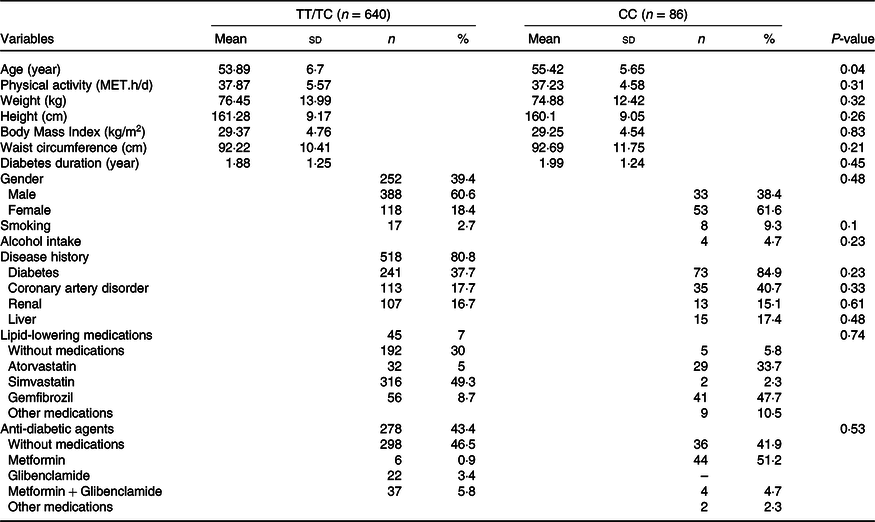
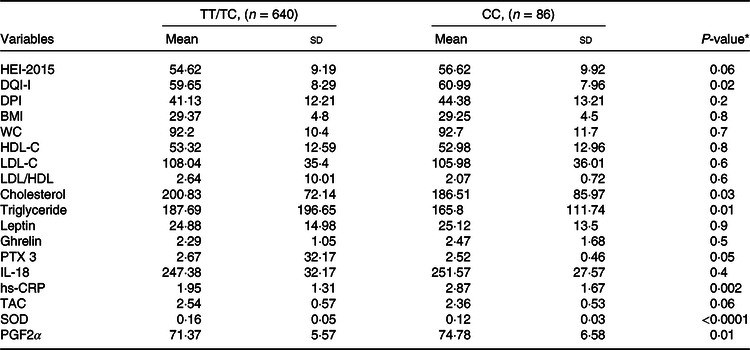
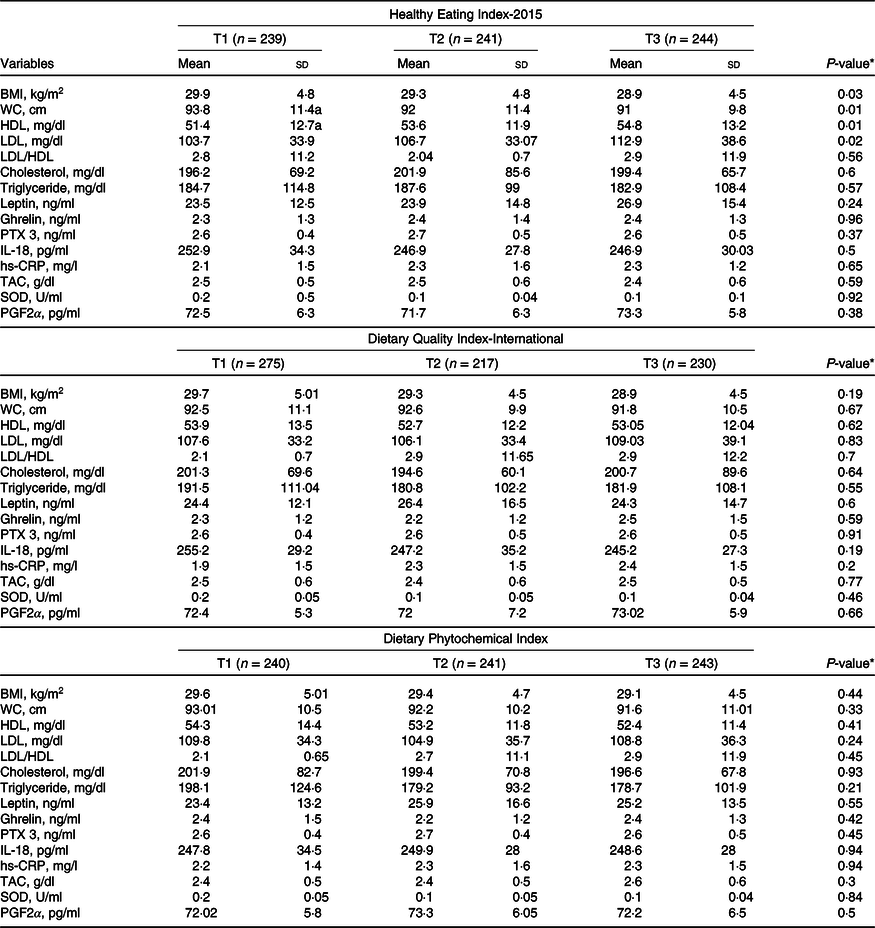
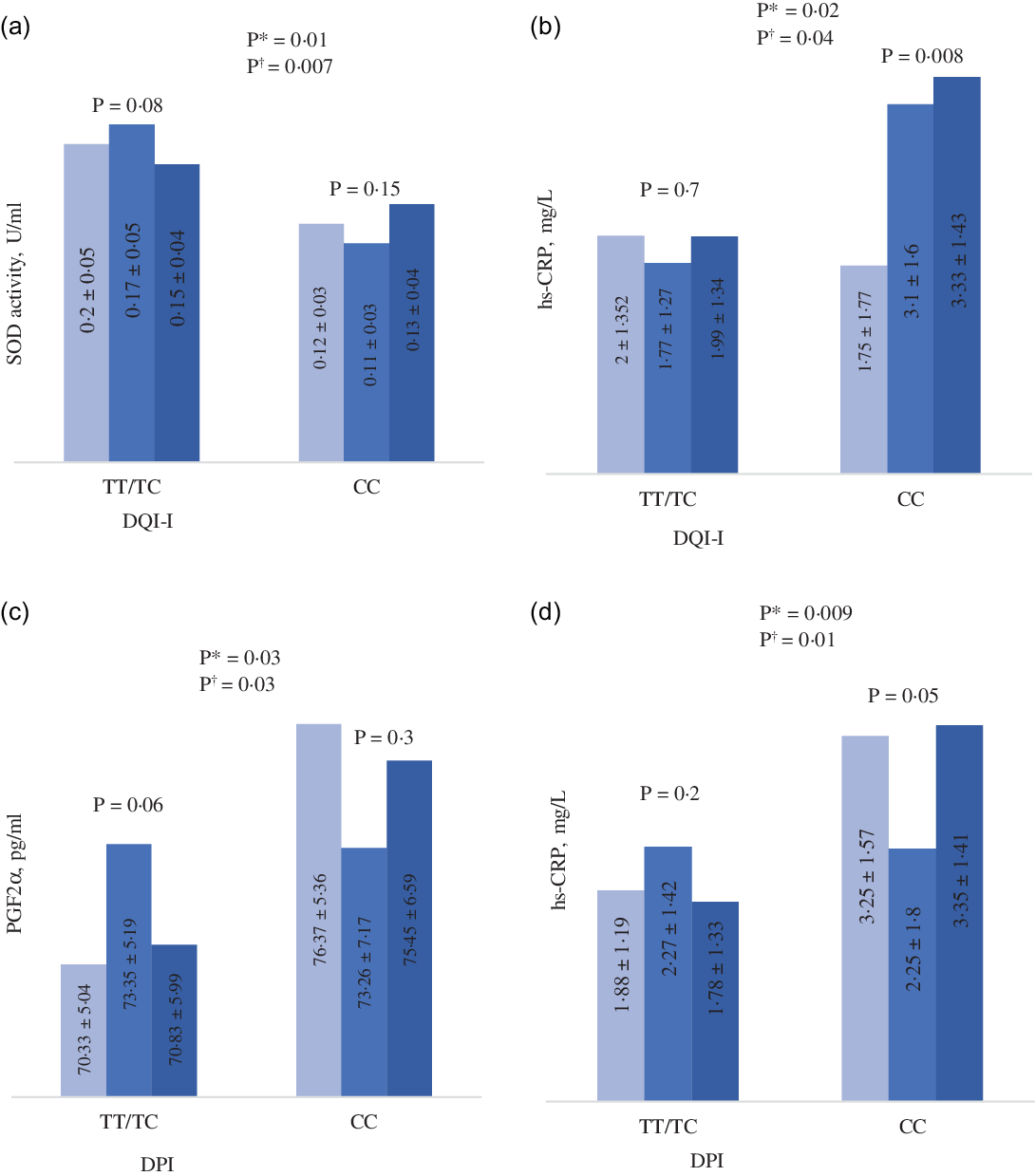
In the present study, among 726 diabetic patients, 39·3 % were men and 60·7 % were women. The interaction effects of the polymorphism with dietary indices were evaluated in two ways. First, analyses were performed into three genotyping groups of TT, TC and CC, which were represented in Supplementary Tables S1 to S3 of Supplementary material. Second, interactions were evaluated in two groups of T-allele carriers and homozygous for C allele due to resembling effects of TT & TC genotypes, which have been considered along with regard to consistency with our previous studies(Reference Keramat, Sadrzadeh-Yeganeh and Sotoudeh7,Reference Basiri, Sotoudeh and Alvandi11,Reference Noorshahi, Sotoudeh and Djalali19,Reference Corella, Arnett and Tsai28–Reference Corella, Tai and Sorlí30) . The T-allele carriers and CC genotype of ApoA2–265T > C had a frequency of 88·2 and 11·8 %, respectively. The allelic distribution complied with the Hardy–Weinberg equilibrium(Reference Noorshahi, Sotoudeh and Djalali19). The CC homozygous was significantly older than the T-allele carriers (P = 0·04). None of the other general characteristics were significantly different in the two groups of genotypes (Table 1). Table 2 shows a comparison of the dietary indexes scores, anthropometric and biochemical measurements according to ApoA2–265T > C genotypes. CC homozygous had significantly higher serum hs-CRP (P = 0·02), PGF2α levels (P = 0·01) and DQI-I score (P = 0·02). Moreover, there was a higher HEI-2015 score near to significant in CC genotype as opposed to T-allele carriers (P = 0·06). On the other hand, T-allele carriers had significantly higher serum TC (P = 0·03), TG (P = 0·01), PTX3 (P = 0·05), total antioxidant capacity (P = 0·05) and SOD activity (P < 0·0001) compared with CC homozygous. Besides, a significant reduction in WC, BMI and LDL-cholesterol level and a significant elevation in HDL-cholesterol concentration were observed through the tertiles of HEI-2015, and there was not any other significant difference in laboratory parameters according to the dietary indexes (Table 3). We found a gene–diet interaction between DQI-I and ApoA2–265T > C in associations with hs-CRP serum concentration and SOD activity (P interaction = 0·02 and P interaction = 0·01, respectively) in crud model. This interaction remained statistically significant in adjusted model (P Interaction =0·04 and P interaction = 0·007, respectively). In particular, the CC homozygous who placed in the last tertile of DQI-I had the highest hs-CRP level contrary to T-allele carriers (P = 0·008). Plus, T-allele carriers in the second tertile had the highest SOD activity than CC homozygous. Furthermore, a significant interaction was detected between DPI and ApoA2–265T > C for hs-CRP and PGF2α in both crude (P Interaction = 0·009 and P Interaction = 0·03, respectively) and adjusted models (P Interaction =0·01 and P Interaction = 0·03, respectively). The highest mean of hs-CRP and PGF2α was observed in CC homozygous and T-allele carriers, respectively, in the first and third tertiles of DPI. No significant interaction was found between ApoA2–265T > C polymorphisms and dietary indexes (HEI, DQI-I and DPI-I) on other parameters.
Comparison of general and anthropometric characteristics between CC genotype and T allele carrying group (TT/TC)
(Mean values and standard deviations; number and percentages)

P ≤ 0·05; Student’s t test was used for comparing mean differences of quantitative variables, χ 2 test was used for qualitative variables.
Comparison of subjects’ indexes scores, anthropometric measurements and laboratory parameters according to ApoA2–265T > C genotypes
(Mean values and standard deviations)

WC, waist circumferences; hs-CRP , high-sensitivity C-reactive protein; PTX3, pentraxin 3; IL-18 , Interleukin 18; TAC, total antioxidant capacity; SOD, superoxide dismutase; PGF2α, prostaglandin F2α.
* P ≤ 0·05; Student’s t test.
Comparison of subjects’ anthropometric measurements, clinical and laboratory parameters according to tertile (T) of indexes
(Mean values and standard deviations)

WC, waist circumferences; PTX3, pentraxin 3; IL-18 , Interleukin 18; hs-CRP , high-sensitivity C-reactive protein; TAC, total antioxidant capacity; SOD, superoxide dismutase; PGF2α, prostaglandin F2α.
* One-way Anova test.
a Post-hoc; Tukey test.
Discussion
As far as we are aware, this is the first study attempt to investigate the interactions of ApoA2–265T > C and dietary indexes on ghrelin and leptin hormones and biochemical markers among patients with type 2 diabetes. Based on our findings, CC homozygous had better DQI-I and HEI-2015 scores, lower TC, triglyceride, PTX3, total antioxidant capacity and SOD activity and higher hs-CRP and PGF2α than T-allele carriers. These findings were in line with the results of our previous works(Reference Keramat, Sadrzadeh-Yeganeh and Sotoudeh7,Reference Basiri, Sotoudeh and Alvandi11,Reference Koohdani, Sadrzadeh-Yeganeh and Djalali14,Reference Noorshahi, Sotoudeh and Djalali19,Reference Koohdani, Sadrzadeh-Yeganeh and Djalali20,Reference Jafari Azad, Yaseri and Daneshzad31,Reference Karimi, Tondkar and Sotoudeh32) . A gene–diet interaction showed that adherence to DQI-I and DPI modifies the effect of ApoA2–265T > C polymorphisms on hs-CRP, PGF2α and SOD activity. The SOD activity and level of PGF2α in T-allele carriers increased in the second tertile of DQI-I and DPI and reduced in the third tertile. On the other hand, CC homozygous showed an increase of hs-CRP level by the adherence to DQI-I, and it was the lowest in the second tertile of DPI. The –265T > C is the most studied SNP among the various SNP of the ApoA2 gene, which is related to reduced serum ApoA2 concentration(Reference Takada, Emi and Ezura33). Determining the risk allele of the aforementioned SNP is a point of contention. The findings of the present study were consistent with the results of studies that described CC homozygous as a risk allele(Reference Corella, Peloso and Arnett29–Reference Karimi, Tondkar and Sotoudeh32); nevertheless, several studies reported the CC homozygous as a protective allele of cardiovascular disorders(Reference Ribas, Sánchez-Quesada and Antón34,Reference van ’t Hooft, Ruotolo and Boquist35) . It has been remarked that the reduced serum ApoA2 concentration might be the main cause of higher hs-CRP levels in CC homozygous which is directly associated with oxidative stress factors(Reference Birjmohun, Dallinga-Thie and Kuivenhoven36–Reference Cauci, Xodo and Buligan38). According to a study conducted on transgenic rabbits with the human ApoA2 gene, lower plasma levels of hs-CRP and higher paraoxonase-1 (PON1) activity were significantly observed in these rabbits which leads to low odds of atherosclerosis(Reference Wang, Niimi and Nishijima39,Reference Koike, Koike and Yang40) . Nevertheless, a lower activity of PON1 was reported in several transgenic mice studies with human ApoA2(Reference Ribas, Sánchez-Quesada and Antón34). It should be noted that, unlike transgenic mice, transgenic rabbits represent a better animal model for human ApoA2 metabolism(Reference Brousseau and Hoeg41). There is a controversy in findings of lipid profile. Consistent with our findings, subjects with lower serum ApoA2 concentration had significantly lower TC and triglyceride in Birjmohun et al. study(Reference Birjmohun, Dallinga-Thie and Kuivenhoven36), whereas a conflicted relationship was reported between ApoA2 and lipid profile in some other studies(Reference Xiao, Zhang and Wiltshire15,Reference Duesing, Charpentier and Marre42) . In this study, a significant reduction in WC, BMI and LDL-cholesterol level and a significant elevation in HDL-cholesterol concentration were observed through the tertiles of HEI-2015. With consideration to Al-Ibrahim et al. study, anthropometric measurements like WC and BMI were decreased by increasing the adherence to HEI which is in line with the results of this study. Dialectical findings have been reported about lipid profiles as well. HDL-cholesterol and LDL-cholesterol levels were increased and decreased, respectively, through the quartiles of HEI but unlike a significant decrease of LDL-cholesterol level in Alternate Healthy Eating Index-2010 (AHEI-2010), it was not significant in HEI-2010(Reference Al-Ibrahim and Jackson43). Likewise, a significant association of HEI with BMI, WC and LDL-cholesterol was exhibited in Haghighatdoost et al. study(Reference Haghighatdoost, Sarrafzadegan and Mohammadifard44). Shivappa et al. showed a significant increase for HDL-cholesterol level and a significant decrease for BMI in tertiles of AHEI-2010(Reference Shivappa, Hebert and Kivimaki45). In contrast to our results, no significant relationships were reported between WC, BMI and HDL-cholesterol concentration and quartiles of HEI-2015 by Khodarahmi et al.(Reference Khodarahmi, Asghari-Jafarabadi and Abbasalizad Farhangi46). There is not any study for evaluating the interaction of the genotypes with dietary patterns, and the gene–diet interaction studies were only focused on the interplay of ApoA2–265T > C and dietary fatty acid intake. The association between high intake of SFA and higher BMI and WC in CC genotype has been figured out in several studies(Reference Basiri, Sotoudeh and Alvandi11,Reference Corella, Peloso and Arnett29,Reference Corella, Tai and Sorlí47,Reference Lai, Smith and Parnell48) ; however, there was not any significant interplay between genotypes and SFA intake on WC in Basiri et al. study(Reference Basiri, Sotoudeh and Alvandi11). Keramt et al. showed higher median consumption of n-3 PUFA and MUFA and decreased hs-CRP and interleukin-18 serum concentration in CC homozygous, whereas an elevation in serum concentration of hs-CRP was seen with a higher median intake of SFA in T-allele carriers(Reference Keramat, Sadrzadeh-Yeganeh and Sotoudeh7). The interplay of ApoA2–265T > C and SFA consumption increased the levels of LDL-cholesterol and LDL/HDL in CC homozygous in the Noorshahi et al. study(Reference Noorshahi, Sotoudeh and Djalali19). No precious mechanism has been revealed yet, but some probable explanation might be available for the interaction of the polymorphism and dietary indexes on some laboratory parameters. As it was illustrated in Fig. 1, despite the adherence to DQI-I, hs-CRP increased in CC homozygous. The intake of MUFA and added sugars was also decreased and increased, respectively, in tertiles of DQI-I in CC homozygous. Considering PPAR as regulator factors of lipid and glucose hemostasis, activated by MUFA, they might reduce inflammation by downregulating pro-inflammatory genes in adipose tissue. Therefore, decreased MUFA and increased added sugars intake were likely to elevate hs-CRP amount; however, some confounding variables might be ignored in this relationship. Furthermore, SOD activity and linolenic acid were highest in the second tertile of DQI-I among T-allele carriers. Studies suggested that n-3 PUFA like linolenic acid can inhibit the production of reactive oxygen species or may interfere in modulating the enzymes responsible for reactive oxygen species production(Reference Zhu, Wang and Zhang49). Likewise, hs-CRP decreased in the second tertile of DPI in minor allele and elevated after that. Consistent with this study, Edalati et al. exhibited the same trend of hs-CRP in tertile of DPI, despite the insignificant relationship between them(Reference Edalati, Alipour and Rashidkhani50). Oxidative stress and inflammation reduction were suggested as potential protective effects of phytochemical-rich diets. It has been suggested that oxidative stress is associated inversely with the DPI score(Reference Vincent, Bourguignon and Taylor18). We saw that T-allele carriers in the second tertile of DPI had the highest amount of PGF2α. Higher consumption of vegetables and fruits is associated with a higher intake of phytochemicals and some other antioxidant components. In the current study, it was observed that, in contrary to high vegetables and fruits consumption, the intake of antioxidants like vitamin E, selenium and fibres is reduced in individuals of DQI-I’s second tertile; therefore, PGF2α increased in these people; however, more investigations needed to determine the actual mechanism of these relationships. Though these findings were novel in this concept, this study has some limitations. This is a cross-sectional study without measurement of ApoA2 serum concentration. As we used FFQ for evaluating the dietary intakes, we cannot ignore the recall bias and over-report or under-report of participants. In conclusion, adherence to DPI and DQI-I interacts with ApoA2 genotypes and could significantly impact on inflammation and oxidative stress. These results emphasise the consideration of gene–diet interaction in health status of diabetic patients.
Interaction between APOA2−265T > C polymorphism and the indices on laboratory parameters. The bars indicate mean ± SD.  , T1;
, T1;  , T2;
, T2;  , T3.
, T3.
*P for unadjusted interaction that obtained from multivariate models using ANCOVA
†P for adjusted interaction obtained from multivariate models using ANCOVA. Adjusted for age, gender, physical activity, smoking, and alcohol intake

Acknowledgements
We would like to express our gratitude to the research deputy of the school of nutritional sciences and dietetics, and especially, the subjects who participate in this study.
This work was supported by the Tehran University of Medical Sciences (grant number 15061).
Z. E.: Conceptualisation, methodology, formal analysis, investigation and writing – original draft. G. S.: Conceptualisation and methodology. M. R.: Formal analysis, writing – editing and interpretation of data. F. K.: Conceptualization, methodology, supervision and project administration
There are no conflicts of interest.
Supplementary material
For supplementary material accompanying this paper visit https://doi.org/10.1017/S0007114521002348