





Vitamin D is a secosteroid hormone with a central role in musculo-skeletal health through its regulatory actions on Ca and phosphorus absorption; adequate vitamin D concentrations are essential to maintain healthy bones, muscles and teeth(Reference DeLuca1). Vitamin D is an umbrella term for two compounds; vitamin D3 (cholecalciferol) and vitamin D2 (ergocalciferol). Vitamin D3 primarily obtained through endogenous synthesis in the skin with exposure to sunlight (UVB radiation) and to a lesser extent through limited dietary sources including oily fish, eggs and fortified foods. Vitamin D2 can only be obtained from plant-based dietary sources such as mushrooms or fortified foods and comprises a much smaller proportion of total vitamin D. Following absorption in the small intestine, these vitamins are then converted in the liver to 25-hydroxyvitamin D [25(OH)D]; circulating levels of 25(OH)D are used to assess vitamin D status. Within the UK, vitamin D deficiency is defined as having a circulating 25(OH)D < 25 nmol/L, and vitamin D insufficiency is defined as concentrations between 25 nmol/L and 50 nmol/L(2).
Within the UK, vitamin D deficiency remains an important public health challenge(Reference Buttriss, Lanham-New and Steenson3). It is estimated that about 16 % of UK adults and nearly 20 % of UK children are vitamin D deficient with much higher proportions of the population estimated to have insufficient 25(OH)D concentrations(4). Furthermore, some population groups are at much greater risk of being deficient; vitamin D deficiency is estimated to affect half of adults of South Asian origin and about a third of adults of Black African Caribbean origin(Reference Lin, Smeeth and Langan5,Reference Vearing, Hart and Charlton6) , adults from lower socio-economic groups are also at a greater risk of being deficient(Reference Sutherland, Zhou and Leach7). Despite recommendations from the UK’s Scientific Advisory Committee on Nutrition for all adults and children to take a vitamin D supplement of 10 µg in the winter months and at-risk individuals to take supplements throughout the year (including ethnic minority groups with dark skin tones, people who are housebound or who cover their skin when outdoors), vitamin D deficiency remains very common(Reference Buttriss, Lanham-New and Steenson3). This indicates a lack of adherence to supplementation guidelines, as around 17 % of adults are estimated to regularly take supplements(4). The persistent poor vitamin D status in the UK has led the UK Government to prioritise the development of strategies to improve vitamin D status of the UK population(8).
The high prevalence of vitamin D deficiency is concerning, considering the potential impact on bone health, in addition to the many other immunological and metabolic effects which low circulating 25(OH)D concentrations may have(Reference Charoenngam and Holick9). Observational studies report strong associations between vitamin D deficiency and increased risk of infections(Reference Martineau, Jolliffe and Hooper10,Reference Taha, Abureesh and Alghamdi11) , chronic disease risk(Reference Khan, Kunutsor and Franco12) and mortality(Reference Hu and Yang13,Reference Holick14) . This evidence highlights the urgent need to investigate and address vitamin D deficiency in the UK population, and particularly populations at high risk(Reference Buttriss, Lanham-New and Steenson3).
There is little information on the prevalence and patterns of vitamin D deficiency in children in the UK, although reports from Primary Care records indicate marked increases in the diagnosis of acute vitamin D deficiency in children during the last decade(Reference Basatemur, Horsfall and Marston15,Reference Uday, Naseem and Large16) . Trend analysis of the National Diet and Nutrition survey data suggests that since 2008, average (25(OH)D concentrations in children have decreased, with the latest data indicating that 19 % of mainly white European, 11- to 18-year-olds study population are vitamin D deficient. In younger children, there is no clear time trend, with mean concentrations fluctuating over the same period; this may be due to the much smaller samples of this age group providing blood samples(4,17) . In addition, there is very limited national UK data on 25(OH)D concentrations in children from ethnic minority groups, who have had limited representation within the National Diet and Nutrition survey samples (< 5 %). Using data from a large cross-sectional survey in children of Black African and Caribbean, South Asian and White European origins, we report on the prevalence of vitamin D deficiency and insufficiency in children throughout the calendar year and investigate the determinants of low circulating 25(OH)D in children, including ethnicity, socio-economic status and adiposity.
Methods
The Child Heart and Health Study was a large cross-sectional survey of approximately 5000 primary school children of South Asian, Black African and Caribbean and White European origins. The primary aim was to investigate early risk markers for type 2 diabetes and CVD in children of different ethnic origins; methods have been published previously(Reference Whincup, Nightingale and Owen18). Primary schools in London, Birmingham and Leicester with a high proportion of South Asian children or Black African and Caribbean children were identified and a random sample of 200 schools was recruited; all schools also included between 15 and 50 % white European children to allow ethnic comparisons to be made on a within school basis. Schools were recruited between 2004 and 2007. All year five children were invited to participate (aged 9–10 years), ethical approval was obtained from the Multicentre Research Ethics Committee (Wales) and the study was carried out in accordance with the principles of the Declaration of Helsinki.
Measurements
All measurements were taken between October 2004 and February 2007, during school term time only (including all months except August) by a single survey team, which included three trained research nurses. Measurements of height, weight and bioelectrical impedance (Bodystat Ltd) were recorded for each child and fat mass index (FMI) was calculated, derived from bioelectrical impedance; a valid measure of body fat in this multi-ethnic population(Reference Nightingale, Rudnicka and Owen19).
Plasma Vitamin D metabolites
Children provided a fasting blood sample following an overnight fast. EDTA plasma aliquots were separated by centrifugation (4000 rpm for 10 min) and stored at −70°C for between 7 and 10 years until analysis of circulating plasma 25(OH)D was performed at the Bioanalytical Facility, University of East Anglia (Norwich, UK) and undertaken in Good Clinical and Laboratory Practice conditions using a previously unthawed aliquot. 25(OH)D3 and 25(OH)D2 were measured using liquid chromatography-tandem MS in singles, as previously described(Reference Tang, Nicholls and Piec20). The assays were calibrated using standard reference material SRM972a from the National Institute of Science and Technology and showed linearity between 0 and 250 nmol/L. The inter/intra-assay (CV across the assay range was ≤ 10 %, and the lower limit of quantification was 0·1 nmol/L. The assay showed an accuracy bias of ±6·7 % against the vitamin D external quality assessment scheme liquid chromatography-tandem MS method group mean and met the vitamin D external quality assessment scheme certification requirements. Total vitamin D (25[OH]D) was determined from the sum of 25(OH)D2 and 25(OH)D3.
Ethnicity and socio-economic status
To categorise the ethnicity of each child, we used self-defined ethnicity for both parents or parental information on the ethnicity of the child. When neither of these information sources were available (∼1 %), the parental and grandparental place of origin was used, as defined by the child. Children were classified into four main ethnic groups (‘white European’, ‘black African Caribbean’ (including both black African and black Caribbean children), ‘South Asian’, (including Indian, Pakistani, Bangladeshi and other South Asian origins) and ‘other’ (including children of different ethnic groups and those with dual heritage). Information on parental occupation, provided by children and parents, was used to determine socio-economic status using the National Statistics-Socioeconomic Classification(Reference Rose, O’Reilly and Martin21). The broad classifications were managerial/professional, intermediate, routine/manual and economically inactive (referring to people who were currently unemployed, whether or not they were seeking work).
Statistical analysis
The distribution of 25(OH)D was reasonably normally distributed and did not require log transformation (online Supplementary Figure 1). Vitamin D status was grouped into replete (> 50 nmol/L), insufficient (25–50 nmol/L) or deficient (< 25 nmol/L). The OR for being vitamin D insufficient or deficient compared with being replete were estimated using ordered logistic regression with a random effect for school to allow for clustering. Models were adjusted for age, sex, National Statistics-Socioeconomic Classification, FMI and month of measurement. All analyses were carried out in Stata v18.
Results
Of the 8641 children invited to take part, consent and agreement were obtained for 5887 (68 % response rate), and 4650 children had complete measurements, including circulating 25(OH)D concentrations (54 % inclusion rate). There were similar numbers of children from each of the main ethnic groups; 1174 Black African and Caribbean children, 1275 South Asian children, 1115 White European children and 1086 children of ‘other’ ethnic origins.
Participant characteristics and vitamin D status
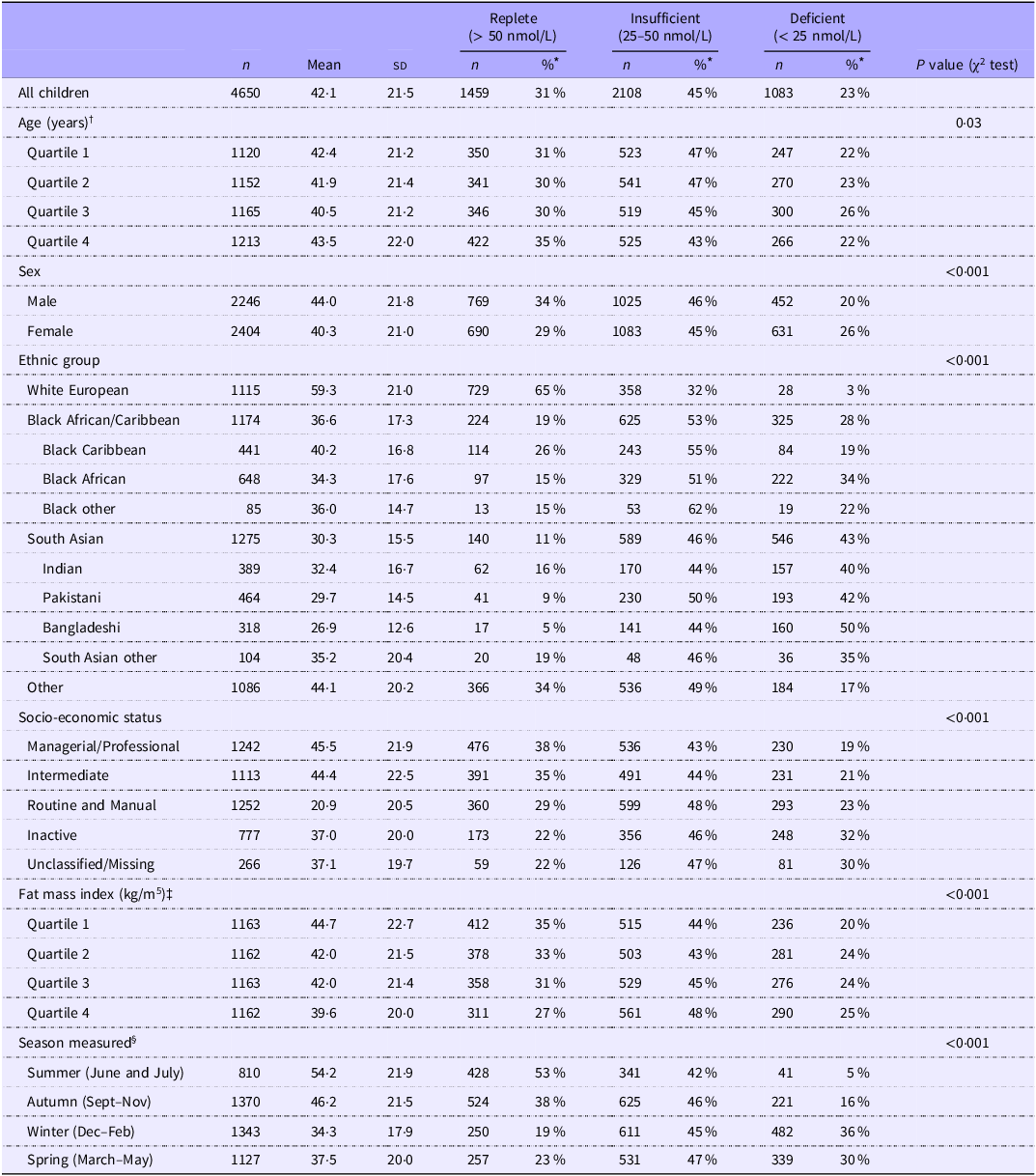
Table 1 presents mean 25(OH)D concentrations and vitamin D status by participant characteristics. Overall, about a fifth of children were classified as vitamin D deficient (23 %), with a higher proportion in girls than boys (26 % v. 20 %, respectively). Marked differences in vitamin D status by ethnicity were observed; 43 % of South Asian children and 28 % of Black African and Caribbean children were vitamin D deficient compared with 3 % of White European children. The highest prevalence of vitamin D deficiency was observed in UK Bangladeshi children. Higher percentages of white European children were vitamin D replete (25(OH)D > 50 nmol/L) (65 %), compared with Black African and Caribbean (19 %) and South Asian children (11 %). Children in the ‘economically inactive’ socio-economic group were more likely to be vitamin D deficient (32 %) compared with children in the ‘managerial/professional’ group (19 %). There was a slightly higher percentage of children in the highest quartile for fat mass index who were vitamin D deficient or insufficient (25 % and 48 %, respectively) compared with the lowest quartile (20 % and 44 % respectively). Finally, children who were measured in the summer months (June–July) had the lowest percentage who were vitamin D deficient (20 %) compared with 36 % of children in the winter months (December–February).
Vitamin D status and characteristics of study participants

* Percentages sum to 100 % for each row.
† Ranges for age quartiles: 1 = 8·9–9·65 years (8 years 10 months–9 years 7 months); 2 = 9·66–9·94 years (9 years 7 months–9 years 11 months); 3 = 9·95–10·21 years (9 years 11 months–10 years 2 months); 4 = 10·22–11·5 years (10 years 2 months–11 years 5 months). 4 children aged 8 and 12 children aged 11 years.
‡ Fat mass index calculated using height to power 5(ref(Reference Nightingale, Rudnicka and Owen19)). Ranges for fat mass index (kg/m5): 1 = 0·238–1·568; 2 = 1·569–2·022; 3 = 2·023–2·681; 4 = 2·682–9·185.
§ No measurements taken in August due to school holidays.
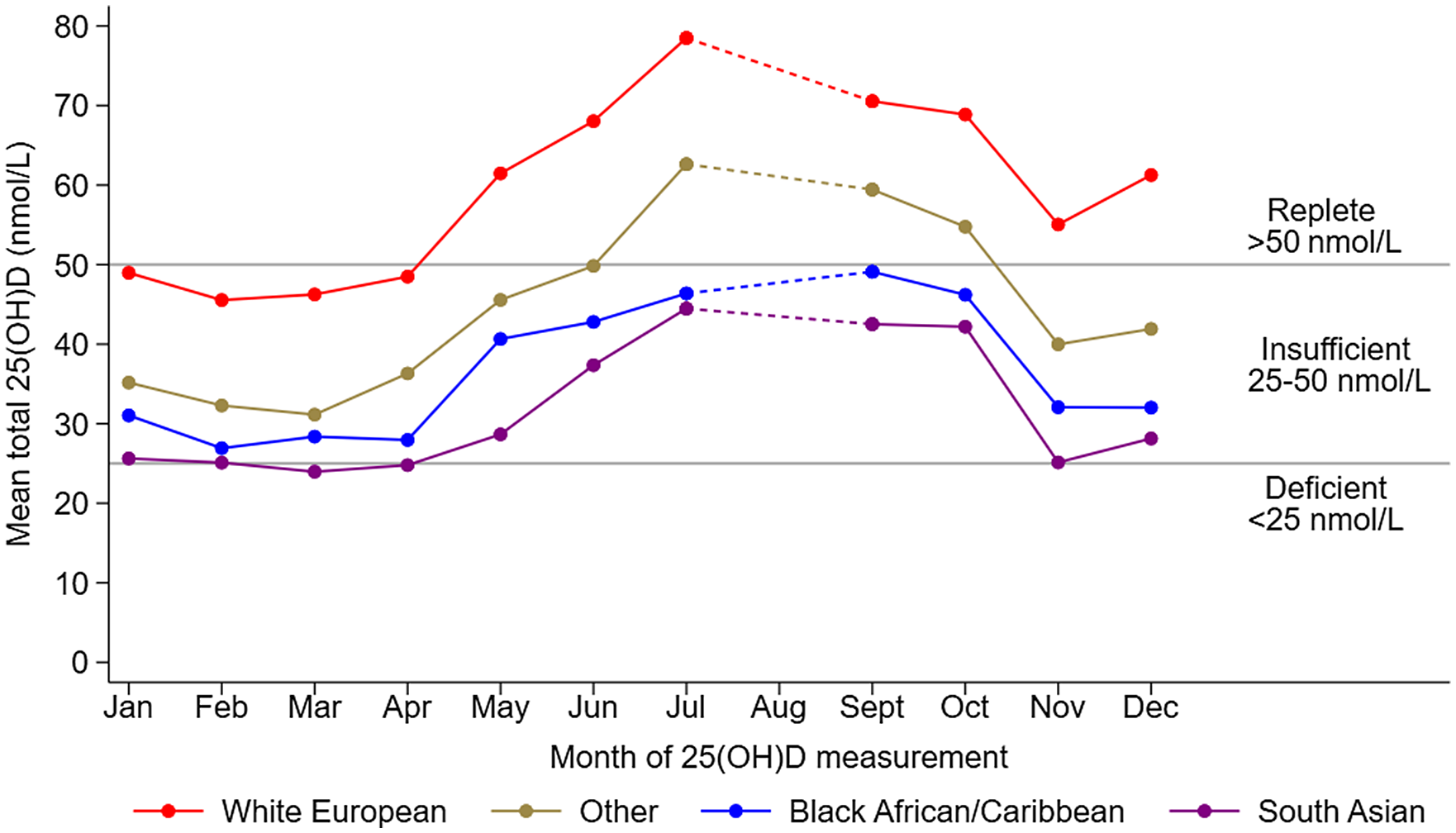
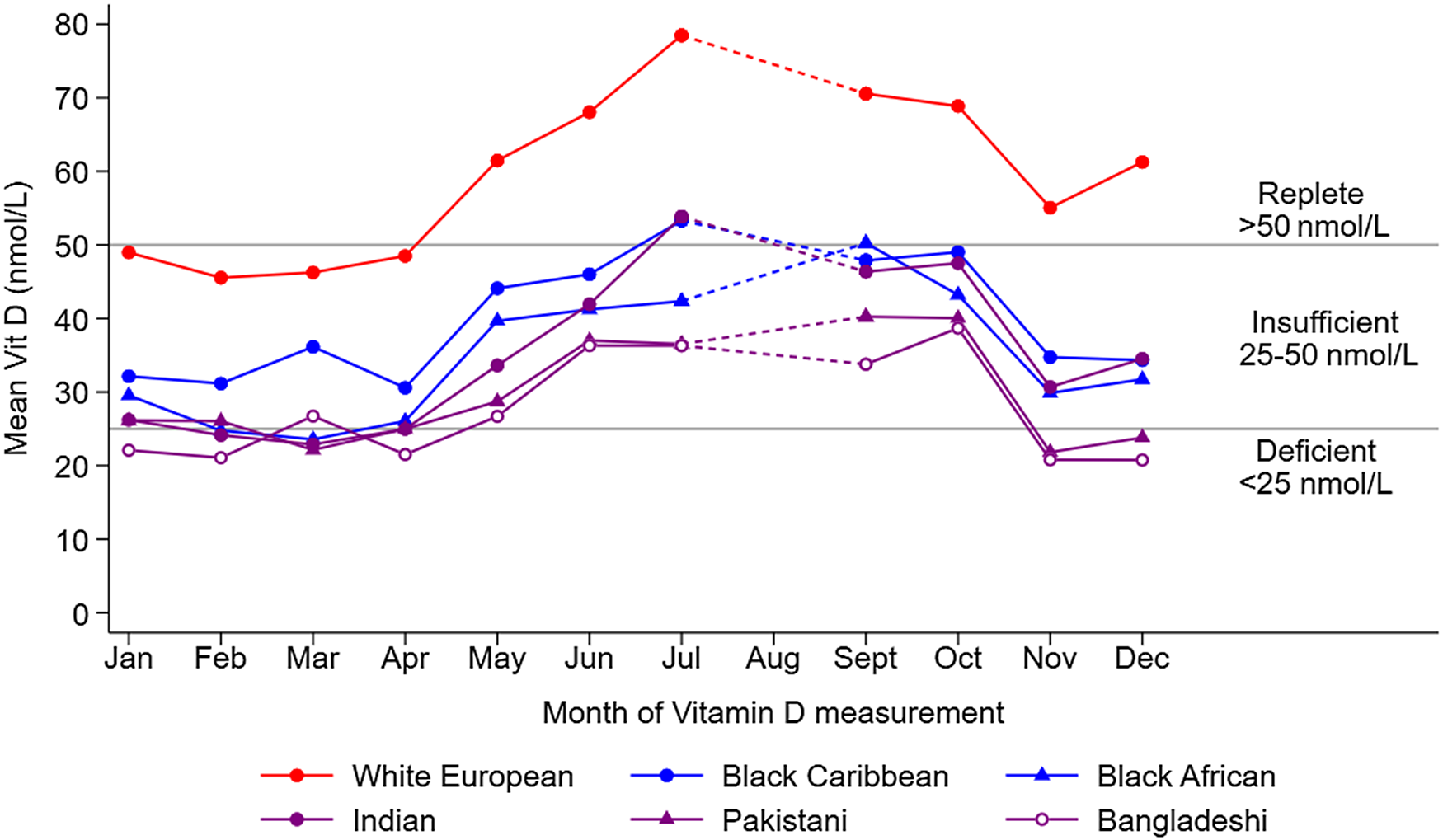
Figure 1 presents the mean 25(OH)D concentrations by month of measurement, separately for each main ethnic group; reference lines representing vitamin D deficiency and insufficiency (see legend) are also included. For White European children, mean 25(OH)D concentrations were within the replete range (> 50 nmol/L) for most months measured, and only fell below this between January and April. In contrast, the mean 25(OH)D concentrations for South Asian, Black African and Caribbean children stayed within the vitamin D insufficiency range throughout the year. Figure 2 presents a similar analysis but separates the children further by ethnic subgroup. For most months measured, mean 25(OH)D concentrations for children of Bangladeshi origin were particularly low, being deficient on average in January, February, April and November and insufficient on average for the remaining months of the year. Children of Pakistani origin had mean 25(OH)D concentrations which were deficient in March and November and insufficient for the remaining months of the year.
Adjusted mean 25(OH)D by month of measurement and ethnic group. Footnote 25(OH)D values are adjusted for sex, age, NS-SEC and fat mass index. NS-SEC, National Statistics-Socioeconomic Classification.

Adjusted mean 25(OH)D by month of measurement and ethnic sub-group. Footnote 25(OH)D values are adjusted for sex, age, NS-SEC and fat mass index. NS-SEC, National Statistics-Socioeconomic Classification.

Determinants of vitamin D status
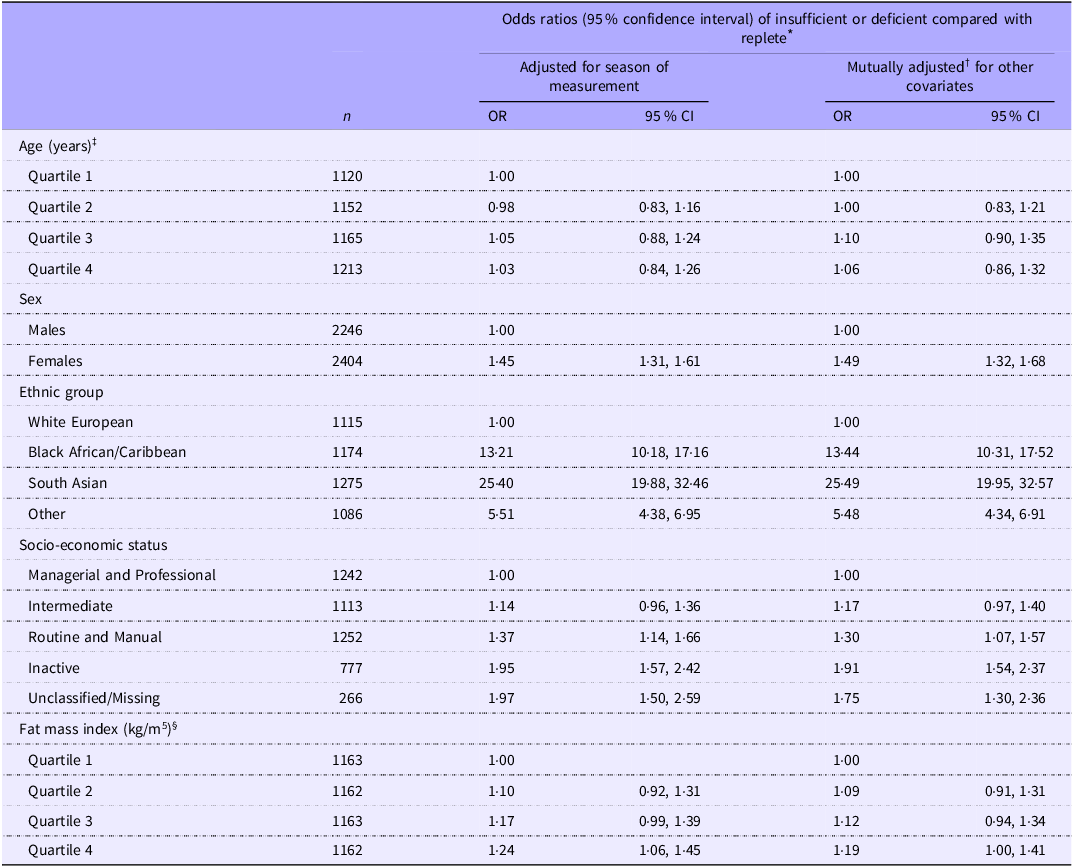
Table 2 presents the OR of being vitamin D deficient or insufficient compared with replete by age, sex, ethnicity, socio-economic status and FMI, adjusted for season only and then for all the other factors in the analysis. Girls had a higher risk of being vitamin D deficient or insufficient compared with boys (OR 1·45, 95 % CI 1·31, 1·61), this risk increased slightly once other covariates were included in the model. South Asian children had a much higher risk of being deficient or insufficient (OR 25·40, 95 % CI 19·88, 32·46), and Black African and Caribbean children a smaller increase in risk (OR 13·21, 95 % CI 10·18, 17·16) compared with white European children; these higher risks did not alter materially in the model with additional adjustments. The children in the most deprived socio-economic groups had an increased risk of vitamin D deficiency (OR 1·95, 95 % CI 1·57, 2·42), which were slightly reduced once other covariates were included in the model. Finally, the risks of vitamin D deficiency or insufficiency increased for each increase in quartile of FMI (risk in quartile 4 v. quartile 1; OR 1·24, 95 % CI 1·06, 1·45), this association was slightly attenuated once other covariates were included in the model (OR 1·19, 95 % CI 1·00, 1·41).
OR of being vitamin D insufficient or deficient compared with replete

* Vitamin D status: Replete > 50 nmol/L; insufficient 25–50 nmol/L; deficient < 25 nmol/L.
† Adjusted OR are mutually adjusted for season of measurement, age, sex, ethnic group, socio-economic status and fat mass index.
‡ Ranges for age quartiles: 1 = 8·9–9·65 years (8 years 10 months–9 years 7 months); 2 = 9·66–9·94 years (9 years 7 months–9 years 11 months); 3 = 9·95–10·21 years (9 years 11 months–10 years 2 months); 4 = 10·22–11·5 years (10 years 2 months – 11 years 5 months). Four children aged 8 and 12 children aged 11 years.
§ Fat mass index calculated using height to power 5(ref(Reference Nightingale, Rudnicka and Owen19). Ranges for fat mass index (kg/m5): 1 = 0·238–1·568; 2 = 1·569–2·022; 3 = 2·023–2·681; 4 = 2·682–9·185.
Discussion
This report presents data on the prevalence of vitamin D deficiency and insufficiency in UK children of Black African and Caribbean, South Asian and White European origins. We found that most children were classified as either vitamin D deficient (26 % of girls and 20 % of boys) or insufficient (45 % girls and 46 % boys). Season, sex, ethnicity, socio-economic status and FMI were all associated with vitamin D status with ethnicity being the strongest determinant. South Asian children (particularly Bangladeshi children) had the highest risks of being vitamin D deficient compared with White European children; 89 % of South Asian children were either deficient (43 %) or insufficient (46 %), and 81 % of Black African and Caribbean children were either deficient (28 %) or insufficient (53 %).
The high proportions of children we report who were vitamin D deficient is consistent with adult and adolescent data across Europe, with vitamin D deficiency being described as a pandemic(Reference Cashman, Dowling and Škrabáková22). In the present study, vitamin D deficiency is particularly concentrated in ethnic groups with darker skin tones(Reference Cashman, Dowling and Škrabáková22). The much higher proportions of children who were classified as having concentrations which were insufficient rather than deficient are also very similar to the proportions reported in European adults, even in sunny climates(Reference Díaz-Rizzolo, Kostov and Gomis23). The associations we report between adiposity and risk of vitamin D deficiency have also previously been reported in both children(Reference Fiamenghi and Mello24,Reference Moore and Liu25) and adults and suggested to be due to reduced bioavailability of vitamin D in adipose tissue, particularly vitamin D3 which has been synthesised cutaneously following exposure to sunlight(Reference Fiamenghi and Mello24). This higher risk of deficiency associated with higher body fatness is particularly concerning given the high prevalence of childhood obesity in UK primary school children(26). Similar seasonal patterns and associations with levels of deprivation have been reported previously(Reference Sutherland, Zhou and Leach7,Reference Scully, Laird and Healy27) .
This large population-based study provides unique data on the vitamin D status of prepubertal children from different ethnic groups within the UK and identifies groups which are at increased risk of deficiency; important to identify for targeted prevention strategies. The design of the study allowed for balanced representation of South Asian children of Indian, Pakistani and Bangladeshi origin and of black African and Caribbean children of African and Caribbean origin. Measurements were also taken across all four seasons in sufficiently large numbers to explore seasonal patterns by ethnicity. The overall inclusion rate (54 % of children consented and provided complete measurements) is moderate potentially impacting the generalisability of our findings; however, similar response rates were seen for each ethnic group, and characteristics of respondents were not appreciably different to non-respondents(Reference Whincup, Nightingale and Owen18). Survey data for this analysis were collected between 2004 and 2007 and is therefore not current; however, it is worth noting that there is a lack of recent data to investigate this multi-ethnic population and that limited data from national surveys do not indicate any substantial changes in either supplement use or vitamin D status in recent years(4). Furthermore, without significant changes to fortification policies or supplementation programmes, experts argue that no change in vitamin D status is likely to occur(Reference Buttriss, Lanham-New and Steenson3). A further limitation of this survey is that it did not include detailed measurements of bone health such as bone mineral density or parathyroid hormone, which would have provided important insights into the physiological consequences of vitamin D deficiency in this under-researched and at-risk population. These measures should be included in future studies investigating vitamin D status and bone health in children of ethnic minority origins. Furthermore, we were unable to adequately measure vitamin D supplement use in this population which would be important to explore further along with other determinants of vitamin D status such as amount of sun exposure.
The implications of our findings suggest that vitamin D deficiency is common in UK children, particularly in winter months; for children from ethnic groups with darker skin tones vitamin D deficiency is highly prevalent throughout the year. Bangladeshi children in particular are at high risk of vitamin D deficiency and will need targeted all-year approaches to increase 25(OHD) concentrations. This is consistent with current UK recommendations for high-risk groups, which advocate all-year supplementation. The very low plasma 25(OH)D concentrations suggest that skeletal development may be affected alongside other potential health impacts, such as reduced immunity to infections and increased inflammation(Reference Holick and Chen28–Reference Johnson and Thacher30). Evidence also suggests that improving vitamin D status in adults who are deficient may reduce the risk of developing type 2 diabetes(Reference Niroomand, Fotouhi and Irannejad31), which would be particularly relevant to South Asian, African and Caribbean populations who have markedly higher risks of type 2 diabetes than White Europeans(Reference Tillin, Hughes and Mayet32). Although large randomised controlled trials (RCT) of vitamin D supplementation on type 2 diabetes risk have not yielded consistent declines in type 2 diabetes risk, this may reflect the vitamin D replete status of most trial participants(Reference Pittas, Jorde and Kawahara33). Recent evidence suggests a non-linear association between circulating 25(OH)D concentrations and mortality risk, with concentrations below 50 nmol/L strongly associated with increased risk(Reference Sutherland, Zhou and Hyppönen34). This suggests that greatest benefits of vitamin D will be seen for those at the lowest concentrations.
Conclusion
Vitamin D deficiency in children is a public health concern in the UK. The extremely low concentrations in some ethnic groups need targeted approaches to increase 25(OH)D concentrations and reduce the associated health risks. Novel population-based strategies to improve vitamin D intakes are needed both for the general population and especially for groups at high risk of vitamin D deficiency(Reference Buttriss, Lanham-New and Steenson3); increasing adherence to supplementation guidelines is one important approach(Reference Uday, Kongjonaj and Aguiar35).
Supplementary material
For supplementary material/s referred to in this article, please visit https://doi.org/10.1017/S0007114525105187
Acknowledgements
The authors would like to acknowledge the long-standing collaboration with Professor William D Fraser and for his support and advice on this project. As lead for the vitamin D laboratory analysis, he contributed significantly to this work but sadly passed away before seeing the final manuscript. We would like to pay tribute to his legacy and his major contributions as a clinician scientist. We are grateful to the CHASE Study Research Team and to the schools, parents and children who participated in the CHASE study.
Data collection in the CHASE Study was supported by grants from the Wellcome Trust (068362/Z/02/Z) and the UK Medical Research Council National Prevention Research Initiative (NPRI) (G0501295). The Funding Partners for this NPRI award were British Heart Foundation; Cancer Research UK; Department of Health; Diabetes UK; Economic and Social Research Council; Medical Research Council; Research and Development Office for the Northern Ireland Health and Social Services; Chief Scientist Office, Scottish Executive Health Department and Welsh Assembly Government. The views expressed in this paper are those of the authors and not necessarily those of the National Health Service, the NIHR or the Department of Health. Vitamin D analyses were supported by a grant from the BUPA Foundation. This study was supported by the National Institute for Health Research (NIHR) Applied Research Collaboration South London (NIHR ARC South London). The views expressed are those of the author(s) and not necessarily those of the NIHR or the Department of Health and Social Care.
A. S. D. was involved in the conceptualisation for this analysis, project administration, data curation, visualisation and writing the original draft. E. L. was responsible for the conceptualisation, methodology, data analysis and reviewing of the final manuscript. J. C. Y. T. were responsible for data curation, methodology, resources, validation and reviewing of the final manuscript. P. H.W. was involved in the conceptualisation, formal analysis, funding acquisition, methodology, resources, supervision, visualisation and reviewing of the final manuscript.
There are no conflicts of interest.


 Open access

