





Introduction
During the last few decades, ongoing global changes have been affecting dramatically the structure and composition of parasite assemblages (Daszak et al., Reference Daszak, Cunningham and Hyatt2000; Marcogliese, Reference Marcogliese2023). By compromising host resistance and increasing opportunistic diseases, climate change may shift the distribution of either hosts or parasites, consequently affecting populations and communities of free-living organisms (Marcogliese, Reference Marcogliese2001; Poulin, Reference Poulin2006). In addition to modifying parasite distribution and host susceptibility to extinction, increased temperatures, one of the components of climate change, may increase parasite development and transmission rates and the number of generations per year (Harvell et al., Reference Harvell, Mitchell, Ward, Altizer, Dobson, Ostfeld and Samuel2002; Poulin, Reference Poulin2006) and disrupt hosts ability to cope with thermal stress (Hector et al., Reference Hector, Sgrò and Hall2019). For these reasons, in general, predictions hypothesise increased probabilities for hosts facing more and/or new parasites, giving rise to the building of new communities (Bordes and Morand, Reference Bordes and Morand2009). This is probably due to the majority of studies having focused on virulent pathogens that could become dominant in a warmer world, mainly those of human health concern (Altizer et al., Reference Altizer, Ostfeld, Johnson, Kutz and Harvell2013; Cizauskas et al., Reference Cizauskas, Carlson, Burgio, Clements, Dougherty, Harris and Phillips2017). Indeed, it has been postulated that even those hosts adapted to cooler or milder climates are expected to suffer an increasing risk of infectious disease outbreaks as climate change accelerates (Cohen et al., Reference Cohen, Sauer, Santiago, Spencer and Rohr2020). As an example, increased parasitism in cold climes has been recorded for several host-parasite systems in arctic vertebrates, where climate change is taking place more rapidly and severely (Gilg et al., Reference Gilg, Kovacs, Aars, Fort, Gauthier, Gremillet, Ims, Meltofte, Moreau, Post, Schmidt, Yannic and Bollache2012).
However, given the complex link between climate and parasitism, climate change may not always lead to a net increase in the abundance or geographic distribution of parasitism. Upper and lower limits to temperature tolerance may produce shifts, instead of increases or decreases, in species distribution (Lafferty, Reference Lafferty2009; Rohr and Cohen, Reference Rohr and Cohen2020). Also, although warm temperatures can accelerate metabolic rates, allowing increased activity, growth, development and reproduction, faster metabolism requires higher food consumption rates to maintain a positive energy balance, which can decrease survivorship as temperature increases, in particular for non-feeding free-living stages (Lafferty, Reference Lafferty2009).
During the last three decades, and at a global scale, a pronounced warming has been recorded for each of the subtropical western boundary currents in the oceans, including the Brazil Current in the Southwestern Atlantic (Johnson and Lyman, Reference Johnson and Lyman2020). In this region, discrete marine ‘hotspots’ have been identified along the path of the Brazil Current, the Brazil-Malvinas Confluence and the Río de la Plata (Hobday and Pecl, Reference Hobday and Pecl2014; Franco et al., Reference Franco, Combes and González Carman2020a). Indeed, on the continental shelf of southern Brazil, Uruguay and northern Argentina, the rise of sea temperatures has impacted the distribution of several fisheries and the composition of the captures at regional scale (Franco et al., Reference Franco, Defeo, Piola, Barreiro, Yang, Ortega, Gianelli, Castello, Vera, Buratti, Pájaro, Pezzi and Möller2020b), producing a tropicalization of demersal megafauna in this region since 2013 (Gianelli et al., Reference Gianelli, Ortega, Marín, Piola and Defeo2019; Alvarez Perez and Sant’Ana, Reference Alvarez Perez and Sant’Ana2022), with many fishery resources displaying different degrees of sensitivity to climate change (Gianelli et al., Reference Gianelli, Orlando, Cardoso, Carranza, Celentano, Correa, de la Rosa, Doño, Haimovici, Horta, Jaureguizar, Jorge-Romero, Lercari, Martínez, Pereyra, Silveira, Vögler and Defeo2023). This rapidly warming hotspot, encompassing the northern Argentine Sea (Hobday and Pecl, Reference Hobday and Pecl2014), provides an excellent model to test whether fish parasites have increased, declined, or remained stable, owing to the thermal change undergone during a relatively short period of time.
Cardiocephaloides is a cosmopolitan genus of the family Strigeidae (Digenea, Diplostomida), composed by seven species, most of them parasites of larid birds, with only C. physalis parasitizing penguins, including its type host Spheniscus magellanicus in coastal regions of South America, from Brazil to Peru, as well as from Spheniscus humboldti from Chile and Peru and Spheniscus demersus from South Africa (Achatz et al., Reference Achatz, Pulis, González-Acuña and Tkach2020). Other marine birds such as gulls, cormorants, and sooty shearwaters Ardenna griseus from Peru have been also reported hosting this parasite species (Achatz et al., Reference Achatz, Pulis, González-Acuña and Tkach2020). The conspecificity of specimens from South America and their South African Atlantic counterparts, identified as C. physalis, has been recently proposed based on 28S rDNA sequence data (Achatz et al., Reference Achatz, Pulis, González-Acuña and Tkach2020). Also, metacercariae from the eyes of South African sardines Sardinops sagax (Clupeidae) and Clinus superciliosus (Clinidae), both from South Africa, were confirmed as belonging to this species after sequencing 28S rDNA, ITS2 rDNA-region and COI mtDNA (Ukomadu, Reference Ukomadu2017; Vermaak et al., Reference Vermaak, Smit and Kudlai2021).
In the Argentine Sea, metacercariae from the eyes of Argentine anchovies, Engraulis anchoita, were recorded as Cardiocephaloides sp. (Timi et al., Reference Timi, Martorelli and Sardella1999) at relatively high prevalence (6-18%) and intensities between 1 and 23 worms per fish, in anchovies caught between 34º and 46º S (Timi et al., Reference Timi, Martorelli and Sardella1999). In adult fishes, the prevalence of this species increased southwards, towards north Patagonian waters, where a discrete anchovy population inhabits (Timi, Reference Timi2003), indicating a preference for colder waters. Metacercariae recorded by Timi et al. (Reference Timi, Martorelli and Sardella1999) are supposed to belong to Cardiocephaloides physalis due to adults of this species are known for parasitizing S. magellanicus in South America (González Acuña et al., Reference González Acuña, Kinsella, Lara and Valenzuela-Dellarossa2008; Díaz et al., Reference Díaz, Cremonte and Navone2010). Although the conspecificity of larvae and adult parasites requires molecular corroboration to derive proper conclusions, quantitative data of adult parasites in Magellanic penguins have also been available along the Argentine and Brazilian coasts since 1996 (Table 1).
Values of prevalence (P), mean abundance (MA), and mean intensity (MI) of Cardiocephaloides physalis parasitizing Spheniscus magellanicus

Considering that a parasite typical of cold waters may be strongly affected by the rapid increase in sea temperature undergone in the northern Argentine Sea, the large set of data available on anchovies caught during 1993–1995 (Timi et al., Reference Timi, Martorelli and Sardella1999; Timi, Reference Timi2003), the easy identification of metacercariae inhabiting the vitreous humour of the anchovy eyes, requiring a minimum dissection and the availability of published historical data of adult parasites in Magellanic penguins from Argentina and Brazil, constitute a good opportunity for a historical comparative study. Therefore, the aim of this work is twofold. (a) To corroborate the specific identity of metacercariae from anchovies as C. physalis and (b) to assess if changes in parasitism did occur in both fish and seabird hosts and the congruence between them, analysing the possible causes for such changes in a scenario of a rapid regional tropicalization.
Materials and methods
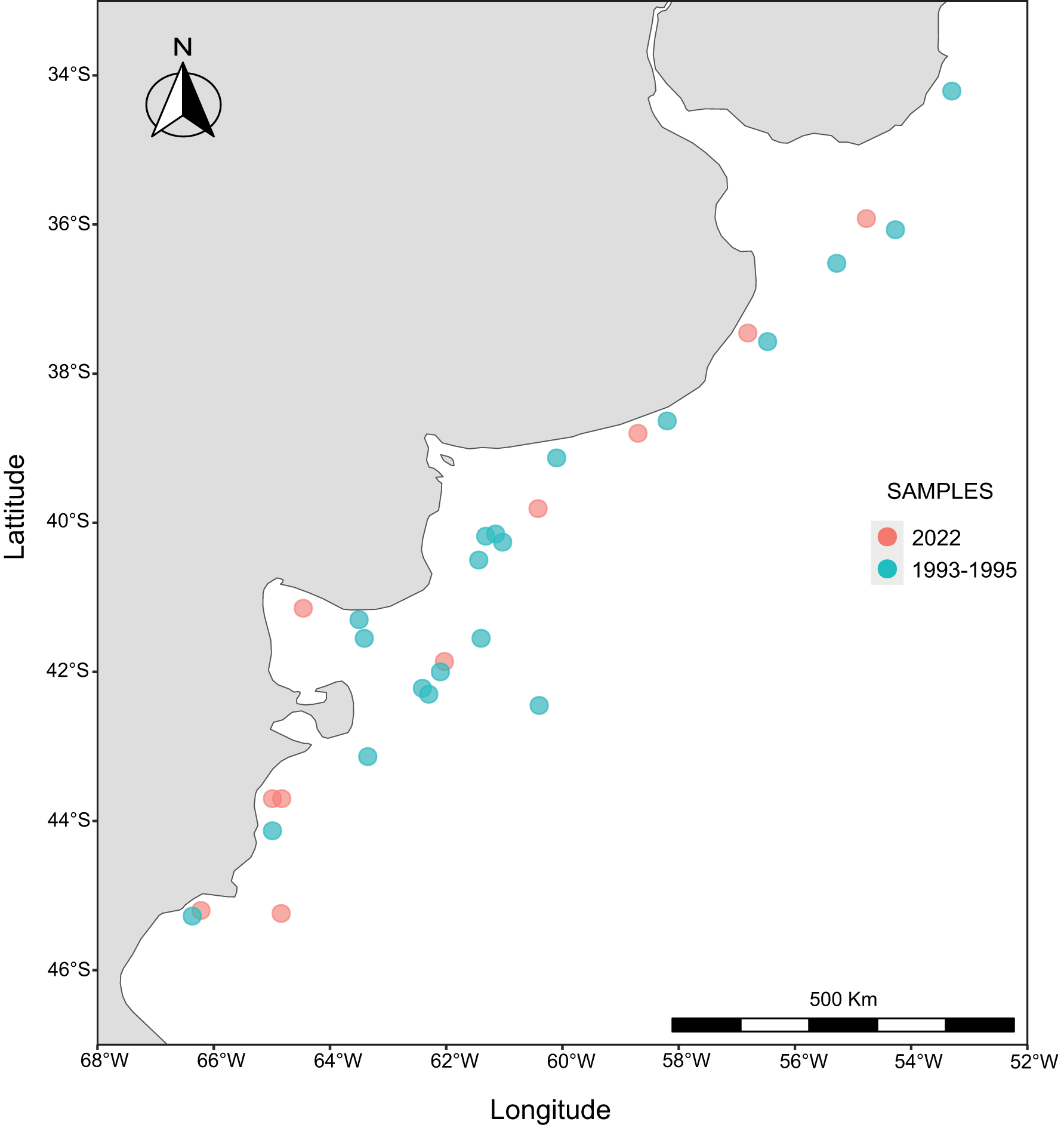
Data on parasitism by metacercariae of Cardiocephaloides sp. in the eyes of 1038 Argentine anchovies of different sizes were available from previous studies, most of them unpublished (mainly data about juvenile fish). These fishes were collected during six research cruises of the Instituto Nacional de Investigación y Desarrollo Pesquero (INIDEP) in the period 1993–1995 following a pre-stratified random sampling design and midwater trawl nets were used to collect samples. This sampling scheme covered the southwest Atlantic shelf from 34 to 46º S (Figure 1; Supplementary Material). Anchovies were assigned to four distinct groups or stocks, identified by using the parasite communities of adult fish (total length > 120 mm) as biological tags (Timi, Reference Timi2003): the autumn north Bonaerense ANB (35–37ºS) and three spring stocks, north Bonaerense SNB (34–40ºS), south Bonaerense SSB (40–43ºS) and Patagonian SP (43–46ºS) (Timi, Reference Timi2003). Despite both autumn and spring samples from the north Bonaerense zone being caught in the same area, parasitological evidence suggested that autumn samples correspond to a different stock, which probably inhabits northern zones than fish caught during spring in these areas (Timi, Reference Timi2003). Additionally, and following Angelescu (Reference Angelescu1982), fish from each stock were grouped into size classes representing the following developmental stages: primary juveniles (36–60 mm total length), secondary juveniles (61–100 mm), pre-adults (101–120 mm) and adults (>120 mm).
Distribution map of Engraulis anchoita samples. Samples from 1993 to 1995 in green, samples from 2022 in orange.

Present samples comprise 714 anchovies caught between 35 and 45ºS, from June to December 2022 (Figure 1) by both commercial vessels and during five research cruises of the INIDEP. Fish were assigned to the same stocks as previous ones according to its date and locality of capture. They also were divided into the same size classes. After defrosting, the eyes of each anchovy were examined under a stereomicroscope before and after being removed with the aid of thin tweezers. Metacercariae were preserved in 96° ethanol for molecular identification.
From February to May 2021 (64 penguins) and from February to March 2023 (>40 penguins) were found stranded dead along the beaches of south-eastern Buenos Aires Province. Of these, 20 fresh carcasses were randomly selected for adult C. physalis examination. Fresh carcasses included recently dead birds, odourless, thus showing features of rigour mortis and those in slight decomposition, with little odour, but intact internal organs. All sampled birds were identified as young – juvenile – individuals that recently abandoned their breeding grounds, with feathers uniformly coloured, i.e. overall bright coloration with grey-blue on the birds´ back and more faded grey-blue on the chest, with no evident wear (no trace of waxy sheath remaining at the base in spite of fully developed feathers) (see Seco Pon and García, Reference Seco Pon and García2022). Whole carcasses were frozen and stored in a sealed plastic bag at−18°C prior to subsequent analysis.
After defrosting, the intestines were dissected out and examined under a stereomicroscope. Adult digeneans were counted and identified.
DNA was extracted from metacercariae using DNeasyTM tissue kit (Qiagen, Hilden, Germany) following the manufacturers’ protocols. For amplification of 28S ribosomal ADN, primers 1500 R (5′-GCT ATC CTG AGG GAA ACT TCG-3′; Snyder and Tkach, Reference Snyder and Tkach2001) and 300 F (5ʹ-CAA GTA CCG TGA GGG AAA GTT G-3ʹ; Littlewood et al., Reference Littlewood, Curini-Galletti and Herniou2000) were used. PCR reaction was set up in 25-μl reactions using: 5 μl of DNA (≥ 10 ng) as the template, 0.5 μl (10 mM) of each primer, 2 μl (10 mM) of dNTPs, 3 μl (25 mM) of MgCl (Promega), 5 μl (5X) of Green Buffer (Promega), 0.3 μl of Go-Tag Polymerase (5 U/μl) (Promega) and sterilized distilled water up to 25 μL. The following thermocycling profile was used for amplification: denaturation (94°C for 2 min); 35 cycles of amplification (94°C for 30 s, 57°C for 45 s and 72°C for 2 min); and final extension at 72°C for 7 min. Amplified PCR products were verified in a 1.2% agarose gel. The PCR product was purified using QIAquick Gel Extraction Kit or QIAquick PCR purification Kit (Qiagen, Hilden, Germany). Sequencing of both strands was carried out using ABI 3730XLs automated sequencer (Applied Biosystems, Macrogen, South Korea). Sequences were edited and assembled in Proseq v.3.5 (Filatov, Reference Filatov2002) and deposited in the GenBank database. For identification, the generated sequence was compared against the NCBI database using the BLAST algorithm (Sayers et al., Reference Sayers, Beck, Bolton, Brister, Chan, Comeau, Connor, DiCuccio, Farrell, Feldgarden, Fine, Funk, Hatcher, Hoeppner, Kane, Kannan, Katz, Kelly, Klimke, Kim, Kimchi, Landrum, Lathrop, Lu, Malheiro, Marchler-Bauer, Murphy, Phan, Prasad, Pujar, Sawyer, Schmieder, Schneider, Schoch, Sharma and Sherry2023).
The prevalence, mean intensity and mean abundance of Cardiocephaloides sp. were calculated, according Bush et al. (Reference Bush, Lafferty, Lotz and Shostak1997) in each sample of anchovies based on the geographical location and season of collection for both past and present samples, as well as for adult worms in penguins.
To test the occurrence of temporal changes in parasitism, the effects of period, but also of other potential sources of variability, such as total length (LT) and anchovy stock on the abundance of C. physalis, generalized linear models with Negative Binomial error distribution, were applied (Crawley, Reference Crawley2007). Obtained models were evaluated with information-theoretic procedures (Burnham and Anderson, Reference Burnham and Anderson2002). The Akaike’s (AIC) information criterion was calculated for each model (Burnham and Anderson, Reference Burnham and Anderson2002). Model selections were made considering a ΔAIC < 2. The relative likelihood that a specific model is the best of the suite of all models was determined by the AIC weight (wi). The percentage explained by the model was calculated using the formula: Null deviance-Residual deviance/Null deviance. Deviance percentage of each variable was calculated on the basis of Analysis of Variance with formula: deviance of variable/sum of variance. Statistical analyses were carried out using R software, Version 2.13.1 (R Development Core Team 2011). All tests were two-tailed, and differences were considered significant at p < 0·05.
Results
A total of 309 metacercariae were found in the 1038 anchovies caught between 1993 and 1995. Parasites were found in fish from spring samples only. On the other hand, only four larvae were found in four out of 714 anchovies caught in 2022.
A unique sequence (924 pb) was obtained from the four amplifications performed on the metacercariae found parasitizing anchovies from 2022, probably due to a poor condition of DNA because fish samples were preserved frozen. The molecular characterization of the metacercaria allowed to identify this specimen as belonging to Cardiocephaloides physalis, matching with a percentage of identity of 99.89% with sequences of metacercariae found in fishes, Clinus superciliosus (MW370426 and MW370427) from South Africa, and penguins, Spheniscus demersus (MW370425) and Spheniscus magellanicus (MN820665), from South Africa and Chile respectively (Vermaak et al., Reference Vermaak, Smit and Kudlai2021). The new sequence is available in GenBank under accession number ID: PV110189.
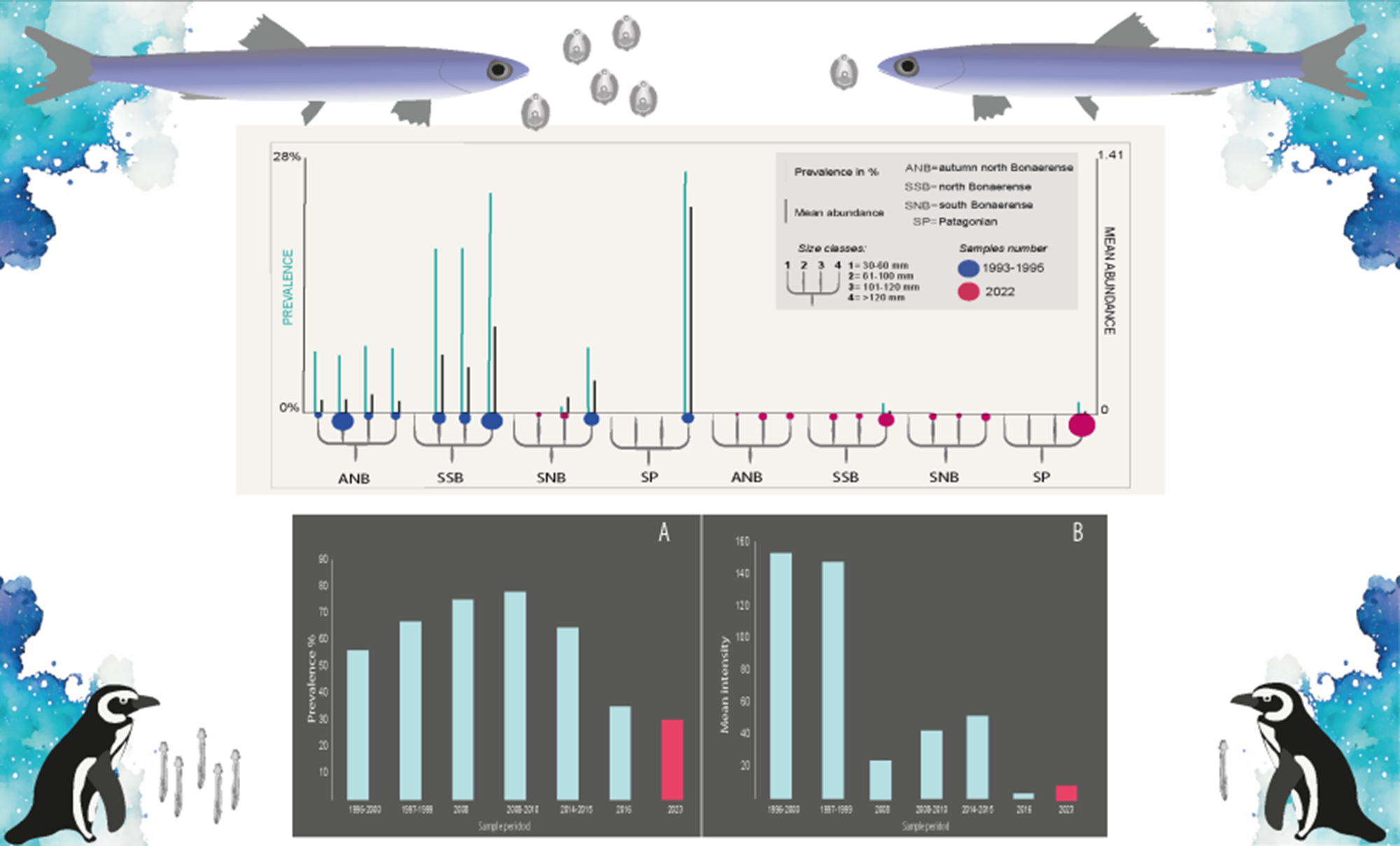
In the older samples, no parasites were found in anchovies caught during autumn whereas a tendency to increase with anchovy size as well as with latitude was evident in terms of both prevalence and mean abundance (Table 2) for spring samples, although no relationship between them. The model that best explained the variation in abundance of C. physalis in anchovies included the time period, total length and stock as explanatory variables (wi = 0.9864), explaining the 51% of variation (Table 3). Other models resulted with a ΔAIC > 2 and lower wi (Table 3). The abundance of C. physalis in E. anchoita decreased significantly in the recent samples (2022) (Table 4), the observed differences of abundance across stocks and its increase with fish size are mainly due to the values of parasitism recorded during the first period. However, when all variables are considered, the most important in determining changes in abundance was the period (Table 5).
Number of examined hosts (N), prevalence (P) and mean abundance (MA), a Cardiocephaloides physalis parasitizing Engraulis anchoita. (N/P/MA)

Summary of model-selection results for models explaining variation in abundance of Cardiocephaloides physalis in relation to period of time and total length (LT). models are listed in decreasing order of importance

Parameter likelihoods, estimated SE and 95% confidence interval limits (CL) for explanatory variables describing variation in abundance of Cardiocephaloides physalis parasitizing Engraulis anchoita

Mixed-model analysis of variance (ANOVA) table to assess different effects on abundance of Carciocephaloides physalis parasitizen Engraulis anchoita

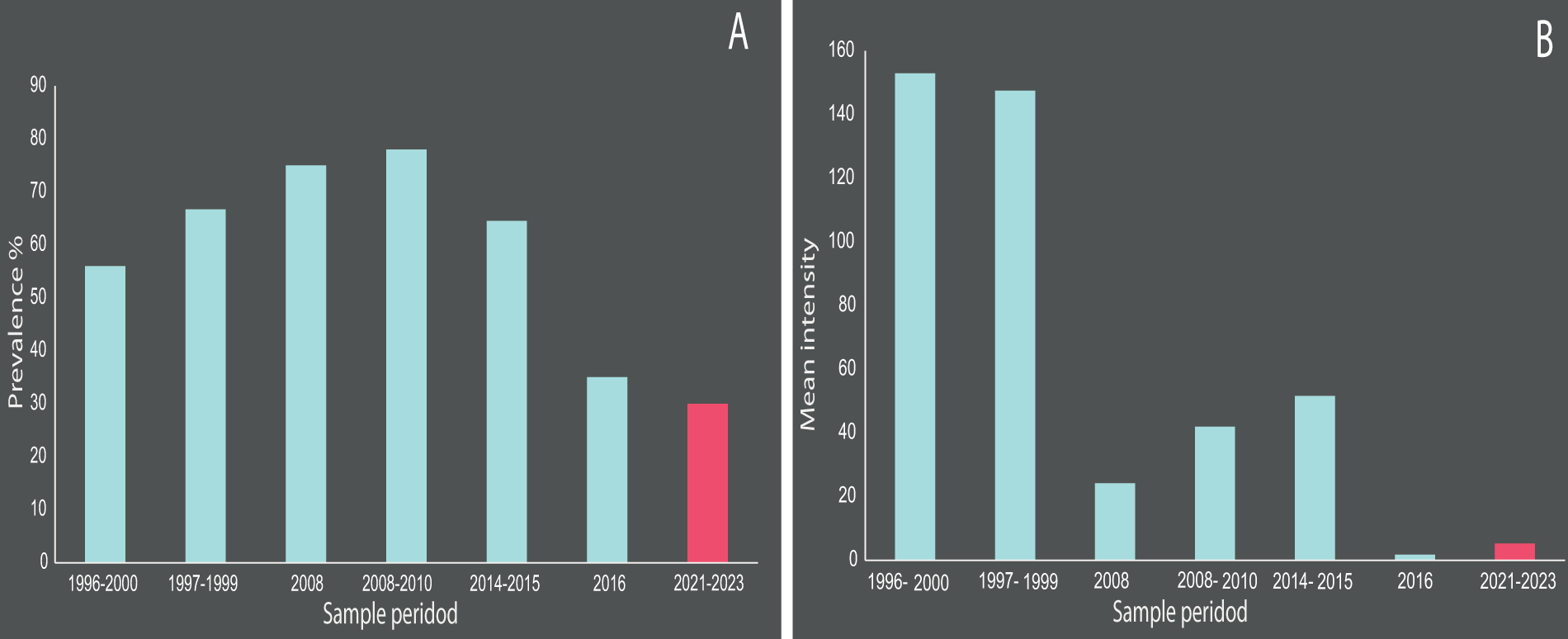
The values of parasitism recorded in the present samples (2021–2023) of penguins also showed low values of prevalence (Figure 2a) and mean intensity (Figure 2b) relative to previous data from literature, especially with those from 1999 to 2000, but similar to those recorded in a sample from 2016 (Figure 2, Table 1). Penguins examined between 2008 and 2015, on the coast of Brazil, showed intermediate values.
Prevalence (A) and mean intensity (B) of Cardiocephaloides physalis from penguins Spheniscus magellanicus. Samples from 1996 to 2016 in light blue, samples from 2021 to 2023 in red.

Discussion
The present work confirms the identity of metacercariae found in E. anchoita as C. physalis, as has been suggested in previous works (Timi et al., Reference Timi, Martorelli and Sardella1999; Timi, Reference Timi2003), providing the first molecular confirmation of this species for the Southwest Atlantic Ocean and highlighting its broad distribution in the Southern Hemisphere.
Three decades ago, C. physalis was relatively common in the eyes of adult anchovies (Timi et al., Reference Timi, Martorelli and Sardella1999; Timi, Reference Timi2003), and according to the present analyses of old data, also for juvenile fish, except for primary juvenile ones. This would explain the relatively high values of prevalence and abundance of adults C. physalis in penguins during that period, given the predominance of anchovies in the diet of penguins living north of 45ºS (Yorio et al., Reference Yorio, González-Zevallos, Gatto, Biagioni and Castillo2017; Ciancio et al., Reference Ciancio, Yorio, Wilson and Frere2018; Blanco et al., Reference Blanco, Gallo, Pisoni, Dell’Omo, Gerez, Molina and Quintana2022). In those times, the trematode followed the cumulative pattern commonly displayed by long-lived larval parasites in intermediate and paratenic hosts (Braicovich et al., Reference Braicovich, Ieno, Sáez, Despos and Timi2016), increasing in number with fish size. In this case, as strigeid cercariae actively penetrates the skin of secondary hosts (van Beest et al., Reference van Beest, Montero, Padrós, Raga and Born-Torrijos2022), the transmission success under natural conditions relies mostly on host encounter rates and not on the feeding activity or amount of fish. Therefore, a differential use of habitat between juvenile and adult anchovies, and consequently of the encounter rates with cercariae, could explain the cumulative pattern plus the fact that older fish have been exposed for longer. The relevance of host size was also clear considering the percentage of deviance in the selected model, a pattern surely determined by the value of parasitism in the first period. Similarly, the effect of host stock was due to metacercariae found in 1993–1995. Indeed, the same geographical pattern was also evident three decades ago, with an increasing number of parasitized hosts and of parasites per fish with latitude, indicating a preference for colder waters. Likewise, metacercariae found in the eyes of S. sagax, in South Africa, showed significantly higher values of parasitism in sardines associated with the cold Benguela Current regarding the warmer Agulhas Current (Weston et al., Reference Weston, Reed, Hendricks, Winker and van der Lingen2015).
The conspecificity of larvae and adults C. physalis could also explain the concomitant decrease of both stages in intermediate fish and definitive bird hosts, with only larger fish from southern latitudes harbouring the few worms currently recorded. Unfortunately, no data of parasitism in anchovies at intermediate dates were available. Therefore, we are reporting just ‘snapshots’, which do not provide complete evidence of the entire process (Mushet et al., Reference Mushet, Solensky and Erickson2019). However, the gradual decline of the population of adult parasites in Magellanic penguins over the last three decades, related to the concomitant decrease of their larvae is an expected result.
Assigning a causative relationship to the observed decrease in parasitism would be speculative, because many interacting variables, biological and environmental, could be acting simultaneously. The widespread effects of environmental change on the ocean biota during recent decades (Carlson et al., Reference Carlson, Burgio, Dougherty, Phillips, Bueno, Clements, Castaldo, Dallas, Cizauskas, Cumming, Doña, Harris, Jovani, Mironov, Muellerklein, Proctor and Getz2017; Tracy et al., Reference Tracy, Pielmeier, Yoshioka, Heron and Harvell2019) have a series of possible causes, some of them interdependent from each other, including, in the case of host-parasite systems, the ecophysiology of their interactions and shifts in behaviour, movement and phenology of both hosts and parasites (Altizer et al., Reference Altizer, Ostfeld, Johnson, Kutz and Harvell2013). However, some possible causes and their respective probabilities of occurrence will be explored here, including changes in host densities, host-parasite encounter rates, and a direct effect of environmental change on parasites.
Any parasite species requires densities of both definitive and intermediate hosts large enough to sustain viable populations, as well as suitable to optimal environmental conditions for their development, reproduction and transmission. Changes in these variables could explain the observed pattern. A wide variability in abundance is a typical feature of small pelagic fishes compared with other fish taxa (Hilborn et al., Reference Hilborn, Buratti, Diaz Acuna, Hively, Kolding, Kurota, Baker, Mace, de Moor, Muko, Osio, Parma, Quiroz and Melnychuk2022), particularly for engraulids (Pennino et al., Reference Pennino, Coll, Albo-Puigserver, Fernández-Corredor, Steenbeek, Giráldez, González, Esteban and Bellido2020). However, no evidence of drastic changes in the density of Argentine anchovies has been recorded during the last decades (Orlando et al., Reference Orlando, Buratti, Garciarena, Buratti, Parietti and Spath2024a, Reference Orlando, Buratti, Garciarena, Buratti, Parietti and Spath2024b), although their success in recruitment undergoes interannual variations related to fluctuations in chlorophyll concentration influenced by changes in water temperature and vertical stratification (Marrari et al., Reference Marrari, Signorini, McClain, Pajaro, Martos, Viñas, Hansen, Dimauro, Cepeda and Buratti2013). Indeed, anchovies have been catalogued as those with the lowest sensitivity to climate change among fishery resources, although with the highest potential to adjust its distribution (Gianelli et al., Reference Gianelli, Orlando, Cardoso, Carranza, Celentano, Correa, de la Rosa, Doño, Haimovici, Horta, Jaureguizar, Jorge-Romero, Lercari, Martínez, Pereyra, Silveira, Vögler and Defeo2023) in response to changes in the regional warming hotspots (Alvarez Perez and Sant’Ana, Reference Alvarez Perez and Sant’Ana2022). Similarly, the overall population size of S. magellanicus in both southern and northern regions of the distribution of breeding colonies in the Atlantic coasts has remained relatively stable over the last 25 years (Millones et al., Reference Millones, Morgenthaler, Gandini and Frere2021; García-Borboroglu et al., Reference García-Borboroglu, Pozzi, Parma, Dell’Arciprete and Yorio2022). Indeed, in northern Patagonia (Chubut and Rio Negro provinces, Argentina), which is the stronghold of the known global population, trends are mixed. Whereas the largest colonies are declining in the central and southern part of northern Patagonia (Boersma et al., Reference Boersma, García Borboroglu, Frere, Godoy Reyes, Kane, Pozzi, Pütz, Raya Rey, Rebstock, Simeone, Smith, Van Buren, Yorio, Boersma and García Borboroglu2015; Pozzi et al., Reference Pozzi, García Borboroglu, Boersma and Pascual2015; Braicovich et al., Reference Braicovich, Ieno, Sáez, Despos and Timi2016; García-Borboroglu et al., Reference García-Borboroglu, Pozzi, Parma, Dell’Arciprete and Yorio2022), the breeding population has expanded north since the 1960s, with new colonies established and growing rapidly (Schiavini et al., Reference Schiavini, Yorio, Gandini, Raya Rey and Boersma2005; Boersma et al., Reference Boersma, García Borboroglu, Frere, Godoy Reyes, Kane, Pozzi, Pütz, Raya Rey, Rebstock, Simeone, Smith, Van Buren, Yorio, Boersma and García Borboroglu2015; Pozzi et al., Reference Pozzi, García Borboroglu, Boersma and Pascual2015). Climate change, however, through increases in the frequency and intensity of storms has resulted in reproductive failure of Magellanic penguins, lowering their reproductive success and undermining their resilience (Boersma and Rebstock, Reference Boersma and Rebstock2014). Unfortunately, the first intermediate molluscan host of C. physalis is unknown and, therefore, possible changes in its populations cannot be disregarded.
As parasites depend on other species for transmission, phenological mismatches between hosts and parasites can alter the severity of diseases due to their differential responses to rising temperatures, leading to reductions in disease (Paull and Johnson, Reference Paull and Johnson2011). Consequently, it is possible that the geographic distributions of many parasites may actually experience net declines with climate change. During the breeding season, the diet and foraging behaviour of S. magellanicus are variable along its distribution range in Atlantic waters, in terms of both prey composition and size (Wilson et al., Reference Wilson, McMahon, Quintana, Frere, Scolaro, Hays and Bradshaw2011) and any environmental change could cause a shift in the distribution of anchovies, which would affect the foraging behaviour of penguins (Blanco et al., Reference Blanco, Gallo, Pisoni, Dell’Omo, Gerez, Molina and Quintana2022) and therefore the probabilities of acquiring parasites. Unfortunately, no information is available to assess at the proper spatial scale possible changes in the availability of Argentine anchovy in the study region and its potential effect on the diet and foraging behaviour of Magellanic penguins (García-Borboroglu et al., Reference García-Borboroglu, Pozzi, Parma, Dell’Arciprete and Yorio2022). On the other hand, a progressive northward shift in the septentrional limit of the Atlantic distribution of breeding colonies of S. magellanicus has been taking place over several decades (García-Borboroglu et al., Reference García-Borboroglu, Pozzi, Parma, Dell’Arciprete and Yorio2022). Owing that all examined birds were juvenile ones, they could have come from these northern colonies, where they could be fed with ‘northern’ and consequently less parasitized anchovies caught by their parents during the chick-rearing period. Nevertheless, both adult and juvenile penguins can potentially track patches of Argentine anchovy for long periods and follow its northward migration from their breeding grounds in Argentina to their wintering grounds in southern Brazil (Marques et al., Reference Marques, Cardoso, Haimovici and Bugoni2018) where the most important factor explaining the density of penguins at sea is the anchovy density (Costa et al., Reference Costa, Bugoni, Kinas and Madureira2020). For such a reason, it is little probable that phenological mismatches or a decrease in host-parasite encounter rates are the main cause of the observed decline of parasite population.
Finally, ectothermic hosts and parasites with environmental transmission stages that can survive outside the host provide the best examples of infectious disease responses to climate change, because their rates of development and transmission should be more sensitive to temperature than other host-pathogen interactions (Altizer et al., Reference Altizer, Ostfeld, Johnson, Kutz and Harvell2013). Trematodes such as C. physalis, with free-living eggs, two free-swimming larval stages, such as miracidia and cercariae, and two ectothermic hosts, such as mollusks and fishes, are highly susceptible to changes in sea temperature, which can affect the release, embryonic development and hatching of eggs, the longevity and infectivity of free-living stages and the development, maturation, longevity and mortality of adult parasites (Marcogliese, Reference Marcogliese2001; Berkhout et al., Reference Berkhout, Lloyd, Poulin and Studer2014; Selbach and Poulin, Reference Selbach and Poulin2020). Therefore, a direct effect of an increase in sea temperature on parasites arose as the main causal candidate for the decline in parasite populations occurred along the last decades. Furthermore, whereas the effects of global change on parasitism have been mostly studied experimentally concerning to temperature (Marcogliese, Reference Marcogliese2016), parasites can respond directly to changes in other climate-driven abiotic parameters, such as salinity and UV radiation, which can have their own and/or combined effects on parasite survival (Studer and Poulin, Reference Studer and Poulin2013).
At present, the negative impacts of climate change on parasite diversity are largely undocumented (Carlson et al., Reference Carlson, Burgio, Dougherty, Phillips, Bueno, Clements, Castaldo, Dallas, Cizauskas, Cumming, Doña, Harris, Jovani, Mironov, Muellerklein, Proctor and Getz2017). With climate change prospects predicting at least 4°C of global warming by the end of this century (Parry et al., Reference Parry, Lowe and Hanson C2009; Stafford Smith et al., Reference Stafford Smith, Horrocks, Harvey and Hamilton2011), the multiplicity of developmental stages, including free-living and parasitic phases, make many parasites especially susceptible to these environmental threats (Marcogliese, Reference Marcogliese2001; Sures et al., Reference Sures, Nachev, Schwelm, Grabner and Selbach2023). This is particularly true for those parasites with high host specificity, complex life cycles or those that infect ectothermic hosts during one or more life cycle phases, which are at greatest risk (Harvell et al., Reference Harvell, Mitchell, Ward, Altizer, Dobson, Ostfeld and Samuel2002; Cizauskas et al., Reference Cizauskas, Carlson, Burgio, Clements, Dougherty, Harris and Phillips2017). However, temperature effects on the physiological homeostasis of endotherm hosts, predominantly on endocrine and immune systems, may also have deep implications for parasite epidemiology (Morley and Lewis, Reference Morley and Lewis2014). In this sense, beyond the biological and ecological consequences of global change on them, parasitic organisms offer excellent systems for measuring and monitoring such effects. The almost local extinction of C. physalis in a marine hotspot of global warming seems to be one of the first examples and a tool for predicting and modelling future environmental changes.
Supplementary material
The supplementary material for this article can be found at https://doi.org/10.1017/S0031182025000216.
Acknowledgements
We thank the scientific staff for the collection of samples on board INIDEP research vessels as well as the donation of samples obtained on commercial vessels.
Author contribution
The study was conceptualized by all authors. J. T. conducted the literature searches and risk of bias assessment and wrote the manuscript. P. M., J. P. S. C., C. B. and M. I. revised and edited the manuscript and provided input for manuscript structure and topics to search using the search terms and topics to discuss in the manuscript. P. M. and M. M. constructed the figures.
Financial support
Financial support was provided by grants from Fondo para la Investigación Científica y Tecnológica (PICT-2021-I-A-01105) and Universidad Nacional de Mar del Plata (EXA1104/22).
Competing interests
The authors declare there are no conflicts of interest.
Ethical standards
This section is mandatory. Not applicable.





 Open access

