




Introduction
Cyprus was a major producer of copper in antiquity, and, as a consequence, the metal and the island toponym (from the Greek ‘Kúpros’) became synonymous (Kassianidou Reference Kassianidou and Webb2014). The question of when and how copper production and metallurgy started on the island, however, has proven difficult to answer. The earliest references to Cypriot copper exports date to the nineteenth to seventeenth centuries BC, occurring in cuneiform texts from Mari and Alalakh—both in the Northern Levant—and from Babylonia (Muhly Reference Muhly, Karageorghis and Christodoulou1972; Knapp Reference Knapp1996). Although there is some archaeological evidence for mining and copper smelting and casting in the early second millennium BC on Cyprus, in particular from the site of Ambelikou-Aletri (Webb & Frankel Reference Webb and Frankel2013: 25–28 & 178–84), more substantial remains of copper production appeared in the Late Bronze Age (Kassianidou Reference Kassianidou2013a, Reference Kassianidou and Webb2014: 262).
The pertinent question is how far back can the emergence of transformative copper metallurgy on Cyprus be traced? Here, by transformative metallurgy, we refer to the extraction of copper from ores through smelting, and the manufacture of artefacts through melting and casting—processes that require temperatures in excess of 1000o C (Radivojević et al. Reference Radivojević, Rehren, Pernicka, Šljivar, Brauns and Borić2010: 2776). Traditionally, it has been argued that both the extraction and production processes began at the start of the Bronze Age, in the so-called ‘Philia’ phase (2400–2200 BC). At this time, a clear Anatolian influence is apparent in Cypriot pottery assemblages and house forms, and in the introduction of cattle, donkey and woolly sheep to the island (Frankel Reference Frankel2000; Webb & Frankel Reference Webb, Frankel, Karageoghis and Kouka2011). The Cypriot Philia assemblages are often interpreted as evidence of a migration from Anatolia, in which the migrants were incentivised by the prospect of exploiting Cypriot copper ores (Frankel Reference Frankel2000; Webb & Frankel Reference Webb, Frankel, Karageoghis and Kouka2011; Kassianidou Reference Kassianidou and Webb2014: 238; for an alternative hybridisation model, see Knapp Reference Knapp2013: 264).
If we accept the argument of the link between the Philia phase and the start of transformative copper production, this would place the adoption of extractive metallurgy at about 1000 years later on Cyprus than in Anatolia, the Southern Levant, Iran and Arabia (Yener Reference Yener2000; Philip et al. Reference Philip, Clogg, Dungworth and Stos2003; Weeks Reference Weeks2003; Thornton Reference Thornton2009). Artefacts with compositions consistent with Cypriot copper ore, however, have been found at Pella in Jordan (Philip et al. Reference Philip, Clogg, Dungworth and Stos2003) and at Agia Photia on Crete (Day et al. Reference Day, Wilson, Kiriatzi and Branigan1998; Stos-Gale & Gale Reference Stos-Gale, Gale, Foster and Laffineur2003; Davaras & Betancourt Reference Davaras and Betancourt2004). Both instances probably date to the early third millennium BC (see also Bolger Reference Bolger2013: 4). The Aghia Photia cemetery is dated on the basis of ceramics that belong to the Kampos group (Davaras & Betancourt Reference Davaras and Betancourt2004: 4). This Kampos assemblage has been the focus of substantial investigations in the past decade and can now be convincingly attributed to the Early Bronze 1 period (Day et al. Reference Day, Wilson, Kiriatzi and Branigan1998: 136; Davaras & Betancourt Reference Davaras and Betancourt2012; Tsipopoulou Reference Tsipopoulou, Mantzourani and Betancourt2012: 215). The argument that the chronology of prehistoric Cyprus requires modification, and that the Philia phase dates to the first half of the third millennium BC (Bourke Reference Bourke2014)—advanced on the basis of the aforementioned metal finds in Jordan and Crete—now seems untenable due to substantial work on the absolute chronology of Cyprus (Peltenburg et al. Reference Peltenburg, Frankel, Paraskeva and Peltenburg2013; Manning Reference Manning and Webb2014; Paraskeva Reference Paraskeva, Kearns and Manning2019). Finally, if Philia-phase settlers migrated from Anatolia, how did they know about the existence of copper ore deposits on Cyprus? While Webb and Frankel (Reference Webb, Frankel, Karageoghis and Kouka2011: 30) argued that “Cyprus—its geography and resources—was clearly part of the cognitive map of incoming groups before they arrived to live permanently on the island”, this view that Anatolians were already familiar with Cypriot landscapes and resources cannot be supported with the evidence currently available. In this article, we reassess the data for the emergence of transformative copper metallurgy on Cyprus by reviewing the composition of recently found Cypriot Chalcolithic copper artefacts and metal objects from Pella and Agia Photia.
Copper artefacts of the Chalcolithic
The question under consideration here does not concern the date of the earliest copper artefacts found on Cyprus, but, rather, the date of the earliest evidence for transformative metallurgy, which is based on ore mining, smelting and casting, rather than cold-working and perhaps annealing of native copper (a form of metallic copper that occurs naturally in small quantities). There is some, albeit limited, evidence for copper-working in Chalcolithic Cyprus (4000–2400 BC) in the form of hammering and possibly melting and casting of small amounts of native copper. There is, however, currently no convincing evidence for transformative copper technologies in the Chalcolithic (Peltenburg Reference Peltenburg, Betancourt and Ferrence2011; Kassianidou Reference Kassianidou and Peltenburg2013b; Kassianidou & Charalambous Reference Kassianidou, Charalambous, Peltenburg, Bolger and Crewe2019). Metal artefacts that date to the Middle Chalcolithic (3500–2900 BC) are relatively few and mostly comprise small ornaments (Kassianidou Reference Kassianidou and Peltenburg2013b: 234). By the Late Chalcolithic (2900–2400 BC), artefacts that can be identified as tools occur; in particular, the awl (KM416) and chisels (KM694 and KM986) from Kissonerga-Mosphilia (KM416) and the chisel from Lemba-Lakkous (LL134) (Peltenburg Reference Peltenburg, Betancourt and Ferrence2011: 7; Kassianidou Reference Kassianidou and Peltenburg2013b: 238). These objects must have been cast in simple moulds, and could indicate the start of transformative metallurgy.
A key question regarding these artefacts is whether they were produced using either Cypriot native copper or smelted copper from local ores, or whether the metal had been imported. While lead isotope analysis carried out in the 1970s and 1980s casts doubt on a Cypriot provenance (Gale Reference Gale1991: 50 & 53), metalworking evidence from Kissonerga-Mosphilia in the form of ore fragments and a crucible demonstrated the possible existence of transformative copper metallurgy in the Chalcolithic (Peltenburg (Reference Peltenburg, Betancourt and Ferrence2011: 7). The casting of larger and more complex objects in moulds, however, appears to have started in the Philia phase, when the quantity of copper-based artefacts increased substantially (Manning Reference Manning and Webb2014; Kassianidou & Charalambous Reference Kassianidou, Charalambous, Peltenburg, Bolger and Crewe2019).
Attempts to determine the date by which transformative copper technologies were first used on Cyprus rely on the chronology of a few key objects. Webb and Frankel (Reference Webb, Frankel, Karageoghis and Kouka2011) argue that the copper-processing evidence from Kissonerga-Mosphilia dates to the end of the Late Chalcolithic, overlapping with the Philia phase, and that there is no evidence for transformative copper metallurgy pre-dating the latter phase. In response to Gale (Reference Gale1991: 57), who argued that analysed Chalcolithic metal artefacts from the site of Kissonerga-Mosphilia were consistent with non-Cypriot ores, Peltenburg (Reference Peltenburg, Betancourt and Ferrence2011: 5) has stated that one of the artefacts—a hook from Kissonerga-Mylouthkia analysed by Gale—was from an insecure context, and that the second object, an axe (KM457) (Gale Reference Gale1991: 45–46), dates to the Philia phase. Clearly, this discussion is complicated by whether larger and cast metal objects can be assigned to the Late Chalcolithic (2900–2400 BC) or the Philia phase (c. 2400–2200 BC). The metal artefacts from Chlorakas-Palloures presented here were recovered from an archaeological context that is securely dated to the Late Chalcolithic, and therefore have much to add to this discussion.
Copper artefacts from Chlorakas-Palloures
The ongoing excavations at the Chalcolithic site of Chlorakas-Palloures began in 2015 (Düring et al. Reference Düring, Klinkenberg, Paraskeva, Kassianidou, Souter, Croft and Charalambous2018). It is one of a series of Chalcolithic sites situated along the coast to the north of Paphos (Figure 1). The site has yielded mainly deposits dating to the earlier part of the Late Chalcolithic, but, importantly, no Philia-phase ceramics have been found either on the surface or in the extensive excavations. It is plausible, therefore, that the site pre-dates the Philia phase.
Map of Chalcolithic sites in western Cyprus (map by V. Klinkenberg).

A three-year rescue excavation (2015–2017) on one of the central areas of the site has revealed two clusters of buildings. In the north is a group of predominantly large, well-built structures. These contained some extraordinary features, such as a large hearth platform and mortar installation. The southern cluster comprised a series of smaller domestic structures, each measuring approximately 4–6m in diameter. In addition to fragments of corroded copper, three metal objects were retrieved from the site. Two are small objects (Figure 2): a copper spiral (857_M1) and a snake-like/spiraliform pendant (700_M1). These objects were most likely produced by cold hammering, and have clear parallels at Souskiou-Laona and Souskiou-Vathyrkakas (Peltenburg Reference Peltenburg, Betancourt and Ferrence2011: 5, fig. 1.1: objects E–G; Kassianidou Reference Kassianidou and Peltenburg2013b: 248–49, pl. 6.2: objects 1–2). These parallels could suggest that, as with the picrolite objects (artefacts made of a locally available, pale green to blue stone—a variant of serpentine) that circulated in Chalcolithic Cyprus, these metal artefacts might have been produced by specific workshops on Cyprus for exchange between communities.
The three copper objects found at Chlorakas-Palloures (photographs by A. Charalambous).

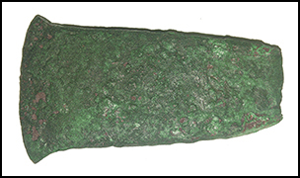
The third and most remarkable copper object found at Chlorakas-Palloures is a copper axe (571_M1)—the only one found in a securely dated Chalcolithic Cypriot context. This metal axe is approximately 75mm long and weighs 119g. The object flares out at the bit and its main body has a flat, trapezoidal shape that tapers towards the rear (Figure 3). The butt of the axe is rectangular in shape. This type of axe currently has no clear comparanda on Cyprus from Chalcolithic, Philia or Early Cypriot (2200–2000 BC) sites, although the previously mentioned Philia-phase axe-butt fragment KM457, which has a composition consistent with Anatolian ores (Gale Reference Gale1991: 45–46; Peltenburg Reference Peltenburg1998: 188–89), matches in terms of dimensions and shape. Flat axes of roughly similar shape, however, are known from Anatolia and the Aegean. A flat axe from the Demircihöyük-Sarıket cemetery, dated c. 2700–2500 BC, for example, is broadly similar in dimensions, shape and weight, although with a more rounded butt (Seeher Reference Seeher2000: 86, fig. 28: grave 171). An axe from Thermi, c. 2900–2700 BC, also seems to be of similar dimensions and shape to the Chlorakas-Palloures example (Branigan Reference Branigan1974: 166, pl. 13: n. 602). By contrast, the flat axes of the Levant have tapered butts or are more elongated, resembling chisels (Gernez Reference Gernez2008; Montanari Reference Montanari, Rosinska-Balik, Ochal-Czarnowicz, Czarnowicz and Debowska-Ludwin2015: 67 & 69).
Drawing of copper axe 571_M1 (produced by V. Klinkenberg).

This axe from Chlorakas-Palloures is unique among the metal artefacts known from Chalcolithic Cyprus. It is larger and heavier than any of the other contemporaneous artefacts so far discovered. As already noted, the Cypriot Chalcolithic assemblage consists predominantly of Middle Chalcolithic ornaments, and includes some small utilitarian objects, mostly chisels, but also awls from the Late Chalcolithic (Peltenburg Reference Peltenburg, Betancourt and Ferrence2011; Kassianidou Reference Kassianidou and Peltenburg2013b). The axe was found inside a complete jar (571_DC1), which was located close to the surface. The jar also contained a large, flat stone axe/adze (571_G1) and four hooks made of pig tusks (567_M1 and 571_M2/M3/M4) (Figure 4; for more details, see Düring et al. Reference Düring, Klinkenberg, Paraskeva, Kassianidou, Souter, Croft and Charalambous2018). The flat stone axe is of a type previously suggested to emulate metal objects (Croft et al. Reference Croft, Peltenburg, Tite and Peltenburg1998: 188). It is therefore remarkable that this particular stone axe resembles the associated copper axe in its thickness, tapering trapezoidal body and somewhat rectangular butt.
Collection of artefacts found in the jar (photographs by I.J. Cohn & A. Charalambous (copper axe)).

A charred barley seed was obtained from the same jar and radiocarbon-dated to 4065±35 BP (GrA68670), which calibrates to 2853–2812 BC (11% probability); 2744–2726 BC (2% probability); and 2696–2487 (82% probability) (calibrated using the IntCal13 curve; Reimer et al. Reference Reimer2013). Thus, the charred seed dates to c. 2600 BC; all the other objects and the jar itself are at least of the same date, and possibly older.
Analysing the Chlorakas-Palloures copper artefacts
We aimed to investigate the chemical composition of the Chlorakas-Palloures metal artefacts to establish whether they were made of pure or alloyed metal, of native or smelted copper from Cyprus, or from imported materials. The best way to differentiate between native and smelted copper is through metallography (Maddin et al. Reference Maddin, Stech-Wheeler and Muhly1980), but to do so requires destructive sampling of the object. In the present context, this was not possible. Instead, we undertook two other types of analysis to determine the chemical properties of the Chlorakas-Palloures metal artefacts. We took non-destructive measurements with a hand-held portable XRF instrument (HHpXRF), followed by lead isotope analysis on the copper residues left after the mechanical removal of corrosion for conservation purposes.
HHpXRF analysis was undertaken by Andreas Charalambous and Vasiliki Kassianidou using a 2010 DP-6500C Delta analyser from Innov-X Systems (now Olympus). The Alloy Plus analytical mode was employed. In this specific mode, Beam 1 (40kV) determines the concentration of the elements: titanium (Ti), vanadium (V), chromium (Cr), manganese (Mn), iron (Fe), colbalt (Co), nickel (Ni), copper (Cu), zinc (Zn), hafnium (Hf), tantalum (Ta), tungsten (W), rhenium (Re), platinum (Pt), gold (Au), lead (Pb), bismuth (Bi), zirconium (Zr), molybdenum (Mo), palladium (Pd), silver (Ag), tin (Sn) and antimony (Sb). Beam 2 (10kV) is used for determining the concentrations of silicone (Si), phosphorus (P) and sulphur (S). Mining mode was used for the determination of arsenic (As). For checking the accuracy and reliability of the Alloy Plus and Mining modes, however, certified reference materials such as CRM-875 (bronze standard) and BCR-691 (set of five copper alloys) were used.
Despite the well-recognised limitations of the technique imposed by analysis of the surface rather than a sample of fresh metal (Shugar Reference Shugar, Armitage and Burton2013: 182–83), the use of pXRF in the present study was necessary, as destructive sampling or removal of the artefacts from the museum was not permitted. This technique, and the same instrument, was also used to analyse other Chalcolithic metal artefacts from Cyprus, and the results were comparable with those of chemical analysis on the same artefacts using other analytical techniques, such as neutron-activation analysis (Kassianidou & Charalambous Reference Kassianidou, Charalambous, Peltenburg, Bolger and Crewe2019: 285).
No arsenic or sulphur was detected in either the spiral object (857_M1) or the snake-like pendant (700_M1) (Table 1). Remarkably, however, the axe (571_M1) contains a small amount of tin. Although the percentage of tin is minute (just 0.10 per cent), this is nevertheless significant, as tin is not present in Cypriot copper ores, even as a trace element (Constantinou Reference Constantinou, Muhly, Maddin and Karageorghis1982: 15; Muhly Reference Muhly1985: 277; Gale Reference Gale1991: 47). Tin is also not usually associated with native copper (Gale Reference Gale1991: fig. 13; Pernicka et al. Reference Pernicka, Begemann, Schmitt-Strecker, Todorova and Kuleff1997: 120–21), and therefore its presence could indicate the use of smelted copper.
Compositional analysis of three metal artefacts (571_M1 = axe; 857_M1 = spiral; 700_M1 = snake-like object) found at Chlorakas-Palloures using an HHpXRF (Düring et al. Reference Düring, Klinkenberg, Paraskeva, Kassianidou, Souter, Croft and Charalambous2018); n.d = not detected.

These results are similar to those obtained by Kassianidou and Charalambous (Reference Kassianidou, Charalambous, Peltenburg, Bolger and Crewe2019), who used the same methodology to analyse 16 other Cypriot Chalcolithic artefacts. Within that assemblage are another two objects that bear traces of tin: one each from the Late Chalcolithic sites of Lemba-Lakkous (LL209) and Kissonerga-Mosphilia (KM694). More importantly, an object (KM2174) from the latter site can be identified as being made of bronze, as it contains 3.30 per cent tin. Further examples of metal artefacts with small but significant amounts of tin have been reported from Middle Chalcolithic Erimi-Pamboules (Erimi 7 & 388; Zwicker Reference Zwicker1981). Gale (Reference Gale1991: 48) also reported that object LL134 from Lemba-Lakkous had traces of tin (<0.04 per cent), although no tin was detected when the object was re-analysed by Kassianidou and Charalambous (Reference Kassianidou, Charalambous, Peltenburg, Bolger and Crewe2019: 285).
In order to determine the provenance of the metal used to produce the Chlorakas-Palloures metal artefacts, we undertook lead isotope analysis. Since the 1960s, this method has been used to investigate the provenance of Mediterranean Bronze Age metals (Gale Reference Gale1991; Philip et al. Reference Philip, Clogg, Dungworth and Stos2003). Use of the technique, however, has not been without controversy. Critiques have, for example, focused on the often large ranges in isotopic signature of single-source areas, and the existence of overlap between possible sources. Furthermore, the use of isotope ratios as mere numbers in simple bi-plots for visual comparison to ore fields has been criticised (Pollard et al. Reference Pollard, Bray, Cuénod, Hommel, Hsu, Liu, Perucchetti, Pouncett and Saunders2018). Not all isotopes are taken into account simultaneously in any such graphical comparison. Moreover, lead isotopic data have a non-normal distribution and evolve according to particular laws of radioactive decay and geochemistry, which have been neglected in archaeological research (De Ceuster & Degryse Reference De Ceuster and Degryse2020). While graphical assessment of lead isotope ratios in bi-plots continues to be used in archaeological studies, kernel density estimates have been suggested as being more appropriate for data representation and for statistical calculations (Baxter et al. Reference Baxter, Beardah and Wright1997).
As it was not possible to sample the objects themselves, we analysed copper particles preserved in the corrosion products that were mechanically removed by conservators at the Cyprus Museum. A high-temperature acid digestion procedure was used to dissolve the samples, from which an aliquot was used for lead isolation and isotope ratio analysis by MC-ICP-MS (Multi-Collector Inductively-Coupled-Plasma Mass Spectrometry) on a Neptune device. Full details of the sample preparation and laboratory procedures are provided by Rademakers et al. (Reference Rademakers, Nikis, Putter and Degryse2017). The uncertainty values measured fall within the currently accepted range for lead isotope analysis (errors <0.005 for all ratios).
The lead isotope data are presented in Table 2 and show little variability between samples. For comparison, the lead isotope compositions of two other artefacts are also considered here: sample 180043 from Pella/Tell al-Husn (Jordan) is from an axe (Philip et al. Reference Philip, Clogg, Dungworth and Stos2003), and sample 4662d from Agia Photia (Crete) is from a copper alloy fish hook (Stos-Gale & Gale Reference Stos-Gale, Gale, Foster and Laffineur2003), both of which were interpreted as being consistent with Cypriot ores on the basis of previous lead isotope analyses (Philip et al. Reference Philip, Clogg, Dungworth and Stos2003; Stos-Gale & Gale Reference Stos-Gale, Gale, Foster and Laffineur2003).
Compositional analysis of three metal artefacts found in the 2016 campaign at Chlorakas-Palloures using lead isotope analysis, and the early third-millennium objects from Pella/Tell al-Husn (180043; Philip et al. Reference Philip, Clogg, Dungworth and Stos2003: 87) and Agia Photia (tomb 176, object 4662d; Stos-Gale & Gale Reference Stos-Gale, Gale, Foster and Laffineur2003: 92) that are reportedly consistent with Cypriot ores.

The lead isotope composition of the five artefacts in Table 2 was evaluated using a new numerical and graphical ‘match–no match’ method (De Ceuster & Degryse Reference De Ceuster and Degryse2020). Kernel density estimates have so far been rarely applied in archaeological lead isotope studies (e.g. Bronk Ramsey et al. Reference Bronk Ramsey, Housley, Lane, Smith and Pollard2015; Hsu et al. Reference Hsu, Rawson, Pollard, Ma, Luo, Yao and Shen2018; Bidegaray & Pollard Reference Bidegaray and Pollard2018). Here, the relative probability that an object is made of ore from a certain source is indicated by calculating the definite integral under the kernel density estimate plot of the lead isotope composition of copper ores from different mining districts, using R© software and legacy data for the mines. A match with the reference dataset may indicate true origin, while no match indicates an unknown origin (i.e. not present in the dataset of mineral resources), or the composite or recycled nature of the artefacts analysed.
We acknowledge that discussion of the isotopic composition of the artefacts presented here focuses on a relatively small range of lead isotope ratios, compared to the characteristics of ore fields and mines studied in archaeological provenance studies; many of these show a much wider range in their lead isotope signatures than the variations discussed here. The artefacts were therefore directly compared only to a database of lead isotope compositions of Anatolian Taurus Mountain ores and Cypriot ores (Seeliger et al. Reference Seeliger, Pernicka, Wagner, Begemann, Schmitt-Strecker, Eibner, Oztunali and Baranyi1985; Wagner et al. Reference Wagner, Pernicka, Seeliger, Oztunali, Baranyi, Begemann and Schmitt-Strecker1985, Reference Wagner, Pernicka, Seeliger, Lorenz, Begemann, Schmitt-Strecker, Eibner and Oztunali1986; Hamelin et al. Reference Hamelin, Dupre, Brevart and Allegre1988; Yener et al. Reference Yener, Sayre, Joel, Ozbal, Barnes and Brill1991; Sayre et al. Reference Sayre, Yener, Joel and Barnes1992; Gale et al. Reference Gale, Stos-Gale, Houghton and Speakman1997; McGeehan-Liritzis & Gale Reference McGeehan-Liritzis and Gale1999).
From this comparison, it is clear that the three Chlorakas-Palloures objects and the Pella artefact match only with Anatolian ores, and a Cypriot origin of the copper can be excluded (the Pella axe mostly by a lack of concurrence of the 207Pb/204Pb ratio of the artefacts with Cyprus ores) (Figures 5–6). Additionally, the kernel density estimates suggest that the copper in the Agia Photia hook probably originated in Anatolia (Figure 6). While a Cypriot source is not excluded, our relative probability calculations show that Anatolia is a more likely source.
Kernel density relative probability calculation of ores from which the Chlorakas-Palloures metal artefacts were produced (figure by S. De Ceuster).

Kernel density relative probability calculation of ores from which the Pella/Tell al-Husn and Agia Photia metal artefacts were produced (figure by S. De Ceuster).

Discussion and conclusion
Three main conclusions can be drawn from our results. The first two are methodological, and the third concerns the emergence of transformative copper technologies on Cyprus. First, the results of HHpXRF and lead isotope analyses in this study concur. While chemical analysis with an HHpXRF requires more careful implementation and expert interpretation than most measurement methods, in this case it has provided reliable indications of a non-Cypriot origin for the metal artefacts found on the island, predominantly because of the presence of tin, even as a trace element. The resolution and quality of lead isotope data is, of course, higher, but that type of analysis is not always possible. Second, the kernel-density approach to lead isotope data used here provides a more reliable tool than visual assessments of bi-plots to assess whether an artefact was produced from specific ores.
Third, our results offer new insight into metallurgy in Late Chalcolithic Cyprus. Although there was previous controversy over the dating and context of larger metal objects produced by casting on Cyprus, the Chlorakas-Palloures axe can be securely assigned to the Late Chalcolithic. The data presented here fit with earlier, but chronologically less secure, evidence, such as axe KM457 found at Mosphilia (Gale Reference Gale1991: 45–46; Peltenburg Reference Peltenburg1998: 188–89). Furthermore, the data indicate that such Late Chalcolithic metal objects from Cyprus that were produced with smelting and casting techniques were not made from Cypriot ores, but, rather, from imported metal—or were imported as finished objects. It is unsurprising that Cyprus imported rare and valuable goods at this time, as it was in the Chalcolithic that the first imported faience beads—containing tin in their glaze—appear at Souskiou-Laona, Souskiou-Vathyrkakas, Kissonerga-Mosphilia and Lemba-Lakkous (Kassianidou & Charalambous Reference Kassianidou, Charalambous, Peltenburg, Bolger and Crewe2019).
Equally important is the conclusion that metal objects from Jordan (Pella) and Crete (Agia Photia), which were often considered to have been consistent with Cypriot ores, and were regarded as evidence for the Chalcolithic export of Cypriot copper, now seem more likely to have been made from Anatolian copper ores. Thus, the earlier views of Gale (Reference Gale1991) and Webb and Frankel (Reference Webb, Frankel, Karageoghis and Kouka2011), that transformative copper technologies were first used on Cyprus in the Philia phase, seem to be supported by our results, and it appears that larger metal objects were imported to the island during the Late Chalcolithic. If, however, Philia settlers came to Cyprus to exploit its copper sources, as has been postulated by various scholars (e.g. Webb & Frankel Reference Webb, Frankel, Karageoghis and Kouka2011), the intriguing question remains as to how these immigrants would have learned about the existence of copper ore on the island.
In conclusion, the study of this unique metal axe and the other smaller metal artefacts from a well-stratified Chalcolithic context at the site of Chlorakas-Palloures has provided evidence for the import of copper metal, either as raw material or as finished object, to Cyprus in the first half of the third millennium BC. This supports previous arguments that Cyprus became a significant source of copper only after the transition to the Bronze Age, and that it technologically lagged behind neighbouring regions, such as Anatolia or the Levant. Furthermore, the re-evaluation of older lead isotope analysis data from objects in Crete and Jordan has now cast doubt on their attributions to Cypriot copper. The results also show that in the Late Chalcolithic, Cyprus was connected with its neighbouring regions, from which it obtained copper and faience beads. Thus, paradoxically, transformative copper metallurgy arrived late on an island that became so closely associated with this metal in later periods.
Acknowledgements
We would like to thank the staff of the Department of Antiquities of Cyprus, and in particular the director Marina Solomidou-Ieronymidou. Our thanks also go to Margarita Kouali of the Paphos Museum. The p-XRF measurements were undertaken by Andreas Charalambous. We thank Frederik Rademakers and Kris Latruwe for performing chemical preparation and analysis at KU Leuven and Ghent University. Finally, we would like to thank the Chlorakas-Palloures team for all their hard work and the two referees for their comments.
Funding statement
Lead isotope ratio measurements were conducted in the framework of project C14/19/060 funded by the KU Leuven Research Council, while additional support was provided by the Centre for Archaeological Sciences. We would like to thank the Byvanck Fonds and an anonymous donor for financial support.


 Open access

