





1. Introduction
The dynamical behaviour of vortices and waves in background flows is central to classical fluid mechanics, including geophysical fluid dynamics. A particularly relevant example is in the ocean, where small-scale vortices and waves coexist with large-scale currents. Mesoscale eddies, with typical radii of 50–150 km and lifetimes of weeks to months, are ubiquitous; submesoscale fronts and vortices, with horizontal scales of 0.1–10 km, Rossby number $Ro=\mathcal{O}(1)$
, and lifetimes of hours to days, are also common in the upper ocean (Klein & Lapeyre Reference Klein and Lapeyre2009; McWilliams Reference McWilliams2016). At even smaller scales, 1–100 m, turbulence cascades energy forward to dissipation and the motions possess a strongly three-dimensional, ageostrophic character (Vallis Reference Vallis2017). However, the large-scale circulation comprises basin gyres that span
$Ro=\mathcal{O}(1)$
, and lifetimes of hours to days, are also common in the upper ocean (Klein & Lapeyre Reference Klein and Lapeyre2009; McWilliams Reference McWilliams2016). At even smaller scales, 1–100 m, turbulence cascades energy forward to dissipation and the motions possess a strongly three-dimensional, ageostrophic character (Vallis Reference Vallis2017). However, the large-scale circulation comprises basin gyres that span $10^3$
–
$10^3$
– $10^4$
km horizontally and includes intense western boundary currents such as the Gulf Stream and the Kuroshio, narrow (
$10^4$
km horizontally and includes intense western boundary currents such as the Gulf Stream and the Kuroshio, narrow ( $\sim$
50–200 km), deep jets that extend hundreds to a thousand km along the boundary, with typical depths of 500–1500 m (Stommel Reference Stommel1948; Munk Reference Munk1950; Vallis Reference Vallis2017). The Antarctic Circumpolar Current forms a circumpolar band roughly 1000–2000 km wide that encircles the Southern Ocean along a path of order
$\sim$
50–200 km), deep jets that extend hundreds to a thousand km along the boundary, with typical depths of 500–1500 m (Stommel Reference Stommel1948; Munk Reference Munk1950; Vallis Reference Vallis2017). The Antarctic Circumpolar Current forms a circumpolar band roughly 1000–2000 km wide that encircles the Southern Ocean along a path of order $2\times 10^4$
km, with strong regional variability (Rintoul et al. Reference Rintoul, Hughes and Olbers2001). Small-scale vortices and waves embedded within these background flows are advected, rotated, stretched and strained by the mean currents; many preserve a coherent identity while undergoing filamentation and vortex stretching, before their energy is ultimately dissipated by eddy or molecular viscosity (Chelton, Schlax & Samelson Reference Chelton, Schlax and Samelson2011; McWilliams Reference McWilliams2016; Vallis Reference Vallis2017).
$2\times 10^4$
km, with strong regional variability (Rintoul et al. Reference Rintoul, Hughes and Olbers2001). Small-scale vortices and waves embedded within these background flows are advected, rotated, stretched and strained by the mean currents; many preserve a coherent identity while undergoing filamentation and vortex stretching, before their energy is ultimately dissipated by eddy or molecular viscosity (Chelton, Schlax & Samelson Reference Chelton, Schlax and Samelson2011; McWilliams Reference McWilliams2016; Vallis Reference Vallis2017).
The main purpose of this paper is to show that, in the presence of a background current $\boldsymbol{u}_b(\boldsymbol{x},t)$
, a particular class of vortices and waves, namely Beltrami fields, which otherwise would be steady solutions, become unsteady and evolve, in a manner fully consistent with the governing dynamical equations, in the presence of a linear background current. The background current, having a time-dependent yet spatially uniform velocity gradient, defines a linear flow. Consequently, the background motion may include a time-dependent translation, isotropic expansion/contraction, pure strain and solid-body rotation. This formulation makes the resulting solutions applicable well beyond geophysical scales. Beltrami velocity fields, or force-free flows,
$\boldsymbol{u}_b(\boldsymbol{x},t)$
, a particular class of vortices and waves, namely Beltrami fields, which otherwise would be steady solutions, become unsteady and evolve, in a manner fully consistent with the governing dynamical equations, in the presence of a linear background current. The background current, having a time-dependent yet spatially uniform velocity gradient, defines a linear flow. Consequently, the background motion may include a time-dependent translation, isotropic expansion/contraction, pure strain and solid-body rotation. This formulation makes the resulting solutions applicable well beyond geophysical scales. Beltrami velocity fields, or force-free flows, $\boldsymbol{\mathcal{U}}(\boldsymbol{x},t)$
that satisfy
$\boldsymbol{\mathcal{U}}(\boldsymbol{x},t)$
that satisfy $\boldsymbol{\nabla }\times \boldsymbol{\mathcal{U}}=-k_0\,\boldsymbol{\mathcal{U}}$
are eigenfunctions of the curl operator (Woltjer Reference Woltjer1958b
; Dombre et al. Reference Dombre, Frisch, Greene, Hénon, Mehr and Soward1986; Arnold & Khesin Reference Arnold and Khesin1998; Enciso & Peralta-Salas Reference Enciso and Peralta-Salas2012). In this setting, the Beltrami field is materially ‘frozen in’ to the background velocity. Its structure is advected, rotated and strained by the imposed linear flow. At laboratory scales, background strain and rotation reshape vortex kinematics and stability, as described by Kida’s exact solution (Kida Reference Kida1981; Robinson & Saffman Reference Robinson and Saffman1984; Dritschel & Legras Reference Dritschel and Legras1991; Legras & Dritschel Reference Legras and Dritschel1991) that shows how an initially elliptic, uniform-vorticity patch embedded in steady planar strain preserves its ellipticity while its aspect ratio and orientation evolve, exhibiting regimes of rotation, nutation and extreme elongation. Subsequent work generalised this framework to rotating strain and analysed stability (Dritschel Reference Dritschel1990).
$\boldsymbol{\nabla }\times \boldsymbol{\mathcal{U}}=-k_0\,\boldsymbol{\mathcal{U}}$
are eigenfunctions of the curl operator (Woltjer Reference Woltjer1958b
; Dombre et al. Reference Dombre, Frisch, Greene, Hénon, Mehr and Soward1986; Arnold & Khesin Reference Arnold and Khesin1998; Enciso & Peralta-Salas Reference Enciso and Peralta-Salas2012). In this setting, the Beltrami field is materially ‘frozen in’ to the background velocity. Its structure is advected, rotated and strained by the imposed linear flow. At laboratory scales, background strain and rotation reshape vortex kinematics and stability, as described by Kida’s exact solution (Kida Reference Kida1981; Robinson & Saffman Reference Robinson and Saffman1984; Dritschel & Legras Reference Dritschel and Legras1991; Legras & Dritschel Reference Legras and Dritschel1991) that shows how an initially elliptic, uniform-vorticity patch embedded in steady planar strain preserves its ellipticity while its aspect ratio and orientation evolve, exhibiting regimes of rotation, nutation and extreme elongation. Subsequent work generalised this framework to rotating strain and analysed stability (Dritschel Reference Dritschel1990).
The divergent component of the background flow is a time-dependent, spatially uniform isotropic expansion, mathematically identical to the ‘Hubble flow’ used to model cosmic expansion, so the time-dependent Beltrami solutions $\boldsymbol{\mathcal{U}}(\boldsymbol{x},t)$
are compatible (Viúdez Reference Viúdez2025b
) with an arbitrary scale-factor history (Peacock Reference Peacock1999; Ryden Reference Ryden2017). The rotational component of the background motion is a time-dependent solid-body rotation. This component causes the Beltrami wavevector
$\boldsymbol{\mathcal{U}}(\boldsymbol{x},t)$
are compatible (Viúdez Reference Viúdez2025b
) with an arbitrary scale-factor history (Peacock Reference Peacock1999; Ryden Reference Ryden2017). The rotational component of the background motion is a time-dependent solid-body rotation. This component causes the Beltrami wavevector $\boldsymbol{k}_0$
to precess about the axis set by the background vorticity (Viúdez Reference Viúdez2025c
), in direct analogy with Larmor precession of a magnetic moment in a uniform external magnetic field (Jackson Reference Jackson1999). Finally, a time-dependent but spatially uniform strain tensor stretches and tilts the Beltrami field. This stretching usually breaks the Beltrami property, except in some particular stretch orientations in the case of Beltrami plane waves, and the advected Beltrami fields become solutions only in the particular approximation of linear dynamics, referred here to as the Beltrami field approximation, in which it is assumed that the nonlinear term in the vorticity equation,
$\boldsymbol{k}_0$
to precess about the axis set by the background vorticity (Viúdez Reference Viúdez2025c
), in direct analogy with Larmor precession of a magnetic moment in a uniform external magnetic field (Jackson Reference Jackson1999). Finally, a time-dependent but spatially uniform strain tensor stretches and tilts the Beltrami field. This stretching usually breaks the Beltrami property, except in some particular stretch orientations in the case of Beltrami plane waves, and the advected Beltrami fields become solutions only in the particular approximation of linear dynamics, referred here to as the Beltrami field approximation, in which it is assumed that the nonlinear term in the vorticity equation, $ (\boldsymbol{\nabla } (\boldsymbol{\nabla }\times \boldsymbol{\mathcal{U}} ) )\boldsymbol{\mathcal{U}} - (\boldsymbol{\nabla }\boldsymbol{\mathcal{U}} )\boldsymbol{\nabla }\times \boldsymbol{\mathcal{U}}$
, which represents the nonlinear departure from a Beltrami field in the vorticity equation, can be neglected in relation to the Beltrami advection terms due to the background velocity.
$ (\boldsymbol{\nabla } (\boldsymbol{\nabla }\times \boldsymbol{\mathcal{U}} ) )\boldsymbol{\mathcal{U}} - (\boldsymbol{\nabla }\boldsymbol{\mathcal{U}} )\boldsymbol{\nabla }\times \boldsymbol{\mathcal{U}}$
, which represents the nonlinear departure from a Beltrami field in the vorticity equation, can be neglected in relation to the Beltrami advection terms due to the background velocity.
The formulation of the problem and the general solution are presented first in § 2. Given an initial steady Beltrami field $\boldsymbol{\mathcal{U}}_0(\boldsymbol{x}_0)$
and a background flow
$\boldsymbol{\mathcal{U}}_0(\boldsymbol{x}_0)$
and a background flow $\boldsymbol{u}_b(\boldsymbol{x},t)$
, the vorticity equation reduces to the freezing condition of
$\boldsymbol{u}_b(\boldsymbol{x},t)$
, the vorticity equation reduces to the freezing condition of $\boldsymbol{\mathcal{U}}_0(\boldsymbol{x}_0)$
in the flow
$\boldsymbol{\mathcal{U}}_0(\boldsymbol{x}_0)$
in the flow $\boldsymbol{v}_b(\boldsymbol{x},t)$
, which differs from the background flow
$\boldsymbol{v}_b(\boldsymbol{x},t)$
, which differs from the background flow $\boldsymbol{u}_b(\boldsymbol{x},t)$
only by a time-dependent drift velocity
$\boldsymbol{u}_b(\boldsymbol{x},t)$
only by a time-dependent drift velocity $\boldsymbol{c}(t)$
. The freezing condition of the Beltrami field is preserved at all times if the background flow has a homogeneous but time-dependent velocity gradient that induces a similarity map, which includes time-dependent rotations and expansion/contraction. The background flow must satisfy the vorticity equation, which leads to a compatibility condition (§ 3) expressing how the rate of change of the background angular velocity
$\boldsymbol{c}(t)$
. The freezing condition of the Beltrami field is preserved at all times if the background flow has a homogeneous but time-dependent velocity gradient that induces a similarity map, which includes time-dependent rotations and expansion/contraction. The background flow must satisfy the vorticity equation, which leads to a compatibility condition (§ 3) expressing how the rate of change of the background angular velocity $\boldsymbol{\nu }(t)$
, or vorticity
$\boldsymbol{\nu }(t)$
, or vorticity $\boldsymbol{\omega }_b(t) = 2\boldsymbol{\nu }(t)$
, depends on the background deviatoric rate-of-deformation (strain) tensor
$\boldsymbol{\omega }_b(t) = 2\boldsymbol{\nu }(t)$
, depends on the background deviatoric rate-of-deformation (strain) tensor $\boldsymbol{\mathsf{D}}_0(t)$
and the background divergence
$\boldsymbol{\mathsf{D}}_0(t)$
and the background divergence $\delta (t)\equiv \boldsymbol{\nabla }\boldsymbol{\cdot }\boldsymbol{u}_b$
. Once this equation is solved, we obtain the flow map
$\delta (t)\equiv \boldsymbol{\nabla }\boldsymbol{\cdot }\boldsymbol{u}_b$
. Once this equation is solved, we obtain the flow map $\boldsymbol{r}_v(\boldsymbol{x}_0,t)$
of the advecting velocity
$\boldsymbol{r}_v(\boldsymbol{x}_0,t)$
of the advecting velocity $\boldsymbol{v}_b(\boldsymbol{x},t)$
and then the inverse map
$\boldsymbol{v}_b(\boldsymbol{x},t)$
and then the inverse map $\boldsymbol{R}_v(\boldsymbol{x},t)$
, which is required to express explicitly the time-dependent Beltrami field
$\boldsymbol{R}_v(\boldsymbol{x},t)$
, which is required to express explicitly the time-dependent Beltrami field $\boldsymbol{\mathcal{U}}(\boldsymbol{x},t)$
. The Beltrami flows are analysed next (§ 4). The solutions
$\boldsymbol{\mathcal{U}}(\boldsymbol{x},t)$
. The Beltrami flows are analysed next (§ 4). The solutions $\boldsymbol{\mathcal{U}}(\boldsymbol{x},t)$
encompass a wide variety of Beltrami fields since, using the Chandrasekhar–Kendall procedure, they can be put into correspondence with any scalar Laplacian eigenfunction
$\boldsymbol{\mathcal{U}}(\boldsymbol{x},t)$
encompass a wide variety of Beltrami fields since, using the Chandrasekhar–Kendall procedure, they can be put into correspondence with any scalar Laplacian eigenfunction $\eta _0(\boldsymbol{x}_0)$
and a steady Beltrami flow
$\eta _0(\boldsymbol{x}_0)$
and a steady Beltrami flow $\boldsymbol{\mathcal{U}}_0(\boldsymbol{x}_0)$
. This procedure is time-independent and, in § 4, it is explained how it may be applied to time-dependent fields frozen in the background flow
$\boldsymbol{\mathcal{U}}_0(\boldsymbol{x}_0)$
. This procedure is time-independent and, in § 4, it is explained how it may be applied to time-dependent fields frozen in the background flow $\boldsymbol{v}_b(\boldsymbol{x},t)$
. Thus, Beltrami fields may be specified in many different geometries: Cartesian plane waves (leading to the Arnold–Beltrami–Childress, ABC flows), cylindrical vortices (yielding cylindrical Kelvin solutions), spherical geometry (leading to spherical vortices and, in particular, to the Hicks–Moffatt spherical vortex), ellipsoidal geometry and so on – corresponding to any coordinate system in which the scalar Helmholtz equation
$\boldsymbol{v}_b(\boldsymbol{x},t)$
. Thus, Beltrami fields may be specified in many different geometries: Cartesian plane waves (leading to the Arnold–Beltrami–Childress, ABC flows), cylindrical vortices (yielding cylindrical Kelvin solutions), spherical geometry (leading to spherical vortices and, in particular, to the Hicks–Moffatt spherical vortex), ellipsoidal geometry and so on – corresponding to any coordinate system in which the scalar Helmholtz equation ${\nabla} ^2\eta _0(\boldsymbol{x}) = -k_0^2\eta _0(\boldsymbol{x})$
is separable. The time evolution of the Beltrami field
${\nabla} ^2\eta _0(\boldsymbol{x}) = -k_0^2\eta _0(\boldsymbol{x})$
is separable. The time evolution of the Beltrami field $\boldsymbol{\mathcal{U}}(\boldsymbol{x},t)$
is prescribed by the background flow
$\boldsymbol{\mathcal{U}}(\boldsymbol{x},t)$
is prescribed by the background flow $\boldsymbol{u}_b(\boldsymbol{x},t)$
, whose deviatoric strain tensor
$\boldsymbol{u}_b(\boldsymbol{x},t)$
, whose deviatoric strain tensor $\boldsymbol{\mathsf{D}}_0(t)$
and divergence
$\boldsymbol{\mathsf{D}}_0(t)$
and divergence $\delta (t)$
are arbitrary time-dependent functions. The prescription of the time evolution of
$\delta (t)$
are arbitrary time-dependent functions. The prescription of the time evolution of $\boldsymbol{\mathsf{D}}_0(t)$
and
$\boldsymbol{\mathsf{D}}_0(t)$
and $\delta (t)$
, together with the initial Beltrami field
$\delta (t)$
, together with the initial Beltrami field $\boldsymbol{\mathcal{U}}_0(\boldsymbol{x}_0)$
, fully determines the solution for the total flow
$\boldsymbol{\mathcal{U}}_0(\boldsymbol{x}_0)$
, fully determines the solution for the total flow $\boldsymbol{u}(\boldsymbol{x},t) \equiv \boldsymbol{\mathcal{U}}(\boldsymbol{x},t)+\boldsymbol{u}_b(\boldsymbol{x},t)$
. These solutions are described (§ 5) in the case of plane Beltrami fields. In § 6, two examples are analysed. The first considers background rotation and expansion, with
$\boldsymbol{u}(\boldsymbol{x},t) \equiv \boldsymbol{\mathcal{U}}(\boldsymbol{x},t)+\boldsymbol{u}_b(\boldsymbol{x},t)$
. These solutions are described (§ 5) in the case of plane Beltrami fields. In § 6, two examples are analysed. The first considers background rotation and expansion, with $\boldsymbol{\mathsf{D}}_0(t)=\boldsymbol{\mathsf{0}}$
. In this case, only the magnitude
$\boldsymbol{\mathsf{D}}_0(t)=\boldsymbol{\mathsf{0}}$
. In this case, only the magnitude $\|\boldsymbol{\nu }(t)\|$
of the background angular velocity may change; the direction
$\|\boldsymbol{\nu }(t)\|$
of the background angular velocity may change; the direction $\hat {\boldsymbol{\nu }} \equiv \boldsymbol{\nu }(t)/\|\boldsymbol{\nu }(t)\|$
remains constant. The second example considers an isochoric background flow,
$\hat {\boldsymbol{\nu }} \equiv \boldsymbol{\nu }(t)/\|\boldsymbol{\nu }(t)\|$
remains constant. The second example considers an isochoric background flow, $\delta (t)=0$
, in which both the magnitude and the direction of the background angular velocity
$\delta (t)=0$
, in which both the magnitude and the direction of the background angular velocity $\boldsymbol{\nu }(t)$
vary. As a third application example, § 7 addresses, using the Beltrami field approximation, the scattering of a Beltrami field by a time-dependent pulse of background flow. Finally, concluding remarks are given in § 8.
$\boldsymbol{\nu }(t)$
vary. As a third application example, § 7 addresses, using the Beltrami field approximation, the scattering of a Beltrami field by a time-dependent pulse of background flow. Finally, concluding remarks are given in § 8.
2. Formulation of the problem and general solution
We seek exact time-dependent velocity field solutions $\boldsymbol{u}(\boldsymbol{x},t)$
to the nonlinear barotropic vorticity equation for a perfect fluid,
$\boldsymbol{u}(\boldsymbol{x},t)$
to the nonlinear barotropic vorticity equation for a perfect fluid,
 \begin{align} \frac {\partial \boldsymbol{\omega }}{\partial t} + \boldsymbol{\nabla }\!\boldsymbol{\omega }\,\boldsymbol{u} - \boldsymbol{\nabla }\!\boldsymbol{u}\,\boldsymbol{\omega } +\boldsymbol{\omega } \boldsymbol{\nabla } \boldsymbol{\cdot } \boldsymbol{u} = \boldsymbol{0} , \end{align}
where $\boldsymbol{\omega }(\boldsymbol{x},t) \equiv \boldsymbol{\nabla }\times {\boldsymbol{u}}$
is the total vorticity field. We use
$\boldsymbol{\omega }(\boldsymbol{x},t) \equiv \boldsymbol{\nabla }\times {\boldsymbol{u}}$
is the total vorticity field. We use $\boldsymbol{\nabla }\!\boldsymbol{a}$
to denote the (covariant) gradient of vector
$\boldsymbol{\nabla }\!\boldsymbol{a}$
to denote the (covariant) gradient of vector $\boldsymbol{a}(\boldsymbol{x})$
, i.e. the
$\boldsymbol{a}(\boldsymbol{x})$
, i.e. the $(1,1)$
tensor defined by its action on any vector
$(1,1)$
tensor defined by its action on any vector $\boldsymbol{b}$
as
$\boldsymbol{b}$
as $\boldsymbol{\nabla }\!\boldsymbol{a}\boldsymbol{b} = (\boldsymbol{\nabla }\!\boldsymbol{a})\boldsymbol{\cdot }\boldsymbol{b} = \boldsymbol{\nabla }\!_{\boldsymbol{b}}\boldsymbol{a} =({\boldsymbol{b}\boldsymbol{\cdot }\boldsymbol{\nabla }})\boldsymbol{a}$
. In Cartesian coordinates,
$\boldsymbol{\nabla }\!\boldsymbol{a}\boldsymbol{b} = (\boldsymbol{\nabla }\!\boldsymbol{a})\boldsymbol{\cdot }\boldsymbol{b} = \boldsymbol{\nabla }\!_{\boldsymbol{b}}\boldsymbol{a} =({\boldsymbol{b}\boldsymbol{\cdot }\boldsymbol{\nabla }})\boldsymbol{a}$
. In Cartesian coordinates, $\boldsymbol{\nabla }\!\boldsymbol{a} =(\partial a_i/\partial x_{\kern-1pt j}) \hat {\boldsymbol{e}}_i\otimes \hat {\boldsymbol{e}}_j$
. It is convenient to express (2.1) using the Cauchy vorticity formula in the spatial description as
$\boldsymbol{\nabla }\!\boldsymbol{a} =(\partial a_i/\partial x_{\kern-1pt j}) \hat {\boldsymbol{e}}_i\otimes \hat {\boldsymbol{e}}_j$
. It is convenient to express (2.1) using the Cauchy vorticity formula in the spatial description as
 \begin{align} \boldsymbol{\omega }(\boldsymbol{x},t) = \frac {1}{J_T(\boldsymbol{x},t)} \boldsymbol{\mathsf{F}}_T(\boldsymbol{x},t) \boldsymbol{\omega }_0(\boldsymbol{R}(\boldsymbol{x},t)) ,\quad \boldsymbol{\omega }_0(\boldsymbol{x}) = \boldsymbol{\omega }(\boldsymbol{x},0) . \end{align}
In (2.2), $\boldsymbol{\mathsf{F}}_T(\boldsymbol{x},t) \equiv \partial (\boldsymbol{r}/\partial \boldsymbol{x}_0)(\boldsymbol{R}(\boldsymbol{x},t))$
is the deformation gradient of the total flow in the spatial description,
$\boldsymbol{\mathsf{F}}_T(\boldsymbol{x},t) \equiv \partial (\boldsymbol{r}/\partial \boldsymbol{x}_0)(\boldsymbol{R}(\boldsymbol{x},t))$
is the deformation gradient of the total flow in the spatial description, $\boldsymbol{r}(\boldsymbol{x}_0,t)$
is the flow map of the total flow,
$\boldsymbol{r}(\boldsymbol{x}_0,t)$
is the flow map of the total flow, $\boldsymbol{R}(\boldsymbol{x},t)$
is the inverse flow map and
$\boldsymbol{R}(\boldsymbol{x},t)$
is the inverse flow map and $J_T \equiv \textrm {det}(\boldsymbol{\mathsf{F}}_T)$
.
$J_T \equiv \textrm {det}(\boldsymbol{\mathsf{F}}_T)$
.
The total velocity field $\boldsymbol{u}(\boldsymbol{x},t)$
is decomposed into the sum of a time-dependent Beltrami flow
$\boldsymbol{u}(\boldsymbol{x},t)$
is decomposed into the sum of a time-dependent Beltrami flow $\boldsymbol{\mathcal{U}}(\boldsymbol{x},t)$
and a time-dependent, non-Beltrami background velocity
$\boldsymbol{\mathcal{U}}(\boldsymbol{x},t)$
and a time-dependent, non-Beltrami background velocity $\boldsymbol{u}_{b}(\boldsymbol{x},t)$
, that is,
$\boldsymbol{u}_{b}(\boldsymbol{x},t)$
, that is,
 \begin{align} \boldsymbol{u}(\boldsymbol{x},t) \equiv \boldsymbol{\mathcal{U}}(\boldsymbol{x},t) + \boldsymbol{u}_{b}(\boldsymbol{x},t) . \end{align}
The time-dependent oscillating flow $\boldsymbol{\mathcal{U}}(\boldsymbol{x},t)$
, which is derived from steady Beltrami solutions
$\boldsymbol{\mathcal{U}}(\boldsymbol{x},t)$
, which is derived from steady Beltrami solutions $\boldsymbol{\mathcal{U}}_0(\boldsymbol{x})$
in the reference initial configuration in § 4, must remain a Beltrami flow at all times, that is,
$\boldsymbol{\mathcal{U}}_0(\boldsymbol{x})$
in the reference initial configuration in § 4, must remain a Beltrami flow at all times, that is,
 \begin{align} \boldsymbol{\nabla }\times \boldsymbol{\mathcal{U}}(\boldsymbol{x},t) = - k(t) \boldsymbol{\mathcal{U}}(\boldsymbol{x},t) , \quad \forall t , \end{align}
with a time-dependent eigenvalue $-k(t)$
, where
$-k(t)$
, where $k(t)$
is a time-dependent wavenumber. In the absence of background flow,
$k(t)$
is a time-dependent wavenumber. In the absence of background flow, $\boldsymbol{u}_b=\boldsymbol{0}$
, the vorticity equation requires
$\boldsymbol{u}_b=\boldsymbol{0}$
, the vorticity equation requires $\partial _t\boldsymbol{\mathcal{U}}=\boldsymbol{0}$
and, therefore, the time-dependence of the Beltrami flow
$\partial _t\boldsymbol{\mathcal{U}}=\boldsymbol{0}$
and, therefore, the time-dependence of the Beltrami flow $\boldsymbol{\mathcal{U}}(\boldsymbol{x},t)$
is completely prescribed from the background velocity
$\boldsymbol{\mathcal{U}}(\boldsymbol{x},t)$
is completely prescribed from the background velocity $\boldsymbol{u}_b(\boldsymbol{x},t)$
.
$\boldsymbol{u}_b(\boldsymbol{x},t)$
.
The background velocity $\boldsymbol{u}_b(\boldsymbol{x},t)$
must satisfy the vorticity equation, that is, the vorticity equation for the total flow (2.1) in the case
$\boldsymbol{u}_b(\boldsymbol{x},t)$
must satisfy the vorticity equation, that is, the vorticity equation for the total flow (2.1) in the case $\boldsymbol{\mathcal{U}}=\boldsymbol{0}$
, which, assuming
$\boldsymbol{\mathcal{U}}=\boldsymbol{0}$
, which, assuming $k(t) \ne 0$
, reduces to
$k(t) \ne 0$
, reduces to
 \begin{align} \frac {\partial }{\partial t}\left ( k\boldsymbol{\mathcal{U}}\right ) + k\boldsymbol{\nabla } \boldsymbol{\mathcal{U}}\,\boldsymbol{v}_{b} - k\boldsymbol{\nabla }\!\boldsymbol{v}_{b}\,\boldsymbol{\mathcal{U}} + k \boldsymbol{\mathcal{U}} \, \boldsymbol{\nabla }\boldsymbol{\cdot } \boldsymbol{v}_b = \boldsymbol{0} , \end{align}
where the advecting velocity $\boldsymbol{v}_b(\boldsymbol{x},t)$
is defined from the background velocity
$\boldsymbol{v}_b(\boldsymbol{x},t)$
is defined from the background velocity $\boldsymbol{u}_b(\boldsymbol{x},t)$
and the Beltrami wavenumber
$\boldsymbol{u}_b(\boldsymbol{x},t)$
and the Beltrami wavenumber $k(t)$
as
$k(t)$
as
 \begin{align} \boldsymbol{v}_{b} \equiv \boldsymbol{u}_{b} + \frac {\boldsymbol{\nabla }\times \boldsymbol{u}_{b}}{k(t)}. \end{align}
Equation (2.5) follows by substituting $\boldsymbol{u}=\boldsymbol{u}_b + \boldsymbol{\mathcal{U}}$
(2.3) into the vorticity equation and subtracting the (generally nonlinear) vorticity equation satisfied by the background flow
$\boldsymbol{u}=\boldsymbol{u}_b + \boldsymbol{\mathcal{U}}$
(2.3) into the vorticity equation and subtracting the (generally nonlinear) vorticity equation satisfied by the background flow $\boldsymbol{u}_b$
(see § 3), so that no background self-advection term is neglected, while the spatial homogeneity
$\boldsymbol{u}_b$
(see § 3), so that no background self-advection term is neglected, while the spatial homogeneity $\boldsymbol{\nabla }\!\boldsymbol{u}_b = \boldsymbol{\mathsf{L}}(t)$
is used only to simplify the remaining coupling terms and yield a closed transport law for
$\boldsymbol{\nabla }\!\boldsymbol{u}_b = \boldsymbol{\mathsf{L}}(t)$
is used only to simplify the remaining coupling terms and yield a closed transport law for $k\boldsymbol{\mathcal{U}}$
.
$k\boldsymbol{\mathcal{U}}$
.
Since the Beltrami fields are isochoric $\boldsymbol{\nabla }\boldsymbol{\cdot }\boldsymbol{\mathcal{U}}=0$
, the divergence of the total flow
$\boldsymbol{\nabla }\boldsymbol{\cdot }\boldsymbol{\mathcal{U}}=0$
, the divergence of the total flow $\boldsymbol{u}$
in (2.3) is due to the divergence of the background flow
$\boldsymbol{u}$
in (2.3) is due to the divergence of the background flow $\boldsymbol{u}_{b}$
, which equals the divergence of the advecting flow
$\boldsymbol{u}_{b}$
, which equals the divergence of the advecting flow $\boldsymbol{v}_{b}$
,
$\boldsymbol{v}_{b}$
,
 \begin{align} \boldsymbol{\nabla }\boldsymbol{\cdot }\boldsymbol{u} = \boldsymbol{\nabla }\boldsymbol{\cdot }\boldsymbol{u}_{b} = \boldsymbol{\nabla }\boldsymbol{\cdot }\boldsymbol{v}_{b} . \end{align}
Equation (2.5) means that the vorticity $-k(t)\boldsymbol{\mathcal{U}}(\boldsymbol{x},t)$
of the Beltrami flow
$-k(t)\boldsymbol{\mathcal{U}}(\boldsymbol{x},t)$
of the Beltrami flow $\boldsymbol{\mathcal{U}}(\boldsymbol{x},t)$
is frozen in the advecting flow
$\boldsymbol{\mathcal{U}}(\boldsymbol{x},t)$
is frozen in the advecting flow $\boldsymbol{v}_b(\boldsymbol{x},t)$
. Assuming that
$\boldsymbol{v}_b(\boldsymbol{x},t)$
. Assuming that $\boldsymbol{u}_b(\boldsymbol{x},t)$
is a flow solution, the motion problem reduces therefore to find the fields
$\boldsymbol{u}_b(\boldsymbol{x},t)$
is a flow solution, the motion problem reduces therefore to find the fields $\{ \boldsymbol{\mathcal{U}},\boldsymbol{v}_{b} \}$
that satisfy the frozen condition (2.5), while
$\{ \boldsymbol{\mathcal{U}},\boldsymbol{v}_{b} \}$
that satisfy the frozen condition (2.5), while $\boldsymbol{\mathcal{U}}$
remains a Beltrami flow (2.4) at all times.
$\boldsymbol{\mathcal{U}}$
remains a Beltrami flow (2.4) at all times.
We obtain the time-dependent Beltrami flow $\boldsymbol{\mathcal{U}}(\boldsymbol{x},t)$
from a Beltrami flow in the initial reference configuration
$\boldsymbol{\mathcal{U}}(\boldsymbol{x},t)$
from a Beltrami flow in the initial reference configuration $\boldsymbol{\mathcal{U}}_0(\boldsymbol{x})$
that is frozen in
$\boldsymbol{\mathcal{U}}_0(\boldsymbol{x})$
that is frozen in $\boldsymbol{v}_b(\boldsymbol{x},t)$
in the following way. Let the flow map of the advecting velocity
$\boldsymbol{v}_b(\boldsymbol{x},t)$
in the following way. Let the flow map of the advecting velocity $\boldsymbol{v}_b(\boldsymbol{x},t)$
be
$\boldsymbol{v}_b(\boldsymbol{x},t)$
be $\boldsymbol{r}_v(\boldsymbol{x}_0,t)$
and its inverse be
$\boldsymbol{r}_v(\boldsymbol{x}_0,t)$
and its inverse be $\boldsymbol{R}_v(\boldsymbol{x},t)$
. Then, the velocity in the material and spatial descriptions are respectively
$\boldsymbol{R}_v(\boldsymbol{x},t)$
. Then, the velocity in the material and spatial descriptions are respectively
 \begin{align} \tilde {\boldsymbol{v}}_b (\boldsymbol{x}_0,t) \equiv \frac {\partial \boldsymbol{r}_v}{\partial t} (\boldsymbol{x}_0,t) \, \quad \textrm {and} \quad \boldsymbol{v}_b(\boldsymbol{x},t) =\tilde {\boldsymbol{v}}_b (\boldsymbol{R}_v(\boldsymbol{x},t),t) . \quad \end{align}
Introducing the deformation gradient of the advecting flow in the material and spatial descriptions as
 \begin{align} \tilde {\boldsymbol{\mathsf{F}}}_v(\boldsymbol{x}_0,t) \equiv \frac {\partial \boldsymbol{r}_v}{\partial \boldsymbol{x}_0} (\boldsymbol{x}_0,t) \, \quad \textrm {and} \quad \boldsymbol{\mathsf{F}}_v(\boldsymbol{x},t) = \tilde {\boldsymbol{\mathsf{F}}}_v(\boldsymbol{R}_v(\boldsymbol{x},t),t) , \quad \end{align}
the solution to (2.5) is the Cauchy formula
 \begin{align} k(t)\boldsymbol{\mathcal{U}}_v(\boldsymbol{x},t) = \frac {1}{J_v(\boldsymbol{x},t)} \boldsymbol{\mathsf{F}}_v(\boldsymbol{x},t) \left ( k_0 \boldsymbol{\mathcal{U}}_0(\boldsymbol{R}_v(\boldsymbol{x},t)) \right ) , \end{align}
where the subscript $v$
in
$v$
in $\boldsymbol{\mathcal{U}}_v$
is introduced to remind of its dependence with the advecting velocity
$\boldsymbol{\mathcal{U}}_v$
is introduced to remind of its dependence with the advecting velocity $\boldsymbol{v}_b(\boldsymbol{x},t)$
. The vector
$\boldsymbol{v}_b(\boldsymbol{x},t)$
. The vector $\boldsymbol{\mathcal{U}}_0(\boldsymbol{R}_v(\boldsymbol{x},t))$
in (2.10) is the value of
$\boldsymbol{\mathcal{U}}_0(\boldsymbol{R}_v(\boldsymbol{x},t))$
in (2.10) is the value of $\boldsymbol{\mathcal{U}}_0$
of the material particle, or spatial point in the reference configuration, which has been (parallel) advected to the point
$\boldsymbol{\mathcal{U}}_0$
of the material particle, or spatial point in the reference configuration, which has been (parallel) advected to the point $(\boldsymbol{x},t)$
by the advecting velocity
$(\boldsymbol{x},t)$
by the advecting velocity $\boldsymbol{v}_b(\boldsymbol{x},t)$
. The term
$\boldsymbol{v}_b(\boldsymbol{x},t)$
. The term $\boldsymbol{\mathsf{F}}_v/J_v$
rotates, stretches and compresses the vector
$\boldsymbol{\mathsf{F}}_v/J_v$
rotates, stretches and compresses the vector $k_0\boldsymbol{\mathcal{U}}_0(\boldsymbol{R}_v(\boldsymbol{x},t))$
in such a way that the final result
$k_0\boldsymbol{\mathcal{U}}_0(\boldsymbol{R}_v(\boldsymbol{x},t))$
in such a way that the final result $k(t)\boldsymbol{\mathcal{U}}_v(\boldsymbol{x},t)$
in (2.10) represents the (frozen) advection of
$k(t)\boldsymbol{\mathcal{U}}_v(\boldsymbol{x},t)$
in (2.10) represents the (frozen) advection of $k_0\boldsymbol{\mathcal{U}}_0$
by the advecting flow
$k_0\boldsymbol{\mathcal{U}}_0$
by the advecting flow $\boldsymbol{v}_b(\boldsymbol{x},t)$
.
$\boldsymbol{v}_b(\boldsymbol{x},t)$
.
Since $\boldsymbol{\mathcal{U}}_v(\boldsymbol{x},t)$
in (2.10) must remain a Beltrami flow at all times while it is (frozen) advected by
$\boldsymbol{\mathcal{U}}_v(\boldsymbol{x},t)$
in (2.10) must remain a Beltrami flow at all times while it is (frozen) advected by $\boldsymbol{v}_b(\boldsymbol{x},t)$
, the motion problem is to find the properties of the advecting velocity
$\boldsymbol{v}_b(\boldsymbol{x},t)$
, the motion problem is to find the properties of the advecting velocity $\boldsymbol{v}_b(\boldsymbol{x},t)$
which transform a Beltrami flow into a Beltrami flow, that is, that leaves the Beltrami condition invariant.
$\boldsymbol{v}_b(\boldsymbol{x},t)$
which transform a Beltrami flow into a Beltrami flow, that is, that leaves the Beltrami condition invariant.
To find these conditions, let $\boldsymbol{\mathcal{U}}_0(\boldsymbol{x}_0)$
be a Beltrami flow and consider the kinematic identity applied to (2.10) for the transformation of the curl,
$\boldsymbol{\mathcal{U}}_0(\boldsymbol{x}_0)$
be a Beltrami flow and consider the kinematic identity applied to (2.10) for the transformation of the curl,
 \begin{align} \boldsymbol{\nabla }_{\boldsymbol{x}} \times \left ( \boldsymbol{\mathsf{F}}_v(t) \boldsymbol{\mathcal{U}}_0(\boldsymbol{R}_v(\boldsymbol{x},t)) \right ) = \frac {1}{J_v(t)} \boldsymbol{\mathsf{F}}_v(t) \, \left ( \boldsymbol{\nabla }_{\boldsymbol{x}_0}\times \boldsymbol{\mathcal{U}}_0(\boldsymbol{x}_0)) (\boldsymbol{R}_v(\boldsymbol{x},t) \right ) . \end{align}
If the homogeneous time-dependent deformation gradient is an isotropic stretch plus a rotation $\boldsymbol{\mathsf{F}}_v = \lambda (t) \boldsymbol{\mathsf{Q}}(t)$
,
$\boldsymbol{\mathsf{F}}_v = \lambda (t) \boldsymbol{\mathsf{Q}}(t)$
, $\boldsymbol{\mathsf{Q}}(t)\in SO(3)$
, thus
$\boldsymbol{\mathsf{Q}}(t)\in SO(3)$
, thus $J(t)=\lambda (t)^3$
, and the requirement that
$J(t)=\lambda (t)^3$
, and the requirement that $\boldsymbol{\nabla }\times \boldsymbol{\mathcal{U}}=-k(t)\boldsymbol{\mathcal{U}}$
forces
$\boldsymbol{\nabla }\times \boldsymbol{\mathcal{U}}=-k(t)\boldsymbol{\mathcal{U}}$
forces $k(t)=k_0/\lambda (t)$
, and therefore,
$k(t)=k_0/\lambda (t)$
, and therefore,
 \begin{align} J_v(t) = \left ( \frac {k_0}{k(t)} \right )^{3} ,\quad \textrm {with} \quad J_v(0) = 1 , \end{align}
and the curl of (2.10), divided by $k(t)$
, becomes
$k(t)$
, becomes
 \begin{align} \boldsymbol{\nabla } \times \boldsymbol{\mathcal{U}}_v (\boldsymbol{x},t) = -k(t) \boldsymbol{\mathsf{F}}_v(t) \boldsymbol{\mathcal{U}}_{0}(\boldsymbol{R}_v(\boldsymbol{x},t)) = - k(t) \boldsymbol{\mathcal{U}}_v(\boldsymbol{x},t) . \end{align}
In other words, since under a Piola transformation the velocity $\boldsymbol{\mathcal{U}}$
transforms as
$\boldsymbol{\mathcal{U}}$
transforms as $\boldsymbol{\mathcal{U}} = \boldsymbol{\mathsf{F}}^{-\top } \boldsymbol{\mathcal{U}}_0$
and the vorticity
$\boldsymbol{\mathcal{U}} = \boldsymbol{\mathsf{F}}^{-\top } \boldsymbol{\mathcal{U}}_0$
and the vorticity $\boldsymbol{\mathcal{W}}$
as
$\boldsymbol{\mathcal{W}}$
as $\boldsymbol{\mathcal{W}} = J^{-1}\boldsymbol{\mathsf{F}} \boldsymbol{\mathcal{W}}_0$
, the Beltrami condition
$\boldsymbol{\mathcal{W}} = J^{-1}\boldsymbol{\mathsf{F}} \boldsymbol{\mathcal{W}}_0$
, the Beltrami condition $\boldsymbol{\mathcal{W}}=-k(t)\boldsymbol{\mathcal{U}}$
is preserved if
$\boldsymbol{\mathcal{W}}=-k(t)\boldsymbol{\mathcal{U}}$
is preserved if $\boldsymbol{\mathsf{F}}(t)^{\top }\boldsymbol{\mathsf{F}}(t) = J(t) (k(t)/k_0)\boldsymbol{\mathsf{I}}$
. Using the polar decomposition
$\boldsymbol{\mathsf{F}}(t)^{\top }\boldsymbol{\mathsf{F}}(t) = J(t) (k(t)/k_0)\boldsymbol{\mathsf{I}}$
. Using the polar decomposition $\boldsymbol{\mathsf{F}}(t)=\boldsymbol{\mathsf{R}}(t)\boldsymbol{\mathsf{U}}(t)$
of the deformation gradient
$\boldsymbol{\mathsf{F}}(t)=\boldsymbol{\mathsf{R}}(t)\boldsymbol{\mathsf{U}}(t)$
of the deformation gradient $\boldsymbol{\mathsf{F}}(t)$
into a rotation
$\boldsymbol{\mathsf{F}}(t)$
into a rotation $\boldsymbol{\mathsf{R}}(t)$
and a positive-definite symmetric right stretch tensor
$\boldsymbol{\mathsf{R}}(t)$
and a positive-definite symmetric right stretch tensor $\boldsymbol{\mathsf{U}}(t)$
, the right Cauchy–Green deformation tensor is
$\boldsymbol{\mathsf{U}}(t)$
, the right Cauchy–Green deformation tensor is $\boldsymbol{\mathsf{C}}(t) \equiv \boldsymbol{\mathsf{F}}^{\top }(t) \boldsymbol{\mathsf{F}}(t) =\boldsymbol{\mathsf{U}}(t)^2$
. Therefore, the right stretch tensor
$\boldsymbol{\mathsf{C}}(t) \equiv \boldsymbol{\mathsf{F}}^{\top }(t) \boldsymbol{\mathsf{F}}(t) =\boldsymbol{\mathsf{U}}(t)^2$
. Therefore, the right stretch tensor
 \begin{align} \boldsymbol{\mathsf{U}}^2(t) = J(t)\frac {k(t)}{k_0} \boldsymbol{\mathsf{I}} , \end{align}
and since $\boldsymbol{\mathsf{U}}$
is symmetric positive-definite, we have
$\boldsymbol{\mathsf{U}}$
is symmetric positive-definite, we have $\boldsymbol{\mathsf{U}}(t)=\lambda (t)\boldsymbol{\mathsf{I}}$
for some scalar function
$\boldsymbol{\mathsf{U}}(t)=\lambda (t)\boldsymbol{\mathsf{I}}$
for some scalar function $\lambda (t)\gt 0$
. Since
$\lambda (t)\gt 0$
. Since $J =\textrm {det}\boldsymbol{\mathsf{F}} =\textrm {det}\boldsymbol{\mathsf{U}} =\lambda ^3$
, the deformation gradient must be
$J =\textrm {det}\boldsymbol{\mathsf{F}} =\textrm {det}\boldsymbol{\mathsf{U}} =\lambda ^3$
, the deformation gradient must be $\boldsymbol{\mathsf{F}}(t)=(k_0/k(t))\boldsymbol{\mathsf{R}}(t)$
, that is, the deformation gradient is an isotropic stretch and a rotation.
$\boldsymbol{\mathsf{F}}(t)=(k_0/k(t))\boldsymbol{\mathsf{R}}(t)$
, that is, the deformation gradient is an isotropic stretch and a rotation.
Therefore, $\boldsymbol{\mathcal{U}}(\boldsymbol{x},t)$
remains a Beltrami flow if is initially a Beltrami flow
$\boldsymbol{\mathcal{U}}(\boldsymbol{x},t)$
remains a Beltrami flow if is initially a Beltrami flow $\boldsymbol{\mathcal{U}}(\boldsymbol{x},0) =\boldsymbol{\mathcal{U}}_0(\boldsymbol{x})$
, with initial wavenumber
$\boldsymbol{\mathcal{U}}(\boldsymbol{x},0) =\boldsymbol{\mathcal{U}}_0(\boldsymbol{x})$
, with initial wavenumber $k_0\equiv k(0)$
, and the deformation gradient of the background flow is an isotropic stretch and a rotation. This result is independent of the particular geometry of the Beltrami flow
$k_0\equiv k(0)$
, and the deformation gradient of the background flow is an isotropic stretch and a rotation. This result is independent of the particular geometry of the Beltrami flow $\boldsymbol{\mathcal{U}}_0(\boldsymbol{x})$
. In the more general case in which the deformation gradient
$\boldsymbol{\mathcal{U}}_0(\boldsymbol{x})$
. In the more general case in which the deformation gradient $\boldsymbol{\mathsf{F}}_v$
is required only to be only time-dependent
$\boldsymbol{\mathsf{F}}_v$
is required only to be only time-dependent $\boldsymbol{\mathsf{F}}_v = \boldsymbol{\mathsf{F}}_v(t)$
, so it may include a time-dependent deviatoric strain
$\boldsymbol{\mathsf{F}}_v = \boldsymbol{\mathsf{F}}_v(t)$
, so it may include a time-dependent deviatoric strain $\boldsymbol{\mathsf{D}}_0(t)$
, the Beltrami property (2.13) does not follow from (2.10) for every steady Beltrami flow
$\boldsymbol{\mathsf{D}}_0(t)$
, the Beltrami property (2.13) does not follow from (2.10) for every steady Beltrami flow $\boldsymbol{\mathcal{U}}_0(\boldsymbol{x})$
. Plane Beltrami flows, however, may satisfy (2.13), as is explained in more detail in § 5. We henceforth assume the more general condition for
$\boldsymbol{\mathcal{U}}_0(\boldsymbol{x})$
. Plane Beltrami flows, however, may satisfy (2.13), as is explained in more detail in § 5. We henceforth assume the more general condition for $\boldsymbol{\mathsf{F}}_v(t)$
and consider an advecting velocity field
$\boldsymbol{\mathsf{F}}_v(t)$
and consider an advecting velocity field $\boldsymbol{v}_b(\boldsymbol{x},t)$
having a linear dependence on
$\boldsymbol{v}_b(\boldsymbol{x},t)$
having a linear dependence on $\boldsymbol{x}$
such that its deformation gradient is only time-dependent
$\boldsymbol{x}$
such that its deformation gradient is only time-dependent $\boldsymbol{\mathsf{F}}_v = \boldsymbol{\mathsf{F}}_v(t)$
.
$\boldsymbol{\mathsf{F}}_v = \boldsymbol{\mathsf{F}}_v(t)$
.
To obtain the permissible initial Beltrami flows in many different geometries, say Cartesian plane waves, spherical, cylindrical, ellipsoidal, etc., we follow the steady Chandrasekhar–Kendall approach (Morse & Feshbach Reference Morse and Feshbach1953; Chandrasekhar & Kendall Reference Chandrasekhar and Kendall1957; Chandrasekhar & Woltjer Reference Chandrasekhar and Woltjer1958; Woltjer Reference Woltjer1958a
,
Reference Woltjerb
) which, from a scalar Laplacian eigenfunction $\eta _0(\boldsymbol{x})$
,
$\eta _0(\boldsymbol{x})$
,
 \begin{align} {\nabla} ^2\eta _0 = - k_0^2\eta _0 , \end{align}
and a constant unit vector $\hat {\boldsymbol{n}}_0$
, obtains a Beltrami flow, say
$\hat {\boldsymbol{n}}_0$
, obtains a Beltrami flow, say $\boldsymbol{\mathcal{U}}_{\eta }(\boldsymbol{x})$
, as
$\boldsymbol{\mathcal{U}}_{\eta }(\boldsymbol{x})$
, as
 \begin{align} \boldsymbol{\mathcal{U}}_{\eta }(\boldsymbol{x}) \equiv \boldsymbol{\nabla } \times \big ( \eta _0 \hat {\boldsymbol{n}}_0 - k_0^{-1}\boldsymbol{\nabla }\times (\eta _0 \hat {\boldsymbol{n}}_0) \big ) ,\quad \textrm {such that} \quad \boldsymbol{\nabla } \times \boldsymbol{\mathcal{U}}_{\eta } = - k_0 \boldsymbol{\mathcal{U}}_{\eta } . \quad \end{align}
Using this Beltrami flow $\boldsymbol{\mathcal{U}}_{\eta }(\boldsymbol{x})$
, associated with the scalar Laplacian eigenfunction
$\boldsymbol{\mathcal{U}}_{\eta }(\boldsymbol{x})$
, associated with the scalar Laplacian eigenfunction $\eta _0(\boldsymbol{x})$
we may write, in the case of background isotropic stretch and rotation, as it is shown in § 4, the Beltrami solution as
$\eta _0(\boldsymbol{x})$
we may write, in the case of background isotropic stretch and rotation, as it is shown in § 4, the Beltrami solution as
 \begin{align} \boldsymbol{\mathcal{U}}(\boldsymbol{x},t) = \boldsymbol{\mathcal{U}}_{\eta v}(\boldsymbol{x},t) = \boldsymbol{\mathsf{F}}_v(t) \boldsymbol{\mathcal{U}}_{\eta }(\boldsymbol{R}_v(\boldsymbol{x},t)) , \end{align}
where the notation $\boldsymbol{\mathcal{U}}_{\eta v}(\boldsymbol{x},t)$
makes explicit that the particular Beltrami solution
$\boldsymbol{\mathcal{U}}_{\eta v}(\boldsymbol{x},t)$
makes explicit that the particular Beltrami solution $\boldsymbol{\mathcal{U}}(\boldsymbol{x},t)$
depends on the Laplacian eigenfunction
$\boldsymbol{\mathcal{U}}(\boldsymbol{x},t)$
depends on the Laplacian eigenfunction $\eta _0(\boldsymbol{x})$
and on the advecting flow
$\eta _0(\boldsymbol{x})$
and on the advecting flow $\boldsymbol{v}_b(\boldsymbol{x},t)$
or, alternatively, on the background flow
$\boldsymbol{v}_b(\boldsymbol{x},t)$
or, alternatively, on the background flow $\boldsymbol{u}_b(\boldsymbol{x},t)$
). Equation (2.17) states that the Beltrami field is advected isochorically by the non-isochoric flow
$\boldsymbol{u}_b(\boldsymbol{x},t)$
). Equation (2.17) states that the Beltrami field is advected isochorically by the non-isochoric flow $\boldsymbol{v}_b(\boldsymbol{x},t)$
.
$\boldsymbol{v}_b(\boldsymbol{x},t)$
.
In addition to the Beltrami condition for $\boldsymbol{\mathcal{U}}(\boldsymbol{x},t)$
, the background flow
$\boldsymbol{\mathcal{U}}(\boldsymbol{x},t)$
, the background flow $\boldsymbol{u}_b(\boldsymbol{x},t)$
must satisfy the vorticity equation and this requirement imposes a constraint to the time-dependent background velocity gradient tensor
$\boldsymbol{u}_b(\boldsymbol{x},t)$
must satisfy the vorticity equation and this requirement imposes a constraint to the time-dependent background velocity gradient tensor $\boldsymbol{\mathsf{L}}(t) \equiv \boldsymbol{\nabla }\!\boldsymbol{u}_b(t)$
, which is considered in the next section. Independently of this constraint, the background flow has uniform vorticity
$\boldsymbol{\mathsf{L}}(t) \equiv \boldsymbol{\nabla }\!\boldsymbol{u}_b(t)$
, which is considered in the next section. Independently of this constraint, the background flow has uniform vorticity $\boldsymbol{\omega }_b(t) = ( \boldsymbol{\nabla }\times \boldsymbol{u}_b )(t)$
and, therefore, we may introduce a vector drift velocity
$\boldsymbol{\omega }_b(t) = ( \boldsymbol{\nabla }\times \boldsymbol{u}_b )(t)$
and, therefore, we may introduce a vector drift velocity $\boldsymbol{c}(t)$
given by
$\boldsymbol{c}(t)$
given by
 \begin{align} \boldsymbol{c}(t) \equiv \frac {\boldsymbol{\nabla }\times \boldsymbol{u}_b(\boldsymbol{x},t)}{k(t)} = \frac {\boldsymbol{\omega }_b(t)}{k(t)} = \frac {2\boldsymbol{\nu }(t)}{k(t)} , \end{align}
where $\boldsymbol{\nu }(t) \equiv \boldsymbol{\omega }_{b}(t)/2$
is the angular velocity of the background flow
$\boldsymbol{\nu }(t) \equiv \boldsymbol{\omega }_{b}(t)/2$
is the angular velocity of the background flow $\boldsymbol{u}_b$
. Thus, the advecting velocity
$\boldsymbol{u}_b$
. Thus, the advecting velocity
 \begin{align} \boldsymbol{v}_{b}(\boldsymbol{x},t) = \boldsymbol{u}_{b}(\boldsymbol{x},t) + \boldsymbol{c}(t) \, \end{align}
differs from the background velocity $\boldsymbol{u}_b(\boldsymbol{x},t)$
by the time-dependent drift
$\boldsymbol{u}_b(\boldsymbol{x},t)$
by the time-dependent drift $\boldsymbol{c}(t)$
.
$\boldsymbol{c}(t)$
.
The subtle difference between the background velocity $\boldsymbol{u}_b$
and the advecting velocity
$\boldsymbol{u}_b$
and the advecting velocity $\boldsymbol{v}_b$
has far-reaching physical consequences. For example, if the background flow
$\boldsymbol{v}_b$
has far-reaching physical consequences. For example, if the background flow $\boldsymbol{u}_b$
is reduced to a steady solid body rotation with constant angular velocity
$\boldsymbol{u}_b$
is reduced to a steady solid body rotation with constant angular velocity $\boldsymbol{\nu }_0$
, that is,
$\boldsymbol{\nu }_0$
, that is, $\boldsymbol{u}_b(\boldsymbol{x}) = \boldsymbol{\nu }_0\times \boldsymbol{x}$
, then the background deformation gradient
$\boldsymbol{u}_b(\boldsymbol{x}) = \boldsymbol{\nu }_0\times \boldsymbol{x}$
, then the background deformation gradient $\boldsymbol{\mathsf{F}}_v(t) =\boldsymbol{\mathsf{R}}_{\hat {\boldsymbol{\nu }}_0}(\nu _0 t)$
is a constant-rate rotation around the angle defined by the unit vector
$\boldsymbol{\mathsf{F}}_v(t) =\boldsymbol{\mathsf{R}}_{\hat {\boldsymbol{\nu }}_0}(\nu _0 t)$
is a constant-rate rotation around the angle defined by the unit vector $\hat {\boldsymbol{\nu }}_0 \equiv \boldsymbol{\nu }_0/\Vert \boldsymbol{\nu }_0\Vert$
. If this external flow
$\hat {\boldsymbol{\nu }}_0 \equiv \boldsymbol{\nu }_0/\Vert \boldsymbol{\nu }_0\Vert$
. If this external flow $\boldsymbol{u}_b$
is interpreted as generated by an external measuring device acting on a Beltrami field
$\boldsymbol{u}_b$
is interpreted as generated by an external measuring device acting on a Beltrami field $\boldsymbol{\mathcal{U}}_0(\boldsymbol{x})$
, the presence of this external flow
$\boldsymbol{\mathcal{U}}_0(\boldsymbol{x})$
, the presence of this external flow $\boldsymbol{u}_b$
not only causes the Beltrami field
$\boldsymbol{u}_b$
not only causes the Beltrami field $\boldsymbol{\mathcal{U}}(\boldsymbol{x},t)$
to precess, due to the
$\boldsymbol{\mathcal{U}}(\boldsymbol{x},t)$
to precess, due to the $\boldsymbol{u}_b$
component on the advecting velocity
$\boldsymbol{u}_b$
component on the advecting velocity $\boldsymbol{v}_b$
in (2.19), but also to displace with the drift velocity
$\boldsymbol{v}_b$
in (2.19), but also to displace with the drift velocity $2\boldsymbol{\nu }_0/k_0$
present in
$2\boldsymbol{\nu }_0/k_0$
present in $\boldsymbol{R}_v(\boldsymbol{x},t)$
in (2.17). This displacement velocity
$\boldsymbol{R}_v(\boldsymbol{x},t)$
in (2.17). This displacement velocity $\boldsymbol{c}_0 =2\boldsymbol{\nu }_0/k_0$
, which depends on the amplitude and direction of the background field
$\boldsymbol{c}_0 =2\boldsymbol{\nu }_0/k_0$
, which depends on the amplitude and direction of the background field $\boldsymbol{\nu }_0$
and on the Beltrami wavenumber
$\boldsymbol{\nu }_0$
and on the Beltrami wavenumber $k_0$
, is an interaction term between the Beltrami field and the measuring field, and therefore, can be used as a measure of the Beltrami field wavenumber
$k_0$
, is an interaction term between the Beltrami field and the measuring field, and therefore, can be used as a measure of the Beltrami field wavenumber $k_0$
. In this case, correlations between measures
$k_0$
. In this case, correlations between measures $i$
in an ensemble (
$i$
in an ensemble ( $i=1, {\cdots} ,N$
) using different apparatus configurations
$i=1, {\cdots} ,N$
) using different apparatus configurations $\boldsymbol{\nu }[i]$
, of two Beltrami fields, say
$\boldsymbol{\nu }[i]$
, of two Beltrami fields, say $\boldsymbol{\mathcal{U}}_a(\boldsymbol{x},t;k_a)$
and
$\boldsymbol{\mathcal{U}}_a(\boldsymbol{x},t;k_a)$
and $\boldsymbol{\mathcal{U}}_b(\boldsymbol{x},t;k_b)$
, must depend on the correlation between
$\boldsymbol{\mathcal{U}}_b(\boldsymbol{x},t;k_b)$
, must depend on the correlation between $\boldsymbol{c}_{a}[i]\equiv 2 \boldsymbol{\nu }_a[i]/k_a[i]$
and
$\boldsymbol{c}_{a}[i]\equiv 2 \boldsymbol{\nu }_a[i]/k_a[i]$
and $\boldsymbol{c}_{b}[i] \equiv 2 \boldsymbol{\nu }_b[i]/k_b[i]$
. This property, which is independent of the particular geometry of the Beltrami field, has been used, with spherical Beltrami fields (Viúdez Reference Viúdez2025), to suggest a classical fluid mechanics explanation of the correlation experimentally found in quantum particle entanglement experiments. We see here that this drift velocity is a general property of Beltrami fields independent of their particular geometry.
$\boldsymbol{c}_{b}[i] \equiv 2 \boldsymbol{\nu }_b[i]/k_b[i]$
. This property, which is independent of the particular geometry of the Beltrami field, has been used, with spherical Beltrami fields (Viúdez Reference Viúdez2025), to suggest a classical fluid mechanics explanation of the correlation experimentally found in quantum particle entanglement experiments. We see here that this drift velocity is a general property of Beltrami fields independent of their particular geometry.
Once a permissible time-dependent, with homogeneous velocity gradient $\boldsymbol{\mathsf{L}}(t)$
, background flow
$\boldsymbol{\mathsf{L}}(t)$
, background flow $\boldsymbol{u}_b(\boldsymbol{x},t)$
, or equivalently
$\boldsymbol{u}_b(\boldsymbol{x},t)$
, or equivalently $\boldsymbol{v}_b(\boldsymbol{x},t)$
, and a particular Laplacian eigenfunction
$\boldsymbol{v}_b(\boldsymbol{x},t)$
, and a particular Laplacian eigenfunction $\eta _0(\boldsymbol{\boldsymbol{x}})$
which specifies the Beltrami flow, are chosen, the resulting oscillatory motion is given by (2.17). An economical way of visualising the time evolution of the Beltrami motion is from the time-dependent scalar density function
$\eta _0(\boldsymbol{\boldsymbol{x}})$
which specifies the Beltrami flow, are chosen, the resulting oscillatory motion is given by (2.17). An economical way of visualising the time evolution of the Beltrami motion is from the time-dependent scalar density function $\eta (\boldsymbol{x},t)$
,
$\eta (\boldsymbol{x},t)$
,
 \begin{align} \eta (\boldsymbol{x},t) \equiv \left (\frac {k(t)}{k_0}\right )^3 \eta _0(\boldsymbol{R}_v(\boldsymbol{x},t)-\boldsymbol{o}(0)) , \end{align}
where $\boldsymbol{o}(0)$
is the value at the initial time
$\boldsymbol{o}(0)$
is the value at the initial time $t=0$
of an arbitrary time-dependent vector
$t=0$
of an arbitrary time-dependent vector $\boldsymbol{o}(t)$
. The scalar function
$\boldsymbol{o}(t)$
. The scalar function $\eta (\boldsymbol{x},t)$
(2.20) is, by construction, frozen in the advecting flow
$\eta (\boldsymbol{x},t)$
(2.20) is, by construction, frozen in the advecting flow $\boldsymbol{v}_b(\boldsymbol{x},t)$
,
$\boldsymbol{v}_b(\boldsymbol{x},t)$
,
 \begin{align} \frac {\partial \eta }{\partial t} + \boldsymbol{\boldsymbol{v}}_b \boldsymbol{\cdot } \boldsymbol{\nabla } \eta + \eta \boldsymbol{\nabla }\boldsymbol{\cdot }\boldsymbol{v}_b = 0 . \end{align}
The Beltrami field $\boldsymbol{\mathcal{U}}(\boldsymbol{x},t)$
can be obtained at any time
$\boldsymbol{\mathcal{U}}(\boldsymbol{x},t)$
can be obtained at any time $t$
from
$t$
from $\eta (\boldsymbol{x},t)$
given by (2.20).
$\eta (\boldsymbol{x},t)$
given by (2.20).
3. Time-dependent background velocity field $\boldsymbol{u}_b(\boldsymbol{x},t)$

The purpose of this section is to obtain the conditions that must satisfy the background flow $\boldsymbol{u}_b(\boldsymbol{x},t)$
to be a solution to the vorticity equation, as well as to obtain the inverse map
$\boldsymbol{u}_b(\boldsymbol{x},t)$
to be a solution to the vorticity equation, as well as to obtain the inverse map $\boldsymbol{R}_v(\boldsymbol{x},t)$
. The inverse map
$\boldsymbol{R}_v(\boldsymbol{x},t)$
. The inverse map $\boldsymbol{R}_v(\boldsymbol{x},t)$
is required to prescribe the time evolution of the Beltrami field
$\boldsymbol{R}_v(\boldsymbol{x},t)$
is required to prescribe the time evolution of the Beltrami field $\boldsymbol{\mathcal{U}}(\boldsymbol{x},t)$
described in the previous section.
$\boldsymbol{\mathcal{U}}(\boldsymbol{x},t)$
described in the previous section.
The background velocity field $\boldsymbol{u}_b(\boldsymbol{x},t)$
, with vorticity
$\boldsymbol{u}_b(\boldsymbol{x},t)$
, with vorticity $\boldsymbol{\omega }_{b}\equiv \boldsymbol{\nabla }\times \boldsymbol{u}_{b}$
, must satisfy the vorticity equation, that is,
$\boldsymbol{\omega }_{b}\equiv \boldsymbol{\nabla }\times \boldsymbol{u}_{b}$
, must satisfy the vorticity equation, that is,
 \begin{align} \frac {\partial \boldsymbol{\omega }_{b}}{\partial t} + \boldsymbol{\nabla }\! \boldsymbol{\omega }_{b} \, \boldsymbol{u}_{b} - \boldsymbol{\nabla }\! \boldsymbol{u}_{b} \, \boldsymbol{\omega }_{b} + \boldsymbol{\nabla } \boldsymbol{\cdot } \boldsymbol{u}_{b} \, \boldsymbol{\omega }_{b} = \boldsymbol{0} . \end{align}
As explained in § 2, the background flow $\boldsymbol{u}_b(\boldsymbol{x},t)$
must have a homogeneous velocity gradient
$\boldsymbol{u}_b(\boldsymbol{x},t)$
must have a homogeneous velocity gradient $\boldsymbol{\mathsf{L}}(t)$
and, consequently, we set
$\boldsymbol{\mathsf{L}}(t)$
and, consequently, we set
 \begin{align} {\boldsymbol{u}}_{b}(\boldsymbol{x},t) = \dot {\boldsymbol{o}}(t) + \boldsymbol{\mathsf{L}}(t) (\boldsymbol{x}-\boldsymbol{o}(t)) , \end{align}
where $\boldsymbol{o}(t)$
is an arbitrary time-dependent vector, interpreted as the origin of the spatial frame, and is included in the term
$\boldsymbol{o}(t)$
is an arbitrary time-dependent vector, interpreted as the origin of the spatial frame, and is included in the term $\boldsymbol{\mathsf{L}}(t)(\boldsymbol{x}-\boldsymbol{o}(t))$
to simplify the mathematical expressions. The origin of the spatial frame
$\boldsymbol{\mathsf{L}}(t)(\boldsymbol{x}-\boldsymbol{o}(t))$
to simplify the mathematical expressions. The origin of the spatial frame $\boldsymbol{o}(t)$
as a free parameter allows us to assign the drift velocity
$\boldsymbol{o}(t)$
as a free parameter allows us to assign the drift velocity $\boldsymbol{c}(t)$
entirely to the advecting flow
$\boldsymbol{c}(t)$
entirely to the advecting flow $\boldsymbol{v}_b(\boldsymbol{x},t)$
setting
$\boldsymbol{v}_b(\boldsymbol{x},t)$
setting $\dot {\boldsymbol{o}}(t)\mapsto \boldsymbol{0}$
, or entirely to the background flow
$\dot {\boldsymbol{o}}(t)\mapsto \boldsymbol{0}$
, or entirely to the background flow $\boldsymbol{u}_b(\boldsymbol{x},t)$
setting
$\boldsymbol{u}_b(\boldsymbol{x},t)$
setting $\dot {\boldsymbol{o}}(t) \mapsto -\boldsymbol{c}(t)$
. In the advecting flow, the origin
$\dot {\boldsymbol{o}}(t) \mapsto -\boldsymbol{c}(t)$
. In the advecting flow, the origin $\boldsymbol{o}_{v}(t)$
of the frame respect to which fluid particle positions are referenced is given by
$\boldsymbol{o}_{v}(t)$
of the frame respect to which fluid particle positions are referenced is given by
 \begin{align} \boldsymbol{o}_v(t) \equiv \boldsymbol{o}(t) + \boldsymbol{\mathsf{F}}(t) \int _0^t \boldsymbol{\mathsf{F}}^{-1}(\tau ) \, \boldsymbol{c}(\tau ) \, \textrm {d}\tau , \quad \boldsymbol{o}_v(0) = \boldsymbol{o}(0) . \end{align}
Thus, we may write
 \begin{align} \boldsymbol{R}_v(\boldsymbol{x},t) - \boldsymbol{o}(0) = \boldsymbol{\mathsf{F}}^{-1}(t) \left ( \boldsymbol{x} - \boldsymbol{o}_v(t) \right ) \equiv \boldsymbol{z}_v(\boldsymbol{x},t) , \end{align}
which serves as a definition of the material variable $\boldsymbol{z}_v(\boldsymbol{x},t)$
. Thus, the time-dependence of the Beltrami field
$\boldsymbol{z}_v(\boldsymbol{x},t)$
. Thus, the time-dependence of the Beltrami field $\boldsymbol{\mathcal{U}}_{\eta }(\boldsymbol{x},t)$
is fully described by the scalar field
$\boldsymbol{\mathcal{U}}_{\eta }(\boldsymbol{x},t)$
is fully described by the scalar field
 \begin{align} \eta (\boldsymbol{x},t) \equiv \frac {1}{J(t)} \eta _0 (\boldsymbol{R}_v(\boldsymbol{x},t)-\boldsymbol{o}(0)) = \frac {1}{J(t)} \eta _0 (\boldsymbol{z}_v(\boldsymbol{x},t)) , \end{align}
through the advection as a density of the Laplacian eigenfunction $\eta _0(\boldsymbol{x}_0)$
by the advecting velocity
$\eta _0(\boldsymbol{x}_0)$
by the advecting velocity $\boldsymbol{v}_b(\boldsymbol{x},t)$
.
$\boldsymbol{v}_b(\boldsymbol{x},t)$
.
Since the drift velocity $\boldsymbol{c}(t)$
only depends on time, the background velocity gradient
$\boldsymbol{c}(t)$
only depends on time, the background velocity gradient $\boldsymbol{\mathsf{L}}(t)$
is the same for both background
$\boldsymbol{\mathsf{L}}(t)$
is the same for both background $\boldsymbol{u}_b$
and advecting
$\boldsymbol{u}_b$
and advecting $\boldsymbol{v}_b$
velocity fields,
$\boldsymbol{v}_b$
velocity fields,
 \begin{align} \boldsymbol{\mathsf{L}}(t) = \boldsymbol{\mathsf{L}}_u(t) \equiv \boldsymbol{\nabla }\!\boldsymbol{u}_{b} = \boldsymbol{\mathsf{L}}_v(t) \equiv \boldsymbol{\nabla }\!\boldsymbol{v}_{b} . \end{align}
To facilitate the analysis, it is useful to separate the background velocity gradient $\boldsymbol{\mathsf{L}}(t)$
into its symmetric strain tensor
$\boldsymbol{\mathsf{L}}(t)$
into its symmetric strain tensor $\boldsymbol{\mathsf{D}}(t)$
and skew-symmetric spin tensor
$\boldsymbol{\mathsf{D}}(t)$
and skew-symmetric spin tensor $\boldsymbol{\mathsf{W}}(t)$
components, and then express the strain
$\boldsymbol{\mathsf{W}}(t)$
components, and then express the strain $\boldsymbol{\mathsf{D}}(t)$
as the sum of the deviatoric traceless strain tensor
$\boldsymbol{\mathsf{D}}(t)$
as the sum of the deviatoric traceless strain tensor $\boldsymbol{\mathsf{D}}_0(t)$
and the volumetric strain
$\boldsymbol{\mathsf{D}}_0(t)$
and the volumetric strain $(1/3)\textrm {tr}(\boldsymbol{\mathsf{D}}(t))\boldsymbol{\mathsf{I}}$
. That is, when acting on an arbitrary vector
$(1/3)\textrm {tr}(\boldsymbol{\mathsf{D}}(t))\boldsymbol{\mathsf{I}}$
. That is, when acting on an arbitrary vector $\boldsymbol{e}$
,
$\boldsymbol{e}$
,
 \begin{align} {\boldsymbol{\mathsf{L}}}(t) \boldsymbol{e} = \left ( \boldsymbol{\mathsf{D}}(t) + \boldsymbol{\mathsf{W}}(t) \right ) \boldsymbol{e} = \left ( \boldsymbol{\mathsf{D}}_0(t) +\dfrac {1}{3}\delta (t) \boldsymbol{\mathsf{I}}\right ) \boldsymbol{e} + \boldsymbol{\nu }(t)\times \boldsymbol{e} , \end{align}
where the divergence $\delta (t)$
, deviatoric strain
$\delta (t)$
, deviatoric strain $\boldsymbol{\mathsf{D}}_0(t)$
and angular velocity
$\boldsymbol{\mathsf{D}}_0(t)$
and angular velocity $\boldsymbol{\nu }(t)$
are
$\boldsymbol{\nu }(t)$
are
 \begin{align} \delta (t) \equiv \boldsymbol{\nabla }\boldsymbol{\cdot } \boldsymbol{u}_b = \textrm {tr}(\boldsymbol{\mathsf{D}}(t)) , \quad \boldsymbol{\mathsf{D}}_0(t) \equiv \boldsymbol{\mathsf{D}}(t) - \frac {1}{3}\textrm {tr}(\boldsymbol{\mathsf{D}}(t)) \boldsymbol{\mathsf{I}} , \quad \boldsymbol{\nu }(t) \equiv \frac {1}{2}\boldsymbol{\omega }_b(t) , \quad\end{align}
where the angular velocity $\boldsymbol{\nu }(t)$
is the axial vector of the spin tensor
$\boldsymbol{\nu }(t)$
is the axial vector of the spin tensor $\boldsymbol{\mathsf{W}}(t)$
,
$\boldsymbol{\mathsf{W}}(t)$
,
 \begin{align} \boldsymbol{\mathsf{W}}(t)\boldsymbol{e} = [\boldsymbol{\nu }(t)\times ]\boldsymbol{e} = \boldsymbol{\nu }(t)\times \boldsymbol{e} . \end{align}
Since the relation between the background velocity $\boldsymbol{u}_b(\boldsymbol{x},t)$
and the advecting velocity
$\boldsymbol{u}_b(\boldsymbol{x},t)$
and the advecting velocity $\boldsymbol{v}_b(\boldsymbol{x},t)$
is a time-dependent drift,
$\boldsymbol{v}_b(\boldsymbol{x},t)$
is a time-dependent drift,
 \begin{align} \boldsymbol{v}_b (\boldsymbol{x},t) \equiv \boldsymbol{u}_b + \frac {\boldsymbol{\nabla }\times \boldsymbol{u}_b}{k(t)} = \boldsymbol{u}_b (\boldsymbol{x},t) + \frac {2\boldsymbol{\nu }(t)}{k(t)} \, \end{align}
if $\boldsymbol{u}_b(\boldsymbol{x},t)$
is a flow solution to the vorticity equation, then
$\boldsymbol{u}_b(\boldsymbol{x},t)$
is a flow solution to the vorticity equation, then $\boldsymbol{v}_b(\boldsymbol{x},t)$
is also a flow solution.
$\boldsymbol{v}_b(\boldsymbol{x},t)$
is also a flow solution.
From the vorticity equation for the background flow (3.1), the background velocity (3.2) and the background velocity gradient (3.7), we obtain the compatibility condition for the background flow,
 \begin{align} \dot {\boldsymbol{\nu }} (t) = \left ( \boldsymbol{\mathsf{D}}_0(t) - \frac {2}{3} \delta (t) \boldsymbol{\mathsf{I}} \right ) \boldsymbol{\nu }(t) , \end{align}
which prescribes a constraint between the time rate of change of the angular velocity $\dot {\boldsymbol{\nu }}(t)$
and the actual values of deviatoric and volumetric strains acting on the angular velocity
$\dot {\boldsymbol{\nu }}(t)$
and the actual values of deviatoric and volumetric strains acting on the angular velocity $\boldsymbol{\nu }(t)$
. Clearly, fluid expansion/contraction described by the background divergence
$\boldsymbol{\nu }(t)$
. Clearly, fluid expansion/contraction described by the background divergence $\delta (t)$
is associated with changes in the magnitude
$\delta (t)$
is associated with changes in the magnitude $\nu (t)$
of the angular velocity
$\nu (t)$
of the angular velocity $\boldsymbol{\nu }(t)=\nu (t)\hat {\boldsymbol{\nu }}(t)$
, and not with changes in its direction
$\boldsymbol{\nu }(t)=\nu (t)\hat {\boldsymbol{\nu }}(t)$
, and not with changes in its direction $\hat {\boldsymbol{\nu }}(t)$
.
$\hat {\boldsymbol{\nu }}(t)$
.
It is necessary to time-integrate (3.11) to find $\boldsymbol{\nu }(t)$
and hence obtain the permissible advecting velocity
$\boldsymbol{\nu }(t)$
and hence obtain the permissible advecting velocity $\boldsymbol{v}_b(\boldsymbol{x},t)$
from which to derive the inverse map
$\boldsymbol{v}_b(\boldsymbol{x},t)$
from which to derive the inverse map $\boldsymbol{R}_{v}(\boldsymbol{x},t)$
. With this objective, it is useful to factorise the right-hand side of the compatibility condition (3.11) introducing the time integral
$\boldsymbol{R}_{v}(\boldsymbol{x},t)$
. With this objective, it is useful to factorise the right-hand side of the compatibility condition (3.11) introducing the time integral $\varDelta (t)$
of the divergence,
$\varDelta (t)$
of the divergence,
 \begin{align} \varDelta (t) \equiv \int _0^t \delta (\tau ) \, \textrm {d}\tau , \end{align}
in such a way that the compressibility effects on the time-rate of change of $\boldsymbol{\nu }(t)$
are solved explicitly,
$\boldsymbol{\nu }(t)$
are solved explicitly,
 \begin{align} \boldsymbol{\nu }(t) = \textrm {e}^{-\tfrac {2}{3}\varDelta (t)} \boldsymbol{\nu }_D(t) , \end{align}
where
 \begin{align} \dot {\boldsymbol{\nu }}_D (t) = \boldsymbol{\mathsf{D}}_0(t) \boldsymbol{\nu }_D(t) ,\quad \textrm {with} \quad \boldsymbol{\nu }_D(0) = \boldsymbol{\nu }(0) . \quad \end{align}
The vector $\boldsymbol{\nu }_{D}(t)$
is the background angular velocity that is related to the background deviatoric strain tensor and is not affected by the fluid expansion/compression. It remains to solve the more complicated (3.14), which explains how time changes on both amplitude and direction of the angular velocity
$\boldsymbol{\nu }_{D}(t)$
is the background angular velocity that is related to the background deviatoric strain tensor and is not affected by the fluid expansion/compression. It remains to solve the more complicated (3.14), which explains how time changes on both amplitude and direction of the angular velocity $\boldsymbol{\nu }_{D}(t)$
are related to the actual values of the deviatoric strain tensor
$\boldsymbol{\nu }_{D}(t)$
are related to the actual values of the deviatoric strain tensor $\boldsymbol{\mathsf{D}}_0(t)$
. The general solution to (3.14) is
$\boldsymbol{\mathsf{D}}_0(t)$
. The general solution to (3.14) is
 \begin{align} \boldsymbol{\nu }_{D}(t) = \textrm {OE}[\boldsymbol{\mathsf{D}}_0](t) \boldsymbol{\nu }_0 = \mathcal{T} \textrm {exp}\left ( \int _0^t \boldsymbol{\mathsf{D}}_0(\tau )\, \textrm {d}\tau \right ) \boldsymbol{\nu }_0 , \end{align}
where $\mathcal{T}$
is the time-ordered exponential
$\mathcal{T}$
is the time-ordered exponential $\textrm {OE}[a](t)$
, which is the unique solution of the differential equation of initial value
$\textrm {OE}[a](t)$
, which is the unique solution of the differential equation of initial value
 \begin{align} \frac { {d}}{\textrm {d}t}\textrm {OE}[a](t) = a(t)\textrm {OE}[a](t) , \quad \textrm {with} \quad \textrm {OE}[a](0) = 1 . \quad \end{align}
For non-commuting $\boldsymbol{\mathsf{D}}_0(t)$
, the fundamental matrix
$\boldsymbol{\mathsf{D}}_0(t)$
, the fundamental matrix $\boldsymbol{\mathsf{U}}_0(t,t_0)$
in
$\boldsymbol{\mathsf{U}}_0(t,t_0)$
in $\boldsymbol{\nu }_{D}(t) = \boldsymbol{\mathsf{U}}_0(t,t_0) \boldsymbol{\nu }_0$
is given by the time-ordered exponential (equivalently its Dyson-series expansion) in (3.15). The close analogy with the quantum evolution operator in time-dependent Schrödinger/quantum field theory dynamics is described in Appendix B.
$\boldsymbol{\nu }_{D}(t) = \boldsymbol{\mathsf{U}}_0(t,t_0) \boldsymbol{\nu }_0$
is given by the time-ordered exponential (equivalently its Dyson-series expansion) in (3.15). The close analogy with the quantum evolution operator in time-dependent Schrödinger/quantum field theory dynamics is described in Appendix B.
The factorisation (3.13) suggests that it is convenient to factorise the background deformation gradient $\boldsymbol{\mathsf{F}}(t)$
as
$\boldsymbol{\mathsf{F}}(t)$
as
 \begin{align} \boldsymbol{\mathsf{F}}(t) = \textrm {e}^{\varDelta (t)/3} \boldsymbol{\mathcal{F}}(t) , \end{align}
where the gradient deformation tensor $\boldsymbol{\mathcal{F}}(t)$
carries the isochoric deformation and rotation. Defining the isochoric velocity gradient
$\boldsymbol{\mathcal{F}}(t)$
carries the isochoric deformation and rotation. Defining the isochoric velocity gradient $\boldsymbol{\mathcal{L}}(t)$
as
$\boldsymbol{\mathcal{L}}(t)$
as
 \begin{align} \boldsymbol{\mathcal{L}}(t) \equiv \boldsymbol{\mathsf{D}}_0(t) + \boldsymbol{\mathsf{W}}(t) = \boldsymbol{\mathsf{L}}(t) -\frac {1}{3}\delta (t) \boldsymbol{\mathsf{I}} , \end{align}
we see that $\boldsymbol{\mathcal{F}}(t)$
satisfies an equation analogous to the kinematic identity,
$\boldsymbol{\mathcal{F}}(t)$
satisfies an equation analogous to the kinematic identity, $\dot {\boldsymbol{\mathsf{F}}} = \boldsymbol{\mathsf{L}}\boldsymbol{\mathsf{F}}$
, that is,
$\dot {\boldsymbol{\mathsf{F}}} = \boldsymbol{\mathsf{L}}\boldsymbol{\mathsf{F}}$
, that is,
 \begin{align} \dot {\boldsymbol{\mathcal{F}}}(t) = \boldsymbol{\mathcal{L}}(t) \boldsymbol{\mathcal{F}}(t) . \end{align}
The solution to (3.19) is again the time-ordered exponential
 \begin{align} \boldsymbol{\mathcal{F}}(t) = \textrm {OE}[\boldsymbol{\mathcal{L}}](t) = \mathcal{T}\textrm {exp}\left ( {\int _0^t\boldsymbol{\mathcal{L}}(\tau ) \, \textrm {d}\tau } \right ) , \quad \textrm {with} \quad \boldsymbol{\mathcal{F}}(0)=\boldsymbol{\mathsf{I}} , \quad \end{align}
which provides the flow map $\boldsymbol{r}_v(\boldsymbol{x}_0,t)$
of the advecting flow,
$\boldsymbol{r}_v(\boldsymbol{x}_0,t)$
of the advecting flow, $\boldsymbol{v}_b(\boldsymbol{x},t)$
,
$\boldsymbol{v}_b(\boldsymbol{x},t)$
,
 \begin{align} \boldsymbol{r}_{v}(\boldsymbol{x}_0,t) = \boldsymbol{o}_v(t) + \textrm {e}^{\varDelta (t)/3} \boldsymbol{\mathcal{F}}(t) (\boldsymbol{x}_0 - \boldsymbol{o}(0)) , \end{align}
and hence, the inverse map
 \begin{align} \boldsymbol{R}_{v}(\boldsymbol{x},t) = \boldsymbol{o}(0) + \textrm {e}^{-\varDelta (t)/3} \boldsymbol{\mathcal{F}}^{-1}(t) (\boldsymbol{x} - \boldsymbol{o}_v(t)) . \end{align}
The Jacobian $J(t)$
of the advecting flow map
$J(t)$
of the advecting flow map $\boldsymbol{r}_v(\boldsymbol{x},t)$
, which is equal to the Jacobian of the background flow map
$\boldsymbol{r}_v(\boldsymbol{x},t)$
, which is equal to the Jacobian of the background flow map $\boldsymbol{r}_u(\boldsymbol{x},t)$
, is
$\boldsymbol{r}_u(\boldsymbol{x},t)$
, is
 \begin{align} J(t) = J_v(t) = J_u(t) = \textrm {det}(\boldsymbol{\mathsf{F}}(t)) = \textrm {e}^{\varDelta (t)} , \end{align}
and its rate of change,
 \begin{align} \frac {\dot {J}(t)}{J(t)} = \dot {\varDelta }(t) = \delta (t) = \boldsymbol{\nabla }\boldsymbol{\cdot }\boldsymbol{u} , \end{align}
expresses the rate of change of volume in the background flow. The advecting velocity $\boldsymbol{v}_b$
in the material description is
$\boldsymbol{v}_b$
in the material description is
 \begin{eqnarray} && \tilde {\boldsymbol{v}}_b(\boldsymbol{x}_0,t) \equiv \frac {\partial \boldsymbol{r}_v}{\partial t}(\boldsymbol{x}_0,t) = \boldsymbol{v}_b(\boldsymbol{r}_v(\boldsymbol{x}_0,t),t) \nonumber \\ &=& \dot {\boldsymbol{o}}_v(t) + \boldsymbol{\mathsf{L}}(t) \boldsymbol{\mathsf{F}}(t) (\boldsymbol{x}_0-\boldsymbol{o}(0)) = \dot {\boldsymbol{o}}_v(t) + \boldsymbol{\mathsf{L}}(t) (\boldsymbol{r}_v(\boldsymbol{x}_0,t)-\boldsymbol{o}_v(t)) \nonumber \\ &=& \dot {\boldsymbol{o}}_v(t) + \frac {1}{3}\delta (t) (\boldsymbol{r}_v(\boldsymbol{x}_0,t)-\boldsymbol{o}_v(t)) \nonumber \\ && + {\mbox{ }} \boldsymbol{\mathsf{D}}_0(t)(\boldsymbol{r}_v(\boldsymbol{x}_0,t)-\boldsymbol{o}_v(t)) + \boldsymbol{\nu }(t) \times \left ( \boldsymbol{r}_v(\boldsymbol{x}_0,t)-\boldsymbol{o}_v(t) \right ) , \end{eqnarray}
which shows in the material description four contributing terms: homogeneous displacement, isotropic expansion/contraction, isochoric stretching and rotation. The background velocity $\boldsymbol{u}_b$
in the material description becomes identical to
$\boldsymbol{u}_b$
in the material description becomes identical to $\boldsymbol{v}_b$
once the origin
$\boldsymbol{v}_b$
once the origin $\boldsymbol{o}_v(t)$
is replaced with
$\boldsymbol{o}_v(t)$
is replaced with $\boldsymbol{o}(t)$
,
$\boldsymbol{o}(t)$
,
 \begin{eqnarray} && \tilde {\boldsymbol{u}}_b(\boldsymbol{x}_0,t) \equiv \frac {\partial \boldsymbol{r}_u}{\partial t}(\boldsymbol{x}_0,t) = \boldsymbol{u}_b(\boldsymbol{r}_u(\boldsymbol{x}_0,t),t) \nonumber \\ &=& \boldsymbol{v}_b(\boldsymbol{r}_v(\boldsymbol{x}_0,t),t) - \frac {2\boldsymbol{\nu }(t)}{k_0} \nonumber \\ &=& \dot {\boldsymbol{o}}(t) + \frac {1}{3}\delta (t) (\boldsymbol{r}_u(\boldsymbol{x}_0,t)-\boldsymbol{o}(t)) \nonumber \\ && + {\mbox{ }} \boldsymbol{\mathsf{D}}_0(t)(\boldsymbol{r}_u(\boldsymbol{x}_0,t)-\boldsymbol{o}(t)) + \boldsymbol{\nu }(t) \times \left ( \boldsymbol{r}_u(\boldsymbol{x}_0,t)-\boldsymbol{o}(t) \right ) . \end{eqnarray}
Since the background vorticity is spatially uniform, the background vorticity in the spatial and material descriptions coincide $\tilde {\boldsymbol{\omega }}_b(\boldsymbol{x}_0,t) = \boldsymbol{\omega }_b(t) = 2 \boldsymbol{\nu }(t)$
, and the Cauchy vorticity formula for the background flow
$\tilde {\boldsymbol{\omega }}_b(\boldsymbol{x}_0,t) = \boldsymbol{\omega }_b(t) = 2 \boldsymbol{\nu }(t)$
, and the Cauchy vorticity formula for the background flow $\boldsymbol{u}_b$
is
$\boldsymbol{u}_b$
is
 \begin{align} \boldsymbol{\nu }(t) = \frac {1}{J(t)} \boldsymbol{\mathsf{F}}(t) \boldsymbol{\nu }_0 , \end{align}
whose time derivative leads, using $\dot {\boldsymbol{\mathsf{F}}}=\boldsymbol{\mathsf{L}}\boldsymbol{\mathsf{F}}$
, to the compatibility condition for the background flow (3.11).
$\dot {\boldsymbol{\mathsf{F}}}=\boldsymbol{\mathsf{L}}\boldsymbol{\mathsf{F}}$
, to the compatibility condition for the background flow (3.11).
In summary, since there are six time-dependent degrees of freedom in the way the velocity field, the velocity gradient of the background flow $\boldsymbol{\mathsf{L}}(t)$
is defined, one needs to specify six time-dependent functions to obtain a compatible velocity gradient
$\boldsymbol{\mathsf{L}}(t)$
is defined, one needs to specify six time-dependent functions to obtain a compatible velocity gradient $\boldsymbol{\mathsf{L}}(t)$
. For example, one may specify five components of
$\boldsymbol{\mathsf{L}}(t)$
. For example, one may specify five components of $\boldsymbol{\mathsf{D}}_0(t)$
and
$\boldsymbol{\mathsf{D}}_0(t)$
and $\delta (t)$
, and then solving for
$\delta (t)$
, and then solving for $\boldsymbol{\nu }_D(t)$
using (3.15). With
$\boldsymbol{\nu }_D(t)$
using (3.15). With $\boldsymbol{\mathsf{D}}_0(t)$
,
$\boldsymbol{\mathsf{D}}_0(t)$
, $\delta (t)$
and
$\delta (t)$
and $\boldsymbol{\nu }_D(t)$
available, one may obtain
$\boldsymbol{\nu }_D(t)$
available, one may obtain $\boldsymbol{\mathcal{L}}(t)$
using (3.18) and then solve (3.20a
) to obtain
$\boldsymbol{\mathcal{L}}(t)$
using (3.18) and then solve (3.20a
) to obtain $\boldsymbol{\mathcal{F}}(t)$
, and finally the inverse map
$\boldsymbol{\mathcal{F}}(t)$
, and finally the inverse map $\boldsymbol{R}_v(\boldsymbol{x},t)$
using (3.22).
$\boldsymbol{R}_v(\boldsymbol{x},t)$
using (3.22).
4. Beltrami field
$\boldsymbol{\mathcal{U}}(\boldsymbol{x},\boldsymbol{t})$

So far, we have been concerned with the background flow $\boldsymbol{u}_b(\boldsymbol{x},t)$
with a homogeneous velocity gradient
$\boldsymbol{u}_b(\boldsymbol{x},t)$
with a homogeneous velocity gradient $\boldsymbol{\mathsf{L}}(t)$
. In laboratory and field practice, flow diagnostics such as particle image velocimetry (PVI)/laser light sheets, dye or seeded Lagrangian tracers are typically designed to be weakly intrusive, so that at continuum scales the measured velocity may be regarded as unaffected to leading order; nevertheless, any observation ultimately relies on a physical coupling (illumination/scattering, tracer inertia and diffusion, finite-size effects) and it is useful in some contexts to represent such a coupling explicitly as an ‘environment’ acting on a coherent structure. This viewpoint is particularly natural in a broader programme of modelling spin-like degrees of freedom with coherent spherical vortical excitations, where the ‘state’ is defined relative to a chosen axis/observer and external couplings can induce precession or drift, as explored, for example, in the precession of spherical spin-1 vortices (Viúdez Reference Viúdez2025c
), in the fluid-mechanical spin-up/spin-down construction associated with Clauser–Horne–Shimony–Holt inequality tests (Viúdez Reference Viúdez2025), and in Euler solutions reproducing Dirac-type dynamics using multipolar oscillations in spherical geometry (Viúdez Reference Viúdez2025a
). Accordingly, we use the background-flow superposition framework here as a controlled model of environmental coupling that yields observable drift/deflection of coherent modes, without implying that practical macroscopic measurements generally require, or are well approximated by, a dynamically significant interaction flow.
$\boldsymbol{\mathsf{L}}(t)$
. In laboratory and field practice, flow diagnostics such as particle image velocimetry (PVI)/laser light sheets, dye or seeded Lagrangian tracers are typically designed to be weakly intrusive, so that at continuum scales the measured velocity may be regarded as unaffected to leading order; nevertheless, any observation ultimately relies on a physical coupling (illumination/scattering, tracer inertia and diffusion, finite-size effects) and it is useful in some contexts to represent such a coupling explicitly as an ‘environment’ acting on a coherent structure. This viewpoint is particularly natural in a broader programme of modelling spin-like degrees of freedom with coherent spherical vortical excitations, where the ‘state’ is defined relative to a chosen axis/observer and external couplings can induce precession or drift, as explored, for example, in the precession of spherical spin-1 vortices (Viúdez Reference Viúdez2025c
), in the fluid-mechanical spin-up/spin-down construction associated with Clauser–Horne–Shimony–Holt inequality tests (Viúdez Reference Viúdez2025), and in Euler solutions reproducing Dirac-type dynamics using multipolar oscillations in spherical geometry (Viúdez Reference Viúdez2025a
). Accordingly, we use the background-flow superposition framework here as a controlled model of environmental coupling that yields observable drift/deflection of coherent modes, without implying that practical macroscopic measurements generally require, or are well approximated by, a dynamically significant interaction flow.
Thus, some practical applications, in particular, those at quantum scales, require including a second flow entity in such a way that the interaction between both flows becomes relevant. For example, at these very small spatial scales, a steady Beltrami flow $\boldsymbol{\mathcal{U}}_0(\boldsymbol{x})$
in a three-dimensional space cannot be observed in isolation; it becomes measurable only through interaction with another flow. Conversely, a large-scale background flow can be detected through the advection of an extensive structure, such as a Beltrami field. In any case, whether the background flow is used to measure the properties of the vortex, or the vortex is used to measure the properties of the background flow, two flow entities are required and what is measured is the interaction between them.
$\boldsymbol{\mathcal{U}}_0(\boldsymbol{x})$
in a three-dimensional space cannot be observed in isolation; it becomes measurable only through interaction with another flow. Conversely, a large-scale background flow can be detected through the advection of an extensive structure, such as a Beltrami field. In any case, whether the background flow is used to measure the properties of the vortex, or the vortex is used to measure the properties of the background flow, two flow entities are required and what is measured is the interaction between them.
In the set-up explained in the previous sections, the time evolution of the Beltrami flow $\boldsymbol{\mathcal{U}}(\boldsymbol{x},t)$
is completely described by (2.17) once an initial Beltrami flow
$\boldsymbol{\mathcal{U}}(\boldsymbol{x},t)$
is completely described by (2.17) once an initial Beltrami flow $\boldsymbol{\mathcal{U}}_0(\boldsymbol{x})$
is given. This initial Beltrami flow can be prescribed by a Chandrasekhar–Kendall (CK) procedure, which provides a Beltrami vector field from a scalar Laplacian eigenfunction
$\boldsymbol{\mathcal{U}}_0(\boldsymbol{x})$
is given. This initial Beltrami flow can be prescribed by a Chandrasekhar–Kendall (CK) procedure, which provides a Beltrami vector field from a scalar Laplacian eigenfunction $\eta _0(\boldsymbol{x})$
. The Laplacian eigenvalue of
$\eta _0(\boldsymbol{x})$
. The Laplacian eigenvalue of $\eta _0(\boldsymbol{x})$
is
$\eta _0(\boldsymbol{x})$
is $-k_0^2$
. Such a procedure is independent of time, but it can be used to provide a time-dependent Beltrami field
$-k_0^2$
. Such a procedure is independent of time, but it can be used to provide a time-dependent Beltrami field $\boldsymbol{\mathcal{U}}(\boldsymbol{x},t)$
from a time-dependent function
$\boldsymbol{\mathcal{U}}(\boldsymbol{x},t)$
from a time-dependent function $\eta _0(\boldsymbol{x},t)$
as long as the procedure is generalised to time-dependent flows. The purpose of this section is to explain that generalisation.
$\eta _0(\boldsymbol{x},t)$
as long as the procedure is generalised to time-dependent flows. The purpose of this section is to explain that generalisation.
Let us assume that $\eta _0(\boldsymbol{x}_0)$
is a Laplacian eigenfunction with eigenvalue
$\eta _0(\boldsymbol{x}_0)$
is a Laplacian eigenfunction with eigenvalue $-k^2_0$
. The frozen-in condition of the density
$-k^2_0$
. The frozen-in condition of the density $\eta _0(\boldsymbol{x})$
in the advecting flow
$\eta _0(\boldsymbol{x})$
in the advecting flow $\boldsymbol{v}_b(\boldsymbol{x},t)$
is
$\boldsymbol{v}_b(\boldsymbol{x},t)$
is
 \begin{align} \eta (\boldsymbol{x},t) = \frac {1}{J(t)} \eta _0(\boldsymbol{z}_v(\boldsymbol{x},t)) , \quad \textrm {where} \quad \boldsymbol{z}_v(\boldsymbol{x},t) \equiv \boldsymbol{R}_v( \boldsymbol{x},t) - \boldsymbol{o}(0). \quad \end{align}
These relations immediately imply, in the spatial description, that
 \begin{align} \frac {\partial \eta }{\partial t} + \boldsymbol{v}_b \boldsymbol{\cdot } \boldsymbol{\nabla }\eta + \eta \boldsymbol{\nabla }\boldsymbol{\cdot }\boldsymbol{v}_b = 0 . \end{align}
The transformation (4.1a
) does not preserve the Laplacian eigenfunction property, unless $\boldsymbol{z}_v(\boldsymbol{x},t)$
(4.1b
) is a similarity, that is, a rigid body rotation and an isotropic expansion (case
$\boldsymbol{z}_v(\boldsymbol{x},t)$
(4.1b
) is a similarity, that is, a rigid body rotation and an isotropic expansion (case $\boldsymbol{\mathsf{D}}_0(t)=\boldsymbol{\mathsf{0}}$
). A direct application of the CK procedure to time-dependent flows requires
$\boldsymbol{\mathsf{D}}_0(t)=\boldsymbol{\mathsf{0}}$
). A direct application of the CK procedure to time-dependent flows requires $\eta (\boldsymbol{x},t)$
be a Laplacian eigenfunction at every time
$\eta (\boldsymbol{x},t)$
be a Laplacian eigenfunction at every time $t$
and that
$t$
and that $\boldsymbol{\mathsf{D}}_0(t)=\boldsymbol{\mathsf{0}}$
for general Beltrami flows. We assume therefore implicitly that the deviatoric stretch tensor
$\boldsymbol{\mathsf{D}}_0(t)=\boldsymbol{\mathsf{0}}$
for general Beltrami flows. We assume therefore implicitly that the deviatoric stretch tensor $\boldsymbol{\mathsf{D}}_0(t)=\boldsymbol{\mathsf{0}}$
. In this case, we have
$\boldsymbol{\mathsf{D}}_0(t)=\boldsymbol{\mathsf{0}}$
. In this case, we have
 \begin{align} \frac {1}{J(t)} = \frac {k(t)^3}{k_0^3} , \end{align}
and $k(t)$
decays or grows as the inverse cubic root of the volume change induced by the background flow, as expected for a wavenumber carried by an isotropically expanding/compressing medium. The time-independent CK procedure can be recovered by setting
$k(t)$
decays or grows as the inverse cubic root of the volume change induced by the background flow, as expected for a wavenumber carried by an isotropically expanding/compressing medium. The time-independent CK procedure can be recovered by setting $\boldsymbol{\mathsf{F}}(t)=\boldsymbol{\mathsf{I}}$
, so that
$\boldsymbol{\mathsf{F}}(t)=\boldsymbol{\mathsf{I}}$
, so that $J(t)=1$
and
$J(t)=1$
and $\boldsymbol{z}_v(\boldsymbol{x},t)=\boldsymbol{x}$
. In any case, this time-dependent procedure can be omitted since
$\boldsymbol{z}_v(\boldsymbol{x},t)=\boldsymbol{x}$
. In any case, this time-dependent procedure can be omitted since $\boldsymbol{\mathcal{U}}(\boldsymbol{x},t)$
can be always obtained more directly from
$\boldsymbol{\mathcal{U}}(\boldsymbol{x},t)$
can be always obtained more directly from $\eta _0(\boldsymbol{x})$
, in a first step computing
$\eta _0(\boldsymbol{x})$
, in a first step computing $\boldsymbol{\mathcal{U}}_{\eta }(\boldsymbol{x})$
using the standard CK procedure (2.16a
) and in a second step using (2.17) to obtain
$\boldsymbol{\mathcal{U}}_{\eta }(\boldsymbol{x})$
using the standard CK procedure (2.16a
) and in a second step using (2.17) to obtain $\boldsymbol{\mathcal{U}}(\boldsymbol{x},t)$
.
$\boldsymbol{\mathcal{U}}(\boldsymbol{x},t)$
.
There are several, but equivalent, ways to define the time-dependent fields, analogous to those in the CK procedure, $\boldsymbol{\chi }(\boldsymbol{x},t)$
,
$\boldsymbol{\chi }(\boldsymbol{x},t)$
, $\boldsymbol{t}(\boldsymbol{x},t)$
,
$\boldsymbol{t}(\boldsymbol{x},t)$
, $\boldsymbol{p}(\boldsymbol{x},t)$
, streamfunction
$\boldsymbol{p}(\boldsymbol{x},t)$
, streamfunction $\boldsymbol{\psi }(\boldsymbol{x},t)$
and
$\boldsymbol{\psi }(\boldsymbol{x},t)$
and $\boldsymbol{\mathcal{U}}(\boldsymbol{x},t)$
. In the following procedure, we define them from their reference initial counterparts
$\boldsymbol{\mathcal{U}}(\boldsymbol{x},t)$
. In the following procedure, we define them from their reference initial counterparts $\boldsymbol{\chi }_0(\boldsymbol{x})$
,
$\boldsymbol{\chi }_0(\boldsymbol{x})$
, $\boldsymbol{t}_0(\boldsymbol{x})$
,
$\boldsymbol{t}_0(\boldsymbol{x})$
, $\boldsymbol{p}_0(\boldsymbol{x})$
,
$\boldsymbol{p}_0(\boldsymbol{x})$
, $\boldsymbol{\psi }_0(\boldsymbol{x})$
and
$\boldsymbol{\psi }_0(\boldsymbol{x})$
and $\boldsymbol{\mathcal{U}}_0(\boldsymbol{x})$
, and hence show their relations. The starting point in the CK procedure is to assume that
$\boldsymbol{\mathcal{U}}_0(\boldsymbol{x})$
, and hence show their relations. The starting point in the CK procedure is to assume that $\eta _0(\boldsymbol{x})$
is a scalar Laplacian eigenfunction,
$\eta _0(\boldsymbol{x})$
is a scalar Laplacian eigenfunction,
 \begin{align} {\nabla} ^2\eta _0(\boldsymbol{x}) = - k_0^2 \eta _0(\boldsymbol{x}) . \end{align}
The steady vector function $\boldsymbol{\chi }_0(\boldsymbol{x})$
is defined from the scalar Laplacian eigenfunction
$\boldsymbol{\chi }_0(\boldsymbol{x})$
is defined from the scalar Laplacian eigenfunction $\eta _0(\boldsymbol{x})$
as
$\eta _0(\boldsymbol{x})$
as
 \begin{align} \boldsymbol{\chi }_0(\boldsymbol{x}) \equiv \eta _0(\boldsymbol{x}) \, \hat {\boldsymbol{n}}_0 , \end{align}
where $\hat {\boldsymbol{n}}_0$
is a constant unit vector that defines the direction of the Beltrami field, and from (4.5), or (4.1a
), we define its generalisation by a Piola push-forward transformation
$\hat {\boldsymbol{n}}_0$
is a constant unit vector that defines the direction of the Beltrami field, and from (4.5), or (4.1a
), we define its generalisation by a Piola push-forward transformation
 \begin{align} \frac {k(t)}{k_0} \boldsymbol{\chi }(\boldsymbol{x},t) \equiv \frac {1}{J(t)} \boldsymbol{\mathsf{F}}(t) \boldsymbol{\chi }_0(\boldsymbol{z}_v(\boldsymbol{x},t)) = \eta (\boldsymbol{x},t) \boldsymbol{\mathsf{F}}(t) \hat {\boldsymbol{n}}_0 = \eta (\boldsymbol{x},t) \boldsymbol{n}(t) , \end{align}
where the time-dependent vector $\boldsymbol{n}(t)$
satisfies
$\boldsymbol{n}(t)$
satisfies
 \begin{align} \boldsymbol{n}(t) \equiv \boldsymbol{\mathsf{F}}(t)\hat {\boldsymbol{n}}_0 \, \quad \textrm {and} \quad \dot {\boldsymbol{n}}(t) = \boldsymbol{\mathsf{L}}(t) \boldsymbol{n}(t) . \quad \end{align}
The next step in the Chandrasekhar–Kendall procedure is to define from (4.5) the velocity potential $\boldsymbol{\psi }_0(\boldsymbol{x})$
as
$\boldsymbol{\psi }_0(\boldsymbol{x})$
as
 \begin{align} \boldsymbol{\psi }_0(\boldsymbol{x}) \equiv \boldsymbol{\chi }_0(\boldsymbol{x}) - \frac {\boldsymbol{\nabla } \times \boldsymbol{\chi }_0(\boldsymbol{x})}{k_0} , \end{align}
or, alternatively, the divergence-free functions $\boldsymbol{t}_0(\boldsymbol{x})$
and
$\boldsymbol{t}_0(\boldsymbol{x})$
and $\boldsymbol{p}_0(\boldsymbol{x})$
as
$\boldsymbol{p}_0(\boldsymbol{x})$
as
 \begin{align} \boldsymbol{t}_0(\boldsymbol{x}) \equiv \boldsymbol{\nabla } \times \boldsymbol{\chi }_0(\boldsymbol{x}) \,\quad \textrm {and} \quad \boldsymbol{p}_0(\boldsymbol{x}) \equiv \frac {1}{k_0} \boldsymbol{\nabla } \times \boldsymbol{t}_0(\boldsymbol{x}) , \quad \end{align}
which are commonly referred to as the toroidal $(\boldsymbol{t}_0)$
and poloidal
$(\boldsymbol{t}_0)$
and poloidal $(\boldsymbol{p}_0)$
components. The relation between the poloidal component and the Gauss potential is described in Appendix C. By construction, the fields
$(\boldsymbol{p}_0)$
components. The relation between the poloidal component and the Gauss potential is described in Appendix C. By construction, the fields $\boldsymbol{t}_0$
and
$\boldsymbol{t}_0$
and $\boldsymbol{p}_0$
are vector Laplacian eigenfunctions,
$\boldsymbol{p}_0$
are vector Laplacian eigenfunctions,
 \begin{align} {\nabla }^2 \boldsymbol{t}_0 = -k_0^2 \boldsymbol{t}_0 \,\quad \textrm {and} \quad {\nabla }^2 \boldsymbol{p}_0 = -k_0^2 \boldsymbol{p}_0 , \quad \end{align}
and satisfy
 \begin{align} \boldsymbol{\nabla }\times \boldsymbol{t}_0 = k_0 \boldsymbol{p}_0 \, \quad \textrm {and} \quad \boldsymbol{\nabla }\times \boldsymbol{p}_0 = k_0 \boldsymbol{t}_0 . \quad \end{align}
Thus, $\boldsymbol{t}_0(\boldsymbol{x})$
and
$\boldsymbol{t}_0(\boldsymbol{x})$
and $\boldsymbol{p}_0(\boldsymbol{x})$
are not Beltrami functions, but their helical combinations
$\boldsymbol{p}_0(\boldsymbol{x})$
are not Beltrami functions, but their helical combinations $\boldsymbol{\mathcal{U}}_{\pm }(\boldsymbol{x}) \equiv \boldsymbol{t}_0(\boldsymbol{x})\pm \boldsymbol{p}_0(\boldsymbol{x})$
are the positive-helicity and negative-helicity Beltrami modes. We therefore define the Beltrami velocity
$\boldsymbol{\mathcal{U}}_{\pm }(\boldsymbol{x}) \equiv \boldsymbol{t}_0(\boldsymbol{x})\pm \boldsymbol{p}_0(\boldsymbol{x})$
are the positive-helicity and negative-helicity Beltrami modes. We therefore define the Beltrami velocity $\boldsymbol{\mathcal{U}}_0$
as
$\boldsymbol{\mathcal{U}}_0$
as
 \begin{align} \boldsymbol{\mathcal{U}}_0(\boldsymbol{x}) \equiv \boldsymbol{\mathcal{U}}_{-}(\boldsymbol{x}) \equiv \boldsymbol{\nabla }\times \boldsymbol{\psi }_0(\boldsymbol{x}) = \boldsymbol{t}_0(\boldsymbol{x}) - \boldsymbol{p}_0(\boldsymbol{x}) , \end{align}
where the minus sign option is used to be consistent with the minus sign in the definition of $\boldsymbol{\psi }_0(\boldsymbol{x})$
(4.8). We therefore consider
$\boldsymbol{\psi }_0(\boldsymbol{x})$
(4.8). We therefore consider $k_0$
as a signed wavenumber, the Beltrami eigenvalue being
$k_0$
as a signed wavenumber, the Beltrami eigenvalue being $-k_0$
, and the wavenumber magnitude
$-k_0$
, and the wavenumber magnitude $|k_0|$
. The positive sign solution may be recovered from the negative sign solution through the transformation
$|k_0|$
. The positive sign solution may be recovered from the negative sign solution through the transformation $k_0 \rightarrow -k_0$
. Otherwise, one may define
$k_0 \rightarrow -k_0$
. Otherwise, one may define $k_0\equiv |k_0|\gt 0$
and work with both polarised solutions explicitly
$k_0\equiv |k_0|\gt 0$
and work with both polarised solutions explicitly $\boldsymbol{\mathcal{U}}_{\pm }(\boldsymbol{x})$
which satisfy
$\boldsymbol{\mathcal{U}}_{\pm }(\boldsymbol{x})$
which satisfy $\boldsymbol{\nabla }\times \boldsymbol{\mathcal{U}}_{\pm }=\pm k_0\boldsymbol{\mathcal{U}}_{\pm }$
. The velocity
$\boldsymbol{\nabla }\times \boldsymbol{\mathcal{U}}_{\pm }=\pm k_0\boldsymbol{\mathcal{U}}_{\pm }$
. The velocity $\boldsymbol{\mathcal{U}}_0$
is therefore a Beltrami flow satisfying
$\boldsymbol{\mathcal{U}}_0$
is therefore a Beltrami flow satisfying
 \begin{align} \boldsymbol{\nabla } \times \boldsymbol{\mathcal{U}}_0 = -k_0 \boldsymbol{\mathcal{U}}_0 . \end{align}
We recall the curl identity applied to a vector function $\boldsymbol{w}(\boldsymbol{z})$
and a vector mapping
$\boldsymbol{w}(\boldsymbol{z})$
and a vector mapping $\boldsymbol{z}(\boldsymbol{x},t)$
,
$\boldsymbol{z}(\boldsymbol{x},t)$
,
 \begin{align} \boldsymbol{\nabla }_{\boldsymbol{x}} \times \big ( \boldsymbol{\mathsf{F}}^{-\top }(t)\boldsymbol{w}(\boldsymbol{z}(\boldsymbol{x},t)) \big ) = \frac {1}{J(t)}\boldsymbol{\mathsf{F}}(t) \left ( \boldsymbol{\nabla }_{\boldsymbol{z}} \times \boldsymbol{w} \right )(\boldsymbol{z}(\boldsymbol{x},t)) . \end{align}
In the time-dependent procedure, we define the vector potential $\boldsymbol{\psi }(\boldsymbol{x},t)$
from
$\boldsymbol{\psi }(\boldsymbol{x},t)$
from $\boldsymbol{\psi }_0$
as a pseudovector
$\boldsymbol{\psi }_0$
as a pseudovector
 \begin{align} \frac {k(t)}{k_0} \boldsymbol{\psi }(\boldsymbol{x},t) \equiv \frac {1}{J(t)} \boldsymbol{\mathsf{F}}(t) \boldsymbol{\psi }_0(\boldsymbol{z}_v(\boldsymbol{x},t)) , \end{align}
and the time-dependent $\boldsymbol{t}(\boldsymbol{x},t)$
and
$\boldsymbol{t}(\boldsymbol{x},t)$
and $\boldsymbol{p}(\boldsymbol{x},t)$
counterparts to
$\boldsymbol{p}(\boldsymbol{x},t)$
counterparts to $\boldsymbol{t}_0(t)$
and
$\boldsymbol{t}_0(t)$
and $\boldsymbol{p}_0(t)$
as
$\boldsymbol{p}_0(t)$
as
 \begin{align} \frac {k(t)}{k_0} \boldsymbol{t}(\boldsymbol{x},t) \equiv \frac {\boldsymbol{\mathsf{F}}(t)}{J(t)} \boldsymbol{t}_0( \boldsymbol{z}_v(\boldsymbol{x},t)) ,\quad \frac {k(t)}{k_0} \boldsymbol{p}(\boldsymbol{x},t) \equiv \frac {\boldsymbol{\mathsf{F}}(t)}{J(t)} \boldsymbol{p}_0( \boldsymbol{z}_{v}(\boldsymbol{x},t)) , \quad \end{align}
which satisfy similar relations to (4.9),
 \begin{align} \boldsymbol{t}(\boldsymbol{x},t) = \frac {1}{k(t)}\boldsymbol{\nabla }\times \boldsymbol{\chi } (\boldsymbol{x},t) \, \quad \textrm {and} \quad \boldsymbol{p}(\boldsymbol{x},t) = \frac {1}{k(t)} \boldsymbol{\nabla }\times \boldsymbol{t}(\boldsymbol{x},t) . \quad \end{align}
Therefore, $\boldsymbol{t}(\boldsymbol{x},t)$
and
$\boldsymbol{t}(\boldsymbol{x},t)$
and $\boldsymbol{p}(\boldsymbol{x},t)$
are time-dependent Laplacian eigenfunctions,
$\boldsymbol{p}(\boldsymbol{x},t)$
are time-dependent Laplacian eigenfunctions,
 \begin{align}{\nabla }^2 \boldsymbol{t} = -k(t)^2 \boldsymbol{t} \,\quad \textrm {and} \quad{\nabla }^2 \boldsymbol{p} = -k(t)^2 \boldsymbol{p} . \quad \end{align}
Finally, the time-dependent Beltrami field $\boldsymbol{\mathcal{U}}(\boldsymbol{x},t)$
is defined from
$\boldsymbol{\mathcal{U}}(\boldsymbol{x},t)$
is defined from $\boldsymbol{\mathcal{U}}_0(\boldsymbol{x})$
as
$\boldsymbol{\mathcal{U}}_0(\boldsymbol{x})$
as
 \begin{eqnarray} \boldsymbol{\mathcal{U}}(\boldsymbol{x},t) &\equiv & \frac {k_0}{k(t)} \frac {\boldsymbol{\mathsf{F}}(t)}{J(t)} \boldsymbol{\mathcal{U}}_0( \boldsymbol{z}_v(\boldsymbol{x},t)) = \frac {k_0}{k(t)} \frac {\boldsymbol{\mathsf{F}}(t)}{J(t)} \left ( \boldsymbol{\nabla }_{\boldsymbol{z}}\times \boldsymbol{\psi }_0 \right ) (\boldsymbol{z}_v(\boldsymbol{x},t)) \nonumber \\[5pt]&=& \boldsymbol{\nabla }\times \boldsymbol{\psi }(\boldsymbol{x},t) = \boldsymbol{t}(\boldsymbol{x},t) - \boldsymbol{p}(\boldsymbol{x},t) , \end{eqnarray}
from which the Beltrami property follows,
 \begin{align} \boldsymbol{\nabla } \times \boldsymbol{\mathcal{U}} = -k(t) \boldsymbol{\mathcal{U}} , \end{align}
and therefore,
 \begin{align} k(t)\boldsymbol{\mathcal{U}}(\boldsymbol{x},t) = \frac {\boldsymbol{\mathsf{F}}(t)}{J(t)} \left ( k_0 \kern1pt \boldsymbol{\mathcal{U}}_0( \boldsymbol{z}_v(\boldsymbol{x},t)) \right ) . \end{align}
Similarly, the vorticity of the Beltrami field,
 \begin{align} \boldsymbol{\mathcal{W}}(\boldsymbol{x},t) \equiv \boldsymbol{\nabla }\times \boldsymbol{\mathcal{U}} (\boldsymbol{x},t) = -k(t) \boldsymbol{\mathcal{U}} (\boldsymbol{x},t) = \frac {\boldsymbol{\mathsf{F}}(t)}{J(t)} \boldsymbol{\mathcal{W}}_0(\boldsymbol{z}(\boldsymbol{x},t)) , \end{align}
is just the Piola pushforward operation on the material vorticity $\boldsymbol{\mathcal{W}}_0 =-k_0\boldsymbol{\mathcal{U}}_0$
. Therefore, the total velocity
$\boldsymbol{\mathcal{W}}_0 =-k_0\boldsymbol{\mathcal{U}}_0$
. Therefore, the total velocity
 \begin{align} \boldsymbol{u}(\boldsymbol{x},t) \equiv \boldsymbol{\mathcal{U}}(\boldsymbol{x},t) + \boldsymbol{u}_b(\boldsymbol{x},t) , \end{align}
with vorticity
 \begin{align} \boldsymbol{\omega }(\boldsymbol{x},t) \equiv \boldsymbol{\nabla } \times \boldsymbol{u}(\boldsymbol{x},t) = \boldsymbol{\mathcal{W}}(\boldsymbol{x},t) + 2\boldsymbol{\nu }(t) = -k(t) \boldsymbol{\mathcal{U}}(\boldsymbol{x},t) + 2\boldsymbol{\nu }(t) , \end{align}
satisfies the time-dependent vorticity (2.1).
The key result of this section is that from a scalar Laplacian eigenfunction $\eta _0(\boldsymbol{x})$
and a background flow
$\eta _0(\boldsymbol{x})$
and a background flow $\boldsymbol{u}_b(\boldsymbol{x},t)$
with time-dependent homogeneous velocity gradient
$\boldsymbol{u}_b(\boldsymbol{x},t)$
with time-dependent homogeneous velocity gradient $\boldsymbol{\mathsf{L}}(t)$
, with vanishing deviatoric strain tensor
$\boldsymbol{\mathsf{L}}(t)$
, with vanishing deviatoric strain tensor $\boldsymbol{\mathsf{D}}_0(t)=\boldsymbol{\mathsf{0}}$
, it is possible to obtain a time-dependent Beltrami flow
$\boldsymbol{\mathsf{D}}_0(t)=\boldsymbol{\mathsf{0}}$
, it is possible to obtain a time-dependent Beltrami flow $\boldsymbol{\mathcal{U}}(\boldsymbol{x},t)$
that is materially advected by the background flow
$\boldsymbol{\mathcal{U}}(\boldsymbol{x},t)$
that is materially advected by the background flow $\boldsymbol{v}_b(\boldsymbol{x},t)$
and, therefore, becomes a solution to the time-dependent vorticity equation. Since there are 11 coordinate systems in which the Helmholtz equation is separable, we have
$\boldsymbol{v}_b(\boldsymbol{x},t)$
and, therefore, becomes a solution to the time-dependent vorticity equation. Since there are 11 coordinate systems in which the Helmholtz equation is separable, we have $\boldsymbol{\mathcal{U}}_0(\boldsymbol{x})$
modes in 11 different geometries. For example, in Cartesian geometry, with coordinates
$\boldsymbol{\mathcal{U}}_0(\boldsymbol{x})$
modes in 11 different geometries. For example, in Cartesian geometry, with coordinates $\{x,y,z\}$
, the plane wave seed function
$\{x,y,z\}$
, the plane wave seed function
 \begin{align} \eta _0(\boldsymbol{x}) \equiv \hat {\eta }_0 \textrm {e}^{ {i}(k_xx+k_yy+k_zz)} ,\quad \textrm {with} \quad k_0^2 = k_x^2 +k_y^2 + k_z^2 , \quad \end{align}
leads to the family of Arnold–Beltrami–Childress (ABC) flows (Arnold Reference Arnold1965; Childress Reference Childress1970; Dombre et al. Reference Dombre, Frisch, Greene, Hénon, Mehr and Soward1986; Galloway & Frisch Reference Galloway and Frisch1986; Soward Reference Soward1987). In cylindrical coordinates $\{\rho ,\varphi ,z\}$
, the seed function
$\{\rho ,\varphi ,z\}$
, the seed function
 \begin{align} \eta _0(\boldsymbol{x}) \equiv \hat {\eta }_0 R_m(\kappa \rho ) \textrm {e}^{ {i}m\varphi } \textrm {e}^{ {i}k_z z} , \quad R_m(\boldsymbol{\cdot }) \in \big\{ J_m(\boldsymbol{\cdot }) , Y_m(\boldsymbol{\cdot }) , H_m^{(1,2)}(\boldsymbol{\cdot })\big\} , \quad k_0^2 = \kappa ^2+k_z^2 , \end{align}
where $\{ J_m,Y_m,H_m^{(1,2)} \}$
are the cylindrical Bessel and Hankel functions, leads to the cylindrical Kelvin modes (Kelvin Reference Kelvin1880; Dritschel Reference Dritschel1991). In spherical geometry, with coordinates
$\{ J_m,Y_m,H_m^{(1,2)} \}$
are the cylindrical Bessel and Hankel functions, leads to the cylindrical Kelvin modes (Kelvin Reference Kelvin1880; Dritschel Reference Dritschel1991). In spherical geometry, with coordinates $\{ r,\theta ,\varphi \}$
, the function
$\{ r,\theta ,\varphi \}$
, the function
 \begin{align} \eta _0(\boldsymbol{x}) \equiv \hat {\eta }_0 \varPsi _{\ell }(k_0 r)Y_{\ell }^m(\theta ,\varphi ) , \quad \textrm {where} \quad \varPsi (\boldsymbol{\cdot }) \in \{ j_{\ell }(\boldsymbol{\cdot }) , y_{\ell }(\boldsymbol{\cdot })\ , h_{\ell }(\boldsymbol{\cdot }) \} , \end{align}
where $\{j_{\ell } , y_{\ell }, h_{\ell }\}$
are the spherical Bessel and Hankel functions, leads to the spherical vortices, including the Hicks–Moffatt vortex (Hicks Reference Hicks1899; Moffatt Reference Moffatt1969, Reference Moffatt2017; Viúdez Reference Viúdez2022). An application of these spherical modes to physical oceanography is described in Appendix A. In parabolic cylindrical geometry, with coordinates
$\{j_{\ell } , y_{\ell }, h_{\ell }\}$
are the spherical Bessel and Hankel functions, leads to the spherical vortices, including the Hicks–Moffatt vortex (Hicks Reference Hicks1899; Moffatt Reference Moffatt1969, Reference Moffatt2017; Viúdez Reference Viúdez2022). An application of these spherical modes to physical oceanography is described in Appendix A. In parabolic cylindrical geometry, with coordinates $\{ u , v , z \}$
, the seed function is
$\{ u , v , z \}$
, the seed function is
 \begin{align} \eta _0(\boldsymbol{x}) = \hat {\eta }_0 D_{\nu }(\sqrt {\kappa }u) D_{\nu }(\sqrt {\kappa }v) \textrm {e}^{ {i}k_zz} ,\quad k_0^2 = \kappa ^2 + k_z^2 , \end{align}
where $D_{\nu }$
are parabolic-cylinder functions. In confocal ellipsoidal geometry, with coordinates
$D_{\nu }$
are parabolic-cylinder functions. In confocal ellipsoidal geometry, with coordinates $\{ \lambda , \mu , \nu \}$
, the seed function
$\{ \lambda , \mu , \nu \}$
, the seed function
 \begin{align} \eta _0(\boldsymbol{x}) \equiv L(\lambda ) M(\mu ) N(\nu ) \, \end{align}
is defined as the product of Lamé wave functions in ellipsoidal coordinates. And so on, in parabolic three-dimensional geometry, elliptic cylindrical geometry, prolate and oblate spheroidal geometries, and conical geometry. Using a different procedure, namely the Bragg–Hawthorne equation, steady-state solutions in the case of axisymmetric flows were given by Bělík et al. (Reference Bělík, Su, Dokken, Scholz and Shvartsman2020) in cylindrical, spherical, paraboloidal, and prolate and oblate spheroidal geometries. The generalised CK procedure described in this section helps to classify all time-dependent Beltrami flows in different geometries within the same family of flow solutions.
5. Plane Beltrami fields
In this section, we consider the particular case in which the Beltrami fields have a plane wave geometry. In the general case considered in the previous section, the background deviatoric tensor $\boldsymbol{\mathsf{D}}_0(t)$
must vanish to allow the advected Beltrami field to preserve its Beltrami property. In the particular case of a plane Beltrami field, it is shown in the following that it is possible to have
$\boldsymbol{\mathsf{D}}_0(t)$
must vanish to allow the advected Beltrami field to preserve its Beltrami property. In the particular case of a plane Beltrami field, it is shown in the following that it is possible to have $\boldsymbol{\mathsf{D}}_0(t)\ne \boldsymbol{\mathsf{0}}$
as long as
$\boldsymbol{\mathsf{D}}_0(t)\ne \boldsymbol{\mathsf{0}}$
as long as $\boldsymbol{\mathsf{D}}_0(t)$
is in the direction of the plane wavevector
$\boldsymbol{\mathsf{D}}_0(t)$
is in the direction of the plane wavevector $\boldsymbol{k}(t)$
.
$\boldsymbol{k}(t)$
.
5.1. Plane Beltrami flows
The Laplacian eigenfunction for a plane wave is
 \begin{align} {\eta }_0(\boldsymbol{x}_0) = \textrm {e}^{ {i}\boldsymbol{k}_0\boldsymbol{\cdot }\boldsymbol{x}_0} ,\quad \textrm {with} \quad {\nabla} ^2{\eta }_0 = - |\boldsymbol{k}_0|^2 {\eta }_0 . \quad \end{align}
For a linear invertible transformation $\boldsymbol{\mathsf{A}}(t)$
, it follows that
$\boldsymbol{\mathsf{A}}(t)$
, it follows that
 \begin{align} {\eta }(\boldsymbol{x},t) \equiv \eta _0(\boldsymbol{\mathsf{A}}(t)\boldsymbol{x}) =\textrm {e}^{ {i} \left (\boldsymbol{\mathsf{A}}(t)^{\top }\boldsymbol{k}_0\right )\boldsymbol{\cdot }\boldsymbol{x}} ,\quad {\nabla} ^2\eta (\boldsymbol{x},t) = - |\boldsymbol{\mathsf{A}}(t)^{\top }\boldsymbol{k}_0|^2 \eta (\boldsymbol{x},t) , \end{align}
that is, ${\eta }(\boldsymbol{x},t)$
is a Laplacian eigenfunction with eigenvalue
${\eta }(\boldsymbol{x},t)$
is a Laplacian eigenfunction with eigenvalue $- |\boldsymbol{\mathsf{A}}(t)^{\top }\boldsymbol{k}_0|^2$
. This property allows us to use the CK procedure at all times. In the CK procedure, the steady material vector plane waves are
$- |\boldsymbol{\mathsf{A}}(t)^{\top }\boldsymbol{k}_0|^2$
. This property allows us to use the CK procedure at all times. In the CK procedure, the steady material vector plane waves are
 \begin{align} \{ \boldsymbol{\chi }_0(\boldsymbol{x}_0) ,\boldsymbol{t}_0(\boldsymbol{x}_0) ,\boldsymbol{p}_0(\boldsymbol{x}_0) \} = \left \{ \hat {\boldsymbol{n}}_0 ,\boldsymbol{k}_0\times \hat {\boldsymbol{n}}_0 ,-\frac {1}{k_0}\boldsymbol{k}_0 \times (\boldsymbol{k}_0\times \hat {\boldsymbol{n}}_0) \right \} \textrm {e}^{ {i}\boldsymbol{k}_0\boldsymbol{\cdot }\boldsymbol{x}_0} . \end{align}
The case $\boldsymbol{k}_0\Vert \hat {\boldsymbol{n}}_0$
produces a zero Beltrami field. In the equivalent time-dependent vector plane waves procedure, the initial seed function is a plane wave
$\boldsymbol{k}_0\Vert \hat {\boldsymbol{n}}_0$
produces a zero Beltrami field. In the equivalent time-dependent vector plane waves procedure, the initial seed function is a plane wave
 \begin{align} {\eta }_0(\boldsymbol{x}_0) = \textrm {e}^{ {i}\boldsymbol{k}_0\boldsymbol{\cdot } (\boldsymbol{x}_0-\boldsymbol{o}(0))} ,\quad {\nabla} ^2{\eta }_0 = - |\boldsymbol{k}_0|^2 {\eta }_0 , \quad \end{align}
whose phase evolves, under the transformation (3.4), as
 \begin{align} \boldsymbol{k}_0 \boldsymbol{\cdot } \big ( \boldsymbol{\mathsf{F}}^{-1}(t) (\boldsymbol{x} - \boldsymbol{o}_v(t)) \big ) = \boldsymbol{k}(t) \boldsymbol{\cdot } (\boldsymbol{x} - \boldsymbol{o}_v(t)) ,\quad \textrm {where} \; \boldsymbol{k}(t)\equiv \boldsymbol{\mathsf{F}}^{-\top }(t)\boldsymbol{k}_0 . \quad \end{align}
The corresponding scalar density function evolves as
 \begin{align} \eta (\boldsymbol{x},t) = \frac {1}{J(t)} \textrm {e}^{ {i} \boldsymbol{k}(t)\boldsymbol{\cdot }(\boldsymbol{x} - \boldsymbol{o}_v(t)) } = A(t) \textrm {e}^{ {i} \boldsymbol{k}(t)\boldsymbol{\cdot }\boldsymbol{x}} , \quad A(t) \equiv \frac {1}{J(t)} \textrm {e}^{- {i} \boldsymbol{k}(t)\boldsymbol{\cdot }\boldsymbol{o}_v(t)} , \quad \end{align}
where $A(t)$
is a time-dependent complex-valued amplitude. The rate of change of the time-dependent wavevector is
$A(t)$
is a time-dependent complex-valued amplitude. The rate of change of the time-dependent wavevector is
 \begin{align} \dot {\boldsymbol{k}}(t) = - \boldsymbol{\mathsf{L}}^{\top }(t)\boldsymbol{k}(t) , \end{align}
and we may check that the rate of change of the phase in the material space is
 \begin{align} \frac {\partial }{\partial t} \left ( \boldsymbol{r}_v(\boldsymbol{x}_0,t)-\boldsymbol{o}_v(t)) \boldsymbol{\cdot } \boldsymbol{k}(t) \right ) =\boldsymbol{\mathsf{L}}(t) \left [ \boldsymbol{\mathsf{F}}(t)(\boldsymbol{x}_0-\boldsymbol{o}(0)- (\boldsymbol{r}_v(\boldsymbol{x}_0,t)-\boldsymbol{o}_v(t))) \right ] \boldsymbol{k}(t) =0, \end{align}
so that the phase in the material space,
 \begin{align} \boldsymbol{r}_v(\boldsymbol{x}_0,t)-\boldsymbol{o}_v(t)) \boldsymbol{\cdot } \boldsymbol{k}(t) = (\boldsymbol{x}_0-\boldsymbol{o}(0))\boldsymbol{\cdot } \boldsymbol{k}_0 , \end{align}
is stationary. Since $\eta (\boldsymbol{x},t)$
is a Laplacian eigenfunction at all times
$\eta (\boldsymbol{x},t)$
is a Laplacian eigenfunction at all times $t$
,
$t$
,
 \begin{align} {\nabla} ^2\eta (\boldsymbol{x},t) = - k(t)^2\eta (\boldsymbol{x},t) , \end{align}
we carry on with the time-dependent CK procedure and define the corresponding fields
 \begin{align} \boldsymbol{\chi }(\boldsymbol{x},t) \equiv \eta (\boldsymbol{x},t) \hat {\boldsymbol{n}}(t) ,\quad \boldsymbol{t}(\boldsymbol{x},t) \equiv \boldsymbol{\nabla }\times \boldsymbol{\chi }(\boldsymbol{x},t) ,\quad \boldsymbol{p}(\boldsymbol{x},t) \equiv \frac {\boldsymbol{\nabla }\times \boldsymbol{\chi }(\boldsymbol{x},t)}{k(t)} , \quad \end{align}
which become
 \begin{align} \boldsymbol{t} = \textrm {i}\eta \boldsymbol{k}\times \hat {\boldsymbol{n}} ,\quad \textrm {and} \quad \boldsymbol{p} = \eta \left ( k \hat {\boldsymbol{n}} - \frac {\boldsymbol{k}\boldsymbol{\cdot \hat {\boldsymbol{n}}}}{k} \boldsymbol{k} \right ) . \quad \end{align}
Next, we obtain, from (5.12a,b ), the Beltrami velocity field
 \begin{align} \boldsymbol{\mathcal{U}}(\boldsymbol{x},t) \equiv \boldsymbol{t}(\boldsymbol{x},t) - \boldsymbol{p}(\boldsymbol{x},t) , \end{align}
and hence, the Beltrami vorticity field $\boldsymbol{\mathcal{W}}(\boldsymbol{x},t)$
as
$\boldsymbol{\mathcal{W}}(\boldsymbol{x},t)$
as
 \begin{align} \boldsymbol{\mathcal{W}}(\boldsymbol{x},t) = \boldsymbol{W}(t) \textrm {e}^{ {i}\boldsymbol{k}(t)\boldsymbol{\cdot }\boldsymbol{x}} , \end{align}
where the polarisation vector $\boldsymbol{W}(t)$
of the Beltrami vorticity field is a function of
$\boldsymbol{W}(t)$
of the Beltrami vorticity field is a function of $\{ \boldsymbol{k}(t) , \hat {\boldsymbol{n}}(t) , A(t) \}$
,
$\{ \boldsymbol{k}(t) , \hat {\boldsymbol{n}}(t) , A(t) \}$
,
 \begin{align} \boldsymbol{W}(t) = \boldsymbol{W}(\boldsymbol{k}(t),\hat {\boldsymbol{n}}(t),A(t)) , \end{align}
and is given by
 \begin{align} \boldsymbol{W}(t) = A(t) \big ( k(t)^2 \hat {\boldsymbol{n}}(t) - (\boldsymbol{k}(t) \boldsymbol{\cdot } \hat {\boldsymbol{n}}(t)) \boldsymbol{k}(t) - \textrm {i} k(t) \boldsymbol{k}(t)\times \hat {\boldsymbol{n}}(t) \big ) . \end{align}
Clearly,
 \begin{align} \boldsymbol{W}(t)\boldsymbol{\cdot }\boldsymbol{k}(t)=0 , \end{align}
so that the polarisation vector $\boldsymbol{W}(t)$
is tangent to the wavefronts and there is no vorticity component along the propagation direction
$\boldsymbol{W}(t)$
is tangent to the wavefronts and there is no vorticity component along the propagation direction $\boldsymbol{k}(t)$
. This is equivalent to the property
$\boldsymbol{k}(t)$
. This is equivalent to the property $\boldsymbol{\nabla }\boldsymbol{\cdot }\boldsymbol{\mathcal{W}}(\boldsymbol{x},t)=0$
in terms of the polarisation vector
$\boldsymbol{\nabla }\boldsymbol{\cdot }\boldsymbol{\mathcal{W}}(\boldsymbol{x},t)=0$
in terms of the polarisation vector $\boldsymbol{W}(t)$
. The vorticity mode
$\boldsymbol{W}(t)$
. The vorticity mode $\boldsymbol{\mathcal{W}}(\boldsymbol{x},t)$
, as well as the velocity mode
$\boldsymbol{\mathcal{W}}(\boldsymbol{x},t)$
, as well as the velocity mode $\boldsymbol{\mathcal{U}}(\boldsymbol{x},t)$
, are transverse waves. This is analogous to the electromagnetic monochromatic plane waves with wavevector
$\boldsymbol{\mathcal{U}}(\boldsymbol{x},t)$
, are transverse waves. This is analogous to the electromagnetic monochromatic plane waves with wavevector $\boldsymbol{k}$
, where the electric
$\boldsymbol{k}$
, where the electric $\boldsymbol{E}(\boldsymbol{x},t)$
and magnetic
$\boldsymbol{E}(\boldsymbol{x},t)$
and magnetic $\boldsymbol{B}(\boldsymbol{x},t)$
fields,
$\boldsymbol{B}(\boldsymbol{x},t)$
fields,
 \begin{align} \boldsymbol{E}(\boldsymbol{x},t) \equiv \Re \big\{\boldsymbol{E}_0 \textrm {e}^{ {i}(\boldsymbol{k}\boldsymbol{\cdot }\boldsymbol{x}-\omega t)}\big\} ,\quad \boldsymbol{B}(\boldsymbol{x},t) \equiv \Re \big\{\boldsymbol{B}_0 \textrm {e}^{ {i}(\boldsymbol{k}\boldsymbol{\cdot }\boldsymbol{x}-\omega t)}\big\} , \quad \end{align}
satisfy the Maxwell equations for the propagation of electromagnetic waves in vacuum, which imply
 \begin{align} \boldsymbol{k}\boldsymbol{\cdot }\boldsymbol{E}_0 = 0 ,\quad \boldsymbol{k}\boldsymbol{\cdot }\boldsymbol{B}_0 = 0 ,\quad \textrm {i}\boldsymbol{k}\times \boldsymbol{E}_0 = \omega \boldsymbol{B}_0 ,\quad \textrm {i}\boldsymbol{k}\times \boldsymbol{B}_0 = -\frac {\omega }{c_0^2} \boldsymbol{E}_0 . \quad \end{align}
So, in vacuum, the time dependence of the electromagnetic plane waves is purely oscillatory via the phase $\textrm {exp}(-\textrm {i}\omega t)$
, and the polarisations
$\textrm {exp}(-\textrm {i}\omega t)$
, and the polarisations $\boldsymbol{E}_0$
and
$\boldsymbol{E}_0$
and $\boldsymbol{B}_0$
are constant. This analogy is pursued in § 5.2. The fluid mechanics analogues to the electromagnetic relations (5.19) are
$\boldsymbol{B}_0$
are constant. This analogy is pursued in § 5.2. The fluid mechanics analogues to the electromagnetic relations (5.19) are
 \begin{align} & \boldsymbol{k}(t)\boldsymbol{\cdot }\boldsymbol{U}(t) = 0 ,\quad \boldsymbol{k}(t)\boldsymbol{\cdot }\frac {\boldsymbol{W}(t)}{k(t)} = 0 ,\quad \textrm {i}\boldsymbol{k}(t)\times \boldsymbol{U}(t) = \boldsymbol{W}(t), \nonumber \\ & \textrm {i}\boldsymbol{k}(t) \times \left ( \frac {\boldsymbol{W}(t)}{k(t)} \right ) = -k(t) \boldsymbol{U}(t) . \end{align}
Given the relation between $\boldsymbol{k}(t)$
and
$\boldsymbol{k}(t)$
and $\boldsymbol{\mathsf{L}}(t)$
(5.7), the problem is to find the relations between the parameters of the advecting flow and the parameters of the Beltrami flow such that the vorticity polarisation is frozen in the advecting flow, that is,
$\boldsymbol{\mathsf{L}}(t)$
(5.7), the problem is to find the relations between the parameters of the advecting flow and the parameters of the Beltrami flow such that the vorticity polarisation is frozen in the advecting flow, that is,
 \begin{align} \dot {\boldsymbol{W}}(t) = \left ( \boldsymbol{\mathsf{D}}_0(t) -\frac {2}{3}\delta (t) \boldsymbol{\mathsf{I}} +\boldsymbol{\mathsf{W}}(t) \right ) \boldsymbol{W}(t) , \end{align}
or, in an equivalent way using the Piola transformation, that
 \begin{align} \boldsymbol{W}(t) =\frac {1}{J(t)} \boldsymbol{\mathsf{F}}(t)\boldsymbol{W}(0) . \end{align}
Time differentiation of (5.22) leads to (5.21). Thus, the polarisation vector $\boldsymbol{W}(t)$
obeys the same time evolution equation as the background vorticity
$\boldsymbol{W}(t)$
obeys the same time evolution equation as the background vorticity $2\boldsymbol{\nu }(t)$
and
$2\boldsymbol{\nu }(t)$
and $\boldsymbol{W}(t)$
is frozen in the flow
$\boldsymbol{W}(t)$
is frozen in the flow $\boldsymbol{v}_b(\boldsymbol{x},t)$
.
$\boldsymbol{v}_b(\boldsymbol{x},t)$
.
Using (5.16), we may express the rate of change of $\boldsymbol{W}(t)$
as
$\boldsymbol{W}(t)$
as
 \begin{align} \dot {\boldsymbol{W}}(t) = \partial _{\boldsymbol{k}} \boldsymbol{W} \dot {\boldsymbol{k}} + \partial _{\hat {\boldsymbol{n}}} \boldsymbol{W} \dot {\hat {\boldsymbol{n}}} + \partial _{A} \boldsymbol{W} \dot {A} . \end{align}
At every time $t$
, relations (5.7) and (5.21) imply six real linear constraints on the nine real components of
$t$
, relations (5.7) and (5.21) imply six real linear constraints on the nine real components of $\boldsymbol{\mathsf{L}}(t)$
, so that in the generic case, for non-degenerate
$\boldsymbol{\mathsf{L}}(t)$
, so that in the generic case, for non-degenerate $\{\boldsymbol{k}(t), \boldsymbol{W}(t)\}$
, there is a three-parameter family of homogeneous flows with velocity gradient
$\{\boldsymbol{k}(t), \boldsymbol{W}(t)\}$
, there is a three-parameter family of homogeneous flows with velocity gradient $\boldsymbol{\mathsf{L}}(t)$
in which the vorticity
$\boldsymbol{\mathsf{L}}(t)$
in which the vorticity $\boldsymbol{\mathcal{W}}(\boldsymbol{x},t)$
is frozen for any given choice of
$\boldsymbol{\mathcal{W}}(\boldsymbol{x},t)$
is frozen for any given choice of $\boldsymbol{k}(t)$
,
$\boldsymbol{k}(t)$
, $\hat {\boldsymbol{n}}(t)$
and
$\hat {\boldsymbol{n}}(t)$
and $A(t)$
. The deviatoric strain tensor
$A(t)$
. The deviatoric strain tensor $\boldsymbol{\mathsf{D}}_0(t)$
causes the anisotropic stretching and tilting of the polarisation, the divergence
$\boldsymbol{\mathsf{D}}_0(t)$
causes the anisotropic stretching and tilting of the polarisation, the divergence $\delta (t)$
is responsible for the isotropic amplification/decay of the magnitude of
$\delta (t)$
is responsible for the isotropic amplification/decay of the magnitude of $\boldsymbol{W}(t)$
, while the background spin causes a rigid body rotation, or precession, of
$\boldsymbol{W}(t)$
, while the background spin causes a rigid body rotation, or precession, of $\boldsymbol{W}(t)$
via
$\boldsymbol{W}(t)$
via $\boldsymbol{\mathsf{W}}(t)\boldsymbol{W}(t)=\boldsymbol{\nu }(t)\times \boldsymbol{W}(t)$
. A Beltrami plane wave
$\boldsymbol{\mathsf{W}}(t)\boldsymbol{W}(t)=\boldsymbol{\nu }(t)\times \boldsymbol{W}(t)$
. A Beltrami plane wave $\boldsymbol{\mathcal{W}}(\boldsymbol{x},t)$
(5.14)
$\boldsymbol{\mathcal{W}}(\boldsymbol{x},t)$
(5.14)
 \begin{align} \boldsymbol{\nabla }\times \boldsymbol{\mathcal{W}} = - k \boldsymbol{\mathcal{W}} \quad \iff \boldsymbol{\mathcal{C}}_{\boldsymbol{k}} \boldsymbol{W}=-k\boldsymbol{W} , \quad \textrm {where} \; \boldsymbol{\mathcal{C}}_{\boldsymbol{k}}\equiv \textrm {i} \boldsymbol{k}\times . \end{align}
Thus, the Beltrami condition implies that the polarisation vector $\boldsymbol{W}(t)$
is an eigenvector of the operator
$\boldsymbol{W}(t)$
is an eigenvector of the operator $\boldsymbol{\mathcal{C}}_{\boldsymbol{k}}$
with eigenvalue
$\boldsymbol{\mathcal{C}}_{\boldsymbol{k}}$
with eigenvalue $-k(t)$
. This means that in the complex representation
$-k(t)$
. This means that in the complex representation
 \begin{align} \boldsymbol{W}(t) = \mathfrak{R}\boldsymbol{W}(t) + \textrm {i} \mathfrak{I}\boldsymbol{W}(t) , \end{align}
the real vectors $\mathfrak{R}\boldsymbol{W}(t)$
and
$\mathfrak{R}\boldsymbol{W}(t)$
and $\mathfrak{I}\boldsymbol{W}(t)$
are orthogonal
$\mathfrak{I}\boldsymbol{W}(t)$
are orthogonal $\mathfrak{R}\boldsymbol{W}\boldsymbol{\cdot }\mathfrak{I}\boldsymbol{W}=0$
, and have the same norm
$\mathfrak{R}\boldsymbol{W}\boldsymbol{\cdot }\mathfrak{I}\boldsymbol{W}=0$
, and have the same norm $||\mathfrak{R}\boldsymbol{W}||=||\mathfrak{I}\boldsymbol{W}||$
, which means that
$||\mathfrak{R}\boldsymbol{W}||=||\mathfrak{I}\boldsymbol{W}||$
, which means that $\boldsymbol{W}(t)$
must have circular polarisation in the plane perpendicular to
$\boldsymbol{W}(t)$
must have circular polarisation in the plane perpendicular to $\boldsymbol{k}(t)$
.
$\boldsymbol{k}(t)$
.
To find the background velocity gradient $\boldsymbol{\mathsf{L}}(t)$
that preserves the Beltrami condition of the plane wave, we assume that the deviatoric tensor
$\boldsymbol{\mathsf{L}}(t)$
that preserves the Beltrami condition of the plane wave, we assume that the deviatoric tensor $\boldsymbol{\mathsf{D}}_0(t)$
is axisymmetric about the direction of
$\boldsymbol{\mathsf{D}}_0(t)$
is axisymmetric about the direction of $\boldsymbol{k}(t)$
and that the spin tensor
$\boldsymbol{k}(t)$
and that the spin tensor $\boldsymbol{\mathsf{W}}(t)$
generates a rotation about the same axis. We define orthonormal basis vectors
$\boldsymbol{\mathsf{W}}(t)$
generates a rotation about the same axis. We define orthonormal basis vectors $\{ \hat {\boldsymbol{e}}_1, \hat {\boldsymbol{e}}_2, \hat {\boldsymbol{e}}_3 \}$
such that
$\{ \hat {\boldsymbol{e}}_1, \hat {\boldsymbol{e}}_2, \hat {\boldsymbol{e}}_3 \}$
such that
 \begin{align} \hat {\boldsymbol{e}}_3 \equiv \hat {\boldsymbol{k}}(t) = \frac {\boldsymbol{k}(t)}{k(t)} . \end{align}
In that orthogonal basis, the deviatoric $\boldsymbol{\mathsf{D}}_0(t)$
and spin
$\boldsymbol{\mathsf{D}}_0(t)$
and spin $\boldsymbol{\mathsf{W}}(t)$
tensors are
$\boldsymbol{\mathsf{W}}(t)$
tensors are
 \begin{align} \boldsymbol{\mathsf{D}}_0(t) = \left ( \begin{array}{ccc} \sigma (t) & 0 & 0 \\ 0 & \sigma (t) & 0 \\ 0 & 0 & -2\sigma (t) \end{array} \right ) ,\quad \boldsymbol{\mathsf{W}}(t) = \left ( \begin{array}{ccc} 0 & - \nu (t) & 0 \\ \nu (t) & 0 & 0 \\ 0 & 0 & 0 \end{array} \right ) , \end{align}
and therefore, the velocity gradient is
 \begin{align} \boldsymbol{\mathsf{L}}(t) = \left ( \begin{array}{ccc} \sigma (t)+\delta (t)/3 & -2\nu (t) & 0 \\[3pt] 2\nu (t) & \sigma (t)+\delta (t)/3 & 0 \\[3pt] 0 & 0 & -2\sigma (t)+\delta (t)/3 \end{array} \right ) . \end{align}
Since $\boldsymbol{\mathsf{L}}(t)$
is block-diagonal with respect to the split
$\boldsymbol{\mathsf{L}}(t)$
is block-diagonal with respect to the split $\mathbb{R}^3=\textrm {span}\{\hat {\boldsymbol{e}}_1,\hat {\boldsymbol{e}}_2\} \oplus \textrm {span} \{\hat {\boldsymbol{e}}_3\}$
, the solution
$\mathbb{R}^3=\textrm {span}\{\hat {\boldsymbol{e}}_1,\hat {\boldsymbol{e}}_2\} \oplus \textrm {span} \{\hat {\boldsymbol{e}}_3\}$
, the solution $\boldsymbol{\mathsf{F}}(t)$
to
$\boldsymbol{\mathsf{F}}(t)$
to $\dot {\boldsymbol{\mathsf{F}}}=\boldsymbol{\mathsf{L}}\boldsymbol{\mathsf{F}}$
has the same block-diagonal form
$\dot {\boldsymbol{\mathsf{F}}}=\boldsymbol{\mathsf{L}}\boldsymbol{\mathsf{F}}$
has the same block-diagonal form
 \begin{align} \boldsymbol{\mathsf{F}}(t) = \left ( \begin{array}{cc} \boldsymbol{\mathsf{F}}_{\perp }(t) & 0 \\[3pt] 0 & \mathsf{F}_{\parallel }(t) \end{array} \right ) , \end{align}
where $\boldsymbol{\mathsf{F}}_{\perp }(t)$
is a
$\boldsymbol{\mathsf{F}}_{\perp }(t)$
is a $2 \times 2$
matrix acting on the transverse plane and
$2 \times 2$
matrix acting on the transverse plane and $\mathsf{F}_{\parallel }(t)$
is a scalar function acting on
$\mathsf{F}_{\parallel }(t)$
is a scalar function acting on $\hat {\boldsymbol{e}}_3$
.
$\hat {\boldsymbol{e}}_3$
.
We first solve the transverse block with evolution equation $\dot {\boldsymbol{\mathsf{F}}}_{\perp }(t) =\boldsymbol{\mathsf{L}}_{\perp }(t) \boldsymbol{\mathsf{F}}_{\perp }(t)$
, with
$\dot {\boldsymbol{\mathsf{F}}}_{\perp }(t) =\boldsymbol{\mathsf{L}}_{\perp }(t) \boldsymbol{\mathsf{F}}_{\perp }(t)$
, with $\boldsymbol{\mathsf{F}}_{\perp }(0)=\boldsymbol{\mathsf{I}}_{2}$
, in which the transverse velocity gradient is
$\boldsymbol{\mathsf{F}}_{\perp }(0)=\boldsymbol{\mathsf{I}}_{2}$
, in which the transverse velocity gradient is
 \begin{align} \boldsymbol{\mathsf{L}}_{\perp }(t) = \left ( \begin{array}{cc} \sigma (t)+\delta (t)/3 & -2\nu (t) \\[3pt] 2\nu (t) & \sigma (t)+\delta (t)/3 \end{array} \right ) . \end{align}
The transverse deformation gradient $\boldsymbol{\mathsf{F}}_{\perp }(t)$
can be explicitly integrated and the solution is
$\boldsymbol{\mathsf{F}}_{\perp }(t)$
can be explicitly integrated and the solution is
 \begin{align} \boldsymbol{\mathsf{F}}_{\perp }(t) = \varLambda _{\perp }(t) \boldsymbol{\mathsf{R}}(\theta (t)) , \end{align}
where
 \begin{align} \varLambda _{\perp }(t) \equiv \textrm {exp} \left ( \int _0^t \left ( \sigma (\tau )+\frac {1}{3}\delta (\tau )\right ) \,\textrm {d}\tau \right ) , \end{align}
and the rotation matrix $\boldsymbol{\mathsf{R}}(\theta )$
and rotation angle
$\boldsymbol{\mathsf{R}}(\theta )$
and rotation angle $\theta (t)$
are
$\theta (t)$
are
 \begin{align} \boldsymbol{\mathsf{R}}(\theta ) = \left ( \begin{array}{cc} \cos \theta & -\sin \theta \\ \sin \theta & \cos \theta \end{array} \right ) ,\quad \theta (t)\equiv \int _0^t \nu (\tau )\,\textrm {d}\tau . \quad \end{align}
Thus, in the transverse plane, the deformation is a uniform stretch $\varLambda _{\perp }(t)$
plus a rotation by an angle
$\varLambda _{\perp }(t)$
plus a rotation by an angle $\theta (t)$
.
$\theta (t)$
.
The axial component of the deformation $\mathsf{F}_{\parallel }(t)$
satisfies
$\mathsf{F}_{\parallel }(t)$
satisfies $\dot {\mathsf{F}}_{\parallel }(t) ={\mathsf{L}}_{\parallel }(t) {\mathsf{F}}_{\parallel }(t)$
, with
$\dot {\mathsf{F}}_{\parallel }(t) ={\mathsf{L}}_{\parallel }(t) {\mathsf{F}}_{\parallel }(t)$
, with ${\mathsf{F}}_{\parallel }(0)=1$
, and
${\mathsf{F}}_{\parallel }(0)=1$
, and
 \begin{align} {\mathsf{L}}_{\parallel }(t) \equiv -2\sigma (t)+\delta (t)/3 . \end{align}
Therefore, the axial component of the deformation gradient $\mathsf{F}_{\parallel }(t)$
is
$\mathsf{F}_{\parallel }(t)$
is
 \begin{align} \mathsf{F}_{\parallel }(t) = \varLambda _{\parallel }(t) = \textrm {exp} \left ( \int _0^t \left ( -2\sigma (\tau )+\frac {1}{3}\delta (\tau )\right ) \,\textrm {d}\tau \right ) . \end{align}
The determinant of the transformation is simply
 \begin{align} J(t) \equiv \textrm {det} \boldsymbol{\mathsf{F}}(t) =\varLambda _{\parallel }^2(t)\varLambda _{\perp }(t) = \textrm {exp} \left ( \int _0^t \delta (\tau )\,\textrm {d}\tau \right ). \end{align}
The time evolution of the wavenumber $k(t)$
is
$k(t)$
is
 \begin{align} k(t) = \frac {k_0}{\varLambda _{\parallel }(t)} = k_0 \textrm {exp} \left ( \int _0^t \left ( 2\sigma (\tau )-\frac {1}{3}\delta (\tau )\right ) \,\textrm {d}\tau \right ) , \end{align}
unit vector $\hat {\boldsymbol{n}}(t)$
,
$\hat {\boldsymbol{n}}(t)$
,
 \begin{align} \hat {\boldsymbol{n}}(t)=\boldsymbol{\mathsf{R}}(\theta (t)) \hat {\boldsymbol{n}}_0 ,\quad \hat {\boldsymbol{n}}_0\perp \hat {\boldsymbol{e}}_3 , \end{align}
and the time evolution of the amplitude $A(t)$
is
$A(t)$
is
 \begin{align} A(t) = A_0\frac {\varLambda _{\parallel }(t)}{\varLambda _{\perp }(t)} = A_0 \textrm {exp} \left ( \int _0^t -3\sigma (\tau ) \,\textrm {d}\tau \right ) . \end{align}
We may summarise the results as follows. An initial helical vector $\boldsymbol{W}(0)$
in
$\boldsymbol{W}(0)$
in $\boldsymbol{k}(0)_{\perp }$
must evolve as
$\boldsymbol{k}(0)_{\perp }$
must evolve as $\boldsymbol{W}(t)=(1/J(t))\boldsymbol{\mathsf{F}}(t)\boldsymbol{W}(0)$
and must remain a helical eigenvector of
$\boldsymbol{W}(t)=(1/J(t))\boldsymbol{\mathsf{F}}(t)\boldsymbol{W}(0)$
and must remain a helical eigenvector of $\textrm {i}\boldsymbol{k}(t)\times$
at all times
$\textrm {i}\boldsymbol{k}(t)\times$
at all times $t$
, that is, it must conserve its circular polarisation. If the transverse part of
$t$
, that is, it must conserve its circular polarisation. If the transverse part of $\boldsymbol{\mathsf{F}}(t)$
is a similarity, consisting of a uniform stretch plus a rotation, the Piola evolution keeps
$\boldsymbol{\mathsf{F}}(t)$
is a similarity, consisting of a uniform stretch plus a rotation, the Piola evolution keeps $\boldsymbol{W}(t)$
inside the helical subspace in the plane perpendicular to
$\boldsymbol{W}(t)$
inside the helical subspace in the plane perpendicular to $\boldsymbol{k}(t)$
; therefore, the Beltrami property survives and the CK representation is possible at all times. In this particular solution, the free parameters of the background flow are the main parameter, namely, the principal deviatoric strain rate
$\boldsymbol{k}(t)$
; therefore, the Beltrami property survives and the CK representation is possible at all times. In this particular solution, the free parameters of the background flow are the main parameter, namely, the principal deviatoric strain rate $\sigma (t)$
in the two transverse directions, the velocity divergence
$\sigma (t)$
in the two transverse directions, the velocity divergence $\delta (t)$
, and the angular velocity
$\delta (t)$
, and the angular velocity $\nu (t)$
. The anisotropic strain rate
$\nu (t)$
. The anisotropic strain rate $\sigma (t)$
stretches/compresses the wavelength along
$\sigma (t)$
stretches/compresses the wavelength along $\boldsymbol{k}(t)$
and exponentially amplifies or damps the plane-wave amplitude
$\boldsymbol{k}(t)$
and exponentially amplifies or damps the plane-wave amplitude $A(t)$
. The isotropic expansion/compression
$A(t)$
. The isotropic expansion/compression $\delta (t)$
modifies the growth/decay of the wavenumber
$\delta (t)$
modifies the growth/decay of the wavenumber $k(t)$
via volume change through
$k(t)$
via volume change through $J(t)$
, but cancels out
$J(t)$
, but cancels out $A(t)$
in this CK–frozen solution. The background rotation rate
$A(t)$
in this CK–frozen solution. The background rotation rate $\nu (t)$
rigidly rotates the polarisation direction
$\nu (t)$
rigidly rotates the polarisation direction $\hat {\boldsymbol{n}}(t)$
in the plane orthogonal to
$\hat {\boldsymbol{n}}(t)$
in the plane orthogonal to $\boldsymbol{k}(t)$
without changing
$\boldsymbol{k}(t)$
without changing $|k(t)|$
or
$|k(t)|$
or $|A(t)|$
.
$|A(t)|$
.
From (5.36), (5.37) and (5.39), we obtain a time invariant
 \begin{align} J(t) A(t)^2k(t)^3 = \textrm {const.} \end{align}
For the CK Beltrami plane-wave, the vorticity amplitude, up to a fixed numerical factor coming from the precise CK normalisation that the vorticity amplitude $\Vert \boldsymbol{\mathcal{W}}\Vert \sim A k^2$
, the velocity
$\Vert \boldsymbol{\mathcal{W}}\Vert \sim A k^2$
, the velocity $\Vert \boldsymbol{\mathcal{U}}\Vert \sim A k$
implies that the helicity density
$\Vert \boldsymbol{\mathcal{U}}\Vert \sim A k$
implies that the helicity density $\mathcal{H} \equiv \boldsymbol{\mathcal{U}} \boldsymbol{\cdot }\boldsymbol{\mathcal{W}} \sim A^2 k^3$
and, therefore,
$\mathcal{H} \equiv \boldsymbol{\mathcal{U}} \boldsymbol{\cdot }\boldsymbol{\mathcal{W}} \sim A^2 k^3$
and, therefore, $H_0 =J(t)A(t)^2k(t)^3$
represents the helicity content of the mode per material volume element.
$H_0 =J(t)A(t)^2k(t)^3$
represents the helicity content of the mode per material volume element.
5.2. Electromagnetic wave analogy: Jones vector and matrix representation
For a monochromatic plane wave propagating along the $z$
-axis, we only need the transverse electric field components, say
$z$
-axis, we only need the transverse electric field components, say $E_x$
and
$E_x$
and $E_y$
. Their complex amplitudes are collected into a column vector called the Jones vector (Jones Reference Jones1941; Collett Reference Collett2005),
$E_y$
. Their complex amplitudes are collected into a column vector called the Jones vector (Jones Reference Jones1941; Collett Reference Collett2005),
 \begin{align} \boldsymbol{E} = \begin{pmatrix} E_x \\ E_y \end{pmatrix} . \end{align}
For example,
 \begin{align} \boldsymbol{E}_x = \begin{pmatrix} 1 \\[2pt] 0 \end{pmatrix} ,\quad \boldsymbol{E}_y = \begin{pmatrix} 0 \\[2pt] 1 \end{pmatrix} ,\quad \boldsymbol{E}_R = \frac {1}{\sqrt {2}} \begin{pmatrix} 1 \\[2pt] -\textrm {i} \end{pmatrix} ,\quad \boldsymbol{E}_L = \frac {1}{\sqrt {2}} \begin{pmatrix} 1 \\[2pt] \textrm {i} \end{pmatrix} , \end{align}
represent linear polarisation along $x$
and along
$x$
and along $y$
, and right and left circular polarizations, respectively. The relative phase between
$y$
, and right and left circular polarizations, respectively. The relative phase between $E_x$
and
$E_x$
and $E_y$
is encoded in the complex entries of the Jones vector. The polarisation changes caused by a linear optical element can be represented by a
$E_y$
is encoded in the complex entries of the Jones vector. The polarisation changes caused by a linear optical element can be represented by a $2\times 2$
complex matrix
$2\times 2$
complex matrix $\boldsymbol{\mathsf{J}}$
, called the the Jones matrix, acting on the Jones vector,
$\boldsymbol{\mathsf{J}}$
, called the the Jones matrix, acting on the Jones vector,
 \begin{align} \boldsymbol{E}_{ {out}} = \boldsymbol{\mathsf{J}} \,\boldsymbol{E}_{ {in}} . \end{align}
For example,
 \begin{align} \boldsymbol{\mathsf{J}} = \begin{pmatrix} 1 & 0 \\ 0 & 1 \end{pmatrix} ,\quad \boldsymbol{\mathsf{J}}_{{pol},x} = \begin{pmatrix} 1 & 0 \\ 0 & 0 \end{pmatrix} ,\quad \boldsymbol{\mathsf{J}}_{ {ret}}(\phi ) = \begin{pmatrix} 1 & 0 \\ 0 & e^{{i}\phi } \end{pmatrix}, \end{align}
represent free space (no change), ideal linear polariser transmitting only the $x$
-component, phase retarder, waveplate that introduces a phase shift
$x$
-component, phase retarder, waveplate that introduces a phase shift $\phi$
in the
$\phi$
in the $y$
-component. Thus, a Jones matrix is simply the linear operator in the two-dimensional polarisation space that maps an input Jones vector to an output Jones vector.
$y$
-component. Thus, a Jones matrix is simply the linear operator in the two-dimensional polarisation space that maps an input Jones vector to an output Jones vector.
In the fluid mechanics solution, the polarisation vector $\boldsymbol{W}(t)$
, or the velocity polarisation
$\boldsymbol{W}(t)$
, or the velocity polarisation $\boldsymbol{U}(t)$
, in the plane orthogonal to
$\boldsymbol{U}(t)$
, in the plane orthogonal to $\boldsymbol{k}(t)$
plays the role of a Jones vector
$\boldsymbol{k}(t)$
plays the role of a Jones vector
 \begin{align} \boldsymbol{W}(t) \in \boldsymbol{k}(t)^\perp \;\cong \; \mathbb{C}^2, \end{align}
that is, the plane $\boldsymbol{k}(t)^\perp$
is isomorphic to
$\boldsymbol{k}(t)^\perp$
is isomorphic to $\mathbb{C}^2$
. The restriction of the time-dependent deformation gradient
$\mathbb{C}^2$
. The restriction of the time-dependent deformation gradient $\boldsymbol{\mathsf{F}}(t)$
of the background flow to the transverse plane,
$\boldsymbol{\mathsf{F}}(t)$
of the background flow to the transverse plane,
 \begin{align} \boldsymbol{\mathsf{F}}_\perp (t) : \boldsymbol{k}(t)^\perp \to \boldsymbol{k}(t)^\perp , \end{align}
acts on $\boldsymbol{W}(t)$
exactly like a Jones matrix
$\boldsymbol{W}(t)$
exactly like a Jones matrix $\boldsymbol{\mathsf{J}}$
(5.43) acts on a Jones vector,
$\boldsymbol{\mathsf{J}}$
(5.43) acts on a Jones vector,
 \begin{align} \boldsymbol{W}(t) \;\propto \; \boldsymbol{\mathsf{F}}_\perp (t)\,\boldsymbol{W}_0. \end{align}
If $\boldsymbol{\mathsf{F}}_\perp (t)$
is of the form
$\boldsymbol{\mathsf{F}}_\perp (t)$
is of the form
 \begin{align} \boldsymbol{\mathsf{F}}_\perp (t) = \lambda (t)\boldsymbol{\mathsf{R}}(\theta (t)) , \end{align}
that is, a scalar stretch $\lambda (t)$
times a rotation
$\lambda (t)$
times a rotation $\boldsymbol{\mathsf{R}}(\theta (t))$
in the transverse plane, that is, transverse isotropy about
$\boldsymbol{\mathsf{R}}(\theta (t))$
in the transverse plane, that is, transverse isotropy about $\boldsymbol{k}(t)$
, then it preserves circular polarisation, and a Beltrami (helical) polarisation remains Beltrami, exactly as an isotropic optical medium preserves circular polarisation. If, instead,
$\boldsymbol{k}(t)$
, then it preserves circular polarisation, and a Beltrami (helical) polarisation remains Beltrami, exactly as an isotropic optical medium preserves circular polarisation. If, instead, $\boldsymbol{\mathsf{F}}_\perp (t)$
contains anisotropic shear (is not a pure stretch plus rotation), then it acts like a birefringent Jones matrix: a circular (Beltrami) polarisation is mapped into an elliptical polarisation in
$\boldsymbol{\mathsf{F}}_\perp (t)$
contains anisotropic shear (is not a pure stretch plus rotation), then it acts like a birefringent Jones matrix: a circular (Beltrami) polarisation is mapped into an elliptical polarisation in $\boldsymbol{k}(t)^\perp$
, and the mode ceases to be Beltrami, even though the vorticity remains frozen-in. We notice that the Jones matrix transformation is an instantaneous transformation, while its fluid mechanics counterpart (5.47) is a continuous deformation. In practice, the scattering of Beltrami fields may be described, under the Beltrami field approximation, by finite-time, or pulses, of a background velocity gradient
$\boldsymbol{k}(t)^\perp$
, and the mode ceases to be Beltrami, even though the vorticity remains frozen-in. We notice that the Jones matrix transformation is an instantaneous transformation, while its fluid mechanics counterpart (5.47) is a continuous deformation. In practice, the scattering of Beltrami fields may be described, under the Beltrami field approximation, by finite-time, or pulses, of a background velocity gradient $\boldsymbol{\mathsf{L}}(t)$
, and consequently, pulses of the background deformation gradient
$\boldsymbol{\mathsf{L}}(t)$
, and consequently, pulses of the background deformation gradient $\boldsymbol{\mathsf{F}}(t)$
acting on the Beltrami field. An example of a scattering process is given in § 7.
$\boldsymbol{\mathsf{F}}(t)$
acting on the Beltrami field. An example of a scattering process is given in § 7.
6. Two examples using particular forms of the velocity gradient
$\boldsymbol{\mathsf{L}}(t)$

The time-dependent Beltrami flow $\boldsymbol{\mathcal{U}}(\boldsymbol{x},t)$
is completely determined by the initial Beltrami flow
$\boldsymbol{\mathcal{U}}(\boldsymbol{x},t)$
is completely determined by the initial Beltrami flow $\boldsymbol{\mathcal{U}}_0(\boldsymbol{x})$
and the background flow
$\boldsymbol{\mathcal{U}}_0(\boldsymbol{x})$
and the background flow $\boldsymbol{u}_b(\boldsymbol{x},t)$
. The temporal changes in
$\boldsymbol{u}_b(\boldsymbol{x},t)$
. The temporal changes in $\boldsymbol{\mathcal{U}}(\boldsymbol{x},t)$
, apart from those derived from the arbitrary rigid translation
$\boldsymbol{\mathcal{U}}(\boldsymbol{x},t)$
, apart from those derived from the arbitrary rigid translation $\boldsymbol{o}(t)$
, are due to the time evolution of the background flow
$\boldsymbol{o}(t)$
, are due to the time evolution of the background flow $\boldsymbol{u}_b(\boldsymbol{x},t)$
, which are themselves prescribed by the time evolution of the background velocity gradient tensor
$\boldsymbol{u}_b(\boldsymbol{x},t)$
, which are themselves prescribed by the time evolution of the background velocity gradient tensor $\boldsymbol{\mathsf{L}}(t)$
. The nine independent components of
$\boldsymbol{\mathsf{L}}(t)$
. The nine independent components of $\boldsymbol{\mathsf{L}}(t)$
correspond to the expansion/contraction term
$\boldsymbol{\mathsf{L}}(t)$
correspond to the expansion/contraction term $\delta (t)$
(one component), vorticity tensor
$\delta (t)$
(one component), vorticity tensor $\boldsymbol{\mathsf{W}}(t)$
(three components) and deviatoric tensor
$\boldsymbol{\mathsf{W}}(t)$
(three components) and deviatoric tensor $\boldsymbol{\mathsf{D}}_0(t)$
(five components, namely two normal/extensional components and three shear-rate components). However, the three components of the angular velocity
$\boldsymbol{\mathsf{D}}_0(t)$
(five components, namely two normal/extensional components and three shear-rate components). However, the three components of the angular velocity $\boldsymbol{\nu }(t)$
must satisfy the vorticity equation, which implies that there are six degrees of freedom in the way the time evolution of
$\boldsymbol{\nu }(t)$
must satisfy the vorticity equation, which implies that there are six degrees of freedom in the way the time evolution of $\boldsymbol{\mathsf{L}}(t)$
can be arbitrarily prescribed. These degrees of freedom allow us to prescribe the time-evolution of the Beltrami field. This freedom can be viewed as the possibilities to prescribe external time-dependent potential, i.e. conservative, forces in the Euler momentum equation. The introduction of forces, however, is not required in this vorticity equation approach, which only assumes that the flow acceleration
$\boldsymbol{\mathsf{L}}(t)$
can be arbitrarily prescribed. These degrees of freedom allow us to prescribe the time-evolution of the Beltrami field. This freedom can be viewed as the possibilities to prescribe external time-dependent potential, i.e. conservative, forces in the Euler momentum equation. The introduction of forces, however, is not required in this vorticity equation approach, which only assumes that the flow acceleration $\boldsymbol{a}(\boldsymbol{x},t)$
is irrotational,
$\boldsymbol{a}(\boldsymbol{x},t)$
is irrotational, $\boldsymbol{\nabla }\times \boldsymbol{a}=\boldsymbol{0}$
. This section provides two examples of how particular solutions of
$\boldsymbol{\nabla }\times \boldsymbol{a}=\boldsymbol{0}$
. This section provides two examples of how particular solutions of $\boldsymbol{\mathsf{L}}(t)$
prescribe the time evolution of a Beltrami field.
$\boldsymbol{\mathsf{L}}(t)$
prescribe the time evolution of a Beltrami field.
6.1. Case
$\boldsymbol{\mathsf{D}}_0(t)=\boldsymbol{\mathsf{0}}$
: background rigid-body rotation with isotropic dilatation

In the case where the deviatoric tensor of the background flow vanishes $\boldsymbol{\mathsf{D}}_0(t)=\boldsymbol{\mathsf{0}}$
, the background flow
$\boldsymbol{\mathsf{D}}_0(t)=\boldsymbol{\mathsf{0}}$
, the background flow $\boldsymbol{u}_b(\boldsymbol{x},t)$
is a rigid-body rotation with isotropic expansion/contraction and there is only one degree of freedom available. In this case, the compatibility condition (4.2) reduces to
$\boldsymbol{u}_b(\boldsymbol{x},t)$
is a rigid-body rotation with isotropic expansion/contraction and there is only one degree of freedom available. In this case, the compatibility condition (4.2) reduces to
 \begin{align} \dot {\boldsymbol{\nu }}(t)=-\frac {2}{3}\delta (t)\boldsymbol{\nu }(t) \, \end{align}
and therefore, only changes in magnitude, and not in orientation, of the background angular velocity $\boldsymbol{\nu }(t)$
are possible, and hence, only changes in the speed of the displacement velocity
$\boldsymbol{\nu }(t)$
are possible, and hence, only changes in the speed of the displacement velocity $\boldsymbol{c}(t)=2\boldsymbol{\nu }(t)/k(t)$
of the Beltrami field. These changes are related to the isotropic expansion/contraction caused by the divergence
$\boldsymbol{c}(t)=2\boldsymbol{\nu }(t)/k(t)$
of the Beltrami field. These changes are related to the isotropic expansion/contraction caused by the divergence $\delta (t)$
,
$\delta (t)$
,
 \begin{align} \dot {\nu }(t) = - \frac {2}{3}\delta (t){\nu }(t) . \end{align}
In terms of the time-integrated divergence $\varDelta (t)$
, relation (6.2) is
$\varDelta (t)$
, relation (6.2) is
 \begin{align} \frac {\dot {\nu }(t)}{\nu (t)} = -\frac {2}{3} \dot {\varDelta }(t) , \quad \textrm {where} \; \dot {\varDelta }(t) = \delta (t) , \quad \end{align}
whose time-integration leads to the solution
 \begin{align} \boldsymbol{\nu }(t) = \boldsymbol{\nu }_0 \textrm {e}^{-\tfrac {2}{3} \varDelta (t)} , \quad \nu (t) = \nu _0 \textrm {e}^{-\tfrac {2}{3} \varDelta (t)} , \quad \boldsymbol{\nu }_0 \equiv \boldsymbol{\nu }(0) , \quad \end{align}
which provides the time-evolution of the background angular velocity $\boldsymbol{\nu }(t)$
as a function of the time-integral of the background divergence
$\boldsymbol{\nu }(t)$
as a function of the time-integral of the background divergence $\delta (t)$
. Using Euler’s identity
$\delta (t)$
. Using Euler’s identity
 \begin{align} \dot {J}(t)=J(t)\delta (t) , \quad \textrm {where} \quad J(t) \equiv \textrm {det}(\boldsymbol{\mathsf{F}}) , \quad \end{align}
the relation between $\dot {\nu }(t)$
and
$\dot {\nu }(t)$
and $\dot {J}(t)$
is
$\dot {J}(t)$
is
 \begin{align} \frac {\dot {\nu }(t)}{\nu (t)} = - \frac {2}{3} \frac {\dot {J}(t)}{J(t)} , \end{align}
whose time integration yields the relation between the time-dependent volume and angular velocity,
 \begin{align} \frac {\nu (t)}{\nu (0)} = \left ( \frac {J(t)}{J(0)} \right )^{-2/3} . \end{align}
Relation (6.3a
) implies that the background velocity $\boldsymbol{u}_b(\boldsymbol{x},t)$
may be written in terms of the time-integrated divergence
$\boldsymbol{u}_b(\boldsymbol{x},t)$
may be written in terms of the time-integrated divergence $\varDelta (t)$
, or in terms of the angular velocity
$\varDelta (t)$
, or in terms of the angular velocity $\nu (t)$
, as
$\nu (t)$
, as
 \begin{align} \boldsymbol{u}_b(\boldsymbol{x},t) &= \dot {\boldsymbol{o}}(t) + \frac {1}{3}\dot {\varDelta }(t)(\boldsymbol{x}-\boldsymbol{o}(t)) + \textrm {e}^{-\tfrac {2}{3}\varDelta (t)} \nu _0 \hat {\boldsymbol{\nu }}_0 \times (\boldsymbol{x}-\boldsymbol{o}(t)) \\[-10pt] \nonumber \end{align}
 \begin{align} &= \dot {\boldsymbol{o}}(t) - \frac {1}{2} \frac {\dot {\nu }(t)}{\nu (t)}(\boldsymbol{x}-\boldsymbol{o}(t)) + \nu (t)\hat {\boldsymbol{\nu }}_0 \times (\boldsymbol{x}-\boldsymbol{o}(t)) . \\[12pt] \nonumber \end{align}
In the case of vanishing background divergence, $\delta (t)=0$
, the background flow reduces to a constant rotation and arbitrary time-dependent translation given by
$\delta (t)=0$
, the background flow reduces to a constant rotation and arbitrary time-dependent translation given by $\boldsymbol{o}(t)$
.
$\boldsymbol{o}(t)$
.
The advecting velocity $\boldsymbol{v}_b(\boldsymbol{x},t)$
is
$\boldsymbol{v}_b(\boldsymbol{x},t)$
is
 \begin{align} \boldsymbol{v}_b(\boldsymbol{x},t) = \boldsymbol{u}_b(\boldsymbol{x},t) + \frac {2\textrm {e}^{-\tfrac {2}{3}\varDelta (t)}\nu _0\hat {\boldsymbol{\nu }}_0}{k(t)} = \boldsymbol{u}_b(\boldsymbol{x},t) + \frac {2\nu (t)}{k(t)}\hat {\boldsymbol{\nu }}_0 . \end{align}
In this case, the deformation gradient reduces to the isotropic expansion/contraction and rotation,
 \begin{align} \boldsymbol{\mathsf{F}}(t) = \textrm {e}^{\varDelta (t)/3} \boldsymbol{\mathsf{R}}(t) , \end{align}
where the rotation tensor
 \begin{align} \boldsymbol{\mathsf{R}}(t) \equiv \boldsymbol{\mathsf{R}}_{\hat {\boldsymbol{\nu }}}(\vartheta (t)) = \textrm {e}^{[\hat {\boldsymbol{\nu }}\times ] \vartheta (t)} , \end{align}
expresses the rotation around the constant axis defined by $\hat {\boldsymbol{\nu }}$
by an angle
$\hat {\boldsymbol{\nu }}$
by an angle $\vartheta (t)$
given by
$\vartheta (t)$
given by
 \begin{align} \vartheta (t) \equiv \int _0^t \nu (\tau ) \, \textrm {d}\tau , \quad \textrm {with} \quad \dot {\vartheta }(t) = \nu (t) . \quad \end{align}
These relations imply that any spatial dependence in the Beltrami field given by a dimensionless scalar term in the form ${\boldsymbol{k}}_0 \boldsymbol{\cdot } \boldsymbol{z}_v(\boldsymbol{x},t)$
, where
${\boldsymbol{k}}_0 \boldsymbol{\cdot } \boldsymbol{z}_v(\boldsymbol{x},t)$
, where ${\boldsymbol{k}}_0$
is a constant wavevector, or co-vector, transform as
${\boldsymbol{k}}_0$
is a constant wavevector, or co-vector, transform as
 \begin{eqnarray} {\boldsymbol{k}}_0 \boldsymbol{\cdot } \boldsymbol{z}_v(\boldsymbol{x},t) &=& {\boldsymbol{k}}_0 \boldsymbol{\cdot } \big ( \textrm {e}^{-\varDelta (t)/3} \boldsymbol{\mathsf{R}}(t)^{\top }(\boldsymbol{x}-\boldsymbol{o}(0)) \big ) = \textrm {e}^{-\varDelta (t)/3} \left ( \boldsymbol{\mathsf{R}}(t) {\boldsymbol{k}}_0 \right ) \boldsymbol{\cdot } (\boldsymbol{x}-\boldsymbol{o}(0)) \nonumber \\[5pt]&=& {\boldsymbol{k}}{(t)} \boldsymbol{\cdot } (\boldsymbol{x}-\boldsymbol{o}(0)) . \end{eqnarray}
That is, if $\boldsymbol{x}-\boldsymbol{o}(0)$
transforms contravariantly
$\boldsymbol{x}-\boldsymbol{o}(0)$
transforms contravariantly $\boldsymbol{z}_v(\boldsymbol{x},t) = (\partial \boldsymbol{r}_v/\partial \boldsymbol{x}_0) (\boldsymbol{x}-\boldsymbol{o}(0)) = \boldsymbol{\mathsf{F}}(t) (\boldsymbol{x} - \boldsymbol{o}(0))$
, then the covector
$\boldsymbol{z}_v(\boldsymbol{x},t) = (\partial \boldsymbol{r}_v/\partial \boldsymbol{x}_0) (\boldsymbol{x}-\boldsymbol{o}(0)) = \boldsymbol{\mathsf{F}}(t) (\boldsymbol{x} - \boldsymbol{o}(0))$
, then the covector $\hat {\boldsymbol{k}}_0$
transforms covariantly into the time-dependent covector
$\hat {\boldsymbol{k}}_0$
transforms covariantly into the time-dependent covector $\boldsymbol{k}(t)$
defined as
$\boldsymbol{k}(t)$
defined as
 \begin{align} \boldsymbol{k}(t) \equiv \textrm {e}^{-\varDelta (t)/3}\boldsymbol{\mathsf{R}}(t) {\boldsymbol{k}}_0 ,\quad \textrm {with} \quad \boldsymbol{k}_0\equiv \boldsymbol{k}(0) , \quad \end{align}
which implies that the solid-body rotation plus isotropic expansion/contraction background flow causes a rotation and an expansion/contraction of the initial wavevector ${\boldsymbol{k}}_0$
, that is, an expansion/contraction and precession of the Beltrami field with an angular frequency
${\boldsymbol{k}}_0$
, that is, an expansion/contraction and precession of the Beltrami field with an angular frequency $\nu (t)$
modulated by the background expansion/contraction.
$\nu (t)$
modulated by the background expansion/contraction.
Since $\boldsymbol{\mathsf{R}}(t)^{\top } = \boldsymbol{\mathsf{R}}_{\hat {\boldsymbol{\nu }}}(-\vartheta (t))$
is a rotation, it preserves norms and, hence, the norm of
$\boldsymbol{\mathsf{R}}(t)^{\top } = \boldsymbol{\mathsf{R}}_{\hat {\boldsymbol{\nu }}}(-\vartheta (t))$
is a rotation, it preserves norms and, hence, the norm of $\boldsymbol{z}_v(\boldsymbol{x},t)$
transforms as
$\boldsymbol{z}_v(\boldsymbol{x},t)$
transforms as
 \begin{align} \Vert \textrm {e}^{-\varDelta (t)/3} \boldsymbol{\mathsf{R}}(t)^{\top } ( \boldsymbol{x}-\boldsymbol{o}(t) ) \Vert = \textrm {e}^{-\varDelta (t)/3} \Vert ( \boldsymbol{x}-\boldsymbol{o}(t) ) \Vert . \end{align}
The flow map $\boldsymbol{R}_v(\boldsymbol{x},t)$
of the advecting velocity
$\boldsymbol{R}_v(\boldsymbol{x},t)$
of the advecting velocity $\boldsymbol{v}(\boldsymbol{x},t)$
is a composition of a translation, a rotation and a uniform scaling by
$\boldsymbol{v}(\boldsymbol{x},t)$
is a composition of a translation, a rotation and a uniform scaling by $\textrm {exp}(-\varDelta (t)/3)$
. The Laplacian is invariant under rigid motions and under uniform scaling, it transforms by a constant factor, consequently,
$\textrm {exp}(-\varDelta (t)/3)$
. The Laplacian is invariant under rigid motions and under uniform scaling, it transforms by a constant factor, consequently,
 \begin{align} {\nabla} ^2 \eta (\boldsymbol{x},t) = - k_0^2 \eta (\boldsymbol{x},t) . \end{align}
We may define a time-dependent radial scalar wavenumber $k(t)$
as
$k(t)$
as
 \begin{align} k(t) \equiv k_0 \textrm {e}^{-\varDelta (t)/3} \end{align}
in such a way that the time evolution of $k_0 \Vert \boldsymbol{x}\Vert$
is expressed as the transformation
$k_0 \Vert \boldsymbol{x}\Vert$
is expressed as the transformation
 \begin{align} k_0 \Vert \boldsymbol{x}\Vert \mapsto k(t) \Vert ( \boldsymbol{x}-\boldsymbol{o}(t) ) \Vert . \end{align}
Relations (6.17) and (6.4b ) imply that
 \begin{align} -\frac {\dot {k}(t)}{k(t)} = \frac {\dot {\varDelta }(t)}{3} = \frac {\delta (t)}{3} = -\frac {1}{2}\frac {\dot {\nu }(t)}{\nu (t)}, \end{align}
and therefore, the relation between angular frequency $\nu (t)$
and wavenumber
$\nu (t)$
and wavenumber $k(t)$
is
$k(t)$
is
 \begin{align} \frac {\nu (t)}{\nu _0} = \frac {k^2(t)}{k_0^2} . \end{align}
As a consequence, the background velocity $\boldsymbol{u}_b(\boldsymbol{x},t)$
(6.8a
) can be written in terms of the radial wavenumber
$\boldsymbol{u}_b(\boldsymbol{x},t)$
(6.8a
) can be written in terms of the radial wavenumber $k(t)$
, or in terms of the angular velocity
$k(t)$
, or in terms of the angular velocity $\nu (t)$
, as
$\nu (t)$
, as
 \begin{align} \boldsymbol{u}_b(\boldsymbol{x},t) &= \dot {\boldsymbol{o}}(t) - \frac {\dot {k}(t)}{k(t)}(\boldsymbol{x}-\boldsymbol{o}(t)) + \frac {k^2(t)}{k_0^2} \nu _0 \hat {\boldsymbol{\nu }}_0 \times (\boldsymbol{x}-\boldsymbol{o}(t)) \\[-12pt] \nonumber \end{align}
 \begin{align} &= \dot {\boldsymbol{o}}(t) - \frac {1}{2}\frac {\dot {\nu }(t)}{\nu (t)}(\boldsymbol{x}-\boldsymbol{o}(t)) + \nu (t) \hat {\boldsymbol{\nu }}_0 \times (\boldsymbol{x}-\boldsymbol{o}(t)) . \\[12pt] \nonumber \end{align}
The radial velocity ${\dot {k}(t)}/{k(t)}(\boldsymbol{x}-\boldsymbol{o}(t))$
in (6.21a
,
b
) is a Hubble flow. This relation to the Hubble flow becomes explicit upon defining a dimensionless spatial scale factor
${\dot {k}(t)}/{k(t)}(\boldsymbol{x}-\boldsymbol{o}(t))$
in (6.21a
,
b
) is a Hubble flow. This relation to the Hubble flow becomes explicit upon defining a dimensionless spatial scale factor $a(t)$
as
$a(t)$
as
 \begin{align} a(t) \equiv \frac {k_0}{k(t)} . \end{align}
Using material coordinates $(R,t)$
, the flow map
$(R,t)$
, the flow map $\boldsymbol{r}_H(R,t)$
of this radial Hubble flow is
$\boldsymbol{r}_H(R,t)$
of this radial Hubble flow is
 \begin{align} \boldsymbol{r}_{H}(R,t) = \frac {k_0}{k(t)} R \hat {\boldsymbol{r}} = R a(t) \hat {\boldsymbol{r}} . \end{align}
The velocity of the fluid particles is therefore
 \begin{align} \tilde {\boldsymbol{u}}_H(R,t) = R \dot {a}(t) \hat {\boldsymbol{r}} = D(t) H(t) \hat {\boldsymbol{r}} , \quad D(t)\equiv R a(t) , \quad H(t) \equiv \frac {\dot {a}(t)}{a(t)} , \quad \end{align}
which is the Hubble flow (Barnes et al. Reference Barnes, Francis, James and Lewis2006) in a universe with dimensionless scale factor $a(t)$
. Term
$a(t)$
. Term $D(t)$
is called the proper distance between galaxies, and (6.24c
) is the definition of the Hubble parameter
$D(t)$
is called the proper distance between galaxies, and (6.24c
) is the definition of the Hubble parameter $H(t)$
. In this fluid mechanics description, the expansion of the space is interpreted as the expansion of the fluid by the background flow in which the Beltrami fields are frozen. The time dependence of the wavenumber
$H(t)$
. In this fluid mechanics description, the expansion of the space is interpreted as the expansion of the fluid by the background flow in which the Beltrami fields are frozen. The time dependence of the wavenumber $k(t)$
of the Beltrami field is used to describe this space expansion.
$k(t)$
of the Beltrami field is used to describe this space expansion.
For example, we may consider Beltrami flows with spherical geometry in which the radial part is given by the spherical Bessel functions $j_{\ell }(k_0 r)$
and the angular part is given by the spherical harmonics
$j_{\ell }(k_0 r)$
and the angular part is given by the spherical harmonics $Y_{\ell }^{m}(\theta ,\varphi )$
. The corresponding function
$Y_{\ell }^{m}(\theta ,\varphi )$
. The corresponding function $\eta _0(\boldsymbol{x})$
, simplifying
$\eta _0(\boldsymbol{x})$
, simplifying $\boldsymbol{o}(t)=\boldsymbol{0}$
, is
$\boldsymbol{o}(t)=\boldsymbol{0}$
, is
 \begin{align} \eta _0(\boldsymbol{x}) = \sum _{\ell \ge 0}\sum _{|m|\le \ell } \hat {\eta }_{\ell m} j_{\ell }\left ( k_0 r \right ) Y_{\ell }^{m}(\theta ,\varphi ) , \end{align}
where $\hat {\eta }_{\ell m}$
are constants. The simplest mode
$\hat {\eta }_{\ell m}$
are constants. The simplest mode $\ell =0$
is
$\ell =0$
is
 \begin{align} \eta _0(\boldsymbol{x})=\hat {\eta }_0 j_0(k_0r) , \end{align}
which, using the CK procedure, leads to a Hicks–Moffatt spherical vortex spatially oriented along $\hat {\boldsymbol{n}}_0$
. The next mode
$\hat {\boldsymbol{n}}_0$
. The next mode $\ell =1$
, in Cartesian coordinates, can be written as
$\ell =1$
, in Cartesian coordinates, can be written as
 \begin{align} \eta _0(\boldsymbol{x}) = j_{1}\left ( k_0 \Vert \boldsymbol{x} \Vert \right ) {\boldsymbol{k}}_0 \boldsymbol{\cdot } \frac {\boldsymbol{x}}{\Vert \boldsymbol{x}\Vert }. \end{align}
Here, we have used the unnormalised real spherical harmonics of order $\ell =1$
and degree
$\ell =1$
and degree $m=\{-1,0,1\}$
, which are
$m=\{-1,0,1\}$
, which are $x/r$
,
$x/r$
, $y/r$
and
$y/r$
and $z/r$
, with
$z/r$
, with $r\equiv \Vert \boldsymbol{x}\Vert$
. The arbitrary constant
$r\equiv \Vert \boldsymbol{x}\Vert$
. The arbitrary constant $\hat {\eta }_1$
can be used to normalise the radial wavevector
$\hat {\eta }_1$
can be used to normalise the radial wavevector $|\hat {\boldsymbol{k}}_0|=1$
. In this case, the time-dependent seed function
$|\hat {\boldsymbol{k}}_0|=1$
. In this case, the time-dependent seed function $\eta (\boldsymbol{x},t)$
becomes
$\eta (\boldsymbol{x},t)$
becomes
 \begin{eqnarray} \eta (\boldsymbol{x},t) &=& \left ( \frac {k(t)}{k_0} \right )^3 j_1 \left ( k(t) \Vert \boldsymbol{x}-\boldsymbol{c}(t)\Vert \right ) \frac {\boldsymbol{k}(t)\boldsymbol{\cdot }(\boldsymbol{x}-\boldsymbol{c}(t))}{|k(t)| \Vert \boldsymbol{x}-\boldsymbol{c}(t)\Vert } \nonumber \\ &=& \left ( \frac {k(t)}{k_0} \right )^3 j_1\left ( k(t) \Vert \boldsymbol{x}-\boldsymbol{c}(t)\Vert \right ) \hat {\boldsymbol{k}}(t)\boldsymbol{\cdot }\frac {\boldsymbol{x}-\boldsymbol{c}(t)} {\Vert \boldsymbol{x}-\boldsymbol{c}(t)\Vert } . \end{eqnarray}
This represents a field $\eta _0(\boldsymbol{x})$
that is displacing with velocity
$\eta _0(\boldsymbol{x})$
that is displacing with velocity $\boldsymbol{c}(t)$
, whose radial part is expanding/contracting by the presence of the time-dependent wavenumber
$\boldsymbol{c}(t)$
, whose radial part is expanding/contracting by the presence of the time-dependent wavenumber $k(t)$
in the spherical Bessel function
$k(t)$
in the spherical Bessel function $j_1(\boldsymbol{\cdot })$
, and whose angular part is rotating by the time-dependent unit vector
$j_1(\boldsymbol{\cdot })$
, and whose angular part is rotating by the time-dependent unit vector $\hat {\boldsymbol{k}}(t)$
, which describes the precession of the Beltrami field.
$\hat {\boldsymbol{k}}(t)$
, which describes the precession of the Beltrami field.
The same interpretation may be applied to the Beltrami fields in different geometries, and therefore flow expansion/contraction and flow precession are general properties of the Beltrami fields in the presence of a background velocity field with homogeneous but time-dependent divergence $\delta (t)$
and vorticity
$\delta (t)$
and vorticity $2\boldsymbol{\nu }(t)$
. In this background flow, the angular velocity
$2\boldsymbol{\nu }(t)$
. In this background flow, the angular velocity $\boldsymbol{\nu }(t)$
cannot change direction
$\boldsymbol{\nu }(t)$
cannot change direction $\hat {\boldsymbol{\nu }}$
and, therefore, the displacement velocity of the Beltrami field
$\hat {\boldsymbol{\nu }}$
and, therefore, the displacement velocity of the Beltrami field $\boldsymbol{c}(t) = 2\boldsymbol{\nu }(t)/k_0$
cannot change its direction either. Changes in the direction of the displacement velocity of the Beltrami field
$\boldsymbol{c}(t) = 2\boldsymbol{\nu }(t)/k_0$
cannot change its direction either. Changes in the direction of the displacement velocity of the Beltrami field $\boldsymbol{c}(t)$
are related to the presence of a background deviatoric deformation gradient tensor
$\boldsymbol{c}(t)$
are related to the presence of a background deviatoric deformation gradient tensor $\boldsymbol{\mathsf{D}}_0(t) \ne \boldsymbol{\mathsf{0}}$
. An example of this possibility is considered in the next subsection.
$\boldsymbol{\mathsf{D}}_0(t) \ne \boldsymbol{\mathsf{0}}$
. An example of this possibility is considered in the next subsection.
6.2. Deviatoric deformation gradient
$\boldsymbol{\mathsf{D}}_0(t)$
is diagonalisable in the same basis

We consider in this section a deviatoric tensor $\boldsymbol{\mathsf{D}}_0(t)\ne \boldsymbol{\mathsf{0}}$
and assume the Beltrami field approximation. In the case where the deviatoric deformation gradient tensor
$\boldsymbol{\mathsf{D}}_0(t)\ne \boldsymbol{\mathsf{0}}$
and assume the Beltrami field approximation. In the case where the deviatoric deformation gradient tensor $\boldsymbol{\mathsf{D}}_0(t)$
is diagonalisable in the same basis at all times,
$\boldsymbol{\mathsf{D}}_0(t)$
is diagonalisable in the same basis at all times,
 \begin{align} \boldsymbol{\mathsf{D}}_0(t) = \sum _{i=1}^3 \lambda _i(t) \hat {\boldsymbol{e}}_i \otimes \hat {\boldsymbol{e}}_i ,\quad \textrm {with} \quad \sum _{i=1}^3 \lambda _i(t) =0 , \quad \end{align}
the deviatoric deformation gradient $\boldsymbol{\mathsf{D}}_0(t)$
commutes with itself at all times,
$\boldsymbol{\mathsf{D}}_0(t)$
commutes with itself at all times,
 \begin{align} [ \boldsymbol{\mathsf{D}}_0(t_1),\boldsymbol{\mathsf{D}}_0(t_2)] \equiv \boldsymbol{\mathsf{D}}_0(t_1)\boldsymbol{\mathsf{D}}_0(t_2) - \boldsymbol{\mathsf{D}}_0(t_2)\boldsymbol{\mathsf{D}}_0(t_1) = \boldsymbol{\mathsf{0}} \, \quad \textrm {for all } t_1,t_2 . \end{align}
This condition implies that we can avoid the time-ordered exponential integral in (3.15) and obtain that the isochoric dependence of the background angular velocity $\boldsymbol{\nu }_{D}(t)$
is given by
$\boldsymbol{\nu }_{D}(t)$
is given by
 \begin{align} \boldsymbol{\nu }_D(t) = \textrm {e}^{\unicode{x1D793}_0(t)} \boldsymbol{\nu }(0) ,\quad \textrm {where} \quad \unicode{x1D793}_0(t) \equiv \int _0^t \boldsymbol{\mathsf{D}}_0(\tau ) \, \textrm {d}\tau . \quad \end{align}
This relation provides the dynamical dependence that $\boldsymbol{\nu }_D(t)$
and
$\boldsymbol{\nu }_D(t)$
and $\boldsymbol{\mathsf{D}}_0(t)$
must satisfy for the background flow to be a solution to the vorticity equation.
$\boldsymbol{\mathsf{D}}_0(t)$
must satisfy for the background flow to be a solution to the vorticity equation.
The next step is to obtain the relation between $\boldsymbol{\nu }_D(t)$
and the principal deviatoric stretches
$\boldsymbol{\nu }_D(t)$
and the principal deviatoric stretches $\lambda _i(t)$
. To do so, we define the tensor
$\lambda _i(t)$
. To do so, we define the tensor
 \begin{align} \boldsymbol{\mathsf{A}}(t) \equiv \boldsymbol{\mathsf{D}}_0(t) - \frac {2}{3}\delta (t)\boldsymbol{\mathsf{I}} , \end{align}
in terms of which the vorticity equation for the background flow is expressed as
 \begin{align} \dot {\boldsymbol{\nu }}(t) = \boldsymbol{\mathsf{A}}(t) \boldsymbol{\nu }(t) . \end{align}
Defining the angular velocity components along the direction of the principal stretches
 \begin{align} \nu _i(t) \equiv \boldsymbol{\nu }(t)\boldsymbol{\cdot }\hat {\boldsymbol{e}}_i ,\quad \textrm {so that } \quad \boldsymbol{\nu }(t) = \sum _{i=1}^3 \nu _i(t) \hat {\boldsymbol{e}}_i , \quad\end{align}
we obtain the decoupled ordinary differential equations for the angular velocity components $\nu _i(t)$
along the deviatoric stretching directions,
$\nu _i(t)$
along the deviatoric stretching directions,
 \begin{align} \dot {\nu }_i(t) = \left ( \lambda _i(t) - \frac {2}{3}\delta (t) \right )\nu _i(t) \,\quad \textrm {for } i=1,2,3 , \end{align}
which have the solutions
 \begin{align} \nu _i(t) = \textrm {e}^{-\tfrac {2}{3}\varDelta (t)} \textrm {e}^{\varLambda _i(t)} \nu _i(0) , \quad \textrm {where} \quad \varLambda _i(t) \equiv \int _0^t \lambda _i(\tau ) \, \textrm {d}\tau . \quad \end{align}
Thus, the time evolution of the background angular velocity vector is given by
 \begin{align} \boldsymbol{\nu }(t) =\textrm {e}^{-\tfrac {2}{3}\varDelta (t)} \sum _{i=1}^3 \nu _i(0) \textrm {e}^{\varLambda _i(t)} \hat {\boldsymbol{e}}_i , \end{align}
which provides the background angular velocity in terms of the time-integrated principal deviatoric stretches $\varLambda _i(t)$
and time-integrated divergence
$\varLambda _i(t)$
and time-integrated divergence $\varDelta (t)$
. The background expansion/contraction
$\varDelta (t)$
. The background expansion/contraction $\delta (t)$
affects the amplitude of the angular velocity, while the deviatoric stretches affect the components of
$\delta (t)$
affects the amplitude of the angular velocity, while the deviatoric stretches affect the components of $\boldsymbol{\nu }(t)$
along the principal deviatoric directions.
$\boldsymbol{\nu }(t)$
along the principal deviatoric directions.
The changes of $\nu _i(t)$
related to the changes of
$\nu _i(t)$
related to the changes of $\lambda _i(t)$
are not independent since the deviatoric stretches must satisfy the condition
$\lambda _i(t)$
are not independent since the deviatoric stretches must satisfy the condition $\lambda _1+\lambda _2+\lambda _3=0$
. To avoid this lack of independence, we may include the isotropic expansion in the effective stretches
$\lambda _1+\lambda _2+\lambda _3=0$
. To avoid this lack of independence, we may include the isotropic expansion in the effective stretches
 \begin{align} \bar {\lambda }_i(t) \equiv \lambda _i(t)-\frac {2}{3}\delta (t) , \end{align}
so that
 \begin{align} \boldsymbol{\nu }(t) = \sum _{i=1}^3 \nu _i(0) \textrm {e}^{\bar {\varLambda }_i(t)} \hat {\boldsymbol{e}}_i ,\quad \textrm {where} \quad \bar {\varLambda }_i(t) \equiv \int _0^t \bar {\lambda }_i(\tau ) \, \textrm {d}\tau , \quad \end{align}
where now the three effective stretches $\bar {\lambda }_i(t)$
are free parameters. Thus, the components of
$\bar {\lambda }_i(t)$
are free parameters. Thus, the components of $\boldsymbol{\nu }(t)$
along the principal deviatoric strain directions change exponentially according to
$\boldsymbol{\nu }(t)$
along the principal deviatoric strain directions change exponentially according to ${\exp }(\bar {\varLambda }_i(t))$
. The direction of
${\exp }(\bar {\varLambda }_i(t))$
. The direction of $\boldsymbol{\nu }(t)$
changes, unless the growth rates
$\boldsymbol{\nu }(t)$
changes, unless the growth rates $\bar {\lambda }_i(t)$
along each direction are all equal, which would imply an isotropic expansion, or
$\bar {\lambda }_i(t)$
along each direction are all equal, which would imply an isotropic expansion, or $\boldsymbol{\nu }(t)$
is initially aligned with a single eigenvector
$\boldsymbol{\nu }(t)$
is initially aligned with a single eigenvector $\hat {\boldsymbol{e}}_N$
, so that
$\hat {\boldsymbol{e}}_N$
, so that $\nu _i(0)=0$
, for
$\nu _i(0)=0$
, for $i\ne N$
. In any other cases, the background angular velocity vector
$i\ne N$
. In any other cases, the background angular velocity vector $\boldsymbol{\nu }(t)$
, and hence the background vorticity vector
$\boldsymbol{\nu }(t)$
, and hence the background vorticity vector $\boldsymbol{\omega }_b(t)=2\boldsymbol{\nu }(t)$
, align over time with the fastest-growing eigen-direction
$\boldsymbol{\omega }_b(t)=2\boldsymbol{\nu }(t)$
, align over time with the fastest-growing eigen-direction $\hat {\boldsymbol{e}}_M$
, that is, along the direction having the largest eigenvalue
$\hat {\boldsymbol{e}}_M$
, that is, along the direction having the largest eigenvalue $\bar {\lambda }_M(t) \equiv \textrm {max}\{ \bar {\lambda }_1(t) , \bar {\lambda }_2(t), \bar {\lambda }_3(t)\}$
. When
$\bar {\lambda }_M(t) \equiv \textrm {max}\{ \bar {\lambda }_1(t) , \bar {\lambda }_2(t), \bar {\lambda }_3(t)\}$
. When $\boldsymbol{\nu }(t)$
is initially aligned with a single eigenvector
$\boldsymbol{\nu }(t)$
is initially aligned with a single eigenvector $\hat {\boldsymbol{e}}_N \in \{ \hat {\boldsymbol{e}}_1,\hat {\boldsymbol{e}}_2,\hat {\boldsymbol{e}}_3\}$
, the background angular velocity
$\hat {\boldsymbol{e}}_N \in \{ \hat {\boldsymbol{e}}_1,\hat {\boldsymbol{e}}_2,\hat {\boldsymbol{e}}_3\}$
, the background angular velocity $\boldsymbol{\nu }(t)=\nu _N(t)\hat {\boldsymbol{e}}_N$
preserves its direction along
$\boldsymbol{\nu }(t)=\nu _N(t)\hat {\boldsymbol{e}}_N$
preserves its direction along $\hat {\boldsymbol{e}}_N$
and scales exponentially. If the initial orientation of the background angular velocity does not correspond to the direction of the largest effective stretching
$\hat {\boldsymbol{e}}_N$
and scales exponentially. If the initial orientation of the background angular velocity does not correspond to the direction of the largest effective stretching $\hat {\boldsymbol{e}}_N \neq \hat {\boldsymbol{e}}_M$
, any small perturbation at a given time
$\hat {\boldsymbol{e}}_N \neq \hat {\boldsymbol{e}}_M$
, any small perturbation at a given time $t_1$
$t_1$ $\delta \nu _M(t_1) \ne 0$
involving a change in the background angular velocity
$\delta \nu _M(t_1) \ne 0$
involving a change in the background angular velocity $\boldsymbol{\nu }(t_1)$
in the direction of
$\boldsymbol{\nu }(t_1)$
in the direction of $\hat {\boldsymbol{e}}_M$
equal to
$\hat {\boldsymbol{e}}_M$
equal to $\delta \nu _M(t_1) \hat {\boldsymbol{e}}_M$
, will produce an exponential change of
$\delta \nu _M(t_1) \hat {\boldsymbol{e}}_M$
, will produce an exponential change of $\delta \nu _M(t_1)$
, and therefore the state
$\delta \nu _M(t_1)$
, and therefore the state $\boldsymbol{\nu }(t) = \boldsymbol{\nu }_N(t)\hat {\boldsymbol{e}}_N$
is unstable.
$\boldsymbol{\nu }(t) = \boldsymbol{\nu }_N(t)\hat {\boldsymbol{e}}_N$
is unstable.
We consider now a unidirectional velocity of the Beltrami field. In the particular case of isochoric background motion $\delta (t)=0$
, a unidirectional velocity of a Beltrami field described by the drift
$\delta (t)=0$
, a unidirectional velocity of a Beltrami field described by the drift $\boldsymbol{c}(t)=2\boldsymbol{\nu }(t)/k_0$
would imply
$\boldsymbol{c}(t)=2\boldsymbol{\nu }(t)/k_0$
would imply
 \begin{align} \delta (t)=0 ,\quad \lambda _z(t) = -\lambda _x(t) - \lambda _y(t) . \end{align}
Consequently, the time evolution of the components of the angular velocity $\boldsymbol{\nu }(t)$
are
$\boldsymbol{\nu }(t)$
are
 \begin{align} \nu _x(t) = \nu _{x}(0) \textrm {e}^{\varLambda _x(t)} ,\quad \nu _x(t) = \nu _{y}(0) \textrm {e}^{\varLambda _y(t)} ,\quad \nu _z(t) = \nu _{z}(0) \textrm {e}^{-\varLambda _x(t)-\varLambda _y(t)} . \end{align}
In this case, unidirectional velocity is possible if the angular velocity vector $\boldsymbol{\nu }(0)$
at
$\boldsymbol{\nu }(0)$
at $t=0$
is aligned with one of the strain directions
$t=0$
is aligned with one of the strain directions $\hat {\boldsymbol{\nu }}=\hat {\boldsymbol{e}}_{\hat {\imath }}$
for some
$\hat {\boldsymbol{\nu }}=\hat {\boldsymbol{e}}_{\hat {\imath }}$
for some $\hat {\imath }=\{1,2,3\}$
. To avoid the growth of the angular velocity components along the normal strain directions the stretches should be negative, say
$\hat {\imath }=\{1,2,3\}$
. To avoid the growth of the angular velocity components along the normal strain directions the stretches should be negative, say $\varLambda _x(t)\lt 0$
and say
$\varLambda _x(t)\lt 0$
and say $\varLambda _y(t)\lt 0$
, but this would imply
$\varLambda _y(t)\lt 0$
, but this would imply $-\varLambda _x(t)-\varLambda _y(t)\gt 0$
and therefore the exponential growth of
$-\varLambda _x(t)-\varLambda _y(t)\gt 0$
and therefore the exponential growth of $\nu _z(t)$
. However, for compressible background flows,
$\nu _z(t)$
. However, for compressible background flows, $\delta (t)\ne 0$
, we may set
$\delta (t)\ne 0$
, we may set
 \begin{align} \lambda _x(t)=\lambda _y(t)=\frac {2}{3}\delta (t) ,\quad \lambda _z(t)=-\frac {4}{3}\delta (t) , \end{align}
so that
 \begin{align} \dot {\nu }_x(t) = \dot {\nu }_y(t) = 0 ,\quad \dot {\nu }_z(t) = - 2 \delta (t)\nu _z(t) , \end{align}
and therefore,
 \begin{align} \nu _x(t)=\nu _x(0) ,\quad \nu _y(t)=\nu _y(0) ,\quad \nu _z(t) = \nu _z(0) \textrm {e}^{-2\varDelta (t)} . \end{align}
In this case, the isotropic expansion/contraction cancels the normal stretches along the $\hat {\boldsymbol{x}}$
and
$\hat {\boldsymbol{x}}$
and $\hat {\boldsymbol{y}}$
directions, and increases/decreases the stretch along the
$\hat {\boldsymbol{y}}$
directions, and increases/decreases the stretch along the $\hat {\boldsymbol{z}}$
direction, and only the
$\hat {\boldsymbol{z}}$
direction, and only the $\hat {\boldsymbol{z}}$
component of the angular background velocity
$\hat {\boldsymbol{z}}$
component of the angular background velocity $\nu _z(t)$
is time-dependent.
$\nu _z(t)$
is time-dependent.
7. Elastic scattering of Beltrami fields in the Beltrami field approximation
Scattering usually refers to the process by which particles or waves are deflected from their straight path due to interactions with other particles or non-uniformities in a medium, involving a change in the direction, and sometimes energy, of the incoming particle or wave. Usually, the medium is a steady inhomogeneous field. However, we may investigate scattering of a Beltrami field $\boldsymbol{\mathcal{U}}(\boldsymbol{x},t)$
by an unsteady homogeneous velocity field
$\boldsymbol{\mathcal{U}}(\boldsymbol{x},t)$
by an unsteady homogeneous velocity field $\boldsymbol{u}_b(\boldsymbol{x},t)$
, under the Beltrami field approximation, assuming that, if the amplitude of the Beltrami flow decays to zero at distances far from the Beltrami field centre, as it happens with spherical Beltrami flows, what the Beltrami vortex experiences along its path is a temporal change in the background homogeneous flow. The process of elastic scattering of a Lamb–Chaplygin dipole (Lamb Reference Lamb1895; Chaplygin Reference Chaplygin1903, Reference Chaplygin2007), a particular case of finite size Beltrami flow in two dimensions, by a background potential flow generated by a central vortex, has been numerically investigated in two-dimensional flows (Zoeller & Viúdez Reference Zoeller and Viúdez2023). These results show that the Lamb–Chaplygin dipole experiences small deformations during the elastic scattering interaction.
$\boldsymbol{u}_b(\boldsymbol{x},t)$
, under the Beltrami field approximation, assuming that, if the amplitude of the Beltrami flow decays to zero at distances far from the Beltrami field centre, as it happens with spherical Beltrami flows, what the Beltrami vortex experiences along its path is a temporal change in the background homogeneous flow. The process of elastic scattering of a Lamb–Chaplygin dipole (Lamb Reference Lamb1895; Chaplygin Reference Chaplygin1903, Reference Chaplygin2007), a particular case of finite size Beltrami flow in two dimensions, by a background potential flow generated by a central vortex, has been numerically investigated in two-dimensional flows (Zoeller & Viúdez Reference Zoeller and Viúdez2023). These results show that the Lamb–Chaplygin dipole experiences small deformations during the elastic scattering interaction.
As a particular example of scattering, we consider the case in which the background angular velocity $\boldsymbol{\nu }(t)$
evolves from an initial value, say
$\boldsymbol{\nu }(t)$
evolves from an initial value, say $\boldsymbol{\nu }_1 = {\nu }_1\hat {\boldsymbol{e}}_1$
at
$\boldsymbol{\nu }_1 = {\nu }_1\hat {\boldsymbol{e}}_1$
at $t=t_1$
, to a final value
$t=t_1$
, to a final value $\boldsymbol{\nu }_2 = {\nu }_{2}\hat {\boldsymbol{e}}_2$
at
$\boldsymbol{\nu }_2 = {\nu }_{2}\hat {\boldsymbol{e}}_2$
at $t = t_2$
. Changes in the background angular velocity require, to be consistent with the vorticity equation, the presence of a deviatoric tensor
$t = t_2$
. Changes in the background angular velocity require, to be consistent with the vorticity equation, the presence of a deviatoric tensor $\boldsymbol{\mathsf{D}}_0(t)$
and, hence, we take in this section the assumption of the Beltrami field approximation. The objective is to define the background velocity field
$\boldsymbol{\mathsf{D}}_0(t)$
and, hence, we take in this section the assumption of the Beltrami field approximation. The objective is to define the background velocity field $\boldsymbol{v}_b(\boldsymbol{x},t)$
that, satisfying the vorticity equation, accelerates the Beltrami field. For simplicity, we assume isochoric background flow
$\boldsymbol{v}_b(\boldsymbol{x},t)$
that, satisfying the vorticity equation, accelerates the Beltrami field. For simplicity, we assume isochoric background flow $\delta (t)=0$
. Next, we may define a scalar function
$\delta (t)=0$
. Next, we may define a scalar function $s(t)$
such that
$s(t)$
such that $s(t_1)=0$
and
$s(t_1)=0$
and $s(t_2)=1$
to model a smooth transition between the scattering angular velocities. For example,
$s(t_2)=1$
to model a smooth transition between the scattering angular velocities. For example,
 \begin{align} s_1(t) \equiv \frac {1}{2} \left ( 1 + \tanh (\mu _0 t) \right ) \in (0,1) ,\quad \mu _0 \gt 0 , \end{align}
so that $s(t)\rightarrow 0$
as
$s(t)\rightarrow 0$
as $t\rightarrow -\infty$
and
$t\rightarrow -\infty$
and $s(t)\rightarrow 1$
as
$s(t)\rightarrow 1$
as $t\rightarrow +\infty$
. Using the functions
$t\rightarrow +\infty$
. Using the functions $s_{\nu }(t)$
and
$s_{\nu }(t)$
and $s_{\theta }(t)$
, the angular velocity component
$s_{\theta }(t)$
, the angular velocity component $\nu (t)$
and phase
$\nu (t)$
and phase $\theta _{\nu }(t)$
evolve as
$\theta _{\nu }(t)$
evolve as
 \begin{align} \nu (t)=\nu _1 + (\nu _2-\nu _1) s_{\nu }(t) ,\quad \theta _{\nu }(t) = \theta _2 + (\theta _2 - \theta _1) s_{\theta }(t) . \end{align}
Next, we define the time-dependent background angular velocity,
 \begin{align} \boldsymbol{\nu }(t) \equiv \nu (t) \left ( \sin \left ( \theta _{\nu }(t) \right ) \hat {\boldsymbol{x}} \right ) + \left ( \cos \left ( \theta _{\nu }(t) \right ) \hat {\boldsymbol{z}} \right ) . \end{align}
The rates of change of the frequency and direction are defined as
 \begin{align} \alpha _{\nu }(t) \equiv \frac {\dot {\nu }(t)}{\nu (t)} \,\quad \textrm {and} \quad \beta _{\nu }(t) \equiv \dot {\theta }_{\nu }(t) . \quad \end{align}
We seek solutions $\boldsymbol{\nu }(t)$
to the vorticity equation such that
$\boldsymbol{\nu }(t)$
to the vorticity equation such that $\alpha _{\nu }(t)\rightarrow 0$
and
$\alpha _{\nu }(t)\rightarrow 0$
and $\beta _{\nu }(t) \rightarrow 0$
as
$\beta _{\nu }(t) \rightarrow 0$
as $t \rightarrow \pm \infty$
. Defining the orthonormal vectors
$t \rightarrow \pm \infty$
. Defining the orthonormal vectors $\{ \hat {\boldsymbol{\nu }}(t), \hat {\boldsymbol{\nu }}_{\bot }(t)\}$
in the
$\{ \hat {\boldsymbol{\nu }}(t), \hat {\boldsymbol{\nu }}_{\bot }(t)\}$
in the $xz$
-plane as
$xz$
-plane as
 \begin{align} \hat {\boldsymbol{\nu }}(t) \equiv \sin (\theta _v(t)) \hat {\boldsymbol{x}} + \cos (\theta _v(t)) \hat {\boldsymbol{z}} ,\quad \hat {\boldsymbol{\nu }}_{\bot }(t) \equiv \cos (\theta _v(t)) \hat {\boldsymbol{x}} - \sin (\theta _v(t)) \hat {\boldsymbol{z}} , \quad \end{align}
the rate of change of $\nu (t)$
and
$\nu (t)$
and $\hat {\boldsymbol{\nu }}(t)$
are
$\hat {\boldsymbol{\nu }}(t)$
are
 \begin{align} \boldsymbol{\nu }(t) = {\nu }(t) \hat {\boldsymbol{\nu }}(t) \,\quad \textrm {and} \quad \dot {\hat {\boldsymbol{\nu }}}(t) = \dot {\theta }_{\nu }(t) \hat {\boldsymbol{\nu }}_{\bot }(t) , \quad \end{align}
so that the rate of change of $\boldsymbol{\nu }(t)$
is
$\boldsymbol{\nu }(t)$
is
 \begin{align} \dot {\boldsymbol{\nu }}(t) = \dot {\nu }(t) \hat {\boldsymbol{\nu }}(t) + {\nu }(t) \dot {\theta }_{\nu }(t) \hat {\boldsymbol{\nu }}_{\bot }(t) . \end{align}
Then, a simple deviatoric strain tensor $\boldsymbol{\mathsf{D}}_0(t)$
satisfying the compatibility condition,
$\boldsymbol{\mathsf{D}}_0(t)$
satisfying the compatibility condition,
 \begin{align} \boldsymbol{\mathsf{D}}_0 \boldsymbol{\nu } = \dot {\boldsymbol{\nu }} = \dot {\nu } \hat {\boldsymbol{\nu }} + {\nu } \dot {\theta }_{\nu } \hat {\boldsymbol{\nu }}_{\bot } , \end{align}
may be written, in tensor form, as
 \begin{align} \boldsymbol{\mathsf{D}}_0 = \alpha _{\nu } \left ( \hat {\boldsymbol{\nu }} \otimes \hat {\boldsymbol{\nu }} - \hat {\boldsymbol{\nu }}_{\bot } \otimes \hat {\boldsymbol{\nu }}_{\bot } \right ) + \beta _{\nu } \left ( \hat {\boldsymbol{\nu }} \otimes \hat {\boldsymbol{\nu }}_{\bot } + \hat {\boldsymbol{\nu }}_{\bot } \otimes \hat {\boldsymbol{\nu }} \right ) . \end{align}
It may be checked out that $\textrm {tr}\boldsymbol{\mathsf{D}}_0=0$
,
$\textrm {tr}\boldsymbol{\mathsf{D}}_0=0$
, $\boldsymbol{\mathsf{D}}_0^{\top } = \boldsymbol{\mathsf{D}}_0$
and that
$\boldsymbol{\mathsf{D}}_0^{\top } = \boldsymbol{\mathsf{D}}_0$
and that $\boldsymbol{\mathsf{D}}_0 \boldsymbol{\nu } = \dot {\boldsymbol{\nu }}$
. Since, for the example of smooth function
$\boldsymbol{\mathsf{D}}_0 \boldsymbol{\nu } = \dot {\boldsymbol{\nu }}$
. Since, for the example of smooth function $s_1(t)$
given by (7.1), its time derivative
$s_1(t)$
given by (7.1), its time derivative
 \begin{align} \dot {s}_1(t)=\frac {\mu _0}{2}\textrm {sech}^2(\mu _0 t) \end{align}
decays at both ends $t \rightarrow \pm \infty$
, we have
$t \rightarrow \pm \infty$
, we have $\alpha _{\nu }(t)\rightarrow 0$
and
$\alpha _{\nu }(t)\rightarrow 0$
and $\beta _{\nu }(t)\rightarrow 0$
as
$\beta _{\nu }(t)\rightarrow 0$
as $t \rightarrow \pm \infty$
, and therefore,
$t \rightarrow \pm \infty$
, and therefore, $\boldsymbol{\mathsf{D}}_0(t)\rightarrow \boldsymbol{\mathsf{0}}$
as
$\boldsymbol{\mathsf{D}}_0(t)\rightarrow \boldsymbol{\mathsf{0}}$
as $t \rightarrow \pm \infty$
. Thus,
$t \rightarrow \pm \infty$
. Thus, $\boldsymbol{\mathsf{D}}_0(t)$
is a localised-in-time strain pulse that smoothly re-orients the angular velocity
$\boldsymbol{\mathsf{D}}_0(t)$
is a localised-in-time strain pulse that smoothly re-orients the angular velocity $\boldsymbol{\nu }(t)$
. The velocity gradient
$\boldsymbol{\nu }(t)$
. The velocity gradient $\boldsymbol{\mathsf{L}}$
of the background flow is
$\boldsymbol{\mathsf{L}}$
of the background flow is
 \begin{align} \boldsymbol{\mathsf{L}} = \alpha _{\nu } \left ( \hat {\boldsymbol{\nu }} \otimes \hat {\boldsymbol{\nu }} - \hat {\boldsymbol{\nu }}_{\bot } \otimes \hat {\boldsymbol{\nu }}_{\bot } \right ) + \beta _{\nu } \left ( \hat {\boldsymbol{\nu }} \otimes \hat {\boldsymbol{\nu }}_{\bot } + \hat {\boldsymbol{\nu }}_{\bot } \otimes \hat {\boldsymbol{\nu }} \right ) + {\nu } \left ( \hat {\boldsymbol{y}} \otimes \hat {\boldsymbol{\nu }}_{\bot } - \hat {\boldsymbol{\nu }}_{\bot } \otimes \hat {\boldsymbol{y}} \right ) . \end{align}
In the $\hat {\boldsymbol{\nu }}$
–
$\hat {\boldsymbol{\nu }}$
– $\hat {\boldsymbol{\nu }}_{\bot }$
plane, the deviatoric strain tensor
$\hat {\boldsymbol{\nu }}_{\bot }$
plane, the deviatoric strain tensor $\boldsymbol{\mathsf{D}}_0(t)$
(7.9) is
$\boldsymbol{\mathsf{D}}_0(t)$
(7.9) is
 \begin{align} \boldsymbol{\mathsf{D}}_{0}|_{ {plane}} = \left ( \begin{array}{cc} \alpha _{\nu } & \beta _{\nu } \\ \beta _{\nu } & -\alpha _{\nu } \end{array} \right ) , \end{align}
whose eigenvalues $\lambda _{\pm }(t)$
are
$\lambda _{\pm }(t)$
are
 \begin{align} \lambda _{\pm }(t) \equiv \pm \sigma _{\nu }(t) ,\quad \textrm {where} \quad \sigma _{\nu } (t) \equiv \sqrt {\alpha _{\nu }^2(t) + \beta _{\nu }^2(t)} . \quad \end{align}
The eigenvector $\hat {\boldsymbol{e}}_M$
for the largest eigenvalue
$\hat {\boldsymbol{e}}_M$
for the largest eigenvalue $\lambda _{+}=+\sigma _{\nu }$
is
$\lambda _{+}=+\sigma _{\nu }$
is
 \begin{align} \hat {\boldsymbol{e}}_{\textrm {M}} \propto \beta _{\nu } \hat {\boldsymbol{\nu }} + (\sigma _{\nu }-\alpha _{\nu }) \hat {\boldsymbol{\nu }}_{\bot } . \end{align}
The objective now is to find the inverse map $\boldsymbol{R}_v(\boldsymbol{x},t)$
of the background advecting velocity
$\boldsymbol{R}_v(\boldsymbol{x},t)$
of the background advecting velocity
 \begin{align} \boldsymbol{v}_b(\boldsymbol{x},t) = \boldsymbol{\mathsf{D}}_0(t)\boldsymbol{x} + \boldsymbol{\nu }(t)\times \boldsymbol{x} = \boldsymbol{\mathsf{A}}(t)\boldsymbol{x} , \quad \textrm {where} \quad \boldsymbol{\mathsf{A}}(t) \equiv \boldsymbol{\mathsf{D}}_0(t) + [\boldsymbol{\nu }(t)\times ] , \quad \end{align}
or in material variables,
 \begin{align} \dot {\boldsymbol{r}} = \boldsymbol{\mathsf{A}}(t)\boldsymbol{r} . \end{align}
To find the deformation gradient $\boldsymbol{\mathsf{F}}(t)$
, we work in the time-dependent frame with unit vectors
$\boldsymbol{\mathsf{F}}(t)$
, we work in the time-dependent frame with unit vectors $\{ \hat {\boldsymbol{\nu }}(t),\hat {\boldsymbol{y}},\hat {\boldsymbol{\nu }}_{\bot }(t)\}$
that co-rotates around the
$\{ \hat {\boldsymbol{\nu }}(t),\hat {\boldsymbol{y}},\hat {\boldsymbol{\nu }}_{\bot }(t)\}$
that co-rotates around the $\boldsymbol{y}$
-axis. To do this, we define the rotation tensor
$\boldsymbol{y}$
-axis. To do this, we define the rotation tensor $\boldsymbol{\mathsf{Q}}(t)$
about the
$\boldsymbol{\mathsf{Q}}(t)$
about the $\boldsymbol{y}$
-axis, normal to
$\boldsymbol{y}$
-axis, normal to $\hat {\boldsymbol{\nu }}$
and
$\hat {\boldsymbol{\nu }}$
and $\hat {\boldsymbol{\nu }}_{\bot }$
, by an angle
$\hat {\boldsymbol{\nu }}_{\bot }$
, by an angle $\theta _{\nu }(t)$
,
$\theta _{\nu }(t)$
,
 \begin{align} \boldsymbol{\mathsf{Q}}(t) \equiv \boldsymbol{\mathsf{R}}_{\boldsymbol{y}}(\theta _{\nu }(t)) = \left ( \begin{array}{ccc} \cos (\theta _{\nu }(t)) & 0 & \sin (\theta _{\nu }(t)) \\[3pt] 0 & 1 & 0 \\[3pt] -\sin (\theta _{\nu }(t)) & 0 & \cos (\theta _{\nu }(t)) \end{array} \right ) , \end{align}
whose value at $t=t_1$
is
$t=t_1$
is $\boldsymbol{\mathsf{Q}}(t_1) = \boldsymbol{\mathsf{R}}_{\boldsymbol{y}}(\theta _1)$
. We introduce the vector
$\boldsymbol{\mathsf{Q}}(t_1) = \boldsymbol{\mathsf{R}}_{\boldsymbol{y}}(\theta _1)$
. We introduce the vector $\boldsymbol{\xi }$
in the rotated frame
$\boldsymbol{\xi }$
in the rotated frame
 \begin{align} \boldsymbol{\xi } \equiv \boldsymbol{\mathsf{Q}}^{\top } \boldsymbol{r} ,\quad \boldsymbol{r} = \boldsymbol{\mathsf{Q}}\boldsymbol{\xi } \quad , \end{align}
and therefore,
 \begin{align} \dot {\boldsymbol{\xi }} = \hat {\boldsymbol{\mathsf{A}}} \boldsymbol{\xi } , \quad \hat {\boldsymbol{\mathsf{A}}} \equiv \boldsymbol{\mathsf{Q}}^{\top }\boldsymbol{\mathsf{A}}\boldsymbol{\mathsf{Q}} - \boldsymbol{\mathsf{Q}}^{\top } \dot {\boldsymbol{\mathsf{Q}}} , \quad \end{align}
expresses the rate of change of $\boldsymbol{\xi }$
in terms of the tensor
$\boldsymbol{\xi }$
in terms of the tensor $\hat {\boldsymbol{\mathsf{A}}}(t)$
. In this tilted reference frame, we introduce an orthogonal basis vector
$\hat {\boldsymbol{\mathsf{A}}}(t)$
. In this tilted reference frame, we introduce an orthogonal basis vector $\{ \hat {\boldsymbol{e}}_x, \hat {\boldsymbol{e}}_y,\hat {\boldsymbol{e}}_z\}$
such that the vectors
$\{ \hat {\boldsymbol{e}}_x, \hat {\boldsymbol{e}}_y,\hat {\boldsymbol{e}}_z\}$
such that the vectors $\hat {\boldsymbol{\nu }}(t) \mapsto \hat {\boldsymbol{e}}_z$
and
$\hat {\boldsymbol{\nu }}(t) \mapsto \hat {\boldsymbol{e}}_z$
and $\hat {\boldsymbol{\nu }}_{\bot }(t) \mapsto \hat {\boldsymbol{e}}_x$
, and the different terms in (7.19) are
$\hat {\boldsymbol{\nu }}_{\bot }(t) \mapsto \hat {\boldsymbol{e}}_x$
, and the different terms in (7.19) are
 \begin{align} \boldsymbol{\mathsf{Q}}^{\top }\boldsymbol{\mathsf{D}}_0\boldsymbol{\mathsf{Q}} &= \alpha _v(t) \left ( \hat {\boldsymbol{e}}_z\otimes \hat {\boldsymbol{e}}_z -\hat {\boldsymbol{e}}_x\otimes \hat {\boldsymbol{e}}_x \right ) + \beta _v(t) \left ( \hat {\boldsymbol{e}}_z\otimes \hat {\boldsymbol{e}}_x +\hat {\boldsymbol{e}}_x\otimes \hat {\boldsymbol{e}}_z \right ) , \\[-9pt] \nonumber \end{align}
 \begin{align} \boldsymbol{\mathsf{Q}}^{\top } [\boldsymbol{\nu }\times ] \boldsymbol{\mathsf{Q}} &= [\nu \hat {\boldsymbol{e}}_z\times ] = \nu \left ( \hat {\boldsymbol{e}}_y\otimes \hat {\boldsymbol{e}}_x -\hat {\boldsymbol{e}}_x\otimes \hat {\boldsymbol{e}}_y \right ) , \\[-9pt] \nonumber \end{align}
 \begin{align} \boldsymbol{\mathsf{Q}}^{\top } \dot {\boldsymbol{\mathsf{Q}}} &= [\beta _{\nu } \hat {\boldsymbol{e}}_y\times ] = \beta _v \left ( \hat {\boldsymbol{e}}_x\otimes \hat {\boldsymbol{e}}_z -\hat {\boldsymbol{e}}_z\otimes \hat {\boldsymbol{e}}_x \right ) . \\[12pt] \nonumber \end{align}
Therefore, in the $\{ \hat {\boldsymbol{e}}_x, \hat {\boldsymbol{e}}_y,\hat {\boldsymbol{e}}_z\}$
basis, the tensor
$\{ \hat {\boldsymbol{e}}_x, \hat {\boldsymbol{e}}_y,\hat {\boldsymbol{e}}_z\}$
basis, the tensor $\hat {\boldsymbol{\mathsf{A}}}(t)$
is
$\hat {\boldsymbol{\mathsf{A}}}(t)$
is
 \begin{align} \hat {\boldsymbol{\mathsf{A}}}(t) = \left [ \begin{array}{ccc} -\alpha _{\nu }(t) & -\nu (t) & 0 \\[3pt] \nu (t) & 0 & 0 \\[3pt] 2\beta _{\nu }(t) & 0 & \alpha _{\nu }(t) \end{array} \right ] . \end{align}
Let
 \begin{align} \boldsymbol{\xi } = X\hat {\boldsymbol{e}}_x + Y \hat {\boldsymbol{e}}_y + Z\hat {\boldsymbol{e}}_z . \end{align}
Equations (7.19) and (7.21) imply that the equations we need to solve are
 \begin{align} \dot {X}=-\alpha _{\nu } X - \nu Y ,\quad \dot {Y}= \nu X ,\quad \dot {Z}= 2\beta _{\nu } X + \alpha _{\nu }Z . \quad \end{align}
From (7.23a,b
), we obtain a separated relation for $Y(t)$
,
$Y(t)$
,
 \begin{align} \ddot {Y}(t) + \frac {\dot {\nu }(t)}{\nu (t)}\dot {Y}(t) + \nu (t)^2 Y(t) = 0 . \end{align}
This is the equation for a parametric oscillator, where the time-dependent damping term is $\alpha _{\nu }=\dot {\nu }/\nu$
. After the usual change of variable
$\alpha _{\nu }=\dot {\nu }/\nu$
. After the usual change of variable $\mathcal{Y}(t) \equiv \nu (t)^{1/2} Y(t)$
, (7.24) transforms into
$\mathcal{Y}(t) \equiv \nu (t)^{1/2} Y(t)$
, (7.24) transforms into
 \begin{align} \ddot {\mathcal{Y}}(t) + \varOmega ^2(t) \mathcal{Y}(t) = 0 , \quad \textrm {where} \quad \varOmega ^2 \equiv \nu ^2 + \frac {1}{4}\left (\frac {\dot {\nu }}{\nu }\right )^2 - \frac {1}{2} \frac {\ddot {\nu }}{\nu } . \quad \end{align}
The solution to (7.25a
) depends on the particular form of $\nu (t)$
. In the simple case of a linear time dependence,
$\nu (t)$
. In the simple case of a linear time dependence,
 \begin{align} \nu (t) = \nu _1+\mu _0 (t-t_1) ,\quad \mu _0 \equiv \frac {\nu _2 - \nu _1}{t_2-t_1} , \quad \end{align}
and the damping term is
 \begin{align} \alpha _v(t) = \frac {\dot {\nu }(t)}{\nu (t)} = \frac {\mu _0}{\nu (t)} . \end{align}
In the case $\nu _2\ne \nu _1$
, the oscillator equation (7.24) simplifies to
$\nu _2\ne \nu _1$
, the oscillator equation (7.24) simplifies to
 \begin{align} \ddot{Y}(t)+\frac{1}{t-t_*}\dot{Y}(t) +\mu_0^2 (t-t_*)^2 Y(t)=0,\quad \textrm{with} \quad t_* \equiv t_1 - \nu_1/\mu_0 , \end{align}
and
 \begin{align} \frac{\dot{\nu}(t)}{\nu(t)}=\frac{1}{t-t_*}.\end{align}
Defining $z\equiv (\mu_0/2)(t-t_*)^2$
, (7.28) transforms into
$z\equiv (\mu_0/2)(t-t_*)^2$
, (7.28) transforms into
 \begin{align} z^2 \frac{d^2Y}{dz^2} + z \frac{dY}{dz} + z^2 Y =0, \end{align}
which is the Bessel equation of order zero, and therefore the fundamental solutions are
 \begin{align} Y(t) = c_1 J_0\left(\frac{\mu_0}{2}(t-t_*)^2\right) + c_2 Y_0 \left(\frac{\mu_0}{2}(t-t_*)^2\right). \end{align}
The simplest case, however, is that in which the amplitude of the background angular velocity $\nu (t)$
is constant, that is,
$\nu (t)$
is constant, that is, $\nu _2=\nu _1=\nu _0$
, and the damping term vanishes
$\nu _2=\nu _1=\nu _0$
, and the damping term vanishes $\alpha _{\nu }(t)=0$
. In this case, the parametric oscillator (7.24) simplifies to the undamped oscillator,
$\alpha _{\nu }(t)=0$
. In this case, the parametric oscillator (7.24) simplifies to the undamped oscillator,
 \begin{align} \ddot {Y}(t) + \nu _0^2 Y(t) = 0 . \end{align}
For undamped oscillations, the deformation gradient $\boldsymbol{\mathsf{F}}_{R}(t;t_1)$
in the rotated reference frame is
$\boldsymbol{\mathsf{F}}_{R}(t;t_1)$
in the rotated reference frame is
 \begin{align} \boldsymbol{\mathsf{F}}_{R}(t;t_1) \equiv \left [ \begin{array}{ccc} \cos \varTheta (t) & -\sin \varTheta (t) & 0 \\[3pt] \sin \varTheta (t) & \cos \varTheta (t) & 0 \\[3pt] A(t) & B(t) & 1 \end{array} \right ] ,\quad \varTheta (t)\equiv \nu _0(t-t_1) ,\quad \textrm {det} \boldsymbol{\mathsf{F}}_{R}=1 , \end{align}
where the terms depending on the rate of change of the scattering angle $\beta _{\nu }(t)\equiv \dot {\theta }_{\nu }(t)$
are
$\beta _{\nu }(t)\equiv \dot {\theta }_{\nu }(t)$
are
 \begin{align} A(t) &\equiv 2 \int _{t_1}^t \beta _{\nu }(\tau ) \cos (\nu _0(\tau -t_1))\, \textrm {d}\tau , \\[-10pt] \nonumber \end{align}
 \begin{align} B(t) &\equiv -2 \int _{t_1}^t \beta _{\nu }(\tau ) \sin (\nu _0(\tau -t_1))\, \textrm {d}\tau . \\[12pt] \nonumber \end{align}
Then, the solution to (7.19) is
 \begin{align} \boldsymbol{\xi }(t) = \boldsymbol{X}(t;t_1) = \boldsymbol{\mathsf{F}}_R(t;t_1) \boldsymbol{X}_0 . \end{align}
In the co-rotating reference frame the effect of the deformation gradient $\boldsymbol{\mathsf{F}}_R(t;t_1)$
on the
$\boldsymbol{\mathsf{F}}_R(t;t_1)$
on the $XY$
-plane is a planar rotation with constant angular rate
$XY$
-plane is a planar rotation with constant angular rate $\nu _0$
,
$\nu _0$
,
 \begin{align} X(t) &= X_0 \cos \varTheta (t) -Y_0\sin \varTheta (t) , \\[-10pt] \nonumber \end{align}
 \begin{align} Y(t) &= X_0 \sin \varTheta (t) + Y_0\cos \varTheta (t) , \\[10pt] \nonumber \end{align}
where $\{ X_0,Y_0,Z_0\}=\boldsymbol{\xi }(0)=\boldsymbol{\mathsf{Q}}^{\top }(0)\boldsymbol{x}_0$
. The coordinate
$\{ X_0,Y_0,Z_0\}=\boldsymbol{\xi }(0)=\boldsymbol{\mathsf{Q}}^{\top }(0)\boldsymbol{x}_0$
. The coordinate $Z(t)$
of the particle along the instantaneous rotation axis
$Z(t)$
of the particle along the instantaneous rotation axis $\hat {\boldsymbol{\nu }}(t)$
is
$\hat {\boldsymbol{\nu }}(t)$
is
 \begin{align} Z(t)= Z_0 + 2\int _{t_1}^t \beta _{\nu }(\tau ) \left ( X_0 \cos \varTheta (\tau ) -Y_0\sin \varTheta (\tau ) \right ) \, \textrm {d}\tau . \end{align}
In fact, $Z(t)=\boldsymbol{\xi }(t)\boldsymbol{\cdot }\hat {\boldsymbol{e}}_z =\hat {\boldsymbol{\nu }}(t) \boldsymbol{\cdot } \boldsymbol{r}(t)$
. The temporal change of
$Z(t)=\boldsymbol{\xi }(t)\boldsymbol{\cdot }\hat {\boldsymbol{e}}_z =\hat {\boldsymbol{\nu }}(t) \boldsymbol{\cdot } \boldsymbol{r}(t)$
. The temporal change of $Z(t)$
is due to temporal change of angular velocity direction,
$Z(t)$
is due to temporal change of angular velocity direction, $\beta _{\nu }(t) \equiv \dot {\theta }_{\nu }(t)$
. Term
$\beta _{\nu }(t) \equiv \dot {\theta }_{\nu }(t)$
. Term $\beta _{\nu }(t)$
is associated with a tilt-induced shear. The term
$\beta _{\nu }(t)$
is associated with a tilt-induced shear. The term $2\beta _{\nu }X$
transforms transverse offset
$2\beta _{\nu }X$
transforms transverse offset $X$
, the coordinate along
$X$
, the coordinate along $\hat {\boldsymbol{e}}_x \mapsto \hat {\boldsymbol{\nu }}_{\bot }$
, into axial motion. When the axis tilts (
$\hat {\boldsymbol{e}}_x \mapsto \hat {\boldsymbol{\nu }}_{\bot }$
, into axial motion. When the axis tilts ( $\beta _{\nu }\neq 0$
), points off the axis are pumped along
$\beta _{\nu }\neq 0$
), points off the axis are pumped along $\hat {\boldsymbol{\nu }}$
. Thus,
$\hat {\boldsymbol{\nu }}$
. Thus, $Z(t)$
, is the projection of
$Z(t)$
, is the projection of $\boldsymbol{r}(t)$
on the instantaneous angular-velocity direction.
$\boldsymbol{r}(t)$
on the instantaneous angular-velocity direction.
We need the inverse deformation gradient $\boldsymbol{\mathsf{F}}_{R}(t;t_1)^{-1}$
in the rotated frame, which, from (7.33), is
$\boldsymbol{\mathsf{F}}_{R}(t;t_1)^{-1}$
in the rotated frame, which, from (7.33), is
 \begin{align} & \boldsymbol{\mathsf{F}}_{R}(t;t_1)^{-1} \nonumber \\ & \equiv \left [ \begin{array}{ccc} \cos \varTheta (t) & \sin \varTheta (t) & 0 \\[3pt] -\sin \varTheta (t) & \cos \varTheta (t) & 0 \\[3pt] -A(t)\cos \varTheta (t)+B(t)\sin \varTheta (t) & -A(t)\sin \varTheta (t)-B(t)\cos \varTheta (t) & 1 \end{array} \right ] . \end{align}
Finally, the solutions, in the laboratory reference frame, for the deformation gradient and the flow map are
 \begin{align} \boldsymbol{\mathsf{F}}(t) = \boldsymbol{\mathsf{Q}}(t)\boldsymbol{\mathsf{F}}_R(t;t_1) \boldsymbol{\mathsf{Q}}^{\top }(t_1) ,\quad \boldsymbol{r}_v(\boldsymbol{x}_0,t) = \boldsymbol{\mathsf{F}}(t)\boldsymbol{x}_0 , \quad \end{align}
and the inverse deformation gradient and the inverse flow map are
 \begin{align} \boldsymbol{\mathsf{F}}^{-1}(t) = \boldsymbol{\mathsf{Q}}(t_1) \boldsymbol{\mathsf{F}}_R(t;t_1)^{-1} \boldsymbol{\mathsf{Q}}^{\top }(t) ,\quad \boldsymbol{R}_v(\boldsymbol{x},t) = \boldsymbol{\mathsf{F}}(t)^{-1}\boldsymbol{x} . \quad \text{(a,b)} \end{align}
The inverse map $\boldsymbol{R}_v(\boldsymbol{x},t)$
in (7.40b
) is
$\boldsymbol{R}_v(\boldsymbol{x},t)$
in (7.40b
) is
 \begin{align} \boldsymbol{R}_v(\boldsymbol{x},t) = \boldsymbol{\mathsf{R}}_{\boldsymbol{y}}(\theta _{\nu }(t_1)) \boldsymbol{\mathsf{F}}_R(t;t_1)^{-1} \boldsymbol{\mathsf{R}}_{\boldsymbol{y}}(-\theta _{\nu }(t)) \boldsymbol{x} , \end{align}
which is the desired inverse flow map of the advecting flow $\boldsymbol{v}_b(\boldsymbol{x},t)$
as a function of the initial
$\boldsymbol{v}_b(\boldsymbol{x},t)$
as a function of the initial $\theta _1$
and final
$\theta _1$
and final $\theta _2$
scattering angles.
$\theta _2$
scattering angles.
We provide next a graphical example of elastic scattering produced by a background velocity pulse with parameters $\theta _1=\pi /2$
and
$\theta _1=\pi /2$
and $\theta _2=\pi /4$
. The scattering angle difference
$\theta _2=\pi /4$
. The scattering angle difference $\varDelta \theta \equiv |\theta _2-\theta _1|=\pi /4$
has been taken excessively large to visualise the deformation from the Beltrami initial flow. The initial time is
$\varDelta \theta \equiv |\theta _2-\theta _1|=\pi /4$
has been taken excessively large to visualise the deformation from the Beltrami initial flow. The initial time is $t_1=0$
and the final time is
$t_1=0$
and the final time is $t_2=1$
. The angular frequency is
$t_2=1$
. The angular frequency is $\nu _0\equiv 2\pi$
, so that the pulse lasts an interval time of one cycle. The wavenumber
$\nu _0\equiv 2\pi$
, so that the pulse lasts an interval time of one cycle. The wavenumber $k_0=1$
. The background angular velocity is
$k_0=1$
. The background angular velocity is
 \begin{align} \boldsymbol{\nu }(t) = 2\pi \left ( \cos \left (\frac {\pi }{4}t\right ) \hat {\boldsymbol{x}} + \sin \left (\frac {\pi }{4}t\right ) \hat {\boldsymbol{z}} \right ) , \quad t\subset [0,1]. \\[-28pt] \nonumber \end{align}
 \begin{align} \boldsymbol{\nu }(t_1) = \nu _0 \hat {\boldsymbol{x}} \,\quad \textrm {and} \quad \boldsymbol{\nu }(t_2) = \frac {\sqrt {2}}{2}\nu _0 (\hat {\boldsymbol{x}}+\hat {\boldsymbol{y}}) ,\quad |\boldsymbol{\nu }(t_1)| =|\boldsymbol{\nu }(t_2)| =|\nu _0| . \\[10pt] \nonumber \end{align}
The scattering angle $\theta (t)$
and its rate of change
$\theta (t)$
and its rate of change $\dot {\theta }(t)$
are
$\dot {\theta }(t)$
are
 \begin{align} \theta (t) \equiv \theta _1 + {\beta }_v(t-t_1) ,\quad \dot {\theta } =\beta _v = \frac {\theta _2-\theta _1}{t_2-t_1} = -\frac {\pi }{4} . \end{align}
The rotation tensors are
 \begin{align} \boldsymbol{\mathsf{Q}}(t) = \left ( \begin{array}{ccc} \sin (\pi t/4) & 0 & \cos (\pi t/4) \\[4pt] 0 & 1 & 0 \\[4pt] -\cos (\pi t/4) & 0 & \sin (\pi t/4) \end{array} \right ) ,\quad \boldsymbol{\mathsf{Q}}(0) = \left ( \begin{array}{ccc} 0 & 0 & 1 \\ 0 & 1 & 0 \\ -1 & 0 & 0 \end{array} \right ) , \end{align}
and the $Z$
-stretchings in the tilted reference frame are
$Z$
-stretchings in the tilted reference frame are
 \begin{align} A(t;t_1) = - \frac {1}{4} \sin (2\pi t) \,\quad \textrm {and} \quad B(t;t_1) = \frac {1}{2} \left ( \sin (\pi t) \right )^2 . \end{align}
The deformation gradient $\boldsymbol{\mathsf{F}}_{R}(t)$
in the tilted reference frame is
$\boldsymbol{\mathsf{F}}_{R}(t)$
in the tilted reference frame is
 \begin{align} \boldsymbol{\mathsf{F}}_{R}(t) = \left ( \begin{array}{ccc} \cos ( 2 \pi t) & -\sin ( 2 \pi t) & 0 \\[4pt]\sin ( 2 \pi t) & \cos ( 2 \pi t) & 0 \\[4pt]-\frac {1}{4}\sin (2\pi t) & \frac {1}{2}\sin ^2(\pi t)) & 1 \end{array} \right ) , \end{align}
and its inverse $\boldsymbol{\mathsf{F}}_{R}(t)^{-1}$
is
$\boldsymbol{\mathsf{F}}_{R}(t)^{-1}$
is
 \begin{align} \boldsymbol{\mathsf{F}}_{R}(t)^{-1} = \left ( \begin{array}{ccc} \cos ( 2 \pi t) & \sin ( 2 \pi t) & 0 \\[4pt] -\sin ( 2 \pi t) & \cos ( 2 \pi t) & 0 \\[4pt] \frac {1}{4}\sin (2\pi t) & \frac {1}{2}\sin ^2(\pi t)) & 1 \end{array} \right ) , \end{align}
and, finally, the inverse map of the advecting flow $\boldsymbol{v}_b(\boldsymbol{x},t)$
is
$\boldsymbol{v}_b(\boldsymbol{x},t)$
is
 \begin{align} \boldsymbol{R}_v(\boldsymbol{x},t) = \boldsymbol{\mathsf{Q}}(0){\boldsymbol{\mathsf{F}}_R(t)}^{-1}\boldsymbol{\mathsf{Q}}(t)^{\top } \boldsymbol{x} , \quad t\subset [0,1] . \end{align}
Time evolution of the distributions of $\eta (0,y,z,t)$
(left column),
$\eta (0,y,z,t)$
(left column), $\eta (x,0,z,t)$
(central column) and
$\eta (x,0,z,t)$
(central column) and $\eta (x,y,0,t)$
(right column), in the case the spherical spin
$\eta (x,y,0,t)$
(right column), in the case the spherical spin $\ell =1$
vortex dipole is initially aligned along the
$\ell =1$
vortex dipole is initially aligned along the $z$
-axis, that is,
$z$
-axis, that is, $\hat {\boldsymbol{k}}_0=\hat {\boldsymbol{z}}$
, at the initial time
$\hat {\boldsymbol{k}}_0=\hat {\boldsymbol{z}}$
, at the initial time $t=0$
(top row),
$t=0$
(top row), $t=1/2$
(middle row) and
$t=1/2$
(middle row) and $t=1$
(bottom row). The initial distribution of
$t=1$
(bottom row). The initial distribution of $\eta (x,y,0,0)=0$
is not included. We notice the evolution of
$\eta (x,y,0,0)=0$
is not included. We notice the evolution of $\eta (x,0,z,t)$
in the
$\eta (x,0,z,t)$
in the $x$
–
$x$
– $z$
plane (mid column) is just a rotation of the field. The vortex recovers its spherical geometry at
$z$
plane (mid column) is just a rotation of the field. The vortex recovers its spherical geometry at $t=1$
(bottom row). These distributions are plotted in the frame in which
$t=1$
(bottom row). These distributions are plotted in the frame in which $\boldsymbol{c}(t)=\boldsymbol{0}$
.
$\boldsymbol{c}(t)=\boldsymbol{0}$
.

Same as figure 1, but in the case the spherical spin $\ell =1$
vortex dipole is initially aligned along the
$\ell =1$
vortex dipole is initially aligned along the $x$
-axis, that is,
$x$
-axis, that is, $\hat {\boldsymbol{k}}_0=\hat {\boldsymbol{x}}$
. The initial distribution of
$\hat {\boldsymbol{k}}_0=\hat {\boldsymbol{x}}$
. The initial distribution of $\eta (0,y,z,0)=0$
is not included.
$\eta (0,y,z,0)=0$
is not included.
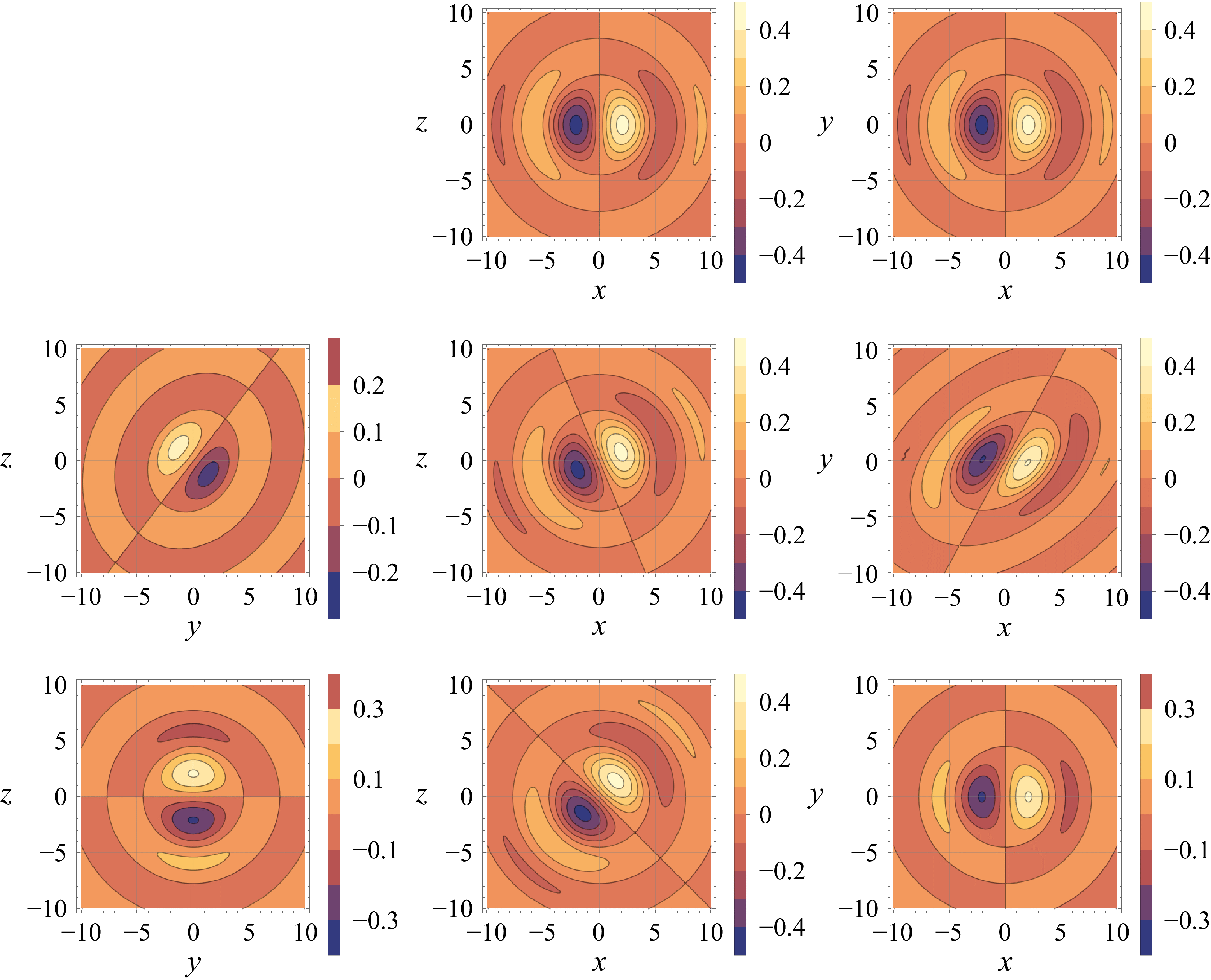
Isosurfaces of (a) $\eta (x_0,y,z,t)=\pm 0.2$
for
$\eta (x_0,y,z,t)=\pm 0.2$
for $x_0=0$
in the
$x_0=0$
in the $(y,z,t)$
space in the case the spherical spin
$(y,z,t)$
space in the case the spherical spin $\ell =1$
vortex dipole is initially aligned along the
$\ell =1$
vortex dipole is initially aligned along the $z$
-axis (
$z$
-axis ( ${\boldsymbol{k}}_0=\hat {\boldsymbol{z}}$
), and (b)
${\boldsymbol{k}}_0=\hat {\boldsymbol{z}}$
), and (b) $\eta (x,y_0,z,t)=\pm 0.2$
for
$\eta (x,y_0,z,t)=\pm 0.2$
for $y_0=0$
in the case the vortex dipole is initially aligned along the
$y_0=0$
in the case the vortex dipole is initially aligned along the $x$
-axis (
$x$
-axis ( ${\boldsymbol{k}}_0=\hat {\boldsymbol{x}}$
).
${\boldsymbol{k}}_0=\hat {\boldsymbol{x}}$
).

In the following figures, we represent contours or isosurfaces of $\eta (\boldsymbol{x},t)\equiv \eta _{s1}(\boldsymbol{R}_v(\boldsymbol{x},t))$
where the seed function,
$\eta (\boldsymbol{x},t)\equiv \eta _{s1}(\boldsymbol{R}_v(\boldsymbol{x},t))$
where the seed function,
 \begin{align} \eta _{S1}(\boldsymbol{x}) = j_1(k_0\Vert \boldsymbol{x}\Vert ) \boldsymbol{k}_0 \boldsymbol{\cdot }\frac {\boldsymbol{x}}{\Vert \boldsymbol{x}\Vert } , \end{align}
is representative of the spherical Beltrami vortex of order $\ell =1$
(Viúdez Reference Viúdez2025c
). The order
$\ell =1$
(Viúdez Reference Viúdez2025c
). The order $\ell =0$
function
$\ell =0$
function $\eta _{S0}(\boldsymbol{x}) = j_0(k_0\Vert \boldsymbol{x}\Vert )$
is also representative of the spherical Beltrami vortex of order
$\eta _{S0}(\boldsymbol{x}) = j_0(k_0\Vert \boldsymbol{x}\Vert )$
is also representative of the spherical Beltrami vortex of order $\ell =1$
, but the precession of the vortex, that is, the rotation of the wavevector
$\ell =1$
, but the precession of the vortex, that is, the rotation of the wavevector $\boldsymbol{k}(t)$
, and its initial orientation is better described by
$\boldsymbol{k}(t)$
, and its initial orientation is better described by $\eta _{S1}(\boldsymbol{x})$
.
$\eta _{S1}(\boldsymbol{x})$
.
We visualise two examples of scattering. In the first example (figures 1, 3(a) and 4), the vortex is initially aligned along the $\hat {\boldsymbol{z}}$
-axis, that is,
$\hat {\boldsymbol{z}}$
-axis, that is, $\boldsymbol{k}_0=\hat {\boldsymbol{z}}$
and therefore
$\boldsymbol{k}_0=\hat {\boldsymbol{z}}$
and therefore $\boldsymbol{k}_0 \perp \boldsymbol{\nu }(0)$
, and the vortex precesses around the axis defined by
$\boldsymbol{k}_0 \perp \boldsymbol{\nu }(0)$
, and the vortex precesses around the axis defined by $\boldsymbol{\nu }(t)$
, which is its instantaneous direction of propagation. In the second example (figures 2, 3(b) and 5), the vortex is initially aligned along the
$\boldsymbol{\nu }(t)$
, which is its instantaneous direction of propagation. In the second example (figures 2, 3(b) and 5), the vortex is initially aligned along the $\hat {\boldsymbol{x}}$
-axis, that is,
$\hat {\boldsymbol{x}}$
-axis, that is, $\boldsymbol{k}_0=\hat {\boldsymbol{x}}$
, and therefore
$\boldsymbol{k}_0=\hat {\boldsymbol{x}}$
, and therefore $\boldsymbol{k}_0 \parallel \boldsymbol{\nu }(0)$
, and the vortex does not precess around its direction of propagation.
$\boldsymbol{k}_0 \parallel \boldsymbol{\nu }(0)$
, and the vortex does not precess around its direction of propagation.
The initial ( $t=0$
), middle (
$t=0$
), middle ( $t=1/2$
) and final (
$t=1/2$
) and final ( $t=1$
) distributions of
$t=1$
) distributions of $\eta (\boldsymbol{x},t)$
on different planes (figures 1 and 2) display the distortion of the spherical vortex at
$\eta (\boldsymbol{x},t)$
on different planes (figures 1 and 2) display the distortion of the spherical vortex at $t=1/2$
, which implies its departure from a Beltrami field, and its recovery at the end of the background pulse. The final state is the same spherical Beltrami field, but whose wavevector has rotated
$t=1/2$
, which implies its departure from a Beltrami field, and its recovery at the end of the background pulse. The final state is the same spherical Beltrami field, but whose wavevector has rotated $\pi /4$
in the
$\pi /4$
in the $x$
–
$x$
– $z$
plane. The vortex precession is visualised as a double spiral isosurfaces of
$z$
plane. The vortex precession is visualised as a double spiral isosurfaces of $\eta (\boldsymbol{x},t)=\pm \eta _0$
in the space
$\eta (\boldsymbol{x},t)=\pm \eta _0$
in the space $(y,z,t)$
in figure 3(a), The vortex departure from its initial spherical Beltrami configuration is visualised better in the non-precessing case from isosurfaces of
$(y,z,t)$
in figure 3(a), The vortex departure from its initial spherical Beltrami configuration is visualised better in the non-precessing case from isosurfaces of $\eta (\boldsymbol{x},t)=\pm \eta _0$
in the space
$\eta (\boldsymbol{x},t)=\pm \eta _0$
in the space $(y,z,t)$
in figure 3(b). The vortex scattering, in both examples, can be visualised from the superposition of isosurfaces of
$(y,z,t)$
in figure 3(b). The vortex scattering, in both examples, can be visualised from the superposition of isosurfaces of $\eta (\boldsymbol{x},t_i)=\pm \eta _0$
at different times
$\eta (\boldsymbol{x},t_i)=\pm \eta _0$
at different times $t_i$
in figures 4 and 5. The large deformation of the isosurfaces at
$t_i$
in figures 4 and 5. The large deformation of the isosurfaces at $t=1/2$
, relative to those at
$t=1/2$
, relative to those at $t=0$
and
$t=0$
and $t=1$
, is due to the large differential scattering angle
$t=1$
, is due to the large differential scattering angle $\varDelta \theta =\pi /2$
prescribed. Smaller values of
$\varDelta \theta =\pi /2$
prescribed. Smaller values of $\varDelta \theta$
, typical of forward scattering, would provide much smaller deformations.
$\varDelta \theta$
, typical of forward scattering, would provide much smaller deformations.
(a) Front and (b) top views of the superposition of isosurfaces of $\eta (x,y,z,t)=\pm 0.3$
in the
$\eta (x,y,z,t)=\pm 0.3$
in the $(x,y,z)$
space at three different times
$(x,y,z)$
space at three different times $t\in \{0, 1/2,1\}$
for the case where the spherical spin
$t\in \{0, 1/2,1\}$
for the case where the spherical spin $\ell =1$
vortex dipole is initially aligned along the
$\ell =1$
vortex dipole is initially aligned along the $z$
-axis.
$z$
-axis.

(a) Front and (b) top views as in figure 4, but for the case where the spherical spin $\ell =1$
vortex dipole is initially aligned along the
$\ell =1$
vortex dipole is initially aligned along the $x$
-axis.
$x$
-axis.

8. Concluding remarks
We have provided in this work exact and approximate solutions to the barotropic vorticity equation in which the time evolution of a Beltrami field $\boldsymbol{\mathcal{U}}(\boldsymbol{x},t)$
, independently of its particular geometry, is completely determined by the presence of a time-dependent linear background flow. In particular, the Beltrami field may precess, expand/contract and displace, due to the presence of a background velocity field
$\boldsymbol{\mathcal{U}}(\boldsymbol{x},t)$
, independently of its particular geometry, is completely determined by the presence of a time-dependent linear background flow. In particular, the Beltrami field may precess, expand/contract and displace, due to the presence of a background velocity field $\boldsymbol{u}_b(\boldsymbol{x},t)$
whose velocity gradient consists of an isotropic time-dependent expansion/contraction and a homogeneous time-dependent rotation. In this case, the dynamical constraint for the background flow does not allow direction changes in the background angular velocity
$\boldsymbol{u}_b(\boldsymbol{x},t)$
whose velocity gradient consists of an isotropic time-dependent expansion/contraction and a homogeneous time-dependent rotation. In this case, the dynamical constraint for the background flow does not allow direction changes in the background angular velocity $\boldsymbol{\nu }(t)$
, and hence the Beltrami field cannot change its direction of propagation. The most interesting cases, however, are those in which the background velocity includes a time-dependent deviatoric tensor
$\boldsymbol{\nu }(t)$
, and hence the Beltrami field cannot change its direction of propagation. The most interesting cases, however, are those in which the background velocity includes a time-dependent deviatoric tensor $\boldsymbol{\mathsf{D}}_0(t)$
. In this case, changes in the direction of the background angular velocity vector
$\boldsymbol{\mathsf{D}}_0(t)$
. In this case, changes in the direction of the background angular velocity vector $\boldsymbol{\nu }(t)$
are allowed and, hence, directional changes in the Beltrami field displacement velocity. The presence of anisotropic strain caused by
$\boldsymbol{\nu }(t)$
are allowed and, hence, directional changes in the Beltrami field displacement velocity. The presence of anisotropic strain caused by $\boldsymbol{\mathsf{D}}_0(t)$
, however, breaks in the general case the Beltrami property of the initial Beltrami field, and this fact complicates the existence of exact time-dependent solutions in the theoretical approach presented in this study. Nevertheless, an approximation method, called here the Beltrami field approximation and which assumes that the oscillating field departs only slightly from its initial Beltrami property, allows the linearisation of the vorticity equation assuming that the oscillating field continues to be frozen in the advecting velocity field
$\boldsymbol{\mathsf{D}}_0(t)$
, however, breaks in the general case the Beltrami property of the initial Beltrami field, and this fact complicates the existence of exact time-dependent solutions in the theoretical approach presented in this study. Nevertheless, an approximation method, called here the Beltrami field approximation and which assumes that the oscillating field departs only slightly from its initial Beltrami property, allows the linearisation of the vorticity equation assuming that the oscillating field continues to be frozen in the advecting velocity field $\boldsymbol{v}_b(\boldsymbol{x},t)$
, as it were still a Beltrami field. This approximation allows the investigation of elastic scattering of vortices by pulses of a background flow with a time-dependent deviatoric strain tensor
$\boldsymbol{v}_b(\boldsymbol{x},t)$
, as it were still a Beltrami field. This approximation allows the investigation of elastic scattering of vortices by pulses of a background flow with a time-dependent deviatoric strain tensor $\boldsymbol{\mathsf{D}}_0(t)\ne \boldsymbol{\mathsf{0}}$
.
$\boldsymbol{\mathsf{D}}_0(t)\ne \boldsymbol{\mathsf{0}}$
.
The Beltrami field, which using the Chandrasekhar–Kendall approach admits any geometry in which the scalar Helmholtz equation is separable, is frozen in the background flow and, hence, the time evolution of the Beltrami field is completely determined by the background flow. The velocity gradient $\boldsymbol{\nabla }\!\boldsymbol{u}_b$
has nine time-dependent components, but the vorticity equation imposes a condition on the time evolution of its antisymmetric part, the spin tensor or the vorticity vector
$\boldsymbol{\nabla }\!\boldsymbol{u}_b$
has nine time-dependent components, but the vorticity equation imposes a condition on the time evolution of its antisymmetric part, the spin tensor or the vorticity vector $2\boldsymbol{\nu }(t)$
, which leads to six, the symmetric components, the number of independent time-dependent functions. These six degrees of freedom may be distributed into the six components of the deviatoric strain tensor
$2\boldsymbol{\nu }(t)$
, which leads to six, the symmetric components, the number of independent time-dependent functions. These six degrees of freedom may be distributed into the six components of the deviatoric strain tensor $\boldsymbol{\mathsf{D}}_0(t)$
, subjected to
$\boldsymbol{\mathsf{D}}_0(t)$
, subjected to $\textrm {tr}\boldsymbol{\mathsf{D}}_0(t)=0$
, and the background divergence
$\textrm {tr}\boldsymbol{\mathsf{D}}_0(t)=0$
, and the background divergence $\delta (t)$
.
$\delta (t)$
.
The main results may be explained in the following way. In the general case, the barotropic vorticity equation may be expressed as the Cauchy vorticity formula $\boldsymbol{\omega }(\boldsymbol{x},t) = (1/J(\boldsymbol{x},t))\boldsymbol{\mathsf{F}} (\boldsymbol{x},t)\boldsymbol{\omega }_0(\boldsymbol{R}(\boldsymbol{x},t))$
, where
$\boldsymbol{\omega }(\boldsymbol{x},t) = (1/J(\boldsymbol{x},t))\boldsymbol{\mathsf{F}} (\boldsymbol{x},t)\boldsymbol{\omega }_0(\boldsymbol{R}(\boldsymbol{x},t))$
, where $\boldsymbol{\omega }_0$
is the vorticity in the reference configuration. This expression includes the inverse map of the total flow
$\boldsymbol{\omega }_0$
is the vorticity in the reference configuration. This expression includes the inverse map of the total flow $\boldsymbol{R}(\boldsymbol{x},t)$
. However, the self-advection of Beltrami fields vanishes, since the vorticity of the Beltrami field is frozen in its own flow. Since the background flow is spatially homogeneous, Cauchy vorticity formula reduces to
$\boldsymbol{R}(\boldsymbol{x},t)$
. However, the self-advection of Beltrami fields vanishes, since the vorticity of the Beltrami field is frozen in its own flow. Since the background flow is spatially homogeneous, Cauchy vorticity formula reduces to $\boldsymbol{\mathcal{W}}(\boldsymbol{x},t) = (1/J_v(t))\boldsymbol{\mathsf{F}}_v (t)\boldsymbol{\mathcal{W}}_0(\boldsymbol{R}_v(\boldsymbol{x},t))$
, that is, the Beltrami field is frozen in the advecting velocity. The advecting velocity
$\boldsymbol{\mathcal{W}}(\boldsymbol{x},t) = (1/J_v(t))\boldsymbol{\mathsf{F}}_v (t)\boldsymbol{\mathcal{W}}_0(\boldsymbol{R}_v(\boldsymbol{x},t))$
, that is, the Beltrami field is frozen in the advecting velocity. The advecting velocity $\boldsymbol{v}_b(\boldsymbol{x},t)$
is spatially homogeneous and its inverse map
$\boldsymbol{v}_b(\boldsymbol{x},t)$
is spatially homogeneous and its inverse map $\boldsymbol{R}_v(\boldsymbol{x},t)$
may be obtained in a closed form. Hence, those initial Beltrami fields, which remain Beltrami after being advected by
$\boldsymbol{R}_v(\boldsymbol{x},t)$
may be obtained in a closed form. Hence, those initial Beltrami fields, which remain Beltrami after being advected by $\boldsymbol{v}_b(\boldsymbol{x},t)$
, are exact solutions to the barotropic vorticity equation. The Beltrami property is preserved when the advecting flow induces a similarity, that is, an isotropic expansion/contraction and a solid body rotation. In this case, exact solutions are possible, which describe an arbitrary time-dependent isotropic expansion/contraction and the precession of the Beltrami field.
$\boldsymbol{v}_b(\boldsymbol{x},t)$
, are exact solutions to the barotropic vorticity equation. The Beltrami property is preserved when the advecting flow induces a similarity, that is, an isotropic expansion/contraction and a solid body rotation. In this case, exact solutions are possible, which describe an arbitrary time-dependent isotropic expansion/contraction and the precession of the Beltrami field.
Independent of its geometry, a main property of the Beltrami field is its time-dependent wavevector $\boldsymbol{k}(t)$
. This wavevector expands/contracts, precesses, displaces and changes its direction guided by the time-dependent background flow. This seems to be conceptually very relevant since a time-dependent wavevector associated with a displacing Beltrami field may be interpreted as a particle-like property of a wave field. This description of motion is therefore consistent with the wave–particle duality as a property of matter. The wave–particle description depends on our ability to assign time-dependent vector or scalar-valued functions to a set of oscillating modal fields.
$\boldsymbol{k}(t)$
. This wavevector expands/contracts, precesses, displaces and changes its direction guided by the time-dependent background flow. This seems to be conceptually very relevant since a time-dependent wavevector associated with a displacing Beltrami field may be interpreted as a particle-like property of a wave field. This description of motion is therefore consistent with the wave–particle duality as a property of matter. The wave–particle description depends on our ability to assign time-dependent vector or scalar-valued functions to a set of oscillating modal fields.
Acknowledgements
I thank the three anonymous reviewers for their careful reading and constructive comments, which helped improve the manuscript. I acknowledge the ‘Severo Ochoa Centre of Excellence’ accreditation (CEX2019-000928-S). Portions of the manuscript text were edited for clarity and grammar using artificial intelligence (AI) tools (ChatGPT 5.2). The author reviewed and verified all AI-assisted text and takes full responsibility for the content.
Funding
This work was funded by the Spanish Government through the project SAGA (Ministerio de Ciencia, Innovación y Universidades, Ref. No. RTI2018-100844-B-C33).
Declaration of interests
The author declares no competing interests.
Appendix A. Oceanographic application
The theory of Beltrami flows in the presence of a background current may be applied to the ocean, in an inertial frame, where the background flow $\boldsymbol{u}_b(\boldsymbol{x})$
is taken as the steady solid body rotation
$\boldsymbol{u}_b(\boldsymbol{x})$
is taken as the steady solid body rotation $\boldsymbol{u}_b(\boldsymbol{x}) \equiv \varOmega _b\hat {\boldsymbol{z}}\times \boldsymbol{x}$
, where
$\boldsymbol{u}_b(\boldsymbol{x}) \equiv \varOmega _b\hat {\boldsymbol{z}}\times \boldsymbol{x}$
, where $\varOmega _b$
is the Earth angular frequency. The Beltrami field consists of a superposition of spherical Beltrami modes
$\varOmega _b$
is the Earth angular frequency. The Beltrami field consists of a superposition of spherical Beltrami modes
 \begin{align} \boldsymbol{\mathcal{U}}(\boldsymbol{x},t) \equiv \sum _{\ell \geq 1}\sum _{|m|\leq \ell } \boldsymbol{\mathcal{U}}_{\ell m}(\boldsymbol{x},t), \end{align}
and the Beltrami modes, in terms of the vector spherical harmonic basis $\{\boldsymbol{Y}_{\ell m}(\theta ,\varphi ), \boldsymbol{\varPsi }_{\ell m}(\theta ,\varphi ), \boldsymbol{\varPhi }_{\ell m}(\theta ,\varphi )\}$
, are
$\{\boldsymbol{Y}_{\ell m}(\theta ,\varphi ), \boldsymbol{\varPsi }_{\ell m}(\theta ,\varphi ), \boldsymbol{\varPhi }_{\ell m}(\theta ,\varphi )\}$
, are
 \begin{align} \boldsymbol{\mathcal{U}}_{\ell m}(\boldsymbol{x},t) &\equiv \ell (\ell +1)\frac {\chi _{\ell }(kr)}{kr}\boldsymbol{Y}_{\ell m}(\theta ,\varphi ) \nonumber \\[5pt]& \quad + \left ( (\ell +1)\frac {\chi _{\ell }(kr)}{kr} - \chi _{\ell +1}(kr) \right ) \boldsymbol{\varPsi }_{\ell m}(\theta ,\varphi ) + \chi _{\ell }(kr) \boldsymbol{\varPhi }_{\ell m}(\theta ,\varphi ), \end{align}
where now
 \begin{align} \chi _{\ell m}(r)\equiv \hat {u}_{\ell m}j_l(kr)+\hat {v}_{\ell m}y_{\ell }(kr) , \end{align}
and $\{\hat {u}_{\ell m},\hat {v}_{\ell m}\}$
are arbitrary amplitudes. The modes are applied to a spherical shell with inner
$\{\hat {u}_{\ell m},\hat {v}_{\ell m}\}$
are arbitrary amplitudes. The modes are applied to a spherical shell with inner $r_1$
and outer
$r_1$
and outer $r_2\gt r_1$
radii whose mean is equal to the mean radius of the Earth and a thickness
$r_2\gt r_1$
radii whose mean is equal to the mean radius of the Earth and a thickness $r_2-r_1$
equal to the mean depth of the ocean. Since this shell does not include
$r_2-r_1$
equal to the mean depth of the ocean. Since this shell does not include $r=0$
, the singularity of the spherical Bessel function of the second kind
$r=0$
, the singularity of the spherical Bessel function of the second kind $y_{\ell }(z)$
at
$y_{\ell }(z)$
at $z=0$
is not a problem. Vanishing radial velocity at
$z=0$
is not a problem. Vanishing radial velocity at $r=r_1,r_2$
, implies that
$r=r_1,r_2$
, implies that $\chi _{\ell m}(kr_1)=\chi _{\ell m}(kr_2)=0$
is possible if the determinant of this system of equations vanishes,
$\chi _{\ell m}(kr_1)=\chi _{\ell m}(kr_2)=0$
is possible if the determinant of this system of equations vanishes,
 \begin{align} j_{\ell m}(k r_1) y_{\ell m}(kr_2) - j_{\ell m}(k r_2) y_{\ell m}(kr_1) =0 . \end{align}
The positive roots $k=k_{\ell n}$
, with
$k=k_{\ell n}$
, with $n=1,2,\ldots$
, are the discrete radial wavenumbers. The radial wavenumber is therefore quantised. For typical ocean values
$n=1,2,\ldots$
, are the discrete radial wavenumbers. The radial wavenumber is therefore quantised. For typical ocean values $r_1\approx 6371 \,\textrm {km}$
and
$r_1\approx 6371 \,\textrm {km}$
and $r_2\approx 6375 \,\textrm {km}$
, the spherical shell is very thin, then
$r_2\approx 6375 \,\textrm {km}$
, the spherical shell is very thin, then $k r_1 \approx k r_2 \gg 1$
and (A4) is very well approximated by
$k r_1 \approx k r_2 \gg 1$
and (A4) is very well approximated by
 \begin{align} \sin (k(r_2-r_1))=0, \quad k_{\ell n} \approx \frac {n\pi }{r_2-r_1} = \frac {n \pi }{4\,\textrm {km}} ,\quad n=1,2,\ldots \end{align}
or a radial wavelength
 \begin{align} \lambda _n \equiv \frac {2\pi }{k_n} \approx \frac {8}{n}\,\textrm {km} . \end{align}
The $\ell$
-dependence in
$\ell$
-dependence in $k_{\ell n}$
is negligible unless for very large values of
$k_{\ell n}$
is negligible unless for very large values of $\ell$
. Once
$\ell$
. Once $k_{\ell n}$
is a root, the ratio between the coefficients
$k_{\ell n}$
is a root, the ratio between the coefficients
 \begin{align} \frac {\hat {v}_{\ell m}}{\hat {u}_{\ell m}} = -\frac {j_{\ell }(k_{\ell n}r_1)}{y_{\ell }(k_{\ell n}r_1)} = -\frac {j_{\ell }(k_{\ell n}r_2)}{y_{\ell }(k_{\ell n}r_2)} \end{align}
is fixed.
Since the $L^2$
(square-integrable) norm on the unit sphere
$L^2$
(square-integrable) norm on the unit sphere $S^2$
of
$S^2$
of $\boldsymbol{\varPhi }_{\ell m}$
is
$\boldsymbol{\varPhi }_{\ell m}$
is $\Vert \boldsymbol{\varPhi }_{\ell m}\Vert _{L^2(S^2)} = \sqrt {\ell (\ell +1)} \Vert Y_{\ell m}\Vert _{L^2(S^2)}$
, the root mean square (r.m.s.) radial versus tangent (to
$\Vert \boldsymbol{\varPhi }_{\ell m}\Vert _{L^2(S^2)} = \sqrt {\ell (\ell +1)} \Vert Y_{\ell m}\Vert _{L^2(S^2)}$
, the root mean square (r.m.s.) radial versus tangent (to $Y_{\ell m}$
levels) speed ratio is
$Y_{\ell m}$
levels) speed ratio is
 \begin{align} \frac {\Vert u_r\Vert _{\textit{rms}}}{\Vert \boldsymbol{u}_{\boldsymbol{\varPhi }}\Vert _{\textit{rms}}} = \frac {\sqrt {\ell (\ell +1)}}{kr}. \end{align}
For the first radial wavenumber root, $k_1 \simeq \pi / (4\,\textrm {km})\simeq 0.785398\,\textrm {km}^{-1}$
, and hence across the shell,
$k_1 \simeq \pi / (4\,\textrm {km})\simeq 0.785398\,\textrm {km}^{-1}$
, and hence across the shell, $k_1 r\in [k_1 r_1,k_1 r_2]=[5003.77, 5006.91]$
so that we can safely take
$k_1 r\in [k_1 r_1,k_1 r_2]=[5003.77, 5006.91]$
so that we can safely take $k_1 r \approx 5005$
, and the ratio
$k_1 r \approx 5005$
, and the ratio $\Vert u_r\Vert _{ {rms}}/\Vert \boldsymbol{u}_{\boldsymbol{\varPhi }}\Vert _{ {rms}}$
ranges from
$\Vert u_r\Vert _{ {rms}}/\Vert \boldsymbol{u}_{\boldsymbol{\varPhi }}\Vert _{ {rms}}$
ranges from $\approx 2.83 \times 10^{-4}$
for
$\approx 2.83 \times 10^{-4}$
for $\ell =1$
to
$\ell =1$
to $\approx 2.10 \times 10^{-3}$
for
$\approx 2.10 \times 10^{-3}$
for $\ell =10$
, whose orders of magnitude are the common scalings for the vertical to horizontal ratio of the secondary circulation in ocean vortices.
$\ell =10$
, whose orders of magnitude are the common scalings for the vertical to horizontal ratio of the secondary circulation in ocean vortices.
However if, instead of assuming that vortex flow satisfies the Helmholtz equation ${\nabla }^2\boldsymbol{\mathcal{U}}=-k^2\boldsymbol{\mathcal{U}}$
, we assume, in the same background velocity field
${\nabla }^2\boldsymbol{\mathcal{U}}=-k^2\boldsymbol{\mathcal{U}}$
, we assume, in the same background velocity field $\boldsymbol{u}_b(\boldsymbol{x},t)\equiv \varOmega _b \hat {\boldsymbol{z}}\times \boldsymbol{x}$
, a vortex flow
$\boldsymbol{u}_b(\boldsymbol{x},t)\equiv \varOmega _b \hat {\boldsymbol{z}}\times \boldsymbol{x}$
, a vortex flow $\bar {\boldsymbol{u}}(\boldsymbol{x},t)$
tangent to the spherical surfaces such that its steady streamfunction, in the absence of background velocity,
$\bar {\boldsymbol{u}}(\boldsymbol{x},t)$
tangent to the spherical surfaces such that its steady streamfunction, in the absence of background velocity, $\bar {\psi }_0(\theta ,\varphi )$
satisfies the Helmholtz equation in the unit sphere
$\bar {\psi }_0(\theta ,\varphi )$
satisfies the Helmholtz equation in the unit sphere
 \begin{align} {\nabla} ^2_S\bar {\psi }_0 = -\kappa ^2 \bar {\psi }_0, \end{align}
where ${\nabla} ^2_S$
is the surface Laplacian operator on the sphere. Then,
${\nabla} ^2_S$
is the surface Laplacian operator on the sphere. Then, $\bar {\psi }_0(\theta ,\varphi )$
is a single Laplace–Beltrami eigenmode on the sphere
$\bar {\psi }_0(\theta ,\varphi )$
is a single Laplace–Beltrami eigenmode on the sphere
 \begin{align} \bar {\psi }_0(\theta ,\varphi ) =\hat {\psi }_{\ell m} Y_{\ell }^{m}(\theta ,\varphi ) ,\quad \kappa ^2=\ell (\ell +1) , \end{align}
the vortex velocity is
 \begin{align} \bar {\boldsymbol{u}}_0(\boldsymbol{x},t) = \boldsymbol{\nabla }\times (\bar {\psi }_0(\theta ,\varphi ) \hat {\boldsymbol{r}}) , \quad \bar {u}_{0r} = 0 . \end{align}
The radial vorticity is
 \begin{align} \bar {\zeta }_0 \equiv \hat {\boldsymbol{r}} \boldsymbol{\cdot } (\boldsymbol{\nabla }\times \bar {\boldsymbol{u}}_0) = - \frac {1}{r^2} {\nabla} ^2_S\bar {\psi }_0 = \frac {\kappa ^2}{r^2}\bar {\psi }_0 . \end{align}
Since the nonlinear self-advection term vanishes $\bar {\boldsymbol{u}}\boldsymbol{\cdot }\boldsymbol{\nabla }\bar {\zeta }=0$
, the barotropic vorticity equation reduces to a linear transport law for the time-dependent radial vorticity
$\bar {\boldsymbol{u}}\boldsymbol{\cdot }\boldsymbol{\nabla }\bar {\zeta }=0$
, the barotropic vorticity equation reduces to a linear transport law for the time-dependent radial vorticity $\bar {\zeta }(\theta ,\varphi ,t)$
,
$\bar {\zeta }(\theta ,\varphi ,t)$
,
 \begin{align} \frac {\partial \bar {\zeta }}{\partial t} + \boldsymbol{\bar {v}}\boldsymbol{\cdot }\boldsymbol{\nabla }\bar {\zeta }= 0 ,\quad \bar {\boldsymbol{v}}(\boldsymbol{x}) = \bar {\varOmega }_{\ell }\hat {\boldsymbol{z}}\times \boldsymbol{x} ,\quad \bar {\varOmega }_{\ell }\equiv \varOmega _b\left ( 1 - \frac {2}{\ell (\ell +1)}\right ) , \end{align}
where
 \begin{align} \bar {\zeta }(\theta ,\varphi ,t) & = \bar {\zeta }_0(\theta ,\varphi -\bar {\varOmega }_{\ell }t) ,\quad \bar {\psi }(\theta ,\varphi ,t)= \bar {\psi }_0(\theta ,\varphi -\bar {\varOmega }_{\ell }t) =\hat {\psi }_{\ell m} Y_{\ell }^{m}(\theta ,\varphi -\bar {\varOmega }_{\ell }t) \nonumber \\[4pt] & =\hat {\psi }_{\ell m} Y_{\ell }^{m}(\theta ,\varphi )\textrm {e}^{-{i}m\bar {\varOmega }_{\ell }t} . \end{align}
Thus, the radial vorticity satisfies
 \begin{align} \frac {\partial \bar {\zeta }}{\partial t} + \varOmega _b \left ( 1 - \frac {2}{\ell (\ell +1)}\right )\frac {\partial \bar {\zeta }}{\partial \varphi }=0 . \end{align}
Therefore, these eigenmode vortices rotate rigidly with a drift velocity $\rho \bar {\varOmega }_{\ell }\hat {\boldsymbol{\varphi }}$
, or a drift angular velocity relative to the background flow equal to
$\rho \bar {\varOmega }_{\ell }\hat {\boldsymbol{\varphi }}$
, or a drift angular velocity relative to the background flow equal to
 \begin{align} \bar {\boldsymbol{c}} = -\frac {2\varOmega _b}{\ell (\ell +1)}\hat {\boldsymbol{\varphi }} = \bar {c}_{\ell }\hat {\boldsymbol{\varphi }} , \end{align}
that is, opposite to the background flow, or westward. These are the Rossby–Haurwitz waves (Rossby et al. Reference Rossby, Willett, Holmboe, Namias, Page and Allen1939; Haurwitz Reference Haurwitz1940), which are usually defined in the rotating reference frame as
 \begin{align} \psi (\theta ,\varphi ,t) = \hat {\psi }_{\ell m}Y_{\ell }^{m}(\theta ,\varphi )\textrm {e}^{- {i}\sigma _{\ell } t} , \end{align}
where the Rossby–Haurwitz dispersion relation is expressed in terms of the local (relative to the rotating frame) frequency
 \begin{align} \sigma _{\ell }\equiv -m \frac {2\varOmega _b}{\ell (\ell +1)} , \end{align}
and the angular phase speed
 \begin{align} c_{\ell } = \frac {\sigma _{\ell }}{m} = -\frac {2\varOmega _b}{\ell (\ell +1)} \end{align}
coincides with $\bar {c}_{\ell }$
in (A16). Both the Rossby–Haurwitz solutions and the spherical Beltrami constructions exploit a common eigenmode principle on the sphere: by choosing fields built from spherical eigenfunctions, the nonlinear advection terms simplify and the resulting pattern can persist while being Doppler-shifted/advected by the same solid-body background rotation
$\bar {c}_{\ell }$
in (A16). Both the Rossby–Haurwitz solutions and the spherical Beltrami constructions exploit a common eigenmode principle on the sphere: by choosing fields built from spherical eigenfunctions, the nonlinear advection terms simplify and the resulting pattern can persist while being Doppler-shifted/advected by the same solid-body background rotation $\boldsymbol{u}_b = \varOmega _b\,\hat {\boldsymbol{z}}\times \boldsymbol{x}$
. In the Rossby–Haurwitz case, the motion is purely tangential and non-divergent,
$\boldsymbol{u}_b = \varOmega _b\,\hat {\boldsymbol{z}}\times \boldsymbol{x}$
. In the Rossby–Haurwitz case, the motion is purely tangential and non-divergent, $\boldsymbol{u}=\boldsymbol{\nabla }\times (\psi \,\hat {\boldsymbol{r}})$
, with
$\boldsymbol{u}=\boldsymbol{\nabla }\times (\psi \,\hat {\boldsymbol{r}})$
, with $\varDelta _S\psi =-\ell (\ell +1)\psi$
so that the relative vorticity satisfies
$\varDelta _S\psi =-\ell (\ell +1)\psi$
so that the relative vorticity satisfies $\bar {\zeta }=-(1/r^2)\varDelta _S\psi \propto \psi$
, yielding an exact nonlinear solution of the barotropic vorticity equation whose frequency is the intrinsic Rossby drift plus the Doppler shift by
$\bar {\zeta }=-(1/r^2)\varDelta _S\psi \propto \psi$
, yielding an exact nonlinear solution of the barotropic vorticity equation whose frequency is the intrinsic Rossby drift plus the Doppler shift by $\varOmega _b$
. In contrast, spherical Beltrami flows are three-dimensional helical modes satisfying
$\varOmega _b$
. In contrast, spherical Beltrami flows are three-dimensional helical modes satisfying $\boldsymbol{\nabla }\times \boldsymbol{\mathcal{U}} = k\,\boldsymbol{\mathcal{U}}$
, and hence,
$\boldsymbol{\nabla }\times \boldsymbol{\mathcal{U}} = k\,\boldsymbol{\mathcal{U}}$
, and hence, $\boldsymbol{\mathcal{U}}$
obeys the vector Helmholtz equation
$\boldsymbol{\mathcal{U}}$
obeys the vector Helmholtz equation ${\nabla} ^2\boldsymbol{\mathcal{U}} + k^2\boldsymbol{\mathcal{U}}=0$
; their vorticity is proportional to the velocity itself and in the presence of
${\nabla} ^2\boldsymbol{\mathcal{U}} + k^2\boldsymbol{\mathcal{U}}=0$
; their vorticity is proportional to the velocity itself and in the presence of $\boldsymbol{u}_b$
, the mode is likewise transported and Doppler-shifted by the background rotation, but with a three-dimensional (3-D) curl-eigenfield structure rather than a surface vorticity wave. Both phenomena can be understood as a consequence of the mismatch between the background velocity and the effective advecting velocity.
$\boldsymbol{u}_b$
, the mode is likewise transported and Doppler-shifted by the background rotation, but with a three-dimensional (3-D) curl-eigenfield structure rather than a surface vorticity wave. Both phenomena can be understood as a consequence of the mismatch between the background velocity and the effective advecting velocity.
Appendix B. Analogy to quantum field theory (QFT) solutions
The analogy of the approach described in § 3 with the approach developed in QFT is based in that in § 3, we have a linear, time-dependent ordinary differential equation along each material label $\boldsymbol{x}_0$
in the form
$\boldsymbol{x}_0$
in the form
 \begin{align} \frac {\partial \boldsymbol{r}}{\partial t}(\boldsymbol{x}_0,t) = \boldsymbol{\mathsf{L}}(t) \boldsymbol{r}(\boldsymbol{x}_0,t) . \end{align}
Introduce the fundamental matrix $\boldsymbol{\mathsf{U}}(t,t_0)$
, which is the deformation gradient in this homogeneous case, by
$\boldsymbol{\mathsf{U}}(t,t_0)$
, which is the deformation gradient in this homogeneous case, by
 \begin{align} \dot {\boldsymbol{\mathsf{U}}}(t,t_0)= \boldsymbol{\mathsf{L}}(t)\boldsymbol{\mathsf{U}}(t,t_0) ,\quad \boldsymbol{\mathsf{U}}(t_0,t_0) = \boldsymbol{\mathsf{I}}, \end{align}
then the particle position is
 \begin{align} \boldsymbol{r}(\boldsymbol{x}_0,t) = \boldsymbol{\mathsf{U}}(t,t_0)\boldsymbol{r}(\boldsymbol{x}_0,t_0) . \end{align}
If $\boldsymbol{\mathsf{L}}(t)$
does not commute with
$\boldsymbol{\mathsf{L}}(t)$
does not commute with $\boldsymbol{\mathsf{L}}(t')$
at different times, the solution is the time-ordered exponential
$\boldsymbol{\mathsf{L}}(t')$
at different times, the solution is the time-ordered exponential
 \begin{align} \boldsymbol{\mathsf{U}}(t,t_0) = \mathcal{T} \textrm {exp}\left ( \int _{t_0}^{t}\boldsymbol{\mathsf{L}}(\tau )\,\textrm {d}\tau \right ) . \end{align}
Equivalently, we may use the Dyson series (Dyson Reference Dyson1949a , Reference Dysonb ),
 \begin{align} \boldsymbol{\mathsf{U}}(t,t_0) = \boldsymbol{\mathsf{I}} + \int _{t_0}^{t} \textrm {d}\tau _1 \, \boldsymbol{\mathsf{L}}(\tau _1) + \int _{t_0}^{t}\textrm {d}\tau _1 \int _{t_0}^{\tau _1}\textrm {d}\tau _2 \, \boldsymbol{\mathsf{L}}(\tau _1) \, \boldsymbol{\mathsf{L}}(\tau _2) + {\cdots} \end{align}
That is mathematically the same structure as quantum time evolution in 0+1 dimensions (time dependence but no space dependence) in which the QFT evolution operator $\hat {H}(t)$
(the Hamiltonian operator) acts on the wavefunction
$\hat {H}(t)$
(the Hamiltonian operator) acts on the wavefunction $\psi (t)$
in the Schrödinger equation
$\psi (t)$
in the Schrödinger equation
 \begin{align} \textrm {i}\frac { {d}}{\textrm {d}t}|\psi (t)\rangle = \hat {H}(t)|\psi (t)\rangle \quad \Longrightarrow \quad |\psi (t)\rangle =\hat {U}(t,t_0)|\psi (t_0)\rangle , \end{align}
with the evolution operator
 \begin{align} \hat {U}(t,t_0)=\mathcal{T}\exp \left (-\textrm {i}\int _{t_0}^{t}\hat H(\tau )\,{\textrm{d}}\tau \right ) . \end{align}
In quantum mechanics the Hamiltonian operator $\hat H(t)$
is Hermitian,
$\hat H(t)$
is Hermitian,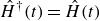 $\hat {H}^\dagger (t)=\hat {H}(t)$
, which implies that the evolution operator (B7) is unitary,
$\hat {H}^\dagger (t)=\hat {H}(t)$
, which implies that the evolution operator (B7) is unitary, $\hat U^\dagger \hat U = \hat {I}$
, and therefore preserves the norm
$\hat U^\dagger \hat U = \hat {I}$
, and therefore preserves the norm $\langle \psi |\psi \rangle$
. With the identification
$\langle \psi |\psi \rangle$
. With the identification $\hat H(t)= \textrm {i}\,\boldsymbol{\mathsf{L}}(t)$
, this property corresponds to
$\hat H(t)= \textrm {i}\,\boldsymbol{\mathsf{L}}(t)$
, this property corresponds to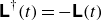 $\boldsymbol{\mathsf{L}}^\dagger (t)=-\boldsymbol{\mathsf{L}}(t)$
, i.e.
$\boldsymbol{\mathsf{L}}^\dagger (t)=-\boldsymbol{\mathsf{L}}(t)$
, i.e. $\boldsymbol{\mathsf{L}}(t)$
is anti-Hermitian. For real-valued velocity gradients, this reduces to
$\boldsymbol{\mathsf{L}}(t)$
is anti-Hermitian. For real-valued velocity gradients, this reduces to $\boldsymbol{\mathsf{L}}^{\top }(t)=-\boldsymbol{\mathsf{L}}(t)$
, so that
$\boldsymbol{\mathsf{L}}^{\top }(t)=-\boldsymbol{\mathsf{L}}(t)$
, so that $\boldsymbol{\mathsf{L}}(t)$
is skew-symmetric and generates a pure rotation. By contrast, for a general fluid velocity gradient
$\boldsymbol{\mathsf{L}}(t)$
is skew-symmetric and generates a pure rotation. By contrast, for a general fluid velocity gradient $\boldsymbol{\mathsf{L}}(t)$
containing strain (symmetric part), the propagator is not unitary and the particle separation
$\boldsymbol{\mathsf{L}}(t)$
containing strain (symmetric part), the propagator is not unitary and the particle separation $\|\boldsymbol{r}\|$
can be amplified or attenuated, even though the evolution retains the same time-ordering (Dyson-series) structure as in Schrödinger dynamics.
$\|\boldsymbol{r}\|$
can be amplified or attenuated, even though the evolution retains the same time-ordering (Dyson-series) structure as in Schrödinger dynamics.
Although this setting is purely classical, it is useful to note a structural analogy with gauge transport in quantum theory. In the homogeneous background case $\boldsymbol{\nabla }\!\boldsymbol{u}_b=\boldsymbol{\mathsf{L}}(t)$
, the deformation/transport of a vector quantity along a material label is governed by a linear non-autonomous system whose fundamental matrix is
$\boldsymbol{\nabla }\!\boldsymbol{u}_b=\boldsymbol{\mathsf{L}}(t)$
, the deformation/transport of a vector quantity along a material label is governed by a linear non-autonomous system whose fundamental matrix is $\boldsymbol{\mathsf{U}}(t,t_0)$
with time ordering required when
$\boldsymbol{\mathsf{U}}(t,t_0)$
with time ordering required when $[\boldsymbol{\mathsf{L}}(t),\boldsymbol{\mathsf{L}}(t')]\neq \boldsymbol{\mathsf{0}}$
. This is mathematically the same propagator structure as quantum time evolution,
$[\boldsymbol{\mathsf{L}}(t),\boldsymbol{\mathsf{L}}(t')]\neq \boldsymbol{\mathsf{0}}$
. This is mathematically the same propagator structure as quantum time evolution, $\hat {U}(t,t_0)$
, and may be viewed as a classical ‘connection’ generating parallel transport of the field components. In this sense, the background velocity gradient
$\hat {U}(t,t_0)$
, and may be viewed as a classical ‘connection’ generating parallel transport of the field components. In this sense, the background velocity gradient $\boldsymbol{\mathsf{L}}(t)$
plays the role of an effective gauge potential acting on the transported object (here the Beltrami excitation), while the resulting drift/deflection can be interpreted as the analogue of a non-trivial holonomy. A non-trivial holonomy in this homogeneous-flow analogy corresponds to a situation where, after a cycle of the background (e.g.
$\boldsymbol{\mathsf{L}}(t)$
plays the role of an effective gauge potential acting on the transported object (here the Beltrami excitation), while the resulting drift/deflection can be interpreted as the analogue of a non-trivial holonomy. A non-trivial holonomy in this homogeneous-flow analogy corresponds to a situation where, after a cycle of the background (e.g. $\boldsymbol{\mathsf{L}}(t+T)=\boldsymbol{\mathsf{L}}(t)$
), the one-period propagator is not the identity, i.e.
$\boldsymbol{\mathsf{L}}(t+T)=\boldsymbol{\mathsf{L}}(t)$
), the one-period propagator is not the identity, i.e. $\boldsymbol{\mathsf{U}}(t_0+T,t_0)\neq \boldsymbol{\mathsf{I}}$
, implying a net rotation/stretch (or phase-like change) of transported directions or modes even though the background has completed a full ‘cycle’. This is a formal analogy (acting in physical-space frames rather than an internal gauge space), included to clarify the role of the time-ordered propagator.
$\boldsymbol{\mathsf{U}}(t_0+T,t_0)\neq \boldsymbol{\mathsf{I}}$
, implying a net rotation/stretch (or phase-like change) of transported directions or modes even though the background has completed a full ‘cycle’. This is a formal analogy (acting in physical-space frames rather than an internal gauge space), included to clarify the role of the time-ordered propagator.
Appendix C. On the ‘Gauss potential’ and the role of the seed function
$\eta$

In the Chandrasekhar–Kendall-type construction, we take $\boldsymbol n=\hat {\boldsymbol z}$
and define
$\boldsymbol n=\hat {\boldsymbol z}$
and define
 \begin{align} \boldsymbol \chi \equiv \eta (\boldsymbol x)\,\hat {\boldsymbol z},\qquad \boldsymbol \psi \equiv \boldsymbol \chi +\frac {1}{k}\boldsymbol{\nabla }\times \boldsymbol \chi ,\qquad \boldsymbol{\mathcal U}\equiv \boldsymbol {\nabla }\times \boldsymbol \psi , \end{align}
with seed function
 \begin{align} \eta (\boldsymbol x)=j_\ell (kr)\,Y_\ell ^{m}(\theta ,\varphi ) , \end{align}
which satisfies the scalar Helmholtz equation. Since $\hat {\boldsymbol z}$
is constant,
$\hat {\boldsymbol z}$
is constant,
 \begin{align} \boldsymbol{\nabla }\times (\eta \,\hat {\boldsymbol z}) =\boldsymbol{\nabla }\eta \times \hat {\boldsymbol z} . \end{align}
In cylindrical coordinates $(\rho ,\varphi ,z)$
, using
$(\rho ,\varphi ,z)$
, using
 \begin{align} \boldsymbol{\nabla }\eta =\hat {\boldsymbol \rho }\,\partial _\rho \eta +\hat {\boldsymbol \varphi }\,\frac {1}{\rho }\partial _\varphi \eta +\hat {\boldsymbol z}\,\partial _z\eta , \end{align}
one obtains
 \begin{align} \boldsymbol{\nabla }\eta \times \hat {\boldsymbol z} =\hat {\boldsymbol \rho }\,\frac {1}{\rho }\,\partial _\varphi \eta -\hat {\boldsymbol \varphi }\,\partial _\rho \eta , \end{align}
and therefore the vector potential $\boldsymbol \psi$
in (C1) has cylindrical components
$\boldsymbol \psi$
in (C1) has cylindrical components
 \begin{align} \psi _\rho =\frac {1}{k\rho } \partial _\varphi \eta ,\qquad \psi _\varphi =-\frac {1}{k} \partial _\rho \eta ,\qquad \psi _z=\eta . \end{align}
For the axisymmetric subset $m=0$
(hence,
$m=0$
(hence, $\partial _\varphi \eta =0$
), the field is independent of
$\partial _\varphi \eta =0$
), the field is independent of $\varphi$
and one may introduce the standard axisymmetric flux/stream function, sometimes termed a ‘Gauss potential’, as
$\varphi$
and one may introduce the standard axisymmetric flux/stream function, sometimes termed a ‘Gauss potential’, as
 \begin{align} \varPsi _G(\rho ,z)\equiv \rho \,\psi _\varphi =-\frac {\rho }{k}\,\partial _\rho \eta . \end{align}
With this definition, the poloidal component of $\boldsymbol{\mathcal U}\equiv \boldsymbol{\nabla }\times \boldsymbol \psi$
can be expressed in the familiar flux-function form
$\boldsymbol{\mathcal U}\equiv \boldsymbol{\nabla }\times \boldsymbol \psi$
can be expressed in the familiar flux-function form
 \begin{align} \boldsymbol{\mathcal U}_p=\frac {1}{\rho } \boldsymbol{\nabla }\varPsi _G\times \hat {\boldsymbol \varphi }, \end{align}
so that the level sets $\varPsi _G=\textrm{const}$
define poloidal stream-surfaces.
$\varPsi _G=\textrm{const}$
define poloidal stream-surfaces.
For generic non-axisymmetric modes $m\neq 0$
, the field depends on
$m\neq 0$
, the field depends on $\varphi$
(equivalently,
$\varphi$
(equivalently, $\partial _\varphi \eta \neq 0$
), and there is, in general, no global scalar flux/stream function whose level sets foliate the domain into invariant ‘flux surfaces’ for
$\partial _\varphi \eta \neq 0$
), and there is, in general, no global scalar flux/stream function whose level sets foliate the domain into invariant ‘flux surfaces’ for $\boldsymbol{\mathcal U}$
. In this fully three-dimensional setting, the natural potential object is the vector potential
$\boldsymbol{\mathcal U}$
. In this fully three-dimensional setting, the natural potential object is the vector potential $\boldsymbol \psi$
in (C1).
$\boldsymbol \psi$
in (C1).
When we refer to topology preserved under diffeomorphisms, we mean the topology of level sets of suitably chosen scalar fields. In the axisymmetric case $m=0$
,
$m=0$
, $\varPsi _G$
in (C7) provides such a scalar label whose level sets coincide with poloidal stream-surfaces. In the general case (including
$\varPsi _G$
in (C7) provides such a scalar label whose level sets coincide with poloidal stream-surfaces. In the general case (including $m\neq 0$
), if one nevertheless wishes to track the deformation/topology of level sets under the diffeomorphisms considered in this work, one may instead use the seed scalar
$m\neq 0$
), if one nevertheless wishes to track the deformation/topology of level sets under the diffeomorphisms considered in this work, one may instead use the seed scalar $\eta (\boldsymbol x)$
(or its real/imaginary part) as a convenient scalar label: its isosurfaces
$\eta (\boldsymbol x)$
(or its real/imaginary part) as a convenient scalar label: its isosurfaces $\eta =\textrm{const}$
define a well-posed family of reference surfaces, even though they are not, in general, stream/flux surfaces of
$\eta =\textrm{const}$
define a well-posed family of reference surfaces, even though they are not, in general, stream/flux surfaces of $\boldsymbol{\mathcal U}$
.
$\boldsymbol{\mathcal U}$
.
We consider now the diffeomorphic invariance of field-line topology and the scaling symmetry of $k$
. Let
$k$
. Let $\boldsymbol{\mathcal U}(\boldsymbol x)$
be a solenoidal field and let
$\boldsymbol{\mathcal U}(\boldsymbol x)$
be a solenoidal field and let $\varPhi _t$
be the smooth flow map generated by a smooth advecting velocity (so
$\varPhi _t$
be the smooth flow map generated by a smooth advecting velocity (so $\varPhi _t$
is a diffeomorphism for all
$\varPhi _t$
is a diffeomorphism for all $t$
before any singularity/caustic formation). The advected/push-forward field may be written schematically as
$t$
before any singularity/caustic formation). The advected/push-forward field may be written schematically as
 \begin{align} \boldsymbol{\mathcal U}_t \;=\; (\varPhi _t)_*\,\boldsymbol{\mathcal U}_0 , \end{align}
so that field lines are transported by $\varPhi _t$
as embedded curves. In particular, any field-line connectivity and knot/link type is preserved under such smooth advection: a diffeomorphism can deform field lines but cannot cut, reconnect or change their topological class. In addition, the Beltrami families in this work exhibit a simple scaling symmetry that changes the curl eigenvalue while preserving field-line topology. Indeed, if
$\varPhi _t$
as embedded curves. In particular, any field-line connectivity and knot/link type is preserved under such smooth advection: a diffeomorphism can deform field lines but cannot cut, reconnect or change their topological class. In addition, the Beltrami families in this work exhibit a simple scaling symmetry that changes the curl eigenvalue while preserving field-line topology. Indeed, if $\boldsymbol{\mathcal U}$
satisfies
$\boldsymbol{\mathcal U}$
satisfies
 \begin{align} \boldsymbol {\nabla }\times \boldsymbol{\mathcal U}=k\,\boldsymbol{\mathcal U}\, \quad (\text{in }\mathbb R^3), \end{align}
then for any $\lambda \gt 0$
, the rescaled field
$\lambda \gt 0$
, the rescaled field
 \begin{align} \boldsymbol{\mathcal U}^{(\lambda )}(\boldsymbol x)\equiv \boldsymbol{\mathcal U}(\lambda \boldsymbol x) \end{align}
satisfies
 \begin{align} \boldsymbol{\nabla }\times \boldsymbol{\mathcal U}^{(\lambda )}=(\lambda k)\,\boldsymbol{\mathcal U}^{(\lambda )} . \end{align}
Since $\boldsymbol x\mapsto \lambda \boldsymbol x$
is a diffeomorphism of
$\boldsymbol x\mapsto \lambda \boldsymbol x$
is a diffeomorphism of $\mathbb R^3$
, this transformation preserves the topology of field lines (it amounts to a global change of length scale), while continuously rescaling the parameter
$\mathbb R^3$
, this transformation preserves the topology of field lines (it amounts to a global change of length scale), while continuously rescaling the parameter $k$
.
$k$
.
The spectral properties of the curl operator (Yoshida & Giga Reference Yoshida and Giga1990) depend sensitively on the domain and boundary conditions. On bounded domains with physically imposed boundary conditions (e.g. tangential/normal constraints, as in the oceanographic application considered in Appendix A, the curl spectrum is typically discrete, so changing $k$
at fixed domain/BC usually means selecting a different eigenfunction, and it is then unsurprising that field-line geometry/topology may change across eigenmodes. In contrast, on unbounded domains (or in settings where scale is not fixed a priori) one naturally encounters continuous families related by symmetries such as translations, rotations and the scaling map above, for which
$k$
at fixed domain/BC usually means selecting a different eigenfunction, and it is then unsurprising that field-line geometry/topology may change across eigenmodes. In contrast, on unbounded domains (or in settings where scale is not fixed a priori) one naturally encounters continuous families related by symmetries such as translations, rotations and the scaling map above, for which $k$
may vary continuously without forcing a jump to a topologically unrelated eigenfunction. This clarifies why the symmetry-generated families considered here do not support the heuristic ‘changing the eigenvalue implies a topology change’: in our case, the change in
$k$
may vary continuously without forcing a jump to a topologically unrelated eigenfunction. This clarifies why the symmetry-generated families considered here do not support the heuristic ‘changing the eigenvalue implies a topology change’: in our case, the change in $k$
is produced by an explicit diffeomorphic (and, in particular, topology-preserving) transformation, rather than by moving between distinct eigenfunctions on a fixed bounded domain with fixed boundary conditions.
$k$
is produced by an explicit diffeomorphic (and, in particular, topology-preserving) transformation, rather than by moving between distinct eigenfunctions on a fixed bounded domain with fixed boundary conditions.


 Open access

