





What is emotional eating
Emotional (or hedonically driven) eating can disrupt the homoeostatic balance of appetite and weight control. This behaviour is associated with eating disorders, particularly binge-eating disorder, but it can also occur in higher weight individuals who may not fit all the criteria of an eating disorder. In contrast to diagnostic labels, which are constructed and perfected by large committees, the term emotional eating lacks a clear definition. In common usage, it refers to overeating in response to negative emotions. Comfort eating is a possible synonym. It is often linked with an impulsive style of responding. Thus, in the search involved in the literature review for this article a variety of terms were used (binge eating, eating disorders, emotional or hedonic eating, loss of control eating, overeating, hyperphagia, craving and eating/food addiction).
A recent study used a questionnaire to assess ‘negative emotional eating’ (sadness, anger and anxiety) or ‘happiness eating’ in people with various eating disorders diagnoses (n 204) and healthy controls (n 172) across a wide weight range. Healthy controls with a higher BMI endorsed higher levels of negative emotional eating and lower happiness eating(Reference Reichenberger, Schnepper and Arend1). People within the binge spectrum group of disorders also had higher levels of negative emotional eating compared to BMI-matched controls. Incontrast, people with Anorexia Nervosa (AN) had the lowest degree of negative emotional eating and the highest degree of happiness eating relative to other eating disorders(Reference Reichenberger, Schnepper and Arend1). Thus, extremes of this trait can underpin the various forms of eating disorder.
Binge-eating disorder has only recently been introduced into standard diagnostic systems(2,3) . Previously, these patients may have been given the diagnosis eating disorder not otherwise specified. Others may have been included in the category of bulimia nervosa. Also, between 32 and 41 % of adults with binge-eating disorders also meet BMI criteria for obesity(Reference Kessler, Berglund and Chiu4), and a similar proportion meets the criteria for a mood disorder such as atypical depression(Reference Treasure, Duarte and Schmidt5). Thus, those who present for treatment may be signposted to different services, such as weight management, eating disorders or other psychiatric clinics (mood disorders, attention-deficit hyperactivity disorder (ADHD), etc.). According to community studies, the majority of people suffering from binge-eating disorder (70–80 %) do not seek diagnosis or treatment this may be because of the internalised stigma and shame associated with these symptoms(Reference Solmi, Hotopf and Hatch6). These factors account for biases and uncertainty in the recorded clinical profile.
Model of emotional eating
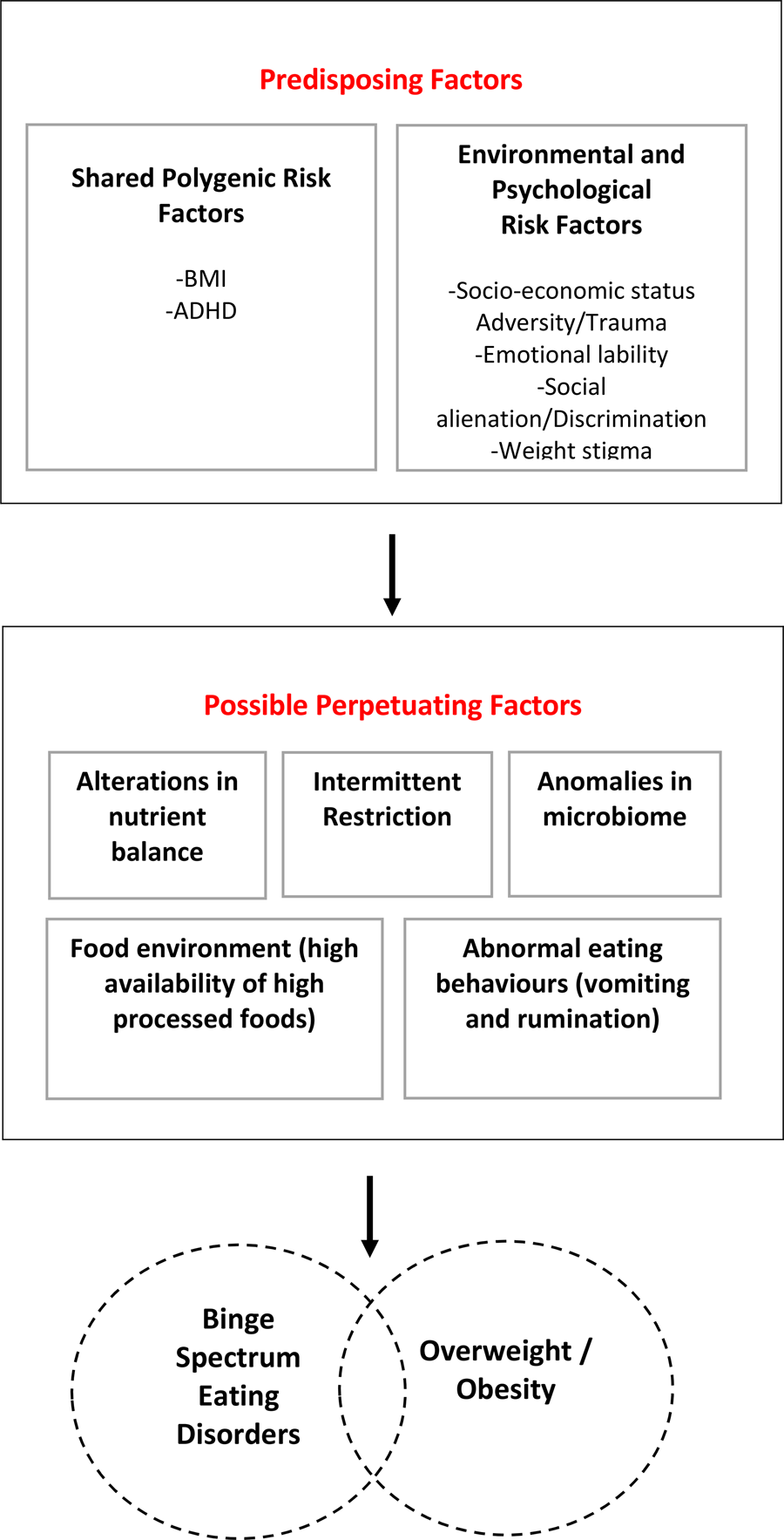
In the following account, we briefly compare and contrast the biopsychosocial factors associated with conditions across the weight and eating disorder spectrum. The quality of the evidence varies. For example, the largest and most detailed genetic studies have included people with anorexia nervosa whereas longitudinal studies have greater power to track the development of binge-eating disorders. In Fig. 1, we outline the factors associated with emotional eating and/or binge-eating disorder.
Relationship between predisposition, maintenance and consequence of emotional eating. ADHD, attention-deficit hyperactivity disorder.
Predisposing factors
Genetic studies have found commonalities between anorexia nervosa, other psychiatric disorders and metabolic variations(Reference Watson, Yilmaz and Thornton7). Interestingly, binge-type eating disorders, anorexia nervosa and constitutional thinness differ in their associations with anthropometric and psychiatric polygenic scores supporting the idea that the same general diagnostic category (eating disorder) may be underpinned by different processes(Reference Hübel, Abdulkadir and Herle8,Reference Abdulkadir, Hübel and Herle9) . Also, people with binge-eating disorders (in contrast to people with anorexia nervosa) share a proportion of their genetic profile with ADHD(Reference Yao, Kuja-Halkola and Martin10). Thus, there are shared and contrasting genetic risk factors within the diagnostic spectrum of ‘eating and weight disorders’.
The epidemiology of ‘eating and weight disorders’ also shows similarities and contrasts. For example, in Australia, obesity (32 %), binge eating (12⋅5 %), comorbid obesity and binge eating (5⋅7 %) have all increased in parallel from 1995 to 2015(Reference Da Luz, Sainsbury and Mannan11). The lifetime growth trajectory shows that higher growth in childhood is associated with the later development of binge-eating disorder. Also, a Mendelian randomisation analysis of people in the The Avon Longitudinal Study of Parents and Children (ALSPAC) longitudinal cohort found that a higher BMI at 7 years was later associated with binge eating(Reference Reed, Micali and Bulik12). Smaller studies also have shown a trajectory of overeating and higher weight precedes the emergence of binge spectrum disorders(Reference Stice, Gau and Rohde13) whereas the opposite profile (leanness and weight suppression) precedes the development of anorexia nervosa(Reference Yilmaz, Gottfredson and Zerwas14,Reference Abdulkadir, Hübel and Herle15) . In addition, a period of weight suppression increases odds for future onset of anorexia nervosa and bulimia nervosa, but not binge-eating disorder(Reference Stice, Rohde and Shaw16).
Several studies have highlighted the importance of antecedent emotional lability and psychosocial and environmental stressors in the risk of development of binge spectrum disorders. Trauma early in life can set the scene for binge spectrum disorder (see recent umbrella review(Reference Solmi, Radua and Stubbs17)). Also 76 % of people seeking treatment for being overweight have experienced adverse childhood events, such as physical and sexual abuse(Reference Schulte, Bach and Berkowitz18). Binge-eating disorder is also associated with high levels of childhood adversity(Reference Röhr, Dölemeyer and Klinitzke19). Often, these adversities are associated with a marginalised identity (based on sexuality, sex, race, etc.)(Reference Bucchianeri, Eisenberg and Neumark-Sztainer20–Reference Kamody, Grilo and Udo22). These factors may be compounded by forms of weight stigma, which may occur both within families(Reference Dahill, Touyz and Morrison23) and more generally(Reference Lie, Rø and Bang24,Reference Hunger, Dodd and Smith25) . For example, weight-related teasing by parents of children with social anxiety was associated with a higher level of emotional eating 1 year later(Reference Webb, Kerin and Zimmer-Gembeck26). Epigenetic processes as a consequence of adversity can shape development(Reference Steiger and Booij27) leading to what has been termed an ‘ecophenotype’(Reference Monteleone, Cascino and Ruzzi28) within the stress and regulatory systems(Reference Heim, Entringer and Buss29,Reference Berens, Jensen and Nelson30) . Thus, a positive feedback system may develop whereby weight stigma and adversities can, through changes in the sensitivity of systems of reward and punishment and stress lead to emotional eating and further weight gain magnifies the problem.
Factors that may maintain emotional eating
Over time, several factors may cause emotional eating to become maintained possibly through the development of ‘addictive’ processes with food or eating behaviour. However, the utility of the concept of food addiction and its overlap with emotional eating, eating disorders and anxiety is uncertain(Reference Oliveira, Kim and Lacroix31).
Rodent models which resemble food addiction/binge eating have been developed through interspersing periods of food restriction with intermittent availability of high fat/high sugar foods. The overeating is associated with changes in mesolimbic dopamine systems(Reference Avena32). Evidence from studies in human subjects may support this mechanism. For example, following a weight loss dietary intervention participants were allocated to diets in which the proportion of carbohydrates varied (high 60 %, moderate 40 % and low 20 % carbohydrate). After 14–20 weeks of the maintenance diet, they had brain scans around a study meal, in the pre- and late post-prandial periods. Blood flow in the reward regions of the brain was increased in those allocated to the high carbohydrate condition. A possible interpretation of these findings is that a high carbohydrate diet following weight loss might sensitise reward processes which might trigger overeating and a difficulty maintaining weight (although this latter step has not been tested)(Reference Holsen, Hoge and Lennerz33). Thus, intermittent dieting may also enhance the rewarding properties of food. Over time emotional eating may develop into a habit and become ‘cue driven’ rather than ‘outcome-driven’.
Another possible maintaining mechanism is the disruption between peripheral (eyes and smell taste) and central metabolic sensing caused by artificial flavouring, etc., and/or vomiting/rumination. For example, in a recent study looking at functional MRIs in participants drinking milkshakes sweetened with either nutritive or non-nutritive sweeteners, signals of satiety were seen only after drinking shakes with nutritive sweeteners (glucose)(Reference Van Opstal, Hafkemeijer and van den Berg-Huysmans34). Inconsistency between sweet taste and energetic value could lead to compensatory overeating(Reference Pearlman, Obert and Casey35). Thus, several processes may contribute to the maintenance of overeating and whether these should be conceptualised as ‘food addiction’ is controversial. However, one conclusion from research in this area is that early interventions to prevent the establishment of these secondary changes are needed.
Another area which is undergoing intense exploration is that of the gut brain microbiota and its links with eating behaviour and weight. There is some evidence associating certain gut microbial species with eating behaviour(Reference Medawar, Haange and Rolle-Kampczyk36). Similarly, changes in abundance of particular bacterial species in the gut have been associated with food addiction scores after bariatric surgeries(Reference Dong, Mayer and Osadchiy37). The gut microbiome may affect eating via various mechanisms including increasing craving for specific foods, changing taste receptor expression, affecting mood, stress and anxiety, modulating afferent nerve activity from the gut(Reference Alcock, Maley and Aktipis38), affecting gut hormones and impacting the system through inflammatory mediators(Reference Novelle39,Reference Gupta, Osadchiy and Mayer40) . Individuals then may develop hedonic eating features as a result of an altered reward system caused by the shift in gut brain microbiota(Reference Dong, Mayer and Osadchiy37,Reference Gupta, Osadchiy and Mayer40) . Several new promising therapeutic strategies may arise from this association. Currently, the use of probiotics and prebiotics to modify the human gut microbiome seems to be a promising approach(Reference Novelle39).
Treatments developed for emotional eating
In the following section, we consider advances in treatments that target the processes associated with emotional eating. Wherever possible we have cited results from a meta-analysis derived from systematic reviews. We selected studies that included people within the binge-eating spectrum and we have not included studies of obesity that do not specify this form of eating behaviour.
The diagnostic guidelines for people with binge spectrum disorders recommend forms of psychotherapy such as cognitive behavioural therapy, possibly augmented with antidepressants(41,Reference Herpertz, Fichter and Herpertz-Dahlmann42) . However, new developments targeting some of the underlying processes are being developed and tested. These target impulsivity, attention and sensitivity to reward or punishment, and/or the cultural cognitive and emotional framing of these problems and include strategies such as brain training or neuromodulation. New forms of psychotherapy using novel technologies to improve engagement have been developed as have new drugs.
Advances in psychotherapy approaches
So-called third wave psychotherapies targeting processes such as emotional regulation for example with mindfulness have been introduced for both the treatment of binge-eating and weight disorders. The literature on mindfulness interventions has been subjected to a meta-analysis(Reference Mercado, Robinson and Gordon43). In the limited number of studies available positive effects on binging (albeit with minimal effects on weight) were found. Two proof of concept studies examining the impact of interventions targeting impulsivity and emotional regulation showed promise(Reference Preuss, Pinnow and Schnicker44,Reference Schag, Rennhak and Leehr45) as did a small study including dialectical behavioural therapy skills(Reference Braden and O'Brien46).
In addition to these traditional forms of psychotherapy, many treatments have been translated into digital forms. The first study of guided self-management using a book describing cognitive behavioural and emotional regulation principles was published almost 30 years ago(Reference Treasure, Schmidt and Troop47). Many similar studies have followed and have been included in systematic reviews using traditional and network forms of analysis(Reference Slade, Keeney and Mavranezouli48). The cost-effectiveness of this approach has led to it being recommended by NICE (2017). A wide range of digital augmentations to therapy have followed see review(Reference Linardon, Shatte and Messer49). These target a range of processes(Reference Wasil, Patel and Cho50). However, it has been generally found that adherence is higher in those that have an interpersonal element(Reference Linardon, Shatte and Messer49). Various strategies are being used to match the intervention with the stage of readiness to change and increase the appeal. For example, a humanoid chat box that presents psychoeducation information has been developed(Reference Prosperi, Guidi and Calabria51).
Advances in treatments targeting emotional regulation and approach and avoidance towards food
Strategies to regulate approach and avoidance processes by focusing on changing learned associations between cues and responses (exposure treatments) have been informed by insights into the process of inhibitory learning from the animal literature(Reference Craske, Treanor and Conway52). Several systematic reviews and theoretical papers have considered applying this approach to eating disorders(Reference Butler and Heimberg53–Reference Reilly, Anderson and Gorrell56).
Developments in the field include the ability to deliver complex exposure experiences, of relevance to people with eating disorders, e.g. talking back to the eating disorder voice embodied in an avatar, eating in a social situation, the virtual experience of being in a larger body and managing weight stigma, etc.(Reference Keizer, van Elburg and Helms57–Reference Porras-Garcia, Ferrer-Garcia and Serrano-Troncoso59). A systematic review of studies using virtual reality for binge eating(Reference Low, Ho and Ho60) found nineteen studies, ten of which related to treatment (including six with a randomised design). The outcomes included small reductions in bingeing and vomiting although changes in weight were negligible. Interestingly, these approaches have been shown to benefit people resistant to standard cognitive behavioural therapy treatment(Reference Ferrer-García, Gutiérrez-Maldonado and Pla-Sanjuanelo61,Reference Ferrer-Garcia, Pla-Sanjuanelo and Dakanalis62) .
Advances in brain training
There have been developments in brain training procedures that target some of the underlying processes such as attention, valuation of food and impulsive responses towards highly palatable binge foods(Reference İnce, Schlatter and Max63). Proof of concept studies in people with binge eating have targeted attentional processes such as eye gauze(Reference Giel, Speer and Schag64), or motor responses using approach/avoidance(Reference Brockmeyer, Friederich and Küppers65) or go/no-go (FOOD T) training tasks(Reference Chami, Reichenberger and Cardi66,Reference Keeler, Chami and Cardi67) . These studies have been found to reduce eating psychopathology, binge eating and weight(Reference Chami, Treasure and Cardi68–Reference Keeler, Chami and Lawrence71). The go/no-go (FOOD T) training task has been modified based on feedback from participants as a gamified app that is acceptable, feasible and effective for reducing the valuation of binge food and eating psychopathology when delivered as an augmentation to treatment as usual(Reference Keeler, Chami and Lawrence71). Thus, the use of these tools as a form of early intervention or to augment treatment might have value.
Advances in the use of neuromodulatory procedures
Neuromodulatory approaches use various forms of stimulation to target regions associated with the approach and avoidance to food. These include non-invasive brain procedures such as transcranial direct current stimulation, transcranial magnetic stimulation and percutaneous nerve stimulation, vagus nerve stimulation, gastric electrical stimulation and invasive procedures such as deep brain stimulation.
Several systematic review studies have examined the effect of neuromodulation on the underlying processes related to overeating and emotional eating such as craving(Reference Song, Zilverstand and Gui72,Reference Mostafavi, Khaleghi and Mohammadi73) , and inhibitory control and impulsivity(Reference Yang, Mauer and Völlm74,Reference Schroeder, Schwippel and Wolz75) with some positive effects. However, a systematic review that examined the effectiveness of these techniques for people falling within the overweight category did not find positive effects on weight reduction(Reference Gouveia, Silk and Davidson76). Similarly, repetitive transcranial magnetic stimulation has so far shown limited efficacy in reducing binge eating(Reference Walpoth, Hoertnagl and Mangweth-Matzek77–Reference Guillaume, Gay and Jaussent79).
An interesting new development is to augment some of the brain training approaches described earlier with forms of neuromodulation. For example, both the eye gauze(Reference Max, Plewnia and Zipfel80) and approach/avoidance training(Reference Gordon, Williamson and Gkofa81) have been augmented with neuromodulatory procedures.
Advances in drug treatment
The neurotransmitters serotonin, noradrenaline, dopamine, γ-aminobutyric acid and glutamate are key signalling molecules for the control of body weight, appetite and food intake; they unfold their effects in the three main brain systems for the regulation of eating behaviour: the hedonic system, the self-regulatory system and the homoeostatic system(Reference Himmerich and Treasure82). These neurotransmitters are also involved in the generation and control of essential emotions such as anxiety, fear, anger and satisfaction(Reference Esperidião-Antonio, Majeski-Colombo and Toledo-Monteverde83) which play a significant role in the development and maintenance of depression, bipolar disorder, ADHD and alcohol dependence(Reference Lara, Pinto and Akiskal84). Therefore, medications to treat these disorders have been tested in obesity, bulimia nervosa and binge-eating disorder where they have been shown to aid the control of emotions and of food intake.
For example, a fixed combination of the antidepressant bupropion and naltrexone, a medication that is used to treat alcohol and drug dependence, has been shown to lead to significant weight loss, a reduction of food craving and decreased food intake in people with obesity, potentially by influencing noradrenergic, dopaminergic and glutamatergic neurotransmission(Reference Greenway, Fujioka and Plodkowski85,Reference Rebello and Greenway86) .
Another approved anti-obesity drug is the glucagon-like peptide-1 agonist liraglutide. In addition to weight loss under therapy with liraglutide, cardiovascular benefits and anti-diabetic effects have also been reported(Reference Mehta, Marso and Neeland87). It has particularly been shown to significantly decrease uncontrolled and emotional eating and to reduce the urge to consume fatty foods(Reference Jensterle, Kocjan and Kravos88–Reference Keskitalo, Tuorila and Spector90). Glucagon-like peptide-1 receptor agonists such as liraglutide act in the hypothalamus, hindbrain and in the mesolimbic reward system, altering various components of eating behaviour(Reference Jensterle, Kocjan and Kravos88). For instance, the stimulation of meso-limbic glucagon-like peptide-1 receptors has been found to reduce hunger-driven feeding and the hedonic value of food(Reference Skibicka91).
Fluoxetine is a serotonergic antidepressant which has been shown to lead to emotional stability across a broad spectrum of mental health conditions such as premenstrual emotional problems(Reference Pearlstein and Yonkers92), disruptive behaviour(Reference Hwang, Chung and Chang93), borderline personality disorder(Reference Stoffers-Winterling, Storebø and Lieb94) and bipolar depression(Reference Walker, DelBello and Landry95). Therefore, it seems natural to use fluoxetine in people with bulimia nervosa, who suffer particularly from emotional dysregulation(Reference Perthes, Kirschbaum-Lesch and Legenbauer96). Indeed, fluoxetine is well evaluated and approved for the treatment of bulimia nervosa, and it is deemed to exert its beneficial effects regarding emotions and the control of eating behaviour in the self-regulatory system of the brain located in the prefrontal cortex(Reference Himmerich and Treasure82).
Regarding binge-eating disorder, lisdexamfetamine (LDX) is the only drug approved in some countries, namely the USA, Canada, Brazil, Puerto Rico, Mexico and Israel. It is a prodrug of amphetamine. Before it was tested in binge-eating disorder, LDX was in use for the treatment of children and adults with ADHD. We have mentioned earlier that people with binge-eating disorder have a genetic profile similar to that of people with ADHD and emotional dysregulation is a feature of both(Reference Groves, Wells and Soto97,Reference Walenda, Kostecka and Santangelo98) . The approval of LDX in binge-eating disorder was based on three randomised controlled trials which found LDX superior to placebo for reducing binge-eating days, obsessive-compulsive binge-eating symptoms and body weight(Reference Appolinario, Nardi and McElroy99).
Atomoxetine is a selective noradrenaline reuptake inhibitor approved for the treatment of ADHD. As it was known to help with the emotional instability in people with ADHD and to lead to weight loss, McElroy et al. tested atomoxetine in a randomised controlled trial that included forty patients with binge-eating disorder. Compared with placebo, atomoxetine was associated with a significantly greater rate of reduction in binge-eating episode frequency, binge day frequency and body weight(Reference McElroy, Guerdjikova and Kotwal100).
However, not all psychopharmacological drugs that help with emotional problems lead to improved control of food intake. For example, the atypical antipsychotic olanzapine which has been shown to improve emotional processing in schizophrenia(Reference Blasi, Popolizio and Taurisano101,Reference Del Fabro, Delvecchio and D'Agostino102) has been reported to lead to binge eating, food craving and clinically significant weight gain as a side effect(Reference Kluge, Schuld and Himmerich103,Reference Himmerich, Minkwitz and Kirkby104) . The weight gain is most probably due to olanzapine's antihistaminergic effects in the hypothalamus which is the centre of the homoeostatic system that generates appetite and hunger(Reference Kroeze, Hufeisen and Popadak105). Antipsychotics with a lower affinity to histaminergic receptors in the hypothalamus such as aripiprazole or ziprasidone produce less weight gain(Reference Kroeze, Hufeisen and Popadak105). Therefore, not all psychopharmacological drugs which lead to an improved control of emotions lead to an increased control of food intake as well.
In summary, some but not all psychopharmacological medications which alleviate emotional dysregulation, attentional or inhibitory problems (e.g. fluoxetine, bupropion, naltrexone, LDX and atomoxetine) have also been shown to help with obesity, bulimia nervosa or binge-eating disorder. Conversely, primarily metabolic drugs that help with obesity (e.g. liraglutide) have been reported to help with uncontrolled and emotional eating.
What interventions do not work
Given the dramatic increase in the prevalence of overweight and obesity, notably among young people, and its link to a higher mortality rate, several strategies have recently been introduced both at the individual and societal levels to prevent obesity(Reference Hunger, Dodd and Smith25). However, it is critical to ensure whether these obesity-prevention initiatives targeting weight loss may have unintended harmful consequences. More specifically, weight is a sensitive and personal topic since it is experienced differently by each person. Therefore, it is of concern that treatment techniques provided by healthcare settings and society may unintentionally foster an environment that contributes to weight stigma rather than creating a supportive and equitable one. Interventions, such as weight reports on schoolchildren(Reference Mensinger, Tylka and Calamari106,Reference Tomiyama, Carr and Granberg107) and energy labelling on menus(108,Reference Treasure and Ambwani109) , may increase weight bias and weight-based discrimination by aggravating cultural ideals or beauty standards of society related to physical appearance. According to Fox, Grange and Power(Reference Fox, Grange, Power, Powell, Overton and Simpson110), a body that is different from what is socially valued can be associated with negative emotions of shame and self-disgust. This may increase the development and maintenance of disordered eating features such as emotional eating among people with overweight. Help-seeking may be inhibited as clinicians themselves hold weight biases(Reference Puhl, Latner and King111). Also, the limited capacity of eating disorder services might contribute to the maintenance of weight stigma through the ‘rationing’ of those services that often exclude patients based on BMI screening. The tendency to deem patients not ‘ill enough’(Reference Harrop, Mensinger and Moore112) results in a lack of access to care.
Conclusions
As the biopsychosocial basis of weight and eating disorders has become more understood, more focused therapies have been developed. The move to target common processes across eating and weight disorders rather than diagnostic categories may facilitate advances in treatment in these areas. Furthermore, innovative technologies offer the possibility of more creative solutions to improve efficacy and the possibility of dissemination. However, in addition to these individual approaches, areas of public policy must consider prevention strategies that consider both eating and weight outcomes.
Acknowledgements
The authors acknowledge the Irish section of the Nutrition Society for inviting the present review paper as part of the Winter Conference 2021: Obesity and the brain.
Financial Support
None.
Conflict of Interest
J. T. has co-authored a self-management book for bulimia nervosa and binge-eating disorder.
Authorship
J. T., H. H., N. D., H. M. and S. B. were involved in formulating the problem and searching the literature. J. T. and H. H. drafted the paper; N. D., H. M. and S. B. edited the paper. All authors read and approved the final manuscript.


 Open access

