





Introduction
The duality of human beings as having both “good” and “bad” character traits within one person has been subject to many religious, philosophical, and psychological debates (Fumerton, Reference Fumerton2013; Swinburne, Reference Swinburne, Lavazza and Robinson2014). “Bad” character traits may include the Dark Triad (DT), a group of three aversive but nonpathological traits that share certain malicious features, namely Psychopathy, Narcissism, and Machiavellianism (Paulus & Williams, Reference Paulhus and Williams2002). Besides the aversive, malevolent impact of DT traits and their association with negative psychosocial outcomes (see Muris et al., Reference Muris, Merckelbach, Otgaar and Meijer2017), previous studies have shown that similar to positive traits such as grit (Duckworth et al, Reference Duckworth, Peterson, Matthews and Kelly2007), negative traits such as primary psychopathy (Akhtar et al., Reference Akhtar, Ahmetoglu and Chamorro-Premuzic2013) and subclinical narcissism (Soyer et al., Reference Soyer, Rovenpor and Kopelman1999) can also positively affect individuals’ achievement in different fields and situations.
The idea of a negative trait positively predicting a desired, positive outcome may seem convoluted, but educational and organizational psychology research is rife with such findings. For example, previous organizational psychology research has shown that psychopathy traits may be beneficial in finance careers (Howe et al., Reference Howe, Falkenbach and Massey2014). Narcissistic traits positively predicted workplace engagement (Furnham & Treglown, Reference Furnham and Treglown2021), and Machiavellianism positively predicted organizational leadership success (Genau et al., Reference Genau, Blickle, Schütte and Meurs2021). In turn, in educational sciences research, Psychopathy has been found to positively predict university grades (Hassall et al., Reference Hassall, Boduszek and Dhingra2015), Machiavellianism has been linked to increased academic achievement in higher education (Eker, Reference Eker, Sarıoğlan and Bağlama2020) and goal orientations (Kareshki, Reference Kareshki2011), and Narcissism was positively associated with mental toughness in school (Papageorgiou et al., Reference Papageorgiou, Malanchini, Denovan, Clough, Shakeshaft, Schofield and Kovas2018) and predicted grades positively among college students (McManus et al., Reference McManus, Pillow and Coyle2022).
Thus, it is not only positive traits that may serve an individual in reaching certain goals or outcomes—negative traits may also be productive. However, the negative impact of traits such as the DT ought not to be overlooked, especially in education. Psychopathy has been associated with educational outcomes such as decreased reading comprehension in the L1 (DeLisi et al., Reference DeLisi, Vaughn, Beaver, Wexler, Barth and Fletcher2011), school drop-out (Hempälä & Hodgins, Reference Hemphälä and Hodgins2014), and truancy and decreased school engagement (Ang et al., Reference Ang, Huan, Chan, Cheong and Leaw2015). In turn, Machiavellianism has been linked to academic dishonesty (Barbaranelli et al., Reference Barbaranelli, Farnese, Tramontano, Fida, Ghezzi, Paciello and Long2018), decreased prosocial classroom behavior (Berger & Palacios, Reference Berger and Palacios2014), and an increased likelihood of bullying peers (Sutton & Keogh, Reference Sutton and Keogh2000). Lastly, Narcissism predicted disruptive school behavior, conduct problems (Hiemstra et al., Reference Hiemstra, Verhulp, Thomaes and Orobio de Castro2020; Ha et al., Reference Ha, Petersen and Sharp2008), and academic misconduct (Brunnell et al., Reference Brunell, Staats, Barden and Hupp2011). As such, in previous educational research, a duality of negative traits is found—some studies found positive outcomes associated with the DT (see Papageorgiou et al., Reference Papageorgiou, Malanchini, Denovan, Clough, Shakeshaft, Schofield and Kovas2018) and some studies have found negative outcomes (DeLisi et al., Reference DeLisi, Vaughn, Beaver, Wexler, Barth and Fletcher2011). Hence, the slopes of significant predictions involving the DT and educational outcomes in general are uncertain.
These observations raise questions regarding the duality of negative traits in predicting desirable or detrimental outcomes in educational contexts, particularly in the realm of second language (L2) acquisition and learning. In terms of the specific educational domain of L2 acquisition, personality traits as predictors of L2 learning research have predominantly been focused on positively framed personality models and traits, such as the Big FiveFootnote 1 (Chen et al., Reference Chen, He, Swanson, Cai and Fan2021), creativity (Nosratinia & Zaker, Reference Nosratinia and Zaker2015), and self-esteem (Takahashi & Takahashi, Reference Takahashi and Takahashi2013). The sheer emphasis on traditional positive traits has resulted in the underrepresentation of the possible impact of other aspects of personality (e.g., aversive, undesirable traits). Considering that educational psychology research has demonstrated that negative traits may serve learners positively in terms of success (Kareshki, Reference Kareshki2011; Papageorgiou et al., Reference Papageorgiou, Malanchini, Denovan, Clough, Shakeshaft, Schofield and Kovas2018; McManus et al., Reference McManus, Pillow and Coyle2022), this paper aims to extend this contradictive prediction of positive outcomes with negative traits to the field of L2 learning. Specifically, the socially maladaptive traits of the DT (Paulhus & Williams, Reference Paulhus and Williams2002) will be examined as predictors of common outcome variables in L2 learning—L2 learning motivation, L2 engagement, L2 academic achievement, and L2 willingness to communicate (WTC).
The myth that negative personality traits, such as those included in the DT, are solely detrimental to outcomes needs to be dismantled. Unraveling this complexity is vital since it could challenge the binary view of personality traits being solely “good” or “bad” and that only positive traits are essential to be investigated to promote success, especially regarding subclinical, invisible negative traits such as DT. Thus, it is critical to examine if and how these traits might influence key outcome variables, such as L2 learning motivation, engagement, overall communication willingness, and overall achievement, as established indicators of students’ success in the process of language learning. The specific interest of the study is therefore not only on the statistical significance of DT factors as predictors of L2 learning, but more specifically on the directionality of significant effects. We therefore extend the current debate regarding negative personality traits found in educational psychology to the field of L2 learning and examine if negative personality traits are positive predictors, negative predictors, or even both when it comes to predicting L2 outcomes.
Literature review
Overview of the Dark Triad
The DT of personality has garnered considerable research attention since its introduction by Paulhus and Williams (Reference Paulhus and Williams2002). Narcissism, Psychopathy, and Machiavellianism as three nonclinical, aversive personality traits that constitute the DT were included in this model as they share close conceptual features, such as callousness, social aversion, selfishness, deceitfulness, and antagonism (e.g., Jones & Figueredo, Reference Jones and Figueredo2013). Moreover, their original measures demonstrated empirical overlap (Paulhus & Williams, Reference Paulhus and Williams2002). Prior to the grouping of these variables, each had received extensive research attention, especially in the clinical domain. In short, Narcissism can be defined as an inflated egoistic self-importance and a quench for social admiration and dominance (Corry et al., Reference Corry, Merritt, Mrug and Pamp2008), while Psychopathy captures impetuous behavior, selfishness, and an absence of regret, empathy, and anxiety (Hare, Reference Hare1985; Paulhus & Williams, Reference Paulhus and Williams2002). Meanwhile, Machiavellianism reflects manipulative and deceptive tendencies toward reaching personal interests and goals (Jones & Paulhus, Reference Jones and Figueredo2013). Paulhus and Williams (Reference Paulhus and Williams2002) examined the resemblance and variance among these traits and reported that although these constructs were intercorrelated (especially Psychopathy and Machiavellianism), they were, indeed, separate traits that should be studied in tandem. Muris et al.’s (Reference Muris, Merckelbach, Otgaar and Meijer2017) meta-analysis of studies on the DT, likewise, confirmed these associations.
In their seminal study on the DT, Paulhus and Williams (Reference Paulhus and Williams2002) adopted the standard measures—Narcissism (The NPI scale; Raskin & Hall, Reference Raskin and Hall1979), Machiavellianism (The Mach-IV inventory; Christie & Geis, Reference Christie and Geis1970), and subclinical Psychopathy (The SRP III; Hare, Reference Hare1985). Utilizing these original measures would require the respondents to answer approximately 124 items. Therefore, several composite scales for constituting concepts under the umbrella of the DT were developed. The Dirty Dozen (Jonason & Webster, Reference Jonason and Webster2010) and the Short DT (Jones & Paulhus, Reference Jones and Paulhus2014) are among the most prevalent measures used. While the former includes 12 items (four for each trait), the latter has 27 questions (nine for each trait). Both of these scales have shown acceptable reliability and validity (Maples et al., Reference Maples, Lamkin and Miller2014). Although many criticized the validity of such scales, especially concerning the multidimensionality of psychopathy and narcissism traits (Lyons, Reference Lyons2019), the studies on the DT that employed these scales have increased in number, likely due to the benefits provided by short-scale use (Rolstad et al., Reference Rolstad, Adler and Rydén2011).
The DT has been studied in a variety of contexts and in relationship to various variables, with varying effect sizes and directionalities found. For instance, Narcissism has shown more positive influence and has been linked to higher emotional expressivity (Lyons & Brockman, Reference Lyons and Brockman2017), self-esteem (Geukes et al., Reference Geukes, Nestler, Hutteman, Dufner, Küfner, Egloff and Back2017), and extraversion (Aluja et al., Reference Aluja, Garcia, Rossier, Ostendorf, Glicksohn, Oumar and Hansenne2022). Machiavellianism and Psychopathy, which are more similar (Lyons, Reference Lyons2019), have been reported to be related to decreased positive mood (Egan et al., Reference Egan, Chan and Shorter2014), decreased emotional expressivity and mental toughness (Lyons & Brockman, Reference Lyons and Brockman2017), and competition-seeking at workplace (Jonason et al., 2015). Furthermore, regarding gender, it has been established that men show higher levels of DT compared to women (e.g. Aluja et al., Reference Aluja, Garcia, Rossier, Ostendorf, Glicksohn, Oumar and Hansenne2022). Among the very few studies focusing on the role of the DT or its subcomponents in educational settings, Papageorgiou et al. (Reference Papageorgiou, Malanchini, Denovan, Clough, Shakeshaft, Schofield and Kovas2018) examined school achievement, mental toughness, and Narcissism among a large sample of Italian students via a longitudinal design. They observed no direct correlation between Narcissism and achievement in school, while a significant, indirect, positive link was revealed between the two through mental toughness. Moreover, studying a British sample from private and state–funded schools, Cannon et al. (Reference Cannon, Vedel and Jonason2020) found that students from the former educational setting showed higher DT levels, indicating the effect of school type on this trait. Moreover, they claimed that DT negatively affected intellectual humility which was correlated with academic performance. Although the majority of the samples for DT studies consisted of students from various majors, no study could be found that investigated the associations between DT and L2 or foreign language learning outcomes.
The lack of existing research may be due to the negative associations of the DT in terms of behavior and interpersonal relationships (Muris et al., Reference Muris, Merckelbach, Otgaar and Meijer2017) and the complexity that arises in examining the contradictory findings that can occur when “undesirable” traits, such as the DT, predict positive outcomes. In addition, the exploration of personality traits as a whole has been neglected in L2 learning studies, most likely due to the smaller effect sizes associated with personality factors as a predictor in comparison to other L2 predictor variables (see Botes et al., Reference Botes, Dewaele, Greiff and Goetz2024a). Indeed, Dörnyei (Reference Dörnyei2005) remarked that “the role and impact of personality factors are of less importance than those of some other individual differences variables such as aptitude and motivation” (p. 10). However, given that the DT has been found to significantly predict (both positively and negatively) behavior in educational settings and educational outcomes in general in the few studies that investigated the DT or its traits in these contexts (e.g. Eker, Reference Eker, Sarıoğlan and Bağlama2020; Hassall et al., Reference Hassall, Boduszek and Dhingra2015; McManus et al., Reference McManus, Pillow and Coyle2022; Papageorgiou et al., Reference Papageorgiou, Malanchini, Denovan, Clough, Shakeshaft, Schofield and Kovas2018), we argue that there is an urgent need to expand these findings to examine the DT as a predictor of L2 classroom behavior and outcomes.
The Dark Triad and L2 learning
Individual Differences (ID) are social, psychological, or biological learner characteristics, that are unique in terms of their combination in each individual and have been found to affect learning outcomes directly or indirectly (Li et al., Reference Li, Hiver, Papi, Li, Hiver and Papi2022). Due to the predictive effect of ID variables on learning outcomes, the explicative role ID variables play in the process of language learning, and the subsequent implications for the practice of language teaching and learning (Li et al., Reference Li, Hiver, Papi, Li, Hiver and Papi2022), ID variables have been a topic of interest among the researchers of this field.
One such variable is learners’ WTC which is the intention to speak or remain silent, given free choice (MacIntyre, Reference MacIntyre2020). Since communication is a vital part of learning a language, whatever the purpose of language learning might be, the primary reason is to be able to use the target language (MacIntyre & Charos, Reference MacIntyre and Charos1996). According to the literature, WTC is predicted by variables such as anxiety, enjoyment, perceived competence, motivation (Dewaele, Reference Dewaele2019; Elahi Shirvan et al., Reference Elahi Shirvan, Khajavy, MacIntyre and Taherian2019), language mindset (Ebn-Abbasi et al., Reference Ebn-Abbasi, Fattahi, Noughabi and Botes2024), and language proficiency (Sato, Reference Sato2023). In terms of personality, traits such as Extraversion, Agreeableness, and Openness to Experience have been linked to WTC (Oz, Reference Oz2014). Although no previous research regarding WTC and the DT could be found, each of the components of the DT has previously been associated with communication behavior. Narcissism has been positively linked to interpersonal communication apprehension (Salazar, Reference Salazar2016), a variable that examines nervousness in communication. Given that WTC requires an individual to speak up in the L2 despite nervousness (MacIntyre, Reference MacIntyre2020) and that WTC is also predicted by communication apprehension (Donovan & MacIntyre, Reference Donovan and MacIntyre2004), these variables are likely to coexist within the same nomological network. In turn, a review of the communication patterns associated with Psychopathy found that people with psychopathic tendencies tended to avoid communication when feeling anxious or uncertain (see Gullhaugen & Sakshaug, Reference Gullhaugen and Sakshaug2019 for an overview). The theoretical foundations of L2 WTC are based on the uncertainty that language learners feel, with MacIntyre (Reference MacIntyre2020) commenting: “Learners often find themselves in a position that requires the use of uncertain L2 skills, be it inside or outside the classroom context” (p.111). In addition, qualitative studies examining WTC in the target language have found that uncertainty and a sense of security were drivers in an L2 learner’s choice to communicate as well as previous traumatic or exhilarating incidents (Dewaele & Pavelescu, Reference Dewaele and Pavelescu2021; Kang, Reference Kang2005). In terms of Machiavellianism, its link with WTC is somewhat less clear, with the former defined as a tendency to manipulate. and domain–general education research findings indicate that higher levels of Machiavellianism predicted certain communication patterns with teachers, notably greater sycophantic communication (Martin et al., Reference Martin, Myers and Mottet2006). Additional research on the communication patterns of Machiavellians also suggests that the WTC of higher–level Machiavellian learners would depend on whether the opportunity for manipulation is present in the communication (Tomkova et al., Reference Tomkova, Cigarska and Ondrijova2022) and if a tangible reward or outcome may be gained from such communication (Birkás et al., Reference Birkás, Csathó, Gács and Bereczkei2015). Overall, even though the DT has not been directly linked to WTC, an extrapolation of previous findings in other research domains does provide a basis for the exploration of a relationship between the DT and L2 WTC.
Another ID that captures the learners’ direction, vigor, and determination of actions in the learning process is motivation (Papi & Hiver, Reference Papi, Hiver, Li, Hiver and Papi2022). The DT can be examined and explained in the context of motivation, such as intrinsic and extrinsic motivation. The former, exhibited as a genuine interest and enjoyment in the learning process contrasts the drive by external rewards or pressures. Learners demonstrating higher intrinsic motivation may also show higher narcissistic attitudes (Morf et al., Reference Morf, Weir and Davidov2000), whereas those influenced by extrinsic motivation are more likely to exhibit greater levels of Machiavellianism and Psychopathy (Glenn et al., Reference Glenn, Efferson, Iyer and Graham2017; McHoskey, Reference McHoskey1999).
Among the various theories of motivation, Dörnyei’s (Reference Dörnyei2005, Reference Dörnyei, Dörnyei and Ushioda2009) L2 motivational self system (L2MSS), comprised of three elements of the ideal L2 self, ought–to L2 self, and L2 learning experience is a prominent one. According to this theory, motivation is the desire to diminish the inconsistency between one’s actual self and ideal or ought–to selves (Dörnyei, Reference Dörnyei, Dörnyei and Ushioda2009). While the ideal L2 self refers to the ideal picture of the future L2 user one wishes to become, ought–to self captures the attributes one believes one ought to possess to meet the expectations of others (Dörnyei, Reference Dörnyei, Dörnyei and Ushioda2009). The available literature sheds light on the relationship between L2MSS components and other ID variables such as personality (Oz, Reference Oz2015), language mindset (Ebn-Abbasi et al., Reference Ebn-Abbasi, Fattahi, Noughabi and Botes2024), and language proficiency (Wong, Reference Wong2020). In terms of personality, general personality traits of Extraversion, Neuroticism, Conscientiousness, and Openness to Experience have been linked to the Ideal L2 Self, with Neuroticism and Conscientiousness associated with Ought–to Self (Ghapanchi et al., Reference Ghapanchi, Khajavy and Asadpour2011). Although no study could be found that examined the DT and L2 learning motivation, support for the proposed relationship between the DT and motivation can be found in domain–general educational psychology studies. Previous research has linked the DT to the motivation of student volunteers (Veres et al., Reference Veres, Eva and Cavanagh2020), and the motivations of medical students (Bujok et al., Reference Bujok, Witte-Humperdinck, Schulze and Ohlendorf2024). Machiavellianism, in particular, may be linked to motivation, as the trait is associated with a high–power motivation (Paulhus, 2014). In turn, Psychopathy is associated with a motivation for power and development (Diller, Czibor, et al., Reference Diller, Czibor, Szabo, Restas, Jonas and Frey2020 as cited in Diller, Frey, et al., Reference Diller, Frey and Jonas2021), which may include a motivation for developing skills such as mastering an L2. This motivation to develop skills may also apply to Narcissism, as highly Narcissistic individuals have a high impression motivation and may want to develop skills to impress others (Wallace & Baumeister, Reference Wallace and Baumeister2002). Given the theoretical foundations of the DT traits and previous findings in domain–general education, there is a research basis from which to explore the relationship between L2 motivation and DT.
A closely related concept to motivation is learner engagement which is the next step taken by learners when they put their motivational sources into action to perform language learning tasks (Hiver, Reference Hiver, Al-Hoorie and Szabo2022). Engagement captures all learning (Hiver, Reference Hiver, Al-Hoorie and Szabo2022) and it has at least three core components, viz., behavioral, emotional (or affective), and cognitive (Fredricks et al., Reference Fredricks, Blumenfeld and Paris2004). Recently, Teravainen-Goff (Reference Teravainen-Goff2023) has introduced a new domain–specific engagement scale that, unlike other available measures, captures the quality of learners’ active participation. She views engagement as a behavioral concept with underlying cognitive and affective dimensions; and defines the quality of L2 engagement as “the perceived usefulness and satisfaction with the learning experience” (Teravainen-Goff, Reference Teravainen-Goff2023, p. 3). The Intensity and Quality of L2 Engagement Questionnaire has five factors, namely intensity of effort in learning, intensity of social engagement, perceived quality of engagement with the teacher, perceived quality of engagement with peers, and perceived quality of engagement with learning activities. Researchers in L2 IDs have investigated the antecedents of L2 engagement such as personality (Angelovska et al, Reference Angelovska, Mercer and Talbot2021), and language mindset and emotions (Ebn-Abbasi et al., Reference Ebn-Abbasi, Fattahi, Sayyahi and Nushi2024). The personality traits linked to engagement include Neuroticism (Angelovska et al., Reference Angelovska, Mercer and Talbot2021) and Grit (Sadoughi & Hejazi, Reference Sadoughi and Hejazi2023). Although the DT has not been examined previously as a predictor of L2 learning engagement, studies in educational psychology have found links between the DT and domain–general learning engagement. Mooney (Reference Mooney2023) and Hughes et al. (Reference Hughes, Adie, Kratsiotis, Bartholomew, Bhakta and Martindale2023) found Narcissism to be positively correlated with students’ engagement whilst Psychopathy was negatively correlated. Previous studies in domain–general education therefore demonstrated that not only is there an association between the DT and learner engagement, but that differing directionalities are found for DT traits.
Achievement and L2 learning
Gaining proficiency in the target language can be perceived to be the ultimate goal of L2 learning. However, objective measures of proficiency can the prohibitively expensive and difficult to administer (Edele et al., Reference Edele, Seuring, Kristen and Stanat2015). As such, academic achievement and self-perceived proficiency have become common proxy variables of proficiency in the field of L2 learning, especially in meta-analytic studies (see Botes et al., Reference Botes, Dewaele and Greiff2020a; Botes et al., Reference Botes, Dewaele and Greiff2022). In addition to commonly being perceived as proxy variables of proficiency, academic achievement of L2 learning classes and the self-perception of proficiency can be seen as outcome variables in their own right. Academic achievement in the form of grades or test scores is a popular outcome variable in educational sciences studies as an indicator of learning success (Steinmayr et al., Reference Steinmayr, Meiǹer, Weideinger and Wirthwein2015). Furthermore, self-perceived proficiency as a variable capturing a learner’s confidence in their ability is associated with L2 variables such as WTC (Donovan & MacIntyre, Reference Donovan and MacIntyre2004), motivation (Wong, Reference Wong2020), and emotions (Botes et al., Reference Botes, Dewaele and Greiff2020b), and as such can be considered a significant variable in the greater nomological network of L2 learning.
Within this nomological network of variables of L2 learning, the relationship between personality and L2 achievement has been extensively examined in the literature. A recent meta-analysis of over 40 years of research in L2 learning examined the relationship between personality as captured via the Big Five and L2 learning achievement found significant positive correlations between achievement and Openness to Experience (r = .23; p < .001), Conscientiousness (r = .18; p = .002), Extraversion (r = .12; p = .017), and Agreeableness (r = .10; p = .025; Chen et al., Reference Chen, He, Swanson, Cai and Fan2021). In addition, L2 perceived competence has also been positively associated with Openness to Experience, Conscientiousness, Extraversion, and Agreeableness (Rivers & Ross, Reference Rivers and Ross2020). To the best of our knowledge, a study of this nature that examined the DT and achievement or proficiency in L2 learning has not yet been carried out. In domain-general education literature, DT has been linked to academic achievement in higher education (Eker, Reference Eker, Sarıoğlan and Bağlama2020; Tahoon, Reference Tahoon2020). Furthermore, the theoretical foundations of each DT trait may provide a basis from which to link the traits to L2 academic and self-perceived achievement. Narcissism is associated with a grandiose sense of self and a need to impress (Paulus & Williams, Reference Paulhus and Williams2002), where both a sense of self and a need to impress may translate into a greater L2 perceived achievement, with a need to impress possibly leading to a drive to achieve (Wallace & Baumeister, Reference Wallace and Baumeister2002). In turn, Machiavellianism is associated with goal–striving behavior and pursuing rewards (Kareshki, Reference Kareshki2011), as higher grades can be considered a goal or a “reward,” it may be that Machiavellian language learners pursue academic achievements. In addition, previous research has shown that Psychopathy was positively associated with academic achievement in domain–general education research (Hassall et al., Reference Hassall, Boduszek and Dhingra2015), whereas Psychopathy had a negative association with L1 reading achievement (DeLisi et al., Reference DeLisi, Vaughn, Beaver, Wexler, Barth and Fletcher2011).
In light of the reviewed literature and previous findings, we hypothesize that the DT traits can affect the L2 learning process by playing a role in learners’ motivation, WTC, quality of engagement, academic achievement, and self-perceived achievement. As previous results regarding the relationship between the DT traits and learning outcomes have often been contradictory in terms of directionality, we do not hypothesize specific directions in the study. Rather, the study is a first exploratory foray into the possible relationships between DT and L2 learning variables. To this end, the following research questions are addressed:
-
1. Do the DT of personality (Machiavellianism, Psychopathy, and Narcissism) predict the L2 Motivational Selves of Ideal L2 Self and Ought–to L2 Self?
-
2. Do the DT of personality (Machiavellianism, Psychopathy, and Narcissism) predict L2 engagement as captured via intensity of effort in learning, intensity of social engagement, quality of engagement with the teacher, quality of engagement with peers, and quality of engagement with learning activities?
-
3. Do the DT of personality (Machiavellianism, Psychopathy, and Narcissism) predict L2 academic achievement and L2 self-perceived achievement?
-
4. Do the DT of personality (Machiavellianism, Psychopathy, and Narcissism) predict L2 willingness to communicate?
Methods
Participants
A total of n = 431 (n = 219 male and n = 199 female) L2 adult learners from [country redacted for peer review] learners participated in the studyFootnote 2. All participants were studying English courses in private English language schools using various course books such as American English File, English File, and Top Notch series. Participants varied across proficiency levels, with n = 11 A2 English learners, n = 201 B1 learners, n = 187 B2 learners, and n = 32 C1 learners as categorized by the Common European Framework of Reference for Languages (CEFR)Footnote 3. The average age of participants was 21.35 years old (SD = 2.173) and ranged from 18 to 29. This research was approved by the University of [blinded] ethical committee and their guidelines were followed throughout the whole research process.
Instruments
The Dark Triad (α = .901): The dark triad of personality was measured via the Dirty Dozen Scale (Jonason & Webster, Reference Jonason and Webster2010), a 12-item, multidimensional scale with three subfactors: Machiavellianism (e.g. “I tend to manipulate others to get my way”; α = .930), Psychopathy (e.g. “I tend to lack remorse”; α = .878), and Narcissism (e.g. “I tend to want others to admire me”; α = .945). The Dirty Dozen was selected as it is considered to be the most prevalent composite questionnaire to assess the DT (Lyons, Reference Lyons2019), in addition to being a valid and reliable measure of the DT (see Maples et al., Reference Maples, Lamkin and Miller2014). Another reason to choose this scale was to avoid the high number of items in the questionnaire which can negatively affect participants’ responses. Each subfactor was measured with four items each, with each item measured on a 5-point Likert scale from “strongly disagree” to “strongly agree.”
L2 Engagement (α = .914): Engagement in the L2 class was measured through the Intensity and Quality of L2 Engagement Questionnaire (Teravainen-Goff, Reference Teravainen-Goff2023). The 18–item, multidimensional questionnaire captures L2 Engagement via five subfactors: Intensity of effort in learning (four items; e.g. “I usually concentrate on the activities we do”; α = .899), intensity of social engagement (three items; e.g. “I usually participate in class discussion; α = .901), quality of engagement with the teacher (four items; e.g. “I usually feel I learn a lot from my teacher”; α = .897), quality of engagement with peers (four items, e.g. “I usually think group work is a good way to learn”; α = .913), and quality of engagement with learning activities (three items; e.g. “I usually learn a lot from the activities we do”; α = .920). All items were measured on a 5-point Likert scale from “strongly disagree” to “strongly agree.”
L2 Motivational Self: The L2 Motivational Self was examined via the L2MSS Scale (Taguchi et al., Reference Taguchi, Magid, Papi, Dörnyei and Ushioda2009). Despite the existence of more recent models, such as Papi et al. (Reference Papi, Bondarenko, Mansouri, Feng and Jiang2019), the current scale has been used and proved a to be valid and reliable measure repeatedly in [blinded] context. Ideal L2 Self, measured through 10 items (α = .951), captured the idealized version of the L2 learner as a proficient user of the L2 and as such encapsulates the intrinsic motivation to learn the L2 (e.g. “I can imagine myself living abroad and having a discussion in English”). The Ought–to L2 Self, measured through 10 items (α = .950), captured the extrinsic motivation to learn the L2 (e.g. “Learning English is necessary because people surrounding me expect me to do so”). All items were measured on a 5–point Likert scale from “strongly disagree” to “strongly agree.”
Willingness to Communicate (α = .952): L2 WTC was measured through Peng and Woodrow’s (Reference Peng and Woodrow2010) L2 WTC Scale. The 10–item, unidimensional scale captured the L2 learner’s willingness to communicate in the English class (e.g. “I am willing to ask my classmates in English how to pronounce a word in English”). All items were measured on a 5–point Likert scale ranging from “strongly disagree” to “strongly agree.”
Academic Achievement and Self–Perceived Achievement: A single item was included in the survey to assess participants” English achievement. They reported their latest English course final grade, which ranged between 1 and 100, which includes the four main skills (speaking, reading, listening, and writing) assessed by the language schools. Participants were specifically asked to report their final scores rather than the midterms. Regarding self–perceived achievement, learners were asked to rate their perceived proficiency in English on a scale of 1 (beginner) to 6 (highly proficient).
Data analysis
All data were analyzed using JASP 0.18.3 (JASP Team, Reference Team2024). Descriptive statistics and Pearson’s correlation coefficients were calculated for all variables. For each research question, a structural equation model (SEM) was analyzed to test the hypothesized relationships between the predictor variables of the dark triad and the outcome variables of L2 learning variables. As a precursor to the analysis of the SEMs, measurement models were analyzed to ensure the necessary validity of the questionnaires used to capture the constructs. The dark triad, as well as L2 engagement scales, were modeled as correlating, multidimensional measurement models to examine each of the subfactors as individual predictors and outcome variables, for instance, Narcissism as a predictor of social engagement. The measurement model results and a summary of the SEMs can be found in the Supplementary Materials. Measurement models and SEMs were estimated with diagonally weighted least squares with standard errors, as all observed variables in the models were ordinal variables (Li, Reference Li2016). Model fit was interpreted via the Comparative Fit Index (CFI; close fit ≥ .95; reasonable fit ≥ .90), Tucker-Lewis Index (TLI; close fit ≥ .95; reasonable fit ≥ .90), Root Mean Square Error of Approximation (RMSEA; close fit ≤ .05; reasonable fit ≤ .08), and Standard Root Mean Square Residual (SRMR; close fit ≤ .05; reasonable fit ≤ .08; Kenny, Reference Kenny2020). Effect sizes were interpreted using the guidelines of Botes et al. (Reference Botes, Resnik, Greiff and Stempfer2024b), which categorizes effect sizes as small (< .20), medium (.35), and large (> .50). It should be noted that the guidelines of Botes et al. (Reference Botes, Resnik, Greiff and Stempfer2024b) were developed based on correlation coefficients. However scholars have argued that standardized regression coefficients can be interpreted in a similar way (see Acock, Reference Acock2014). Furthermore, the guidelines of Botes et al. (Reference Botes, Resnik, Greiff and Stempfer2024b) were specifically developed for L2 IDs, whereas L2 specific regression coefficient effect size guidelines have yet to be developed.
It should be noted that each of the research questions were examined as a separate structural equation model, as the necessary statistical power was not present to test a complex overarching model with all outcome variables as well as possible interrelationships between outcome variables (e.g. WTC predicting academic achievement as previously supported in the literature, see Al-Murtadha, Reference Al-Murtadha2021). With a total of 62 observed variables, the study would require between 620 and 1240 participants to meet the SEM sample requirements as laid out by Kline (Reference Kline2015; e.g. 10-20 participants per observed variable). However, by examining each individual research question in its own model, the necessary sample size requirements are met with the current sample of n = 431. Nevertheless, by depicting the research questions as individual models, we do not disregard that all variables measured in this study likely are found within the same nomological network and complex interrelationships between the outcome variables are likely present. However, the modelling and analyzing of such interrelationships are not within the purview of the study as the focus was on examining the dark triad of personality as predictor variables. A summary of the findings of all latent regression paths can be found in the Supplementary Materials. The study was preregistered: [Blinded for peer review].
Results
Descriptive statistics
The descriptive statistics and correlation matrix of all variables can be found in Table 1 and Table 2. No normality of multicollinearity concerns were found in the data (Field, Reference Field2013).
Descriptive statistics

Manifest Pearson correlation matrix

Note: ***p < .001; **p < .01; p < .05
Research question 1: Dark Triad predicting L2 motivational selves
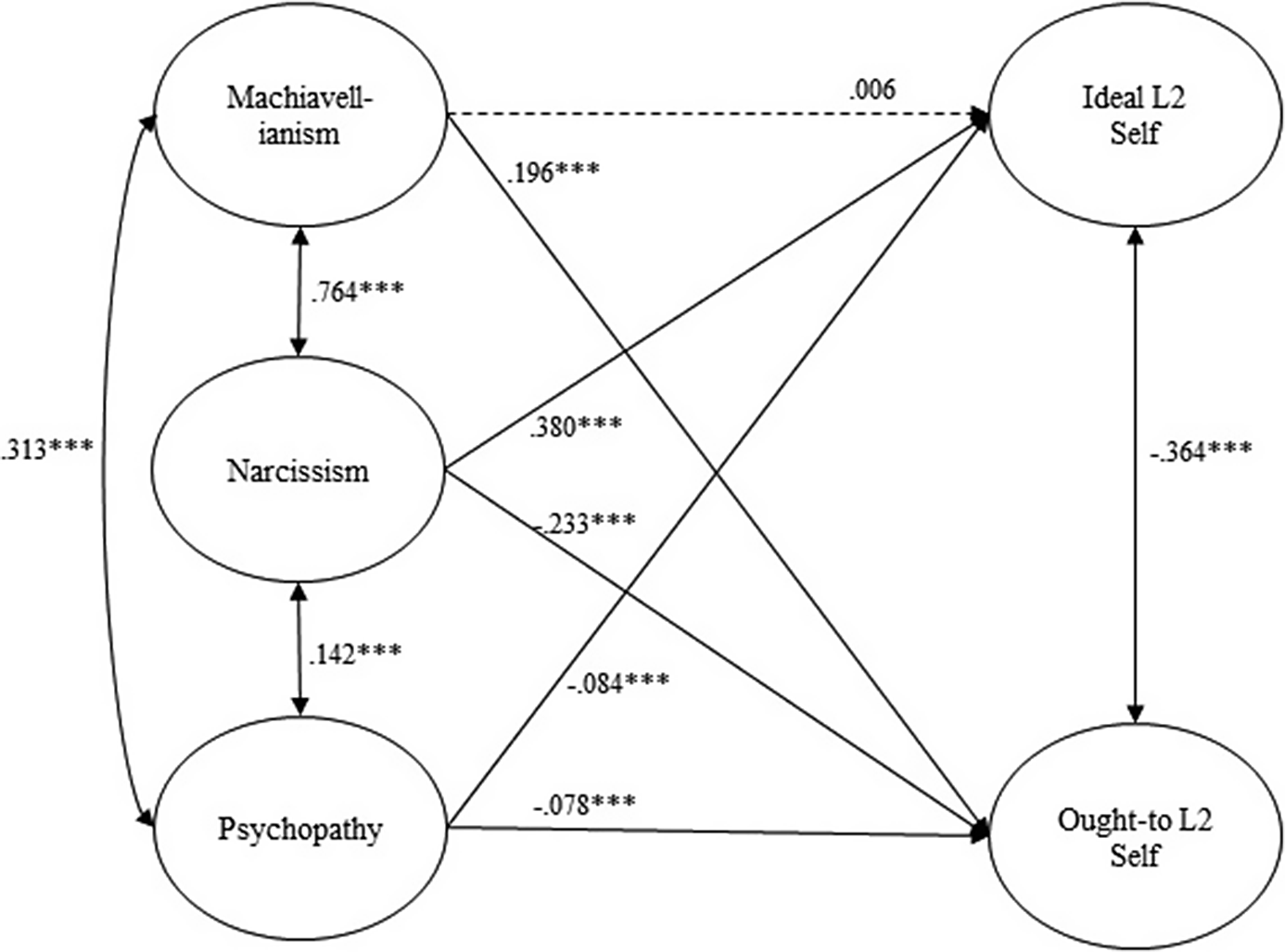
The SEM of the Dark Triad of personality factors and the L2 Motivational Selves demonstrated close fit (χ 2(452) = 654.314, p < .001), with the CFI (.995) and TLI (.994) both above the cut-off of > .95 and the RMSEA (.032) and SRMR (.049) both below the needed < .05 (Kenny, Reference Kenny2020; see Figure 1). Furthermore, the model found that Ideal L2 Self was positively predicted by Narcissism (β = .380; p < .001), negatively predicted by Psychopathy (β = -.084; p < .001), and was not significantly predicted by Machiavellianism (p = .896). In turn, Ought–to L2 Self was positively predicted by Machiavellianism (β = .196; p < .001) and negatively predicted by Narcissism (β = -.233; p < .001) and Psychopathy (β = -.078; p < .001).
L2 Selves Structural Equation Model.
Note: ***p < .001; **p < .01; *p < .05.

Research question 2: Dark Triad predicting L2 engagement
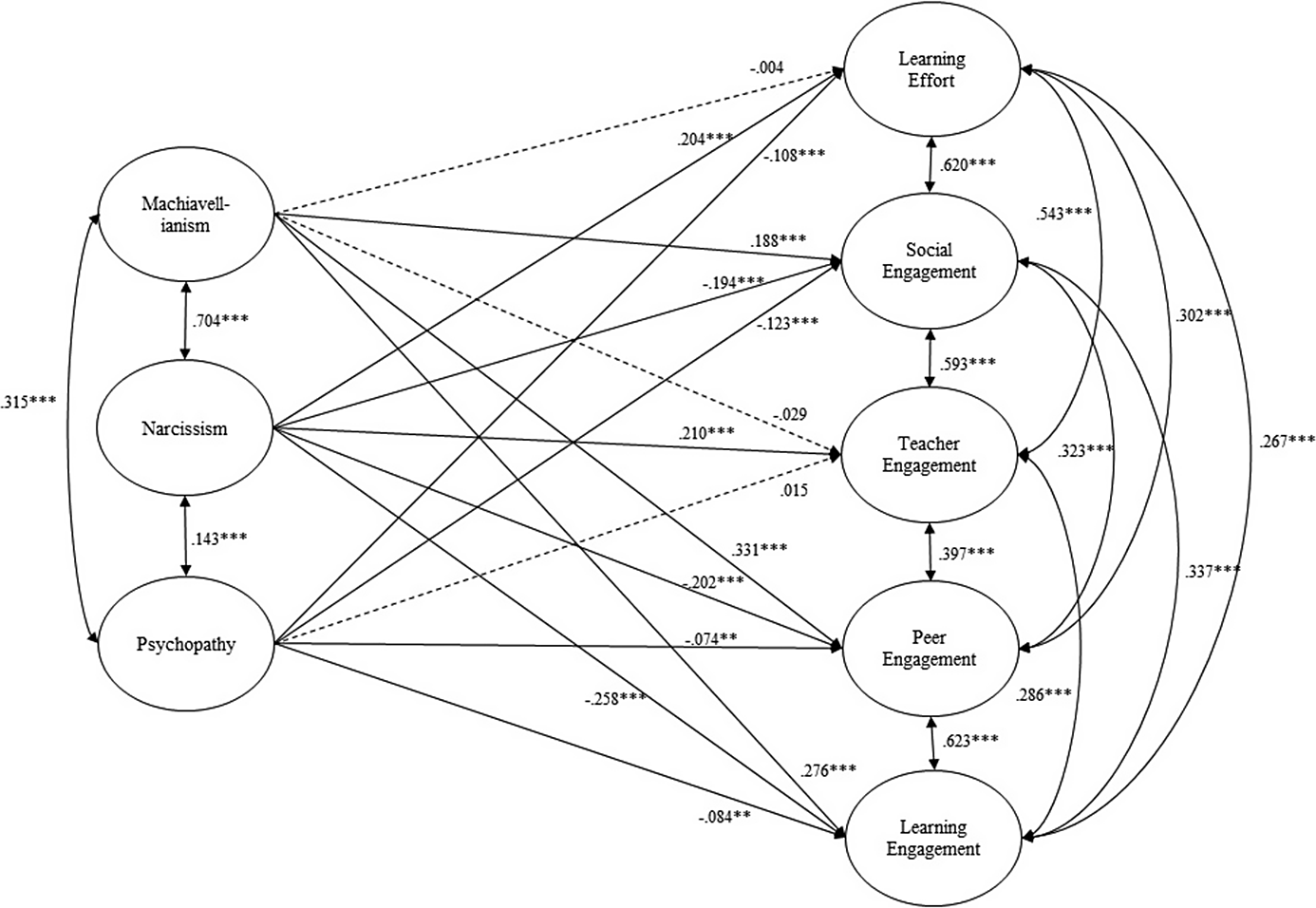
The SEM of the correlated L2 Engagement factors achieved close fit (χ 2(377) = 422.959, p = .051), with the CFI (.998) and TLI (.998) comfortably meeting the cut-off of > .95 and the RMSEA (.017) and SRMR (.044) both below the desired < .05 (Kenny, Reference Kenny2020; see Figure 2). Machiavellianism positively predicted social engagement (β = .188; p < .001), peer engagement (β = .331; p < .001), and engagement with learning activities (β = .276; p < .001). Machiavellianism did not significantly predict learning effort (p = .936) or teacher engagement (p = .515). In turn, Psychopathy negatively predicted learning effort (β = -.108; p < .001), social engagement (β = -.123; p < .001), peer engagement (β = -.074; p = .001), and engagement with learning activities (β = -.084; p = .001), but did not significantly predict teacher engagement (p = .522). It should however be noted that although the regression coefficients with Psychopathy as a predictor were statistically significant, all regressions were rather small (-.123 < β < -.074; Botes et al., Reference Botes, Resnik, Greiff and Stempfer2024b). Lastly, in contrast to Machiavellianism and Psychopathy, which both showed a uniform slope as predictors, Narcissism was found to be both a positive and negative predictor of L2 engagement. Narcissism positively predicted learning effort (β = .204; p < .001) and teacher engagement (β = .210; p < .001) and negatively predicted social engagement (β = -.194; p < .001), peer engagement (β = -.202; p < .001), and engagement with learning activities (β = -.258; p < .001).
L2 Engagement Structural Equation Model.
Note: ***p < .001; **p < .01; *p < .05.

Research question 3: Dark Triad predicting L2 achievement
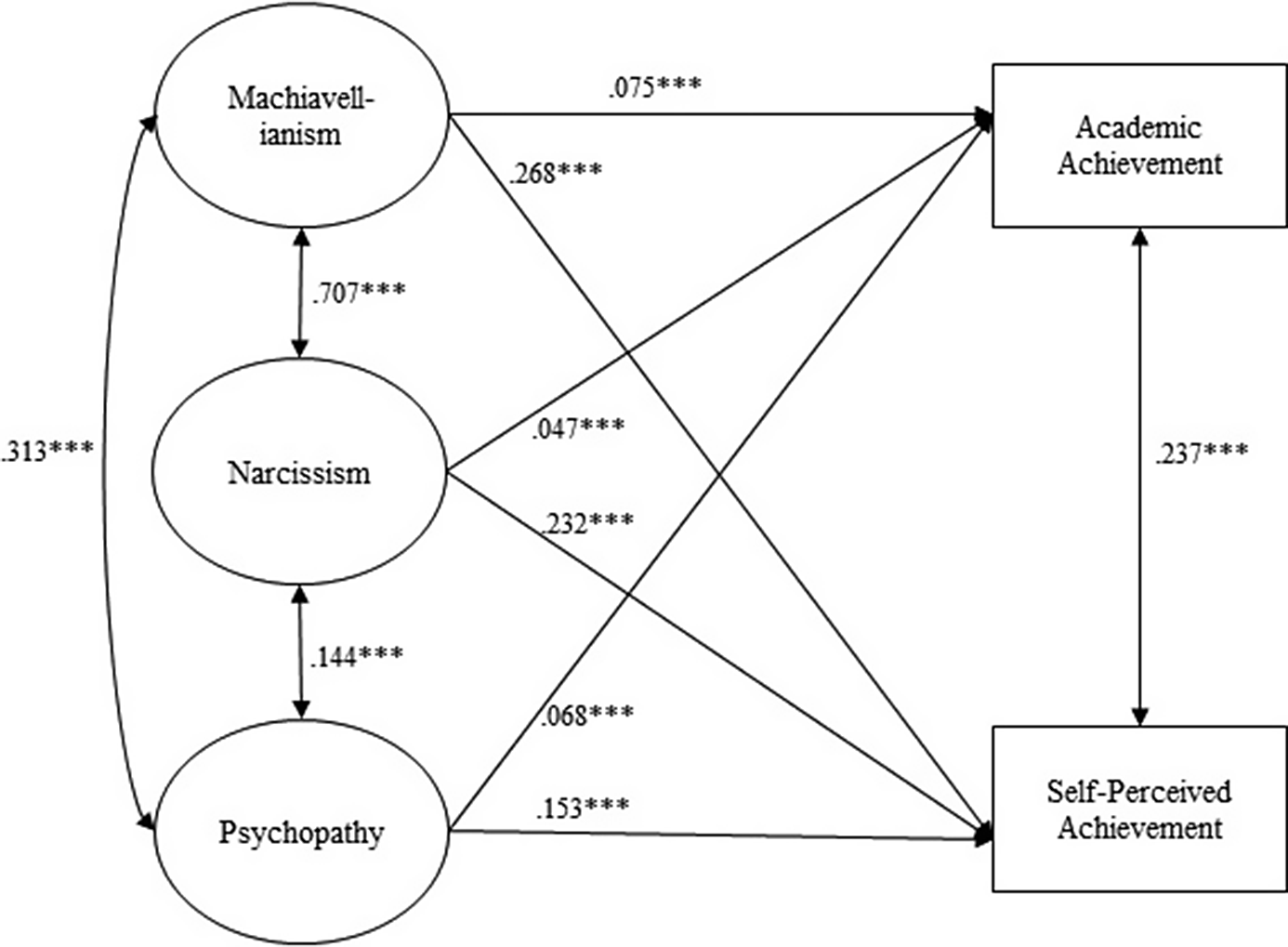
The SEM of the dark triad predicting L2 achievement showed reasonable fit (χ 2(69) = 285.795, p < .001), with the CFI (.994) and TLI (.992) both above the cut-off of > .95 and the RMSEA (.086) and SRMR (.037) below the recommended < .05 (Kenny, Reference Kenny2020; see Figure 3). However, the RMSEA was somewhat higher than desired (.086 > .08; Kenny, Reference Kenny2020). All the proposed paths in the model were statistically significant. Academic achievement was positively predicted by Machiavellianism (β = .075; p < .001), Narcissism (β = .047; p < .001), and Psychopathy (β = .068; p < .001). It should be noted that all the effect sizes of the regression coefficients for academic achievement can be classified as small (Botes et al., Reference Botes, Resnik, Greiff and Stempfer2024b). In turn, self-perceived achievement had much larger effect sizes and was also positively predicted by Machiavellianism (β = .268; p < .001), Narcissism (β = .232; p < .001), and Psychopathy (β = .153; p < .001).
L2 Achievement Structural Equation Model.
Note: ***p < .001; **p < .01; *p < .05.

Research question 4: Dark Triad predicting WTC
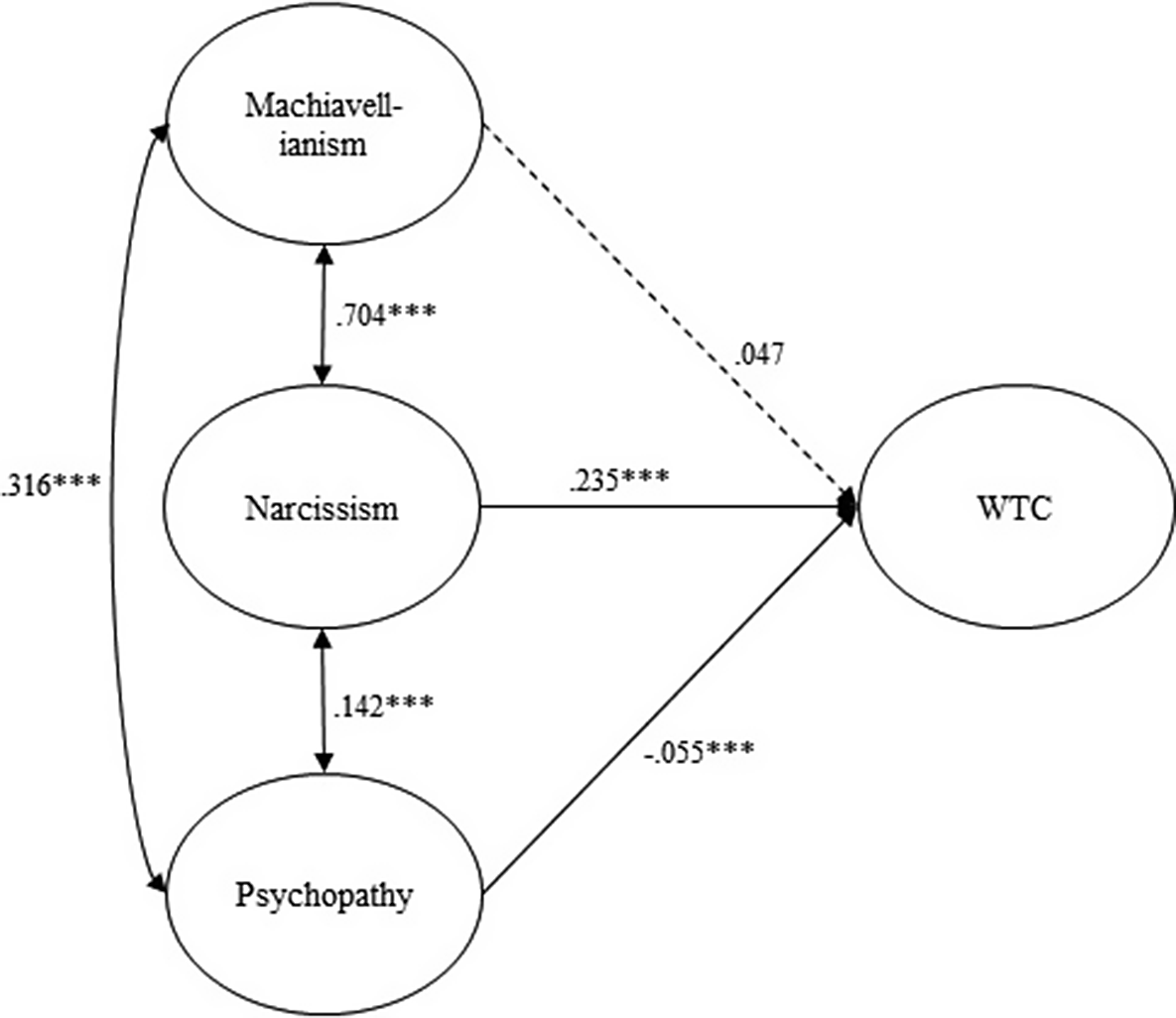
The last model tested, that of the dark triad of personality predicting WTC, also achieved close fit (χ 2(203) = 284.022, p < .001), with the CFI (.996) and TLI (.996) both above the cut-off of > .95 and the RMSEA (.030) and SRMR (.048) below the needed < .05 (Kenny, Reference Kenny2020; see Figure 4). Narcissism was found to be a positive predictor of WTC (β = .235; p < .001), with Psychopathy negatively predicting WTC (β = -.055; p < .001). Machiavellianism did not have a significant effect on WTC (p = .068).
L2 WTC Structural Equation Model.
Note: ***p < .001; **p < .01; *p < .05.

Discussion
The study examined the DT traits of Machiavellianism, Narcissism, and Psychopathy as predictors of L2 learning outcomes. By and large, the results demonstrated that the DT traits were significant predictors, although the directionality of significant results paints a muddy picture. DT traits were found to be both positive and negative predictors of L2 learning outcomes (see Table 3) and thus the presence of these “malicious” traits in an L2 learner may be both a help and a hindrance in their pursuit of language learning.
Summary of results

The first research question examined the DT traits as predictors of Ideal L2 Self and Ought–to L2 Self. Ideal L2 Self, which represents an idealized future version of the language learner and the person that meets social expectations, was significantly positively predicted by Narcissism and negatively predicted by Psychopathy. The relationship between Narcissism and the Ideal L2 Self can be explained by the grandiose sense of self that is central to the trait of Narcissism (Paulhus & Williams, Reference Paulhus and Williams2002), thus a more grandiose sense of self as an L2 learner. In turn, the significantly negative result found in Psychopathy predicting Ideal L2 Self is in contrast to previous research theorizing Psychopathy as a possible motivating drive to master skills (Diller, Czibor et al., Reference Diller, Czibor, Szabo, Restas, Jonas and Frey2020). Although previous research has found that Psychopathy is linked to lower levels of self-esteem and negative self-evaluations (Morrison & Gilbert, Reference Morrison and Gilbert2001; Shagufta & Nazir, Reference Shagufta and Nazir2021) and given that Ideal L2 Self represents the self-belief of a language learner (Al-Hoorie & Hiver, Reference Al-Hoorie and Hiver2024), it may be that higher levels of Psychopathy results in lower beliefs about the idealized future self. However, it should be noted that the effect size of the relationship between Psychopathy and Idealized L2 Self can be considered rather small (β = -.084; p < .001).
As the Ideal L2 Self represents an internal drive to master the target language, so does Ought–to L2 Self represent an external motivation driven by the expectations and duty towards others to learn the skill. Machiavellianism significantly positively predicted Ought–to L2 Self, whereas Narcissism and Psychopathy were both significant negative predictors. Both Narcissism and Psychopathy are linked to a lower sense of duty and sense of obligation towards others (Lachowicz-Tabaczek et al., Reference Lachowicz-Tabaczek, Lewandowska, Kochan-Wójcik, Andrzejewska and Juszkiewicz2021), which may explain the negative association with Ought–to L2 Self. In turn, the positive relationship between Machiavellianism and Ought–to L2 Self supports previous research findings regarding Machiavellianism as a predictor of motivation, including extrinsic motivation, and mastery goals (Kareshki, Reference Kareshki2011).
The second research question examined the relationship between DT traits and L2 engagement. Machiavellianism has been theorized to involve “high cognitive and neural skills in social activities” that can lead individuals with high trait levels to be task-oriented and socially engaged (Bereczkei, Reference Bereczkei2018, p. 32). This theory regarding Machiavellianism supports our finding of the trait as a significant predictor of social engagement and peer engagement—demonstrating that the Machiavellian skill in social activities in the classroom can be a boon to L2 learning. In turn, Psychopathy was negatively associated with learning effort, social engagement, peer engagement, and learning engagement, which confirmed previous findings in nondomain–specific education studies regarding the detrimental relationship between Psychopathy and classroom engagement (Mooney, Reference Mooney2023; Hughes et al., Reference Hughes, Adie, Kratsiotis, Bartholomew, Bhakta and Martindale2023). In contrast to the uniform directionalities found for Machiavellianism and Psychopathy, Narcissism showed mixed effects. Social, peer, and learning engagement were negatively predicted by Narcissism, in contrast to previous nondomain–specific educational research (Mooney, Reference Mooney2023). Although the findings regarding Narcissism as a negative predictor of especially social and peer engagement may be explained by the differentiation made in the literature between self-esteem and Narcissism, where high self-esteem individuals are concerned with “getting along,” Narcissists are concerned with “getting ahead” (Roberts et al., Reference Roberts, Woodman and Sedikides2018). However, Narcissism was a positive predictor of teacher engagement, supporting previous research regarding the tendency of Narcissists to ingratiate themselves with authority figures (Ahmad et al., Reference Ahmad, Ishaq and Raza2024).
In terms of the third research question, all three DT traits were significant positive predictors of academic achievement and self–perceived achievement. This finding is in line with previous research linking success to DT traits, where the DT has predicted effective leadership (Diller et al., Reference Diller, Czibor, Szabó, Restás, Jonas and Frey2021), success in sports (Vaughan & Madigan, Reference Vaughan and Madigan2021), and successful learning (McManus et al., Reference McManus, Pillow and Coyle2022). However, it should be noted that underlying this drive for success is the assumption that there is a reward component linked to DT success, as explained by Lyons (Reference Lyons2019, p. 2): “The DT traits do have positive sides too, especially in circumstances where there is a possibility to gain something for oneself.” Therefore, in the L2 classroom, the assumption would be that higher grades and a sense of achievement are “something to gain,” where DT traits can be beneficial and a drive towards success. However, this reward mechanism may be limited to L2 learning in a classroom setting, where grades and perception of one’s own achievement are intrinsically tied. Future research examining the DT traits in other L2 settings such as self–driven learning should be investigated, as well as studies examining proficiency as opposed to academic achievement as an outcome. The discrepancy in effect sizes between DT traits as predictors of academic achievement (.047 ≤ β ≤ .075) and self–perceived achievement (.153 ≤ β ≤ .268) should also be noted, as the DT had a considerably stronger effect on the perception of achievement as opposed to actual achievement.
The fourth and last research question examined the relationship between the DT traits and WTC, with Narcissism positively predicting WTC and Psychopathy as a negative predictor. Narcissism is linked to a need to impress and higher levels of sociability when the Narcissist perceives that something can be gained from the social interaction (Maass et al., Reference Maass, Wehner, Ziegler, Hermann, Brunell and Foster2018). As such, Narcissists in the L2 classroom may be more eager to communicate in the target language and demonstrate their skills. In turn, Psychopathy is associated with lower sociability in uncertain situations (Gullhaugen & Sakshaug, Reference Gullhaugen and Sakshaug2019), which may lead to lower levels of communication in the L2 classroom. However, again it should be noted that the effect size of Psychopathy as a predictor is rather small (β = -.055; p < .001). In addition, Machiavellianism was not a significant predictor of WTC, thus language learners more prone to manipulation were not more or less likely to communicate in the target language. As communication patterns in Machiavellians have been found to depend on whether or not the opportunity to manipulate is present (Tomkova et al., Reference Tomkova, Cigarska and Ondrijova2022) or if a tangible reward is associated with the communication (Birkás et al., Reference Birkás, Csathó, Gács and Bereczkei2015), it may be that the relationship between Machiavellianism and WTC is more complex than can be modeled in linear regression. Future research examining Machiavellianism on a finer grade level may be needed to further explore whether the communication patterns of Machiavellians result in a tendency to communicate more or less in the L2.
Overall, Narcissism and Psychopathy had mixed results with positive and negative slopes, whereas Machiavellianism was a wholly positive predictor of L2 learning outcomes (see Table 3). Previous research has linked Machiavellian traits to positive variables, such as goal–setting behavior (Kareshki, Reference Kareshki2011). Given that L2 learning is a long–term academic pursuit that requires goal–setting behavior (Han & Lu, Reference Han and Lu2018), it may be that Machiavellian traits are beneficial in L2 learning. However, conversely, previous research has also found Machiavellianism to be negatively linked to Emotional Intelligence (Michels & Schulze, Reference Michels and Schulze2021), academic self-efficacy (Saadat et al., Reference Saadat, Kalantari and Ghamarani2017), and classroom prosocial behaviors (Berger & Palacios, Reference Berger and Palacios2014), with each of these variables positively associated with L2 learning (Taheri et al., Reference Taheri, Sadighi, Bagheri and Bavali2019; Young Kyo, Reference Young Kyo2022; Olivero, Reference Olivero2021). Whereas in our findings, Machiavellianism was positively linked to peer engagement, social engagement, and self-perceptions. Considerable future research is needed to understand the mechanisms at play with Machiavellian traits in the L2 classroom, as it is likely context-dependent with moderating and mediating variables at play. Indeed, previous research has found that the perception of reward impacts the behavior of Machiavellians (Birkás et al., Reference Birkás, Csathó, Gács and Bereczkei2015) and as such it may be that the relationship of Machiavellianism on L2 learning outcomes may differ in highly competitive learning environments with greater rewards at stake in comparison to self–driven learning or less competitive environments.
In light of the mixed results found in terms of slopes of the DT traits as predictors, future research should take heed when analyzing personality traits in the L2 context. The fine–grained modeling of relationships between subfactors as predictors and outcomes may lead to radically different conclusions in comparison to simple correlations or regressions made with overarching factors (see Botes et al., 2024). In addition, the differing results in terms of directionality found across the DT traits for L2 engagement and L2 motivation variables raise further questions regarding the construction of the DT. Some studies have argued for a higher–order Dark Core model (see Bertl et al., Reference Bertl, Pietschnig, Tran, Stieger and Voracek2017), where Machiavellianism, Narcissism, and Psychopathy are considered subfactors of a higher–order factor. Other studies have argued for a Dark Dyad, with Machiavellianism and Psychopathy as a single variable, due to the propensity of these factors to overlap (see Rogoza & Cieciuch, Reference Rogoza and Cieciuch2020). However, should this approach of aggregating the DT traits have been followed, considerably less nuance would have emerged in our results. Future research should therefore consider whether the DT traits truly do function in unison when modelling these traits as predictors.
Limitations and research implications
As with all studies, several limitations ought to be taken into account. Firstly, the data were self-reported, including the academic achievement. Self–report data in questionnaires are subject to self–reporting biases and may be skewed in terms of the response style of participants. Secondly, the study is highly exploratory, as no previous research could be found examining the DT in the L2 context. It should also be noted that the effect sizes found in this study can be considered small to moderate (Botes et al., Reference Botes, Resnik, Greiff and Stempfer2024b). As such, future research is needed to further explore and replicate the findings of this study. In addition, the data were collected in a single country, and the DT has been found to vary across cultures (Jonason et al., Reference Jonason, Żemojtel‐Piotrowska, Piotrowski, Sedikides, Campbell, Gebauer and Yahiiaev2020), with Narcissism being found to be especially sensitive to cultural variations. Countries with more hierarchical systems were found to have higher levels of Narcissism and sex differences are more pronounced in developed countries (Jonason et al., Reference Jonason, Żemojtel‐Piotrowska, Piotrowski, Sedikides, Campbell, Gebauer and Yahiiaev2020). As such, future research is needed to examine whether the results found in this study can be replicated in different cultural settings. The measure used to examine the DT, the Dirty Dozen (Jonason & Webster, Reference Jonason and Webster2010), also does not differentiate between subfactors of DT traits. For example, the Machiavellian Personality Scale includes four subfactors, namely: Distrust of others, desire for status, desire for control, and amoral manipulation (Dahling et al., Reference Dahling, Whitaker and Levy2009). Future research may want to examine the DT traits in the L2 context via a qualitative approach and more fine–grained domain–specific DT measures to pinpoint the exact mechanisms of these personality traits that may benefit or hinder L2 learning, especially in the case of Machiavellianism where the subfactors may have mixed results in terms of predicting L2 learning outcomes. Lastly, due to statistical power constraints, no single large model of all L2 outcomes could be analyzed, instead, individual models were used. As such, the variables modeled in this study were ring-fenced and the greater nomological network of interacting L2 variables, including possible mediating and moderating effects, could not be taken into account.
Although the drawing of pedagogical implications is standard practice in IDs in L2 learning research, we do want to caution against drawing overt implications for either L2 teachers or learners based on the results of this study. For example, all three DT traits were positively associated with L2 academic achievement; however, the encouragement of DT behaviors in L2 learners or the fostering of these behaviors in the L2 classrooms by L2 teachers should not be the conclusion drawn from this study. The study is exploratory, with the theoretical premises linking the DT with L2 learning outcomes being based on existing findings in personality psychology, educational sciences, and behavioral sciences. As such, the findings of our study ought to be a first step in investigating “dark” or “undesirable” traits in L2 research, but the extent to which findings can be generalized is limited. Future research examining how DT behaviors manifest in the L2 classroom, the possible mechanisms between DT traits and L2 learning, and the classroom management techniques for teachers having to manage DT behaviors in the L2 class is needed before pedagogical implications can be made. This is especially a concern in terms of the sensitive nature of DT traits, the possible ethical concerns that may arise by labeling L2 learners as having DT traits, and the destructive behaviors often associated with the DT (Muris et al., Reference Muris, Merckelbach, Otgaar and Meijer2017).
Lastly, future research ought also not be constrained to only examining the DT, as other “undesirable” traits may play a role in L2 learning. Other research domains have examined the effect of aggressiveness in learning (Lin et al., Reference Lin, Durbin and Rancer2017), pessimism toward learning and achievement (Brown & Marshall, Reference Brown, Marshall and Chang2001), procrastination regarding school work (Kim & Seo, Reference Kim and Seo2015), and impulsivity (Lozano et al., Reference Lozano, Gordillo and Pérez2014). Future research examining the complex interplay between positive and negative traits in the FL classroom is encouraged.
Conclusion
Although the DT traits of Machiavellianism, Psychopathy, and Narcissism are considered malicious and undesirable (Paulhus & Williams, Reference Paulhus and Williams2002), this study demonstrated that at times such undesirable traits may have desirable outcomes. Psychopathy and Narcissism were found to be both positive and negative predictors of L2 learning variables, whereas Machiavellianism was a wholly positive predictor. This finding is in line with previous research on success and the DT (Lyons, Reference Lyons2019), as the DT traits can be a driver to achieve, including in the L2 classroom. The findings also shed new and positive light on the dark side of personality. Further research and intervention studies involving DT traits may lead to the development of teaching strategies where these undesirable traits could be turned into assets and the encouragement of teachers to employ these negative traits constructively in reaching language acquisition goals rather than suppressing them.
Supplementary material
The supplementary material for this article can be found at http://doi.org/10.1017/S027226312500004X.




 Open access

