


Introduction
Humans and human activity constitute the greatest threat to biodiversity, and successful biodiversity conservation depends directly on successful management of people. Thus, preservationist approaches to conservation have progressively incorporated participation of local communities (Dearden et al., Reference Dearden, Bennett and Johnston2006). This momentum accelerated with the introduction of Integrated Conservation and Development Projects (ICDPs). Early ICDPs had the primary goal of biodiversity conservation, with local development components as a tool for that goal, but later diversified around a core theme of sustainable development (Hughes & Flintan, Reference Hughes and Flintan2001). Despite few quantitative assessments of their outputs (Linkie et al., Reference Linkie, Smith, Zhu, Martyr, Suedmeyer, Pramono and Leader-Williams2008; Gubbi et al., Reference Gubbi, Linkie and Leader-Williams2009) and arguments that their diverse approaches should not be quickly dismissed after a few failures (Hughes & Flintan, Reference Hughes and Flintan2001), ICDPs were seen by many conservationists as failing to make strong links between often short-term investments in community development and often long-term conservation objectives, relying on high levels of external funding and technical assistance, and largely failing to demonstrate conservation impacts (Kremen et al., Reference Kremen, Merenlander and Murphy1994; Oates, Reference Oates1999; Sage & Nguyen Cu, Reference Sage and Nguyen2001).
It is now generally acknowledged that strict protection and conservation through development both have useful elements, are rarely mutually exclusive, and are each more or less suited to differing local contexts (Sunderland et al., Reference Sunderland, Ehringhaus and Campbell2008). Some lessons have been learned from ICDP failures, and there is increased focus on less ambitious, smaller scale, longer-term, and more community-based or community-driven efforts.
One of the most widespread programmes of site-based conservation involving local communities has been the Local Conservation Group (also known as Site Support Group in Africa and Caretaker Group in Europe) approach developed by BirdLife International to support site-based action at Important Bird Areas (IBAs; BirdLife International, 2006c). Although the term local conservation group is in widespread usage, here Local Conservation Group refers solely to groups established, guided or supported by the BirdLife partnership. BirdLife views these as ‘groups of local stakeholders who share a common commitment to the conservation of an IBA’ (BirdLife International, 2007), although this definition has been refined in Africa to ‘an independent and organized group of voluntary individuals that work to promote conservation and sustainable development at IBAs and other biodiversity sites, in partnership with relevant stakeholders’ (BirdLife International African Partnership, 2004). There are no strict governance criteria for Local Conservation Groups but members are typically volunteers motivated by the economic, cultural, religious, recreational or livelihood-supporting values of the site and its resources. The first Local Conservation Group was established in 1989 and the approach has since been taken up rapidly in Europe, Africa and Indochina. By March 2010, 198 Local Conservation Groups had been established at 119 IBAs in 21 African countries (Hazell Thompson, pers. comm. 2010).
The five main functions of Local Conservation Groups are seen as on-the-ground conservation, education and awareness-raising, monitoring, improving community livelihoods, and linking the wider local community, the government and site management authorities (BirdLife International, 2007; Ngari, Reference Ngari2007). Individual Group aims vary with regard to, and may exclude some of, these overall functions, reflecting differing circumstances and the need for site-specific strategies.
In Indochina BirdLife has developed most Local Conservation Groups at IBAs without formal protected status where at least some local stakeholders share conservation objectives. Since 2002, 40 Groups have been developed, with 16 now defunct primarily owing to discontinued financial and/or technical support (Table 1). Many Groups in Indochina contain two subgroups, one patrolling/monitoring and one raising awareness. BirdLife has supported Groups with technical advice, training, capacity building, brokering of relationships, equipment, resources and payment of small per diems for field monitoring and patrolling trips. Direct payment of per diems marks out Local Conservation Groups in Indochina from more voluntary Groups elsewhere.
Important Bird Areas (IBAs) with Local Conservation Groups in Cambodia, Myanmar and Vietnam, with their initial protected status (if any), the maximum number of Groups that existed (different numbers of Groups existed at various times at some sites), composition of patrolling subgroups, main threats to the site, dates when the Groups functioned, and relevant references.

Membership of Local Conservation Groups in Indochina is 5–30 individuals, with significant variations in composition (Table 1). A spectrum exists from Groups composed entirely or largely of local government officials at many Cambodian sites, with one to two Groups per site where threats are mainly external, to Groups composed entirely of local community members (especially reformed hunters) in Myanmar, with each Group based on one village or cluster of hamlets, where most threats stem from local communities.
Assessing Local Conservation Groups in Indochina
Unfortunately, a major flaw of Local Conservation Groups in Indochina has been the lack of monitoring of their outputs, let alone impacts, and so it is difficult to measure success or otherwise. This is not an issue solely related to Local Conservation Groups in Asia (Timberlake & Fenton, Reference Timberlake and Fenton2003), or to other Local Conservation Groups (Kremen et al., Reference Kremen, Merenlander and Murphy1994; Millennium Ecosystem Assessment, 2005), but is a disappointing omission given the severe criticisms levelled at ICDPs for the same oversight. Nonetheless, a number of unpublished evaluations have tried to qualitatively assess Local Conservation Group projects in Indochina (BirdLife International–Vietnam Programme, 2003, 2004; BirdLife International in Indochina, 2006, 2007a, 2007b; Wilkinson & Nguyen Thanh Van, Reference Wilkinson and Nguyen2006; BirdLife International, 2006b; BirdLife International Asia Division, 2007; BirdLife International–Cambodia Programme, 2007; Darwin Initiative, 2007; Eames et al., Reference Eames, U, U Htin, Khin Ma Ma, Aung Kyaw and Luu Thi2007; Eberhardt et al., Reference Eberhardt, U, Aung and Hungman2007). Here, we draw on these project documents and our collective experience to distil and review factors that have affected success of Local Conservation Groups in their five key functions, illustrated by qualitative examples of success and failure. The nature of project documents, and weak documentation and monitoring during projects, necessitate a qualitative rather than quantitative review. Nonetheless, this analysis provides an understanding of the factors that can help improve design and implementation of future site-based conservation involving local communities.
On-the-ground conservation
Ngari (Reference Ngari2007) frames this function in terms of reclamation and restoration of degraded habitats. On-the-ground conservation in Indochina has more often taken the form of site patrolling by Local Conservation Groups to detect, deter and remove destructive local practices and external threats. The relative success of such patrolling and enforcement activities in Indochina appears to have been influenced by two main factors, one internal to the design and implementation of Local Conservation Groups, and one external. Firstly, Local Conservation Groups that have included relevant and sufficiently senior local government staff on patrols have both the legal authority to immediately apprehend people conducting illegal activities and the perceived authority to remove illegal equipment (e.g. snares). Secondly, Local Conservation Groups have had some success at slowing locally-caused threats but have had limited ability to combat threats stemming from provincial- or national-level decisions (such as land-use change policies or infrastructure development) or government/army corruption.
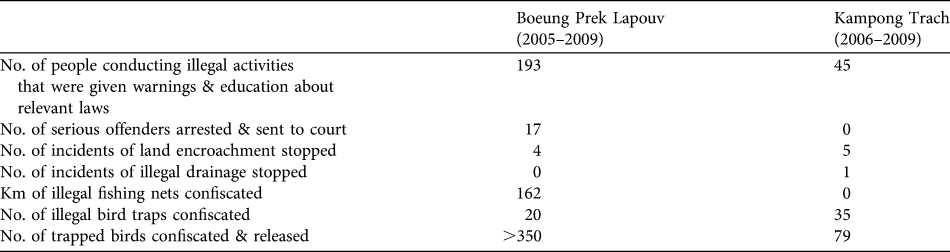
In Cambodia Local Conservation Groups with a strong contingent of government staff have apprehended a number of people carrying out illegal activities such as land grabbing, land encroachment, burning of grassland to harvest wildlife, cutting of inundated forest, use of illegal fishing gear and bird hunting. A large quantity of illegal equipment has been confiscated and destroyed and some wildlife confiscated and released (Table 2). In all cases, it appears that these illegal activities have been consequently reduced or halted (BirdLife International in Indochina, 2006, 2007a). Impacts on biodiversity are hard to measure but enforcement of minimum mesh sizes on fishing nets by Local Conservation Groups at Boeung Prek Lapouv is perceived by local fishermen to have increased catch sizes (BirdLife International in Indochina, 2006, 2007a). Conversely, in Vietnam, Local Conservation Groups that have not included relevant, or sufficiently senior, local government staff have been unable to detain people conducting illegal activities, and have often feared retribution for removing illegal equipment (BirdLife International in Indochina 2007b).
Example patrolling and law enforcement results from the operation of Local Conservation Groups in two wetland sites (Table 1) in Cambodia (BirdLife, unpubl. data).
In Western Siem Pang, Cambodia, training by the Local Conservation Group has led to establishment of trapaeng (seasonal pool) best practice management protocols. These are reported to have led to a perceived reduction in the number of reported illegal activities and halting of bird hunting at target trapaengs (BirdLife International–Cambodia Programme, 2007). Despite such successes, at some sites the most significant threats, such as conversion of land to dry season rice cultivation in Cambodia, have had a level of official sanction and the Local Conservation Group alone has thus not had the authority or capacity to respond (BirdLife International in Indochina, 2007a).
Education and awareness-raising
All Local Conservation Groups established in Indochina have carried out some education and awareness-raising but these activities have often fallen far short of their full potential (BirdLife International in Indochina, 2006, 2007b). In most cases, often owing to a lack of relevant internal staff capacity, BirdLife has not provided substantial support or training. Rather than participatory, locally-relevant approaches, awareness-raising led by Local Conservation Groups has thus often been limited to top-down explanation of existing laws and regulations. This may be useful in areas with transient human populations (such as Boeung Prek Lapouv, where many threats originate from seasonal migrants) but is probably less effective at fostering a commitment to conservation objectives and behaviours among resident communities. Awareness activities to date have undoubtedly been better received when relating to issues that impose clear benefits or costs on local communities, such as external developments that threaten both livelihoods and biodiversity.
One popular top-down attempt to raise awareness in Vietnam has involved development of conservation agreements, which the Local Conservation Group and relevant local authorities sign with any local households and people found during Local Conservation Group patrols to be breaching regulations. These agreements state local rights to access forest resources and responsibilities not to hunt wildlife, extract timber for sale or engage in other unsustainable activities. Although large numbers of such agreements have been signed, their actual impact remains unclear and may be limited (BirdLife International in Indochina, 2006, 2007b). Conversely, a more successful and bottom-up approach to awareness-raising by a Local Conservation Group, where external development pressures would restrict forest use by local people in Western Siem Pang, has facilitated local support for Protected Forest establishment (BirdLife International–Cambodia Programme, 2007).
Monitoring
Experience with monitoring activities by Local Conservation Groups in Indochina has supported assessments elsewhere (Timberlake & Fenton, Reference Timberlake and Fenton2003; Hughes, Reference Hughes2005) that such monitoring can provide baseline information, early warning of threats and a valuable focus for patrol activities by the Groups but are not sufficiently standardized, consistent in space and time, and do not have sufficiently large sample sizes to reveal trends in either biodiversity or threats without intensive and sustained inputs from partner organizations. In the long-term Local Conservation Groups are only likely to retain interest in monitoring if they have the capacity to analyse the data collected, which few community groups do, and if monitoring results are relevant to a Group’s priorities (Wilkinson & Nguyen Thanh Van, Reference Wilkinson and Nguyen2006). Simpler methods of monitoring (BirdLife International, 2006a, 2007) could increase the ability of Local Conservation Groups to provide meaningful data, if supervised or facilitated by partner organizations (Danielsen et al., Reference Danielsen, Burgess, Balmford, Donald, Funder and Jones2008).
The greatest potential for species monitoring by Local Conservation Groups in Indochina is in Cambodia where wetland birds and vultures are a conservation priority. These species are often large-bodied, relatively easy to identify and concentrated in small areas, and illegal activities are more easily detected in wetlands than forests. Nonetheless, intermittent training and oversight of such monitoring, combined with low capacity for keeping written records, has resulted in a lack of systematic data collection on illegal activities and data on biodiversity that are generally of insufficient accuracy to detect population changes (BirdLife International–Cambodia Programme, 2007; BirdLife International in Indochina, 2007a). Vulture monitoring has been the most successful. Standardized data have been collected on three species at six sites for > 3 years through a collaborating network of Local Conservation Groups, international NGOs and government officials. Local staff are now largely able to run this process without technical support.
Improving community livelihoods
The focus of Local Conservation Groups in Indochina has been biodiversity conservation but many have also been involved in livelihood-improvement activities to compensate for restrictions on traditional resource use or to provide incentives for participating in Group activities. However, many of these livelihood activities appear to have had similar failings to those of ICDPs by not stemming from a participatory approach, not seeking like-for-like substitutions of activities, poorly linking conservation and development, being led by an organization with limited development expertise, and not being given the sustained commitment necessary to achieve results.
For example, in return for running anti-poaching patrols, 14 villages around Natmataung National Park, Myanmar, received development inputs from BirdLife, CARE and the UN Development Programme, including bridges, schools, school equipment, agricultural extension and health extension (Eames et al., Reference Eames, U, U Htin, Khin Ma Ma, Aung Kyaw and Luu Thi2007; Eberhardt et al., Reference Eberhardt, U, Aung and Hungman2007). However, such benefits were often given once only and thus did not guarantee conservation for any future period (Darwin Initiative, 2007; Eames et al., Reference Eames, U, U Htin, Khin Ma Ma, Aung Kyaw and Luu Thi2007; BirdLife International in Indochina, 2007a), and it was rarely possible to ensure development assistance was contingent on conservation activities, partly because the agencies responsible were insufficiently coordinated or not equally committed to conservation objectives (Eberhardt et al., Reference Eberhardt, U, Aung and Hungman2007).
Around Truong Son and Dakrong IBAs in Vietnam attempts to improve community livelihoods have been initiated without suitably participatory socio-economic assessments, leading to an inability to target the most forest-dependent communities and households and the failure of attempts to implement environmentally sustainable but economically non-viable activities. A lack of participatory decision-making has also sometimes led to differing expectations of, and thus conflicts over, benefits, damaging the crucial relationship between Local Conservation Groups and their partner NGO (BirdLife International in Indochina, 2007b). Worse, some requests for livelihood activities from local people have been taken up without assessment of environmental impacts. For example, provision of non-native Acacia seedlings has led to clearing of areas of natural forest in Dakrong IBA (BirdLife International in Indochina, 2007b).
Linking the wider local community, the government and site-management authorities
The key lesson learned here is that even small achievements are significant in Indochina, where civil society often has little or no formal role in government decision-making and local authorities have low accountability to poor rural populations, particularly indigenous peoples. The prestige (i.e. social capital) of being in a Local Conservation Group, including uniforms for patrolling and the ability to meet with government staff, is a key benefit mentioned by local people in Indochina. Such steps are small but are considerable milestones towards control over resources in a region where decision-making is so centralized. A key factor influencing success of linkages between local communities and authorities has been their level of overlap in interests.
Local and provincial authorities responsible for enforcement have often voiced their support for, and stressed the value to them of, monitoring of illegal activities by Local Conservation Groups (BirdLife International in Indochina, 2006, 2007a, 2007b). A notable example of linkage to government authorities in Vietnam occurred when a Local Conservation Group reported to district authorities that a new road was being illegally constructed east of Khe Net IBA. Work on the road was halted by provincial authorities (BirdLife International in Indochina, 2006). Likewise, reports of illegal logging by Huong Hoa and Kim Hoa Local Conservation Groups led local authorities to confiscate vehicles and illegally-cut timber (BirdLife International in Indochina, 2006).
However responsive local authorities in Vietnam have sometimes been to threats from illegal logging or infrastructure they have, despite their remit to do so, had limited interest in combating illegal hunting. Conversely, local communities have often been more concerned about illegal hunting than logging, as this more directly affects resources they are allowed to exploit (BirdLife International in Indochina, 2006, 2007b).
Local Conservation Groups have played an important role in designing, gathering information for, and raising local support for provincial- and national-level conservation designation for sites. For example, in Cambodia, Local Conservation Groups north of Tonle Sap have raised awareness of the threat to both biodiversity and local livelihoods from land grabbing, and thus fostered support for a new category of conservation designation (Integrated Farming and Biodiversity Areas), which preserves traditional farming methods compatible with biodiversity conservation, and ultimately resulted in the conservation designation of Boeung Prek Lapouv (BirdLife International–Cambodia Programme, 2007; BirdLife International in Indochina, 2007a).
External factors constraining effectiveness
As documented for community-based approaches in other regions, external factors constraining the effectiveness of Local Conservation Groups in Indochina include lack of security of land tenure (Dudley, Reference Dudley2004) and lack of legal rights for local communities to use natural resources (Ngari, Reference Ngari2007). In particular, the general lack of secure land or resource-use tenure in Indochina is not conducive to promoting sustainable resource use. This is exacerbated by prevailing government attitudes across the region, particularly in Laos, Vietnam and Myanmar, that natural resource stewardship is a state, not local community, responsibility. An additional constraint in the region is governments that are at best suspicious of, and at worst oppressive of, civil society organizing activities, and reluctant to enable civil society participation in policy creation and implementation.
Internal factors critical for effectiveness
In Indochina variations in design and implementation have most affected the relative success of Local Conservation Groups. Positive factors for implementation of these Groups and other community-based approaches have been documented elsewhere but were often overlooked during day-to-day support of Local Conservation Groups by partner NGOs, including ensuring the Groups had a clear and respected leadership (Timberlake & Fenton, Reference Timberlake and Fenton2003; Kimani, Reference Kimani2004; Ngari, Reference Ngari2007), were built around a small core of active individuals but had broader stakeholder representation (Timberlake & Fenton, Reference Timberlake and Fenton2003; Zeba, Reference Zeba2004), had a clear focus (Timberlake & Fenton, Reference Timberlake and Fenton2003), had realistic expectations (Ostrom, Reference Ostrom1999; Kimani, Reference Kimani2004; Ngari, Reference Ngari2007), were given sufficient resources including a good information base (Kimani, Reference Kimani2004) and training (Mehta & Heinen, Reference Mehta and Heinen2001; Kimani, Reference Kimani2004), were trusted to participate in decision-making (Ostrom, Reference Ostrom1999; Kimani, Reference Kimani2004) and had a long-term relationship with partner NGOs (Mehta & Heinen, Reference Mehta and Heinen2001). Timberlake & Fenton (Reference Timberlake and Fenton2003), however, cautioned against allowing this to develop into a dependency. Failure to incorporate many of these positive influences led to difficulties in implementation of Local Conservation Groups in Indochina. The following seven key lessons have been drawn from the successes and failures of the Local Conservation Group experience in Indochina:
(1) Flexibility to tailor Group membership to the specific threats to conservation and the social and economic context of a site is critical. If the threat is external, higher level government officials and authorities must be involved in education and enforcement. If the threat is local, villagers must form the basis of Local Conservation Groups, with support from relevant government agencies. A top-down approach, focusing on enforcement through local officials, has probably been the most effective method at sites mainly experiencing externally driven threats. An issue to address is motivation, as many local officials that join Local Conservation Groups do so not as volunteers but on the orders of their superiors.
(2) The benefit of participation in a Local Conservation Group must outweigh the costs, whether for local communities or officials. Because local communities in the developing world often cannot afford to volunteer their time for conservation activities, tangible benefits, whether financial, in-kind, natural resource, land tenure, status, or compliance with regulations, have widely been recognized as key to community participation, and not just in Local Conservation Groups (Newmark et al., Reference Newmark, Leonard, Sariko and Gamassa1993; Ostrom, Reference Ostrom1999; Mehta & Heinen, Reference Mehta and Heinen2001; Timberlake & Fenton, Reference Timberlake and Fenton2003; Ngari, Reference Ngari2007). The benefits and costs to communities and officials who participate in a Local Conservation Group should be transparent during the negotiation process. Key to success is also ensuring widespread benefits without conflict (Kimani, Reference Kimani2004; Agrawal & Chhatre, Reference Agrawal and Chhatre2006).
(3) Viable livelihood alternatives with clear links to conservation or improved management of existing livelihood resources have often meant the difference between success and failure in Indochina. Local Conservation Group projects that were not able to deliver alternative livelihood strategies in the face of external impacts on local livelihoods or increased restrictions on natural resource exploitation have faced considerably more difficulties than those that have been linked to clear development benefits. Per diem payments to Group members can clearly only be an interim measure. In Indochina supporting communities to achieve development objectives will mean acquiring the relevant skills and resources within the conservation organization or partnering with a development organization. If partnering, the development organization must have an equal commitment to conservation objectives and be willing to clearly programme those objectives into community project plans for the development–conservation link to be effective at the village level.
(4) Indicators meaningful to, and measurable by, Local Conservation Groups must be set for monitoring progress and outcomes, even if these are not the full set of indicators that the conservation project will use. Monitoring of indicators that the Groups cannot realistically monitor may be done by specialists. Monitoring of biodiversity and threats has provided an important focus for Group patrolling activities in Indochina but has rarely constituted more than surveillance. Expectations of monitoring by Groups need to be significantly reduced and partner support to systematic monitoring increased. Such partner-supported monitoring needs to be not only of the project implementation process but also of project impact, including direct conservation outcomes and Local Conservation Group sustainability.
(5) Placement of Local Conservation Groups within a wider multiple stakeholder support network that provides horizontal as well as vertical links is key to supporting the effectiveness and sustainability of the Groups. Horizontal links include exchanges with Groups in other villages, for mutual support and learning. Vertical links include those with protected area, township, district and provincial officials and authorities for enforcement and possibly material support. They also include links with national-level government agencies for activation of policies (e.g. community tenure rights) that support the goals and operation of Local Conservation Groups. Lastly, vertical links are needed with development agencies for assistance in meeting livelihood needs.
(6) Skills to facilitate participatory processes and multi-stakeholder forums or locally-relevant approaches to awareness-raising must be acquired by conservation organizations. Participatory processes of planning and implementation of both development and conservation activities, and participatory processes that convene stakeholders ranging from local to national, are critical for implementing and achieving objectives. Local Conservation Groups in Indochina, especially Vietnam, have often been developed in haste along project timescales, with insufficient attention given to stakeholder agreement on approach and aims, participatory project and activity planning, and stakeholder representation. Many Local Conservation Groups have fallen short of their potential because of insufficient training, monitoring, oversight, mentoring and encouragement: factors related to the lack of capacity and experience of supporting NGOs. The rallying of communities around conservation activities and the engagement of stakeholders at multiple levels takes time, as well as specific skills, and these need to be developed and given due status in conservation organizations.
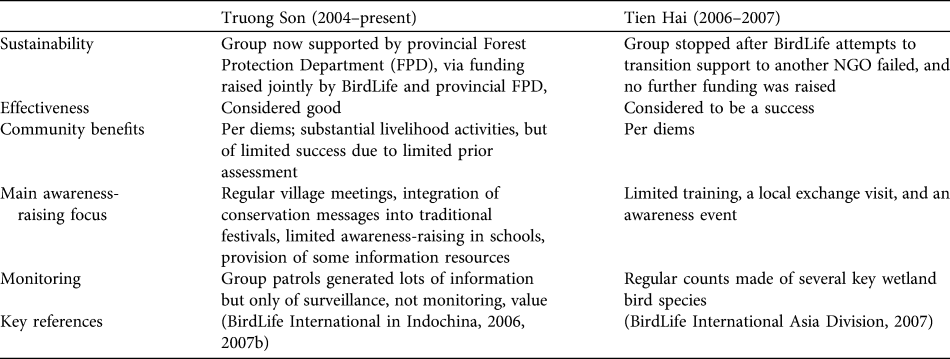
(7) Consideration of approaches to the sustainability of Local Conservation Groups should occur from the start of planning, and include how Groups could grow within a network of supportive organizations, become institutionalised if necessary, and find necessary human and material resources to become self-sufficient. As such, working closely to develop a Local Conservation Group focus within existing organizations is more likely to be successful than setting up new organizations. Many Local Conservation Groups in Indochina stopped functioning when the relationship with the partner NGO broke because of a lack of resources. With the exception of the Local Conservation Group at Xuan Thuy, Vietnam, the only Local Conservation Groups still extant in the region are at Cambodian sites where BirdLife has committed to long-term financial and technical support or at Vietnamese sites where BirdLife has assisted provincial authorities to raise donor funding to continue Group activities (Table 3). It must be recognized that achieving sustainability will take time and dexterity and that support to Local Conservation Groups will necessarily pose a cost to conservation objectives. This short-term cost to conservation should be seen as an investment in long-term conservation gains.
Illustrative contrast between Local Conservation Groups in Vietnam that are still extant (Truong Son) and that are defunct (Tien Hai).
Discussion
Successful biodiversity conservation in Indochina is more dependent on the management of people than on that of species or their habitats: the successful influencing of behaviour of human communities, of interest groups within communities, of people and governments in towns, cities and villages, including populations often in stress of poverty, migration or resettlement, and managing the diverse interests, motivations and capacities of authorities and government agencies. Local Conservation Groups are challenged to bring people together in a mutually accountable interest group that has a primary interest in the protection of a site and its related species. The skills to achieve this are not traditional strengths of conservation organizations but unless these skills to facilitate participatory multi-stakeholder processes are built into conservation organizations they will not be equipped to meet the challenge of biodiversity conservation.
In Indochina Local Conservation Groups have, in some cases, been an important mechanism for starting to empower local communities by providing a formalized focal point for interaction with district- and provincial-level forest and fisheries protection authorities. The mutual benefits of this have been recognized both by local people and authorities. Such cooperation has resulted both in increased efforts to tackle illegal natural resource exploitation and in establishment of conservation legislation at IBAs for the common benefit of local communities and biodiversity.
Indochina may not offer the most suitable enabling conditions for community-based conservation because of a lack of secure land and resource tenure for local communities, and a limited tradition of civil society responsibility. Nonetheless, despite increasing inequities, land titling is progressing, civil society is growing, and income and education levels are increasing. There is thus increasing potential to capitalize on the Local Conservation Group approach, utilizing lessons learned. Most notable threats to biodiversity that Local Conservation Group-based conservation have failed to tackle in Indochina have resulted from external development pressures and it is important that future Group activities are always complemented by attention to such higher-level policy issues.
Greater success is likely to result from a number of changes in implementation. Increased attention is needed to provision tangible benefits that clearly meet both conservation and development objectives, to recognize the heterogeneity of ethnic groups and communities and to tailor such benefits to individuals and groups within communities. Increased support is needed for awareness-raising activities, as it is to clear monitoring of activities and impacts. Most importantly, there is a need for adoption of a consistent programme-based rather than project-based approach to Local Conservation Groups to ensure much greater consistency and continuity of support from partner NGOs.
Overall, there are sufficient positive signs from pilot initiatives to expect that, if adapted, improved and supported by increased partner NGO capacity, Local Conservation Groups could become an important conservation and development tool in Indochina. Although there has been a lack of quantitative monitoring of implementation and results it appears that Local Conservation Groups have, with only limited external inputs, contributed to civil society empowerment and reduction of threats to biodiversity, and increased conservation designation at a number of sites that are globally significant for biodiversity. There are no examples yet in Indochina of Local Conservation Groups that are financially or institutionally sustainable, largely because none have been given sustained support for the time necessary to build capacity for such sustainability. If lessons are learned from experiences to date, Local Conservation Groups have significant potential for locally-driven support to conservation outcomes. There is a need to learn from the successes of these Groups and not be disheartened by their failures, which are always to be expected in the challenge of biodiversity conservation.
Acknowledgements
This article was partially supported by MacArthur Foundation Grant number 0992507000GSS as an output of the project Evaluating, Consolidating and Sustaining Conservation of Key Sites in the Lower Mekong. We thank Julius Arinaitwe, David Thomas and Roger Safford for discussions about Local Conservation Groups. Comments by Jack Tordoff, Le Trong Trai, Nguyen Duc Tu, David Thomas, Tran Thi Binh, Tran Van Hung and two anonymous reviewers considerably improved this article.
Biographical sketches
John D. Pilgrim has a particular interest in assessing and funding conservation priorities, and improving conservation approaches. Karin Eberhardt provides technical support to community-led conservation, natural resource management and livelihoods initiatives, mostly in Myanmar. Jonathan C. Eames leads the BirdLife International Indochina Programme across Cambodia, Laos, Myanmar and Vietnam. Bou Vorsak and Pham Tuan Anh manage the Cambodia and Vietnam programmes, respectively, of BirdLife International.



