


Introduction
A persistent pattern in public opinion research is the influence of elite communication on citizens’ political beliefs, attitudes, and behaviours (Bullock, Reference Bullock2011; Lenz, Reference Lenz2012; Zaller, Reference Zaller1992). According to these influential theories, voters’ political choices are susceptible to persuasion efforts by candidates and parties, notably through advertising and personal contact (see Druckman, Reference Druckman2022). Yet, empirical evidence supports the idea that persuasive influence by political parties and candidates is often very limited (Nickerson and Rogers, Reference Nickerson and Rogers2020). Consistent with this claim, field and survey experiments generally document very small and short lived marginal effects of most campaign advertising on turnout, vote choice, and candidate evaluations and recognition (for example, Aggarwal et al., Reference Aggarwal, Allen, Coppock, Frankowski, Messing, Zhang, Barnes, Beasley, Hantman and Zheng2023; Broockman and Green, Reference Broockman and Green2014; Broockman and Kalla, Reference Broockman and Kalla2023; Coppock et al., Reference Coppock, Hill and Vavreck2020; Coppock et al., Reference Coppock, Green and Porter2022; Gerber et al., Reference Gerber, Gimpel, Green and Shaw2011; Green et al., Reference Green, Krasno, Coppock, Farrer, Lenoir and Zingher2016; Hewitt et al., Reference Hewitt, Broockman, Coppock, Tappin, Slezak, Coffman, Lubin and Hamidian2024; Kalla and Broockman, Reference Kalla and Broockman2018).
All else equal, the small effects of campaign advertising on public opinion seem to be an established and robust finding. Still, a recurring concern has been that these small average effects hide large heterogeneous effects. But recent empirical work has now uncovered an additional pattern regarding the persuasive effects of campaign ads: persuasion does not seem to vary by characteristics of the messages, the receiver, or the sender (Coppock et al., Reference Coppock, Hill and Vavreck2020). The persuasive impact of campaign advertising is not a simple curiosity. It has important implications for theories of public opinion, campaign finance, and microtargeting. Importantly, the aforementioned findings directly challenge political consultants and pundits who advocate for precise targeting and tailored advertisements for specific audiences. Microtargeting has become a common practice across electoral democracies to sway voters’ opinions and influence elections in recent years (Tappin et al., Reference Tappin, Wittenberg, Hewitt, Berinsky and Rand2023). Yet, the homogeneity of persuasive treatment effects challenges the extent to which targeting improves the effectiveness and usefulness of campaign advertisements.
But still, direct evidence of the persuasive effects of political advertising outside the United States remains slight, as much less attention has been devoted to other advanced democracies. This raises a reasonable concern about whether these findings generalize to different contexts with distinct institutional designs.
This paper aims to conceptually replicate the evidence put forth by scholars such as Coppock, Hill and Vavreck (Reference Coppock, Hill and Vavreck2020) and Broockman and Kalla (Reference Broockman and Kalla2023) in Canada. The goal of the study is to systematically reconfirm these findings, while extending them to a new multiparty context. Canada stands as a natural alternative for two main reasons. First and foremost, prior research has examined the persuasive effects of campaign advertising on a multitude of outcomes during American elections, but no work of which we are aware investigates these questions in Canada. Footnote 1 This study is an attempt to fill the gap.
Second, over the past two decades, Canadian political strategists have expanded their marketing efforts by tailoring appeals to voters based on a range of social characteristics (Flanagan, Reference Flanagan2009; Patten, Reference Patten, Gagnon and Tanguay2017). What scholars have labeled political marketing refers to a strategy in which parties treat voters like market segments (O’Shaughnessy and Henneberg, Reference O’Shaughnessy and Henneberg2002). Rather than appealing to the electorate as a whole with broad appeals, parties segment a heterogeneous electorate into strategic groups, then position their policies in ways designed to appeal to those groups (Ouellet et al., Reference Ouellet, Gervasi, Sirmalis, Fortier-Chouinard, Birch, Arsenault, Duval and Dufresne2025). Yet, if advertisements have largely homogeneous effects, this raises questions about the necessity of such marketing strategies.
To study the effects of political advertising in Canada, we conceptually replicated prior research on the persuasive effects of campaign adverts on vote choice and candidate favourability, aiming to reproduce its findings while employing slightly different procedures and designs. We conducted three preregistered survey experiments during the 2025 Canadian federal election (total n = 3,346). In each experiment, participants were randomly assigned to read an advertisement from one of the five major political parties in Canada, and we subsequently measured candidate evaluations and vote intentions. In total, we evaluated the effects of 15 campaign advertisements over the four weeks of the federal campaign. Our results are consistent with prior research conducted in the United States insofar as we find no evidence that campaign advertising in Canada produces large or heterogeneous persuasive effects. We contribute to increasing the amount of evidence about the effects of advertising beyond the US, providing evidence that strengthens theories of minimal persuasive effects of campaigns (Berelson et al., Reference Berelson, Lazarsfeld and McPhee1954; Brady et al., Reference Brady, Johnston, Sides, Johnston and Brady2006).
Data and Methods
We conducted three randomized survey experiments on convenience samples of Canadian adults between April 9, 2025 and April 28, 2025, covering almost the entirety of the Canadian federal election campaign. We started on April 9 as it was the first day voters were able to access the complete list of candidates in their riding. We provide a complete description and discussion of the samples used in section S5 of the Supplementary Materials. The samples are not representative of the Canadian population and disproportionately composed of respondents from Quebec. While treatment effects do not appear to be conditional on individual-level demographics, we caution that Quebecers and the rest of Canada may react differently to campaign advertising—a possibility we examine further in section S6 of the Supplementary Materials.
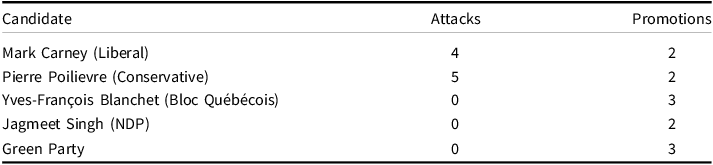
We collected treatment advertisements from parties and candidates’ online platforms and social media accounts. We tested a total of 15 advertisements, each either attacking a candidate, promoting a candidate, or doing both. Treatments come in the form of brief statements in textual format, often accompanied by a picture. Table 1 summarizes the main treatment advertisements. A complete description of each advertisement, including full transcripts, images, survey questionnaire, and date of fielding is available in the Supplementary Materials S1 and S2.
Number of Treatment Advertisements by Candidate

Note: This table summarizes all treatment advertisements. Some advertisements both attacked and promoted a candidate simultaneously. In total, 15 advertisements were tested.
The experiments all followed between-subjects designs employing multi-arm trials, where the main manipulation involved the exposure to a campaign advertisement, followed by measurements of candidate evaluations and vote intentions. Participants outside Quebec were randomly assigned to one of five conditions using complete random assignment: exposure to a campaign ad from one of the four main parties or a control condition. Footnote 2 Because the Bloc Québécois only runs in Quebec, participants in Quebec were randomly assigned to one additional condition, bringing the total to six. Those in the control group received contextual information about the election. Immediately post-treatment, respondents rated each candidate’s favourability on a five-point scale and indicated the probability they would vote for each party on a scale from 0 to 10.
The main estimand is the average intent-to-treat effect (ITT), which is the average effect of the advertisements regardless of compliance given that our experiments did not include manipulation checks. Footnote 3 In addition to the lack of manipulation checks, our inferences could be complicated by differential attrition, but it appears very modest in our experiments (see the Supplementary Materials S7). We estimate average ITTs using ordinary least squares (OLS) regressions separately for each experiment. To increase precision, we adjust for gender, age, education, income, province of residence, and party identification. Because probability of treatment assignment varies by province, adjusting for province of residence is particularly important here (see Gerber and Green, Reference Gerber and Green2012: chap. 4).
The experiments vary in sample size, and some are somewhat underpowered due to a combination of small sample sizes and multiple treatment conditions. To address this, we use random-effects meta-analysis to pool treatment effects across conditions and experiments. This approach provides a single, more precise estimate of the average ITT for all experiments. Importantly, because we conduct multi-arm trials, these meta-analyses take into account that the estimated ITTs within an experiment are correlated because all treated groups are compared to a common control condition.Footnote 4 As we discuss in section S9 of the Supplementary Materials, our pre-analysis plan did not specify the approach used to conduct the meta-analysis but should have.
Findings
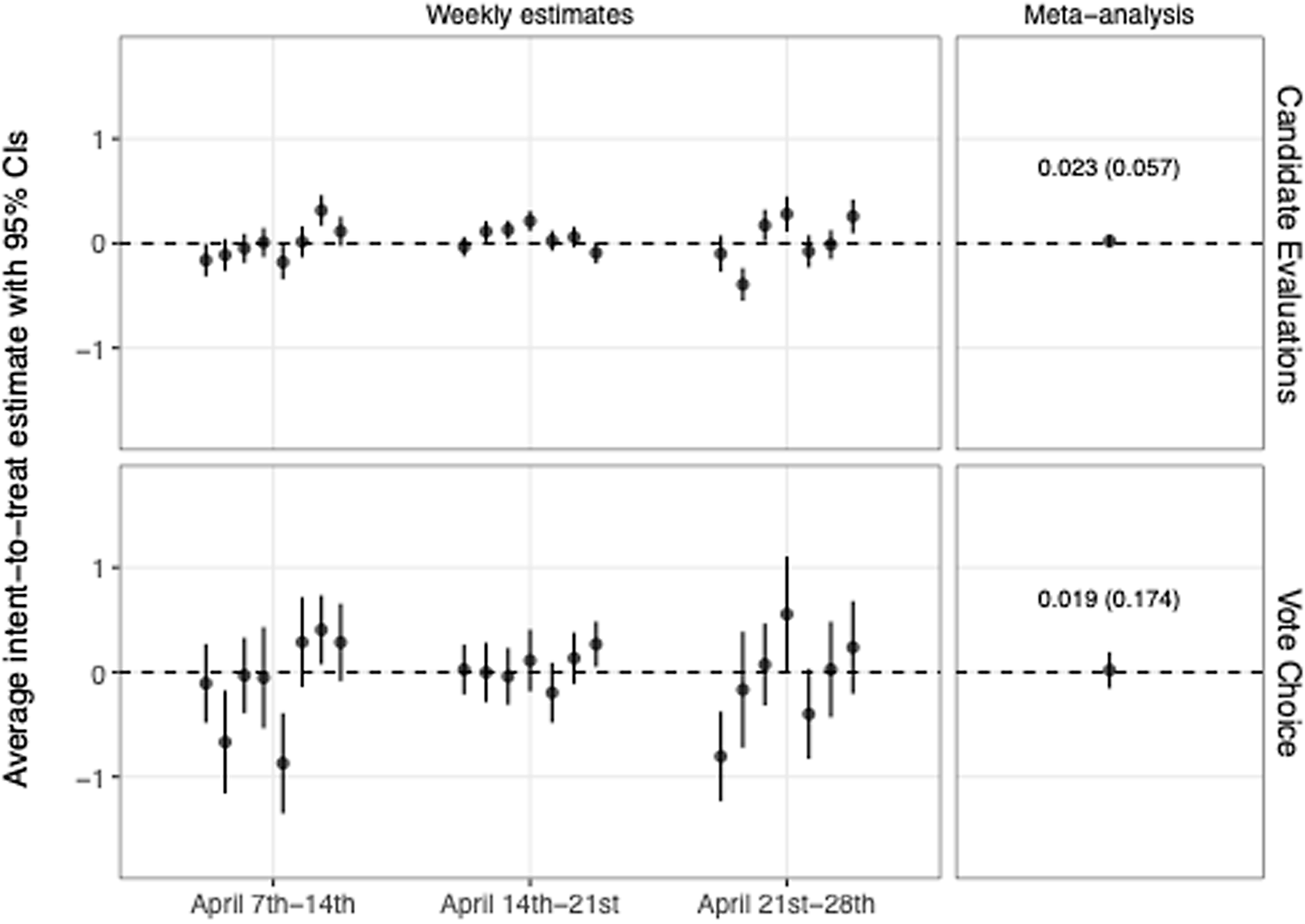
Figure 1 presents the main results. It plots average ITT estimates and 95 per cent confidence intervals for each of the three experiments for our two main outcomes estimated via OLS. In this analysis, treatment effect estimates indicate the effects of a randomly assigned campaign advertisement on participants’ evaluations of the candidates it targets, as well as vote intentions toward the candidates’ parties. The top panel of Figure 1 reports ITTs for candidate evaluations, and the bottom panel presents ITTs for vote choice. The horizontal axis plots the dates in which the experiments were conducted relative to the campaign period. Each point presents an individual ITT—that is, the average effect of an advertisement on target candidates’ evaluations and vote choice. To derive a single, more precise estimate of treatment effects, we then pooled the estimates using random-effects meta-analysis, providing an average “meta-analytic estimate” of campaign ads’ effects on candidate evaluations and vote intentions from the three experiments pooled together. These estimates are presented on the right panels.
Average ITT of Advertising on Candidate Vote Choice and Favourability.
Note: This plot displays ITT estimates of advertising on vote choice and candidate favourability estimated by OLS. Under the “Weekly estimates” panels, each point presents an ITT estimate representing the average effect of advertising on target candidates for both specified outcomes. Under the “Meta-analysis” panels, the points present one average effect of all advertisements on both specified outcomes. Vote intent is measured on a ten-point scale and candidate evaluations on a five-point scale (n = 3,346).

On average, and keeping gender, age, education, income, province of residence, and party identification constant, the advertisements moved target candidate evaluations by 0.023 scale-points on a five-point scale in the expected direction. Here we say “expected” because estimates for adverts attacking another candidate were rescaled so that the effects are interpreted on the same scale as promotional adverts. Advertisements moved vote choice by 0.019 points on a ten-point scale, on average. Both these estimates are quite small (not even one percentage point) and do not reach statistical significance at the 5 per cent level. The corresponding regression outputs for Figure 1 are presented in Tables S4.1 and S4.2 of the Supplementary Materials.
Conditional Effects
We now turn to the conditionality of persuasive effects by types of messages, sender, and receiver. We consider five sources of heterogeneity: respondents’ partisanship, whether the advertisement attacks a candidate, whether the advertisement promotes a candidate, whether the advertisement includes a visual presentation, and the target candidate.
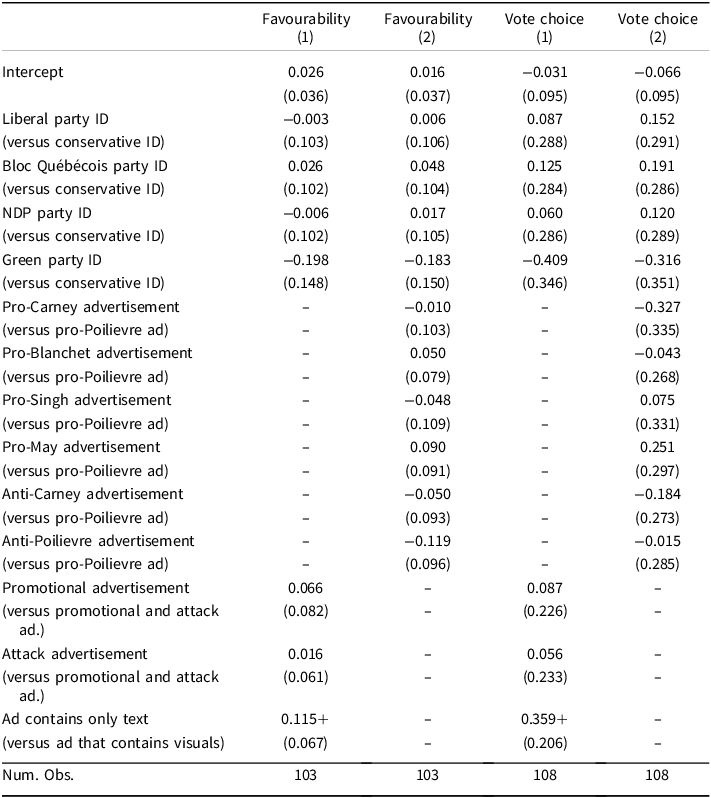
Table 2 reports meta-regression estimates of advertisements on target candidate favourability and vote choice. Again, we followed Coppock et al. (Reference Coppock, Hill and Vavreck2020) procedure and first estimated conditional ITTs of each advertisement on our two outcomes by respondents’ partisanship. We then estimated meta-regressions with OLS to assess whether the conditional ITTs systematically vary with common predictors of heterogeneity used in campaign studies (for example, advertisements’ characteristics). The dependent variable in each meta-regression is the conditional ITT estimate, which we regressed on several variables to test whether characteristics of the sender and the receiver systematically explain variation in the effect sizes. Thus, coefficients indicate how much more or less effective advertisements are when a particular feature is present. All predictors were demeaned—centered around their mean— so the intercept represents the average ITT. The coefficients show how the effectiveness of the advertisement changes, on average, with a one-unit increase in each predictor, relative to the reference category.
Meta-Analytic Regression Estimates of Advertisements on Target Candidate Favourability and Vote Choice
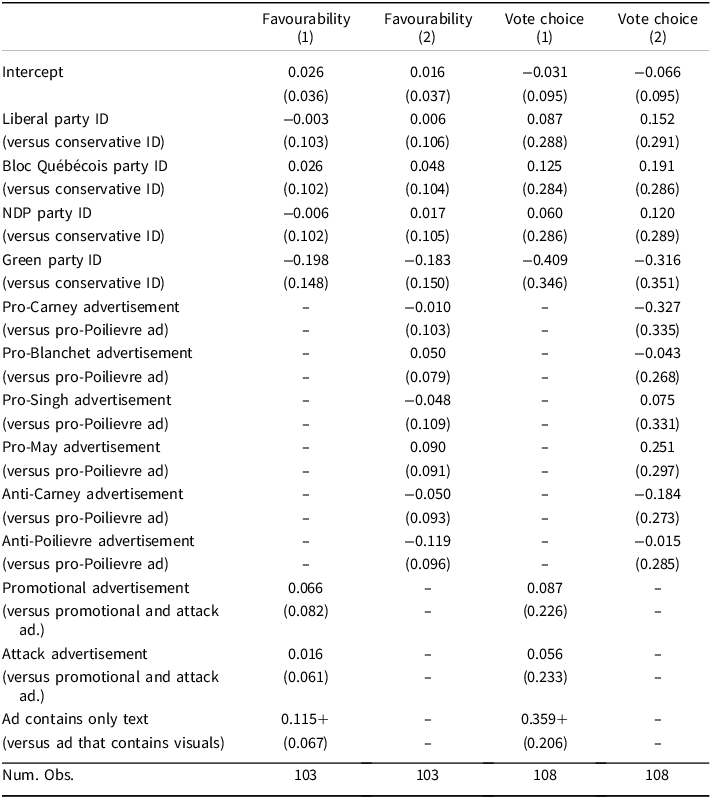
Table 2. Long description
The table presents meta-regression estimates of advertisements on target candidate favourability and vote choice. It includes four columns: Favourability (1), Favourability (2), Vote choice (1), and Vote choice (2). Each column lists various predictors and their corresponding coefficients and standard errors. The predictors include different party IDs, types of advertisements, and characteristics of the advertisements. The table has 15 rows, each representing a different predictor. The coefficients indicate how much more or less effective advertisements are when a particular feature is present. All predictors were demeaned-centered around their mean so the intercept represents the average ITT. The coefficients show how the effectiveness of the advertisement changes, on average, with a one-unit increase in each predictor, relative to the reference category.
+ p < 0.1, *p < 0.05, **p < 0.01, ***p < 0.001.
Dependent variable: Conditional ITT estimates.
Note: Entries represent the variation in conditional ITT estimates for each advertisement, conditional on respondents’ characteristics and features of the advertisements. Variables were rescaled so that higher positive values indicate that promotional advertisements had positive effects on target candidate favourability or vote choice, and that attack advertisements had negative effects. All regressors have been centered around their means, so the intercept shows the overall average effect. All other regression coefficients show how the effectiveness of the ads changes conditional on each regressor, relative to the reference category. Robust standard errors are in parentheses.
Overall, Table 2 offers little indication that the strength of persuasion depends on the moderators we examine. The coefficients are small and most standard errors are greater than the coefficients themselves, suggesting that our best estimate of conditional ITTs is near zero. As discussed in Section S8 of the Supplementary Materials, the conclusions remain unchanged when we test for heterogeneity by individual characteristics (for example, partisanship).
Together, Figure 1 and Table 2 increase the amount of evidence about the effects of campaign advertisements and lend support to the idea that such effects are small and mostly homogeneous. Synthesizing results across three survey experiments conducted during the 2025 Canadian federal election campaign, we find no evidence of large effects of campaign advertisements on candidate evaluations and vote intentions. From this, we conclude that the best estimate of campaign advertisements’ effects delivered within a month of a federal election is negligible. Although our studies do not allow us to claim definite proof of near-zero marginal effects and absolute homogeneity, these results provide no evidence that advertising has large and heterogeneous effects.
Discussion and Conclusion
A substantial body of work has found that the persuasive effects of campaign advertising are small (for example, Kalla and Broockman, Reference Kalla and Broockman2018), and have very similar effects across voters (Coppock et al., Reference Coppock, Hill and Vavreck2020). However, this scholarship has been almost exclusively limited to the United States, with less focus on other advanced electoral democracies. In this article, we conceptually replicated prior experiments on the persuasive effects of campaign advertising on vote choice and candidate favourability in Canada. Placing this conceptual replication in the context of the existing literature, we lend support to theories of minimal persuasive effects and extend their scope beyond the American elections in which they were originally developed (Berelson et al., Reference Berelson, Lazarsfeld and McPhee1954).
Consistent with recent theories, we find no evidence of large persuasive effects of campaign advertising and little indication that these effects vary by characteristics of either the advertisements or the receivers we studied. The results strengthen the case that minimal persuasive effects of ads are not a peculiarity of the American two-party system or of unusually polarized electoral environments, but a more general feature of campaign advertising in advanced electoral democracies.
Although our findings might paint a pessimistic view of campaigns’ ability to influence elections, caution is in order. It is important to stress that campaign advertisements may still matter in ways our study cannot speak to. For instance, in close elections, even a substantively small effect can prove decisive. And with repeated exposure over longer campaigns, these estimates may have consequential effects (although see Huber and Arceneaux, Reference Huber and Arceneaux2007). Moreover, campaigns can effectively increase voter turnout (Green and Gerber, Reference Green and Gerber2019), and our study does not speak to campaigns ability to set an agenda, signal issue positions, or influence media coverage (Sides and Vavreck, Reference Sides and Vavreck2013; Vavreck, Reference Vavreck2009). And it could also be the case that advertising has greater effects in provincial or municipal elections (see Sides et al., Reference Sides, Vavreck and Warshaw2022). Our point is not to suggest whether or not campaign managers should stop running advertisements, but rather that advertising does not seem to have large immediate effects on voters in Canada. We still remain optimistic that advertisements serve important functions in democratic elections.
Our findings have important implications for scholars, consultants, and policymakers in Canada. If the persuasive effects of campaign advertising are as small as our findings suggest, campaigns would be well-advised to allocate resources carefully. One promising avenue is the more systematic use of experimentation to pretest advertisements before broader deployment (see Hewitt et al., Reference Hewitt, Broockman, Coppock, Tappin, Slezak, Coffman, Lubin and Hamidian2024). The value of this strategy is underscored by recent evidence suggesting that our own ability to identify which messages persuade voters is quite limited (Broockman et al., Reference Broockman, Kalla, Caballero and Easton2024).
In closing, our study has several important limitations. First, persuasive effects often appear to be zero in campaigns when treatments are delivered within two months of election day (Kalla and Broockman, Reference Kalla and Broockman2018). Thus, we cannot rule out the possibility that our experiments were conducted too close to election day, which may explain why we fail to detect significant effects. Second, due to a combination of small sample sizes and multiple treatment conditions, we might lack the statistical power to find some potentially meaningful effects. Third, the samples are unrepresentative of the Canadian adults’ population, particularly as it relates to province of residence. While the analyses in section S6 of the Supplementary Materials should allay these concerns, it remains possible that our findings may generalize more readily to Quebec adults than to the rest of Canada. Fourth, the advertisements we selected may have been suboptimal. Compared to the US, Canadian politics involves less money and, consequently, less campaign specialization, which could make Canadian ads less effective overall. Fifth, our analysis focuses on a single type of advertisement. It remains possible that more targeted ads, particularly on social media, exert stronger effects on very specific subgroups of the population. Finally, because our findings are necessarily tied to the 2025 Canadian federal election, which was peculiar given the unusually high salience of the U.S. relationship in the campaign, replications in future elections would clearly be of interest to determine the robustness of our conclusions.
But perhaps most importantly, one limitation of our design is that survey experiments may underestimate real-world persuasion. Voters exposed to advertisements in a controlled survey environment are not exposed to competing messages that characterize real campaigns (see Shaw, Reference Shaw1999). Since our experiments were not conducted in a natural setting, we cannot fully rule out this possibility. We note, however, that field experiments delivering treatments in real-world contexts (for example, door-to-door canvassing, lawn signs, or online advertising) have reached similar conclusions (Aggarwal et al., Reference Aggarwal, Allen, Coppock, Frankowski, Messing, Zhang, Barnes, Beasley, Hantman and Zheng2023; Kalla and Broockman, Reference Kalla and Broockman2018). Still, measuring the marginal effect of a single advertisement within a survey experiment may differ from the total effect of an entire campaign or the effects in more intense information environment.
With that said, our study provides a first step in assessing the effects of campaign advertising in Canada. Our conceptual replication shows that during the 2025 Canadian Federal election, campaign advertisements delivered within a month of election day had limited effects on voters.
Supplementary material
The supplementary material for this article can be found at https://doi.org/10.1017/S0008423926101309
Acknowledgements
We are grateful to Mathieu Turgeon, and the editor and two anonymous reviewers, for helpful comments and advice. We also thank seminar participants at the Université de Montréal and the Political Communication panel at the 2026 annual conference of the Canadian Political Science Association.


 Open access

