


Policy diffusion is a process in which information on policy innovations is ‘communicated through certain channels over time among the members of a social system in an uncoordinated manner’.Footnote 1 It ‘occurs when government policy decisions in a given country are systematically conditioned by prior policy choices made in other countries’.Footnote 2 Most extant literature treats determinants of diffusion as static, but scholars increasingly recognise important differences between adopter categories.Footnote 3 International Relations scholars have studied diffusion mechanisms extensively,Footnote 4 while paying limited attention to the motivations of early adopters. Existing theory may be insufficient, as early adopters necessarily have few or no prior adoptions to reviewand limited opportunity for gathering information. Early adoption may create costly externalities or an unlevel international playing field – or lead to political backlash – prompting governments to wait until they have ample information on prior adopters’ experiences. Previous research has not fully explained why some governments adopt early despite these risks, and many expectations about early adopters from sociology do not hold in empirical policy studies.Footnote 5 Early adoption thus presents a puzzle. This article aims to provide a theoretical framework for answering the question: What explains early adoption of international policy innovations?
Policy diffusion studies have proliferated for three decades without adequately explaining why some governments set off diffusion. Mallinson states: ‘While differences between leader and laggard states receive attention within the policy diffusion research program, a strong theoretical foundation remains underdeveloped regarding how and why adoption predictors differ as diffusion unfolds.’Footnote 6 Recent research on temporal variation in the determinants of policy adoption is limited to large-N studies of federalist systems.Footnote 7 The environmental politics literature is replete with studies of ‘pioneers’ or ‘leaders’ – usually referring only to the first, most innovative adopter.Footnote 8 Virtually none of these studies explores whether motivations apply across the early adopter category, and many identify only characteristics of pioneers without considering causal motivations. Most policy diffusion researchers are ‘explicitly not interested in processes of creation and invention’ and assume invariant diffusion once a policy exists, while studies of pioneers largely disregard subsequent diffusion.Footnote 9 This literature also has a narrow environmental sectoral focus, disregarding generalisability, and almost exclusively concerns the European Union (EU). Explanations tend to be examined in isolation and have not been systematised into a coherent analytical framework. Overall, research on pioneering offers limited empirical evidence, contradictory findings, and low statistical significance.Footnote 10
Understanding early adopters’ motivations is important because diffusion scholarship is ultimately of limited value for explaining change in world politics unless it better explains why some actors initiate diffusion at all. Governments reference early adopters’ experiences in adoption decision-making in later stages of diffusion,Footnote 11 and actors in laggard states leverage early adopters’ issue frames and definitions.Footnote 12 Early adopters thus set boundaries for diffusion and significantly influence laggards’ policy designs.Footnote 13 Once underway, diffusion can significantly change the terms of debate, rendering ideas taboo or increasing their mainstream acceptance.Footnote 14
This article makes two significant contributions. First, it proposes a generalisable, integrated theoretical framework for studying governments’ motivations for becoming early adopters of international policy innovations. I develop four motivations based on the policy pioneering, leadership, and diffusion literatures and International Relations theory. I call these motivations normative, reputation, competition, and locking-in. Governments may swiftly adopt policy innovations when they strongly support the content, aligning with existing values, policies, and international commitments – especially when advocacy coalitions support the policy and influence government preferences. Early adoption may also be driven by the desire to enhance or maintain reputation to access material or social rewards. Governments may become early adopters to influence the design of other governments’ policies ahead of anticipated diffusion. Finally, governments may adopt early during windows of opportunity in periods of political change to secure preferred policies, especially to promote future international cooperation. While similar motivations could explain later adoptions, I suggest these motivations are especially likely to apply in the early phase based on governments’ strategic aims and may be sufficiently powerful to overcome reluctance to assume the perceived risks of early adoption. I also show that they may interact and be mutually reinforcing, a point which has not been assessed in previous research.
Second, this article offers an important empirical contribution. I illustrate the framework with case studies on early (non-)adoption of business and human rights (BHR) policy innovations. In 2011, the United Nations (UN) Human Rights Council (UNHRC) endorsed the Guiding Principles on Business and Human Rights (UNGPs), an international policy instrument that outlines: (1) the state duty to protect human rights from business-related abuses by adopting a mix of binding and non-binding measures; (2) the corporate responsibility to respect human rights by conducting ‘human rights due diligence’; and (3) access to effective remedy.Footnote 15 The main policies that governments have adopted to implement the UNGPs are National Action Plans (NAPs). This article provides novel empirical material on NAP processes, which have received limited scholarly attention. I conduct a comparative study of Colombia, an early adopter of a NAP, and Ecuador, a non-adopter, using a most-similar-systems, dissimilar-on-outcome design and within-case congruence.Footnote 16 The article adds to the expanding literature on policy diffusion from and across Latin America.Footnote 17
I show that the Colombian government sought to reverse a negative reputation on human rights to access a diplomatic reward: accession to the Organization for Economic Cooperation and Development (OECD). Adopting a NAP helped the government improve its reputation after decades of corporate human rights abuses in the context of armed conflict. The NAP signalled a locking in of reforms, reflecting the government’s normative preferences during a window of opportunity presented by a domestic peace process and the incumbency of a liberal president. There is also evidence that the UNGPs were better aligned with Colombia’s preferences than with those of Ecuador and that more political space was available for Colombian civil society to press for policy innovation. Colombia also sought to promote similar policies throughout Latin America, anticipating future regional diffusion, while Ecuador initially preferred a binding international agreement with a narrower approach.
The article proceeds as follows. The next section elaborates the theoretical framework and discusses possible alternative explanations and potential interactions among theorised motivations. The following section provides an overview of methods and materials for the empirical study. I then briefly discuss existing NAPs on BHR and proceed with a narrative of the case studies, followed by comparative analysis. In the final section, I conclude with a discussion about implications for future research.
Theoretical framework
Early adopters are the first adopter category in diffusion of innovations.Footnote 18 They include leaders/pioneers and other highly innovative governments, up to 15 per cent of the total population of adopters. Explanations for pioneering behaviour, often developed with little regard to the diffusion research programme, potentially apply to other early adopters because innovativeness is a continuous variable.Footnote 19 Moreover, governments do not necessarily adopt policies in the same order that they initiate policy processes. While previous research identifies characteristics of and differences between early and late adopters, it mostly explores monocausal explanations for pioneering and only considers certain types of states or policy areas. The framework proposed here builds on this literature and disentangles overlapping expectations, connecting them with International Relations theory to develop four potential motivations.
Before proceeding, I assert that certain possible explanations are better understood as scope conditions for, or components of, the following theorised motivations. One common explanation for pioneering behaviour is high problem pressure, which creates a sense of urgency and engenders demand for policy solutions. Problem pressure finds only limited support in large-N multivariate studies.Footnote 20 It might enhance causal effects without being a motivation per se. Vulnerability to environmental degradation, for example, makes civil society and business more likely to press for innovative policy solutions,Footnote 21 as in the normative motivation below. High problem pressure could also tarnish a government’s reputation if seen as evidence of failing to prevent or rectify a crisis, leading to strategic efforts at reputation improvement.
Scholars also debate state capacity explanations. Capacity, however, is not itself a motivation. Some research shows high economic development to be the most important predictor of policy leadership, as state resources help overcome innovation obstacles,Footnote 22 but other research finds capacity does not predict early adoption.Footnote 23 Multivariate studies find especially weak support for institutional factors, and any limited importance may be conditional on policy type.Footnote 24 High capacity for policymaking is a potentially necessary condition for pioneering, but it appears to at most facilitate, rather than motivate, innovation.Footnote 25
Another explanation is regional clustering: adoptions among neighbouring states are especially common in early diffusion. Governments ostensibly emulate geographically proximate states, swiftly following neighbours even when wider diffusion is not imminent.Footnote 26 Such observations may, however, more precisely show closely timed adoptions among ideological peers that tend to cluster geographically.Footnote 27 Other relevant factors also manifest regionally – for example, trade relations as a scope condition for ‘racing to the top’. I therefore regard regional clustering as a potential empirical manifestation of the following theorised motivations.
I further differentiate the following motivations from the four diffusion mechanisms commonly identified in the literature: coercion, competition, emulation, and learning. Under coercion, policies diffuse when powerful actors exploit asymmetrical relationships and manipulate incentives to encourage adoption either through conditionality, such as on loans or aid, or unilateral acts that alter other actors’ available choices. Competition involves selecting policies to attract or retain resources by making a jurisdiction appealing to international investors or minimising production costs. Emulation involves mimicking prior adopters’ behaviour because of shared understandings of appropriateness, regardless of the policy’s effectiveness. Finally, learning is a mechanism wherein an actor’s beliefs are altered.Footnote 28 Learning is necessarily voluntary (unlike coercion) and purposive (unlike emulation).Footnote 29 It is Bayesian and rational – often boundedly, as governments rely on cognitive heuristics and update their beliefs based on information’s symbolic value, overlapping with emulation.Footnote 30
These mechanisms often lack conceptual clarity and theoretical coherence, muddling cause and causal mechanism, although some scholars have recently attempted to ascribe particular motivations to particular mechanisms.Footnote 31 Moreover, these mechanisms were developed to study full diffusion processes; their associated motivations assume prior adoptions about which there is (some) available information. Governments need information to understand what they are being coerced into, to adjust their policies competitively, to identify what to emulate, or to learn about the policy’s effects. One cannot obviously assume early adoptions are explained by coercion, competition, emulation, or learning mechanisms – or by policy transfer at all – nor by motivations previously theorised for these mechanisms. This caveat should hold across much of the early adopter category, as multiple governments might initiate, but not complete, policy processes prior to the initial adopter, and information and the time and means to collect it are necessarily more limited in early stages of diffusion. The following motivations are not conceived mechanistically but indicate potential links to diffusion mechanisms.
Normative
The first motivation is normative, here defined as adoption of a policy because of a normative commitment to its contents. Normative preferences motivate early adoption when a government is more interested than others in adopting a policy whose contents it values and wants to quickly implement. Accordingly, the government likely already has similar policies in place, lowering the burden of adjustment. The motivation is predicated on the assumption that government preferences derive from values supported by actors with power in the polity and are mediated by their position relative to other governments’ preferences.
Previous research indicates that governments should be more likely to adopt international policy innovations early when they value the contents. Human rights treaties, for example, are more rapidly ratified by established democracies.Footnote 32 Valuing the contents of a policy suggests the government should have similar, pre-existing policies and practices that lower (perceived) adjustment costs – one of the most salient hindrances to innovativeness.Footnote 33 The earliest ratifiers of human rights treaties are thus those for whom adjustment costs are lowest because of prior human rights commitments and protections.Footnote 34 Conversely, a misfit between an environmental policy innovation and domestic precedent significantly deters early adoption.Footnote 35 Early adopters should already have such well-aligned policies in place because of their preferences. These insights speak to ideational liberalism, which focuses on the compatibility of such preferences across fundamental goods, including socio-economic regulation, and ‘views the configuration of domestic social identities and values as a basic determinant of state preferences’.Footnote 36 Hence, governments should be more likely to be early adopters of a policy that ‘embodies values supported by the political parties or groups in power and, relatedly, when the political system provides effective channels of influence to the main beneficiaries’.Footnote 37
Civil society organisations and other interest groups should then play a key role. Broad support for a policy and pressure from non-state actors and transnational advocacy networks are key to domestic adoption of international norms.Footnote 38 These advocacy coalitions are especially important for enabling norm innovativeness.Footnote 39 Entrepreneurs leverage international norms to strengthen their domestic political position and thus play a prominent role in early stages of diffusion.Footnote 40 Early adopters face greater domestic resistance that can block adoption, while support from domestic actors helps to legitimate the policy.Footnote 41 Broad domestic support may even be sufficient to overcome policy misfits.Footnote 42 Strong ‘green’ advocacy coalitions are, for example, a significant determinant of pioneering environmental regulations.Footnote 43 Also, while business opposition can hinder regulatory innovation, its support is a particularly powerful driver.Footnote 44
International socialisation also shapes preferences. Sociological institutionalist accounts hold that states commit to policies when doing so conforms to norms of appropriate behaviour defined by the wider political/social system, transmitted through institutions.Footnote 45 Socialisation is a ‘process by which social interaction leads novices to endorse “expected ways of thinking, feeling and acting”’.Footnote 46 It is ‘the process by which states internalize norms originating elsewhere in the international system’.Footnote 47 Socialisation thereby influences the policies governments adopt and potentially when they do so. Accordingly, state preferences reflect patterns of transnational social interaction, and policy choices reflect ‘the configuration of preferences of all other states linked by patterns of significant policy interdependence’.Footnote 48 Additionally, socialisation within international organisations (IOs) leads member state preferences to converge over time.Footnote 49
Although socialisation effects are especially pronounced in later stages of diffusion,Footnote 50 certain aspects could explain early adoption. Early adopters tend to be more similar ideologically, and governments are likely to adopt in quick succession following ideologically aligned pioneers.Footnote 51 The emulation mechanism might therefore facilitate diffusion when the subsequent early adopter’s motivation is normative and at least one antecedent early adopter was an ideological counterpart. This approach to the mechanism has rather narrow analytical utility, however, and does not necessarily explain the antecedent adopter’s motivations, nor can it address ideological heterogeneity within the adopter category.
Socialisation may alternatively predispose governments to adopt policy innovations promoted by IOs. Policy adoption also faces high international barriers in early stages of diffusion, but support from IOs increases acceptance.Footnote 52 The promotion of policies by IOs is sometimes considered a form of the coercion mechanism, especially where governments believe powerful IOs will provide benefits in exchange.Footnote 53 Yet the emulation mechanism explains adoption of policies seen as normatively appropriate and may be more relevant. International organisations influence which policies are considered appropriate even prior to domestic adoptions, and governments ‘emulate’ novel policies that IOs promote.Footnote 54 Further, IOs can ‘teach’ new norms to member states and work with communities of experts to socialise governments into acceptance.Footnote 55 Such norms may be constructed in the first place by IO-appointed experts and subsequently promoted among national governments,Footnote 56 as was the case with the UNGPs, developed and promoted by UN Special Representative of the Secretary-General John Ruggie.Footnote 57 Several IOs also encouraged and materially supported early adopters of conditional cash transfer policies in Latin America.Footnote 58 Emulation also appears to explain early adoption of carbon taxes: ‘although it may seem premature, at this point, to invoke emulation as an explanation given the lack of pre-existing policies to emulate’, the logic applies, as the first wave of carbon tax policies were adopted in response to the UN and EU elevating climate change as an issue of moral responsibility.Footnote 59 This understanding of emulation, in which prior state-level adoptions are not requisite, deviates from standard conceptualisationsFootnote 60 and may relate to normative motivations more specific to early adopters.
Based on this discussion, one should expect that greater commitment to values reflected in a policy increases the likelihood that a government adopts it early. The strength and sincerity of commitment may be evidenced by the extent of existing laws and policies, including international legal commitments, in the relevant policy domain. Evidence for this motivation could also include the degree of influence of advocacy coalitions supporting adoption of the policy. Other possible evidence includes the extent to which IOs of which the adopting state is a member state promote the policy. (For a detailed discussion of variables, evidence, and indicators for each motivation, see Table 1 and the Online Supplementary Material [OSM].)
Theoretical framework

Reputation
The second motivation relates to a government’s concern for its reputation. Early adoption may improve a tarnished – or maintain a positive – reputation. The motivation is predicated on the assumptions that governments are concerned with perceptions held by other governments, creditors, investors, and the public and thus act strategically to manage their reputations; that social influence processes create shared understandings of appropriate behaviour against which reputations are assessed; and that reputations can be improved, maintained, or damaged following state behaviour. This motivation may be especially pronounced where there is a perceived link between reputational gains and material or social rewards.
Regime theorists advanced the idea that reputation influences strategic state behaviour. Rationalists argued that governments fear costs imposed when reputations sink due to repeated transgressions in international cooperation. The logic of appropriateness gives way to a logic of consequences, as violations of standards of appropriate conduct create reputational damage. Governments conform with international norms because they fear their rule violations will encourage violations by others, and they do not want to reduce cooperation prospects in other areas.Footnote 61 Reputation explains international commitments in areas such as human rights, where rationalists cannot otherwise explain compliance absent reciprocity. Preoccupation with reputation leads to strategic, rather than sincere, commitments because governments ‘can produce good press or an improved image with audiences both at home and abroad’, which may generate material or social benefits.Footnote 62
Constructivism informs another assumption of the motivation. Social influence involves ‘the desire to maximise status, honour, prestige – diffuse reputation or image – and the desire to avoid a loss of status, shaming or humiliation and other social sanctions’.Footnote 63 Status maximisation is attractive to governments because reputational effects are attributed to particular status markers. A positive reputation in one arena encourages cooperation with the status bearer in others.Footnote 64 Social influence can induce even hegemonic states to change behaviour to avoid reputational damage if facing near-universal opprobrium.Footnote 65 Reputation thus depends on a normative consensus on good behaviour and institutions in which actions are observable.
The third assumption is that reputations are mutable. Other actors update their information in response to governments’ actions, and reputations ‘should change when governments act contrary to their perceived type, given the circumstances’.Footnote 66 One could reason that governments swiftly adopt policies to preserve a good reputation in areas where they are perceived frontrunners and to avoid reputational damage associated with becoming laggards, or to reverse negative reputations by acting contrary to perceived type as a probable laggard. Reputation concerns could also influence later adoptions (laggards may improve their reputations compared to not adopting at all), but the augmented costs and risks of early adoption could signal a stronger commitment with enhanced reputation effects.
Reputation is often linked to (perceived) rewards, and reputation improvement or maintenance may bestow rewards linked specifically to adoption timing. International human rights commitments, for example, involve trading off ‘the short-term certainty of positive ratification benefits against the long-run and uncertain risk [of] compliance costs in the future. … This strategy involves risks since governments have only limited information about the future consequences of ratification.’Footnote 67 The short time horizon between commitment and attaining diplomatic rewards allows governments to delay exposure as insincere or non-compliant.Footnote 68 Some rewards may compensate for any associated adjustment costs – including favourable trade conditions, investment, development assistance, or IO accession. Kelley found, for example, that early adopters of election monitoring were concerned about their reputations, which were linked to benefits such as foreign aid and foreign direct investment.Footnote 69
Time-linked rewards can also be purely social. Early adopters sustain reputations for progressiveness and leadership for decades after they stop being accurate.Footnote 70 International environmental leadership reputations, for example, are not matched by domestic policy ambitiousness over time.Footnote 71 That reputational gains from one-off or sporadic early adoptions last so long makes them particularly coveted. Kollman found this logic in the Dutch case of the pioneering of same-sex marriage, which was largely motivated by ‘the lure of being a policy pioneer, and the international reputational gains that come with it’.Footnote 72 The Dutch government adopted the controversial policy despite possible political consequences because of ‘the expectation that their decision on this increasingly prominent issue would be recognized by an international audience’.Footnote 73 The case illustrates how early adopters expect to enhance their reputations by assuming risks with limited information about possible consequences, and desire the associated progressive identity.
The reputation motivation has potential connections to several diffusion mechanisms. Rooted in constructivism, it could be linked to emulation, whereby governments adopt intersubjectively approved behaviours. However, this motivation’s rationalist element suggests more purposive action and consideration of consequences than diffusion scholars generally associate with emulation. Reputation could be linked to learning, if governments update their information about rewards attained by early adopters – either very recently, for the same policy innovation, or in historical diffusions. Where reputation management is part of a clear rationale to improve or maintain the state’s economic situation,Footnote 74 the motivation could also be connected to the competition mechanism.
This motivation leads to the expectation that when a government seeks to uphold a positive or improve a negative reputation in the relevant policy domain, it is more likely to be an early adopter of the policy innovation. It is necessary for empirical research to establish the government’s pre-existing reputation in the policy area and identify active reputation management strategies centred on the relevant policy innovation. Evidence could include acts of shaming (or praising) by peer states or NGOs that established the state’s negative (or positive) reputation in the relevant policy domain. The government’s strategy could be evidenced by diplomatic efforts, such as statements at international fora, to boast of its (planned) policy adoption. Evidence of associated rewards is difficult to predict and will depend on the specific policy, but the existence of and desire for specific rewards could potentially be established or inferred from claims about the policy or target venues for promoting the policy.
Competition
The third motivation is competition, whereby governments adopt early to influence subsequent diffusion. This motivation rests on the assumption that policies adopted in one state are transferred in similar forms elsewhere, and later adopters regularly reference the experiences and frames of early adopters. The motivation also assumes that governments are aware of this potential effect on anticipated diffusion and strategically seek to influence what type of policy style diffuses, ensuring that the international playing field is levelled closer to their ideal point.
The diffusion literature shows that policy transfer occurs between states: adoption in one state influences adoptions elsewhere. Policy adoption decisions involve full ‘time horizons’, which implies considering policy transfer in the future, as well as the past and present.Footnote 75 One can reason that early adopters consider the prospects of future diffusion and convergence at the point of their adoption decision. The competition motivation is thus closely conceptually related to the competition diffusion mechanism, but rather than explaining policy adoptions as competitive reactions to past adopters, it concerns the future.
Regulators compete in offering a product to internationalised business – that is, regulatory regimes consisting of standards, information gathering and provision, and enforcement.Footnote 76 This economic rationale is mostly associated with lowering standards,Footnote 77 but competition also involves raising standards to level the playing field or to offer more attractive styles of regulation.Footnote 78 Scholars often describe this phenomenon as ‘racing to the top’, or the California effect – a ratcheting-up of standards in response to pioneers, where powerful and wealthy states spark upward regulatory competition with trade partners. National governments drive each other to raise standards, just as California’s environmental regulations influence other US states seeking to retain market access. Domestic firms support regulations that provide a competitive advantage, leading wealthier states to enact stricter standards that force foreign producers to adjust, including by creating pressure through trade agreements.Footnote 79 The effect applies to both production and product standards, as well as some non-regulatory policies.Footnote 80 This logic largely overlaps with that involved in coercion,Footnote 81 implying early adopters are motivated by plans to engage in future coercion.
That large, wealthy states are most capable of triggering the California effect suggests state capacity is a scope condition for this motivation. If competition hinges on economic interdependence, the effect should play out according to international political economic power dynamics. Wealthy and powerful states are the most likely to innovate in many policy areas,Footnote 82 and developing states generally tend to emulate policies already adopted in donor countries, driven by coercive relationships.Footnote 83 Developed states are not, however, the only states capable of exporting policies and inducing races to the top, although policy transfer from developing states may have support from powerful partners.Footnote 84
The next assumption in the motivation is that governments act strategically to influence future diffusion. Governments have multiple ways of translating international norms into national policy.Footnote 85 Early adoption offers a means of accelerating upward competition to increase the prospects that their preferred approach diffuses widely, potentially staving off convergence towards a less preferred policy style, whether because it is deemed too stringent, too weak, or more or less effective or legitimate. Here, the ‘top’ of regulatory races is contested: governments may agree on the nature of problems and be open to a range of solutions that are more or less costly for particular states.Footnote 86 The issue-definition stage comes early in diffusion and involves debating solutions to problems,Footnote 87 thereby incentivising early adoption.
Previous research shows such strategic decision-making. Creating competitive advantages for domestic industry is one of the most prevalent explanations for environmental policy pioneering.Footnote 88 These pioneers leverage visibility within IOs to influence the international policy agenda by ‘uploading’ innovations for other governments to adopt, functioning as intellectual leaders under conditions of uncertainty and leading towards global policy convergence.Footnote 89 Nordic governments, for example, coordinated carbon taxes within the Nordic Council and then explicitly pursued a strategy of promoting them through other IOs.Footnote 90 The Dutch government similarly wanted to promote marriage equality abroad and sought to burnish its reputation as a pioneer, incorporating promotion of same-sex relationship recognition into foreign policy.Footnote 91
This motivation leads to the expectation that governments who seek to influence policies adopted elsewhere are more likely to become early adopters. Evidence of such a desire may rely largely on decision-makers’ statements, but certain facilitative conditions can be identified. Metrics for state wealth and power, as well as openness to trade and financial flows, indicate a government’s ability to trigger upward regulatory competition. Other relevant evidence could include statements of concern over alternative policy designs that might be more or less stringent than desired, for example in claims made during debates by decision-makers. Additional evidence could include provisions in the policy text, or pledges made alongside its adoption, to promote subsequent foreign adoptions of similar policies, whether through diplomatic persuasion, economic pressure, or conditionality.
Locking-in
The fourth motivation is based on considerations of recent or imminent domestic political instability and change, and potentially future international cooperation. The locking-in motivation rests on an assumption that policy adoption ‘ties the hands’ of incumbent and future governments, which is desirable when incumbents either seek to garner credibility following civil strife or face losing power to an adversary who opposes the policy, hampering future international cooperation on the issue. ‘Hands-tying’ in such windows of opportunity may be sufficiently attractive to motivate a government to assume the risks of early adoption.
Governments want policies to remain in place beyond near-term political change and may therefore be willing to take greater risks, especially following periods of civil strife or ahead of power loss. The earliest proponents of international human rights commitments tend to be newly established democracies seeking to consolidate democratic institutions to enhance their credibility and stability. Fledgling democratic governments, constrained by fears of domestic laws being struck down, adopt policies to secure democracy.Footnote 92 Among the earliest ratifiers of the Rome Statute of the International Criminal Court were also non-democracies that leveraged ‘hands-tying’ to enhance the credibility of domestic promises after periods of violence.Footnote 93 Early adopters of liberal reforms seek to send credible signals of their commitments, even if non-reciprocally binding, shortly after democratic transitions.Footnote 94 In Latin America, democratisation and conflict resolution have often marked periods of institutional and policy innovation, creating windows of opportunity for novel ideas from social movements to influence the policy agenda.Footnote 95
Windows of opportunity are important, time-related determinants of policy transfer.Footnote 96 They can be a ‘situative’ factor of policy pioneering related to changes of parties in government, economic conditions, and external events.Footnote 97 Windows thus arise not only after strife, but also preceding loss of power. Anticipated electoral gain is a key factor in the political will to innovate; policy innovation is more likely when an election is imminent – or conversely, more distant for unpopular policies.Footnote 98 Non-state actors exploit these windows to press for favoured policies. French NGOs, for example, leveraged a rare spell of Socialist Party dominance and convinced the French government to pass the world’s first mandatory human rights due diligence legislation in 2017 ahead of certain electoral loss to either of two presidential candidates who opposed the law.Footnote 99 Adoption at any point in diffusion could in principle lock in policies, but the motivation may be especially potent in overcoming reluctance to early adoption. It may also be especially likely in early diffusion if actors learn from historical diffusions that ‘hands-tying’ is more effective then. For example, despite significant challenges to conditional cash transfer policies, engendering changes or repeals in other adopter categories, not a single early adopter has ever abandoned its policy (although this may be explained by the sincerity of their normative commitment).Footnote 100
Policy adoption can also tie future governments’ hands, especially with international commitments and binding legislation, improving prospects for future international cooperation and regulatory convergence. Influencing future international law-making by reducing adjustment costs is a common explanation for environmental policy pioneering.Footnote 101 Anticipating convergence provides a political rationale for leadership: if a ‘green’ policymaker prefers international cooperation on an environmental issue but risks losing power, they may adopt the policy unilaterally to avoid future cooperation failure despite immediate costs. Future cost reductions then increase subsequent governments’ probability of cooperating.Footnote 102 Unilateral human rights commitments are also explained by this logic.Footnote 103 The locking-in motivation is not obviously linked to any particular diffusion mechanism, as it primarily concerns near-term domestic consequences. However, the desire to lock in reforms could involve emulation if relevant IOs promote the reform, or it could be linked to considerations of future coercion if there is a preference for international harmonisation.
This discussion leads to an expectation that early adoption is more likely preceding or following political change either from resolving civil strife or transitioning power, especially where the incumbent favours international cooperation in the relevant policy domain. Evidence of this motivation could include recent histories of civil strife, likely documented in journalistic accounts. Alternatively, one might look for evidence that incumbents anticipated imminent loss of power, including through public opinion polling. One could also examine statements by opposition politicians to ascertain their aversion to the relevant policy, as well as statements by incumbents about their desire for international cooperation.
Motivation interaction
This framework theorises each motivation as discrete but not mutually exclusive. They might manifest mostly epiphenomenally or combine or interact to reinforce each other. Possible combinations and interactions remain an open empirical question. These motivations may be individually sufficient, but combinations might enhance prospects of early adoption. Some interactions are more intuitively obvious, and previous research illustrates, at least implicitly, possible combinations – for example, of the normative, reputation, and competition motivations.Footnote 104 The normative motivation has high potential to interact with other motivations because governments should be especially interested in influencing future diffusion according to their values or want to lock in preferred policies before losing power. A negative reputation from past bad behaviour could also strengthen the case for locking in a policy during a window of opportunity, if the innovation is poised to increase the credibility of the behaviour change. This study does not test for specific combinations and interactions but maintains awareness of potential manifestations in its analysis.
Methods and materials
To illustrate the framework, I adopt a ‘most-similar-cause, most-dissimilar-on-outcome’ case-based research design, using the cases of Colombia and Ecuador. Cross-case comparison enables the detection of potential causes (i.e. motivations) and provides a powerful disconfirmatory test for ascertaining the sufficiency of theorised motivations. I combine cross-case comparison and within-case congruence, which together help to test and refine expectations about relationships between causes and outcomes.Footnote 105 For further explanation of the research design and methodology, see the OSM.
Congruence requires clear descriptions of the evidence one expects to find for theorised causes.Footnote 106 I have suggested above potential evidence for different components of the motivations. Due to the need for transparency and clarity in congruence, I provide specific operationalisations for this study and discuss which empirical materials were used in detail in the OSM (see also Table 1). I translated Spanish-language documents using translation software and assistance from a native-speaking colleague. For information on political conditions in both countries, I reviewed Economist Intelligence Unit Country Reports. For information on human rights conditions in each country, I reviewed Human Rights Watch’s World Report series and Amnesty International’s State of the World’s Human Rights annual reports from 2010–21, focusing especially on the period to 2015 when Colombia adopted a NAP. A full list of reports consulted is included in the OSM; where such context is discussed below, I summarise trends across numerous reports without individual references.
Because motivations are difficult to measure and may not be revealed in public documents, I conducted semi-structured elite interviews in Bogotá and Quito in October 2018 to acquire information on actors’ motivations.Footnote 107 I interviewed seven stakeholders involved in the Colombian NAP process representing business, civil society, and government, and I contacted an additional three stakeholders from business who were unable to be interviewed. I interviewed four stakeholders in Ecuador from civil society, business, and government and contacted an additional four stakeholders in business and civil society who did not respond. Interviews were conducted in person, with one exception via Skype. I recorded and transcribed most interviews; where interviewees did not consent to recording, I took notes. All interviews proceeded in English, except for three interviewees who spoke Spanish with a professional interpreter present to provide translation.
Early adoption of business and human rights policies
The UN Working Group on Business and Human Rights was established in 2011 to foster implementation of the UNGPs. It encourages all governments to adopt a NAP, which it defines as ‘an evolving policy strategy developed by a State to protect against adverse human rights impacts by business enterprises in conformity with the [UNGPs].’Footnote 108 Being generally non-binding, NAPs may seem low-cost or low-risk. Yet they could signal a forthcoming ‘hardening’ of regulation. Moreover, not all political risks are financial: IOs have criticised governments whose national policy planning lacks stringency in areas like sustainable development, suggesting potential reputational harm.Footnote 109 It is therefore relevant to study motivations for their early adoption.
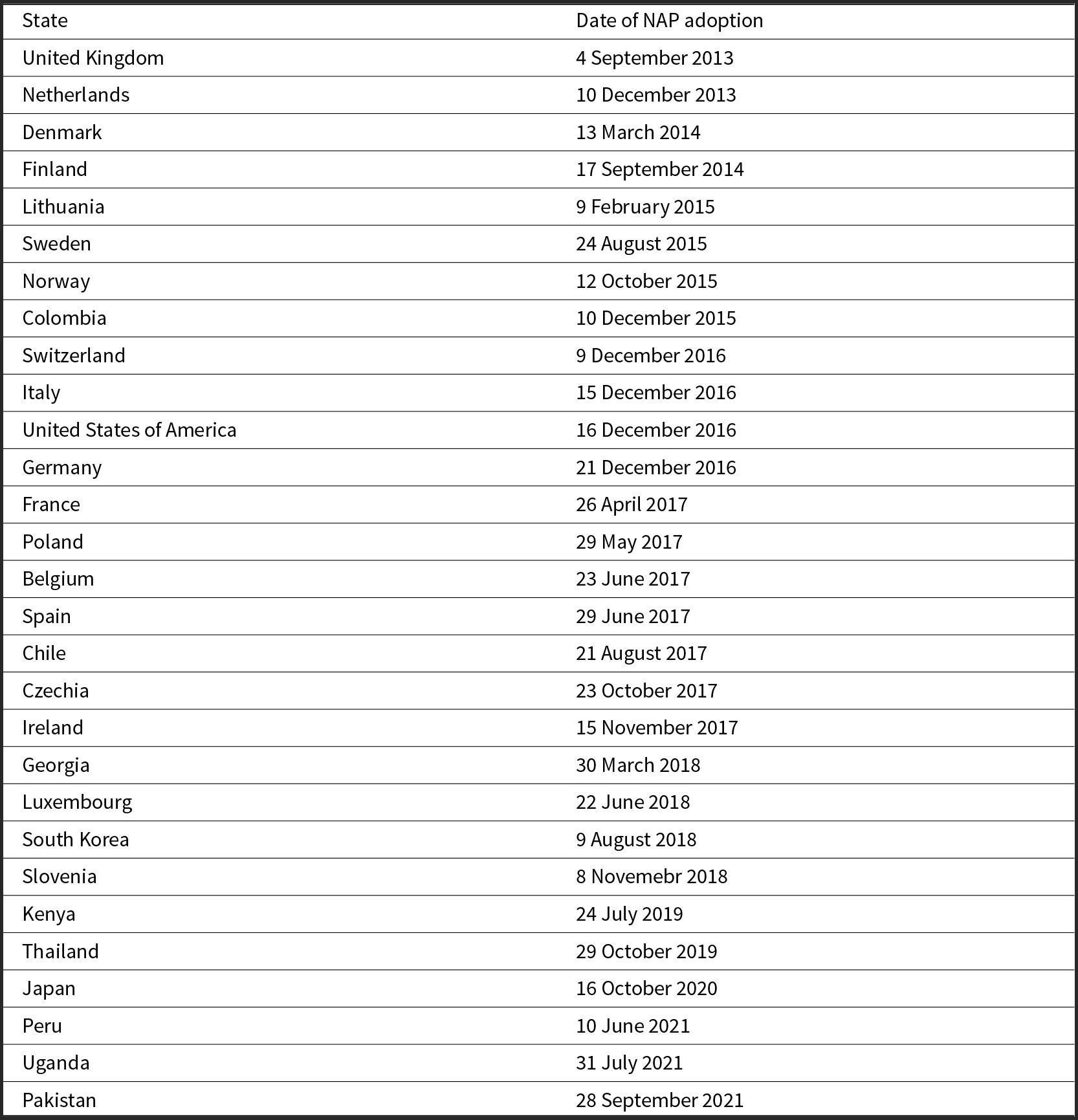
The 29 extant NAP adopters (see Table 2) as of June 2023 represent 15 per cent of all 193 UN member states, or what would be the complete early adopter category in a successful diffusion. One could expect early adopter motivations to apply for these governments, especially those in the initial years of adoption when learning opportunities were limited. The Danish Institute for Human Rights identified an additional 18 governments committed to developing a NAP, indicating likely further diffusion. In the remainder of this section, I narrate case studies on the politics of (not) adopting a NAP in Colombia and Ecuador and then compare them.
Early adopters of NAPs on BHRa
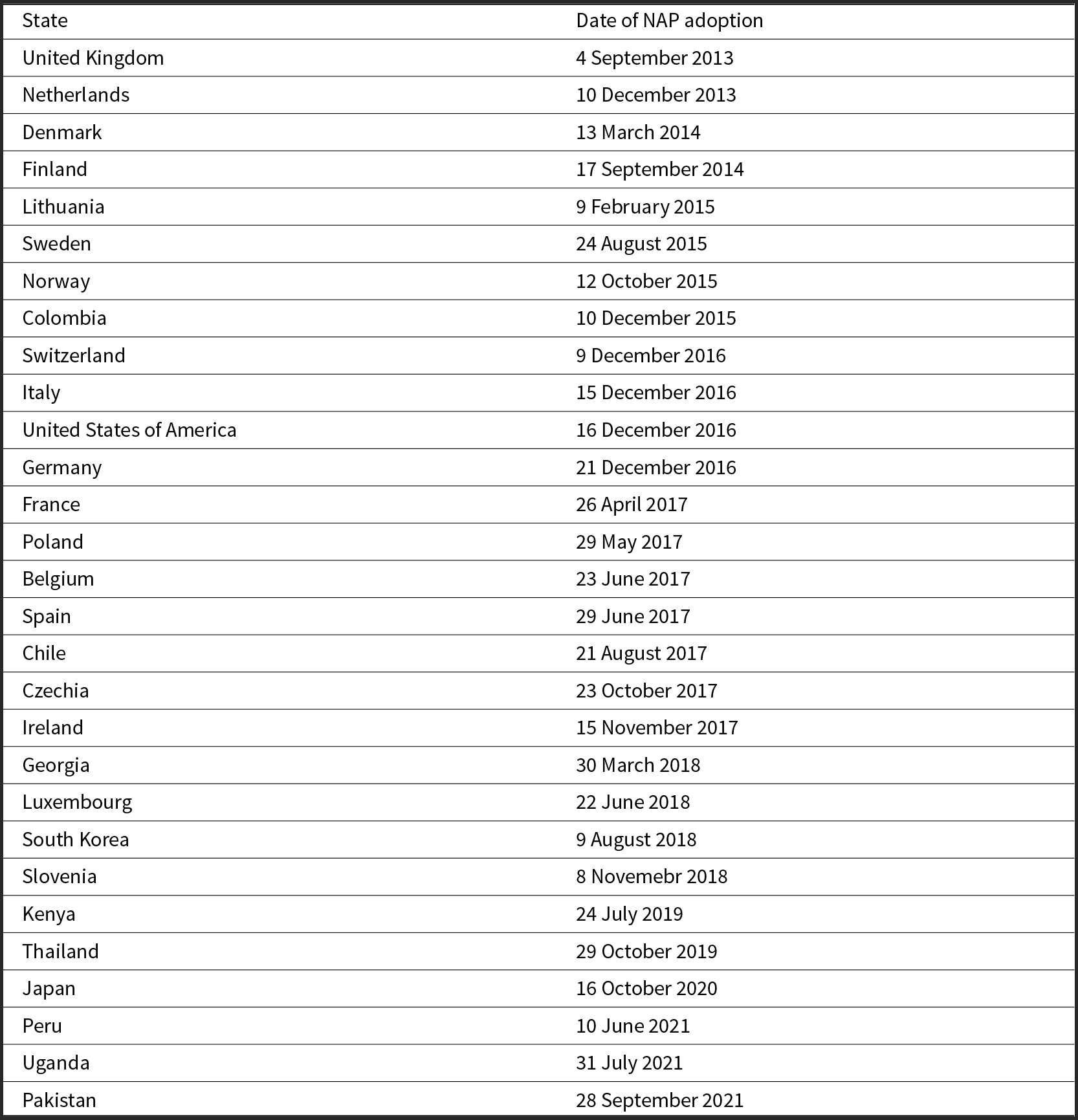
a Danish Institute for Human Rights, ‘National Action Plans on Business and Human Rights’, available at: {https://globalnaps.org}.
Colombia
The Colombian government prioritised human rights after the 2010 election of President Juan Manuel Santos, whose predecessor, Álvaro Uribe, was associated with egregious human rights abuses related to internal armed conflict. Santos began negotiations to resolve the conflict in 2012 and reached a peace settlement with the Revolutionary Armed Forces of Colombia (FARC) guerrilla group in 2016. As part of this liberal pivot, Santos tasked the Presidential Advisory Office for Human Rights and International Affairs (CDDHH) in 2012 with conducting research on BHR and began a NAP process in 2015.Footnote 110 CDDHH established a multi-stakeholder steering committee and organised countrywide consultations. The NAP, adopted in December 2015, was designed as a three-year instrument. The government published progress reports in 2017 and 2018 before adopting a follow-up NAP in 2020.Footnote 111 Colombia’s initial NAP included policies covering all three pillars of the UNGPs.
The NAP is linked to conflict resolution, calling BHR and peacebuilding ‘two political agendas walking together’.Footnote 112 It is described as a ‘component for post-conflict and peacebuilding’ that contributes to ‘lasting peace’.Footnote 113 Several interviewees confirmed the link between NAP development and the peace process.Footnote 114 A representative of the Defensoría del Pueblo, Colombia’s human rights ombudsman, stated that companies wanted the NAP to be a ‘reference point for future governments’ on ‘peacebuilding and transitional justice’.Footnote 115 When Santos lost power to the more conservative Iván Duque in 2018, a coalition of civil society and business formed to support retaining the NAP because Duque opposed the peace agreement.Footnote 116
Colombia had numerous pre-existing commitments and policies of relevance. It had ratified all conventions to which the UNGPs refer as the minimum list of human rights that businesses should respect, including the two conventions in the International Bill of Human Rights and International Labour Organization (ILO) fundamental conventions. Since the 1990s, Colombia had centred human rights in economic liberalisation, deviating from starker neoliberalism across Latin America, and successive governments pursued interventionist policies to guarantee rights while supporting business.Footnote 117
Colombia has a robust civil society, including many NGOs and industry associations working on BHR. One former employee of CDDHH stated: ‘A very important factor was the role of civil society … It was a perfect combination of political will, and that’s why the Colombian government started to work on the creation of this NAP.’Footnote 118 The interviewee called civil society one of three driving forces behind the NAP’s adoption, along with the domestic peace process and accession to the OECD.Footnote 119 An NGO representative stated that companies were generally not addressing human rights prior to the NAP, but they were aware of the issue and supported developing a policy.Footnote 120 Numerous NGOs championed BHR policy in Colombia, including Dejusticia, Fundación Paz y Reconciliación, and Fundación Ideas para la Paz (FiP), which has corporate backing. Dejusticia has criticised the NAP process as not meaningfully including all stakeholders,Footnote 121 but representatives of CDDHH and another NGO argued that NGOs and trade unions participated extensively.Footnote 122
Although Colombia had strong formal human rights commitments, armed conflict was intertwined with high-profile BHR challenges for decades preceding NAP adoption. Uribe faced allegations of complicity in atrocities related to the conflict, sometimes involving business. Colombia was heavily criticised for violence against human rights defenders and trade unionists by international NGOs, numerous UN treaty bodies and special procedures mandate-holders, the Office of the Prosecutor of the International Criminal Court, the Organization of American States, and the Inter-American Commission on Human Rights (IACHR).
Santos received praise from many of the same organisations for efforts to address systematic abuses. Reversing Colombia’s negative reputation became a key foreign policy under Santos’s campaign for OECD accession. Five interviewees independently identified the significance of OECD accession in motivating early adoption, one of whom described ‘a really strong connection’ between accession and the NAP process.Footnote 123 Due to Colombia’s negative reputation, OECD members required it to meet certain conditionalities on human rights. The OECD’s Accession Roadmap for Colombia stated that it must produce a ‘credible plan’ for implementing the OECD Guidelines for Multinational Enterprises, which incorporate the UNGPs.Footnote 124 One interviewee said the OECD was particularly concerned about killings of trade unionists and noted that Santos became personally involved in assuaging concerns.Footnote 125 In 2014, Santos spoke at the OECD, acknowledging the criticism and elaborating planned steps for improving Colombia’s reputation.Footnote 126 The government saw the NAP as ‘a prerequisite for Colombia to enter this group of high standards countries’ even though few other governments then had one.Footnote 127 A representative of CDDHH confirmed that the NAP ‘was made in light of improving business practices, and of course it is tied to the OECD process’.Footnote 128 A representative of the Defensoría stated that the government was ‘in such a rush to adopt a NAP’ that even civil society proponents questioned the haste, and ‘it was obvious from the international political context’ that the NAP was part of Santos’s rebranding strategy.Footnote 129
The interviewee therefore considered OECD conditionality to be a primary driver behind the NAP, along with Santos’s relationship with UK prime minister David Cameron. They attributed this ‘very close’ relationship with ‘transplanting’ BHR policy rhetoric from the UK.Footnote 130 Cameron and Santos issued a joint statement in 2011 that the UK would help Colombia develop a NAP.Footnote 131 Other governments also played a role in Colombia’s NAP process. An officer at the Swedish Embassy in Bogotá stated that promoting BHR was part of a ‘very important cooperation initiative’ between Sweden and Colombia on the 2030 Agenda.Footnote 132 The Swedish International Development Cooperation Agency seconded an officer to CDDHH to assist with the NAP process.Footnote 133 Two interviewees also noted that Spain encouraged Colombia to adopt a NAP and provided financial support.Footnote 134 A representative of CDDHH insisted these relations were ‘mutual dialogues’ – not the result of seeking assistance or donor pressure.Footnote 135
The government also envisioned exporting its BHR policy throughout Latin America. The NAP stated that the Ministry of Foreign Affairs ‘will disseminate and promote this plan internationally through its Diplomatic Missions’.Footnote 136 A representative of CDDHH stated that the government was committed to promoting NAPs at the annual UN Forum on BHR and at annual regional UN consultations ‘to create a movement’.Footnote 137 Another interviewee had encouraged Andean states to adopt NAPs while previously employed at CDDHH, whose leadership explicitly intended for Colombia to become a regional ‘hub’ for sharing information and best practices on NAPs.Footnote 138
Ecuador
At time of publication, Ecuador had still not adopted a NAP, although in October 2020, the government announced intentions to develop one.Footnote 139 Ecuador’s UNHRC delegation stated in 2011 that it would not block consensus on the UNGPs but lamented the lack of a binding international legal framework.Footnote 140 Ecuador prefers instead codifying BHR obligations in international law. In 2014, Ecuador spearheaded a UNHRC resolution establishing a Working Group to elaborate such an instrument; negotiations remain ongoing.Footnote 141 Luis Espinosa-Salas, then Director of Human Rights and Peace in the Ministry of Foreign Affairs and previous leader of the human rights team in Ecuador’s Permanent Mission to the UN, stated, ‘It’s fine to have the Guiding Principles, but we need to go further than that. … [The UNGPs] will not allow you to push actors who are apparently under the scope of this nonbinding document … because they are not obliged.’Footnote 142 Ecuador, however, pushed for early drafts of the treaty to cover only business ‘of a transnational character’, which would have included virtually none of the Ecuadorian extractive companies implicated in allegations of human rights abuse, contrary to the soft law UNGPs, which also cover domestic operations.Footnote 143
Ecuador was the second ratifier of both International Bill of Human Rights covenants and has ratified all ILO fundamental conventions, indicating pre-existing human rights commitments. During the Presidency of Rafael Correa (2007–17), the Ecuadorian constitution was updated (2008) to include provisions on the rights of minority groups and the environment, including a guarantee for Indigenous Peoples to the right to free prior and informed consultation on resource extraction.Footnote 144 Correa also made human rights violations a criminal offence in Ecuador’s penal code.Footnote 145 Espinosa-Salas stated that Ecuador’s constitution and penal code went ‘far beyond what the Guiding Principles may say’.Footnote 146 He felt that a NAP would add no value, and the government believed its legislation exceeded anything achievable through policy planning.Footnote 147 Yet an executive at EP Petroecuador, the state-owned petroleum company, stated that despite such legal instruments, the company had asked the government for more active public policy on BHR: ‘There is the need for stronger state intervention and especially training on human rights.’Footnote 148 The interviewee noted that Ecuador has ‘very strict regulations since the nineties’ and ‘high authorities, including the President … are always watching’.Footnote 149
Other stakeholders were unlikely to press for a NAP. Large international NGOs working on BHR issues, such as Amnesty International and Human Rights Watch, did not have offices in Ecuador during this period. The only relevant NGO named by interviewees was Centro de Derechos Económicos y Sociales (CDES),Footnote 150 which presses companies in Ecuador to respect human rights and advocates for corporate accountability. Its advocacy, however, focuses on a binding treaty, and this research produced no evidence that CDES has advocated for national implementation of the UNGPs.Footnote 151 Moreover, CDES criticises existing NAPs for lacking binding mechanisms.Footnote 152 If this is the view of the only significant NGO working on BHR policy in Ecuador, there may be little domestic political support for a NAP.
This absence of support could be explained by a repressive political climate. From 2010, Correa implemented regulations requiring human rights NGOs to submit to continuous government monitoring. He assumed sweeping powers to repress dissent and deauthorised critical NGOs. The administration routinely sought to discredit or dismantle civil society groups and human rights defenders, including dissolving an NGO that opposed oil extraction in the Amazon. Correa also persecuted critical press using criminal provisions on ‘lack of respect’ for authorities. Repression eased somewhat with the 2017 election of Lenín Moreno, but not all such practices were abandoned. A representative of Ecuador’s Defensoría del Pueblo stated that public authorities in Ecuador ‘think they can do everything they like arbitrarily’, including ‘creating rules for responsible extraction without consulting Indigenous communities’.Footnote 153 It is perhaps unsurprising that the only NGO notably active on BHR mirrored the government’s exclusive preference for international law.
State repression had significant reputational consequences. International NGOs and expert bodies were highly critical of state-owned extractive companies’ repeated violations of Indigenous Peoples’ rights. The IACHR held hearings on violations of freedom of expression and Indigenous Peoples’ rights in the context of extractive activities from 2011, sparking a period of hostility between Ecuador and this institution. The Correa administration refused to participate in hearings or comply with recommendations and launched a campaign to replace the entire Inter-American human rights regime.
One case attracted worldwide attention and significantly shaped BHR politics in Ecuador. Texaco Petroleum, a subsidiary of US-based Texaco Inc., acquired by Chevron in 2000, allegedly spilled oil in the Ecuadorian Amazon, causing environmental and health damages to local communities. Ecuadorian courts awarded significant but unenforceable penalties to victims, while litigation in foreign courts was unsuccessful. Chevron has denied responsibility, as Texaco was a minority partner in an oil consortium led by EP Petroecuador, and the government certified Texaco’s successful remediation of its share of damages in 1992, when it ceased operations in Ecuador.Footnote 154 Espinosa-Salas stated that the case ‘pushed us to reflect on what and how to do something to avoid cases like that one in the future and in other parts of the world’ – which the government decided should be an international legally binding instrument.Footnote 155
Correa’s tenure marked a comparatively stable period in Ecuadorian politics. Neoliberalism and dollarisation led to a coup d’état in 2000, bringing to power a president who was subsequently ousted in 2005 amid mass protests. Correa took power in 2007 and followed an upwards trajectory in popularity coinciding with an economic boom. Moreno, Correa’s hand-picked successor, was elected in 2017, indicating their party’s loss of power was not imminent. Although Moreno subsequently tacked to the centre, the government’s preference for a binding treaty over domestic policy did not change. Espinosa-Salas stated, ‘I think that now we may say [the treaty] is a “state initiative”. It doesn’t matter which person is leading the government. They have realised that this is an initiative that must be continued … even if a new government takes over in Ecuador when new elections are held.’Footnote 156
In 2019, Moreno’s neoliberal shift sparked protests, plunging Ecuador into a new period of instability. Moreno did not seek re-election in 2021, and the centre-right Guillermo Lasso took power. The government finally committed to developing a NAP in 2020, on the precipice of losing power, but Ecuador had not published or adopted a text nearly four years later.Footnote 157
Analysis
Both Colombia and Ecuador had pre-existing human rights commitments that suggest lower adjustment costs for adopting novel BHR policies. Yet Ecuador’s extensive human rights laws, including constitutionally enshrined BHR provisions, are routinely unenforced or undermined. Colombia certainly has a history of human rights abuses, but in the period studied, civil society organisations praised the Santos administration for efforts to reverse repressive practices. In the same period, the Correa administration increased repression of civil society, leaving comparatively few human rights NGOs operating in Ecuador. The most influential Ecuadorian NGO on BHR appeared to share the government’s position that domestic implementation of the UNGPs was superfluous. Colombia had a robust civil society; prominent NGOs collaborated with business to press for a NAP, and multiple interviewees confirmed civil society’s importance in motivating adoption. These findings strengthen confidence in the normative motivation, especially concerning the effects of civil society.
Colombia and Ecuador demonstrated distinct approaches to reputation management, and the international political context may explain divergent early adoption outcomes. While both governments had negative reputations on BHR issues, Colombia’s reputation was a barrier to gaining coveted membership in the OECD. Colombia actively sought to improve its reputation through behaviour change, including consolidating BHR policies under a peace process. Santos personally promoted these changes to the OECD. The peace process constituted a critical window of opportunity after decades of armed conflict. Although an election was not imminent when the NAP was adopted, the opposition rejected the peace process and associated policies. Adopting a NAP thus enabled the government to signal its commitment to human rights in the aftermath of conflict and ensure policy continuity while simultaneously bolstering Colombia’s international reputation. That civil society perceived the government as even excessively hasty in adopting a NAP to improve its reputation highlights the importance of reputation-linked rewards in motivating early adoption.
Ecuador, in contrast, took an adversarial stance on its negative reputation. The government persecuted critical NGOs and sought to dismantle the regional human rights regime that shamed it. Negative reputations alone are therefore insufficient to motivate early adoption. Governments may need to be actively concerned with reputation maintenance or improvement, which appears more likely when reputations are linked to rewards like IO accession. Moreover, Ecuador experienced no similar window of opportunity in this period. Despite political upheaval at the turn of the millennium, Ecuador had no comparable recent history of armed conflict and was stably governed from 2007–21 by one political party, which remained popular until its final months in office. Together, these findings strengthen confidence in the reputation and locking-in motivations and their interactions: civil strife – and divided opinion over its resolution – motivated the Colombian government to consolidate domestic reforms, which also served to improve a tarnished national image for diplomatic audiences.
One could interpret OECD conditionality as a form of the coercion diffusion mechanism. Yet that analysis alone would not account for Santos’s active interest in reversing Colombia’s reputation and overlooks his instructions to CDDHH to begin researching BHR policy options a year before the OECD issued Colombia’s Accession Roadmap. Additionally, interviewees stated that other explanatory factors were as important as OECD accession. One could argue that Colombia was also subjected to more bilateral coercive or competitive pressures, even as one of the earliest adopters, given the apparent significance of Spain, Sweden, and the UK in promoting NAPs and supporting the process. This reading, however, requires an assumption of one-way influence, whereas the Colombian government regarded the process as mutual diplomacy. The evidence has also not established that Spain, Sweden, or the UK were not instead seeking to learn from Colombia’s process while supporting it: Colombia–UK cooperation on BHR began prior to either state’s NAP adoption, Sweden’s process occurred nearly simultaneously, and Spain adopted two years later. The evidence could suggest that early adopters coordinate policies and share real-time information – in which case, diffusion was by definition not yet underway, with adoptions requiring different explanatory mechanisms.
Both states sought to influence international regulatory convergence, but only Colombia shows evidence of the competition motivation, although it was possibly not a core motivation. Colombia and Ecuador had similar levels of economic development and trade,Footnote 158 although Colombia, as a larger market, was potentially more capable of inducing a regional race to the top. Colombia’s NAP states the intention to promote the policy abroad, and Colombia’s participation in international fora and efforts to become a hub for information-sharing on NAPs indicate that the government wanted NAPs to be adopted widely, although this was not a primary driver mentioned by interviewees. Ecuador arguably also sought regulatory convergence, but not by steering future diffusion; instead, the government favoured harmonisation via reciprocally binding international law.
Finally, these case studies suggest that the alternative explanations for early adoption mentioned above (problem pressure, state capacity, and regional clustering), while potentially serving as facilitative conditions, did not motivate early adoption. See the OSM for further discussion.
Conclusion
This article set out to develop an integrated theoretical framework for studying early adoption of international policy innovations. It theorised four motivations for early adoption – normative, reputation, competition, and locking-in – and respective expectations and potential observable manifestations. Empirically, this article illustrated this framework using two Global South cases. Colombia adopted a policy on BHR early for several reasons, especially strategic reputation management to gain OECD accession during a window of opportunity in which the government was consolidating a domestic peace process. Civil society, in alignment with business, also significantly influenced the Colombian government’s preferences in support of the policy. There is also evidence that Colombia sought to set the regional agenda and influence BHR policy diffusion in Latin America by adopting ahead of regional peers. A key difference in Ecuador was the active repression of civil society, indicating a potentially less sincere commitment to human rights and limiting the scope for domestic actors to alter government preferences. The Ecuadorian government was apparently uninterested in improving its sinking reputation among Western states, instead attacking its critics, and perceived no obvious reward to gain.
The comparative research design strengthens confidence in disconfirmatory findings of any cause present in both cases. Superficial evidence of the normative motivation appears in both cases, but it holds up less in practice in Ecuador. Ecuador sought to influence other governments’ BHR policies, suggesting possible dual presence of the competition motivation, but it initially wanted to do so through coordinated, reciprocally binding measures that would not significantly affect Ecuadorian business; Ecuador was not interested in influencing policy diffusion. This article thus disconfirms none of the four theorised motivations, and congruence with the empirical record strengthens confidence in their plausibility. The reputation/lock-in conjunctional motivation could be analysed in future research to better explain whether and how these motivations operate in isolation and if they could be disconfirmed.
The selection of Global South cases deviated from the heavily Western-focused pioneering and diffusion literatures, contributing to a burgeoning research programme on diffusion from developing states that has shown Latin America to be a prime site for policy export. These findings expand knowledge by showing that early adoption in Global South states may result from complex motivations that do not neatly fit into conventional donor–recipient frameworks, even as they ostensibly involve political economic factors like conditionality and development cooperation. Future research should apply this framework in more cases in the Global North and South to refine expectations.
Future research should also further explore how the motivations operate mechanistically and under which conditions they are likely to interact. I have suggested potential diffusion mechanisms linked to the motivations, but these remain conceptually incoherent in much of the literature and blur the boundaries between cause and causal mechanism. As a step towards identifying potential connections to discrete motivations, this article lays the groundwork for further disentangling these mechanisms.
The framework developed here should be generalisable to other policy domains. Different evidence will need to be theorised depending on the area. Prior commitments and policy fit may differ and be less connected to international law. Researchers could also consider more tangentially related policy areas or look to relevant discourses on an issue within a state. Sources of international shaming and reputational damage will differ across policy areas. The locking-in motivation also need not apply only to ‘altruistic’ issues: governments may adopt financial regulations or other business policies to demonstrate good governance during crucial windows of opportunity.
Supplementary material
The supplementary material for this article can be found at https://doi.org/10.1017/S026021052400072X.
Acknowledgements
Earlier versions of this article were presented at the International Studies Association Annual Convention in 2018 and a Global and Regional Governance Seminar at Stockholm University in 2022. For detailed comments on earlier versions of this article, I wish to thank Karin Bäckstrand, TimBartley, Lisa Dellmuth, Felicitas Fritzsche, Johannes Geith, Niklas Heijl Bremberg, Susan Kang, Faradj Koliev, Ludvig Norman, Mark Rhinard, Thomas Sommerer, Karin Sundström, Carl Vikberg, and Ognjen Zugic. I offer special thanks to Jonas Tallberg, three anonymous reviewers, and the editors of this journal for especially thoughtful feedback. Thank you also to Joakim Kreutz, Tara Van Ho, and Frida Zaric for helping to secure interviews and to my interview subjects for lending their time. This research is drawn from a larger project conducted by the author at Stockholm University that was partially funded by the Nordic Centre of Excellence for Security Technologies and Societal Values (NordSTEVA), a consortium funded by a NordForsk grant. I also acknowledge funding from the Grantham Foundation for the Protection of the Environment and the Grantham Research Institute on Climate Change and the Environment, and I thank Forskraftstiftelsen Theodor Adelswärds Minne for generously funding fieldwork in Colombia and Ecuador.



 Open access

