


1. Introduction
Glacier mass balance is directly linked to glacier fluctuations and climate change and also directly reflects changes in glacier volume, melting and runoff. As a result, it has been the focus of much research during the past several decades (e.g. Reference YangYang, 1992; Reference ChinnChinn, 1999; Reference Fountain, Lewis and DoranFountain and others, 1999; Reference Fricker, Warner and AllisonFricker and others, 2000; Reference Oerlemans and ReichertOerlemans and Reichert, 2000; Reference Hoelzle, Haeberli, Dischl and PeschkeHoelzle and others, 2003; Reference Schneider and JanssonSchneider and Jansson, 2003). Recent studies show that in many regions of western China the climate has changed considerably since the mid-1980s (Reference Shi, Shen and HuShi and others, 2002). Ürümqi glacier No. 1 (UG1) and other high-altitude Asian glaciers are good indicators of climatic change (Reference Liu, Ding and WangLiu and others, 1998, Reference Liu, Ding, Ye, Wang and Xie2000). An intensive program with emphasis on mass-balance studies on UG1 has been conducted from the late 1950s to the present (Reference Xie and GeXie and Ge, 1965; J. Reference ZhangZhang, 1981; X. Reference Zhang, Wang and LiZhang and others, 1984; Reference Kang, Liu, Wang, Han and ZhangKang and others, 1994; Reference Liu, Xie and WangLiu and others, 1997; Reference Jiao, Wang and HanJiao and others, 2000; Reference Han, Liu, Ding and JiaoHan and others, 2005; Reference Yang, Li, Ye, Jiao and ZhaoYang and others, 2005). This paper is intended to analyze the spatial and temporal variations of the mass balance of UG1 and to identify its response to changes in temperature and precipitation.
2. Study Site, Datasets and Methods
Ürümqi glacier No. 1 (UG1; 43.058 N, 86.498 E) is located at the headwaters of the Ürümqi river, Tien Shan, China (Fig. 1). UG1 is a small continental cirque-valley glacier, comprising east and west branches that had a total area of 1.95 km2 in 1962 (Reference Xie and GeXie and Ge, 1965). Glacier shrinkage caused these branches to separate into two small glaciers in 1994 (Reference Jiao, Wang and HanJiao and others, 2000). The glacier area in 1994 was 1.742 km2 and had decreased to 1.708 km2 by August 2001 (Tien Shan Glaciological Station, 2002). The horizontal distance between the tongues of the two branches was 45 m in 2001 (Reference Yang, Li, Ye, Jiao and ZhaoYang and others, 2005).
Map showing the location of Urumqi glacier No. 1.

Mass-balance observations on UG1 started in 1959 using a permanent stake network on the glacier surface, and have continued up to the present, with an interruption during the years 1967–79. The mass-balance data have been published in annual reports of the Tien Shan Glacier Station from 1980 to 2004, and in the ‘Glacier Mass Balance Bulletin’ of the World Glacier Monitoring Service every 2 years, and glacier fluctuations every 5 years are compiled by the Global Glacier Monitoring Service of the International Commission on Snow and Ice. Annual mass-balance data are available for the period 1959–2002, and monthly data for the period 1980–2002. Daily ablation measurements were conducted during the period 29 June–5 September 1989 using four stakes on the west branch of UG1 at 3815–3860 m a.s.l. (Tien Shan Glaciological Station, 2002). Meteorological data have been collected from two meteorological stations located downstream of the glacier: Daxigou station (3539 ma.s.l.) about 3 km downstream from the glacier tongue, and UG1 station (3659ma.s.l.) about 300 m downstream from the glacier tongue (Fig. 1). Temperature and precipitation data are available for the period 1958–2002 at Daxigou station, and for the period 1980–2002 at UG1 station. The spatial and temporal mass-balance variations were analyzed by statistical measures, such as trend and spectral analysis, correlation and partial correlation methods.
3. Characteristics of Mass-Balance Variations
3.1. Annual mass balance
3.1.1. Mass-balance characteristics
Glacier mass-balance measurement techniques using a standardized method have been described by Reference MeierMeier (1962). The method of accumulation and ablation measurements has been applied in the observation of mass balance by using 51 stakes over UG1 (Fig. 1). The method is expressed in the equation

where b n , b i , bs and b si are the mass balance, glacier ice, snow cover and superimposed ice mass balance for each stake, respectively. The total mass balance of the glacier (B n) can be obtained by the area-weighted method for all altitude zones:
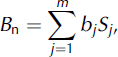
where Sj and bj are the area of altitude zone j and the corresponding mass balance, respectively, and m is the number of glacier altitude intervals. The altitude interval used here is about 50 m. Figure 2 shows the annual mass balance, cumulative mass balance and 5 year running mean mass balance of UG1 during the period 1959−2002. The cumulative mass balance reached −9599 mm w.e., and there were 29 negative balance years during the period. Moreover, there were only 5 years with weak positive mass balance after 1980. There was a strong negative annual mass balance of –425.6mma−1 during the period 1985–2002, 351.1 mma−1 more negative than the mean mass balance of –74.5mma−1 during the period 1959–84. The annual mean value of 739.6 mma−1 during the period 1997–2002 points to a particularly strong climatic warming in the last 5 years.
Mass-balance variations of UG1, 1959–2002.

The results of the spectral analysis (not shown) indicate that the mass balance of UG1 has a significant periodicity of 7 and 15 years. Reference Yang, Li, Ye, Jiao and ZhaoYang and others (2005) also report a periodicity of 3, 5 and 7 years of negative mass balance on the glacier.
3.1.2. Relationship between mass balance and air temperature and precipitation
Situated in the interior of the Tien Shan, UG1 is mainly affected by westerly airflow. The climate from October to March is very cold, with little precipitation; most precipitation occurs in summer from June to August, a period of strong ablation and accumulation. Both temperature and precipitation are important factors affecting the mass balance. Partial correlation analyses show that the mass balance is mainly influenced by summer mean air temperature from June to August, when the correlation coefficient is –0.62 (significant at the 99% level). However, the correlation coefficient between annual mass balance and precipitation in the same period is as low as 0.19, without statistical significance.
Air temperature has been rising continuously since the late 1970s, especially in winter (Reference Liu, Wang and DingLiu and others, 1999; Reference Han, Ye and JiaoHan and others, 2002), accentuating glacier shrinkage (Reference Li, Han, Jing, Yang and JiaoLi and others, 2003). Precipitation has also increased during this time, but the mass balance is still unprecedentedly negative. The glacier mass balance was clearly affected much more by the warming than by the precipitation increase. Strong melting is mainly responsible for the significantly negative mass balance after 1997.
The air-temperature increase preceded the precipitation increase. Figure 3a and b shows the relationship between annual mass balance, mean air temperature and precipitation from June to August (JJA). It is evident that the glacial ablation increase coincides with the temperature increase, which started in the late 1970s and accelerated in the mid-to late 1990s. The precipitation increase started only in the late 1980s.
Relationship between mass balance of UG1 and temperature (σ) and precipitation (b) in summer, 1959–2002.

3.1.3. Spatial variations of mass balance
The mass-balance data (1980–2002) measured with the stake network on the glacier surface were used to identify the spatial patterns of mass-balance variations. The mass balance was negative over the whole glacier during the period 1997–2002, so the strong warming influenced not only the ablation rate but also the ablation area.
The spatial pattern of mass balance shows a clear seasonality. When glacial ablation strengthens, the accumulation rate is also high; as a result, the mass-balance gradient increases (Reference Liu, Xie and WangLiu and others, 1997). The spatial pattern of mass balance also exhibits a marked interannual variation (Fig. 4). Amplitudes of annual mass-balance variation are –2526.6 and –2095.2 mm in the ablation zones of the east and west branches, respectively, while in the accumulation zone they are 1210.4 and 1209.2 mm, respectively (Table 1). Amplitudes of ablation rate show a difference between the east and west glacier branches, while amplitudes of accumulation rate are similar in the two branches. Amplitudes of ablation rate in the ablation zones are greater than amplitudes of accumulation rate in the accumulation zone. The glacier ablation in the accumulation zone is large when the glacier shows a strong negative annual mass balance.
Annual mass balance of UG1 at different altitudes, 1980–2002: (σ) east branch; (b) west branch.

The amplitudes of maximum and minimum mass balance in the ablation and accumulation areas of UG1, 1980–2002

3.2. Monthly mass balance
3.2.1. Characteristics of mass balance
The monthly mass balance of UG1 shows a clear seasonality. Weak accumulation and ablation occurs in winter from October to March, and mean accumulation rates are <1.5mmd−1. Moderate accumulation and ablation occurs in spring from April to May, with a mean accumulation rate of >2mm d−1, and ablation occasionally occurs through melting of fresh snow. Strong accumulation and ablation occurs in summer from June to August, with the greatest ablation rate in July. The mean ablation rate ranges from 5 to 11 mmd−1 in the ablation area of the glacier, whereas the accumulation continuously increases in the accumulation area at 3–6 mm δ−1. Moderate ablation also occurs in autumn, especially in September. The ablation rate is generally <3 mm δ−1, while the accumulation rate in the accumulation area is 1.5–2.0mm d−1 (Reference Liu, Xie and WangLiu and others, 1997).
3.2.2. Relationship between mass balance and air temperature and precipitation
Due to low air temperature, the glacier mass balance in May–June is mostly slightly positive (Fig. 5), but July–August is a strong ablation period, with a mass-balance variation similar to that of the annual mass balance. This probably implies that the period July–August has a pronounced effect on the yearly variation of mass balance.
Monthly mass balance of UG1, May–August 1989–2002: (σ) west branch; (b) east branch.

As precipitation and melting are both strong in the summer season, the variation of glacier mass balance depends on both factors. Precipitation and air temperature impose varying controls on the glacier mass balance in different months. Partial correlation analyses are used to detect the effect between mass balance, air temperature and precipitation in different months. Results show that the relationship between monthly mass balance and monthly mean air temperature from May to August is negative (significant at the 99% confidence level in July and August and at the 90% confidence level in May and June). This means that higher temperature indicates stronger ablation from May to August, and vice versa. In addition, the correlation coefficient between monthly mass balance and monthly precipitation is negative in May and August (significant at the 95% confidence level), perhaps due to concurrent air-temperature changes. The monthly precipitation and mass balance in June and July exhibit a weak positive correlation. The results reveal that the glacier mass balance is influenced mainly by air temperature.
3.2.3. Spatial variations of mass balance
The spatial pattern of the glacier mass balance varies from season to season. The variation of the spatial pattern of the glacier mass balance throughout the year can help to explain the response of the glacier to seasonal climatic transitions. The monthly mass balances in 1993 and 2001 were used to represent the general characteristics before and after the glacier separated into two branches (Fig. 6).
(a,b) Monthly mass balance of UG1 in 1993: (σ) west branch; (b) east branch. (c,d) Monthly mass balance of UG in 2001: (c) west branch; (d) east branch.

The spatial patterns of mass-balance variations are much smaller in May and June than in July and August (Fig. 6). The accumulation rate is small in the accumulation zone, so strong ablation leads to a large decrease in accumulation area. The accumulation zone area was 1.27 and 0.65 km2 (total of west and east branches of UG1) in 1993 and 2001 respectively (Tien Shan Glaciological Station, 2002). In addition, the glacier equilibrium line has been rising since 1996 (Reference Han, Liu, Ding and JiaoHan and others, 2005). The equilibrium-line altitude of UG1 was 3980 and 4137ma.s.l. in 1993 and 2001, respectively.
3.3. Daily characteristics of ablation
The variation of daily ablation of the glacier shows a negative correlation with daily mean air temperature (r = –0.41) but a positive correlation with daily precipitation (r = 0.46) (Fig. 7), both of which were statistically significant at the 99% confidence level. This shows that daily ablation is affected by both air temperature and precipitation. Furthermore, the correlation analysis indicates that accumulated ablation (B t) is significantly and positively correlated with accumulated positive temperature (T) at the 99% significance level (Fig. 8), a relationship which can be expressed as:

The observational and statistical analyses reveal that air temperature is mostly above average when the glacier is free of snow on the surface, and glacier ablation is then more severe, with a maximum rate of 50−60 mm d−1. The decreased albedo of the glacier surface leads to stronger ablation due to more heat input from solar radiation.
(σ) Daily precipitation and (b) daily temperature and mass balance of UG1, 29 June–5 September 1989.

Cumulative daily mass balance vs cumulative positive daily temperature, 29 June–5 September 1989.

4. Discussion and Conclusions
Glacier mass-balance variations are affected by annual precipitation and summer mean temperature. A number of other factors may also influence the glacier mass balance, such as short- and longwave radiation (especially related to cloud cover), albedo, wind speed, ice temperature, evaporation and sublimation. Calculating the heat budget of the glacier will require considering other factors including precipitation and ice volume, in particular if melting and runoff are considered. This research emphasizes the characteristics of different temporal and spatial variations of mass balance on UG1.
Results show that the correlation between monthly mass balance and monthly precipitation is negative in May and August, probably because heavy precipitation occurred contemporaneously with high temperatures in May and August.
The observed data show that the accumulated mass balance of UG1 was −9599 mm w.e. during the period 1959−2002. The mass balance of UG1 has shown an accelerated negative trend since 1985, and the mean negative mass balance was −739.6 mm a−1 during the period 1997−2002. Weak mass gain occurred only in five of the years 1980−2002. Climate warming not only enhanced the ablation, but also increased the ablation area. The glacier mass balance shows a clear periodicity, with alternating 7 and 15 year cycles over the past several decades.
Annual mass balance is significantly correlated with mean air temperature in summer (r = - 0.62 , a = 0.01). However, it also shows a weak correlation, or even no correlation, with precipitation from June to August. This implies that the influence of increasing temperature on the mass balance overcame that of increasing precipitation. Furthermore, mass balance is shown to be influenced more by annual air temperature than by precipitation.
Monthly mass balance exhibits a negative correlation with monthly mean air temperature; in particular, the correlation coefficient in July and August exceeds the 99% confidence level. Strong ablation of the glacier began in the late 1970s, while a significant increase in precipitation occurred in the late 1980s. The correlation between monthly mass balance and precipitation shows a weak negative correlation in May and August (a = 0.05), but a positive correlation in June and July. There is a clear rising trend in the equilibrium-line altitude of UG1, due to climate warming.
The correlation between the daily accumulated ablation and the positive daily accumulated temperature was remarkable, with a correlation coefficient of −0.995 (a = 0.01).
Acknowledgements
This work was supported by the Knowledge Innovation Program of the Chinese Academy of Sciences (KZCX3-SW-345), the Key Open Laboratory of Atmospheric Chemistry of China Meteorological Bureau (project CCSF2005-3-DH17) and the National Natural Science Foundation of China (project 40371026, 40371028). The authors thank M. Vuille for editing and improving the English.



