




1. Introduction
The Chichicastenango dialect of K’iche’ (ISO639-3 QUC) is known among Mayan languages for its tense–lax vowel system, which replaced a historical length contrast (López Ixcoy Reference López Ixcoy1994; Par Sapón & Can Pixabaj Reference Par Sapón and Angelina Can Pixabaj2000; Can Pixabaj Reference Can Pixabaj2017; England & Baird Reference England, Baird and Judith Aissen2017), as also occurred in the closely related language Kaqchikel (Majzul, García Matzar & Espantzay Serech Reference Majzul, Matzar and Espantzay Serech2000; Bennett Reference Bennett2016a). Like other Mayan languages, K’iche’ also has a set of words with vowels produced with laryngealized phonation towards the end of the vowel, which have been alternately analyzed as either two segments – a vowel followed by a glottal stop – or one segment – a phonemically glottalized vowel (Baird Reference Baird2011). In Chichicastenango K’iche’, these vowels appear to have lax quality for high and mid vowel pairs but tense quality for the central pair, and although they are perceptually distinct from plain (tense or lax) vowels, full glottal closures appear to be very uncommon. The only existing acoustic study of vowels in the language is a pilot study of tense and lax vowels (Wood Reference Wood2020). Therefore, many aspects of this system remain unclear. This paper presents an acoustic analysis of vowel quality, duration, and voice quality in Chichicastenango K’iche’ (henceforth CK) vowels through a controlled speech production experiment.
The paper is organized as follows. Section 2 provides background on the consonants and vowels of CK, contextualized within the Mayan language family and cross-linguistic patterns. Section 3 details the methods used for the production experiment, and Section 4 describes the results. Section 5 discusses some major aspects of these results, focusing on the evidence for ongoing mergers of the high lax vowels with surrounding vowels and the implications of the vowel quality and voice quality results for the analysis of glottalized vowels. Section 6 concludes the article. The appendix includes additional statistical results excluded from the main text. The supplementary materials include audio examples for all CK words cited throughout the paper. When possible, all examples come from the experimental data; otherwise, they come from elicitation sessions or spontaneous speech recorded by the author in Chichicastenango between 2018–2025.Footnote 1
2. Background: Chichicastenango K’iche’ sounds in Mayan and cross-linguistic perspective
The consonant inventory of K’iche’ is shown in Table 1. Where different from the IPA, the orthographic symbols are included in < >.
K’iche’ consonant inventory

Table 1 Long description
The table presents the consonant inventory of Kiche, detailing various consonants categorized by their place of articulation (Bilabial, Alveolar, Postalveolar, Palatal, Velar, Uvular, Glottal) and manner of articulation (Plain stop, Glottalized stop, Plain affricate, Glottalized affricate, Fricative, Nasal, Approximant, Lateral). Each cell specifies the corresponding consonant symbol, with orthographic symbols in angle brackets where they differ from the International Phonetic Alphabet (IPA). The table includes 8 columns for different places of articulation and 8 rows for different manners of articulation, providing a comprehensive overview of Kiche consonants. Row 1: Plain stop, p, t, , k, q, <>. Row 2: Glottalized stop, <b>, t, k, q, , . Row 3: Plain affricate, ts, <tz>, t, <ch>, , , . Row 4: Glottalized affricate, ts, <tz>, t, <ch>, , , . Row 5: Fricative, , s, <x>, <j>, , , . Row 6: Nasal, m, n, , , , , . Row 7: Approximant, w, <r>, , j, <y>, , . Row 8: Lateral, , l, , , , , .
Stops and affricates contrast a plain series with a series referred to as ‘glottalized’ in the Mayanist literature (Bennett Reference Bennett2016b). In CK, like other Mayan languages, most of the glottalized consonants are ejective, but the bilabial is usually realized as a voiced implosive. With the exception of the bilabial implosive, all obstruents are voiceless and all sonorants voiced. All voiced consonants except for the nasals are sometimes devoiced in word-final position, though this appears to occur much less frequently than in related languages (Bennett Reference Bennett2016b).
Most K’iche’ dialects have vowels at five places of articulation /i e u o a/ with a phonemic length contrast (Par Sapón & Can Pixabaj Reference Par Sapón and Angelina Can Pixabaj2000). In CK, however, the length contrast has been replaced by a contrast in quality, with historic long vowels appearing as ‘tense’ /i e u o a/ and historic short vowels as ‘lax’ /ɪ ɛ ʊ ɔ ə/ (<ï eë ü ö ä>) (López Ixcoy Reference López Ixcoy1994; Par Sapón & Can Pixabaj Reference Par Sapón and Angelina Can Pixabaj2000; Can Pixabaj Reference Can Pixabaj2017; England & Baird Reference England, Baird and Judith Aissen2017). A pilot speech production study of CK showed that tense vowels are overall more peripheral and lax vowels more centralized, but the relative contributions of F1, F2, and duration could not be determined due to the small size of the dataset and considerable variation across speakers and vowel pairs (Wood Reference Wood2020). Furthermore, the high front lax vowel /ɪ/ in this data appeared to be merging with surrounding categories /i/ and /ə/, with variation observed across speakers and items.
The tense–lax contrast is important in the grammar of CK in several ways. The stress pattern of verbs prioritizes tense over lax vowels, e.g., stress is on the tense vowel /u/ in the penultimate syllable of jumaj /χumaχ/ [ˈχu.maχ] ‘to throw’, but on the final syllable of knaj /kʊnaχ/ [k.ˈnaχ] ‘to heal’, where the penultimate vowel is lax (see Wood Reference Wood2024 for a more detailed description of stress in the language). Lax vowels in CK are regularly deleted in unstressed, non-final open syllables, but tense vowels strongly resist deletion (Wood Reference Wood2024). Tense and lax vowels also alternate in a number of phonological and morphological contexts. Lax vowels are realized as the corresponding tense pair when word-initial, e.g. atz’yäq [at͡s'.ˈjəq] ‘clothing’ beginning with [a] vs. wätz’yaq [wət͡s'.ˈjaq] ‘my clothing’ where the first vowel is realized as its underlying lax quality [ə] due to the presence of an initial consonant. Many nouns have lax vowels in their final syllable which become the corresponding tense vowel when the noun is possessed; the same pattern is found with vowel length in other K’iche’ dialects (Can Pixabaj Reference Can Pixabaj2017). This alternation can be seen in the second syllable of the word for ‘clothing’ mentioned previously. Lax vowels in CVC transitive roots become tense in the passive form; this alternation again occurs with vowel length in other K’iche’ dialects, e.g., xäkk’äm [ʃək.ˈk'əm] ‘they took it’ with the lax vowel [ə] in the root /k'əm/ ‘take’ vs. kik’am [ki.ˈk'am] ‘they are taken’ with corresponding tense vowel [a].
The terms “tense” and “lax” have been used to describe a wide range of phonetic contrasts in different languages, including various combinations of vowel height (e.g., Dalton Reference Dalton2011), duration (e.g., Bennett Reference Bennett1968), tongue root position (e.g., Fulop, Kari & Ladefoged Reference Fulop, Kari and Ladefoged1998) and voice quality (e.g., Di Paolo & Faber Reference Di Paolo and Faber1990). In Kaqchikel and other Mayan languages with quality contrasts beyond the five canonical vowels /a e i o u/, the terms refer to a centralization contrast, where tense vowels are more peripheral and lax vowels are in some sense more central (closer to the center of gravity of the vowel space) (Bennett Reference Bennett2016a; England & Baird Reference England, Baird and Judith Aissen2017). It is worth noting that in this usage, lax vowels are not universally lower than their tense counterparts, as the lax partner of tense /a/ is /ə/, /ɨ/ or otherwise higher than /a/. Bennett (Reference Bennett2016a) finds a duration difference of about 20 ms between the tense and lax central vowel pair in Kaqchikel, but no significant differences between the tense and lax high and mid vowel pairs. This difference is much smaller than the 30–50 ms difference found for stressed tense and lax vowels in English (Peterson & Lehiste Reference Peterson and Lehiste1960; van Santen Reference van Santen1992), which, like those of Kaqchikel and CK, come historically from a length contrast (see e.g. Bennett Reference Bennett2016b on Mayan, Hogg Reference Hogg2012 on English). ATR systems, where tongue root position creates the contrast between the pairs, are not typically accompanied by duration contrasts (Hess Reference Hess1992; Guion, Post & Payn Reference Guion, Post and Payn2004; Przezdziecki Reference Przezdziecki2005; Starwalt Reference Starwalt2008; Koffi Reference Koffi2016; Kirkham & Nance Reference Kirkham and Nance2017). Because of the wide variety of ways in which different languages implement fine-grained quality contrasts, it is not immediately obvious whether duration differences should be expected between CK tense and lax vowels. However, if there are such differences, tense vowels are expected to be longer in keeping with their more peripheral vowel quality and historical origin as long vowels.
K’iche’, like other Mayan languages, has a number of words that have been analyzed as containing vowels followed by a complex coda in which the first consonant is a glottal stop, e.g., pö’t /pɔʔt/ ‘huipil’. These same words have alternately been analyzed as having phonemically glottalized vowels, e.g. /pɔ̰t/. Which analysis is preferable continues to be a contested question in Mayan linguistics (Sobrino Gómez & Bennett Reference Sobrino Gómez, Bennett, Arellanes, Hernández and Hernándezsubmitted). In K’iche’, glottal stop is clearly a consonant in some contexts. For instance, when epenthesized to stressed vowel-initial words, it permits the realization of the preceding indefinite article jün /χʊn/ as ju [χu], without its final consonant. This is not permitted before vowel-initial words, e.g., ju ‘ik’ [χu ʔik'] ‘a month’, ju kär [χu kəɾ] ‘a fish’, but jün ixöq [χʊn iʃɔq] ‘a woman’ (for evidence that word-initial glottal stops are epenthetic in these cases, see Wood Reference Wood2024 on CK and Bennett Reference Bennett2016b on cross-Mayan patterns). Glottal stop can also appear intervocalically, whereas vowel hiatus is strictly avoided within words, e.g., mi’al [miʔal] ‘daughter’, u’al [uʔal] ‘broth’. One method of resolving vowel hiatus is through glottal stop insertion, e.g., ki’el /kiel/ [kiʔel] ‘they go out’.Footnote 2 Finally, many CVC roots – the canonical root shape in Mayan languages (England & Baird Reference England, Baird and Judith Aissen2017) – have a glottal stop as the final consonant. Unlike the potentially phonemically glottalized vowels, which are always lax (with the exception of [a], discussed further below), the vowels in these roots may be tense or lax in CK, just as occurs preceding any other final consonant in the language, e.g., no’ [noʔ] ‘no’ vs. jö’ [χɔʔ] ‘let’s go’, si’ [siʔ] ‘firewood’ vs. kï’ [kɪʔ] ‘sweet’. In contrast to these clearly consonantal uses of glottal stop, it is not clear whether the glottalization that occurs in words like ‘huipil’ should be considered a consonant or a vocalic feature.
Acoustic analysis of the Ixtahuacán and Cantel dialects of K’iche’ shows that words with glottalized vowels are most commonly produced with a full glottal stop at or towards the end of the vowel, though sometimes with creaky voicing towards the middle or end of the vowel with no complete closure (Baird Reference Baird2011). No previous acoustic studies exist of glottalized vowels or post-vocalic glottal stop in CK. Wood (Reference Wood2020, Reference Wood2024) shows that word-initial glottal stops are rarely produced as a full closure in CK, with the most common realization being glottalized phonation on the initial vowel. (As will be shown in this study, ‘glottalized’ vowels in CK are also practically never realized with a full closure, despite the very similar research methods and expected speech genre compared to Baird’s (Reference Baird2011) work on other K’iche’ dialects.)
As noted above, the question of whether there are phonemically glottalized vowels, or rather these are simply sequences of vowels and glottal stops, is an issue across the Mayan language family, and both the surface facts as well as their phonological analysis remain controversial (Baird & Pascual Reference Baird and Francisco Pascual2011; Bennett Reference Bennett2016b; England & Baird Reference England, Baird and Judith Aissen2017; DiCanio & Bennett Reference DiCanio, Bennett, Gussenhoven and Chen2021; Sobrino Gómez & Bennett Reference Sobrino Gómez, Bennett, Arellanes, Hernández and Hernándezsubmitted). In some languages, various phonological patterns relating to stress assignment, neutralization in unstressed syllables, and root phonotactics suggest that [ʔ] behaves at least sometimes as a vowel feature (England & Baird Reference England, Baird and Judith Aissen2017; Sobrino Gómez & Bennett Reference Sobrino Gómez, Bennett, Arellanes, Hernández and Hernándezsubmitted). Few acoustic studies exist of glottal stop or vowel glottalization in Mayan languages. Baird & Pascual (Reference Baird and Francisco Pascual2011) show that in Q’anjob’al full closures are about as frequent as other types of glottalized phonation without a full closure, and full closures are most likely in word-final position. In Yucatec Maya, comparable tokens are usually produced with creaky voicing on the second part of the vowel but no full closure (Frazier Reference Frazier2009). A different phonological status does not necessarily correlate with a different phonetic realization in Mayan languages, as both full closures as well as reduced productions can be found for both clearly consonantal instances of [ʔ] as well as those that behave phonologically as vowel features (Sobrino Gómez & Bennett Reference Sobrino Gómez, Bennett, Arellanes, Hernández and Hernándezsubmitted).
Cross-linguistically, the phonetic realization of a glottal stop, even when clearly functioning as a consonant, is highly variable. In many different languages, it has been shown that what is analyzed phonologically as a glottal stop is often or usually realized as glottalized phonation (creaky voice, tense voice, aperiodic voice, or other realizations of greater glottal constriction) on the adjacent vowels or other sonorants, without a complete closure (Priestly Reference Priestly1976; Kohler Reference Kohler1994; Ladefoged & Maddieson Reference Ladefoged and Maddieson1996; Alber Reference Alber2001; Quick Reference Quick2003; Pompino-Marschall & Zygis Reference Pompino-Marschall and Zygis2011; DiCanio Reference DiCanio2012; Garellek Reference Garellek2014; Whalen et al. Reference Whalen, DiCanio, Geissler and King2016; Esling et al. Reference Esling, Moisik, Benner and Crevier-Buchman2019; Mitterer, Kim & Cho Reference Mitterer, Kim and Cho2019; Davidson Reference Davidson2021). Phonemically glottalized vowels and other sonorants may also have varied realizations, from apparently modal voicing, to creaky or other types of laryngealized phonation, to full glottal closures (Bird Reference Bird2011; Davidson Reference Davidson2020). The timing of the non-modal phonation also varies: within a glottalized vowel, the glottalized portion often does not cover the full vowel segment, but may be present only at the beginning, middle, or end of the vowel (Davidson Reference Davidson2020). Laryngeal phenomena of many types are very common in Mesoamerican languages, affecting both vowels and consonants, and many aspects of these systems remain poorly understood, including their timing and their interaction with tone and other prosodic phenomena (DiCanio & Bennett Reference DiCanio, Bennett, Gussenhoven and Chen2021).
The following section describes the methods used for the acoustic study of vowels in CK. This study addresses the following questions: (i) What is the difference in vowel quality between tense and lax vowels? (ii) Does the vowel /ɪ/ have a distinct quality or is it merged or merging with surrounding categories, as suggested by pilot data (Wood Reference Wood2020)? (iii) Are there duration differences between tense and lax vowels? (iv) Do glottalized vowels have either tense or lax vowel quality? (v) Are glottalized vowels produced with a full glottal closure or other types of glottalization? (vi) Is there any acoustic evidence that favors a one-segment or two-segment analysis of glottalized vowels?
For the purposes of disambiguating potentially phonemically glottalized vowels from cases that are clearly vowel–glottal stop sequences, the former will be represented as V̰ throughout the remainder of the text, and the latter as Vʔ. Whether glottalized vowels are in fact better analyzed as one segment, or a sequence of segments, will be returned to in the discussion.
3. Methods
3.1 Experimental design
Six words were included in the experiment for each tense or lax vowel phoneme, with the exception of lax /ɪ/ for which nine words were included due to its apparent ongoing merger with surrounding vowels. Each of these words were common monosyllabic nouns or adjectives with surface shape (C)CVC, chosen with the goal of being known by all speakers and easy to translate from Spanish.Footnote 3 Five items were included for each of the glottalized vowel phonemes due to the smaller number of words of this type and resulting difficulty finding appropriate items. Each of the words with glottalized vowels were monosyllabic or disyllabic nouns or adjectives, where the relevant syllable was of the shape (C)CV̰C. In the case of disyllables, the target vowel was always in the second, stressed syllable. The items are shown in Table 2, with the total number of tokens of each item included in the experiment (more on data inclusion and exclusion below).
Items and token counts included in the experiment

Table 2 Long description
A table with four rows and three columns displaying items and token counts included in the experiment. The table is divided into three sections: High front, High back, Mid front, Mid back, Low central. Each section lists words with their respective token counts for tense, lax, and glottalized vowels. The table includes words like 'firewood', 'sheep', 'cypress', 'chile', 'shoulder bag', 'thorn' for high front tense vowels, and their corresponding token counts. Similar data is presented for other vowel categories. The total token counts for each category are also provided at the bottom of the table.
Many of the experiment items include vowels adjacent to uvular consonants, which tend to have strong coarticulatory effects on vowels in many languages (e.g., Zawaydeh Reference Zawaydeh1997; Gordon, Barthmaier & Sands Reference Gordon, Barthmaier and Sands2002; Wilson Reference Wilson2007; Evans et al. Reference Evans, Sun, Chiu and Liou2016; Holliday & Martin Reference Holliday and Martin2018). Uvular consonants are very frequent in CK, and therefore it would be very difficult to exclude them entirely. In particular, many of the words with the mid front vowels /e/ and /ɛ/, which are especially uncommon in the language, have uvular consonants. In order to account for these and other potential coarticulatory effects, the place of articulation of adjacent consonants was included in the statistical models, as discussed further below, and an effort was made to include items with uvular consonants for every phoneme. Similarly, a number of items followed by glottal stop were included in order to facilitate understanding the behavior of the vowel /ɪ/, which appeared in the pilot study data to be merging with surrounding categories. It was noticed that words with /ɪ/ followed by a glottal stop tended to sound [e]-like, whereas in other contexts they tended to sound [i]- or [ə]-like. In addition to a number of /ɪ/ items preceding glottal stops, instances of other front and central vowels preceding glottal stops were included in the study where possible. Notably, no words were found with [əʔ] sequences, a fact which will be returned to in the discussion. [ɛʔ] sequences occur in the language but no suitable common nouns or adjectives were identified and therefore they are also absent in the experiment data.
The phonemic identity of each vowel was determined through perceptual judgments, supported, where possible, by cross-dialectal comparison. The majority of the words can be found in Ajpacajá Tum et al.’s (Reference Ajpacajá Tum, Chox Tum, Tepax Raxulew and Guarchaj Ajtzalam2005) dictionary, with lax vowels corresponding to short vowels, tense vowels to long vowels, and glottalized vowels to vowel–glottal stop sequences (all of which include short vowels). Others appear in Christenson’s (unpublished) dictionary, although this source does not distinguish tense and lax vowels except for the central pair. A few items show some differences compared to the forms found in the dictionaries: in the dictionary entries, /kʊ̰t/ ‘one-handed’ has no glottalization, /t͡ʃ'ɔχ/ ‘fight’ does have glottalization, /mɔ̰s/ ‘ladino’ appears with a high rather than mid vowel, /k'ɛq/ ‘flea’ and /kɛq'/ ‘guava’ appear with low vowels, and /t͡sɛ̰n/ ‘laughter’ has no final nasal.Footnote 4 Finally, some words appear to be specific to CK or missing from the dictionaries for unknown reasons: /tuʃ/ ‘hen’, /qʊ̰l/ ‘turkey’, and /mam/ ‘rooster’.
Tense, lax, and glottalized vowels occur in both stressed and unstressed syllables in CK. Examples of each type of vowel in an unstressed syllable include ch’ab’äl [t͡ʃ'a.ˈɓəl] ‘language’, wächb’äl [wət͡ʃ.ˈɓəl] ‘image’, na’tsb’äl [na̰t.s(ə).ˈɓəl] ‘reminder’. However, the experimental data is restricted to stressed syllables due to time constraints and with the goal of comparing the most hyperarticulated tokens, where the contrast between categories is expected to be clearest.
The words were elicited through a translation task from the Spanish, the contact language in which most K’iche’ speakers, and all experiment participants, are fluent.Footnote 5 Each word with a tense or lax vowel was placed into a frame sentence of the structure ‘There is (a) [target noun] [locative phrase]’ or ‘There is (a) [target adjective] [noun] [locative phrase]’. Each word with a glottalized vowel was placed into a frame sentence of the structure ‘I [past tense verb] (a/the) [target noun] [oblique phrase]’ or ‘I [past tense verb] (a/the) [target adjective] [noun] [oblique phrase]’. Full verbs were used instead of existential structures for words with glottalized vowels to allow greater flexibility in the meanings of the target words, e.g., including some abstract nouns such as ‘hatred’ and ‘laughter’. However, the basic prosody and word order of both sentence structures is the same.
The sentences were shown on a computer screen with an accompanying image of the target word intended to stimulate lexical access. The sentences were displayed in a random order for each participant. Examples are shown in Figure 1.
Example stimuli for a noun with a plain vowel (sak’ ‘grasshopper’, top left), adjective with a plain vowel (q’ëq ‘black’, top right), noun with a glottalized vowel (xpa’ch ‘lizard’, bottom left), and adjective with a glottalized vowel (chqï’j ‘dry’, bottom right)

Figure 1 Long description
The top left image shows a green grasshopper on grass. The top right image features a black cat sitting on a bed. The bottom left image displays a lizard on a rock. The bottom right image depicts a person hanging clothes on a line and then placing them in a wardrobe.
Participants were asked to read the sentence in Spanish (in their head or out loud) and then produce the K’iche’ translation, saying it twice. Participants were recorded with an H4n digital recorder at a sampling rate of 44.1 kHz and wore a Shure SM10A headset microphone to limit background noise. If the participant could not think of the translation of a word, the researcher (a non-native speaker of K’iche’) hesitantly suggested the target word, such as ‘¿se podría decir algo como X? (‘would it be possible to say something like X?’). Otherwise, the researcher did not interfere in the productions.
In total, 11 participants were included in the study (eight female, three male). Their ages ranged from young adults to middle aged. All were native speakers of K’iche’ from the Chichicastenango area (city center or dependent rural communities). Within Chichicastenango, K’iche’ is the default language among most adults both at home and in public, and all experiment participants regularly used the language in their daily lives. All participants provided informed consent to participate, and the study was conducted under the approval of the University of Texas at Austin, Institutional Review Board. All data was collected in Chichicastenango in March 2023.
3.2 Data inclusion
Participants often produced variations of the target sentence, such as changing the order of constituents (K’iche’ has a relatively free word order), adding morphemes to the target word (possessive prefixes on nouns and superlative suffixes or status suffixes on adjectives), adding additional words or phrases, or substituting words for synonyms or related words. All productions that included the target word were included in the study unless they were nouns produced with a possessive prefix where the possessed form of the noun has a different vowel quality, e.g. chkäch [t͡ʃkət͡ʃ] ‘basket’ vs. qächkach [qət͡ʃkat͡ʃ] ‘our basket’ (15 exclusions). With this exclusion and missing data from participants who did not produce the target word in the sentence, a total of 1,235 tokens were included in the analysis. The number of tokens for each item is shown in Table 2 above. It may be noted that for two items, ‘money’ and ‘nice’, no speakers produced the intended target word without a change in vowel quality caused by possession, and therefore no tokens of these two items were ultimately included in the analysis.
3.3 Segmentation and annotation
The beginning and end of each included vowel segment was marked in Praat (Boersma & Weenink Reference Boersma and Weenink2023). Following a glide, the boundary was placed 30% of the way through the glide–vowel portion, as the transition between the two segments was typically gradient and smooth.Footnote 6 The boundary between a vowel and a glottal stop realized with a full closure was placed at the onset of silence (at least 20 ms). Otherwise portions of glottalized phonation were included in the vowel. If two vowels were separated by a glottal stop realized as a period of glottalized phonation without complete closure, the boundary between them was placed at the beginning of the longest pulse in the glottalized section. This metric was chosen in order to approximate the point of greatest glottal constriction as well as to have a consistent and replicable metric, as the transition between glottalized and modal phonation was typically gradient. In all other contexts the segmentation was done with reference to the amplitude: where the amplitude begins to increase following an affricate, fricative, or sonorant, after the burst following a stop, and where the amplitude stops decreasing preceding a stop, affricate, fricative, or sonorant. These changes in amplitude seemed to the author to be more consistent, visually salient, and objectively determinable than changes in the formant structure, e.g., F2, commonly used in phonetic research (Machač & Skarnitzl Reference Machač and Skarnitzl2009). Examples of segmentation are shown in Figure 2. The spectrograms shown here and throughout the paper were made with Elvira García’s (Reference Elvira García2022) Create pictures with tiers Praat script.
Examples of vowel segmentation. After a glide and before a fricative in wäj [wəχ] ‘my fresh corn’ (top left), after a glottal stop and before a fricative in ju oj [χu ʔoj] ‘an avocado’ (top right), before and after an ejective stop in t’ot’ [t’ot'] ‘snail’ (bottom left), after an affricate and before a nasal in chim [t͡ʃim] ‘bag’ (bottom right).

Figure 2 Long description
The image contains four spectrograms, each illustrating vowel segmentation in Chichicastenango Kiche. The top left spectrogram shows the vowel segmentation after a glide and before a fricative in the word 'wj' meaning 'my fresh corn.' The top right spectrogram depicts the vowel segmentation after a glottal stop and before a fricative in the word 'ju oj' meaning 'an avocado.' The bottom left spectrogram illustrates the vowel segmentation before and after an ejective stop in the word 'tot' meaning 'snail.' The bottom right spectrogram shows the vowel segmentation after an affricate and before a nasal in the word 'chim' meaning 'bag.' Each spectrogram includes a waveform at the top and a detailed frequency analysis below, highlighting the specific phonetic contexts and vowel qualities.
Each vowel was categorized according to the following factors relevant to the statistical analysis, as explained below:
-
• Speaker and item
-
• Category: tense /i u e o a/, lax /ɪ ʊ ɛ ɔ ə/, glottalized (/ɪ̰ ʊ̰ ɛ̰ ɔ̰ a̰/)
-
• Height: high (/i u ɪ ʊ ɪ̰ ʊ̰/), mid (/e o ɛ ɔ ɛ̰ ɔ̰/), low (/a ə a̰/)
-
• Frontness: front (/i e ɪ ɛ ɪ̰ ɛ̰/), central (/a ə a̰/), back (/u o ʊ ɔ ʊ̰ ɔ̰/)
-
• Place of articulation of preceding and following consonant: bilabial, alveolar, postalveolar, velar, uvular, glottal
-
• Laryngeal state of preceding and following consonant: voiced sonorant, voiceless obstruent, glottalized obstruent
-
• Order of production (instance of the sentence produced by the speaker): first, second
-
• Following pause (at least 200 ms): yes, no
-
• Added suffix: yes, no
-
• Added prefix: yes, no
Coding of different types of glottalization

Table 3 Long description
A table categorizing different types of glottalization with evidence for each category. The table has four rows and two columns. The first column lists the categories: Full closure, Creaky voice, Intensity dip, and Apparently modal voice. The second column provides evidence for each category. Full closure is defined by at least 20 milliseconds of silence or a single glottal pulse followed by silence. Creaky voice is characterized by clearly laryngealized phonation without complete closure. Intensity dip is described as a dip in the intensity curve towards the middle of the vowel. Apparently modal voice shows no visible indications of glottalized phonation. The table aligns with past studies of glottal stops and glottalized vowels in Mayan languages to facilitate comparisons across languages.
Additionally, glottalized vowels and plain vowels followed by a glottal stop coda were categorized according to the phonetic type of glottalization observed in that token, as detailed in Table 3. Classification was carried out through visual inspection of the waveform and spectrogram, paying special attention to the second half of the vowel, as glottalized phonation occurred primarily towards the middle or end of the vowel segment across tokens. When multiple types were observed in a given token, it was coded according to the dominant pattern.
Examples of each of these categories are shown in Figure 3.
Full closure in ch’a’k /t͡ʃ'a̰k/ ‘sore’ (top left; 22 ms between two pulses towards the center of the vowel); creaky voice in pö’t /pɔ̰t/ ‘huipil’ (top right); intensity dip in sü’t /sʊ̰t/ ‘cloth’ (bottom left); apparently modal voice in the second syllable of t’isö’n /t’isɔ̰n/ ‘sewing’ (bottom right).

Figure 3 Long description
The image contains four spectrograms, each paired with a waveform and intensity level graph. The top left spectrogram shows full closure in the sound /t'ak/ with a 22-millisecond gap between two pulses towards the center of the vowel. The top right spectrogram illustrates creaky voice in the sound /pt/ huipil. The bottom left spectrogram displays an intensity dip in the sound /st/ cloth. The bottom right spectrogram presents apparently modal voice in the second syllable of the sound /tisn/ sewing. Each spectrogram spans a frequency range from 0 to 5000 hertz and a time range from 0 to 0.5 seconds. The intensity levels are measured in decibels, ranging from -60 to -20 decibels. The waveforms show variations in amplitude over time, while the spectrograms depict the frequency components of the sounds. All values are approximated.
It is worth noting that it is possible that glottalized vowels might have additional acoustic cues not considered in this article. For instance, these vowels sometimes sound diphthongal, with a change in vowel quality in the glottalized portion. In some cases, glottalization is perceptible, but not visually detectable in the waveform or spectrogram. A more thorough investigation of all of the possible realizations of glottalization is left for future projects.
3.4 Measurements
A Praat (Boersma & Weenink Reference Boersma and Weenink2023) script was used to measure F1 and F2 at the midpoint of the vowel interval as well as the duration of the interval. High vowels with F1 values above 750 Hz (female speakers) or 700 Hz (male speakers), as well as back vowels with F2 values above 2,000 Hz (female speakers) or 1,500 Hz (male speakers) were individually checked. If these measurements were a result of a formant tracking error, all formant values for that token were manually corrected. Measurements were taken at the midpoint in order to minimize potential coarticulatory effects. Since only one point was measured per vowel, the results do not provide any information on any potential dynamic cues to the relevant contrasts over the course of the vowel.
In order to permit comparisons across speakers, F1 and F2 values were normalized according to the Lobanov method (Z-scores) (Lobanov Reference Lobanov1971; Adank, Smits & van Hout Reference Adank, Smits and van Hout2004; Bennett Reference Bennett2016a). The number of tokens in each category is not fully balanced, which can result in distortions of the vowel space when using Lobanov normalization (Barreda & Neary Reference Barreda and Nearey2018). However, the Lobanov values are highly correlated with formant ratio values (dividing F1 and F2 over F3 for each token), which are completely independent of the number of tokens in a given category and have been shown to remove speaker-dependent variation from vowel productions (Monahan & Idsardi Reference Monahan and Idsardi2010). Pearson’s correlation between the two normalization methods, calculated in R (R Core Team 2020), is 0.926 for the F1 dimension and 0.952 for the F2 dimension.
3.5 Statistical analysis
The vowel quality and duration measurements were analyzed statistically using linear mixed effects models, modeled with the package lme4 (Bates et al. Reference Bates, Mächler, Bolker and Walker2015) in R (R Core Team 2020), with pairwise comparisons done with the package emmeans (Lenth Reference Lenth2024). Data visualization was done with the package ggplot2 (Wickham Reference Wickham2016).
Two models of vowel quality were created, with dependent variables F1 and F2. The potential predictors considered in the F1 model included fixed effects phoneme category (tense, lax, glottalized), height (high, mid, low), the interaction between them, preceding consonant place of articulation (alveolar, bilabial, postalveolar, velar, uvular, glottal), following consonant place of articulation (alveolar, bilabial, postalveolar, velar, uvular, glottal), preceding consonant laryngeal state (glottalized, voiceless obstruent, voiced sonorant), and following consonant laryngeal state (glottalized, voiceless obstruent, voiced sonorant). Hypotheses about these factors are shown in Table 4.
Factors and hypotheses for the F1 model

Table 4 Long description
The table presents factors and hypotheses for the F1 model in vowel quality analysis. It consists of three columns: Factor, Hypotheses, and Rationale, and four rows detailing specific hypotheses and their rationales. The first row discusses the interaction between height and category, predicting that high tense vowels have higher F1 values compared to other categories. The second row examines the place of articulation of preceding and following consonants, suggesting that uvular and glottal consonants result in lower adjacent vowels. The third row explores the laryngeal state of preceding and following consonants, indicating that ejective consonants increase F1 values while voiced sonorants decrease them. Each hypothesis is supported by studies and observations in various languages.
The factors considered in the model of F2 included fixed effects phoneme category (tense, lax, glottalized), frontness (front, central, back), the interaction between them, preceding consonant place of articulation (alveolar, bilabial, postalveolar, velar, uvular, glottal), following consonant place of articulation (alveolar, bilabial, postalveolar, velar, uvular, glottal), preceding consonant laryngeal state (glottalized, voiceless obstruent, voiced sonorant), and following consonant laryngeal state (glottalized, voiceless obstruent, voiced sonorant). Hypotheses are shown in Table 5.
Factors and hypotheses for the F2 model

Table 5 Long description
The table compares factors and hypotheses for the F2 model, focusing on frontness and category, preceding and following consonant place of articulation, and preceding and following consonant laryngeal state. It has three columns labeled Factor, Hypotheses, and Rationale, and four rows detailing specific hypotheses and their rationales. The first row discusses frontness and category, noting that front tense vowels are expected to have higher F2 values based on their positions on the IPA vowel chart and pilot study results. The second row examines the place of articulation of preceding and following consonants, highlighting the effects of velar, alveolar, uvular, and labial consonants on vowel F2 values. The third row explores the laryngeal state of preceding and following consonants, indicating that voiced sonorants are associated with higher F2 values compared to voiceless obstruents and ejectives.
The factors considered in the model of duration included category (tense, lax, glottalized), order (first production, second production), following pause (yes, no), prefix (yes, no), suffix (yes, no), preceding and following consonant place of articulation (alveolar, bilabial, postalveolar, velar, uvular, glottal), and preceding and following consonant laryngeal state (glottalized, voiceless obstruent, voiced sonorant). Additionally, an interaction between category and pair (high front, high back, mid front, mid back, low central) was considered. The hypotheses about these factors are shown in Table 6.
Factors and hypotheses for the duration model

Table 6 Long description
The table presents factors and hypotheses for the duration model, structured with three columns: Factor, Hypotheses, and Rationale. It includes nine rows of data, each detailing specific factors such as category, order, following pause, prefix, suffix, preceding and following consonant place of articulation, and preceding and following consonant laryngeal state. The hypotheses and rationales for these factors are also provided. For instance, glottalized vowels are hypothesized to be longer than tense and lax vowels due to their complexity. The table also considers an interaction between category and pair, noting that duration differences may not occur for all vowel pairs. The data is supported by various studies and observations, highlighting the complexity and variability in vowel duration.
All models also included random effects speaker and lexical item. For all models, significance level was set at α = 0.05. The statistical models used treatment (“dummy”) coding.
3.6 Data accessibility
The audio recordings, experimental stimuli, Praat TextGrids, Praat script, and data spreadsheet associated with this study can be accessed through the Texas Data Repository (DOI: 10.18738/T8/YSWMIC).
4. Results
4.1 Vowel quality
4.1.1 Data visualization
Figure 4 shows the normalized data for tense and lax vowels, with ellipse level 0.67 (showing about one standard deviation). Tense vowels are shaded in dark gray and lax vowels in light gray.
Normalized tense and lax vowels for all speakers.

Figure 4 Long description
A scatter plot displays the distribution of normalized tense and lax vowels for all speakers. The plot features several clusters of data points, each labeled with different vowel symbols such as 'i', 'e', 'ɛ', 'a', 'ɑ', 'o', 'u', and 'ʉ'. The x-axis represents the normalized F2 values, ranging from approximately 2 to -2, while the y-axis represents the normalized F1 values, ranging from approximately -3 to 2. Each cluster is enclosed in an elliptical shape, indicating the distribution of data points for each vowel. The plot shows distinct groupings for each vowel, with some overlap between adjacent clusters. All values are approximated.
Overall, the tense vowels /i e u o a/ occur along the edges of the vowel space, while the lax vowels /ɪ ɛ ʊ ɔ ə/ are closer to the center. However, this greater closeness to the center is primarily in the F1 dimension and not the F2 dimension. The lax vowels /ɛ ʊ ɔ/ occur along the edges of the vowel space, just like their tense counterparts, but they are lower. The lax vowel /ə/ and its tense counterpart /a/ are both in the middle of the F2 dimension. The only lax vowel which is closer to the center in terms of frontness in a way not expected from the natural triangular shape of the vowel space is /ɪ/. However, it is also immediately apparent that the ellipse marking one standard deviation of the normalized values for /ɪ/ is very large compared to the other vowel categories, overlapping considerably with categories from /i/ to /ə/. There is also a large amount of overlap between the categories /o/ and /ʊ/, with the ellipse for /o/ falling almost entirely inside of the /ʊ/ ellipse.
Figure 5 shows the glottalized back vowels compared to the tense and lax back vowels. In order to facilitate reading the plot, which has many categories crowded closely together, only the tense and lax vowels are shown on the left. On the right, the glottalized vowels are added. The glottalized tokens cluster with the lax group in each case: glottalized mid back vowels with /ɔ/ and glottalized high back vowels with /ʊ/ (and /o/). They are labeled on the graph, therefore, as /ɔ̰/ and /ʊ̰/, respectively.
Normalized tense, lax and glottalized back vowels for all speakers.

Figure 5 Long description
The image features two Venn diagrams side by side, each comparing normalized tense, lax, and glottalized back vowels for all speakers in Chichicastenango Kiche. Each diagram consists of three overlapping ellipses representing different vowel categories: tense, lax, and glottalized. The ellipses are shaded to indicate the density of data points within each region. The labels 'u', 'o', and 'q' are placed within the ellipses to denote the specific vowel categories. The overlapping areas signify the relationships and distinctions between these categories. The diagrams illustrate how these vowel categories interact and differ in the Chichicastenango dialect of Kiche, highlighting the complex vowel system of the language.
Figure 6 shows the comparison between plain and glottalized front and central vowels. The mid front glottalized vowels cluster again with the lax group /ɛ/, and are labeled as /ɛ̰/. The central glottalized vowels, in contrast, cluster with the tense category /a/, and are labeled as /a̰/. The high front glottalized tokens cover a large area contained mostly within the space of /ɪ/, stretching from /i/ to /ɛ/, and are labeled /ɪ̰ /.
Normalized tense, lax and glottalized front and central vowels for all speakers.

Figure 6 Long description
A scatter plot with two panels, each displaying normalized tense, lax, and glottalized front and central vowels for all speakers. The x-axis represents F2 normalized values, and the y-axis represents F1 normalized values. Each panel contains several data points clustered into distinct groups, with labeled vowels such as 'i', 'e', 'ɛ', 'a', and 'ə'. The clusters are enclosed by ellipses, indicating the distribution of vowel qualities. The data points are color-coded and shaped differently to represent various vowel qualities. The overall trend shows distinct separation between different vowel types, with some overlap in certain regions. All values are approximated.
4.1.2 Statistical results
The original model specification for F1 is shown in (1).
-
(1) Initial model specification for F1
F1 ∼ height * category + preceding consonant POA + following consonant POA + preceding consonant laryngeal state + following consonant laryngeal state + (1|speaker) + (1|item)
The original model of F1 had a singular fit if the random effect of speaker was included, possibly due to the normalization, and therefore it was removed. Additionally, model comparison using the AIC (Akaike’s information criterion) and BIC (Bayesian information criterion) functions in R was performed to assess whether the inclusion of each of the factors for preceding and following consonant characteristics sufficiently improved the fit of the model in light of the added complexity. The full model was compared to a model with each one of the factors removed. As shown in Table 7, the values for the full model are higher than for any of the reduced models, indicating that the removal of these factors improves the fit. Therefore, each of the factors for preceding and following consonant characteristics were removed from the final model.
Comparison of F1 models

Table 7 Long description
The table presents a comparison of F1 models with various factors removed, focusing on degrees of freedom, Akaike Information Criterion (AIC), and Bayesian Information Criterion (BIC) values. The table has five rows and four columns. The columns are labeled Model, DF, AIC, and BIC. The rows are labeled Full model, Removing preceding consonant POA, Removing following consonant POA, Removing preceding consonant laryngeal state, and Removing following consonant laryngeal state. The Full model has 25 degrees of freedom, an AIC value of 2221.412, and a BIC value of 2356.105. Removing preceding consonant POA results in 20 degrees of freedom, an AIC value of 2201.775, and a BIC value of 2309.529. Removing following consonant POA also results in 20 degrees of freedom, an AIC value of 2210.091, and a BIC value of 2317.845. Removing preceding consonant laryngeal state results in 23 degrees of freedom, an AIC value of 2215.259, and a BIC value of 2339.177. Removing following consonant laryngeal state results in 23 degrees of freedom, an AIC value of 2217.199, and a BIC value of 2341.117. The values for the full model are higher than for any of the reduced models, indicating that the removal of these factors improves the fit.
The final model specification for F1 is shown in (2).
-
(2) Final model specification for F1
F1 ∼ height * category + (1|item)
The results of the final model are shown in Table 8, where the baseline for height is high and for phoneme category tense.
Results of the final model of F1

Table 8 Long description
The table presents the results of the final model of F1, focusing on the interactions between height and phoneme categories. It includes columns for Estimate, Standard Error (SE), Degrees of Freedom (DF), t-value, and p-value. The baseline for height is high, and for phoneme category, it is tense. The table has 10 rows and 5 columns. Key interactions include Height: low, Height: mid, Category: lax, Category: glottalized, and their combinations. Notable trends include significant p-values for most interactions, indicating strong statistical significance. The table provides detailed insights into how different height and category variables affect the model's outcomes.
As expected, there is a significant effect of height, where both mid and low (tense) vowels have higher F1 values than high (tense) vowels. There is also a significant effect of category, with both lax and glottalized (high) vowels having higher F1 values than tense (high) values. There are significant interactions between height and category as well. The difference in F1 for tense and lax low vowels is different than for tense and lax high vowels. The effect of glottalized category also differs for low vowels.
Pairwise comparisons of the height by category interaction in this model show that all contrasts are significant except for the following: low tense vs. low glottalized (p = .994), mid lax vs. mid glottalized (p = .101), high lax vs. high glottalized (p = .995), mid tense vs. high lax (p = .999), mid tense vs. high glottalized (p = 1.000), high lax vs. low lax (p = .077), and low lax vs. mid lax (p = .806). That is, low tense and glottalized vowels are at the same height, whereas high and mid lax vowels share the same height as the corresponding glottalized vowels, confirming their perceptual impressions. Additionally, mid tense and high lax/glottalized vowels are at the same height. Finally, low lax vowels cannot be significantly distinguished from either high or mid lax vowels. In contrast to all other comparisons, the difference between high lax and low lax approaches significance, and likely reflects the large range of the high lax vowel /ɪ/, many of whose realizations overlap with /ə/. The full pairwise results can be found in the Appendix (Table A1).
The original model specification for F2 is shown in (3).
-
(3) Initial model specification for F2
F2 ∼ frontness * category + preceding consonant POA + following consonant POA + preceding consonant laryngeal state + following consonant laryngeal state + (1|speaker) + (1|item)
This initial model had a singular fit if the random effect of speaker was included, again possibly due to normalization of the data, and therefore it was removed. As was done for the model of F1, the AIC and BIC functions were used in R to determine whether the inclusion of the preceding and following consonant place of articulation and laryngeal state factors sufficiently improved the model considering the added complexity. As shown in Table 9, the values for the full model are higher than for any of the other models, indicating that removing each of these factors improves the fit of the model. Therefore, these factors were removed in the final model.
Comparison of F2 models

Table 9 Long description
The table presents a comparison of five different models based on their degrees of freedom, Akaike Information Criterion (AIC), and Bayesian Information Criterion (BIC) values. The models include the full model and variations where different factors are removed. The full model has 25 degrees of freedom with an AIC value of 986.277 and a BIC value of 1120.970. Removing the preceding consonant place of articulation results in a model with 20 degrees of freedom, an AIC value of 973.801, and a BIC value of 1081.555. Removing the following consonant place of articulation yields a model with 20 degrees of freedom, an AIC value of 978.6824, and a BIC value of 1086.437. Removing the preceding consonant laryngeal state results in a model with 23 degrees of freedom, an AIC value of 979.071, and a BIC value of 1102.988. Removing the following consonant laryngeal state results in a model with 23 degrees of freedom, an AIC value of 980.040, and a BIC value of 1103.219. The table indicates that removing each of these factors improves the fit of the model.
The final model specification for F2 is shown in (4).
-
(4) Final model specification for F2
F2 ∼ frontness * category + (1|item)
The results of the final F2 model are shown in Table 10, where the baseline for frontness is back and for category tense.
Results of the final model of F2

Table 10 Long description
The table presents the results of the final F2 model, focusing on the factors of frontness and category, along with their interactions. It includes columns for Estimate, Standard Error (SE), Degrees of Freedom (DF), t-value, and p-value. The baseline for frontness is back, and for category, it is tense. The intercept has an estimate of 1.080, a standard error of 0.097, 77.666 degrees of freedom, a t-value of 11.088, and a p-value of less than 0.001. Frontness: central has an estimate of 0.928, a standard error of 0.168, 76.104 degrees of freedom, a t-value of 5.530, and a p-value of less than 0.001. Frontness: front has an estimate of 2.390, a standard error of 0.137, 76.516 degrees of freedom, a t-value of 17.424, and a p-value of less than 0.001. Category: lax has an estimate of 0.207, a standard error of 0.137, 76.867 degrees of freedom, a t-value of 1.506, and a p-value of 0.136. Category: glottalized has an estimate of 0.001, a standard error of 0.145, 79.010 degrees of freedom, a t-value of 0.006, and a p-value of 0.995. The interaction between Frontness: central and Category: lax has an estimate of -0.133, a standard error of 0.237, 76.206 degrees of freedom, a t-value of -0.561, and a p-value of 0.576. The interaction between Frontness: front and Category: lax has an estimate of -0.772, a standard error of 0.190, 76.131 degrees of freedom, a t-value of -4.056, and a p-value of less than 0.001. The interaction between Frontness: central and Category: glottalized has an estimate of 0.076, a standard error of 0.249, 76.734 degrees of freedom, a t-value of 0.303, and a p-value of 0.763. The interaction between Frontness: front and Category: glottalized has an estimate of -0.410, a standard error of 0.209, 79.183 degrees of freedom, a t-value of -1.965, and a p-value of 0.053.
As expected, there is a significant effect of frontness, with central and front (tense) vowels having higher F2 values than back (tense) vowels. There is no significant effect of category. There is, however, a significant interaction between frontness and category, with the effect of lax category being different for front vowels than for back vowels.
Pairwise comparisons of frontness by category in this model show that all differences are significant except for the following. There was no significant difference between back tense and lax (p = .849), back tense and glottalized (p = 1.000), or back lax and glottalized (p = .887). Similarly, there was no significant difference between central tense and lax (p = 1.000), central tense and glottalized (p = 1.000), or central lax and glottalized (p = 1.000). Finally, there was no significant difference between front lax and glottalized (p = .977) or front tense and glottalized (p = .154). In sum, all back vowels have similar F2 values, all central vowels have similar F2 values, and front glottalized vowels cannot be distinguished in F2 from either tense or lax front vowels. The difference between front tense and glottalized vowels approaches significance, and the lack of a significant difference likely reflects the wide range of /ɪ̰ /. The full results for the pairwise comparisons are shown in the Appendix (Table A2).
In sum, F1 distinguishes four height categories: high tense > high lax/mid tense > mid lax/low lax > low tense. F2 distinguishes four frontness categories: front tense > front lax > central > back – in line with the usual expectations of the vowel space, where the front line is sloped and the back line straighter. Glottalized vowels pattern with lax vowels in the high and mid sets, but tense vowels in the low set. Brought together, this creates the system shown in Table 11.
Contrasts in vowel height and frontness according to the statistical results

Table 11 Long description
A table with four rows and four columns comparing vowel height and frontness. The rows are labeled High tense, High lax/mid tense, Mid lax/low lax, and Low tense. The columns are labeled Front tense, Front lax, Central, and Back. The table shows the following vowel contrasts: High tense row has i in Front tense and u in Back; High lax/mid tense row has e in Front tense, i, i in Front lax, and o, o in Back; Mid lax/low lax row has r, g in Front tense, Ø in Central, and Ø, Ø in Back; Low tense row has a, a in Back. The table illustrates the statistical results of vowel height and frontness contrasts.
4.1.3 Apparent vowel mergers
There is no statistically significant difference between the vowels /ʊ/ and /o/ in either F1 or F2. Figure 7 shows these two vowels for each speaker (values as recorded, not normalized). It can be seen that it is not the case that individual speakers merely have different strategies for distinguishing these two vowels. Instead, there is near-complete overlap between the two categories for practically every speaker.
Vowels /o/ and /ʊ/ by speaker.

Figure 7 Long description
A scatter plot displays vowel phonemes for eleven participants, with F1 values on the y-axis ranging from 300 to 900 and F2 values on the x-axis ranging from 500 to 2000. Each subplot represents a different participant, labeled from Participant 1 to Participant 11. The phonemes are color-coded, with dark gray representing the phoneme /o/ and light gray representing the phoneme //. The data points form clusters within each subplot, indicating the distribution of the phonemes for each participant. The scatter plot highlights the variation in vowel production among different speakers. All values are approximated.
Furthermore, a difference between /o/ and /ʊ/ does not appear when the overall duration of the vowel is longer, allowing a more hyperarticulated production. This is shown in Figure 8. For both F1 and F2, the regression lines for the two phonemes over time are very close, and their confidence intervals overlap extensively.
Normalized F1 and F2 vowels for the phonemes /o/ and /ʊ/ as duration changes.

Figure 8 Long description
A scatter plot illustrates the relationship between normalized F1 and F2 vowels for the phonemes /o/ and // as duration changes. The x-axis represents duration in seconds, ranging from 0 to 0.3 seconds. The y-axis represents normalized F1 and F2 values, ranging from -1.5 to 1.5. The plot includes dozens of data points, with different shapes and colors representing different phonemes. A regression line is present, indicating a trend. The data points show some clustering and patterns, with a visible negative correlation between duration and normalized F2 values. All values are approximated.
The /ɪ/ category, in contrast, is statistically significantly different in F1 and/or F2 from all other vowel categories except for /ɪ̰ /. However, as noted above, it shows considerable overlap with several other categories, from /i/ to /ə/. It is not likely that this overlap results merely because /ɪ/ has a particularly large vowel space, because its realization changes very predictably according to the lexical item, as shown in Figure 9 (this will be further discussed below – see Table 15).
Normalized tense and lax front and central vowels, showing the realizations of /ɪ/.

Figure 9 Long description
A scatter plot displays normalized tense and lax front and central vowels. The plot features various symbols representing different labels, including kik, bT, ki', tzT, nim, sib', snik, and pix. Each symbol is clustered within shaded regions, indicating groupings of similar vowel qualities. The x-axis is labeled F2 (normalized), and the y-axis is labeled F1 (normalized). Specific vowel symbols such as i, e, E, and E are highlighted within the plot, showing their positions relative to the clusters. The plot illustrates the centralization contrast between tense and lax vowels, where tense vowels are more peripheral and lax vowels are more central.
The vowel /ɪ/ is consistently realized as [i] in kïk’ /kɪk'/ blood’, as [e] in b’ï’ /ɓɪʔ/‘name’ and kï’ /kɪʔ/‘sweet’, as [ɛ] in tz’ï’ /t͡s'ɪʔ/ ‘dog’, and as [ə] in nïm /nɪm/ ‘big’, sïb’ /sɪɓ/ ‘smoke’ and snïk /s(ə)nɪk/ ‘ant’. Realizations of the vowel in pïx /pɪʃ/ ‘tomato’ vary across speakers, with some producing [i] and others [ə].
Similarly, Figure 10 shows the distribution of the words with /ɪ̰ /.
Normalized front and central tense, lax and glottalized vowels, showing the realizations of /ɪ̰/.

Figure 10 Long description
A scatter plot displays the realizations of normalized front and central tense, lax, and glottalized vowels. The x-axis represents F2 normalized values, ranging from 0 to 2, while the y-axis represents F1 normalized values, ranging from -2 to 1. The plot includes several data points, each marked with different symbols representing distinct labels: ti't, chqi', ri', kotz'i', and sq'in. The data points are color-coded and shaped differently to indicate these labels. Clusters of data points are visible, with some overlapping and others forming distinct groups. The plot also includes ellipses around certain clusters, indicating areas of higher density. The overall trend shows a distribution of vowels along the normalized F1 and F2 axes, with specific labels occupying different regions of the plot. All values are approximated.
This vowel is realized as [i] in tï’t /tɪ̰ t/ ‘hatred’, as [e] in chqï’j /t͡ʃ(ə)qɪ̰ χ/ ‘dry’ and usually as [e] in rï’j /ɾɪ̰ χ/ ‘old’. Realizations of the same vowel in kotz’ï’j /kot͡s'ɪ̰ χ/ ‘flower’ are mixed between [e] and [ɛ], and in sqï’n /sqɪ̰ n/ ‘a little’ they are consistently [ɛ].
4.2 Duration
4.2.1 Data visualization
Figure 11 shows the duration of tense, lax and glottalized vowels in each vowel pair.
Durations of tense, lax and glottalized vowels in each place of articulation set.

Figure 11 Long description
The box-and-whisker plot displays the durations of tense, lax, and glottalized vowels across various places of articulation sets. The x-axis represents different sets of vowels categorized by their place of articulation: Central, High back, High front, Mid back, and Mid front. The y-axis measures the duration in seconds, ranging from 0 to 0.35 seconds. Each set contains three box plots representing tense, lax, and glottalized vowels, color-coded in black, gray, and white respectively. The boxes show the interquartile range (Q1 to Q3), with the median (Q2) marked by a horizontal line within each box. The whiskers extend to the minimum and maximum values, excluding outliers which are depicted as individual points. The Central set shows a wider range of durations for tense vowels compared to lax and glottalized vowels. In the High back set, lax vowels have a broader interquartile range than tense and glottalized vowels. The High front set exhibits a similar pattern with lax vowels showing more variability. The Mid back set has a notable spread in durations for tense vowels, while the Mid front set shows a relatively consistent duration across all categories. Outliers are present in various sets, indicating some extreme values in vowel durations. All values are approximated.
4.2.2 Statistical results
The initial model specification for duration is shown in (5).
-
(5) Initial model specification for duration
duration ∼ category * vowel pair + order + pause + prefix + suffix + preceding consonant POA + following consonant POA + preceding consonant laryngeal state + following consonant laryngeal state + (1|speaker) + (1|item)
In order to determine which factors included in the initial model improved the fit of the model despite the cost of added complexity, the AIC and BIC values of the full model were compared to simpler models removing each of the fixed effects other than category. As shown in Table 12, the AIC and BIC values for the full model are higher than those for the models which remove the factors prefix, suffix, following consonant place of articulation, preceding consonant laryngeal state and following consonant laryngeal state, indicating that the removal of these factors improves the fit of the model. Therefore, the final model removed each of these fixed effects. Contrary to the expectation based on the pilot study results (Wood Reference Wood2020), removing the fixed effect of vowel pair (high front, high back, mid front, mid back, central) or the interaction between category and vowel pair also resulted in lower values, so the factor vowel pair was also removed.
Comparison of duration models

Table 12 Long description
A table comparing duration models with AIC and BIC values for different factors. The table has 11 rows and 4 columns. The columns are labeled Model, DF, AIC, and BIC. The rows list different models with their corresponding degrees of freedom (DF), Akaike Information Criterion (AIC) values, and Bayesian Information Criterion (BIC) values. The full model has 36 degrees of freedom, an AIC value of 5879.132, and a BIC value of 5685.174. Removing pause results in 35 degrees of freedom, an AIC value of 5876.991, and a BIC value of 5688.421. Removing order results in 35 degrees of freedom, an AIC value of 5835.479, and a BIC value of 5646.909. Removing prefix results in 35 degrees of freedom, an AIC value of 5889.807, and a BIC value of 5701.237. Removing suffix results in 35 degrees of freedom, an AIC value of 5887.365, and a BIC value of 5698.795. Removing preceding consonant POA results in 31 degrees of freedom, an AIC value of 5863.051, and a BIC value of 5696.032. Removing following consonant POA results in 31 degrees of freedom, an AIC value of 5889.711, and a BIC value of 5722.692. Removing preceding consonant laryngeal state results in 34 degrees of freedom, an AIC value of 5898.850, and a BIC value of 5715.668. Removing following consonant laryngeal state results in 34 degrees of freedom, an AIC value of 5897.792, and a BIC value of 5714.610. Removing vowel pair results in 24 degrees of freedom, an AIC value of 5954.047, and a BIC value of 5824.741. Removing interaction between category and vowel pair results in 28 degrees of freedom, an AIC value of 5931.057, and a BIC value of 5780.201.
The final model specification for duration is shown in (6).
-
(6) Final model specification for duration
duration ∼ category + pause + order + preceding consonant POA + (1|speaker) + (1|item)
The results of the final model of vowel duration are shown in Table 13. The baseline level for category is tense, for pause none, for order first production, and for preceding consonant place of articulation alveolar.
Results of final model of vowel duration (estimates in seconds)

Table 13 Long description
The table presents the results of a final model of vowel duration, with estimates provided in seconds. It includes columns for estimate, standard error (SE), degrees of freedom (DF), t-value, and p-value. The baseline levels for the categories are tense, no pause, first production, and alveolar for the preceding consonant place of articulation. The table has 11 rows and 5 columns. The first row shows the intercept with an estimate of 0.144 seconds, a standard error of 0.010, 37.280 degrees of freedom, a t-value of 14.892, and a p-value of less than 0.001, marked with three asterisks indicating high significance. The second row represents the category lax with an estimate of -0.020 seconds, a standard error of 0.008, 73.585 degrees of freedom, a t-value of -2.489, and a p-value of less than 0.05, marked with one asterisk. The third row shows the category glottalized with an estimate of 0.034 seconds, a standard error of 0.009, 78.3176 degrees of freedom, a t-value of 3.719, and a p-value of less than 0.001, marked with three asterisks. The fourth row indicates a pause with an estimate of 0.009 seconds, a standard error of 0.002, 1542.506 degrees of freedom, a t-value of 3.801, and a p-value of less than 0.001, marked with three asterisks. The fifth row shows the order second with an estimate of 0.013 seconds, a standard error of 0.002, 1514.825 degrees of freedom, a t-value of 7.59, and a p-value of less than 0.001, marked with three asterisks. The sixth row represents the preceding consonant place of articulation bilabial with an estimate of 0.003 seconds, a standard error of 0.010, 86.0347 degrees of freedom, a t-value of 0.322, and a p-value of 0.748. The seventh row shows the preceding consonant place of articulation glottal with an estimate of 0.073 seconds, a standard error of 0.011, 117.193 degrees of freedom, a t-value of 6.473, and a p-value of less than 0.001, marked with three asterisks. The eighth row represents the preceding consonant place of articulation postalveolar with an estimate of 0.014 seconds, a standard error of 0.010, 73.746 degrees of freedom, a t-value of 1.328, and a p-value of 0.188. The ninth row shows the preceding consonant place of articulation uvular with an estimate of -0.007 seconds, a standard error of 0.011, 75.336 degrees of freedom, a t-value of -0.609, and a p-value of 0.544. The tenth row represents the preceding consonant place of articulation velar with an estimate of 0.006 seconds, a standard error of 0.009, 75.076 degrees of freedom, a t-value of 0.598, and a p-value of 0.551.
There is a significant effect of category, where lax vowels are shorter and glottalized vowels longer than tense vowels. The significant positive effect of pause shows that vowels are longer preceding a pause, and the significant negative effect of order that vowels are shorter in the repetition of the sentence than in the initial sentence. These effects are as expected. Finally, there is a significant positive effect of preceding glottal consonant, indicating that vowels are longer in this context. This may be due to the fact that prevocalic glottal stops are often realized as creaky phonation at the beginning of a vowel, which was segmented together with the vowel, and therefore the vowel segmentation may include part of the production of this consonant.
4.2.3 Apparent vowel mergers
Because the high lax vowels could not be distinguished from surrounding categories in quality, an additional ad hoc investigation was conducted of the duration of these vowels compared to the categories they appear to be merged with. A model of duration was created for only the /ʊ o/ subset, including the same factors as the main duration model. In this model, there was no significant effect of vowel quality, although it did approach significance (p = .058). The full results can be found in the Appendix (Table A3). Another model of duration was created for the /i ɪ e ɛ ə/ subset with the same factors. The full results can be seen in the Appendix (Table A4). Pairwise comparisons between the phonemes in this model, with the vowel /ɪ/ separated into several subcategories according to its realization, showed no significant difference between the vowels /i/ and /ɪ/ in words where the realization is [i] (p = .410), no significant difference between the vowels /e/ and /ɪ/ in words where the realization is [e] (p = .953), no significant difference between the vowels /ɛ/ and /ɪ/ in words where the realization is [ɛ] (p = .695), and no significant difference between the vowels /ə/ and /ɪ/ in words where the realization is [ə] (p = .999). The full results can be found in the Appendix (Table A5).
4.3 Voice quality
The number of tokens with each type of glottalization is shown in Table 14, which compares plain (tense or lax) vowels followed by a simple glottal stop coda (C𐁖ʔ) with ‘glottalized’ vowels (CV̰C). Remember that, as described above, a single glottal stop or glottalized phonation following a vowel with no additional consonants in the word was categorized as a simple glottal stop coda, whereas a glottal stop or glottalized phonation on a vowel followed by another coda consonant was categorized as a glottalized vowel. Glottalized vowels are further categorized according to the type of consonant that follows: an obstruent (voiceless) or a sonorant (voiced).
Rates of each type of glottalization by context

Table 14 Long description
The table presents data on the rates of different types of glottalization in various contexts. It includes three main columns: CV, CVC (voiceless obstruent), and CVC (voiced sonorant). Each column lists the number and percentage of occurrences for four types of glottalization: full closure, creaky voice, intensity dip, and apparently modal voice. The total number of tokens for each context is also provided. Notable trends include a high rate of creaky voice in the CV context and a significant presence of intensity dip in the CVC (voiceless obstruent) context.
Rates of each type of glottalization by context.

Figure 12 Long description
The bar graph compares the rates of different types of glottalization across three contexts: CV, CVC with voiceless obstruent, and CVC with voiced sonorant. The graph is a stacked bar chart with three vertical bars. The x-axis represents the context categories, and the y-axis represents the count of each type of glottalization. The color scheme includes three colors: black for creaky voice, dark gray for intensity dip, and light gray for apparently modal voice. In the CV context, creaky voice is the most prevalent, followed by intensity dip and apparently modal voice. In the CVC with voiceless obstruent context, intensity dip is the most prevalent, followed by creaky voice and apparently modal voice. In the CVC with voiced sonorant context, apparently modal voice is the most prevalent, followed by intensity dip and creaky voice. The graph shows that the distribution of glottalization types varies significantly across different contexts. All values are approximated.
Plain vowels followed by a simple glottal coda occurred with a full closure (> 20 ms) about 10% of the time, creaky voice (or other types of laryngealized phonation) about 62% of the time, an intensity dip about 14% of the time, and apparently modal voice about 14% of the time. Glottalized vowels showed much lower rates of strong glottalization, influenced by the type of consonant that followed. When followed by a voiceless obstruent, there was one instance of a full closure, about 35% of the time creaky voice, 45% of the time an intensity dip, and 19% of the time apparently modal phonation. When followed by a voiced sonorant, there were no instances of full closures, about 14% of the time creaky voice, 43% of the time an intensity dip, and 44% of the time apparently modal voice. (Note that the instances of apparently modal voice included in this table are of lexical items categorized as having a following glottal stop coda or glottalized vowel phonologically because other instances of the same word are typically produced with visually detectable glottalization or audible glottalization that is not visually detectable.)
In the categorization of the data reflected in Table 14, a token was considered to have a full closure if it presented a period of silence of at least 20 ms or a single pulse followed by silence with a total duration of at least 20 ms, following previous research on glottal stops and glottalized vowels in Mayan languages (Frazier Reference Frazier2009; Baird Reference Baird2011; Baird & Pascual Reference Baird and Francisco Pascual2011; Wood Reference Wood2023). However, a pause of over 20 ms between pulses may occur not only due to a true full glottal closure but also in other realizations of glottalized phonation, such as particularly low-pitched creaky voice, meaning that some or all of the tokens categorized as full closures in the data may not result from true glottal closures. An exploration of these tokens supports this concern. Of the 16 instances of ‘full closures’, only one has a duration over 30 ms, and all occur in the context of strong creaky voice (see Figure 3 above). Therefore, the distinction between full closures and creaky voice initially made in the categorization of the data is not well supported. Combining these two categories, the results for voice quality are summarized in Figure 12.
5. Discussion
The results of the study show that most of the 10 tense and lax vowel phonemes can be distinguished in quality, through F1 and F2. The tense vowel in most pairs is further from the center of the vowel space than the lax vowel, although this greater distance mostly reflects vowel height rather than frontness. Glottalized high and mid vowels have the relevant lax quality, while glottalized central vowels coincide in quality with the tense vowel. However, there are two areas of the vowel space that show considerable overlap between categories: the high front lax vowel /ɪ/ and its glottalized counterpart with surrounding vowels, and the back vowels /o/ and /ʊ/. Glottalized vowels are longer than tense vowels, which are longer than lax vowels. Finally, the voice quality of glottalized vowels varies considerably and shows an effect of following context, with stronger realizations before (voiceless) obstruents and weaker realizations before (voiced) sonorants. Realizations with full closures are practically non-existent. The following sections discuss in more detail the apparent vowel mergers and the status of glottalized vowels.
Phonetic realization of lax and glottalized high front vowels by item (glottal stop included in following context for glottalized vowels)

Table 15 Long description
The table presents the phonetic realization of lax and glottalized high front vowels by item, with a focus on the glottal stop included in the following context for glottalized vowels. It consists of five rows and five columns, with headers labeled Realization, Item, Gloss, Preceding context, and Following context. Each row lists specific phonetic realizations, items, glosses, and contexts. For example, the first row shows the realization of 'kik'' as 'blood' with preceding context 'k' and following context 'k'. The table also includes various other realizations such as 'tɪt' for 'hatred', 'ɡɪʔ' for 'name', and 'kʰɪʔ' for 'sweet'. Notable trends include the predictable changes in realization according to the lexical item, as indicated in the caption. The table provides a detailed comparison of different phonetic realizations and their contexts.
5.1 Vowel mergers
The vowel /ɪ/, though on average different from all other vowel categories, overlaps with /i/, /e/, /ɛ/ and /ə/, with the realization being mostly predictable based on the lexical item. Similar variation is found for the glottalized version /ɪ̰ /. The typical realization of each item is summarized in Table 15.
Some tendencies based on the segmental context are observable. When followed by a glottal stop (either as a simple glottal stop coda or in a glottalized vowel/followed by complex glottal stop coda), the realization is nearly always [e] or [ɛ], whereas in other contexts it is [i] or [ə]. The realization appears to be [ə] adjacent to a nasal. However, it is not clear that it is possible to predict the realization based entirely on the phonological context, as similar contexts occur with different realizations in different words. For instance, the vowel is realized as [e] in /t͡ʃqɪ̰ χ/ ‘dry’ but [ɛ] in /sqɪ̰ n/ ‘a little’. /tɪ̰ t/ ‘hatred’ has a glottalized vowel but its realization is typically [i]. A more detailed study with a larger number of words with lax /ɪ/ would be necessary to determine whether a predictable phonological environment can be found for the different realizations.
The data does not show any quality differences between /ɪ/ realized as one of the other phonemes and the vowels actually belonging to that phoneme category. However, the vowel /ɪ/ does still seem to exist as a phonemic category in the language, since it behaves phonologically as a high front lax vowel irrespective of its specific realization in a given word. For instance, as noted above, many nouns have lax vowels which become the corresponding tense vowel when the noun is possessed. Irrespective of the realization of /ɪ/ in a given word, the possessed form (if it changes) seems to be realized as tense [i], not [e] or [a] as would be expected for a word with a phonemic /ɛ/ or /ə/, respectively. E.g. tz’ï’ /t͡s'ɪʔ/ [t͡s'ɛʔ] ‘dog’ vs. ntz’i’ /nt͡s'iʔ/ [nt͡s'iʔ] ‘my dog’, rjïl /ɾχɪl/ [ɾχəl] ‘money’ vs. nrjil /nɾχil/ [nɾχil] ‘my money’.
A similar argument may be made for the back vowels. Although there is no statistically significant difference in quality between the vowels /o/ and /ʊ/, these vowels behave differently phonologically. When a word with lax /ʊ/ changes under possession, it is realized as [u], not [o]. E.g., süb’ /sʊɓ/ [soɓ] ‘tamalito’ vs. qsub’ /qəsuɓ/ [qsuɓ] ‘our tamalito’.
These facts may be understood as representing an intermediate stage in the loss of the high lax phonemes /ɪ/ and /ʊ/. These categories still exist in the phonological system of the language, and exhibit different behaviors from the categories they overlap with phonetically, but they are no longer distinct in quality nor duration. It is possible that in the future, words with /ʊ/ will be reanalyzed as containing underlyingly /o/, and begin to pattern as tense vowels rather than lax vowels. Similarly, words with /ɪ/ may be reanalyzed as containing /i/, /e/, /ɛ/ or /ə/, and consequently shift their phonological behavior.
Vowel mergers resulting in the loss of the mid front lax vowel /ɛ/ or all of the non-central lax vowels are common in closely related languages (Majzul et al. Reference Majzul, Matzar and Espantzay Serech2000; Bennett Reference Bennett2016a; Bennett Reference Bennett2016b). The loss of /ɪ/ (merged with /i/) is attested in Sololá Kaqhickel (Bennett Reference Bennett2016a) and the high lax vowels are used inconsistently by some speakers in San Martín Jilotepeque Kaqchikel (Majzul et al. Reference Majzul, Matzar and Espantzay Serech2000). However, the loss of the high lax phonemes, and in particular /ɪ/, is in general uncommon in K’ichean languages: /ɪ/ is the only lax vowel other than /ə/ to be maintained in some related languages, such as the Kaqchikel dialects of San Miguel Pochuta and San Pedro Yopocapa (Majzul et al. Reference Majzul, Matzar and Espantzay Serech2000).
5.2 Glottalized vowels
The glottalized vowels of CK can be analyzed as either phonemically glottalized vowels or vowels followed by a complex coda in which the first consonant is a glottal stop. These vowels correspond to short vowels in other K’iche’ dialects. Therefore, they would be expected to surface as lax vowels in CK.Footnote 7 However, their phonetic realization is not lax in all cases: in the case of the central pair, it is tense [a] rather than lax [ə]. The central pair is the only one of the tense–lax pairs where the tense vowel is lower than the lax vowel. Therefore, the realization of the glottalized vowels could be seen as selecting the lower of the two options. A restriction against schwa preceding a glottal stop is found in unrelated languages such as those of the Salish family (Brunner & Zygis Reference Brunner and Zygis2011). Vowels are lowered adjacent to glottal stops in many languages and there is a general correlation between glottals and low vowels (Brunner & Zygis Reference Brunner and Zygis2011; Moisik, Czaykowska-Higgins & Esling Reference Moisik, Czaykowska-Higgins and Esling2021). These facts can be explained as resulting from the epilaryngeal constriction that accompanies and contributes to vocal fold adduction (Moisik Reference Moisik2013; Moisik et al. Reference Moisik, Esling, Crevier-Buchman, Amelot and Halimi2015; Moisik et al. Reference Moisik, Czaykowska-Higgins and Esling2021; Garellek Reference Garellek2022). Therefore, the appearance of [a̰] instead of [ə̰] could be a phonologization of a coarticulatory process: initially the articulation of the glottal and epilaryngeal constriction during or at the end of the vowel resulted in lower realizations of the vowel, which was then reanalyzed as belonging to the /a/ category. There is a large difference in the height of lax and glottalized central vowels, whereas glottalized high and mid vowels are only slightly lowered compared to their lax counterparts. Therefore, the very low quality of /a̰/ is not likely due to phonetic coarticulation alone.
Notably, the effects of a clearly consonantal following glottal stop on vowels that come historically from short /a/, and are therefore expected to surface as [ə] in CK, is the same as what is found for glottalized vowels. Tense (historically long) and lax (historically short) low vowels are neutralized in this context, e.g. ka’ *kaːʔ [kaʔ] ‘grinding stone’, ja’ * χaʔ [χaʔ] ‘water’ (reconstructions from Kaufman & Justeson Reference Kaufman and Justeson2003). There are no attested words with the sequence [əʔ] in CK. In contrast, the realization of high and mid glottalized vowels is lax and there is no restriction against lax (or tense) high or mid vowels preceding a simple glottal stop coda. E.g., tense si’ /siʔ/ [siʔ] ‘firewood’ and che’ /t͡ʃeʔ/ [t͡ʃeʔ] ‘tree’ vs. lax jö’ /χɔʔ/ [χɔʔ] ‘let’s go!’ and të’ /tɛʔ/ [tɛʔ] ‘then’, or the many examples with /ɪʔ/ discussed in the previous section.
The voice quality results show that the realization of glottalized vowels varies according to the following context, and is different from what is found for plain (tense or lax) vowels followed by a simple glottal coda. Stronger realizations (creaky voice) are more common in the latter context, whereas weaker realizations (intensity dip or apparently modal phonation) are more common for glottalized vowels.Footnote 8 However, it is possible that complex codas are simply more reduced than simple codas in this language, and this difference does not indicate a phonemic contrast in the vowels. Among the glottalized vowels, stronger realizations are more common when preceding a (voiceless) obstruent than a (voiced) sonorant, showing that the context can have a significant effect on the realization of glottal/glottalized segments. In some cases, glottalization is detectable in the following voiced consonant when the vowel itself appears to be modal, so it is possible that the weaker realization of glottalization in this context is facilitated by the fact that it can still be detected in the following consonant.Footnote 9
These results show some similarities to what Baird (Reference Baird2011) found about the realization of 𐁖ʔ sequences and glottalized vowels in the Ixtahuacán and Cantel dialects of K’iche’. In these dialects, realizations as creaky voice were much more common preceding voiceless fricatives and stops than preceding nasals. Baird did not distinguish 𐁖ʔ sequences and glottalized vowels in the analysis, treating all as sequences, however all items in the provided word list where the environment is preceding another consonant would be considered glottalized vowels according to the classification of the CK study. However, the CK results are strikingly different from Baird’s (Reference Baird2011) results in other ways. The near complete lack of realizations with full closures among the glottalized vowels in CK, despite the very low benchmark (> 20 ms), contrasts with what occurs in these other K’iche’ dialects, where a full closure was the most common realization: 81% of the time in Ixtahuacán K’iche’ and about 65% of the time in Cantel K’iche’. Furthermore, in these dialects, glottalized vowels preceding a nasal consonant were more likely to have a full closure than those preceding a voiceless consonant. Apparently modal realizations were very rare (less than 5% of the data from each dialect). Therefore, the contexts where weaker realizations (apparently modal phonation or intensity dip) occur most frequently in CK are the same contexts where full closures are most common in these other dialects.
A difference in registers cannot explain this contrast, as the experiment data described in this paper, like Baird’s data, consists of elicitations in a fairly formal context likely to induce clear, careful speech. Nevertheless, other environments where glottal stop is clearly a consonant rather than a vocalic feature, such as word-initial position, are also rarely realized with full closures in CK (Wood Reference Wood2023). Word-final glottal stops were almost always realized with a full closure in Baird’s (Reference Baird2011) data, whereas they are again practically never realized in this way in the present study. Therefore, the differences observed for glottalized vowels may simply reflect a difference in the typical realization of the glottal stop consonant across dialects. The lack of full closures is not surprising from a cross-linguistic perspective, as glottal stops, including those which clearly behave as consonants rather than vocalic features, are often realized in many different languages as creaky or other types of laryngealized phonation on adjacent vowels without a full closure (Priestly Reference Priestly1976; Kohler Reference Kohler1994; Ladefoged & Maddieson Reference Ladefoged and Maddieson1996; Alber Reference Alber2001; Quick Reference Quick2003; Pompino-Marschall & Zygis Reference Pompino-Marschall and Zygis2011; DiCanio Reference DiCanio2012; Garellek Reference Garellek2014; Whalen et al. Reference Whalen, DiCanio, Geissler and King2016; Esling et al. Reference Esling, Moisik, Benner and Crevier-Buchman2019; Mitterer et al. Reference Mitterer, Kim and Cho2019; Davidson Reference Davidson2021). Variation in the typical realization of glottalization across closely related languages is also attested, e.g. glottalization tends to be realized quite weakly in the Salish language SENĆOT–EN compared to related languages such as Hul’q’umi’num, where its realization tends to be strong (Bird Reference Bird2020; Bird, Czaykowska-Higgins & Leonard Reference Bird, Czaykowska-Higgins and Leonard2012; Percival Reference Percival2024).
In sum, neither vowel quality nor voice quality results show strong reason to prefer a one-segment (phonemically glottalized vowel) vs. two-segment (plain vowel followed by a glottal stop) analysis. In both respects, there are no differences in the behavior of glottalized vowels as compared to lax vowels followed by glottal stops that cannot be explained through contextual factors. It is possible that other types of acoustic differences might be determinable though quantitative analysis of voice quality in glottalized vowels compared to vowel–glottal stop sequences. This would be an interesting question for future research.
In some other K’ichean languages, phonological evidence shows that a glottal stop acts as a consonant in some contexts and a vocalic feature in others; nevertheless, this distinction does not correlate with a phonetic difference, as the same phonetic properties are found in both cases (Bennett Reference Bennett2024; Sobrino Gómez & Bennett Reference Sobrino Gómez, Bennett, Arellanes, Hernández and Hernándezsubmitted). For example, Sobrino Gómez & Bennett (Reference Sobrino Gómez, Bennett, Arellanes, Hernández and Hernándezsubmitted) show that in Kaqchikel lax vowels are neutralized to tense when outside of the final (stressed) syllable, as in k’äy [ˈk’ɨj̥] ‘bitter’ vs. ruk’ayil [ru.k’a.ˈjil̥] ‘its bitterness’. Glottalized vowels are also neutralized to tense in this position, as in chaqi’j [͡tʃa.ˈqiʔχ] ‘dry’ vs. chaqijirisab’äl [͡tʃa.qi.χi.ri.sa.b’əl̥] ‘dryer’. In stressed syllables only a tense vowel can precede a glottal stop (Sobrino Gómez & Bennett Reference Sobrino Gómez, Bennett, Arellanes, Hernández and Hernándezsubmitted). The same patterns are not found in CK, however, where neither tense, lax, nor glottalized vowels are restricted to stressed syllables, as in ch’ab’äl [t͡ʃ'a.ˈɓəl] ‘language’, wächb’äl [wət͡ʃ.ˈɓəl] ‘image’, na’tsb’äl [na̰t.ˈsɓəl] ‘reminder’. As shown above, either tense or lax vowels can precede a glottal stop coda. Thus, although ultimately distinguishing between a one-segment or two-segment analysis for CK glottalized vowels will likely rely on phonological rather than phonetic evidence, the existing phonological evidence is inconclusive.
6. Conclusion
This article details the results of a controlled speech production experiment focused on CK tense, lax and glottalized vowels. The results show that overall tense vowels are longer than lax vowels and occupy further positions from the middle of the vowel space, with this distance mostly in the height dimension. The lax high front vowel /ɪ/ varies in realization as [i], [e] [ɛ] or [ə], mostly predictable based on the item and suggesting possible phonological conditioning that cannot be fully elucidated with the available data. The lax high back vowel /ʊ/ is not significantly different from the tense mid back vowel /o/. However, both /ɪ/ and /ʊ/ behave phonologically like lax vowels rather than tense vowels, suggesting that they may be at an intermediate stage of merging with surrounding categories.
The voice quality results show that glottalized vowels (vowels alternately analyzed as phonemically glottalized or as plain vowels followed by a glottal stop) are practically never produced with full glottal stops. Strong realizations of glottalization, such as creaky voice or other types of laryngealized phonation, are more common when followed by a voiceless consonant than a voiced one; in the latter context, weak realizations, such as a dip in intensity or apparently modal phonation, are more common. Plain (tense or lax) vowels followed by a simple glottal stop coda show stronger realizations of glottalization than glottalized vowels, though full closures are again very rarely produced. The vowel quality of glottalized vowels is lax for the high and mid vowels (/ɛ̰/, /ɪ̰ /, /ɔ̰/, /ʊ̰/) but tense for the central vowel (/a̰/), mirroring the neutralization of tense and lax central vowels when preceding a simple glottal stop coda. In cross-linguistic and historical context, the vowel quality and voice quality results do not show clear evidence in favor of either a one-segment or two-segment analysis for glottalized vowels.
Acknowledgments
I would like to thank all of the K’iche’ speakers who contributed to this project. Thanks also to the Associate Editor and two anonymous reviewers, who provided valuable feedback which significantly improved this article. This work was supported by the University of Texas at Austin Carlota Smith Fellowship and College of Liberal Arts Office of Research and Graduate Studies Carl J. and Tamara M. Tricoli Endowed Fellowship.
Competing interests
The author declares none.
Supplementary material
To view supplementary material for this article, please visit https://doi.org/10.1017/S0025100325100698
Appendix: Full statistical results
Pairwise comparisons of vowel height by phoneme category in the F1 model

Table A1 Long description
The table presents pairwise comparisons of vowel height by phoneme category in the F1 model. It includes estimates, standard errors, degrees of freedom, t-ratios, and p-values for various contrasts. The table has 42 rows and 6 columns, with column headers labeled as Contrast, Estimate, SE, DF, t-ratio, and p-value. Notable trends include significant contrasts for most comparisons, except for specific pairs like low tense vs. low glottalized and mid lax vs. mid glottalized. The data indicates that low tense and glottalized vowels are at the same height, and high and mid lax vowels share the same height as the corresponding glottalized vowels. Additionally, mid tense and high lax/glottalized vowels are at the same height. The table provides detailed statistical insights into vowel height differences.
Pairwise comparisons of vowel frontness by phoneme category in the F2 model

Table A2 Long description
The table presents pairwise comparisons of vowel frontness by phoneme category in the F2 model, detailing estimates, standard errors, degrees of freedom, t-ratios, and p-values. It includes comparisons between back tense, central tense, front tense, back lax, central lax, front lax, back glottalized, central glottalized, and front glottalized vowels. Notable findings include no significant differences between back tense and lax, back tense and glottalized, back lax and glottalized, central tense and lax, central tense and glottalized, central lax and glottalized, front lax and glottalized, and front tense and glottalized. The table highlights that all back vowels have similar F2 values, all central vowels have similar F2 values, and front glottalized vowels cannot be distinguished in F2 from either tense or lax front vowels. The difference between front tense and glottalized vowels approaches significance. The table consists of 40 rows and 6 columns, with column headers including Estimate, SE, DF, t-ratio, and p-value.
Results of the duration model of the /o ʊ/ subset

Table A3 Long description
The table presents the results of the duration model for the /o/ subset, detailing various factors affecting vowel duration. It includes columns for estimate, standard error, degrees of freedom, t-value, and p-value. Key factors analyzed include intercept, phoneme, pause, order, and preceding consonant place of articulation. Notable findings include significant effects of the intercept, order, and preceding consonant place of articulation, particularly for glottal consonants. The table provides a comprehensive overview of the statistical analysis of vowel duration.
Results of the duration model of the /i ɪ e ɛ ə/ subset

Table A4 Long description
The table presents the results of a duration model for the /i e / subset, detailing estimates, standard errors, degrees of freedom, t-values, and p-values for different categories and factors. The table includes rows for Intercept, various vowel categories, pause conditions, order, and preceding consonant points of articulation. Each row provides specific values for these metrics, indicating the statistical significance and relationships between the factors analyzed. Notable trends include significant effects for certain categories and factors, as indicated by p-values less than 0.05. The table is structured to compare these factors systematically, providing insights into the duration of vowels in different linguistic contexts.
Pairwise comparisons in the /i ɪ e ɛ ə/ duration model

Table A5 Long description
The table presents a detailed comparison of pairwise phoneme duration model estimates, including standard errors, degrees of freedom, t-ratios, and p-values. It consists of 30 rows and 6 columns, with headers labeled Contrast, Estimate, SE, DF, t-ratio, and p-value. The table includes various phoneme contrasts such as /a/ - /e/, /a/ - /i/, and /e/ - /i/, along with their respective subcategories. Notable trends include significant p-values for contrasts like /a/ - /e/ with a p-value of less than 0.001, indicating strong statistical significance. The table also highlights non-significant contrasts with p-values close to 1, such as /a/ - /i/ as [i] with a p-value of 0.999. The data provides insights into the duration differences among phonemes in the /i e / subset.
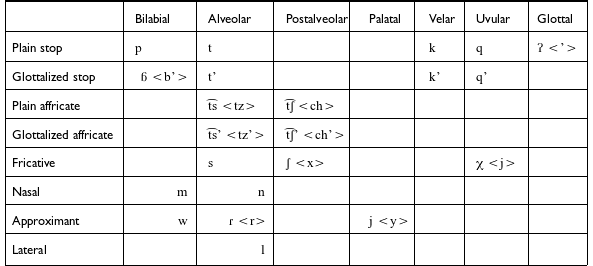
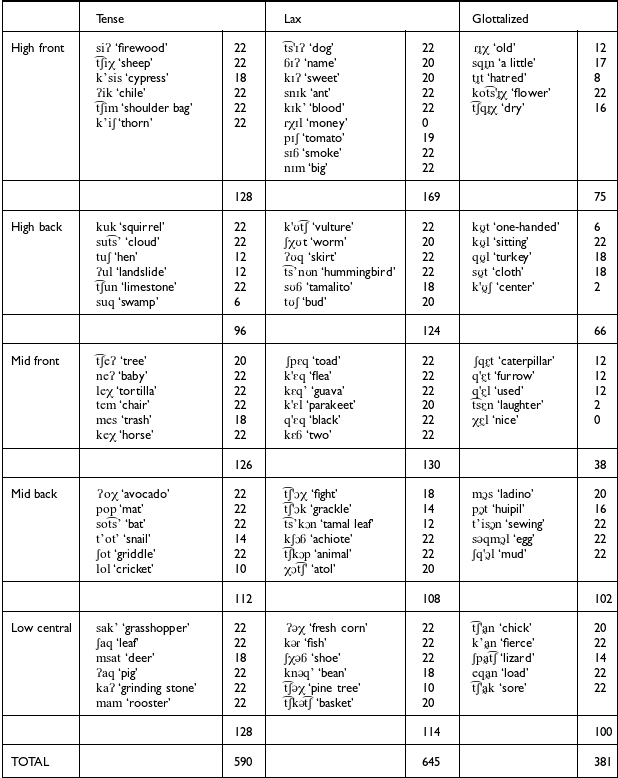


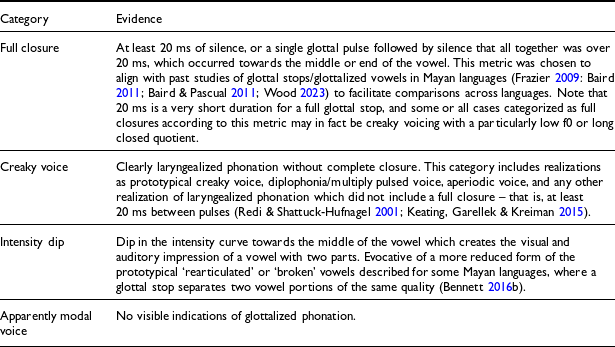

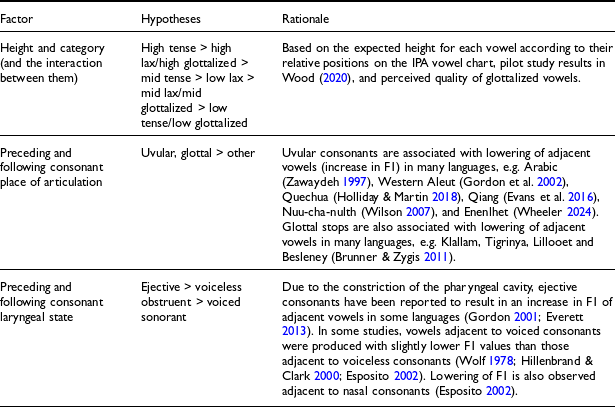
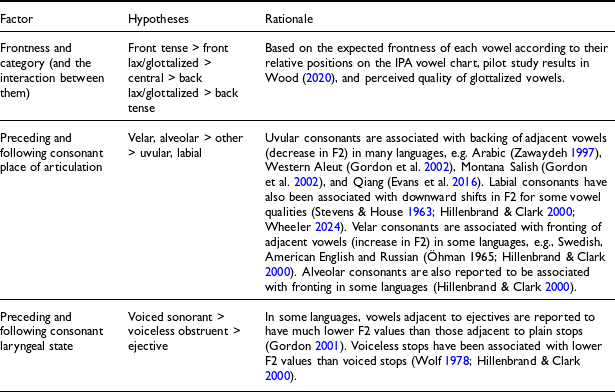
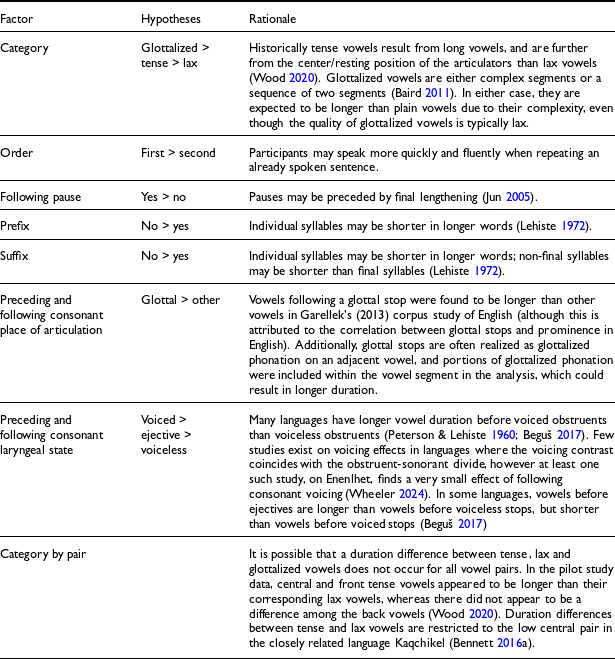


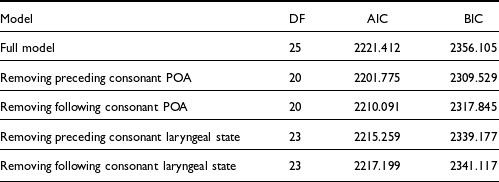
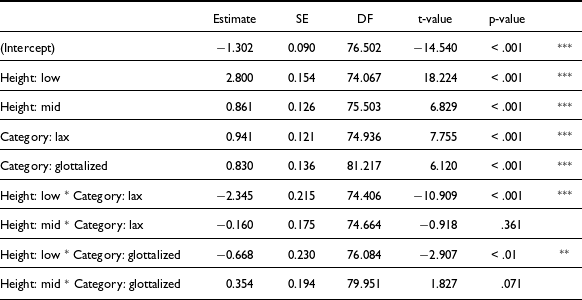
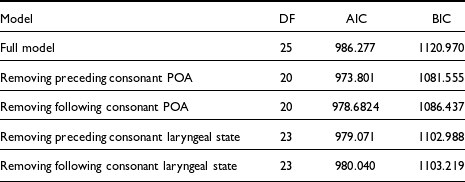
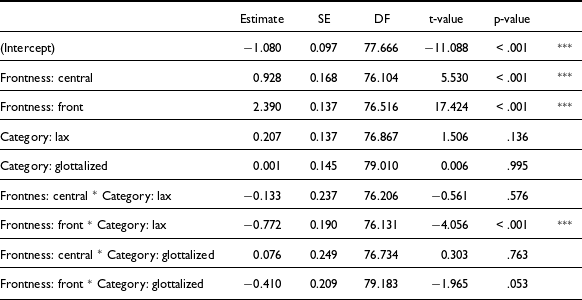
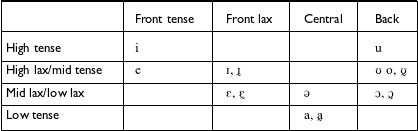


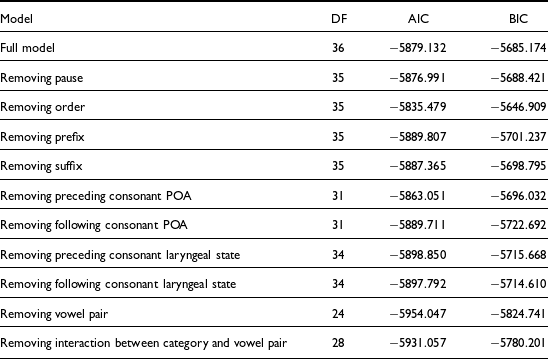
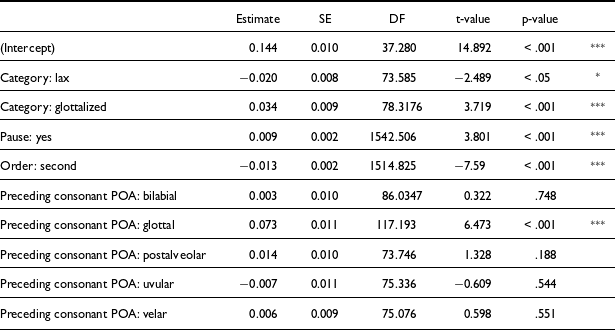
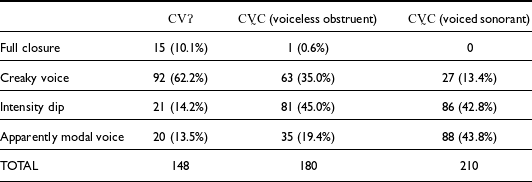
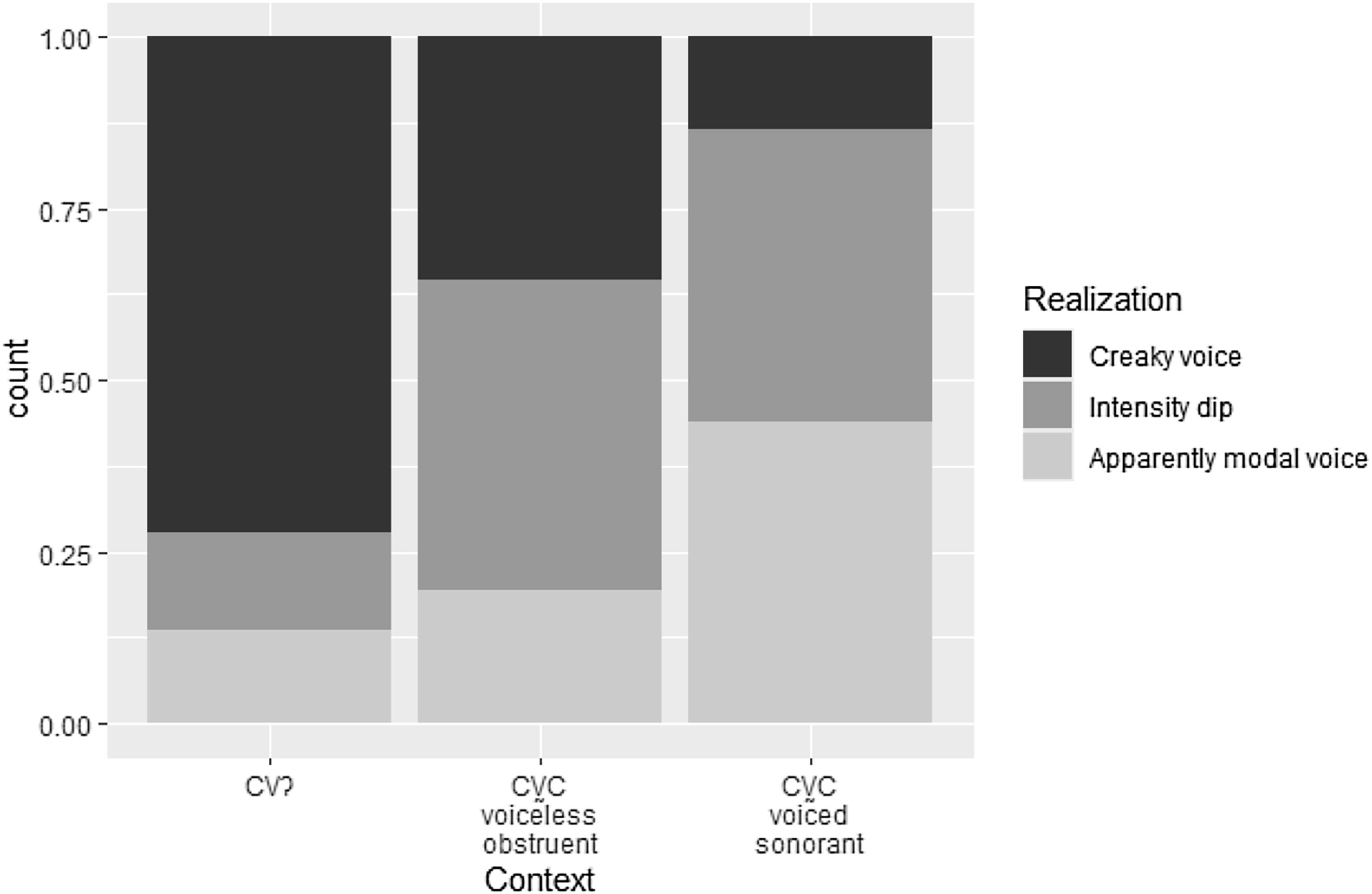
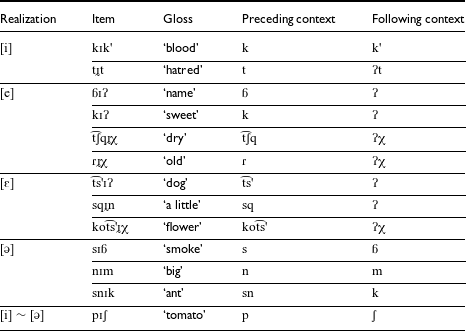
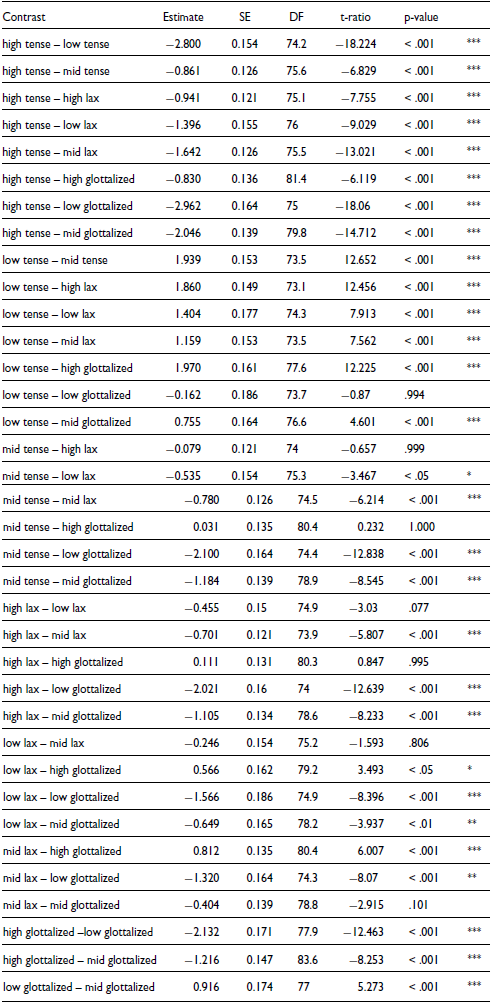
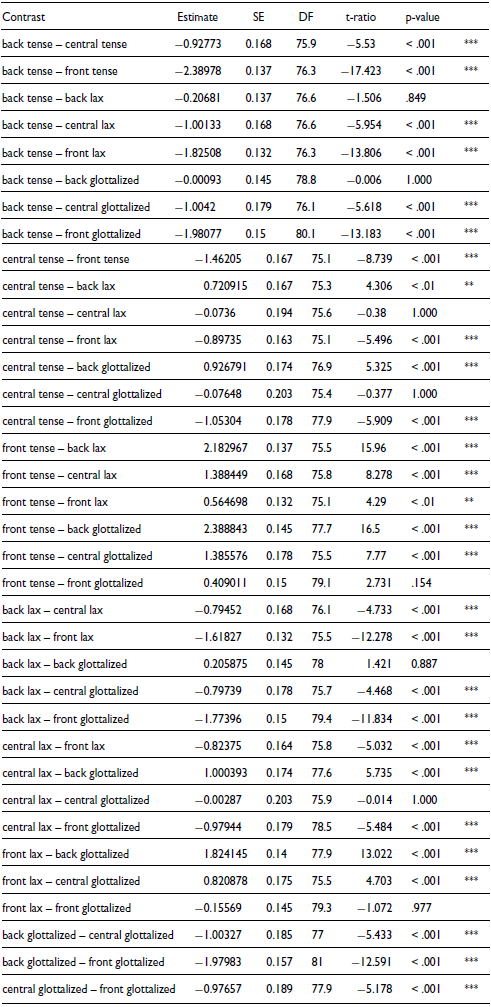
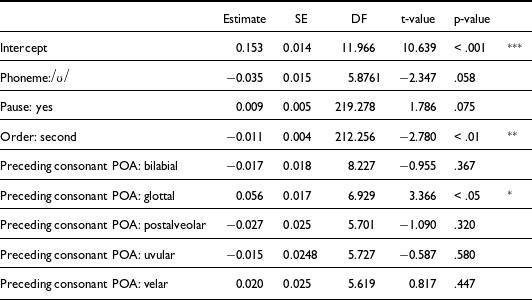
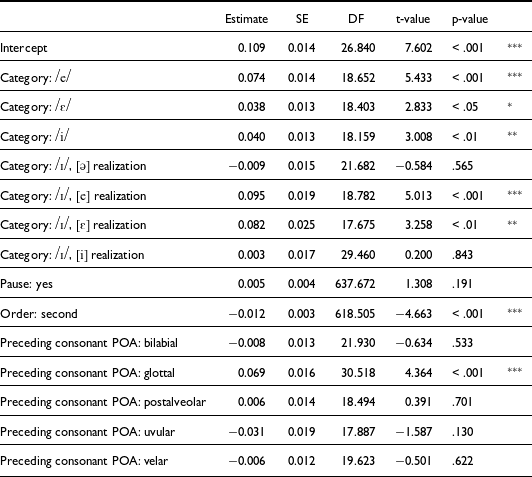
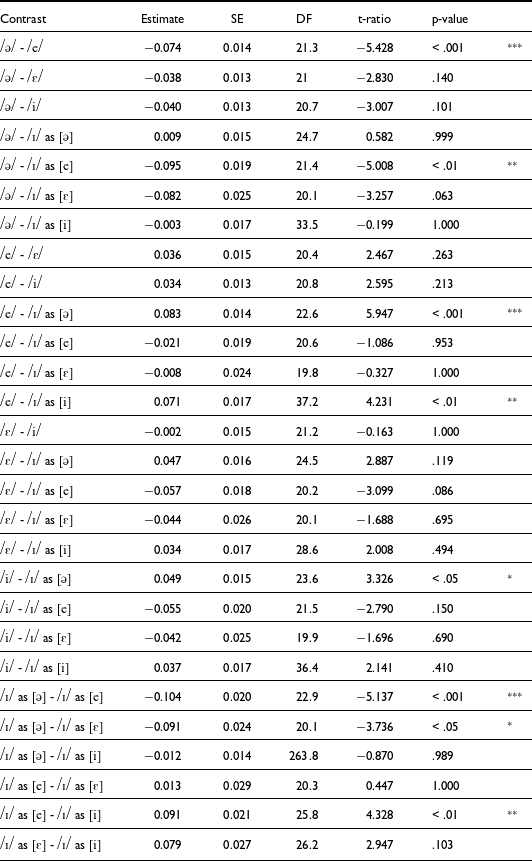


 Open access

