


Obesity poses one of the most challenging public health problems of the 21st century. Although we have a good understanding of the behavioural aetiology of obesity (energy imbalance due to poor eating and/or inadequate physical activity), the underlying drivers of these obesity-risk behaviours are yet to be elucidated. Given that as many as one in four children in developed countries are overweight or obese, that childhood obesity makes an impact on immediate and long-term health and that the prevalence of childhood obesity has doubled in the past 20 years, gaining an understanding of the drivers of obesity-risk behaviours is crucial. This is particularly so for those who are socioeconomically disadvantaged, who are more likely to eat poorly, to be physically inactive and to be overweight or obese(Reference Ball and Crawford1). Social–ecological theory posits that a range of personal, social and environmental level factors influence health behaviours(Reference Stokols2). Emerging evidence suggests that factors in the home and local neighbourhood environments may be important in determining weight status among children. Although these factors are believed to have an impact on obesity, there are relatively few empirical studies among children and the evidence is far from conclusive. Even fewer studies have considered the social environment.
In the home environment, more frequent dinner consumption while watching television (TV)(Reference MacFarlane, Cleland and Crawford3), more frequent fast food consumption at home(Reference MacFarlane, Cleland and Crawford3), the number of opportunities to engage in screen-based behaviours (i.e. TV viewing, electronic games or computers) at home(Reference Timperio, Salmon and Ball4) and having a TV in the bedroom(Reference Adachi-Mejia, Longacre and Gibson5) are positively associated with BMI z scores or weight status in children. Evidence relating parents' use of restriction in feeding to child weight is equivocal, with some studies showing no association with weight(Reference Carnell and Wardle6–Reference Powers, Chamberlin and van Schaick8), some showing it to be predictive of increased weight(Reference Faith, Berkowitz and Stallings9, Reference Francis and Birch10) and others showing it to be protective against changes in weight(Reference Campbell, Andrianopoulos and Hesketh11, Reference Farrow and Blissett12). In addition, parental modelling of physical activity(Reference Davison and Birch13), sibling engagement in physical activity and the number of physical activity items at home are negatively associated with change in BMI z scores in girls(Reference Timperio, Salmon and Ball4).
There is a dearth of studies examining relationships between the social environment and adiposity in children. It is generally accepted that social influences on physical activity and nutrition become more pronounced with age. Some studies have shown positive relationships between social norms and physical activity among children and pre-adolescents(Reference Sallis, Prochaska and Taylor14, Reference Trost, Pate and Ward15), and social norms are consistent predictors of several eating behaviours in youth(Reference McClain, Chappuis and Nguyen-Rodriguez16). However, there are no studies that have examined associations between social norms for physical activity and eating behaviours and adiposity in children.
In terms of the local neighbourhood environment, inconsistent findings have been reported, with variation by sex, age and area of residence(Reference Dunton, Kaplan and Wolch17). Parental perceptions of heavy traffic and concerns about traffic are positively associated with children's weight status(Reference Timperio, Salmon and Telford18), but proxy objective measures (length of local and busy roads) were unrelated to adiposity in cross-sectional and longitudinal analyses(Reference Timperio, Jeffery and Crawford19). The number of sport and recreation spaces was negatively associated with BMI z scores in one study(Reference Timperio, Jeffery and Crawford19), but most other studies have found no association between access to facilities or spaces for physical activity and obesity outcomes in children(Reference Dunton, Kaplan and Wolch17). Walkability and street connectivity may also be important, with cross-sectional studies finding lower odds of overweight in pre-school girls living in walkable neighbourhoods and neighbourhoods with many intersections(Reference Spence, Cutumisu and Edwards20) and lower BMI z scores with increasing length of access paths (shortcuts) available in the neighbourhood(Reference Timperio, Jeffery and Crawford19). Longitudinal analyses have found negative associations between number of four-way intersections and increase in BMI z scores over 3 years(Reference Timperio, Jeffery and Crawford19). Very little work has focused on neighbourhood food environments among children. Most studies focus only on availability of fast food outlets, and these have found no associations between availability of fast food outlets and risk of overweight among children(Reference Crawford, Timperio and Salmon21). In a more comprehensive examination, although with a small sample, higher odds of having a high BMI were found for those with a convenience store in their census block, but no associations were found with restaurants, fast food restaurants, supermarkets, grocery stores or specialty stores(Reference Galvez, Hong and Choi22).
Although there has been some research examining the role of home and neighbourhood factors in relation to childhood obesity, few studies have concurrently considered factors associated with children's weight status in both the home and local neighbourhood environments(Reference Crawford, Cleland and Timperio23), and there has been little research that has examined determinants among children from low socioeconomic backgrounds or relationships with social norms. Given that public health efforts to date to curb the obesity epidemic have largely failed, gaining a more detailed understanding of the underlying drivers of obesity-risk behaviours is important in order to inform future prevention initiatives, particularly for individuals of low socioeconomic position who are at increased risk of unhealthy weight gain. The aim of this paper is to examine home, social and neighbourhood correlates of BMI in children living in disadvantaged neighbourhoods.
Methods
Participants
Data were collected during 2007–2008, as part of the Resilience for Eating and Activity Despite Inequality study. Ethical approval was granted by the Deakin University Human Research Ethics Committee, the Catholic Education Office and the Victorian Department of Education and Early Child Development.
In all, forty urban and forty rural socioeconomically disadvantaged areas (suburbs) of the state of Victoria were randomly selected. Areas were classified using the Australian Bureau of Statistics' 2001 Socio-Economic Index for Areas, an indicator of area-level disadvantage constructed from the population census(24), and those areas within the bottom third of the Socio-Economic Index for Areas distribution for the state comprised the sampling frame.
A total of 150 women, aged 18–45 years, from each of the eighty areas were randomly identified from the Australian electoral roll (n 11 940; in some areas in which there were fewer than 150 eligible women, all eligible women were sampled); 4934 women (41 %) responded to a postal invitation to complete a questionnaire. For privacy reasons, information on non-responders is not available from the Australian Electoral Commission. Data were excluded for 585 respondents wherein the respondent had moved from the sampled suburb before completing the survey (n 571), wherein the person who completed the survey was not the intended participant (n 3), wherein respondents withdrew their data after completing the survey (n 2) or wherein respondents were aged < 17 or >46 years (n 9). Of the 4349 eligible women, those with a 5- to 12-year-old child (n 1457) were invited to complete an additional survey about their child (selected using the next-birthday method), with 771 (53 %) agreeing to do so. Child surveys were received from 613 mothers. More mothers who returned child surveys had a higher level of education (25·7 v. 17·6 %; P < 0·001) and were older (38·5 (sd 5·1) v. 37·1 (sd 6·3) years; P < 0·001) than mothers who were not mailed a survey or did not return a completed survey. There were no differences in marital status, number of children, BMI or weight status between these two groups.
Measures
Demographic information
The age of each child at the time their height and weight were measured was recorded, along with their sex. Maternal age and education information was self-reported by mothers. Mothers reported the highest level of education that they had completed, with response categories: ‘no formal education’, ‘year 10 or equivalent’, ‘year 12 or equivalent’, ‘trade/apprenticeship’, ‘certificate/diploma’, ‘university degree’ and ‘higher university degree’. Responses were collapsed into three categories of maternal education: low (‘no formal education’ or ‘year 10 or equivalent’), medium (‘year 12 or equivalent’, ‘trade/apprenticeship’ or ‘certificate/diploma’) and high (‘university degree’ or ‘higher university degree’).
Adiposity
Research staff attended each child's school or home and measured height using a portable stadiometer and weight using digital scales. BMI was calculated for each child by dividing weight by height squared (kg/m2). Subsequently, age- and sex-adjusted BMI z scores were calculated for each child based on the Centers for Disease Control reference population(Reference Kuczmarski, Ogden and Grummer-Strawn25). Additionally, child weight status (underweight, healthy weight, overweight or obese) was determined using cut points of Cole et al. (Reference Cole, Bellizzi and Flegal26).
Home environment
Measures of the home environment were included in the survey completed by mothers (Table 1). These included measures of: maternal efficacy for the child doing physical activity; maternal efficacy for preventing the child engaging in screen-based behaviours; maternal efficacy for the child eating healthily; parental support for physical activity; maternal perception of the importance of doing physical activity as a family; views on the use of food as a reward; views on the use of screen-based behaviour as a reward; having rules to limit screen-based behaviours; feelings and beliefs about food enjoyment (measured with the items, ‘it gives me pleasure to give my children the food they enjoy’; ‘I believe in letting children enjoy foods treats/rewards’); home access to physical activity equipment; home access to opportunities for screen-based behaviours; and the children having access to a TV in their bedroom.
Measures used to assess home, social and neighbourhood environment characteristics among Resilience for Eating and Activity Despite Inequality children aged 5–12 years*

TV, television; DVD, digital video disc; ICC, intra-class correlation coefficient.
* Children were recruited from socioeconomically disadvantaged suburbs in urban and rural areas of Victoria, Australia during 2007–2008.
Social environment
Measures of social norms were included in the survey completed by mothers, including perceptions of: social norms for physical activity; social norms for unhealthy eating; and social norms for eating fruit (Table 1).
Neighbourhood environment
Measures of the neighbourhood environment were included in the survey completed by mothers. These included measures of perceptions of: the neighbourhood physical activity environment; neighbourhood familiarity; neighbourhood social network; neighbourhood personal safety; neighbourhood road safety; and neighbourhood availability and quality of healthy foods (Table 1).
Statistical analysis
Cronbach's α describing the internal reliability of measures (where appropriate) and κ coefficients for 2-week test–retest reliability of measures or previously published test–retest reliability are provided (Table 1). Participants were excluded from analyses if they had missing data for BMI z scores (n 50) or any of the correlates or covariates (n 122), leaving a final sample of n 491. Associations between each correlate and BMI z scores were examined via linear regression. Those variables that were significantly associated (P < 0·05) with BMI z scores were then entered together into a multivariable linear regression model. All analyses were conducted controlling for two covariates, namely, child sex and child age. Owing to the clustered sampling procedure used, all analyses were controlled for clustering by suburb using STATA's ‘cluster’ command. STATA 10.1 (StataCorp, College Station, TX, USA) was used to perform all analyses.
Results
Demographic characteristics of the sample are presented in Table 2. The majority of the children (71·7 %) were in the healthy weight range. Approximately half of the children were male and had a mother with a medium level of education. The mean age of the children was 9·4 years and the mean age of their mothers was 38·8 years. A comparison of the 491 children whose data were included in the analysis sample and the 122 who were excluded because of missing data revealed no differences in children's BMI z scores, weight status categories or maternal education. However, the children in the analytic sample were significantly older (mean age 9·5 v. 8·9 years) and had older mothers (mean age 38·8 v. 37·1 years).
(Mean values, standard deviations and percentages, n 491)
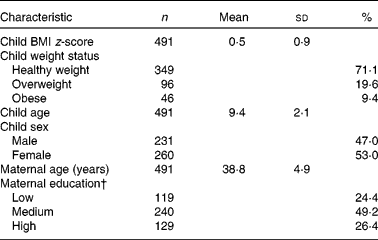
* Children were recruited from socioeconomically disadvantaged suburbs in urban and rural areas of Victoria, Australia during 2007–2008.
† The column total n for this characteristic does not equal 491 due to missing data for three participants
Partially adjusted and fully adjusted multivariable associations between exposure variables and BMI z scores are presented in Table 3. Of the home environment characteristics, five were significantly associated with BMI z scores in the individual regression analyses. Maternal efficacy for the child doing physical activity, preventing the child from engaging in screen-based behaviours and the child eating healthily were inversely associated with BMI z scores, such that higher efficacy was associated with lower BMI z scores. Additionally, using food as a reward for good behaviour was associated with higher BMI z scores and children with a TV in their bedroom tended to have higher BMI z scores than those without. Only one of the ‘neighbourhood’ characteristics was associated with BMI z scores in the partially adjusted analyses. Greater agreement by mothers that their neighbourhood ‘has lots of good places’ for their child to play and be active was associated with lower BMI z scores.
(B coefficients and 95 % confidence intervals, n 491)

TV, television.
Values were significantly different: * P < 0·05, ** P < 0·01, *** P < 0·005.
† Children were recruited from socioeconomically disadvantaged suburbs in urban and rural areas of Victoria, Australia during 2007–2008.
‡ Adjusted for child age and sex, and clustering by suburb.
§ Adjusted for other predictors in multivariable model, child age and sex and clustering by suburb.
When the characteristics significantly associated with BMI z scores in the individual analyses were entered into a multivariable model, only three remained significant. Children whose mothers had higher efficacy for them doing physical activity had significantly lower BMI z scores, whereas children who had a TV in their bedroom and those whose mothers made greater use of food as a reward for good behaviour had significantly higher BMI z scores.
Discussion
The present study sought to examine the home, social and local neighbourhood correlates of BMI z scores in children living in disadvantaged communities. We found that a small number of potentially modifiable features of the home environment were associated with children's BMI z scores, and that none of the social or neighbourhood factors were associated once the home environment was also considered. The findings suggest that increasing efficacy among mothers to promote physical activity, limit the use of food as a reward and not provide children with a TV in their bedroom are likely to be important targets for future obesity prevention initiatives in disadvantaged communities.
The finding that parental use of food as a reward is associated with increased BMI z scores has not previously been described. This may reflect the fact that, until recently, the two items pertaining to use of food as a reward from Birch's Child Feeding Questionnaire(Reference Birch, Fisher and Grimm-Thomas27) have been included within the broader feeding restriction subscale. The present study considered food as a reward specifically, and exploratory factor analyses undertaken on the Child Feeding Questionnaire(Reference Corsini28) in Australian samples have indicated that this is appropriate. Although there are no reports of associations between the use of food as a reward and child weight, a small number of cross-sectional studies report direct associations between use of food as reward and obesity-promoting eating(Reference Kröller and Warschburger29–Reference Vereecken, Legiest and De Bourdeaudhuij31). It may be that the use of food as a reward increases a child's preference for that food and in turn its consumption(Reference Newman and Taylor32). If parents provide energy-dense foods as rewards, this may increase risk of unhealthy weight gain.
We are unaware of any research that has examined parental efficacy regarding their ability to influence children's lifestyle behaviours and child's weight status. However, Adkins et al. (Reference Adkins, Sherwood and Story33) reported that parent's self-efficacy for supporting their daughters to be active was associated with girls' engagement in physical activity. Among preschoolers, maternal self-efficacy was positively associated with water, fruit and vegetable consumption and was inversely associated with cordial and cake consumption(Reference Campbell, Hesketh and Silverii34). In the same study, maternal self-efficacy to limit TV viewing time was inversely associated with screen time. The findings of the present study suggest that interventions that include a focus on improving mothers' confidence to influence children's obesity-risk behaviours may be important.
A small number of studies have reported positive associations between the presence of a TV in the bedroom and children's BMI z scores or weight status(Reference Adachi-Mejia, Longacre and Gibson5, Reference Dennison, Erb and Jenkins35). A US expert panel reviewed the evidence of associations between children's TV viewing and weight, and with more than 60 % of children over 8 years having a TV set in their bedroom, it recommended that parents remove TV from their child's bedroom or preferably not put them there in the first place(Reference Jordan and Robinson36). A recent analysis of two large cross-sectional surveys (one from Germany, and the other from the USA) found that having a TV set in the bedroom mediated the association between socioeconomic status and BMI among 10- to 17-year-old children and adolescents in the two samples(Reference Morgenstern, Sargent and Hanewinkel37). Given the focus of the present study on children and mothers living in socioeconomically disadvantaged neighbourhoods, this is an important consideration for families most at risk.
In contrast to previous studies(Reference Sallis, Prochaska and Taylor14–Reference Galvez, Hong and Choi22), none of the social or neighbourhood environmental factors remained significant in the multivariable analyses. In addition, relatively few of the home environment variables were significantly associated with BMI. These contrasting findings may be because previous studies have not considered a broad range of potential correlates across home, social and neighbourhood levels of influence simultaneously in the same model. The inclusion of a range of potential correlates in the home and neighbourhood environments, including the social environment, which is rarely considered, is an important strength of the present study. Other strengths include the objective measure of children's height and weight and the focus on an at-risk and under-served population group. Limitations of the present study include the cross-sectional study design, reliance on self-reported perceptions rather than objective measures of the neighbourhood environment and the use of maternal reports of other potential correlates.
Conclusion
The present study provides novel data on potentially modifiable influences on obesity among socioeconomically disadvantaged children that could underpin the development of initiatives aimed at preventing obesity. Developing strategies aimed at increasing mother's efficacy to promote physical activity, limit the use of food as a reward and disallow children to have a TV in their bedroom warrant further investigation as components of future obesity prevention programmes in disadvantaged communities.
Acknowledgements
The present study was funded by a National Health and Medical Research Council Strategic Award (ID 374241). D. A. C., K. J. C. and A. F. T. are supported by the Public Health Research Fellowships from VicHealth; K. B. (ID 479513) and V. J. C. (ID 533917) are supported by fellowships from the National Health and Medical Research Council; and J. A. S. is supported by a Fellowship from the National Heart Foundation of Australia and Sanofi-Aventis. D. A. C., K. B., A. F. T. and J. A. S. were involved in designing and conducting the study; V. J. C. was involved in coordinating the study; G. A. analysed the data; D. A. C., V. J. C., K. J. C. and A. F. T. wrote specific sections of the manuscript; and all authors contributed to drafting the manuscript, providing important intellectual contributions. All authors read and approved the final manuscript. The authors declare that there are no conflicts of interest.



