





1 Introduction
1.1 Kauffman bracket skein module
The Kauffman skein module ${\mathscr S}_{q^{1/2}}(M)$
of an oriented 3-manifold M, introduced by Przytycki [Reference Przytycki32] and Turaev [Reference Turaev36, Reference Turaev37], serves as a bridge between quantum and classical topology and helps solving many important problems in low-dimensional topology. By definition,
${\mathscr S}_{q^{1/2}}(M)$
of an oriented 3-manifold M, introduced by Przytycki [Reference Przytycki32] and Turaev [Reference Turaev36, Reference Turaev37], serves as a bridge between quantum and classical topology and helps solving many important problems in low-dimensional topology. By definition, ${\mathscr S}_{q^{1/2}}(M)$
is the
${\mathscr S}_{q^{1/2}}(M)$
is the ${\mathbb C}$
-vector space spanned by isotopy classes of unoriented framed links in M subject to the Kauffman relations ([Reference Kauffman20])
${\mathbb C}$
-vector space spanned by isotopy classes of unoriented framed links in M subject to the Kauffman relations ([Reference Kauffman20])

See Section 2 for details. Here, $q^{1/2}$
is a nonzero complex number.
$q^{1/2}$
is a nonzero complex number.
The calculation of ${\mathscr S}_{q^{1/2}}(M)$
is in general difficult. One attractive approach is to cut M into simpler pieces and try to understand
${\mathscr S}_{q^{1/2}}(M)$
is in general difficult. One attractive approach is to cut M into simpler pieces and try to understand ${\mathscr S}_{q^{1/2}}(M)$
from the skein modules of the pieces. For example, when
${\mathscr S}_{q^{1/2}}(M)$
from the skein modules of the pieces. For example, when $M= M_1 \# M_2$
is the connected sum of
$M= M_1 \# M_2$
is the connected sum of $M_1$
and
$M_1$
and $M_2$
there is a natural
$M_2$
there is a natural ${\mathbb C}$
-linear homomorphism
${\mathbb C}$
-linear homomorphism
 $$ \begin{align*} \Psi_{M_1,M_2} : {\mathscr S}_{q^{1/2}}(M_1) \otimes_{\mathbb C} {\mathscr S}_{q^{1/2}} (M_2) \to {\mathscr S}_{q^{1/2}}(M), \quad (x \otimes y) \to x \sqcup y. \end{align*} $$
Przytycki [Reference Przytycki32] showed that if q is not a root of 1, then $\Psi _{M_1, M_2}$
is bijective. Our first result is to show that when q is a root of 1 the kernel of
$\Psi _{M_1, M_2}$
is bijective. Our first result is to show that when q is a root of 1 the kernel of $f_{M_1,M_2}$
is generally big.
$f_{M_1,M_2}$
is generally big.
Theorem 1 (Special case of Theorem 3.1).
Suppose $q^4$
is a primitive N-th root of 1. The kernel of
$q^4$
is a primitive N-th root of 1. The kernel of $\Psi _{M_1 \# M_2} $
contains
$\Psi _{M_1 \# M_2} $
contains $F_{q^{1/2} } (M_1) \otimes F_{q^{1/2} } (M_2)$
, where
$F_{q^{1/2} } (M_1) \otimes F_{q^{1/2} } (M_2)$
, where $F_{q^{1/2} } (M)$
is the subspace of
$F_{q^{1/2} } (M)$
is the subspace of ${\mathscr S}_{q^{1/2}}(M)$
spanned by closures of the Jones–Wenzl idempotent
${\mathscr S}_{q^{1/2}}(M)$
spanned by closures of the Jones–Wenzl idempotent ${f}_{N-1}$
.
${f}_{N-1}$
.
We recall the Jones–Wenzl idempotent in Subsection 3.1. In particular, when $M_i$
are thickened surfaces we show that each
$M_i$
are thickened surfaces we show that each $F_{q^{1/2} } (M_i)$
is nonzero, hence the kernel of
$F_{q^{1/2} } (M_i)$
is nonzero, hence the kernel of $\Psi _{M_1 \# M_2}$
is nontrivial. For work related to Theorem 1, see Remark 3.7.
$\Psi _{M_1 \# M_2}$
is nontrivial. For work related to Theorem 1, see Remark 3.7.
Suppose $q^4$
is a primitive N-th root of unity. Then
$q^4$
is a primitive N-th root of unity. Then $\varepsilon := q^{N^2}$
has the property
$\varepsilon := q^{N^2}$
has the property $\varepsilon ^8=1$
. There exists a
$\varepsilon ^8=1$
. There exists a ${\mathbb C}$
-linear map, known as the Chebyshev–Frobenius map,
${\mathbb C}$
-linear map, known as the Chebyshev–Frobenius map,
 $$ \begin{align*}\Phi_{q^{1/2}} : {\mathscr S}_\varepsilon(M) \to {\mathscr S}_{q^{1/2}}(M)\end{align*} $$
which was constructed by Bonahon and Wong [Reference Bonahon and Wong8], see also [Reference Lê25] especially for general 3-manifolds. For the thickened surfaces it is known that $\Phi _{q^{1/2}}$
is injective. We show that in general
$\Phi _{q^{1/2}}$
is injective. We show that in general $\Phi _{q^{1/2}}$
is not injective.
$\Phi _{q^{1/2}}$
is not injective.
Theorem 2 (See Theorem 3.11).
Assume $q^4$
is a primitive N-th root of 1 with
$q^4$
is a primitive N-th root of 1 with ${N>1}$
. There exists a compact oriented 3-manifold M such that the Chebyshev–Frobenius homomorphism
${N>1}$
. There exists a compact oriented 3-manifold M such that the Chebyshev–Frobenius homomorphism $ \Phi _{q^{1/2}} : {\mathscr S}_\varepsilon (M) \to {\mathscr S}_{q^{1/2}}(M)$
is not injective.
$ \Phi _{q^{1/2}} : {\mathscr S}_\varepsilon (M) \to {\mathscr S}_{q^{1/2}}(M)$
is not injective.
Theorems 1 and 2, as well as their analogs for the stated skein module case, exhibit the surprising fact that at roots of 1 certain skein identities are not local as they can only be established by means of tangles far away from their supports. This is very counterintuitive in the theory of skein modules.
1.2 Marked 3-manifolds, stated skein modules and noninjectivity
Suppose $S \subset M$
is a properly embedded surface. Let
$S \subset M$
is a properly embedded surface. Let $M'$
be the result of cutting M along S. The goal is to understand the skein module of M through that of
$M'$
be the result of cutting M along S. The goal is to understand the skein module of M through that of $M'$
. For this purpose in [Reference Lê26, Reference Costantino and Le10, Reference Bloomquist and Lê3, Reference Lê and Yu29], we with collaborators extended the definition of skein modules of 3-manifolds to stated skein modules of marked 3-manifolds, where the marking consists of disjoint oriented interval in the boundary of M. A main result is the existence of a cutting homomorphism relating the stated skein modules of M and
$M'$
. For this purpose in [Reference Lê26, Reference Costantino and Le10, Reference Bloomquist and Lê3, Reference Lê and Yu29], we with collaborators extended the definition of skein modules of 3-manifolds to stated skein modules of marked 3-manifolds, where the marking consists of disjoint oriented interval in the boundary of M. A main result is the existence of a cutting homomorphism relating the stated skein modules of M and $M'$
when
$M'$
when $S=D^2$
, the closed disk. When M is a thickened surface the cutting homomorphism is always injective, by [Reference Lê26, Theorem 1]. We show that in general the cutting homomorphism is not injective.
$S=D^2$
, the closed disk. When M is a thickened surface the cutting homomorphism is always injective, by [Reference Lê26, Theorem 1]. We show that in general the cutting homomorphism is not injective.
Theorem 3 (See Theorem 3.9).
Suppose $q^4$
is a primitive N-root of 1 with
$q^4$
is a primitive N-root of 1 with $N>1$
. There exists a marked 3-manifold M and a properly embedded disk
$N>1$
. There exists a marked 3-manifold M and a properly embedded disk $D \hookrightarrow M$
such that the cutting homomorphism corresponding to the cutting of M along D is not injective.
$D \hookrightarrow M$
such that the cutting homomorphism corresponding to the cutting of M along D is not injective.
When q is not a root of 1, one can show (see Proposition 4.10) that ${\mathscr S}_{q^{1/2}}(M_1 \# M_2)$
is spanned by skeins with support disjoint from the cutting sphere S which realises the connected sum. It turns out that the picture is quite opposite at root of 1 in the presence of markings.
${\mathscr S}_{q^{1/2}}(M_1 \# M_2)$
is spanned by skeins with support disjoint from the cutting sphere S which realises the connected sum. It turns out that the picture is quite opposite at root of 1 in the presence of markings.
Theorem 4 (Special case of Theorem 3.8).
Suppose $q^4$
is a primitive N-th root of 1 with
$q^4$
is a primitive N-th root of 1 with $N>1$
. Assume that each of
$N>1$
. Assume that each of $M_1$
and
$M_1$
and $M_2$
is connected and has at least one marking. Then every skein in
$M_2$
is connected and has at least one marking. Then every skein in $ M_1 \# M_2$
whose support is disjoint from the cutting sphere S is equal to 0. In particular, the empty skein is 0.
$ M_1 \# M_2$
whose support is disjoint from the cutting sphere S is equal to 0. In particular, the empty skein is 0.
The framework of stated skeins allows to properly study gluing and cutting operations on manifolds and interpret them algebraically. This point of view had been explored in the case of stated skein algebras of surfaces in [Reference Costantino and Le10] (see also [Reference Korinman and Quesney22]) where, for instance, it had been shown that the quantised coordinate algebra ${\mathcal O}_{q^2}(\mathrm {SL}(2))$
of
${\mathcal O}_{q^2}(\mathrm {SL}(2))$
of $SL_2({\mathbb C})$
(see Section 2) is naturally isomorphic to the stated skein algebra of the bigon and as such it coacts on all stated skein modules of surfaces.
$SL_2({\mathbb C})$
(see Section 2) is naturally isomorphic to the stated skein algebra of the bigon and as such it coacts on all stated skein modules of surfaces.
1.3 More general marking, gluing along general surfaces
Cutting along an embedded closed disk is understood via the cutting homomorphism. We want to consider cutting along more general surfaces and include the stated skein module into a topological quantum field theory (TQFT).
To make the theory more fluid, we will extend the stated skein modules to marked manifolds where the marking includes circles, in addition to intervals. For the details, see Section 2. This setting is new even for surfaces, even though in the presence of a circular marking we loose the algebra structure of stated skein modules of surfaces. However, we can do cutting along circle:
Theorem 5 (See Theorem 2.16 for more precise statement).
Suppose $\mathfrak S'$
is the result of cutting a marked surface
$\mathfrak S'$
is the result of cutting a marked surface $\mathfrak S$
along a circle. There is a naturally defined
$\mathfrak S$
along a circle. There is a naturally defined ${\mathbb C}$
-linear map
${\mathbb C}$
-linear map $\rho : {\mathscr S}_{q^{1/2}}(\mathfrak S) \to {\mathscr S}_{q^{1/2}}(\mathfrak S')$
, given by an explicit state sum formula.
$\rho : {\mathscr S}_{q^{1/2}}(\mathfrak S) \to {\mathscr S}_{q^{1/2}}(\mathfrak S')$
, given by an explicit state sum formula.
Cutting along a circle provides more flexibility in the study of the skein modules of surfaces. We present a basis for these skein modules in Theorem 2.11 and Proposition 2.13, extending the previous analogous theorem of [Reference Lê26]. In particular, we recover the Hochshild homology $\mathrm {HH}_0({\mathcal O}_{q^2}(\mathrm {SL}(2)))$
of
$\mathrm {HH}_0({\mathcal O}_{q^2}(\mathrm {SL}(2)))$
of ${\mathcal O}_{q^2}(\mathrm {SL}(2))$
as the stated skein module of an annulus with two circular marked components.
${\mathcal O}_{q^2}(\mathrm {SL}(2))$
as the stated skein module of an annulus with two circular marked components.
The cutting homomorphism corresponding to cutting along an embedded closed disk can be defined as in the case without circular marking; see Theorem 2.18.
Besides the cutting operation, we introduce the slitting operation. When cutting a surface $\mathfrak S$
along an ideal arc c, we get a new surface
$\mathfrak S$
along an ideal arc c, we get a new surface $\mathfrak S'$
having two copies
$\mathfrak S'$
having two copies $c_1, c_2$
of c such that by identifying
$c_1, c_2$
of c such that by identifying $c_1$
with
$c_1$
with $c_2$
we get back
$c_2$
we get back $\mathfrak S$
. On the other hand, slitting
$\mathfrak S$
. On the other hand, slitting $\mathfrak S$
along a properly embedded arc d (not an ideal arc) means simply to remove d from
$\mathfrak S$
along a properly embedded arc d (not an ideal arc) means simply to remove d from $\mathfrak S$
. There is also an operation of slitting along a half-ideal arc, that is, an arc one endpoint of which is an ideal point and the other endpoint is on the boundary of
$\mathfrak S$
. There is also an operation of slitting along a half-ideal arc, that is, an arc one endpoint of which is an ideal point and the other endpoint is on the boundary of $\mathfrak S$
. We describe how the skein modules behave under the slitting operations in Theorems 2.10 and 2.13. The slitting operations allow even more flexibility in studying skein modules.
$\mathfrak S$
. We describe how the skein modules behave under the slitting operations in Theorems 2.10 and 2.13. The slitting operations allow even more flexibility in studying skein modules.
The geometric setting gives additional, natural structures on the stated skein module of a marked three manifold M. Each connected component of the marking defines a comodule structure on ${\mathscr S}_{q^{1/2}}(M)$
over
${\mathscr S}_{q^{1/2}}(M)$
over ${\mathcal O}_{q^2}(\mathrm {SL}(2))$
or over the coalgebra
${\mathcal O}_{q^2}(\mathrm {SL}(2))$
or over the coalgebra $\mathrm {HH}_0({\mathcal O}_{q^2}(\mathrm {SL}(2)))$
according as the component is an interval or a circle.
$\mathrm {HH}_0({\mathcal O}_{q^2}(\mathrm {SL}(2)))$
according as the component is an interval or a circle.
The slitting operation can be generalised to the following more general situation. Assume $\Sigma $
is a compact surface and
$\Sigma $
is a compact surface and $\mathcal P$
a finite set of points in the boundary
$\mathcal P$
a finite set of points in the boundary ${ \partial \Sigma }$
, where each point is equipped with a sign
${ \partial \Sigma }$
, where each point is equipped with a sign $\pm $
. The thickened surface
$\pm $
. The thickened surface $(\Sigma \times (-1,1), \mathcal P\times (-1,1))$
is a marked 3-manifold, and its stated skein module, denoted by
$(\Sigma \times (-1,1), \mathcal P\times (-1,1))$
is a marked 3-manifold, and its stated skein module, denoted by ${\mathscr S}(\Sigma ,\mathcal P)$
, has a natural structure of an algebra, where the product is defined by the usual stacking operation. Assume
${\mathscr S}(\Sigma ,\mathcal P)$
, has a natural structure of an algebra, where the product is defined by the usual stacking operation. Assume $(M,\mathcal N)$
is a marked 3-manifold and
$(M,\mathcal N)$
is a marked 3-manifold and $\Sigma \hookrightarrow M$
is a compact, oriented, connected, properly embedded surface which meets
$\Sigma \hookrightarrow M$
is a compact, oriented, connected, properly embedded surface which meets $\mathcal N$
transversally. Let
$\mathcal N$
transversally. Let $(M', \mathcal N')$
be the result of removing
$(M', \mathcal N')$
be the result of removing $\Sigma $
from
$\Sigma $
from $(M,\mathcal N)$
. Then there are natural left and right actions of the algebra
$(M,\mathcal N)$
. Then there are natural left and right actions of the algebra ${\mathscr S}(\Sigma , \Sigma \cap \mathcal N)$
on
${\mathscr S}(\Sigma , \Sigma \cap \mathcal N)$
on ${\mathscr S}(M', \mathcal N')$
, making the latter a bimodule over
${\mathscr S}(M', \mathcal N')$
, making the latter a bimodule over ${\mathscr S}(\Sigma , \Sigma \cap \mathcal N)$
. For a bimodule V over an algebra A, one can define the 0-th Hochschild homology by
${\mathscr S}(\Sigma , \Sigma \cap \mathcal N)$
. For a bimodule V over an algebra A, one can define the 0-th Hochschild homology by
 $$ \begin{align*}\mathrm{HH}_0(V) = V/ ( v * a - a *v).\end{align*} $$
We prove the following:
Theorem 6 (See Theorem 5.1).
The inclusion $(M',\mathcal N')\to (M,\mathcal N)$
induces an isomorphism of
$(M',\mathcal N')\to (M,\mathcal N)$
induces an isomorphism of ${R}$
-modules:
${R}$
-modules:
 $$ \begin{align*}\mathrm{HH}_0({\mathscr S}(M',\mathcal N'))\xrightarrow{\cong} {\mathscr S}(M,\mathcal N).\end{align*} $$
As shown in Examples 5.2 and 5.3, this result encompasses multiple previous statements; it also allows one to generalise the ‘triangle sum’ of surfaces studied in [Reference Costantino and Le10] to the case of marked $3$
-manifolds and prove in Theorem 5.5 that if M is the triangle sum of
$3$
-manifolds and prove in Theorem 5.5 that if M is the triangle sum of $M_1$
and
$M_1$
and $M_2$
, then there is a natural
$M_2$
, then there is a natural ${\mathbb C}$
-linear isomorphism
${\mathbb C}$
-linear isomorphism ${\mathscr S}_{q^{1/2}}(M)\cong {\mathscr S}_{q^{1/2}}(M_1)\otimes {\mathscr S}_{q^{1/2}}(M_2)$
.
${\mathscr S}_{q^{1/2}}(M)\cong {\mathscr S}_{q^{1/2}}(M_1)\otimes {\mathscr S}_{q^{1/2}}(M_2)$
.
We conclude the paper by defining a category of decorated cobordisms whose objects are marked surfaces and morphisms are marked $3$
-manifolds whose boundary is suitably decomposed into positive, negative and ‘side’ parts. We then show that
$3$
-manifolds whose boundary is suitably decomposed into positive, negative and ‘side’ parts. We then show that ${\mathscr S}$
can be interpreted as a functor from this category to the Morita category
${\mathscr S}$
can be interpreted as a functor from this category to the Morita category ${\mathsf { Morita}}$
of algebras and their bimodules. The main result of our TQFT theory is the following:
${\mathsf { Morita}}$
of algebras and their bimodules. The main result of our TQFT theory is the following:
Theorem 7 (See Theorem 6.5).
The stated skein functor ${\mathscr S}:\mathrm {DeCob}\to {\mathsf { Morita}}$
is a symmetric monoidal functor.
${\mathscr S}:\mathrm {DeCob}\to {\mathsf { Morita}}$
is a symmetric monoidal functor.
Immediate consequences of Theorems 6.5 and 5.1 are a Van-Kampen-like theorem for stated skein modules (Theorem 6.10), a description of ${\mathscr S}(M)$
given a Heegaard decomposition of M (Theorem 6.11) and the fact that
${\mathscr S}(M)$
given a Heegaard decomposition of M (Theorem 6.11) and the fact that ${\mathscr S}(\mathfrak S\times S^1)=\mathrm {HH}_0({\mathscr S}(\mathfrak S))$
(Proposition 6.7). The computation of
${\mathscr S}(\mathfrak S\times S^1)=\mathrm {HH}_0({\mathscr S}(\mathfrak S))$
(Proposition 6.7). The computation of ${\mathscr S}(M,\mathcal N)$
from a Heegaard decomposition was already obtained in [Reference Gunningham, Jordan and Safronov12]. Furthermore, the Van Kampen like theorem is very much similar in spirit to Habiro’s quantum fundamental group behaviour ([Reference Habiro15]). In [Reference Costantino and Le11] we will show that the stated skein functor, restricted to a suitable category, is actually a braided monoidal functor with values in suitable Morita-like category of braided comodule algebras over
${\mathscr S}(M,\mathcal N)$
from a Heegaard decomposition was already obtained in [Reference Gunningham, Jordan and Safronov12]. Furthermore, the Van Kampen like theorem is very much similar in spirit to Habiro’s quantum fundamental group behaviour ([Reference Habiro15]). In [Reference Costantino and Le11] we will show that the stated skein functor, restricted to a suitable category, is actually a braided monoidal functor with values in suitable Morita-like category of braided comodule algebras over ${\mathcal O}_{q^2}(\mathrm {SL}(2))$
.
${\mathcal O}_{q^2}(\mathrm {SL}(2))$
.
Remark that the TQFT described in Theorem 6.5 is different from those studied, for instance, in [Reference Reshetikhin and Turaev34, Reference Blanchet, Habegger, Masbaum and Vogel5] in that the target category is not that of vector spaces. Rather, when working over a field, it seems to fit very well in the general framework of [Reference Brochier, Jordan and Snyder4] where in particular a cp-rigid and cocomplete braided monoidal category is shown to be a $3$
-dualisable object in the
$3$
-dualisable object in the $4$
-category
$4$
-category $\mathbf {BrTens}$
so that, as a consequence, there is an extended TQFT associated to it. We expect that our construction is a special case of this, for the ribbon category of right
$\mathbf {BrTens}$
so that, as a consequence, there is an extended TQFT associated to it. We expect that our construction is a special case of this, for the ribbon category of right ${\mathcal O}_{q^2}(\mathrm {SL}(2))$
-comodules at least when q is a generic complex number, although there are some aspects in which our construction is more general in the sense that it allows multiple markings on manifolds and, more importantly, circular ones. From this point of view, our TQFT should correspond to the
${\mathcal O}_{q^2}(\mathrm {SL}(2))$
-comodules at least when q is a generic complex number, although there are some aspects in which our construction is more general in the sense that it allows multiple markings on manifolds and, more importantly, circular ones. From this point of view, our TQFT should correspond to the $(3,2)$
-part of an extended 4d TQFT: associating to a surface an algebra is equivalent to associating to it the category of modules over that algebra, and associating to a
$(3,2)$
-part of an extended 4d TQFT: associating to a surface an algebra is equivalent to associating to it the category of modules over that algebra, and associating to a $3$
-cobordism a bimodule is equivalent to associating a functor. But, as explained in Remark 6.6, in order to avoid too many technicalities, we intentionally chose to avoid the higher categorical language even though the categories
$3$
-cobordism a bimodule is equivalent to associating a functor. But, as explained in Remark 6.6, in order to avoid too many technicalities, we intentionally chose to avoid the higher categorical language even though the categories $\mathrm {DeCob}$
and
$\mathrm {DeCob}$
and ${\mathsf { Morita}}$
are naturally truncation of symmetric
${\mathsf { Morita}}$
are naturally truncation of symmetric $2$
-categories so that the above theorem should extend to this larger setting. All these connections are still to be explored as it has been done in [Reference Haïoun16] for the relations between stated skein algebras of surfaces and integrals of ribbon categories over surfaces. While completing the present paper, we were informed that a result similar to Theorem 7 is independently proved by J. Korinman and J. Murakami [Reference Korinman and Murakami23].
$2$
-categories so that the above theorem should extend to this larger setting. All these connections are still to be explored as it has been done in [Reference Haïoun16] for the relations between stated skein algebras of surfaces and integrals of ribbon categories over surfaces. While completing the present paper, we were informed that a result similar to Theorem 7 is independently proved by J. Korinman and J. Murakami [Reference Korinman and Murakami23].
It turns out (see [Reference Haïoun16]) that over a field the stated skein algebra of a surface is isomorphic to the internal algebra of the $U_q(sl_2)$
skein category [Reference Ben-Zvi, Brochier and Jordan2, Reference Cooke9, Reference Johnson-Freyd24, Reference Walker38]. Furthermore, when the surface has only one boundary component with a single marking, these algebras are isomorphic to those defined by Alekseev, Grosse and Schomerus ([Reference Alekseev, Grosse and Schomerus1]) and by Buffenoir and Roche ([Reference Buffenoir and Roche6]) (see also [Reference Faitg13, Reference Lê and Yu29]). Our approach is more elementary and geometric in nature, with explicit generators and relations. Moreover, it works over any ground ring and allows to find embeddings of stated skein algebras into quantum tori; see, for example, [Reference Lê and Yu30].
$U_q(sl_2)$
skein category [Reference Ben-Zvi, Brochier and Jordan2, Reference Cooke9, Reference Johnson-Freyd24, Reference Walker38]. Furthermore, when the surface has only one boundary component with a single marking, these algebras are isomorphic to those defined by Alekseev, Grosse and Schomerus ([Reference Alekseev, Grosse and Schomerus1]) and by Buffenoir and Roche ([Reference Buffenoir and Roche6]) (see also [Reference Faitg13, Reference Lê and Yu29]). Our approach is more elementary and geometric in nature, with explicit generators and relations. Moreover, it works over any ground ring and allows to find embeddings of stated skein algebras into quantum tori; see, for example, [Reference Lê and Yu30].
2 Stated skein modules of marked 3-manifolds
Throughout the paper, let $\mathbb Z$
be the set of integers,
$\mathbb Z$
be the set of integers, $\mathbb N$
be the set of nonnegative integers,
$\mathbb N$
be the set of nonnegative integers, ${\mathbb C}$
be the set of complex numbers. The ground ring
${\mathbb C}$
be the set of complex numbers. The ground ring ${R}$
is a commutative ring with unit 1, containing a distinguished invertible element
${R}$
is a commutative ring with unit 1, containing a distinguished invertible element $q^{1/2}$
.
$q^{1/2}$
.
The Kronecker delta is defined as usual: $ \delta _{x,y} = \begin {cases} 1\quad &\text {if} \ x=y,\\ 0 &\text {if} \ x\neq y \end {cases} $
For a finite set X, we denote by $|X|$
the number of elements of X.
$|X|$
the number of elements of X.
2.1 Marked 3-manifold
By a open interval (respectively circle) we mean the image of $(0,1)$
(resp. the standard circle
$(0,1)$
(resp. the standard circle $S^1$
) through an embedding of
$S^1$
) through an embedding of $[0,1]$
(resp. of
$[0,1]$
(resp. of $S^1$
) into a manifold.
$S^1$
) into a manifold.
Definition 2.1.
A marked 3-manifold $(M,\mathcal N)$
consists of an oriented 3-manifold M with (possibly empty) boundary
$(M,\mathcal N)$
consists of an oriented 3-manifold M with (possibly empty) boundary $\partial M$
and a one-dimensional oriented submanifold
$\partial M$
and a one-dimensional oriented submanifold $\mathcal N \subset \partial M$
such that
$\mathcal N \subset \partial M$
such that $\mathcal N$
is the disjoint union of several open intervals and circles; we will refer to the intervals as ‘boundary edges’ or ‘edges’ and to the circles as ‘marked circles’.
$\mathcal N$
is the disjoint union of several open intervals and circles; we will refer to the intervals as ‘boundary edges’ or ‘edges’ and to the circles as ‘marked circles’.
An embedding of pairs of marked 3-manifolds $i:(M,\mathcal N)\hookrightarrow (M',\mathcal N')$
is an orientation preserving proper embedding
$i:(M,\mathcal N)\hookrightarrow (M',\mathcal N')$
is an orientation preserving proper embedding $i:M\to M'$
such that
$i:M\to M'$
such that $i(\mathcal N)\subset \mathcal N'$
and i preserves the orientation on
$i(\mathcal N)\subset \mathcal N'$
and i preserves the orientation on $\mathcal N$
.
$\mathcal N$
.
A priori two components of $\mathcal N$
might be mapped by i into the same component of
$\mathcal N$
might be mapped by i into the same component of $\mathcal N'$
.
$\mathcal N'$
.
If no component of $\mathcal N$
is a circle, we call
$\mathcal N$
is a circle, we call $(M,\mathcal N)$
a circle-free marked 3-manifold.
$(M,\mathcal N)$
a circle-free marked 3-manifold.
Remark 2.2. Our notion of a marked 3-manifold is more general than that in [Reference Lê and Yu29, Reference Bloomquist and Lê3] where only circle-free marked 3-manifolds are considered.
Definition 2.3. Let $(M,\mathcal N)$
be a marked 3-manifold. An
$(M,\mathcal N)$
be a marked 3-manifold. An $\mathcal N$
-tangle L (in M) is a one-dimensional, compact, nonoriented smooth submanifold of M equipped with a normal vector field such that
$\mathcal N$
-tangle L (in M) is a one-dimensional, compact, nonoriented smooth submanifold of M equipped with a normal vector field such that $L \cap \mathcal N = \partial L$
and at a boundary point in
$L \cap \mathcal N = \partial L$
and at a boundary point in $\partial L=L \cap \mathcal N $
, the normal vector is a positive tangent of
$\partial L=L \cap \mathcal N $
, the normal vector is a positive tangent of $\mathcal N$
.
$\mathcal N$
.
Here, a normal vector field on L is a vector field not tangent to L at any point.
A loop component of L, that is, a component diffeomorphic to $S^1$
, is called a
$S^1$
, is called a $\mathcal N$
-knot and a nonloop component, which must be diffeomorphic to
$\mathcal N$
-knot and a nonloop component, which must be diffeomorphic to $[0,1]$
, is called an
$[0,1]$
, is called an $\mathcal N$
-arc.
$\mathcal N$
-arc.
Two $\mathcal N$
-tangle are
$\mathcal N$
-tangle are $\mathcal N$
-isotopic if they are isotopic through the class of
$\mathcal N$
-isotopic if they are isotopic through the class of $\mathcal N$
-tangles.
$\mathcal N$
-tangles.
The empty set is also considered a $\mathcal N$
-tangle which is isotopic only to itself.
$\mathcal N$
-tangle which is isotopic only to itself.
A state of an $\mathcal N$
-tangle L is a map
$\mathcal N$
-tangle L is a map $s:\partial L\to \{\pm \}$
. The switching map
$s:\partial L\to \{\pm \}$
. The switching map $\{ \pm \} \to \{ \pm \} $
is the involution
$\{ \pm \} \to \{ \pm \} $
is the involution $\epsilon \to \bar \epsilon : =-\epsilon $
. The set
$\epsilon \to \bar \epsilon : =-\epsilon $
. The set $\{\pm \}$
is order so that
$\{\pm \}$
is order so that $ -$
is smaller than
$ -$
is smaller than $+$
. A state is increasing if while moving along any boundary edge in the positive direction, that is, the direction induced from the orientation of the surface, the state function is increasing, that is, one encounters first a sequence of
$+$
. A state is increasing if while moving along any boundary edge in the positive direction, that is, the direction induced from the orientation of the surface, the state function is increasing, that is, one encounters first a sequence of $-$
and then a sequence of
$-$
and then a sequence of $+$
.
$+$
.
It should be noted that while $M,\mathcal N$
are oriented, an
$M,\mathcal N$
are oriented, an $\mathcal N$
-tangle is not.
$\mathcal N$
-tangle is not.
Definition 2.4. The stated skein module ${\mathscr S}(M,\mathcal N)$
of a marked 3-manifold
${\mathscr S}(M,\mathcal N)$
of a marked 3-manifold $(M,\mathcal N)$
is the
$(M,\mathcal N)$
is the ${R}$
-module spanned by isotopy classes of stated
${R}$
-module spanned by isotopy classes of stated $\mathcal N$
-tangles in M modulo the following relations:
$\mathcal N$
-tangles in M modulo the following relations:


In the above identities, the pictures depict the intersection of an $\mathcal N$
-tangle with a box
$\mathcal N$
-tangle with a box $ S \times [-1,1]\hookrightarrow M$
, where S is a square and is identified with
$ S \times [-1,1]\hookrightarrow M$
, where S is a square and is identified with $S \times \{0\}$
. In this box, the
$S \times \{0\}$
. In this box, the $\mathcal N$
-tangle is described by its diagram coming from the standard projection onto S, which is the shadowed square. The orientation of S is counterclockwise, and the orientation of M is the given by that of S followed by the orientation of
$\mathcal N$
-tangle is described by its diagram coming from the standard projection onto S, which is the shadowed square. The orientation of S is counterclockwise, and the orientation of M is the given by that of S followed by the orientation of $[-1,1]$
, which is pointed to the reader. In Equations (3) and (4), the drawn edge of the square with its orientation is an oriented subarc of
$[-1,1]$
, which is pointed to the reader. In Equations (3) and (4), the drawn edge of the square with its orientation is an oriented subarc of $\mathcal N$
. Besides, the signs indicate the states of each endpoint of the diagram. In all pictures in this paper, the framing is pointing towards the reader except in small neighbourhood of the boundary edges (the oriented arrows) where the framing twists by
$\mathcal N$
. Besides, the signs indicate the states of each endpoint of the diagram. In all pictures in this paper, the framing is pointing towards the reader except in small neighbourhood of the boundary edges (the oriented arrows) where the framing twists by $\frac {\pi }{4}$
in order to become positively tangent to
$\frac {\pi }{4}$
in order to become positively tangent to $\mathcal N$
(up to isotopy there is only one way to achieve this). Besides, the signs indicate the states of each endpoint of the diagram.
$\mathcal N$
(up to isotopy there is only one way to achieve this). Besides, the signs indicate the states of each endpoint of the diagram.
Identity (3) with $\epsilon =+, \nu =-$
is an easy consequence of the other relations (see [Reference Lê26, Lemma 2.3]), but we add it here for a complete list of values of cups (or trivial arcs).
$\epsilon =+, \nu =-$
is an easy consequence of the other relations (see [Reference Lê26, Lemma 2.3]), but we add it here for a complete list of values of cups (or trivial arcs).
It is clear that an embedding of pairs $i:(M,\mathcal N) \to (M' \mathcal N')$
induces an R-linear map
$i:(M,\mathcal N) \to (M' \mathcal N')$
induces an R-linear map $i_*: {\mathscr S}(M,N) \to {\mathscr S}(M', \mathcal N')$
, which depends only on the isotopy class of i.
$i_*: {\mathscr S}(M,N) \to {\mathscr S}(M', \mathcal N')$
, which depends only on the isotopy class of i.
Easy consequences of the defining relations are the following


Remark 2.5. (1) The convention of diagrams near arrowed edges is different from that in [Reference Lê26, Reference Costantino and Le10, Reference Lê and Yu29]: There the marking is perpendicular to the page and the framing is vertical everywhere, while here the marking (the arrowed interval) is lying flat on the page. There the arrow indicates the height order, but here the arrow is the orientation of $\mathcal N$
. However, the two presentations are canonically equivalent. Our current presentation is more suitable for the generalisation to marked three manifolds of the present paper.
$\mathcal N$
. However, the two presentations are canonically equivalent. Our current presentation is more suitable for the generalisation to marked three manifolds of the present paper.
(2) If $\mathcal N$
does not have a circle component, then our definition of stated skein modules coincides with that in [Reference Bloomquist and Lê3, Reference Lê and Yu29].
$\mathcal N$
does not have a circle component, then our definition of stated skein modules coincides with that in [Reference Bloomquist and Lê3, Reference Lê and Yu29].
2.2 Orientation inversion of components of $\mathcal N$

Recall $C(+)=-q^{-\frac {5}{2}}, C(-)=q^{-\frac {1}{2}}$
.
$C(+)=-q^{-\frac {5}{2}}, C(-)=q^{-\frac {1}{2}}$
.
Proposition 2.6. Let e be a connected component of the marking set $\mathcal N$
of a marked 3-manifold
$\mathcal N$
of a marked 3-manifold $(M,\mathcal N)$
. Let
$(M,\mathcal N)$
. Let ${\mathsf {inv}}_e(\mathcal N)$
be identical to
${\mathsf {inv}}_e(\mathcal N)$
be identical to $\mathcal N$
except that the orientation of e is reversed. There is an isomorphism of
$\mathcal N$
except that the orientation of e is reversed. There is an isomorphism of ${R}$
-modules
${R}$
-modules ${\mathsf {inv}}_e:{\mathscr S}(M,\mathcal N)\to {\mathscr S}(M,{\mathsf {inv}}_e(\mathcal N))$
defined on a stated
${\mathsf {inv}}_e:{\mathscr S}(M,\mathcal N)\to {\mathscr S}(M,{\mathsf {inv}}_e(\mathcal N))$
defined on a stated $\mathcal N$
-tangle
$\mathcal N$
-tangle $\alpha $
by:
$\alpha $
by:
 $$ \begin{align} {\mathsf{inv}}_e(\alpha)=\left(\prod_{u \in \alpha\cap e} C(u)\right) \overline{\alpha}, \end{align} $$
where $\overline {\alpha }$
is obtained from
$\overline {\alpha }$
is obtained from $\alpha $
by switching all the states of
$\alpha $
by switching all the states of $\alpha \cap e$
and changing locally near e the framing of
$\alpha \cap e$
and changing locally near e the framing of $\alpha $
by adding a positive half twist to each component touching e. Furthermore, applying twice
$\alpha $
by adding a positive half twist to each component touching e. Furthermore, applying twice ${\mathsf {inv}}_e$
gives the identity map
${\mathsf {inv}}_e$
gives the identity map ${\mathscr S}(M,\mathcal N)\to {\mathscr S}(M,\mathcal N)$
.
${\mathscr S}(M,\mathcal N)\to {\mathscr S}(M,\mathcal N)$
.
Proof. To show that ${\mathsf {inv}}_e$
is well defined, we check that Relations (3) and (4) are preserved.
${\mathsf {inv}}_e$
is well defined, we check that Relations (3) and (4) are preserved.
Relation (3) is preserved, because from the definition and Equation (6),

Consider Relation (4). Apply ${\mathsf {inv}}_e$
to the left-hand side of Equation (4),
${\mathsf {inv}}_e$
to the left-hand side of Equation (4),

where the last identity follows from [Reference Lê26, Equ. (20)]. Apply ${\mathsf {inv}}_e$
to the left-hand side of Equation (4),
${\mathsf {inv}}_e$
to the left-hand side of Equation (4),

where the second equality follows from [Reference Lê26, Equ. (21)]. Comparing Equations (8) and (9), we see that Relation (4) is transformed into itself.
To prove the last statement observe that the total effect of applying twice ${\mathsf {inv}}_e$
is to multiply a
${\mathsf {inv}}_e$
is to multiply a $\mathcal N$
-tangle by
$\mathcal N$
-tangle by $(-q^{-3})^{\# e\cap \alpha }$
and to add a full positive twist to each strand of
$(-q^{-3})^{\# e\cap \alpha }$
and to add a full positive twist to each strand of $\alpha $
near e. But each additional framing is equivalent to multiplying
$\alpha $
near e. But each additional framing is equivalent to multiplying $\alpha $
by
$\alpha $
by $-q^{3}$
(see Equation (5)) so that the different factors compensate.
$-q^{3}$
(see Equation (5)) so that the different factors compensate.
Remark 2.7. We only need $C(+) C(-)= - q^{-3}$
in the proof.
$C(+) C(-)= - q^{-3}$
in the proof.
2.3 Manifolds defined up to strict isomorphisms
We will consider certain geometric operations on 3-manifolds, like cutting and gluing them along disks, or smoothing corners, which produce new manifolds defined up a diffeomorphisms only. Following [Reference TTQ and Sikora28], we use the following notion: A strict isomorphism class of marked 3-manifolds is a family of marked 3-manifolds $(M_i, \mathcal N_i), i \in I$
, equipped with diffeomorphisms
$(M_i, \mathcal N_i), i \in I$
, equipped with diffeomorphisms $f_{ij} : (M_i,\mathcal N_i)\to (M_j,\mathcal N_j)$
for any two indices
$f_{ij} : (M_i,\mathcal N_i)\to (M_j,\mathcal N_j)$
for any two indices $i,j$
such that
$i,j$
such that $f_{ii} = \mathrm {id}$
and
$f_{ii} = \mathrm {id}$
and $f_{jk} \circ f_{ij} = f_{ik}$
up to isotopy. For a strict isomorphism class of marked 3-manifolds, we can identify all
$f_{jk} \circ f_{ij} = f_{ik}$
up to isotopy. For a strict isomorphism class of marked 3-manifolds, we can identify all ${R}$
-modules
${R}$
-modules ${\mathscr S}(M_i, \mathcal N_i)$
via the isomorphisms
${\mathscr S}(M_i, \mathcal N_i)$
via the isomorphisms $(f_{ij})_*$
. Note that gluing and cutting operations or smoothing corner operations produce strict isomorphism classes of marked 3-manifolds.
$(f_{ij})_*$
. Note that gluing and cutting operations or smoothing corner operations produce strict isomorphism classes of marked 3-manifolds.
2.4 Boundary-oriented surface
Definition 2.8 (boundary-oriented surface).
-
1. A boundary-oriented surface is a pair
$(\mathfrak S, { \mathsf {or}})$
, where-
•
$\mathfrak S$
is an oriented surface of finite type, that is, of the form
$\mathfrak S =\overline {\mathfrak S} \setminus P$
, where
$\overline {\mathfrak S}$
is a compact surface with possibly empty boundary and P is a finite set, each element of which is called an ideal point of
$\mathfrak S$
, -
•
${\mathsf {or}}$
is an orientation of the boundary
$\partial \mathfrak S$
.
A connected component of
$\partial \mathfrak S$
is positive or negative according as the orientation
${ \mathsf {or}}$
on it is the one induced from the orientation of
$\mathfrak S$
or not. A noncompact component of the boundary
$\partial \mathfrak S$
is called a boundary edge. -
-
2. A
$\partial \mathfrak S$
-arc is a proper embedding
$[0,1] \hookrightarrow \mathfrak S$
. -
3. An ideal of
$\mathfrak S$
is an embedding
$(0,1) \hookrightarrow \mathfrak S$
which can be extended to immersion
$[0,1] \to \overline {\mathfrak S}$
. -
4. A half-ideal arc in
$\mathfrak S$
is a proper embedding
$\alpha :(0,1] \hookrightarrow \overline {\mathfrak S}$
which can be extended to an embedding
$\tilde \alpha : [0,1] \hookrightarrow \overline {\mathfrak S}$
. Thus,
$\tilde \alpha (0)$
is an ideal point while
$\alpha (1)$
is an interior point of a boundary edge. -
5. An embedding of boundary-oriented surfaces is a proper orientation preserving embedding which preserves also the orientation of the boundary.
-
6. The thickening of a boundary-oriented surface
$\mathfrak S$
is the marked 3-manifold
$(M,\mathcal N)$
, where
$M= \mathfrak S \times (-1,1)$
and
$\mathcal N = \partial \mathfrak S\subset \mathfrak S \equiv \mathfrak S \times \{0\}$
. Define
${\mathscr S}(\mathfrak S,{ \mathsf {or}}) = {\mathscr S}(M,\mathcal N)$
.


When it is clear from context, we write $\mathfrak S$
instead of
$\mathfrak S$
instead of $(\mathfrak S,{ \mathsf {or}})$
. The orientation inversion map
$(\mathfrak S,{ \mathsf {or}})$
. The orientation inversion map ${\mathsf {inv}}_e$
given by Proposition 2.6 shows that as R-modules
${\mathsf {inv}}_e$
given by Proposition 2.6 shows that as R-modules ${\mathscr S}(\mathfrak S, { \mathsf {or}})\cong {\mathscr S}(\mathfrak S, { \mathsf {or}}_+)$
, where
${\mathscr S}(\mathfrak S, { \mathsf {or}})\cong {\mathscr S}(\mathfrak S, { \mathsf {or}}_+)$
, where ${ \mathsf {or}}_+$
is the positive orientation of
${ \mathsf {or}}_+$
is the positive orientation of $\partial \mathfrak S$
.
$\partial \mathfrak S$
.
The projection $ \mathfrak S \times (-1,1)\to \mathfrak S$
allows to consider diagrams of
$ \mathfrak S \times (-1,1)\to \mathfrak S$
allows to consider diagrams of $\mathcal N$
-tangles.
$\mathcal N$
-tangles.
Definition 2.9. A $\partial \mathfrak S$
-tangle diagram D is a generic immersion of a compact nonoriented one-dimensional manifold into
$\partial \mathfrak S$
-tangle diagram D is a generic immersion of a compact nonoriented one-dimensional manifold into $\mathfrak S$
in which every double point is endowed with the under/overcrossing information of the two involved strands. Isotopies of
$\mathfrak S$
in which every double point is endowed with the under/overcrossing information of the two involved strands. Isotopies of $\partial \mathfrak S$
-tangle diagrams are ambient isotopies of
$\partial \mathfrak S$
-tangle diagrams are ambient isotopies of $\mathfrak S$
.
$\mathfrak S$
.
Note that ‘generic immersion’ implies D meets $\partial \mathfrak S$
transversally and D has only a finite number of singularity, each is a double point lying in the interior of
$\partial \mathfrak S$
transversally and D has only a finite number of singularity, each is a double point lying in the interior of $\mathfrak S$
. The empty set is considered as a
$\mathfrak S$
. The empty set is considered as a $\partial \mathfrak S$
-tangle diagram.
$\partial \mathfrak S$
-tangle diagram.
A $\partial \mathfrak S$
-tangle diagram D defines a
$\partial \mathfrak S$
-tangle diagram D defines a $\mathcal N$
-isotopy class of
$\mathcal N$
-isotopy class of $\mathcal N$
-tangle: Equip D with the vertical framing everywhere, except near
$\mathcal N$
-tangle: Equip D with the vertical framing everywhere, except near $\partial \mathfrak S$
one turns the framing by
$\partial \mathfrak S$
one turns the framing by $\pi /4$
to match the orientation
$\pi /4$
to match the orientation ${ \mathsf {or}}$
of
${ \mathsf {or}}$
of $\partial \mathfrak S$
. A
$\partial \mathfrak S$
. A $\partial \mathfrak S$
-tangle diagram is stated if it is equipped with a state, which is a map
$\partial \mathfrak S$
-tangle diagram is stated if it is equipped with a state, which is a map $\partial D \to \{ \pm \}$
. A state of D is increasing if for each boundary edge c of
$\partial D \to \{ \pm \}$
. A state of D is increasing if for each boundary edge c of $\partial \mathfrak S$
, the states on e are increasing when traveling in the direction of
$\partial \mathfrak S$
, the states on e are increasing when traveling in the direction of ${ \mathsf {or}}$
.
${ \mathsf {or}}$
.
A stated $\partial \mathfrak S$
-tangle diagram defines an element of
$\partial \mathfrak S$
-tangle diagram defines an element of ${\mathscr S}(\mathfrak S,{ \mathsf {or}})$
. Every
${\mathscr S}(\mathfrak S,{ \mathsf {or}})$
. Every $\mathcal N$
-isotopy class of stated
$\mathcal N$
-isotopy class of stated $\mathcal N$
-tangles can be represented by stated
$\mathcal N$
-tangles can be represented by stated $\partial \mathfrak S$
-tangle diagrams. Note that if D is a stated
$\partial \mathfrak S$
-tangle diagrams. Note that if D is a stated $\partial \mathfrak S$
-tangle diagram representing an element
$\partial \mathfrak S$
-tangle diagram representing an element $x\in {\mathscr S}(\mathfrak S,{ \mathsf {or}})$
and e is a boundary edge of
$x\in {\mathscr S}(\mathfrak S,{ \mathsf {or}})$
and e is a boundary edge of $\mathfrak S$
, then D, up to a power of
$\mathfrak S$
, then D, up to a power of $q^{1/2}$
, also represents the element
$q^{1/2}$
, also represents the element ${\mathsf {inv}}_e(x)\in {\mathscr S}(\mathfrak S,{\mathsf {inv}}_e({ \mathsf {or}}))$
, where
${\mathsf {inv}}_e(x)\in {\mathscr S}(\mathfrak S,{\mathsf {inv}}_e({ \mathsf {or}}))$
, where ${\mathsf {inv}}_e({ \mathsf {or}})$
is the same as
${\mathsf {inv}}_e({ \mathsf {or}})$
is the same as ${ \mathsf {or}}$
except the orientation of e is reversed.
${ \mathsf {or}}$
except the orientation of e is reversed.
When $\partial \mathfrak S$
does not have a circle component, we call
$\partial \mathfrak S$
does not have a circle component, we call $\mathfrak S$
circle-free. In that case,
$\mathfrak S$
circle-free. In that case, ${\mathscr S}(\mathfrak S,{ \mathsf {or}})$
has an algebra structure defined in Section 4.
${\mathscr S}(\mathfrak S,{ \mathsf {or}})$
has an algebra structure defined in Section 4.
If $\mathfrak S$
is circle-free and
$\mathfrak S$
is circle-free and ${ \mathsf {or}}={ \mathsf {or}}_+$
, then
${ \mathsf {or}}={ \mathsf {or}}_+$
, then $\mathfrak S$
is known as a punctured bordered surface in [Reference Lê26, Reference Costantino and Le10, Reference Lê and Yu29, Reference Lê and Yu30] and
$\mathfrak S$
is known as a punctured bordered surface in [Reference Lê26, Reference Costantino and Le10, Reference Lê and Yu29, Reference Lê and Yu30] and ${\mathscr S}(\mathfrak S,{ \mathsf {or}})$
is studied intensively there.
${\mathscr S}(\mathfrak S,{ \mathsf {or}})$
is studied intensively there.
2.5 Half-ideal slit of surface
A $\partial \mathfrak S$
-tangle diagram is simple if it has neither double points nor trivial components. Here, a component is trivial if it is a circle bounding a disk in
$\partial \mathfrak S$
-tangle diagram is simple if it has neither double points nor trivial components. Here, a component is trivial if it is a circle bounding a disk in $\mathfrak S$
or it is an arc homotopic relative its endpoints to a subset of
$\mathfrak S$
or it is an arc homotopic relative its endpoints to a subset of $\partial \mathfrak S$
. By [Reference Lê26, Theorem 2.8], if
$\partial \mathfrak S$
. By [Reference Lê26, Theorem 2.8], if $\mathfrak S$
is circle-free, then
$\mathfrak S$
is circle-free, then ${\mathscr S}(\mathfrak S,{ \mathsf {or}})$
is free over R with basis the set
${\mathscr S}(\mathfrak S,{ \mathsf {or}})$
is free over R with basis the set $\mathcal B(\mathfrak S,{ \mathsf {or}})$
of all isotopy classes of increasingly stated simple diagrams. We want to consider the case when
$\mathcal B(\mathfrak S,{ \mathsf {or}})$
of all isotopy classes of increasingly stated simple diagrams. We want to consider the case when $\partial \mathfrak S$
has a circle component. It turns out that when
$\partial \mathfrak S$
has a circle component. It turns out that when $\mathfrak S$
is noncompact and connected we can show that
$\mathfrak S$
is noncompact and connected we can show that ${\mathscr S}(\mathfrak S,{ \mathsf {or}})$
is free over R and find a free basis of it by eliminating the circles.
${\mathscr S}(\mathfrak S,{ \mathsf {or}})$
is free over R and find a free basis of it by eliminating the circles.
Assume $\alpha $
is a half-ideal arc connecting an ideal point p and a point of a boundary component
$\alpha $
is a half-ideal arc connecting an ideal point p and a point of a boundary component $c\subset \partial \mathfrak S$
. Note that p can be an interior ideal point or a boundary ideal point, and c can be a boundary edge or a boundary circle. The
$c\subset \partial \mathfrak S$
. Note that p can be an interior ideal point or a boundary ideal point, and c can be a boundary edge or a boundary circle. The $\alpha $
-slit of
$\alpha $
-slit of $(\mathfrak S,{ \mathsf {or}})$
is the boundary oriented surface
$(\mathfrak S,{ \mathsf {or}})$
is the boundary oriented surface $(\mathfrak S', { \mathsf {or}}')$
, where
$(\mathfrak S', { \mathsf {or}}')$
, where $\mathfrak S':=\mathfrak S\setminus \alpha $
and
$\mathfrak S':=\mathfrak S\setminus \alpha $
and ${ \mathsf {or}}'$
is the restriction of
${ \mathsf {or}}'$
is the restriction of ${ \mathsf {or}}$
; see Figure 1. The whole interval
${ \mathsf {or}}$
; see Figure 1. The whole interval $\alpha $
is an ideal point of
$\alpha $
is an ideal point of $\mathfrak S'$
. We also call
$\mathfrak S'$
. We also call $(\mathfrak S', { \mathsf {or}}')$
a half-ideal slit of
$(\mathfrak S', { \mathsf {or}}')$
a half-ideal slit of $({\mathfrak S}, \mathsf {or})$
breaking c when we don’t want to mention
$({\mathfrak S}, \mathsf {or})$
breaking c when we don’t want to mention $\alpha $
. In
$\alpha $
. In $\mathfrak S'$
, the remnant of c is never a circle.
$\mathfrak S'$
, the remnant of c is never a circle.
A half-ideal slit breaking c, with an interior ideal point.

Theorem 2.10. Assume $(\mathfrak S', { \mathsf {or}}')$
is the
$(\mathfrak S', { \mathsf {or}}')$
is the $\alpha $
-slit of a boundary-oriented surface
$\alpha $
-slit of a boundary-oriented surface $(\mathfrak S,{ \mathsf {or}})$
, where
$(\mathfrak S,{ \mathsf {or}})$
, where $\alpha $
is a half-ideal arc. The natural embedding
$\alpha $
is a half-ideal arc. The natural embedding $\iota : (\mathfrak S', { \mathsf {or}}') \hookrightarrow (\mathfrak S, { \mathsf {or}})$
induces an R-linear isomorphism
$\iota : (\mathfrak S', { \mathsf {or}}') \hookrightarrow (\mathfrak S, { \mathsf {or}})$
induces an R-linear isomorphism $\iota _*: {\mathscr S}(\mathfrak S', { \mathsf {or}}') \cong {\mathscr S}(\mathfrak S, { \mathsf {or}})$
.
$\iota _*: {\mathscr S}(\mathfrak S', { \mathsf {or}}') \cong {\mathscr S}(\mathfrak S, { \mathsf {or}})$
.
Proof. Using the isomorphism ${\mathsf {inv}}_e$
, we can assume that
${\mathsf {inv}}_e$
, we can assume that ${ \mathsf {or}}$
is the positive orientation. Relation (4) can be rewritten as
${ \mathsf {or}}$
is the positive orientation. Relation (4) can be rewritten as

which shows that any $x\in {\mathscr S}(\mathfrak S, { \mathsf {or}})$
is a linear combination of stated
$x\in {\mathscr S}(\mathfrak S, { \mathsf {or}})$
is a linear combination of stated $\partial \mathfrak S$
-tangle diagrams not meeting
$\partial \mathfrak S$
-tangle diagrams not meeting $\alpha $
. Hence, the map
$\alpha $
. Hence, the map $\iota _*$
is surjective. We will construct an inverse of
$\iota _*$
is surjective. We will construct an inverse of $\iota _*$
.
$\iota _*$
.
Claim. ${\mathscr S}(\mathfrak S,{ \mathsf {or}})$
is the free span of isotopy classes of stated
${\mathscr S}(\mathfrak S,{ \mathsf {or}})$
is the free span of isotopy classes of stated $\partial \mathfrak S$
-tangle diagrams modulo the four relations (1)–(4). In fact, isotopy classes of stated
$\partial \mathfrak S$
-tangle diagrams modulo the four relations (1)–(4). In fact, isotopy classes of stated $\partial \mathfrak S$
-tangles are given by isotopy classed of stated
$\partial \mathfrak S$
-tangles are given by isotopy classed of stated $\partial \mathfrak S$
-tangle diagrams modulo the Reidemeister moves of type II and type III defined in [Reference Lickorish31]. Thus,
$\partial \mathfrak S$
-tangle diagrams modulo the Reidemeister moves of type II and type III defined in [Reference Lickorish31]. Thus, ${\mathscr S}(\mathfrak S,{ \mathsf {or}})$
is the free span of isotopy classes of stated
${\mathscr S}(\mathfrak S,{ \mathsf {or}})$
is the free span of isotopy classes of stated $\partial \mathfrak S$
-tangle diagrams modulo the four relations (1)–(4) and the Reidemeister moves of type II and type III. By [Reference Lickorish31, Lemma 3.3], a Reidemeister move of type II or III can be realised by Relations (1) and (2). Hence, we have the claim.
$\partial \mathfrak S$
-tangle diagrams modulo the four relations (1)–(4) and the Reidemeister moves of type II and type III. By [Reference Lickorish31, Lemma 3.3], a Reidemeister move of type II or III can be realised by Relations (1) and (2). Hence, we have the claim.
For a concrete stated $\partial \mathfrak S$
-tangle diagram D intersecting
$\partial \mathfrak S$
-tangle diagram D intersecting $\alpha $
transversally in k points define
$\alpha $
transversally in k points define $f(D) \in {\mathscr S}(\mathfrak S', { \mathsf {or}}')$
by repeatedly applying identity (10):
$f(D) \in {\mathscr S}(\mathfrak S', { \mathsf {or}}')$
by repeatedly applying identity (10):

Here, ‘concrete’ simply means to we don’t identify D with its isotopy class in $\mathfrak S$
. Let us show that f depends only on the isotopy class of D. It is enough to show that f is invariant under the moves M1 and M2 given in Figure 2.
$\mathfrak S$
. Let us show that f depends only on the isotopy class of D. It is enough to show that f is invariant under the moves M1 and M2 given in Figure 2.
Moves M1 and M2 for isotopy of D.

Consider move M1. Using Equation (11) and the values of the cups given by Equation (3),

Consider move M2. Using Equation (11) then move M1, and then Equation (10), we have

More in general, if in D there are some vertical strands between the cup shaped strand and c, then we first apply Equation (11) to these strands to reduce to the previous case pictured above.
Thus, f is a well-defined R-linear map. From the definition $f \circ \iota _*=\mathrm {id}$
. It follows that
$f \circ \iota _*=\mathrm {id}$
. It follows that $\iota _*$
is injective, whence bijective.
$\iota _*$
is injective, whence bijective.
When $\mathfrak S$
is noncompact and connected, for a circle boundary component c there is a half-ideal arc
$\mathfrak S$
is noncompact and connected, for a circle boundary component c there is a half-ideal arc $\alpha $
with endpoint in c, and the
$\alpha $
with endpoint in c, and the $\alpha $
-slit of
$\alpha $
-slit of $\mathfrak S$
is still connected. Hence, we have
$\mathfrak S$
is still connected. Hence, we have
Corollary 2.11 (Basis for the stated skein module of a noncompact surface).
Assume a connected noncompact boundary-oriented surface $(\mathfrak S,{ \mathsf {or}})$
has k circle boundary components. After k half-ideal slits breaking all circle components of
$(\mathfrak S,{ \mathsf {or}})$
has k circle boundary components. After k half-ideal slits breaking all circle components of $\partial \mathfrak S$
, we get a circle-free boundary-oriented surface
$\partial \mathfrak S$
, we get a circle-free boundary-oriented surface $(\mathfrak S', { \mathsf {or}}')$
. The embedding
$(\mathfrak S', { \mathsf {or}}')$
. The embedding $\iota :(\mathfrak S', { \mathsf {or}}') \hookrightarrow (\mathfrak S, { \mathsf {or}})$
induces an R-linear isomorphism
$\iota :(\mathfrak S', { \mathsf {or}}') \hookrightarrow (\mathfrak S, { \mathsf {or}})$
induces an R-linear isomorphism $\iota _*:{\mathscr S}(\mathfrak S', { \mathsf {or}}') \cong {\mathscr S}(\mathfrak S, { \mathsf {or}})$
. In particular,
$\iota _*:{\mathscr S}(\mathfrak S', { \mathsf {or}}') \cong {\mathscr S}(\mathfrak S, { \mathsf {or}})$
. In particular, ${\mathscr S}(\mathfrak S,{ \mathsf {or}})$
is a free R-module with basis
${\mathscr S}(\mathfrak S,{ \mathsf {or}})$
is a free R-module with basis $\iota _*(\mathcal B(\mathfrak S', { \mathsf {or}}'))$
.
$\iota _*(\mathcal B(\mathfrak S', { \mathsf {or}}'))$
.
Remark 2.12. (1) If the endpoint of the half-ideal arc $\alpha $
is in a boundary edge e, then Theorem 2.10 is not quite new: It is a reformulation of a fact proved in [Reference Costantino and Le10, Theorem 4.17] stating that gluing over a triangle induces isomorphism of stated skein modules. The proof presented here is new even for this special case.
$\alpha $
is in a boundary edge e, then Theorem 2.10 is not quite new: It is a reformulation of a fact proved in [Reference Costantino and Le10, Theorem 4.17] stating that gluing over a triangle induces isomorphism of stated skein modules. The proof presented here is new even for this special case.
(2) Note that in general the slit isomorphism is not an algebra homomorphism, in case when ${\mathscr S}(\mathfrak S,{ \mathsf {or}})$
has the algebra structure, that is, when
${\mathscr S}(\mathfrak S,{ \mathsf {or}})$
has the algebra structure, that is, when $\mathfrak S$
is circle-free.
$\mathfrak S$
is circle-free.
2.6 Compact slit
Corollary 2.11 provides a free basis of the ${R}$
-module
${R}$
-module ${\mathscr S}(\mathfrak S)$
under the hypothesis that
${\mathscr S}(\mathfrak S)$
under the hypothesis that $\mathfrak S$
is noncompact and connected. We will show that when
$\mathfrak S$
is noncompact and connected. We will show that when $\mathfrak S$
is compact
$\mathfrak S$
is compact ${\mathscr S}(\mathfrak S,{ \mathsf {or}})$
is a nice quotient of
${\mathscr S}(\mathfrak S,{ \mathsf {or}})$
is a nice quotient of ${\mathscr S}(\mathfrak S',{ \mathsf {or}}')$
, where
${\mathscr S}(\mathfrak S',{ \mathsf {or}}')$
, where $\mathfrak S'$
is noncompact. Besides, Example 2.14 will show that in general
$\mathfrak S'$
is noncompact. Besides, Example 2.14 will show that in general ${\mathscr S}(\mathfrak S,{ \mathsf {or}})$
is not free over
${\mathscr S}(\mathfrak S,{ \mathsf {or}})$
is not free over ${R}$
, unlike the case when
${R}$
, unlike the case when $\mathfrak S$
is noncompact and connected.
$\mathfrak S$
is noncompact and connected.
Theorem 2.13. Suppose $(\mathfrak S,{ \mathsf {or}})$
is a boundary-oriented surface and
$(\mathfrak S,{ \mathsf {or}})$
is a boundary-oriented surface and $\alpha $
is a
$\alpha $
is a $\partial \mathfrak S$
-arc. Let
$\partial \mathfrak S$
-arc. Let $\mathfrak S'=\mathfrak S\setminus \alpha $
and
$\mathfrak S'=\mathfrak S\setminus \alpha $
and ${ \mathsf {or}}'$
be the restriction of
${ \mathsf {or}}'$
be the restriction of ${ \mathsf {or}}$
; see Figure 3. Then
${ \mathsf {or}}$
; see Figure 3. Then ${\mathscr S}(\mathfrak S,{ \mathsf {or}})={\mathscr S}(\mathfrak S',{ \mathsf {or}}')/\sim $
, where
${\mathscr S}(\mathfrak S,{ \mathsf {or}})={\mathscr S}(\mathfrak S',{ \mathsf {or}}')/\sim $
, where $\sim $
is the equivalence relation given in Figure 3.
$\sim $
is the equivalence relation given in Figure 3.
Left: slitting along a properly embedding arc. Right: the equivalence relation. All circular bold arcs might be in the same component of $\partial \mathfrak S$
.
$\partial \mathfrak S$
.

Proof. The proof is similar and uses many ingredients of the proof of Theorem 2.10. Again, using ${\mathsf {inv}}_e$
we can assume that the orientation
${\mathsf {inv}}_e$
we can assume that the orientation ${ \mathsf {or}}$
is positive.
${ \mathsf {or}}$
is positive.
The map induced from the embedding $ (\mathfrak S', { \mathsf {or}}') \hookrightarrow (\mathfrak S, { \mathsf {or}})$
clearly descends to an R-linear map
$ (\mathfrak S', { \mathsf {or}}') \hookrightarrow (\mathfrak S, { \mathsf {or}})$
clearly descends to an R-linear map $\pi :{\mathscr S}(\mathfrak S',{ \mathsf {or}}')/\sim \to {\mathscr S}(\mathfrak S,{ \mathsf {or}})$
. Identity (10) shows that
$\pi :{\mathscr S}(\mathfrak S',{ \mathsf {or}}')/\sim \to {\mathscr S}(\mathfrak S,{ \mathsf {or}})$
. Identity (10) shows that $\pi $
is surjective. We will define an inverse of it. Orient
$\pi $
is surjective. We will define an inverse of it. Orient $\alpha $
, for example, assuming its direction is pointing to the right in Figure 3.
$\alpha $
, for example, assuming its direction is pointing to the right in Figure 3.
Let D be a concrete stated $\partial \mathfrak S$
-tangle diagram. Define
$\partial \mathfrak S$
-tangle diagram. Define $f(D)$
by exactly the same formula (11), except now the values should be in
$f(D)$
by exactly the same formula (11), except now the values should be in ${\mathscr S}(\mathfrak S',{ \mathsf {or}}')/\sim $
. Note that in defining f we use the right circular arc (determined by the direction of
${\mathscr S}(\mathfrak S',{ \mathsf {or}}')/\sim $
. Note that in defining f we use the right circular arc (determined by the direction of $\alpha $
), not the left one.
$\alpha $
), not the left one.
Two stated $\partial \mathfrak S$
-tangle diagrams give isotopic stated
$\partial \mathfrak S$
-tangle diagrams give isotopic stated $\partial \mathfrak S$
-tangles if and only if they are related by moves M1, M2 and in addition move M3:
$\partial \mathfrak S$
-tangles if and only if they are related by moves M1, M2 and in addition move M3:

From the proof of Theorem 2.10, we know f is invariant under moves M1 and M2, even without the relation $\sim $
. For move M3, we will need relation
$\sim $
. For move M3, we will need relation $\sim $
. Using the definition of f then relation
$\sim $
. Using the definition of f then relation $\sim $
,
$\sim $
,

Thus, f gives a well-defined map ${\mathscr S}(\mathfrak S, { \mathsf {or}}) \to {\mathscr S}(\mathfrak S',{ \mathsf {or}}')/\sim $
which is a left inverse of
${\mathscr S}(\mathfrak S, { \mathsf {or}}) \to {\mathscr S}(\mathfrak S',{ \mathsf {or}}')/\sim $
which is a left inverse of $\pi $
. It follows that
$\pi $
. It follows that $\pi $
is injective, whence bijective.
$\pi $
is injective, whence bijective.
2.7 Examples, torsion in case of compact surfaces
An n-gon ${\mathbb P}_n$
is the standard closed disk with n points on its boundary removed.
${\mathbb P}_n$
is the standard closed disk with n points on its boundary removed.
Let ${\mathbb P}_{n,k}$
be obtained from
${\mathbb P}_{n,k}$
be obtained from ${\mathbb P}_n$
be removing k interior points. In particular,
${\mathbb P}_n$
be removing k interior points. In particular, ${\mathbb P}_{0,k}$
is the closed disk with k interior points removed. In this subsection, we consider
${\mathbb P}_{0,k}$
is the closed disk with k interior points removed. In this subsection, we consider ${\mathbb P}_{n,k}$
as a boundary-oriented surface, where the orientation of the boundary is positive.
${\mathbb P}_{n,k}$
as a boundary-oriented surface, where the orientation of the boundary is positive.
In [Reference Lê26], it is proved that ${\mathscr S}({\mathbb P}_{1})\cong R$
via the map whose inverse is
${\mathscr S}({\mathbb P}_{1})\cong R$
via the map whose inverse is $r \to r \emptyset $
. We proved in [Reference Costantino and Le10] that
$r \to r \emptyset $
. We proved in [Reference Costantino and Le10] that ${\mathscr S}({\mathbb P}_2)$
has a natural structure of a Hopf algebra, and as Hopf algebras it is isomorphic to the quantised coordinate algebra
${\mathscr S}({\mathbb P}_2)$
has a natural structure of a Hopf algebra, and as Hopf algebras it is isomorphic to the quantised coordinate algebra ${\mathcal O}_{q^2}(\mathrm {SL}(2))$
of the group
${\mathcal O}_{q^2}(\mathrm {SL}(2))$
of the group $SL_2(R)$
. See also [Reference Korinman and Quesney22].
$SL_2(R)$
. See also [Reference Korinman and Quesney22].
By Theorem 2.11, using a half-ideal slit on ${\mathbb P}_{n,k+1}$
we get an R-linear isomorphism
${\mathbb P}_{n,k+1}$
we get an R-linear isomorphism
 $$ \begin{align} {\mathscr S}({\mathbb P}_{n,k+1} ) \cong {\mathscr S}({\mathbb P}_{n+1,k}). \end{align} $$
In particular, we have the following ${R}$
-linear isomorphisms:
${R}$
-linear isomorphisms:
 $$ \begin{align*}{\mathscr S}({\mathbb P}_{0,1})\cong {{\mathscr S}}({\mathbb P}_{1,0} ) \cong R, \quad {\mathscr S}({\mathbb P}_{1,1})\cong {\mathscr S}({\mathbb P}_{2}) \cong {\mathcal O}_{q^2}(\mathrm{SL}(2)). \end{align*} $$
If $S_{2,1}$
is the result of removing two small open disks and one point from the sphere, with positive orientation, then by using two half-ideal slits we get
$S_{2,1}$
is the result of removing two small open disks and one point from the sphere, with positive orientation, then by using two half-ideal slits we get ${R}$
-linear isomorphism
${R}$
-linear isomorphism
 $$ \begin{align} {\mathscr S}(S_{2,1})={\mathscr S}({\mathbb P}_2)={\mathcal O}_{q^2}(\mathrm{SL}(2)). \end{align} $$
Example 2.14 (Nontrivial torsion).
Let $\mathfrak S=D^2$
be the closed disk with positive boundary orientation. Then by applying Theorem 2.13, slitting along a diameter, we get that
$\mathfrak S=D^2$
be the closed disk with positive boundary orientation. Then by applying Theorem 2.13, slitting along a diameter, we get that ${\mathscr S}(\mathfrak S)$
isomorphic to
${\mathscr S}(\mathfrak S)$
isomorphic to ${\mathscr S}({\mathbb P}_1)\otimes {\mathscr S}({\mathbb P}_1)/\sim $
, where
${\mathscr S}({\mathbb P}_1)\otimes {\mathscr S}({\mathbb P}_1)/\sim $
, where $\sim $
is defined in Figure 3. In
$\sim $
is defined in Figure 3. In ${\mathbb P}_1$
, the top red arc in the figure is equivalent to
${\mathbb P}_1$
, the top red arc in the figure is equivalent to $0$
if its states are equal, to
$0$
if its states are equal, to $q^{-1/2}$
if the left state is
$q^{-1/2}$
if the left state is $+$
and the right one
$+$
and the right one $-$
and finally to
$-$
and finally to $-q^{-5/2}$
in the remaining case. The bottom red arc is instead equivalent to
$-q^{-5/2}$
in the remaining case. The bottom red arc is instead equivalent to $0$
if its states are equal, to
$0$
if its states are equal, to $-q^{-5/2}$
if the left state is
$-q^{-5/2}$
if the left state is $+$
and the right one
$+$
and the right one $-$
and finally to
$-$
and finally to $q^{-1/2}$
in the remaining case. Therefore, we get
$q^{-1/2}$
in the remaining case. Therefore, we get ${\mathscr S}(\mathfrak S)={R}/(q^{-1/2}+q^{-5/2})={R}/(1+q^{2})$
.
${\mathscr S}(\mathfrak S)={R}/(q^{-1/2}+q^{-5/2})={R}/(1+q^{2})$
.
2.8 Circle boundary element
Lemma 2.15. Suppose c is a circle boundary component of an oriented surface $\mathfrak S$
. Assume a stated
$\mathfrak S$
. Assume a stated $\partial \mathfrak S$
-tangle diagram
$\partial \mathfrak S$
-tangle diagram $\alpha $
is the disjoint union
$\alpha $
is the disjoint union $\alpha = \alpha _1\sqcup \alpha _2$
, where
$\alpha = \alpha _1\sqcup \alpha _2$
, where $\alpha _1$
is a simple closed curve parallel to c. Then as elements of
$\alpha _1$
is a simple closed curve parallel to c. Then as elements of ${\mathscr S}(\mathfrak S)$
we have
${\mathscr S}(\mathfrak S)$
we have $\alpha =2\alpha _2\in {\mathscr S}(\mathfrak S)$
.
$\alpha =2\alpha _2\in {\mathscr S}(\mathfrak S)$
.

2.9 Cutting homomorphism
Two boundary components of a boundary-oriented surface are of the same type if they are both circles or both boundary edges. Let $c_1, c_2$
be two boundary components of the same type of a boundary-oriented surface
$c_1, c_2$
be two boundary components of the same type of a boundary-oriented surface $(\mathfrak S',{ \mathsf {or}}')$
. Assume
$(\mathfrak S',{ \mathsf {or}}')$
. Assume $c_1$
and
$c_1$
and $c_2$
have opposite orientations, that is, one positive and one negative. Let
$c_2$
have opposite orientations, that is, one positive and one negative. Let $\mathfrak S= \mathfrak S'/(c_1=c_2)$
where we identify
$\mathfrak S= \mathfrak S'/(c_1=c_2)$
where we identify $c_1$
with
$c_1$
with $c_2$
via an orientation preserving diffeomorphism. Let
$c_2$
via an orientation preserving diffeomorphism. Let ${ \mathsf {or}}$
be the orientation of
${ \mathsf {or}}$
be the orientation of $\partial \mathfrak S$
which is induced from
$\partial \mathfrak S$
which is induced from ${ \mathsf {or}}'$
, and
${ \mathsf {or}}'$
, and $\mathrm {pr}: \mathfrak S' \to {\mathfrak S}$
be the natural projection. Denote
$\mathrm {pr}: \mathfrak S' \to {\mathfrak S}$
be the natural projection. Denote $c= \mathrm {pr}(c_1)= \mathrm {pr}(c_2)$
. If
$c= \mathrm {pr}(c_1)= \mathrm {pr}(c_2)$
. If $c_1, c_2$
are boundary edges, then c is an oriented ideal arc of
$c_1, c_2$
are boundary edges, then c is an oriented ideal arc of $\mathfrak S$
; otherwise, c is a an oriented simple closed curve in the interior of
$\mathfrak S$
; otherwise, c is a an oriented simple closed curve in the interior of $\mathfrak S$
.
$\mathfrak S$
.
In this situation, we also say that $(\mathfrak S',{ \mathsf {or}}')$
is a result of cutting
$(\mathfrak S',{ \mathsf {or}}')$
is a result of cutting $(\mathfrak S,{ \mathsf {or}})$
along c. For an example, see Figure 4, where we also give an idea of how the map
$(\mathfrak S,{ \mathsf {or}})$
along c. For an example, see Figure 4, where we also give an idea of how the map $\mathsf {Cut}_c$
is defined.
$\mathsf {Cut}_c$
is defined.
Left: Cutting along an interior ideal arc c. Right: The map $\mathsf {Cut}_c$
. The case when c is a circle is similar.
$\mathsf {Cut}_c$
. The case when c is a circle is similar.

Suppose $\alpha $
is a stated
$\alpha $
is a stated $\partial \mathfrak S$
-tangle diagram transversal to c. Then
$\partial \mathfrak S$
-tangle diagram transversal to c. Then $\tilde \alpha :=\mathrm {pr}^{-1}(\alpha )$
is a
$\tilde \alpha :=\mathrm {pr}^{-1}(\alpha )$
is a $\partial \mathfrak S'$
-tangle diagram which inherits states from
$\partial \mathfrak S'$
-tangle diagram which inherits states from $\alpha $
at all boundary points, except for those in
$\alpha $
at all boundary points, except for those in $c_1 \cup c_2$
. For every
$c_1 \cup c_2$
. For every $\boldsymbol {\epsilon }: \alpha \cap c \to \{\pm \}$
, let
$\boldsymbol {\epsilon }: \alpha \cap c \to \{\pm \}$
, let $\tilde \alpha (\boldsymbol {\epsilon })$
be the stated
$\tilde \alpha (\boldsymbol {\epsilon })$
be the stated $\partial \mathfrak S'$
-tangle diagram whose states on
$\partial \mathfrak S'$
-tangle diagram whose states on $c_1 \cup c_2$
are the lift of
$c_1 \cup c_2$
are the lift of $\boldsymbol {\epsilon }$
, that is, the state at both points in
$\boldsymbol {\epsilon }$
, that is, the state at both points in $\mathrm {pr}^{-1}(u)$
is
$\mathrm {pr}^{-1}(u)$
is $\boldsymbol {\epsilon }(u)$
.
$\boldsymbol {\epsilon }(u)$
.
Here is an extension of [Reference Lê26, Theorem 1], where the case c is an ideal arc is proved.
Theorem 2.16. Assume $(\mathfrak S',{ \mathsf {or}}')$
is a result of cutting
$(\mathfrak S',{ \mathsf {or}}')$
is a result of cutting $(\mathfrak S,{ \mathsf {or}})$
along c as above, where c is either an interior oriented ideal arc or an interior oriented simple loop.
$(\mathfrak S,{ \mathsf {or}})$
along c as above, where c is either an interior oriented ideal arc or an interior oriented simple loop.
There exists a unique ${R}$
-linear homomorphism
${R}$
-linear homomorphism $\mathsf {Cut}_c :{\mathscr S}(\mathfrak S,{ \mathsf {or}}) \to {\mathscr S}(\mathfrak S',{ \mathsf {or}}')$
such that if
$\mathsf {Cut}_c :{\mathscr S}(\mathfrak S,{ \mathsf {or}}) \to {\mathscr S}(\mathfrak S',{ \mathsf {or}}')$
such that if $\alpha $
is a stated
$\alpha $
is a stated $\partial \mathfrak S$
-tangle diagram transversal to c, then
$\partial \mathfrak S$
-tangle diagram transversal to c, then
 $$ \begin{align} \mathsf{Cut}_c(\alpha) = \sum_{\boldsymbol{\epsilon}: \alpha \cap c \to \{ \pm \}} \tilde \alpha(\boldsymbol{\epsilon}) \in {\mathscr S}(\mathfrak S'). \end{align} $$
Proof. The proof for the case when c is an ideal arc is given in [Reference Lê26] and can be applied also to the case when c is a circle: For a concrete stated $\partial \mathfrak S$
-tangle diagram D define
$\partial \mathfrak S$
-tangle diagram D define $\mathsf {Cut}_c \in {\mathscr S}(\mathfrak S', { \mathsf {or}}')$
by the right-hand side of Equation (14). We need to show that
$\mathsf {Cut}_c \in {\mathscr S}(\mathfrak S', { \mathsf {or}}')$
by the right-hand side of Equation (14). We need to show that $\mathsf {Cut}_c(D)$
depends only on the isotopy class of D. It is enough show that
$\mathsf {Cut}_c(D)$
depends only on the isotopy class of D. It is enough show that $\mathsf {Cut}_c(D)$
is invariant under the move
$\mathsf {Cut}_c(D)$
is invariant under the move

This is proved in [Reference Lê26] for the case when c is an ideal arc, but the proof there involves only a small part of c and applies as well in the case when c is a circle.
From the definition, we see that if c and $c'$
are disjoint, then
$c'$
are disjoint, then
 $$ \begin{align} \mathsf{Cut}_{c} \circ \mathsf{Cut}_{c'} = \mathsf{Cut}_{c'} \circ \mathsf{Cut}_{c}. \end{align} $$
Remark 2.17. In [Reference Lê26], it is proved that if $\mathfrak S$
is circle-free, then
$\mathfrak S$
is circle-free, then $\mathsf {Cut}_c$
is injective. However, cutting along a circle might not be injective. In fact, let
$\mathsf {Cut}_c$
is injective. However, cutting along a circle might not be injective. In fact, let $\mathfrak S$
be an arbitrary circle-free boundary-oriented surface and c be a trivial simple loop in
$\mathfrak S$
be an arbitrary circle-free boundary-oriented surface and c be a trivial simple loop in $\mathfrak S$
. Cutting
$\mathfrak S$
. Cutting $\mathfrak S$
along c we get
$\mathfrak S$
along c we get $\mathfrak S'=\mathfrak S_1 \sqcup \mathfrak S_2$
, where
$\mathfrak S'=\mathfrak S_1 \sqcup \mathfrak S_2$
, where $\mathfrak S_2$
is a closed disk. By Example 2.14, as R-modules
$\mathfrak S_2$
is a closed disk. By Example 2.14, as R-modules ${\mathscr S}(\mathfrak S_2)= R/(q^2+1)$
. The cutting homomorphism
${\mathscr S}(\mathfrak S_2)= R/(q^2+1)$
. The cutting homomorphism
 $$ \begin{align*}\mathsf{Cut}_c: {\mathscr S}(\mathfrak S) \to {\mathscr S}(\mathfrak S') = {\mathscr S}(\mathfrak S_1) \otimes_R (R/(q^2+1))\end{align*} $$
is not injective since it maps the empty element $\emptyset $
, which is an element of the free R-basis
$\emptyset $
, which is an element of the free R-basis $\mathcal B(\mathfrak S)$
of
$\mathcal B(\mathfrak S)$
of ${\mathscr S}(\mathfrak S)$
, to a torsion element killed by
${\mathscr S}(\mathfrak S)$
, to a torsion element killed by $q^2+1$
.
$q^2+1$
.
2.10 Cutting for
$3$
-manifolds

Cutting for 3-manifolds is similar. The case involving a boundary edge is discussed in [Reference Bloomquist and Lê3, Reference Lê and Yu29]. Let us consider the general case.
Suppose $(M', \mathcal N')$
is a marked 3-manifold, not necessarily connected. Assume
$(M', \mathcal N')$
is a marked 3-manifold, not necessarily connected. Assume $c_1, c_2\subset \partial M'$
are two distinct components of
$c_1, c_2\subset \partial M'$
are two distinct components of $\mathcal N'$
of the same type (i.e., both arcs or circles), and let
$\mathcal N'$
of the same type (i.e., both arcs or circles), and let $D_1,D_2\subset \partial M'$
be closed disjoint regular neighbourhoods of
$D_1,D_2\subset \partial M'$
be closed disjoint regular neighbourhoods of $c_1$
and
$c_1$
and $c_2$
. This means, if
$c_2$
. This means, if $c_1, c_2$
are boundary edges then each
$c_1, c_2$
are boundary edges then each $D_i$
is a closed disk containing
$D_i$
is a closed disk containing $c_i$
in its interior; otherwise, each
$c_i$
in its interior; otherwise, each $D_i$
is a closed annulus containing
$D_i$
is a closed annulus containing $c_i$
in its interior and deformation retracts to
$c_i$
in its interior and deformation retracts to $c_i$
. We assume that
$c_i$
. We assume that $D_i\cap \mathcal N= c_i$
. Choose an orientation-reversing diffeomophism
$D_i\cap \mathcal N= c_i$
. Choose an orientation-reversing diffeomophism $\phi :D_1 \to D_2$
such that
$\phi :D_1 \to D_2$
such that $\phi (c_1)=c_2$
as oriented arcs or circles. Let M be obtained from
$\phi (c_1)=c_2$
as oriented arcs or circles. Let M be obtained from $M'$
by gluing
$M'$
by gluing $D_1$
to
$D_1$
to $D_2$
via
$D_2$
via $\phi $
and
$\phi $
and $\mathrm {pr}:M' \to M$
be the canonical projection. Denote
$\mathrm {pr}:M' \to M$
be the canonical projection. Denote $c= \mathrm {pr}(c_1) =\mathrm {pr}( c_2)$
and
$c= \mathrm {pr}(c_1) =\mathrm {pr}( c_2)$
and $D= \mathrm {pr}(D_1)= \mathrm {pr}(D_2)$
. Orient c using the orientation of
$D= \mathrm {pr}(D_1)= \mathrm {pr}(D_2)$
. Orient c using the orientation of $c_1$
(or
$c_1$
(or $c_2$
). Consider the marked 3-manifold
$c_2$
). Consider the marked 3-manifold $(M,\mathcal N)$
, where
$(M,\mathcal N)$
, where $\mathcal N = \mathrm {pr}^{-1}( \mathcal N' \setminus ( c_1 \cup c_2))$
.
$\mathcal N = \mathrm {pr}^{-1}( \mathcal N' \setminus ( c_1 \cup c_2))$
.
An $\mathcal N$
-tangle
$\mathcal N$
-tangle $\alpha $
in M is
$\alpha $
in M is $(D,c)$
-transversal if
$(D,c)$
-transversal if
-
•
$\alpha $
is transversal to D, -
•
$\alpha \cap D=\alpha \cap c$
, and -
• the framing at every point of
$\alpha \cap c$
is a positive tangent vector of c.


It is easy to see that every $\mathcal N$
-tangle is
$\mathcal N$
-tangle is $\mathcal N$
-isotopic to one which is
$\mathcal N$
-isotopic to one which is $(D,c)$
-transversal.
$(D,c)$
-transversal.
Suppose $\alpha $
is a
$\alpha $
is a $(D,c)$
-transversal stated
$(D,c)$
-transversal stated $\mathcal N$
-tangle. Then
$\mathcal N$
-tangle. Then $\tilde \alpha :=\mathrm {pr}^{-1}(\alpha )$
is an
$\tilde \alpha :=\mathrm {pr}^{-1}(\alpha )$
is an $\mathcal N'$
-tangle which is stated at every boundary point except for the boundary points in
$\mathcal N'$
-tangle which is stated at every boundary point except for the boundary points in $c_1\cup c_2$
. For every map
$c_1\cup c_2$
. For every map $\boldsymbol {\epsilon }: \alpha \cap c \to \{\pm \}$
, let
$\boldsymbol {\epsilon }: \alpha \cap c \to \{\pm \}$
, let $\tilde \alpha (\boldsymbol {\epsilon })$
be the stated
$\tilde \alpha (\boldsymbol {\epsilon })$
be the stated $\mathcal N'$
-tangle, where the state of a boundary point
$\mathcal N'$
-tangle, where the state of a boundary point $u\in N \cup N'$
is
$u\in N \cup N'$
is $ \boldsymbol {\epsilon }(\mathrm {pr}(u))$
.
$ \boldsymbol {\epsilon }(\mathrm {pr}(u))$
.
Theorem 2.18. With the above assumptions, there is a unique R-linear homomorphism $\mathsf {Cut}_{D,c}: {\mathscr S}(M,\mathcal N) \to {\mathscr S}(M', \mathcal N')$
such that for every
$\mathsf {Cut}_{D,c}: {\mathscr S}(M,\mathcal N) \to {\mathscr S}(M', \mathcal N')$
such that for every $(D,c)$
-transversal stated
$(D,c)$
-transversal stated $\mathcal N$
-tangle
$\mathcal N$
-tangle $\alpha $
,
$\alpha $
,
 $$ \begin{align*}\mathsf{Cut}_{D,c}(\alpha)= \sum_{\boldsymbol{\epsilon}: \alpha \cap c \to \{\pm \}} \tilde \alpha(\boldsymbol{\epsilon}), \quad \text{identity in } \ {\mathscr S}(M', \mathcal N'). \end{align*} $$
Furthermore if $(D',c')$
is another pair as above so that
$(D',c')$
is another pair as above so that $D\cap D'=\emptyset $
, then
$D\cap D'=\emptyset $
, then $\mathsf {Cut}_{D,c}\circ \mathsf {Cut}_{D',c'}=\mathsf {Cut}_{D',c'}\circ \mathsf {Cut}_{D,c}$
.
$\mathsf {Cut}_{D,c}\circ \mathsf {Cut}_{D',c'}=\mathsf {Cut}_{D',c'}\circ \mathsf {Cut}_{D,c}$
.
Proof. One needs to prove that the map is well defined. This is a local statement where this verification is identical to that performed in [Reference Lê26]. The proof of all the statements is identical to that given in [Reference Lê26].
Lemma 2.19. Let $(M,\mathcal N)$
be a marked
$(M,\mathcal N)$
be a marked $3$
-manifold, and suppose that
$3$
-manifold, and suppose that $c\in \mathcal N$
is a circle component. Let
$c\in \mathcal N$
is a circle component. Let $\alpha \subset M$
be the framed link isotopic to c with the framing tangent to
$\alpha \subset M$
be the framed link isotopic to c with the framing tangent to $\partial M$
along c. Then
$\partial M$
along c. Then $[\alpha ]=2[\emptyset ] \in {\mathscr S}(M,\mathcal N)$
.
$[\alpha ]=2[\emptyset ] \in {\mathscr S}(M,\mathcal N)$
.
Proof. A tubular neighbourhood of c in M is homeomorphic to the thickening of an annulus with one circular marked boundary. Then the statement follows from Lemma 2.15.
By Example 2.14, we have the following:
Lemma 2.20. If $(M,\mathcal N)$
is as above and
$(M,\mathcal N)$
is as above and $c\in \mathcal N$
is a circle component bounding a disc in
$c\in \mathcal N$
is a circle component bounding a disc in $\partial M$
then
$\partial M$
then $(q^2+1)[\emptyset ]=0\in {\mathscr S}(M,\mathcal N)$
.
$(q^2+1)[\emptyset ]=0\in {\mathscr S}(M,\mathcal N)$
.
3 Noninjectivity of several natural maps
In this section, we show that several homomorphisms between skein modules, which are injective in surface cases, are not injective in 3-manifold cases.
For a nonzero complex number $q^{1/2}$
, denote
$q^{1/2}$
, denote ${\mathscr S}_{q^{1/2}}(M,\mathcal N):={\mathscr S}(M,\mathcal N)$
, where the ground ring is
${\mathscr S}_{q^{1/2}}(M,\mathcal N):={\mathscr S}(M,\mathcal N)$
, where the ground ring is ${R}=({\mathbb C},q^{1/2})$
. When
${R}=({\mathbb C},q^{1/2})$
. When $\mathcal N=\emptyset $
, we denote
$\mathcal N=\emptyset $
, we denote ${\mathscr S}_{q^{1/2}}(M,\mathcal N)$
by
${\mathscr S}_{q^{1/2}}(M,\mathcal N)$
by ${\mathscr S}_{q^{1/2}}(M)$
. Note that in this case
${\mathscr S}_{q^{1/2}}(M)$
. Note that in this case ${\mathscr S}_{q^{1/2}}(M)$
depends only on q.
${\mathscr S}_{q^{1/2}}(M)$
depends only on q.
A complex number q is a root of 1 if there is a positive integer d such that $q^d=1$
, and the least such positive integer is denoted by
$q^d=1$
, and the least such positive integer is denoted by $\mathrm {ord}(q)$
. The quantum integer is defined by
$\mathrm {ord}(q)$
. The quantum integer is defined by
 $$ \begin{align*}[n]_q= \sum_{i=-n+1}^{n-1} q^{2i}= \frac{q^{2n} - q^{-2n}}{q^{2} - q^{-2}}.\end{align*} $$
The smallest positive integer N such that $[N]_q=0$
is equal
$[N]_q=0$
is equal $\mathrm {ord}(q^4)$
as long as
$\mathrm {ord}(q^4)$
as long as $\mathrm {ord}(q^4)>1$
. For this reason, we often use
$\mathrm {ord}(q^4)>1$
. For this reason, we often use $\mathrm {ord}(q^4)$
instead of
$\mathrm {ord}(q^4)$
instead of $\mathrm {ord}(q)$
.
$\mathrm {ord}(q)$
.
3.1 Pattern in a disk
Let D be the standard closed disk and $W_n\subset \partial D$
be a set of
$W_n\subset \partial D$
be a set of $2n$
points in its boundary. A
$2n$
points in its boundary. A $W_n$
-tangle diagram T on D is a generic embedding of a compact nonoriented one-dimensional manifold into D such that
$W_n$
-tangle diagram T on D is a generic embedding of a compact nonoriented one-dimensional manifold into D such that $\partial T= W_n$
, with the usual under/overcrossing information at every double point like in a knot diagram. We consider T as a framed tangle in
$\partial T= W_n$
, with the usual under/overcrossing information at every double point like in a knot diagram. We consider T as a framed tangle in $\tilde D:=D \times (-1,1)$
, with vertical framing everywhere. Define
$\tilde D:=D \times (-1,1)$
, with vertical framing everywhere. Define $\mathsf {TL}_{n}$
as the
$\mathsf {TL}_{n}$
as the ${\mathbb C}$
-module generated by isotopy classes of
${\mathbb C}$
-module generated by isotopy classes of $W_n$
-tangle diagrams modulo the skein relations (1) and (2). Note that
$W_n$
-tangle diagrams modulo the skein relations (1) and (2). Note that $\mathsf {TL}_n$
, known as the Temperley–Lieb algebra, depends on q but we suppress q in the notation. An element
$\mathsf {TL}_n$
, known as the Temperley–Lieb algebra, depends on q but we suppress q in the notation. An element $x\in \mathsf {TL}_n$
is called a pattern.
$x\in \mathsf {TL}_n$
is called a pattern.
Suppose $x= \sum c_i T_i\in \mathsf {TL}_n$
, where each
$x= \sum c_i T_i\in \mathsf {TL}_n$
, where each $T_i$
is a
$T_i$
is a $W_n$
-tangle diagram. An element
$W_n$
-tangle diagram. An element $\alpha \in {\mathscr S}(M,\mathcal N)$
is a closure of x if there is an embedding of the thickening
$\alpha \in {\mathscr S}(M,\mathcal N)$
is a closure of x if there is an embedding of the thickening $\tilde D:=D \times (-1,1)$
into M such that
$\tilde D:=D \times (-1,1)$
into M such that $\alpha $
has a presentation
$\alpha $
has a presentation $\alpha = \sum c_i \alpha _i$
, where each
$\alpha = \sum c_i \alpha _i$
, where each $\alpha _i$
is a stated
$\alpha _i$
is a stated $\mathcal N$
-tangle and
$\mathcal N$
-tangle and $\alpha _i\cap \tilde D= T_i$
, and outside
$\alpha _i\cap \tilde D= T_i$
, and outside $ \tilde D$
all the tangles
$ \tilde D$
all the tangles $\alpha _i$
are the same. If we denote the common outside part by
$\alpha _i$
are the same. If we denote the common outside part by $\beta $
, then we say that
$\beta $
, then we say that $\alpha $
is the result of closing x by
$\alpha $
is the result of closing x by $\beta $
.
$\beta $
.
For each $n \ge 0$
the Jones–Wenzl idempotent is the element
$n \ge 0$
the Jones–Wenzl idempotent is the element $f_n\in \mathsf {TL}_n$
, denoted by a box enclosing n and defined by
$f_n\in \mathsf {TL}_n$
, denoted by a box enclosing n and defined by

where ${\mathrm {Sym}}_n$
is the group of permutations of n objects, and
${\mathrm {Sym}}_n$
is the group of permutations of n objects, and $\sigma _+$
is the positive braid with minimal number of crossing representing the permutation
$\sigma _+$
is the positive braid with minimal number of crossing representing the permutation $\sigma $
, and
$\sigma $
, and $\ell (\sigma )$
is the length of
$\ell (\sigma )$
is the length of $\sigma $
. For the definition
$\sigma $
. For the definition $f_n$
, we must assume that
$f_n$
, we must assume that $[n]_q!$
is invertible in
$[n]_q!$
is invertible in ${R}$
. It is known that (see [Reference Lickorish31, Lemma 13.2])
${R}$
. It is known that (see [Reference Lickorish31, Lemma 13.2]) $f_n$
has the nonreturnable property:
$f_n$
has the nonreturnable property:

where the cap connect two consecutive right boundary points of the box.
Let $\mathring {\mathbb A}=(-1,1)\times S^1$
be the open annulus. The core of
$\mathring {\mathbb A}=(-1,1)\times S^1$
be the open annulus. The core of $\mathring {\mathbb A}$
is the circle
$\mathring {\mathbb A}$
is the circle $a=\{0\} \times S^1$
. The skein algebra
$a=\{0\} \times S^1$
. The skein algebra ${\mathscr S}(\mathring {\mathbb A})$
is equal to the ring
${\mathscr S}(\mathring {\mathbb A})$
is equal to the ring $R[a]$
of polynomials in a. By [Reference Lickorish31, Lemma 13.2], in
$R[a]$
of polynomials in a. By [Reference Lickorish31, Lemma 13.2], in ${\mathscr S}(\mathring {\mathbb A})$
we have
${\mathscr S}(\mathring {\mathbb A})$
we have

where $S_n(x)\in \mathbb Z[x]$
is the Chebychev polynomial of second type defined inductively by
$S_n(x)\in \mathbb Z[x]$
is the Chebychev polynomial of second type defined inductively by
 $$ \begin{align*}S_0(x)=1, S_1(x)= x, S_n(x) = x S_{n-1}(x) - S_{n-2}(x) \ \text{for} \ n \ge 2.\end{align*} $$
3.2 Connected sum
For $i=1,2$
, assume
$i=1,2$
, assume ${\mathbf M}_i=(M_i,\mathcal N_i)$
is a connected marked 3-manifold. Recall that the connected sum
${\mathbf M}_i=(M_i,\mathcal N_i)$
is a connected marked 3-manifold. Recall that the connected sum $M_1 \# M_2$
is obtained by first removing the interior of a small ball
$M_1 \# M_2$
is obtained by first removing the interior of a small ball $B_i$
from
$B_i$
from $M_i$
to obtain
$M_i$
to obtain $M^{\prime }_i$
then gluing
$M^{\prime }_i$
then gluing $M^{\prime }_1$
with
$M^{\prime }_1$
with $M^{\prime }_2$
along the boundaries of
$M^{\prime }_2$
along the boundaries of $B_i$
. Let
$B_i$
. Let ${\mathbf M}_1 \# {\mathbf M}_2= (M_1\# M_2, \mathcal N_1 \cup \mathcal N_2)$
. Define
${\mathbf M}_1 \# {\mathbf M}_2= (M_1\# M_2, \mathcal N_1 \cup \mathcal N_2)$
. Define
 $$ \begin{align*}\Psi_{{\mathbf M}_1, {\mathbf M}_2;q^{1/2}} : {\mathscr S}_{q^{1/2}}({\mathbf M}_1) \otimes {\mathscr S}_{q^{1/2}}({\mathbf M}_2) \to {\mathscr S}_{q^{1/2}}({\mathbf M}_1 \# {\mathbf M}_2)\end{align*} $$
so that if $\alpha _i\subset M_i$
is a framed tangle not meeting
$\alpha _i\subset M_i$
is a framed tangle not meeting $B_i$
, then
$B_i$
, then
 $$ \begin{align*} \Psi_{{\mathbf M}_1, {\mathbf M}_2;q^{1/2}}(\alpha_1 \otimes \alpha_2) = \alpha_1 \cup \alpha_2, \ \text{as an element of } {\mathscr S}_{q^{1/2}}({\mathbf M}_1 \# {\mathbf M}_2). \end{align*} $$
It is easy to see that $\Psi _{{\mathbf M}_1, {\mathbf M}_2;q^{1/2}}$
is a well-defined
$\Psi _{{\mathbf M}_1, {\mathbf M}_2;q^{1/2}}$
is a well-defined ${\mathbb C}$
-linear homomorphism.
${\mathbb C}$
-linear homomorphism.
J. Pryztycki [Reference Przytycki32] proved that if q is not a root of 1 and $\mathcal N_1=\mathcal N_2=\emptyset $
, then
$\mathcal N_1=\mathcal N_2=\emptyset $
, then $\Psi _{{\mathbf M}_1, {\mathbf M}_2;q^{1/2}}$
is bijective. The proof can be easily extended to the case of arbitrary
$\Psi _{{\mathbf M}_1, {\mathbf M}_2;q^{1/2}}$
is bijective. The proof can be easily extended to the case of arbitrary $\mathcal N_1$
and
$\mathcal N_1$
and $\mathcal N_2$
using Proposition 4.10. Here, we show that in general the map
$\mathcal N_2$
using Proposition 4.10. Here, we show that in general the map $\Psi _{{\mathbf M}_1, {\mathbf M}_2;q^{1/2}}$
is not injective.
$\Psi _{{\mathbf M}_1, {\mathbf M}_2;q^{1/2}}$
is not injective.
Assume q is a root of 1. For a marked 3-manifold ${\mathbf M}=(M,\mathcal N)$
, let
${\mathbf M}=(M,\mathcal N)$
, let $F_{q^{1/2}}({\mathbf M})$
be the
$F_{q^{1/2}}({\mathbf M})$
be the ${\mathbb C}$
-subspace of
${\mathbb C}$
-subspace of ${\mathscr S}_{q^{1/2}}({\mathbf M})$
spanned by all closures the Jones–Wenzl idempotent
${\mathscr S}_{q^{1/2}}({\mathbf M})$
spanned by all closures the Jones–Wenzl idempotent $f_{N-1}$
, where
$f_{N-1}$
, where $N = \mathrm {ord}(q^4)$
.
$N = \mathrm {ord}(q^4)$
.
Theorem 3.1 (in Subsection 3.7).
Assume q is a complex root of 1 with $\mathrm {ord}(q^4)=N>1$
. Then
$\mathrm {ord}(q^4)=N>1$
. Then $F_{q^{1/2}}({\mathbf M}_1) \otimes F_{q^{1/2}}({\mathbf M}_2)$
is in the kernel of
$F_{q^{1/2}}({\mathbf M}_1) \otimes F_{q^{1/2}}({\mathbf M}_2)$
is in the kernel of $\Psi _{{\mathbf M}_1, {\mathbf M}_2;q^{1/2}}$
.
$\Psi _{{\mathbf M}_1, {\mathbf M}_2;q^{1/2}}$
.
Remark 3.2. The proof actually shows that the statement is true over any ground ring, assuming $\mathrm {ord}(q^4)=N>1$
and
$\mathrm {ord}(q^4)=N>1$
and $[N-1]_q!$
is invertible so that
$[N-1]_q!$
is invertible so that $f_{N-1}$
can be defined.
$f_{N-1}$
can be defined.
In particular, if $N=2$
we get the following:
$N=2$
we get the following:
Corollary 3.3. Suppose $\mathrm {ord}(q^4)=2$
. If for
$\mathrm {ord}(q^4)=2$
. If for $i=1,2$ $\alpha _i\subset {\mathbf M}_i$
is a nonempty
$\alpha _i\subset {\mathbf M}_i$
is a nonempty $\mathcal N_i$
-tangle, then
$\mathcal N_i$
-tangle, then
 $$ \begin{align*}\Psi_{{\mathbf M}_1, {\mathbf M}_2;q^{1/2}}(\alpha_1\sqcup \alpha_2)=0.\end{align*} $$
Proof. Since $\mathrm {ord}(q^4)=2$
, the subspace
$\mathrm {ord}(q^4)=2$
, the subspace $F_{q^{1/2}}({\mathbf M}_i)$
is spanned by closures of
$F_{q^{1/2}}({\mathbf M}_i)$
is spanned by closures of $f_1$
, which is the same as a plain strand.
$f_1$
, which is the same as a plain strand.
We expect that if $\mathrm {ord}(q^4)>1$
and
$\mathrm {ord}(q^4)>1$
and $\pi _1(M)$
is nontrivial, then
$\pi _1(M)$
is nontrivial, then $F_{q^{1/2}}(M) \neq 0$
. This is true at least for thickened surfaces:
$F_{q^{1/2}}(M) \neq 0$
. This is true at least for thickened surfaces:
Proposition 3.4. Assume $\mathfrak S$
is a circle-free boundary-oriented surface with nontrivial fundamental group, and
$\mathfrak S$
is a circle-free boundary-oriented surface with nontrivial fundamental group, and $q\in {\mathbb C}$
is a root of 1 with
$q\in {\mathbb C}$
is a root of 1 with $\mathrm {ord}(q^4)>1$
. Then
$\mathrm {ord}(q^4)>1$
. Then $F_{q^{1/2}}(\mathfrak S) \neq \{0\}$
. More precisely, for any nontrivial simple closed curve
$F_{q^{1/2}}(\mathfrak S) \neq \{0\}$
. More precisely, for any nontrivial simple closed curve $\alpha \subset \mathfrak S$
we have
$\alpha \subset \mathfrak S$
we have $0\neq S_{N-1}(\alpha ) \in F_{q^{1/2}}(\mathfrak S)$
.
$0\neq S_{N-1}(\alpha ) \in F_{q^{1/2}}(\mathfrak S)$
.
Proof. For $n \in \mathbb N$
, the elements
$n \in \mathbb N$
, the elements $\alpha ^n\in {\mathscr S}(\mathfrak S)$
, presented by n parallel copies of
$\alpha ^n\in {\mathscr S}(\mathfrak S)$
, presented by n parallel copies of $\alpha $
, are distinct elements of the free basis
$\alpha $
, are distinct elements of the free basis $\mathcal B(\mathfrak S)$
of
$\mathcal B(\mathfrak S)$
of ${\mathscr S}(\mathfrak S)$
described in Subsection 2.5. Hence,
${\mathscr S}(\mathfrak S)$
described in Subsection 2.5. Hence, $S_n(\alpha )\neq 0$
for all n. By Equation (17), the skein
$S_n(\alpha )\neq 0$
for all n. By Equation (17), the skein $S_n(\alpha )$
is a closure of
$S_n(\alpha )$
is a closure of $f_{n}$
. Thus,
$f_{n}$
. Thus, $0\neq S_{N-1}(\alpha ) \in F_{q^{1/2}}(\mathfrak S)$
.
$0\neq S_{N-1}(\alpha ) \in F_{q^{1/2}}(\mathfrak S)$
.
Corollary 3.5. For $i=1,2$
, suppose
$i=1,2$
, suppose $M_i= \mathfrak S_i \times (-1,1)$
, where
$M_i= \mathfrak S_i \times (-1,1)$
, where $\mathfrak S_i$
is a circle-free boundary-oriented surface with nontrivial fundamental group. Let
$\mathfrak S_i$
is a circle-free boundary-oriented surface with nontrivial fundamental group. Let $x_i\subset \mathfrak S_i$
be a nontrivial simple closed curve. Assume q is a root of 1 with
$x_i\subset \mathfrak S_i$
be a nontrivial simple closed curve. Assume q is a root of 1 with $\mathrm {ord}(q^4)=N>1$
. Then
$\mathrm {ord}(q^4)=N>1$
. Then $S_{N-1}(x_1) \otimes S_{N-1}(x_2)$
is a nonzero element of the kernel of
$S_{N-1}(x_1) \otimes S_{N-1}(x_2)$
is a nonzero element of the kernel of $\Psi _{M_1, M_2;q^{1/2}}$
.
$\Psi _{M_1, M_2;q^{1/2}}$
.
A special useful case is when $M_1, M_2$
are the thickening of the annulus
$M_1, M_2$
are the thickening of the annulus $\mathring {\mathbb A}= (0,1)\times S^1$
.
$\mathring {\mathbb A}= (0,1)\times S^1$
.
Corollary 3.6. Suppose $M_1\cong M_2 \cong \mathring {\mathbb A} \times (-1,1)$
. Let
$M_1\cong M_2 \cong \mathring {\mathbb A} \times (-1,1)$
. Let $x_i$
be the core of
$x_i$
be the core of $M_i$
. Assume
$M_i$
. Assume $\mathrm {ord}(q^4)=N>1$
. Then
$\mathrm {ord}(q^4)=N>1$
. Then $S_{N-1}(x_1) \otimes S_{N-1}(x_2)$
is a nonzero element of the kernel of
$S_{N-1}(x_1) \otimes S_{N-1}(x_2)$
is a nonzero element of the kernel of $\Psi _{M_1, M_2;q^{1/2}}$
.
$\Psi _{M_1, M_2;q^{1/2}}$
.
Remark 3.7. In an earlier version of the paper, we proved Corollary 3.3 which shows the noninjectivity of $\Psi _{M_1,M_2; q^{1/2}}$
for the case
$\Psi _{M_1,M_2; q^{1/2}}$
for the case $\mathrm {ord}(q^4)=2$
, for a large class of 3-manifolds. Then, answering the second author’s question about a generalisation to higher-order roots, H. Karuo [Reference Karuo21] proved a weaker version of Corollary 3.6, showing that the kernel of
$\mathrm {ord}(q^4)=2$
, for a large class of 3-manifolds. Then, answering the second author’s question about a generalisation to higher-order roots, H. Karuo [Reference Karuo21] proved a weaker version of Corollary 3.6, showing that the kernel of $\Psi _{M_1, M_2;q^{1/2}}$
contains a polynomial in
$\Psi _{M_1, M_2;q^{1/2}}$
contains a polynomial in ${\mathbb C}[x_1, x_2]$
with highest term
${\mathbb C}[x_1, x_2]$
with highest term $x_1^{N-1} x_2^{N-1}$
. Here, we have an explicit formula for a polynomial in the kernel, and we will use this explicit formula in the proof of the noninjectivity of the Chebychev–Frobebius homomorphism; see Theorem 3.11.
$x_1^{N-1} x_2^{N-1}$
. Here, we have an explicit formula for a polynomial in the kernel, and we will use this explicit formula in the proof of the noninjectivity of the Chebychev–Frobebius homomorphism; see Theorem 3.11.
3.3 Empty tangle element
If $\mathfrak S$
is a circle-free boundary-oriented surface, then the empty tangle, being an element of the free basis
$\mathfrak S$
is a circle-free boundary-oriented surface, then the empty tangle, being an element of the free basis $\mathcal B(\mathfrak S)$
, is not zero and moreover serves as the unit of the algebra structure.
$\mathcal B(\mathfrak S)$
, is not zero and moreover serves as the unit of the algebra structure.
The situation can change for 3-manifolds. Suppose $(M,\mathcal N)$
is a marked 3-manifold. We say that an embedded sphere
$(M,\mathcal N)$
is a marked 3-manifold. We say that an embedded sphere $S=S^2 \hookrightarrow M$
lying in the interior of M is marking separating if there there is a properly embedded path
$S=S^2 \hookrightarrow M$
lying in the interior of M is marking separating if there there is a properly embedded path $a: [0,1] \hookrightarrow M$
transversal to S and meeting S at exactly one point such that
$a: [0,1] \hookrightarrow M$
transversal to S and meeting S at exactly one point such that $a(0), a(1) \in \mathcal N$
.
$a(0), a(1) \in \mathcal N$
.
Theorem 3.8 (in Subsection 3.7).
Assume a marked 3-manifold $(M,\mathcal N)$
has a marking separating sphere S, and q is a complex root of 1 such that
$(M,\mathcal N)$
has a marking separating sphere S, and q is a complex root of 1 such that $\mathrm {ord}(q^4)>1$
. Then any stated
$\mathrm {ord}(q^4)>1$
. Then any stated $\mathcal N$
-tangle not meeting S is equal to 0 in
$\mathcal N$
-tangle not meeting S is equal to 0 in ${\mathscr S}_{q^{1/2}}(M,\mathcal N)$
. In particular, the empty tangle is zero.
${\mathscr S}_{q^{1/2}}(M,\mathcal N)$
. In particular, the empty tangle is zero.
3.4 Noninjectivity of the cutting homomorphism
For surfaces, the cutting homomorphism along an ideal arc is always injective; see [Reference Lê26].
Theorem 3.9 (Proof in Subsection 3.7).
Suppose q is a complex root of 1 with ${\mathrm {ord}(q^4)>1}$
. There exists a compact 3-manifold M, a properly embedding disk
${\mathrm {ord}(q^4)>1}$
. There exists a compact 3-manifold M, a properly embedding disk $E \hookrightarrow M$
and an oriented open interval
$E \hookrightarrow M$
and an oriented open interval $e\subset E$
such that the cutting homomorphism
$e\subset E$
such that the cutting homomorphism
 $$ \begin{align*}\mathsf{Cut}_{E,e}: {\mathscr S}_{q^{1/2}}(M) \to {\mathscr S}_{q^{1/2}}(M', \mathcal N')\end{align*} $$
is not injective. Here, $(M', \mathcal N')$
is the result of cutting
$(M', \mathcal N')$
is the result of cutting $(M, \emptyset )$
along
$(M, \emptyset )$
along $(E,e')$
.
$(E,e')$
.
3.5 Noninjectivity of adding a marking
Let ${\mathbf M}=(M,\mathcal N)$
be a marked 3-manifold where M is connected. Choose a closed ball B in the interior of M. Let
${\mathbf M}=(M,\mathcal N)$
be a marked 3-manifold where M is connected. Choose a closed ball B in the interior of M. Let $\hat {{\mathbf M}} = (\hat M, \widehat {\mathcal N})$
, where
$\hat {{\mathbf M}} = (\hat M, \widehat {\mathcal N})$
, where $\hat M = M \setminus \mathring B$
and
$\hat M = M \setminus \mathring B$
and $\widehat {\mathcal N}= \mathcal N \cup c$
, where c is an open interval on
$\widehat {\mathcal N}= \mathcal N \cup c$
, where c is an open interval on $\partial B$
. Define the R-linear map
$\partial B$
. Define the R-linear map $\Gamma _{\mathbf M}: {\mathscr S}({\mathbf M}) \to {\mathscr S}(\hat {{\mathbf M}})$
as follows. Suppose
$\Gamma _{\mathbf M}: {\mathscr S}({\mathbf M}) \to {\mathscr S}(\hat {{\mathbf M}})$
as follows. Suppose $\alpha \in {\mathscr S}({\mathbf M})$
is represented by a stated
$\alpha \in {\mathscr S}({\mathbf M})$
is represented by a stated $\mathcal N$
-tangle T. By an isotopy, we can assume T does not meet B. Then
$\mathcal N$
-tangle T. By an isotopy, we can assume T does not meet B. Then $\Gamma _{\mathbf M}(\alpha )=T$
as an element
$\Gamma _{\mathbf M}(\alpha )=T$
as an element ${\mathscr S}(\hat {{\mathbf M}})$
. It is easy to see that
${\mathscr S}(\hat {{\mathbf M}})$
. It is easy to see that $\Gamma $
is well defined. This construction is closely related to the notion of quantum fundamental group discussed in Subsection 6.3.
$\Gamma $
is well defined. This construction is closely related to the notion of quantum fundamental group discussed in Subsection 6.3.
Theorem 3.10. Assume q is a complex root of unity with $N=\mathrm {ord}(q^4)>1$
. There exists a marked 3-manifold
$N=\mathrm {ord}(q^4)>1$
. There exists a marked 3-manifold ${\mathbf M}=(M,\mathcal N)$
such that
${\mathbf M}=(M,\mathcal N)$
such that $\Gamma _{\mathbf M}$
is not injective.
$\Gamma _{\mathbf M}$
is not injective.
Proof. We present here two independent proofs.
(i) Let M be the closed 3-ball and $\mathcal N$
be an open interval on
$\mathcal N$
be an open interval on $\partial M$
. The
$\partial M$
. The $\hat M= S^2 \times [1,2]$
and
$\hat M= S^2 \times [1,2]$
and $\widehat {\mathcal N}$
consisting of two intervals
$\widehat {\mathcal N}$
consisting of two intervals $e_1, e_2$
, where
$e_1, e_2$
, where $e_i \subset S^2 \times \{i\}$
. Clearly, the sphere
$e_i \subset S^2 \times \{i\}$
. Clearly, the sphere $S^2 \times \{3/2\}$
is separating
$S^2 \times \{3/2\}$
is separating $e_1$
and
$e_1$
and $e_2$
. By Theorem 3.8, the empty tangle is equal to 0 in
$e_2$
. By Theorem 3.8, the empty tangle is equal to 0 in ${\mathscr S}_{q^{1/2}}(\hat {{\mathbf M}})$
. Since
${\mathscr S}_{q^{1/2}}(\hat {{\mathbf M}})$
. Since ${\mathbf M}$
is the thickening of the monogon
${\mathbf M}$
is the thickening of the monogon ${\mathbb P}_1$
, the empty tangle is not 0 in
${\mathbb P}_1$
, the empty tangle is not 0 in ${\mathscr S}_{q^{1/2}}({\mathbf M})= {\mathbb C}$
.
${\mathscr S}_{q^{1/2}}({\mathbf M})= {\mathbb C}$
.
(ii) The following proof gives a much larger class of examples. First, assume ${\mathbf M}$
be any marked 3-manifold. We have the following commutative diagram
${\mathbf M}$
be any marked 3-manifold. We have the following commutative diagram

where the lower map is the isomorphism of Theorem 6.10. Corollary 3.6 showed that there are examples when $\Psi _{{\mathbf M}, {\mathbf M};q^{1/2}}$
is not injective. In that case, the commutative diagram implies that
$\Psi _{{\mathbf M}, {\mathbf M};q^{1/2}}$
is not injective. In that case, the commutative diagram implies that $\Gamma _{{\mathbf M}} \otimes \Gamma _{{\mathbf M}}$
is not injective, which in turns, implies that
$\Gamma _{{\mathbf M}} \otimes \Gamma _{{\mathbf M}}$
is not injective, which in turns, implies that $\Gamma _{{\mathbf M}}$
is not injective.
$\Gamma _{{\mathbf M}}$
is not injective.
3.6 Noninjectivity of the Chebyshev–Frobenius homomorphism
Suppose $q^{1/2}$
is a root of 1 and
$q^{1/2}$
is a root of 1 and $N= \mathrm {ord} (q^4)$
. Let
$N= \mathrm {ord} (q^4)$
. Let $\epsilon := q^{N^2/2}$
. Note that
$\epsilon := q^{N^2/2}$
. Note that $\epsilon ^8=1$
.
$\epsilon ^8=1$
.
The Chebyshev polynomial of first type $T_n(x)=\sum _{i=0}^N c_i x^i\in \mathbb Z[x]$
is defined by the identity
$T_n(x)=\sum _{i=0}^N c_i x^i\in \mathbb Z[x]$
is defined by the identity
 $$ \begin{align*}T_n(u+u^{-1}) = u^n + u^{-n}.\end{align*} $$
For a framed knot $\alpha $
in an oriented 3-manifold M, define the
$\alpha $
in an oriented 3-manifold M, define the $T_N$
-threading of
$T_N$
-threading of $\alpha $
by
$\alpha $
by
 $$ \begin{align*}\alpha^{(T_N)} = \sum_{i=0}^N c_i \alpha^{(i)},\ \text{considered as an element of } \ {\mathscr S}_{q^{1/2}}(M),\end{align*} $$
where $\alpha ^{(i)}$
is i parallel push-offs (using the framing) of
$\alpha ^{(i)}$
is i parallel push-offs (using the framing) of $\alpha $
lying in a small neighbourhood of
$\alpha $
lying in a small neighbourhood of $\alpha $
. When
$\alpha $
. When $\alpha $
is the disjoint union of k framed knots,
$\alpha $
is the disjoint union of k framed knots, $\alpha = \sqcup _{i=1}^k \alpha _i$
, its threading is defined by linear extrapolation:
$\alpha = \sqcup _{i=1}^k \alpha _i$
, its threading is defined by linear extrapolation:
 $$ \begin{align*}\alpha^{(T_N)} = \alpha_1^{(T_N)} \cup \dots \cup \alpha_k^{(T_N)}:= \sum_{i_1,\dots, i_k=0}^N c_{i_1} \dots c_{i_k} \left [ \alpha_{1}^{(i_1)} \cup \dots \cup \alpha_{k}^{(i_k)} \right]\!.\end{align*} $$
The Chebyshev–Frobenius homomorphism is the ${\mathbb C}$
-linear map
${\mathbb C}$
-linear map
 $$ \begin{align*}\Phi_{q^{1/2}}: {\mathscr S}_\epsilon (M) \to {\mathscr S}_{q^{1/2}} (M)\end{align*} $$
defined so that if $x\in {\mathscr S}_\epsilon (M)$
is presented by disjoint union
$x\in {\mathscr S}_\epsilon (M)$
is presented by disjoint union $\alpha $
of framed knots, then
$\alpha $
of framed knots, then
 $$ \begin{align} \Phi_{q^{1/2}}(\alpha) = \alpha^{(T_N)} \quad \text{considered as an element of } \ {\mathscr S}_{q^{1/2}}(M). \end{align} $$
The well definedness of $\Phi _{q^{1/2}}$
is not an easy fact. When M is a thickened surface without boundary Bonahon and Wong [Reference Bonahon and Wong8] showed that
$\Phi _{q^{1/2}}$
is not an easy fact. When M is a thickened surface without boundary Bonahon and Wong [Reference Bonahon and Wong8] showed that $\Phi _{q^{1/2}}$
is well defined. The result is extended to all 3-manifolds in [Reference Lê25]. For the case of marked 3-manifolds, see [Reference Bloomquist and Lê3, Reference Lê and Paprocki27], where the definition of
$\Phi _{q^{1/2}}$
is well defined. The result is extended to all 3-manifolds in [Reference Lê25]. For the case of marked 3-manifolds, see [Reference Bloomquist and Lê3, Reference Lê and Paprocki27], where the definition of $\Phi _{q^{1/2}}$
needs to be modified for arcs. When M is the thickening of a surface,
$\Phi _{q^{1/2}}$
needs to be modified for arcs. When M is the thickening of a surface, $\mathfrak S$
without boundary
$\mathfrak S$
without boundary $\Phi _{q^{1/2}}$
is injective as it maps the basis
$\Phi _{q^{1/2}}$
is injective as it maps the basis $\mathcal B(\mathfrak S)$
of
$\mathcal B(\mathfrak S)$
of ${\mathscr S}_\epsilon (\mathfrak S)$
injectively into a basis of
${\mathscr S}_\epsilon (\mathfrak S)$
injectively into a basis of ${\mathscr S}_{q^{1/2}}(\mathfrak S)$
. Here, we show that
${\mathscr S}_{q^{1/2}}(\mathfrak S)$
. Here, we show that $\Phi _{q^{1/2}}$
is not injective in general.
$\Phi _{q^{1/2}}$
is not injective in general.
Theorem 3.11. Let q be a complex root of 1 with $\mathrm {ord}(q^4)= N>1$
. There exists a compact oriented 3-manifold M such that Chebyshev–Frobenius homomomorphism
$\mathrm {ord}(q^4)= N>1$
. There exists a compact oriented 3-manifold M such that Chebyshev–Frobenius homomomorphism $\Phi _{q^{1/2}}: {\mathscr S}_\epsilon (M) \to {\mathscr S}_{q^{1/2}}(M)$
is not injective.
$\Phi _{q^{1/2}}: {\mathscr S}_\epsilon (M) \to {\mathscr S}_{q^{1/2}}(M)$
is not injective.
Proof. Let $M= M_1 \#M_2$
, where each
$M= M_1 \#M_2$
, where each $M_i$
is a thickened annulus
$M_i$
is a thickened annulus ${\mathbb A} \times [-1,1]$
, a solid torus. Let
${\mathbb A} \times [-1,1]$
, a solid torus. Let $x_i$
be the core of
$x_i$
be the core of $M_i$
. Recall that
$M_i$
. Recall that $\Psi _{M_1,M_2;\epsilon }$
is the connected sum homomorphism (Subsection 3.2). Define
$\Psi _{M_1,M_2;\epsilon }$
is the connected sum homomorphism (Subsection 3.2). Define
 $$ \begin{align*}x= \Psi_{M_1,M_2;\epsilon }((x_1^2-4) \otimes (x_2^2-4)) \in {\mathscr S}_\epsilon(M) .\end{align*} $$
By definition,
 $$ \begin{align*}\Phi_{q^{1/2}}(x)= \Psi_{M_1,M_2;q^{1/2}} ( (T_N(x_1)^2-4) \otimes (T_N(x_2)^2-4)) \in {\mathscr S}_{q^{1/2}}(M) .\end{align*} $$
Let us show that $T_n(x)^2-4 \in S_{n-1}(x) \mathbb Z[x]$
. Embed
$T_n(x)^2-4 \in S_{n-1}(x) \mathbb Z[x]$
. Embed $\mathbb Z[x] \hookrightarrow \mathbb Z[u^{\pm 1}]$
by
$\mathbb Z[x] \hookrightarrow \mathbb Z[u^{\pm 1}]$
by $x=u+ u^{-1}$
. Then
$x=u+ u^{-1}$
. Then
 $$ \begin{align*} T_n(x)^2-4 = (u^n + u^{-n})^2-4=(u^n - u^{-n})^2 = (u-u^{-1})^2 S_{n-1}(x)^2 \in S_{n-1} (x) \mathbb Z[x]. \end{align*} $$
Thus, $(T_N(x_1)^2-4) \otimes (T_N(x_2)^2-4)\in F_{q^{1/2}}(M_1) \otimes F_{q^{1/2}}(M_2)$
. By Corollary 3.6, we have
$(T_N(x_1)^2-4) \otimes (T_N(x_2)^2-4)\in F_{q^{1/2}}(M_1) \otimes F_{q^{1/2}}(M_2)$
. By Corollary 3.6, we have $\Phi _{q^{1/2}}(x)=0$
.
$\Phi _{q^{1/2}}(x)=0$
.
It remains to show $x\neq 0$
in
$x\neq 0$
in ${\mathscr S}_\epsilon (M)$
.
${\mathscr S}_\epsilon (M)$
.
First, we assume $\epsilon ^2= \pm 1$
. In this case,
$\epsilon ^2= \pm 1$
. In this case, ${\mathscr S}_\epsilon (M)$
has the structure of a commutative algebra where for two disjoint framed links
${\mathscr S}_\epsilon (M)$
has the structure of a commutative algebra where for two disjoint framed links $\alpha $
and
$\alpha $
and $\beta $
in M the product
$\beta $
in M the product $\alpha \beta $
is the disjoint union
$\alpha \beta $
is the disjoint union $\alpha \sqcup \beta $
. As a
$\alpha \sqcup \beta $
. As a ${\mathbb C}$
-algebra,
${\mathbb C}$
-algebra, ${\mathscr S}_\epsilon (M)$
is isomorphic to the universal
${\mathscr S}_\epsilon (M)$
is isomorphic to the universal $SL_2$
-character variety of M; see [Reference Bullock7, Reference Przytycki and Sikora33]. In particular, there is a surjective algebra homomorphism
$SL_2$
-character variety of M; see [Reference Bullock7, Reference Przytycki and Sikora33]. In particular, there is a surjective algebra homomorphism $\Omega : {\mathscr S}_\epsilon (M) \to {\mathbb C}[\chi (M)]$
, where
$\Omega : {\mathscr S}_\epsilon (M) \to {\mathbb C}[\chi (M)]$
, where $\chi (M)$
is the
$\chi (M)$
is the $SL_2({\mathbb C})$
-character variety of the fundamental group
$SL_2({\mathbb C})$
-character variety of the fundamental group $\pi _1(M)$
. The fundamental group of M is free on two generators
$\pi _1(M)$
. The fundamental group of M is free on two generators $z_1$
and
$z_1$
and $z_2$
, where
$z_2$
, where $z_i$
is a loop representing the core of
$z_i$
is a loop representing the core of $M_i$
. It is known that
$M_i$
. It is known that ${\mathbb C}[\chi (M)]$
is the ring of polynomials in three variables
${\mathbb C}[\chi (M)]$
is the ring of polynomials in three variables $u_1=\operatorname {\mathrm {tr}}(z_1), u_2=\operatorname {\mathrm {tr}}(z_2)$
and
$u_1=\operatorname {\mathrm {tr}}(z_1), u_2=\operatorname {\mathrm {tr}}(z_2)$
and $u_{12}=\operatorname {\mathrm {tr}}(z_1z_2)$
. In particular, we have an embedding
$u_{12}=\operatorname {\mathrm {tr}}(z_1z_2)$
. In particular, we have an embedding ${\mathbb C}[u_1, u_2 ] \hookrightarrow {\mathbb C}[\chi (F_2)]$
. By definition,
${\mathbb C}[u_1, u_2 ] \hookrightarrow {\mathbb C}[\chi (F_2)]$
. By definition, $\Omega (x_1)= \mathsf {Sign}(x_i) u_i$
, where
$\Omega (x_1)= \mathsf {Sign}(x_i) u_i$
, where $\mathsf {Sign}(x_i) \in \{\pm 1\}$
whose exact value is not important as
$\mathsf {Sign}(x_i) \in \{\pm 1\}$
whose exact value is not important as $\Omega (x_1^2)= u_i^2$
. It follows that
$\Omega (x_1^2)= u_i^2$
. It follows that
 $$ \begin{align*}\Omega(x) = (u_1^2-4)(u_2^2-4) \neq 0 \ \text{in } {\mathbb C}[u_1, u_2 ] \subset {\mathbb C}[\chi(F_2)].\end{align*} $$
Hence, $x\neq 0$
.
$x\neq 0$
.
Now, assume $\epsilon ^2=\pm i$
. Note that M can be embedded into
$\epsilon ^2=\pm i$
. Note that M can be embedded into $S^3$
since each solid torus
$S^3$
since each solid torus $M_i$
can. Sikora [Reference Sikora35] showed that when M can be embedded into a homology sphere, the skein module
$M_i$
can. Sikora [Reference Sikora35] showed that when M can be embedded into a homology sphere, the skein module ${\mathscr S}_\epsilon (M)$
, with
${\mathscr S}_\epsilon (M)$
, with $\epsilon ^2=\pm i$
, has a commutative algebra structure such that if
$\epsilon ^2=\pm i$
, has a commutative algebra structure such that if $\alpha , \beta $
are framed knots them
$\alpha , \beta $
are framed knots them $\alpha \beta = s(\alpha ,\beta ) (\alpha \cup \beta )$
, where
$\alpha \beta = s(\alpha ,\beta ) (\alpha \cup \beta )$
, where $s(\alpha ,\beta )\in \{ \pm 1\}$
. Moreover, the algebra
$s(\alpha ,\beta )\in \{ \pm 1\}$
. Moreover, the algebra ${\mathscr S}_\epsilon (M)$
is also isomorphic to the universal
${\mathscr S}_\epsilon (M)$
is also isomorphic to the universal $SL_2({\mathbb C})$
-character ring of M, and we get a surjective algebra homomorphism
$SL_2({\mathbb C})$
-character ring of M, and we get a surjective algebra homomorphism $\Omega : {\mathscr S}_\epsilon (M) \to {\mathbb C}[\chi (M)]$
. Now,
$\Omega : {\mathscr S}_\epsilon (M) \to {\mathbb C}[\chi (M)]$
. Now, $\Omega (x_i) = \pm q^{d_i} u_i$
, where
$\Omega (x_i) = \pm q^{d_i} u_i$
, where $d_i\in \mathbb Z$
. It follows that
$d_i\in \mathbb Z$
. It follows that
 $$ \begin{align*}\Omega(x) = (\pm q^{2d_1} u_1^2-4)(\pm q^{2d_2} u_2^2-4) \neq 0 \ \text{in } {\mathbb C}[u_1, u_2 ] \subset {\mathbb C}[\chi(F_2)].\end{align*} $$
Hence, $x\neq 0$
. This completes the proof of the theorem.
$x\neq 0$
. This completes the proof of the theorem.
3.7 Proofs
For integers $k,m \ge 0$
, let
$k,m \ge 0$
, let $v_{k,m}$
and
$v_{k,m}$
and $u_{k,m}$
be the elements defined in Figure 5, which are patterns, that is, elements of
$u_{k,m}$
be the elements defined in Figure 5, which are patterns, that is, elements of $\mathsf {TL}_{2(k+m)}$
. Here, each box stands for the Jones–Wenzl idempotent
$\mathsf {TL}_{2(k+m)}$
. Here, each box stands for the Jones–Wenzl idempotent $f_{k+m}$
. A circle enclosing a number k means there are k parallel strands passing the circle. By convention,
$f_{k+m}$
. A circle enclosing a number k means there are k parallel strands passing the circle. By convention, $u_{0,0}= v_{0,0} =\emptyset $
.
$u_{0,0}= v_{0,0} =\emptyset $
.
The elements $v_{k,m}$
and
$v_{k,m}$
and $u_{k,m}$
.
$u_{k,m}$
.

The proof of the following main technical lemma uses only the nonreturnable property of the Jones–Wenzl idempotent.
Lemma 3.12. If $k\ge 1$
, then
$k\ge 1$
, then
 $$ \begin{align} u_{k,m} = q^{4k-2} v_{k,m} + q^{2k-4}(q^{2k } -q^{-2k} ) v_{k-1, m+1}. \end{align} $$
Proof. The skein relation (1) replaces a crossing with the sum of a positive and a negative resolution of the crossing, each with a positive or negative power of q. The nonreturning property of the Jones–Wenzl idempotent (16) shows that for the upper $2k-2$
crossings in
$2k-2$
crossings in $k_{k,m}$
only the positive resolution results in a nonzero term. Hence,
$k_{k,m}$
only the positive resolution results in a nonzero term. Hence,

Resolve the upper left crossing,

For the first tangle, resolve the crossings on the left from top to bottom, then the crossings on the right from bottom to top, except for the very last one. Only positive resolutions contribute. For the second tangle, resolve the left crossings from top to bottom. Only negative resolutions contribute. Thus, we have

For the left tangle, resolve the crossing in two ways. For the right one, note that removing the kink using Equation (5). After that, only negative resolutions contribute. Eventually, we get

Using the above identity in Equation (21), we get Equation (20).
Proof. Proof (Proof of Theorem 3.1).
Assume that the shaded rectangle D in the picture of $v_{k,m}$
(Figure 5) is embedded in
$v_{k,m}$
(Figure 5) is embedded in $M= M_1 \#M_2$
so that the separating sphere S of the connected sum
$M= M_1 \#M_2$
so that the separating sphere S of the connected sum $M_1 \#M_2$
meets D in the vertical line separating D into two equal halves. In what follows,
$M_1 \#M_2$
meets D in the vertical line separating D into two equal halves. In what follows, $x \overset {\#}{=} x'$
for
$x \overset {\#}{=} x'$
for $x,x'\in \mathsf {TL}_{2k+2m}$
means that if
$x,x'\in \mathsf {TL}_{2k+2m}$
means that if $\mathsf {cl}(x)$
and
$\mathsf {cl}(x)$
and $\mathsf {cl}(x')$
are closures of x and
$\mathsf {cl}(x')$
are closures of x and $x'$
, respectively, by the same closing element not meeting
$x'$
, respectively, by the same closing element not meeting $S $
, then
$S $
, then $\mathsf {cl}(x)=\mathsf {cl}(x')$
as elements of
$\mathsf {cl}(x)=\mathsf {cl}(x')$
as elements of ${\mathscr S}_{q^{1/2}}(M)$
.
${\mathscr S}_{q^{1/2}}(M)$
.
Sliding the top strand of $v_{k, m}$
over the sphere
$v_{k, m}$
over the sphere $S^2$
and taking into account the framing, we get
$S^2$
and taking into account the framing, we get
 $$ \begin{align*}u_{k,m} \overset{\#}{=} q^{-6} v_{k,m}, \quad \text{if} \ k\ge 1.\end{align*} $$
Using Equation (20), we get
 $$ \begin{align*}q^{-6} v_{k,m} \overset{\#}{=} q^{4k-2} v_{k,m} + q^{2k-4}(q^{2k } -q^{-2k} ) v_{k-1, m+1}\end{align*} $$
Multiply by $q^{4-2k}$
,
$q^{4-2k}$
,
 $$ \begin{align*}(q^{-2k-2 } -q^{2k+2} ) v _{k,m} \overset{\#}{=} (q^{2k } -q^{-2k} ) v _{k-1,m+1}.\end{align*} $$
Replacing k by $k-1$
and continue until
$k-1$
and continue until $k=1$
, we get
$k=1$
, we get
 $$ \begin{align} (q^{-2k-2 } -q^{2k+2} ) v _{k,m} \overset{\#}{=} (-1)^k(q^{2 } -q^{-2} ) v _{0,m+k}. \end{align} $$
Let $m=0$
and
$m=0$
and $k=N-1$
. The scalar of the left-hand side is 0 because
$k=N-1$
. The scalar of the left-hand side is 0 because $\mathrm {ord}(q^4)= N$
, and the scalar of the right side is not 0. Hence,
$\mathrm {ord}(q^4)= N$
, and the scalar of the right side is not 0. Hence, $ v_{0, N-1} \overset {\#}{=} 0.$
Since any element of $F_{q^{1/2}}(M_1) \otimes F_{q^{1/2}}(M_2)$
is a linear combination of closures of
$F_{q^{1/2}}(M_1) \otimes F_{q^{1/2}}(M_2)$
is a linear combination of closures of $v_{0,N-1}$
, we have
$v_{0,N-1}$
, we have $F_{q^{1/2}}(M_1) \otimes F_{q^{1/2}}(M_2)\overset {\#}{=} 0$
. This completes the proof of Theorem 3.1.
$F_{q^{1/2}}(M_1) \otimes F_{q^{1/2}}(M_2)\overset {\#}{=} 0$
. This completes the proof of Theorem 3.1.
Proof of Theorem 3.8.
By definition there are components $e_1, e_2$
of
$e_1, e_2$
of $ \mathcal N$
and a properly embedded path a in M meeting S transversally at one point such that one endpoint of a is in
$ \mathcal N$
and a properly embedded path a in M meeting S transversally at one point such that one endpoint of a is in $e_1$
and the other is in
$e_1$
and the other is in $e_2$
. It might happen that
$e_2$
. It might happen that $e_1=e_2$
. Let
$e_1=e_2$
. Let $\alpha $
be a stated
$\alpha $
be a stated $\mathcal N$
-link contained in
$\mathcal N$
-link contained in $M\setminus S$
. We can embed the shaded square D into
$M\setminus S$
. We can embed the shaded square D into $M\setminus \alpha $
so that the left side of D is
$M\setminus \alpha $
so that the left side of D is $e_1$
, the right side is
$e_1$
, the right side is $e_2$
and S meets D in the vertical line dividing D into two equal halves.
$e_2$
and S meets D in the vertical line dividing D into two equal halves.
For integers $k,m \ge 0$
, let
$k,m \ge 0$
, let $v^{\prime }_{k,m}$
and
$v^{\prime }_{k,m}$
and $u^{\prime }_{k,m}$
be the stated diagrams on D as given in Figure 6.
$u^{\prime }_{k,m}$
be the stated diagrams on D as given in Figure 6.
The elements $v'_{k,m}$
and
$v'_{k,m}$
and $u'_{k,m}$
.
$u'_{k,m}$
.

Here, on a left side or right side, from bottom to top, there are $k+m$
negative states followed by
$k+m$
negative states followed by $k+m$
positive states. Note the similarity between
$k+m$
positive states. Note the similarity between $v^{\prime }_{k,m}$
and
$v^{\prime }_{k,m}$
and $v_{k,m}$
, and
$v_{k,m}$
, and $u^{\prime }_{k,m}$
and
$u^{\prime }_{k,m}$
and $u_{k,m}$
. Instead of the Jones–Wenzl boxes at the boundary in
$u_{k,m}$
. Instead of the Jones–Wenzl boxes at the boundary in $v_{k,m}$
and
$v_{k,m}$
and $u_{k,m}$
, we have states, all positive or all negative in a place where we had a box before. Because they are the same states, we still have the nonreturnable property by the defining relation (3) of stated skein modules. Since
$u_{k,m}$
, we have states, all positive or all negative in a place where we had a box before. Because they are the same states, we still have the nonreturnable property by the defining relation (3) of stated skein modules. Since $\alpha $
is contained outside a neighborhood of
$\alpha $
is contained outside a neighborhood of $S\cup D$
, the proof of Lemma 3.12 and subsequent arguments, where we used only the nonreturnable property of the Jones–Wenzl idempotent, are still valid if we replace
$S\cup D$
, the proof of Lemma 3.12 and subsequent arguments, where we used only the nonreturnable property of the Jones–Wenzl idempotent, are still valid if we replace $v_{k,m}$
and
$v_{k,m}$
and $u_{k,m}$
by
$u_{k,m}$
by $v^{\prime }_{k,m}\sqcup \alpha $
and
$v^{\prime }_{k,m}\sqcup \alpha $
and $u^{\prime }_{k,m}\sqcup \alpha $
. Thus, we have the analog of Identity (22)
$u^{\prime }_{k,m}\sqcup \alpha $
. Thus, we have the analog of Identity (22)
 $$ \begin{align*} (q^{-2k-2 } -q^{2k+2} ) (v' _{k,m}\sqcup \alpha) = (-1)^k(q^{2 } -q^{-2} ) ( v' _{0,m+k} \sqcup \alpha). \end{align*} $$
Again, let $m+k=N-1$
. Then the left-hand side is 0. Hence,
$m+k=N-1$
. Then the left-hand side is 0. Hence, $v' _{0,N-1}\sqcup \alpha =0$
. But
$v' _{0,N-1}\sqcup \alpha =0$
. But $v' _{0,N-1}$
consists of
$v' _{0,N-1}$
consists of $2(N-1)$
trivial arcs, each has one positive and one negative state. From the defining relation (3), we have
$2(N-1)$
trivial arcs, each has one positive and one negative state. From the defining relation (3), we have
 $$ \begin{align*}v' _{0,N-1}\sqcup \alpha = q^{l/2} \alpha, \ l \in \mathbb Z.\end{align*} $$
It follows that $\alpha =0$
in
$\alpha =0$
in ${\mathscr S}_{q^{1/2}}(M,\mathcal N)$
.
${\mathscr S}_{q^{1/2}}(M,\mathcal N)$
.
Proof of Theorem 3.9.
Let M be the result of removing the 3-ball $d \times c$
from
$d \times c$
from $S^2 \times S^1$
, where
$S^2 \times S^1$
, where $d\subset S^2$
is an open disk and
$d\subset S^2$
is an open disk and $c\subset S^1$
is an open interval. The embedding
$c\subset S^1$
is an open interval. The embedding $Y \hookrightarrow S^2 \times S^1$
induces an isomorphism of skein modules. The skein module
$Y \hookrightarrow S^2 \times S^1$
induces an isomorphism of skein modules. The skein module ${\mathscr S}(S^2 \times S^1; {\mathbb Z[q^{\pm 1/2}]})$
over the ring
${\mathscr S}(S^2 \times S^1; {\mathbb Z[q^{\pm 1/2}]})$
over the ring ${\mathbb Z[q^{\pm 1/2}]}$
has been calculated by Hoste and Przytycki [Reference Hoste and Przytycki18]:
${\mathbb Z[q^{\pm 1/2}]}$
has been calculated by Hoste and Przytycki [Reference Hoste and Przytycki18]:
 $$ \begin{align} {\mathscr S}(S^2 \times S^1; {\mathbb Z[q^{\pm 1/2}]}) = {\mathbb Z[q^{\pm 1/2}]} \oplus \bigoplus_{i=1}^\infty {\mathbb Z[q^{\pm 1/2}]}/(1-q^{2i+4}), \end{align} $$
where the first component ${\mathbb Z[q^{\pm 1/2}]}$
is the free
${\mathbb Z[q^{\pm 1/2}]}$
is the free ${\mathbb Z[q^{\pm 1/2}]}$
-module generated by
${\mathbb Z[q^{\pm 1/2}]}$
-module generated by $\emptyset $
. By change of ground ring, we have
$\emptyset $
. By change of ground ring, we have $\emptyset \neq 0$
in
$\emptyset \neq 0$
in ${\mathscr S}_{q^{1/2}}(Y)$
, for any nonzero
${\mathscr S}_{q^{1/2}}(Y)$
, for any nonzero $q^{1/2}\in {\mathbb C}$
.
$q^{1/2}\in {\mathbb C}$
.
Let E be the disk $E=d'\times \{t\}$
, where
$E=d'\times \{t\}$
, where $d'= S^2 \setminus d$
and
$d'= S^2 \setminus d$
and $t\in c$
, and e be an open interval in E. Let
$t\in c$
, and e be an open interval in E. Let $(M', \mathcal N')$
be the result of cutting Y along
$(M', \mathcal N')$
be the result of cutting Y along $(E,e)$
, with
$(E,e)$
, with $\mathcal N'= e_1 \cup e_2$
, where each
$\mathcal N'= e_1 \cup e_2$
, where each $e_i$
is a preimage of e. The two components
$e_i$
is a preimage of e. The two components $e_1$
and
$e_1$
and $e_2$
are separated by the sphere
$e_2$
are separated by the sphere $S^2 \times t'$
, where
$S^2 \times t'$
, where $t'\not \in c$
. By Theorem 3.8, we have
$t'\not \in c$
. By Theorem 3.8, we have $\emptyset =0$
in
$\emptyset =0$
in ${\mathscr S}_{q^{1/2}}(M', \mathcal N')$
, but
${\mathscr S}_{q^{1/2}}(M', \mathcal N')$
, but $\emptyset $
is not 0 in
$\emptyset $
is not 0 in ${\mathscr S}_{q^{1/2}}(Y)$
. This shows the cutting homomorphism is not injective.
${\mathscr S}_{q^{1/2}}(Y)$
. This shows the cutting homomorphism is not injective.
Remark 3.13. The component ${\mathbb Z[q^{\pm 1/2}]}/(1-q^{2i+4})$
in Equation (23) is generated over
${\mathbb Z[q^{\pm 1/2}]}/(1-q^{2i+4})$
in Equation (23) is generated over ${\mathbb Z[q^{\pm 1/2}]}$
by
${\mathbb Z[q^{\pm 1/2}]}$
by $x_i$
which is i parallel copies of the a curve
$x_i$
which is i parallel copies of the a curve $x \times S^1$
, where
$x \times S^1$
, where $x\in S^2$
. By changing the ground ring to
$x\in S^2$
. By changing the ground ring to ${\mathbb C}$
with q a root of 1 with
${\mathbb C}$
with q a root of 1 with $\mathrm {ord}(q^4) =N> 1$
, we see that the element
$\mathrm {ord}(q^4) =N> 1$
, we see that the element $x_{N-2}$
is not zero in
$x_{N-2}$
is not zero in ${\mathscr S}_{q^{1/2}}(Y)$
. However, a calculation can also show that the image of
${\mathscr S}_{q^{1/2}}(Y)$
. However, a calculation can also show that the image of $x_{N-2}$
under the cutting homomorphism is 0. This gives another example of elements in the kernel of the cutting homomorphism.
$x_{N-2}$
under the cutting homomorphism is 0. This gives another example of elements in the kernel of the cutting homomorphism.
4 Comodule and module structures on stated skein modules
4.1 Marked surfaces
Definition 4.1 (Marked surface).
A marked surface is a pair $(\Sigma , \mathcal P)$
, where
$(\Sigma , \mathcal P)$
, where $\Sigma $
is a compact oriented surface with boundary
$\Sigma $
is a compact oriented surface with boundary ${ \partial \Sigma }$
and
${ \partial \Sigma }$
and $\mathcal P= \mathcal P^0 \sqcup \mathcal P^1$
such that
$\mathcal P= \mathcal P^0 \sqcup \mathcal P^1$
such that $\mathcal P^0$
consists of a finite number of signed points in the boundary
$\mathcal P^0$
consists of a finite number of signed points in the boundary ${ \partial \Sigma }$
, called marked points, and
${ \partial \Sigma }$
, called marked points, and $\mathcal P^1$
the union of some oriented components of
$\mathcal P^1$
the union of some oriented components of ${ \partial \Sigma }$
not having marked points. We also assume each connected component of
${ \partial \Sigma }$
not having marked points. We also assume each connected component of $\Sigma $
has at least one marked point.
$\Sigma $
has at least one marked point.
The orientation of a component of $\mathcal P^1$
is positive if it is the one induced from the orientation of
$\mathcal P^1$
is positive if it is the one induced from the orientation of $\Sigma $
and negative else.
$\Sigma $
and negative else.
Each connected component of $\mathcal P^1$
is called a ‘circular marking’. A circle component of
$\mathcal P^1$
is called a ‘circular marking’. A circle component of $\partial \Sigma \setminus \mathcal P^1$
is called a ‘puncture component’.
$\partial \Sigma \setminus \mathcal P^1$
is called a ‘puncture component’.
The thickening of $(\Sigma , \mathcal P)$
, also called a thickened marked surface, is the marked 3-manifold
$(\Sigma , \mathcal P)$
, also called a thickened marked surface, is the marked 3-manifold $(M,\mathcal N)$
, where
$(M,\mathcal N)$
, where $M =\Sigma \times (-1,1)$
and
$M =\Sigma \times (-1,1)$
and $\mathcal N= (\mathcal P^0 \times (-1,1)) \cup \mathcal P^1 $
, with the identification
$\mathcal N= (\mathcal P^0 \times (-1,1)) \cup \mathcal P^1 $
, with the identification $\Sigma \equiv \Sigma \times \{0\} \subset M$
. The orientation of the boundary edge
$\Sigma \equiv \Sigma \times \{0\} \subset M$
. The orientation of the boundary edge $p \times (-1,1)$
, for
$p \times (-1,1)$
, for $p\in \mathcal P^0$
, is the positive or the negative orientation of
$p\in \mathcal P^0$
, is the positive or the negative orientation of $(-1,1)$
according as p is positive or negative.
$(-1,1)$
according as p is positive or negative.
The stated skein module of $(\Sigma , \mathcal P)$
is
$(\Sigma , \mathcal P)$
is ${\mathscr S}(\Sigma , \mathcal P)= {\mathscr S}(M,\mathcal N)$
.
${\mathscr S}(\Sigma , \mathcal P)= {\mathscr S}(M,\mathcal N)$
.
An embedding of marked surfaces $j:(\Sigma ,\mathcal P)\hookrightarrow (\Sigma ',\mathcal P')$
is an orientation preserving proper embedding of surfaces
$j:(\Sigma ,\mathcal P)\hookrightarrow (\Sigma ',\mathcal P')$
is an orientation preserving proper embedding of surfaces $j:\mathfrak S\hookrightarrow \mathfrak S'$
such that
$j:\mathfrak S\hookrightarrow \mathfrak S'$
such that $j(\mathcal P)\subset \mathcal P'$
and j preserves the orientation of each component of
$j(\mathcal P)\subset \mathcal P'$
and j preserves the orientation of each component of $\mathcal P$
.
$\mathcal P$
.
Such an embedding induces an embedding of the corresponding thickened surfaces, and hence an R-linear map $j_*: {\mathscr S}(\Sigma , \mathcal P) \to {\mathscr S}(\Sigma ', \mathcal P').$
Remark 4.2. Our marked surfaces are finer than usual as marked points are signed, and the marking set might contain oriented circular boundary components. For technical reasons we require that each connected component of $\mathfrak S$
has at least one marked point.
$\mathfrak S$
has at least one marked point.
Suppose $\mathcal P$
has no circular component. The skein module
$\mathcal P$
has no circular component. The skein module ${\mathscr S}(\Sigma , \mathcal P)$
has an algebra structure where the product of two stated
${\mathscr S}(\Sigma , \mathcal P)$
has an algebra structure where the product of two stated $\mathcal N$
-tangles
$\mathcal N$
-tangles $\alpha $
and
$\alpha $
and $\beta $
is obtained by stacking
$\beta $
is obtained by stacking $\alpha $
above
$\alpha $
above $\beta $
. This means, we first isotope so that
$\beta $
. This means, we first isotope so that $\alpha \subset \Sigma \times (0,1)$
and
$\alpha \subset \Sigma \times (0,1)$
and $\beta \subset (-1,0)$
then define
$\beta \subset (-1,0)$
then define $\alpha \beta = \alpha \cup \beta $
. For
$\alpha \beta = \alpha \cup \beta $
. For $e=p\times (-1,1)$
where
$e=p\times (-1,1)$
where $p\in \mathcal P^0$
, we will denote
$p\in \mathcal P^0$
, we will denote ${\mathsf {inv}}_p={\mathsf {inv}}_e$
, where
${\mathsf {inv}}_p={\mathsf {inv}}_e$
, where ${\mathsf {inv}}_e$
defined in Proposition 2.6. Remark that with this product, the map
${\mathsf {inv}}_e$
defined in Proposition 2.6. Remark that with this product, the map ${\mathsf {inv}}_p$
is an algebra isomorphism.
${\mathsf {inv}}_p$
is an algebra isomorphism.
For a marked surface $(\Sigma ,\mathcal P)$
, its associated boundary-oriented surface
$(\Sigma ,\mathcal P)$
, its associated boundary-oriented surface $\mathfrak S= \mathfrak S_{(\Sigma ,\mathcal P) }$
is defined as follows. For each
$\mathfrak S= \mathfrak S_{(\Sigma ,\mathcal P) }$
is defined as follows. For each $p\in \mathcal P^0$
, let
$p\in \mathcal P^0$
, let $N(p)\subset { \partial \Sigma }$
be a small open interval containing p. Let
$N(p)\subset { \partial \Sigma }$
be a small open interval containing p. Let $\mathfrak S$
be the result of removing the boundary
$\mathfrak S$
be the result of removing the boundary ${ \partial \Sigma }$
, except for
${ \partial \Sigma }$
, except for $\mathcal P^1$
and all the
$\mathcal P^1$
and all the $N(p)$
, from
$N(p)$
, from $\Sigma $
:
$\Sigma $
:
 $$ \begin{align*}\mathfrak S= (\Sigma\setminus { \partial \Sigma} ) \cup \mathcal P^1 \cup (\bigcup_{p\in \mathcal P^0} N(p)) .\end{align*} $$
The orientation ${ \mathsf {or}}$
on
${ \mathsf {or}}$
on $\partial \mathfrak S= (\bigcup _{p\in \mathcal P^0} N(p)) \cup \mathcal P^1$
is defined by: A component in
$\partial \mathfrak S= (\bigcup _{p\in \mathcal P^0} N(p)) \cup \mathcal P^1$
is defined by: A component in $\mathcal P^1$
is already oriented, while a component
$\mathcal P^1$
is already oriented, while a component $N(p)$
is oriented by the orientation coming from
$N(p)$
is oriented by the orientation coming from $\mathfrak S$
or its reverse according as p is positive or negative. The resulting
$\mathfrak S$
or its reverse according as p is positive or negative. The resulting $(\mathfrak S,{ \mathsf {or}})$
is a boundary-oriented surface.
$(\mathfrak S,{ \mathsf {or}})$
is a boundary-oriented surface.
The requirement that each connected component of $\Sigma $
has at least one marked points implies that each connected component of
$\Sigma $
has at least one marked points implies that each connected component of $\mathfrak S$
has a boundary edge. Conversely, it is easy to see that every boundary-oriented surface
$\mathfrak S$
has a boundary edge. Conversely, it is easy to see that every boundary-oriented surface $\mathfrak S$
, where each connected component has at least one boundary edge is of the form
$\mathfrak S$
, where each connected component has at least one boundary edge is of the form $\mathfrak S= \mathfrak S_{(\Sigma , \mathcal P)}$
for certain marked surface
$\mathfrak S= \mathfrak S_{(\Sigma , \mathcal P)}$
for certain marked surface $(\Sigma , \mathcal P)$
.
$(\Sigma , \mathcal P)$
.
Identify ${\mathscr S}(\Sigma , \mathcal P)$
with
${\mathscr S}(\Sigma , \mathcal P)$
with ${\mathscr S}(\mathfrak S)$
via the following R-linear isomorphism
${\mathscr S}(\mathfrak S)$
via the following R-linear isomorphism
 $$ \begin{align*}{\mathscr S}(M, \mathcal N) \xrightarrow{{\mathsf{inv}} } {\mathscr S}(M, \mathcal N') \xrightarrow{f_* } {\mathscr S}(M, \mathcal P^1 \cup (\cup_{p} N(p) ),\end{align*} $$
where
-
•
${\mathsf {inv}}$
is the composition of
${\mathsf {inv}}_p$
of all negative
$p\in \mathcal P^0$
, and
$\mathcal N'$
is the same as
$\mathcal N$
, except that the orientation of each
$p \times (-1,1)$
is the one coming from
$(-1,1)$
, -
•
$f: (M,\mathcal N') \to (M, \mathcal P^1 \cup (\cup _{p} N(p) )$
is identity except in a small neighbourhood of each
$N(p) \times (-1,1)$
in which it rotates
$p\times (-1,1)$
by
$\pi /4$
or
$-\pi /4$
to make it become
$N(p)$
, matching the natural orientation of
$p\times (-1,1)$
with the orientation
${ \mathsf {or}}$
of
$N(p)$
.


We will often use the above identification ${\mathscr S}(\Sigma , \mathcal P)\equiv {\mathscr S}(\mathfrak S).$
With this identification, the skein module
${\mathscr S}(\Sigma , \mathcal P)\equiv {\mathscr S}(\mathfrak S).$
With this identification, the skein module ${\mathscr S}(\mathfrak S,{ \mathsf {or}})$
of a circle free boundary-oriented surface has an algebra structure which was studied in many works, for example, [Reference Lê26, Reference Costantino and Le10, Reference Lê and Yu29, Reference Lê and Yu30, Reference Korinman and Quesney22].
${\mathscr S}(\mathfrak S,{ \mathsf {or}})$
of a circle free boundary-oriented surface has an algebra structure which was studied in many works, for example, [Reference Lê26, Reference Costantino and Le10, Reference Lê and Yu29, Reference Lê and Yu30, Reference Korinman and Quesney22].
4.2 The bigon
From now on, let ${\mathbb P}_2$
be the boundary-oriented bigon where the boundary orientation is positive on one edge, called the right edge
${\mathbb P}_2$
be the boundary-oriented bigon where the boundary orientation is positive on one edge, called the right edge $e_r$
, and negative on the other, called the left edge
$e_r$
, and negative on the other, called the left edge $e_l$
; see Figure 7(a). The corresponding marked surface is
$e_l$
; see Figure 7(a). The corresponding marked surface is ${\mathbf P}_2= (D, \mathcal P)$
, where D is the standard closed disk and
${\mathbf P}_2= (D, \mathcal P)$
, where D is the standard closed disk and $\mathcal P$
consists of two points in
$\mathcal P$
consists of two points in $\partial D$
, one positive and one negative.
$\partial D$
, one positive and one negative.
(a) Bigon ${\mathbb P}_2$
. (b) The horizontal arc. (c) Product
${\mathbb P}_2$
. (b) The horizontal arc. (c) Product $xy$
.
$xy$
.

Let $a,b,c,d$
be the stated
$a,b,c,d$
be the stated $\partial {\mathbb P}_2$
-arc of Figure 7(b), where
$\partial {\mathbb P}_2$
-arc of Figure 7(b), where $\nu \mu $
are, respectively,
$\nu \mu $
are, respectively, $++, +-, -+, --$
. In [Reference Lê26, Reference Costantino and Le10], it is proved that the algebra
$++, +-, -+, --$
. In [Reference Lê26, Reference Costantino and Le10], it is proved that the algebra ${\mathscr S}({\mathbb P}_2)$
is generated by
${\mathscr S}({\mathbb P}_2)$
is generated by $a,b,c,d$
subject to the following relations:
$a,b,c,d$
subject to the following relations:
 $$ \begin{align*} ba&= q^2 ab, ca = q^2 ac, db = q^2 bd, dc = q^2 cd \\ bc &= cb, ad - q^{-2} bc = da - q^{2} bc =1. \end{align*} $$
The product of two elements, represented by stated $\partial {\mathbb P}_2$
-tangle diagrams x and y, is the union
$\partial {\mathbb P}_2$
-tangle diagrams x and y, is the union $x\cup y$
where we first isotope x so that it is higher than y; see Figure 7(c).
$x\cup y$
where we first isotope x so that it is higher than y; see Figure 7(c).
In [Reference Costantino and Le10], we defined geometrically the coproduct, counit and antipode which make ${\mathscr S}({\mathbb P}_2)$
a Hopf algebra. The coproduct is particularly simple: By cutting the bigon
${\mathscr S}({\mathbb P}_2)$
a Hopf algebra. The coproduct is particularly simple: By cutting the bigon ${\mathbb P}_2$
along the ideal arc connecting the two vertices, we get two copies of
${\mathbb P}_2$
along the ideal arc connecting the two vertices, we get two copies of ${\mathbb P}_2$
, and the cutting homomorphism is the coproduct
${\mathbb P}_2$
, and the cutting homomorphism is the coproduct $\Delta $
. On the generators, the counit
$\Delta $
. On the generators, the counit $\varepsilon $
and the antipode S are given by
$\varepsilon $
and the antipode S are given by
 $$ \begin{align} \varepsilon(a) &= \varepsilon(d)=1, \varepsilon(b)= \varepsilon(c)=1 \end{align} $$
 $$ \begin{align} S(a) &= d, S(d)=a, S(b) = - q^2 b, S(c) = - q^{-2} c. \end{align} $$
The above Hopf algebra is the well-known quantised coordinate algebra ${\mathcal O}_{q^2}(\mathrm {SL}(2))$
of the Lie group
${\mathcal O}_{q^2}(\mathrm {SL}(2))$
of the Lie group $SL(2)$
. The following was proved in [Reference Costantino and Le10]:
$SL(2)$
. The following was proved in [Reference Costantino and Le10]:
Proposition 4.3. Let $(\mathfrak S,{ \mathsf {or}})$
be a boundary oriented surface and
$(\mathfrak S,{ \mathsf {or}})$
be a boundary oriented surface and $e\subset \partial \mathfrak S$
a positive (resp. negative) edge. Then
$e\subset \partial \mathfrak S$
a positive (resp. negative) edge. Then ${\mathscr S}(\mathfrak S,{ \mathsf {or}})$
is a right (resp. left) algebra comodule over
${\mathscr S}(\mathfrak S,{ \mathsf {or}})$
is a right (resp. left) algebra comodule over ${\mathscr S}({\mathbb P}_2)={\mathcal O}_{q^2}(\mathrm {SL}(2))$
with the coaction induced by cutting along an oriented edge
${\mathscr S}({\mathbb P}_2)={\mathcal O}_{q^2}(\mathrm {SL}(2))$
with the coaction induced by cutting along an oriented edge $e'\subset \mathfrak S$
parallel to e.
$e'\subset \mathfrak S$
parallel to e.
4.3 The annulus
Let ${\mathbb A}= [-1,1] \times S^1$
be the boundary-oriented annulus with one positive orientation on one boundary component, called the right component, and one negative orientation on the other, called the left component. A slit along a properly embedded arc connecting the two boundary components yields the bigon
${\mathbb A}= [-1,1] \times S^1$
be the boundary-oriented annulus with one positive orientation on one boundary component, called the right component, and one negative orientation on the other, called the left component. A slit along a properly embedded arc connecting the two boundary components yields the bigon ${\mathbb P}_2$
, where the right (resp. left) component goes to the right (resp. left) edge. By Theorem 2.13,
${\mathbb P}_2$
, where the right (resp. left) component goes to the right (resp. left) edge. By Theorem 2.13,
 $$ \begin{align*}{\mathscr S}({\mathbb A}) = {\mathscr S}({\mathbb P}_2)/\sim = {\mathcal O}_{q^2}(\mathrm{SL}(2))/\sim\!.\end{align*} $$
Relation $\sim $
of Theorem 2.13, with the product structure as described in Subsection 4.1, translates to
$\sim $
of Theorem 2.13, with the product structure as described in Subsection 4.1, translates to $xy = yx$
for all
$xy = yx$
for all $x,y\in {\mathcal O}_{q^2}(\mathrm {SL}(2))$
. Thus, we have
$x,y\in {\mathcal O}_{q^2}(\mathrm {SL}(2))$
. Thus, we have
 $$ \begin{align*}{\mathscr S}({\mathbb A}) = {\mathcal O}_{q^2}(\mathrm{SL}(2))/(xy-yx),\end{align*} $$
which is known as the 0-th Hochchild homology $\mathrm {HH_0}({\mathcal O}_{q^2}(\mathrm {SL}(2)))$
. This space was computed in [Reference Feng and Tsygan14] over
$\mathrm {HH_0}({\mathcal O}_{q^2}(\mathrm {SL}(2)))$
. This space was computed in [Reference Feng and Tsygan14] over $\mathbb {C}$
when q is not a root of unity; its complete structure when working over arbitrary ground ring
$\mathbb {C}$
when q is not a root of unity; its complete structure when working over arbitrary ground ring ${R}$
is unknown to us. But it is not difficult to show that over the ring
${R}$
is unknown to us. But it is not difficult to show that over the ring ${\mathbb Z[q^{\pm 1/2}]}$
the module
${\mathbb Z[q^{\pm 1/2}]}$
the module $\mathrm {HH_0}({\mathcal O}_{q^2}(\mathrm {SL}(2)))$
contains torsion. For instance, it is an easy exercise to show that
$\mathrm {HH_0}({\mathcal O}_{q^2}(\mathrm {SL}(2)))$
contains torsion. For instance, it is an easy exercise to show that $(q^2-1)\tau (ab)=0$
but
$(q^2-1)\tau (ab)=0$
but $\tau (ab)\neq 0$
, where
$\tau (ab)\neq 0$
, where $\tau : {\mathcal O}_{q^2}(\mathrm {SL}(2)) \twoheadrightarrow \mathrm {HH_0}({\mathcal O}_{q^2}(\mathrm {SL}(2)))$
is the natural projection and
$\tau : {\mathcal O}_{q^2}(\mathrm {SL}(2)) \twoheadrightarrow \mathrm {HH_0}({\mathcal O}_{q^2}(\mathrm {SL}(2)))$
is the natural projection and $a,b$
are the generators given in Subsection 4.2. We also observe for later purposes that if
$a,b$
are the generators given in Subsection 4.2. We also observe for later purposes that if $\gamma $
is the core of the annulus, then by Lemma 2.15 we have
$\gamma $
is the core of the annulus, then by Lemma 2.15 we have $\gamma =2[\emptyset ]$
in
$\gamma =2[\emptyset ]$
in $\mathrm {HH_0}({\mathcal O}_{q^2}(\mathrm {SL}(2)))$
.
$\mathrm {HH_0}({\mathcal O}_{q^2}(\mathrm {SL}(2)))$
.
Note that the product in ${\mathcal O}_{q^2}(\mathrm {SL}(2))$
does not descend to a product in
${\mathcal O}_{q^2}(\mathrm {SL}(2))$
does not descend to a product in $\mathrm {HH_0}({\mathcal O}_{q^2}(\mathrm {SL}(2)))$
. However, the coalgebra structure does descend to
$\mathrm {HH_0}({\mathcal O}_{q^2}(\mathrm {SL}(2)))$
. However, the coalgebra structure does descend to $\mathrm {HH_0}({\mathcal O}_{q^2}(\mathrm {SL}(2)))$
. For this, we need to check that
$\mathrm {HH_0}({\mathcal O}_{q^2}(\mathrm {SL}(2)))$
. For this, we need to check that $\sim $
is a coideal. In fact, if
$\sim $
is a coideal. In fact, if $\Delta (x)=x_{1}\otimes x_2$
and
$\Delta (x)=x_{1}\otimes x_2$
and $\Delta (y)=y_{1}\otimes y_2$
(in Sweedler’s notation), then
$\Delta (y)=y_{1}\otimes y_2$
(in Sweedler’s notation), then
 $$ \begin{align*}\Delta([x,y])=[x_1,y_1]\otimes x_2y_2+y_1x_1\otimes [x_2,y_2]\end{align*} $$
and $\epsilon ([x,y])=0$
. Here
$\epsilon ([x,y])=0$
. Here $[x,y]= xy-yx$
.
$[x,y]= xy-yx$
.
As in [Reference Costantino and Le10], the existence of the cutting morphism allows to prove the following:
Proposition 4.4. Let $(\mathfrak S,{ \mathsf {or}})$
be a boundary-oriented surface with a circular marking c oriented positively (resp. negatively). Then
$(\mathfrak S,{ \mathsf {or}})$
be a boundary-oriented surface with a circular marking c oriented positively (resp. negatively). Then ${\mathscr S}(\mathfrak S)$
is a right (resp. left) comodule over the coalgebra
${\mathscr S}(\mathfrak S)$
is a right (resp. left) comodule over the coalgebra $\mathrm {HH_0}({\mathcal O}_{q^2}(\mathrm {SL}(2)))$
via the coaction given by cutting along an oriented circle
$\mathrm {HH_0}({\mathcal O}_{q^2}(\mathrm {SL}(2)))$
via the coaction given by cutting along an oriented circle $c'\subset \mathfrak S$
parallel to c.
$c'\subset \mathfrak S$
parallel to c.
Proof. We prove the statement for c positive, the other case is similar. The annulus bounded by $c'$
and c is identified with the standard annulus
$c'$
and c is identified with the standard annulus ${\mathcal A}$
, where c is the right boundary component. The cutting morphism
${\mathcal A}$
, where c is the right boundary component. The cutting morphism $\Theta _{c'}:{\mathscr S}(\mathfrak S)\to {\mathscr S}(\mathfrak S\sqcup A)={\mathscr S}(\mathfrak S)\otimes _{{R}}\mathrm { HH_0}({\mathcal O}_{q^2}(\mathrm {SL}(2)))$
is coassociative by Identity (15). Furthermore, if
$\Theta _{c'}:{\mathscr S}(\mathfrak S)\to {\mathscr S}(\mathfrak S\sqcup A)={\mathscr S}(\mathfrak S)\otimes _{{R}}\mathrm { HH_0}({\mathcal O}_{q^2}(\mathrm {SL}(2)))$
is coassociative by Identity (15). Furthermore, if $\alpha (\vec \eta ,\vec \nu )$
is a disjoint union of parallel arcs embedded in A and connecting the two boundary components with states
$\alpha (\vec \eta ,\vec \nu )$
is a disjoint union of parallel arcs embedded in A and connecting the two boundary components with states $\vec {\eta },\vec {\nu }$
, then from Equation (24) we have
$\vec {\eta },\vec {\nu }$
, then from Equation (24) we have $\epsilon (\alpha (\vec {\eta },\vec {\nu }))=\delta _{\vec {\eta },\vec {\nu }}$
so that
$\epsilon (\alpha (\vec {\eta },\vec {\nu }))=\delta _{\vec {\eta },\vec {\nu }}$
so that $(Id_{\mathfrak S}\otimes \epsilon )\circ \Delta =Id_{\mathfrak S}$
.
$(Id_{\mathfrak S}\otimes \epsilon )\circ \Delta =Id_{\mathfrak S}$
.
4.4 Comodule structure of
${\mathscr S}(M,\mathcal N)$

Let $(M,\mathcal N)$
be a marked manifold and c be a component of
$(M,\mathcal N)$
be a marked manifold and c be a component of $\mathcal N$
. We will show that associated to c is a comodule structure of
$\mathcal N$
. We will show that associated to c is a comodule structure of ${\mathscr S}(M,\mathcal N)$
over
${\mathscr S}(M,\mathcal N)$
over ${\mathscr S}(\mathcal P_2)$
(if c is an arc) or
${\mathscr S}(\mathcal P_2)$
(if c is an arc) or $\mathrm {HH}_0({\mathcal O}_{q^2}(\mathrm {SL}(2)))$
(if c is a circle).
$\mathrm {HH}_0({\mathcal O}_{q^2}(\mathrm {SL}(2)))$
(if c is a circle).
Suppose first that c is an oriented arc, that is, c is the image of $(-1,1)$
via a smooth embedding of
$(-1,1)$
via a smooth embedding of $[-1,1]$
in
$[-1,1]$
in $\partial M$
. Let us denote
$\partial M$
. Let us denote $\overline {c}$
the image of
$\overline {c}$
the image of $[-1,1]$
via the embedding. Let
$[-1,1]$
via the embedding. Let $N(c)$
be a regular neighbourhood of
$N(c)$
be a regular neighbourhood of $\overline {c}$
in M, and
$\overline {c}$
in M, and ${\mathsf {interior}}(N(c))$
be the interior of
${\mathsf {interior}}(N(c))$
be the interior of $N(c)$
.
$N(c)$
.
Let $D^2$
be the unit disc in
$D^2$
be the unit disc in $\mathbb {C}$
, and let
$\mathbb {C}$
, and let $\psi _+:N(c) \to D^2\times I$
(resp.
$\psi _+:N(c) \to D^2\times I$
(resp. $\psi _-$
) be an orientation preserving diffeomorphism sending c to
$\psi _-$
) be an orientation preserving diffeomorphism sending c to $\{+1\}\times (-1,1)$
(resp.
$\{+1\}\times (-1,1)$
(resp. $\{-1\}\times (-1,1)$
). Letting
$\{-1\}\times (-1,1)$
). Letting $M'=M\setminus {\mathsf {interior}}(N(c))$
, there exists an orientation preserving diffeomorphism
$M'=M\setminus {\mathsf {interior}}(N(c))$
, there exists an orientation preserving diffeomorphism $\phi :M'\to M$
unique up to isotopy which is the identity out of a neighbourhood of
$\phi :M'\to M$
unique up to isotopy which is the identity out of a neighbourhood of $N(c)$
; let
$N(c)$
; let $\mathcal N'=\phi ^{-1}(\mathcal N)$
and
$\mathcal N'=\phi ^{-1}(\mathcal N)$
and $c'=\phi ^{-1}(c)$
. Endow
$c'=\phi ^{-1}(c)$
. Endow $N(c)$
with the marking
$N(c)$
with the marking $\mathcal N"=\{\pm 1\}\times (-1,1)$
. Cutting
$\mathcal N"=\{\pm 1\}\times (-1,1)$
. Cutting $N(c)$
out of M is obtained by cutting along a properly embedded disc D containing
$N(c)$
out of M is obtained by cutting along a properly embedded disc D containing $c'$
and by Theorem 2.18 we obtain a morphism:
$c'$
and by Theorem 2.18 we obtain a morphism:
 $$ \begin{align*}\mathsf{Cut}_{D,c'}:{\mathscr S}(M,\mathcal N)\to {\mathscr S}(M',\mathcal N')\otimes_{R}{\mathscr S}(N(c),\mathcal N")={\mathscr S}(M,\mathcal N)\otimes_{R} {\mathscr S}(N(c),\mathcal N"),\end{align*} $$
where the second equality is induced by $\phi _*\otimes Id_{{\mathscr S}(N(c),\mathcal N")}.$
Now, observe that
$\phi _*\otimes Id_{{\mathscr S}(N(c),\mathcal N")}.$
Now, observe that $(N(c),\mathcal N")$
is diffeomorphic to a thickened bigon endowed with two positive markings. In order to get the bigon with a negative and a positive marking (whose stated skein algebra, as recalled in Subsection 4.2, is canonically
$(N(c),\mathcal N")$
is diffeomorphic to a thickened bigon endowed with two positive markings. In order to get the bigon with a negative and a positive marking (whose stated skein algebra, as recalled in Subsection 4.2, is canonically ${\mathcal O}_{q^2}(\mathrm {SL}(2))$
) we need to apply one inversion morphism
${\mathcal O}_{q^2}(\mathrm {SL}(2))$
) we need to apply one inversion morphism ${\mathsf {inv}}$
. Via the identification
${\mathsf {inv}}$
. Via the identification $\psi _+$
(resp.
$\psi _+$
(resp. $\psi _-$
) the image of c is
$\psi _-$
) the image of c is $e_r=\{1\}\times (-1,1)$
(resp.
$e_r=\{1\}\times (-1,1)$
(resp. $e_l=\{-1\}\times (-1,1)$
). Therefore, in order to get a right
$e_l=\{-1\}\times (-1,1)$
). Therefore, in order to get a right ${\mathcal O}_{q^2}(\mathrm {SL}(2))$
-module structure on
${\mathcal O}_{q^2}(\mathrm {SL}(2))$
-module structure on ${\mathscr S}(M,\mathcal N)$
we define:
${\mathscr S}(M,\mathcal N)$
we define:
 $$ \begin{align*}\Delta_R=(Id_{{\mathscr S}(M,\mathcal N)}\otimes ({\mathsf{inv}}_{e_l}\circ (\psi_+)_*))\circ \mathsf{Cut}_{D,c'}\qquad\end{align*} $$
and in order to get a left ${\mathcal O}_{q^2}(\mathrm {SL}(2))$
-module structure we define:
${\mathcal O}_{q^2}(\mathrm {SL}(2))$
-module structure we define:
 $$ \begin{align*}\Delta_L=(({\mathsf{inv}}_{e_l}\circ (\psi_-)_*)\otimes \mathrm{Id}_{{\mathscr S}(M,\mathcal N)}) \circ \tau\circ \mathsf{Cut}_{D,c'}\end{align*} $$
where $\tau (x\otimes y)=y\otimes x$
.
$\tau (x\otimes y)=y\otimes x$
.
Proposition 4.5.
 $$ \begin{align*}\Delta_R:{\mathscr S}(M,\mathcal N)\to {\mathscr S}(M,\mathcal N)\otimes {\mathscr S}(D^2\times I,\{1\}\times [-1,1])\end{align*} $$
is a right comodule structure. Similarly,
 $$ \begin{align*}\Delta_L:{\mathscr S}(M,\mathcal N)\to {\mathscr S}(D^2\times I,\{-1\}\times [-1,1])\otimes {\mathscr S}(M,\mathcal N)\end{align*} $$
is a left comodule structure.
Proof. The proof is similar to the proof of coassociativity of the coaction for the case of boundary oriented surfaces given in [Reference Costantino and Le10]. If $D'\subset M$
is another properly embedded disc parallel to D and we let
$D'\subset M$
is another properly embedded disc parallel to D and we let $c"\subset D'$
be an oriented edge parallel to
$c"\subset D'$
be an oriented edge parallel to $c'$
, then by the commutativity statement of Theorem 2.18, we get the associativity of the coaction:
$c'$
, then by the commutativity statement of Theorem 2.18, we get the associativity of the coaction:
 $$ \begin{align*}{\mathsf{inv}}_{d"}\circ {\mathsf{inv}}_{d'}\circ \mathsf{Cut}_{D',c"}\circ \mathsf{Cut}_{D,c'}={\mathsf{inv}}_{d"}\circ {\mathsf{inv}}_{d'}\circ \mathsf{Cut}_{D,c'}\circ \mathsf{Cut}_{D',c"},\end{align*} $$
where we let $d'$
(resp.
$d'$
(resp. $d"$
) be the copy of
$d"$
) be the copy of $c'$
(resp.
$c'$
(resp. $c"$
) contained in the component of
$c"$
) contained in the component of $\mathsf {Cut}_{D,c'}$
(resp
$\mathsf {Cut}_{D,c'}$
(resp $\mathsf {Cut}_{D',c"}$
) containing c.
$\mathsf {Cut}_{D',c"}$
) containing c.
If instead c is a circle marking, let $N(c)$
be a regular neighbourhood of c in M, diffeomorphic to the thickening of the annulus
$N(c)$
be a regular neighbourhood of c in M, diffeomorphic to the thickening of the annulus ${\mathbb A}$
(see Subsection 4.3) via an orientation preserving diffeomorphism
${\mathbb A}$
(see Subsection 4.3) via an orientation preserving diffeomorphism $\psi _+$
(resp.
$\psi _+$
(resp. $\psi _-$
) such that
$\psi _-$
) such that $\psi _+(c)$
is the positive (resp. negative) boundary component of
$\psi _+(c)$
is the positive (resp. negative) boundary component of ${\mathbb A}$
. Let
${\mathbb A}$
. Let $\mathcal N"$
be a marking on
$\mathcal N"$
be a marking on $N(c)$
given by
$N(c)$
given by $\psi _+^{-1}(\partial {\mathbb A}\times \{0\})$
(resp.
$\psi _+^{-1}(\partial {\mathbb A}\times \{0\})$
(resp. $\psi _-^{-1}(\partial {\mathbb A}\times \{0\})$
).
$\psi _-^{-1}(\partial {\mathbb A}\times \{0\})$
).
As above, there exists a diffeomorphism $\phi :M'=M\setminus {\mathsf {interior}}(N(c))\to M$
which is the identity out of a regular neighbourhood of
$\phi :M'=M\setminus {\mathsf {interior}}(N(c))\to M$
which is the identity out of a regular neighbourhood of $N(c)$
, unique up to isotopy. Letting
$N(c)$
, unique up to isotopy. Letting $\mathcal N'=\phi ^{-1}(\mathcal N)$
and
$\mathcal N'=\phi ^{-1}(\mathcal N)$
and $c'=\phi ^{-1}(c)$
, we can then identify
$c'=\phi ^{-1}(c)$
, we can then identify ${\mathscr S}(M',\mathcal N')$
and
${\mathscr S}(M',\mathcal N')$
and ${\mathscr S}(M,\mathcal N)$
via
${\mathscr S}(M,\mathcal N)$
via $\phi _*$
. Let then
$\phi _*$
. Let then $D\subset M$
be a properly embedded annulus containing
$D\subset M$
be a properly embedded annulus containing $c'$
; applying Theorem 2.18, we then define
$c'$
; applying Theorem 2.18, we then define
 $$ \begin{align*}\mathsf{Cut}_{D,c'}:{\mathscr S}(M,\mathcal N)\to {\mathscr S}(M',\mathcal N')\otimes_{R}{\mathscr S}(N(c),\mathcal N")={\mathscr S}(M,\mathcal N)\otimes_{R} {\mathscr S}(N(c),\mathcal N"),\end{align*} $$
where the second equality is induced by $\phi _*\otimes Id_{{\mathscr S}(N(c),\mathcal N")}$
. By Proposition 4.4, we have
$\phi _*\otimes Id_{{\mathscr S}(N(c),\mathcal N")}$
. By Proposition 4.4, we have ${\mathscr S}(N(c), \mathcal N")=\mathrm {HH}_0({\mathcal O}_{q^2}(\mathrm {SL}(2)))$
. Therefore, we get a right
${\mathscr S}(N(c), \mathcal N")=\mathrm {HH}_0({\mathcal O}_{q^2}(\mathrm {SL}(2)))$
. Therefore, we get a right $\mathrm {HH}_0({\mathcal O}_{q^2}(\mathrm {SL}(2)))$
-comodule structure on
$\mathrm {HH}_0({\mathcal O}_{q^2}(\mathrm {SL}(2)))$
-comodule structure on ${\mathscr S}(M,\mathcal N)$
via:
${\mathscr S}(M,\mathcal N)$
via:
 $$ \begin{align*}\Delta_R=(\mathrm{Id}_{{\mathscr S}(M,\mathcal N)}\otimes (\psi_+)_*) \circ \Delta\end{align*} $$
or a left $\mathrm {HH}_0({\mathcal O}_{q^2}(\mathrm {SL}(2)))$
-comodule structure via:
$\mathrm {HH}_0({\mathcal O}_{q^2}(\mathrm {SL}(2)))$
-comodule structure via:
 $$ \begin{align*}\Delta_L=((\psi_-)_*\otimes \mathrm{Id}_{{\mathscr S}(M,\mathcal N)} ) \circ \tau \circ \Delta,\end{align*} $$
where $\tau (x\otimes y)=y\otimes x$
.
$\tau (x\otimes y)=y\otimes x$
.
Proposition 4.6.
 $$ \begin{align*}\Delta_R:{\mathscr S}(M,\mathcal N)\to {\mathscr S}(M,\mathcal N)\otimes {\mathscr S}({\mathbb A}\times [-1,1],\partial {\mathbb A}\times \{0\})\end{align*} $$
is a right comodule structure. Similarly,
 $$ \begin{align*}\Delta_L:{\mathscr S}(M,\mathcal N)\to {\mathscr S}({\mathbb A}\times [-1,1],\partial {\mathbb A}\times \{0\})\otimes {\mathscr S}(M,\mathcal N)\end{align*} $$
is a left comodule structure.
Proof. If $D'\subset M$
is another properly embedded annulus parallel to D and we let
$D'\subset M$
is another properly embedded annulus parallel to D and we let $c"\subset D'$
be its core oriented as
$c"\subset D'$
be its core oriented as $c'$
, then by the commutativity statement of Theorem 2.18, we get
$c'$
, then by the commutativity statement of Theorem 2.18, we get
 $$ \begin{align*}\mathsf{Cut}_{D',c"}\circ \mathsf{Cut}_{D,c'}=\mathsf{Cut}_{D,c'}\circ \mathsf{Cut}_{D',c"}\end{align*} $$
which proves coassociativity.
Remark 4.7. If $c,c'\in \mathcal N$
are distinct markings in M, then the associated comodule structures commute with each other.
$c,c'\in \mathcal N$
are distinct markings in M, then the associated comodule structures commute with each other.
4.5 Module structure of
${\mathscr S}(M,\mathcal N)$

Let $(\Sigma ,\mathcal P)$
be a marked surface, and let
$(\Sigma ,\mathcal P)$
be a marked surface, and let $\phi :{\Sigma }\to \partial M$
be an embedding; we will say that the sign of
$\phi :{\Sigma }\to \partial M$
be an embedding; we will say that the sign of $\phi $
is
$\phi $
is $+1$
if
$+1$
if $\phi $
is orientation preserving and
$\phi $
is orientation preserving and $-1$
otherwise. Recall that by hypothesis each edge of
$-1$
otherwise. Recall that by hypothesis each edge of $\mathcal N$
is the image of
$\mathcal N$
is the image of $(-1,1)$
through an embedding of
$(-1,1)$
through an embedding of $[-1,1]$
in
$[-1,1]$
in $\partial M$
; therefore, we will talk of ‘target’ of the edge c (the image of
$\partial M$
; therefore, we will talk of ‘target’ of the edge c (the image of $\{1\}$
) and of its source (the image of
$\{1\}$
) and of its source (the image of $\{-1\}$
) and we will denote
$\{-1\}$
) and we will denote $\overline {c}$
and
$\overline {c}$
and $\overline {\mathcal N}$
the closures, respectively, of c and of
$\overline {\mathcal N}$
the closures, respectively, of c and of $\mathcal N$
in
$\mathcal N$
in $\partial M$
.
$\partial M$
.
Suppose that $\overline {\mathcal N}\subset \partial M$
is such that
$\overline {\mathcal N}\subset \partial M$
is such that $\overline {\mathcal N}\cap \phi (\Sigma )=\phi (\mathcal P)$
and that for each
$\overline {\mathcal N}\cap \phi (\Sigma )=\phi (\mathcal P)$
and that for each $p\in \mathcal P$
, if
$p\in \mathcal P$
, if $c\in \mathcal N$
is the component such that
$c\in \mathcal N$
is the component such that $\overline {c}\cap \phi (\Sigma )=\{p\}$
, then p is the target of c if
$\overline {c}\cap \phi (\Sigma )=\{p\}$
, then p is the target of c if $\mathsf {Sign}(p)\mathsf {Sign}(\phi )=1$
and it is the source of c if
$\mathsf {Sign}(p)\mathsf {Sign}(\phi )=1$
and it is the source of c if $\mathsf {Sign}(p)\mathsf {Sign}(\phi )=-1$
(here,
$\mathsf {Sign}(p)\mathsf {Sign}(\phi )=-1$
(here, $\mathsf {Sign}(p)$
is the sign of the component of
$\mathsf {Sign}(p)$
is the sign of the component of $\mathfrak S$
containing it).
$\mathfrak S$
containing it).
Then a regular neighbourhood of $\phi (\Sigma )$
in M is diffeomorphic to
$\phi (\Sigma )$
in M is diffeomorphic to $(\Sigma \times [-1,1],\mathcal P\times [-1,1])$
: Let
$(\Sigma \times [-1,1],\mathcal P\times [-1,1])$
: Let $i:(\Sigma \times [-1,1],\mathcal P\times [-1,1])\to (M,\mathcal N)$
the embedding. Furthermore, there is a diffeomorphism
$i:(\Sigma \times [-1,1],\mathcal P\times [-1,1])\to (M,\mathcal N)$
the embedding. Furthermore, there is a diffeomorphism $\psi :M\to M\setminus {\mathsf {interior}}(i(\Sigma \times [-1,1]))$
isotopic to the identity of M.
$\psi :M\to M\setminus {\mathsf {interior}}(i(\Sigma \times [-1,1]))$
isotopic to the identity of M.
We can define a left action (resp. a right action) of $\alpha \in {\mathscr S}(\Sigma ,\mathcal P)$
on
$\alpha \in {\mathscr S}(\Sigma ,\mathcal P)$
on $m\in {\mathscr S}(M,\mathcal N)$
as
$m\in {\mathscr S}(M,\mathcal N)$
as
 $$ \begin{align*}\alpha\cdot m:=[i(\alpha) \sqcup \psi(m)]\ (\mathrm{{respectively}} \ m\cdot \alpha:=[\psi(m)\sqcup i(\alpha)]),\end{align*} $$
where $[x]$
denotes the class in
$[x]$
denotes the class in ${\mathscr S}(M,\mathcal N)$
of the stated tangle x. The proof of the following proposition is straightforward and left to the reader:
${\mathscr S}(M,\mathcal N)$
of the stated tangle x. The proof of the following proposition is straightforward and left to the reader:
Proposition 4.8. The above defined structure endows ${\mathscr S}(M,\mathcal N)$
with the structure of a left module (resp. right module) over
${\mathscr S}(M,\mathcal N)$
with the structure of a left module (resp. right module) over ${\mathscr S}(\Sigma ,\mathcal P)$
.
${\mathscr S}(\Sigma ,\mathcal P)$
.
Furthermore, recall that for each edge $p\in \mathcal P$
the algebra
$p\in \mathcal P$
the algebra ${\mathscr S}(\Sigma ,\mathcal P)$
is also a
${\mathscr S}(\Sigma ,\mathcal P)$
is also a ${\mathcal O}_{q^2}(\mathrm {SL}(2))$
-comodule algebra; it is not difficult to prove that the above result actually holds in the category of
${\mathcal O}_{q^2}(\mathrm {SL}(2))$
-comodule algebra; it is not difficult to prove that the above result actually holds in the category of ${\mathcal O}_{q^2}(\mathrm {SL}(2))$
-comodules, namely that for each
${\mathcal O}_{q^2}(\mathrm {SL}(2))$
-comodules, namely that for each $e\in \mathcal N$
if
$e\in \mathcal N$
if ${\mathscr S}(M,\mathcal N)$
and
${\mathscr S}(M,\mathcal N)$
and ${\mathscr S}(\Sigma ,\mathcal P)$
are endowed with the right
${\mathscr S}(\Sigma ,\mathcal P)$
are endowed with the right ${\mathcal O}_{q^2}(\mathrm {SL}(2))$
-comodule structure associated to e (resp.
${\mathcal O}_{q^2}(\mathrm {SL}(2))$
-comodule structure associated to e (resp. $e\cap \Sigma $
), then it holds:
$e\cap \Sigma $
), then it holds:
 $$ \begin{align*}\Delta_e(\alpha\cdot m)=\Delta_e(\alpha)\cdot \Delta_e(m)\ \mathrm{(resp.}\ \Delta_e(m\cdot \alpha)=\Delta_e(m)\cdot \Delta_e(\alpha) ),\end{align*} $$
where in the right-hand side of the equalities $\cdot $
stands for the tensor product of the action and of the product in
$\cdot $
stands for the tensor product of the action and of the product in ${\mathcal O}_{q^2}(\mathrm {SL}(2))$
.
${\mathcal O}_{q^2}(\mathrm {SL}(2))$
.
Remark 4.9. If the set of edges of $\mathcal N$
is ordered, then using Remark 4.7 one has actually a comodule algebra structure over a suitable tensor power of
$\mathcal N$
is ordered, then using Remark 4.7 one has actually a comodule algebra structure over a suitable tensor power of ${\mathcal O}_{q^2}(\mathrm {SL}(2))$
depending on the comodule structure defined in
${\mathcal O}_{q^2}(\mathrm {SL}(2))$
depending on the comodule structure defined in ${\mathscr S}(M,\mathcal N)$
.
${\mathscr S}(M,\mathcal N)$
.
4.6 Sphere lemma
Suppose that one component of $\partial M$
is a sphere endowed with a single oriented arc
$\partial M$
is a sphere endowed with a single oriented arc $e\in \mathcal N$
, and let
$e\in \mathcal N$
, and let ${\mathscr S}_0(M,\mathcal N)$
be the sub
${\mathscr S}_0(M,\mathcal N)$
be the sub ${R}$
-module generated by stated skeins represented by arcs not intersecting e. Let also
${R}$
-module generated by stated skeins represented by arcs not intersecting e. Let also $\hat {M}$
be obtained by filling M with a ball
$\hat {M}$
be obtained by filling M with a ball $B^3$
along that boundary component and
$B^3$
along that boundary component and $\hat {\mathcal N}=\mathcal N\setminus e\subset \partial \hat {M}$
. Let
$\hat {\mathcal N}=\mathcal N\setminus e\subset \partial \hat {M}$
. Let ${{R}}^{loc}$
be the ring obtained by localising
${{R}}^{loc}$
be the ring obtained by localising ${R}$
by the multiplicative set generated by
${R}$
by the multiplicative set generated by $\mathbb {Z}\setminus \{0\}\cup \{1-q^{2n+4},n\geq 1\}$
.
$\mathbb {Z}\setminus \{0\}\cup \{1-q^{2n+4},n\geq 1\}$
.
Proposition 4.10. (Sphere lemma)
 $$ \begin{align*}{R}^{loc}\otimes {\mathscr S}(M,\mathcal N)={R}^{loc}\otimes {\mathscr S}_0(M,\mathcal N)={R}^{loc}\otimes {\mathscr S}(\hat{M},\hat{\mathcal N}).\end{align*} $$
Proof. The second equality is clear as isotopy in $\hat {M}$
is the same as isotopy in M for arcs not touching
$\hat {M}$
is the same as isotopy in M for arcs not touching $\partial B^3$
, and we note here that it holds over
$\partial B^3$
, and we note here that it holds over ${R}$
. To prove the first equality, we apply the standard sphere trick: If
${R}$
. To prove the first equality, we apply the standard sphere trick: If $\alpha $
is a stated skein such that
$\alpha $
is a stated skein such that $\alpha \cap \partial B^3$
has n points, then we can isotope one strand of
$\alpha \cap \partial B^3$
has n points, then we can isotope one strand of $\alpha $
around
$\alpha $
around $\partial B^3$
so to get the equality of Figure 8. Then applying relations (1) to all the crossings and then Equation (3), we have the following equality:
$\partial B^3$
so to get the equality of Figure 8. Then applying relations (1) to all the crossings and then Equation (3), we have the following equality: $\alpha =+q^{6}\cdot q^{2(n-1)} \alpha + l.o.t.$
, where
$\alpha =+q^{6}\cdot q^{2(n-1)} \alpha + l.o.t.$
, where $l.o.t$
stands for a linear combination of skeins whose intersection with
$l.o.t$
stands for a linear combination of skeins whose intersection with $\partial B^3$
has less than n points. As a consequence since
$\partial B^3$
has less than n points. As a consequence since $1-q^{2n+4}$
is invertible in
$1-q^{2n+4}$
is invertible in ${R}^{loc}$
we can express
${R}^{loc}$
we can express $\alpha $
a linear combination of skeins with lower intersection with B. Arguing by induction on this number of intersections, we prove that each skein can be represented as a linear combination of skeins not intersecting B.
$\alpha $
a linear combination of skeins with lower intersection with B. Arguing by induction on this number of intersections, we prove that each skein can be represented as a linear combination of skeins not intersecting B.
Isotopy of one strand around the sphere in the case $n=4$
.
$n=4$
.
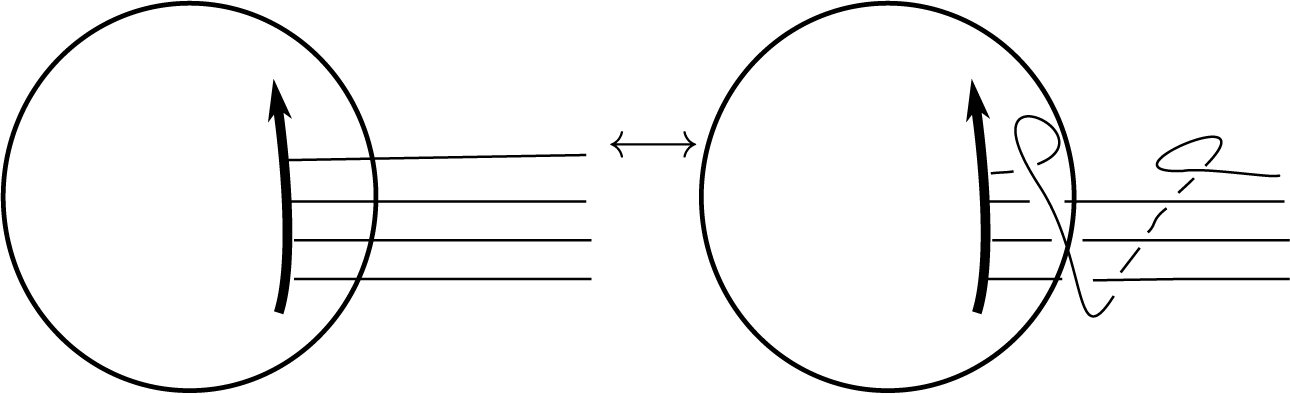
5 Splitting along a strict surface
Suppose ${\mathbf M} =(M,\mathcal N)$
is a marked 3-manifold. A strict subsurface
${\mathbf M} =(M,\mathcal N)$
is a marked 3-manifold. A strict subsurface $\Sigma $
of
$\Sigma $
of ${\mathbf M}$
is a proper embedding
${\mathbf M}$
is a proper embedding $\Sigma \hookrightarrow M$
of a compact surface (so that
$\Sigma \hookrightarrow M$
of a compact surface (so that $\partial \Sigma \subset \partial M$
),
$\partial \Sigma \subset \partial M$
), $\Sigma $
is traversal to
$\Sigma $
is traversal to $\mathcal N$
and every connected component of
$\mathcal N$
and every connected component of $\Sigma $
intersects
$\Sigma $
intersects $\mathcal N$
. Define the slit
$\mathcal N$
. Define the slit ${\mathsf {Sl}}_\Sigma ({\mathbf M}):= (M', \mathcal N')$
, where
${\mathsf {Sl}}_\Sigma ({\mathbf M}):= (M', \mathcal N')$
, where $M'= M \setminus \Sigma $
and
$M'= M \setminus \Sigma $
and $\mathcal N'= \mathcal N \setminus \Sigma $
. For a point
$\mathcal N'= \mathcal N \setminus \Sigma $
. For a point $p\in \mathcal P:= \Sigma \cap \mathcal N$
, define its sign to be
$p\in \mathcal P:= \Sigma \cap \mathcal N$
, define its sign to be $+$
or
$+$
or $-$
according as the orientation of M is equal the orientation of
$-$
according as the orientation of M is equal the orientation of $\Sigma $
followed by the orientation of the tangent to
$\Sigma $
followed by the orientation of the tangent to $\mathcal N$
at p or not. Then
$\mathcal N$
at p or not. Then ${\boldsymbol {\Sigma }}= (\Sigma , \mathcal P)$
is a marked surface and there is a right and a left action of
${\boldsymbol {\Sigma }}= (\Sigma , \mathcal P)$
is a marked surface and there is a right and a left action of ${\mathscr S}({\boldsymbol {\Sigma }})$
on
${\mathscr S}({\boldsymbol {\Sigma }})$
on ${\mathscr S}({\mathsf {Sl}}_\Sigma ({\mathbf M}))$
defined as follows. An obvious compactification
${\mathscr S}({\mathsf {Sl}}_\Sigma ({\mathbf M}))$
defined as follows. An obvious compactification $M'$
near
$M'$
near $\Sigma $
gives a manifold
$\Sigma $
gives a manifold $M"$
having two copies
$M"$
having two copies $\Sigma _1$
and
$\Sigma _1$
and $\Sigma _2$
of
$\Sigma _2$
of $\Sigma $
on its boundary such that
$\Sigma $
on its boundary such that $M"/(\Sigma _1 = \Sigma )$
is M. There is a left action of
$M"/(\Sigma _1 = \Sigma )$
is M. There is a left action of ${\mathscr S}(\Sigma _1, \mathcal P)$
on
${\mathscr S}(\Sigma _1, \mathcal P)$
on ${\mathscr S}(M", \mathcal N')$
and a right action of
${\mathscr S}(M", \mathcal N')$
and a right action of ${\mathscr S}(\Sigma _2, \mathcal P)$
on
${\mathscr S}(\Sigma _2, \mathcal P)$
on ${\mathscr S}(M", \mathcal N')$
. Now, identify each of
${\mathscr S}(M", \mathcal N')$
. Now, identify each of ${\mathscr S}(\Sigma _1, \mathcal P)$
and
${\mathscr S}(\Sigma _1, \mathcal P)$
and ${\mathscr S}(\Sigma _2, \mathcal P)$
with
${\mathscr S}(\Sigma _2, \mathcal P)$
with ${\mathscr S}(\Sigma , \mathcal P)$
, and identify
${\mathscr S}(\Sigma , \mathcal P)$
, and identify ${\mathscr S}(M", \mathcal N')$
with
${\mathscr S}(M", \mathcal N')$
with ${\mathscr S}(M,\mathcal N)$
via the embedding
${\mathscr S}(M,\mathcal N)$
via the embedding $(M', \mathcal N') \hookrightarrow (M", \mathcal N')$
.
$(M', \mathcal N') \hookrightarrow (M", \mathcal N')$
.
The embedding ${\mathsf {Sl}}_\Sigma ({\mathbf M}) \hookrightarrow {\mathbf M}$
induces an
${\mathsf {Sl}}_\Sigma ({\mathbf M}) \hookrightarrow {\mathbf M}$
induces an ${R}$
-linear homomorphism
${R}$
-linear homomorphism $\varphi _\Sigma : {\mathscr S}({\mathsf {Sl}}_\Sigma ({\mathbf M})) \to {\mathscr S}({\mathbf M})$
.
$\varphi _\Sigma : {\mathscr S}({\mathsf {Sl}}_\Sigma ({\mathbf M})) \to {\mathscr S}({\mathbf M})$
.
Theorem 5.1. Assume $\Sigma $
is a strict subsurface of a marked 3-manifold
$\Sigma $
is a strict subsurface of a marked 3-manifold ${\mathbf M}=(M,\mathcal N)$
. Then
${\mathbf M}=(M,\mathcal N)$
. Then ${\mathscr S}({\mathbf M})= \mathrm { HH}_0( {\mathscr S}({\mathsf {Sl}}_\Sigma ({\mathbf M})) )$
, the
${\mathscr S}({\mathbf M})= \mathrm { HH}_0( {\mathscr S}({\mathsf {Sl}}_\Sigma ({\mathbf M})) )$
, the $0$
-th Hochschild homology of the
$0$
-th Hochschild homology of the ${\mathscr S}({\boldsymbol {\Sigma }} )$
-bimodule
${\mathscr S}({\boldsymbol {\Sigma }} )$
-bimodule ${\mathscr S}({\mathsf {Sl}}_\Sigma ({\mathbf M}))$
.
${\mathscr S}({\mathsf {Sl}}_\Sigma ({\mathbf M}))$
.
More precisely, the ${R}$
-linear map
${R}$
-linear map $\varphi _\Sigma : {\mathscr S}({\mathsf {Sl}}_\Sigma ({\mathbf M})) \to {\mathscr S}({\mathbf M})$
is surjective and its kernel is the
$\varphi _\Sigma : {\mathscr S}({\mathsf {Sl}}_\Sigma ({\mathbf M})) \to {\mathscr S}({\mathbf M})$
is surjective and its kernel is the ${R}$
-span of
${R}$
-span of $\{ a*x - x*a \mid x\in {\mathscr S}({\mathsf {Sl}}_\Sigma ({\mathbf M})), \ a \in {\mathscr S}({\boldsymbol {\Sigma }})\}$
.
$\{ a*x - x*a \mid x\in {\mathscr S}({\mathsf {Sl}}_\Sigma ({\mathbf M})), \ a \in {\mathscr S}({\boldsymbol {\Sigma }})\}$
.
Proof. Clearly, the map $\varphi _\Sigma $
descends to an
$\varphi _\Sigma $
descends to an ${R}$
-linear map
${R}$
-linear map $\bar \varphi _\Sigma : HH_0( {\mathscr S}({\mathsf {Sl}}_\Sigma ({\mathbf M})) ) \to {\mathscr S}({\mathbf M})$
. We will show that
$\bar \varphi _\Sigma : HH_0( {\mathscr S}({\mathsf {Sl}}_\Sigma ({\mathbf M})) ) \to {\mathscr S}({\mathbf M})$
. We will show that $\bar \varphi _\Sigma $
is bijective.
$\bar \varphi _\Sigma $
is bijective.
Let D be a concrete stated $\mathcal N$
-tangle transversal to
$\mathcal N$
-tangle transversal to $\Sigma $
. An embedding
$\Sigma $
. An embedding $\alpha : (0,1] \hookrightarrow \Sigma $
is good with respect to D if
$\alpha : (0,1] \hookrightarrow \Sigma $
is good with respect to D if $\alpha (1)\in \mathcal N \cap \Sigma $
and
$\alpha (1)\in \mathcal N \cap \Sigma $
and $\alpha \cap D =D \cap \Sigma $
. We are in a situation similar to that in the proof of Theorem 2.10. For such a
$\alpha \cap D =D \cap \Sigma $
. We are in a situation similar to that in the proof of Theorem 2.10. For such a $\alpha $
, define
$\alpha $
, define $ \tilde j_\alpha (D) \in {\mathscr S}({\mathsf {Sl}}_\Sigma ({\mathbf M}))$
by the same formula as in Equation (11), where
$ \tilde j_\alpha (D) \in {\mathscr S}({\mathsf {Sl}}_\Sigma ({\mathbf M}))$
by the same formula as in Equation (11), where $\alpha $
is the horizontal line and D is the red strands.
$\alpha $
is the horizontal line and D is the red strands.
Let $j_\alpha (D)= \tau (\tilde j_\alpha (D))$
, where
$j_\alpha (D)= \tau (\tilde j_\alpha (D))$
, where $\tau :{\mathscr S}({\mathsf {Sl}}_\Sigma ({\mathbf M})) \twoheadrightarrow \mathrm {HH}_0( {\mathscr S}({\mathsf {Sl}}_\Sigma ({\mathbf M})))$
is the natural projection. Note that
$\tau :{\mathscr S}({\mathsf {Sl}}_\Sigma ({\mathbf M})) \twoheadrightarrow \mathrm {HH}_0( {\mathscr S}({\mathsf {Sl}}_\Sigma ({\mathbf M})))$
is the natural projection. Note that
 $$ \begin{align} \bar \varphi_\Sigma(\tilde j_\alpha(D))= [D], \end{align} $$
where $[D]\in {\mathscr S}(M,\mathcal N) $
is the element represented by D. This shows that
$[D]\in {\mathscr S}(M,\mathcal N) $
is the element represented by D. This shows that $\bar \varphi _\Sigma $
is surjective.
$\bar \varphi _\Sigma $
is surjective.
Let $\Sigma '$
be a parallel copy of
$\Sigma '$
be a parallel copy of $\Sigma $
in M, and let
$\Sigma $
in M, and let $\alpha ': (0,1] \hookrightarrow \Sigma '$
be another embedding which is good with respect to D. Let us show that
$\alpha ': (0,1] \hookrightarrow \Sigma '$
be another embedding which is good with respect to D. Let us show that $j_\alpha (D) = j_{\alpha '}(D)$
. From the definition of the slitting operations, we have
$j_\alpha (D) = j_{\alpha '}(D)$
. From the definition of the slitting operations, we have
 $$ \begin{align*}\tilde j_{\alpha'} ( \tilde j_\alpha(D))= \tilde j_{\alpha} ( \tilde j_{\alpha'}(D)) \ \text{in } \ {\mathscr S}({\mathsf{Sl}}_{\Sigma, \Sigma'}({\mathbf M})).\end{align*} $$
Denote the common value of the above by x. Note that
 $$ \begin{align*}{\mathscr S}({\mathsf{Sl}}_{\Sigma, \Sigma'}({\mathbf M}))= {\mathscr S}({\mathsf{Sl}}_{\Sigma}({\mathbf M})) \otimes {\mathscr S}({\boldsymbol{\Sigma}}) = {\mathscr S}({\boldsymbol{\Sigma}}) \otimes {\mathscr S}({\mathsf{Sl}}_{\Sigma}({\mathbf M})).\end{align*} $$
Using Equation (26), we have
 $$ \begin{align*}j_\alpha(D) = \tau ( *_r(x)),\end{align*} $$
where $*_r: {\mathscr S}({\mathsf {Sl}}_{\Sigma }({\mathbf M})) \otimes {\mathscr S}({\boldsymbol {\Sigma }}) \to {\mathscr S}({\mathsf {Sl}}_{\Sigma }({\mathbf M}))$
is the right action. Similarly,
$*_r: {\mathscr S}({\mathsf {Sl}}_{\Sigma }({\mathbf M})) \otimes {\mathscr S}({\boldsymbol {\Sigma }}) \to {\mathscr S}({\mathsf {Sl}}_{\Sigma }({\mathbf M}))$
is the right action. Similarly,
 $$ \begin{align*}j_{\alpha'}(D) = \tau ( *_l(x)),\end{align*} $$ $*_l: {\mathscr S}({\boldsymbol {\Sigma }}) \otimes {\mathscr S}({\mathsf {Sl}}_{\Sigma }({\mathbf M})) \to {\mathscr S}({\mathsf {Sl}}_{\Sigma }({\mathbf M}))$
is the left action. Hence, as elements of
$*_l: {\mathscr S}({\boldsymbol {\Sigma }}) \otimes {\mathscr S}({\mathsf {Sl}}_{\Sigma }({\mathbf M})) \to {\mathscr S}({\mathsf {Sl}}_{\Sigma }({\mathbf M}))$
is the left action. Hence, as elements of $\mathrm {HH}_0( {\mathscr S}({\mathsf {Sl}}_{\Sigma }({\mathbf M})) )$
we have
$\mathrm {HH}_0( {\mathscr S}({\mathsf {Sl}}_{\Sigma }({\mathbf M})) )$
we have $j_{\alpha }(D)= j_{\alpha '}(D)$
, and we denote this common value by
$j_{\alpha }(D)= j_{\alpha '}(D)$
, and we denote this common value by $j(D)$
.
$j(D)$
.
Let us show that $j(D)$
depends only on the the isotopy class of D. Clearly, an isotopy whose support does not intersect
$j(D)$
depends only on the the isotopy class of D. Clearly, an isotopy whose support does not intersect $\Sigma $
does not change the values of
$\Sigma $
does not change the values of $j(D)$
. In a small neighbourhood of
$j(D)$
. In a small neighbourhood of $\Sigma $
, an isotopy of D is a finite composition of moves M1 and M2 described in Figure 2, where the horizontal line stands for
$\Sigma $
, an isotopy of D is a finite composition of moves M1 and M2 described in Figure 2, where the horizontal line stands for $\Sigma $
. The invariance of
$\Sigma $
. The invariance of $j(D)$
under M1 and M2 was already proved in the proof of Theorem 2.10.
$j(D)$
under M1 and M2 was already proved in the proof of Theorem 2.10.
All the defining relations of the skein module can be assumed to be away from $\Sigma $
. Hence,
$\Sigma $
. Hence, $j: {\mathscr S}({\mathbf M}) \to \mathrm {HH}_0( {\mathscr S}({\mathsf {Sl}}_{\Sigma }({\mathbf M})) )$
is well defined. By definition,
$j: {\mathscr S}({\mathbf M}) \to \mathrm {HH}_0( {\mathscr S}({\mathsf {Sl}}_{\Sigma }({\mathbf M})) )$
is well defined. By definition, $ j \circ \bar \varphi _\Sigma (D) = D$
, since if D is a stated
$ j \circ \bar \varphi _\Sigma (D) = D$
, since if D is a stated $\mathcal N'$
-tangle in
$\mathcal N'$
-tangle in $M'$
, then it does not intersect
$M'$
, then it does not intersect $\Sigma $
. It follows that
$\Sigma $
. It follows that $\bar \varphi $
is injective, and whence bijective.
$\bar \varphi $
is injective, and whence bijective.
Example 5.2. Consider the special case when $\Sigma =D$
is a disk which intersects
$\Sigma =D$
is a disk which intersects $\mathcal N$
at one point. In this case, Theorem 5.1 recovers Theorem 2.10 about the half-ideal splitting of a surface.
$\mathcal N$
at one point. In this case, Theorem 5.1 recovers Theorem 2.10 about the half-ideal splitting of a surface.
Example 5.3. Consider the special case when $\Sigma =D$
is a disk which intersects
$\Sigma =D$
is a disk which intersects $\mathcal N$
at two positive points. In this case, Theorem 5.1 recovers Theorem 2.13 about the compact spitting of a surface.
$\mathcal N$
at two positive points. In this case, Theorem 5.1 recovers Theorem 2.13 about the compact spitting of a surface.
Example 5.4 (Triangle sum of marked manifolds).
Let ${\mathbf P}_3$
be the disc with three marked positive points in its boundary and
${\mathbf P}_3$
be the disc with three marked positive points in its boundary and $\mathbf {B}$
be its thickening, whose marked edges we denote
$\mathbf {B}$
be its thickening, whose marked edges we denote $e_0,e_1,e_2$
. Let
$e_0,e_1,e_2$
. Let $\Sigma \subset \mathbf {B}$
be a properly embedded disc intersecting once transversally
$\Sigma \subset \mathbf {B}$
be a properly embedded disc intersecting once transversally $e_0$
and such that
$e_0$
and such that $e_1$
and
$e_1$
and $e_2$
are in two distinct connected components of
$e_2$
are in two distinct connected components of ${\mathsf {Sl}}_{\Sigma }(\mathbf {B})$
. Let
${\mathsf {Sl}}_{\Sigma }(\mathbf {B})$
. Let ${\mathbf M}'$
be a marked three manifold with at least two edge markings
${\mathbf M}'$
be a marked three manifold with at least two edge markings $e^{\prime }_1,e^{\prime }_2\in \mathcal N$
, and let
$e^{\prime }_1,e^{\prime }_2\in \mathcal N$
, and let ${\mathbf M}$
be obtained by gluing
${\mathbf M}$
be obtained by gluing ${\mathbf M}'$
and
${\mathbf M}'$
and $\mathbf {B}$
by identifying disc neighbourhoods of
$\mathbf {B}$
by identifying disc neighbourhoods of $e^{\prime }_i$
and
$e^{\prime }_i$
and $e_i, i=1,2$
in
$e_i, i=1,2$
in $\partial {\mathbf M}'$
and
$\partial {\mathbf M}'$
and $\partial \mathbf {B}$
. We will say that
$\partial \mathbf {B}$
. We will say that ${\mathbf M}$
is obtained by operating a self-triangle sum of
${\mathbf M}$
is obtained by operating a self-triangle sum of ${\mathbf M}'$
(if
${\mathbf M}'$
(if ${\mathbf M}'={\mathbf M}_1\sqcup {\mathbf M}_2$
with
${\mathbf M}'={\mathbf M}_1\sqcup {\mathbf M}_2$
with $e^{\prime }_i\in {\mathbf M}_i$
; this corresponds to gluing
$e^{\prime }_i\in {\mathbf M}_i$
; this corresponds to gluing ${\mathbf M}_1$
and
${\mathbf M}_1$
and ${\mathbf M}_2$
to a same ball, whence the name of the operation).
${\mathbf M}_2$
to a same ball, whence the name of the operation).
By Theorem 5.1, we get that ${\mathscr S}({\mathbf M})={\mathscr S}({\mathbf M}')$
as
${\mathscr S}({\mathbf M})={\mathscr S}({\mathbf M}')$
as ${R}$
-modules: Indeed, it is sufficient to remark that
${R}$
-modules: Indeed, it is sufficient to remark that ${\mathscr S}(\Sigma )={R}$
and that
${\mathscr S}(\Sigma )={R}$
and that ${\mathsf {Sl}}_{\Sigma }({\mathbf M})$
is diffeomorphic to
${\mathsf {Sl}}_{\Sigma }({\mathbf M})$
is diffeomorphic to ${\mathbf M}'$
.
${\mathbf M}'$
.
The conclusion of Example 5.4 can be refined by observing that ${\mathscr S}({\mathbf M}')$
is a right
${\mathscr S}({\mathbf M}')$
is a right ${\mathcal O}_{q^2}(\mathrm {SL}(2))^{\otimes 2}$
-comodule by the right coaction
${\mathcal O}_{q^2}(\mathrm {SL}(2))^{\otimes 2}$
-comodule by the right coaction $\Delta =(\Delta _{1}\otimes Id_{{\mathcal O}_{q^2}(\mathrm {SL}(2))})\circ \Delta _2$
, where
$\Delta =(\Delta _{1}\otimes Id_{{\mathcal O}_{q^2}(\mathrm {SL}(2))})\circ \Delta _2$
, where $\Delta _i$
is the right coaction associated to edge
$\Delta _i$
is the right coaction associated to edge $e^{\prime }_i$
as explained in Proposition 4.5. Then we can endow
$e^{\prime }_i$
as explained in Proposition 4.5. Then we can endow ${\mathscr S}({\mathbf M}')$
with the structure of a right
${\mathscr S}({\mathbf M}')$
with the structure of a right ${\mathcal O}_{q^2}(\mathrm {SL}(2))$
-comodule via
${\mathcal O}_{q^2}(\mathrm {SL}(2))$
-comodule via $\Delta '=(Id_{{\mathscr S}({\mathbf M}')}\otimes m)\circ \Delta $
, where
$\Delta '=(Id_{{\mathscr S}({\mathbf M}')}\otimes m)\circ \Delta $
, where $m:{\mathcal O}_{q^2}(\mathrm {SL}(2))^{\otimes 2}\to {\mathcal O}_{q^2}(\mathrm {SL}(2))$
is the product. Then the following holds:
$m:{\mathcal O}_{q^2}(\mathrm {SL}(2))^{\otimes 2}\to {\mathcal O}_{q^2}(\mathrm {SL}(2))$
is the product. Then the following holds:
Theorem 5.5 (Triangle sum of marked manifolds).
The inclusion of ${\mathbf M}'$
in
${\mathbf M}'$
in ${\mathbf M}$
induces the following isomorphism of right
${\mathbf M}$
induces the following isomorphism of right ${\mathcal O}_{q^2}(\mathrm {SL}(2))$
-comodules:
${\mathcal O}_{q^2}(\mathrm {SL}(2))$
-comodules:
 $$ \begin{align*}{\mathscr S}({\mathbf M})={\mathscr S}({\mathbf M}').\end{align*} $$
In particular, if ${\mathbf M}'$
is the disjoint union of marked manifolds
${\mathbf M}'$
is the disjoint union of marked manifolds ${\mathbf M}_1$
and
${\mathbf M}_1$
and ${\mathbf M}_2$
containing, respectively,
${\mathbf M}_2$
containing, respectively, $e^{\prime }_1$
and
$e^{\prime }_1$
and $e^{\prime }_2$
then the following isomorphism of right
$e^{\prime }_2$
then the following isomorphism of right ${\mathcal O}_{q^2}(\mathrm {SL}(2))$
-comodules holds:
${\mathcal O}_{q^2}(\mathrm {SL}(2))$
-comodules holds:
 $$ \begin{align*}{\mathscr S}({\mathbf M})={\mathscr S}({\mathbf M}_1)\otimes_{R} {\mathscr S}({\mathbf M}_2).\end{align*} $$
Proof. We adopt the notation of Example 5.4 and, up to renaming the marked edges of $\mathbf {B}$
, suppose that
$\mathbf {B}$
, suppose that $e_1$
and the target of
$e_1$
and the target of $e_0$
(recall that each
$e_0$
(recall that each $e_i$
is oriented) lie in the same component of
$e_i$
is oriented) lie in the same component of ${\mathsf {Sl}}_{\Sigma }(\mathbf {B})$
. Since by Example 5.4 we already know that the map
${\mathsf {Sl}}_{\Sigma }(\mathbf {B})$
. Since by Example 5.4 we already know that the map $i:{\mathsf {Sl}}_{\Sigma }({\mathbf M})\hookrightarrow {\mathbf M}$
induces an isomorphism of
$i:{\mathsf {Sl}}_{\Sigma }({\mathbf M})\hookrightarrow {\mathbf M}$
induces an isomorphism of ${R}$
-modules, we just need to check that it induces a morphism of right
${R}$
-modules, we just need to check that it induces a morphism of right ${\mathcal O}_{q^2}(\mathrm {SL}(2))$
-comodules. To see this, observe that if a stated skein
${\mathcal O}_{q^2}(\mathrm {SL}(2))$
-comodules. To see this, observe that if a stated skein $\alpha \subset {\mathsf {Sl}}_{\Sigma }({\mathbf M})$
has
$\alpha \subset {\mathsf {Sl}}_{\Sigma }({\mathbf M})$
has $\Delta (\alpha )=\alpha _0\otimes \alpha _1\otimes \alpha _2\in {\mathscr S}({\mathsf {Sl}}_{\Sigma }({\mathbf M}))\otimes {\mathcal O}_{q^2}(\mathrm {SL}(2))\otimes {\mathcal O}_{q^2}(\mathrm {SL}(2))$
, then
$\Delta (\alpha )=\alpha _0\otimes \alpha _1\otimes \alpha _2\in {\mathscr S}({\mathsf {Sl}}_{\Sigma }({\mathbf M}))\otimes {\mathcal O}_{q^2}(\mathrm {SL}(2))\otimes {\mathcal O}_{q^2}(\mathrm {SL}(2))$
, then $\Delta '(\alpha )=\alpha _0\otimes (\alpha _1\alpha _2)$
(we suppress sums for clarity); on the other side, if we let
$\Delta '(\alpha )=\alpha _0\otimes (\alpha _1\alpha _2)$
(we suppress sums for clarity); on the other side, if we let $\Delta _{{\mathbf M}}$
be the coaction of
$\Delta _{{\mathbf M}}$
be the coaction of ${\mathscr S}({\mathbf M})$
, then we also immediately see graphically that
${\mathscr S}({\mathbf M})$
, then we also immediately see graphically that $\Delta _{{\mathbf M}}(i_*(\alpha ))= i_*(\alpha _0)\otimes \alpha _1\alpha _2$
because all the endpoints of the components in
$\Delta _{{\mathbf M}}(i_*(\alpha ))= i_*(\alpha _0)\otimes \alpha _1\alpha _2$
because all the endpoints of the components in $\alpha _1$
are nearer to the target of
$\alpha _1$
are nearer to the target of $e_0$
and hence higher than the endpoints of
$e_0$
and hence higher than the endpoints of $\alpha _2$
in the bigon cut out to define
$\alpha _2$
in the bigon cut out to define $\Delta _{{\mathbf M}}$
.
$\Delta _{{\mathbf M}}$
.
Remark 5.6. For surface case, the triangle sum was discussed in [Reference Costantino and Le10], where no circular marking was considered, and the proof used an explicit basis of the stated skein module of surfaces. A proof not using basis was given by Higgins [Reference Higgins17] for stated $SL_3$
-skein algebra of
$SL_3$
-skein algebra of $SL_3$
, and was generalised to
$SL_3$
, and was generalised to $SL_n$
-skein modules in [Reference TTQ and Sikora28]. The proof presented in this paper (only for
$SL_n$
-skein modules in [Reference TTQ and Sikora28]. The proof presented in this paper (only for $SL_2$
) is new.
$SL_2$
) is new.
6 A stated skein TQFT
In this section, we interpret the stated skein module of marked $3$
-manifolds as a monoidal functor from a suitable category of ‘decorated cobordisms’ to the category of algebras and their bimodules. In all this section,
$3$
-manifolds as a monoidal functor from a suitable category of ‘decorated cobordisms’ to the category of algebras and their bimodules. In all this section, ${R}$
is a fixed ring with a distinguished invertible element
${R}$
is a fixed ring with a distinguished invertible element $q^{\frac {1}{2}}$
.
$q^{\frac {1}{2}}$
.
6.1 The category of decorated cobordisms
Given a marked three manifold $(M,\mathcal N)$
, recall that by hypothesis each edge c of
$(M,\mathcal N)$
, recall that by hypothesis each edge c of $\mathcal N$
is the image of
$\mathcal N$
is the image of $(-1,1)$
through an embedding of
$(-1,1)$
through an embedding of $[-1,1]$
in
$[-1,1]$
in $\partial M$
; therefore, we will talk of ‘target’ of c (the image of
$\partial M$
; therefore, we will talk of ‘target’ of c (the image of $\{1\}$
) and of its source (the image of
$\{1\}$
) and of its source (the image of $\{-1\}$
) and we will denote
$\{-1\}$
) and we will denote $\overline {c}$
and
$\overline {c}$
and $\overline {\mathcal N}$
the closures, respectively, of c and of
$\overline {\mathcal N}$
the closures, respectively, of c and of $\mathcal N$
in
$\mathcal N$
in $\partial M$
.
$\partial M$
.
Definition 6.1. A decorated manifold is 5-tuple $\mathbb M=(M,\partial ^+M,\partial ^-M,\partial ^s M,\mathcal N)$
(see Figure 9) where:
$\mathbb M=(M,\partial ^+M,\partial ^-M,\partial ^s M,\mathcal N)$
(see Figure 9) where:
-
1. M is a compact oriented three manifold,
-
2.
$\partial ^s M,\partial ^\pm M\subset \partial M$
are compact surfaces with boundary with disjoint interior and oriented as induced by the orientation of M such that
$$ \begin{align*}\partial M=\partial^+M\cup \partial^-M\cup \partial^s M, \qquad \mathrm{and }\qquad \partial^+M\cap \partial^- M=\emptyset.\end{align*} $$
-
3.
$\mathcal N\subset \partial ^sM$
is a finite set of oriented arcs or circles such that each connected component of
$(\partial ^\pm M,\partial ^\pm M\cap \overline {\mathcal N})$
is a marked surface without circular markings. We define the sign of a marked point (i.e., an element of
$\overline {\mathcal N}\cap \partial ^\epsilon M,\epsilon \in \{\pm \}$
) as
$\epsilon $
if the orientation of
$\mathcal N$
locally points into
$\partial ^\epsilon M$
and
$-\epsilon $
else.


We will say that a decorated cobordism is ‘straight’ if each component of $\overline {\mathcal N}$
intersects both
$\overline {\mathcal N}$
intersects both $M_-$
and
$M_-$
and $M_+$
in its end points. A diffeomorphism of decorated cobordisms is an orientation preserving diffeomorphism preserving all the above structures.
$M_+$
in its end points. A diffeomorphism of decorated cobordisms is an orientation preserving diffeomorphism preserving all the above structures.
A decorated cobordism.

Remark 6.2. Since the empty surface is considered to be a marked surface, $\partial ^\pm M$
can be empty.
$\partial ^\pm M$
can be empty.
Associated to each decorated cobordism $\mathbb M$
is an underlying marked three-manifold
$\mathbb M$
is an underlying marked three-manifold $(M,\mathcal N)$
and its stated skein module:
$(M,\mathcal N)$
and its stated skein module: ${\mathscr S}(\mathbb M)={\mathscr S}(M,\mathcal N)$
, which is endowed with the natural structure of left module over
${\mathscr S}(\mathbb M)={\mathscr S}(M,\mathcal N)$
, which is endowed with the natural structure of left module over ${\mathscr S}(\partial ^+\mathbb M)$
and right module over
${\mathscr S}(\partial ^+\mathbb M)$
and right module over ${\mathscr S}(\partial ^-\mathbb M)$
.
${\mathscr S}(\partial ^-\mathbb M)$
.
Definition 6.3 (The category of decorated cobordisms). $\mathrm {DeCob}$
is the category whose objects are nonempty marked surfaces and
$\mathrm {DeCob}$
is the category whose objects are nonempty marked surfaces and $1$
-morphisms are described as follows. A morphism from
$1$
-morphisms are described as follows. A morphism from $\Sigma _-$
to
$\Sigma _-$
to $\Sigma _+$
is the diffeomorphism class of an admissible decorated manifold
$\Sigma _+$
is the diffeomorphism class of an admissible decorated manifold $\mathbb M$
endowed with diffeomorphisms
$\mathbb M$
endowed with diffeomorphisms $\phi _\pm :\partial ^\pm \mathbb M\to \Sigma _\pm $
with
$\phi _\pm :\partial ^\pm \mathbb M\to \Sigma _\pm $
with $\phi _+$
orientation preserving and
$\phi _+$
orientation preserving and $\phi _-$
orientation reversing. The composition of a morphism
$\phi _-$
orientation reversing. The composition of a morphism $\mathbb M_1:\Sigma _-\to \Sigma $
and
$\mathbb M_1:\Sigma _-\to \Sigma $
and $\mathbb M_2:\Sigma \to \Sigma _+$
(with boundary identifications
$\mathbb M_2:\Sigma \to \Sigma _+$
(with boundary identifications $(\phi _i)_\pm ,i=1,2$
) is the decorated manifold obtained by gluing
$(\phi _i)_\pm ,i=1,2$
) is the decorated manifold obtained by gluing $\mathbb M_2$
and
$\mathbb M_2$
and $\mathbb M_1$
along
$\mathbb M_1$
along $(\phi _2)_-^{-1}\circ (\phi _1)_+$
; the arcs of
$(\phi _2)_-^{-1}\circ (\phi _1)_+$
; the arcs of $\overline {\mathcal N}\subset \partial M$
are the images of the arcs of
$\overline {\mathcal N}\subset \partial M$
are the images of the arcs of $\overline {\mathcal N}_i,i=1,2$
which do not intersect
$\overline {\mathcal N}_i,i=1,2$
which do not intersect $\partial ^+\mathbb M_1=\partial ^-\mathbb M_2$
and those obtained by gluing the remaining arcs as follows. Let
$\partial ^+\mathbb M_1=\partial ^-\mathbb M_2$
and those obtained by gluing the remaining arcs as follows. Let $\overline {c}_1\in \overline {\mathcal N}_1$
be an arc intersecting
$\overline {c}_1\in \overline {\mathcal N}_1$
be an arc intersecting $\partial ^+\mathbb M_1$
in a point p and let
$\partial ^+\mathbb M_1$
in a point p and let $\overline {c}_2\in \overline {\mathcal N}_2$
be the arc starting from
$\overline {c}_2\in \overline {\mathcal N}_2$
be the arc starting from $(\phi _2)_-^{-1}\circ (\phi _1)_+(p)$
; by construction, the orientations of
$(\phi _2)_-^{-1}\circ (\phi _1)_+(p)$
; by construction, the orientations of $\overline {c}_1$
and
$\overline {c}_1$
and $\overline {c}_2$
match (they go from
$\overline {c}_2$
match (they go from $M_1$
to
$M_1$
to $M_2$
iff
$M_2$
iff $\mathsf {Sign}(p)=1$
) and thus they define an oriented arc in
$\mathsf {Sign}(p)=1$
) and thus they define an oriented arc in $\mathcal N\subset \partial ^s \mathbb M$
. It can be checked that the so-obtained
$\mathcal N\subset \partial ^s \mathbb M$
. It can be checked that the so-obtained $\mathcal N$
satisfies the conditions of Definition 6.1.
$\mathcal N$
satisfies the conditions of Definition 6.1.
Example 6.4. Let $(\Sigma ,\mathcal P)$
be a marked surface without circular markings. Then the identity morphism on
$(\Sigma ,\mathcal P)$
be a marked surface without circular markings. Then the identity morphism on $(\Sigma ,\mathcal P)$
is the decorated manifold
$(\Sigma ,\mathcal P)$
is the decorated manifold $\mathrm {Id}_{(\Sigma ,\mathcal P)}$
with
$\mathrm {Id}_{(\Sigma ,\mathcal P)}$
with $M=\Sigma \times [-1,1]$
,
$M=\Sigma \times [-1,1]$
, $\partial ^\pm M=\Sigma \times \{\pm 1\}, \partial ^sM=(\partial \Sigma )\times [-1,1]$
and
$\partial ^\pm M=\Sigma \times \{\pm 1\}, \partial ^sM=(\partial \Sigma )\times [-1,1]$
and $\mathcal N=\mathcal P\times [-1,1]$
.
$\mathcal N=\mathcal P\times [-1,1]$
.
The category $\mathrm {DeCob}$
is symmetric monoidal with
$\mathrm {DeCob}$
is symmetric monoidal with $\otimes $
given by disjoint union. (Actually, as in the standard case of TQFTs, in order to properly define the symmetric monoidal structure one has to consider the category whose objects are surfaces with ordered connected components, but we will not detail this point as it is exactly the same as in the standard case.)
$\otimes $
given by disjoint union. (Actually, as in the standard case of TQFTs, in order to properly define the symmetric monoidal structure one has to consider the category whose objects are surfaces with ordered connected components, but we will not detail this point as it is exactly the same as in the standard case.)
Furthermore, it is rigid: The dual of a marked surface $\Sigma $
is the surface
$\Sigma $
is the surface ${\Sigma }^*$
consisting of
${\Sigma }^*$
consisting of $\Sigma $
with the opposite orientation and the same markings with the same signs. The evaluation and coevaluation morphisms are the morphisms
$\Sigma $
with the opposite orientation and the same markings with the same signs. The evaluation and coevaluation morphisms are the morphisms $ev:\Sigma ^*\sqcup {\Sigma }\to \emptyset $
and
$ev:\Sigma ^*\sqcup {\Sigma }\to \emptyset $
and $coev:\emptyset \to \Sigma \sqcup {\Sigma }^*$
represented by the decorated manifold
$coev:\emptyset \to \Sigma \sqcup {\Sigma }^*$
represented by the decorated manifold $W=\Sigma \times [0,1]$
with
$W=\Sigma \times [0,1]$
with $\partial ^-W=\Sigma \times \{0\}\sqcup \Sigma \times \{1\}, \partial ^+W=\emptyset $
and
$\partial ^-W=\Sigma \times \{0\}\sqcup \Sigma \times \{1\}, \partial ^+W=\emptyset $
and $\partial ^s W=\overline {\partial W\setminus \partial ^-W}$
(respectively
$\partial ^s W=\overline {\partial W\setminus \partial ^-W}$
(respectively $\partial ^+W=\Sigma \times \{1\}\sqcup \Sigma \times \{0\}, \partial ^-W=\emptyset $
and
$\partial ^+W=\Sigma \times \{1\}\sqcup \Sigma \times \{0\}, \partial ^-W=\emptyset $
and $\partial ^s W=\overline {\partial W\setminus \partial ^+W}$
).
$\partial ^s W=\overline {\partial W\setminus \partial ^+W}$
).
In particular, the composition $ev_{\Sigma }\circ coev_{{\Sigma }^*}$
(‘the quantum trace’) is the decorated manifold
$ev_{\Sigma }\circ coev_{{\Sigma }^*}$
(‘the quantum trace’) is the decorated manifold $T=\Sigma \times S^1$
with
$T=\Sigma \times S^1$
with $\partial \pm T=\emptyset $
,
$\partial \pm T=\emptyset $
, $\partial ^sT=\partial \overline {\Sigma }\times S^1$
and
$\partial ^sT=\partial \overline {\Sigma }\times S^1$
and $\mathcal N=\mathcal P\times S^1$
, where
$\mathcal N=\mathcal P\times S^1$
, where $\mathcal P\subset \partial \Sigma $
is the marking of
$\mathcal P\subset \partial \Sigma $
is the marking of $\Sigma $
.
$\Sigma $
.
6.2 Description of the main theorem
If $\mathbb M:\Sigma _-\to \Sigma _+$
is a decorated cobordism, then
$\mathbb M:\Sigma _-\to \Sigma _+$
is a decorated cobordism, then ${\mathscr S}(\mathbb M)$
is a right module over
${\mathscr S}(\mathbb M)$
is a right module over ${\mathscr S}(\Sigma _-)$
and a left module over
${\mathscr S}(\Sigma _-)$
and a left module over ${\mathscr S}(\Sigma _+)$
. Let
${\mathscr S}(\Sigma _+)$
. Let $\mathrm {Mor}$
be the ‘Morita category’ whose objects are
$\mathrm {Mor}$
be the ‘Morita category’ whose objects are ${R}$
-algebras and morphisms are isomorphism classes of bimodules in the category of
${R}$
-algebras and morphisms are isomorphism classes of bimodules in the category of ${R}$
-modules. The composition is given by the tensor product over the mid algebra (which is well defined up to isomorphism). The identity of an algebra A is the isomorphism class of A as left and right bimodule over itself via left and right multiplication. It is a symmetric monoidal category with the tensor product
${R}$
-modules. The composition is given by the tensor product over the mid algebra (which is well defined up to isomorphism). The identity of an algebra A is the isomorphism class of A as left and right bimodule over itself via left and right multiplication. It is a symmetric monoidal category with the tensor product $\otimes _{{R}}$
and symmetry
$\otimes _{{R}}$
and symmetry $A_1\otimes _{{R}} A_2\to A_2\otimes _{{R}} A_1$
for every two algebras
$A_1\otimes _{{R}} A_2\to A_2\otimes _{{R}} A_1$
for every two algebras $A_1,A_2$
.
$A_1,A_2$
.
It is also rigid with the dual of an algebra A being $A^{op}$
and the left evaluation morphism
$A^{op}$
and the left evaluation morphism $A^{op}\otimes _{{R}} A\to {R}$
being the isomorphism class of the bimodule A with natural
$A^{op}\otimes _{{R}} A\to {R}$
being the isomorphism class of the bimodule A with natural ${R}$
-left module structure and right
${R}$
-left module structure and right $A^{op}\otimes _{{R}}A$
-module structure given by
$A^{op}\otimes _{{R}}A$
-module structure given by $a\cdot (a_1\otimes a_2)=a_1aa_2$
. Similarly, the left coevaluation is the isomorphism class of the bimodule A seen as a right
$a\cdot (a_1\otimes a_2)=a_1aa_2$
. Similarly, the left coevaluation is the isomorphism class of the bimodule A seen as a right ${R}$
-module and a left
${R}$
-module and a left $A\otimes A^{op}$
-module with action
$A\otimes A^{op}$
-module with action $(a_1\otimes a_2) \cdot a=a_1aa_2$
.
$(a_1\otimes a_2) \cdot a=a_1aa_2$
.
Then the following is the main result of this section:
Theorem 6.5. ${\mathscr S}:\mathrm {DeCob}\to \mathrm {Mor}$
is a symmetric monoidal functor.
${\mathscr S}:\mathrm {DeCob}\to \mathrm {Mor}$
is a symmetric monoidal functor.
Remark 6.6. As pointed out by the referee, both our categories $\mathrm {DeCob}$
and
$\mathrm {DeCob}$
and $\mathrm {Mor}$
are actually truncations of symmetric monoidal
$\mathrm {Mor}$
are actually truncations of symmetric monoidal $2$
-categories obtained by respectively considering
$2$
-categories obtained by respectively considering $3$
-manifolds not up to diffeomorphism (and adding
$3$
-manifolds not up to diffeomorphism (and adding $2$
-morphisms which are isotopies) and bimodules not up to isomorphism (and adding
$2$
-morphisms which are isotopies) and bimodules not up to isomorphism (and adding $2$
-morphisms which are morphisms of bimodules). In this sense, Theorem 6.5 should be formulated at the level of
$2$
-morphisms which are morphisms of bimodules). In this sense, Theorem 6.5 should be formulated at the level of $2$
-categories. But we decided to avoid this level of generality in order to keep the language as elementary as possible and avoid dealing with many technicalities related to gluing
$2$
-categories. But we decided to avoid this level of generality in order to keep the language as elementary as possible and avoid dealing with many technicalities related to gluing $3$
-manifolds along their boundary (collars etc…) and tensoring bimodules (the tensor product is a priory only defined up to isomorphism and choices are needed to define it explicitly).
$3$
-manifolds along their boundary (collars etc…) and tensoring bimodules (the tensor product is a priory only defined up to isomorphism and choices are needed to define it explicitly).
Proof. Assuming first that ${\mathscr S}$
is a functor, its symmetric monoidality is a direct consequence of the fact that
${\mathscr S}$
is a functor, its symmetric monoidality is a direct consequence of the fact that ${\mathscr S}(\Sigma _1\sqcup \Sigma _2)={\mathscr S}(\Sigma _1)\otimes _{R} {\mathscr S}(\Sigma _2)$
and
${\mathscr S}(\Sigma _1\sqcup \Sigma _2)={\mathscr S}(\Sigma _1)\otimes _{R} {\mathscr S}(\Sigma _2)$
and ${\mathscr S}(\mathbb M_1\sqcup \mathbb M_2)={\mathscr S}(\mathbb M_1)\otimes _{R} {\mathscr S}(\mathbb M_2)$
for every marked surfaces
${\mathscr S}(\mathbb M_1\sqcup \mathbb M_2)={\mathscr S}(\mathbb M_1)\otimes _{R} {\mathscr S}(\mathbb M_2)$
for every marked surfaces $\Sigma _1,\Sigma _2$
and decorated cobordisms
$\Sigma _1,\Sigma _2$
and decorated cobordisms $\mathbb M_1,\mathbb M_2$
.
$\mathbb M_1,\mathbb M_2$
.
In order to prove that ${\mathscr S}$
is a functor, we have to prove that if
${\mathscr S}$
is a functor, we have to prove that if $\mathbb M_1:\Sigma _{-1}\to \Sigma $
and
$\mathbb M_1:\Sigma _{-1}\to \Sigma $
and $\mathbb M_2:\Sigma \to \Sigma _1$
are decorated cobordisms then
$\mathbb M_2:\Sigma \to \Sigma _1$
are decorated cobordisms then ${\mathscr S}(\mathbb M_2\circ \mathbb M_1)={\mathscr S}(\mathbb M_2)\otimes _{{\mathscr S}(\Sigma )}{\mathscr S}(\mathbb M_1)$
as
${\mathscr S}(\mathbb M_2\circ \mathbb M_1)={\mathscr S}(\mathbb M_2)\otimes _{{\mathscr S}(\Sigma )}{\mathscr S}(\mathbb M_1)$
as $({\mathscr S}(\Sigma _1),{\mathscr S}(\Sigma _{-1}))$
-bimodules.
$({\mathscr S}(\Sigma _1),{\mathscr S}(\Sigma _{-1}))$
-bimodules.
Let $i_1:\mathbb M_1\hookrightarrow \mathbb M_2\circ \mathbb M_1$
and
$i_1:\mathbb M_1\hookrightarrow \mathbb M_2\circ \mathbb M_1$
and $i_2:\mathbb M_2\hookrightarrow \mathbb M_2\circ \mathbb M_1$
be the natural inclusions. We need to prove that the map
$i_2:\mathbb M_2\hookrightarrow \mathbb M_2\circ \mathbb M_1$
be the natural inclusions. We need to prove that the map
 $$ \begin{align*}(i_2)_*\otimes (i_1)_*:{\mathscr S}(\mathbb M_2)\otimes_{{R}} {\mathscr S}(\mathbb M_1)\to {\mathscr S}(\mathbb M)\end{align*} $$
factors through an isomorphism of ${R}$
-modules
${R}$
-modules
 $$ \begin{align*}\phi_*:{\mathscr S}(\mathbb M_2)\otimes_{{\mathscr S}(\Sigma)} {\mathscr S}(\mathbb M_1)\to {\mathscr S}(\mathbb M)\end{align*} $$
which is an isomorphism of ${\mathscr S}(\Sigma _-)$
and
${\mathscr S}(\Sigma _-)$
and ${\mathscr S}(\Sigma _+)$
bimodules. Observing that
${\mathscr S}(\Sigma _+)$
bimodules. Observing that $\mathbb M_1\sqcup \mathbb M_2={\mathsf {Sl}}_{\Sigma }(\mathbb M)$
, this is a direct consequence of Theorem 5.1. The fact that
$\mathbb M_1\sqcup \mathbb M_2={\mathsf {Sl}}_{\Sigma }(\mathbb M)$
, this is a direct consequence of Theorem 5.1. The fact that $\phi _*$
is an isomorphism of left
$\phi _*$
is an isomorphism of left ${\mathscr S}(\Sigma _1)$
-modules (resp. of right
${\mathscr S}(\Sigma _1)$
-modules (resp. of right ${\mathscr S}(\Sigma _{-1})$
-modules) is a direct consequence of the definition of the actions as
${\mathscr S}(\Sigma _{-1})$
-modules) is a direct consequence of the definition of the actions as $\Sigma _1$
(resp.
$\Sigma _1$
(resp. $\Sigma _{-1}$
) are far from
$\Sigma _{-1}$
) are far from $\Sigma $
.
$\Sigma $
.
6.3 Immediate corollaries of Theorems 5.1 and 6.5
Proposition 6.7. Let $\Sigma $
be a marked surface. Then
$\Sigma $
be a marked surface. Then ${\mathscr S}(\Sigma \times S^1)=\mathrm {HH_0}({\mathscr S}(\Sigma ))={\mathscr S}(\Sigma )/\{x\cdot y-y\cdot x\}$
, where
${\mathscr S}(\Sigma \times S^1)=\mathrm {HH_0}({\mathscr S}(\Sigma ))={\mathscr S}(\Sigma )/\{x\cdot y-y\cdot x\}$
, where ${\mathscr S}(\Sigma )$
is seen as a left and right module over itself.
${\mathscr S}(\Sigma )$
is seen as a left and right module over itself.
Proof. Observe that ${\mathsf {Sl}}_{\Sigma \times \{1\}}(\Sigma \times S^1)$
is diffeomorphic as a marked manifold to
${\mathsf {Sl}}_{\Sigma \times \{1\}}(\Sigma \times S^1)$
is diffeomorphic as a marked manifold to $\Sigma \times [-1,1]$
. Therefore, the statement is an immediate corollary of Theorem 5.1.
$\Sigma \times [-1,1]$
. Therefore, the statement is an immediate corollary of Theorem 5.1.
Let $(M,\mathcal N)$
be a marked connected oriented
$(M,\mathcal N)$
be a marked connected oriented $3$
-manifold, and let
$3$
-manifold, and let $\hat {M}=M\setminus D^3$
be the complement of an open ball in
$\hat {M}=M\setminus D^3$
be the complement of an open ball in ${\mathsf {interior}}(M)$
. Then
${\mathsf {interior}}(M)$
. Then $\partial \hat {M}=S^2\sqcup \partial M$
; decompose
$\partial \hat {M}=S^2\sqcup \partial M$
; decompose $S^2$
as
$S^2$
as $\partial (D^2\times [-1,1])$
, and set
$\partial (D^2\times [-1,1])$
, and set $\partial ^\pm \hat {M}=D^2\times \{\pm 1\}$
and
$\partial ^\pm \hat {M}=D^2\times \{\pm 1\}$
and $\partial ^s \hat {M}=(\partial D^2)\times [-1,1]\sqcup \partial M$
; finally let
$\partial ^s \hat {M}=(\partial D^2)\times [-1,1]\sqcup \partial M$
; finally let $\hat {\mathcal N}=\{1\}\times [-1,1]\sqcup \mathcal N$
. Then
$\hat {\mathcal N}=\{1\}\times [-1,1]\sqcup \mathcal N$
. Then $\mathbb M=(\hat {M},\partial ^+\hat {M},\partial ^-\hat {M},\partial ^s\hat {M}, \hat {\mathcal N})$
is a decorated cobordism providing a morphism in
$\mathbb M=(\hat {M},\partial ^+\hat {M},\partial ^-\hat {M},\partial ^s\hat {M}, \hat {\mathcal N})$
is a decorated cobordism providing a morphism in $\mathrm {DeCob}$
 $$ \begin{align*}\mathbb M:(D,(p,+))\to (D,(p,+))\end{align*} $$
from the disc with one marked point to itself.
Definition 6.8 (
$SL_2$
-Quantum fundamental group).

Let $\mathcal {S}_\pi (M)={\mathscr S}(\mathbb M)$
as an
$\mathcal {S}_\pi (M)={\mathscr S}(\mathbb M)$
as an ${\mathcal O}_{q^2}(\mathrm {SL}(2))$
-comodule with respect to the only edge in
${\mathcal O}_{q^2}(\mathrm {SL}(2))$
-comodule with respect to the only edge in $\hat {\mathcal N}\setminus \mathcal N$
.
$\hat {\mathcal N}\setminus \mathcal N$
.
The following is straightforward:
Proposition 6.9. $\mathcal {S}_\pi $
is a functor from the category whose objects are oriented connected
$\mathcal {S}_\pi $
is a functor from the category whose objects are oriented connected $3$
-manifolds and morphisms are orientation preserving embeddings, to the category of
$3$
-manifolds and morphisms are orientation preserving embeddings, to the category of ${\mathcal O}_{q^2}(\mathrm {SL}(2))$
-comodules.
${\mathcal O}_{q^2}(\mathrm {SL}(2))$
-comodules.
The following is then a direct corollary of Theorem 6.5:
Theorem 6.10 (Van Kampen’s type theorem).
Let $M_1$
and
$M_1$
and $M_2$
be two connected, oriented manifolds. Then
$M_2$
be two connected, oriented manifolds. Then
 $$ \begin{align*}\mathcal{S}_\pi(M_1\# M_2)=\mathcal{S}_\pi(M_1)\otimes_{{R}} \mathcal{S}_\pi(M_2).\end{align*} $$
Proof. Let $M_0=M_1\#M_2$
, and observe that
$M_0=M_1\#M_2$
, and observe that $\mathbb M_2\circ \mathbb M_1=\mathbb M_0$
. The statement then follows from Theorem 6.5.
$\mathbb M_2\circ \mathbb M_1=\mathbb M_0$
. The statement then follows from Theorem 6.5.
Let now $\mathbf {H}_g^+$
(resp.
$\mathbf {H}_g^+$
(resp. $\mathbf {H}_g^-$
) be the straight decorated cobordism whose underlying
$\mathbf {H}_g^-$
) be the straight decorated cobordism whose underlying $3$
-manifold is a handlebody of genus g,
$3$
-manifold is a handlebody of genus g, $\partial ^- \mathbf {H}_g^+=(D^2,+)$
the disc with one marked point (resp.
$\partial ^- \mathbf {H}_g^+=(D^2,+)$
the disc with one marked point (resp. $\partial ^+ \mathbf {H}_g^-=(D^2,+)$
),
$\partial ^+ \mathbf {H}_g^-=(D^2,+)$
), $\partial ^s \mathbf {H}_g^\pm $
is a regular neighbourhood of
$\partial ^s \mathbf {H}_g^\pm $
is a regular neighbourhood of $\partial D^2$
and
$\partial D^2$
and $\partial ^+ \mathbf {H}_g^+=\partial \mathbf {H}_g^+\setminus (\partial ^-\mathbf {H}_g^+\sqcup \partial ^s\mathbf {H}_g^+)$
(resp.
$\partial ^+ \mathbf {H}_g^+=\partial \mathbf {H}_g^+\setminus (\partial ^-\mathbf {H}_g^+\sqcup \partial ^s\mathbf {H}_g^+)$
(resp. $\partial ^- \mathbf {H}_g^-=\partial \mathbf {H}_g^-\setminus (\partial ^+\mathbf {H}_g^-\sqcup \partial ^s\mathbf {H}_g^-)$
).
$\partial ^- \mathbf {H}_g^-=\partial \mathbf {H}_g^-\setminus (\partial ^+\mathbf {H}_g^-\sqcup \partial ^s\mathbf {H}_g^-)$
).
Theorem 6.11. Let $M=H_g\sqcup H^{\prime }_g$
be a Heegaard decomposition of a closed oriented
$M=H_g\sqcup H^{\prime }_g$
be a Heegaard decomposition of a closed oriented $3$
-manifold. Then
$3$
-manifold. Then $\mathcal {S}_\pi (M)={\mathscr S}(\mathbf {H}^+_g)\otimes _{{\mathscr S}(\partial ^+ \mathbf {H}^+_g)}{\mathscr S}(\mathbf {H'}^-_g)$
.
$\mathcal {S}_\pi (M)={\mathscr S}(\mathbf {H}^+_g)\otimes _{{\mathscr S}(\partial ^+ \mathbf {H}^+_g)}{\mathscr S}(\mathbf {H'}^-_g)$
.
Proof. This is a direct consequence of Theorem 6.5 as $\mathbf {H}^+_g$
is diffeomorphic to a cobordism from a disc
$\mathbf {H}^+_g$
is diffeomorphic to a cobordism from a disc $(D,(p,+))$
to a genus g surface with one boundary component and one marked point on it and
$(D,(p,+))$
to a genus g surface with one boundary component and one marked point on it and $(\mathbf {H}')^-_g$
is a cobordism from the latter surface back to
$(\mathbf {H}')^-_g$
is a cobordism from the latter surface back to $(D,(p,+))$
and by construction
$(D,(p,+))$
and by construction $ \mathbf {H}^-_g\circ \mathbf {H}^+_g=\hat {M}$
.
$ \mathbf {H}^-_g\circ \mathbf {H}^+_g=\hat {M}$
.
Acknowledgements
F.C. is grateful to Utah State University in Logan where this work was concluded. He also acknowledges the funding from CIMI Labex ANR 11-LABX-0040 at IMT Toulouse within the program ANR-11-IDEX-0002-02 and from the French ANR Project CATORE ANR-18-CE40-0024.
T. L. is partially supported by NSF grant 1811114.
The authors would like to thank David Jordan, Julien Korinman, Adam Sikora and Dominic Weiller for helpful discussions, as well as the anonymous referee for useful remarks.
Competing interest
The authors declare no competing interest.
Data availability statement
The authors confirm that the data supporting the findings of this study are available within the article.


 Open access

